do/work/!ike etc. (present simple)
&*
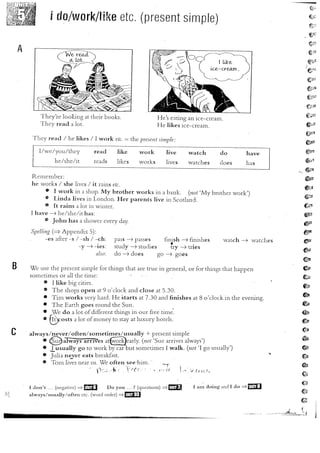
They're looking at their books.
They read a lot.
He's eating an ice-cream.
He likes ice-cream.
They read / he likes / Iwork etc. - the present simple:
I/we/you/they
he/she/it
read
reads
like
likes
work
works
live
lives
watch
watches
do
does
have
has
Remember:
he works / she lives / it rains etc.
• I work in a shop. My brother works in a bank. (not 'My brother work')
®' Linda lives in London. Her parents live in Scotland.
0 It rains alot in winter.
he/she/ithas:I have
Johii has a shower every day
Spelling (=$> Appendix 5):
-es after -s / -sh / -ch:
-y —•> -íes:
aiso:
pass —> passes finish —>
study —> studies try —>
do —> does go —> goes
finishes
tries
w;atch —> watches
D We use the present simple for things that are true in general, or for things that happen
sometimes or all the time: - - • ' ."
® I like big cities.
® The shop,s open at 9 o'clock and cióse at5.30.
• Tim works very hard. He starts at 7.30 and finishes .at 8 o'clock in the evenin^
• The Earth goes round the Sun.
• We do a lot of different things in our irée time.
• f Itcosts a lot of money to stay at luxury hotels.
v^x
always/never/often/sometimes/usuálly + presentsimple
0 ^^álways arrives at^/ork)early. (not 'Suearrives always')
• ¿usually go to work by carbut sometimes I walk. (not 'I go usually')
• Julia neyer eats breakfa.su.
• Toin lives near us.Weoften see-him. " ^
1 don't ... (negative) ^> [EEO Do y°u • • • ? (questions)
always/usually/often etc. (word order) =>iit7liH^l
I am cioing andI do
UNfct
EXERCISES
5V1/ Write theseverbs +-sor-es.
,1
5.5
1 (read) she ..J.! _
2 (think) he ÍV^S.
3 (fly) it
4 (dance) he ....
5 (have)
6 (finish) it
Complete the sentencesafrout the people in the picture(s. Usethese verbs:
eat go live t^y P^ay sleep
4 I.!.:l:l...........:.; tennisJ?.... the piano.
2 They .,.A^I in a very big house. 5 ^^1.^1...^^ to the cinema a lot.
3 £-B;A?, £'.¿Ajb*. • : a lot of £ruit. 6 'Ca L.;f l.vl eight hours a night.
Complete the sentences. Use these verbs:
boíl Glose cost cost like Hke meet speak wash
1 Margaret ...?P.?^?5... four languages.
2 In Britain the banks usuqjily ........O..V.CO.............at 9.30in the morning.
3 The City Museum........l:^;JklL.......at 5 o'clock in the evening.
4 Tina is a teacher. She..........k.ft.cb.O... mathematics to young chüdren.
5 Myjob is very ¿nteresting. I......v#u:.¿.»...............a lot of people.
Peter.........^¿^;-S.^.^)........his hair twice a week.
7 Food is expensive. It.......................!?..._.....a lot of money.
8 Shoes arepqpejisive. They......G.?...;t...................a lot of money.
9 "Water.......!?o..;l3..............at 100 degrees Celsius.
10 Julia and I are goodfriends. I......L.L.?...................her and she.......................
6
me.
5.4 Write sentences from thesewords. Putthe verb in the right íorm (arrive or arrives etc.).
1 (always / early / Sue / arrive)
2 (basketbaU / I / play / often) I
3 (work / Margaret / hard / usually)
4 (Jenny / always / nice clothes / wear)
5 (dinner / we / have / always / at 7.30)
6 (televisión / Tim / watch / never)
7 (like / chocolate / chüdren / usually)
8 (Julia / parties / enjoy / always)
Write sentences about yourselí. Usealways/never/often/sometimes/usually.
1 (watch televisión) J...!?£Y.^..Wft^ / !
2 (read in bed) I "
3 (get up befbre 7 o'.clock)
4 (go to work/school by bus)
5 (drink cofíee) !...' ".
[19]
I dqn't... (presentsimple negativo)
••&£*
r^i®
f-S*^
A The present simple negarive is don't/doesn't -f verb:
B
No;
don't drlnk
coffee.
She doesn't drink coffee. He doesn't like hisjob.
positive negatwe
I
we
you
they
he
she
work
like
do
have
works
likes
does
has
I
we
you
they
he
she
it
do not
(don't)
does not
(doesn't)
work
like
do
have
® I drink coffee but I don't drink tea. ^
® Sue drinks tea but she doesn't drink coffee.
® You don't work very hard.
• Wedon't watch televisión very often.
• The weather isusually nice. It doesn't rain very often.
• Gerry andLinda don't know many people.
Remember:
I/v/e/you/they don't ...
he/she/it doesn't ...
I don't like football.
He doesn't like football.
• I don't like Fred and Fred doesn't like me. (not Tred don't like')
• My car doesn't usemuch petrol. (not 'My car don't use')
• Sometimes he islate but it doesn't happen very often.
We use don't/doesn't + infinitive (don't like / doesn't speak / doesn't do etc.):
• I don't like washing the car. I don't do it very often.
• Sandra speaks Spanish but she doesn't speak Italian. (not 'doesn't speaks')
• Bill doesn't do his job very well. (not 'Bill doesn't his job')
• Paula doesn't usuallyhave breakfast. (not 'doesn't ... has')
I do/vork/like etc. (present simple) ; Do you ... ? (present simple questions) :
UNST
EXERCISES
í.1 Writetheneg'ative.
1 I play the piano very well.
2 Jane plays the piano very well.
3 They know my phone number.
4 We work very hard.
5 He has a bath every day
6 You do the same thing everyday.
Jane ..
r . ,
5,2 Study the Information and write sentences with like.
JDi: Qi g>i
1 classical music?
2 boxing?
3 horror films?
Bill and
Rose
yes
no,
yes
Carol
no
yes
no
..^
Carol ...$^...cf-£,^l^ A^^ Ú.M:.cd.J
I l.j..k.£ classical music.
2 Bill and Rose ....:•....,..: ÍM.V.S ^.:.:.í:..'./:..?i..
Carol !'£.«£ í^,....íT...^
S.3 Writeaboutyourself. Use: Inever... orí often ... orí don't... very often.
1 (watchTV) J...?!^!^?^^
2 (go to the theatre) ...-.¿.....Cl:
3 (ride a bicycle) ..$. ^
4 (eat in restaurants) ..*-.• A/.<
5 (travel by train) ...«3 ¥%
8.4 Complete the sentences.All of them are negative.Use don't/doesn't + one of theseverbs:
cbist kn^w -road see use
1 I buy a nevspaper every daybut sometimes I ..^.!í.5.í?^r... it.
2 Paul has a car but he M<MO..y£C it very often.
3 They like films but they £?.£?/?.'j .{$p. to the cinema very often.
4 Amanda is$ married but she $M.$&1 v^M a ring.
5 I M.Q.f:.!.t .^...fQ^.... much aboutpolitics. J'm not interested in it.• i i i
6 It's not an expensive hotel. It «.O.?,^.ñ..rt .C.Ohi.l much to stay there.
7 Brian Uves near us but we M?.?l'.í •&?.!?. him very often.
S-5 Put the verb into the correct form, positive ornegative.
1 Margaret;..?PM*S.... four languages - English, French, Germán andSpanish. (speak)
2 I ..4^.^..t .Lü?.^.... my job. It'svery boring. (like)
3 'Where's Martin?' l'm sorry. I .....dl.Q..^.^lI....)^y>.9.!íí..* '! (know) *'
"? Sue is a very quiet person. She d.a€.4£:...l .*j.Qll."k very much. (talk)—
5 Jim ¿t.í.íO.Í..^ , a lot pf tea. It's his favourite drink. (drink)-f>
6 It's not true! I Ct$..o..;* Q£.:£^r... it! (beüeve)
7 That's a very beautiful picture. I , .L^.l ¡it very much. (like) *>
8 Mark is a vegetarian. He d.^ü.^'.^.....C.Ú...L ;...meat. (eat) -
[21]
Do you ... ? (present simple questions)
A
B
U
We use do/does' in present simple questions:
positiva
I
we
you
they
he
she
it
work
like
do
have
works
likes
does
has
do
does
I ~
we -
yo u ,
they -
he -
she ...
it
work?'
like?
do?
have?
Study che word order:
do/does + subject inñnitwe
Where
How oíten
What
How rnuch
Do
Do
Does
do
do
does
does
you
your friends
Chris
your parents
you
this word
it
work
live
play
live?
wash
mean?
cost
in the evening?
near here?
tennis?
your hair?
to fly to Rome?
Questions with always/usually/often:
What
Do
Does
do
you
Chris
you
always
often
usually
have
play
do
breakfast?
tennis?
at weekenxls?
What do you do? = What's your Job?:
Q £What do you do?' 'I work in a bank.'
Remember:
do I/we/you/they ...
does he/she/it .. .
short answers
Do they like music?
Does he like music?
Yes,
l/we/you/they do.
he/she/it does.-
No,
I/we/you/they
he/she/it
don't.
doesn't.
* 'Do you play tennis?' 'No, I don't.'
* 'Do your parents speak EnglisH?' 'Yes, they do.'
* 'Does George work hard?' 'Yes, he does.'
* 'Does your sister live in London.' 'No, she doesn't.'
'
[22] I do/work/like etc. I don't ... (negative) questions :
EXERCiSES
.7.1 Write questions with Do ...? and Does ...?
1 I like chocolate. AndfyouJ)
2 I play tennis. And you?
3 Tbm plántennos] ^nd Ann}
4 You live near here. And your friends?
5 You speak English. And yourbrother?
6 I do exercises every morning. And you?
7 Sue often goes av/ay. And Paul?
8 I want to be famous. And you?
9 You work hard. And Linda? •
7
Do uou Uke diocelote?-J • • • • • » h-
7.2 Write questions. Usethe words in brackets (...)+ do/does. Putthe words in the right order.
1 (where / l¿ve / your parents?)
2 (you / early / always / getup?)
3 (how often / TV / you/ watch?)
4 (you / want / what / fordínner?)
5 (Hke / YOU/ footbaü?)
6 (your brother / like / íbotball?) ....•:
7 (what / you / do / in the evenings?)
8 (your sister / work / where?)
9 (to the cinema / often / you / go?)
10 (what / mean / this word?)
11 (often / snow / it / here?)
12 (go/ usually / to bed / what time / you?)
13 (how much / to phone New York / it / cost?)
WHere do uour parents Itve?««j i
.
.'.'..i;....c5
i
^O
:!ofcrd
hi?
14 (you / for breakfast / have / usually / what?
7.3
7.4
Complete the questions. Use these verbs:
'Ao ( do enjoy ^o }i^e

3
4
5
6
7
What .
start tea
What time......'¿.........ó.^........."..;...V/.1.S.
..':^..'-.;..lv......C.!Ü..
.áO......H-QV...::.
in the morning?
r::;.....on Saturdays?
'....j. to work?
And your husband. What.........2^).í?..4...be......«.O................?
What .../ÍD.«......r:.e........^..fi.í.l":................?'
How
WOlfK
I work in a bookshop.
It's OK.
At 9 o'clock.
Sometimes.
Usually by bus.
He's a teacher.
Science.
Yes,-he loves it.
Write short answers (Yes, hedoes. /No, I don't. etc.).
1 Do you watch TV a lót? ....Ho^...L^!i .OR..T.e.5J I' df>:.
2 Do you Uve in a big city? .^.M.j...^.....^....- .y.l..¡J í..¿±.
o i—x i~. • T i • ' i -f /T -v i /Tr t^ll
3 Do you often ride a bicycle? .: l.f..^...^......?...: -. .: ,.|.
4 Does it rain a lot where you live?. ...fe ¿& .ítíel V.Q X CÍ..O.M..O....'.....-
5 Do you play the piano? '?!.!>:.,...-L...'.-:<.ü..f?...r
[23]

Excercise 3

  • 1.
    do/work/!ike etc. (presentsimple) &* They're looking at their books. They read a lot. He's eating an ice-cream. He likes ice-cream. They read / he likes / Iwork etc. - the present simple: I/we/you/they he/she/it read reads like likes work works live lives watch watches do does have has Remember: he works / she lives / it rains etc. • I work in a shop. My brother works in a bank. (not 'My brother work') ®' Linda lives in London. Her parents live in Scotland. 0 It rains alot in winter. he/she/ithas:I have Johii has a shower every day Spelling (=$> Appendix 5): -es after -s / -sh / -ch: -y —•> -íes: aiso: pass —> passes finish —> study —> studies try —> do —> does go —> goes finishes tries w;atch —> watches D We use the present simple for things that are true in general, or for things that happen sometimes or all the time: - - • ' ." ® I like big cities. ® The shop,s open at 9 o'clock and cióse at5.30. • Tim works very hard. He starts at 7.30 and finishes .at 8 o'clock in the evenin^ • The Earth goes round the Sun. • We do a lot of different things in our irée time. • f Itcosts a lot of money to stay at luxury hotels. v^x always/never/often/sometimes/usuálly + presentsimple 0 ^^álways arrives at^/ork)early. (not 'Suearrives always') • ¿usually go to work by carbut sometimes I walk. (not 'I go usually') • Julia neyer eats breakfa.su. • Toin lives near us.Weoften see-him. " ^ 1 don't ... (negative) ^> [EEO Do y°u • • • ? (questions) always/usually/often etc. (word order) =>iit7liH^l I am cioing andI do
  • 2.
    UNfct EXERCISES 5V1/ Write theseverbs+-sor-es. ,1 5.5 1 (read) she ..J.! _ 2 (think) he ÍV^S. 3 (fly) it 4 (dance) he .... 5 (have) 6 (finish) it Complete the sentencesafrout the people in the picture(s. Usethese verbs: eat go live t^y P^ay sleep 4 I.!.:l:l...........:.; tennisJ?.... the piano. 2 They .,.A^I in a very big house. 5 ^^1.^1...^^ to the cinema a lot. 3 £-B;A?, £'.¿Ajb*. • : a lot of £ruit. 6 'Ca L.;f l.vl eight hours a night. Complete the sentences. Use these verbs: boíl Glose cost cost like Hke meet speak wash 1 Margaret ...?P.?^?5... four languages. 2 In Britain the banks usuqjily ........O..V.CO.............at 9.30in the morning. 3 The City Museum........l:^;JklL.......at 5 o'clock in the evening. 4 Tina is a teacher. She..........k.ft.cb.O... mathematics to young chüdren. 5 Myjob is very ¿nteresting. I......v#u:.¿.»...............a lot of people. Peter.........^¿^;-S.^.^)........his hair twice a week. 7 Food is expensive. It.......................!?..._.....a lot of money. 8 Shoes arepqpejisive. They......G.?...;t...................a lot of money. 9 "Water.......!?o..;l3..............at 100 degrees Celsius. 10 Julia and I are goodfriends. I......L.L.?...................her and she....................... 6 me. 5.4 Write sentences from thesewords. Putthe verb in the right íorm (arrive or arrives etc.). 1 (always / early / Sue / arrive) 2 (basketbaU / I / play / often) I 3 (work / Margaret / hard / usually) 4 (Jenny / always / nice clothes / wear) 5 (dinner / we / have / always / at 7.30) 6 (televisión / Tim / watch / never) 7 (like / chocolate / chüdren / usually) 8 (Julia / parties / enjoy / always) Write sentences about yourselí. Usealways/never/often/sometimes/usually. 1 (watch televisión) J...!?£Y.^..Wft^ / ! 2 (read in bed) I " 3 (get up befbre 7 o'.clock) 4 (go to work/school by bus) 5 (drink cofíee) !...' ". [19]
  • 3.
    I dqn't... (presentsimplenegativo) ••&£* r^i® f-S*^ A The present simple negarive is don't/doesn't -f verb: B No; don't drlnk coffee. She doesn't drink coffee. He doesn't like hisjob. positive negatwe I we you they he she work like do have works likes does has I we you they he she it do not (don't) does not (doesn't) work like do have ® I drink coffee but I don't drink tea. ^ ® Sue drinks tea but she doesn't drink coffee. ® You don't work very hard. • Wedon't watch televisión very often. • The weather isusually nice. It doesn't rain very often. • Gerry andLinda don't know many people. Remember: I/v/e/you/they don't ... he/she/it doesn't ... I don't like football. He doesn't like football. • I don't like Fred and Fred doesn't like me. (not Tred don't like') • My car doesn't usemuch petrol. (not 'My car don't use') • Sometimes he islate but it doesn't happen very often. We use don't/doesn't + infinitive (don't like / doesn't speak / doesn't do etc.): • I don't like washing the car. I don't do it very often. • Sandra speaks Spanish but she doesn't speak Italian. (not 'doesn't speaks') • Bill doesn't do his job very well. (not 'Bill doesn't his job') • Paula doesn't usuallyhave breakfast. (not 'doesn't ... has') I do/vork/like etc. (present simple) ; Do you ... ? (present simple questions) :
  • 4.
    UNST EXERCISES í.1 Writetheneg'ative. 1 Iplay the piano very well. 2 Jane plays the piano very well. 3 They know my phone number. 4 We work very hard. 5 He has a bath every day 6 You do the same thing everyday. Jane .. r . , 5,2 Study the Information and write sentences with like. JDi: Qi g>i 1 classical music? 2 boxing? 3 horror films? Bill and Rose yes no, yes Carol no yes no ..^ Carol ...$^...cf-£,^l^ A^^ Ú.M:.cd.J I l.j..k.£ classical music. 2 Bill and Rose ....:•....,..: ÍM.V.S ^.:.:.í:..'./:..?i.. Carol !'£.«£ í^,....íT...^ S.3 Writeaboutyourself. Use: Inever... orí often ... orí don't... very often. 1 (watchTV) J...?!^!^?^^ 2 (go to the theatre) ...-.¿.....Cl: 3 (ride a bicycle) ..$. ^ 4 (eat in restaurants) ..*-.• A/.< 5 (travel by train) ...«3 ¥% 8.4 Complete the sentences.All of them are negative.Use don't/doesn't + one of theseverbs: cbist kn^w -road see use 1 I buy a nevspaper every daybut sometimes I ..^.!í.5.í?^r... it. 2 Paul has a car but he M<MO..y£C it very often. 3 They like films but they £?.£?/?.'j .{$p. to the cinema very often. 4 Amanda is$ married but she $M.$&1 v^M a ring. 5 I M.Q.f:.!.t .^...fQ^.... much aboutpolitics. J'm not interested in it.• i i i 6 It's not an expensive hotel. It «.O.?,^.ñ..rt .C.Ohi.l much to stay there. 7 Brian Uves near us but we M?.?l'.í •&?.!?. him very often. S-5 Put the verb into the correct form, positive ornegative. 1 Margaret;..?PM*S.... four languages - English, French, Germán andSpanish. (speak) 2 I ..4^.^..t .Lü?.^.... my job. It'svery boring. (like) 3 'Where's Martin?' l'm sorry. I .....dl.Q..^.^lI....)^y>.9.!íí..* '! (know) *' "? Sue is a very quiet person. She d.a€.4£:...l .*j.Qll."k very much. (talk)— 5 Jim ¿t.í.íO.Í..^ , a lot pf tea. It's his favourite drink. (drink)-f> 6 It's not true! I Ct$..o..;* Q£.:£^r... it! (beüeve) 7 That's a very beautiful picture. I , .L^.l ¡it very much. (like) *> 8 Mark is a vegetarian. He d.^ü.^'.^.....C.Ú...L ;...meat. (eat) - [21]
  • 5.
    Do you ...? (present simple questions) A B U We use do/does' in present simple questions: positiva I we you they he she it work like do have works likes does has do does I ~ we - yo u , they - he - she ... it work?' like? do? have? Study che word order: do/does + subject inñnitwe Where How oíten What How rnuch Do Do Does do do does does you your friends Chris your parents you this word it work live play live? wash mean? cost in the evening? near here? tennis? your hair? to fly to Rome? Questions with always/usually/often: What Do Does do you Chris you always often usually have play do breakfast? tennis? at weekenxls? What do you do? = What's your Job?: Q £What do you do?' 'I work in a bank.' Remember: do I/we/you/they ... does he/she/it .. . short answers Do they like music? Does he like music? Yes, l/we/you/they do. he/she/it does.- No, I/we/you/they he/she/it don't. doesn't. * 'Do you play tennis?' 'No, I don't.' * 'Do your parents speak EnglisH?' 'Yes, they do.' * 'Does George work hard?' 'Yes, he does.' * 'Does your sister live in London.' 'No, she doesn't.' ' [22] I do/work/like etc. I don't ... (negative) questions :
  • 6.
    EXERCiSES .7.1 Write questionswith Do ...? and Does ...? 1 I like chocolate. AndfyouJ) 2 I play tennis. And you? 3 Tbm plántennos] ^nd Ann} 4 You live near here. And your friends? 5 You speak English. And yourbrother? 6 I do exercises every morning. And you? 7 Sue often goes av/ay. And Paul? 8 I want to be famous. And you? 9 You work hard. And Linda? • 7 Do uou Uke diocelote?-J • • • • • » h- 7.2 Write questions. Usethe words in brackets (...)+ do/does. Putthe words in the right order. 1 (where / l¿ve / your parents?) 2 (you / early / always / getup?) 3 (how often / TV / you/ watch?) 4 (you / want / what / fordínner?) 5 (Hke / YOU/ footbaü?) 6 (your brother / like / íbotball?) ....•: 7 (what / you / do / in the evenings?) 8 (your sister / work / where?) 9 (to the cinema / often / you / go?) 10 (what / mean / this word?) 11 (often / snow / it / here?) 12 (go/ usually / to bed / what time / you?) 13 (how much / to phone New York / it / cost?) WHere do uour parents Itve?««j i . .'.'..i;....c5 i ^O :!ofcrd hi? 14 (you / for breakfast / have / usually / what? 7.3 7.4 Complete the questions. Use these verbs: 'Ao ( do enjoy ^o }i^e 3 4 5 6 7 What . start tea What time......'¿.........ó.^........."..;...V/.1.S. ..':^..'-.;..lv......C.!Ü.. .áO......H-QV...::. in the morning? r::;.....on Saturdays? '....j. to work? And your husband. What.........2^).í?..4...be......«.O................? What .../ÍD.«......r:.e........^..fi.í.l":................?' How WOlfK I work in a bookshop. It's OK. At 9 o'clock. Sometimes. Usually by bus. He's a teacher. Science. Yes,-he loves it. Write short answers (Yes, hedoes. /No, I don't. etc.). 1 Do you watch TV a lót? ....Ho^...L^!i .OR..T.e.5J I' df>:. 2 Do you Uve in a big city? .^.M.j...^.....^....- .y.l..¡J í..¿±. o i—x i~. • T i • ' i -f /T -v i /Tr t^ll 3 Do you often ride a bicycle? .: l.f..^...^......?...: -. .: ,.|. 4 Does it rain a lot where you live?. ...fe ¿& .ítíel V.Q X CÍ..O.M..O....'.....- 5 Do you play the piano? '?!.!>:.,...-L...'.-:<.ü..f?...r [23]