Physically-based Modelling
2D Rigid Body Young-Min Kang
Tongmyong University
Kinematics of Rigid Body
❖ difference between particle and rigid body
❖ particle: no rotation
❖ rigid body: rotates!
❖ rigid body
❖ linear motion of mass centre (identical to particle)
❖ rotational motion
❖ torque (works like force f)
❖ angular velocity (works like linear velocity v)
❖ angular acceleration (works like linear acceleration a)
⌧
!
˙!
Local Coordinates
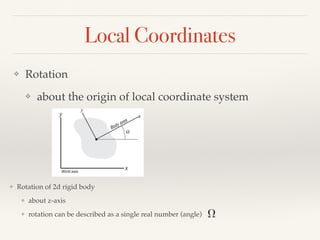
❖ Rotation
❖ about the origin of local coordinate system
❖ Rotation of 2d rigid body
❖ about z-axis
❖ rotation can be described as a single real number (angle) ⌦
Angular Velocity and Acceleration
❖ linear velocity = rate of change of position in time
❖ angular velocity = rate of change of angle in time
❖ so…
❖ angular acceleration
! =
d⌦
dt
˙! =
d!
dt
Linear Velocity due to Rotation
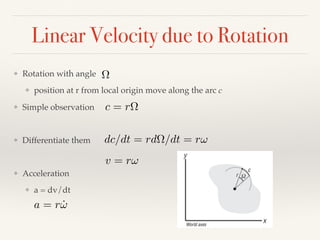
❖ Rotation with angle
❖ position at r from local origin move along the arc c
❖ Simple observation
❖ Differentiate them
❖ Acceleration
❖ a = dv/dt
c = r⌦
⌦
dc/dt = rd⌦/dt = r!
v = r!
a = r ˙!
2D Rigid Body Simulation
❖ State
❖ Inertia
❖ mass : resistance to linear motion
❖ moment of inertia : resistance to rotational motion
❖ Simulation
❖ compute force and torque
(x, v, ⌦, !)
m
I
f, ⌧
⌧ = r ⇥ f
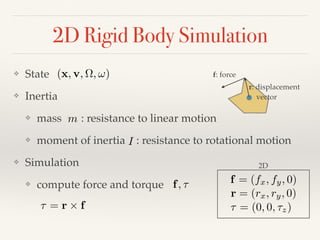
f: force
r: displacement
vector
⌧ = (0, 0, ⌧z)
r = (rx, ry, 0)
f = (fx, fy, 0)
2D
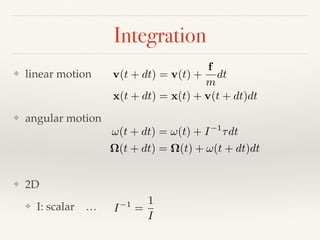
Integration
❖ linear motion
❖ angular motion
❖ 2D
❖ I: scalar …
v(t + dt) = v(t) +
f
m
dt
x(t + dt) = x(t) + v(t + dt)dt
!(t + dt) = !(t) + I 1
⌧dt
⌦(t + dt) = ⌦(t) + !(t + dt)dt
I 1
=
1
I
Implementation
❖ Dynamic Simulator
void CDynamicSimulator::doSimulation(double dt, double currentTime) {
hover.simulate(dt);
}
void CDynamicSimulator::visualize(void) {
hover.draw();
}
void CDynamicSimulator::control(unsigned char key) {
int engineNumber = (int) (key-'1');
hover.switchEngine(engineNumber, hover.isEngineOn(engineNumber)?false:true);
}
CVec3d CDynamicSimulator::getCameraPosition(void) {
CVec3d loc;
loc = hover.getLocation();
return loc;
}
Hovercraft.h
enum ENGINE_NUMBER {
LEFT_THRUST,
RIGHT_THRUST,
RIGHT_SIDE,
FRONT_BRAKE,
LEFT_SIDE,
NUMBER_OF_ENGINES
};
class CHovercraft {
double mass;
double inertia;
CVec3d loc;
CVec3d vel;
CVec3d force;
double angle;
double aVel;
double torque;
CVec3d r[NUMBER_OF_ENGINES];
CVec3d fLocal[NUMBER_OF_ENGINES];
bool on[NUMBER_OF_ENGINES];
CVec3d localVectorToWorldVector(const CVec3d &lV);
public:
…
void draw(void);
void switchEngine(int engineNumber, bool switch_state);
bool isEngineOn(int engineNumber);
void simulate(double dt);
void setLocation(CVec3d location);
CVec3d getLocation(void);
};
Hovercraft.cpp - constructor
CHovercraft::CHovercraft() :
mass(1.0), inertia(1.0), angle(0.0), aVel(0.0), torque(0.0) {
loc.set(0.0, 0.0, 0.0);
vel.set(0.0, 0.0, 0.0);
force.set(0.0, 0.0, 0.0);
r[LEFT_THRUST].set(-1.0, -1.0, 0.0);
r[RIGHT_THRUST].set(1.0, -1.0, 0.0);
r[LEFT_SIDE].set(-1.0, 1.0, 0.0);
r[RIGHT_SIDE].set(1.0, 1.0, 0.0);
r[FRONT_BRAKE].set(0.0, 1.5, 0.0);
fLocal[LEFT_THRUST].set( 0.0, 1.0, 0.0);
fLocal[RIGHT_THRUST].set(0.0, 1.0, 0.0);
fLocal[LEFT_SIDE].set( 1.0, 0.0, 0.0);
fLocal[RIGHT_SIDE].set( -1.0, 0.0, 0.0);
fLocal[FRONT_BRAKE].set( 0.0,-1.0, 0.0);
for (int i=0; i<NUMBER_OF_ENGINES; i++) on[i] = false;
}
CHovercraft::~CHovercraft() {
}
r[LEFT_THRUST] r[RIGHT_THRUST]
r[RIGHT_SIDE]r[LEFT_SIDE]
r[FRONT_BRAKE]
Hovercraft.cpp - Simulation
void CHovercraft::simulate(double dt) {
force.set(0.0, 0.0, 0.0);
torque = 0.0;
// rigid body
CVec3d fWorld;
CVec3d torqueVec;
for (int i=0; i<NUMBER_OF_ENGINES; i++) {
if(on[i]) {
fWorld = localVectorToWorldVector(fLocal[i]);
force = force + fWorld;
torqueVec = r[i]*fLocal[i];
torque += torqueVec[2];
}
}
// drag force
double kd = 0.5;
force = force -kd*vel;
torque += -kd*aVel;
// numerical integration
vel = vel + (dt/mass)*force;
loc = loc + dt * vel;
aVel = aVel + (dt/inertia)*torque;
angle = angle + dt * aVel;
}
Animation Demo
❖ https://www.youtube.com/watch?v=xbu_-VP7Ed0
❖ http://goo.gl/s8TTAi

Lec gp05 rigidbody2d

  • 1.
    Physically-based Modelling 2D RigidBody Young-Min Kang Tongmyong University
  • 2.
    Kinematics of RigidBody ❖ difference between particle and rigid body ❖ particle: no rotation ❖ rigid body: rotates! ❖ rigid body ❖ linear motion of mass centre (identical to particle) ❖ rotational motion ❖ torque (works like force f) ❖ angular velocity (works like linear velocity v) ❖ angular acceleration (works like linear acceleration a) ⌧ ! ˙!
  • 3.
    Local Coordinates ❖ Rotation ❖about the origin of local coordinate system ❖ Rotation of 2d rigid body ❖ about z-axis ❖ rotation can be described as a single real number (angle) ⌦
  • 4.
    Angular Velocity andAcceleration ❖ linear velocity = rate of change of position in time ❖ angular velocity = rate of change of angle in time ❖ so… ❖ angular acceleration ! = d⌦ dt ˙! = d! dt
  • 5.
    Linear Velocity dueto Rotation ❖ Rotation with angle ❖ position at r from local origin move along the arc c ❖ Simple observation ❖ Differentiate them ❖ Acceleration ❖ a = dv/dt c = r⌦ ⌦ dc/dt = rd⌦/dt = r! v = r! a = r ˙!
  • 6.
    2D Rigid BodySimulation ❖ State ❖ Inertia ❖ mass : resistance to linear motion ❖ moment of inertia : resistance to rotational motion ❖ Simulation ❖ compute force and torque (x, v, ⌦, !) m I f, ⌧ ⌧ = r ⇥ f f: force r: displacement vector ⌧ = (0, 0, ⌧z) r = (rx, ry, 0) f = (fx, fy, 0) 2D
  • 7.
    Integration ❖ linear motion ❖angular motion ❖ 2D ❖ I: scalar … v(t + dt) = v(t) + f m dt x(t + dt) = x(t) + v(t + dt)dt !(t + dt) = !(t) + I 1 ⌧dt ⌦(t + dt) = ⌦(t) + !(t + dt)dt I 1 = 1 I
  • 8.
    Implementation ❖ Dynamic Simulator voidCDynamicSimulator::doSimulation(double dt, double currentTime) { hover.simulate(dt); } void CDynamicSimulator::visualize(void) { hover.draw(); } void CDynamicSimulator::control(unsigned char key) { int engineNumber = (int) (key-'1'); hover.switchEngine(engineNumber, hover.isEngineOn(engineNumber)?false:true); } CVec3d CDynamicSimulator::getCameraPosition(void) { CVec3d loc; loc = hover.getLocation(); return loc; }
  • 9.
    Hovercraft.h enum ENGINE_NUMBER { LEFT_THRUST, RIGHT_THRUST, RIGHT_SIDE, FRONT_BRAKE, LEFT_SIDE, NUMBER_OF_ENGINES }; classCHovercraft { double mass; double inertia; CVec3d loc; CVec3d vel; CVec3d force; double angle; double aVel; double torque; CVec3d r[NUMBER_OF_ENGINES]; CVec3d fLocal[NUMBER_OF_ENGINES]; bool on[NUMBER_OF_ENGINES]; CVec3d localVectorToWorldVector(const CVec3d &lV); public: … void draw(void); void switchEngine(int engineNumber, bool switch_state); bool isEngineOn(int engineNumber); void simulate(double dt); void setLocation(CVec3d location); CVec3d getLocation(void); };
  • 10.
    Hovercraft.cpp - constructor CHovercraft::CHovercraft(): mass(1.0), inertia(1.0), angle(0.0), aVel(0.0), torque(0.0) { loc.set(0.0, 0.0, 0.0); vel.set(0.0, 0.0, 0.0); force.set(0.0, 0.0, 0.0); r[LEFT_THRUST].set(-1.0, -1.0, 0.0); r[RIGHT_THRUST].set(1.0, -1.0, 0.0); r[LEFT_SIDE].set(-1.0, 1.0, 0.0); r[RIGHT_SIDE].set(1.0, 1.0, 0.0); r[FRONT_BRAKE].set(0.0, 1.5, 0.0); fLocal[LEFT_THRUST].set( 0.0, 1.0, 0.0); fLocal[RIGHT_THRUST].set(0.0, 1.0, 0.0); fLocal[LEFT_SIDE].set( 1.0, 0.0, 0.0); fLocal[RIGHT_SIDE].set( -1.0, 0.0, 0.0); fLocal[FRONT_BRAKE].set( 0.0,-1.0, 0.0); for (int i=0; i<NUMBER_OF_ENGINES; i++) on[i] = false; } CHovercraft::~CHovercraft() { } r[LEFT_THRUST] r[RIGHT_THRUST] r[RIGHT_SIDE]r[LEFT_SIDE] r[FRONT_BRAKE]
  • 11.
    Hovercraft.cpp - Simulation voidCHovercraft::simulate(double dt) { force.set(0.0, 0.0, 0.0); torque = 0.0; // rigid body CVec3d fWorld; CVec3d torqueVec; for (int i=0; i<NUMBER_OF_ENGINES; i++) { if(on[i]) { fWorld = localVectorToWorldVector(fLocal[i]); force = force + fWorld; torqueVec = r[i]*fLocal[i]; torque += torqueVec[2]; } } // drag force double kd = 0.5; force = force -kd*vel; torque += -kd*aVel; // numerical integration vel = vel + (dt/mass)*force; loc = loc + dt * vel; aVel = aVel + (dt/inertia)*torque; angle = angle + dt * aVel; }
  • 12.