2-Dimensional Motion2-Dimensional Motion
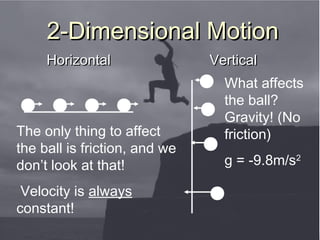
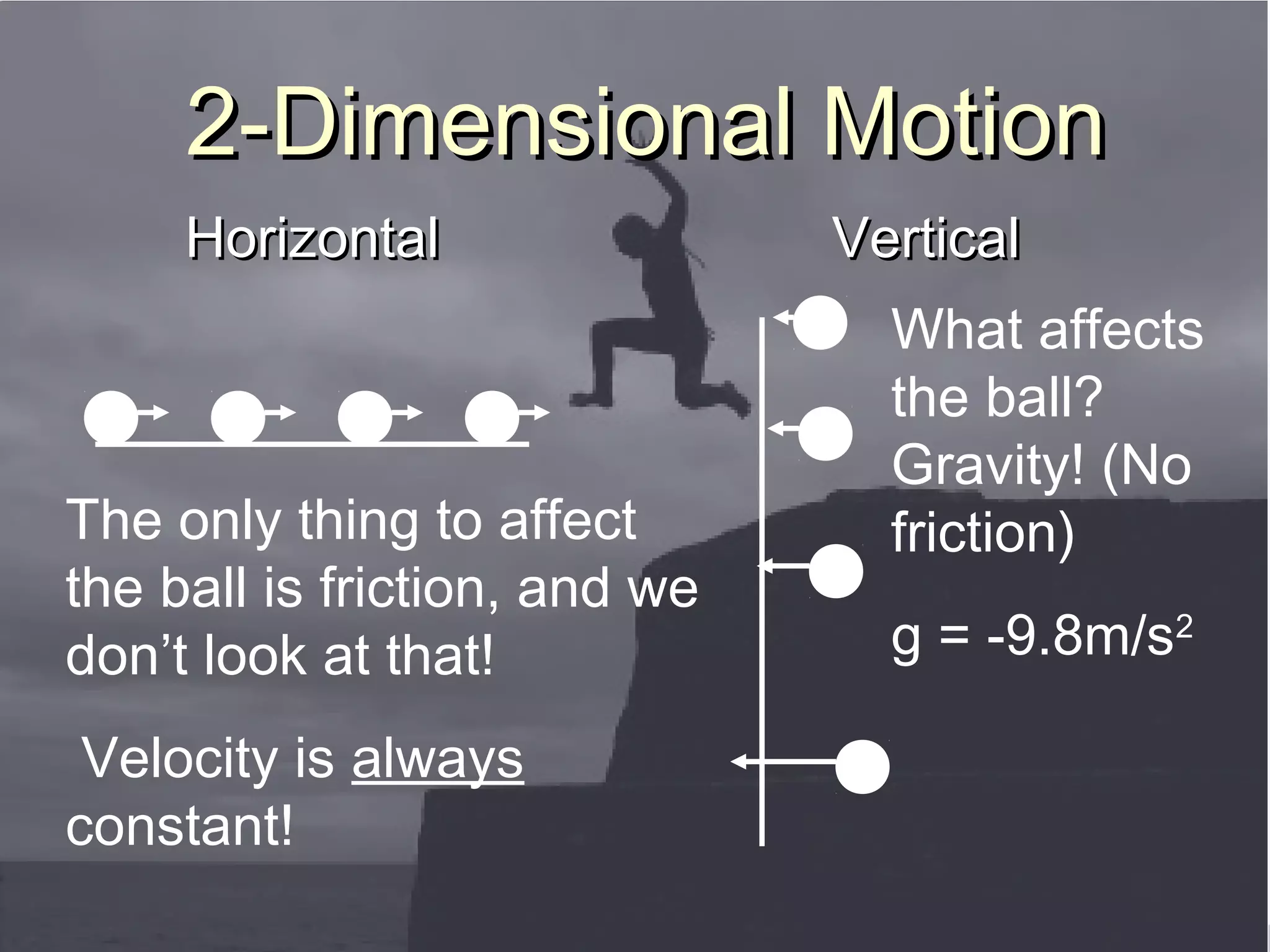
HorizontalHorizontal VerticalVertical
The only thing to affect
the ball is friction, and we
don’t look at that!
Velocity is always
constant!
What affects
the ball?
Gravity! (No
friction)
g = -9.8m/s2
Background picture from gettyimages
CombineCombine
the twothe two
Horizontal and Vertical
components are independent!
(They don’t affect each
other. It doesn’t matter how
fast the object is going in the
x direction, gravity still acts
evenly on the object.) [Quarters]
So … all these problems are at
2 problems: one problem in
the y direction, one problem in
the x direction.
time is what combines the two.
Background picture from gettyimages
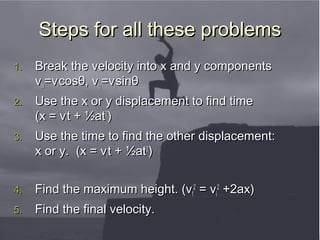
Steps for all these problemsSteps for all these problems
½.½. Picture & GivensPicture & Givens
1.1. Break the velocity into x and y componentsBreak the velocity into x and y components
vvixix=v=vii cos θ, vcos θ, viyiy=v=vii sin θsin θ
2.2. Use the x or y displacement to find timeUse the x or y displacement to find time
(x = v(x = vii t + ½att + ½at22
))
3.3. Use the time to find the other displacement:Use the time to find the other displacement:
x or y. (x = vx or y. (x = viit + ½att + ½at22
))
4.4. Find the maximum height. (vFind the maximum height. (vff
22
= v= vii
22
+2ax)+2ax)
5.5. Find the final velocity.Find the final velocity.
Background picture from gettyimages
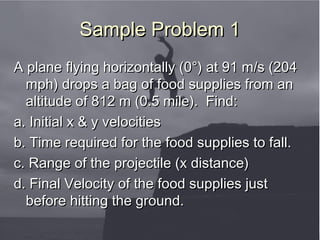
Sample Problem #1Sample Problem #1
A plane flying horizontally (0°) at 91 m/s (204 mph)A plane flying horizontally (0°) at 91 m/s (204 mph)
drops a bag of food supplies from an altitude ofdrops a bag of food supplies from an altitude of
812 m (0.5 mile). Find:812 m (0.5 mile). Find:
a. Picture & Givensa. Picture & Givens
b. Initial x & y velocitiesb. Initial x & y velocities
c. Time required for the food supplies to fall.c. Time required for the food supplies to fall.
d. Range of the projectile (x distance)d. Range of the projectile (x distance)
e. Final Velocity of the food supplies just beforee. Final Velocity of the food supplies just before
hitting the ground.hitting the ground.
Background picture from gettyimages
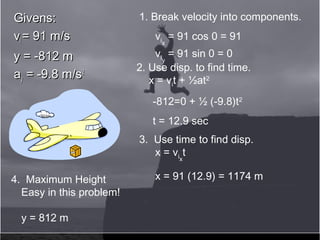
Givens:Givens:
vvii = 91 m/s= 91 m/s
y = -812 my = -812 m
aayy = -9.8 m/s= -9.8 m/s22
1. Break velocity into components.
vix
= 91 cos 0 = 91
viy
= 91 sin 0 = 0
2. Use disp. to find time.
x = vit + ½at2
-812=0 + ½ (-9.8)t2
t = 12.9 sec
3. Use time to find disp.
x = vix
t
x = 91 (12.9) = 1174 m4. Maximum Height
Easy in this problem!
y = 812 m
Background picture from gettyimages
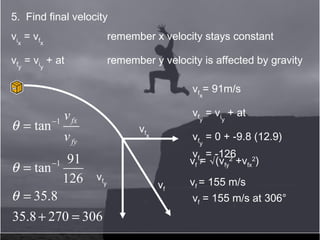
5. Find final velocity
vix
= vfx
remember x velocity stays constant
vfy
= viy
+ at remember y velocity is affected by gravity
vfx
vfy vf
vfx
= 91m/s
vfy
= viy
+ at
vfy
= 0 + -9.8 (12.9)
vfy
= -126
vf = √(vfy
2
+vfx
2
)
vf = 155 m/s
1
1
tan
91
tan
126
35.8
35.8 270 306
fx
fy
v
v
θ
θ
θ
−
−
=
=
=
+ =
vf = 155 m/s at 306°
Background picture from gettyimages
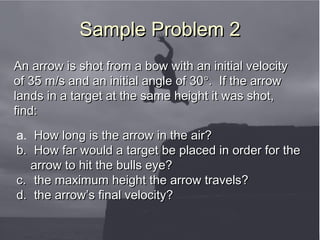
Sample Problem #2Sample Problem #2
An arrow is shot from a bow with an initial velocityAn arrow is shot from a bow with an initial velocity
of 35 m/s and an initial angle of 30of 35 m/s and an initial angle of 30°°. If the arrow. If the arrow
lands in a target at the same height it was shot,lands in a target at the same height it was shot,
find:find:
a. How long is the arrow in the air?How long is the arrow in the air?
b.b. How far would a target be placed in order for theHow far would a target be placed in order for the
arrow to hit the bulls eye?arrow to hit the bulls eye?
c.c. the maximum height the arrow travels?the maximum height the arrow travels?
d.d. the arrow’s final velocity?the arrow’s final velocity?
Background picture from gettyimages
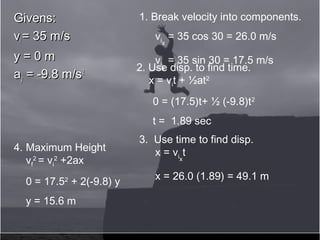
Givens:Givens:
vvii = 35 m/s= 35 m/s
y = 0 my = 0 m
aayy = -9.8 m/s= -9.8 m/s22
1. Break velocity into components.
vix
= 35 cos 30 = 26.0 m/s
viy
= 35 sin 30 = 17.5 m/s
2. Use disp. to find time.
x = vit + ½at2
0 = (17.5)t+ ½ (-9.8)t2
t = 3.57 sec
3. Use time to find disp.
x = vix
t
x = 26.0 (1.89) = 49.1 m
4. Maximum Height
vf
2
= vi
2
+2ax
0 = 17.52
+ 2(-9.8) y
y = 15.6 m
Background picture from gettyimages
Sample Problem #3Sample Problem #3
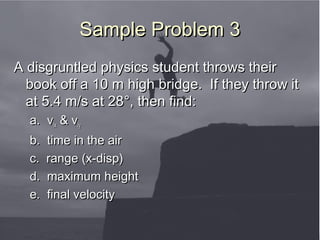
A disgruntled physics student throw their bookA disgruntled physics student throw their book
off a 10 m high bridge. If they throw it at 5.4off a 10 m high bridge. If they throw it at 5.4
m/s at 28°, then find:m/s at 28°, then find:
a. va. vixix & v& viyiy
b. time in the airb. time in the air
c. range (x-disp)c. range (x-disp)
d. maximum heightd. maximum height
e. final velocitye. final velocity
Background picture from gettyimages
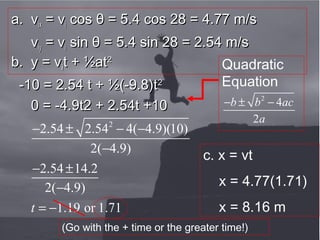
a. va. vixix = v= vii cos θ = 5.4 cos 28 = 4.77 m/scos θ = 5.4 cos 28 = 4.77 m/s
vviyiy = v= vii sin θ = 5.4 sin 28 = 2.54 m/ssin θ = 5.4 sin 28 = 2.54 m/s
b. y = vb. y = viit + ½att + ½at22
-10 = 2.54 t + ½(-9.8)t-10 = 2.54 t + ½(-9.8)t22
0 = -4.9t2 + 2.54t +100 = -4.9t2 + 2.54t +10
Quadratic
Equation
2
4
2
b b ac
a
− ± −
2
2.54 2.54 4( 4.9)(10)
2( 4.9)
2.54 14.2
2( 4.9)
1.19 or 1.71t
− ± − −
−
− ±
−
= −
c. x = vt
x = 4.77(1.71)
x = 8.16 m
(Go with the + time or the greater time!)
Background picture from gettyimages
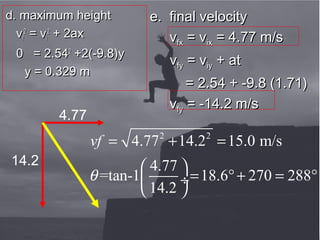
d. maximum heightd. maximum height
vvff
22
= v= vii
22
+ 2ax+ 2ax
0 = 2.540 = 2.5422
+2(-9.8)y+2(-9.8)y
y = 0.329 my = 0.329 m
e. final velocitye. final velocity
vvfxfx = v= vixix = 4.77 m/s= 4.77 m/s
vvfyfy = v= viyiy + at+ at
= 2.54 + -9.8 (1.71)= 2.54 + -9.8 (1.71)
vvfyfy = -14.2 m/s= -14.2 m/s
14.2
4.77
2 2
4.77 14.2 15.0 m/s
4.77
=tan-1 18.6 270 288
14.2
vf
θ
= + =
 
= °+ = ° ÷
 

2D Kinematics Notes

  • 1.
    2-Dimensional Motion2-Dimensional Motion HorizontalHorizontalVerticalVertical The only thing to affect the ball is friction, and we don’t look at that! Velocity is always constant! What affects the ball? Gravity! (No friction) g = -9.8m/s2
  • 2.
    Background picture fromgettyimages CombineCombine the twothe two Horizontal and Vertical components are independent! (They don’t affect each other. It doesn’t matter how fast the object is going in the x direction, gravity still acts evenly on the object.) [Quarters] So … all these problems are at 2 problems: one problem in the y direction, one problem in the x direction. time is what combines the two.
  • 3.
    Background picture fromgettyimages Steps for all these problemsSteps for all these problems ½.½. Picture & GivensPicture & Givens 1.1. Break the velocity into x and y componentsBreak the velocity into x and y components vvixix=v=vii cos θ, vcos θ, viyiy=v=vii sin θsin θ 2.2. Use the x or y displacement to find timeUse the x or y displacement to find time (x = v(x = vii t + ½att + ½at22 )) 3.3. Use the time to find the other displacement:Use the time to find the other displacement: x or y. (x = vx or y. (x = viit + ½att + ½at22 )) 4.4. Find the maximum height. (vFind the maximum height. (vff 22 = v= vii 22 +2ax)+2ax) 5.5. Find the final velocity.Find the final velocity.
  • 4.
    Background picture fromgettyimages Sample Problem #1Sample Problem #1 A plane flying horizontally (0°) at 91 m/s (204 mph)A plane flying horizontally (0°) at 91 m/s (204 mph) drops a bag of food supplies from an altitude ofdrops a bag of food supplies from an altitude of 812 m (0.5 mile). Find:812 m (0.5 mile). Find: a. Picture & Givensa. Picture & Givens b. Initial x & y velocitiesb. Initial x & y velocities c. Time required for the food supplies to fall.c. Time required for the food supplies to fall. d. Range of the projectile (x distance)d. Range of the projectile (x distance) e. Final Velocity of the food supplies just beforee. Final Velocity of the food supplies just before hitting the ground.hitting the ground.
  • 5.
    Background picture fromgettyimages Givens:Givens: vvii = 91 m/s= 91 m/s y = -812 my = -812 m aayy = -9.8 m/s= -9.8 m/s22 1. Break velocity into components. vix = 91 cos 0 = 91 viy = 91 sin 0 = 0 2. Use disp. to find time. x = vit + ½at2 -812=0 + ½ (-9.8)t2 t = 12.9 sec 3. Use time to find disp. x = vix t x = 91 (12.9) = 1174 m4. Maximum Height Easy in this problem! y = 812 m
  • 6.
    Background picture fromgettyimages 5. Find final velocity vix = vfx remember x velocity stays constant vfy = viy + at remember y velocity is affected by gravity vfx vfy vf vfx = 91m/s vfy = viy + at vfy = 0 + -9.8 (12.9) vfy = -126 vf = √(vfy 2 +vfx 2 ) vf = 155 m/s 1 1 tan 91 tan 126 35.8 35.8 270 306 fx fy v v θ θ θ − − = = = + = vf = 155 m/s at 306°
  • 7.
  • 8.
    Background picture fromgettyimages Sample Problem #2Sample Problem #2 An arrow is shot from a bow with an initial velocityAn arrow is shot from a bow with an initial velocity of 35 m/s and an initial angle of 30of 35 m/s and an initial angle of 30°°. If the arrow. If the arrow lands in a target at the same height it was shot,lands in a target at the same height it was shot, find:find: a. How long is the arrow in the air?How long is the arrow in the air? b.b. How far would a target be placed in order for theHow far would a target be placed in order for the arrow to hit the bulls eye?arrow to hit the bulls eye? c.c. the maximum height the arrow travels?the maximum height the arrow travels? d.d. the arrow’s final velocity?the arrow’s final velocity?
  • 9.
    Background picture fromgettyimages Givens:Givens: vvii = 35 m/s= 35 m/s y = 0 my = 0 m aayy = -9.8 m/s= -9.8 m/s22 1. Break velocity into components. vix = 35 cos 30 = 26.0 m/s viy = 35 sin 30 = 17.5 m/s 2. Use disp. to find time. x = vit + ½at2 0 = (17.5)t+ ½ (-9.8)t2 t = 3.57 sec 3. Use time to find disp. x = vix t x = 26.0 (1.89) = 49.1 m 4. Maximum Height vf 2 = vi 2 +2ax 0 = 17.52 + 2(-9.8) y y = 15.6 m
  • 10.
  • 11.
    Background picture fromgettyimages Sample Problem #3Sample Problem #3 A disgruntled physics student throw their bookA disgruntled physics student throw their book off a 10 m high bridge. If they throw it at 5.4off a 10 m high bridge. If they throw it at 5.4 m/s at 28°, then find:m/s at 28°, then find: a. va. vixix & v& viyiy b. time in the airb. time in the air c. range (x-disp)c. range (x-disp) d. maximum heightd. maximum height e. final velocitye. final velocity
  • 12.
    Background picture fromgettyimages a. va. vixix = v= vii cos θ = 5.4 cos 28 = 4.77 m/scos θ = 5.4 cos 28 = 4.77 m/s vviyiy = v= vii sin θ = 5.4 sin 28 = 2.54 m/ssin θ = 5.4 sin 28 = 2.54 m/s b. y = vb. y = viit + ½att + ½at22 -10 = 2.54 t + ½(-9.8)t-10 = 2.54 t + ½(-9.8)t22 0 = -4.9t2 + 2.54t +100 = -4.9t2 + 2.54t +10 Quadratic Equation 2 4 2 b b ac a − ± − 2 2.54 2.54 4( 4.9)(10) 2( 4.9) 2.54 14.2 2( 4.9) 1.19 or 1.71t − ± − − − − ± − = − c. x = vt x = 4.77(1.71) x = 8.16 m (Go with the + time or the greater time!)
  • 13.
    Background picture fromgettyimages d. maximum heightd. maximum height vvff 22 = v= vii 22 + 2ax+ 2ax 0 = 2.540 = 2.5422 +2(-9.8)y+2(-9.8)y y = 0.329 my = 0.329 m e. final velocitye. final velocity vvfxfx = v= vixix = 4.77 m/s= 4.77 m/s vvfyfy = v= viyiy + at+ at = 2.54 + -9.8 (1.71)= 2.54 + -9.8 (1.71) vvfyfy = -14.2 m/s= -14.2 m/s 14.2 4.77 2 2 4.77 14.2 15.0 m/s 4.77 =tan-1 18.6 270 288 14.2 vf θ = + =   = °+ = ° ÷  