STRUCTURAL ANALYSIS
(Determinate)
Soran University
Faculty of Engineering
Civil Engineering Department
Yousif J. Bas
(2023-2024)
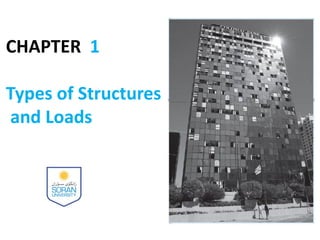
CHAPTER 1
Types of Structures
and Loads
Types of Structures and Loads
CHAPTER OBJECTIVES
 To introduce the basic types of structures.
 To provide a brief explanation of the various types
of loads that must be considered for an appropriate
analysis and design.
R. C. Hibbeler, Structural Analysis, 10th Edition, 2017 (Yousif J. Bas)
Chapter Outline
 Introduction
 Classification of Structures
 Loads
 Structural Design
Introduction
 A structure refers to a system of connected parts used to
support a load.
 Important examples related to civil engineering include
buildings, bridges, and towers.
 in other branches of engineering, ship and aircraft frames,
tanks, pressure vessels, mechanical systems, and electrical
supporting structures are important.
 When designing a structure factors to consider:
 Safety
 Esthetics
 Serviceability
 Economic & environmental constraints
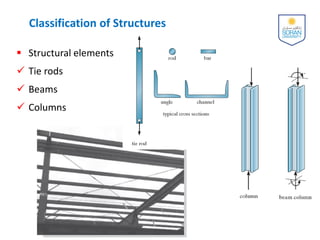
Classification of Structures
 Structural elements
 Tie rods
 Beams
 Columns
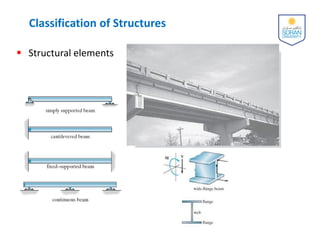
Classification of Structures
 Structural elements
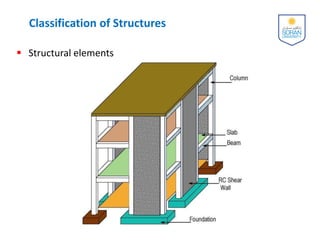
Classification of Structures
 Structural elements
Classification of Structures
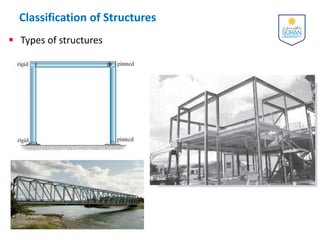
 Types of structures
 Trusses
 Cables & Arches
 Frames
 Surface Structures
Classification of Structures
 Types of structures
Loads
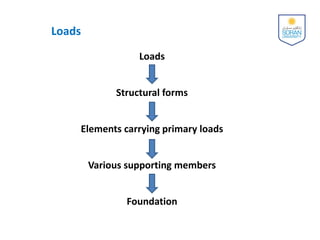
Loads
Structural forms
Elements carrying primary loads
Various supporting members
Foundation
Loads
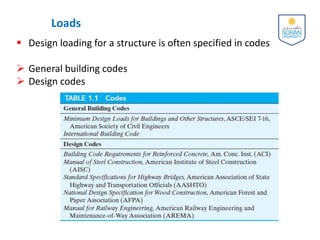
 Design loading for a structure is often specified in codes
 General building codes
 Design codes
Loads
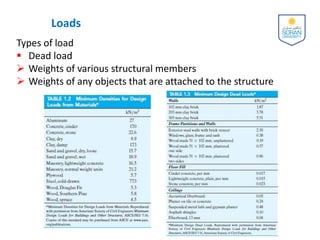
Types of load
 Dead load
 Weights of various structural members
 Weights of any objects that are attached to the structure
Loads
Example
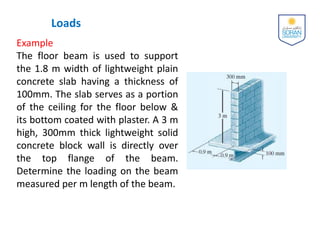
The floor beam is used to support
the 1.8 m width of lightweight plain
concrete slab having a thickness of
100mm. The slab serves as a portion
of the ceiling for the floor below &
its bottom coated with plaster. A 3 m
high, 300mm thick lightweight solid
concrete block wall is directly over
the top flange of the beam.
Determine the loading on the beam
measured per m length of the beam.
Loads
Solution
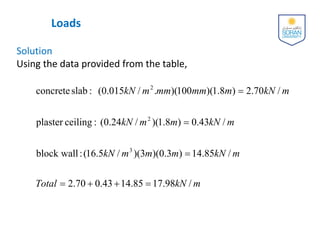
Using the data provided from the table,
m
kN
Total
m
kN
m
m
m
kN
m
kN
m
m
kN
m
kN
m
mm
mm
m
kN
/
98
.
17
85
.
14
43
.
0
70
.
2
/
85
.
14
)
3
.
0
)(
3
)(
/
5
.
16
(
:
block wall
/
43
.
0
)
8
.
1
)(
/
24
.
0
(
:
ceiling
plaster
/
70
.
2
)
8
.
1
)(
100
)(
.
/
015
.
0
(
:
slab
concrete
3
2
2







Loads
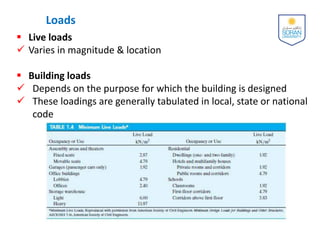
 Live loads
 Varies in magnitude & location
 Building loads
 Depends on the purpose for which the building is designed
 These loadings are generally tabulated in local, state or national
code
Loads
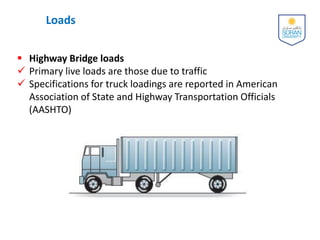
 Highway Bridge loads
 Primary live loads are those due to traffic
 Specifications for truck loadings are reported in American
Association of State and Highway Transportation Officials
(AASHTO)
Loads
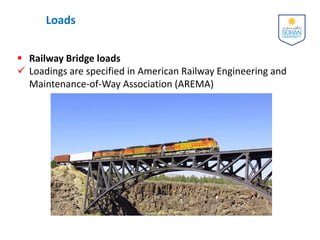
 Railway Bridge loads
 Loadings are specified in American Railway Engineering and
Maintenance-of-Way Association (AREMA)
Loads
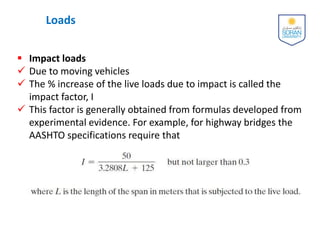
 Impact loads
 Due to moving vehicles
 The % increase of the live loads due to impact is called the
impact factor, I
 This factor is generally obtained from formulas developed from
experimental evidence. For example, for highway bridges the
AASHTO specifications require that
Loads
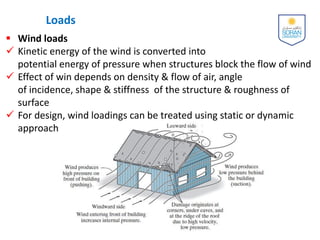
 Wind loads
 Kinetic energy of the wind is converted into
potential energy of pressure when structures block the flow of wind
 Effect of win depends on density & flow of air, angle
of incidence, shape & stiffness of the structure & roughness of
surface
 For design, wind loadings can be treated using static or dynamic
approach
Loads
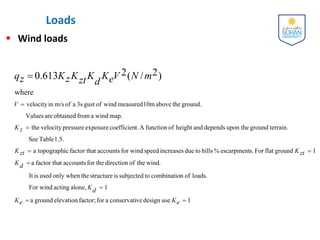
 Wind loads
1
use
design
ve
conservati
a
for
factor;
elevation
ground
a
1
alone,
acting
For wind
loads.
of
n
combinatio
to
subjected
is
structure
the
only when
used
is
It
wind.
the
of
direction
for the
accounts
t
factor tha
a
1
ground
flat
For
s.
escarpment
%
hills
to
due
increases
speed
for wind
accounts
t
factor tha
ic
topograph
a
1.5.
Table
See
terrain.
ground
upon the
depends
and
height
of
function
A
t.
coefficien
exposure
pressure
velocity
the
map.
wind
a
from
obtained
are
Values
ground.
the
above
10m
measured
wind
of
gust
3s
a
of
m/s
in
velocity
where
)
2
/
(
2
613
.
0









e
K
e
K
d
K
d
K
zt
K
zt
K
z
K
V
m
N
V
e
K
d
K
zt
K
z
K
z
q
Loads
 Wind loads
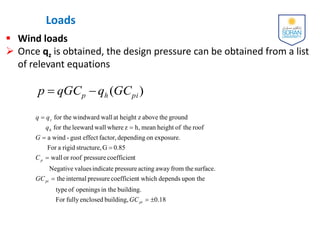
 Once qz is obtained, the design pressure can be obtained from a list
of relevant equations
)
( pi
h
p GC
q
qGC
p 

18
.
0
building,
enclosed
fully
For
building.
in the
openings
of
type
upon the
depends
t which
coefficien
pressure
internal
the
surface.
the
from
away
acting
pressure
indicate
values
Negative
t
coefficien
pressure
roof
or
wall
0.85
G
structure,
rigid
a
For
exposure.
on
depending
factor,
effect
gust
-
wind
a
roof
the
of
height
mean
,
h
z
where
wall
leeward
for the
ground
the
above
z
height
at
wall
windward
for the








pi
pi
p
h
z
GC
GC
C
G
q
q
q
Loads
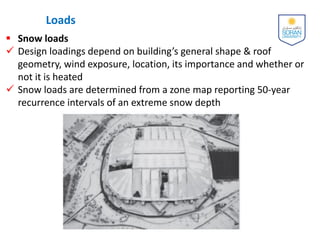
 Snow loads
 Design loadings depend on building’s general shape & roof
geometry, wind exposure, location, its importance and whether or
not it is heated
 Snow loads are determined from a zone map reporting 50-year
recurrence intervals of an extreme snow depth
Loads
 Snow loads
 For flat roof (slope < 5%):
hospital
&
schools
for
1.2
and
facilities
storage
&
e
agricultur
for
0.8
e.g,
For
occupancy.
to
relates
it
as
factor
importance
the
1.0.
then
structure,
heated
normally
a
supporting
is
roof
the
if
whereas
1.2,
freezing
below
kept
structure
unheated
For
building.
within the
re
temperatu
average
the
to
refers
ch
factor whi
thermal
a
1.2
city
large
a
of
centre
in the
located
&
sheltered
is
roof
the
If
0.8.
area
ed
unobstruct
an
in
roof
exposed
fully
A
terrain.
upon the
depending
factor
exposure
an
1.5)
(eq
7
.
0










I
I
I
t
C
t
C
t
C
e
C
e
C
e
C
g
s
t
e
f p
I
C
C
p
Loads
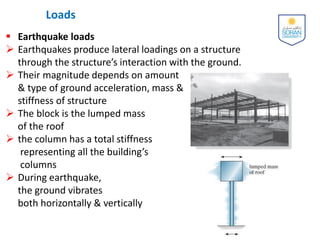
 Earthquake loads
 Earthquakes produce lateral loadings on a structure
through the structure’s interaction with the ground.
 Their magnitude depends on amount
& type of ground acceleration, mass &
stiffness of structure
 The block is the lumped mass
of the roof
 the column has a total stiffness
representing all the building’s
columns
 During earthquake,
the ground vibrates
both horizontally & vertically
Loads
 Earthquake loads
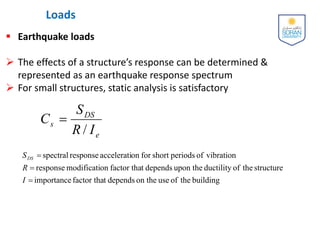
 The effects of a structure’s response can be determined &
represented as an earthquake response spectrum
 For small structures, static analysis is satisfactory
/ e
DS
s
I
R
S
C 
building
the
of
use
on the
depends
t
factor tha
importance
structure
the
of
ductility
upon the
depends
t
factor tha
on
modificati
response
vibration
of
periods
short
for
on
accelerati
response
spectral



I
R
SDS
Loads
 Hydrostatic & Soil Pressure
 The pressure developed by these loadings when the structures are
used to retain water or soil or granular materials
 E.g. tanks, dams, ships, bulkheads & retaining walls
 Other natural loads
 Effect of blast
 Temperature changes
 Differential settlement of foundation
Structural Design
 Whenever a structure is designed, it is important to give
consideration to both material and load uncertainties. These
uncertainties include:
1. A possible variability in material properties
2. residual stress in materials
3. intended measurements being different from fabricated sizes
4. Loadings due to vibration or impact
5. material corrosion or decay
Structural Design
 ASD. Allowable-stress design (ASD) methods include both the
material and load uncertainties into a single factor of safety.
 The many types of loads discussed previously can occur
simultaneously on a structure, but it is very unlikely that the
maximum of all these loads will occur at the same time. For
example, both maximum wind and earthquake loads will normally
not act simultaneously on a structure.
 In working-stress design, the computed elastic stress in the material
must not exceed the allowable stress along with the following
typical load combinations as specified by the ASCE 7-16 Standard
 dead load
 dead load + live load
 0.6 (dead load) + 0.6(wind load)
Structural Design
 LRFD. (load and resistance factor design)
Since uncertainty can be considered using probability theory, there
has been an increasing trend to separate material uncertainty from
load uncertainty.
 this method (LRFD) or (strength design) uses load factors applied
to the loads or combinations of loads
 1.4 (Dead load)
 1.2 (dead load) + 1.6 (live load) + 0.5 (roof live load or snow load
or rain load)
 1.2 (dead load) + 1.0 (wind load) + 1.0 (live load) + 0.5 (roof live
load or snow load or rain load)
 0.9 (dead load) + 1.0 (wind load)

1-Types of Structures and Loads.pdf

  • 1.
    STRUCTURAL ANALYSIS (Determinate) Soran University Facultyof Engineering Civil Engineering Department Yousif J. Bas (2023-2024)
  • 2.
    CHAPTER 1 Types ofStructures and Loads
  • 3.
    Types of Structuresand Loads CHAPTER OBJECTIVES  To introduce the basic types of structures.  To provide a brief explanation of the various types of loads that must be considered for an appropriate analysis and design. R. C. Hibbeler, Structural Analysis, 10th Edition, 2017 (Yousif J. Bas)
  • 4.
    Chapter Outline  Introduction Classification of Structures  Loads  Structural Design
  • 5.
    Introduction  A structurerefers to a system of connected parts used to support a load.  Important examples related to civil engineering include buildings, bridges, and towers.  in other branches of engineering, ship and aircraft frames, tanks, pressure vessels, mechanical systems, and electrical supporting structures are important.  When designing a structure factors to consider:  Safety  Esthetics  Serviceability  Economic & environmental constraints
  • 6.
    Classification of Structures Structural elements  Tie rods  Beams  Columns
  • 7.
  • 8.
  • 9.
    Classification of Structures Types of structures  Trusses  Cables & Arches  Frames  Surface Structures
  • 10.
  • 11.
    Loads Loads Structural forms Elements carryingprimary loads Various supporting members Foundation
  • 12.
    Loads  Design loadingfor a structure is often specified in codes  General building codes  Design codes
  • 13.
    Loads Types of load Dead load  Weights of various structural members  Weights of any objects that are attached to the structure
  • 14.
    Loads Example The floor beamis used to support the 1.8 m width of lightweight plain concrete slab having a thickness of 100mm. The slab serves as a portion of the ceiling for the floor below & its bottom coated with plaster. A 3 m high, 300mm thick lightweight solid concrete block wall is directly over the top flange of the beam. Determine the loading on the beam measured per m length of the beam.
  • 15.
    Loads Solution Using the dataprovided from the table, m kN Total m kN m m m kN m kN m m kN m kN m mm mm m kN / 98 . 17 85 . 14 43 . 0 70 . 2 / 85 . 14 ) 3 . 0 )( 3 )( / 5 . 16 ( : block wall / 43 . 0 ) 8 . 1 )( / 24 . 0 ( : ceiling plaster / 70 . 2 ) 8 . 1 )( 100 )( . / 015 . 0 ( : slab concrete 3 2 2       
  • 16.
    Loads  Live loads Varies in magnitude & location  Building loads  Depends on the purpose for which the building is designed  These loadings are generally tabulated in local, state or national code
  • 17.
    Loads  Highway Bridgeloads  Primary live loads are those due to traffic  Specifications for truck loadings are reported in American Association of State and Highway Transportation Officials (AASHTO)
  • 18.
    Loads  Railway Bridgeloads  Loadings are specified in American Railway Engineering and Maintenance-of-Way Association (AREMA)
  • 19.
    Loads  Impact loads Due to moving vehicles  The % increase of the live loads due to impact is called the impact factor, I  This factor is generally obtained from formulas developed from experimental evidence. For example, for highway bridges the AASHTO specifications require that
  • 20.
    Loads  Wind loads Kinetic energy of the wind is converted into potential energy of pressure when structures block the flow of wind  Effect of win depends on density & flow of air, angle of incidence, shape & stiffness of the structure & roughness of surface  For design, wind loadings can be treated using static or dynamic approach
  • 21.
    Loads  Wind loads 1 use design ve conservati a for factor; elevation ground a 1 alone, acting Forwind loads. of n combinatio to subjected is structure the only when used is It wind. the of direction for the accounts t factor tha a 1 ground flat For s. escarpment % hills to due increases speed for wind accounts t factor tha ic topograph a 1.5. Table See terrain. ground upon the depends and height of function A t. coefficien exposure pressure velocity the map. wind a from obtained are Values ground. the above 10m measured wind of gust 3s a of m/s in velocity where ) 2 / ( 2 613 . 0          e K e K d K d K zt K zt K z K V m N V e K d K zt K z K z q
  • 22.
    Loads  Wind loads Once qz is obtained, the design pressure can be obtained from a list of relevant equations ) ( pi h p GC q qGC p   18 . 0 building, enclosed fully For building. in the openings of type upon the depends t which coefficien pressure internal the surface. the from away acting pressure indicate values Negative t coefficien pressure roof or wall 0.85 G structure, rigid a For exposure. on depending factor, effect gust - wind a roof the of height mean , h z where wall leeward for the ground the above z height at wall windward for the         pi pi p h z GC GC C G q q q
  • 23.
    Loads  Snow loads Design loadings depend on building’s general shape & roof geometry, wind exposure, location, its importance and whether or not it is heated  Snow loads are determined from a zone map reporting 50-year recurrence intervals of an extreme snow depth
  • 24.
    Loads  Snow loads For flat roof (slope < 5%): hospital & schools for 1.2 and facilities storage & e agricultur for 0.8 e.g, For occupancy. to relates it as factor importance the 1.0. then structure, heated normally a supporting is roof the if whereas 1.2, freezing below kept structure unheated For building. within the re temperatu average the to refers ch factor whi thermal a 1.2 city large a of centre in the located & sheltered is roof the If 0.8. area ed unobstruct an in roof exposed fully A terrain. upon the depending factor exposure an 1.5) (eq 7 . 0           I I I t C t C t C e C e C e C g s t e f p I C C p
  • 25.
    Loads  Earthquake loads Earthquakes produce lateral loadings on a structure through the structure’s interaction with the ground.  Their magnitude depends on amount & type of ground acceleration, mass & stiffness of structure  The block is the lumped mass of the roof  the column has a total stiffness representing all the building’s columns  During earthquake, the ground vibrates both horizontally & vertically
  • 26.
    Loads  Earthquake loads The effects of a structure’s response can be determined & represented as an earthquake response spectrum  For small structures, static analysis is satisfactory / e DS s I R S C  building the of use on the depends t factor tha importance structure the of ductility upon the depends t factor tha on modificati response vibration of periods short for on accelerati response spectral    I R SDS
  • 27.
    Loads  Hydrostatic &Soil Pressure  The pressure developed by these loadings when the structures are used to retain water or soil or granular materials  E.g. tanks, dams, ships, bulkheads & retaining walls  Other natural loads  Effect of blast  Temperature changes  Differential settlement of foundation
  • 28.
    Structural Design  Whenevera structure is designed, it is important to give consideration to both material and load uncertainties. These uncertainties include: 1. A possible variability in material properties 2. residual stress in materials 3. intended measurements being different from fabricated sizes 4. Loadings due to vibration or impact 5. material corrosion or decay
  • 29.
    Structural Design  ASD.Allowable-stress design (ASD) methods include both the material and load uncertainties into a single factor of safety.  The many types of loads discussed previously can occur simultaneously on a structure, but it is very unlikely that the maximum of all these loads will occur at the same time. For example, both maximum wind and earthquake loads will normally not act simultaneously on a structure.  In working-stress design, the computed elastic stress in the material must not exceed the allowable stress along with the following typical load combinations as specified by the ASCE 7-16 Standard  dead load  dead load + live load  0.6 (dead load) + 0.6(wind load)
  • 30.
    Structural Design  LRFD.(load and resistance factor design) Since uncertainty can be considered using probability theory, there has been an increasing trend to separate material uncertainty from load uncertainty.  this method (LRFD) or (strength design) uses load factors applied to the loads or combinations of loads  1.4 (Dead load)  1.2 (dead load) + 1.6 (live load) + 0.5 (roof live load or snow load or rain load)  1.2 (dead load) + 1.0 (wind load) + 1.0 (live load) + 0.5 (roof live load or snow load or rain load)  0.9 (dead load) + 1.0 (wind load)