08MTP/MAU/MFD11
USN
First Semester M.Tech. Degree Examination, Dee.09/Jan.1O
Applied Mathematics
Time: 3 hrs.
Max. Marks:100
Note: Answer any FIVE full questions.
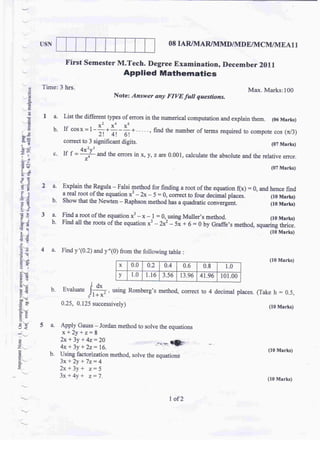
1 a. Find the binary form of the number
193. (06 Marks)
b. The number 3.1415927 is approximated as 3.1416. Find the following:
i) error ii) relative error and iii) number of significant digits of the approximation.(04 Marks)
8 0
If A=
[ write Fortran program for the multiplication of ther
1
2
-
3
5 6
4
, B 2c. =
L -1
7
4
matrices A & B.
Generates the functions f;(7,.) , i = 0, 1, 2, 3 and 4 for the tridiagonal matrix
3 -2 0 0
-2 5 -3 0
A 0 -3 7 -4
0 0 -4 9
r4 3
2 a. Find the L,, L2, L, and L, norms of the matrix A = 17 6, (06 Marks)
b. Find the solution of the following set of equations using the Gauss elimination method:
2x, - x2 + x3 = 4 , 4x, + 3x2 - x3 = 6 and 3x, + 2x2 + 2x3 = 15 (06 Marks)
4 -1 1
E
c. Find the inverse of the matrix A = (-1 6 - 41 using the relation [A]-' = [U]-' ([U]-' )T .
1 -4 5
3 a. Convert the eigen value problem l
5000 -500
00 5 00 ]{x2} ^[ 0 5J{x2}[1 0
to a standard eigen value problem.
J
b. Find the Eigen values and the Eigen vectors of the matrix
12 6 -6
A= 6 16 2 by using Jacobi method.
-6 2 16
c.
(10 Marks)
(08 Marks)
(08 Marks)
(04 Marks)
(08 Marks)
a. Evaluate the mixed partial derivative &2 2 of the function f(x, y) = 2x4x3 using central
differences at x = I and y = 1 with a step size Ax = Ay =
0.1 (12 Marks)
b. Find the first three derivatives of f(x) = x z e-4x and express Taylor's series expansion
(
08 Marks)
atx=1.
08MTP/MAU/MFD11
b
crnti tic the value of the integral I = f (x)dx, where
a
0.84885406+31.51924706x - 137.66731262x2 + 240.55831238x3
-171.45245361x4 + 41.95066071x5
J - 0.0 and b = 1.5 using Simpson's 1/3 rule with different step sizes. ( 08 Marks)
date the integral I = J ye2vdy using the Gauss-Legendre quadrature . (04 Marks)
0
I n
aiuate the integral I= J J f Sxy3z2dxdydz using the two-point Gauss-Legendre
ddrature rule. (08 Marks)
nu inc solution of the initial value problem y' = y + 2x -1 ; y(O) =1 in the interval
I using Adams - Bashforth open formulas of order 2 through 6. (10 Marks)
nd the solution of the initial value problem.
2x + v y(0) = 1, at x = 0.4 using the fourth order Adams predictor-corrector
hod with h = 0.1. (10 Marks)
ditterential equation governing the transverse deflection of a beam w(x) subjected to a
,^:'tnbutcd load, p(x) as shown in the Fig.7(a), is given as
z z
22 (EI dx p(x)
i e l = Young's modulus and I= area moment of inertia of the beam.
Fig.7(a)
n,uiate the boundary value problem for a uniform beam i ) fixed at the both ends and ii)
;.phv supported at both ends . ( 08 Marks)
,.main the shooting methods. ( 12 Marks)
tai rod of length 1 in is initially at 70°C. The steady-state temperature of the left and
ends of the rod are given as 50°C and 20°C respectively. Using a2 = 0.1 m2/min,
U 'm and At = 0.3 min, determine the temperature distribution in the rod for 0 5 t <- 0,
rfl ( rank-Nicholson method. (10 Marks)
luminium plate of size 0.3mxO.3m is initially at the temperature 30°C. If the adjacent
)C the plate are suddenly brought to 120°C and maintained at the temperature, derive
quations necessary for the determination of the time variation of temperature in the
using the alternating direction implicit method.
K = 236W/m-k. C = 900 J/kg-K, p = 2700 kg/m3 , Ax = Ay = 0.1 M. (10 Marks)
East West Institute of Technology
PG Library & Information Centre
Suggestions at: library.ewit@gmail.com
First Semester M.Tech. Degree Examination, June/July 2013
Applied Mathematics
Time: 3 hrs. Max. Marks:100
Note: Answer any FIVE full questions.
1 a.
b.
A bungee jumper with a mass of 68.1 kg leaps from a stationary hot balloon. Use
m
cV
g
dt
dv
 to compute the velocity for the first 12 secs of free fall by employing a finite
difference technique. The drag coefficient is 12.5 kg/s and g = 9.81. Given V(0) = 0. Employ
a step size of 25 for calculation. (10 Marks)
Explain in brief: i) Significant figures ii) Inherent error iii) Truncation error
iv) True percentage relative error (10 Marks)
2 a.
b.
Explain Regular Falsi method to find the root of the equation, show that the roots lie in the
interval (2.7, 2.8). Use it to find three approximations for 02.1xlogx)x(f 10  with four
decimals in each computation. (10 Marks)
Use both the standard and modified Newton-Raphson method to evaluate the multiple root
of 3x7x5x)x(f 23
 with an initial guess of ,0x0  perform three iterations in each
case. (10 Marks)
3 a.
b.
Use Muller’s method with guesses x0, x1 and x2 = 4.5, 5.5, 5 to determine a root of the
equation 12x13x)x(f 3
 with a permissible error of 1%. (10 Marks)
Find all the roots of the polynomial 06x11x6x 23
 by Graeffc’s root square method.
Perform three iterations. (10 Marks)
4 a.
b.
A rod is rotating in a plane. The following table gives the angle  radians through which the
rod has turned for various values of the time t secs. (10 Marks)
t 0 0.2 0.4 0.6 0.8 1.0 1.2
 0 0.12 0.49 1.12 2.02 3.20 4.67
Calculate the angular velocity and angular acceleration of the rod when t = 0.6 second.
Use Romberg’s method to compute  

1
0
x1
dx
I correct to three decimal places. (10 Marks)
5 a.
b.
Determine the inverse of the matrix











353
134
111
using the partition method. Hence find the
solution of the system of equations 1xxx 321  ,
6xx3x4 321  ,
4x3x5x3 321  (10 Marks)
Solve the system of equations by Gauss elimination method,
2xxxx 4321 
5xx2xx2 4321 
7x4x3x2x3 4321 
5x2x3x2x 4321  (10 Marks)
1 of 2
ImportantNote:1.Oncompletingyouranswers,compulsorilydrawdiagonalcrosslinesontheremainingblankpages.
2.Anyrevealingofidentification,appealtoevaluatorand/orequationswritteneg,42+8=50,willbetreatedasmalpractice. USN 10MMD/MDE/MCM/MEA/MAR11
10MMD/MDE/MCM/MEA/MAR11
6 a.
b.
Use Jacobi method to find all the eigen values and the corresponding eigen vectors of the
matrix. Perform four iterations












121
212
121
. (10 Marks)
Find all the eigen values of the matrix using Rutishauser method,











231
212
111
A iterate till
all the elements of the lower triangular part are less than 0.05 in magnitude. (10 Marks)
7 a.
b.
Define the matrix with examples for, i) Linear transformation ii) Shear transformation iii)
Super position transformation. (10 Marks)
Let











742
213
111
A ,













7
2
3
C
Define a linear transformation :T 3
3
by T(x) = AX. Determine if C is in the range of transformation of T. (10 Marks)
8 a.
b.
Find a QR factorization of













111
111
011
001
A using Gram-Schmidt process. (10 Marks)
Find a least square solution of AX = b for





















1001
1001
0101
0101
0011
0011
A ,























1
5
2
0
1
3
b . (10 Marks)
* * * * *
2 of 2
First Semester M.Tech. Degree Examination, Dec. 2013 / Jan 2014.
Applied Mathematics
Time: 3 hrs. Max. Marks:100
Note: Answer any FIVE full questions.
1 a. Explain in brief : i) Significant figures ii) Accuracy iii) Precision iv) Round off
errors v) Truncation errors. (10 Marks)
b. Find the sum of 0.1874 × 10⁴
and 27.8 × 10⁻¹
and obtain its chopping off and rounding off
approximations in four – digit mantissa. Find the error and relative error in each case.
(10 Marks)
2 a. Applying Regula – Falsi method, find a real root of the equation xlog10 x – 1.2 correct to 3
decimal places. (10 Marks)
b. Derive Newton’s formula to find N . Hence find 28 correct to 4 decimal places.
(10 Marks)
3 a. Perform two iterations of the Bairstow method to extract a quadratic factor x2
+ px + q from
the polynomial x3
+ x2
– x + 2 = 0. Use the initial approximation p0 = -0.9 , q0 = 0.9.
(10 Marks)
b. Find all the roots of the polynomial equation x3
– 6x2
+ 11x – 6 = 0, using Graeffe’s root
squaring method (Squaring 3 times). (10 Marks)
4
a. Use Romberg’s method to compute  
1
0
2
x1
dx
, correct to four decimal places, by taking
h = 0.5, 0.25 and 0.125. (10 Marks)
b. Find the derivative of f(x) = -0.1x4
– 0.15x3
– 0.5x2
– 0.25x + 1.2 at x = 0.5 using the high
accuracy formula (Forward difference of accuracy and back ward difference of accuracy of
O(h2
). Take h = 0.25). (10 Marks)
5 a. Apply Gauss – Jordan method to solve the equation x + y + z = 9 ; 2x – 3y + 4z = 13 ;
3x + 4y + 5z = 40. (10 Marks)
b. Solve the system of linear equations
x1 + x2 + x3 = 1
4x1 + 3x2 – x3 = 6
3x1 + 5x2 + 3x3 = 4 by using triangularization method. (10 Marks)
6 a. Find the smallest eigen value in magnitude of the matrix
A =













210
121
012
, using the four iterations of the inverse power method. (10 Marks)
b. Find all the eigen values of the matrix A = 





21
34
using the Rutisha user method.(10 Marks)
1 of 2
ImportantNote:1.Oncompletingyouranswers,compulsorilydrawdiagonalcrosslinesontheremainingblankpages.
2.Anyrevealingofidentification,appealtoevaluatorand/orequationswritteneg,42+8=50,willbetreatedasmalpractice.
USN 10MMD/MDE/MCM/MEA/MAR11
10MMD/MDE/MCM/MEA/MAR11
7 a. Define a linear transformation T : R2
→ R2
by T(X) = AX = 





1
2
x
x
, where A = 







01
10
.
Find the images under T of u = 





3
2
, v = 





2
3
and u + v = 





5
5
. Interpret the result
graphically. (10 Marks)
b. For T(x1, x2) = (3x1 + x2, 5x1 + 7x2 , x1 + 3x2) , show that T is a one - to – one linear
transformation. Does T map R2
onto R3
? (10 Marks)
8 a. Find the least square solution of the system Ax = b for
A =










11
20
04
, b =










11
0
2
. (10 Marks)
b. Construct an orthogonal set for A =












111
111
011
001
. Using Gram – Schmidt process. (10 Marks)
*****
2 of 2
First Semester M.Tech. Degree Examination, June/July 2013
Applied Mathematic
Time: 3 hrs. Max. Marks:100
Note: 1. Answer any FIVE full questions.
2. Missing data, if any, may be suitable assumed.
1 a.
b.
Perform two iterations with Muller method for log10x – x + 3 = 0, x0 = 0.25, x1 = 0.5,
x2 = 1. (10 Marks)
Perform one iteration of the Bairstow method to extract a quadratic factor x2
+ px + q from
the polynomial x4
+ x3
+ 2x2
+ x + 1 = 0. Use the initial approximation p0 = 0.5 and q = 0.5.
(10 Marks)
2 a.
b.
Solve the equation
t
u
t
u
2
2





subject to the conditions u(0.t) = u(1, t) = 0






1x)x1(2
x0x2
)0,x(u
2
1
2
1
Carryout computation for 3 levels, taking h = 0.1 and k = 0.001. (10 Marks)
Solve 2
2
2
2
t
u
x
u





subject to the boundary conditions u(0,t) = 0 = u(1, t) t  0 and the initial
conditions, 0
t
)0,x(u



, u(x, 0) sin  x, 0  x  1 by taking h = ¼ and k = ⅕. Carryout
second level solutions in the time scale. (10 Marks)
3 a.
b.
Solve the following system of equations :
20x + y – 2z = 17
3x + 20 y – z = – 18
2x – 3y + 20z = 25
Using Gauss – Seidel method directly and in error format. Person two iterations. (10 Marks)
Explain Jacobi method to find the eigen value and corresponding eigen vectors of a real
symmetric matrix and find all the eigen values and corresponding eigen vectors of the matrix











321
232
123
A
Iterate till off – diagonal elements in magnitude are less than 0.4. (10 Marks)
4 a.
b.
Obtain the cubic spline approximation for the function defined by the data with M(0) = 0.
x 0 1 2 3
f(x) 1 2 33 244
M(3) = 0. Hence find an estimate of f(2.5). (10 Marks)
Use the Numerov method to solve the initial value problem u = (1 + t2
)u, u(0) = 1, u(0) = 0
t  [0, 1] with h = 0.2. (10 Marks)
1 of 2
ImportantNote:1.Oncompletingyouranswers,compulsorilydrawdiagonalcrosslinesontheremainingblankpages.
2.Anyrevealingofidentification,appealtoevaluatorand/orequationswritteneg,42+8=50,willbetreatedasmalpractice.
USN 12EPE/EPS/ECD/EMS11
12EPE/EPS/ECD/EMS11
5 a.
b.
A factory uses 3 types of machines to produce tow types of electronic gadgets. The first
gadget requires in hours 12, 4 and 2 respectively on the 3 types of machines. The second
gadget requires in hours 6, 10 and 3 on the machines respectively. The total available time in
hours on the machines are 6000, 4000, 1800. If two types of gadgets respectively fetches a
profit of rupees 400 and 1000 find the number of gadgets of each type to be produced for
getting the maximum profit. Use graphical method. (10 Marks)
Solve the following minimization problem by simplex method :
Objective function : P = -3x + 8y – 5z
Constants : – x – 2z  5
2x – 3y + z  z
2x – 5y + 6z  5
x  0, y  0, z  0. (10 Marks)
6 a.
b.
Prove that a simple graph with n vertices and k components can have at most (n – k)
(n – k + 1)/2 edges. (10 Marks)
Define Euler circuits. Prove that a connected graph G has an Euler circuit if and only if all
vertices of G are of even degree. (10 Marks)
7 a.
b.
c.
Let V be a vector space which is spanned by a finite set of vectors B = {1, 2, - - - - m}.
Then prove that any independent set of vectors in V is finite and contains no move than ‘m’
elements. (07 Marks)
Determine whether B = {(1, 2, 1), (3, 4, –7), (3, 1, 5)} is a basis of V3(R). (06 Marks)
If W1 and W2 are finite dimensional subspaces of a vector space V. Then prove that
W1 + W2 is finite dimensional and dim W1 + dim W2 = dim (W1  W2) + dim (W1 + W2).
(07 Marks)
8 a.
b.
Find the range, null space, rank and nullity of linear transformation T : V3(R)  V2(R)
defined by T(x,y, z) = (y – x, y – z). Also verify the Rank – Nullity theorem. (10 Marks)
Show that the transformation T : V3(R)V3(R) defined by
T(x1,x2,x3)=(x1 + x2 +x3, x3 –x2, x3) is non – singular and find its inverse. (10 Marks)
* * * * *
2 of 2
First Semester M.Tech. Degree Examination, June/July 2013
Applied Mathematics
Time: 3 hrs. Max. Marks:100
Note: Answer any FIVE full questions.
1 a.
b.
Explain in brief:
i) Inherent errors
ii) Rounding errors
iii) Truncation errors
iv) Absolute, relative and percentage errors. (10 Marks)
If 3
2
z
xy4
f  and the errors in x, y, z are 0.001, find the maximum relative error in f at
x = y = z = 1. (10 Marks)
2 a.
b.
Explain secant method for finding a root of the equation f(x) = 0. By using the Regula-Falsi
method, find the root of the equation 2.1xlogx 10  that lies between 2 and 3. (10 Marks)
Find the multiple root of the equation 064x16x36x11x 234
 , that lies near 3.9.
(10 Marks)
3 a.
b.
Find two iterations of the Muller method to find the root of the equation
01x5x)x(f 3
 in (0, 1). (10 Marks)
Perform two iterations of the Bairstow method to extract a quadratic factor qpxx2
 from
the polynomial 060x40x20x5x 234
 , use the initial approximations p0 = 4,
q0 = 8. (10 Marks)
4 a.
b.
From the following data obtain the first and second derivatives of xlogy e i) at x = 500,
ii) at x = 550. (10 Marks)
Evaluate the integral  





5.0
0
dx
xsin
x
using Romberg’s method, correct to three decimal places.
(10 Marks)
5 a.
b.
Use Cholesky’s method to solve the system
1zyx 
5z3yx3 
10z5y2x  (10 Marks)
Using the partition method, solve the system of equations:
4z3y4x2 
1zy 
2zy2x2  (10 Marks)
1 of 2
ImportantNote:1.Oncompletingyouranswers,compulsorilydrawdiagonalcrosslinesontheremainingblankpages.
2.Anyrevealingofidentification,appealtoevaluatorand/orequationswritteneg,42+8=50,willbetreatedasmalpractice.
USN 12MMD/MDE/MCM/MEA/MAR/MST11
12MMD/MDE/MCM/MEA/MAR/MST11
6 a.
b.
By employing the Given’s method, reduce the matrix














322
221
212
A
to tridiagonal form and hence find its largest eigen value. (10 Marks)
Find all the eigenvalues of the matrix











231
212
111
A
using the Rutishauser method. (Carryout 5 steps) (10 Marks)
7 a.
b.
Find a spanning set for the null space of the matrix














48542
13221
71163
A (10 Marks)
Let














6873
3752
1242
A ,















0
1
2
3
u and











3
1
3
v
i) Determine if u is in Nul A, could u be in Col A?
ii) Determine if v is in Col A, could v be in Nul A? (10 Marks)
8 a.
b.
Find a least-squares solution of the system AX = b where












42
13
51
A ,












3
2
4
b . (10 Marks)
If












1
5
2
u1 ,











1
1
2
u2 ,











3
2
1
y and w = span {u1, u2}, then find orthogonal projection of
y onto w. (10 Marks)
* * * * *
2 of 2
First Semester M.Tech. Degree Examination, Dec.2013/Jan.2014
Applied Mathematics
Time: 3 hrs. Max. Marks:100
Note: Answer any FIVE full questions.
1 a.
b.
Define with suitable examples
i) Inherent error.
ii) Significant figures.
iii) Truncation error.
iv) True percentage relative error. (10 Marks)
A parachutist of mass 68.1kgs jumps out of a stationary hot air balloon, use v
m
c
g
dt
dv
 to
compute velocity v prior to opening the chute. The drag coefficient is equal to 12.5kg/s.
Given that g = 9.8. Use analytical method to compute velocity prior to opening the chute,
calculate the terminal velocity also. (Take a step size of 2 secs for computation). (10 Marks)
2 a.
b.
Explain bisection method. Use regular Falsi method to find a third approximation of the root
for the equation tanx + tanhx = 0, which lies between 2 & 3. (10 Marks)
Explain modified Newton-Raphson method. Use modified Newton-Raphson method to find
a root of the equation x4
– 11x + 8 = 0 correct to four decimal places. Given x0 = 2.
(10 Marks)
3 a.
b.
Use Muller’s method with guesses of x0, x1 and x2 = 4.5, 5.5, 5 to determine a root of the
equation f(x) = x3
– 13x – 12. Perform two iterations. (10 Marks)
Find all the roots of the polynomial x3
– 6x2
+ 11x – 6 using the Graffe’s Root square
method by squaring thrice. (10 Marks)
4 a.
b.
Obtain a suitable Newton’s interpolation formula to find the first derivative. Use it to
evaluate at x = 1.2 from the following table: (10 Marks)
x: 1.0 1.5 2.0 2.5 3.0
y: 27 106.75 324.0 783.75 1621.00
Apply Romberg’s integration method to evaluate  
2.1
0
x1
dx
taking stepsize h = 0.6, 0.3, 0.15.
(10 Marks)
5 a.
b.
Solve the following set of equations by Crout’s method:
2x + y + 4z = 12
8x – 3y + 2z = 20
4x + 11y – z = 33. (10 Marks)
Determine the inverse of the matrix











353
134
111
by using the Partition method. (10 Marks)
1 of 2
ImportantNote:1.Oncompletingyouranswers,compulsorilydrawdiagonalcrosslinesontheremainingblankpages.
2.Anyrevealingofidentification,appealtoevaluatorand/orequationswritteneg,42+8=50,willbetreatedasmalpractice.
USN 12MMD/MDE/MCM/MEA/MAR/MST11
12MMD/MDE/MCM/MEA/MAR/MST11
6 a.
b.
Find all the eigen values and eigen vectors of the matrix by
A











124
232
421
by Jacobi’s method. Perform two iterations. (10 Marks)
Find the smallest eigen value in magnitude of the matrix














210
121
012
A
using four iterations of the inverse power method. (10 Marks)
7 a.
b.
c.
Define a linear transformation T: 2
 2
by

















 

1
2
2
1
x
x
x
x
01
10
)x(T .
Find the images under T of 












3
2
v
1
4
u and 






4
6
vu . (07 Marks)
Let T : n
 m
be a linear transformation and let A be the standard matrix. Then prove
that: T maps n
onto m
iff the columns of A span m
. (06 Marks)
For T(x1, x2) = (3x1 + x2, 5x1 + 7x2, x1 + 3x2). Show that T is a one to one linear
transformation. Does T maps 2
onto 3
. (07 Marks)
8 a.
b.
Let W = span {x1, x2} where






















2
2
1
xand
0
6
3
x 21 x. Construct an orthonormal basis
{v1, v2} for w. (10 Marks)
Find a least-squares solution of the inconsistent system






















11
0
2
b
11
20
04
AforbAx . (10 Marks)
* * * * *
2 of 2
Applied mathematics 40

Applied mathematics 40

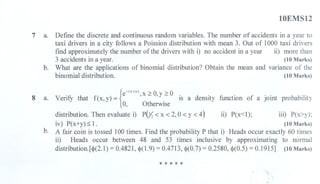
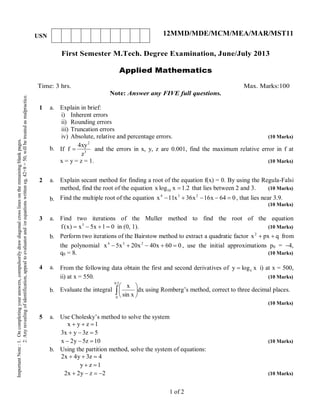
  • 7.
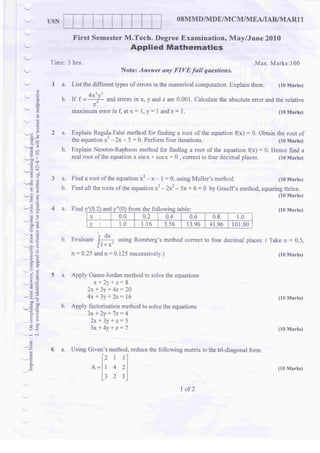
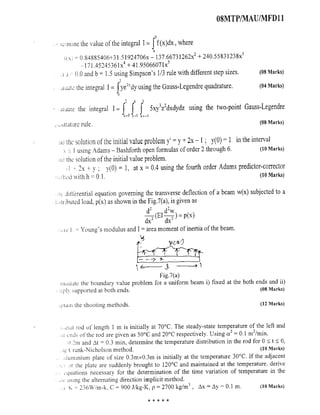
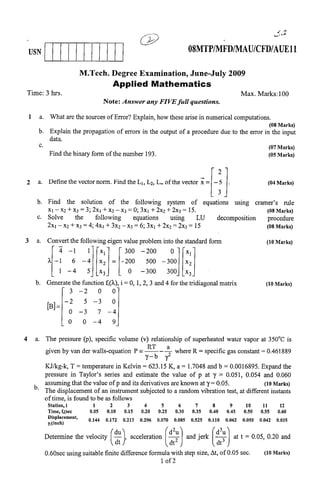
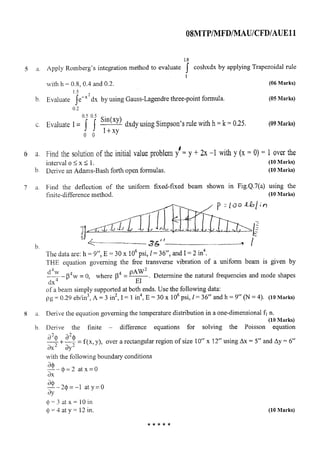
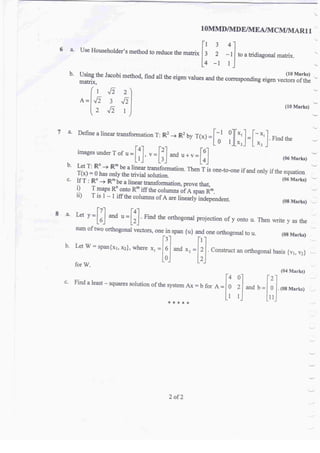
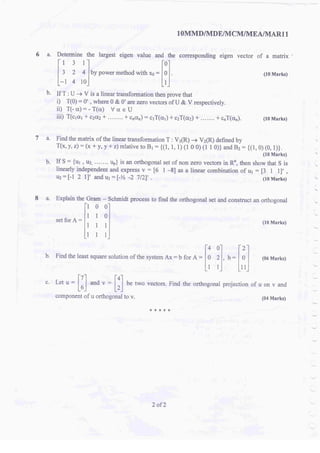
    08MTP/MAU/MFD11 USN First Semester M.Tech.Degree Examination, Dee.09/Jan.1O Applied Mathematics Time: 3 hrs. Max. Marks:100 Note: Answer any FIVE full questions. 1 a. Find the binary form of the number 193. (06 Marks) b. The number 3.1415927 is approximated as 3.1416. Find the following: i) error ii) relative error and iii) number of significant digits of the approximation.(04 Marks) 8 0 If A= [ write Fortran program for the multiplication of ther 1 2 - 3 5 6 4 , B 2c. = L -1 7 4 matrices A & B. Generates the functions f;(7,.) , i = 0, 1, 2, 3 and 4 for the tridiagonal matrix 3 -2 0 0 -2 5 -3 0 A 0 -3 7 -4 0 0 -4 9 r4 3 2 a. Find the L,, L2, L, and L, norms of the matrix A = 17 6, (06 Marks) b. Find the solution of the following set of equations using the Gauss elimination method: 2x, - x2 + x3 = 4 , 4x, + 3x2 - x3 = 6 and 3x, + 2x2 + 2x3 = 15 (06 Marks) 4 -1 1 E c. Find the inverse of the matrix A = (-1 6 - 41 using the relation [A]-' = [U]-' ([U]-' )T . 1 -4 5 3 a. Convert the eigen value problem l 5000 -500 00 5 00 ]{x2} ^[ 0 5J{x2}[1 0 to a standard eigen value problem. J b. Find the Eigen values and the Eigen vectors of the matrix 12 6 -6 A= 6 16 2 by using Jacobi method. -6 2 16 c. (10 Marks) (08 Marks) (08 Marks) (04 Marks) (08 Marks) a. Evaluate the mixed partial derivative &2 2 of the function f(x, y) = 2x4x3 using central differences at x = I and y = 1 with a step size Ax = Ay = 0.1 (12 Marks) b. Find the first three derivatives of f(x) = x z e-4x and express Taylor's series expansion ( 08 Marks) atx=1.
  • 8.
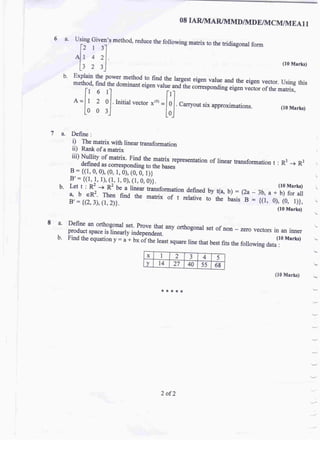
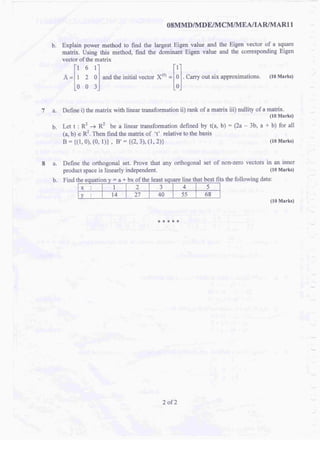
    08MTP/MAU/MFD11 b crnti tic thevalue of the integral I = f (x)dx, where a 0.84885406+31.51924706x - 137.66731262x2 + 240.55831238x3 -171.45245361x4 + 41.95066071x5 J - 0.0 and b = 1.5 using Simpson's 1/3 rule with different step sizes. ( 08 Marks) date the integral I = J ye2vdy using the Gauss-Legendre quadrature . (04 Marks) 0 I n aiuate the integral I= J J f Sxy3z2dxdydz using the two-point Gauss-Legendre ddrature rule. (08 Marks) nu inc solution of the initial value problem y' = y + 2x -1 ; y(O) =1 in the interval I using Adams - Bashforth open formulas of order 2 through 6. (10 Marks) nd the solution of the initial value problem. 2x + v y(0) = 1, at x = 0.4 using the fourth order Adams predictor-corrector hod with h = 0.1. (10 Marks) ditterential equation governing the transverse deflection of a beam w(x) subjected to a ,^:'tnbutcd load, p(x) as shown in the Fig.7(a), is given as z z 22 (EI dx p(x) i e l = Young's modulus and I= area moment of inertia of the beam. Fig.7(a) n,uiate the boundary value problem for a uniform beam i ) fixed at the both ends and ii) ;.phv supported at both ends . ( 08 Marks) ,.main the shooting methods. ( 12 Marks) tai rod of length 1 in is initially at 70°C. The steady-state temperature of the left and ends of the rod are given as 50°C and 20°C respectively. Using a2 = 0.1 m2/min, U 'm and At = 0.3 min, determine the temperature distribution in the rod for 0 5 t <- 0, rfl ( rank-Nicholson method. (10 Marks) luminium plate of size 0.3mxO.3m is initially at the temperature 30°C. If the adjacent )C the plate are suddenly brought to 120°C and maintained at the temperature, derive quations necessary for the determination of the time variation of temperature in the using the alternating direction implicit method. K = 236W/m-k. C = 900 J/kg-K, p = 2700 kg/m3 , Ax = Ay = 0.1 M. (10 Marks)
  • 15.
    East West Instituteof Technology PG Library & Information Centre Suggestions at: library.ewit@gmail.com
  • 23.
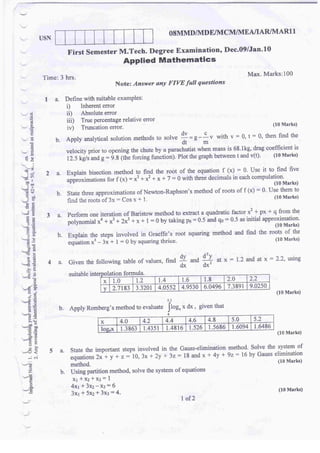
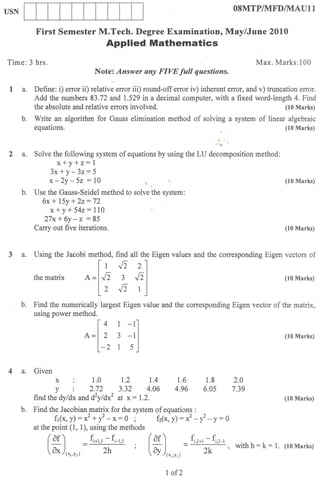
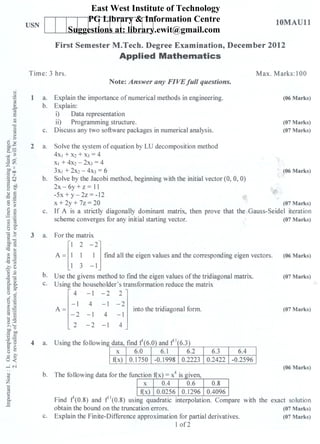
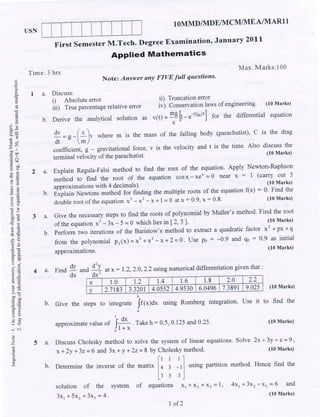
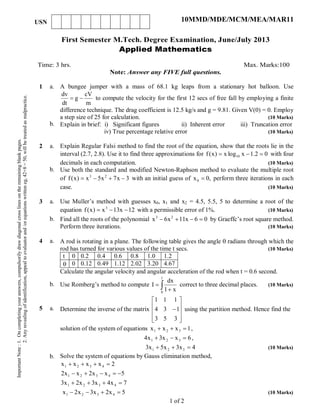
    First Semester M.Tech.Degree Examination, June/July 2013 Applied Mathematics Time: 3 hrs. Max. Marks:100 Note: Answer any FIVE full questions. 1 a. b. A bungee jumper with a mass of 68.1 kg leaps from a stationary hot balloon. Use m cV g dt dv  to compute the velocity for the first 12 secs of free fall by employing a finite difference technique. The drag coefficient is 12.5 kg/s and g = 9.81. Given V(0) = 0. Employ a step size of 25 for calculation. (10 Marks) Explain in brief: i) Significant figures ii) Inherent error iii) Truncation error iv) True percentage relative error (10 Marks) 2 a. b. Explain Regular Falsi method to find the root of the equation, show that the roots lie in the interval (2.7, 2.8). Use it to find three approximations for 02.1xlogx)x(f 10  with four decimals in each computation. (10 Marks) Use both the standard and modified Newton-Raphson method to evaluate the multiple root of 3x7x5x)x(f 23  with an initial guess of ,0x0  perform three iterations in each case. (10 Marks) 3 a. b. Use Muller’s method with guesses x0, x1 and x2 = 4.5, 5.5, 5 to determine a root of the equation 12x13x)x(f 3  with a permissible error of 1%. (10 Marks) Find all the roots of the polynomial 06x11x6x 23  by Graeffc’s root square method. Perform three iterations. (10 Marks) 4 a. b. A rod is rotating in a plane. The following table gives the angle  radians through which the rod has turned for various values of the time t secs. (10 Marks) t 0 0.2 0.4 0.6 0.8 1.0 1.2  0 0.12 0.49 1.12 2.02 3.20 4.67 Calculate the angular velocity and angular acceleration of the rod when t = 0.6 second. Use Romberg’s method to compute    1 0 x1 dx I correct to three decimal places. (10 Marks) 5 a. b. Determine the inverse of the matrix            353 134 111 using the partition method. Hence find the solution of the system of equations 1xxx 321  , 6xx3x4 321  , 4x3x5x3 321  (10 Marks) Solve the system of equations by Gauss elimination method, 2xxxx 4321  5xx2xx2 4321  7x4x3x2x3 4321  5x2x3x2x 4321  (10 Marks) 1 of 2 ImportantNote:1.Oncompletingyouranswers,compulsorilydrawdiagonalcrosslinesontheremainingblankpages. 2.Anyrevealingofidentification,appealtoevaluatorand/orequationswritteneg,42+8=50,willbetreatedasmalpractice. USN 10MMD/MDE/MCM/MEA/MAR11
  • 24.
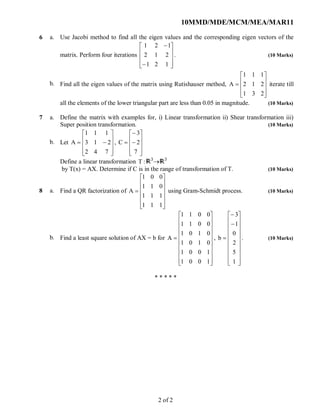
    10MMD/MDE/MCM/MEA/MAR11 6 a. b. Use Jacobimethod to find all the eigen values and the corresponding eigen vectors of the matrix. Perform four iterations             121 212 121 . (10 Marks) Find all the eigen values of the matrix using Rutishauser method,            231 212 111 A iterate till all the elements of the lower triangular part are less than 0.05 in magnitude. (10 Marks) 7 a. b. Define the matrix with examples for, i) Linear transformation ii) Shear transformation iii) Super position transformation. (10 Marks) Let            742 213 111 A ,              7 2 3 C Define a linear transformation :T 3 3 by T(x) = AX. Determine if C is in the range of transformation of T. (10 Marks) 8 a. b. Find a QR factorization of              111 111 011 001 A using Gram-Schmidt process. (10 Marks) Find a least square solution of AX = b for                      1001 1001 0101 0101 0011 0011 A ,                        1 5 2 0 1 3 b . (10 Marks) * * * * * 2 of 2
  • 25.
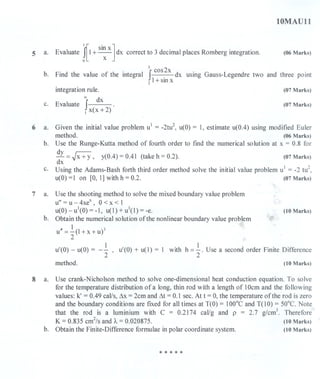
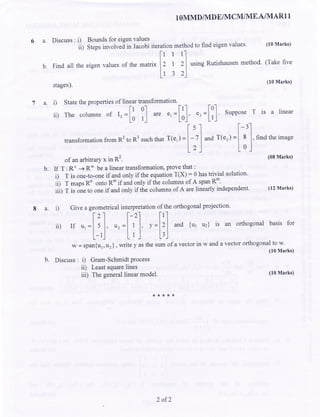
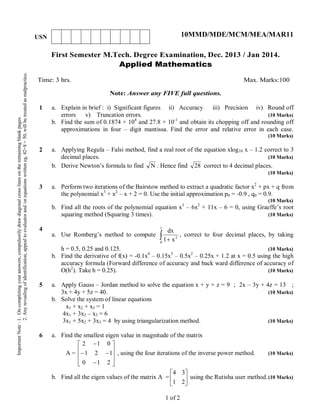
    First Semester M.Tech.Degree Examination, Dec. 2013 / Jan 2014. Applied Mathematics Time: 3 hrs. Max. Marks:100 Note: Answer any FIVE full questions. 1 a. Explain in brief : i) Significant figures ii) Accuracy iii) Precision iv) Round off errors v) Truncation errors. (10 Marks) b. Find the sum of 0.1874 × 10⁴ and 27.8 × 10⁻¹ and obtain its chopping off and rounding off approximations in four – digit mantissa. Find the error and relative error in each case. (10 Marks) 2 a. Applying Regula – Falsi method, find a real root of the equation xlog10 x – 1.2 correct to 3 decimal places. (10 Marks) b. Derive Newton’s formula to find N . Hence find 28 correct to 4 decimal places. (10 Marks) 3 a. Perform two iterations of the Bairstow method to extract a quadratic factor x2 + px + q from the polynomial x3 + x2 – x + 2 = 0. Use the initial approximation p0 = -0.9 , q0 = 0.9. (10 Marks) b. Find all the roots of the polynomial equation x3 – 6x2 + 11x – 6 = 0, using Graeffe’s root squaring method (Squaring 3 times). (10 Marks) 4 a. Use Romberg’s method to compute   1 0 2 x1 dx , correct to four decimal places, by taking h = 0.5, 0.25 and 0.125. (10 Marks) b. Find the derivative of f(x) = -0.1x4 – 0.15x3 – 0.5x2 – 0.25x + 1.2 at x = 0.5 using the high accuracy formula (Forward difference of accuracy and back ward difference of accuracy of O(h2 ). Take h = 0.25). (10 Marks) 5 a. Apply Gauss – Jordan method to solve the equation x + y + z = 9 ; 2x – 3y + 4z = 13 ; 3x + 4y + 5z = 40. (10 Marks) b. Solve the system of linear equations x1 + x2 + x3 = 1 4x1 + 3x2 – x3 = 6 3x1 + 5x2 + 3x3 = 4 by using triangularization method. (10 Marks) 6 a. Find the smallest eigen value in magnitude of the matrix A =              210 121 012 , using the four iterations of the inverse power method. (10 Marks) b. Find all the eigen values of the matrix A =       21 34 using the Rutisha user method.(10 Marks) 1 of 2 ImportantNote:1.Oncompletingyouranswers,compulsorilydrawdiagonalcrosslinesontheremainingblankpages. 2.Anyrevealingofidentification,appealtoevaluatorand/orequationswritteneg,42+8=50,willbetreatedasmalpractice. USN 10MMD/MDE/MCM/MEA/MAR11
  • 26.
    10MMD/MDE/MCM/MEA/MAR11 7 a. Definea linear transformation T : R2 → R2 by T(X) = AX =       1 2 x x , where A =         01 10 . Find the images under T of u =       3 2 , v =       2 3 and u + v =       5 5 . Interpret the result graphically. (10 Marks) b. For T(x1, x2) = (3x1 + x2, 5x1 + 7x2 , x1 + 3x2) , show that T is a one - to – one linear transformation. Does T map R2 onto R3 ? (10 Marks) 8 a. Find the least square solution of the system Ax = b for A =           11 20 04 , b =           11 0 2 . (10 Marks) b. Construct an orthogonal set for A =             111 111 011 001 . Using Gram – Schmidt process. (10 Marks) ***** 2 of 2
  • 29.
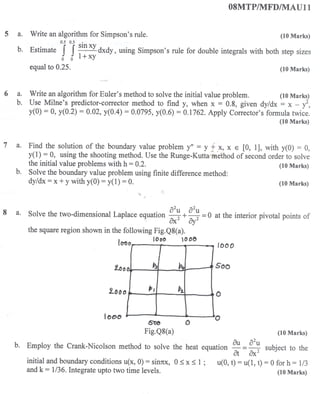
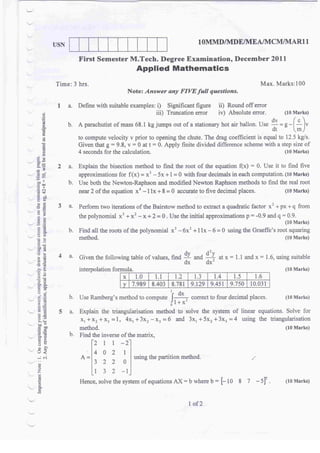
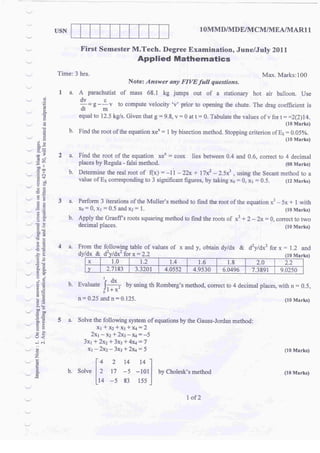
    First Semester M.Tech.Degree Examination, June/July 2013 Applied Mathematic Time: 3 hrs. Max. Marks:100 Note: 1. Answer any FIVE full questions. 2. Missing data, if any, may be suitable assumed. 1 a. b. Perform two iterations with Muller method for log10x – x + 3 = 0, x0 = 0.25, x1 = 0.5, x2 = 1. (10 Marks) Perform one iteration of the Bairstow method to extract a quadratic factor x2 + px + q from the polynomial x4 + x3 + 2x2 + x + 1 = 0. Use the initial approximation p0 = 0.5 and q = 0.5. (10 Marks) 2 a. b. Solve the equation t u t u 2 2      subject to the conditions u(0.t) = u(1, t) = 0       1x)x1(2 x0x2 )0,x(u 2 1 2 1 Carryout computation for 3 levels, taking h = 0.1 and k = 0.001. (10 Marks) Solve 2 2 2 2 t u x u      subject to the boundary conditions u(0,t) = 0 = u(1, t) t  0 and the initial conditions, 0 t )0,x(u    , u(x, 0) sin  x, 0  x  1 by taking h = ¼ and k = ⅕. Carryout second level solutions in the time scale. (10 Marks) 3 a. b. Solve the following system of equations : 20x + y – 2z = 17 3x + 20 y – z = – 18 2x – 3y + 20z = 25 Using Gauss – Seidel method directly and in error format. Person two iterations. (10 Marks) Explain Jacobi method to find the eigen value and corresponding eigen vectors of a real symmetric matrix and find all the eigen values and corresponding eigen vectors of the matrix            321 232 123 A Iterate till off – diagonal elements in magnitude are less than 0.4. (10 Marks) 4 a. b. Obtain the cubic spline approximation for the function defined by the data with M(0) = 0. x 0 1 2 3 f(x) 1 2 33 244 M(3) = 0. Hence find an estimate of f(2.5). (10 Marks) Use the Numerov method to solve the initial value problem u = (1 + t2 )u, u(0) = 1, u(0) = 0 t  [0, 1] with h = 0.2. (10 Marks) 1 of 2 ImportantNote:1.Oncompletingyouranswers,compulsorilydrawdiagonalcrosslinesontheremainingblankpages. 2.Anyrevealingofidentification,appealtoevaluatorand/orequationswritteneg,42+8=50,willbetreatedasmalpractice. USN 12EPE/EPS/ECD/EMS11
  • 30.
    12EPE/EPS/ECD/EMS11 5 a. b. A factoryuses 3 types of machines to produce tow types of electronic gadgets. The first gadget requires in hours 12, 4 and 2 respectively on the 3 types of machines. The second gadget requires in hours 6, 10 and 3 on the machines respectively. The total available time in hours on the machines are 6000, 4000, 1800. If two types of gadgets respectively fetches a profit of rupees 400 and 1000 find the number of gadgets of each type to be produced for getting the maximum profit. Use graphical method. (10 Marks) Solve the following minimization problem by simplex method : Objective function : P = -3x + 8y – 5z Constants : – x – 2z  5 2x – 3y + z  z 2x – 5y + 6z  5 x  0, y  0, z  0. (10 Marks) 6 a. b. Prove that a simple graph with n vertices and k components can have at most (n – k) (n – k + 1)/2 edges. (10 Marks) Define Euler circuits. Prove that a connected graph G has an Euler circuit if and only if all vertices of G are of even degree. (10 Marks) 7 a. b. c. Let V be a vector space which is spanned by a finite set of vectors B = {1, 2, - - - - m}. Then prove that any independent set of vectors in V is finite and contains no move than ‘m’ elements. (07 Marks) Determine whether B = {(1, 2, 1), (3, 4, –7), (3, 1, 5)} is a basis of V3(R). (06 Marks) If W1 and W2 are finite dimensional subspaces of a vector space V. Then prove that W1 + W2 is finite dimensional and dim W1 + dim W2 = dim (W1  W2) + dim (W1 + W2). (07 Marks) 8 a. b. Find the range, null space, rank and nullity of linear transformation T : V3(R)  V2(R) defined by T(x,y, z) = (y – x, y – z). Also verify the Rank – Nullity theorem. (10 Marks) Show that the transformation T : V3(R)V3(R) defined by T(x1,x2,x3)=(x1 + x2 +x3, x3 –x2, x3) is non – singular and find its inverse. (10 Marks) * * * * * 2 of 2
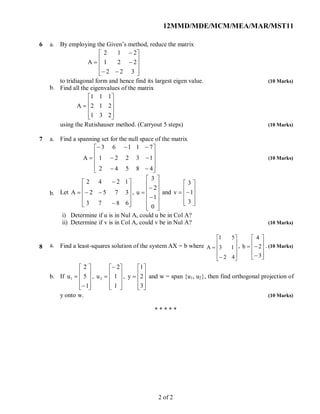
  • 35.
    First Semester M.Tech.Degree Examination, June/July 2013 Applied Mathematics Time: 3 hrs. Max. Marks:100 Note: Answer any FIVE full questions. 1 a. b. Explain in brief: i) Inherent errors ii) Rounding errors iii) Truncation errors iv) Absolute, relative and percentage errors. (10 Marks) If 3 2 z xy4 f  and the errors in x, y, z are 0.001, find the maximum relative error in f at x = y = z = 1. (10 Marks) 2 a. b. Explain secant method for finding a root of the equation f(x) = 0. By using the Regula-Falsi method, find the root of the equation 2.1xlogx 10  that lies between 2 and 3. (10 Marks) Find the multiple root of the equation 064x16x36x11x 234  , that lies near 3.9. (10 Marks) 3 a. b. Find two iterations of the Muller method to find the root of the equation 01x5x)x(f 3  in (0, 1). (10 Marks) Perform two iterations of the Bairstow method to extract a quadratic factor qpxx2  from the polynomial 060x40x20x5x 234  , use the initial approximations p0 = 4, q0 = 8. (10 Marks) 4 a. b. From the following data obtain the first and second derivatives of xlogy e i) at x = 500, ii) at x = 550. (10 Marks) Evaluate the integral        5.0 0 dx xsin x using Romberg’s method, correct to three decimal places. (10 Marks) 5 a. b. Use Cholesky’s method to solve the system 1zyx  5z3yx3  10z5y2x  (10 Marks) Using the partition method, solve the system of equations: 4z3y4x2  1zy  2zy2x2  (10 Marks) 1 of 2 ImportantNote:1.Oncompletingyouranswers,compulsorilydrawdiagonalcrosslinesontheremainingblankpages. 2.Anyrevealingofidentification,appealtoevaluatorand/orequationswritteneg,42+8=50,willbetreatedasmalpractice. USN 12MMD/MDE/MCM/MEA/MAR/MST11
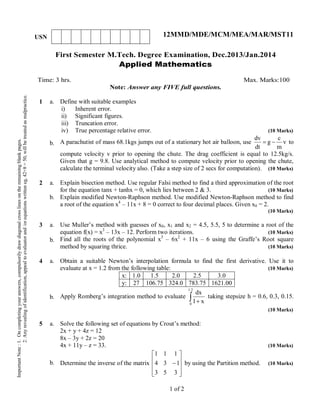
  • 36.
    12MMD/MDE/MCM/MEA/MAR/MST11 6 a. b. By employingthe Given’s method, reduce the matrix               322 221 212 A to tridiagonal form and hence find its largest eigen value. (10 Marks) Find all the eigenvalues of the matrix            231 212 111 A using the Rutishauser method. (Carryout 5 steps) (10 Marks) 7 a. b. Find a spanning set for the null space of the matrix               48542 13221 71163 A (10 Marks) Let               6873 3752 1242 A ,                0 1 2 3 u and            3 1 3 v i) Determine if u is in Nul A, could u be in Col A? ii) Determine if v is in Col A, could v be in Nul A? (10 Marks) 8 a. b. Find a least-squares solution of the system AX = b where             42 13 51 A ,             3 2 4 b . (10 Marks) If             1 5 2 u1 ,            1 1 2 u2 ,            3 2 1 y and w = span {u1, u2}, then find orthogonal projection of y onto w. (10 Marks) * * * * * 2 of 2
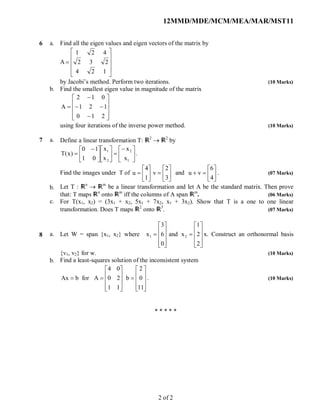
  • 37.
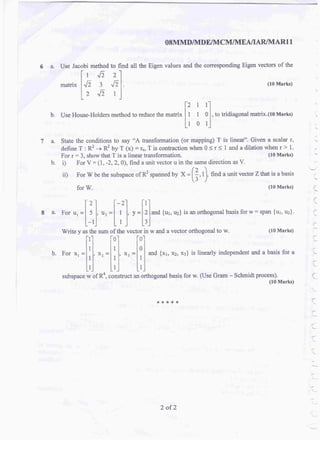
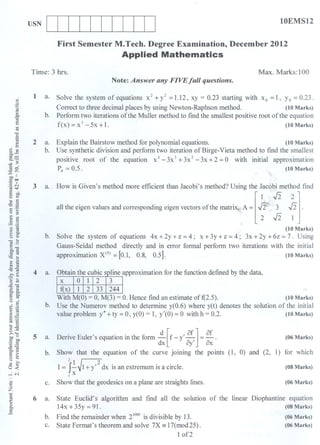
    First Semester M.Tech.Degree Examination, Dec.2013/Jan.2014 Applied Mathematics Time: 3 hrs. Max. Marks:100 Note: Answer any FIVE full questions. 1 a. b. Define with suitable examples i) Inherent error. ii) Significant figures. iii) Truncation error. iv) True percentage relative error. (10 Marks) A parachutist of mass 68.1kgs jumps out of a stationary hot air balloon, use v m c g dt dv  to compute velocity v prior to opening the chute. The drag coefficient is equal to 12.5kg/s. Given that g = 9.8. Use analytical method to compute velocity prior to opening the chute, calculate the terminal velocity also. (Take a step size of 2 secs for computation). (10 Marks) 2 a. b. Explain bisection method. Use regular Falsi method to find a third approximation of the root for the equation tanx + tanhx = 0, which lies between 2 & 3. (10 Marks) Explain modified Newton-Raphson method. Use modified Newton-Raphson method to find a root of the equation x4 – 11x + 8 = 0 correct to four decimal places. Given x0 = 2. (10 Marks) 3 a. b. Use Muller’s method with guesses of x0, x1 and x2 = 4.5, 5.5, 5 to determine a root of the equation f(x) = x3 – 13x – 12. Perform two iterations. (10 Marks) Find all the roots of the polynomial x3 – 6x2 + 11x – 6 using the Graffe’s Root square method by squaring thrice. (10 Marks) 4 a. b. Obtain a suitable Newton’s interpolation formula to find the first derivative. Use it to evaluate at x = 1.2 from the following table: (10 Marks) x: 1.0 1.5 2.0 2.5 3.0 y: 27 106.75 324.0 783.75 1621.00 Apply Romberg’s integration method to evaluate   2.1 0 x1 dx taking stepsize h = 0.6, 0.3, 0.15. (10 Marks) 5 a. b. Solve the following set of equations by Crout’s method: 2x + y + 4z = 12 8x – 3y + 2z = 20 4x + 11y – z = 33. (10 Marks) Determine the inverse of the matrix            353 134 111 by using the Partition method. (10 Marks) 1 of 2 ImportantNote:1.Oncompletingyouranswers,compulsorilydrawdiagonalcrosslinesontheremainingblankpages. 2.Anyrevealingofidentification,appealtoevaluatorand/orequationswritteneg,42+8=50,willbetreatedasmalpractice. USN 12MMD/MDE/MCM/MEA/MAR/MST11
  • 38.
    12MMD/MDE/MCM/MEA/MAR/MST11 6 a. b. Find allthe eigen values and eigen vectors of the matrix by A            124 232 421 by Jacobi’s method. Perform two iterations. (10 Marks) Find the smallest eigen value in magnitude of the matrix               210 121 012 A using four iterations of the inverse power method. (10 Marks) 7 a. b. c. Define a linear transformation T: 2  2 by                     1 2 2 1 x x x x 01 10 )x(T . Find the images under T of              3 2 v 1 4 u and        4 6 vu . (07 Marks) Let T : n  m be a linear transformation and let A be the standard matrix. Then prove that: T maps n onto m iff the columns of A span m . (06 Marks) For T(x1, x2) = (3x1 + x2, 5x1 + 7x2, x1 + 3x2). Show that T is a one to one linear transformation. Does T maps 2 onto 3 . (07 Marks) 8 a. b. Let W = span {x1, x2} where                       2 2 1 xand 0 6 3 x 21 x. Construct an orthonormal basis {v1, v2} for w. (10 Marks) Find a least-squares solution of the inconsistent system                       11 0 2 b 11 20 04 AforbAx . (10 Marks) * * * * * 2 of 2