
1ST MATERIAL

 GERUND &
 INFINITIVE
 Yudhie Indra G S.Pd
STANDARD COMPETENCY
   This course aims at able to understand some
    english structure for their use and form
    correctly.
BASIC COMPETENCY
Students understand the usage of gerund and
infinitives.
INDICATOR
Students can differenciate gerund and infinitives
LEARNING ACTIVITY


A.
GERUND
B.
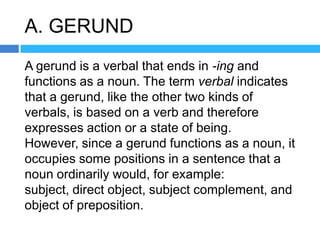
A. GERUND
A gerund is a verbal that ends in -ing and
functions as a noun. The term verbal indicates
that a gerund, like the other two kinds of
verbals, is based on a verb and therefore
expresses action or a state of being.
However, since a gerund functions as a noun, it
occupies some positions in a sentence that a
noun ordinarily would, for example:
subject, direct object, subject complement, and
object of preposition.
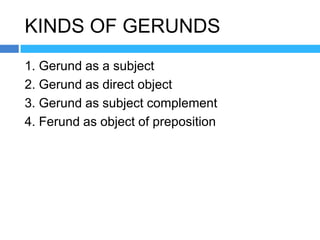
KINDS OF GERUNDS
1. Gerund as a subject
2. Gerund as direct object
3. Gerund as subject complement
4. Ferund as object of preposition
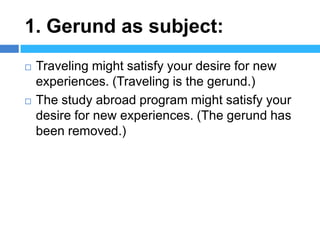
1. Gerund as subject:
   Traveling might satisfy your desire for new
    experiences. (Traveling is the gerund.)
   The study abroad program might satisfy your
    desire for new experiences. (The gerund has
    been removed.)
2. Gerund as direct object
   They do not appreciate my singing. (The
    gerund is singing.)
   They do not appreciate my assistance. (The
    gerund has been removed)
3. Gerund as subject
complement
   My cat's favorite activity is sleeping. (The
    gerund is sleeping.)
   My cat's favorite food is salmon. (The gerund
    has been removed.)
4. Gerund as object of
preposition
   The police arrested him for speeding. (The
    gerund is speeding.)
   The police arrested him for criminal activity.
    (The gerund has been removed.)
B. INFINITIVE
An infinitive is a verbal consisting of the word to
plus a verb (in its simplest "stem" form) and
functioning as a noun, adjective, or adverb. The
term verbal indicates that an infinitive, like the
other two kinds of verbals, is based on a verb
and therefore expresses action or a state of
being. However, the infinitive may function as a
subject, direct object, subject
complement, adjective, or adverb in a sentence.
Although an infinitive is easy to locate because
of the to + verb form, deciding what function it
has in a sentence can sometimes be confusing.
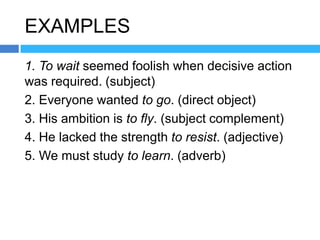
EXAMPLES
1. To wait seemed foolish when decisive action
was required. (subject)
2. Everyone wanted to go. (direct object)
3. His ambition is to fly. (subject complement)
4. He lacked the strength to resist. (adjective)
5. We must study to learn. (adverb)
That is the end of my presentation.
   Thank you for your attention


                         nice to have been
                           with you today,
                             Good Luck
                         And see you again
LONG..TOLOOOOONG

1st gerund and invinitive

  • 1.
    1ST MATERIAL GERUND& INFINITIVE Yudhie Indra G S.Pd
  • 2.
    STANDARD COMPETENCY  This course aims at able to understand some english structure for their use and form correctly.
  • 3.
    BASIC COMPETENCY Students understandthe usage of gerund and infinitives.
  • 4.
  • 5.
  • 6.
    A. GERUND A gerundis a verbal that ends in -ing and functions as a noun. The term verbal indicates that a gerund, like the other two kinds of verbals, is based on a verb and therefore expresses action or a state of being. However, since a gerund functions as a noun, it occupies some positions in a sentence that a noun ordinarily would, for example: subject, direct object, subject complement, and object of preposition.
  • 7.
    KINDS OF GERUNDS 1.Gerund as a subject 2. Gerund as direct object 3. Gerund as subject complement 4. Ferund as object of preposition
  • 8.
    1. Gerund assubject:  Traveling might satisfy your desire for new experiences. (Traveling is the gerund.)  The study abroad program might satisfy your desire for new experiences. (The gerund has been removed.)
  • 9.
    2. Gerund asdirect object  They do not appreciate my singing. (The gerund is singing.)  They do not appreciate my assistance. (The gerund has been removed)
  • 10.
    3. Gerund assubject complement  My cat's favorite activity is sleeping. (The gerund is sleeping.)  My cat's favorite food is salmon. (The gerund has been removed.)
  • 11.
    4. Gerund asobject of preposition  The police arrested him for speeding. (The gerund is speeding.)  The police arrested him for criminal activity. (The gerund has been removed.)
  • 12.
    B. INFINITIVE An infinitiveis a verbal consisting of the word to plus a verb (in its simplest "stem" form) and functioning as a noun, adjective, or adverb. The term verbal indicates that an infinitive, like the other two kinds of verbals, is based on a verb and therefore expresses action or a state of being. However, the infinitive may function as a subject, direct object, subject complement, adjective, or adverb in a sentence. Although an infinitive is easy to locate because of the to + verb form, deciding what function it has in a sentence can sometimes be confusing.
  • 13.
    EXAMPLES 1. To waitseemed foolish when decisive action was required. (subject) 2. Everyone wanted to go. (direct object) 3. His ambition is to fly. (subject complement) 4. He lacked the strength to resist. (adjective) 5. We must study to learn. (adverb)
  • 14.
    That is theend of my presentation. Thank you for your attention nice to have been with you today, Good Luck And see you again
  • 15.