Genetics
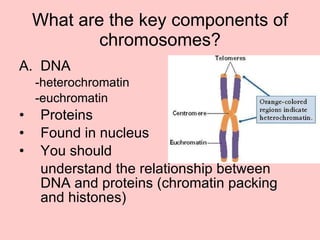
What are the key components of chromosomes? DNA -heterochromatin -euchromatin Proteins Found in nucleus You should understand the relationship between DNA and proteins (chromatin packing and histones)
Key terms Eukaryotic chromosomes-made of DNA and proteins (histones) Gene-heritable factor that controls specific characteristics -made up of a length of DNA, found on a specific chromosome location (a locus) C. Allele-one specific form of a gene (all found at the same locus) -Example: Everyone has the gene for eye color.  The possible alleles are blue, brown, green, etc.
More Key Terms D. Genome-total genetic material of an organism or species  (Example:  The Human Genome) E. Gene pool-total of all genes carried by individuals in a population
Mutations Chromosome mutations-involve large sections of chromosomes (or the whole thing) -Ex:  Down’s syndrome, Turner’s syndrome
B. Gene mutation-involves changes in single base pairs -Some mutations may not have any effect on the cell and may involve: 1. part of the sense strand of DNA  which is  not transcribed 2. part of the DNA that a cell does not use 3. changes in second or third bases of a  codon (since the genetic code is degenerate  the same base may still be coded for) Mutations
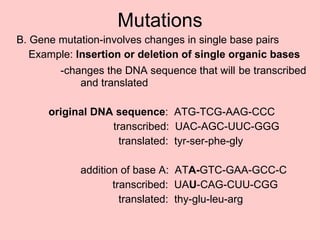
Mutations B. Gene mutation-involves changes in single base pairs Example:  Insertion or deletion of single organic bases   -changes the DNA sequence that will   be transcribed  and translated original DNA sequence :  ATG-TCG-AAG-CCC   transcribed:  UAC-AGC-UUC-GGG   translated:  tyr-ser-phe-gly addition of base A:  AT A- GTC-GAA-GCC-C transcribed:  UA U -CAG-CUU-CGG   translated:  thy-glu-leu-arg
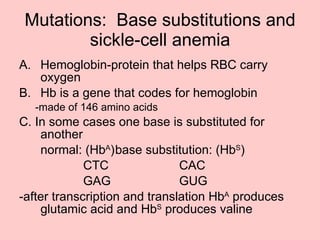
Hemoglobin-protein that helps RBC carry oxygen Hb is a gene that codes for hemoglobin -made of 146 amino acids C. In some cases one base is substituted for another normal: (Hb A ) base substitution: (Hb S )  CTC CAC GAG GUG -after transcription and translation Hb A  produces glutamic acid and Hb S  produces valine Mutations:  Base substitutions and sickle-cell anemia
D. The altered hemoglobin Hb S  is crystalline at low oxygen levels causing the RBC to become sickled and less efficient at oxygen transport E. Symptoms of sickle cell anemia -physical weakness -heart or/and kidney damage -death  Mutations:  base substitutions and sickle-cell anemia
F. In heterozygous people (one normal allele and one sickle cell allele) -the alleles are codominant, but the normal allele is expressed more strongly -in codominance both alleles are expressed (one is  not dominant to the other) -some sickled cells present, but most are normal -some people show mild anemia (deficiency of the hemoglobin, often accompanied by a reduced number of red blood cells and causing paleness, weakness, and breathlessness)  Mutations:  base substitutions and sickle-cell anemia
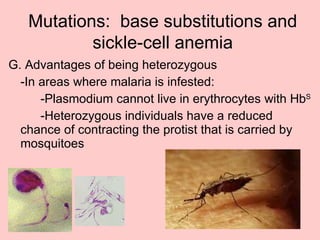
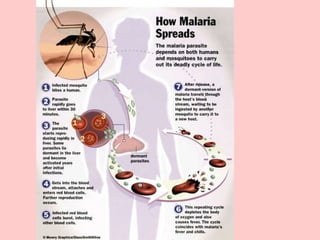
G. Advantages of being heterozygous -In areas where malaria is infested: -Plasmodium cannot live in erythrocytes  with Hb S -Heterozygous individuals have a reduced  chance of contracting the protist that is carried by  mosquitoes Mutations:  base substitutions and sickle-cell anemia
 
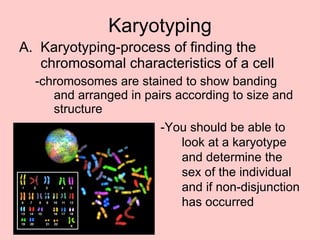
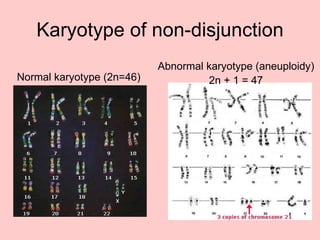
Karyotyping Karyotyping-process of finding the chromosomal characteristics of a cell -chromosomes are stained to show banding and arranged in pairs according to size and structure -You should be able to look at a karyotype and determine the sex of the individual and if non-disjunction has occurred
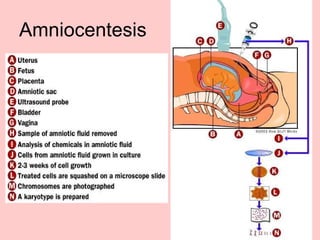
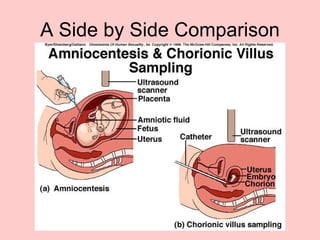
Amniocentesis and karyotyping Amniocentesis -performed at around 16 wks -sample of amniotic fluid is taken and cultured -when there are enough cells, a karyotype can be performed -chromosomes are arranged into pairs to detect any abnormalities -can be used to detect Down’s syndrome (a.k.a. trisomy 21)  -can be used to recognize sex or non-disjunction
Amniocentesis
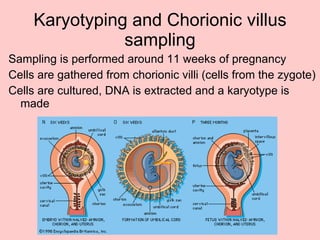
Karyotyping and Chorionic villus sampling Sampling is performed around 11 weeks of pregnancy Cells are gathered from chorionic villi (cells from the zygote) Cells are cultured, DNA is extracted and a karyotype is made
A Side by Side Comparison
Meiosis Key Terms Diploid-having two sets of chromosomes Homologous chromosomes-matching pairs of chromosomes -have the same genes -are not identical (one chromosome comes from each parent, thus alleles may be different) -found in diploid cells C. Haploid-having only one set of chromosomes
More Meiosis Terms D. Chromatids -two parts of a chromosome E. Centromere -part of a chromosome that connects the chromatids F. Reduction division-in organisms that reproduce sexually  -reduction of the number of chromosomes by half (from a diploid nucleus to a haploid nucleus) -think of eggs and sperm; both are haploid (when they unite the diploid number is restored)
Meiosis B. Produces gametes (sperm and egg) C. Overview 1. homologous chromosomes pair (diploid) 2. two divisions (meiosis I and meiosis II) 3. result=4 haploid cells D. When gametes unite (to produce a diploid cell) a cell with homologous pairs is created -one set of chromosomes is from the mom  and one set of chromosome is from the dad
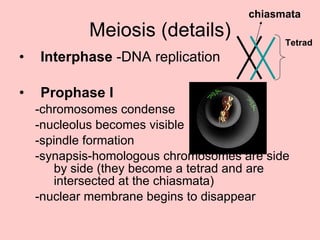
Meiosis (details) Interphase  -DNA replication Prophase I -chromosomes condense -nucleolus becomes visible -spindle formation -synapsis-homologous chromosomes are side by side (they become a tetrad and are intersected at the chiasmata) -nuclear membrane begins to disappear chiasmata Tetrad
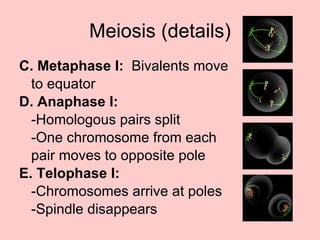
C. Metaphase I:   Bivalents move  to equator D. Anaphase I:   -Homologous pairs split -One chromosome from each  pair moves to opposite pole E. Telophase I: -Chromosomes arrive at poles -Spindle disappears Meiosis (details)
F. Prophase II  – new spindle is formed at right angles to the previous spindle G. Metaphase II  – Chromosomes move to equator H. Anaphase II –  -Chromosomes separate -Chromatids move to opposite poles Meiosis (details)
I. Telophase II -Chromosomes arrive at poles -Spindle disappears -Nuclear membrane reappears -Nucleolus becomes visible -Chromosomes become chromatin -Cytokinesis Meiosis (details)
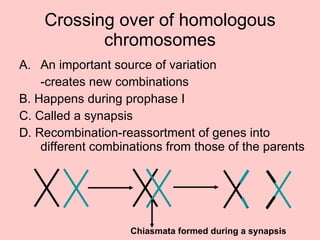
An important source of variation -creates new combinations B. Happens during prophase I  C. Called a synapsis D. Recombination-reassortment of genes into different combinations from those of the parents Crossing over of homologous chromosomes Chiasmata formed during a synapsis
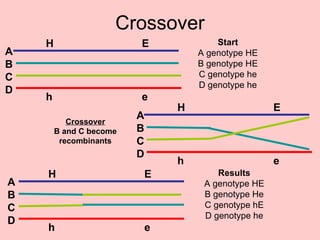
Crossover Results A genotype HE B genotype He C genotype hE D genotype he Start A genotype HE B genotype HE C genotype he D genotype he Crossover B and C become recombinants A B C D H E h e A B C D H E h e A B C D H E h e
Meiosis and genetic variation The number of possible gametes produced by random orientation of chromosomes is 2 n  (where n is = to the haploid number of chromosomes) In humans the production of 1 gamete has over 8 million possible combinations (2 23) C. Recombination (in prophase I) + Random orientation of chromosomes (in metaphase I) = an infinite number of variations
Meiosis and Non-disjunction Disjunction  - when the homologous chromosomes separate in anaphase I Aneuploidy  -happens when chromosomes do not separate (in anaphase I or II) -caused by non-disjunction -result:  one cell missing a chromosome and one cell having an extra chromosome -Total number of chromosomes = 2n  ± 1 C. Polyploidy- having more than two complete sets of chromosomes (common in plants)
Karyotype of non-disjunction Normal karyotype (2n=46) Abnormal karyotype (aneuploidy) 2n + 1 = 47
Non-disjunction and Down’s syndrome One of the parent gametes contains two copies of chromosome 21 The zygote then ends up with 3 copies -2 from one parent -1 from the other C. Down’s syndrome = trisomy 21 D. Chances of non-disjunction of chromosomes increases with age in females (in males too, but less of an effect)
Non-disjunction and Down’s syndrome E. Female age has a greater effect because: -gametes are produced before birth -more exposure to chemicals, radiation, etc. F. Male age has less effect because they do not produce gametes until puberty G. Genetics may also increase the likelihood of having a child with Down’s syndrome
Theoretical Genetics Key Terms Dominant allele-the allele that always shows in the heterozygous state (Example:  Bb=brown) Recessive allele-the allele that only shows in the homozygous recessive state (Example:  bb=blue) Codominant alleles-pairs of alleles where two differing alleles are shown in the phenotype in a heterozygote Homozygous -having two identical alleles of a gene (Example:  BB or bb) Heterozygous -having two different alleles of a gene (Example: Bb)
More Vocabulary F. Carrier- a person who has a recessive allele, but does not express it (they are generally heterozygous, Bb) G. Genotype-alleles that a person has (the letters) Ex:  Bb H. Phenotype- the physical characteristics the a person shows (caused by the genotype) Ex:  brown hair or blue eyes I. Test cross- crossing two or more genotypes to find the possible genetic outcomes
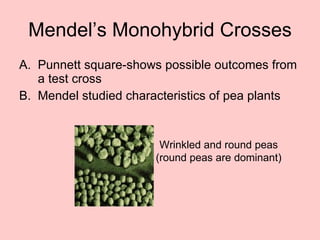
Mendel’s Monohybrid Crosses Punnett square-shows possible outcomes from a test cross Mendel studied characteristics of pea plants Wrinkled and round peas (round peas are dominant)
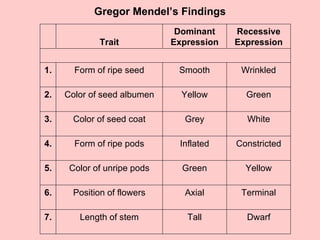
Gregor Mendel’s Findings Dwarf Tall Length of stem 7. Terminal Axial Position of flowers 6. Yellow Green Color of unripe pods 5. Constricted Inflated Form of ripe pods 4. White Grey Color of seed coat 3. Green Yellow Color of seed albumen 2. Wrinkled Smooth Form of ripe seed 1. Recessive Expression Dominant Expression Trait
Mendel’s Monohybrid Crosses C. Mendel found tall is dominant over short D. His procedures were: 1. Start with 2 pure breeding homozygous plants (This is the P generation.) -Plant 1=tall (TT) -Plant 2= short (tt) 2. Cross-breed the plants  -Place pollen from the tall plant in the short  plant and vice versa.
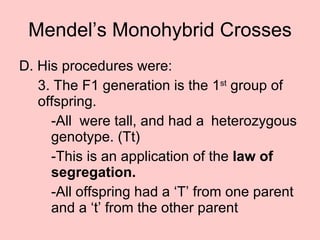
Mendel’s Monohybrid Crosses D. His procedures were: 3. The F1 generation is the 1 st  group of offspring. -All  were tall, and had a  heterozygous  genotype. (Tt) -This is an application of the  law of  segregation.   -All offspring had a ‘T’ from one parent  and a ‘t’ from the other parent
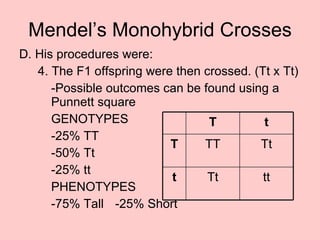
Mendel’s Monohybrid Crosses D. His procedures were: 4. The F1 offspring were then crossed. (Tt x Tt) -Possible outcomes can be found using a  Punnett square GENOTYPES -25% TT -50% Tt -25% tt PHENOTYPES -75% Tall -25% Short tt Tt t Tt TT T t T
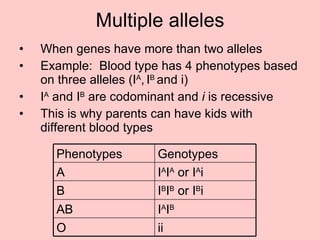
Multiple alleles When genes have more than two alleles Example:  Blood type has 4 phenotypes based on three alleles (I A ,   I B  and i) I A  and I B  are codominant and  i  is recessive This is why parents can have kids with different blood types ii O I A I B AB I B I B  or I B i B I A I A  or I A i A Genotypes Phenotypes
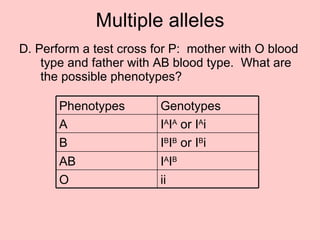
Multiple alleles D. Perform a test cross for P:  mother with O blood type and father with AB blood type.  What are the possible phenotypes? ii O I A I B AB I B I B  or I B i B I A I A  or I A i A Genotypes Phenotypes
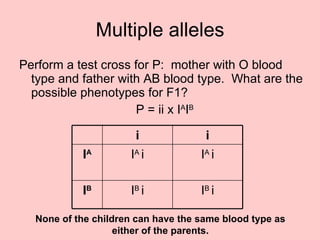
Perform a test cross for P:  mother with O blood type and father with AB blood type.  What are the possible phenotypes for F1?   P = ii x I A I B  Multiple alleles None of the children can have the same blood type as either of the parents. I B  i I B  i I B I A  i I A  i I A i i
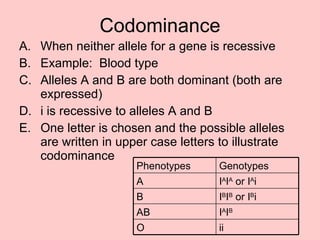
Codominance When neither allele for a gene is recessive Example:  Blood type Alleles A and B are both dominant (both are expressed) i is recessive to alleles A and B One letter is chosen and the possible alleles are written in upper case letters to illustrate codominance ii O I A I B AB I B I B  or I B i B I A I A  or I A i A Genotypes Phenotypes
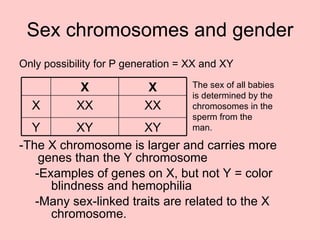
Sex chromosomes and gender Only possibility for P generation = XX and XY -The X chromosome is larger and carries more genes than the Y chromosome  -Examples of genes on X, but not Y = color blindness and hemophilia -Many sex-linked traits are related to the X chromosome. The sex of all babies is determined by the chromosomes in the sperm from the man. XY XY Y XX XX X X X
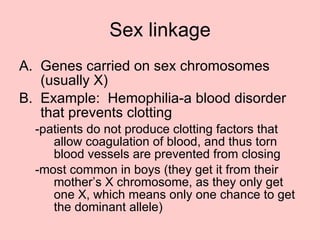
Sex linkage Genes carried on sex chromosomes (usually X) Example:  Hemophilia-a blood disorder that prevents clotting -patients do not produce clotting factors that allow coagulation of blood, and thus torn blood vessels are prevented from closing -most common in boys (they get it from their mother’s X chromosome, as they only get one X, which means only one chance to get the dominant allele)
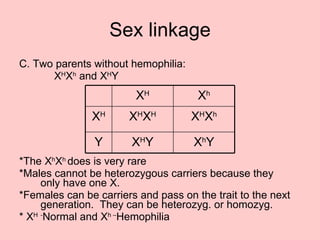
Sex linkage C. Two parents without hemophilia:   X H X h  and X H Y *The X h X h  does is very rare *Males cannot be heterozygous carriers because they only have one X. *Females can be carriers and pass on the trait to the next generation.  They can be heterozyg. or homozyg. * X H - Normal and X h – Hemophilia X h Y X H Y Y X H X h X H X H X H X h X H
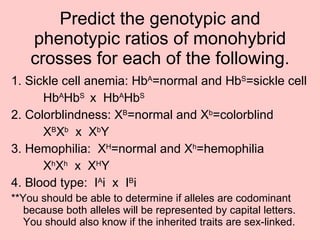
Predict the genotypic and phenotypic ratios of monohybrid crosses for each of the following. 1. Sickle cell anemia: Hb A =normal and Hb S =sickle cell Hb A Hb S  x  Hb A Hb S 2. Colorblindness: X B =normal and X b =colorblind X B X b   x  X b Y 3. Hemophilia:  X H =normal and X h =hemophilia X h X h   x  X H Y 4. Blood type:  I A i  x  I B i **You should be able to determine if alleles are codominant because both alleles will be represented by capital letters.  You should also know if the inherited traits are sex-linked.
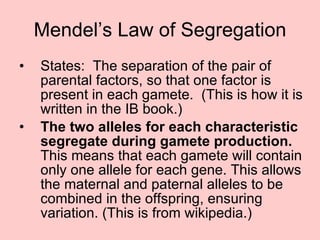
Mendel’s Law of Segregation States:  The separation of the pair of parental factors, so that one factor is present in each gamete.  (This is how it is written in the IB book.) The two alleles for each characteristic segregate during gamete production.  This means that each gamete will contain only one allele for each gene. This allows the maternal and paternal alleles to be combined in the offspring, ensuring variation. (This is from wikipedia.)
Mendel’s Law of Segregation and Meiosis Mendel looked at genes (on chromosomes) Found that each gene appeared twice (in homologous pairs) Figured out that when a synapsis occurs in prophase I followed by a separation in anaphase I, homologous chromosomes move to opposite poles One chromosome from each pair ends up in a gamete
Mendel’s Law of Independent Assortment States that allele pairs separate independently during the formation of gametes  Any one pair of characteristics may combine with any one of another pair of characteristics See p. 163 in Green Book
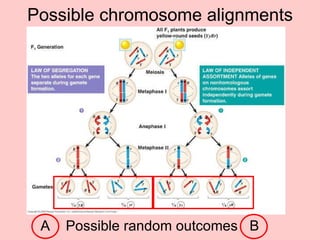
Independent assortment and meiosis Any combination of chromosomes is possible in metaphase I (there is no ‘master plan’ for the order that they line up on the metaphase plate before separation) Mendel thought all genes were inherited separately and had no relationship -Ex:  Pea plants could be green or yellow and wrinkled or round.  Shape and color had nothing to do with each other, because the genes are on separate chromosomes.  Any combination could have been produced (wrinkled/green, wrinkled/yellow, round/green, round yellow) C. This is demonstrated in Dihybrid crosses. D.  Today we realize that there are many exceptions to this law.
Possible chromosome alignments A  Possible random outcomes  B
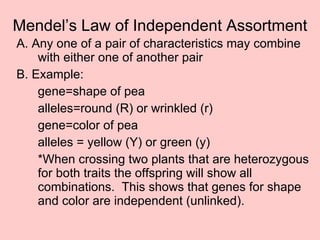
Mendel’s Law of Independent Assortment A. Any one of a pair of characteristics may combine with either one of another pair B. Example: gene=shape of pea alleles=round (R) or wrinkled (r) gene=color of pea alleles = yellow (Y) or green (y) *When crossing two plants that are heterozygous for both traits the offspring will show all combinations.  This shows that genes for shape and color are independent (unlinked).
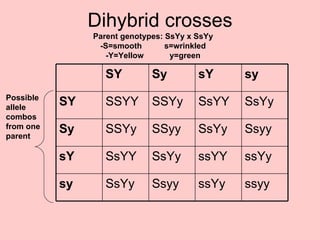
Dihybrid crosses Parent genotypes: SsYy x SsYy -S=smooth s=wrinkled -Y=Yellow y=green Possible allele combos from one parent ssyy ssYy Ssyy SsYy sy ssYy ssYY SsYy SsYY sY Ssyy SsYy SSyy SSYy Sy SsYy SsYY SSYy SSYY SY sy sY Sy SY
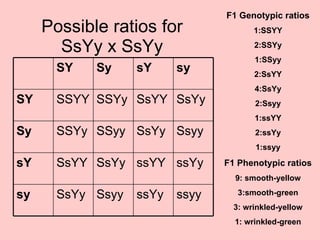
Possible ratios for SsYy x SsYy F1 Genotypic ratios 1:SSYY 2:SSYy 1:SSyy 2:SsYY 4:SsYy 2:Ssyy 1:ssYY 2:ssYy 1:ssyy F1 Phenotypic ratios 9: smooth-yellow 3:smooth-green 3: wrinkled-yellow 1: wrinkled-green ssyy ssYy Ssyy SsYy sy ssYy ssYY SsYy SsYY sY Ssyy SsYy SSyy SSYy Sy SsYy SsYY SSYy SSYY SY sy sY Sy SY
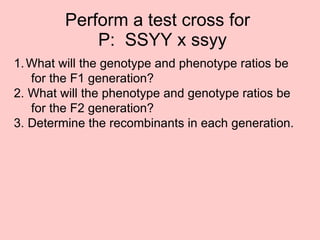
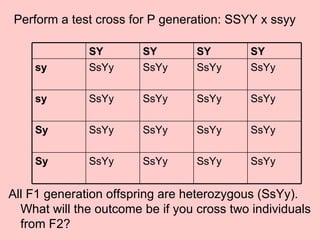
Perform a test cross for   P:  SSYY x ssyy What will the genotype and phenotype ratios be  for the F1 generation? 2. What will the phenotype and genotype ratios be  for the F2 generation? 3. Determine the recombinants in each generation.
Perform a test cross for P generation: SSYY x ssyy All F1 generation offspring are heterozygous (SsYy).  What will the outcome be if you cross two individuals from F2?  SsYy SsYy SsYy SsYy Sy SsYy SsYy SsYy SsYy Sy SsYy SsYy SsYy SsYy sy SsYy SsYy SsYy SsYy sy SY SY SY SY
Autosomal Gene Linkage Autosome  -all chromosomes that are not sex chromosomes Sex chromosomes  -determine if an individual is male or female Linkage group  -a group of genes whose loci are on the same chromosome Gene linkage is caused by pairs of genes being inherited together.  The presence or absence of one can affect the other.
Autosomal Gene Linkage In gene linkage, all of the genes on a chromosome are inherited together Does not apply to Mendel’s law of independent assortment The closer the loci of the two genes on the chromosome, the smaller the chance that crossing over will occur in a chiasmata If no info. is given, assume the genes are not linked
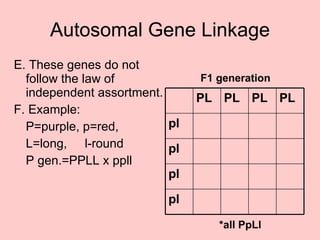
Autosomal Gene Linkage E. These genes do not follow the law of independent assortment. F. Example:  P=purple, p=red,  L=long,    l-round P gen.=PPLL x ppll F1 generation *all PpLl pl pl pl pl PL PL PL PL
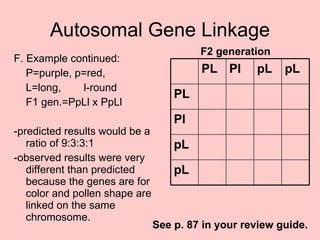
Autosomal Gene Linkage F. Example continued:  P=purple, p=red,  L=long,    l-round F1 gen.=PpLl x PpLl -predicted results would be a ratio of 9:3:3:1 -observed results were very different than predicted because the genes are for color and pollen shape are linked on the same chromosome. F2 generation See p. 87 in your review guide. pL pL Pl PL pL pL Pl PL
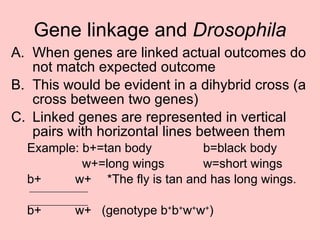
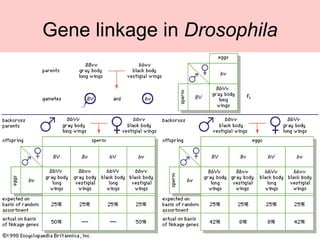
Gene linkage and  Drosophila When genes are linked actual outcomes do not match expected outcome  This would be evident in a dihybrid cross (a cross between two genes) Linked genes are represented in vertical pairs with horizontal lines between them Example: b+=tan body b=black body   w+=long wings w=short wings b+ w+ *The fly is tan and has long wings. b+ w+  (genotype b + b + w + w + )
Gene linkage in  Drosophila
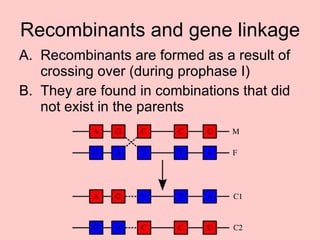
Recombinants and gene linkage Recombinants are formed as a result of crossing over (during prophase I) They are found in combinations that did not exist in the parents
Poly genic Inheritance When the inheritance/expression of a characteristic is controlled by  more than one gene Example:  Human skin color -involves at least 3  independent  genes -A, B and C represent alleles for dark -a, b and c represent alleles for light skin -P:  AABBCC x aabbcc -F1: AaBbCc (all are heterozygous for all alleles) -F2:???
Polygenic Inheritance B. Example:  Human skin color -F2:??? -to find out you can make a Punnett square -The more dominant alleles there are, the darker the skin -Dominant alleles are codominant (they are all expressed)
Polygenic inheritance (Other traits) Height Eye color Finger prints
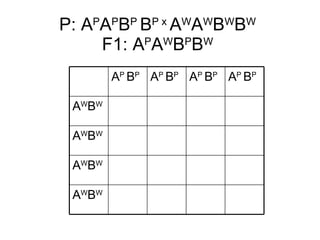
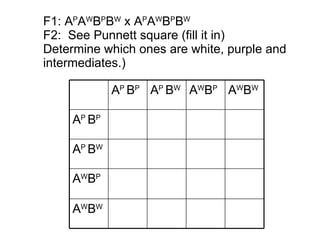
Polygenic Inheritance Example:  Flower color of beans -Genes A and B control color expression -A P  and B P  = purple  -A W  and B W  = white -Each color has two alleles -Purple and white are codominant -Because of the codominance the flowers will be shaded depending on their genotypes
P: A P A P B P  B P x  A W A W B W B W   F1: A P A W B P B W   A W B W A W B W A W B W A W B W A P  B P A P  B P A P  B P A P  B P
F1: A P A W B P B W  x A P A W B P B W F2:  See Punnett square (fill it in) Determine which ones are white, purple and intermediates.) A W B W A W B P A P  B W A P  B P A W B W A W B P A P  B W A P  B P
Polygenic inheritance and variation patterns Two patterns are commonly expressed  Continuous variation – shows a continuum of variation among a population in a bell curve format - Example:  In height expression people can be short, medium or tall (and everything in between) B. Discontinuous variation – does not show a continuum (it is one or the other, there is no in-between expression of phenotype) - Example:  Blood type can be A, B, AB or O (nothing in between)
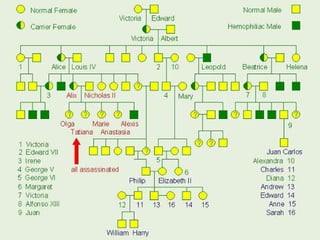
Pedigree Charts Used to show inheritance of traits over several generations Affected individuals-shaded black Unaffected individuals- left blank Heterozygous individuals (carriers)-shaded grey or filled in half way Example:  Queen Victoria and hemophilia (recessive/sex-linked)
 
PCR PCR=polymerase chain reaction PCR=DNA photocopier Used to make copies of specific DNA sequences (for study)
How a PCR works DNA is heated (H bonds are broken) RNA primers are added to start replication As the DNA cools primers bind to the single strands (H bonds and complementary base pairing) Nucleotides and DNA polymerase are added
How PCR works 5. Nucleotides bond with ‘exposed’ bases on the DNA strand 6. DNA polymerase joins them 7. Complimentary strands are formed 8. New strands can be heated, separated and copied 9. Animation
Gel electrophoresis Technique used to separate molecules base on their rates of movement in an electric field -caused by charge and size of molecules B. Commonly used in DNA profiling
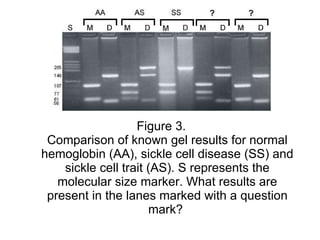
Gel electrophoresis and DNA profiling Scientists cut a mixture of DNA into segments by restriction enzymes Place into a special gel with a current running through it DNA separates into bands according to size Mixture is compared to a control group  The more similar the DNA strands are the more closely they are related See p. 30 in review guide or p. 66 in IB textbook for examples
Figure 3. Comparison of known gel results for normal hemoglobin (AA), sickle cell disease (SS) and sickle cell trait (AS). S represents the molecular size marker. What results are present in the lanes marked with a question mark?
Application of DNA profiling Criminal investigations -collect blood or semen from suspect -if enough is not present use PCR -compare gel electrophoresis of suspect and victim B. Indentify remains of deceased -take blood samples of living -compare with samples from dead C. Paternal tests
Genetic screening Test individuals in a population for presence of absence of a gene or allele
Genetic Screening B. Advantages: pre-natal diagnostics (seek treatment or abortion) Ex:  PKU or down’s syndrome Reduce frequency of alleles that cause genetic illnesses (opt to not reproduce or use IVF and select embyros without genetic defect) Genetic diseases that show symptoms in later life can be detected earlier (Ex:  Huntington’s disease)
Genetic Screening C. Disadvantages: 1. Increased abortion rate 2. Harmful psychological effects  -could lead to discrimination (when  seeking insurance or medical assistance) -fear of getting older (depression) -creates a genetic ‘underclass’
Human Genome Project An international cooperative venture established to sequence the complete human genome Hope to determine the location and structure of all genes in the human chromosomes Genome-total genetic material of a cell Completed in 2000 (about 10 years early)
Advantages of the Human Genome Project Understand genetic diseases Figure out if any of them can be prevented though screening -could also be negative (in terms of insurance or employers) May lead to development of pharmaceuticals Insight into evolution and migration patterns
Genetic Modification Deliberate manipulation of genetic material Genetic code is universal  -it can be transferred between organisms because the bases are the same C. Used to create new combinations of DNA D. Mutation and recombination occur naturally (often are disadvantageous and do not remain in the population)
Genetic Modification E. Genetic engineers direct the process of recombination  -increase chances of favorable combinations
Technique for gene transfer Example-insulin production Must have a vector (bacteriophage), a host (bacteria), restriction enzymes and DNA ligase Plasmids (small circular DNA from bacteria) are cut using restriction enzymes Sticky ends are created by adding C nucleotides
Technique for gene transfer Example-insulin production D. mRNA that codes for insulin is extracted from the pancreas E.  Reverse transcriptase  makes DNA from the mRNA F. Sticky ends are creating by adding G nucleotides G. Insulin gene and plamsid are mixed H. They join together at the sticky ends (C pairs with G)
Technique for gene transfer Example-insulin production I. Plasmid with the human insulin gene is called a recombinant J. Host cell (usually  E. coli ) receives the gene K.  E. coli  are cultured w/ new gene L. Insulin produced by modified E. coli is extracted and eventually given to diabetics
Other examples of genetic modification Insulin production in E. coli (discussed above) Bacteria can be modified to produce growth hormone for cows -cows injected with hormone increase milk production by 10-20% C. Breeding of plants to increase disease resistance D. Dog breeding
Benefits of genetic modification Less disease (possibly) -long term effects are unknown B. More product -Ex:  milk C. Some are beneficial with no know side effects -Ex:  Insulin production
Negative aspects of genetic modification Introducing plasmids -hospitals fear them -can carry genes for antibiotic resistance -can be passed from one species to another B. Don’t know long term effects (Example) -effects of using growth hormone in cows is unknown (some could be in our food) -cows needs extra antibiotics to stay healthy (we get these too) C. Could create super bacteria D. Less than perfect becomes unacceptable (if anyone can be genetically modified before birth)
Gene therapy Treatment of genetic illness by modification of genotype, or base sequence, or allele (dominant for recessive) Best if done with stem cells Many attempts have not been successful Read SCID example on p. 28
Cloning Clone-group of individuals identical in genotype or a group of cells descended from a single parent cell
How Dolly was made 1. Udder cells removed from sheep 1 a. cells grown in a culture to turn off their genes 2. Embryos removed from sheep 2 Nuclei removed from embryos 3. Embryos and udder cells fused by electricity to form zygotes 4. Zygotes developed to embryos 5. Embryos implanted into Sheep 3 (the surrogate mother) 6. Dolly develops and becomes first born clone  a. Identical to sheep 1
Ethical issues of cloning in humans Possible to only clone a specific organ? Does the whole person need to be cloned for organ donation? -if we take the heart, what do we do with the rest of the body C. Read p. 32 in the review guide for arguments for and against therapeutic cloning of humans.

IB Biology Genetics

  • 1.
  • 2.
    What are thekey components of chromosomes? DNA -heterochromatin -euchromatin Proteins Found in nucleus You should understand the relationship between DNA and proteins (chromatin packing and histones)
  • 3.
    Key terms Eukaryoticchromosomes-made of DNA and proteins (histones) Gene-heritable factor that controls specific characteristics -made up of a length of DNA, found on a specific chromosome location (a locus) C. Allele-one specific form of a gene (all found at the same locus) -Example: Everyone has the gene for eye color. The possible alleles are blue, brown, green, etc.
  • 4.
    More Key TermsD. Genome-total genetic material of an organism or species (Example: The Human Genome) E. Gene pool-total of all genes carried by individuals in a population
  • 5.
    Mutations Chromosome mutations-involvelarge sections of chromosomes (or the whole thing) -Ex: Down’s syndrome, Turner’s syndrome
  • 6.
    B. Gene mutation-involveschanges in single base pairs -Some mutations may not have any effect on the cell and may involve: 1. part of the sense strand of DNA which is not transcribed 2. part of the DNA that a cell does not use 3. changes in second or third bases of a codon (since the genetic code is degenerate the same base may still be coded for) Mutations
  • 7.
    Mutations B. Genemutation-involves changes in single base pairs Example: Insertion or deletion of single organic bases -changes the DNA sequence that will be transcribed and translated original DNA sequence : ATG-TCG-AAG-CCC transcribed: UAC-AGC-UUC-GGG translated: tyr-ser-phe-gly addition of base A: AT A- GTC-GAA-GCC-C transcribed: UA U -CAG-CUU-CGG translated: thy-glu-leu-arg
  • 8.
    Hemoglobin-protein that helpsRBC carry oxygen Hb is a gene that codes for hemoglobin -made of 146 amino acids C. In some cases one base is substituted for another normal: (Hb A ) base substitution: (Hb S ) CTC CAC GAG GUG -after transcription and translation Hb A produces glutamic acid and Hb S produces valine Mutations: Base substitutions and sickle-cell anemia
  • 9.
    D. The alteredhemoglobin Hb S is crystalline at low oxygen levels causing the RBC to become sickled and less efficient at oxygen transport E. Symptoms of sickle cell anemia -physical weakness -heart or/and kidney damage -death Mutations: base substitutions and sickle-cell anemia
  • 10.
    F. In heterozygouspeople (one normal allele and one sickle cell allele) -the alleles are codominant, but the normal allele is expressed more strongly -in codominance both alleles are expressed (one is not dominant to the other) -some sickled cells present, but most are normal -some people show mild anemia (deficiency of the hemoglobin, often accompanied by a reduced number of red blood cells and causing paleness, weakness, and breathlessness) Mutations: base substitutions and sickle-cell anemia
  • 11.
    G. Advantages ofbeing heterozygous -In areas where malaria is infested: -Plasmodium cannot live in erythrocytes with Hb S -Heterozygous individuals have a reduced chance of contracting the protist that is carried by mosquitoes Mutations: base substitutions and sickle-cell anemia
  • 12.
  • 13.
    Karyotyping Karyotyping-process offinding the chromosomal characteristics of a cell -chromosomes are stained to show banding and arranged in pairs according to size and structure -You should be able to look at a karyotype and determine the sex of the individual and if non-disjunction has occurred
  • 14.
    Amniocentesis and karyotypingAmniocentesis -performed at around 16 wks -sample of amniotic fluid is taken and cultured -when there are enough cells, a karyotype can be performed -chromosomes are arranged into pairs to detect any abnormalities -can be used to detect Down’s syndrome (a.k.a. trisomy 21) -can be used to recognize sex or non-disjunction
  • 15.
  • 16.
    Karyotyping and Chorionicvillus sampling Sampling is performed around 11 weeks of pregnancy Cells are gathered from chorionic villi (cells from the zygote) Cells are cultured, DNA is extracted and a karyotype is made
  • 17.
    A Side bySide Comparison
  • 18.
    Meiosis Key TermsDiploid-having two sets of chromosomes Homologous chromosomes-matching pairs of chromosomes -have the same genes -are not identical (one chromosome comes from each parent, thus alleles may be different) -found in diploid cells C. Haploid-having only one set of chromosomes
  • 19.
    More Meiosis TermsD. Chromatids -two parts of a chromosome E. Centromere -part of a chromosome that connects the chromatids F. Reduction division-in organisms that reproduce sexually -reduction of the number of chromosomes by half (from a diploid nucleus to a haploid nucleus) -think of eggs and sperm; both are haploid (when they unite the diploid number is restored)
  • 20.
    Meiosis B. Producesgametes (sperm and egg) C. Overview 1. homologous chromosomes pair (diploid) 2. two divisions (meiosis I and meiosis II) 3. result=4 haploid cells D. When gametes unite (to produce a diploid cell) a cell with homologous pairs is created -one set of chromosomes is from the mom and one set of chromosome is from the dad
  • 21.
    Meiosis (details) Interphase -DNA replication Prophase I -chromosomes condense -nucleolus becomes visible -spindle formation -synapsis-homologous chromosomes are side by side (they become a tetrad and are intersected at the chiasmata) -nuclear membrane begins to disappear chiasmata Tetrad
  • 22.
    C. Metaphase I: Bivalents move to equator D. Anaphase I: -Homologous pairs split -One chromosome from each pair moves to opposite pole E. Telophase I: -Chromosomes arrive at poles -Spindle disappears Meiosis (details)
  • 23.
    F. Prophase II – new spindle is formed at right angles to the previous spindle G. Metaphase II – Chromosomes move to equator H. Anaphase II – -Chromosomes separate -Chromatids move to opposite poles Meiosis (details)
  • 24.
    I. Telophase II-Chromosomes arrive at poles -Spindle disappears -Nuclear membrane reappears -Nucleolus becomes visible -Chromosomes become chromatin -Cytokinesis Meiosis (details)
  • 25.
    An important sourceof variation -creates new combinations B. Happens during prophase I C. Called a synapsis D. Recombination-reassortment of genes into different combinations from those of the parents Crossing over of homologous chromosomes Chiasmata formed during a synapsis
  • 26.
    Crossover Results Agenotype HE B genotype He C genotype hE D genotype he Start A genotype HE B genotype HE C genotype he D genotype he Crossover B and C become recombinants A B C D H E h e A B C D H E h e A B C D H E h e
  • 27.
    Meiosis and geneticvariation The number of possible gametes produced by random orientation of chromosomes is 2 n (where n is = to the haploid number of chromosomes) In humans the production of 1 gamete has over 8 million possible combinations (2 23) C. Recombination (in prophase I) + Random orientation of chromosomes (in metaphase I) = an infinite number of variations
  • 28.
    Meiosis and Non-disjunctionDisjunction - when the homologous chromosomes separate in anaphase I Aneuploidy -happens when chromosomes do not separate (in anaphase I or II) -caused by non-disjunction -result: one cell missing a chromosome and one cell having an extra chromosome -Total number of chromosomes = 2n ± 1 C. Polyploidy- having more than two complete sets of chromosomes (common in plants)
  • 29.
    Karyotype of non-disjunctionNormal karyotype (2n=46) Abnormal karyotype (aneuploidy) 2n + 1 = 47
  • 30.
    Non-disjunction and Down’ssyndrome One of the parent gametes contains two copies of chromosome 21 The zygote then ends up with 3 copies -2 from one parent -1 from the other C. Down’s syndrome = trisomy 21 D. Chances of non-disjunction of chromosomes increases with age in females (in males too, but less of an effect)
  • 31.
    Non-disjunction and Down’ssyndrome E. Female age has a greater effect because: -gametes are produced before birth -more exposure to chemicals, radiation, etc. F. Male age has less effect because they do not produce gametes until puberty G. Genetics may also increase the likelihood of having a child with Down’s syndrome
  • 32.
    Theoretical Genetics KeyTerms Dominant allele-the allele that always shows in the heterozygous state (Example: Bb=brown) Recessive allele-the allele that only shows in the homozygous recessive state (Example: bb=blue) Codominant alleles-pairs of alleles where two differing alleles are shown in the phenotype in a heterozygote Homozygous -having two identical alleles of a gene (Example: BB or bb) Heterozygous -having two different alleles of a gene (Example: Bb)
  • 33.
    More Vocabulary F.Carrier- a person who has a recessive allele, but does not express it (they are generally heterozygous, Bb) G. Genotype-alleles that a person has (the letters) Ex: Bb H. Phenotype- the physical characteristics the a person shows (caused by the genotype) Ex: brown hair or blue eyes I. Test cross- crossing two or more genotypes to find the possible genetic outcomes
  • 34.
    Mendel’s Monohybrid CrossesPunnett square-shows possible outcomes from a test cross Mendel studied characteristics of pea plants Wrinkled and round peas (round peas are dominant)
  • 35.
    Gregor Mendel’s FindingsDwarf Tall Length of stem 7. Terminal Axial Position of flowers 6. Yellow Green Color of unripe pods 5. Constricted Inflated Form of ripe pods 4. White Grey Color of seed coat 3. Green Yellow Color of seed albumen 2. Wrinkled Smooth Form of ripe seed 1. Recessive Expression Dominant Expression Trait
  • 36.
    Mendel’s Monohybrid CrossesC. Mendel found tall is dominant over short D. His procedures were: 1. Start with 2 pure breeding homozygous plants (This is the P generation.) -Plant 1=tall (TT) -Plant 2= short (tt) 2. Cross-breed the plants -Place pollen from the tall plant in the short plant and vice versa.
  • 37.
    Mendel’s Monohybrid CrossesD. His procedures were: 3. The F1 generation is the 1 st group of offspring. -All were tall, and had a heterozygous genotype. (Tt) -This is an application of the law of segregation. -All offspring had a ‘T’ from one parent and a ‘t’ from the other parent
  • 38.
    Mendel’s Monohybrid CrossesD. His procedures were: 4. The F1 offspring were then crossed. (Tt x Tt) -Possible outcomes can be found using a Punnett square GENOTYPES -25% TT -50% Tt -25% tt PHENOTYPES -75% Tall -25% Short tt Tt t Tt TT T t T
  • 39.
    Multiple alleles Whengenes have more than two alleles Example: Blood type has 4 phenotypes based on three alleles (I A , I B and i) I A and I B are codominant and i is recessive This is why parents can have kids with different blood types ii O I A I B AB I B I B or I B i B I A I A or I A i A Genotypes Phenotypes
  • 40.
    Multiple alleles D.Perform a test cross for P: mother with O blood type and father with AB blood type. What are the possible phenotypes? ii O I A I B AB I B I B or I B i B I A I A or I A i A Genotypes Phenotypes
  • 41.
    Perform a testcross for P: mother with O blood type and father with AB blood type. What are the possible phenotypes for F1? P = ii x I A I B Multiple alleles None of the children can have the same blood type as either of the parents. I B i I B i I B I A i I A i I A i i
  • 42.
    Codominance When neitherallele for a gene is recessive Example: Blood type Alleles A and B are both dominant (both are expressed) i is recessive to alleles A and B One letter is chosen and the possible alleles are written in upper case letters to illustrate codominance ii O I A I B AB I B I B or I B i B I A I A or I A i A Genotypes Phenotypes
  • 43.
    Sex chromosomes andgender Only possibility for P generation = XX and XY -The X chromosome is larger and carries more genes than the Y chromosome -Examples of genes on X, but not Y = color blindness and hemophilia -Many sex-linked traits are related to the X chromosome. The sex of all babies is determined by the chromosomes in the sperm from the man. XY XY Y XX XX X X X
  • 44.
    Sex linkage Genescarried on sex chromosomes (usually X) Example: Hemophilia-a blood disorder that prevents clotting -patients do not produce clotting factors that allow coagulation of blood, and thus torn blood vessels are prevented from closing -most common in boys (they get it from their mother’s X chromosome, as they only get one X, which means only one chance to get the dominant allele)
  • 45.
    Sex linkage C.Two parents without hemophilia: X H X h and X H Y *The X h X h does is very rare *Males cannot be heterozygous carriers because they only have one X. *Females can be carriers and pass on the trait to the next generation. They can be heterozyg. or homozyg. * X H - Normal and X h – Hemophilia X h Y X H Y Y X H X h X H X H X H X h X H
  • 46.
    Predict the genotypicand phenotypic ratios of monohybrid crosses for each of the following. 1. Sickle cell anemia: Hb A =normal and Hb S =sickle cell Hb A Hb S x Hb A Hb S 2. Colorblindness: X B =normal and X b =colorblind X B X b x X b Y 3. Hemophilia: X H =normal and X h =hemophilia X h X h x X H Y 4. Blood type: I A i x I B i **You should be able to determine if alleles are codominant because both alleles will be represented by capital letters. You should also know if the inherited traits are sex-linked.
  • 47.
    Mendel’s Law ofSegregation States: The separation of the pair of parental factors, so that one factor is present in each gamete. (This is how it is written in the IB book.) The two alleles for each characteristic segregate during gamete production. This means that each gamete will contain only one allele for each gene. This allows the maternal and paternal alleles to be combined in the offspring, ensuring variation. (This is from wikipedia.)
  • 48.
    Mendel’s Law ofSegregation and Meiosis Mendel looked at genes (on chromosomes) Found that each gene appeared twice (in homologous pairs) Figured out that when a synapsis occurs in prophase I followed by a separation in anaphase I, homologous chromosomes move to opposite poles One chromosome from each pair ends up in a gamete
  • 49.
    Mendel’s Law ofIndependent Assortment States that allele pairs separate independently during the formation of gametes Any one pair of characteristics may combine with any one of another pair of characteristics See p. 163 in Green Book
  • 50.
    Independent assortment andmeiosis Any combination of chromosomes is possible in metaphase I (there is no ‘master plan’ for the order that they line up on the metaphase plate before separation) Mendel thought all genes were inherited separately and had no relationship -Ex: Pea plants could be green or yellow and wrinkled or round. Shape and color had nothing to do with each other, because the genes are on separate chromosomes. Any combination could have been produced (wrinkled/green, wrinkled/yellow, round/green, round yellow) C. This is demonstrated in Dihybrid crosses. D. Today we realize that there are many exceptions to this law.
  • 51.
    Possible chromosome alignmentsA Possible random outcomes B
  • 52.
    Mendel’s Law ofIndependent Assortment A. Any one of a pair of characteristics may combine with either one of another pair B. Example: gene=shape of pea alleles=round (R) or wrinkled (r) gene=color of pea alleles = yellow (Y) or green (y) *When crossing two plants that are heterozygous for both traits the offspring will show all combinations. This shows that genes for shape and color are independent (unlinked).
  • 53.
    Dihybrid crosses Parentgenotypes: SsYy x SsYy -S=smooth s=wrinkled -Y=Yellow y=green Possible allele combos from one parent ssyy ssYy Ssyy SsYy sy ssYy ssYY SsYy SsYY sY Ssyy SsYy SSyy SSYy Sy SsYy SsYY SSYy SSYY SY sy sY Sy SY
  • 54.
    Possible ratios forSsYy x SsYy F1 Genotypic ratios 1:SSYY 2:SSYy 1:SSyy 2:SsYY 4:SsYy 2:Ssyy 1:ssYY 2:ssYy 1:ssyy F1 Phenotypic ratios 9: smooth-yellow 3:smooth-green 3: wrinkled-yellow 1: wrinkled-green ssyy ssYy Ssyy SsYy sy ssYy ssYY SsYy SsYY sY Ssyy SsYy SSyy SSYy Sy SsYy SsYY SSYy SSYY SY sy sY Sy SY
  • 55.
    Perform a testcross for P: SSYY x ssyy What will the genotype and phenotype ratios be for the F1 generation? 2. What will the phenotype and genotype ratios be for the F2 generation? 3. Determine the recombinants in each generation.
  • 56.
    Perform a testcross for P generation: SSYY x ssyy All F1 generation offspring are heterozygous (SsYy). What will the outcome be if you cross two individuals from F2? SsYy SsYy SsYy SsYy Sy SsYy SsYy SsYy SsYy Sy SsYy SsYy SsYy SsYy sy SsYy SsYy SsYy SsYy sy SY SY SY SY
  • 57.
    Autosomal Gene LinkageAutosome -all chromosomes that are not sex chromosomes Sex chromosomes -determine if an individual is male or female Linkage group -a group of genes whose loci are on the same chromosome Gene linkage is caused by pairs of genes being inherited together. The presence or absence of one can affect the other.
  • 58.
    Autosomal Gene LinkageIn gene linkage, all of the genes on a chromosome are inherited together Does not apply to Mendel’s law of independent assortment The closer the loci of the two genes on the chromosome, the smaller the chance that crossing over will occur in a chiasmata If no info. is given, assume the genes are not linked
  • 59.
    Autosomal Gene LinkageE. These genes do not follow the law of independent assortment. F. Example: P=purple, p=red, L=long, l-round P gen.=PPLL x ppll F1 generation *all PpLl pl pl pl pl PL PL PL PL
  • 60.
    Autosomal Gene LinkageF. Example continued: P=purple, p=red, L=long, l-round F1 gen.=PpLl x PpLl -predicted results would be a ratio of 9:3:3:1 -observed results were very different than predicted because the genes are for color and pollen shape are linked on the same chromosome. F2 generation See p. 87 in your review guide. pL pL Pl PL pL pL Pl PL
  • 61.
    Gene linkage and Drosophila When genes are linked actual outcomes do not match expected outcome This would be evident in a dihybrid cross (a cross between two genes) Linked genes are represented in vertical pairs with horizontal lines between them Example: b+=tan body b=black body w+=long wings w=short wings b+ w+ *The fly is tan and has long wings. b+ w+ (genotype b + b + w + w + )
  • 62.
    Gene linkage in Drosophila
  • 63.
    Recombinants and genelinkage Recombinants are formed as a result of crossing over (during prophase I) They are found in combinations that did not exist in the parents
  • 64.
    Poly genic InheritanceWhen the inheritance/expression of a characteristic is controlled by more than one gene Example: Human skin color -involves at least 3 independent genes -A, B and C represent alleles for dark -a, b and c represent alleles for light skin -P: AABBCC x aabbcc -F1: AaBbCc (all are heterozygous for all alleles) -F2:???
  • 65.
    Polygenic Inheritance B.Example: Human skin color -F2:??? -to find out you can make a Punnett square -The more dominant alleles there are, the darker the skin -Dominant alleles are codominant (they are all expressed)
  • 66.
    Polygenic inheritance (Othertraits) Height Eye color Finger prints
  • 67.
    Polygenic Inheritance Example: Flower color of beans -Genes A and B control color expression -A P and B P = purple -A W and B W = white -Each color has two alleles -Purple and white are codominant -Because of the codominance the flowers will be shaded depending on their genotypes
  • 68.
    P: A PA P B P B P x A W A W B W B W F1: A P A W B P B W A W B W A W B W A W B W A W B W A P B P A P B P A P B P A P B P
  • 69.
    F1: A PA W B P B W x A P A W B P B W F2: See Punnett square (fill it in) Determine which ones are white, purple and intermediates.) A W B W A W B P A P B W A P B P A W B W A W B P A P B W A P B P
  • 70.
    Polygenic inheritance andvariation patterns Two patterns are commonly expressed Continuous variation – shows a continuum of variation among a population in a bell curve format - Example: In height expression people can be short, medium or tall (and everything in between) B. Discontinuous variation – does not show a continuum (it is one or the other, there is no in-between expression of phenotype) - Example: Blood type can be A, B, AB or O (nothing in between)
  • 71.
    Pedigree Charts Usedto show inheritance of traits over several generations Affected individuals-shaded black Unaffected individuals- left blank Heterozygous individuals (carriers)-shaded grey or filled in half way Example: Queen Victoria and hemophilia (recessive/sex-linked)
  • 72.
  • 73.
    PCR PCR=polymerase chainreaction PCR=DNA photocopier Used to make copies of specific DNA sequences (for study)
  • 74.
    How a PCRworks DNA is heated (H bonds are broken) RNA primers are added to start replication As the DNA cools primers bind to the single strands (H bonds and complementary base pairing) Nucleotides and DNA polymerase are added
  • 75.
    How PCR works5. Nucleotides bond with ‘exposed’ bases on the DNA strand 6. DNA polymerase joins them 7. Complimentary strands are formed 8. New strands can be heated, separated and copied 9. Animation
  • 76.
    Gel electrophoresis Techniqueused to separate molecules base on their rates of movement in an electric field -caused by charge and size of molecules B. Commonly used in DNA profiling
  • 77.
    Gel electrophoresis andDNA profiling Scientists cut a mixture of DNA into segments by restriction enzymes Place into a special gel with a current running through it DNA separates into bands according to size Mixture is compared to a control group The more similar the DNA strands are the more closely they are related See p. 30 in review guide or p. 66 in IB textbook for examples
  • 78.
    Figure 3. Comparisonof known gel results for normal hemoglobin (AA), sickle cell disease (SS) and sickle cell trait (AS). S represents the molecular size marker. What results are present in the lanes marked with a question mark?
  • 79.
    Application of DNAprofiling Criminal investigations -collect blood or semen from suspect -if enough is not present use PCR -compare gel electrophoresis of suspect and victim B. Indentify remains of deceased -take blood samples of living -compare with samples from dead C. Paternal tests
  • 80.
    Genetic screening Testindividuals in a population for presence of absence of a gene or allele
  • 81.
    Genetic Screening B.Advantages: pre-natal diagnostics (seek treatment or abortion) Ex: PKU or down’s syndrome Reduce frequency of alleles that cause genetic illnesses (opt to not reproduce or use IVF and select embyros without genetic defect) Genetic diseases that show symptoms in later life can be detected earlier (Ex: Huntington’s disease)
  • 82.
    Genetic Screening C.Disadvantages: 1. Increased abortion rate 2. Harmful psychological effects -could lead to discrimination (when seeking insurance or medical assistance) -fear of getting older (depression) -creates a genetic ‘underclass’
  • 83.
    Human Genome ProjectAn international cooperative venture established to sequence the complete human genome Hope to determine the location and structure of all genes in the human chromosomes Genome-total genetic material of a cell Completed in 2000 (about 10 years early)
  • 84.
    Advantages of theHuman Genome Project Understand genetic diseases Figure out if any of them can be prevented though screening -could also be negative (in terms of insurance or employers) May lead to development of pharmaceuticals Insight into evolution and migration patterns
  • 85.
    Genetic Modification Deliberatemanipulation of genetic material Genetic code is universal -it can be transferred between organisms because the bases are the same C. Used to create new combinations of DNA D. Mutation and recombination occur naturally (often are disadvantageous and do not remain in the population)
  • 86.
    Genetic Modification E.Genetic engineers direct the process of recombination -increase chances of favorable combinations
  • 87.
    Technique for genetransfer Example-insulin production Must have a vector (bacteriophage), a host (bacteria), restriction enzymes and DNA ligase Plasmids (small circular DNA from bacteria) are cut using restriction enzymes Sticky ends are created by adding C nucleotides
  • 88.
    Technique for genetransfer Example-insulin production D. mRNA that codes for insulin is extracted from the pancreas E. Reverse transcriptase makes DNA from the mRNA F. Sticky ends are creating by adding G nucleotides G. Insulin gene and plamsid are mixed H. They join together at the sticky ends (C pairs with G)
  • 89.
    Technique for genetransfer Example-insulin production I. Plasmid with the human insulin gene is called a recombinant J. Host cell (usually E. coli ) receives the gene K. E. coli are cultured w/ new gene L. Insulin produced by modified E. coli is extracted and eventually given to diabetics
  • 90.
    Other examples ofgenetic modification Insulin production in E. coli (discussed above) Bacteria can be modified to produce growth hormone for cows -cows injected with hormone increase milk production by 10-20% C. Breeding of plants to increase disease resistance D. Dog breeding
  • 91.
    Benefits of geneticmodification Less disease (possibly) -long term effects are unknown B. More product -Ex: milk C. Some are beneficial with no know side effects -Ex: Insulin production
  • 92.
    Negative aspects ofgenetic modification Introducing plasmids -hospitals fear them -can carry genes for antibiotic resistance -can be passed from one species to another B. Don’t know long term effects (Example) -effects of using growth hormone in cows is unknown (some could be in our food) -cows needs extra antibiotics to stay healthy (we get these too) C. Could create super bacteria D. Less than perfect becomes unacceptable (if anyone can be genetically modified before birth)
  • 93.
    Gene therapy Treatmentof genetic illness by modification of genotype, or base sequence, or allele (dominant for recessive) Best if done with stem cells Many attempts have not been successful Read SCID example on p. 28
  • 94.
    Cloning Clone-group ofindividuals identical in genotype or a group of cells descended from a single parent cell
  • 95.
    How Dolly wasmade 1. Udder cells removed from sheep 1 a. cells grown in a culture to turn off their genes 2. Embryos removed from sheep 2 Nuclei removed from embryos 3. Embryos and udder cells fused by electricity to form zygotes 4. Zygotes developed to embryos 5. Embryos implanted into Sheep 3 (the surrogate mother) 6. Dolly develops and becomes first born clone a. Identical to sheep 1
  • 96.
    Ethical issues ofcloning in humans Possible to only clone a specific organ? Does the whole person need to be cloned for organ donation? -if we take the heart, what do we do with the rest of the body C. Read p. 32 in the review guide for arguments for and against therapeutic cloning of humans.