By-Ayushi Patel
 Drug excipient compatibility represent an important
phase in the preformulation stage of the development of
all dosage forms.
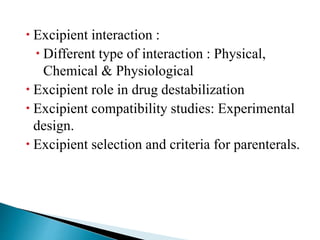
 Excipient interaction :
 Different type of interaction : Physical,
Chemical & Physiological
 Excipient role in drug destabilization
 Excipient compatibility studies: Experimental
design.
 Excipient selection and criteria for parenterals.
 Before initiating drug product development, the formulation
scientists must fully consider the chemical structure of the
drug substance, the type of delivery system required and the
proposed manufacturing process.
 Initial selection of excipients should be based on appropriate
delivery characteristics , Potential mechanisms of degradation
for the drug in question should be considered. Known
chemical incompatibilities of common excipients may be
obtained from existing published information.
The objectives of drug–excipient compatibility studies is to
find out interactions between potential formulation excipients
and the API, thus allowing the rapid optimisation of a particular
dosage form with respect to patentability, processing, drug
release, elegance, and physical and chemical
stability.
In the typical drug–excipient compatibility testing program,
binary powder mixes are prepared by triturating API with the
individual excipients.
These powder samples, usually with or without added water
and occasionally compacted or prepared as slurries, are stored
under accelerated conditions
 Samples are analyzed by stability-indicating methodology,
for example- HPLC, CE and so forth
 Another approach is to conduct short-term stability
studies using prototype formulations, under stressed
conditions.
 Both the chemical stability, as measured by
chromatographic methods and physical stability as
measured by microscopic, particle analysis, in vitro
dissolution methods and so forth, are performed.
 A scientific approach, , is through a variety of statistical
designs.
 ‘One-factor-at-a-time’ methods have been supplanted by
factorial design. The factorial design can be useful for
screening purposes or as an aid to identifying effects in
complex systems.
 Excipients that should be included in these designs are fillers,
disintegrants, binders, lubricants and granulating liquids.
 However, it is well known that the chemical compatibility
of a drug substance in a binary mixture may differ
completely from a multi-component prototype formulation.
 Statistical designs can be used to determine the occurrence
of chemical interactions in complex formulations, with a
view towards establishing which excipients cause
incompatibility within a given mixture.
Excipients can be divided into four classes;
I. non-hygroscopic
II. slightly hygroscopic
III. moderately hygroscopic
IV. very hygroscopic
 In a closed system water from excipients will re-equilibrate
between the individual components of the formulation, via the
vapour phase, to attain the most thermodynamically stable
state.
 In practice, as most excipients contain more available
moisture than the drug substance, this results in the API being
the net recipient of the available moisture, resulting in an
increased potential for degradation.
.
Excipient role in drug destabilization
 The degradation rate for many drugs varies as a
function of pH of the surrounding environment. This
appears to be equally true in the solid state as it is in the
solution state.
 The pH within the micro-environment of a solid oral
dosage form can impact on the stability of the
formulation.
 In the case of hydrophobic excipients, there is the potential
for drug to be adsorbed onto the surface of the excipient,
resulting in the formation of a drug monolayer, which would
be more susceptible to chemical instability.
 Increased degradation of acetylsalicylic acid could be the
result of diffusion of the dissolved drug onto the
microcrystalline cellulose, in binary mixtures of the two
compounds.
 For maximum stability it is critical to optimise the pH of the
micro-environment, by judicious selection of excipients; this
is especially true for degradation pathways that are pH
sensitive.
 Study was done on compatibility of acetylsalicylic acid in
the presence of three common diluents: lactose,
microcrystalline cellulose and dicalcium phosphate.
 It was demonstrated that dicalcium phosphate, despite
having much lower moisture pick-up levels than
microcrystalline cellulose, had a greater destabilizing effect
on the drug. The authors attributed this to the alkalinity of
the dicalcium phosphate in the solid state.
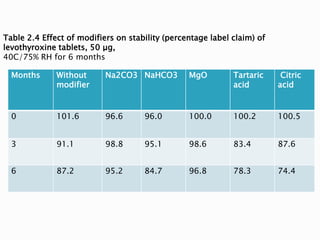
 Levothyroxine tablets, 50 μg, continue to have numerous
product recalls due to degradation, Levoxythyroxine has a
complex stability profile and is sensitive to heat, light,
moisture, pH and oxidation. It was found that moisture and
the pH of the micro-environment influenced degradation the
most. They identified the best diluent for tablet manufacture
as being dibasic calcium phosphate, with a basic modifier
(sodium carbonate ,sodium bicarbonate or magnesium oxide)
 Degradation pathways observed were deiodination,
deamination and decarboxylation.
Table 2.4 Effect of modifiers on stability (percentage label claim) of
levothyroxine tablets, 50 μg,
40C/75% RH for 6 months
Months Without
modifier
Na2CO3 NaHCO3 MgO Tartaric
acid
Citric
acid
0 101.6 96.6 96.0 100.0 100.2 100.5
3 91.1 98.8 95.1 98.6 83.4 87.6
6 87.2 95.2 84.7 96.8 78.3 74.4
 Degradation pathway of pravastatin sodium was directly
linked to the micro-pH environment within the formulation.
Under neutral conditions (pH 6.5), the statin formed two
degradation products, a cyclic lactone and an internal
hydroxyl rearrangement product.
 However, as the pH was increased to 9.9 with the
incorporation of magnesium oxide into the blend, the only
degradation mechanism involved the formation of the
cleavage product, 2-methylpropanoic acid.
 Hydrolysis :One of the most common pathways of drug
product degradation is hydrolysis.
 The source of the raw materials can greatly influence
hydrolytic reactions. It could also influence the pH of
the micro-environment.
 Oxidation: Excipients play a key role in oxidation, either as a
primary source of oxidants, trace amounts of metals, or other
contaminants
Peroxides are a very common impurity in many excipients,
particularly polymeric excipients peroxide residues in
povidone (binder) and crospovidone (disintegrant) were
attributable to the formation of the N-oxide oxidation product
of raloxifene.
 Impact of processing on photostability:
Processing can impact on the photostability of drug products.
This is possibly due to the fact that photodegradation is a
surface-mediated phenomenon.
Though excipients within the formulation will reduce the
impact of photodegradation of API at the tablet surface
because of dilution effect.
 Dextrose is widely used as an isotonic media in parenteral
formulations. Sterilization using autoclaving has been

reported to induce the formation of fructose via an
isomerisation reaction, with the formation of 5-
hydroxymethylfurfural.
 Duloxetine hydrochloride, as an enteric-coated tablet was
destabilized by degradation products within these enteric
polymers succinyl and phthalyl residues from the
hydroxypropyl methylcellulose acetate succinate (HPMCAS)
and hydroxypropyl methylcellulose phthalate (HPMCP).
.
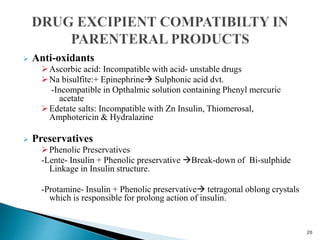
 Anti-oxidants
Ascorbic acid: Incompatible with acid- unstable drugs
Na bisulfite:+ Epinephrine Sulphonic acid dvt.
-Incompatible in Opthalmic solution containing Phenyl mercuric
acetate
Edetate salts: Incompatible with Zn Insulin, Thiomerosal,
Amphotericin & Hydralazine
 Preservatives
Phenolic Preservatives
-Lente- Insulin + Phenolic preservative Break-down of Bi-sulphide
Linkage in Insulin structure.
-Protamine- Insulin + Phenolic preservative tetragonal oblong crystals
which is responsible for prolong action of insulin.
20
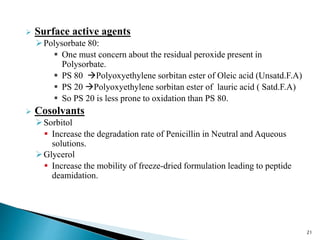
 Surface active agents
Polysorbate 80:
 One must concern about the residual peroxide present in
Polysorbate.
 PS 80 Polyoxyethylene sorbitan ester of Oleic acid (Unsatd.F.A)
 PS 20 Polyoxyethylene sorbitan ester of lauric acid ( Satd.F.A)
 So PS 20 is less prone to oxidation than PS 80.
 Cosolvants
Sorbitol
 Increase the degradation rate of Penicillin in Neutral and Aqueous
solutions.
Glycerol
 Increase the mobility of freeze-dried formulation leading to peptide
deamidation.
21
22
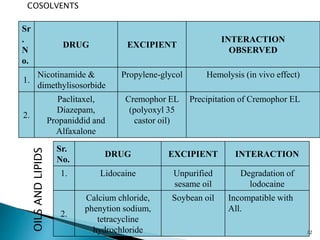
Sr
.
N
o.
DRUG EXCIPIENT
INTERACTION
OBSERVED
1.
Nicotinamide &
dimethylisosorbide
Propylene-glycol Hemolysis (in vivo effect)
2.
Paclitaxel,
Diazepam,
Propaniddid and
Alfaxalone
Cremophor EL
(polyoxyl 35
castor oil)
Precipitation of Cremophor EL
COSOLVENTS
Sr.
No.
DRUG EXCIPIENT INTERACTION
1. Lidocaine Unpurified
sesame oil
Degradation of
lodocaine
2.
Calcium chloride,
phenytion sodium,
tetracycline
hydrochloride
Soybean oil Incompatible with
All.
OILSANDLIPIDS
23
DRUG EXCIPIENT
INTERACTION
OBSERVED
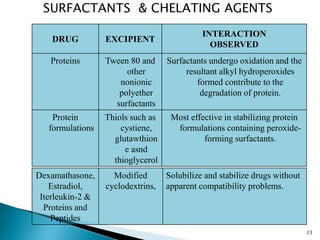
Proteins Tween 80 and
other
nonionic
polyether
surfactants
Surfactants undergo oxidation and the
resultant alkyl hydroperoxides
formed contribute to the
degradation of protein.
Protein
formulations
Thiols such as
cystiene,
glutawthion
e asnd
thioglycerol
Most effective in stabilizing protein
formulations containing peroxide-
forming surfactants.
SURFACTANTS & CHELATING AGENTS
Dexamathasone,
Estradiol,
Iterleukin-2 &
Proteins and
Peptides
Modified
cyclodextrins,
Solubilize and stabilize drugs without
apparent compatibility problems.
24
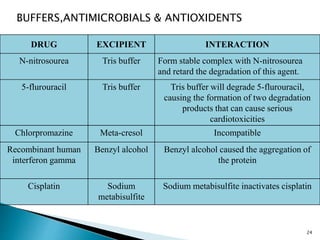
DRUG EXCIPIENT INTERACTION
N-nitrosourea Tris buffer Form stable complex with N-nitrosourea
and retard the degradation of this agent.
5-flurouracil Tris buffer Tris buffer will degrade 5-flurouracil,
causing the formation of two degradation
products that can cause serious
cardiotoxicities
Chlorpromazine Meta-cresol Incompatible
Recombinant human
interferon gamma
Benzyl alcohol Benzyl alcohol caused the aggregation of
the protein
Cisplatin Sodium
metabisulfite
Sodium metabisulfite inactivates cisplatin
BUFFERS,ANTIMICROBIALS & ANTIOXIDENTS
Drug excipient compatibility

Drug excipient compatibility

  • 1.
  • 2.
     Drug excipientcompatibility represent an important phase in the preformulation stage of the development of all dosage forms.
  • 3.
     Excipient interaction:  Different type of interaction : Physical, Chemical & Physiological  Excipient role in drug destabilization  Excipient compatibility studies: Experimental design.  Excipient selection and criteria for parenterals.
  • 4.
     Before initiatingdrug product development, the formulation scientists must fully consider the chemical structure of the drug substance, the type of delivery system required and the proposed manufacturing process.  Initial selection of excipients should be based on appropriate delivery characteristics , Potential mechanisms of degradation for the drug in question should be considered. Known chemical incompatibilities of common excipients may be obtained from existing published information.
  • 5.
    The objectives ofdrug–excipient compatibility studies is to find out interactions between potential formulation excipients and the API, thus allowing the rapid optimisation of a particular dosage form with respect to patentability, processing, drug release, elegance, and physical and chemical stability. In the typical drug–excipient compatibility testing program, binary powder mixes are prepared by triturating API with the individual excipients. These powder samples, usually with or without added water and occasionally compacted or prepared as slurries, are stored under accelerated conditions  Samples are analyzed by stability-indicating methodology, for example- HPLC, CE and so forth
  • 6.
     Another approachis to conduct short-term stability studies using prototype formulations, under stressed conditions.  Both the chemical stability, as measured by chromatographic methods and physical stability as measured by microscopic, particle analysis, in vitro dissolution methods and so forth, are performed.
  • 7.
     A scientificapproach, , is through a variety of statistical designs.  ‘One-factor-at-a-time’ methods have been supplanted by factorial design. The factorial design can be useful for screening purposes or as an aid to identifying effects in complex systems.  Excipients that should be included in these designs are fillers, disintegrants, binders, lubricants and granulating liquids.
  • 8.
     However, itis well known that the chemical compatibility of a drug substance in a binary mixture may differ completely from a multi-component prototype formulation.  Statistical designs can be used to determine the occurrence of chemical interactions in complex formulations, with a view towards establishing which excipients cause incompatibility within a given mixture.
  • 9.
    Excipients can bedivided into four classes; I. non-hygroscopic II. slightly hygroscopic III. moderately hygroscopic IV. very hygroscopic  In a closed system water from excipients will re-equilibrate between the individual components of the formulation, via the vapour phase, to attain the most thermodynamically stable state.  In practice, as most excipients contain more available moisture than the drug substance, this results in the API being the net recipient of the available moisture, resulting in an increased potential for degradation. . Excipient role in drug destabilization
  • 10.
     The degradationrate for many drugs varies as a function of pH of the surrounding environment. This appears to be equally true in the solid state as it is in the solution state.  The pH within the micro-environment of a solid oral dosage form can impact on the stability of the formulation.
  • 11.
     In thecase of hydrophobic excipients, there is the potential for drug to be adsorbed onto the surface of the excipient, resulting in the formation of a drug monolayer, which would be more susceptible to chemical instability.  Increased degradation of acetylsalicylic acid could be the result of diffusion of the dissolved drug onto the microcrystalline cellulose, in binary mixtures of the two compounds.  For maximum stability it is critical to optimise the pH of the micro-environment, by judicious selection of excipients; this is especially true for degradation pathways that are pH sensitive.
  • 12.
     Study wasdone on compatibility of acetylsalicylic acid in the presence of three common diluents: lactose, microcrystalline cellulose and dicalcium phosphate.  It was demonstrated that dicalcium phosphate, despite having much lower moisture pick-up levels than microcrystalline cellulose, had a greater destabilizing effect on the drug. The authors attributed this to the alkalinity of the dicalcium phosphate in the solid state.
  • 13.
     Levothyroxine tablets,50 μg, continue to have numerous product recalls due to degradation, Levoxythyroxine has a complex stability profile and is sensitive to heat, light, moisture, pH and oxidation. It was found that moisture and the pH of the micro-environment influenced degradation the most. They identified the best diluent for tablet manufacture as being dibasic calcium phosphate, with a basic modifier (sodium carbonate ,sodium bicarbonate or magnesium oxide)  Degradation pathways observed were deiodination, deamination and decarboxylation.
  • 14.
    Table 2.4 Effectof modifiers on stability (percentage label claim) of levothyroxine tablets, 50 μg, 40C/75% RH for 6 months Months Without modifier Na2CO3 NaHCO3 MgO Tartaric acid Citric acid 0 101.6 96.6 96.0 100.0 100.2 100.5 3 91.1 98.8 95.1 98.6 83.4 87.6 6 87.2 95.2 84.7 96.8 78.3 74.4
  • 15.
     Degradation pathwayof pravastatin sodium was directly linked to the micro-pH environment within the formulation. Under neutral conditions (pH 6.5), the statin formed two degradation products, a cyclic lactone and an internal hydroxyl rearrangement product.  However, as the pH was increased to 9.9 with the incorporation of magnesium oxide into the blend, the only degradation mechanism involved the formation of the cleavage product, 2-methylpropanoic acid.
  • 16.
     Hydrolysis :Oneof the most common pathways of drug product degradation is hydrolysis.  The source of the raw materials can greatly influence hydrolytic reactions. It could also influence the pH of the micro-environment.
  • 17.
     Oxidation: Excipientsplay a key role in oxidation, either as a primary source of oxidants, trace amounts of metals, or other contaminants Peroxides are a very common impurity in many excipients, particularly polymeric excipients peroxide residues in povidone (binder) and crospovidone (disintegrant) were attributable to the formation of the N-oxide oxidation product of raloxifene.
  • 18.
     Impact ofprocessing on photostability: Processing can impact on the photostability of drug products. This is possibly due to the fact that photodegradation is a surface-mediated phenomenon. Though excipients within the formulation will reduce the impact of photodegradation of API at the tablet surface because of dilution effect.
  • 19.
     Dextrose iswidely used as an isotonic media in parenteral formulations. Sterilization using autoclaving has been reported to induce the formation of fructose via an isomerisation reaction, with the formation of 5- hydroxymethylfurfural.  Duloxetine hydrochloride, as an enteric-coated tablet was destabilized by degradation products within these enteric polymers succinyl and phthalyl residues from the hydroxypropyl methylcellulose acetate succinate (HPMCAS) and hydroxypropyl methylcellulose phthalate (HPMCP). .
  • 20.
     Anti-oxidants Ascorbic acid:Incompatible with acid- unstable drugs Na bisulfite:+ Epinephrine Sulphonic acid dvt. -Incompatible in Opthalmic solution containing Phenyl mercuric acetate Edetate salts: Incompatible with Zn Insulin, Thiomerosal, Amphotericin & Hydralazine  Preservatives Phenolic Preservatives -Lente- Insulin + Phenolic preservative Break-down of Bi-sulphide Linkage in Insulin structure. -Protamine- Insulin + Phenolic preservative tetragonal oblong crystals which is responsible for prolong action of insulin. 20
  • 21.
     Surface activeagents Polysorbate 80:  One must concern about the residual peroxide present in Polysorbate.  PS 80 Polyoxyethylene sorbitan ester of Oleic acid (Unsatd.F.A)  PS 20 Polyoxyethylene sorbitan ester of lauric acid ( Satd.F.A)  So PS 20 is less prone to oxidation than PS 80.  Cosolvants Sorbitol  Increase the degradation rate of Penicillin in Neutral and Aqueous solutions. Glycerol  Increase the mobility of freeze-dried formulation leading to peptide deamidation. 21
  • 22.
    22 Sr . N o. DRUG EXCIPIENT INTERACTION OBSERVED 1. Nicotinamide & dimethylisosorbide Propylene-glycolHemolysis (in vivo effect) 2. Paclitaxel, Diazepam, Propaniddid and Alfaxalone Cremophor EL (polyoxyl 35 castor oil) Precipitation of Cremophor EL COSOLVENTS Sr. No. DRUG EXCIPIENT INTERACTION 1. Lidocaine Unpurified sesame oil Degradation of lodocaine 2. Calcium chloride, phenytion sodium, tetracycline hydrochloride Soybean oil Incompatible with All. OILSANDLIPIDS
  • 23.
    23 DRUG EXCIPIENT INTERACTION OBSERVED Proteins Tween80 and other nonionic polyether surfactants Surfactants undergo oxidation and the resultant alkyl hydroperoxides formed contribute to the degradation of protein. Protein formulations Thiols such as cystiene, glutawthion e asnd thioglycerol Most effective in stabilizing protein formulations containing peroxide- forming surfactants. SURFACTANTS & CHELATING AGENTS Dexamathasone, Estradiol, Iterleukin-2 & Proteins and Peptides Modified cyclodextrins, Solubilize and stabilize drugs without apparent compatibility problems.
  • 24.
    24 DRUG EXCIPIENT INTERACTION N-nitrosoureaTris buffer Form stable complex with N-nitrosourea and retard the degradation of this agent. 5-flurouracil Tris buffer Tris buffer will degrade 5-flurouracil, causing the formation of two degradation products that can cause serious cardiotoxicities Chlorpromazine Meta-cresol Incompatible Recombinant human interferon gamma Benzyl alcohol Benzyl alcohol caused the aggregation of the protein Cisplatin Sodium metabisulfite Sodium metabisulfite inactivates cisplatin BUFFERS,ANTIMICROBIALS & ANTIOXIDENTS