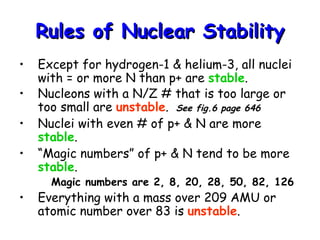
Rules of Nuclear Stability Except for hydrogen-1 & helium-3, all nuclei with = or more N than p+ are  stable . Nucleons with a N/Z # that is too large or too small are  unstable .  See fig.6 page 646 Nuclei with even # of p+ & N are more  stable . “ Magic numbers” of p+ & N tend to be more  stable . Magic numbers are 2, 8, 20, 28, 50, 82, 126 Everything with a mass over 209 AMU or atomic number over 83 is  unstable .
Nuclear Change 18.2
Radioactive Decay Changes an unstable nucleus to a stable nucleus. Causes a release of particles and/or electromagnetic waves.
Nuclear Particles H 1 1 n 0 1 -1 0 e e 0 +1 He 2 4 Particle Symbol  Charge  Proton p+  +1 Neutron n  0 Electron/Beta β - -1 Positron β + +1 Alpha particle α   +2 Gamma ray 0
Beta Decay To become stable a N can be converted to a p+ by emitting a beta particle. Atomic # increases by 1 but the mass # does not change. Example: C 14 6 N 14 7 e 0 -1 +
Electron Capture Unstable nucleus absorbs an e- from the innermost orbital, s1. This changes a p+ to a N. Decreases atomic # by 1 but mass stays the same. Example: Cr 51 24 V 51 23 e 0 -1 + +
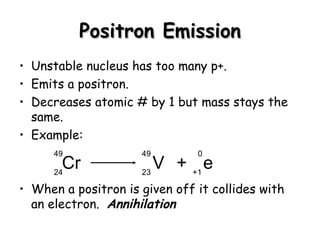
Positron Emission Unstable nucleus has too many p+. Emits a positron. Decreases atomic # by 1 but mass stays the same. Example: When a positron is given off it collides with an electron.  Annihilation Cr 49 24 V 49 23 e 0 +1 +
Losing Alpha Particles Elements with N/Z # greater than 1 can stabilize by emitting an alpha particle. Mass is decreased by 4, atomic # decreased by 2. This can be repeated until it reaches stability.  See figure 10 p. 651  Decay series. U 238 92 Th 234 90 He 4 2 +
Nuclear Equations  must  Balance Sum of the mass # on one side must = the sum of the mass # on the other. Sum of the atomic # on one side must equal the sum of the atomic # on the other. Example: Atomic # 92 Atomic # 90 + 2 = 92 Mass = 238 Mass = 234 + 4 = 238 U 238 92 Th 234 90 He 4 2 +

18.2

  • 1.
    Rules of NuclearStability Except for hydrogen-1 & helium-3, all nuclei with = or more N than p+ are stable . Nucleons with a N/Z # that is too large or too small are unstable . See fig.6 page 646 Nuclei with even # of p+ & N are more stable . “ Magic numbers” of p+ & N tend to be more stable . Magic numbers are 2, 8, 20, 28, 50, 82, 126 Everything with a mass over 209 AMU or atomic number over 83 is unstable .
  • 2.
  • 3.
    Radioactive Decay Changesan unstable nucleus to a stable nucleus. Causes a release of particles and/or electromagnetic waves.
  • 4.
    Nuclear Particles H1 1 n 0 1 -1 0 e e 0 +1 He 2 4 Particle Symbol Charge Proton p+ +1 Neutron n 0 Electron/Beta β - -1 Positron β + +1 Alpha particle α +2 Gamma ray 0
  • 5.
    Beta Decay Tobecome stable a N can be converted to a p+ by emitting a beta particle. Atomic # increases by 1 but the mass # does not change. Example: C 14 6 N 14 7 e 0 -1 +
  • 6.
    Electron Capture Unstablenucleus absorbs an e- from the innermost orbital, s1. This changes a p+ to a N. Decreases atomic # by 1 but mass stays the same. Example: Cr 51 24 V 51 23 e 0 -1 + +
  • 7.
    Positron Emission Unstablenucleus has too many p+. Emits a positron. Decreases atomic # by 1 but mass stays the same. Example: When a positron is given off it collides with an electron. Annihilation Cr 49 24 V 49 23 e 0 +1 +
  • 8.
    Losing Alpha ParticlesElements with N/Z # greater than 1 can stabilize by emitting an alpha particle. Mass is decreased by 4, atomic # decreased by 2. This can be repeated until it reaches stability. See figure 10 p. 651 Decay series. U 238 92 Th 234 90 He 4 2 +
  • 9.
    Nuclear Equations must Balance Sum of the mass # on one side must = the sum of the mass # on the other. Sum of the atomic # on one side must equal the sum of the atomic # on the other. Example: Atomic # 92 Atomic # 90 + 2 = 92 Mass = 238 Mass = 234 + 4 = 238 U 238 92 Th 234 90 He 4 2 +