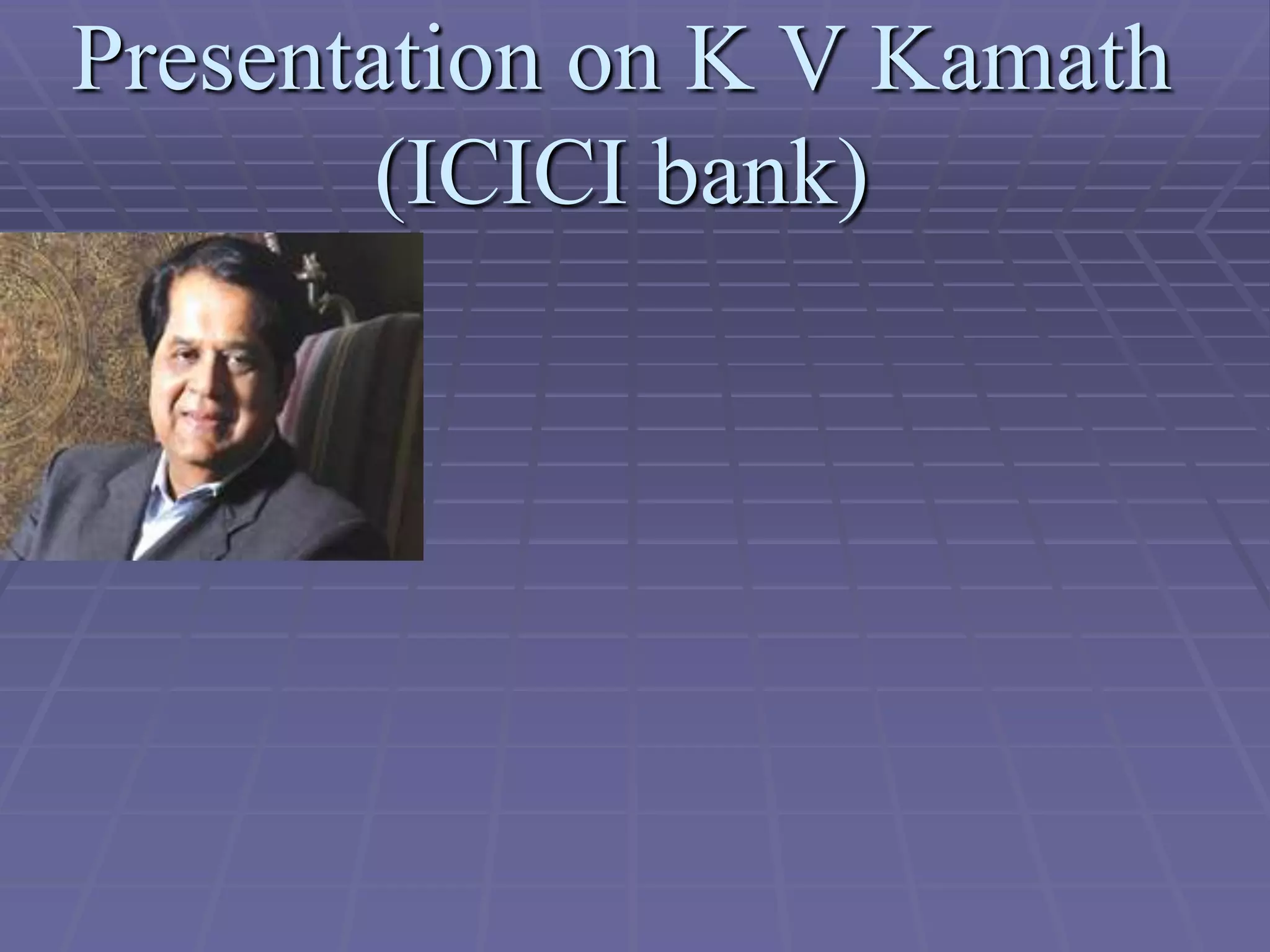
Presentation on K V Kamath
        (ICICI bank)
History of ICICI Bank
 Incorporated In 1994.
 First Indian Company To Raise Funds From
    International Markets
   2nd Largest Bank In India
   Network Of 2777 Branches
   10021 ATMs
   SUBSIDIARIES IN UK, RUSSIA, CANADA,
    SINGAPORE etc
   Launched private banking in 2002.
 "I believe that once someone tastes success
 one must not let it go easily. That’s where
 culture comes in. One needs to take the
 innovative spirit and push it to a level where
 change, learning, and knowledge sharing
 become a regular part of the company’s
 culture.“ – K V Kamath
K V Kamath
 Name: Kundapur Vaman Kamath
 Age: 64
 Title: non-executive chairman of ICICI Bank &
  Infosys
 Education: Mechanical engineer (Karnataka Regional
  Education College); MBA (Indian Institute of
  Management, Ahmedabad)
 Pursuits: Watching motor racing and cricket; reading
 Claim to fame: Transformed a single-product, project
  finance entity into a multi-specialist financial services
  conglomerate, ICICI Bank, in less than a decade.
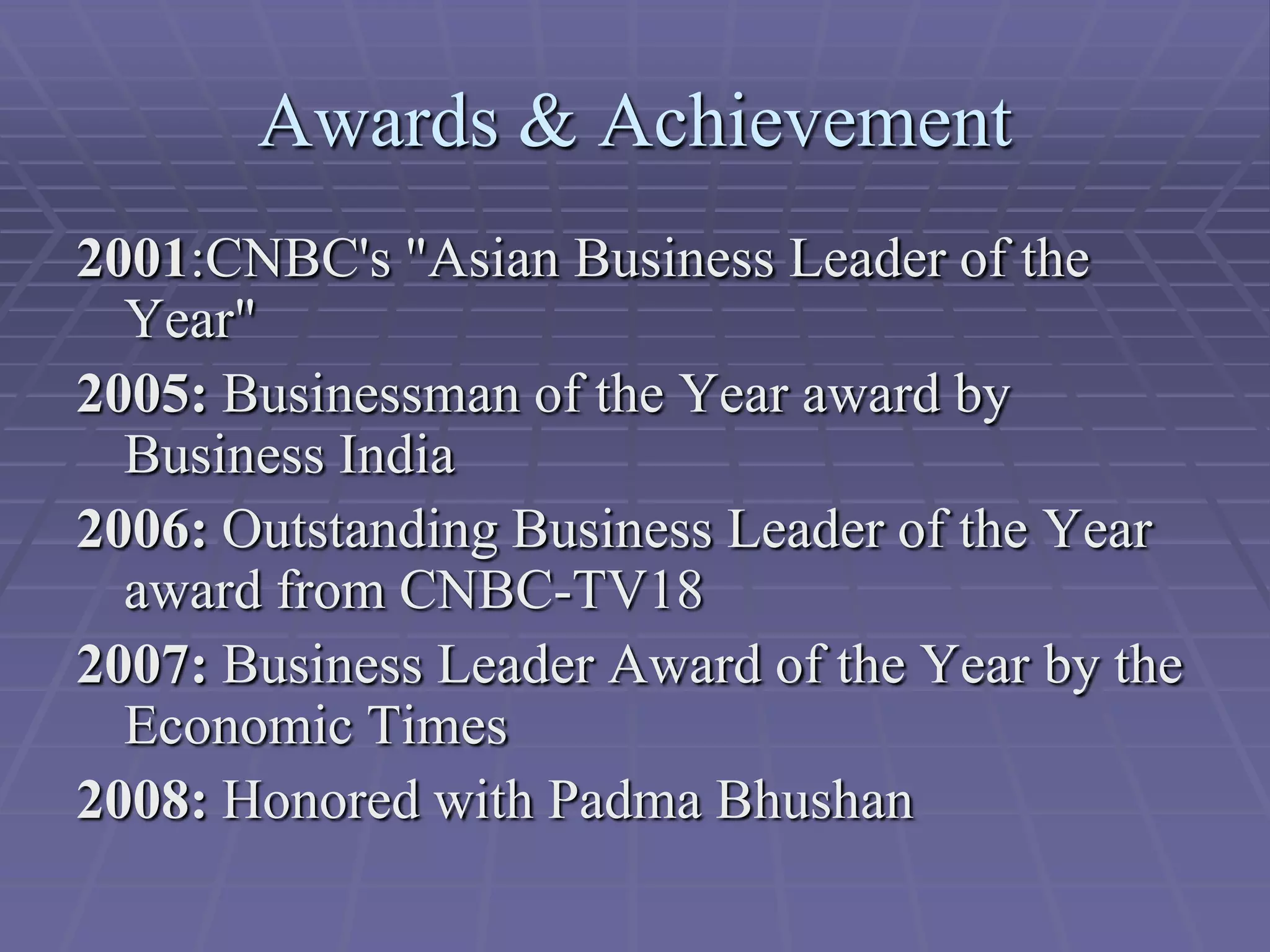
Awards & Achievement
2001:CNBC's "Asian Business Leader of the
  Year"
2005: Businessman of the Year award by
  Business India
2006: Outstanding Business Leader of the Year
  award from CNBC-TV18
2007: Business Leader Award of the Year by the
  Economic Times
2008: Honored with Padma Bhushan
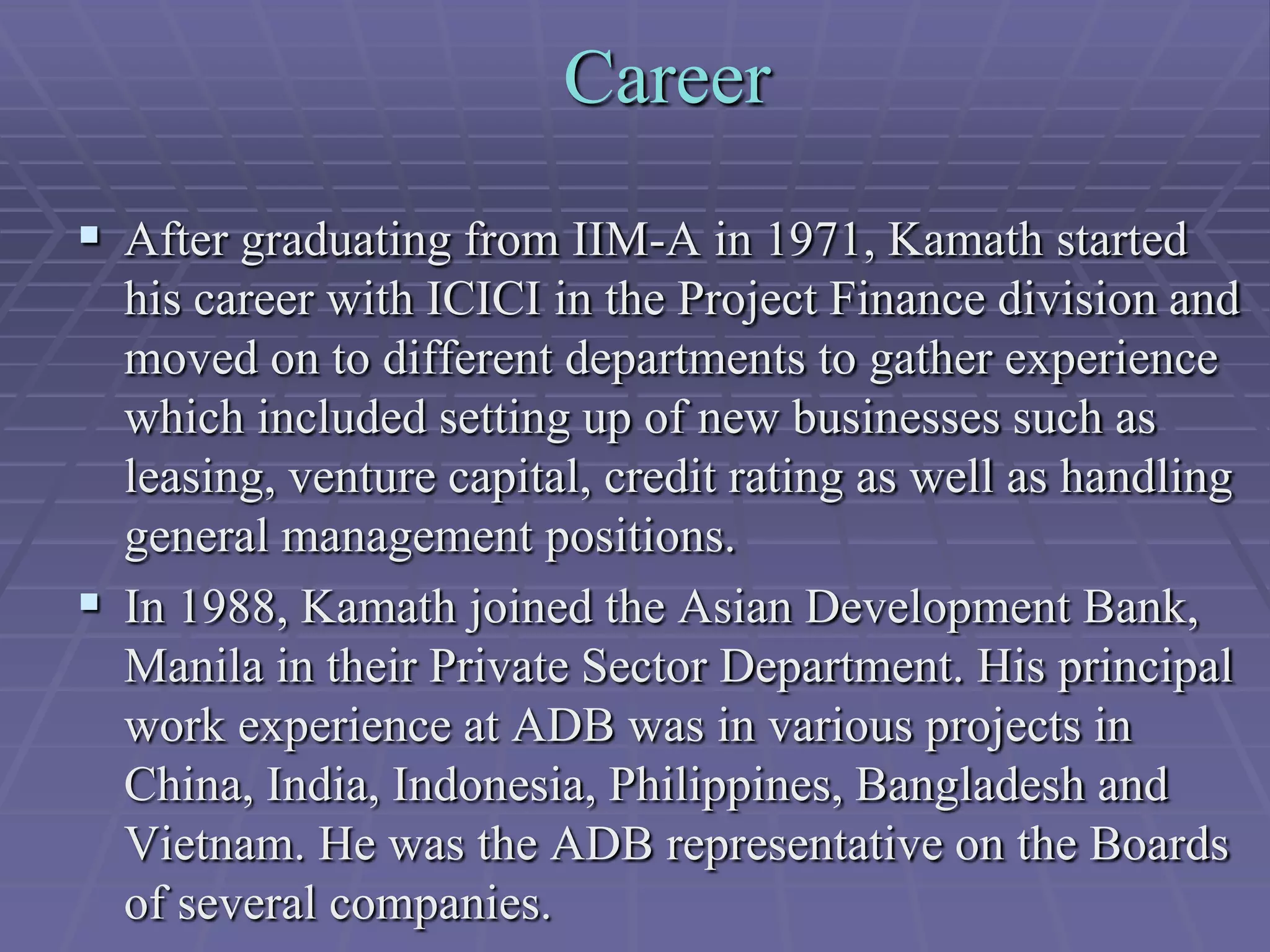
Career
 After graduating from IIM-A in 1971, Kamath started
  his career with ICICI in the Project Finance division and
  moved on to different departments to gather experience
  which included setting up of new businesses such as
  leasing, venture capital, credit rating as well as handling
  general management positions.
 In 1988, Kamath joined the Asian Development Bank,
  Manila in their Private Sector Department. His principal
  work experience at ADB was in various projects in
  China, India, Indonesia, Philippines, Bangladesh and
  Vietnam. He was the ADB representative on the Boards
  of several companies.
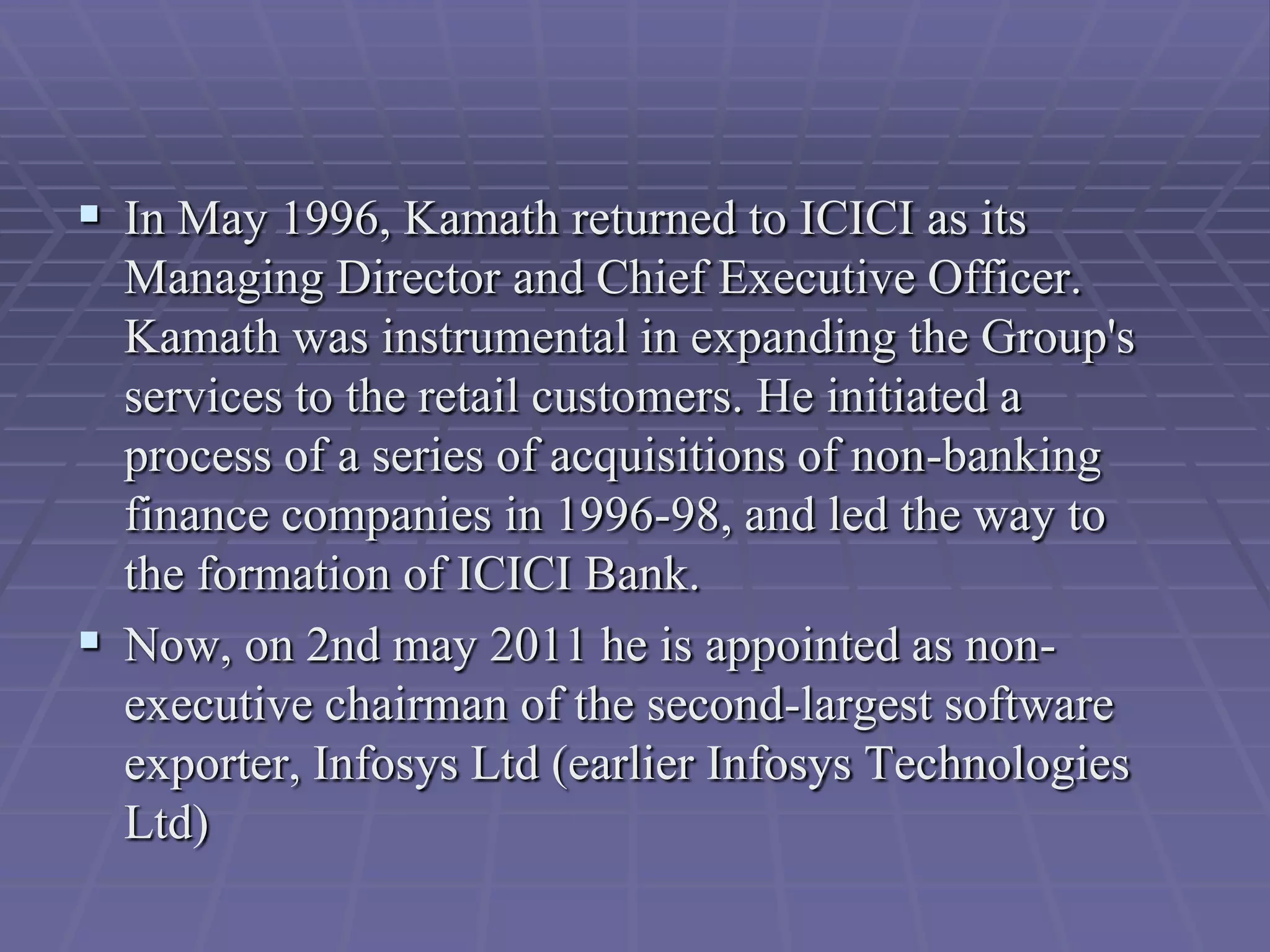
 In May 1996, Kamath returned to ICICI as its
  Managing Director and Chief Executive Officer.
  Kamath was instrumental in expanding the Group's
  services to the retail customers. He initiated a
  process of a series of acquisitions of non-banking
  finance companies in 1996-98, and led the way to
  the formation of ICICI Bank.
 Now, on 2nd may 2011 he is appointed as non-
  executive chairman of the second-largest software
  exporter, Infosys Ltd (earlier Infosys Technologies
  Ltd)
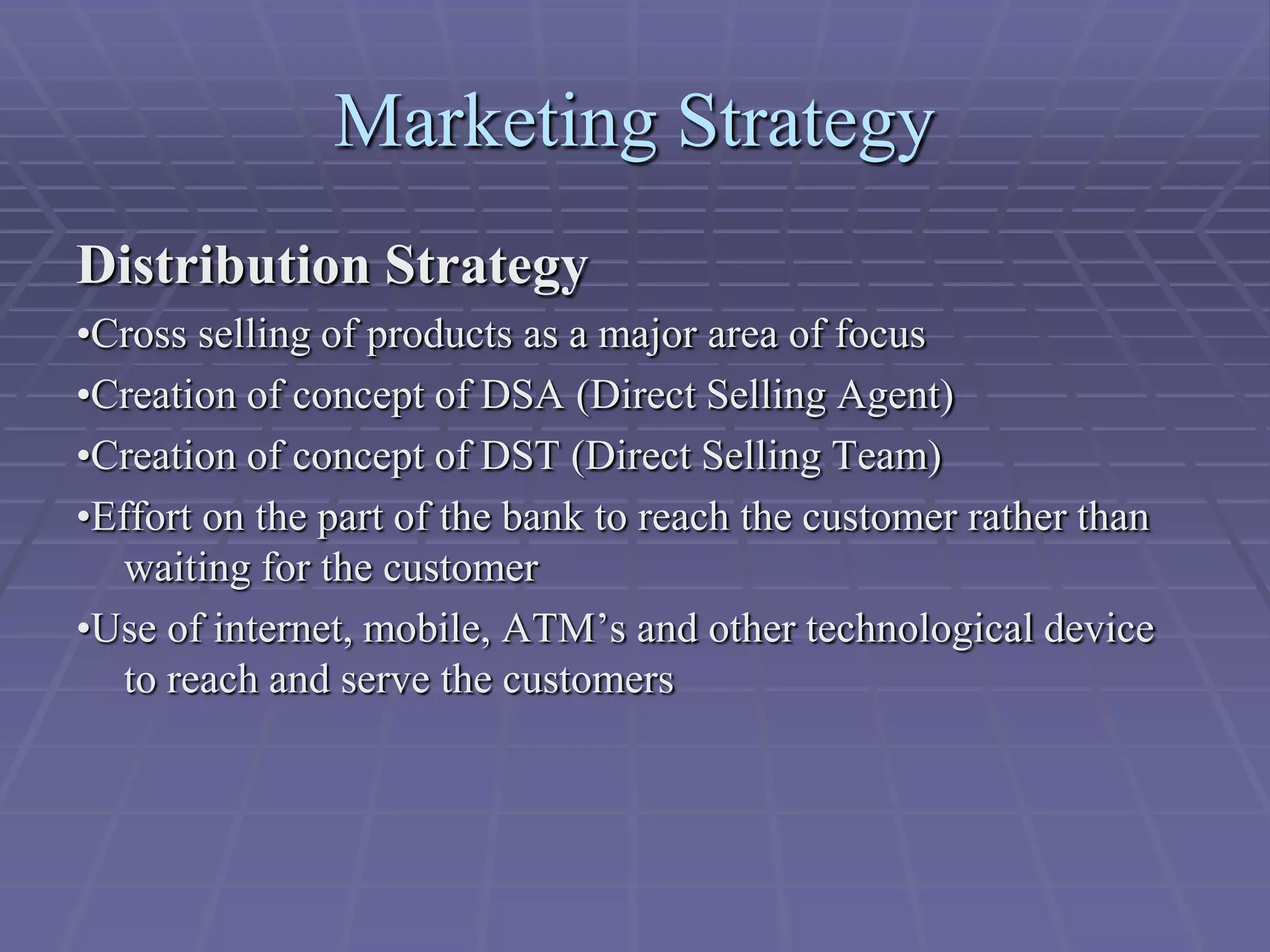
Marketing Strategy
Distribution Strategy
•Cross selling of products as a major area of focus
•Creation of concept of DSA (Direct Selling Agent)
•Creation of concept of DST (Direct Selling Team)
•Effort on the part of the bank to reach the customer rather than
   waiting for the customer
•Use of internet, mobile, ATM’s and other technological device
   to reach and serve the customers
Product Promotion
•Aimed at generating sales
•Communicates product features and benefits
•Mainly through print media
•Point of purchase promotion tools for different
  products to reach the relevant customer segment
Core strategy

 Consumer banking (home loan, car loan etc)
 Setting up of international offices
 Use of big opportunity in rural India
 Offer a multi-channel delivery system to its
  customers
Acquisitions & Merger Strategies
Acquisition
 acquisitions like SCICI Ltd, ITC Classic
  Finance, which had a strong retail base in
  Eastern India and a strong base in the West.
 acquired Bank of Madhura at a time when its
  own revenues stood at Rs 2,500 crore (Rs 25
  billion) and that of the bank at Rs 100 crore
  (Rs 1 billion), it was time for the next
  courageous move.
Merger
 The year 2002 was the landmark year for ICICI,
  the board of directors of ICICI and ICICI Bank
  approved the merger of the parent company
  ICICI and subsidiaries like ICICI Personal
  Financial Services Ltd and ICICI Capital
  Services Ltd, with yet another subsidiary ICICI
  Bank.
 It was a reverse merger and quite rare in
  corporate India, where a parent company merged
  with its subsidiary and adopted the later's
  identity.
Contribution of Kamath
 ICICI's computerisation programme, which in
  later years would give ICICI a huge
  competitive advantage.
 ICICI's strategy and product offering
  recognized the changing demands of a
  growing middle-class.
 ICICI's computerisation programme, which in later
  years would give ICICI a huge competitive advantage.

 ICICI's strategy and product offering recognized the
  changing demands of a growing middle-class.

 1999, That year, ICICI Ltd got listed on the New York
  Stock Exchange, NYSE, the first ever Indian financial
  institution to go the American Depositary Receipts

 the first to go into online trading and Internet banking
 introduced ATMs across the country to meet
  the shortfall of being able to offer branch
  facilities
 In December 2005, ICICI Bank announced its
  initial public offer to the Indian market and
  amassed over Rs 80 billion.
18 k v kamath

18 k v kamath

  • 1.
    Presentation on KV Kamath (ICICI bank)
  • 2.
    History of ICICIBank  Incorporated In 1994.  First Indian Company To Raise Funds From International Markets  2nd Largest Bank In India  Network Of 2777 Branches  10021 ATMs  SUBSIDIARIES IN UK, RUSSIA, CANADA, SINGAPORE etc  Launched private banking in 2002.
  • 3.
     "I believethat once someone tastes success one must not let it go easily. That’s where culture comes in. One needs to take the innovative spirit and push it to a level where change, learning, and knowledge sharing become a regular part of the company’s culture.“ – K V Kamath
  • 4.
    K V Kamath Name: Kundapur Vaman Kamath  Age: 64  Title: non-executive chairman of ICICI Bank & Infosys  Education: Mechanical engineer (Karnataka Regional Education College); MBA (Indian Institute of Management, Ahmedabad)  Pursuits: Watching motor racing and cricket; reading  Claim to fame: Transformed a single-product, project finance entity into a multi-specialist financial services conglomerate, ICICI Bank, in less than a decade.
  • 5.
    Awards & Achievement 2001:CNBC's"Asian Business Leader of the Year" 2005: Businessman of the Year award by Business India 2006: Outstanding Business Leader of the Year award from CNBC-TV18 2007: Business Leader Award of the Year by the Economic Times 2008: Honored with Padma Bhushan
  • 6.
    Career  After graduatingfrom IIM-A in 1971, Kamath started his career with ICICI in the Project Finance division and moved on to different departments to gather experience which included setting up of new businesses such as leasing, venture capital, credit rating as well as handling general management positions.  In 1988, Kamath joined the Asian Development Bank, Manila in their Private Sector Department. His principal work experience at ADB was in various projects in China, India, Indonesia, Philippines, Bangladesh and Vietnam. He was the ADB representative on the Boards of several companies.
  • 7.
     In May1996, Kamath returned to ICICI as its Managing Director and Chief Executive Officer. Kamath was instrumental in expanding the Group's services to the retail customers. He initiated a process of a series of acquisitions of non-banking finance companies in 1996-98, and led the way to the formation of ICICI Bank.  Now, on 2nd may 2011 he is appointed as non- executive chairman of the second-largest software exporter, Infosys Ltd (earlier Infosys Technologies Ltd)
  • 8.
    Marketing Strategy Distribution Strategy •Crossselling of products as a major area of focus •Creation of concept of DSA (Direct Selling Agent) •Creation of concept of DST (Direct Selling Team) •Effort on the part of the bank to reach the customer rather than waiting for the customer •Use of internet, mobile, ATM’s and other technological device to reach and serve the customers
  • 9.
    Product Promotion •Aimed atgenerating sales •Communicates product features and benefits •Mainly through print media •Point of purchase promotion tools for different products to reach the relevant customer segment
  • 10.
    Core strategy  Consumerbanking (home loan, car loan etc)  Setting up of international offices  Use of big opportunity in rural India  Offer a multi-channel delivery system to its customers
  • 11.
  • 12.
    Acquisition  acquisitions likeSCICI Ltd, ITC Classic Finance, which had a strong retail base in Eastern India and a strong base in the West.  acquired Bank of Madhura at a time when its own revenues stood at Rs 2,500 crore (Rs 25 billion) and that of the bank at Rs 100 crore (Rs 1 billion), it was time for the next courageous move.
  • 13.
    Merger  The year2002 was the landmark year for ICICI, the board of directors of ICICI and ICICI Bank approved the merger of the parent company ICICI and subsidiaries like ICICI Personal Financial Services Ltd and ICICI Capital Services Ltd, with yet another subsidiary ICICI Bank.  It was a reverse merger and quite rare in corporate India, where a parent company merged with its subsidiary and adopted the later's identity.
  • 14.
    Contribution of Kamath ICICI's computerisation programme, which in later years would give ICICI a huge competitive advantage.  ICICI's strategy and product offering recognized the changing demands of a growing middle-class.
  • 15.
     ICICI's computerisationprogramme, which in later years would give ICICI a huge competitive advantage.  ICICI's strategy and product offering recognized the changing demands of a growing middle-class.  1999, That year, ICICI Ltd got listed on the New York Stock Exchange, NYSE, the first ever Indian financial institution to go the American Depositary Receipts  the first to go into online trading and Internet banking
  • 16.
     introduced ATMsacross the country to meet the shortfall of being able to offer branch facilities  In December 2005, ICICI Bank announced its initial public offer to the Indian market and amassed over Rs 80 billion.