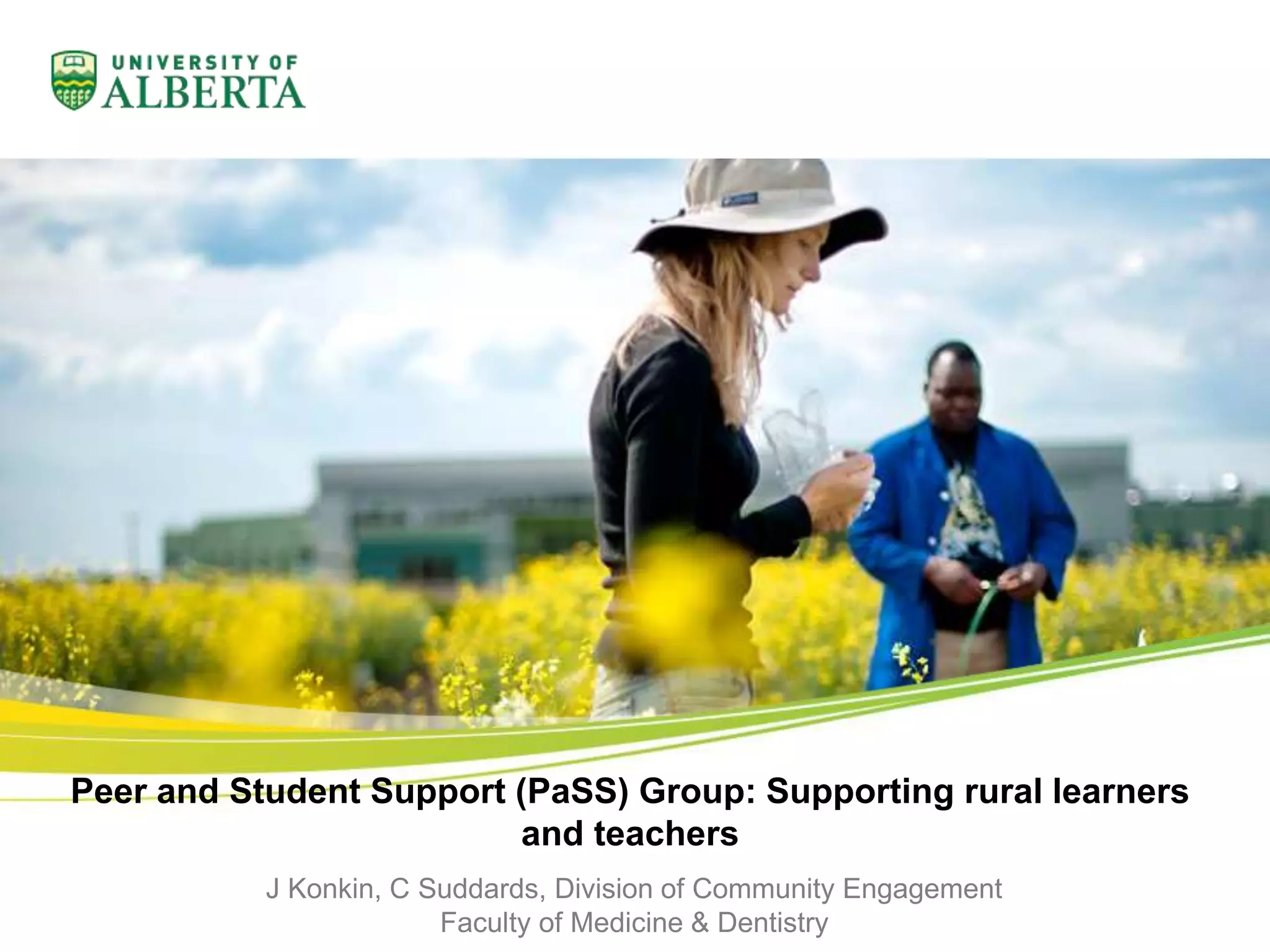

Peer and Student Support (PaSS) Group: Supporting rural learners 
and teachers 
J Konkin, C Suddards, Division of Community Engagement 
Faculty of Medicine & Dentistry
Faculty/Presenter Disclosure 
Slide 1 
• Faculty: Jill Konkin, 
Carol Suddards 
• Relationships with 
commercial interests: 
None
Disclosure of Commercial 
Support 
Slide 2 
• This program has received financial 
support from Health Workforce 
Action Plan, Government of 
Alberta in the form of Program 
Grant including budget for 
Program Evaluation 
• There are no conflicts of interest
University of Alberta, Edmonton, Canada
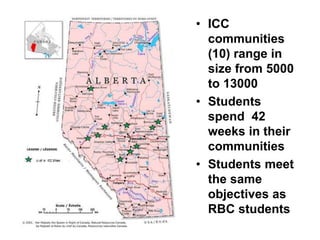
• ICC 
communities 
(10) range in 
size from 5000 
to 13000 
• Students 
spend 42 
weeks in their 
communities 
• Students meet 
the same 
objectives as 
RBC students
Integrated Community Clerkship–University of Alberta 
• 3rd year of a 4-year medical program 
• Physician teachers primarily family 
physicians, many with enhanced skills, i.e. 
generalist environment 
• 110 students (2007-2014): 
• 49% male; 51% female 
• On survey, 44% report rural background 
• 22 students in 10 communities in 2014-15
Part of larger program of research 
• Evaluating program outcomes -- standards-based 
and responsive to interests of stakeholders & 
research community (Stake, 2004) 
• Exploring how students make sense of their lived 
experience in the ICC 
• Wanting to better understand what works (or does 
not), why and for whom 
Program of research
Program goals as they relate to the PaSS Group 
To establish a patient-centred, community based, 
pedagogically sound clerkship to be based in 
selected rural and regional Alberta communities 
- students feel supported in their learning 
To strengthen and enhance the relationships 
between rural communities and urban tertiary 
teaching institutions 
- Community physicians are supported in their role as site 
administrators 
- Contribute to community physician retention
Peer and Student Support (PaSS) Objectives 
• Educational support and mentorship for 
students and preceptors 
• Direct observation of students and preceptors 
with timely feedback 
• Feedback to program coordinator from students 
and community preceptors 
• Involvement in other formal academic activities 
of the ICC program including orientation
Multiple data sources: 
• student reflective conversations at the end of 
third year [2009 – 2011] 
• student surveys at the end of the ICC year [2012 
– 2014] 
• preceptor/ site coordinator surveys [2009 – 
2014] 
Methodology
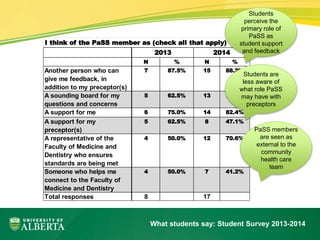
I think of the PaSS member as (check all that apply) 
2013 2014 
N % N % 
Students 
perceive the 
primary role of 
PaSS as 
student support 
and feedback 
Students are 
less aware of 
what role PaSS 
may have with 
preceptors 
What students say: Student Survey 2013-2014 
Another person who can 
give me feedback, in 
addition to my preceptor(s) 
7 87.5% 15 88.2% 
A sounding board for my 
questions and concerns 
5 62.5% 13 76.5% 
A support for me 6 75.0% 14 82.4% 
A support for my 
5 62.5% 8 47.1% 
preceptor(s) 
A representative of the 
Faculty of Medicine and 
Dentistry who ensures 
standards are being met 
4 50.0% 12 70.6% 
Someone who helps me 
connect to the Faculty of 
Medicine and Dentistry 
4 50.0% 7 41.2% 
Total responses 8 17 
PaSS members 
are seen as 
external to the 
community 
health care 
team
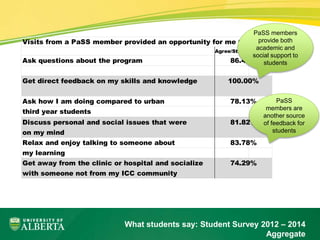
PaSS members 
provide both 
academic and 
social support to 
Agree/Strongly Agree 
86.49% 
100.00% 
78.13% 
81.82% 
students 
What students say: Student Survey 2012 – 2014 
Aggregate 
Visits from a PaSS member provided an opportunity for me to 
Ask questions about the program 
Get direct feedback on my skills and knowledge 
Ask how I am doing compared to urban 
third year students 
Discuss personal and social issues that were 
on my mind 
Relax and enjoy talking to someone about 
my learning 
Get away from the clinic or hospital and socialize 
with someone not from my ICC community 
83.78% 
74.29% 
PaSS 
members are 
another source 
of feedback for 
students
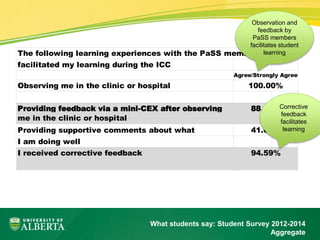
Observation and 
feedback by 
PaSS members 
facilitates student 
learning 
Agree/Strongly Agree 
100.00% 
Corrective 
feedback 
facilitates 
learning 
88.89% 
What students say: Student Survey 2012-2014 
Aggregate 
The following learning experiences with the PaSS member 
facilitated my learning during the ICC 
Observing me in the clinic or hospital 
Providing feedback via a mini-CEX after observing 
me in the clinic or hospital 
Providing supportive comments about what 
I am doing well 
I received corrective feedback 
41.67% 
94.59%
What students say: reflective conversations 
… my experience with our PaSS member was 
great …s/he did the Mini-CEX well and s/he’d do 
…several of them the day that he/she 
came…she/he felt sort of more objective because 
you know s/he was only, s/he was gone all the 
time and then he/she would just come in for those 
assessments … [it’s] like a link to the faculty….[I]t 
felt good to, to just have that extra evaluation to 
sort of know where we’re at.
What students say: Reflective conversations 
Um and it was also just really enjoyable, like we’d 
go out for lunch and um you know it was a time for 
us to talk about our concerns face to face with 
someone, which I think is different than you know 
any other way of communication. And I just wanna 
say that I really thought that that was … a strong 
point of the program and if there’s ever a thought 
of doing away with that, don’t. 
[Yr 3 Student, Class of 2011]
What preceptors say: Site administrators’ reports 
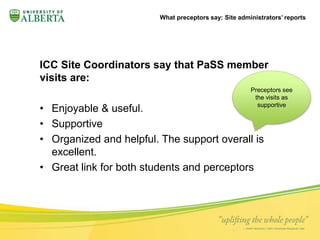
ICC Site Coordinators say that PaSS member 
visits are: 
Preceptors see 
the visits as 
• Enjoyable & useful. 
• Supportive 
• Organized and helpful. The support overall is 
excellent. 
• Great link for both students and perceptors 
supportive
What preceptors say: Site administrators’ reports 
Site Coordinators want: 
You can’t get 
enough of a good 
• More feedback from visiting faculty, including 
thing! 
formal written feedback on their performance as 
preceptor and site coordinator 
• More visits from faculty to explain to all of us as a 
group what the expectations are with regard to 
teaching.
• Peer Observation of Peer Teaching Tool 
(POPTT) 
• Telemeetings every 6-8 weeks 
• Site visit report form 
• Inclusion at Orientation at the beginning of each 
year’s ICC 
What the program does to support PaSS
• PaSS group members enjoy their visits to rural 
Alberta and become attached to their 
communities 
• Helpful in assisting students and community 
preceptors in identifying issues that need to 
come to the program coordinator 
• Winter roads & weather can be a challenge 
• Initial anxiety about peer observation of 
teaching 
Peer & Student Support Group
• The Peer & Student Support Group has been a 
very successful addition to the ICC 
• Students, Site Coordinators, Community 
Preceptors and the ICC Coordinator find value 
in the PaSS group 
• PaSS group members find visits to the 
communities rewarding 
Conclusion
Thank you! 
???Questions??? 
Jill Konkin, MD jill.konkin@ualberta.ca 
Carol Suddards, PhD suddards@telus.net 
Contact

155 muster2014 konkin

  • 1.
    Peer and StudentSupport (PaSS) Group: Supporting rural learners and teachers J Konkin, C Suddards, Division of Community Engagement Faculty of Medicine & Dentistry
  • 2.
    Faculty/Presenter Disclosure Slide1 • Faculty: Jill Konkin, Carol Suddards • Relationships with commercial interests: None
  • 3.
    Disclosure of Commercial Support Slide 2 • This program has received financial support from Health Workforce Action Plan, Government of Alberta in the form of Program Grant including budget for Program Evaluation • There are no conflicts of interest
  • 4.
    University of Alberta,Edmonton, Canada
  • 5.
    • ICC communities (10) range in size from 5000 to 13000 • Students spend 42 weeks in their communities • Students meet the same objectives as RBC students
  • 6.
    Integrated Community Clerkship–Universityof Alberta • 3rd year of a 4-year medical program • Physician teachers primarily family physicians, many with enhanced skills, i.e. generalist environment • 110 students (2007-2014): • 49% male; 51% female • On survey, 44% report rural background • 22 students in 10 communities in 2014-15
  • 7.
    Part of largerprogram of research • Evaluating program outcomes -- standards-based and responsive to interests of stakeholders & research community (Stake, 2004) • Exploring how students make sense of their lived experience in the ICC • Wanting to better understand what works (or does not), why and for whom Program of research
  • 8.
    Program goals asthey relate to the PaSS Group To establish a patient-centred, community based, pedagogically sound clerkship to be based in selected rural and regional Alberta communities - students feel supported in their learning To strengthen and enhance the relationships between rural communities and urban tertiary teaching institutions - Community physicians are supported in their role as site administrators - Contribute to community physician retention
  • 9.
    Peer and StudentSupport (PaSS) Objectives • Educational support and mentorship for students and preceptors • Direct observation of students and preceptors with timely feedback • Feedback to program coordinator from students and community preceptors • Involvement in other formal academic activities of the ICC program including orientation
  • 10.
    Multiple data sources: • student reflective conversations at the end of third year [2009 – 2011] • student surveys at the end of the ICC year [2012 – 2014] • preceptor/ site coordinator surveys [2009 – 2014] Methodology
  • 11.
    I think ofthe PaSS member as (check all that apply) 2013 2014 N % N % Students perceive the primary role of PaSS as student support and feedback Students are less aware of what role PaSS may have with preceptors What students say: Student Survey 2013-2014 Another person who can give me feedback, in addition to my preceptor(s) 7 87.5% 15 88.2% A sounding board for my questions and concerns 5 62.5% 13 76.5% A support for me 6 75.0% 14 82.4% A support for my 5 62.5% 8 47.1% preceptor(s) A representative of the Faculty of Medicine and Dentistry who ensures standards are being met 4 50.0% 12 70.6% Someone who helps me connect to the Faculty of Medicine and Dentistry 4 50.0% 7 41.2% Total responses 8 17 PaSS members are seen as external to the community health care team
  • 12.
    PaSS members provideboth academic and social support to Agree/Strongly Agree 86.49% 100.00% 78.13% 81.82% students What students say: Student Survey 2012 – 2014 Aggregate Visits from a PaSS member provided an opportunity for me to Ask questions about the program Get direct feedback on my skills and knowledge Ask how I am doing compared to urban third year students Discuss personal and social issues that were on my mind Relax and enjoy talking to someone about my learning Get away from the clinic or hospital and socialize with someone not from my ICC community 83.78% 74.29% PaSS members are another source of feedback for students
  • 13.
    Observation and feedbackby PaSS members facilitates student learning Agree/Strongly Agree 100.00% Corrective feedback facilitates learning 88.89% What students say: Student Survey 2012-2014 Aggregate The following learning experiences with the PaSS member facilitated my learning during the ICC Observing me in the clinic or hospital Providing feedback via a mini-CEX after observing me in the clinic or hospital Providing supportive comments about what I am doing well I received corrective feedback 41.67% 94.59%
  • 14.
    What students say:reflective conversations … my experience with our PaSS member was great …s/he did the Mini-CEX well and s/he’d do …several of them the day that he/she came…she/he felt sort of more objective because you know s/he was only, s/he was gone all the time and then he/she would just come in for those assessments … [it’s] like a link to the faculty….[I]t felt good to, to just have that extra evaluation to sort of know where we’re at.
  • 15.
    What students say:Reflective conversations Um and it was also just really enjoyable, like we’d go out for lunch and um you know it was a time for us to talk about our concerns face to face with someone, which I think is different than you know any other way of communication. And I just wanna say that I really thought that that was … a strong point of the program and if there’s ever a thought of doing away with that, don’t. [Yr 3 Student, Class of 2011]
  • 16.
    What preceptors say:Site administrators’ reports ICC Site Coordinators say that PaSS member visits are: Preceptors see the visits as • Enjoyable & useful. • Supportive • Organized and helpful. The support overall is excellent. • Great link for both students and perceptors supportive
  • 17.
    What preceptors say:Site administrators’ reports Site Coordinators want: You can’t get enough of a good • More feedback from visiting faculty, including thing! formal written feedback on their performance as preceptor and site coordinator • More visits from faculty to explain to all of us as a group what the expectations are with regard to teaching.
  • 18.
    • Peer Observationof Peer Teaching Tool (POPTT) • Telemeetings every 6-8 weeks • Site visit report form • Inclusion at Orientation at the beginning of each year’s ICC What the program does to support PaSS
  • 19.
    • PaSS groupmembers enjoy their visits to rural Alberta and become attached to their communities • Helpful in assisting students and community preceptors in identifying issues that need to come to the program coordinator • Winter roads & weather can be a challenge • Initial anxiety about peer observation of teaching Peer & Student Support Group
  • 20.
    • The Peer& Student Support Group has been a very successful addition to the ICC • Students, Site Coordinators, Community Preceptors and the ICC Coordinator find value in the PaSS group • PaSS group members find visits to the communities rewarding Conclusion
  • 21.
    Thank you! ???Questions??? Jill Konkin, MD jill.konkin@ualberta.ca Carol Suddards, PhD suddards@telus.net Contact

Editor's Notes

  • #12 Animations are: Students perceive the primary role of PaSS as student support and feedback PaSS members are seen as external to the community health care team Students are less aware of what role PaSS may have with preceptors
  • #13 Animations are: PaSS members provide both academic and social support to students PaSS members are another source of feedback for students
  • #14 Animations are: Observation and feedback by PaSS members facilitates student learning Corrective feedback facilitates learning
  • #17 Animation is: 1. Preceptors see the visits as supportive
  • #18 Animation is: You can’t get enough of a good thing!