Quality Improvement
Roadshow
Roadshow Video
Our quality
improvement programme
Why?
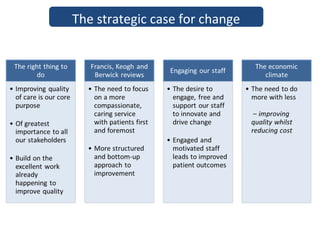
The strategic case for change
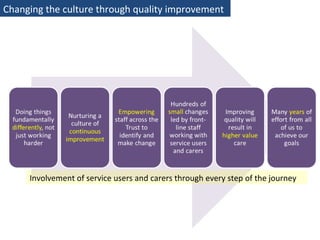
Changing the culture through quality improvement
Involvement of service users and carers through every step of the journey
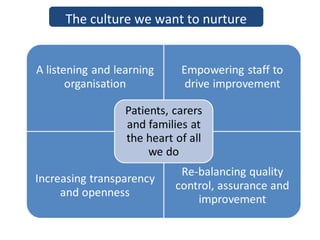
The culture we want to nurture
Our quality
improvement programme
How?
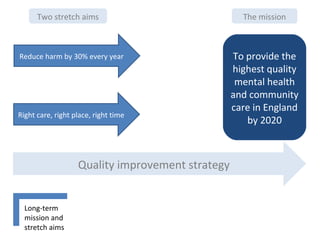
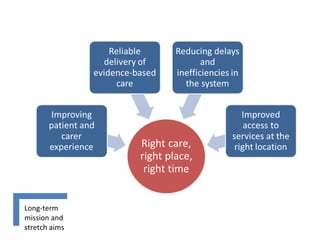
Long-term
mission and
stretch aims
The mission
To provide the
highest quality
mental health
and community
care in England
by 2020
Quality improvement strategy
Reduce harm by 30% every year
Right care, right place, right time
Two stretch aims
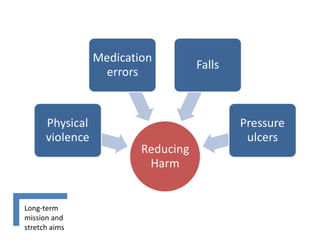
Long-term
mission and
stretch aims
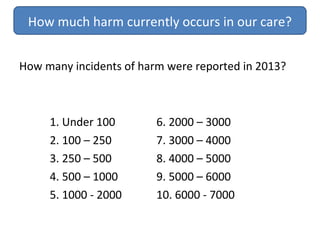
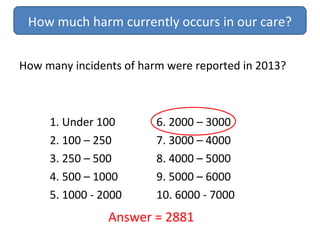
How many incidents of harm were reported in 2013?
How much harm currently occurs in our care?
1. Under 100 6. 2000 – 3000
2. 100 – 250 7. 3000 – 4000
3. 250 – 500 8. 4000 – 5000
4. 500 – 1000 9. 5000 – 6000
5. 1000 - 2000 10. 6000 - 7000
How many incidents of harm were reported in 2013?
How much harm currently occurs in our care?
1. Under 100 6. 2000 – 3000
2. 100 – 250 7. 3000 – 4000
3. 250 – 500 8. 4000 – 5000
4. 500 – 1000 9. 5000 – 6000
5. 1000 - 2000 10. 6000 - 7000
Answer = 2881
Long-term
mission and
stretch aims
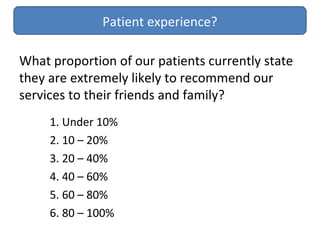
What proportion of our patients currently state
they are extremely likely to recommend our
services to their friends and family?
Patient experience?
1. Under 10%
2. 10 – 20%
3. 20 – 40%
4. 40 – 60%
5. 60 – 80%
6. 80 – 100%
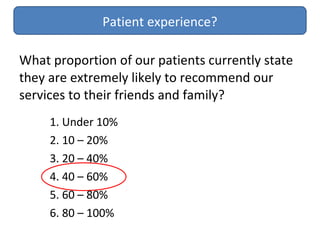
What proportion of our patients currently state
they are extremely likely to recommend our
services to their friends and family?
Patient experience?
1. Under 10%
2. 10 – 20%
3. 20 – 40%
4. 40 – 60%
5. 60 – 80%
6. 80 – 100%
Long-term
mission and
stretch aims
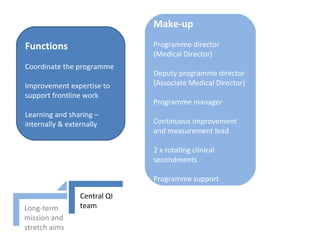
Central QI
team
Functions
Coordinate the programme
Improvement expertise to
support frontline work
Learning and sharing –
internally & externally
Make-up
Programme director
(Medical Director)
Deputy programme director
(Associate Medical Director)
Programme manager
Continuous improvement
and measurement lead
2 x rotating clinical
secondments
Programme support
Central QI
team
Building the
will
Long-term
mission and
stretch aims
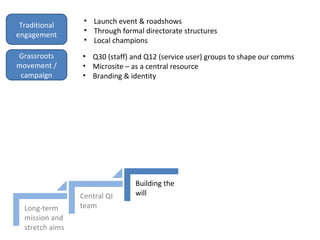
Traditional
engagement
Grassroots
movement /
campaign
• Launch event & roadshows
• Through formal directorate structures
• Local champions
• Q30 (staff) and Q12 (service user) groups to shape our comms
• Microsite – as a central resource
• Branding & identity
Central QI
team
Building the
will
Long-term
mission and
stretch aims
Aligning our
systems
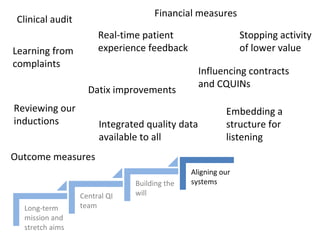
Clinical audit
Real-time patient
experience feedbackLearning from
complaints
Datix improvements
Reviewing our
inductions Integrated quality data
available to all
Embedding a
structure for
listening
Outcome measures
Influencing contracts
and CQUINs
Financial measures
Stopping activity
of lower value
Central QI
team
Building the
will
Long-term
mission and
stretch aims
Aligning our
systems
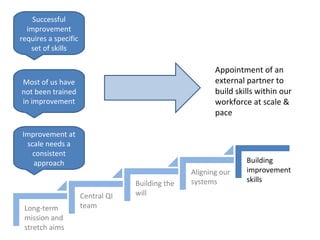
Building
improvement
skills
Successful
improvement
requires a specific
set of skills
Most of us have
not been trained
in improvement
Improvement at
scale needs a
consistent
approach
Appointment of an
external partner to
build skills within our
workforce at scale &
pace
Methodology
How do we deliver a consistent approach to quality?
Introduction to our external partner
Independent, not-for-profit organisation
Based in Cambridge, Massachusetts
Leading innovator, convenor, partner and driver of
results in health and healthcare worldwide
5 key areas of work
• Improvement capability
• Patient and family-centred care
• Patient safety
• Quality, cost and value
• Triple aim for populations (improving health
outcomes, experience and per capita cost)
The Model for Improvement
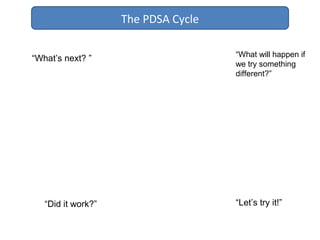
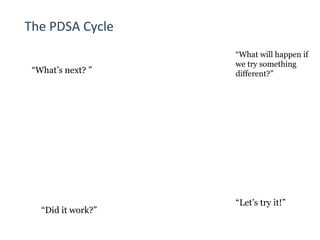
“What will happen if
we try something
different?”
“Let’s try it!”“Did it work?”
“What’s next? ”
The PDSA Cycle
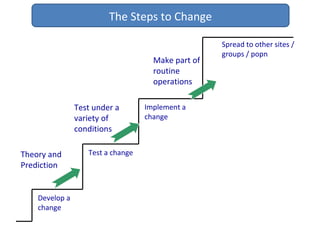
Spread to other sites /
groups / popn
Develop a
change
Implement a
change
Test a changeTheory and
Prediction
Test under a
variety of
conditions
Make part of
routine
operations
The Steps to Change
Measurement and
Using Data for
Improvement
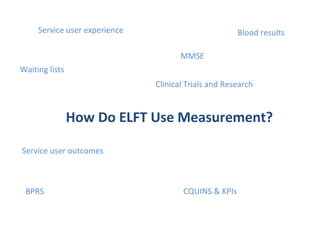
How Do ELFT Use Measurement?
MMSE
CQUINS & KPIs
Clinical Trials and Research
Service user outcomes
Service user experience
Waiting lists
BPRS
Blood results
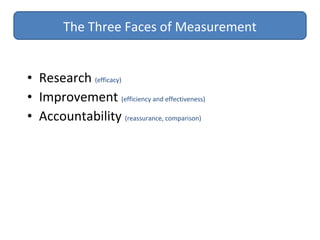
• Research (efficacy)
• Improvement (efficiency and effectiveness)
• Accountability (reassurance, comparison)
The Three Faces of Measurement
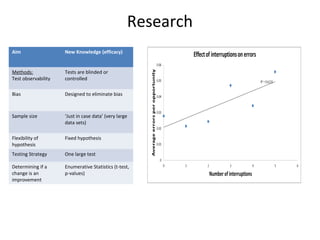
Research
Aim New Knowledge (efficacy)
Methods:
Test observability
Tests are blinded or
controlled
Bias Designed to eliminate bias
Sample size ‘Just in case data’ (very large
data sets)
Flexibility of
hypothesis
Fixed hypothesis
Testing Strategy One large test
Determining if a
change is an
improvement
Enumerative Statistics (t-test,
p-values)
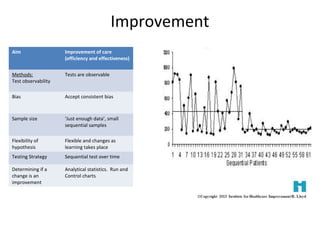
Improvement
Aim Improvement of care
(efficiency and effectiveness)
Methods:
Test observability
Tests are observable
Bias Accept consistent bias
Sample size ‘Just enough data’, small
sequential samples
Flexibility of
hypothesis
Flexible and changes as
learning takes place
Testing Strategy Sequential test over time
Determining if a
change is an
improvement
Analytical statistics. Run and
Control charts
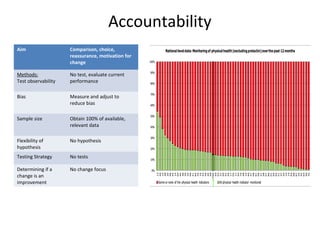
Accountability
Aim Comparison, choice,
reassurance, motivation for
change
Methods:
Test observability
No test, evaluate current
performance
Bias Measure and adjust to
reduce bias
Sample size Obtain 100% of available,
relevant data
Flexibility of
hypothesis
No hypothesis
Testing Strategy No tests
Determining if a
change is an
improvement
No change focus
• Research (efficacy)
• Improvement (efficiency and effectiveness)
• Accountability (reassurance, comparison)
The Three Faces of Measurement
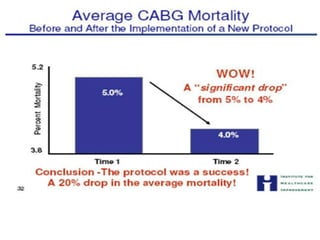
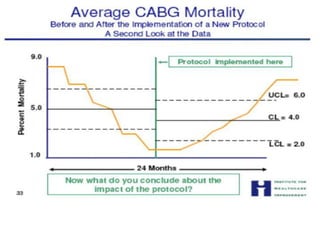
Does this represent improvement?
1.Yes 2. No
• How can you tell if you are improving?
• Data collection and analysis are central to QI
• Helps identify quality problems but also opportunities
for improvement
• Allows us to track improvement over time
• Success of programme will hinge on the
measurements we put in place
Why Measure?
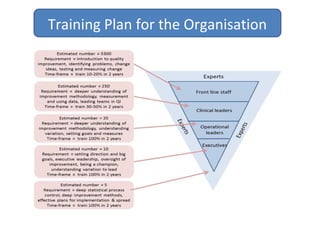
Training Plan for the Organisation
• IHI Open School programme available to all
staff
• Face to face training for 200 staff in next
year
• Learning Events (Autumn 2014)
Training Plan for the Organisation
“I’m In” Video
Break
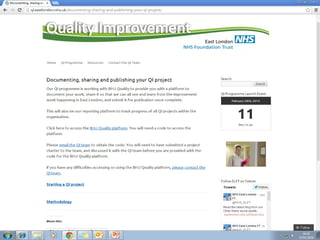
Starting an
Improvement Project
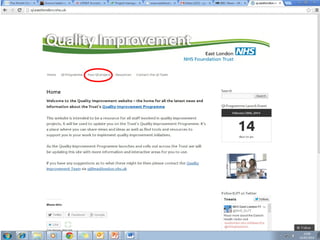
qi.eastlondon.nhs.uk
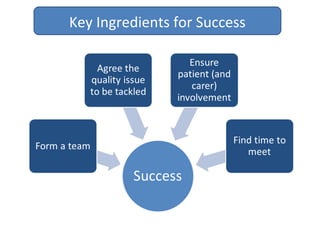
Key Ingredients for Success
And why is this important?
(the strategic and business case)
What are We Trying to Accomplish?
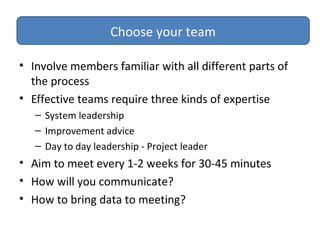
• Involve members familiar with all different parts of
the process
• Effective teams require three kinds of expertise
– System leadership
– Improvement advice
– Day to day leadership - Project leader
• Aim to meet every 1-2 weeks for 30-45 minutes
• How will you communicate?
• How to bring data to meeting?
Choose your team
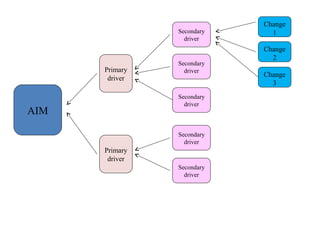
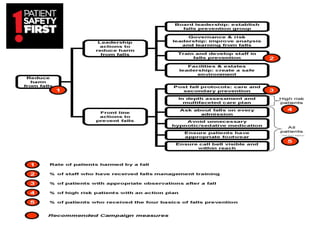
The Driver Diagram is a
tool to help us
understand the system,
its outcomes and the
processes that drive the
outcomes
Defining your messy system
AIM
Primary
driver
Primary
driver
Secondary
driver
Secondary
driver
Secondary
driver
Secondary
driver
Secondary
driver
Change
1
Change
2
Change
3
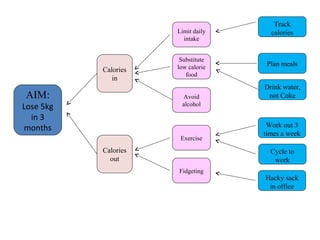
AIM:
Lose 5kg
in 3
months
Calories
in
Calories
out
Limit daily
intake
Substitute
low calorie
food
Avoid
alcohol
Exercise
Fidgeting
Track
calories
Plan meals
Drink water,
not Coke
Work out 3
times a week
Cycle to
work
Hacky sack
in office
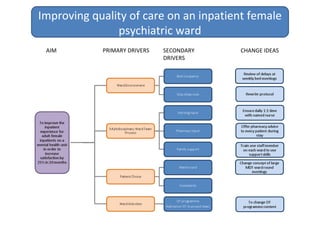
AIM PRIMARY DRIVERS SECONDARY
DRIVERS
CHANGE IDEAS
Improving quality of care on an inpatient female
psychiatric ward
Draw a Driver Diagram
The Model for Improvement
Video: Overview of the model for
improvement
• A strong, measurable
aim with a clear time
frame will help keep
your project on course
• It has to be important to
those involved
The Aim
• Be creative
Developing Changes
• Measurement is critical
for testing and
implementing changes
• Different from
measurement for
research
Measurement
Video: The Model for Improvement,
Developing Changes and Measurement
The PDSA Cycle
“What will happen if
we try something
different?”
“Let’s try it!”
“Did it work?”
“What’s next? ”
Video: The PDSA Cycle
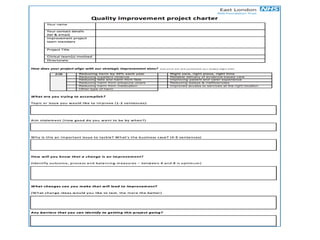
Complete Project Charter
• Email to QI team
• qi@eastlondon.nhs.uk
• QI team will get in contact in a few days
• Make sure you have right ingredients for success
• Help finalise charter
• Make sure your project aligns with programme
aims
• Link you with support on project and
methodology
• Provide support and access to BMJ Quality
platform
The QI Team Will…
Draft Measurement
Framework
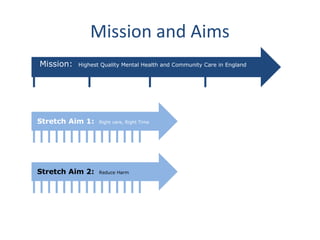
Mission and Aims
Mission: Highest Quality Mental Health and Community Care in England
Stretch Aim 1: Right care, Right Time
Stretch Aim 2: Reduce Harm
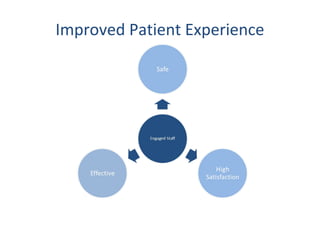
Improved Patient Experience
Summary and Close

ELFT Quality improvement roadshow - 2014

  • 1.
  • 2.
  • 3.
  • 4.
  • 5.
    Changing the culturethrough quality improvement Involvement of service users and carers through every step of the journey
  • 6.
    The culture wewant to nurture
  • 8.
  • 9.
    Long-term mission and stretch aims Themission To provide the highest quality mental health and community care in England by 2020 Quality improvement strategy Reduce harm by 30% every year Right care, right place, right time Two stretch aims
  • 10.
  • 11.
    How many incidentsof harm were reported in 2013? How much harm currently occurs in our care? 1. Under 100 6. 2000 – 3000 2. 100 – 250 7. 3000 – 4000 3. 250 – 500 8. 4000 – 5000 4. 500 – 1000 9. 5000 – 6000 5. 1000 - 2000 10. 6000 - 7000
  • 12.
    How many incidentsof harm were reported in 2013? How much harm currently occurs in our care? 1. Under 100 6. 2000 – 3000 2. 100 – 250 7. 3000 – 4000 3. 250 – 500 8. 4000 – 5000 4. 500 – 1000 9. 5000 – 6000 5. 1000 - 2000 10. 6000 - 7000 Answer = 2881
  • 13.
  • 14.
    What proportion ofour patients currently state they are extremely likely to recommend our services to their friends and family? Patient experience? 1. Under 10% 2. 10 – 20% 3. 20 – 40% 4. 40 – 60% 5. 60 – 80% 6. 80 – 100%
  • 15.
    What proportion ofour patients currently state they are extremely likely to recommend our services to their friends and family? Patient experience? 1. Under 10% 2. 10 – 20% 3. 20 – 40% 4. 40 – 60% 5. 60 – 80% 6. 80 – 100%
  • 16.
    Long-term mission and stretch aims CentralQI team Functions Coordinate the programme Improvement expertise to support frontline work Learning and sharing – internally & externally Make-up Programme director (Medical Director) Deputy programme director (Associate Medical Director) Programme manager Continuous improvement and measurement lead 2 x rotating clinical secondments Programme support
  • 17.
    Central QI team Building the will Long-term missionand stretch aims Traditional engagement Grassroots movement / campaign • Launch event & roadshows • Through formal directorate structures • Local champions • Q30 (staff) and Q12 (service user) groups to shape our comms • Microsite – as a central resource • Branding & identity
  • 18.
    Central QI team Building the will Long-term missionand stretch aims Aligning our systems Clinical audit Real-time patient experience feedbackLearning from complaints Datix improvements Reviewing our inductions Integrated quality data available to all Embedding a structure for listening Outcome measures Influencing contracts and CQUINs Financial measures Stopping activity of lower value
  • 19.
    Central QI team Building the will Long-term missionand stretch aims Aligning our systems Building improvement skills Successful improvement requires a specific set of skills Most of us have not been trained in improvement Improvement at scale needs a consistent approach Appointment of an external partner to build skills within our workforce at scale & pace
  • 20.
    Methodology How do wedeliver a consistent approach to quality?
  • 21.
    Introduction to ourexternal partner
  • 22.
    Independent, not-for-profit organisation Basedin Cambridge, Massachusetts Leading innovator, convenor, partner and driver of results in health and healthcare worldwide 5 key areas of work • Improvement capability • Patient and family-centred care • Patient safety • Quality, cost and value • Triple aim for populations (improving health outcomes, experience and per capita cost)
  • 23.
    The Model forImprovement
  • 24.
    “What will happenif we try something different?” “Let’s try it!”“Did it work?” “What’s next? ” The PDSA Cycle
  • 25.
    Spread to othersites / groups / popn Develop a change Implement a change Test a changeTheory and Prediction Test under a variety of conditions Make part of routine operations The Steps to Change
  • 26.
  • 27.
    How Do ELFTUse Measurement? MMSE CQUINS & KPIs Clinical Trials and Research Service user outcomes Service user experience Waiting lists BPRS Blood results
  • 28.
    • Research (efficacy) •Improvement (efficiency and effectiveness) • Accountability (reassurance, comparison) The Three Faces of Measurement
  • 29.
    Research Aim New Knowledge(efficacy) Methods: Test observability Tests are blinded or controlled Bias Designed to eliminate bias Sample size ‘Just in case data’ (very large data sets) Flexibility of hypothesis Fixed hypothesis Testing Strategy One large test Determining if a change is an improvement Enumerative Statistics (t-test, p-values)
  • 30.
    Improvement Aim Improvement ofcare (efficiency and effectiveness) Methods: Test observability Tests are observable Bias Accept consistent bias Sample size ‘Just enough data’, small sequential samples Flexibility of hypothesis Flexible and changes as learning takes place Testing Strategy Sequential test over time Determining if a change is an improvement Analytical statistics. Run and Control charts
  • 31.
    Accountability Aim Comparison, choice, reassurance,motivation for change Methods: Test observability No test, evaluate current performance Bias Measure and adjust to reduce bias Sample size Obtain 100% of available, relevant data Flexibility of hypothesis No hypothesis Testing Strategy No tests Determining if a change is an improvement No change focus
  • 32.
    • Research (efficacy) •Improvement (efficiency and effectiveness) • Accountability (reassurance, comparison) The Three Faces of Measurement
  • 34.
    Does this representimprovement? 1.Yes 2. No
  • 36.
    • How canyou tell if you are improving? • Data collection and analysis are central to QI • Helps identify quality problems but also opportunities for improvement • Allows us to track improvement over time • Success of programme will hinge on the measurements we put in place Why Measure?
  • 37.
    Training Plan forthe Organisation
  • 38.
    • IHI OpenSchool programme available to all staff • Face to face training for 200 staff in next year • Learning Events (Autumn 2014) Training Plan for the Organisation
  • 39.
  • 40.
  • 41.
  • 42.
  • 44.
  • 45.
    And why isthis important? (the strategic and business case) What are We Trying to Accomplish?
  • 46.
    • Involve membersfamiliar with all different parts of the process • Effective teams require three kinds of expertise – System leadership – Improvement advice – Day to day leadership - Project leader • Aim to meet every 1-2 weeks for 30-45 minutes • How will you communicate? • How to bring data to meeting? Choose your team
  • 47.
    The Driver Diagramis a tool to help us understand the system, its outcomes and the processes that drive the outcomes Defining your messy system
  • 48.
  • 49.
    AIM: Lose 5kg in 3 months Calories in Calories out Limitdaily intake Substitute low calorie food Avoid alcohol Exercise Fidgeting Track calories Plan meals Drink water, not Coke Work out 3 times a week Cycle to work Hacky sack in office
  • 50.
    AIM PRIMARY DRIVERSSECONDARY DRIVERS CHANGE IDEAS Improving quality of care on an inpatient female psychiatric ward
  • 52.
  • 53.
    The Model forImprovement
  • 54.
    Video: Overview ofthe model for improvement
  • 55.
    • A strong,measurable aim with a clear time frame will help keep your project on course • It has to be important to those involved The Aim
  • 56.
  • 57.
    • Measurement iscritical for testing and implementing changes • Different from measurement for research Measurement
  • 58.
    Video: The Modelfor Improvement, Developing Changes and Measurement
  • 59.
    The PDSA Cycle “Whatwill happen if we try something different?” “Let’s try it!” “Did it work?” “What’s next? ”
  • 60.
  • 61.
    Complete Project Charter •Email to QI team • qi@eastlondon.nhs.uk • QI team will get in contact in a few days
  • 62.
    • Make sureyou have right ingredients for success • Help finalise charter • Make sure your project aligns with programme aims • Link you with support on project and methodology • Provide support and access to BMJ Quality platform The QI Team Will…
  • 63.
  • 64.
    Mission and Aims Mission:Highest Quality Mental Health and Community Care in England Stretch Aim 1: Right care, Right Time Stretch Aim 2: Reduce Harm
  • 65.
  • 66.

Editor's Notes

  • #24 The PDSA cycle is a tool we use to distinguish changes that are effective from those that are not so that we can concentrate our efforts
  • #25 Four parts of the cycle: Plan: Decide what change you will make, who will do it, and when it will be done. Formulate an hypothesis about what you think will happen when you try the change. What do you expect will happen? Identify data that you can collect (either quantitative or qualitative) that will allow you to evaluate the result of the test. Do: Carry out the change. Study: Make sure that you leave time for reflection about your test. Use the data and the experience of those carrying out the test to discuss what happened. Did you get the results you expected? If not, why not? Did anything unexpected happen during the test? Act: Given what you learned during the test, what will your next test be? Will you make refinements to the change? Abandon it? Keep the change and try it on a larger scale?
  • #54 The PDSA cycle is a tool we use to distinguish changes that are effective from those that are not so that we can concentrate our efforts
  • #55 The PDSA cycle is a tool we use to distinguish changes that are effective from those that are not so that we can concentrate our efforts
  • #56 References: 1. Accelerating the pace of improvement: interview with Thomas Nolan. Journal of Quality Improvement. 1997;23(4). 2. Berwick DM. A primer on leading the improvement of systems. BMJ. 1996;312:619-622. 3. Langley G, Nolan K, Nolan T, Norman C, Provost L. The Improvement Guide: A Practical Approach to Enhancing Organizational Performance. San Francisco, CA: Jossey-Bass Publishers; 1996. 4. Lloyd R. Quality Health Care: A Guide to Developing and Using Indicators. Sudbury, MA: Jones and Bartlett Publishers; 2004. 5. Moen R, Nolan T, Provost L. Quality Improvement Through Planned Experimentation. 2nd ed. New York, NY: McGraw-Hill Companies; 1998. 6. The Improvement Handbook. Austin, TX: Associates in Process Improvement; 2005.
  • #57 Notes: The design of your change will depend on what you are trying to change
  • #59 The PDSA cycle is a tool we use to distinguish changes that are effective from those that are not so that we can concentrate our efforts
  • #60 Four parts of the cycle: Plan: Decide what change you will make, who will do it, and when it will be done. Formulate an hypothesis about what you think will happen when you try the change. What do you expect will happen? Identify data that you can collect (either quantitative or qualitative) that will allow you to evaluate the result of the test. Do: Carry out the change. Study: Make sure that you leave time for reflection about your test. Use the data and the experience of those carrying out the test to discuss what happened. Did you get the results you expected? If not, why not? Did anything unexpected happen during the test? Act: Given what you learned during the test, what will your next test be? Will you make refinements to the change? Abandon it? Keep the change and try it on a larger scale?
  • #61 Instructions: Ask the learner which of the above three is a good aim? Answer is the second one because it is specific, measurable, determines a timeframe