AP Biology
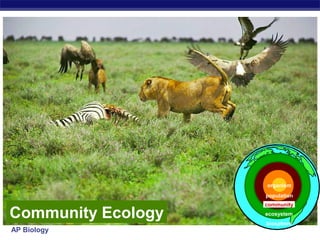
Community Ecology
population
ecosystem
community
biosphere
organism
AP Biology
Community Ecology
 Community
 all the organisms that live together in a
place
 interactions
 Community Ecology
 study of
interactions
among all
populations
in a common
environment
To answer:
In what way do the
populations interact?
To answer:
In what way do the
populations interact?
AP Biology
Fundamental
niches
Realized
niches
High tide
Low tide
Species 1
Species 2
Niche
 An organism’s niche is its ecological role
 habitat = address vs. niche = job
Competitive Exclusion
If Species 2 is removed,
then Species 1 will occupy
whole tidal zone. But at
lower depths Species 2
out-competes Species 1,
excluding it from its
potential (fundamental)
niche.
Competitive Exclusion
If Species 2 is removed,
then Species 1 will occupy
whole tidal zone. But at
lower depths Species 2
out-competes Species 1,
excluding it from its
potential (fundamental)
niche.
Chthamalus sp.
Semibalanus sp.
AP Biology
Niche & competition
 Competitive Exclusion
 No two similar species can occupy the
same niche at the same time
AP Biology
Resource partitioning
Reduce competition through microhabitats
“the ghost of
competition past”
“the ghost of
competition past”
AP Biology
Interspecific interactions
 Symbiotic interactions
 competition (-/-)
 compete for limited resource
 competitive exclusion!
 predation / parasitism (-/+)
 mutualism (+/+)
 lichens (algae & fungus)
 commensalism (+/0)
 barnacles attached
to whale
AP Biology
commensalism
predation competition
Symbiosis
mutualism
…not very funny
for a clown fish
+/0
+/+
+/- -/-
AP Biology
What relationship is this?
AP Biology
Predation drives evolution
 Predators adaptations
 locate & subdue prey
 Prey adaptations
 elude & defend
spines, thorns, toxins
horns, speed, coloration
Predation provides
a strong selection
pressure on both
prey & predator
Predation provides
a strong selection
pressure on both
prey & predator
AP Biology
Anti-predator adaptations
 Hide from predators
 avoid detection
 camouflage
 Warn predators
 advertise how undesirable
you are as prey
 aposematic coloration
 apo = away & sematic = sign/meaning
 Batesian mimicry
 Mullerian mimicry
AP Biology
Defense mechanisms
 Camouflage
 cryptic coloration
whipporwill
lizard
toadlizard
frog
AP Biology
Mimicry
palatable or harmless species
mimics a harmful model
palatable or harmless species
mimics a harmful model
Hawkmoth larva puffs up toHawkmoth larva puffs up to
look like poisonous snakelook like poisonous snake
Hawkmoth larva puffs up toHawkmoth larva puffs up to
look like poisonous snakelook like poisonous snake
Batesian mimicryBatesian mimicry
hawkmoth larvae
green parrot snake
Convergent evolutionConvergent evolution
AP Biology
Batesian mimicry
Monarch male
poisonous
Convergent evolutionConvergent evolution
fly bee moth bee
Which is the fly vs. the bee?Which is the moth vs. the bee?
Viceroy male
edible
AP Biology
Mullerian mimicry
yellow jacket
cuckoo bee
two or more protected
species look like each other
two or more protected
species look like each other
- group defense?- group defense?
- predators may evolve innate avoidance- predators may evolve innate avoidance
- group defense?- group defense?
- predators may evolve innate avoidance- predators may evolve innate avoidanceMullerian mimicry
AP Biology
Common warning coloration
 Aposematic species come to resemble each other
black, red,
orange & yellow
means:
DON’T EAT ME!
AP Biology
What kind of mimicry?
Coral snake
is poisonous
King snake is not
Red on yellow, poison fellow;
red on black, safe from attack
AP Biology
Coevolution in Community
 Predator-prey relationships
 Parasite-host relationships
 Flowers & pollinators
Long term evolutionary adjustments between speciesLong term evolutionary adjustments between species
AP Biology
Characterizing a community
 Community structure
 species diversity
 how many different species
 composition
 dominant species
 most abundant species
or highest biomass
(total weight)
 keystone species
 changes over time
 succession
AP Biology
Species diversity
greater diversity = greater stability
 Greater biodiversity
offers:
 more food
resources
 more habitats
 more resilience
in face of
environmental
change
AP Biology
suburban lawnagricultural
“monoculture”
The impact of reduced biodiversity
“old field”
compare these communitiescompare these communities
 Irish potato famine
 1970 US corn crop failure
 Irish potato famine
 1970 US corn crop failure
AP Biology
 Influential ecological role
 exert important
regulating effect
on other species
in community
 keystone
species
increases
diversity
in habitat
Keystone species Pisaster ochraceous
Sea star
diversity decreases
mussels out-compete
other species
diversity increases
Washington coast
AP Biology
Keystone species
Sea otter is a
keystone
predator in
North Pacific
Sea otter is a
keystone
predator in
North Pacific
What is theWhat is the
impact of theimpact of the
Orca whale?Orca whale?
What is theWhat is the
impact of theimpact of the
Orca whale?Orca whale?
AP Biology
Keystone species
Beaver is a
keystone species in
Northeast & West
Beaver is a
keystone species in
Northeast & West
dams transform flowing streams into ponds creating new habitatdams transform flowing streams into ponds creating new habitatdams transform flowing streams into ponds creating new habitatdams transform flowing streams into ponds creating new habitat
AP Biology
Ecological succession
 Sequence of community changes
 transition in species composition over time
 years or decades
 usually after a disturbance
Mt. St. Helens
AP Biology
Primary succession
 Begins with
virtually
lifeless area
without soil,
then…
 bacteria
 lichens &
mosses
 grasses
 shrubs
 trees
make
soil
{
AP Biology
Secondary succession
 Existing community cleared,
but base soil is still intact
burning releases
nutrients formerly
locked up in the
tissues of tree
burning releases
nutrients formerly
locked up in the
tissues of tree
the disturbance
starts the process
of succession
over again
the disturbance
starts the process
of succession
over again
AP Biology
Succession of species
lichens & mosses grasses
treesbushes & small trees
pioneer species
climax forest
compete well in high sunlight
more shade tolerant species
shade tolerant species
stable community
AP Biology
What causes succession?
 Tolerance
 early species are weedy r-selected
 tolerant of harsh conditions
 Facilitation & Inhibition
 early species facilitate habitat changes
 change soil pH
 change soil fertility
 change light levels
 allows other species
to out-compete
AP Biology
Climax forest
 Plant community dominated by trees
 Representing final stage of natural
succession for specific location
 stable plant community
 remains essentially unchanged in species
composition as long as site remains undisturbed
 birch, beech, maple,
hemlock
 oak, hickory, pine
AP Biology
Climax forest
 solar energy levels
 temperature
 rainfall
 fertility & depth of soil
The species mix of
climax forest is
dependent on the
abiotic factors of
the region
temperate deciduous forest
birch, beech, maple, hemlock
taiga
AP Biology
Disturbances as natural cycle
 Disturbances are often necessary for
community development & survival
- release nutrients
- increases biodiversity
- release nutrients
- increases biodiversity
- increases habitats
- rejuvenates community
- increases habitats
- rejuvenates community
fire climax forestsfire climax forests
AP Biology
Fire climax species
Jack PineJack Pine
adaptations to survive
and reproduce in areas
than experience
frequent fires
adaptations to survive
and reproduce in areas
than experience
frequent fires
AP Biology
When people don’t learn ecology!
Building homes in fire climax zones
preventing fires
makes next year’s
fire much worse!
preventing fires
makes next year’s
fire much worse!
2007-2008AP Biology
Don’t blow
your top!
Ask
Questions!

17 ch54communityecology2008

  • 1.
  • 2.
    AP Biology Community Ecology Community  all the organisms that live together in a place  interactions  Community Ecology  study of interactions among all populations in a common environment To answer: In what way do the populations interact? To answer: In what way do the populations interact?
  • 3.
    AP Biology Fundamental niches Realized niches High tide Lowtide Species 1 Species 2 Niche  An organism’s niche is its ecological role  habitat = address vs. niche = job Competitive Exclusion If Species 2 is removed, then Species 1 will occupy whole tidal zone. But at lower depths Species 2 out-competes Species 1, excluding it from its potential (fundamental) niche. Competitive Exclusion If Species 2 is removed, then Species 1 will occupy whole tidal zone. But at lower depths Species 2 out-competes Species 1, excluding it from its potential (fundamental) niche. Chthamalus sp. Semibalanus sp.
  • 4.
    AP Biology Niche &competition  Competitive Exclusion  No two similar species can occupy the same niche at the same time
  • 5.
    AP Biology Resource partitioning Reducecompetition through microhabitats “the ghost of competition past” “the ghost of competition past”
  • 6.
    AP Biology Interspecific interactions Symbiotic interactions  competition (-/-)  compete for limited resource  competitive exclusion!  predation / parasitism (-/+)  mutualism (+/+)  lichens (algae & fungus)  commensalism (+/0)  barnacles attached to whale
  • 7.
  • 8.
  • 9.
    AP Biology Predation drivesevolution  Predators adaptations  locate & subdue prey  Prey adaptations  elude & defend spines, thorns, toxins horns, speed, coloration Predation provides a strong selection pressure on both prey & predator Predation provides a strong selection pressure on both prey & predator
  • 10.
    AP Biology Anti-predator adaptations Hide from predators  avoid detection  camouflage  Warn predators  advertise how undesirable you are as prey  aposematic coloration  apo = away & sematic = sign/meaning  Batesian mimicry  Mullerian mimicry
  • 11.
    AP Biology Defense mechanisms Camouflage  cryptic coloration whipporwill lizard toadlizard frog
  • 12.
    AP Biology Mimicry palatable orharmless species mimics a harmful model palatable or harmless species mimics a harmful model Hawkmoth larva puffs up toHawkmoth larva puffs up to look like poisonous snakelook like poisonous snake Hawkmoth larva puffs up toHawkmoth larva puffs up to look like poisonous snakelook like poisonous snake Batesian mimicryBatesian mimicry hawkmoth larvae green parrot snake Convergent evolutionConvergent evolution
  • 13.
    AP Biology Batesian mimicry Monarchmale poisonous Convergent evolutionConvergent evolution fly bee moth bee Which is the fly vs. the bee?Which is the moth vs. the bee? Viceroy male edible
  • 14.
    AP Biology Mullerian mimicry yellowjacket cuckoo bee two or more protected species look like each other two or more protected species look like each other - group defense?- group defense? - predators may evolve innate avoidance- predators may evolve innate avoidance - group defense?- group defense? - predators may evolve innate avoidance- predators may evolve innate avoidanceMullerian mimicry
  • 15.
    AP Biology Common warningcoloration  Aposematic species come to resemble each other black, red, orange & yellow means: DON’T EAT ME!
  • 16.
    AP Biology What kindof mimicry? Coral snake is poisonous King snake is not Red on yellow, poison fellow; red on black, safe from attack
  • 17.
    AP Biology Coevolution inCommunity  Predator-prey relationships  Parasite-host relationships  Flowers & pollinators Long term evolutionary adjustments between speciesLong term evolutionary adjustments between species
  • 18.
    AP Biology Characterizing acommunity  Community structure  species diversity  how many different species  composition  dominant species  most abundant species or highest biomass (total weight)  keystone species  changes over time  succession
  • 19.
    AP Biology Species diversity greaterdiversity = greater stability  Greater biodiversity offers:  more food resources  more habitats  more resilience in face of environmental change
  • 20.
    AP Biology suburban lawnagricultural “monoculture” Theimpact of reduced biodiversity “old field” compare these communitiescompare these communities  Irish potato famine  1970 US corn crop failure  Irish potato famine  1970 US corn crop failure
  • 21.
    AP Biology  Influentialecological role  exert important regulating effect on other species in community  keystone species increases diversity in habitat Keystone species Pisaster ochraceous Sea star diversity decreases mussels out-compete other species diversity increases Washington coast
  • 22.
    AP Biology Keystone species Seaotter is a keystone predator in North Pacific Sea otter is a keystone predator in North Pacific What is theWhat is the impact of theimpact of the Orca whale?Orca whale? What is theWhat is the impact of theimpact of the Orca whale?Orca whale?
  • 23.
    AP Biology Keystone species Beaveris a keystone species in Northeast & West Beaver is a keystone species in Northeast & West dams transform flowing streams into ponds creating new habitatdams transform flowing streams into ponds creating new habitatdams transform flowing streams into ponds creating new habitatdams transform flowing streams into ponds creating new habitat
  • 24.
    AP Biology Ecological succession Sequence of community changes  transition in species composition over time  years or decades  usually after a disturbance Mt. St. Helens
  • 25.
    AP Biology Primary succession Begins with virtually lifeless area without soil, then…  bacteria  lichens & mosses  grasses  shrubs  trees make soil {
  • 26.
    AP Biology Secondary succession Existing community cleared, but base soil is still intact burning releases nutrients formerly locked up in the tissues of tree burning releases nutrients formerly locked up in the tissues of tree the disturbance starts the process of succession over again the disturbance starts the process of succession over again
  • 27.
    AP Biology Succession ofspecies lichens & mosses grasses treesbushes & small trees pioneer species climax forest compete well in high sunlight more shade tolerant species shade tolerant species stable community
  • 28.
    AP Biology What causessuccession?  Tolerance  early species are weedy r-selected  tolerant of harsh conditions  Facilitation & Inhibition  early species facilitate habitat changes  change soil pH  change soil fertility  change light levels  allows other species to out-compete
  • 29.
    AP Biology Climax forest Plant community dominated by trees  Representing final stage of natural succession for specific location  stable plant community  remains essentially unchanged in species composition as long as site remains undisturbed  birch, beech, maple, hemlock  oak, hickory, pine
  • 30.
    AP Biology Climax forest solar energy levels  temperature  rainfall  fertility & depth of soil The species mix of climax forest is dependent on the abiotic factors of the region temperate deciduous forest birch, beech, maple, hemlock taiga
  • 31.
    AP Biology Disturbances asnatural cycle  Disturbances are often necessary for community development & survival - release nutrients - increases biodiversity - release nutrients - increases biodiversity - increases habitats - rejuvenates community - increases habitats - rejuvenates community fire climax forestsfire climax forests
  • 32.
    AP Biology Fire climaxspecies Jack PineJack Pine adaptations to survive and reproduce in areas than experience frequent fires adaptations to survive and reproduce in areas than experience frequent fires
  • 33.
    AP Biology When peopledon’t learn ecology! Building homes in fire climax zones preventing fires makes next year’s fire much worse! preventing fires makes next year’s fire much worse!
  • 34.

Editor's Notes

  • #6 Resource partitioning among Dominican Republic lizards. Seven species of Anolis lizards live in close proximity, and all feed on insects and other small arthropods. However, competition for food is reduced because each lizard species has a different perch, thus occupying a distinct niche. Sympatric species often partition available resources, reducing competition between them.
  • #9 clown fish & sea anemone ants & acacia impala & oxpeckers
  • #10 Predation provides a strong selective pressure on prey populations. Ay feature that would decrease the probability of capture should be strongly favored.
  • #21 In the early 1970's, a new corn genotype was released in the US; the "Texas male sterile" (TMS). Hybrids that contained this new characteristic had many desirable properties, and growers were excited about them, planting them over miles and miles of corn acreage in US. They were, of course, bred to be resistant to the most common corn diseases. However, they were not resistant to a previously unimportant strain of a fungal disease; the southern corn leaf blight (caused by the fungus Helminthosporium maydis ). Ninety percent of the corn sowed in the US in 1970 contained the TMS trait and also shared genetic susceptibility to this pathogen. The fungus encountered all this acreage of susceptible host and wiped out one fourth of the US corn crop in 1970, a loss of over one billion dollars in production! If the corn acreage hadn't been such a monoculture, the fungus wouldn't have been able to spread as rapidly, as it would have encountered barriers of genetically resistant plants.
  • #23 Structure of a community may be controlled bottom-up by nutrients or top-down by predators