Regulation of Gene Expression
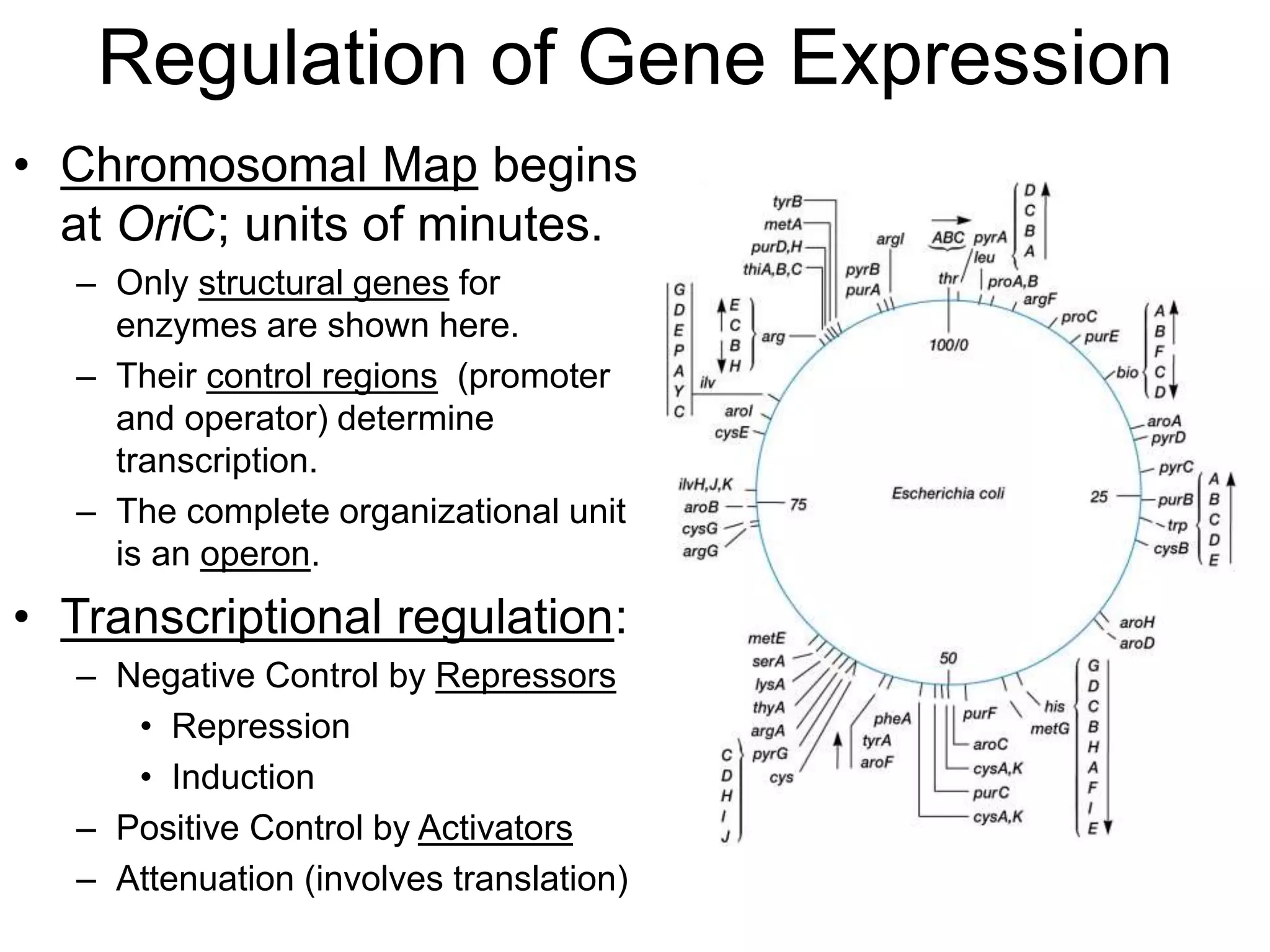
• Chromosomal Map begins
at OriC; units of minutes.
– Only structural genes for
enzymes are shown here.
– Their control regions (promoter
and operator) determine
transcription.
– The complete organizational unit
is an operon.
• Transcriptional regulation:
– Negative Control by Repressors
• Repression
• Induction
– Positive Control by Activators
– Attenuation (involves translation)
Transcriptional Regulation by
Repression
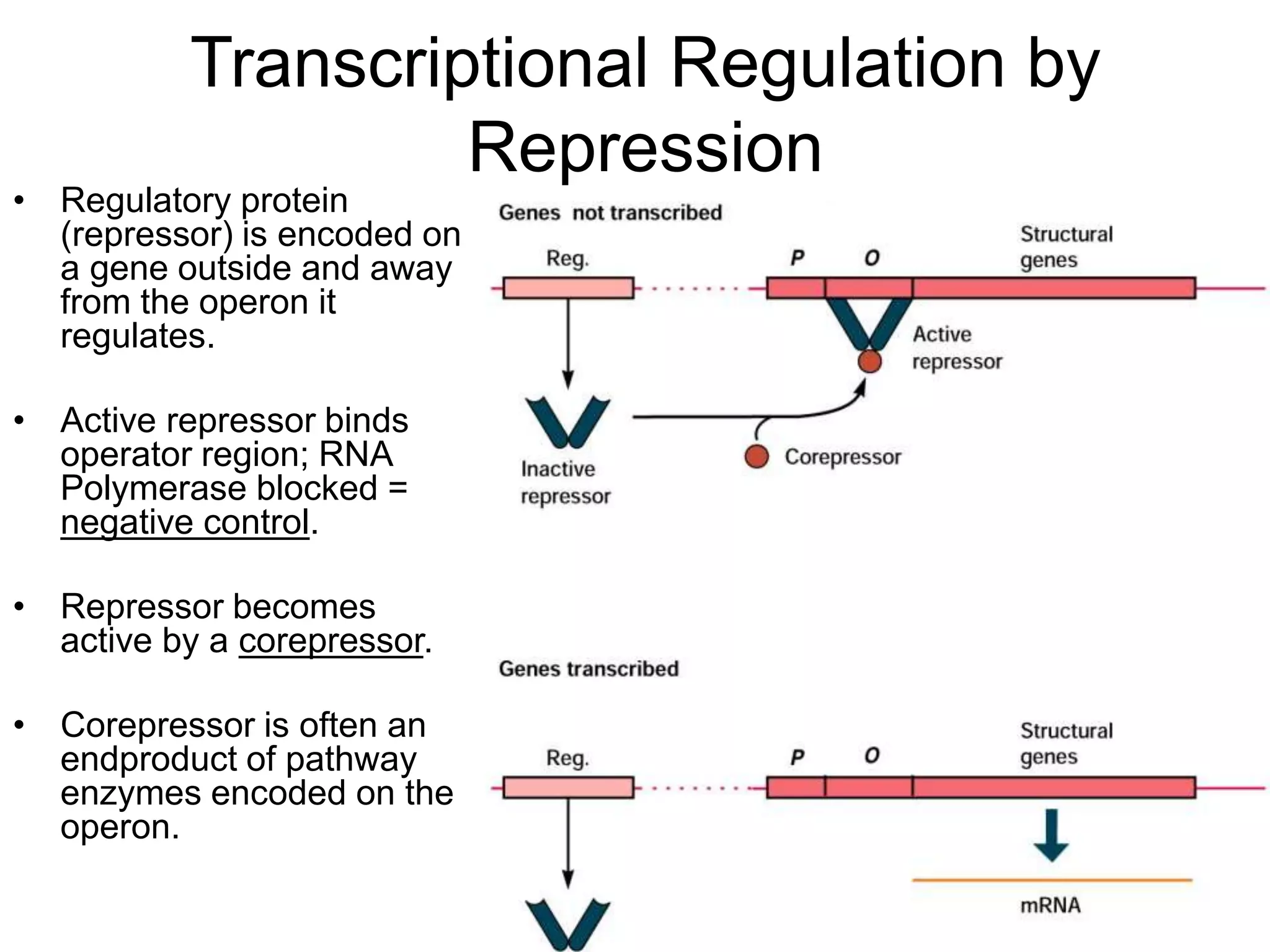
• Regulatory protein
(repressor) is encoded on
a gene outside and away
from the operon it
regulates.
• Active repressor binds
operator region; RNA
Polymerase blocked =
negative control.
• Repressor becomes
active by a corepressor.
• Corepressor is often an
endproduct of pathway
enzymes encoded on the
operon.
Transcriptional Regulation by
Induction
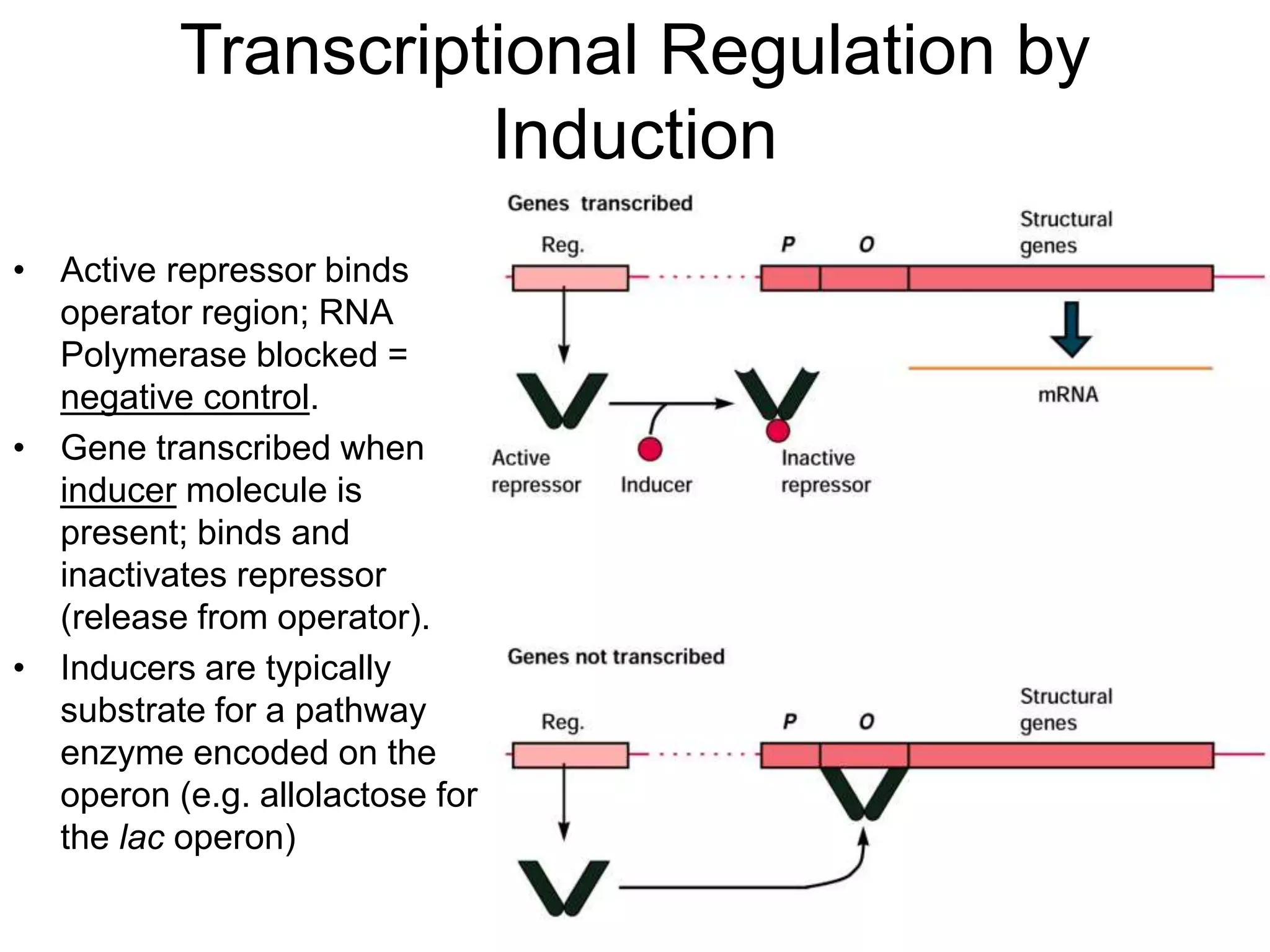
• Active repressor binds
operator region; RNA
Polymerase blocked =
negative control.
• Gene transcribed when
inducer molecule is
present; binds and
inactivates repressor
(release from operator).
• Inducers are typically
substrate for a pathway
enzyme encoded on the
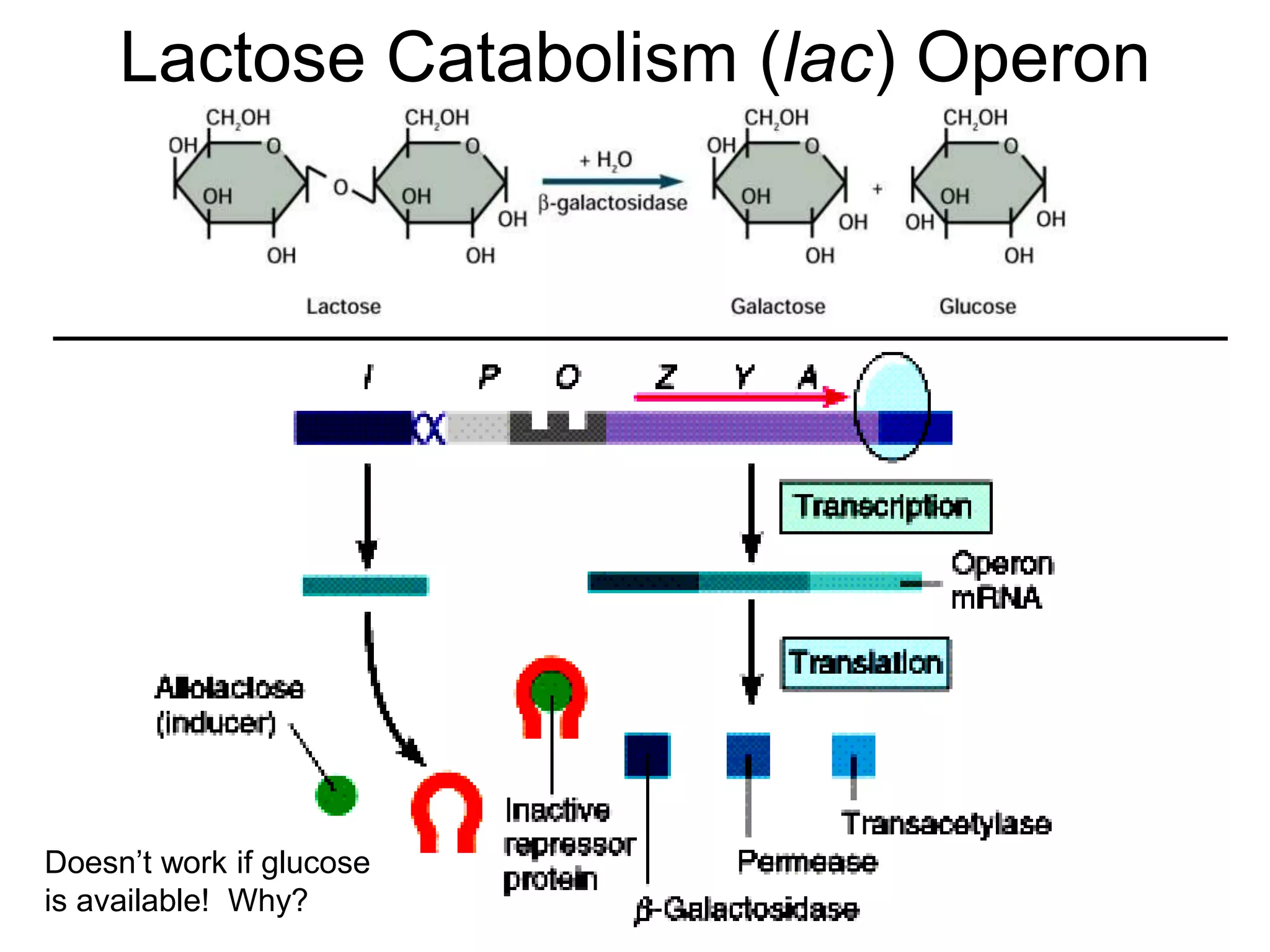
operon (e.g. allolactose for
the lac operon)
Lactose Catabolism (lac) Operon
Doesn’t work if glucose
is available! Why?
Transcriptional Regulation by
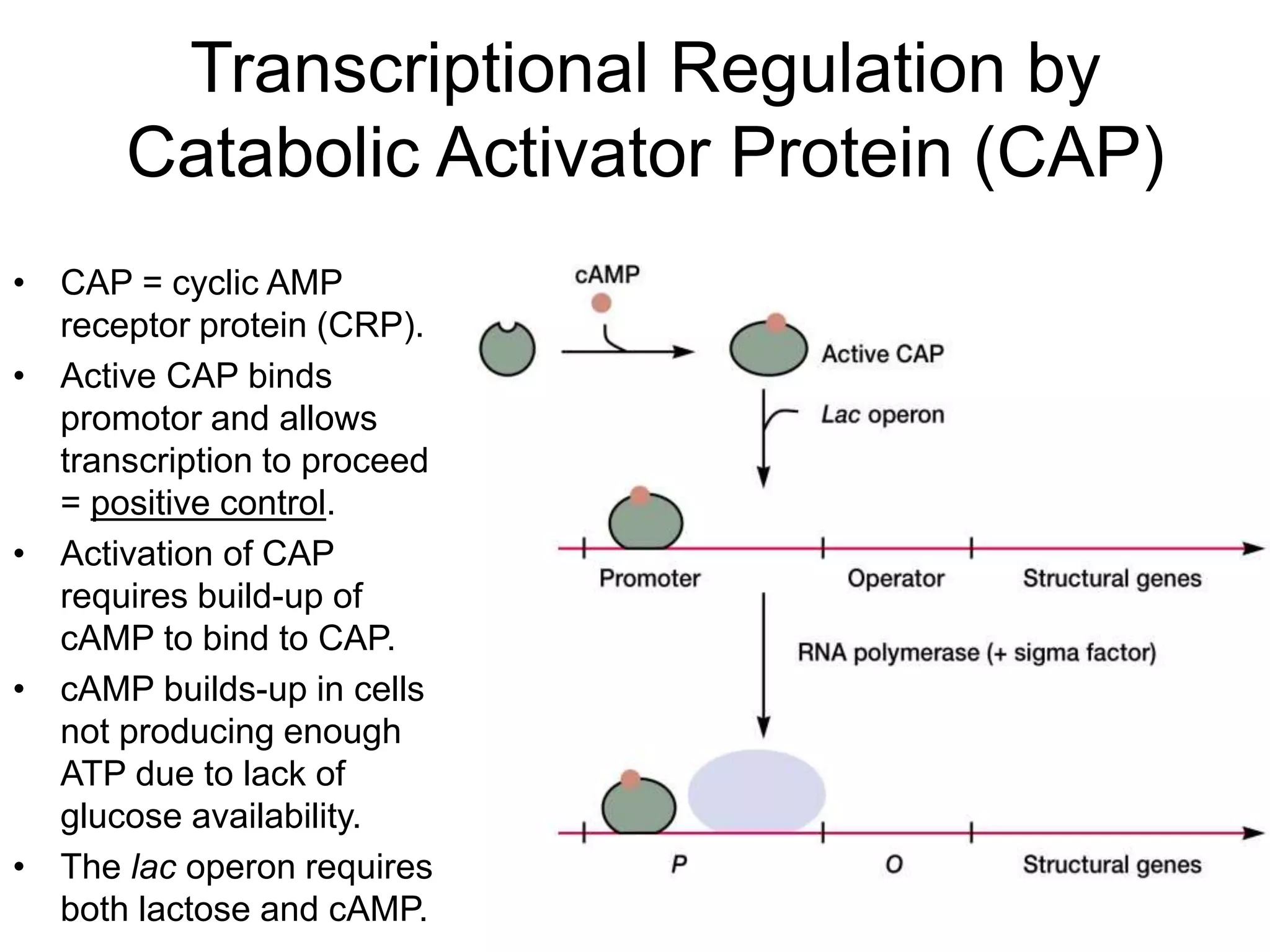
Catabolic Activator Protein (CAP)
• CAP = cyclic AMP
receptor protein (CRP).
• Active CAP binds
promotor and allows
transcription to proceed
= positive control.
• Activation of CAP
requires build-up of
cAMP to bind to CAP.
• cAMP builds-up in cells
not producing enough
ATP due to lack of
glucose availability.
• The lac operon requires
both lactose and cAMP.
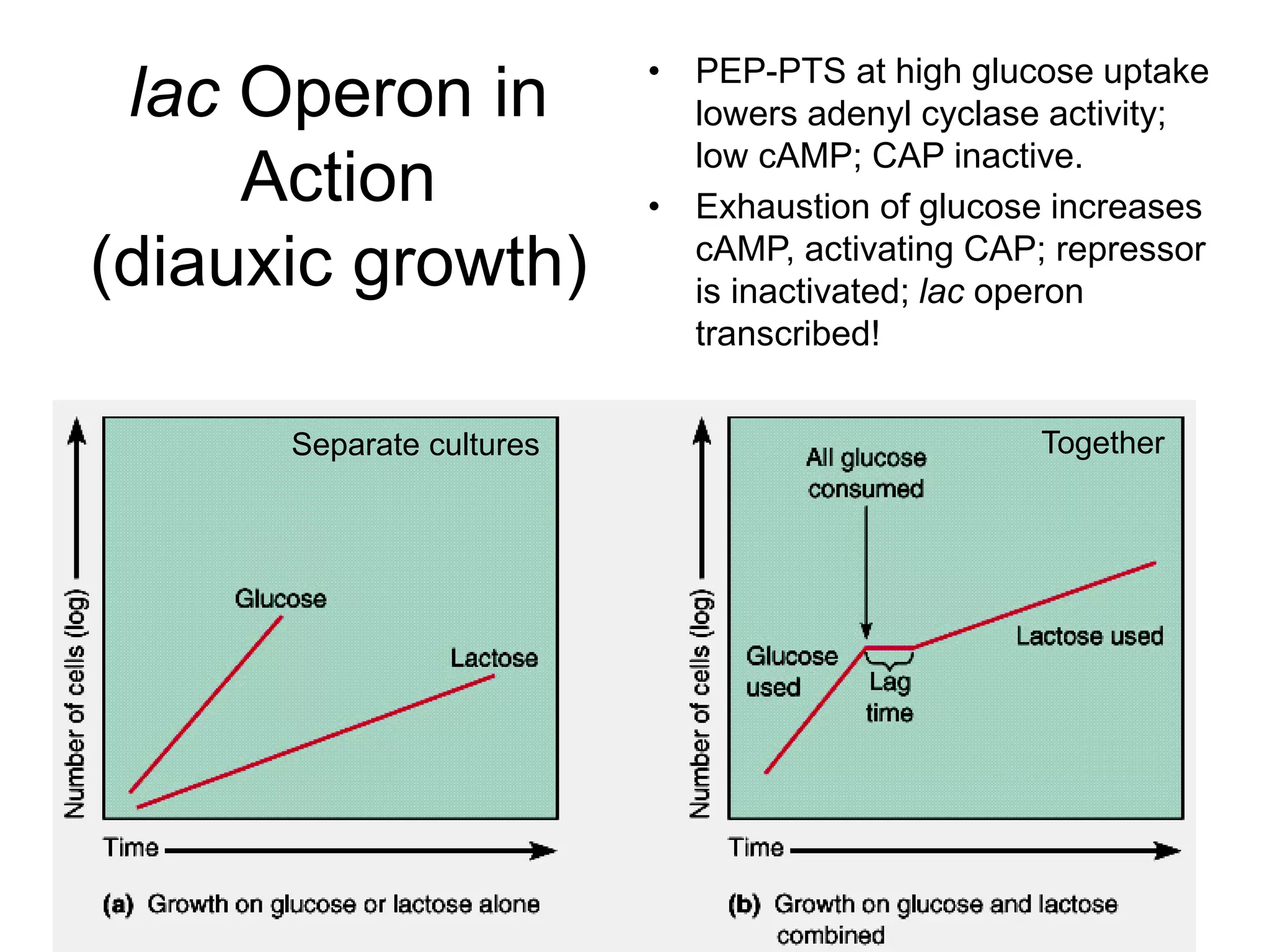
lac Operon in
Action
(diauxic growth)
• PEP-PTS at high glucose uptake
lowers adenyl cyclase activity;
low cAMP; CAP inactive.
• Exhaustion of glucose increases
cAMP, activating CAP; repressor
is inactivated; lac operon
transcribed!
Separate cultures Together
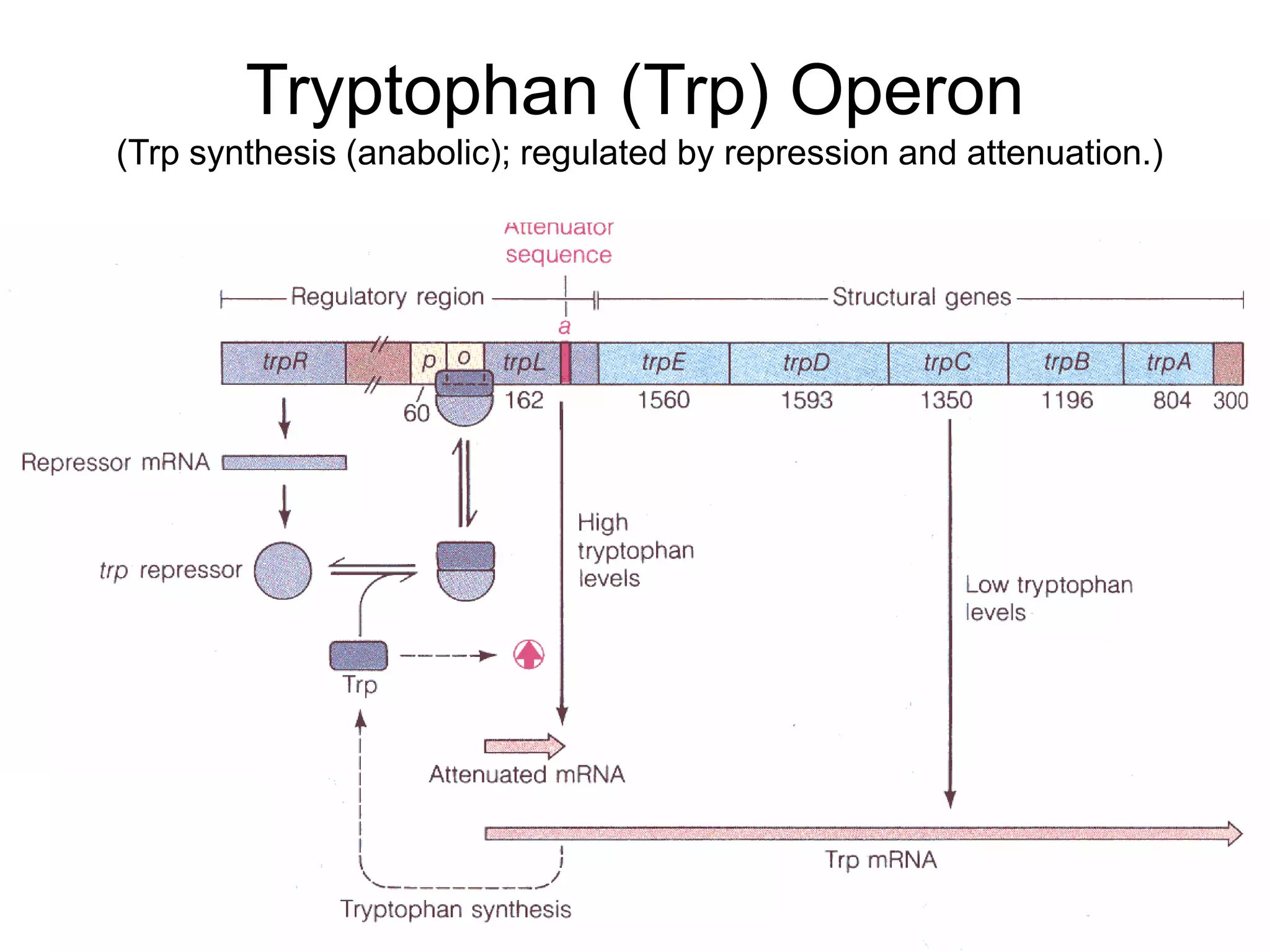
Tryptophan (Trp) Operon
(Trp synthesis (anabolic); regulated by repression and attenuation.)
Transcriptional Regulation by
Attenuation
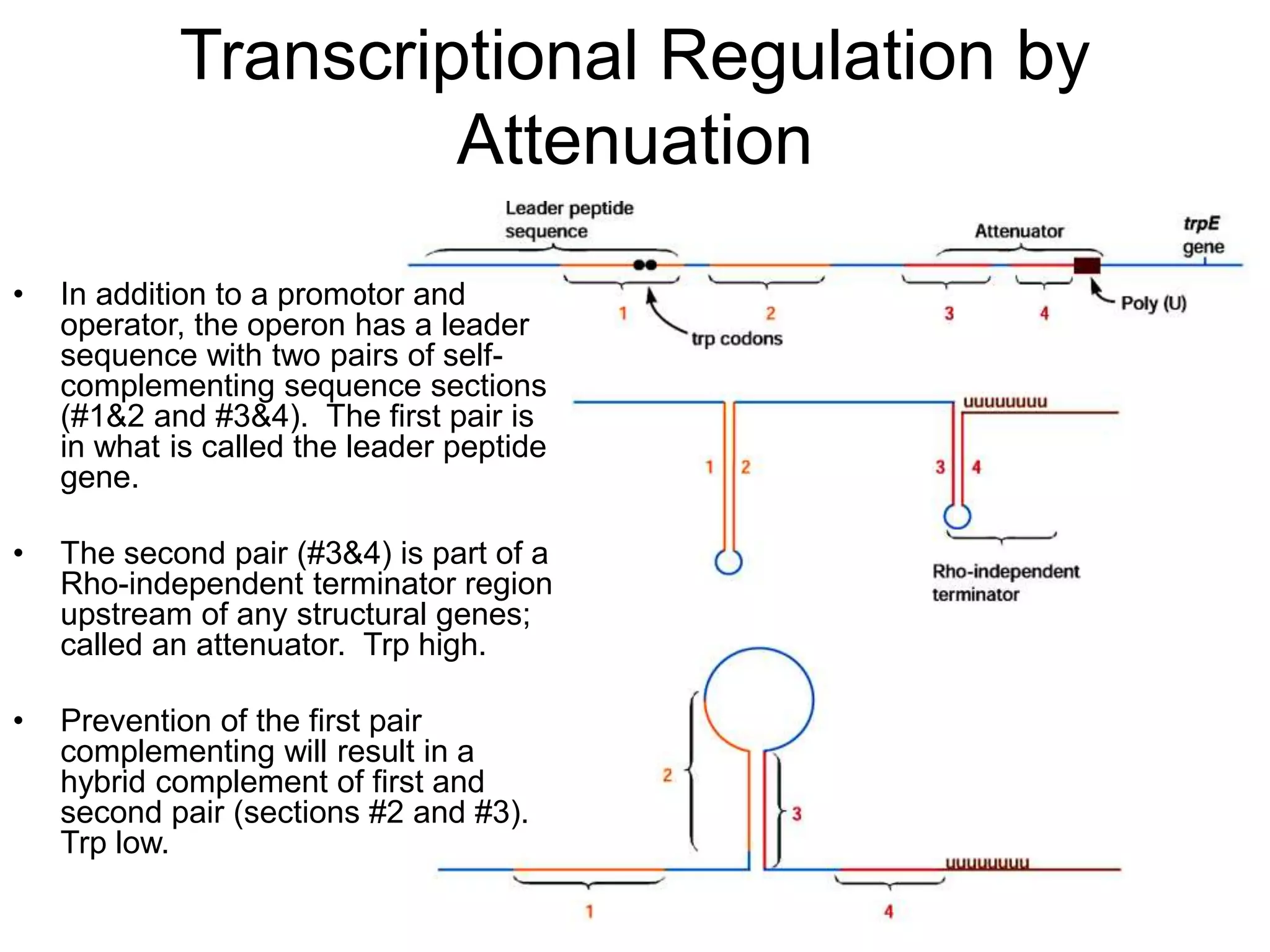
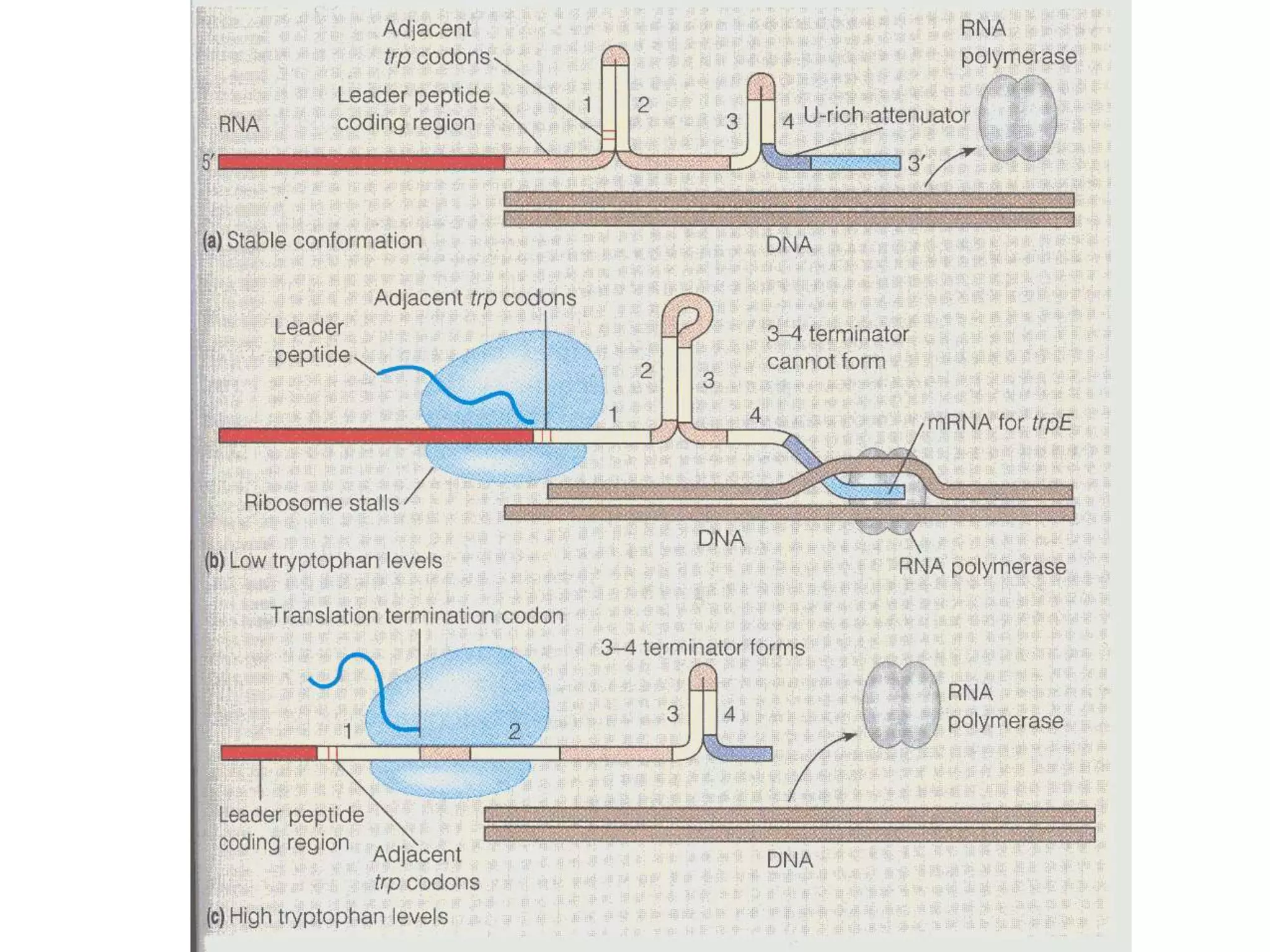
• In addition to a promotor and
operator, the operon has a leader
sequence with two pairs of self-
complementing sequence sections
(#1&2 and #3&4). The first pair is
in what is called the leader peptide
gene.
• The second pair (#3&4) is part of a
Rho-independent terminator region
upstream of any structural genes;
called an attenuator. Trp high.
• Prevention of the first pair
complementing will result in a
hybrid complement of first and
second pair (sections #2 and #3).
Trp low.
Transcriptional
Regulation by
Attenuation
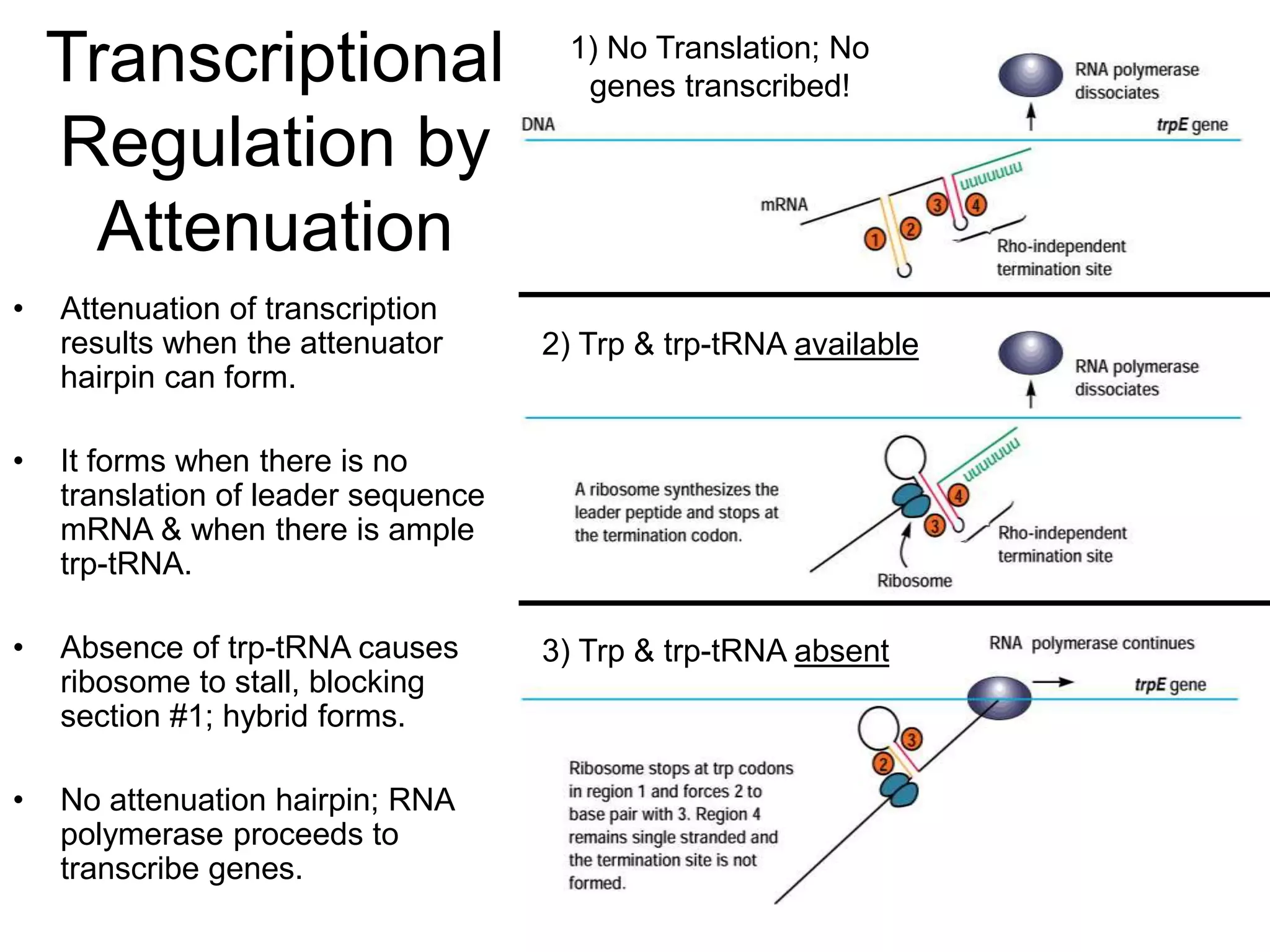
• Attenuation of transcription
results when the attenuator
hairpin can form.
• It forms when there is no
translation of leader sequence
mRNA & when there is ample
trp-tRNA.
• Absence of trp-tRNA causes
ribosome to stall, blocking
section #1; hybrid forms.
• No attenuation hairpin; RNA
polymerase proceeds to
transcribe genes.
1) No Translation; No
genes transcribed!
2) Trp & trp-tRNA available
3) Trp & trp-tRNA absent
15-gene expression.ppt

15-gene expression.ppt

  • 1.
    Regulation of GeneExpression • Chromosomal Map begins at OriC; units of minutes. – Only structural genes for enzymes are shown here. – Their control regions (promoter and operator) determine transcription. – The complete organizational unit is an operon. • Transcriptional regulation: – Negative Control by Repressors • Repression • Induction – Positive Control by Activators – Attenuation (involves translation)
  • 2.
    Transcriptional Regulation by Repression •Regulatory protein (repressor) is encoded on a gene outside and away from the operon it regulates. • Active repressor binds operator region; RNA Polymerase blocked = negative control. • Repressor becomes active by a corepressor. • Corepressor is often an endproduct of pathway enzymes encoded on the operon.
  • 3.
    Transcriptional Regulation by Induction •Active repressor binds operator region; RNA Polymerase blocked = negative control. • Gene transcribed when inducer molecule is present; binds and inactivates repressor (release from operator). • Inducers are typically substrate for a pathway enzyme encoded on the operon (e.g. allolactose for the lac operon)
  • 4.
    Lactose Catabolism (lac)Operon Doesn’t work if glucose is available! Why?
  • 5.
    Transcriptional Regulation by CatabolicActivator Protein (CAP) • CAP = cyclic AMP receptor protein (CRP). • Active CAP binds promotor and allows transcription to proceed = positive control. • Activation of CAP requires build-up of cAMP to bind to CAP. • cAMP builds-up in cells not producing enough ATP due to lack of glucose availability. • The lac operon requires both lactose and cAMP.
  • 6.
    lac Operon in Action (diauxicgrowth) • PEP-PTS at high glucose uptake lowers adenyl cyclase activity; low cAMP; CAP inactive. • Exhaustion of glucose increases cAMP, activating CAP; repressor is inactivated; lac operon transcribed! Separate cultures Together
  • 7.
    Tryptophan (Trp) Operon (Trpsynthesis (anabolic); regulated by repression and attenuation.)
  • 8.
    Transcriptional Regulation by Attenuation •In addition to a promotor and operator, the operon has a leader sequence with two pairs of self- complementing sequence sections (#1&2 and #3&4). The first pair is in what is called the leader peptide gene. • The second pair (#3&4) is part of a Rho-independent terminator region upstream of any structural genes; called an attenuator. Trp high. • Prevention of the first pair complementing will result in a hybrid complement of first and second pair (sections #2 and #3). Trp low.
  • 9.
    Transcriptional Regulation by Attenuation • Attenuationof transcription results when the attenuator hairpin can form. • It forms when there is no translation of leader sequence mRNA & when there is ample trp-tRNA. • Absence of trp-tRNA causes ribosome to stall, blocking section #1; hybrid forms. • No attenuation hairpin; RNA polymerase proceeds to transcribe genes. 1) No Translation; No genes transcribed! 2) Trp & trp-tRNA available 3) Trp & trp-tRNA absent