Model Hamiltonian and
Experimental Measurements
MEE 471
Lecture 12
Pakpoom Buabthong
pakpoom.b@nrru.ac.th
Recap
• Non-Boltzmann sampling
• Non-Metropolis
2
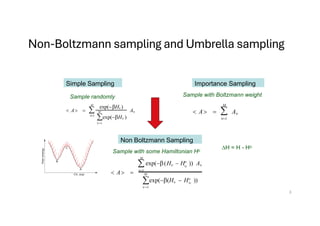
Non-Boltzmann sampling and Umbrella sampling
Simple Sampling Importance Sampling
Sample with Boltzmann weight
Sample randomly
M
< A> = å An
n=1
exp(-bHn )
M
åexp(-bHn )
n=1
An
M
< A> = å
n=1
Non Boltzmann Sampling
DH = H - Ho
< A> =
u
Sample with some Hamiltonian Ho
M
åexp(-b(Hn - Ho
)) An
u
n =1
n=1
M
åexp(-b(Hn - Ho
))
3
Allow non-equal a-priori probabilities to get less possible moves that are not accepted
Wo
= f DH
ij [ ij ]
ji
Wo
ji
= f[DH ]
In Metropolis this is symmetric
Detailed balance
PWo
P = P W o
P
i ij ij j ji ji
Pij
ji
=
f DHij
[ ]
ji
P f[DH ] ij
exp(-bDH )
Non-Metropolis Monte Carlo
4
Outline
• Large-scale nanostructures, semiconductor alloy
• Mapping electronic structure-calculations into model
Hamiltonians
• Experimental measurements
• UV-Vis
• XPS
• XAS
5
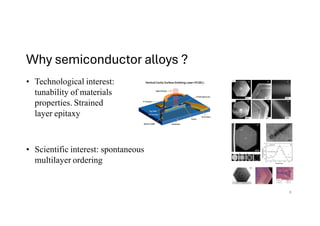
Why semiconductor alloys ?
• Technological interest:
tunability of materials
properties. Strained
layer epitaxy
• Scientific interest: spontaneous
multilayer ordering
6
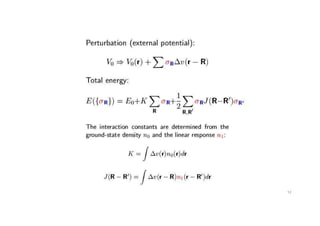
Configurational Statistical Mechanics
• Energy of a configuration ?
Linear-response
theory
• Thermodynamic properties ?
Monte Carlo
Response to small perturbation
7
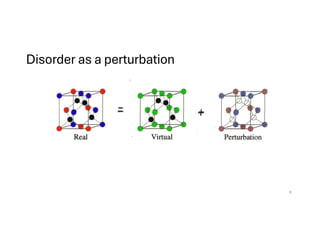
Disorder as a perturbation
8
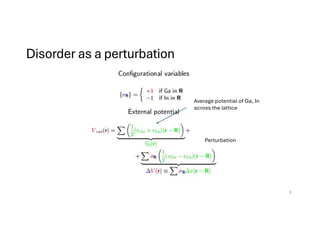
Disorder as a perturbation
Average potential of Ga, In
across the lattice
Perturbation
9
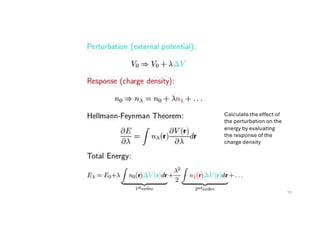
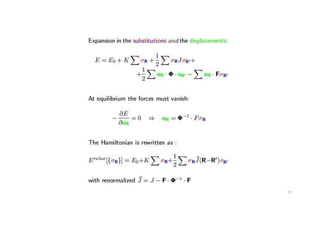
Calculate the effect of
the perturbation on the
energy by evaluating
the response of the
charge density
10
11
12
13
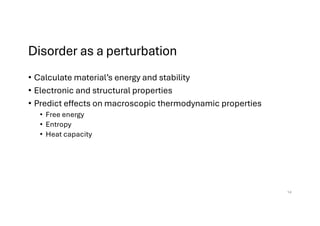
Disorder as a perturbation
• Calculate material’s energy and stability
• Electronic and structural properties
• Predict effects on macroscopic thermodynamic properties
• Free energy
• Entropy
• Heat capacity
14
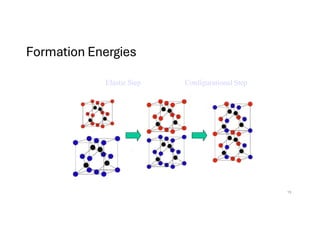
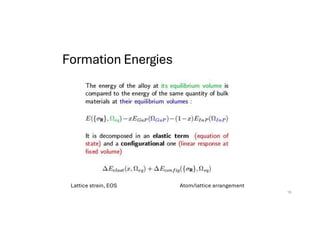
Formation Energies
Elastic Step Configurational Step
15
Formation Energies
Lattice strain, EOS Atom/lattice arrangement
16
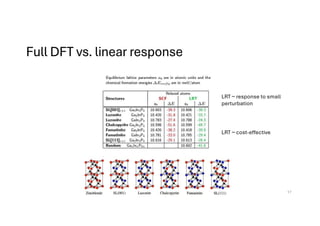
Full DFT vs. linear response
LRT ~ cost-effective
LRT ~ response to small
perturbation
17
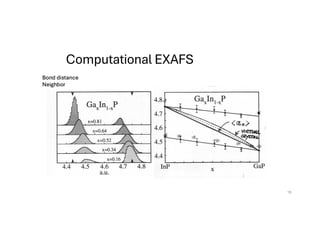
Computational EXAFS
18
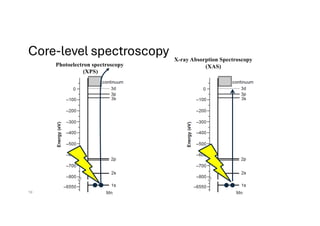
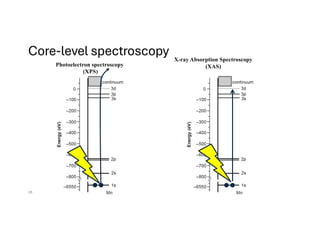
Core-level spectroscopy
19
Photoelectron spectroscopy
(XPS)
X-ray Absorption Spectroscopy
(XAS)
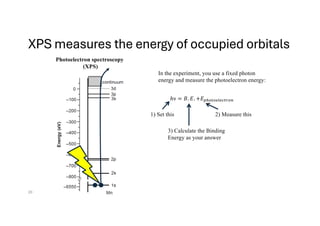
XPS measures the energy of occupied orbitals
20
Photoelectron spectroscopy
(XPS)
In the experiment, you use a fixed photon
energy and measure the photoelectron energy:
ℎν = 𝐵. 𝐸. +𝐸!"#$#%&%'$(#)
1) Set this 2) Measure this
3) Calculate the Binding
Energy as your answer
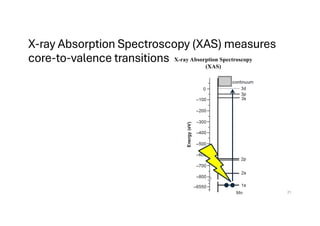
X-ray Absorption Spectroscopy (XAS) measures
core-to-valence transitions X-ray Absorption Spectroscopy
(XAS)
21
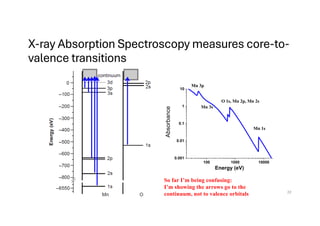
X-ray Absorption Spectroscopy measures core-to-
valence transitions
!"" !""" !""""
"#""!
"#"!
"#!
!
!"
!"#A%"&'() $%&'E)*+&,-
So far I’m being confusing:
I’m showing the arrows go to the
continuum, not to valence orbitals
Mn 3p
Mn 3s
O 1s, Mn 2p, Mn 2s
Mn 1s
22
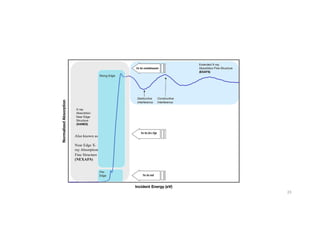
Also known as
Near Edge X-
ray Absorption
Fine Structure
(NEXAFS)
23
24
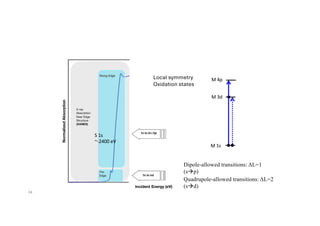
M 3d
M 1s
S 1s
~-2400 eV
M 4p
Dipole-allowed transitions: ΔL=1
(sàp)
Quadrupole-allowed transitions: ΔL=2
(sàd)
Local symmetry
Oxidation states
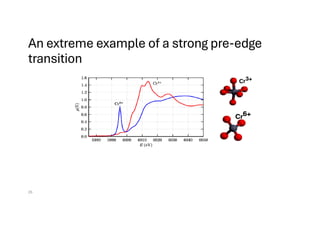
An extreme example of a strong pre-edge
transition
25
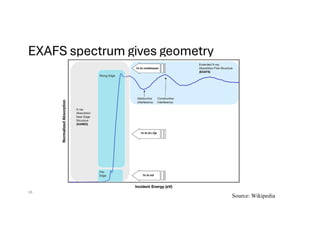
EXAFS spectrum gives geometry
26
Source: Wikipedia
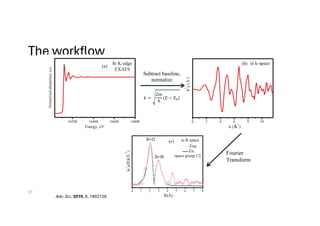
The workflow
27
Subtract baseline,
normalize
𝑘 =
2𝑚
ℎ
(𝐸 − 𝐸!)
Fourier
Transform
Adv. Sci. 2019, 6, 1802126
Core-level spectroscopy
28
Photoelectron spectroscopy
(XPS)
X-ray Absorption Spectroscopy
(XAS)
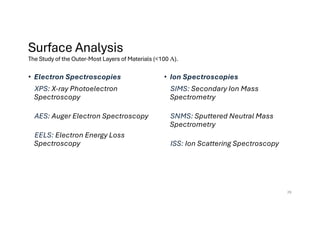
Surface Analysis
The Study of the Outer-Most Layers of Materials (<100 A).
• Electron Spectroscopies
XPS: X-ray Photoelectron
Spectroscopy
AES: Auger Electron Spectroscopy
EELS: Electron Energy Loss
Spectroscopy
• Ion Spectroscopies
SIMS: Secondary Ion Mass
Spectrometry
SNMS: Sputtered Neutral Mass
Spectrometry
ISS: Ion Scattering Spectroscopy
29
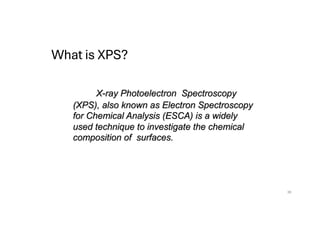
What is XPS?
X-ray Photoelectron Spectroscopy
(XPS), also known as Electron Spectroscopy
for Chemical Analysis (ESCA) is a widely
used technique to investigate the chemical
composition of surfaces.
30
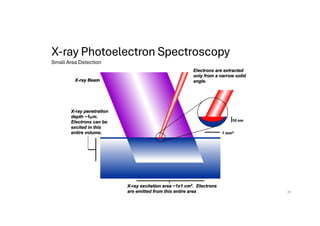
X-ray Photoelectron Spectroscopy
Small Area Detection
X-ray Beam
X-ray penetration
depth ~1µm.
Electrons can be
excited in this
entire volume.
X-ray excitation area ~1x1 cm2. Electrons
are emitted from this entire area
Electrons are extracted
only from a narrow solid
angle.
1 mm2
10 nm
31
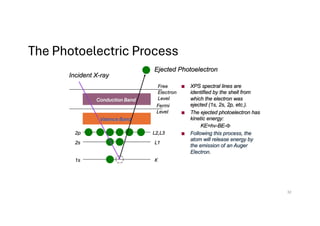
 XPS spectral lines are
identified by the shell from
which the electron was
ejected (1s, 2s, 2p, etc.).
 The ejected photoelectron has
kinetic energy:
KE=hv-BE-F
 Following this process, the
atom will release energy by
the emission of an Auger
Electron.
Conduction Band
Valence Band
L2,L3
L1
K
Fermi
Level
Free
Electron
Level
Incident X-ray
Ejected Photoelectron
1s
2s
2p
The Photoelectric Process
32
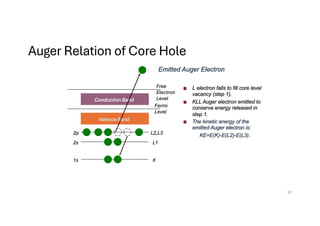
 L electron falls to fill core level
vacancy (step 1).
 KLL Auger electron emitted to
conserve energy released in
step 1.
 The kinetic energy of the
emitted Auger electron is:
KE=E(K)-E(L2)-E(L3).
Conduction Band
Valence Band
L2,L3
L1
K
Fermi
Level
Free
Electron
Level
Emitted Auger Electron
1s
2s
2p
Auger Relation of Core Hole
33
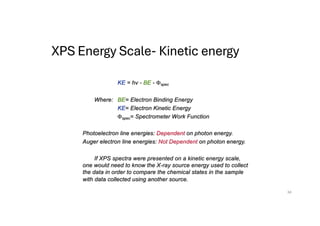
KE = hv - BE - Fspec
Where: BE= Electron Binding Energy
KE= Electron Kinetic Energy
Fspec= Spectrometer Work Function
Photoelectron line energies: Dependent on photon energy.
Auger electron line energies: Not Dependent on photon energy.
If XPS spectra were presented on a kinetic energy scale,
one would need to know the X-ray source energy used to collect
the data in order to compare the chemical states in the sample
with data collected using another source.
XPS Energy Scale- Kinetic energy
34
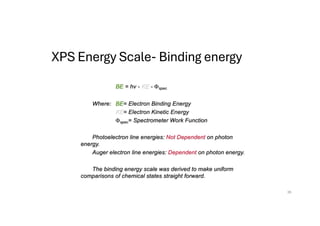
XPS Energy Scale- Binding energy
BE = hv - KE - Fspec
Where: BE= Electron Binding Energy
KE= Electron Kinetic Energy
Fspec= Spectrometer Work Function
Photoelectron line energies: Not Dependent on photon
energy.
Auger electron line energies: Dependent on photon energy.
The binding energy scale was derived to make uniform
comparisons of chemical states straight forward.
35
Free electrons (those giving rise to conductivity) find
an equal potential which is constant throughout the material.
Fermi-Dirac Statistics:
f(E) = 1
exp[(E-Ef)/kT] + 1
1.0
f(E)
0
0.5
Ef
1. At T=0 K: f(E)=1 for E<Ef
f(E)=0 for E>Ef
2. At kT<<Ef (at room temperature kT=0.025 eV)
f(E)=0.5 for E=Ef
T=0 K
kT<<Ef
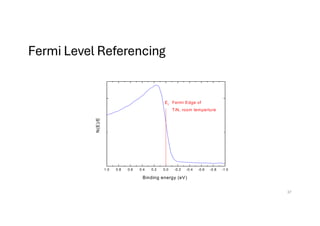
Fermi Level Referencing
36
Fermi Level Referencing
!"# #"$ #"B #"& #"' #"# E#"' E#"& E#"B E#"$ E!"#
F
*+
,-./0F*N2-F3+F
4056F.33/FT-/8-.TV.-
:0;N0;2F-;-.2<F=->?
5=*?@*
F
F
37
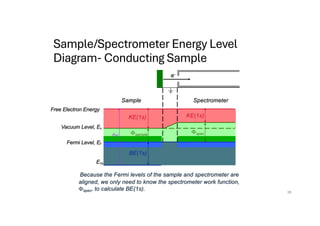
hv
Because the Fermi levels of the sample and spectrometer are
aligned, we only need to know the spectrometer work function,
Fspec, to calculate BE(1s).
E1s
Sample Spectrometer
e-
Free Electron Energy
Fermi Level, Ef
Vacuum Level, Ev
Fsample
KE(1s) KE(1s)
Fspec
BE(1s)
Sample/Spectrometer Energy Level
Diagram- Conducting Sample
38
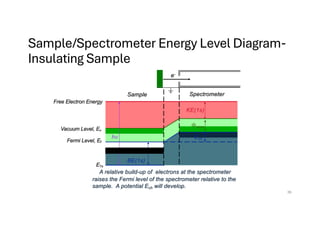
hv
A relative build-up of electrons at the spectrometer
raises the Fermi level of the spectrometer relative to the
sample. A potential Ech will develop.
E1s
Sample Spectrometer
e-
Free Electron Energy
BE(1s)
Fermi Level, Ef
Vacuum Level, Ev
KE(1s)
Fspec
Ech
Sample/Spectrometer Energy Level Diagram-
Insulating Sample
39
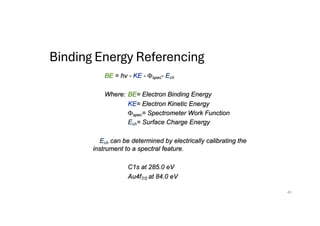
Binding Energy Referencing
BE = hv - KE - Fspec- Ech
Where: BE= Electron Binding Energy
KE= Electron Kinetic Energy
Fspec= Spectrometer Work Function
Ech= Surface Charge Energy
Ech can be determined by electrically calibrating the
instrument to a spectral feature.
C1s at 285.0 eV
Au4f7/2 at 84.0 eV
40
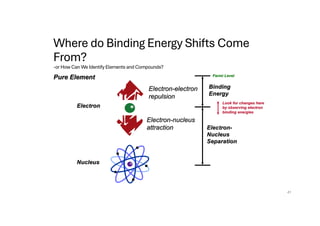
Where do Binding Energy Shifts Come
From?
-or How Can We Identify Elements and Compounds?
Electron-electron
repulsion
Electron-nucleus
attraction
Electron
Nucleus
Binding
Energy
Pure Element
Electron-
Nucleus
Separation
Fermi Level
Look for changes here
by observing electron
binding energies
41
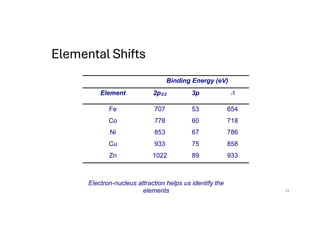
Elemental Shifts
!"#$"#B&'#E)B*&+E,-
'.E/E#0 12341 32 !
!" #$# %C '%(
F* ##+ '$ #,+
-. +%C '# #+'
F/ 0CC #% +%+
N2 ,$33 +0 0CC
!"#$%&'E)E*$"#*+,-%%&-$%.'E,/#"0+,*+,.1#E%.23,%/#
#"#4#E%+ 42
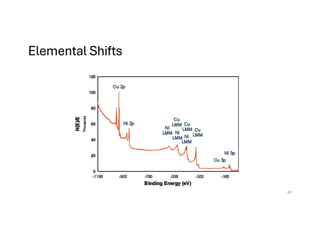
Elemental Shifts
43
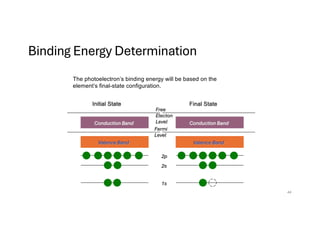
Binding Energy Determination
The photoelectron’s binding energy will be based on the
element’s final-state configuration.
Conduction Band
Valence Band
Fermi
Level
Free
Electon
Level Conduction Band
Valence Band
1s
2s
2p
Initial State Final State
44
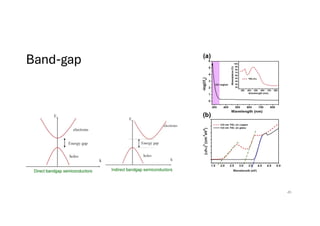
Band-gap
45
81

Lecture-12 atomistic simulation of materials

  • 1.
    Model Hamiltonian and ExperimentalMeasurements MEE 471 Lecture 12 Pakpoom Buabthong pakpoom.b@nrru.ac.th
  • 2.
  • 3.
    Non-Boltzmann sampling andUmbrella sampling Simple Sampling Importance Sampling Sample with Boltzmann weight Sample randomly M < A> = å An n=1 exp(-bHn ) M åexp(-bHn ) n=1 An M < A> = å n=1 Non Boltzmann Sampling DH = H - Ho < A> = u Sample with some Hamiltonian Ho M åexp(-b(Hn - Ho )) An u n =1 n=1 M åexp(-b(Hn - Ho )) 3
  • 4.
    Allow non-equal a-prioriprobabilities to get less possible moves that are not accepted Wo = f DH ij [ ij ] ji Wo ji = f[DH ] In Metropolis this is symmetric Detailed balance PWo P = P W o P i ij ij j ji ji Pij ji = f DHij [ ] ji P f[DH ] ij exp(-bDH ) Non-Metropolis Monte Carlo 4
  • 5.
    Outline • Large-scale nanostructures,semiconductor alloy • Mapping electronic structure-calculations into model Hamiltonians • Experimental measurements • UV-Vis • XPS • XAS 5
  • 6.
    Why semiconductor alloys? • Technological interest: tunability of materials properties. Strained layer epitaxy • Scientific interest: spontaneous multilayer ordering 6
  • 7.
    Configurational Statistical Mechanics •Energy of a configuration ? Linear-response theory • Thermodynamic properties ? Monte Carlo Response to small perturbation 7
  • 8.
    Disorder as aperturbation 8
  • 9.
    Disorder as aperturbation Average potential of Ga, In across the lattice Perturbation 9
  • 10.
    Calculate the effectof the perturbation on the energy by evaluating the response of the charge density 10
  • 11.
  • 12.
  • 13.
  • 14.
    Disorder as aperturbation • Calculate material’s energy and stability • Electronic and structural properties • Predict effects on macroscopic thermodynamic properties • Free energy • Entropy • Heat capacity 14
  • 15.
    Formation Energies Elastic StepConfigurational Step 15
  • 16.
    Formation Energies Lattice strain,EOS Atom/lattice arrangement 16
  • 17.
    Full DFT vs.linear response LRT ~ cost-effective LRT ~ response to small perturbation 17
  • 18.
  • 19.
  • 20.
    XPS measures theenergy of occupied orbitals 20 Photoelectron spectroscopy (XPS) In the experiment, you use a fixed photon energy and measure the photoelectron energy: ℎν = 𝐵. 𝐸. +𝐸!"#$#%&%'$(#) 1) Set this 2) Measure this 3) Calculate the Binding Energy as your answer
  • 21.
    X-ray Absorption Spectroscopy(XAS) measures core-to-valence transitions X-ray Absorption Spectroscopy (XAS) 21
  • 22.
    X-ray Absorption Spectroscopymeasures core-to- valence transitions !"" !""" !"""" "#""! "#"! "#! ! !" !"#A%"&'() $%&'E)*+&,- So far I’m being confusing: I’m showing the arrows go to the continuum, not to valence orbitals Mn 3p Mn 3s O 1s, Mn 2p, Mn 2s Mn 1s 22
  • 23.
    Also known as NearEdge X- ray Absorption Fine Structure (NEXAFS) 23
  • 24.
    24 M 3d M 1s S1s ~-2400 eV M 4p Dipole-allowed transitions: ΔL=1 (sàp) Quadrupole-allowed transitions: ΔL=2 (sàd) Local symmetry Oxidation states
  • 25.
    An extreme exampleof a strong pre-edge transition 25
  • 26.
    EXAFS spectrum givesgeometry 26 Source: Wikipedia
  • 27.
    The workflow 27 Subtract baseline, normalize 𝑘= 2𝑚 ℎ (𝐸 − 𝐸!) Fourier Transform Adv. Sci. 2019, 6, 1802126
  • 28.
  • 29.
    Surface Analysis The Studyof the Outer-Most Layers of Materials (<100 A). • Electron Spectroscopies XPS: X-ray Photoelectron Spectroscopy AES: Auger Electron Spectroscopy EELS: Electron Energy Loss Spectroscopy • Ion Spectroscopies SIMS: Secondary Ion Mass Spectrometry SNMS: Sputtered Neutral Mass Spectrometry ISS: Ion Scattering Spectroscopy 29
  • 30.
    What is XPS? X-rayPhotoelectron Spectroscopy (XPS), also known as Electron Spectroscopy for Chemical Analysis (ESCA) is a widely used technique to investigate the chemical composition of surfaces. 30
  • 31.
    X-ray Photoelectron Spectroscopy SmallArea Detection X-ray Beam X-ray penetration depth ~1µm. Electrons can be excited in this entire volume. X-ray excitation area ~1x1 cm2. Electrons are emitted from this entire area Electrons are extracted only from a narrow solid angle. 1 mm2 10 nm 31
  • 32.
     XPS spectrallines are identified by the shell from which the electron was ejected (1s, 2s, 2p, etc.).  The ejected photoelectron has kinetic energy: KE=hv-BE-F  Following this process, the atom will release energy by the emission of an Auger Electron. Conduction Band Valence Band L2,L3 L1 K Fermi Level Free Electron Level Incident X-ray Ejected Photoelectron 1s 2s 2p The Photoelectric Process 32
  • 33.
     L electronfalls to fill core level vacancy (step 1).  KLL Auger electron emitted to conserve energy released in step 1.  The kinetic energy of the emitted Auger electron is: KE=E(K)-E(L2)-E(L3). Conduction Band Valence Band L2,L3 L1 K Fermi Level Free Electron Level Emitted Auger Electron 1s 2s 2p Auger Relation of Core Hole 33
  • 34.
    KE = hv- BE - Fspec Where: BE= Electron Binding Energy KE= Electron Kinetic Energy Fspec= Spectrometer Work Function Photoelectron line energies: Dependent on photon energy. Auger electron line energies: Not Dependent on photon energy. If XPS spectra were presented on a kinetic energy scale, one would need to know the X-ray source energy used to collect the data in order to compare the chemical states in the sample with data collected using another source. XPS Energy Scale- Kinetic energy 34
  • 35.
    XPS Energy Scale-Binding energy BE = hv - KE - Fspec Where: BE= Electron Binding Energy KE= Electron Kinetic Energy Fspec= Spectrometer Work Function Photoelectron line energies: Not Dependent on photon energy. Auger electron line energies: Dependent on photon energy. The binding energy scale was derived to make uniform comparisons of chemical states straight forward. 35
  • 36.
    Free electrons (thosegiving rise to conductivity) find an equal potential which is constant throughout the material. Fermi-Dirac Statistics: f(E) = 1 exp[(E-Ef)/kT] + 1 1.0 f(E) 0 0.5 Ef 1. At T=0 K: f(E)=1 for E<Ef f(E)=0 for E>Ef 2. At kT<<Ef (at room temperature kT=0.025 eV) f(E)=0.5 for E=Ef T=0 K kT<<Ef Fermi Level Referencing 36
  • 37.
    Fermi Level Referencing !"##"$ #"B #"& #"' #"# E#"' E#"& E#"B E#"$ E!"# F *+ ,-./0F*N2-F3+F 4056F.33/FT-/8-.TV.- :0;N0;2F-;-.2<F=->? 5=*?@* F F 37
  • 38.
    hv Because the Fermilevels of the sample and spectrometer are aligned, we only need to know the spectrometer work function, Fspec, to calculate BE(1s). E1s Sample Spectrometer e- Free Electron Energy Fermi Level, Ef Vacuum Level, Ev Fsample KE(1s) KE(1s) Fspec BE(1s) Sample/Spectrometer Energy Level Diagram- Conducting Sample 38
  • 39.
    hv A relative build-upof electrons at the spectrometer raises the Fermi level of the spectrometer relative to the sample. A potential Ech will develop. E1s Sample Spectrometer e- Free Electron Energy BE(1s) Fermi Level, Ef Vacuum Level, Ev KE(1s) Fspec Ech Sample/Spectrometer Energy Level Diagram- Insulating Sample 39
  • 40.
    Binding Energy Referencing BE= hv - KE - Fspec- Ech Where: BE= Electron Binding Energy KE= Electron Kinetic Energy Fspec= Spectrometer Work Function Ech= Surface Charge Energy Ech can be determined by electrically calibrating the instrument to a spectral feature. C1s at 285.0 eV Au4f7/2 at 84.0 eV 40
  • 41.
    Where do BindingEnergy Shifts Come From? -or How Can We Identify Elements and Compounds? Electron-electron repulsion Electron-nucleus attraction Electron Nucleus Binding Energy Pure Element Electron- Nucleus Separation Fermi Level Look for changes here by observing electron binding energies 41
  • 42.
    Elemental Shifts !"#$"#B&'#E)B*&+E,- '.E/E#0 1234132 ! !" #$# %C '%( F* ##+ '$ #,+ -. +%C '# #+' F/ 0CC #% +%+ N2 ,$33 +0 0CC !"#$%&'E)E*$"#*+,-%%&-$%.'E,/#"0+,*+,.1#E%.23,%/# #"#4#E%+ 42
  • 43.
  • 44.
    Binding Energy Determination Thephotoelectron’s binding energy will be based on the element’s final-state configuration. Conduction Band Valence Band Fermi Level Free Electon Level Conduction Band Valence Band 1s 2s 2p Initial State Final State 44
  • 45.
  • 46.