ugent.be lumilab.ugent.be nb-photonics.ugent.be
Persistent phosphors beyond the afterglow:
optical and mechanical detrapping
ESTE2016 – 6th International Conference on Excited States of Transition Elements
Polanica Zdrój, Poland – Augustus 23 2016
Philippe F. Smet
Claude Tydtgat, Dirk Poelman, Katrien W. Meert,
Simon Michels, Mathias Kersemans
philippe.smet@ugent.be
@pfsmet
1
2
The game changing persistent phosphor: SrAl2O4:Eu,Dy
Van den Eeckhout K. et al, Materials 3 (2010) 2536-2566
Persistent Luminescence in Eu2+-Doped Compounds: A Review
@pfsmet
@pfsmet
thermally, mechanically
or optically driven
release
I (cd/m²)
Time after sunset (h)
Thermally driven (uncontrolled) release
DT = 0°C
DT = -10°C
DT = -20°C
Botterman et al, Optics Express 23 (2015) A868
Persistent phosphor SrAl2O4:Eu,Dy in outdoor conditions: saved by the trap distribution
@pfsmet
Back of the envelope calculation
Accessible traps: 10% of recombination centers
2% molar doping by Eu in SrAl2O4
Alkaline battery: 407 J/g
Charging
(filling of traps)
Decharging
(emptying of traps)
New persistent phosphors were developed
(which are sometimes not even visible to the human eye)
T. Maldiney et al., Nat. Mater. 13, 418–426 (2014), “The in vivo activation of persistent
nanophosphors for optical imaging of vascularization, tumours and grafted cells”
Botterman et al., Acta Materialia 60 (2012) 5494-5500
Mechanoluminescence in BaSi2O2N2:Eu
BaSi2O2N2:Eu
Mechanically driven release
Whatever the application ( ),
energy storage capacity is crucial.
Where is the bottleneck?
@pfsmet
Charging CaAl2O4:Eu,Nd
The trapping probability is very, very high.
Afterglow
… > 72 hours
How can we unite
• a (relatively) low storage capacity
• a very high trapping efficiency
?
One possible approach:
Modelling trapping and detrapping simultaneously
The experiment... in order to understand (de)trapping
Variation 193K to 353K
Jonas Botterman et al, Physical Review B 90, 085147 (2014)
Trapping and detrapping in SrAl2O4:Eu,Dy persistent phosphors: Influence of excitation…
Simple system (one Eu site) – Sr2MgSi2O7:Eu,Dy
Charging | Afterglow | TL analysis
TL cannot be explained
by single trap depth
Setting up the model: keep it simple & local
Eu2+
Trap + e
Eu3+
Empty trap
Detrapping
Claude Tydtgat et al, Optical Materials Express 6 (2016) 844-858
Optically stimulated detrapping during charging of persistent phosphors
pnr
• Boundary conditions for charging and afterglow
• pe (excitation rate) is small
• Two solutions l1 and l2: two exponentials
Differential equations
Eu2+ trap
• pe  0 : Eigenvalues for charging and afterglow are 
• Solution for charging:
charging
afterglow
@pfsmet
Adding distribution for trap depths
Claude Tydtgat et al, Optical Materials Express 6 (2016) 844-858
Optically stimulated detrapping during charging of persistent phosphors
Eu2+ traps
Problem #1
Step in charging curve ≠ Step for afterglow
Charging | Afterglow | TL analysis
Simple system (one Eu site)
Sr2MgSi2O7:Eu,Dy
Charging | Afterglow | TL analysis
Problem #2
Eigenvalues are identical for different pe
≠ Charging dynamics strongly depend on pe
Problem #3
Absorption  pe(M-me-m) should decrease
<> Absorption increases, depends on pe
Reflected
excitation
light
Influence of excitation rate pe not negligible, on the contrary!
Large influence, yet pe is low
Effect is proportional to pe x a
OSL : a pe
Claude Tydtgat et al, Optical Materials Express 6 (2016) 844-858
Optically stimulated detrapping during charging of persistent phosphors
Eu2+ traps
It makes sense for charging and decharging…
Emission intensity
a = 200
Claude Tydtgat et al, Optical Materials Express 6 (2016) 844-858
Optically stimulated detrapping during charging of persistent phosphors
Charging | Afterglow
… and for the influence of the excitation intensity pe
Claude Tydtgat et al, Optical Materials Express 6 (2016) 844-858
Optically stimulated detrapping during charging of persistent phosphors
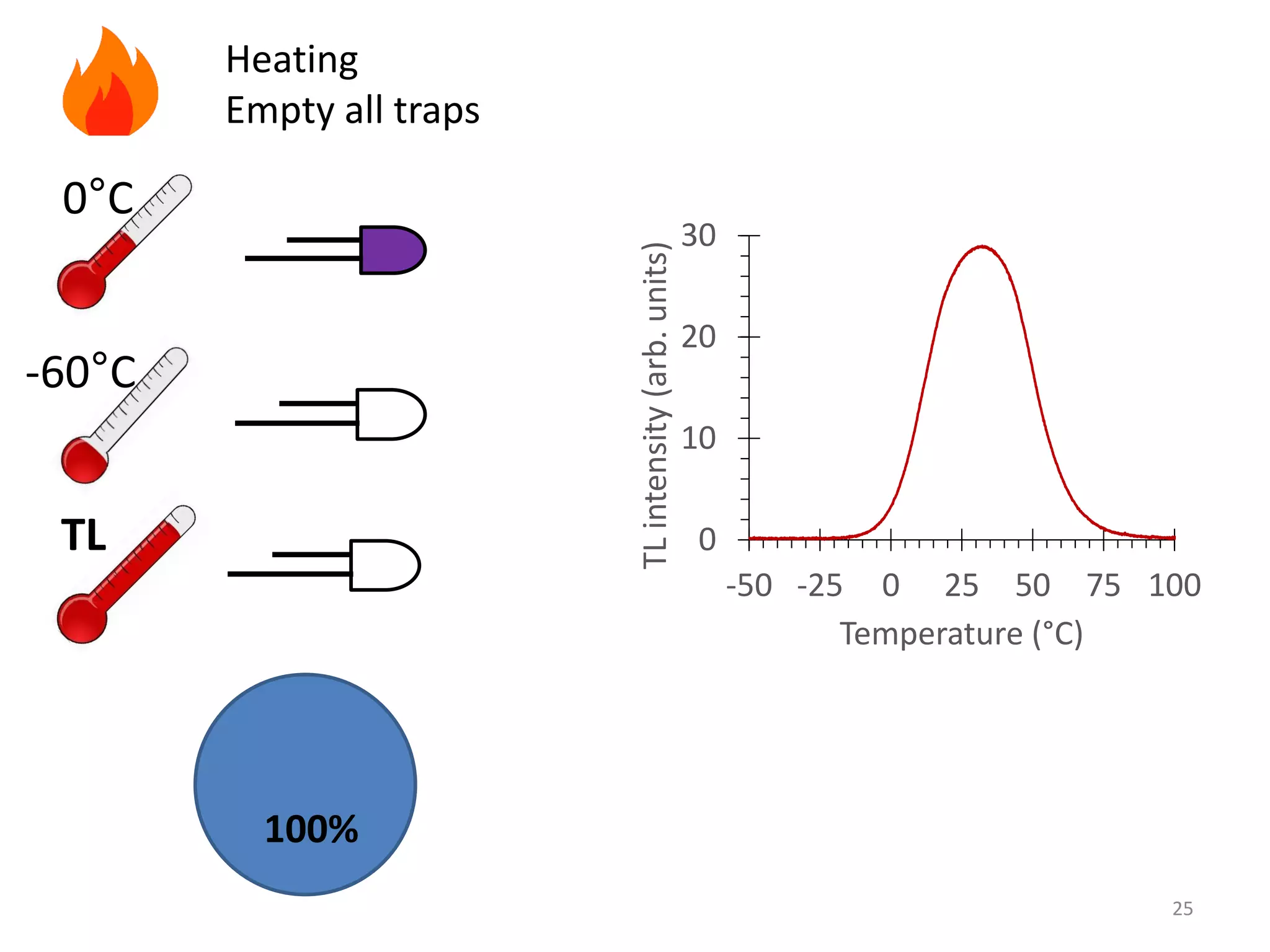
25
-60°C
0°C
TL
Heating
Empty all traps
0
10
20
30
-50 -25 0 25 50 75 100
TLintensity(arb.units)
Temperature (°C)
100%
26
-60°C
0°C
TL
Heating
Empty all traps
100% 1% 60%
Thermal barrier
for trapping
27
-60°C
0°C
TL
Heating
Empty all traps
100% 1% 60%
OSL (at charging l) is compatible with:
• Different initial rise and drop after charging
• Exponentials for charging and afterglow are different
• Absorption increases during charging
• Influence of excitation intensity
• Charging behaviour depends on wavelength (via abs)
• Different trap filling for different wavelengths
This is worrying/hopeful for applications…
… and requires careful study!
Part 2: Mechanically driven release
C.-N. Xu et al.
N. Terasaki and C.-N. Xu, IEEE Sens. J., 2013, 13, 3999.
Kersemans et al, Applied Physics Letters 107 (2015) 234102
Fast Reconstruction of a Bounded Ultrasonic Beam using Acoustically induced Piezoluminescence
Part 2: Mechanically driven release
BaSi2O2N2:Eu2+
Kersemans et al, Applied Physics Letters 107 (2015) 234102
Fast Reconstruction of a Bounded Ultrasonic Beam using Acoustically induced Piezoluminescence
Part 2: Mechanically driven release
32
Ultra-
sound
Competition with thermal detrapping
Linear response to ultrasound power
Kersemans et al, Applied Physics Letters 107 (2015) 234102
Fast Reconstruction of a Bounded Ultrasonic Beam using Acoustically induced Piezoluminescence
33
Imaging of US pressure field by Acoustically induced Piezoluminescence
Kersemans et al, Applied Physics Letters 107 (2015) 234102
Fast Reconstruction of a Bounded Ultrasonic Beam using Acoustically induced Piezoluminescence
34
0
Transducer Increasing distance z (mm)
100 200 300
Kersemans et al, Applied Physics Letters 107 (2015) 234102
Fast Reconstruction of a Bounded Ultrasonic Beam using Acoustically induced Piezoluminescence
35
Simulation
APL
Fast (10”)
Hydrophone
Slow (10’)
2cm
Towards a fast, full 3D reconstruction
of ultrasound beams
Kersemans et al, Applied Physics Letters 107 (2015) 234102
Fast Reconstruction of a Bounded Ultrasonic Beam using Acoustically induced Piezoluminescence
Conclusions.
1. In persistent phosphors, optically stimulated
detrapping occurs also at excitation wavelength,
limiting the trapping capacity.
2. Mechanoluminescent phosphors can be used to
map ultrasound pressure.
Resources
Feature issue on Persistent and Photostimulable Phosphors
in Optical Materials Express (published March 2016)
http://tiny.cc/OMEXPPP
Chapter
Persistent Phosphors
Handbook on the Physics and Chemistry of Rare Earths
Volume 48, Chapter 274 (2015) 1 - 108
Resources & Acknowledgments
Thank you for your attention !
(and your feedback…)
Presentation can be found at http://www.slideshare.net/pfsmet

ESTE2016 Detrapping in persistent phosphors

  • 1.
    ugent.be lumilab.ugent.be nb-photonics.ugent.be Persistentphosphors beyond the afterglow: optical and mechanical detrapping ESTE2016 – 6th International Conference on Excited States of Transition Elements Polanica Zdrój, Poland – Augustus 23 2016 Philippe F. Smet Claude Tydtgat, Dirk Poelman, Katrien W. Meert, Simon Michels, Mathias Kersemans philippe.smet@ugent.be @pfsmet 1
  • 2.
  • 3.
    The game changingpersistent phosphor: SrAl2O4:Eu,Dy Van den Eeckhout K. et al, Materials 3 (2010) 2536-2566 Persistent Luminescence in Eu2+-Doped Compounds: A Review
  • 4.
  • 5.
  • 6.
    I (cd/m²) Time aftersunset (h) Thermally driven (uncontrolled) release DT = 0°C DT = -10°C DT = -20°C Botterman et al, Optics Express 23 (2015) A868 Persistent phosphor SrAl2O4:Eu,Dy in outdoor conditions: saved by the trap distribution
  • 7.
    @pfsmet Back of theenvelope calculation Accessible traps: 10% of recombination centers 2% molar doping by Eu in SrAl2O4 Alkaline battery: 407 J/g Charging (filling of traps) Decharging (emptying of traps)
  • 8.
    New persistent phosphorswere developed (which are sometimes not even visible to the human eye) T. Maldiney et al., Nat. Mater. 13, 418–426 (2014), “The in vivo activation of persistent nanophosphors for optical imaging of vascularization, tumours and grafted cells”
  • 9.
    Botterman et al.,Acta Materialia 60 (2012) 5494-5500 Mechanoluminescence in BaSi2O2N2:Eu BaSi2O2N2:Eu Mechanically driven release
  • 10.
    Whatever the application( ), energy storage capacity is crucial. Where is the bottleneck? @pfsmet
  • 11.
    Charging CaAl2O4:Eu,Nd The trappingprobability is very, very high. Afterglow … > 72 hours
  • 12.
    How can weunite • a (relatively) low storage capacity • a very high trapping efficiency ? One possible approach: Modelling trapping and detrapping simultaneously
  • 13.
    The experiment... inorder to understand (de)trapping Variation 193K to 353K Jonas Botterman et al, Physical Review B 90, 085147 (2014) Trapping and detrapping in SrAl2O4:Eu,Dy persistent phosphors: Influence of excitation…
  • 14.
    Simple system (oneEu site) – Sr2MgSi2O7:Eu,Dy Charging | Afterglow | TL analysis TL cannot be explained by single trap depth
  • 15.
    Setting up themodel: keep it simple & local Eu2+ Trap + e Eu3+ Empty trap Detrapping Claude Tydtgat et al, Optical Materials Express 6 (2016) 844-858 Optically stimulated detrapping during charging of persistent phosphors
  • 16.
    pnr • Boundary conditionsfor charging and afterglow • pe (excitation rate) is small • Two solutions l1 and l2: two exponentials Differential equations Eu2+ trap
  • 17.
    • pe 0 : Eigenvalues for charging and afterglow are  • Solution for charging: charging afterglow @pfsmet
  • 18.
    Adding distribution fortrap depths Claude Tydtgat et al, Optical Materials Express 6 (2016) 844-858 Optically stimulated detrapping during charging of persistent phosphors Eu2+ traps
  • 19.
    Problem #1 Step incharging curve ≠ Step for afterglow Charging | Afterglow | TL analysis Simple system (one Eu site) Sr2MgSi2O7:Eu,Dy
  • 20.
    Charging | Afterglow| TL analysis Problem #2 Eigenvalues are identical for different pe ≠ Charging dynamics strongly depend on pe
  • 21.
    Problem #3 Absorption pe(M-me-m) should decrease <> Absorption increases, depends on pe Reflected excitation light
  • 22.
    Influence of excitationrate pe not negligible, on the contrary! Large influence, yet pe is low Effect is proportional to pe x a OSL : a pe Claude Tydtgat et al, Optical Materials Express 6 (2016) 844-858 Optically stimulated detrapping during charging of persistent phosphors Eu2+ traps
  • 23.
    It makes sensefor charging and decharging… Emission intensity a = 200 Claude Tydtgat et al, Optical Materials Express 6 (2016) 844-858 Optically stimulated detrapping during charging of persistent phosphors Charging | Afterglow
  • 24.
    … and forthe influence of the excitation intensity pe Claude Tydtgat et al, Optical Materials Express 6 (2016) 844-858 Optically stimulated detrapping during charging of persistent phosphors
  • 25.
    25 -60°C 0°C TL Heating Empty all traps 0 10 20 30 -50-25 0 25 50 75 100 TLintensity(arb.units) Temperature (°C) 100%
  • 26.
    26 -60°C 0°C TL Heating Empty all traps 100%1% 60% Thermal barrier for trapping
  • 27.
  • 28.
    OSL (at chargingl) is compatible with: • Different initial rise and drop after charging • Exponentials for charging and afterglow are different • Absorption increases during charging • Influence of excitation intensity • Charging behaviour depends on wavelength (via abs) • Different trap filling for different wavelengths This is worrying/hopeful for applications… … and requires careful study!
  • 29.
    Part 2: Mechanicallydriven release C.-N. Xu et al. N. Terasaki and C.-N. Xu, IEEE Sens. J., 2013, 13, 3999.
  • 30.
    Kersemans et al,Applied Physics Letters 107 (2015) 234102 Fast Reconstruction of a Bounded Ultrasonic Beam using Acoustically induced Piezoluminescence Part 2: Mechanically driven release BaSi2O2N2:Eu2+
  • 31.
    Kersemans et al,Applied Physics Letters 107 (2015) 234102 Fast Reconstruction of a Bounded Ultrasonic Beam using Acoustically induced Piezoluminescence Part 2: Mechanically driven release
  • 32.
    32 Ultra- sound Competition with thermaldetrapping Linear response to ultrasound power Kersemans et al, Applied Physics Letters 107 (2015) 234102 Fast Reconstruction of a Bounded Ultrasonic Beam using Acoustically induced Piezoluminescence
  • 33.
    33 Imaging of USpressure field by Acoustically induced Piezoluminescence Kersemans et al, Applied Physics Letters 107 (2015) 234102 Fast Reconstruction of a Bounded Ultrasonic Beam using Acoustically induced Piezoluminescence
  • 34.
    34 0 Transducer Increasing distancez (mm) 100 200 300 Kersemans et al, Applied Physics Letters 107 (2015) 234102 Fast Reconstruction of a Bounded Ultrasonic Beam using Acoustically induced Piezoluminescence
  • 35.
  • 36.
    2cm Towards a fast,full 3D reconstruction of ultrasound beams Kersemans et al, Applied Physics Letters 107 (2015) 234102 Fast Reconstruction of a Bounded Ultrasonic Beam using Acoustically induced Piezoluminescence
  • 37.
    Conclusions. 1. In persistentphosphors, optically stimulated detrapping occurs also at excitation wavelength, limiting the trapping capacity. 2. Mechanoluminescent phosphors can be used to map ultrasound pressure.
  • 38.
    Resources Feature issue onPersistent and Photostimulable Phosphors in Optical Materials Express (published March 2016) http://tiny.cc/OMEXPPP
  • 39.
    Chapter Persistent Phosphors Handbook onthe Physics and Chemistry of Rare Earths Volume 48, Chapter 274 (2015) 1 - 108
  • 40.
    Resources & Acknowledgments Thankyou for your attention ! (and your feedback…) Presentation can be found at http://www.slideshare.net/pfsmet