March 2, 2015
CLASS PRESENTATION 3
Lean
Entrepreneurship
Project
Chief Food Officers
Team 4
Agenda
Our Last Week1
Business Model3
The 10 Hypotheses: Summary,
Evaluation and Forms
2
Lessons Learned4
Our last week…
Brainstorming Evaluate
Hypothesis
Impact and
Probability of
Failure
10 Hypothesis
Voting Discussion
The 10 Hypotheses: Summary
Customer Segments: Time poor
Customer Segments:Lazy/ Don‘t want to cook
Value Propositions: Quality
Value Propositions: Fast Delivery
Channels: Website
Channels: Mobile Application
Customer Relationships: Automated/ Customized Service
Revenue Streams: Comission Fee
Revenue Streams: Delivery Fee
Key Activities: Distribution
The 10 Hypotheses: Evaluation
The 10 highly scored are our
10 hypothesis to evaluate
Customer Segments,
Channels and Revenue
Streams are the most
important Components.
The 10 Hypotheses: Form 1
Component: Customer Segments
Hypothesis Time-poor consumer will order food online.
Test Interview 25-50 persons from the segment “time-poor consumers” and ask them if
they would order food online from our website
Validation At least 70% of the people mentioned that they would order.
The 10 Hypotheses: Form 2
Component: Customer Segments
Hypothesis Lazy consumers/consumers that don't want to cook will order food online.
Test Surveys to 100 people (mainly students) and ask them if they would order food
online from our website.
Validation At least 75% of the people mentioned that they would order from our website.
The 10 Hypotheses: Form 3
Component: Value Propositions
Hypothesis High food quality increases consumers‘ likelihood to order food online.
Test Online survey to 100 potential customers (university students, young
professionals, etc.) to find out if a high food quality would increase their likelihood
to order food online.
Validation At least 70% of the respondents state that high food quality would increase their
likelihood to order food online.
The 10 Hypotheses: Form 4
Component: Value Propositions
Hypothesis Fast delivery increases consumers‘ likelihood to order food online.
Test Online survey to 100 potential customers (university students, young
professionals, etc.) to find out if fast delivery increases the likelihood to order food
online.
Validation At least 70% of respondents state that fast delivery would increase their likelihood
to order food online.
The 10 Hypotheses: Form 5
Component: Channels
Hypothesis Our customers will use a website to order food from different types of restaurants.
Test Interview 25-50 potential customers (university students, business people, busy
mothers, ..) to see how approachable and convenient would this tool be and how
useful it would be in their daily tasks management.
Validation If 80% of the interviewees consider using this tool to order food online, we should
validate the hypothesis.
The 10 Hypotheses: Form 6
Component: Channels
Hypothesis Our customers will use a mobile application to order food.
Test Interview 25-50 potential customers (university students, business people, busy
mothers, …) to see how approachable and convenient would this tool be and how
useful it would be in their daily tasks management.
Validation If 60% of the interviewees consider using this tool to order food online, we should
validate the hypothesis.
The 10 Hypotheses: Form 7
Component: Customer Relationships
Hypothesis Automated but simultaneously customized relationships are important to
build/increase customer satisfaction.
Test Interview 20 potential customers (university students, young professionals, etc.) to
find out if they like these kinds of relationships.
Validation At least 70% of respondents state that they would like these kinds of relationships.
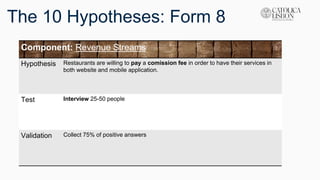
The 10 Hypotheses: Form 8
Component: Revenue Streams
Hypothesis Restaurants are willing to pay a comission fee in order to have their services in
both website and mobile application.
Test Interview 25-50 people
Validation Collect 75% of positive answers
The 10 Hypotheses: Form 9
Component: Revenue Streams
Hypothesis Customers are willing to pay for the delivery service which means an additional
cost compared with the normal prices of the restaurant.
Test With a landing page with fake food ordering at home with a delivery fee
OR/AND 200 Surveys
Validation When more than 1000 people click for ordering the food with the delivery fee
OR/AND we have 50% positive answers on the survey
The 10 Hypotheses: Form 10
Component: Key activities
Hypothesis We can rely on our restaurant partners to take care of the delivery.
Test Telephone calls or interviews with 30 potential partner restaurants to find out if
they are offering delivery services.
Validation At least 50% of respondents state that they are currently offering own delivery
services.
Business Model
Key Partners Key Activities Value Propositions Customer RelationshipsCustomer Segments
Revenue Streams
ChannelsKey Resources
Cost Structure
Time
Poor
Lazy/
Don’t
want to
cook
Personal
Assistance
(Phone)
Automated/
Customized
Website Mobile
Application
Quality FoodVariety
Fast Delivery Easiness/
Convenience
Sales
Marketing
Distribution
Scooters
IT System
Partners
Brand
Marketing ScootersHR Rent
Comission
Fee from
restaurants
Delivery Fee
from final
consumers
Restaurants
and
Takeaways
IT Partners
Scooter
Suppliers
Lessons Learned
How to develop a business name in
group
How to validate a Business Model Hypothesis
“How to Conduct an Interview
Effectively”,http://www.entrepreneur.com/arti
cle/225960
- Thank
You -

150301 lep class-4-v002

  • 1.
    March 2, 2015 CLASSPRESENTATION 3 Lean Entrepreneurship Project Chief Food Officers Team 4
  • 2.
    Agenda Our Last Week1 BusinessModel3 The 10 Hypotheses: Summary, Evaluation and Forms 2 Lessons Learned4
  • 3.
    Our last week… BrainstormingEvaluate Hypothesis Impact and Probability of Failure 10 Hypothesis Voting Discussion
  • 4.
    The 10 Hypotheses:Summary Customer Segments: Time poor Customer Segments:Lazy/ Don‘t want to cook Value Propositions: Quality Value Propositions: Fast Delivery Channels: Website Channels: Mobile Application Customer Relationships: Automated/ Customized Service Revenue Streams: Comission Fee Revenue Streams: Delivery Fee Key Activities: Distribution
  • 5.
    The 10 Hypotheses:Evaluation The 10 highly scored are our 10 hypothesis to evaluate Customer Segments, Channels and Revenue Streams are the most important Components.
  • 6.
    The 10 Hypotheses:Form 1 Component: Customer Segments Hypothesis Time-poor consumer will order food online. Test Interview 25-50 persons from the segment “time-poor consumers” and ask them if they would order food online from our website Validation At least 70% of the people mentioned that they would order.
  • 7.
    The 10 Hypotheses:Form 2 Component: Customer Segments Hypothesis Lazy consumers/consumers that don't want to cook will order food online. Test Surveys to 100 people (mainly students) and ask them if they would order food online from our website. Validation At least 75% of the people mentioned that they would order from our website.
  • 8.
    The 10 Hypotheses:Form 3 Component: Value Propositions Hypothesis High food quality increases consumers‘ likelihood to order food online. Test Online survey to 100 potential customers (university students, young professionals, etc.) to find out if a high food quality would increase their likelihood to order food online. Validation At least 70% of the respondents state that high food quality would increase their likelihood to order food online.
  • 9.
    The 10 Hypotheses:Form 4 Component: Value Propositions Hypothesis Fast delivery increases consumers‘ likelihood to order food online. Test Online survey to 100 potential customers (university students, young professionals, etc.) to find out if fast delivery increases the likelihood to order food online. Validation At least 70% of respondents state that fast delivery would increase their likelihood to order food online.
  • 10.
    The 10 Hypotheses:Form 5 Component: Channels Hypothesis Our customers will use a website to order food from different types of restaurants. Test Interview 25-50 potential customers (university students, business people, busy mothers, ..) to see how approachable and convenient would this tool be and how useful it would be in their daily tasks management. Validation If 80% of the interviewees consider using this tool to order food online, we should validate the hypothesis.
  • 11.
    The 10 Hypotheses:Form 6 Component: Channels Hypothesis Our customers will use a mobile application to order food. Test Interview 25-50 potential customers (university students, business people, busy mothers, …) to see how approachable and convenient would this tool be and how useful it would be in their daily tasks management. Validation If 60% of the interviewees consider using this tool to order food online, we should validate the hypothesis.
  • 12.
    The 10 Hypotheses:Form 7 Component: Customer Relationships Hypothesis Automated but simultaneously customized relationships are important to build/increase customer satisfaction. Test Interview 20 potential customers (university students, young professionals, etc.) to find out if they like these kinds of relationships. Validation At least 70% of respondents state that they would like these kinds of relationships.
  • 13.
    The 10 Hypotheses:Form 8 Component: Revenue Streams Hypothesis Restaurants are willing to pay a comission fee in order to have their services in both website and mobile application. Test Interview 25-50 people Validation Collect 75% of positive answers
  • 14.
    The 10 Hypotheses:Form 9 Component: Revenue Streams Hypothesis Customers are willing to pay for the delivery service which means an additional cost compared with the normal prices of the restaurant. Test With a landing page with fake food ordering at home with a delivery fee OR/AND 200 Surveys Validation When more than 1000 people click for ordering the food with the delivery fee OR/AND we have 50% positive answers on the survey
  • 15.
    The 10 Hypotheses:Form 10 Component: Key activities Hypothesis We can rely on our restaurant partners to take care of the delivery. Test Telephone calls or interviews with 30 potential partner restaurants to find out if they are offering delivery services. Validation At least 50% of respondents state that they are currently offering own delivery services.
  • 16.
    Business Model Key PartnersKey Activities Value Propositions Customer RelationshipsCustomer Segments Revenue Streams ChannelsKey Resources Cost Structure Time Poor Lazy/ Don’t want to cook Personal Assistance (Phone) Automated/ Customized Website Mobile Application Quality FoodVariety Fast Delivery Easiness/ Convenience Sales Marketing Distribution Scooters IT System Partners Brand Marketing ScootersHR Rent Comission Fee from restaurants Delivery Fee from final consumers Restaurants and Takeaways IT Partners Scooter Suppliers
  • 17.
    Lessons Learned How todevelop a business name in group How to validate a Business Model Hypothesis “How to Conduct an Interview Effectively”,http://www.entrepreneur.com/arti cle/225960
  • 18.