“The man on top of the
mountain didn’t fall there.”
- Vince Lombardi
2
“Everything is selling. Nothing happens in this world, nothing comes into this world, until
somebody makes a sale.” - Richard Yates
Are you in sales? If you’re reading this, I sure hope so!
Do you work hard, but wonder if there are ways that you can do better?
Do you want to increase your take-home pay and fulfil your personal financial goals?
Are you constantly searching for the best ways to sell more and make your customers
happier?
That’s what this ebook is all about.
You will learn our absolute best tips and techniques including:
•	 when to push past “no”
•	 the best email templates for getting a response
•	 when to bring up pricing
•	 how to stay motivated for improved performance
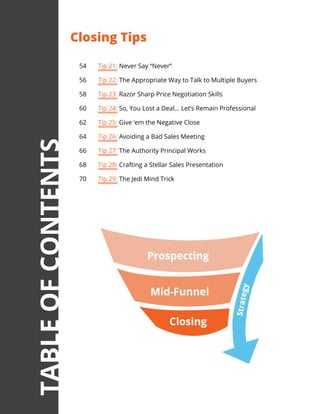
We’ve divided the book into sections for easy reference - starting at the very top of the sales
funnel and working your way through closing the deal. Each chapter addresses one specific
piece of advice, shares some real world examples, and explains how to apply our knowledge
to help you better your sales game.
Using the tips in this book, I am confident that you will find methods to increase your sales
and make more money. So turn the page and begin now!
Adam Honig is the co-founder and CEO of Spiro Technologies. He is
a recognized thought-leader in sales process and effectiveness, and
has previously co-founded three successful technology companies:
Innoveer Solutions, C-Bridge, and Open Environment. He is best
known for speaking at various conferences including Dreamforce,
for pioneering the ‘No Jerks’ hiring model, and for flying his drone
while traveling the world.
Adam Honig
@adamhonig
Introduction
About the Author
Introduction
37	 Tip 13: Responding to “Now’s Not a Good Time”
39	 Tip 14: An Email Trick for Great Response Rates
41	 Tip 15: Face-to-Face Can’t Be Replaced!
43	 Tip 16: Never Stop Calling!
45	 Tip 17: Should You Keep Pushing Past “NO”?
47	 Tip 18: Unstick Your Stuck Deal
49	 Tip 19: There is No Shame in Stating Your Goal!
51	 Tip 20: It’s Safe to Talk About the Competition
7	 Tip 1: Networking Opportunities Are Right In Front of Your Face
10	 Tip 2: Reconnecting With Lost Prospects is Key
12	 Tip 3: Prevent Getting Ghosted
16	 Tip 4: It’s Okay To Text Your Prospects
18	 Tip 5: Ace Your Very First Call
20	 Tip 6: Go Ahead - Have the Budget Talk
22	 Tip 7: Creative Ways to Stay in Touch
25	 Tip 8: The Ultimate No-Nos of Emailing
27	 Tip 9: Stay On Top of Your Early Stage Opps
29	 Tip 10: Get Over Rejection FAST
31	 Tip 11: Mind Your Body Language
34	 Tip 12: Twitter is Your Friend #BFF @Twitter
Prospecting Tips
Mid-Funnel Tips
TABLEOFCONTENTS
54	 Tip 21: Never Say “Never”
56	 Tip 22: The Appropriate Way to Talk to Multiple Buyers
58	 Tip 23: Razor Sharp Price Negotiation Skills
60	 Tip 24: So, You Lost a Deal... Let’s Remain Professional
62	 Tip 25: Give ‘em the Negative Close
64	 Tip 26: Avoiding a Bad Sales Meeting
66	 Tip 27: The Authority Principal Works
68	 Tip 28: Crafting a Stellar Sales Presentation
70	 Tip 29: The Jedi Mind Trick
Closing Tips
TABLEOFCONTENTS
73	 Tip 30: How to Stay Analytically Driven
75	 Tip 31: Get Your Charm On
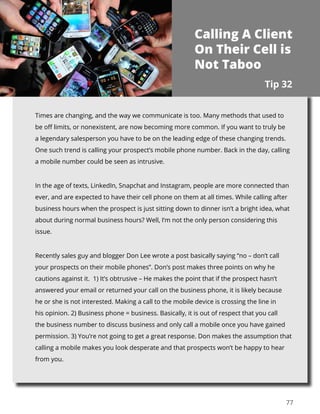
77	 Tip 32: Calling a Client on their Cell is not Taboo
79	 Tip 33: The Ins and Outs of Leaving a Voicemail
81	 Tip 34: The Power of Positive Thinking
83	 Tip 35: The Time and Place for Email
85	 Tip 36: Swear a Little (I $hit You Not)
87	 Tip 37: Confirm All Your Meetings
89	 Tip 38: Make Them Laugh, Funny Guy
92	 Tip 39: Please Just Stop Talking
94	 Tip 40: Getting the Most Out of Your Manager
97	 Tip 41: Don’t Fake It
99	 Tip 42: Harness Your Powers of Observation
101	 Tip 43: Staying Motivated Is Hard
104	 Tip 44: Use Spiro to Make More Money
Strategy Tips
TABLEOFCONTENTS
PROSPECTING
7
Did you ever kick yourself for not seeing an opportunity that was
right in front of your eyes? I see salespeople miss opportunities
to mine contacts from the people within the inner circles of their
network all the time just because, well, who would have thought…
Funny enough, this happened to me and it changed my perspective
on networking forever.
Years ago, I was working for a company that did business with all
different kinds of insurance companies. We dealt with some big
names, but I had my heart set on John Hancock Insurance – the guys
who owned and operated out of the tallest building in Boston. I’d
look out at that building every day and I swear my eyes would tear
up.
For YEARS we tried all different ways to get in touch with them
and eventually got a meeting there. As we were prepping for the
meeting, our HR head popped in and said, “Hey, I heard you guys are
meeting with my Uncle Bob.” Mind blown. We had the golden ticket
right here working with us in the same office. Her uncle was the
freaking CIO. Frankly it wasn’t even part of our process to check our
team for anyone who knows someone. Unfortunately, we didn’t get
the deal, but the moral is: Never overlook what your whole team’s
connections are. You’ve got leverage at your fingertips.
Tip 1
Networking Opportunities Are In Front
of Your Face
8
We spend a lot of time focusing on outside networks, but you should never
neglect your first tier. Why? Because a. proximity, b. familiarity, and c.
accountability. Human psychology makes us want to help out if we’re on the
same team and if the odds of seeing each other again (on a daily basis) are
high, the perceived obligation to make it happen will likely be higher than
for someone who you don’t run into often. Be connected to everyone you
know on LinkedIn, and then start to view who your contact’s contacts are,
which can make the bigger picture much easier to see. For new salespeople
especially, it makes sense to see where the people are within your company
and where their connections are against the target accounts.
At my last company we made it a requirement as part of
the onboarding process for new employees, no matter
what department, to share any possible connections
they had for our target accounts. If salespeople are
communicating with their colleagues about who they
are targeting, the odds are much higher that you’ll get
something. If you’re working for a 200 person company,
for example, the possibilities are profound. I even know
salespeople who run what are essentially marketing
campaigns within their company using MailChimp, a free
email automation program. Offer a Starbucks gift card or
some small reward for anyone who helps you get a lead –
be innovative – it doesn’t hurt.
9
Another suggestion is to turn networking inside out. Target
companies that your inside contacts know instead of focusing on an
outside target.
Lastly, don’t forget about your valued customers. If you’re doing
a good job keeping them happy, then capitalize on it! Ask them
for contacts. They’re very likely to help you with introductions if
they like what you’ve done for them so far. In my old company I
mentioned before I got tons of contacts for new business from
existing customers. A lot of industries aren’t
as cut-throat competitive as you think. In my
experience, they were often friendly with
competition and happy to be references.
10
We invest so much time and energy on an opportunity with a prospect,
and if it doesn’t work out – *poof* – we make like a ghost and disappear.
Big mistake. Too often salespeople don’t look back on the prospects
who’ve slipped through their fingers and, to be honest, this makes no
sense to me. Why would you pass up a perfectly good opportunity to
make money?
Has your ego been bruised? It’s hard to stare rejection in the face. Even
though it’s not personal, it often feels like it is. Just suck it up and get back
into the game, remember that you invested a lot of time in this prospect
already, they know you, and it’s best to stay on their mind in case they
need you in the future or things don’t work out with the other guy.
Are you afraid of being turned down twice? The odds of being rejected
twice are pretty high, but, guess what, they’re always high in the sales
business. You might not have been a goof fit for that buyer’s need at the
time, but both you and their company can evolve. The company might
have changed to your benefit or vice versa.
And please don’t use the excuse that you are
busy. You’re never too busy if you’re really
serious about making more money.
Enough about the reasons you aren’t
connecting with an old client, let’s talk
about when you should try to reestablish
a relationship. So much is about
Tip 2
Reconnecting With Lost Prospects is Key
11
timing in this aspect. You need to be there at the right time. We have a lot of Spiro users
at Paychex, for example. Here’s how they have to think about selling their product to a
buyer: it’s not often that a company will be thinking about changing their payroll provider
– at most once a year or so. They need to be there when the company is thinking about it,
otherwise the opportunity will come and go. Always be aware of certain important dates
and indicators affecting the client when you choose to follow up.
I believe in engaging prospects with content, so I’m not shy about emailing them something
relevant, just to keep on their mind. I’ll let them know about any new content that we have
on the Spiro blog and anything in general that I think would be valuable to them. There are
a lot of tools that can help you with finding relevant content. You can then use programs
like MailChimp to automate your emails.
Have a drip campaign – send an email a month – then on the fourth one, call them up and
say you’d like to schedule a phone call or meeting. You’ll be on their mind from all the other
emails. It’s important to send the emails consistently and over a regular length of time. The
technique is simple, but rarely used correctly.
I have a rule of thumb about how frequently I get back in touch: whatever the length of
contract I was selling I want to be back in front of a lost deal within about 75 percent of that
time. For example, if we’re selling a year’s worth of payroll services and lost the deal, I’d
want to be back in front of buyer within 9 months. You know that the subscription you’re
selling will expire and you want to be in front of them before the next round comes and
goes. If you’re there just when the contract expires in 12 months, you probably already lost
it.
It’s worth it to try again with a lost prospect; you never know what might have changed over
time, whether it’s with you or with them. People develop new skills and needs change –
always be ready to jump on the opportunity!
12
Once upon a time we were pitching Sony Pictures on a deal. We had an initial
call that went well, we flew to LA, did a big demo – a lot of people were there and
everything went great. We sent them a proposal, even flew out again to follow
up, but never ever heard a single word after that. A cool deal that we were totally
stoked about went up in smoke. Ghosting is a frequent occupational hazard in
sales – everything goes well with a client, you’re getting positive vibes, then they
disappear without a trace. It happens all the time, but you don’t have to let it slide.
To fight ghosting, you first have to know what causes it.
One common reason for ghosting is that the prospect is interested, but other
factors are conspiring against you. The timing just isn’t right. The prospect might
be dealing with competing priorities, not have room in the budget, or have a boss
who doesn’t think it’s a good idea. They don’t want to get back to you because they
feel kind of dumb for putting you through all the motions only to disappoint you.
So the project was delayed to next year – who wants to be the jerk that delivers
the bad news?
Tip 3: Prevent Getting Ghosted
13
Another explanation for a vanishing client is that maybe what you’re selling just doesn’t
work for them. This could arise if your salesmanship was so on point that you sold them on
YOU, but, when they took a look at it after being dazzled by your brilliant personality, they
realized that they’d gotten in farther than they meant to.
A third possibility is that they are talking to another vendor. I worked with a sales manager
early in my career who would often interpret silence from a prospect as a sign that they’re
talking to another vendor. He figured that they don’t want to say yes, but also don’t want
to say no until they figure out whether they’re doing a deal with the other party. This is a
somewhat paranoid, but justified, point of view from a sales guy and I think a somewhat
reasonable rationale from the buyer. They don’t want to piss off the other vendor in case
they need them.
And lastly, perhaps you messed up terribly during a sales meeting, and the avoidance is
very deliberate. Did you mention the wrong company, mention that you were working with
one of their competitors? Salespeople can get wrapped up in a blame game, obsessing
over what they might have done.
But don’t take ghosting laying down. You can try a few things to stop a buyer from ghosting
you. My philosophy is I’d rather get a “no” from a buyer than radio silence, because
there are many ways to push past no. I don’t let them slink off because I expect a level of
professionalism. We’re doing things in an above-board and honest way and I expect the
same back. It’s a moral issue for me, but I have to remember not to take it personally.
Often a prospect might simply be afraid of a bad reaction from a disappointed salesperson.
Here are some effective ways you can stop a prospect from ghosting you.
14
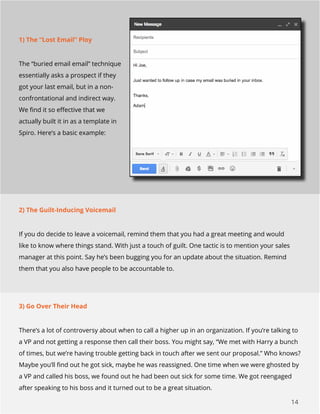
1) The “Lost Email” Ploy
The “buried email email” technique
essentially asks a prospect if they
got your last email, but in a non-
confrontational and indirect way.
We find it so effective that we
actually built it in as a template in
Spiro. Here’s a basic example:
2) The Guilt-Inducing Voicemail
If you do decide to leave a voicemail, remind them that you had a great meeting and would
like to know where things stand. With just a touch of guilt. One tactic is to mention your sales
manager at this point. Say he’s been bugging you for an update about the situation. Remind
them that you also have people to be accountable to.
3) Go Over Their Head
There’s a lot of controversy about when to call a higher up in an organization. If you’re talking to
a VP and not getting a response then call their boss. You might say, “We met with Harry a bunch
of times, but we’re having trouble getting back in touch after we sent our proposal.” Who knows?
Maybe you’ll find out he got sick, maybe he was reassigned. One time when we were ghosted by
a VP and called his boss, we found out he had been out sick for some time. We got reengaged
after speaking to his boss and it turned out to be a great situation.
15
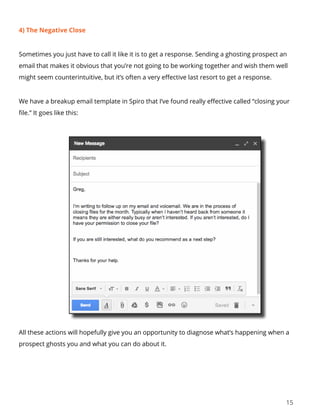
4) The Negative Close
Sometimes you just have to call it like it is to get a response. Sending a ghosting prospect an
email that makes it obvious that you’re not going to be working together and wish them well
might seem counterintuitive, but it’s often a very effective last resort to get a response.
We have a breakup email template in Spiro that I’ve found really effective called “closing your
file.” It goes like this:
All these actions will hopefully give you an opportunity to diagnose what’s happening when a
prospect ghosts you and what you can do about it.
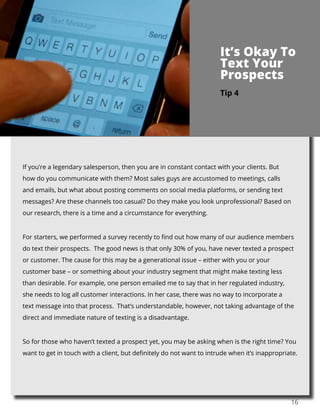
16
If you’re a legendary salesperson, then you are in constant contact with your clients. But
how do you communicate with them? Most sales guys are accustomed to meetings, calls
and emails, but what about posting comments on social media platforms, or sending text
messages? Are these channels too casual? Do they make you look unprofessional? Based on
our research, there is a time and a circumstance for everything.
For starters, we performed a survey recently to find out how many of our audience members
do text their prospects. The good news is that only 30% of you, have never texted a prospect
or customer. The cause for this may be a generational issue – either with you or your
customer base – or something about your industry segment that might make texting less
than desirable. For example, one person emailed me to say that in her regulated industry,
she needs to log all customer interactions. In her case, there was no way to incorporate a
text message into that process. That’s understandable, however, not taking advantage of the
direct and immediate nature of texting is a disadvantage.
So for those who haven’t texted a prospect yet, you may be asking when is the right time? You
want to get in touch with a client, but definitely do not want to intrude when it’s inappropriate.
Tip 4
It’s Okay To
Text Your
Prospects
17
One case when texting is a great idea, is when you are heading to a meeting and grabbing a
coffee - it is a nice gesture to ask if your prospect would like something. It’s a nice ice breaker
and opens up the texting line of communication. Recently, I was going to meet a former
colleague and new prospect named Joe. I arrived a bit early, so I stopped at a nearby Starbucks.
A few minutes before I left, I texted Joe and offered to get him something. That got an immediate
response and let him know I was on my way.
Texting is also useful when you want to show urgency. If you have a message you want the
person to receive right away. When it comes to sales, it’s just a fact of life that sales guys have
targets that get measured in months, quarters and years. I believe in making sure that your
prospects know that you have deadlines that are important to you, and a text is a great way to
convey this point! This can be done by sending a follow up text to ask if your prospect is ready to
move forward with the deal. Be sure to send this during regular business hours.
Another scenario is this: You had a great meeting, but no matter how many times you call and
email, you’re not getting a response back. Before you give up, why not send a quick text, “Hi
Denise, hope you’re doing well. Just wanted to make sure that I didn’t do something to offend
you in our last meeting.” This is sure to get a response which can help you get an answer. Many
times prospects have an unanswered objection, have been busy or just aren’t interested but
don’t want to say no. This text will help you identify where your prospect stands by putting a
little pressure on them.
Lastly, when you are running late a text is a must. While successful salespeople are rarely late,
when we are, a quick text is much more helpful to a prospect than an email. This is simply
because it’s likely to be noticed right away. Yes, it’s bad to be running late, but at least the
prospect won’t be sitting and wondering if you will even show up.
So, if you have yet to break the seal on texting your prospects or customers, now you have some
ideas on how to do so appropriately. Texting to offer a coffee is an easy one to start with, and
eventually, you can start using texts to help you close deals and get the answers you need. As
the younger generations fill the workplace and technology permeates further into the workforce,
texting looks to become more and more commonplace.
18
I remember spending hours reaching out to prospects and then suddenly
connecting with one and being extremely tongue-tied. Once the prospect felt
so bad for me, that he coached me through the process of my own sales call! (I
didn’t get the sale.)
A similar situation comes to mind from the movie Wall Street. Do you remember
the scene when Bud finally – after 59 straight days of calling – gets a meeting
with Gordon Gekko? Let’s look at the approach he uses. Bud starts with some
flattery:
“I just want to let you know Mr. Gekko I read all about you at NYU Business, and I
think you’re an incredible genius and I’ve always dreamed of only one thing — to
do business with a man like you…”
But Gekko isn’t biting and he replies “So whatta you got for me, sport? Why are
you here?” Bud offers him his standard pitch – sounding very much like a sales
guy – and Gekko shoots him down. Ever experienced a scenario like that? So,
how can you engage prospects like Gekko and get them to actually bite?
The first step is doing your homework so you know your prospect. I’m going to
assume you’re connecting with your prospect on the phone and not meeting
in their opulent office. You need to be brief and make a good impression
immediately. Before you even get them on the phone, what sort of research
do you do? I’m hoping you’ve taken at least a moment to look at their LinkedIn
profile (and other social media sources, if possible) and know something about
the person – not just the company you’re trying to pitch. This gives you more
power in the conversation. Determining the personality of your prospect is
critical to your pitch. You might want to consider services like Crystal that can
give you some insights. However, don’t spend more than one minute on this as
it’s easy to get sucked into a vortex of research. Keep it brief.
Tip 5Ace Your Very First Call
19
Next, you need to get your opening right. It is the door that will allow you to get into
the room where the deal happens. Here are three of my favorite sales openings, but
of course you should vary them on what your research shows:
1) Build Rapport from Research – Make a relevant comment based on their public
LinkedIn or other social media postings. For me you might say, “Hi Adam, this is Bill
from Onagio Software. First of all, I loved your drone videos on YouTube. Great stuff
there.” It’s hard to dislike someone who likes your stuff! It needs to be specific to work.
Note how Bud says he dreamed of doing business with a ‘man like you’. A man like
you? For me that would be off-putting. What does that even mean?
2) Use the Negative Close – Next, ask for their advice or recommendations; you can
combine this with the negative close “I’m trying to figure out if ABC Company is a
good prospect for me… can you tell me what you think?” For bonus points you can
always blame it on your manager. Almost everyone has a manager, so you might
get a bit of sympathy here: “Hi Adam, can you give me some advice? My manager
thinks ABC Company is a good prospect for me, but I’m not so sure.”
3) Be Simple and Honest! – Always a good approach, tell your prospect you’re
a sales guy covering his account. Of course, don’t put on your “I’m-a-robot-
salesperson” voice and sound like Bud from Wall Street. Most business executives
have a good bullshit detector, so honesty works.
When panic kicks in, people resort to desperate measures. For example, Bud offering
up some inside trading secrets to pique Gekko’s interest. That doesn’t usually end
well, so instead, be prepared and confident by doing your homework and practicing
your sales opening. With these tips, you can get your message across smoothly and
transition into the sale.
20
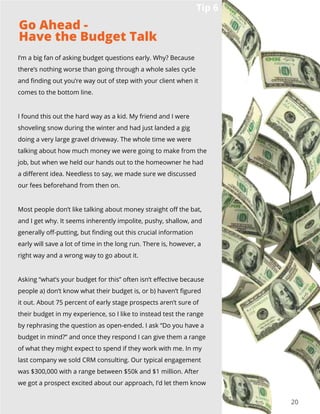
I’m a big fan of asking budget questions early. Why? Because
there’s nothing worse than going through a whole sales cycle
and finding out you’re way out of step with your client when it
comes to the bottom line.
I found this out the hard way as a kid. My friend and I were
shoveling snow during the winter and had just landed a gig
doing a very large gravel driveway. The whole time we were
talking about how much money we were going to make from the
job, but when we held our hands out to the homeowner he had
a different idea. Needless to say, we made sure we discussed
our fees beforehand from then on.
Most people don’t like talking about money straight off the bat,
and I get why. It seems inherently impolite, pushy, shallow, and
generally off-putting, but finding out this crucial information
early will save a lot of time in the long run. There is, however, a
right way and a wrong way to go about it.
Asking “what’s your budget for this” often isn’t effective because
people a) don’t know what their budget is, or b) haven’t figured
it out. About 75 percent of early stage prospects aren’t sure of
their budget in my experience, so I like to instead test the range
by rephrasing the question as open-ended. I ask “Do you have a
budget in mind?” and once they respond I can give them a range
of what they might expect to spend if they work with me. In my
last company we sold CRM consulting. Our typical engagement
was $300,000 with a range between $50k and $1 million. After
we got a prospect excited about our approach, I’d let them know
Tip 6
Go Ahead -
Have the Budget Talk
21
that typical clients of their size spent x amount of money with us. Instead of asking them
about their budget (unless they told me otherwise), I’d let them know how much similar
clients spent. Frequently, it showed that we weren’t a good match. That actually makes
your life easier because, I don’t know about you, but I’d rather find that out early before I
shoveled their whole damn driveway.
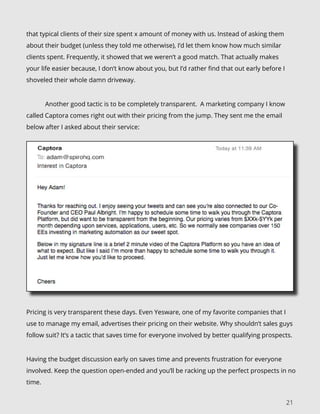
	 Another good tactic is to be completely transparent. A marketing company I know
called Captora comes right out with their pricing from the jump. They sent me the email
below after I asked about their service:
Pricing is very transparent these days. Even Yesware, one of my favorite companies that I
use to manage my email, advertises their pricing on their website. Why shouldn’t sales guys
follow suit? It’s a tactic that saves time for everyone involved by better qualifying prospects.
Having the budget discussion early on saves time and prevents frustration for everyone
involved. Keep the question open-ended and you’ll be racking up the perfect prospects in no
time.
22
Let’s face it, most sales cycles stretch out longer than we’d like. This requires us
salespeople to be patient, but more importantly, somehow stay in the mind of potential
buyers while they are doing whatever they do between our sales calls.
In my personal experience a few years back, I sold a lot of middleware software to a
large Midwestern telecommunications firm. They needed the software to build a new IT
system, which would help provision customers quicker so they could sell them bundled
phone services. Their project was dependent on another project, which (surprise!) ran
late. The buyers liked my solution, but keeping them interested throughout the three
month delay, was going to be a challenge. I needed to keep my solution at the top of
their mind, so interest wouldn’t fade by the time their project started up again. During
those three months, I was able to maintain a presence with those buyers and learned
some valuable tactics. You need figure out how to stay in touch with potential clients
during delays without seeming like a stalker.
Tip 7: Creative Ways to Stay in Touch
23
One of my favorite techniques is to send my customers and prospects a recent blog entry.
This can either be from your company or from a good site, with a quick note about how it
made you think of their business, or the deal you’re working on. Be sure to make it relevant!
Even if they don’t reply or acknowledge your outreach, you’re still building your presence.
They are seeing your name front and center.
Ditto for recent wins (hopefully only those that are relevant to their industry, or geography).
If your client is in Denver, I’m sure they appreciate hearing that you’re building up the client
base nearby. If you sadly don’t have any recent wins, then just share relevant company news.
For instance, if your company announces a new product or feature or service, that’s at least
somewhat relevant, let them know! No pressure, you’re just keeping them updated.
You may also be wondering on how to stay in touch - should you email or call? Use email
to build awareness, but don’t count on responses. Use your phone to engage them in
conversations. And people love to talk (especially about themselves). Be interesting! Your
job is to make them want to talk with you, so don’t send them dull stuff. It would be better
to share a great photo or video you made with your drone, than a dull product release.
Remember, you’re selling to a person.
That sums up what you should do, but there is a flip side to every coin. So let’s focus for
a second on what you should NOT do. Please don’t send a Facebook or LinkedIn happy
birthday message. Everyone knows how easy that is to do, and no one values it. The only
strategy you might want to use here is actually calling them on their birthday to personally
wish them a happy birthday. I received about 400 messages on LinkedIn on my birthday
(because it’s so easy to do), but the one I really remember was my colleague, from three
companies ago, who picked up the phone and called. (Thanks, Teddi!)
And please stop sounding like a robot. The last thing your clients want to hear is a robotic
reading of some script that everyone under the sun gets exposed to. People like to feel
special, as if you know them and value them. When you make calls while reading from a
preplanned text, your sales potential flies out the window (you’ll be lucky if they don’t hang
2424
up on you before the second paragraph).
Even using sales language can make you
sound robotic. Yes, we all went through
training to “up” our sales and climb the
corporate ladder. In the midst of that
training, we were submerged in sales lingo.
However, the rest of corporate America
doesn’t want to hear our jargon. They want
to know why our products are the best in
the industry and how they are going to suit
their company needs. Don’t sound like a
salesperson.
The best way to make a sale, is to ensure
that your name (and that of your company)
is at the forefront of future clients’ minds.
Send them blogs and news in order to
keep your name in their view. Make sure,
of course, that the things you send are
relevant and useful. Make phone calls and
be interesting! No matter how desperate
you are for a sale, or how many people you
have to call each day, never resort to being
robotic and impersonal. Make that birthday
phone call, talk to each individual in a
manner fitting his/her field and style, and
definitely don’t try to talk shop with people
not working in yours.
25
I said it before and I’ll say it again: Phone calls are the best way to get in
touch and keep in touch with prospects. But emails do have their place, even
if it is next to the box of kitty litter. Emails are a dime a dozen. Virtually any
person you talk to will tell you they get too many of them, their inbox is full to
bursting, and they’ve just learned to ignore the fray. If that’s the case, you bet
your butt it’s going to be an uphill battle to get a prospect’s attention via the
digital dog pile.
There’s an upside to that truth, however. You could, for example, probably get
away with emailing more frequently than you think. If emailing once a week
seems like pestering to you, you must be quite vain. Did it ever occur to you it
hasn’t even been read? Yeah, you should always assume so. With this in mind,
you now have carte blanche to send more than one email a week. Permission
granted. But you still have to make each email count.
There are some things you just DON’T DO when it comes to emails. The Muse
wrote a whole article on this, and while I agree with most of it, here are my
personal peeves that I think deserve highlighting.
Don’t bullshit. Get to the point and say what you want. Let’s talk about the
proposal, etc. Why couch it with language that deflects from the purpose?
You don’t have time and neither do they. Trust me, your busy prospect will
appreciate your respect for their time.
Don’t be lazy about your subject line. We used email at Spiro to get feedback
from legendary sales guys who’ve downloaded our beta app. We asked them
Tip 8: The Ultimate No-Nos of Emailing
2626
to fill out a form – a lot of times they don’t do a great job or don’t do it at all.
We’ve used a lot of different techniques to get people to fill out the form, I can
tell you. And the one that worked the best was as simple as could be: a change
in subject line. We’ve found that response rates for using different words or
phrases can be dramatically different. We sent out an email with the subject
line “don’t go breaking my heart.” Our response rate was through the roof – at
around 22 percent! When writing emails, avoid using uninteresting or vague
email subjects.
Don’t say “Hope this find you well”. Why wouldn’t they be well? It’s a meaningless
cliche, a filler. You should be as succinct and to the point as possible. If you give
the reader the ability to opt out because it’s not immediately grabbing them,
you’re doing yourself a disservice. Any introductory blather makes your emails
less effective.
Use these tips to help you craft an email that can’t be ignored (more than
10 times). Email might be inferior to phone calls, but when it is necessary or
appropriate to send an email, be sure
to make it count!
27
As salespeople, we are always wanting to close a deal. After all, coffee is for closers,
right? We want to make a call and close a sale right then and there. Even if the call
only results in a small sale, it’s enough to make our day and give us that immediate
gratification.
But too many salespeople get so focused on only trying to close deals. Instead, they
should be focusing their time and energy across their whole pipeline — which means
cultivating early stage opportunities. When we come across the deal that is early in
the buying cycle, it is easy to shrug them off because they aren’t ready to buy. This is
a fatal mistake many salespeople make. Instead of looking at early stage deals as a
burden, look at them as an opportunity.
Early stage buyers are often much less set on what they want to buy. Many are still in
the research phase. This puts you in a perfect position to educate them about multiple
products and services that you offer. More importantly, you can follow the model
proposed by Matthew Dixon in The Challenger Sale. According to Dixon, “When you
have that additional time, it allows you to build a vision of how your product or service
drives value for the customer.” Finding the value also drives the sale.
Tip 9
Stay On Top of Your Early Stage Opps
28
One of the biggest problems is that salespeople forget about their early stage prospects
at the end of the quarter. Someone says they aren’t ready to buy and the salesperson
moves on and focuses on someone else in the buying mode. The key is to stay focused
on all your prospects, regardless of the stage. The only way to do this is to build a
system.
First, make sure you have a contact database that tracks all of your current
opportunities in all stages of the sale. Second, make it a habit of checking in on that
list of opportunities every single week. Block off a time on your calendar, have your
assistant remind you (wouldn’t that be nice!), or do something that ensures that you
take this time to check in on your prospects every single week. Checking in with those
early stage prospects every week is key to staying on top of mind and being there to
close the sale when they are ready.
When you take the time to invest into these early stage relationships, you help someone
go through the entire buying cycle. Throughout this you are able to build a relationship
and trust with them. This trust grows and when the time to buy has come around, you
are the obvious choice. When you take the time to really help someone got through the
whole process, you often win more than just that first sale. You may win future sales and
business from the buyer as well.
When you focus on these early stage opportunities, you are setting yourself up for
success down the line. Even though you may be struggling to hit quota this year, next
year will be a breeze when these opportunities come through. Great salespeople don’t
just focus on closing the next deal. They are thinking big picture with their clients and
cultivate relationships that take years to unfold.
The bottom line is, it’s easy to get caught up in the hustle of closing deals at the end of
the quarter to meet quota. Don’t let your hustle distract you from focusing on those
early stage opportunities which may be the key to your future success as a salesperson.
Create a system and stay focused on those early stage opportunities. Getting organized
with your sales system is key to a successful sales career.
29
Salespeople - you need to stay positive or GTFO. It’s
sales, after all, and eighty percent of prospects say
no four times before they say yes. Eighty percent.
Four times. Translation: you need to have bullet proof
Rambo-style grit in this business. The stat comes from a
great blog post by Matt Tuscon, a fellow sales guy who laid out
some interesting figures that will make you think. He said you need to have some
thick skin in this business – yeah, no crap!
I had an experience years ago that taught me the importance of keeping my chin
up despite really bad odds. Years ago, my team and I were working on a bid for Sun
Microsystems, one of the biggest tech companies in the world at the time. We were
the underdogs, fighting an incumbent vendor to win their business. We researched
the account, built relationships with executives, and focused on the goals and
objectives of their business to make sure we had an airtight value proposition. We
did all the right things and wound up flying out to Denver to do a presentation for
the exec team as part of the final step in the proposal.
Everyone that was short-listed for consideration was going to be there. We practiced
all evening because we knew five of the biggest heavy hitters at Sun were going to
be at the meeting. In the morning, to our disappointment, only three of the five key
people for Sun showed up. It felt like we weren’t being taken seriously. Ultimately, we
didn’t win the deal.
Yeah, we were disappointed, but instead of being sore losers and saying “screw
these guys,” we came up with a simple plan to stay in their good graces until the next
opportunity arose. We figured out through our friendly contacts at Sun when they
were going to start working with the other vendor. We timed it so that we sent a gift
basket at the start of the contract reminding them of our strengths. The result was,
Tip 10: Get Over Rejection FAST
30
two years later, when there was another op with them, we became a favorite and won the next
bit of business.
We could have easily sulked around feeling bad for ourselves when we spent so much time on
the Sun proposal and didn’t get it. But that would have gotten us nowhere.
There are times when sales guys need to keep pushing past “no” and times when they should
move on to greener pastures. Maybe there’s something in your value proposition that you
haven’t communicated the right way or maybe you’re not talking to the right person.
In the case that the buyer isn’t educated enough to make the right decision, it’s your job to take
him or her to school. For example, if you’re in logistics sales and you know you can save the
buyer 20 percent, it’s almost like you have an obligation to because it’s in their interest. If they’re
still giving you push back, maybe you need to call somebody else in from their organization such
as a supervisor or other department head who will better understand the value you can provide.
Don’t stop until you feel you and your product have been seriously vetted.
Maybe if we sold Sun a $10k starter something just to be an approved vendor, instead of going
straight for the $3M big enchilada we would have been better off. But hindsight’s always 20/20.
One way to stay on a prospect’s mind while you wait for an opportunity is to use the reciprocity
principle – a little psychological trick that plays on our basic social expectations. This is how it
works: Most people want to return favors, repay debts and cultivate general goodwill with their
fellow man (or woman). According to smart guy Robert Cialdini (he only wrote one of the most
famous social selling books of all time), the psychological principle of reciprocity is directly tied to
influence because people cringe a little bit on the inside when they don’t or can’t return a favor.
You have to have a thick skin in sales – there’s no two ways about it. You’re going to lose more
times than you’re going to win, but if you focus on the right deals and do the right things to stay
on your client’s mind, you’ll be in the money in no time.
31
One of the top salespeople who worked for me a number of years ago was on an
amazing streak. She was highly likable and very good at listening to her clients. This
resulted in her being over her quota by 150% for three years in a row, despite her
target increasing each year.
She was almost the ideal salesperson, except for one thing. She would often get
very nervous during sales presentations, and developed a bad habit of rubbing
her hands together as a nervous tick. It reminded me a little bit of Mr. Burns in the
Simpsons. Obviously this saleswoman wasn’t rubbing her hands in anticipation of
the money she’d make from the sale – but it looked sort of like that. With a little bit
of coaching, she stopped this habit and went on to again crush her quota.
Do you have body language that is communicating the wrong message to your
clients? Are you aware of your body language? If you aren’t, you may be seriously
hindering the amount of deals you close. Let’s take a look at some of the worst body
language mistakes you can make.
Tip 11: Mind Your Body Language
3232
Do you slouch? The posture you hold speaks to your confidence level. When you are
slouching, you are signaling that you don’t have confidence in the sale you’re trying
to make. If you don’t believe in it, why should your clients?
Do you have an overly aggressive handshake? A handshake can say a lot about a
person, and a grip that is overly aggressive can be off-putting. You want to present
yourself as a confident problem solver, not someone who is overly eager to win
a deal. On the same token, you do not want to shake too weak and seem under
confident.
Are you angling your body away from others? If you’re not facing someone directly,
you might be showing them you’re disinterested in what they’re saying. This can be
perceived as disrespectful and work against building rapport.
Do you stand too close to people? Not only can standing too close be uncomfortable
for your prospects, being in their personal space might indicate to your buyer that
you have a lack of respect for them.
Are you looking at your watch too much? No doubt you need to keep an eye on the
time, but it still might be signaling disrespect. You don’t want your prospects to think
you do not value the time you have with them and are more concerned about the
next place you have to be.
If you answered “no” to all the questions above, then you are off to a good start,
but I’m sure we can all improve our habits. To work on your body language, you
can observe yourself when you are talking to others and even practice in front of a
mirror. It can also be helpful to visualize yourself with the body language you want
to have, before you go and interact with others. Remember, you want to be open,
honest and comfortable. If you are not feeling like that, you should investigate why.
Also be aware of key body language barriers, as mentioned above, and consciously
avoid them.
33
When it comes time for your meetings with customers and prospects, you need to
be doing two things always. First, monitor the situation (and yourself) – do this by
watching everyone’s body language, including your own. You also need to focus
your attention on your customer and really listen. Show you’re listening by repeating
back and clarifying what they’re saying. Secondly, run your agenda – be aware of
others and yourself, and guide them through your agenda accordingly.
Most body language needs to be a balance of enough, but not too much. Once
you’re aware, you can begin to experiment to find the right balance for you. Make
eye contact, but don’t stare; Give a firm handshake, but not too firm. As a result, you
can show your clients through your actions and words that they should do business
with you. Then, instead of reminding prospective clients of a greedy Mr. Burns, you
can be more like a confident and cool Leonardo DiCaprio.
3434
You’re at a sick party; everyone is dressed to impress. You go with an open mind,
hoping by chance that you’ll meet someone who makes a real difference in your life
– whether that be love or a job opportunity…whatever. I used to think that Twitter
was like that party, except everyone was talking and no one was listening. Now I’ve
changed my mind.
I realized that Twitter is a goldmine of opportunity, as are all of the big social
networks. Not only are people listening, but the iron curtain between regular Joes
and MVPs has turned into tissue paper and the party is more like a backstage
pass. I personally believe that everyone looks at tweets which mention them, even
celebrities. You CAN build relationships with MVPs. But the trick here is that you’re
using Twitter to establish rapport, not make sales.
We recently had a Twitter success story at Spiro when our Tweets engaged the host
of a renowned business podcast (We can’t tell you who it is just yet) and resulted in
us getting a spot on his show. All we did was 1) comment on posts in a meaningful
way, and 2) @mention handles when appropriate to draw attention to our content.
Our dialogue wasn’t pushy or one-sided; it was a 140 character conversation.
We also conducted a very unscientific experiment under the theory that Tweeting
would net us a bigger, better response rate than email lists. We began Tweeting
the people in our email list and responses to our beta release jumped through the
Tip 12
@Twitter
Twitter is Your Friend #BFF
35
Follow us on Twitter!
@SpiroHQ
@AdamHonig
roof – turns out sales guys love Twitter! Once you have that natural dialogue going
just move the conversation to email and, bam, you’re 10 steps closer to yes than you
would be if you started out cold calling.
Twitter is not just about generating leads, it’s useful throughout the sales cycle.
Twitter can help you find prospects! There are more than 500 million accounts on
Twitter and it’s your job to find the ones that are most relevant and high quality for
you. Find the right accounts to follow by searching relevant hashtags and keywords.
Check out a competitor’s Twitter account for ideas on who to follow. Once you’ve got
it narrowed down, use a Twitter client like HootSuite to create lists.
You can also use Twitter as an alternative to traditional communication channels.
Can’t reach someone on the phone or email? Try Tweeting them.
Another trick is to follow a company’s Twitter feed so you can gain insight into their
culture, goals, and agenda. Following what is said about them can give you insight
into what their pain points and strengths are according to their customers.
It doesn’t always have to be about pursuing a prospect. There are influencers out
there who can help you with professional or personal development and expand your
network. Follow and engage with them.
MID-FUNNEL
37
Salespeople face multiple objections every day. Sucks, doesn’t it? Well stop
crying about it and man up because it’s all a part of the job. I’m sure you
have heard “Now’s just not a good time” from a client before. Well, this is the
objection I encounter most and it’s usually a simple issue of prioritization. The
company is interested in what you’re offering, but it’s just not at the top of
their list. So what do you do? You find a way to make them understand how
your product compliments their priorities.
First, you have to know what their priorities ARE. If you’re doing your
homework, you’ll come prepared with a way to rephrase your value
proposition in a way that make them think, hey, I need that! Here’s a real world
example: My team and I were trying to score a big deal with United Healthcare
for our software service. Every year UHC figures out their strategic plans,
main initiatives, and what they can budget into their capital spending (where
products like mine would fit in). They thought our software was interesting,
but not in their top-things-they-needed-to-get-done-that-year list. Boom. Wall.
But we got over it. First, we had to hook them with the emotional appeal of
how cool and exciting our product was, then we had to reel them in with the
intellectual appeal of it being strategically relevant.
We emphasized how our product could be good for
the careers of the people in the IT department
(direct appeal tactic) who would be working with
our software. They were onboard, but their
pitch to the higher ups failed. So we opted to
attack head-on and show them that working
with us was still very strategic. We suggested
a collaborative brainstorm to see how we fit
into their strategic framework. One of their
biggest priorities was minimizing the number
Tip 13
Responding to “Now’s Not a Good Time”
38
of people who signed up for their healthcare and then switched
out. When we told them that our software was able to detect
people beforehand who might be tempted to not re-subscribe in
advance, they were sold. Our initial proposal was a tech sale that
failed, but once we rejiggered our value proposition to align with
their priorities, we were golden!
Have you ever felt like you’re not getting the whole story? Or been turned down without a
real good reason? Maybe you have heard the old, “We can’t say exactly why, but we’re not
interested”. It’s important to read between the lines. You may discover that what’s killing
your deal is just bullshit internal politics.
Real life example: We were selling a deal with a division of Kraft foods and had great
relationship with the CIO who was the main purchaser of the middleware software we were
selling. He felt the need to have agreement among his teams before making a final decision
so we presented our product to each leader individually. Everything seemed to be going well
– they all seemed to love our product. Then, out of left field, the CIO told us the teams were
not in agreement. Someone threw a wrench in the gears.
We got a false positive because we had been talking to everyone individually, when people
are more likely to skew positive. We obviously hadn’t convinced everyone so we pushed the
CIO to get one group meeting together to voice their concerns. What came out on that group
video conference was shocking – two members of the team were having an affair, broke up,
and just weren’t on speaking terms. THAT was what was gumming up our deal.
The point here is that salespeople need to make sure that their internal communication is on
the same level as their communication with the company rep, otherwise you’ll end up with
political situation you have no control over like the one above. Set up individual meetings
before group meetings and make sure everyone is in alignment. It will be easier to
make your case.
39
I get a lot of cold emails from people I don’t know. Most of them are the familiar boring, generic
intros and requests – and most of them get ignored. So what gets me to respond? Someone
who’s taken the time to make their email a little interesting.
One day I got a cold email from a salesperson whom I didn’t know. I would have been hesitant
to reply back, if it weren’t for his unique approach. He sent me an email about drones. If you
don’t know, I’m REALLY into drones. I fly them all around Boston and made some cool videos of
the city. He didn’t even ask about security or whatever he was selling. He just ended by saying,
‘by the way, I’m with a technology firm, we should talk.’ It ended up in a meeting.
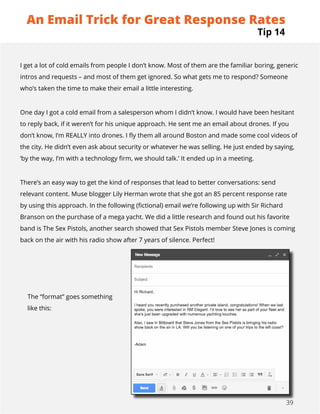
There’s an easy way to get the kind of responses that lead to better conversations: send
relevant content. Muse blogger Lily Herman wrote that she got an 85 percent response rate
by using this approach. In the following (fictional) email we’re following up with Sir Richard
Branson on the purchase of a mega yacht. We did a little research and found out his favorite
band is The Sex Pistols, another search showed that Sex Pistols member Steve Jones is coming
back on the air with his radio show after 7 years of silence. Perfect!
The “format” goes something
like this:
Tip 14
An Email Trick for Great Response Rates
40
The reason behind these great results, Herman says, is that people feel like you’re
investing in them and want to return the favor. Sound familiar? That’s because we’ve
talked about it before. It’s called the Reciprocity Principle. The reciprocity principle
is crucial in social selling, because it hinges on the way humans think about their
relationships with other people.
In my point of view there are three sources of content that are relevant and accessible
to salespeople that they need to take advantage of.
1. Your Company’s Blog
The odds are that there is probably a prospect having a problem that’s somehow
relevant to the blog that you guys just posted. If you’re selling software, for example,
did your communications department just run a helpful how-to that would be of
interest? The info is right there, wrapped up in a bow, for you to send to your prospect.
2. Other People’s Blogs
I wouldn’t send along the blog of a direct competitor, but we’re all in the same field
here, right? If I come along an interesting blog from thought leaders like Jim Keenan or
Andy Paul, I’ll send it out! At the end of my email I’ll put a simple call to action.
3. News About Companies Like or Near Them
Let’s say you have a prospect and just closed a deal with a hospital nearby, send them
a quick note and let them know. Companies always want to know what’s going on with
businesses like them, especially like them AND near them.
41
At my old company we had been trying to sell Staples for a while. They were the top dog in
our territory and we were dying to do business with them. The day finally came when we had
an opportunity to meet. It went really well and as we were headed out, high on the fact that
we might have a shot in Hell, we ran into an old client named Mike.
We had no idea that he had started working at Staples. This was brilliant – he was a big fan
of ours and helpful for us in his last company. A chance run-in with Mike ended up being
the thing that got us our first small project with Staples. If we hadn’t actually been physically
present in that office building, we wouldn’t have gotten the leverage we needed to get our
foot in the door. This, my friends, is why meeting face-to-face will never go out of style.
One reason why in person meetings work so well, is it gives you a chance to pick
up on body language clues. There is subconscious information exchanged
between people when they meet in person that can reveal a whole story
where a phone call could reveal just one chapter. Body language – the way
a person places their arms, the way their eyes dart to the side, the way they
lower or raise their chin – is VERY useful for reading between the lines.
Perhaps one of the best advantages person-to-person meetings
bring is the chance to bond. Take lunch meetings, for example,
often as much time is spent discussing business as it is shooting
the shit. Here’s a story of just how important a single lunch
meeting was for one sales guy’s relationship with a prospect.
Let’s look at an example of when a face-to-face meeting works.
Sales guy Chris needed to put a bit more effort into his relationship
with a prospect to prove he was truly interested in helping them.
When he talked with his main contact at the company he offered to fly
out to Las Vegas to buy her lunch – just give me one chance, he said.
The prospect was taken aback by his offer. She relented and he flew out
Tip 15Face-to-Face Can’t Be Replaced!
42
to Vegas and treated her to lunch. During the meal, she confessed that even
though she had been working with his arch rival competitor for 10 years, not
a single person there had offered to take her out to lunch.
Chris wasn’t even sure what to say. To him, meeting people in person and
doing kind things for them was just a part of the business. Eventually, the
prospect made a small purchase from Chris’ company. He gave it his all, really
impressed the client, and discussed how they could work together in the
future. Do you think Chris would have gotten the same results if he hadn’t
met his prospect in person? Probably not.
At Spiro, we’ve been having a lot of meetings with sales VPs recently
while working on another edition of our tool. When we asked
about their issues and priorities, guess what they said? They
said they want their teams to have more face to face meetings
so they can expand their relationships inside those accounts.
There you have it – plenty of other teams are realizing that
person-to-person relationships can’t be replaced.
Think of the limitations of a phone call, for example.
When you’re on a call, you don’t know who else is
on the call with them – should you be talking to that
person? Are they more important? I think the odds of
you getting passed to the right person after a face to
face meeting are a lot higher. The secret with selling
is to use every avenue to form a relationship with the
right person in your prospect or client’s organization. Use
the principles of psychological selling and a good balance
of phone time and face time and you’ll be kicking ass and
taking names in no time.
43
When you rely on emails and voicemails to get in touch with prospects you may as well
be that kid who used to talk to himself in the back of class. Just because you’re chattering
away doesn’t mean anyone’s listening. What it boils down to is this - you can’t avoid
the dreaded phone call in sales. It’s the only thing that’s effective when it comes to
establishing a relationship with a prospect, and if you’re afraid of being annoying, well,
you better get over it now or move the hell on.
At my last company, the inside sales team made about a hundred dials a day and
only reached maybe ten people. Let’s say you’re a sales guy and working on twenty
opportunities and there are three people involved in each. If you called each one twice a
day that’s 120 phone calls. For the average sales noob that sounds like a lot, but it’s not.
How often you call a prospect depends on where they are in the sales funnel. Market
research shows that the faster you speak to the new lead, the more likely you will close
on them. I personally think you should call frequently on new leads – twice a day for a
couple days. What’s the downside? The odds are that if you don’t get ahold of them in
two days, there won’t be a lead to follow up on anyway. You really have nothing to lose –
either they get pissed off at you for calling too much or you kiss that lead goodbye.
Follow up after the first conversation very quickly. A third of the leads you have great
conversations with are blowing smoke up your butt and you’ll never speak to again. For
the rest of the bunch, I would follow up with a bit of relevant insight. NEVER say “I’m just
Tip 16
Never Stop Calling!
44
checking in.” That’s the definition of lame and annoying. If you were smart you could even save
some important info from the first conversation for the follow up call.
The amount of following up you do also depends on your pipeline. Dealing with 100 opps is very
different than three, but you should at least touch base with your contacts twice a week. I know
it sounds daunting. Even I’m guilty of not following up enough. Whenever I was a sales manager
they always had to encourage me to follow up more with prospects more frequently.
The natural reaction for new sales guys is that they don’t want to risk bugging their prospects.
I get it. And that’s why I don’t think you should leave voicemails or send cold emails. How is
clogging up someone’s inbox making you any friends? What’s really annoying is just calling to
check in. It’s superficial. At least talk about something relevant that you saw in the news, that you
read about their company, even a baseball team they love. You can’t just call up and say, “you
guys ready to buy yet?” Ease into it with some context.
Recently I’ve been trying to connect with the head of sales for a fast growing tech company. I’ve
been following this method: call 2 x week, email 1 x week. I give the guy progress updates on
Spiro and also talk to him about his progress making HIS number for HIS company. It’s been
slow going because he’s a busy guy and only last week I managed to have a full conversation
with him. I was a concerned I was reaching out too much so I simply asked him if that was the
case. He actually applauded my persistence because he was interested in what we were doing,
just very busy.
If you’re still afraid of bugging your clients with calls and would rather hide behind an email or
voicemail I suggest you start looking for a career outside of sales. I know it sounds mean, but it’s
just the cold truth. While Twitter or LinkedIn messages are great ways to open the door, they’re
also still nowhere near as effective as a phone call. Be persistent and you’ll eventually reach
someone you can charm with your high-value pitch. Next stop, deal city.
45
“Get your butt to Iowa and don’t come back unless you have a deal.” When I said that, Garth,
my sales guy on the John Deere account, knew I wasn’t screwing around. It was my first sales
leadership job and my butt was on the line – this deal had the potential to be huge and take us
to the next level. It wasn’t just my job on the line, it was all of ours, and I had to make it crystal
clear to this guy: Do NOT screw this up. Do NOT come back until you have the deal tied up in
a bow with a kiss from grandma. Do NOT take “no” for an answer. After finessing that deal in
corn country for a week, guess what? We won the deal. Sometimes I wonder if the classic “don’t
take no for an answer” sales mantra still works now. My conclusion is yes, no, and maybe. Let’s
explore…
I’m sure you have heard a client say some of these to you before: “No. Not interested. Maybe
later. I’ll take a message. We don’t have the money. We’re not in the market. It’s not my
decision“.
These objections are all opportunities for the legendary sales guy to sharpen his or her skills.
As a salesperson, there are many ways for you to get creative and use that brilliant brain of
yours to convince the buyer that you provide needed value. Of course you’ll come correct by
being armed with an arsenal of knowledge on the prospect: including their pain points, market
share, goals, strengths, culture, and competitors. If you’ve done your homework you can
use this knowledge as leverage and plowing through the front lines will be a cakewalk. If you
continue to face a wall of “no”, it may come down to these brass tacks:
One case where it’s smart to push past “No” is when you know something the buyer doesn’t.
In the case that the buyer isn’t educated enough to make the right decision, it’s your job to
take him or her to school. For example, if you’re in logistics sales and you know you can save
the buyer 20 percent, it’s almost like you have an obligation to because it’s in their interest.
If they’re still giving you push back, maybe you need to call somebody else in from their
organization such as a supervisor or other department head who will better understand the
value you can provide. Don’t stop until you feel you and your product have been seriously
Tip 17Should You Keep Pushing Past “NO”?
46
vetted. Another time when I don’t take no for an answer is when I just can’t afford not to get
a yes. Sometimes, if your back’s against the wall because you have few prospects in your
pipeline then keep fighting – just remember to maintain your integrity.
On the other hand, there are times when you just need to walk away. The internet
revolutionized a lot of things since the 90s, including sales. Buyers often prefer to self-
educate and most likely have vetted their options on the market before you even get a
word in. If you find yourself facing a wall of “no” in this situation, you probably won’t get too
far.
Perhaps you have better prospects in your pipeline then, by all means, cut the fat and go
fry those bigger fish. As salespeople we have a tendency to be overachievers, but when
trying to win ’em all means spreading yourself too thin and winning nothing, you’ve got a
problem. Or maybe the deal is just taking too long. There’s a timing element – a rhythm – to
a successful deal. One time we lost a sale after it had dragged on for over nine months to
a company that swooped in last minute. If your pitch gets stale, at some point you have to
give into no, if just to step back and do something different. In fact, I’m a firm believer that
sales guys should walk away from more deals.
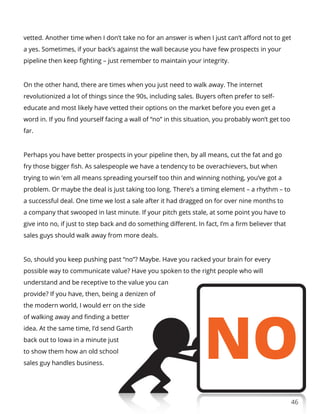
So, should you keep pushing past “no”? Maybe. Have you racked your brain for every
possible way to communicate value? Have you spoken to the right people who will
understand and be receptive to the value you can
provide? If you have, then, being a denizen of
the modern world, I would err on the side
of walking away and finding a better
idea. At the same time, I’d send Garth
back out to Iowa in a minute just
to show them how an old school
sales guy handles business.
47
You know the feeling. You have been working on this deal for what feels like ages but it is not
going anywhere. The deal feels “stuck”. Is the deal dead? Should you stop wasting your time
and move on to other prospects? I’m a fan of killing your low priority opportunities as a way
to increase focus. Often the right answer is to buckle down and try to get it going again. If so,
how do you actually go about getting this stuck deal unstuck?
One idea is to stop calling your one contact at the account. Instead branch out and start
seeking out other contacts in the organization. This may tick off your primary contact who you
have been communicating with, but who cares. If they are not willing to push the deal forward
then start seeking someone else who is willing to take action. Recently I was talking with a
great salesperson who fell into the trap of relying on his primary contact at a deal with a large
pharmaceutical company. He didn’t want to alienate him, but it turned out that he was talking
with the completely wrong person and wasting his time.
If the deal is stuck, try and determine what the prospect’s need for your product really is. Did
you get ‘happy ears’ when listening to your prospect because you could envision exactly how
your product would fix their needs? Then try to write and explain exactly why they need your
product or service. What would happen if they bought the service? How would it improve their
lives and their business? What would happen if they did not buy? Get crystal clear and use this
to drive your message home.
Of course you should always be asking your prospect ‘What else is going on?’ or ‘What other
priorities are you facing right now?’ But when a deal is stuck it might just be that you have a
Tip 18: Unstick Your Stuck Deal
48
great solution and it just isn’t a priority for them right now. First, start by understanding what
their priorities are. This will give you clarity on where your project stands in the prospect’s mind
right now. Second, start figuring out how to raise your project in the prospect’s priority list.
What can you do to make this a priority for them? I remember a deal we were working on with
a multinational hotel chain. Our sponsors loved the product, but they couldn’t get funding until
we worked with them closely to align the solution with one of their corporate initiatives. A deal
that was stuck in limbo for months quickly pushed through the sales process.
Sometimes all a deal needs to get going again is a bit of patience on your end. You are an eager
and excitable sales guy. Maybe the deal is not really stuck, maybe you are just inpatient. Maybe
you just need to give it some time for the company to feel comfortable buying from you and
your company. Buying takes a lot of trust, so be patient and build the relationships and build
trust. It may take time but eventually that deal will become unstuck. Get on a regular schedule
of staying in touch with your prospect via phone or email. Send them an interesting blog or
company update. Don’t always expect a response, but know that your outreach is keeping you
on their radar.
If the deal really is stuck, then you might need to kill it and move on to other opportunities.
Before moving on, try the negative close. Tell your prospect something like “Well, this seems to
be a low priority for you…” See if they disagree with you. Sometimes the negative close will jolt a
deal back to life, other times it puts the nail in the coffin so you can move onward.
Stuck deals can drain your energy so use these ideas as a plan of action on how to move them
forward.
49
Much like a business meeting, a sales call should always have an objective. Don’t be sucked into
routine sales calls that lack purpose and leave the prospect asking, “What is the point of this?”
You don’t need to have the exact minutiae of the call planned down to the syllable, but there
should be clear aims you hope to accomplish. If you don’t have any purpose, your prospect is
definitely not going to believe in what you are saying and you will be viewed as a sales robot.
Have you ever been the buyer and sat through a sales call? In most cases, you probably weren’t
very engaged in what they were saying, and you most likely didn’t pay a lot of attention. On the
flip side, have you ever received an organized, purposeful call that convinced you they had a
solution that could benefit your life? The difference is night and day.
Your goals and plans should involve some kind of way to bring your customers in and engage
them with your pitch and your product. An easy first step is to develop a clear purpose that you
can succinctly state for your customers.
Aristotle — a guy who was a lot better at sales than I am — said “Well begun is half done.” I
don’t know if he intended that to rhyme (it sounds something like “Καλά ξεκίνησε γίνεται κατά
το ήμισυ” in Greek, but I’m a little rusty, so I don’t actually know how the rhyme translates.)
Aristotle’s point, however, stands. A strong base for a sale or a meeting, or anything else greatly
improves your chances of being entirely successful. It paints out the target, so you know what
you are shooting for.
There is No Shame in Stating Your Goal!
Tip 19
“Well begun is half done.”
- ARISTOTLE
50
Sure, people get lucky all the time – but a big part of business is actually making your success
repeatable, and waiting for lightning to strike is one of the less impressive business models I’ve
encountered in my lifetime. Stating your goals forces you to have a purpose. It asks why you’re
doing the thing you’re doing, in the way that you’re doing it. It forces you to justify yourself
and your methods. It helps you avoid common mistakes in sales calls. Additionally, it focuses
the attention on your customers. It gives them a piece of context for your product and, more
importantly, your sale. Finally, it makes you sound professional. Although increasing casualness
is becoming more prevalent in business and sales, more people will react positively to a
professional demeanor, and having a good goal that is clearly stated is an easy way of getting
that across.
Don’t just make your goal “I want to tell you all sorts of great things about new product X.” Your
goals should be customer-focused. Remember earlier how we said that you should think from
your prospect’s perspective? That applies to your goals, too. It’s simple to change the language
of your goal a little to focus on the customer. For example, “I want to tell you about our new
product” can easily become, “I’d like to explain how you can benefit from x, y and z.” Empathy,
putting yourself in your customer’s position, is important here, and can really be the difference
between a successful sales call, and one that was close but no cigar. Customer empathy is one of
the keys to Apple’s success.
Sales is about putting your best foot forward. This means confidence and charisma, certainly,
but also necessitates a lot of preparation and background work. Strong, clearly-stated goals are
the first step towards making your sales calls more productive and profitable.
51
You just wrapped up a great meeting with your prospect and things are on the right
track – then they throw you that ubiquitous curve ball and ask, what’s your take on your
competitor? Think carefully! But, it’s really not something to fear. It’s an open invitation to
paint yourself as the right solution.
Think of yourself as a kind of advisor, a consigliere like Tom Hagen was for Don Corleone
and the Family. Even though you have your own self interest at heart, you also know that
your prospect’s best interest is in your best interest. Hagen was the voice of reason, as
you must be. Do NOT bash your competition like an insecure juiced up frat boy or come
across as defensive. Instead, be the calm resource that will help paint a picture of what the
outcomes might be should your prospect choose you or them.
You’re serious about becoming a legendary sales guy and making mondo amounts of
money, so you of course know your competition like the back of your hand. There are two
kinds of competition from your point of view: worthy and unworthy. Here’s how you might
handle a conversation about each kind.
Years ago, my team and I were going head to head against one other company, a software
vendor, for a contract with a prospect. We knew our competition wasn’t the right fit.
“Frankly, we’re puzzled about what they’re offering,” we told the prospect. “They’re asking
a question that hasn’t even been asked.” Ever hear of “if it ain’t broke, don’t fix it,” or the
principle of elegance in systems? The simplest solution is often the best. We offered the
simplest solution. Our competitors offered software that would have required a complete
reconfiguration of our prospect’s CRM system – a cost of time and money that just didn’t
seem necessary. We explained our thinking in an analytical way and guided the prospect to
a favorable conclusion – us. We were able to do this because we thoroughly understood our
prospect’s needs and our competition’s limits.
Tip 20
It’s Safe to Talk About the Competition
52
Here’s an experience that shows how to give your opinion on a worthy adversary while
simultaneously framing yourself in a flattering light. We were competing for a contract against
Deloitte, one of largest companies in the world, a distinguished juggernaut with almost 100
years experience behind them. This was going to be a tall order. We couldn’t badmouth
them and there was really nothing to critique. What could we do? We had to damn them with
great praise. There are virtues of being an underdog, like we were in this situation. A smaller
company like ours was more lithe, efficient, able to think outside the box. Being such as large
organization, Deloitte could not move as quickly. In this case, we knew that our prospect was
on a tight timeline, so we leveraged time as our strength while managing to avoid bashing
Deloitte and coming across as a bunch of assholes.
I know it’s awkward to talk about the competition – there seem to be so many opportunities to
put your foot in your mouth. But you do yourself a disservice by saying nothing. To make sales
successful, you need to be seen as a resource, a partner. If you throw your hands up or pass
it off to someone else in your organization, it degrades your value. The way to sell the biggest
best deal is by understanding the prospect and fitting your product into their strategic goals.
If you just can’t bring yourself to say anything on the spot, offer to check into the competition
and come back with a good answer.
Worst case scenario is that your prospect goes with the competition. Oh well, that happens!
Often a buyer changes their mind about what they need and might engage multiple vendors
in different sectors by the time they make a decision. There will often be other opportunities
down the line.
The bottom line is that you shouldn’t shy away from the competition convo, you should
expect it. Frame your competition in a way that your solution aligns with their goals and your
competitor’s falls outside of it.
CLOSING
5454
Sales professionals should never say never. I’ll repeat that: Never say never. I got
called out for saying “never leave voicemails” by a reader who’s had a lot of positive
results from voicemails. I’m happy for him, but I still don’t like them. As a concession,
I’ll say that nothing fails or succeeds 100 percent of the time and sales guys should
ALWAYS be trying something new. The point he brings up is that salespeople should
always be trying new (and old) things and if anyone says “never do x,” don’t listen to
them. Point taken and I whole-heartedly agree.
Salespeople have generally stopped doing direct mail, for example. When was the
last time you tried to reach a prospect by mail? If you were born after 1983, probably
never. But, guess what, it’s so old, it’s new again. Prospects and customers don’t
expect it when they receive written correspondence or a nice old gift in the mail by
Pony Express, it’s a novelty. Here’s an example of old school done right: My friends
at Play Bigger, a West Coast tech startup consultancy, wanted to have a marketing
campaign that would take people by surprise, but the digital space was already so
saturated. What would get people’s attention?
Play Bigger created a compelling direct mail piece with insane targeting and tailored
to a T. It was original, unexpected, and sincere. Needless to say, they got a fantastic
response. Direct mail can still be effective if done right. Make sure you’re using it
under the right circumstance and be creative! There’s plenty of inspiration out there
on the web, including ideas like balloon in a box, trendy stickers, and working record
players made out of cardboard.
Tip 21: Never Say “Never”
55
I’m a big fan of thank you gestures as a way to recap your value proposition and make
a lasting impression on your prospect. It shows class and an appreciation for values
that are rare these days. I’ve sent gift baskets to clients a number of times, as well
as other small unexpected treats, such artisan scones I bought from our prospect’s
favorite bakery in Dublin. A simple hand-written thank you note can also have a big
impact.
Texting is still new territory for most sales guys, but for the upcoming generation, it’s
the communication mode of choice. We took a poll a while back on our blog and found
that 20 percent of respondents said “Yes” they text, and 37 percent said they text “very
occasionally.” Many are concerned that texting comes across as overly-casual and will
be viewed negatively by prospects. It still might be risky, but there are ways that it can
be a good tool to communicate things between the lines: it could be used to escalate
the sense of urgency or confront a prospect who’s been giving you the cold shoulder;
or even when you’re running late (or early) for a meeting.
When it comes to sales, I have my personal preferences and things that have been
proven to work and not work in my experience – but a sales guy should never say
never. Always be experimenting, shake it up, and find the new (or old) angle that will
give you the edge.
Tip 21: Never Say “Never”
56
We’d been working an account for a while and gotten in really tight with Sunil, the head
of IT and the technical buyer. He was our man on the inside and, in the long run, the
reason why we didn’t get the big deal we were after. He was a rock solid connection for
us, but he was only one out of multiple people who we needed to convince to get the
sale. Problem was, he wouldn’t let us talk to them. Whatever his reasons were for being
so… possessive …of us, I guess I understand because, after all, he’s ultimately the one
who’ll be judged on the success or failure of our product with his company.
Sunil had no power over the budget, the head of marketing did. So, because he wouldn’t
let us talk with them, we eventually lost the sale after what seemed like several years
of trying. We just weren’t in touch with the many buyers involved in the process.
There’s never just ONE buyer you need to convince at a large company – the most apt
comparison would probably be more like Medusa than Larry from Marketing. Your job
as a legendary sales guy is that you’re telling them all what they need to hear.
Think of the sales cycle: A company will first recognize a need, then go about
determining how to solve that need. Ideally, you would want to get the company to
recognize the need before the competition beats you to it. Our mistake was to wait for
Sunil to recognize the need, then spend uber time with him to get the money for
it. We put all our eggs in one basket and suffered for it. So, how can
you avoid making the same mistake we did?
Salespeople are often way more confident that things
will happen then they should be. In reality it’s an 80
percent chance. Sunil seemed like it was a sure bet, but
it never happened. In hindsight, we were too cautious
in our approach with Sunil. We should have pushed
The Appropriate Way to Talk to
Multiple Buyers Tip 22
57
harder to speak to the marketing people. If he didn’t like it, we probably should have
done it anyway. Of course you should always proceed with caution and realize that
you may risk burning bridges.
You don’t want to cut off your nose to spite your face, but there’s a way you can avoid
a mess: blame it on someone else. Yes, have someone else within your company
make it happen. A great candidate is… your sales manager! A helpful sales manager
would be the one to make the call to the head of marketing to take the heat off of you.
Just apologize after with a sincere, “Hey, I’m sorry my boss did that. He went over my
head, what a jerk.” Then slyly wink to your sales manager.
Another tactic is to just convince your contact that you can do it. If your relationship
with your contact is strong enough and you present your agenda upfront, you may be
able to convince him or her that you won’t screw things up with the marketing folks
(or whomever it is you need to speak to).
And remember, you aren’t here to make friends - this is sales afterall. If you don’t like
having to ruffle a few feathers once in awhile to get things done, maybe you need to
find a new career. You’re never going to make a deal if you’re only speaking to one
person so push if you have to!
58
Nobody wants to waste time, energy and effort, only to reach a standoff on price at the
end. So by setting expectations early on, before the proposal, you eliminate price from
being an obstacle that will halt a sale. This is accomplished by asking your client about
their budget up front and setting expectations about the price range they are looking
at. By doing so, you are showing clients that you are not shying away from the price
discussion because you believe in the value of your product, and also makes a statement
that counter offers outside of the discussed range are unreasonable.
While this pre-work works in your favor, what if despite all your efforts, you still find
yourself in a price negotiation? Obviously you need to follow your company’s rules and
guidelines, but how do you approach the situation?
First off, remember that they need to negotiate. Don’t take it personally if a client tries
to negotiate anyway; it is oftentimes just part of their job. Most companies require that
Tip 23: Razor Sharp Price Negotiation Skills
59
buyers have the conversation about a lower price, even if they’re not going to force the issue.
Imagine their boss saying to them “did you ask for a lower price?” They have goals to meet too.
Rarely is price the determining issue, and if it is, you’ve got trouble! On the other hand, a product
having a higher price is often a sign that it is worth more. Use that to your advantage.
Another thing that works to your advantage is the power of silence. When you know what you
want, and you have shown the client, don’t push it. Silence can be used as a strategy where
you let the deal come to you. This of course has to be used at the right time, and when it is, a
customer will often feel the need to fill that silence, giving you the upper hand.
If you do give a price concession, you must get something back. This may be an introduction
to another prospect, a testimonial, a LinkedIn recommendation, etc. Don’t be surprised if your
prospect says it’s conditional on the product being as good as you said it is. Fair enough!
One word of caution on price concession, is that discounting may be hurting you. It might be
obvious, but any discounting you do basically comes right out of your company’s profit. The
average company in the S&P 500 is making $0.15 on the dollar of sales. Think about that when
your prospect asks for a 10% discount! These additional profits are most likely going to be
reinvested in making your company stronger, which enables you to have more support selling
and thus make more money.
After all the negotiating, be ready to hold your ground! You need to be prepared to walk. And
by prepared, I mean mentally. Otherwise you’ll never have the balls to hold your ground. Before
you enter the negotiation, you need to know what you are willing to do and where you draw the
line. Many times, this will bring the client to your side when they see you are serious about your
position.
With these tips in mind, you can become a more effective negotiator. A huge aspect of
negotiations and the outcome of them depends on the mindset you have when entering in.
By first taking steps to prevent negotiations in the first place, and being prepared with these
guiding tips when they do happen, you can steer more deals in your favor.
60
Our goal, as salespeople, is getting the deal done. So, when that doesn’t happen, we often
find ourselves at a loss. Truth be told, I tend to invest my heart and soul into too many of my
opportunities. As a result of this, I take losing deals personally.
One particularly heart-aching moment is easy to recall. We were pitching a really big deal at a
Fortune 500 company in the Baltimore area that seemed to be going really well. We had great
alignment on product fit, and even though it was a large amount of money for us, the budget
was very acceptable to the prospect. What we didn’t really do a great job on was the timing
needs required by this prospect. Sure, our solution was potentially going to save them a lot of
money, but it had to fit into their corporate schedule of initiatives. That aspect of the deal made
the process go slower than we would have liked. Yet, even though the deal dragged out, we got
buying sign after buying sign. I was enthusiastic!
However, at the same time – and unbeknownst to us – our big competitor (who was more than
1,000 times bigger than us) was working on a similar deal at a different division of this company.
Once the timing became appropriate for the prospect to move forward, they combined the two
initiatives and we were crushed by the long-standing relationship that the prospect had with
our competitor. It’s true, who you know often trumps what you know (or in this case, the deal in
which you’ve passionately invested your time).
Even though we were very disappointed (and that’s definitely an understatement), we worked
hard to maintain a great professional relationship with the buyers. When the deal falls flat, you
can’t just walk away. Another chance might be around the bend. There are a few ways you can
keep a positive relationship going.
Tip 24: So, You Lost a Deal...
Let’s Remain Professional
61
First off, we didn’t bad-mouth the competition. In fact, we told them that the company they
chose over us was a good company, because it was true. Their solution wasn’t better than ours,
but it was certainly workable. This built credibility in their eyes. Next, we educated them on
key challenges that they would be facing with any supplier, including us, during the process.
We didn’t want them going into this deal blind, even if they weren’t working with us. And finally,
we continued to include them in our prospecting and marketing efforts to remind them that
we were an alternative solution. Basically, we didn’t let them go and we didn’t let them forget
our existence and previous hard work on their behalf. They were left with the impression that
we had high integrity and were a professional firm. If nothing else, they could at least speak
positively about us as well!
Wouldn’t you know it, over the next year, we received three referrals that turned into
opportunities that this firm passed along to us. They thought highly enough about our efforts
that they continued to advocate for us. And about two years after that, after a change in their
strategy, we were invited back to pitch for a new opportunity at this firm. After having spent six
months selling to them before, and the time after that staying in touch, we were the obvious
solution. We won a very significant deal!
Sure it hurts, in a lot of ways, when a deal falls through. However, that’s not a good reason
to pack in the bag with the potential firm. In fact, as we learned here, a continued pursuit
and reminder of our existence was what it took to eventually land a very nice deal with them.
Ultimately, the advice I want to leave you with, is that perseverance will always pay off. Even if
we hadn’t gained the deal with them in the end, we did garner three additional opportunities
through that tenacity. Keep your name in their view, keep your integrity and eventually, if you’re
good at what you do, you’ll get the deal done!
62
You know how they say a lot of great inventions were created by accident? Like
the discovery of Penicillin and the awesomeness we now know as potato chips?
Seriously – if you don’t believe me, look it up. That aside, I discovered one of my
favorite sales techniques in pretty much the same way.
My first sales job was selling technical education classes. Not the most thrilling
work, but it was my entry into sales. We’ve all gotta start somewhere. I would
go through a list of prospects, call them up and see if they were interested in
learning more about developing “open source solutions.” My pitch was focused on
speeding product development for their company, thereby increasing career value
for the attendee. Like many young salespeople, I was often very chipper about the
benefits of these classes. I was supposed to make them sound desirable, right?
One time, I got a fairly cranky developer on the phone. He wasn’t very excited
about our offerings even though I knew (of course) that he would get immense
benefits from them. He had literally zero interest. At that point, something slipped
out of my mouth before I could stop it. “You know what? I don’t think you’re right
for our class.” I couldn’t believe what I just said, but it got his attention! Amazingly,
the topic of conversation switched focus on to why he might actually be right for
the class. And thus the discovery that sometimes the negative will make the close.
Read on to find out how I do it.
There are a lot of sales gurus out there who are all about enthusiastic deliveries
and getting prospects to positively reinforce your message. I totally agree with this
thought, but when used properly, the negative close can be equally as effective.
Just to be clear, I’m using the term ‘negative close’ as the sales technique where
a salesperson basically challenges the prospect to reject an offering. Examples
include questions like “this project will never get funded, right?” or “it’s unlikely you
can get approval for this, right?” The idea is to get your prospect to disagree with
you. But even if they don’t, there is great benefit to this approach.
Tip 25Give ‘em the Negative Close
63
Part of the challenge in sales is getting your customers to be honest with you about their
reservations with your product, or their timing and budget for a purchase. It’s not like they are
always trying to hide something from you. Often they themselves don’t even know the answer.
Giving a prospect an easy way to say “no” can help you qualify a deal quicker and move onto
other more lucrative opportunities. You’ll find out what your potential client is really looking for
and if he/she has the budget to back his/her desires. It’s a time saver for all involved.
If you say something like, “You guys are never going to invest in XYZ,” and they say, “Oh, yes we
will…” I believe that is twice as reinforcing because they’re putting more mental energy into it.
You are asking them to seriously consider your product and their need for it. Let’s face it, reverse
psychology totally works in sales. We can tell people they don’t want or need what we have and
then they’ll talk themselves into the reasons they do! People are better at selling themselves on
something than any salesperson ever could be.
Be cautious though. You do need to keep in mind a few things when trying to employ the
negative close as a means of selling. Your tone needs to be right. You can’t say sarcastic and
harsh things like, “You guys are too dumb to understand our product,” and hope that the
customer says, “No, we’re really smart and we get it!” No one likes condescension. Don’t sound
like a sales guy and say, “Your company isn’t looking to increase revenue, right?” In truth, those
statements are just ridiculous and they’ll only irritate your prospects. And don’t overuse it! All
good things are best utilized in moderation.
64
As us sales guys know, being rejected by prospect after prospect can test our
perseverance. Then comes the hit; the potential customer that is interested and agrees
to a meeting. Once the meeting is landed, then comes the opportunity, and a deal with
that prospect all depends on one meeting.
For one sales guy – let’s call him Roger – his opportunity didn’t go so well. He was getting
ready to present in the prospect’s conference room, and waiting for the prospect to
come in, so thought he would check his fantasy football lineup. You know how it goes:
you forgot about that Thursday night game, and you need to make a critical substitution.
Unfortunately, my friend Roger forgot he was projecting his laptop screen on the wall,
so when the CEO of his prospect walked into the room, the first thing he saw was
Roger’s line-up. The CEO took one look and promptly left the room, never to return.
Roger stopped what he was doing and the rest of the team assembled, but he was
disappointed and the demo wasn’t his best. Needless to say, he didn’t win that meeting.
The sad truth is that salespeople only come across so many well qualified prospects.
You really can’t afford to blow a deal because you weren’t on your game.
Before you walk into a meeting and tell a prospect why they should choose you, you
need to do your research. The focus should not be on showing how awesome your
product or service is in general, but showing why it is a beneficial choice for them. You
Tip 26: Avoiding a
Bad Sales Meeting
65
have to put yourself in the customer’s shoes, understand the obstacles they are facing and
identify how your solution can help them. Once you have a plan, share the agenda with
your sales team so that everyone is on the same page.
Next, you need to confirm that the meeting you set is fully understood and accepted by
your prospect. You don’t want to become one of the sales horror stories where you drive
3 hours only to be told the prospect wasn’t interested in talking with you. Prevent this by
doing your research and confirming the time, date and agenda of the meeting beforehand.
Then, 1-2 hours before the meeting, you need to get in the right mindset. To do so you
need to be focused, confident and energetic. Music can be very helpful as it can help
ease your nerves, increase your creativity and motivate you. In fact, studies have shown
that retail stores increase their sales when they play upbeat music. Find a few songs that
motivate you and listen to them before the meeting.
Once the meeting is underway, you need to stay focused. You may have 10 other things
to do after your meeting, but you can’t do them during the meeting, so they don’t matter.
Focus on the present and give your full attention to the deal at hand. Review the research
you have done, review the pitch you are going to present and give it your all. Putting your
cell phone on mute and not checking it is key.
And, what if something does go wrong, you ask? For a few years, Roger invited the CEO to
join his fantasy football league. The CEO never joined, but it helped Roger turn the situation
into a positive in his mind. Roger worked hard to get back in with this prospect and
eventually he did. On a smaller scale, even if you run into hurdles in the meeting, don’t give
up. Face objections head on and keep the conversation focused on finding a solution.
These tips can help you to make each of your meetings count. No opportunity should be
taken lightly, do your research, confirm the meeting, use music to get in the right mindset,
focus and be ready to think on your toes. By doing so, you can avoid becoming a Roger.
You can always check your fantasy football after you’ve closed the deal anyways!
66
My former boss was an MIT professor at one time and always reminded us of it – he
even insisted that we had lunch at the MIT faculty club. Even though I thought he was a
bit ridiculous, it taught me an important lesson about the influence of authority.
While my boss was doubling down on his image as some sort of Professor X of
technology and we were snickering at the water cooler, he knew exactly the kind of
mind trick he was playing on us. He was simply appealing to one of the most primitive
psychological triggers used by everyone from the police to parents. I like to call it the
“because I said so” principle.
Obedience to authority is deeply ingrained in us since birth. It starts with your mom
and dad and expands to the rest of polite society – your teacher, your soccer coach, the
security guard who caught you and your friends trespassing when you were trying to
imitate Steve-O… Yeah, we’ve all been there, and you probably learned that going against
authority has some sort of uncomfortable consequence. That’s exactly the point.
The authority principle is so powerful that it can cause people to do things that would
normally conflict with their most deeply held values. If you’ve taken a basic psychology
class in college, you’d remember the ultra-creepy Stanley Milgram experiment that
showed how regular people would hurt others if told to by an authority figure under
certain conditions. In sales we use authority all the time to build confidence in our
Tip 27: The Authority
Principal Works
67
prospects. Whether it’s by having a swank office, a professional answering service, impressive
credentials, or years of experience and big-name endorsements.
Social selling master of the universe Dr. Robert Cialdini outlines the authority principle in his
book Influence. A sharp suit, a badge, a nice car, an entourage, graduate degrees – most of us
accept these as tokens of authority. People subconsciously respond to these signals with trust
or respect when faced with a less-authoritative alternative. For example, the average person
is more likely to give money to a person on the street wearing a uniform than he or she is to a
person dressed in sweatpants. It’s just human nature.
What this really means is that looking and acting like a boss will make people think that you’re a
boss. Pretty basic, huh? But Hell hath no fury like someone who’s been tricked into thinking you
know what you’re doing when you don’t, that’s why it’s important to walk the walk AND talk the
talk. You need to be able to back up your confidence with capability. Credible, knowledgeable
experts exert the most influence as authority figures because they can back it up. While Dapper
Dan is out there racking up leads, his wiser and more capable partner is closing deals because
he’s gone past exhibiting superficial signals of authority and cultivated a relationship of trust by
being the real deal.
Cialdini illustrates this in an experiment with a real estate agency that changed the way they
referred prospects to agents. They were able to increase the number of property appraisals and
contracts they wrote by starting off with their agency’s credentials, such as “Joe has 25 years
experience in the micro-log cabin market, let me transfer you to him.” This “expert” intro led to a
20 percent rise in appointments and 15 percent increase in signed contracts. This small change
was ethical and costless to implement.
Now that you know the power of this simple psychological tool you’ll notice it in use all around
you. Try incorporating it into your sales approach but, remember, no one likes a liar. Only go so
far as you can back it up or rely on someone who can. If you get someone to listen to you and
then drop the ball, you’ll lose trust and never get it back.
68
So many of us confuse the journey with the destination when making sales
presentations. Think of increasing customer interest (and ultimately landing a sale)
as your destination and the sales presentation the car you drive on the way there.
Of course you want to start by driving a nice car – preferably a late model Acura NSX
convertible – then you’ll figure out when to speed up, when to stop for gas, when to
pull over and do some sightseeing, and when to park it in the driveway.
Have you ever been in the middle (or, sadly, at the start or end) of a sales
presentation and felt like you’ve stalled and are just churning out noxious fumes that
are killing your audience’s attention span? There’s no reason it should be that way.
Like I said, presentations are a means to an end, not a destination.
If you want to keep your prospect’s attention, begin with having a well-defined goal.
Always know what the next step is for your customer. If you’re pleasantly surprised
by achieving it earlier on than predicted, stop the presentation. Wrap up early –
everyone will appreciate it. And if things aren’t going well, don’t be afraid to veer from
the script and always be ready to take it to the next level. It’s your canvas, use all the
colors in your palette and show some personality.
Right at the beginning of the presentation, ask your audience why they’re there
and what they want to learn at the get-go. This reinforces goals for the
audience and keeps them engaged. It also helps clients connect the
dots between their organization and your product or expertise.
And then continue to ask a lot of questions during your
presentation. It will help people pay more attention and
engage as well as enforce the critical “why should I
care” factor. A good trick is getting everyone’s
name on a sign-in sheet and calling on
Tip 28: Crafting a Stellar Sales Presentation
69
random people by name – it sounds ruthless, but it’s effective. Once you call one out, you’ll have
the attention of all. No one wants to be caught looking clueless — remember grade school guys?
Studies have proven over and over again that many business deals are made on emotion – do I
like this guy or girl? Do I feel like I can trust him or her? Don’t be afraid to share some personal
anecdotes about yourself and your experiences with the room. It will make a huge difference
because, honestly, who wants to buy from a machine? As long as you’re equipped with your hard
facts and figures don’t be afraid to open up a bit. People will remember you.
You have two jobs when making the presentation: obviously hitting your talking points, but also
being sure to watch how people are reacting. Use their reactions and body language to guide the
presentation. Take control of the moment — don’t just rush through what you’ve prepared. As
we noted, stop when you hit your goal. If you see that you’ve hit that sweet spot don’t hesitate to
stop your presentation. You’ve been taking questions and a passionate organic conversation has
just broken out in the audience? Harness it and take control. Let the slide burn into the screen;
pull up a chair and bring everyone back around to why your product is the right one for them.
Keep these points in mind and you should be hitting high notes in no time. Just remember,
you’re not there to give a presentation, you’re there to sell, sell, sell. Put your back into it and
soon you’ll be driving that NSX.
70
One of my all time favorite movie scenes is when Obi Wan Kenobi pulls out the old
Jedi mind trick to stop some poor Stormtroopers from finding R2D2 and C3P0. (If you
haven’t seen this, stop what you’re doing right now google it.) With a wave of his hand,
Obi Wan tells them exactly what he wants them to say and they mindlessly repeat it
back to him and let him through the checkpoint.
Obi Wan’s Jedi mind trick has always inspired me in my sales process. Over the years,
I’ve worked hard at cultivating this skill and here is what I’ve learned. The key trick to
being a Sales Jedi and persuading people to your side (hopefully not the dark side) – is
getting them to articulate why they want to do what you’re suggesting.
Repetition, by itself, is of course a useful technique. Think about how you learned
your multiplication tables when you were in elementary school. How was repetition
useful there? You didn’t necessarily understand what you were doing, but you
memorized those suckers until you knew them like the back of your hand. Apply that
same principle to sales. When a customer says back to you the value of your product,
it’s self reinforcing and over time becomes their opinion. There lies the problem –
how do you get them to state the value of your product?
I often try to start this process by asking throughout a sales call, “What do you see of
value here?” and then see what they say. However, NEVER ask what they didn’t like
for the same reason. Through this technique, you can get them to state the value of
Tip 29: The Jedi
Mind Trick
71
various aspects of your product or service. When you later repeat those back to a client or
prospect, they are more influential because they came from their mouth.
Another sales technique to try comes from Daniel Pink, a Harvard professor and well
published author. Daniel taught me that prompting others to speak about their own reasons
for doing something is far more effective than pushing the reasons you think they should be
doing something onto them. He further believes that when it is someone’s own ideas, they
are far more likely to behave based on those reasons.
So, how can you be a Sales Jedi and get your customers and prospects to say what you want?
Daniel suggests a two step question approach to prompt another person to speak about
their reasons. For example, let’s say you’re trying to convince a hospital to upgrade their
existing MRI equipment, but they seem resistant. Don’t ask them directly if they’re going to
update — that might get a negative response that would reinforce their position. Instead ask
them to rate their readiness to upgrade on a scale of 1 to 10 (with 1 being not ready and 10
being fully ready). Unless they rated their readiness to upgrade a 1 out of 10, then ask them
“why didn’t you pick a lower number?” Suddenly a funny thing happens. The question leads
a person into explaining their own reasons for being ready to take an action, even if they are
not fully ready. That creates a great starting point for seeing your side of the picture. Daniel
explains how persuasion is often thought of as convincing someone else to do or say what
another wants, but argues that persuasion is prompting someone to see why they might
want what you want. This is a powerful tool
in sales, and can be used to help close more
deals.
No question that perfecting this way of
speaking to customers will take time. Years,
maybe. With practice though, it is possible to
be just like Obi Wan.
STRATEGY
73
Sometimes I wish I was more like Stone Cold Steve Austin. Not that I wish I could
throw down (I can), I just wish I could be more detached. Salespeople operate with
an indelible sense of optimism – we have to or else we’d be shattered after every
rejection and disappointment that comes our way. We get attached to promising
prospects, and it’s that commitment to blindly getting the “yes” on a deal that led me
to the biggest screw up of my sales career.
We were working on a big deal with a Fortune 500 company in the Philly area, pitching
a consulting service. I had a strong sense that our culture and our solution were a
perfect match for them, and as an added bonus I actually REALLY LIKED the people at
the company. We were on the same wavelength – how could they NOT go with us??
Alas, it didn’t work out. And here’s where our tale of woe begins.
While my team and this company were like peas in a pod, there was another division
of the same company that became interested in our product (sounds like a bizarre
love triangle, doesn’t it?). In some sort of serotonin-induced high we recommended
that both divisions work together to solve their problems the same way. It would be
good for both of us, we thought; a win-win situation. What we didn’t realize was that
the other division was working
with the largest consulting
company in the world and
already had a great relationship
with them.
Long story short, we had a hard
time connecting with the other
team because they already had
a strong relationship with the
other consulting company. We
How to Stay Analytically Driven
Tip 30
74
went from a really strong shot at a good-sized deal with our buddies, to a who-knows
shot at a really big deal with both teams. We probably could have just taken the
smaller deal off the table and went from there, but because we were so blinded by
our (or my) feelings, we got ourselves in a situation that just couldn’t be resolved. We
thought our team would be able to convince the other team to choose us. That didn’t
happen and we wound up losing a really big deal we’d been working on for a year, in
addition to the smaller deal we’d given up to chase the big deal.
In short, my biggest sales mistake was that I was more emotionally driven than
analytically driven. I should have taken a step back to get more perspective. Maybe I
could have gotten some beans out of the whole enchilada before I squashed it.
One way to not let your emotions get the best of you, is to talk with your manager
for their perspective. You have to meet with your sales manager anyway, right? Use
them for all that they’re worth! They can smack some sense into you if you’re getting
too carried away by your attachments. You might have a favorite prospect, but are
you losing sight of the bigger picture?
If talking isn’t your strong suit, then sit down and crunch the numbers. Look at these
three numbers: average deal size, win rate, and opportunities created per week. If
the math doesn’t add up, you’d better take another look at your special “feelings”
and ask if they’re worth losing Benjamins.
Always monitor yourself for these issues, especially as the stakes get bigger and
bigger. It’s only human nature to get attached to clients that you vibe with, but don’t
let your emotions cloud your better judgement on the way to becoming a legendary
sales guy.
75
The first meeting with a client is always a lot of pressure. First impressions are
pretty important after all. So how do you make that good first impression?
Remember that when you go into this meeting you aren’t trying to manipulate
the person into liking you. You’re not P. Diddy in Get Him To The Greek. Instead
you want to charm the person with genuine charisma so that they like you and
want to work with you. Forget the manipulative sales tactics you may have been
taught and in this first meeting just focus on being a genuine human being and
building rapport. Maybe even try a little humor.
It’s best practice to do your homework. Don’t show up to your meeting clueless.
Do some research on your prospect before you ever show up. When you are
prepared and have knowledge about the prospect and their situation it signals
that you are a professional and increases their trust in you.
When you walk into the room, don’t just dive in head first. Instead take a step
back and assess the situation. Does their body language tell you anything? Is
their attire a signal of anything? What kind of mood do they seem in? Assess the
situation and adapt your approach accordingly.
In building rapport, the small act of a smile can go a long way. Don’t walk in and
run through the meeting with a serious or grouchy face. Instead smile and be
confident. This subconsciously shows to the prospect that you are not a threat
and that you enjoy your time with them. But be cautious because a forced or
fake smile can be even worse than not smiling at all. Don’t smile just to smile.
Smile because you are genuinely happy and excited to be talking with this
prospect.
Tip 31: Get Your Charm On
76
After you do your homework, assess the situation, and smile, it’s time to start talking. But
no one likes to hear you ramble so instead of just diving straight into your pitch, open it up
with a question. Keep it light and personal if you want. Talk about the weather, travel, kids
or anything that is easy to relate on. This simple short non-business related conversation
keeps things casual and builds trust before you dive into the serious sales talk.
One of the biggest mistakes you can make is forgetting the name of your prospect. Often
this can be a challenge especially if there are multiple people in the room. Try a simple
trick of getting everyone’s name and then repeating it back to them the second you hear
it. Then try to work it into conversation when you address them. This helps you remember
their name and it also builds rapport. People love when they hear their own name. Don’t
overuse it but slip their name into conversation when it fits.
Listen to the prospects needs and emphasize with them. Make them feel as if they have
been understood and repeat back their pain points to them from time to time. When you
repeat back what they are telling you, it ensures them that you have been listening and
understand their needs.
Most of all, just be yourself. If you’re into flying drones, bring it up! Whatever your passions
are both for work and fun, bring them out. Don’t try to lie, manipulate or trick them into
buying from you. In this first meeting you just want to build rapport and get them to like
you.
77
Times are changing, and the way we communicate is too. Many methods that used to
be off limits, or nonexistent, are now becoming more common. If you want to truly be
a legendary salesperson you have to be on the leading edge of these changing trends.
One such trend is calling your prospect’s mobile phone number. Back in the day, calling
a mobile number could be seen as intrusive.
In the age of texts, LinkedIn, Snapchat and Instagram, people are more connected than
ever, and are expected to have their cell phone on them at all times. While calling after
business hours when the prospect is just sitting down to dinner isn’t a bright idea, what
about during normal business hours? Well, I’m not the only person considering this
issue.
Recently sales guy and blogger Don Lee wrote a post basically saying “no – don’t call
your prospects on their mobile phones”. Don’s post makes three points on why he
cautions against it. 1) It’s obtrusive – He makes the point that if the prospect hasn’t
answered your email or returned your call on the business phone, it is likely because
he or she is not interested. Making a call to the mobile device is crossing the line in
his opinion. 2) Business phone = business. Basically, it is out of respect that you call
the business number to discuss business and only call a mobile once you have gained
permission. 3) You’re not going to get a great response. Don makes the assumption that
calling a mobile makes you look desperate and that prospects won’t be happy to hear
from you.
Tip 32
Calling A Client
On Their Cell is
Not Taboo
78
I gotta say, I beg to differ! If sales guys aren’t using all their resources, they are letting
opportunities slip through the cracks. Here is why I say that Don’s claims are off the mark, and
why you’re crazy to not at least try reaching prospects via their mobile number.
First off, you need to make a connection! The odds of your prospect calling you back from your
voicemail is some number very close to zero. Perhaps it’s somewhat intrusive, but it’s like 1000x
more effective than emailing over and over. The definition of insanity is doing the same thing
over and over and expecting a different result, you know. Try something different and call the
mobile. There is a much higher risk in never talking to your prospect at all, versus pissing them
off.
Secondly, I disagree that a business phone only equals business. No way – It is not the year 2000
here. Everyone uses their mobile phone for work, too. So you’re telling me your prospect doesn’t
call their contacts when they’re driving in their car between meetings? Of course they do.
Thirdly, it is really not obtrusive. Everyone has caller ID; everyone screens their calls. If you’re
worried about catching someone “heading to the emergency room because his daughter is hurt”
why would they answer their phone under their circumstances? C’mon!
Finally, how do you even know what response you’ll get until you try? Frankly, mobile phones are
so common that some companies we know don’t even have desk phones for their employees.
Unless you’re some super-secret hacker who illegally obtained the mobile phone number, how
do you have it anyhow? In Don’s example, the receptionist gave it to him… but he doesn’t want
to call? Call, and if the prospect is pissed, blame it on the receptionist! Did your prospect put
their mobile number on their business card? Call!
For me, the real concern here is: can you quickly be charming and engaging on the phone
when you get the prospect on the line? If you can, it won’t matter which line you reach them on.
Legendary salespeople don’t shy away from contact – they jump in with both feet forward. If you
haven’t already, try dialing those mobile phone numbers and see what happens.
79
The general consensus is that salespeople
should never ever leave a voicemail for a
prospect. It’s a terrible idea. Everyone hates
voicemails, and they really want you to stop
leaving them. Except sometimes.
Yes, there are instances – not many – when leaving a voicemail is okay. We’ll
explain that in the next paragraph, but first, a reminder of why they’re a bad
idea in general. 1) They’re the hallmark of the lazy salesperson. Voicemails are
used by those looking for the easy way out. 2) They show a lack of initiative. As
a salesperson, you’re supposed to make things happen rather than waiting for
someone to respond to your voicemail. 3) They don’t usually work. People just don’t
respond to voicemails, no matter how cleverly you try to word them.
So, when is it okay to leave a voicemail you ask? Generally speaking, voicemails can
be acceptable once you’ve established contact with a prospect. If you are calling
to confirm an upcoming meeting and can’t reach your prospect, it’s probably fine
to leave a voicemail. The other alternative of just not confirming your meeting can
have dire consequences. Besides, it gives you a free pass at another sales pitch
(within limits).
It’s also acceptable to resort to voicemail if you are in the middle of active
engagement. You may be deep into a sale and just negotiating a fine point on a
contract - a voicemail is useful then. Still, consider sending a text. And sometime
you may encounter a customer that prefers voicemails, which then gives you
carte blanche to voicemail away. Some people got used to voicemails and never
Tip 33
The Ins and Outs of
Leaving a Voicemail
80
fully adapted to emails. You’ll probably be able to tell because they’re not on
LinkedIn. Besides these specific instances, sometimes mixing things up also
works. You might have tried emails, texts, etc., and still not reached them. It
might not hurt to leave a heartfelt voicemail. You never know.
If you find the need to leave a voicemail, be careful what you say. There are
some unwritten rules for sales voicemails. Please don’t refer to other calls,
as people will instantly delete a message that says, “I’m following up on my
voicemail from …”. It’s also best to avoid being vague - no one returns a call
when the caller is “just checking in”… A voicemail should be upbeat and not
boring. Try to be engaging. Years ago when voicemails were widely accepted
in business, my friend Chris Lochhead always concluded his voicemails with an
amusing “thought of the day.” People listened to the whole message just to hear
what Chris was going to say at the end! And please, don’t be a robot . There are
technologies that will allow you to leave mass, pre-recorded voicemails. Never
do this, unless you think being replaced by a sales robot is a good idea.
The bottom line is that there are limited circumstances when voicemails can
work. But proceed with caution or they may backfire on you.
81
Years ago, things were really going to crap with a huge account of mine and I was doing
all I could to prepare myself for getting ripped a new one. After eleven hours of trains,
planes and automobiles to Peoria, IL, I was slammed up against a one hour meeting
with one very unhappy client: they hated what we were doing for them, hated the
product, hated everything. It took me by surprise, but I faced the hour of reaming with a
smile. By the end of the day, they bought another $100k of software from us.
It was the power of projection, my friends, that saved my butt. By maintaining my
cool and keeping a positive attitude I was able to convince our very angry client that I
was genuinely committed to solving their problem. We weren’t defensive, we weren’t
confrontational, and we didn’t go home with our tail between our legs – we persisted
and blinded them with our eternal optimism.
See, I would rather people hate me or love me – it’s indifference I can’t stand. To really
be that angry about a piece of software meant that they cared. Harnessing the power
of attitude – both yours and your client’s can make or break you. Having the right
attitude is critical in sales. We face rejection on a regular basis and need to learn how
to deal with it like champs or look for careers elsewhere. Think of it this way: a really
good baseball player hits one out of every three. It’s the same with sales guys – we get
rejected seven or eight times out of ten. How do we deal with that?
Tip 34: The Power of
Positive Thinking
8282
Lifehacker has a great post about how to maintain your positive attitude in the face of rejection.
They recommend picking the easiest tip to fit into your life for starters, so I thought I’d give
you the highlights. Remember, folks, if you want to be legendary in this business it’s all about
attitude.
One great thing to remember is “garbage in, garbage out”. It’s a pretty good visual. What you
put inside your head, is what will come out. So if you are constantly surrounded by negativity –
whether that’s from your coworkers, your boss, the TV, learn to cut it out. It’ll become a lot easier
to maintain your positivity when there aren’t so many negative forces getting into your head.
Another nugget to retain is that you can determine your own reality. You can choose how to
interpret every situation – as positive or negative. When you eventually learn to see the positive
in every situation you’ll open up a whole Pandora’s box of opportunities. Look what happened
when I turned things around with my client.
What works for me is to just stop thinking negatively. If you feel a negative thought rearing its
ugly head, beat that sucker back with a baseball bat of positivity. It’ll become easier over time,
but while you’re getting there try using a method to get yourself back into happy territory such
as humming your favorite song or repeating a mantra.
Remember that you don’t want to blow smoke up your client’s butt. There is a balance between
positivity and delusion – what we’re trying to get at here is teaching yourself to see less walls and
more open roads. When you’re constantly thinking negatively you are letting fear control your
life and shutting the door before it’s even open, so smash those
bad thoughts and become legendary in this business.
83
How often do you use email throughout your day? Do
you work through full deals via email, or move to a phone
call after a set amount of messages? How much is too
much? As of 2012, studies found that employees were
spending 28% of their day on email. This can’t be the most efficient use of time! As
sales reps, we need to be as efficient as possible, but is email really helping us get
ahead?
I think what it comes down to is using email the right way. It is definitely a useful
tool, but it needs to be put in its place. I know in my days as a sales rep, I would
show up to work after a few days off and have loads of emails to sort through.
This would eat up at least an hour of my time. Then, throughout the day, I would
receive messages about every 15 minutes. If I attended to my inbox every time I
got a notification, I wouldn’t get much else done. This is how many people fall into
the trap of email, which siphons up their productivity. Instead, I suggest you draw
boundaries for when to check email and what it is used for.
Email is best used for; short concise messages, initial contact with a prospect, and
in helping to raise awareness of your company. Email is great for sending short
messages that are non-urgent. However, studies have found that it is difficult to
communicate emotions and personality properly through an email, so topics should
be factual, informative and straight-forward. As Dale Carnegie never said, “it’s very
hard to close a deal over email.” Next, email is also good for making a first contact
with a prospect. An email gives prospects a heads up that you will be contacting
them and gives you the opportunity to tell them why. It is also less intrusive than a
Tip 35: The Time and
Place for Email
84
call and is more likely to be read, than the likelihood of a cold call being answered.
Even if the recipient does not respond, your email will get them more familiar with
your name and company. I used to send emails to all my prospects before calling
and had several say that they recognized my company name as a result, and so took
my call.
Even though email is great for first touches and short messages, it really should
be kept to a limit of 2 or 3 messages. When it’s really time to get to business, I
recommend picking up the phone. Which brings us to when to not use email!
Email doesn’t convey emotions often times, so messages that could be misconstrued
should be handled via phone or in person. Additionally, email is efficient for
reaching a wide range of people. However, when trying to work out the details of
a sale, a call can clear up an issue that may take 10 emails to clarify. Sometimes
details just need to be talked out. One misunderstood email can break the deal, so
a phone call gives you more control. If a topic is important due to urgency, sensitive
information or personal content, it is respectful to approach it in person - don’t
resort to email. Lastly, for goodness sakes, email is not for task management!
Imagine this, you go to insert a task and see you have new messages, so you check
them. Then you go to mark off a finished task and you have more emails, so you
check them again. This can quickly take up far too much of your time. A dedicated
task management tool will allow you to stay organized and focused, and then return
to email on your terms.
Take control over your day and your inbox. Don’t let new messages send you on a
wild goose chase that side tracks your day. Set aside time to check your mail, and
then take care of the other tasks you’d like to accomplish. Lastly, make mindful
decisions about how you communicate instead of just resorting to email as a “one-
size fits all” solution. By putting email in its rightful place, you can truly optimize your
day and improve your relationships.
85
Cuss words: they’re the dirty darlings of the English language that emerge in
conversations between friends in dark bars, and at football games – forever banished
to the shadows of casual conversation. They’re also powerful tools of persuasion that
can help you gain the attention, trust, and respect of your prospects and customers if
used correctly.
My dad knew the value of a well-placed swear word. He was an ad guy and at any
given time he’d be pitching at least 20 different ideas to the jaded executives at Proctor
& Gamble. His ace in the hole was a rehearsed, yet convincing, “ah-ha” moment
punctuated by a swear word.
Maybe it’s because they’re unexpected, or convey passion, or show your prospect
that you’re willing to be vulnerable, but swear words definitely have an impact. We’ve
done our own research at Spiro on the correlation between swearing and people’s
performance in sales and found that people who swear a moderate amount have
bigger pipelines. But we’re not the only ones who see something going on here.
A 2006 study from Northern Illinois University showed that observers reacted more
positively to speakers who used the word “damn” a moderate amount in their speeches
than those who did not. The study also showed that swearing did not significantly
affect the speaker’s credibility. Basically, if you know your shit, tossing in a well-timed
swear word can be a tool to add some psychological panache.
Tip 36
Swear a Little
(I Sh&!T You Not)
86
Other research shows that cursing can also improve social bonds by signaling
that we are open, honest, self-deprecating and easygoing. Our prospects will find
it easier to relate to us as human beings rather than just annoying salespeople
because of our authenticity in a world full of phonies.
With all this in mind, there’s always a time and a place for everything so use
discretion and don’t be stupid about it. Dropping a casual “bull$hit,” or a “f$&king”
for emphasis is an art. If you know your prospect is super conservative, then it’s
probably a good idea to keep any dirty words in your pocket. If your prospect is a
hard-hitting, busy business exec maybe a few curse words will make him think your
balls are bigger than he or she thought.
87
You are a successful salesperson. You have a lot of clients and potential buyers. You
have high sales targets and your weeks are full of meetings and calls. Everyday you send
out meeting requests and your clients or prospective buyers have accepted them, but
are you confirming your upcoming meetings? Will your customers remember they are
meeting with you, or even know why they’re meeting with you?
If you don’t confirm your appointments, your client may not be ready to meet you and
that can be a terrible waste of time. Once, a colleague and I drove two hours from my
office in Amsterdam to Eindhoven to meet with a senior executive at ING Group, one of
the largest banks in Europe at the time. The drive was long, but we were excited for the
opportunity to land ING as a client. When we arrived, the ING executive was anything
but happy to see us. He greeted us by saying he had “no idea why his secretary had
even booked the meeting”, and told us he only had five minutes to listen to us. After the
five minutes were up, he kicked us out and actually told us that he had no interest in us
following up with him so he didn’t even want to give us his card. Clearly this illustrates
the importance of meeting confirmations.
Sales representatives make all kinds of excuses for not sending out meeting
confirmations. No doubt, they have incredibly busy schedules and it takes time to send
out a meeting request. It’s a pain to log in and send the reminder, or they honestly just
don’t remember to send out the confirmation at all. And often they simply rely on the
accepted meeting request as a proxy for actual confirmation.
Tip 37
All Your MeetingsCONFIRM
88
As you can see from my ING story, taking a small amount time out of your schedule to
confirm the meeting, can actually save you a lot of time and effort. Instead of seeing it as a
pain, look at the ways you can use the meeting confirmation email as another opportunity
to sell or to gain insight on the prospective client. Gather information on your client and
what they hope to get from the meeting by asking questions. Try out a few questions like
these: Who else is coming to the meeting?, Do you think we should invite Todd from the
accounting department?, Who else at XYZ Corp should I be meeting with while I’m there?,
Are there other people in St. Louis you think I should see while I’m in town?, Do we have the
right agenda for the meeting?
Confirming meetings also makes you look more professional. It’s been about five years since
the long drive I took (and back!) from Amsterdam to Eindhoven for that terrible sales call,
and frankly, I’m still a bit upset about it. Besides avoiding the waste of time that I endured,
confirming meetings will make you look more professional, prepared and focused on your
customer.
Meetings take planning and effort, but a successful meeting can go a long way to building
lasting relationships with your clients. You don’t need a sales assistant to start your meeting
off right by confirming the meeting and planning out what you want to accomplish.
89
Victor Borge once said, “Laughter is the shortest distance between two people.” Sure,
sales is about the client buying what you have to sell, but that is far from the whole
story. The foundation of each sale is built on a connection between you and the client.
Unfortunately, for us sales guys that is, we usually are at a disadvantage because
clients see us as having our own agendas. To break down that barrier, we need a good
strategy that shows we can be trusted. Humor is one of the most effective ways to get
the client to open up and see the real human being behind the sales guy and not a
sales robot.
When you crack a joke, assuming it is somewhat funny or at least well-intentioned,
you encourage your clients to warm up. Humor makes you vulnerable, which can
take away some of the vulnerability the client feels. It also shows you are
friendly, creative and intelligent. If you can create an environment
where your clients feel comfortable asking you questions,
laughing and having a good time, you have created the ideal
atmosphere for closing deals.
While it may seem obvious that humor can help
most any situation go smoother, there is plenty of
scientific research to back it up. Humor causes
the release of endorphins within the brain,
which causes us to feel good, relax
and move in the direction of
accomplishing tasks. You never
know the kind of day your
Tip 38: Make Them Laugh, Funny Guy
90
client is having; they may be tired, distracted or stressed out. They may have
come from talking with 3 other vendors in competition with you. Humor levels
the playing field to help people be “in the moment” and focus on finding a
solution with you. A good laugh causes relaxation by increasing oxygen in the
brain. This allows for a better air exchange and deeper thinking. Some retail
stores actually pump supplemental oxygen into their buildings to try and
improve the mood of customers. All the while, all you had to do is have a little
fun.
So, if humor is effective, what type is best for sales? As we stated earlier,
humor is a sign of intelligence and creativity. It is not limited by personality or
innate comedic ability, it is simply understanding the concept of what is funny.
In sales, the type of humor has to be carefully chosen, as we have to walk a
fine line between being funny and being offensive. You can just as easily turn
someone away with a bad joke, as warm them up with a good one. With that in
mind, choose carefully.
One of the most recommended forms of humor is poking fun at yourself.
You don’t want to make yourself out to be an idiot, but you will seem more
approachable if you can make cracks at
yourself. Joking about your hairline is
funny, while taking digs at your business
is not. Another powerful tactic is telling a
funny story about your past experiences
that is relevant to the situation. This
creates rapport between you and the
client, as it shows a more personal side,
despite your role of selling them something.
91
But remember, it’s also
important to know what is
not funny. When testing out
the comedic waters, there
are a few things to avoid.
First, don’t make jokes at
anyone’s expense besides
your own. You definitely
don’t want to offend your
prospect and don’t want to come off as mean-spirited. Secondly, keep the jokes
clean and without offensive language. Third, avoid anything related to politics or
religion as you don’t want to bring unneeded controversy into the conversation.
Lastly, make sure the humor is used to connect with the customer, but is not
causing the sale to be side tracked. Keep your focus on where you want the
interaction to go.
As a salesperson, you are already used to talking with people. Now, start
experimenting by injecting some humor into the conversation and watch how it
affects your clients. Take note of what works and what doesn’t, and gradually you
will build confidence in your sense of humor in sales.
92
Everyone in sales knows how important it is to listen. In fact, any sales trainer
who isn’t a complete phony will tell you that listening is the most important skill
a salesperson can develop. They say you have two ears and one mouth for a
reason, but why is it so difficult for many (if not most) salespeople to deal with
more than a few seconds of silence? In fact, studies suggest that after asking
a question, the average salesperson waits no longer than 2-3 seconds before
rephrasing the question, answering it themselves, or changing the topic.
Learning to embrace silence can do wonders for your sales career. A salesperson
who is able to ask questions and keep their mouth shut long enough to listen
to the answers will see immediate success and will be a step ahead of their
competitors.
Silence can be a very powerful tool. It’s so powerful that most people can’t stand
more than a few seconds of it in conversation for fear of an awkward moment,
too much tension, or just because of how foreign it feels. Very rarely will you lose
a customer by letting them speak – but you can easily lose a customer by talking
too much. Embrace silence, learn to thrive in it, and watch your sales numbers
shoot up.
If you can stop talking for a few minutes, the customer may just tell you
everything you want to know. Salespeople frequently make the mistake of
believing that they already know everything they need to know to sell their
customers a product. But what better way to find out how to close a customer
than letting them tell you themselves?! Ask the right questions and then let
the prospect speak until they have nothing else to say. And then ask another
question, and so on. Sooner or later the customer will tell you what need they’re
trying to solve, and then you can custom-tailor your pitch accordingly.
Tip 39: Please Just Stop Talking
93
Human beings love when you listen to them. Especially in today’s fast
paced world, where getting the person you’re talking to to look up
at you from their phone for more than a few seconds seems like an
accomplishment. Those who have mastered the art of listening and being
patient are providing something that’s becoming harder and harder to
find. Think about the average person. They probably don’t get listened to
at work, they don’t get listened to at home, and they definitely don’t get
listened to by politicians. If you can satisfy that basic human need, you’re
much more likely to get their business.
The public thinks the stereotypical salesperson is fast-talking, pushy, and
only cares about closing deals. The best way to counter that narrative is
to do the exact opposite. Listen twice as much as you speak, make the
prospect feel important and listened to, and when it comes time to close
the deal you will both feel like you’ve arrived at an agreement together.
Silence may also give you a leg up on your competition. As mentioned
earlier, the average salesperson will only wait a few seconds after asking
a question before talking. This gives anyone who has mastered the art
of listening a major advantage over their competitors. Let’s face it, most
people have a very hard time changing their behavior, and bad listening
skills can be one of the toughest
communication habits to break. If you’re
on a call, try covering your mouth when
there is a moment of silence, or if you’re
in person, count to ten in your head
before interjecting with a follow-up
question or comment. But whatever you
do, stop talking immediately.
94
Getting the right support and feedback from your sales manager can often be the
difference between being a top earner in sales and winning the proverbial “third
prize”. My advice to salespeople is simple. I’ve worked for great sales managers and
I’ve worked for ones who could have been featured in Horrible Bosses, but no matter
how good or bad at managing your sales manager might be, they were undoubtedly
promoted because they were really good at sales.
Take advantage of this valuable resource and use it to your advantage. Instead
of dreading your weekly one-on-one, be prepared and drive the conversation.
Remember, your manager can’t help you unless you come prepared with areas you
want to improve on or things you want to improve. Your sales follow-ups, will benefit
from what you learn in these meetings.
Get the Most Out of Your Manager
Tip 40
95
When you have the attention of your manager in your weekly meeting, start
by asking them, “which deals do you think I should be focused on?” A key
function of your manager should be helping you understand which accounts
and opportunities are right for you and your product by providing valuable
context. For example, you might think that Staples is a great opportunity
because they’re one of the biggest companies around. Your manager will
be able to draw on her experience to tell you if you even have a chance at
winning in the retail sector and how past attempts to sell to that particular
vertical have turned out.
It is also important to ask, “why do you think we lost this deal?” Often
salespeople don’t want to bring up lost deals, because frankly, we don’t want
to look stupid. However, your boss already knows you lost the deal, and it
is a key learning moment so you can avoid making the same mistakes in
the future. If your manager wasn’t involved in the sales process at all, bring
recorded calls or email exchanges to your one-on-one so she has a full
understanding of how the deal played out.
Don’t be afraid to ask for specific help like, “how do I get this prospect to get
back to me?” Your sales manager has the benefit of works with a full team of
salespeople. She may have tricks up her own sleeve, or she might be hearing
about strategies that other salespeople have been using successfully.
I also suggest you invite your manager along on client calls. It’s good to ask,
“which meetings can you join me on?” Don’t dread the ride-along or get self-
conscious at the expense of your personal performance. Even major league
baseball players have hitting coaches who watch them hit. A small adjustment
in behavior, word choice, or even voice tone can make a big difference in your
sales game — it never hurts to get an objective second opinion to point out
bad habits you don’t even notice.
96
Don’t forget to question your manager on other helpful tips you may not know
about. Try asking, “what are my other team members doing that I’m not?” You
might think you know everything that your teammates are trying out on prospects,
but your manager can tell you which strategies are actually working. Learn a few
new best practices each week and you’ll stay on top of the leaderboard.
And finally, end your meeting by asking, “what else is going on at our company that
I can tell my prospects about?” If you’re going to reach out to prospects, you always
need a good reason. Company news like new wins, new products, or features
released can always be turned into a call or email to start a discussion. Strategize
with your manager to help find the best message of the week.
Your sales manager can be a great resource for you, and it’s your responsibility to
get the most out of her. Stop thinking of your manager as someone whose job it
is to please the leadership team, and turn her into your secret weapon. Your bank
account will thank you.
97
At my last company we prided ourselves on doing excellent work. We had a stellar
reputation for doing things right, even when things went wrong. I once received a
compliment from a sales lady who was really impressed with how we handled some
challenges with her client. She was blown away with how much we BELIEVED in our
value and how it guided us through hard times.
I think the measure of your worth as a company is how you deal when the shit hits the
fan. How do you walk your client through a tough situation? Short answer: You give a
damn.
“Fake it till you make it” is the unofficial mantra of some salespeople. Somehow
we’ve come to think that being full of crap is acceptable and even a way to make it
to your goal – it’s time to rethink that. Being AUTHENTIC is the key to sales success,
not being some full of bull talking head. Inauthenticity is a serious drain on morale
that compromises our performance in all sorts of ways. In fact, it can make us feel
immoral. No one likes feeling like they’re telling lies or half truths all day, right? But
many people who aren’t aligned with the products and services they sell must do
exactly that to tow the line. The internal conflict caused by being a total phony can lead
us to sabotage ourselves in ways that are completely subconscious – not something
you want creeping up on you when you’ve got a big deal on the line.
Tip 41: Don’t Fake It
98
Our view is that the best salespeople are completely authentic in what they’re doing. They
believe in their heart and soul that what they are selling is helpful and provides value that they
can get behind.
That woman who gave us the compliment before? She knew that we wouldn’t have been able to
help our customer through a crisis if we didn’t really believe in our product. Salespeople have an
obligation to be in love with what they’re selling. Anything less, and it will come back to bite you.
The best salespeople are the ones who can sell without the customer ever feeling like they’re
being sold. The key to pulling this off, in my opinion, is to truly stand behind what you’re selling.
When you truly believe in what you sell, everything else falls into place – your attitude, your
words, your body language, and that amount of energy you put into your sale.
We salespeople run up against all sorts of biases about our profession, not the least being
that we’re willing to put some heavy duty “spin” on product to sell it. Is that a myth we should
perpetuate? I think not. If you think you’re gilding a turd it might be time to find a product
you can actually get behind without feeling like a phony. In the long run, your wallet, and your
mental health, will thank you.
Are you passionate about your product or service? Can you genuinely relate to the people you’re
selling to? Are you able to relax and easily show how your product brings value to your prospect?
Let’s write off “faking it till you make it” as bad advice. When it comes to being authentic in sales,
the proof is in the pudding.
99
I’ve gotten into Sherlock Holmes lately and am always amazed how he manages to
suss out the culprit and solve unsolvable riddles. His skills got me thinking about how
important it is for salespeople to develop the same powers of observation if they want to
be truly legendary.
A lot of sales is about reading between the lines – focusing on the hidden message
and connecting the dots to understand what’s influencing your prospect or customer’s
decision making process. It’s easy to get a false positive from a prospect, for example,
because people just don’t like saying no. You might also be able to link to company
objectives. For example, if you’re selling advertising and hear that their current marketing
strategy isn’t working out.
If you could pick up on the spooky hidden cues that show the difference between what
people say and what people do, you wouldn’t have to waste precious time on the wrong
relationships. It’s this kind of heightened awareness that separates good salespeople
from great ones. So how can you improve your powers of observation? According
psychologist Maria Konnikova, author of the upcoming book Mastermind: How to Think
Like Sherlock Holmes, it’s not that hard. Here are a few tips from an interview with her on
LifeHacker to start honing those spidey senses that will make you a sales guru.
First, you need to slow down and observe. Unfortunately, a lot of people have trained
themselves to speed up in order to meet the demands of the fast-paced world we live in.
When you train yourself to slow down and notice at least one new thing every day about
Tip 42:
Harness
Your
Powers of
Observation
100
your regular environment, you’ll be exercising a shift in behavior that will help rewire your brain
to pick up on detail. Try setting challenges like noticing the times of day your prospect likes to
talk, or the number of times your coworker wears the same shirt.
Then, grab a small notebook or pad and jot down all the interesting things you notice about your
environment, people, routines, and places every day. Take notes on everything. Putting these
details on paper that you otherwise would have flushed out of your brain the next day will help
shift your perspective and create a new behavior pathway for observation.
Another trick to hone your observation skills is to start practicing meditation. Yes, meditating
really does help. The proven benefits of even a few minutes of meditation are great and will
help center your mind and quiet down the swirl of disorganized thoughts. Try being present and
aware of all things around you.
Observation isn’t much without deduction. You need to be able to take A and B and get to C,
otherwise you’re no Sherlock Holmes. Start by always thinking critically about your environment,
look for connections and instead of thinking linearly, engage your entire knowledge base. A
good way to improve your deduction abilities is to simply learn more about your target. Do your
research!
Despite all his powers of observation and deduction, I do think that Sherlock would still be
a terrible salesperson. He isn’t persuasive and doesn’t use the psychological principles of
influence, but relies on Watson to do that for him. Remember that in order to read between the
lines and suss out the difference between what people say and mean, you have to KNOW how
people think.
101
Salespeople don’t dial it back – we go hard or go home. You know why?
Because we love to win. I once worked with a guy that was so full on with his
job that we had to force him to go on vacation because we couldn’t keep up
with the demand he was generating. He wasn’t even a born sales guy, he just
had drive.
In this business, you need to find a way to enjoy working hard and putting
in the long hours, so when I recently came across a post in The Muse about
how to chill yourself out from working too hard I thought to myself about how
much it doesn’t apply to what we do…and also that the author has obviously
never worked in sales. A salesperson, especially if he’s or she’s legendary,
knows you have to work your butt off to become legendary because a) it’s just
par for the course and b) the payoff can be spectacular.
Are you staying motivated and working hard enough? Let’s look at some signs
that you may not be, and explore how to kick it into high gear.
Yes, going out for happy hour is fun, but making that extra call to catch up
with a prospect or do some research to get a competitive edge is better in the
long run. If you’re not prospecting at all times (even while socializing), you’re
missing out on valuable opportunities. Of course you should be prospecting

to the right people and not wasting your time on dead ends. Take a cue from
our friend Michelle Goyette who is so on top of her game she actually made a
deal selling in yoga class. Michelle has used her social sales know-how to land
Tip 43
Staying Motivated is Hard Work
102
over 100 clients in a single calendar year – I don’t think many of us can say that. The lesson
here is to use your social time to improve your sales skills. Spend time with prospects and
expand your network. You can also try working on your psych sales game by practicing the
six principles of influence like authority, reciprocity, and commitment. Knowing how people
think and being able to use it to persuade them is a huge part of what successful sales guys
do.
The guy I mentioned at the beginning
was making way more money than I did
just through sheer determination. And
let me tell you people envied him. While
we can’t all be supernovas like that
guy, you should always strive to be the
best version of yourself. Even if you’re
feeling stressed out, knowing that
you’re operating at max capacity and
doing some of your best work is a great
reward. You’ll know you’re peaking
when you reach a state of flow – the
mental equivalent of planets aligning
and angels singing on high.
Everyone talks about how bad stress is for your body, but the reverse is often just as true.
Low levels of stress can actually make you smarter by boosting neurotransmitters, it can also
boost your immunity (temporarily) and make future stressful situations easier to manage.
Plus you’ll be riding that adrenaline high that makes closing those deals soooooo much more
fun.
103
Learning to manage stress is an essential job skill in our industry. Tim Ferris, author of
The Four-Hour Workweek, has some simple productivity hacks on his website that any
glory-hungry, pre-legendary sales guy can use. First, don’t check email as soon as you
wake up. Set aside two times a day just for reviewing and responding to email – say 12
and 4 p.m. You can use a tool like Yesware to schedule emails ahead of time. Secondly,
make a prioritized list and pay attention to the items that cause the most anxiety.
They tend to be the one’s you’ve been putting off for far too long. For each item, ask
yourself if it were the only thing you accomplished today would you be satisfied and
will completing it make everything else easier to do later. Then, prioritize the ones you
answered “yes” to and set aside 2-3 hours to focus on one for the day. Finally, avoid
procrastination and just do it!
At the end of the day, a sales guy is only worth as much as the time and effort he or
she puts into the job. You just have to learn how to deal – the payoff will be worth it.
104
After reading all of the 43 preceding sales tips, you are probably finding yourself fully
prepared to get out there and crush your quota. But wait, there’s one final tip that will
take you from an ordinary salesperson and turn you into a legendary one.
You see, not only have I been focused on learning the most effective things
salespeople can do to succeed, and not only have I then delivered that wisdom onto
you through blogs and e-books, but I’ve also baked all that great knowledge into
Spiro, our intelligent sales platform.
Spiro uses advanced technology to help salespeople reach out to the right prospects
and customers at the right time. With our personal sales assistant, you will never miss
a follow-up again.
Spiro was designed so that you can spend your time selling, not updating a CRM. After
each call or email, it automatically creates a record, builds your pipeline based on your
interaction with prospects and includes many pre-written email templates. It simplifies
Tip 44
Use Spiro to Make More Money!
105
the recording of what happened on a sales call or meeting to a few clicks, so you can focus
on closing more deals.
To keep you motivated, Spiro comes with multiple fun and engaging assistant personalities
like: R-Rated, Surfer Dude, Coach, Gossip Girl, Jewish Mother and Fabio. Each interacts with
you in a different way and is 100% guaranteed to provide additional amusement to your
day. The result is you’re better able to push past ‘no’ and make more calls during the week.
Motivated salespeople sell more.
Our customers report that they’re closing 20% more deals, increasing the size of the deals
they’re closing and talking to more prospects per week since they started using Spiro. If
you’re in sales and you’re looking for ways to sell more and make more money, I encourage
you to take tip # 44 very seriously, and try Spiro.
Try Spiro for free. Close more deals. Make more money.

44-best-sales-tips-ever

  • 1.
    “The man ontop of the mountain didn’t fall there.” - Vince Lombardi
  • 2.
    2 “Everything is selling.Nothing happens in this world, nothing comes into this world, until somebody makes a sale.” - Richard Yates Are you in sales? If you’re reading this, I sure hope so! Do you work hard, but wonder if there are ways that you can do better? Do you want to increase your take-home pay and fulfil your personal financial goals? Are you constantly searching for the best ways to sell more and make your customers happier? That’s what this ebook is all about. You will learn our absolute best tips and techniques including: • when to push past “no” • the best email templates for getting a response • when to bring up pricing • how to stay motivated for improved performance We’ve divided the book into sections for easy reference - starting at the very top of the sales funnel and working your way through closing the deal. Each chapter addresses one specific piece of advice, shares some real world examples, and explains how to apply our knowledge to help you better your sales game. Using the tips in this book, I am confident that you will find methods to increase your sales and make more money. So turn the page and begin now! Adam Honig is the co-founder and CEO of Spiro Technologies. He is a recognized thought-leader in sales process and effectiveness, and has previously co-founded three successful technology companies: Innoveer Solutions, C-Bridge, and Open Environment. He is best known for speaking at various conferences including Dreamforce, for pioneering the ‘No Jerks’ hiring model, and for flying his drone while traveling the world. Adam Honig @adamhonig Introduction About the Author Introduction
  • 3.
    37 Tip 13:Responding to “Now’s Not a Good Time” 39 Tip 14: An Email Trick for Great Response Rates 41 Tip 15: Face-to-Face Can’t Be Replaced! 43 Tip 16: Never Stop Calling! 45 Tip 17: Should You Keep Pushing Past “NO”? 47 Tip 18: Unstick Your Stuck Deal 49 Tip 19: There is No Shame in Stating Your Goal! 51 Tip 20: It’s Safe to Talk About the Competition 7 Tip 1: Networking Opportunities Are Right In Front of Your Face 10 Tip 2: Reconnecting With Lost Prospects is Key 12 Tip 3: Prevent Getting Ghosted 16 Tip 4: It’s Okay To Text Your Prospects 18 Tip 5: Ace Your Very First Call 20 Tip 6: Go Ahead - Have the Budget Talk 22 Tip 7: Creative Ways to Stay in Touch 25 Tip 8: The Ultimate No-Nos of Emailing 27 Tip 9: Stay On Top of Your Early Stage Opps 29 Tip 10: Get Over Rejection FAST 31 Tip 11: Mind Your Body Language 34 Tip 12: Twitter is Your Friend #BFF @Twitter Prospecting Tips Mid-Funnel Tips TABLEOFCONTENTS
  • 4.
    54 Tip 21:Never Say “Never” 56 Tip 22: The Appropriate Way to Talk to Multiple Buyers 58 Tip 23: Razor Sharp Price Negotiation Skills 60 Tip 24: So, You Lost a Deal... Let’s Remain Professional 62 Tip 25: Give ‘em the Negative Close 64 Tip 26: Avoiding a Bad Sales Meeting 66 Tip 27: The Authority Principal Works 68 Tip 28: Crafting a Stellar Sales Presentation 70 Tip 29: The Jedi Mind Trick Closing Tips TABLEOFCONTENTS
  • 5.
    73 Tip 30:How to Stay Analytically Driven 75 Tip 31: Get Your Charm On 77 Tip 32: Calling a Client on their Cell is not Taboo 79 Tip 33: The Ins and Outs of Leaving a Voicemail 81 Tip 34: The Power of Positive Thinking 83 Tip 35: The Time and Place for Email 85 Tip 36: Swear a Little (I $hit You Not) 87 Tip 37: Confirm All Your Meetings 89 Tip 38: Make Them Laugh, Funny Guy 92 Tip 39: Please Just Stop Talking 94 Tip 40: Getting the Most Out of Your Manager 97 Tip 41: Don’t Fake It 99 Tip 42: Harness Your Powers of Observation 101 Tip 43: Staying Motivated Is Hard 104 Tip 44: Use Spiro to Make More Money Strategy Tips TABLEOFCONTENTS
  • 6.
  • 7.
    7 Did you everkick yourself for not seeing an opportunity that was right in front of your eyes? I see salespeople miss opportunities to mine contacts from the people within the inner circles of their network all the time just because, well, who would have thought… Funny enough, this happened to me and it changed my perspective on networking forever. Years ago, I was working for a company that did business with all different kinds of insurance companies. We dealt with some big names, but I had my heart set on John Hancock Insurance – the guys who owned and operated out of the tallest building in Boston. I’d look out at that building every day and I swear my eyes would tear up. For YEARS we tried all different ways to get in touch with them and eventually got a meeting there. As we were prepping for the meeting, our HR head popped in and said, “Hey, I heard you guys are meeting with my Uncle Bob.” Mind blown. We had the golden ticket right here working with us in the same office. Her uncle was the freaking CIO. Frankly it wasn’t even part of our process to check our team for anyone who knows someone. Unfortunately, we didn’t get the deal, but the moral is: Never overlook what your whole team’s connections are. You’ve got leverage at your fingertips. Tip 1 Networking Opportunities Are In Front of Your Face
  • 8.
    8 We spend alot of time focusing on outside networks, but you should never neglect your first tier. Why? Because a. proximity, b. familiarity, and c. accountability. Human psychology makes us want to help out if we’re on the same team and if the odds of seeing each other again (on a daily basis) are high, the perceived obligation to make it happen will likely be higher than for someone who you don’t run into often. Be connected to everyone you know on LinkedIn, and then start to view who your contact’s contacts are, which can make the bigger picture much easier to see. For new salespeople especially, it makes sense to see where the people are within your company and where their connections are against the target accounts. At my last company we made it a requirement as part of the onboarding process for new employees, no matter what department, to share any possible connections they had for our target accounts. If salespeople are communicating with their colleagues about who they are targeting, the odds are much higher that you’ll get something. If you’re working for a 200 person company, for example, the possibilities are profound. I even know salespeople who run what are essentially marketing campaigns within their company using MailChimp, a free email automation program. Offer a Starbucks gift card or some small reward for anyone who helps you get a lead – be innovative – it doesn’t hurt.
  • 9.
    9 Another suggestion isto turn networking inside out. Target companies that your inside contacts know instead of focusing on an outside target. Lastly, don’t forget about your valued customers. If you’re doing a good job keeping them happy, then capitalize on it! Ask them for contacts. They’re very likely to help you with introductions if they like what you’ve done for them so far. In my old company I mentioned before I got tons of contacts for new business from existing customers. A lot of industries aren’t as cut-throat competitive as you think. In my experience, they were often friendly with competition and happy to be references.
  • 10.
    10 We invest somuch time and energy on an opportunity with a prospect, and if it doesn’t work out – *poof* – we make like a ghost and disappear. Big mistake. Too often salespeople don’t look back on the prospects who’ve slipped through their fingers and, to be honest, this makes no sense to me. Why would you pass up a perfectly good opportunity to make money? Has your ego been bruised? It’s hard to stare rejection in the face. Even though it’s not personal, it often feels like it is. Just suck it up and get back into the game, remember that you invested a lot of time in this prospect already, they know you, and it’s best to stay on their mind in case they need you in the future or things don’t work out with the other guy. Are you afraid of being turned down twice? The odds of being rejected twice are pretty high, but, guess what, they’re always high in the sales business. You might not have been a goof fit for that buyer’s need at the time, but both you and their company can evolve. The company might have changed to your benefit or vice versa. And please don’t use the excuse that you are busy. You’re never too busy if you’re really serious about making more money. Enough about the reasons you aren’t connecting with an old client, let’s talk about when you should try to reestablish a relationship. So much is about Tip 2 Reconnecting With Lost Prospects is Key
  • 11.
    11 timing in thisaspect. You need to be there at the right time. We have a lot of Spiro users at Paychex, for example. Here’s how they have to think about selling their product to a buyer: it’s not often that a company will be thinking about changing their payroll provider – at most once a year or so. They need to be there when the company is thinking about it, otherwise the opportunity will come and go. Always be aware of certain important dates and indicators affecting the client when you choose to follow up. I believe in engaging prospects with content, so I’m not shy about emailing them something relevant, just to keep on their mind. I’ll let them know about any new content that we have on the Spiro blog and anything in general that I think would be valuable to them. There are a lot of tools that can help you with finding relevant content. You can then use programs like MailChimp to automate your emails. Have a drip campaign – send an email a month – then on the fourth one, call them up and say you’d like to schedule a phone call or meeting. You’ll be on their mind from all the other emails. It’s important to send the emails consistently and over a regular length of time. The technique is simple, but rarely used correctly. I have a rule of thumb about how frequently I get back in touch: whatever the length of contract I was selling I want to be back in front of a lost deal within about 75 percent of that time. For example, if we’re selling a year’s worth of payroll services and lost the deal, I’d want to be back in front of buyer within 9 months. You know that the subscription you’re selling will expire and you want to be in front of them before the next round comes and goes. If you’re there just when the contract expires in 12 months, you probably already lost it. It’s worth it to try again with a lost prospect; you never know what might have changed over time, whether it’s with you or with them. People develop new skills and needs change – always be ready to jump on the opportunity!
  • 12.
    12 Once upon atime we were pitching Sony Pictures on a deal. We had an initial call that went well, we flew to LA, did a big demo – a lot of people were there and everything went great. We sent them a proposal, even flew out again to follow up, but never ever heard a single word after that. A cool deal that we were totally stoked about went up in smoke. Ghosting is a frequent occupational hazard in sales – everything goes well with a client, you’re getting positive vibes, then they disappear without a trace. It happens all the time, but you don’t have to let it slide. To fight ghosting, you first have to know what causes it. One common reason for ghosting is that the prospect is interested, but other factors are conspiring against you. The timing just isn’t right. The prospect might be dealing with competing priorities, not have room in the budget, or have a boss who doesn’t think it’s a good idea. They don’t want to get back to you because they feel kind of dumb for putting you through all the motions only to disappoint you. So the project was delayed to next year – who wants to be the jerk that delivers the bad news? Tip 3: Prevent Getting Ghosted
  • 13.
    13 Another explanation fora vanishing client is that maybe what you’re selling just doesn’t work for them. This could arise if your salesmanship was so on point that you sold them on YOU, but, when they took a look at it after being dazzled by your brilliant personality, they realized that they’d gotten in farther than they meant to. A third possibility is that they are talking to another vendor. I worked with a sales manager early in my career who would often interpret silence from a prospect as a sign that they’re talking to another vendor. He figured that they don’t want to say yes, but also don’t want to say no until they figure out whether they’re doing a deal with the other party. This is a somewhat paranoid, but justified, point of view from a sales guy and I think a somewhat reasonable rationale from the buyer. They don’t want to piss off the other vendor in case they need them. And lastly, perhaps you messed up terribly during a sales meeting, and the avoidance is very deliberate. Did you mention the wrong company, mention that you were working with one of their competitors? Salespeople can get wrapped up in a blame game, obsessing over what they might have done. But don’t take ghosting laying down. You can try a few things to stop a buyer from ghosting you. My philosophy is I’d rather get a “no” from a buyer than radio silence, because there are many ways to push past no. I don’t let them slink off because I expect a level of professionalism. We’re doing things in an above-board and honest way and I expect the same back. It’s a moral issue for me, but I have to remember not to take it personally. Often a prospect might simply be afraid of a bad reaction from a disappointed salesperson. Here are some effective ways you can stop a prospect from ghosting you.
  • 14.
    14 1) The “LostEmail” Ploy The “buried email email” technique essentially asks a prospect if they got your last email, but in a non- confrontational and indirect way. We find it so effective that we actually built it in as a template in Spiro. Here’s a basic example: 2) The Guilt-Inducing Voicemail If you do decide to leave a voicemail, remind them that you had a great meeting and would like to know where things stand. With just a touch of guilt. One tactic is to mention your sales manager at this point. Say he’s been bugging you for an update about the situation. Remind them that you also have people to be accountable to. 3) Go Over Their Head There’s a lot of controversy about when to call a higher up in an organization. If you’re talking to a VP and not getting a response then call their boss. You might say, “We met with Harry a bunch of times, but we’re having trouble getting back in touch after we sent our proposal.” Who knows? Maybe you’ll find out he got sick, maybe he was reassigned. One time when we were ghosted by a VP and called his boss, we found out he had been out sick for some time. We got reengaged after speaking to his boss and it turned out to be a great situation.
  • 15.
    15 4) The NegativeClose Sometimes you just have to call it like it is to get a response. Sending a ghosting prospect an email that makes it obvious that you’re not going to be working together and wish them well might seem counterintuitive, but it’s often a very effective last resort to get a response. We have a breakup email template in Spiro that I’ve found really effective called “closing your file.” It goes like this: All these actions will hopefully give you an opportunity to diagnose what’s happening when a prospect ghosts you and what you can do about it.
  • 16.
    16 If you’re alegendary salesperson, then you are in constant contact with your clients. But how do you communicate with them? Most sales guys are accustomed to meetings, calls and emails, but what about posting comments on social media platforms, or sending text messages? Are these channels too casual? Do they make you look unprofessional? Based on our research, there is a time and a circumstance for everything. For starters, we performed a survey recently to find out how many of our audience members do text their prospects. The good news is that only 30% of you, have never texted a prospect or customer. The cause for this may be a generational issue – either with you or your customer base – or something about your industry segment that might make texting less than desirable. For example, one person emailed me to say that in her regulated industry, she needs to log all customer interactions. In her case, there was no way to incorporate a text message into that process. That’s understandable, however, not taking advantage of the direct and immediate nature of texting is a disadvantage. So for those who haven’t texted a prospect yet, you may be asking when is the right time? You want to get in touch with a client, but definitely do not want to intrude when it’s inappropriate. Tip 4 It’s Okay To Text Your Prospects
  • 17.
    17 One case whentexting is a great idea, is when you are heading to a meeting and grabbing a coffee - it is a nice gesture to ask if your prospect would like something. It’s a nice ice breaker and opens up the texting line of communication. Recently, I was going to meet a former colleague and new prospect named Joe. I arrived a bit early, so I stopped at a nearby Starbucks. A few minutes before I left, I texted Joe and offered to get him something. That got an immediate response and let him know I was on my way. Texting is also useful when you want to show urgency. If you have a message you want the person to receive right away. When it comes to sales, it’s just a fact of life that sales guys have targets that get measured in months, quarters and years. I believe in making sure that your prospects know that you have deadlines that are important to you, and a text is a great way to convey this point! This can be done by sending a follow up text to ask if your prospect is ready to move forward with the deal. Be sure to send this during regular business hours. Another scenario is this: You had a great meeting, but no matter how many times you call and email, you’re not getting a response back. Before you give up, why not send a quick text, “Hi Denise, hope you’re doing well. Just wanted to make sure that I didn’t do something to offend you in our last meeting.” This is sure to get a response which can help you get an answer. Many times prospects have an unanswered objection, have been busy or just aren’t interested but don’t want to say no. This text will help you identify where your prospect stands by putting a little pressure on them. Lastly, when you are running late a text is a must. While successful salespeople are rarely late, when we are, a quick text is much more helpful to a prospect than an email. This is simply because it’s likely to be noticed right away. Yes, it’s bad to be running late, but at least the prospect won’t be sitting and wondering if you will even show up. So, if you have yet to break the seal on texting your prospects or customers, now you have some ideas on how to do so appropriately. Texting to offer a coffee is an easy one to start with, and eventually, you can start using texts to help you close deals and get the answers you need. As the younger generations fill the workplace and technology permeates further into the workforce, texting looks to become more and more commonplace.
  • 18.
    18 I remember spendinghours reaching out to prospects and then suddenly connecting with one and being extremely tongue-tied. Once the prospect felt so bad for me, that he coached me through the process of my own sales call! (I didn’t get the sale.) A similar situation comes to mind from the movie Wall Street. Do you remember the scene when Bud finally – after 59 straight days of calling – gets a meeting with Gordon Gekko? Let’s look at the approach he uses. Bud starts with some flattery: “I just want to let you know Mr. Gekko I read all about you at NYU Business, and I think you’re an incredible genius and I’ve always dreamed of only one thing — to do business with a man like you…” But Gekko isn’t biting and he replies “So whatta you got for me, sport? Why are you here?” Bud offers him his standard pitch – sounding very much like a sales guy – and Gekko shoots him down. Ever experienced a scenario like that? So, how can you engage prospects like Gekko and get them to actually bite? The first step is doing your homework so you know your prospect. I’m going to assume you’re connecting with your prospect on the phone and not meeting in their opulent office. You need to be brief and make a good impression immediately. Before you even get them on the phone, what sort of research do you do? I’m hoping you’ve taken at least a moment to look at their LinkedIn profile (and other social media sources, if possible) and know something about the person – not just the company you’re trying to pitch. This gives you more power in the conversation. Determining the personality of your prospect is critical to your pitch. You might want to consider services like Crystal that can give you some insights. However, don’t spend more than one minute on this as it’s easy to get sucked into a vortex of research. Keep it brief. Tip 5Ace Your Very First Call
  • 19.
    19 Next, you needto get your opening right. It is the door that will allow you to get into the room where the deal happens. Here are three of my favorite sales openings, but of course you should vary them on what your research shows: 1) Build Rapport from Research – Make a relevant comment based on their public LinkedIn or other social media postings. For me you might say, “Hi Adam, this is Bill from Onagio Software. First of all, I loved your drone videos on YouTube. Great stuff there.” It’s hard to dislike someone who likes your stuff! It needs to be specific to work. Note how Bud says he dreamed of doing business with a ‘man like you’. A man like you? For me that would be off-putting. What does that even mean? 2) Use the Negative Close – Next, ask for their advice or recommendations; you can combine this with the negative close “I’m trying to figure out if ABC Company is a good prospect for me… can you tell me what you think?” For bonus points you can always blame it on your manager. Almost everyone has a manager, so you might get a bit of sympathy here: “Hi Adam, can you give me some advice? My manager thinks ABC Company is a good prospect for me, but I’m not so sure.” 3) Be Simple and Honest! – Always a good approach, tell your prospect you’re a sales guy covering his account. Of course, don’t put on your “I’m-a-robot- salesperson” voice and sound like Bud from Wall Street. Most business executives have a good bullshit detector, so honesty works. When panic kicks in, people resort to desperate measures. For example, Bud offering up some inside trading secrets to pique Gekko’s interest. That doesn’t usually end well, so instead, be prepared and confident by doing your homework and practicing your sales opening. With these tips, you can get your message across smoothly and transition into the sale.
  • 20.
    20 I’m a bigfan of asking budget questions early. Why? Because there’s nothing worse than going through a whole sales cycle and finding out you’re way out of step with your client when it comes to the bottom line. I found this out the hard way as a kid. My friend and I were shoveling snow during the winter and had just landed a gig doing a very large gravel driveway. The whole time we were talking about how much money we were going to make from the job, but when we held our hands out to the homeowner he had a different idea. Needless to say, we made sure we discussed our fees beforehand from then on. Most people don’t like talking about money straight off the bat, and I get why. It seems inherently impolite, pushy, shallow, and generally off-putting, but finding out this crucial information early will save a lot of time in the long run. There is, however, a right way and a wrong way to go about it. Asking “what’s your budget for this” often isn’t effective because people a) don’t know what their budget is, or b) haven’t figured it out. About 75 percent of early stage prospects aren’t sure of their budget in my experience, so I like to instead test the range by rephrasing the question as open-ended. I ask “Do you have a budget in mind?” and once they respond I can give them a range of what they might expect to spend if they work with me. In my last company we sold CRM consulting. Our typical engagement was $300,000 with a range between $50k and $1 million. After we got a prospect excited about our approach, I’d let them know Tip 6 Go Ahead - Have the Budget Talk
  • 21.
    21 that typical clientsof their size spent x amount of money with us. Instead of asking them about their budget (unless they told me otherwise), I’d let them know how much similar clients spent. Frequently, it showed that we weren’t a good match. That actually makes your life easier because, I don’t know about you, but I’d rather find that out early before I shoveled their whole damn driveway. Another good tactic is to be completely transparent. A marketing company I know called Captora comes right out with their pricing from the jump. They sent me the email below after I asked about their service: Pricing is very transparent these days. Even Yesware, one of my favorite companies that I use to manage my email, advertises their pricing on their website. Why shouldn’t sales guys follow suit? It’s a tactic that saves time for everyone involved by better qualifying prospects. Having the budget discussion early on saves time and prevents frustration for everyone involved. Keep the question open-ended and you’ll be racking up the perfect prospects in no time.
  • 22.
    22 Let’s face it,most sales cycles stretch out longer than we’d like. This requires us salespeople to be patient, but more importantly, somehow stay in the mind of potential buyers while they are doing whatever they do between our sales calls. In my personal experience a few years back, I sold a lot of middleware software to a large Midwestern telecommunications firm. They needed the software to build a new IT system, which would help provision customers quicker so they could sell them bundled phone services. Their project was dependent on another project, which (surprise!) ran late. The buyers liked my solution, but keeping them interested throughout the three month delay, was going to be a challenge. I needed to keep my solution at the top of their mind, so interest wouldn’t fade by the time their project started up again. During those three months, I was able to maintain a presence with those buyers and learned some valuable tactics. You need figure out how to stay in touch with potential clients during delays without seeming like a stalker. Tip 7: Creative Ways to Stay in Touch
  • 23.
    23 One of myfavorite techniques is to send my customers and prospects a recent blog entry. This can either be from your company or from a good site, with a quick note about how it made you think of their business, or the deal you’re working on. Be sure to make it relevant! Even if they don’t reply or acknowledge your outreach, you’re still building your presence. They are seeing your name front and center. Ditto for recent wins (hopefully only those that are relevant to their industry, or geography). If your client is in Denver, I’m sure they appreciate hearing that you’re building up the client base nearby. If you sadly don’t have any recent wins, then just share relevant company news. For instance, if your company announces a new product or feature or service, that’s at least somewhat relevant, let them know! No pressure, you’re just keeping them updated. You may also be wondering on how to stay in touch - should you email or call? Use email to build awareness, but don’t count on responses. Use your phone to engage them in conversations. And people love to talk (especially about themselves). Be interesting! Your job is to make them want to talk with you, so don’t send them dull stuff. It would be better to share a great photo or video you made with your drone, than a dull product release. Remember, you’re selling to a person. That sums up what you should do, but there is a flip side to every coin. So let’s focus for a second on what you should NOT do. Please don’t send a Facebook or LinkedIn happy birthday message. Everyone knows how easy that is to do, and no one values it. The only strategy you might want to use here is actually calling them on their birthday to personally wish them a happy birthday. I received about 400 messages on LinkedIn on my birthday (because it’s so easy to do), but the one I really remember was my colleague, from three companies ago, who picked up the phone and called. (Thanks, Teddi!) And please stop sounding like a robot. The last thing your clients want to hear is a robotic reading of some script that everyone under the sun gets exposed to. People like to feel special, as if you know them and value them. When you make calls while reading from a preplanned text, your sales potential flies out the window (you’ll be lucky if they don’t hang
  • 24.
    2424 up on youbefore the second paragraph). Even using sales language can make you sound robotic. Yes, we all went through training to “up” our sales and climb the corporate ladder. In the midst of that training, we were submerged in sales lingo. However, the rest of corporate America doesn’t want to hear our jargon. They want to know why our products are the best in the industry and how they are going to suit their company needs. Don’t sound like a salesperson. The best way to make a sale, is to ensure that your name (and that of your company) is at the forefront of future clients’ minds. Send them blogs and news in order to keep your name in their view. Make sure, of course, that the things you send are relevant and useful. Make phone calls and be interesting! No matter how desperate you are for a sale, or how many people you have to call each day, never resort to being robotic and impersonal. Make that birthday phone call, talk to each individual in a manner fitting his/her field and style, and definitely don’t try to talk shop with people not working in yours.
  • 25.
    25 I said itbefore and I’ll say it again: Phone calls are the best way to get in touch and keep in touch with prospects. But emails do have their place, even if it is next to the box of kitty litter. Emails are a dime a dozen. Virtually any person you talk to will tell you they get too many of them, their inbox is full to bursting, and they’ve just learned to ignore the fray. If that’s the case, you bet your butt it’s going to be an uphill battle to get a prospect’s attention via the digital dog pile. There’s an upside to that truth, however. You could, for example, probably get away with emailing more frequently than you think. If emailing once a week seems like pestering to you, you must be quite vain. Did it ever occur to you it hasn’t even been read? Yeah, you should always assume so. With this in mind, you now have carte blanche to send more than one email a week. Permission granted. But you still have to make each email count. There are some things you just DON’T DO when it comes to emails. The Muse wrote a whole article on this, and while I agree with most of it, here are my personal peeves that I think deserve highlighting. Don’t bullshit. Get to the point and say what you want. Let’s talk about the proposal, etc. Why couch it with language that deflects from the purpose? You don’t have time and neither do they. Trust me, your busy prospect will appreciate your respect for their time. Don’t be lazy about your subject line. We used email at Spiro to get feedback from legendary sales guys who’ve downloaded our beta app. We asked them Tip 8: The Ultimate No-Nos of Emailing
  • 26.
    2626 to fill outa form – a lot of times they don’t do a great job or don’t do it at all. We’ve used a lot of different techniques to get people to fill out the form, I can tell you. And the one that worked the best was as simple as could be: a change in subject line. We’ve found that response rates for using different words or phrases can be dramatically different. We sent out an email with the subject line “don’t go breaking my heart.” Our response rate was through the roof – at around 22 percent! When writing emails, avoid using uninteresting or vague email subjects. Don’t say “Hope this find you well”. Why wouldn’t they be well? It’s a meaningless cliche, a filler. You should be as succinct and to the point as possible. If you give the reader the ability to opt out because it’s not immediately grabbing them, you’re doing yourself a disservice. Any introductory blather makes your emails less effective. Use these tips to help you craft an email that can’t be ignored (more than 10 times). Email might be inferior to phone calls, but when it is necessary or appropriate to send an email, be sure to make it count!
  • 27.
    27 As salespeople, weare always wanting to close a deal. After all, coffee is for closers, right? We want to make a call and close a sale right then and there. Even if the call only results in a small sale, it’s enough to make our day and give us that immediate gratification. But too many salespeople get so focused on only trying to close deals. Instead, they should be focusing their time and energy across their whole pipeline — which means cultivating early stage opportunities. When we come across the deal that is early in the buying cycle, it is easy to shrug them off because they aren’t ready to buy. This is a fatal mistake many salespeople make. Instead of looking at early stage deals as a burden, look at them as an opportunity. Early stage buyers are often much less set on what they want to buy. Many are still in the research phase. This puts you in a perfect position to educate them about multiple products and services that you offer. More importantly, you can follow the model proposed by Matthew Dixon in The Challenger Sale. According to Dixon, “When you have that additional time, it allows you to build a vision of how your product or service drives value for the customer.” Finding the value also drives the sale. Tip 9 Stay On Top of Your Early Stage Opps

  • 28.
    28 One of thebiggest problems is that salespeople forget about their early stage prospects at the end of the quarter. Someone says they aren’t ready to buy and the salesperson moves on and focuses on someone else in the buying mode. The key is to stay focused on all your prospects, regardless of the stage. The only way to do this is to build a system. First, make sure you have a contact database that tracks all of your current opportunities in all stages of the sale. Second, make it a habit of checking in on that list of opportunities every single week. Block off a time on your calendar, have your assistant remind you (wouldn’t that be nice!), or do something that ensures that you take this time to check in on your prospects every single week. Checking in with those early stage prospects every week is key to staying on top of mind and being there to close the sale when they are ready. When you take the time to invest into these early stage relationships, you help someone go through the entire buying cycle. Throughout this you are able to build a relationship and trust with them. This trust grows and when the time to buy has come around, you are the obvious choice. When you take the time to really help someone got through the whole process, you often win more than just that first sale. You may win future sales and business from the buyer as well. When you focus on these early stage opportunities, you are setting yourself up for success down the line. Even though you may be struggling to hit quota this year, next year will be a breeze when these opportunities come through. Great salespeople don’t just focus on closing the next deal. They are thinking big picture with their clients and cultivate relationships that take years to unfold. The bottom line is, it’s easy to get caught up in the hustle of closing deals at the end of the quarter to meet quota. Don’t let your hustle distract you from focusing on those early stage opportunities which may be the key to your future success as a salesperson. Create a system and stay focused on those early stage opportunities. Getting organized with your sales system is key to a successful sales career.
  • 29.
    29 Salespeople - youneed to stay positive or GTFO. It’s sales, after all, and eighty percent of prospects say no four times before they say yes. Eighty percent. Four times. Translation: you need to have bullet proof Rambo-style grit in this business. The stat comes from a great blog post by Matt Tuscon, a fellow sales guy who laid out some interesting figures that will make you think. He said you need to have some thick skin in this business – yeah, no crap! I had an experience years ago that taught me the importance of keeping my chin up despite really bad odds. Years ago, my team and I were working on a bid for Sun Microsystems, one of the biggest tech companies in the world at the time. We were the underdogs, fighting an incumbent vendor to win their business. We researched the account, built relationships with executives, and focused on the goals and objectives of their business to make sure we had an airtight value proposition. We did all the right things and wound up flying out to Denver to do a presentation for the exec team as part of the final step in the proposal. Everyone that was short-listed for consideration was going to be there. We practiced all evening because we knew five of the biggest heavy hitters at Sun were going to be at the meeting. In the morning, to our disappointment, only three of the five key people for Sun showed up. It felt like we weren’t being taken seriously. Ultimately, we didn’t win the deal. Yeah, we were disappointed, but instead of being sore losers and saying “screw these guys,” we came up with a simple plan to stay in their good graces until the next opportunity arose. We figured out through our friendly contacts at Sun when they were going to start working with the other vendor. We timed it so that we sent a gift basket at the start of the contract reminding them of our strengths. The result was, Tip 10: Get Over Rejection FAST
  • 30.
    30 two years later,when there was another op with them, we became a favorite and won the next bit of business. We could have easily sulked around feeling bad for ourselves when we spent so much time on the Sun proposal and didn’t get it. But that would have gotten us nowhere. There are times when sales guys need to keep pushing past “no” and times when they should move on to greener pastures. Maybe there’s something in your value proposition that you haven’t communicated the right way or maybe you’re not talking to the right person. In the case that the buyer isn’t educated enough to make the right decision, it’s your job to take him or her to school. For example, if you’re in logistics sales and you know you can save the buyer 20 percent, it’s almost like you have an obligation to because it’s in their interest. If they’re still giving you push back, maybe you need to call somebody else in from their organization such as a supervisor or other department head who will better understand the value you can provide. Don’t stop until you feel you and your product have been seriously vetted. Maybe if we sold Sun a $10k starter something just to be an approved vendor, instead of going straight for the $3M big enchilada we would have been better off. But hindsight’s always 20/20. One way to stay on a prospect’s mind while you wait for an opportunity is to use the reciprocity principle – a little psychological trick that plays on our basic social expectations. This is how it works: Most people want to return favors, repay debts and cultivate general goodwill with their fellow man (or woman). According to smart guy Robert Cialdini (he only wrote one of the most famous social selling books of all time), the psychological principle of reciprocity is directly tied to influence because people cringe a little bit on the inside when they don’t or can’t return a favor. You have to have a thick skin in sales – there’s no two ways about it. You’re going to lose more times than you’re going to win, but if you focus on the right deals and do the right things to stay on your client’s mind, you’ll be in the money in no time.
  • 31.
    31 One of thetop salespeople who worked for me a number of years ago was on an amazing streak. She was highly likable and very good at listening to her clients. This resulted in her being over her quota by 150% for three years in a row, despite her target increasing each year. She was almost the ideal salesperson, except for one thing. She would often get very nervous during sales presentations, and developed a bad habit of rubbing her hands together as a nervous tick. It reminded me a little bit of Mr. Burns in the Simpsons. Obviously this saleswoman wasn’t rubbing her hands in anticipation of the money she’d make from the sale – but it looked sort of like that. With a little bit of coaching, she stopped this habit and went on to again crush her quota. Do you have body language that is communicating the wrong message to your clients? Are you aware of your body language? If you aren’t, you may be seriously hindering the amount of deals you close. Let’s take a look at some of the worst body language mistakes you can make. Tip 11: Mind Your Body Language
  • 32.
    3232 Do you slouch?The posture you hold speaks to your confidence level. When you are slouching, you are signaling that you don’t have confidence in the sale you’re trying to make. If you don’t believe in it, why should your clients? Do you have an overly aggressive handshake? A handshake can say a lot about a person, and a grip that is overly aggressive can be off-putting. You want to present yourself as a confident problem solver, not someone who is overly eager to win a deal. On the same token, you do not want to shake too weak and seem under confident. Are you angling your body away from others? If you’re not facing someone directly, you might be showing them you’re disinterested in what they’re saying. This can be perceived as disrespectful and work against building rapport. Do you stand too close to people? Not only can standing too close be uncomfortable for your prospects, being in their personal space might indicate to your buyer that you have a lack of respect for them. Are you looking at your watch too much? No doubt you need to keep an eye on the time, but it still might be signaling disrespect. You don’t want your prospects to think you do not value the time you have with them and are more concerned about the next place you have to be. If you answered “no” to all the questions above, then you are off to a good start, but I’m sure we can all improve our habits. To work on your body language, you can observe yourself when you are talking to others and even practice in front of a mirror. It can also be helpful to visualize yourself with the body language you want to have, before you go and interact with others. Remember, you want to be open, honest and comfortable. If you are not feeling like that, you should investigate why. Also be aware of key body language barriers, as mentioned above, and consciously avoid them.
  • 33.
    33 When it comestime for your meetings with customers and prospects, you need to be doing two things always. First, monitor the situation (and yourself) – do this by watching everyone’s body language, including your own. You also need to focus your attention on your customer and really listen. Show you’re listening by repeating back and clarifying what they’re saying. Secondly, run your agenda – be aware of others and yourself, and guide them through your agenda accordingly. Most body language needs to be a balance of enough, but not too much. Once you’re aware, you can begin to experiment to find the right balance for you. Make eye contact, but don’t stare; Give a firm handshake, but not too firm. As a result, you can show your clients through your actions and words that they should do business with you. Then, instead of reminding prospective clients of a greedy Mr. Burns, you can be more like a confident and cool Leonardo DiCaprio.
  • 34.
    3434 You’re at asick party; everyone is dressed to impress. You go with an open mind, hoping by chance that you’ll meet someone who makes a real difference in your life – whether that be love or a job opportunity…whatever. I used to think that Twitter was like that party, except everyone was talking and no one was listening. Now I’ve changed my mind. I realized that Twitter is a goldmine of opportunity, as are all of the big social networks. Not only are people listening, but the iron curtain between regular Joes and MVPs has turned into tissue paper and the party is more like a backstage pass. I personally believe that everyone looks at tweets which mention them, even celebrities. You CAN build relationships with MVPs. But the trick here is that you’re using Twitter to establish rapport, not make sales. We recently had a Twitter success story at Spiro when our Tweets engaged the host of a renowned business podcast (We can’t tell you who it is just yet) and resulted in us getting a spot on his show. All we did was 1) comment on posts in a meaningful way, and 2) @mention handles when appropriate to draw attention to our content. Our dialogue wasn’t pushy or one-sided; it was a 140 character conversation. We also conducted a very unscientific experiment under the theory that Tweeting would net us a bigger, better response rate than email lists. We began Tweeting the people in our email list and responses to our beta release jumped through the Tip 12 @Twitter Twitter is Your Friend #BFF
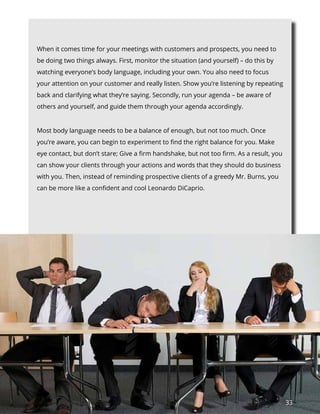
  • 35.
    35 Follow us onTwitter! @SpiroHQ @AdamHonig roof – turns out sales guys love Twitter! Once you have that natural dialogue going just move the conversation to email and, bam, you’re 10 steps closer to yes than you would be if you started out cold calling. Twitter is not just about generating leads, it’s useful throughout the sales cycle. Twitter can help you find prospects! There are more than 500 million accounts on Twitter and it’s your job to find the ones that are most relevant and high quality for you. Find the right accounts to follow by searching relevant hashtags and keywords. Check out a competitor’s Twitter account for ideas on who to follow. Once you’ve got it narrowed down, use a Twitter client like HootSuite to create lists. You can also use Twitter as an alternative to traditional communication channels. Can’t reach someone on the phone or email? Try Tweeting them. Another trick is to follow a company’s Twitter feed so you can gain insight into their culture, goals, and agenda. Following what is said about them can give you insight into what their pain points and strengths are according to their customers. It doesn’t always have to be about pursuing a prospect. There are influencers out there who can help you with professional or personal development and expand your network. Follow and engage with them.
  • 36.
  • 37.
    37 Salespeople face multipleobjections every day. Sucks, doesn’t it? Well stop crying about it and man up because it’s all a part of the job. I’m sure you have heard “Now’s just not a good time” from a client before. Well, this is the objection I encounter most and it’s usually a simple issue of prioritization. The company is interested in what you’re offering, but it’s just not at the top of their list. So what do you do? You find a way to make them understand how your product compliments their priorities. First, you have to know what their priorities ARE. If you’re doing your homework, you’ll come prepared with a way to rephrase your value proposition in a way that make them think, hey, I need that! Here’s a real world example: My team and I were trying to score a big deal with United Healthcare for our software service. Every year UHC figures out their strategic plans, main initiatives, and what they can budget into their capital spending (where products like mine would fit in). They thought our software was interesting, but not in their top-things-they-needed-to-get-done-that-year list. Boom. Wall. But we got over it. First, we had to hook them with the emotional appeal of how cool and exciting our product was, then we had to reel them in with the intellectual appeal of it being strategically relevant. We emphasized how our product could be good for the careers of the people in the IT department (direct appeal tactic) who would be working with our software. They were onboard, but their pitch to the higher ups failed. So we opted to attack head-on and show them that working with us was still very strategic. We suggested a collaborative brainstorm to see how we fit into their strategic framework. One of their biggest priorities was minimizing the number Tip 13 Responding to “Now’s Not a Good Time”
  • 38.
    38 of people whosigned up for their healthcare and then switched out. When we told them that our software was able to detect people beforehand who might be tempted to not re-subscribe in advance, they were sold. Our initial proposal was a tech sale that failed, but once we rejiggered our value proposition to align with their priorities, we were golden! Have you ever felt like you’re not getting the whole story? Or been turned down without a real good reason? Maybe you have heard the old, “We can’t say exactly why, but we’re not interested”. It’s important to read between the lines. You may discover that what’s killing your deal is just bullshit internal politics. Real life example: We were selling a deal with a division of Kraft foods and had great relationship with the CIO who was the main purchaser of the middleware software we were selling. He felt the need to have agreement among his teams before making a final decision so we presented our product to each leader individually. Everything seemed to be going well – they all seemed to love our product. Then, out of left field, the CIO told us the teams were not in agreement. Someone threw a wrench in the gears. We got a false positive because we had been talking to everyone individually, when people are more likely to skew positive. We obviously hadn’t convinced everyone so we pushed the CIO to get one group meeting together to voice their concerns. What came out on that group video conference was shocking – two members of the team were having an affair, broke up, and just weren’t on speaking terms. THAT was what was gumming up our deal. The point here is that salespeople need to make sure that their internal communication is on the same level as their communication with the company rep, otherwise you’ll end up with political situation you have no control over like the one above. Set up individual meetings before group meetings and make sure everyone is in alignment. It will be easier to make your case.
  • 39.
    39 I get alot of cold emails from people I don’t know. Most of them are the familiar boring, generic intros and requests – and most of them get ignored. So what gets me to respond? Someone who’s taken the time to make their email a little interesting. One day I got a cold email from a salesperson whom I didn’t know. I would have been hesitant to reply back, if it weren’t for his unique approach. He sent me an email about drones. If you don’t know, I’m REALLY into drones. I fly them all around Boston and made some cool videos of the city. He didn’t even ask about security or whatever he was selling. He just ended by saying, ‘by the way, I’m with a technology firm, we should talk.’ It ended up in a meeting. There’s an easy way to get the kind of responses that lead to better conversations: send relevant content. Muse blogger Lily Herman wrote that she got an 85 percent response rate by using this approach. In the following (fictional) email we’re following up with Sir Richard Branson on the purchase of a mega yacht. We did a little research and found out his favorite band is The Sex Pistols, another search showed that Sex Pistols member Steve Jones is coming back on the air with his radio show after 7 years of silence. Perfect! The “format” goes something like this: Tip 14 An Email Trick for Great Response Rates
  • 40.
    40 The reason behindthese great results, Herman says, is that people feel like you’re investing in them and want to return the favor. Sound familiar? That’s because we’ve talked about it before. It’s called the Reciprocity Principle. The reciprocity principle is crucial in social selling, because it hinges on the way humans think about their relationships with other people. In my point of view there are three sources of content that are relevant and accessible to salespeople that they need to take advantage of. 1. Your Company’s Blog The odds are that there is probably a prospect having a problem that’s somehow relevant to the blog that you guys just posted. If you’re selling software, for example, did your communications department just run a helpful how-to that would be of interest? The info is right there, wrapped up in a bow, for you to send to your prospect. 2. Other People’s Blogs I wouldn’t send along the blog of a direct competitor, but we’re all in the same field here, right? If I come along an interesting blog from thought leaders like Jim Keenan or Andy Paul, I’ll send it out! At the end of my email I’ll put a simple call to action. 3. News About Companies Like or Near Them Let’s say you have a prospect and just closed a deal with a hospital nearby, send them a quick note and let them know. Companies always want to know what’s going on with businesses like them, especially like them AND near them.
  • 41.
    41 At my oldcompany we had been trying to sell Staples for a while. They were the top dog in our territory and we were dying to do business with them. The day finally came when we had an opportunity to meet. It went really well and as we were headed out, high on the fact that we might have a shot in Hell, we ran into an old client named Mike. We had no idea that he had started working at Staples. This was brilliant – he was a big fan of ours and helpful for us in his last company. A chance run-in with Mike ended up being the thing that got us our first small project with Staples. If we hadn’t actually been physically present in that office building, we wouldn’t have gotten the leverage we needed to get our foot in the door. This, my friends, is why meeting face-to-face will never go out of style. One reason why in person meetings work so well, is it gives you a chance to pick up on body language clues. There is subconscious information exchanged between people when they meet in person that can reveal a whole story where a phone call could reveal just one chapter. Body language – the way a person places their arms, the way their eyes dart to the side, the way they lower or raise their chin – is VERY useful for reading between the lines. Perhaps one of the best advantages person-to-person meetings bring is the chance to bond. Take lunch meetings, for example, often as much time is spent discussing business as it is shooting the shit. Here’s a story of just how important a single lunch meeting was for one sales guy’s relationship with a prospect. Let’s look at an example of when a face-to-face meeting works. Sales guy Chris needed to put a bit more effort into his relationship with a prospect to prove he was truly interested in helping them. When he talked with his main contact at the company he offered to fly out to Las Vegas to buy her lunch – just give me one chance, he said. The prospect was taken aback by his offer. She relented and he flew out Tip 15Face-to-Face Can’t Be Replaced!
  • 42.
    42 to Vegas andtreated her to lunch. During the meal, she confessed that even though she had been working with his arch rival competitor for 10 years, not a single person there had offered to take her out to lunch. Chris wasn’t even sure what to say. To him, meeting people in person and doing kind things for them was just a part of the business. Eventually, the prospect made a small purchase from Chris’ company. He gave it his all, really impressed the client, and discussed how they could work together in the future. Do you think Chris would have gotten the same results if he hadn’t met his prospect in person? Probably not. At Spiro, we’ve been having a lot of meetings with sales VPs recently while working on another edition of our tool. When we asked about their issues and priorities, guess what they said? They said they want their teams to have more face to face meetings so they can expand their relationships inside those accounts. There you have it – plenty of other teams are realizing that person-to-person relationships can’t be replaced. Think of the limitations of a phone call, for example. When you’re on a call, you don’t know who else is on the call with them – should you be talking to that person? Are they more important? I think the odds of you getting passed to the right person after a face to face meeting are a lot higher. The secret with selling is to use every avenue to form a relationship with the right person in your prospect or client’s organization. Use the principles of psychological selling and a good balance of phone time and face time and you’ll be kicking ass and taking names in no time.
  • 43.
    43 When you relyon emails and voicemails to get in touch with prospects you may as well be that kid who used to talk to himself in the back of class. Just because you’re chattering away doesn’t mean anyone’s listening. What it boils down to is this - you can’t avoid the dreaded phone call in sales. It’s the only thing that’s effective when it comes to establishing a relationship with a prospect, and if you’re afraid of being annoying, well, you better get over it now or move the hell on. At my last company, the inside sales team made about a hundred dials a day and only reached maybe ten people. Let’s say you’re a sales guy and working on twenty opportunities and there are three people involved in each. If you called each one twice a day that’s 120 phone calls. For the average sales noob that sounds like a lot, but it’s not. How often you call a prospect depends on where they are in the sales funnel. Market research shows that the faster you speak to the new lead, the more likely you will close on them. I personally think you should call frequently on new leads – twice a day for a couple days. What’s the downside? The odds are that if you don’t get ahold of them in two days, there won’t be a lead to follow up on anyway. You really have nothing to lose – either they get pissed off at you for calling too much or you kiss that lead goodbye. Follow up after the first conversation very quickly. A third of the leads you have great conversations with are blowing smoke up your butt and you’ll never speak to again. For the rest of the bunch, I would follow up with a bit of relevant insight. NEVER say “I’m just Tip 16 Never Stop Calling!
  • 44.
    44 checking in.” That’sthe definition of lame and annoying. If you were smart you could even save some important info from the first conversation for the follow up call. The amount of following up you do also depends on your pipeline. Dealing with 100 opps is very different than three, but you should at least touch base with your contacts twice a week. I know it sounds daunting. Even I’m guilty of not following up enough. Whenever I was a sales manager they always had to encourage me to follow up more with prospects more frequently. The natural reaction for new sales guys is that they don’t want to risk bugging their prospects. I get it. And that’s why I don’t think you should leave voicemails or send cold emails. How is clogging up someone’s inbox making you any friends? What’s really annoying is just calling to check in. It’s superficial. At least talk about something relevant that you saw in the news, that you read about their company, even a baseball team they love. You can’t just call up and say, “you guys ready to buy yet?” Ease into it with some context. Recently I’ve been trying to connect with the head of sales for a fast growing tech company. I’ve been following this method: call 2 x week, email 1 x week. I give the guy progress updates on Spiro and also talk to him about his progress making HIS number for HIS company. It’s been slow going because he’s a busy guy and only last week I managed to have a full conversation with him. I was a concerned I was reaching out too much so I simply asked him if that was the case. He actually applauded my persistence because he was interested in what we were doing, just very busy. If you’re still afraid of bugging your clients with calls and would rather hide behind an email or voicemail I suggest you start looking for a career outside of sales. I know it sounds mean, but it’s just the cold truth. While Twitter or LinkedIn messages are great ways to open the door, they’re also still nowhere near as effective as a phone call. Be persistent and you’ll eventually reach someone you can charm with your high-value pitch. Next stop, deal city.
  • 45.
    45 “Get your buttto Iowa and don’t come back unless you have a deal.” When I said that, Garth, my sales guy on the John Deere account, knew I wasn’t screwing around. It was my first sales leadership job and my butt was on the line – this deal had the potential to be huge and take us to the next level. It wasn’t just my job on the line, it was all of ours, and I had to make it crystal clear to this guy: Do NOT screw this up. Do NOT come back until you have the deal tied up in a bow with a kiss from grandma. Do NOT take “no” for an answer. After finessing that deal in corn country for a week, guess what? We won the deal. Sometimes I wonder if the classic “don’t take no for an answer” sales mantra still works now. My conclusion is yes, no, and maybe. Let’s explore… I’m sure you have heard a client say some of these to you before: “No. Not interested. Maybe later. I’ll take a message. We don’t have the money. We’re not in the market. It’s not my decision“. These objections are all opportunities for the legendary sales guy to sharpen his or her skills. As a salesperson, there are many ways for you to get creative and use that brilliant brain of yours to convince the buyer that you provide needed value. Of course you’ll come correct by being armed with an arsenal of knowledge on the prospect: including their pain points, market share, goals, strengths, culture, and competitors. If you’ve done your homework you can use this knowledge as leverage and plowing through the front lines will be a cakewalk. If you continue to face a wall of “no”, it may come down to these brass tacks: One case where it’s smart to push past “No” is when you know something the buyer doesn’t. In the case that the buyer isn’t educated enough to make the right decision, it’s your job to take him or her to school. For example, if you’re in logistics sales and you know you can save the buyer 20 percent, it’s almost like you have an obligation to because it’s in their interest. If they’re still giving you push back, maybe you need to call somebody else in from their organization such as a supervisor or other department head who will better understand the value you can provide. Don’t stop until you feel you and your product have been seriously Tip 17Should You Keep Pushing Past “NO”?
  • 46.
    46 vetted. Another timewhen I don’t take no for an answer is when I just can’t afford not to get a yes. Sometimes, if your back’s against the wall because you have few prospects in your pipeline then keep fighting – just remember to maintain your integrity. On the other hand, there are times when you just need to walk away. The internet revolutionized a lot of things since the 90s, including sales. Buyers often prefer to self- educate and most likely have vetted their options on the market before you even get a word in. If you find yourself facing a wall of “no” in this situation, you probably won’t get too far. Perhaps you have better prospects in your pipeline then, by all means, cut the fat and go fry those bigger fish. As salespeople we have a tendency to be overachievers, but when trying to win ’em all means spreading yourself too thin and winning nothing, you’ve got a problem. Or maybe the deal is just taking too long. There’s a timing element – a rhythm – to a successful deal. One time we lost a sale after it had dragged on for over nine months to a company that swooped in last minute. If your pitch gets stale, at some point you have to give into no, if just to step back and do something different. In fact, I’m a firm believer that sales guys should walk away from more deals. So, should you keep pushing past “no”? Maybe. Have you racked your brain for every possible way to communicate value? Have you spoken to the right people who will understand and be receptive to the value you can provide? If you have, then, being a denizen of the modern world, I would err on the side of walking away and finding a better idea. At the same time, I’d send Garth back out to Iowa in a minute just to show them how an old school sales guy handles business.
  • 47.
    47 You know thefeeling. You have been working on this deal for what feels like ages but it is not going anywhere. The deal feels “stuck”. Is the deal dead? Should you stop wasting your time and move on to other prospects? I’m a fan of killing your low priority opportunities as a way to increase focus. Often the right answer is to buckle down and try to get it going again. If so, how do you actually go about getting this stuck deal unstuck? One idea is to stop calling your one contact at the account. Instead branch out and start seeking out other contacts in the organization. This may tick off your primary contact who you have been communicating with, but who cares. If they are not willing to push the deal forward then start seeking someone else who is willing to take action. Recently I was talking with a great salesperson who fell into the trap of relying on his primary contact at a deal with a large pharmaceutical company. He didn’t want to alienate him, but it turned out that he was talking with the completely wrong person and wasting his time. If the deal is stuck, try and determine what the prospect’s need for your product really is. Did you get ‘happy ears’ when listening to your prospect because you could envision exactly how your product would fix their needs? Then try to write and explain exactly why they need your product or service. What would happen if they bought the service? How would it improve their lives and their business? What would happen if they did not buy? Get crystal clear and use this to drive your message home. Of course you should always be asking your prospect ‘What else is going on?’ or ‘What other priorities are you facing right now?’ But when a deal is stuck it might just be that you have a Tip 18: Unstick Your Stuck Deal
  • 48.
    48 great solution andit just isn’t a priority for them right now. First, start by understanding what their priorities are. This will give you clarity on where your project stands in the prospect’s mind right now. Second, start figuring out how to raise your project in the prospect’s priority list. What can you do to make this a priority for them? I remember a deal we were working on with a multinational hotel chain. Our sponsors loved the product, but they couldn’t get funding until we worked with them closely to align the solution with one of their corporate initiatives. A deal that was stuck in limbo for months quickly pushed through the sales process. Sometimes all a deal needs to get going again is a bit of patience on your end. You are an eager and excitable sales guy. Maybe the deal is not really stuck, maybe you are just inpatient. Maybe you just need to give it some time for the company to feel comfortable buying from you and your company. Buying takes a lot of trust, so be patient and build the relationships and build trust. It may take time but eventually that deal will become unstuck. Get on a regular schedule of staying in touch with your prospect via phone or email. Send them an interesting blog or company update. Don’t always expect a response, but know that your outreach is keeping you on their radar. If the deal really is stuck, then you might need to kill it and move on to other opportunities. Before moving on, try the negative close. Tell your prospect something like “Well, this seems to be a low priority for you…” See if they disagree with you. Sometimes the negative close will jolt a deal back to life, other times it puts the nail in the coffin so you can move onward. Stuck deals can drain your energy so use these ideas as a plan of action on how to move them forward.
  • 49.
    49 Much like abusiness meeting, a sales call should always have an objective. Don’t be sucked into routine sales calls that lack purpose and leave the prospect asking, “What is the point of this?” You don’t need to have the exact minutiae of the call planned down to the syllable, but there should be clear aims you hope to accomplish. If you don’t have any purpose, your prospect is definitely not going to believe in what you are saying and you will be viewed as a sales robot. Have you ever been the buyer and sat through a sales call? In most cases, you probably weren’t very engaged in what they were saying, and you most likely didn’t pay a lot of attention. On the flip side, have you ever received an organized, purposeful call that convinced you they had a solution that could benefit your life? The difference is night and day. Your goals and plans should involve some kind of way to bring your customers in and engage them with your pitch and your product. An easy first step is to develop a clear purpose that you can succinctly state for your customers. Aristotle — a guy who was a lot better at sales than I am — said “Well begun is half done.” I don’t know if he intended that to rhyme (it sounds something like “Καλά ξεκίνησε γίνεται κατά το ήμισυ” in Greek, but I’m a little rusty, so I don’t actually know how the rhyme translates.) Aristotle’s point, however, stands. A strong base for a sale or a meeting, or anything else greatly improves your chances of being entirely successful. It paints out the target, so you know what you are shooting for. There is No Shame in Stating Your Goal! Tip 19
  • 50.
    “Well begun ishalf done.” - ARISTOTLE 50 Sure, people get lucky all the time – but a big part of business is actually making your success repeatable, and waiting for lightning to strike is one of the less impressive business models I’ve encountered in my lifetime. Stating your goals forces you to have a purpose. It asks why you’re doing the thing you’re doing, in the way that you’re doing it. It forces you to justify yourself and your methods. It helps you avoid common mistakes in sales calls. Additionally, it focuses the attention on your customers. It gives them a piece of context for your product and, more importantly, your sale. Finally, it makes you sound professional. Although increasing casualness is becoming more prevalent in business and sales, more people will react positively to a professional demeanor, and having a good goal that is clearly stated is an easy way of getting that across. Don’t just make your goal “I want to tell you all sorts of great things about new product X.” Your goals should be customer-focused. Remember earlier how we said that you should think from your prospect’s perspective? That applies to your goals, too. It’s simple to change the language of your goal a little to focus on the customer. For example, “I want to tell you about our new product” can easily become, “I’d like to explain how you can benefit from x, y and z.” Empathy, putting yourself in your customer’s position, is important here, and can really be the difference between a successful sales call, and one that was close but no cigar. Customer empathy is one of the keys to Apple’s success. Sales is about putting your best foot forward. This means confidence and charisma, certainly, but also necessitates a lot of preparation and background work. Strong, clearly-stated goals are the first step towards making your sales calls more productive and profitable.
  • 51.
    51 You just wrappedup a great meeting with your prospect and things are on the right track – then they throw you that ubiquitous curve ball and ask, what’s your take on your competitor? Think carefully! But, it’s really not something to fear. It’s an open invitation to paint yourself as the right solution. Think of yourself as a kind of advisor, a consigliere like Tom Hagen was for Don Corleone and the Family. Even though you have your own self interest at heart, you also know that your prospect’s best interest is in your best interest. Hagen was the voice of reason, as you must be. Do NOT bash your competition like an insecure juiced up frat boy or come across as defensive. Instead, be the calm resource that will help paint a picture of what the outcomes might be should your prospect choose you or them. You’re serious about becoming a legendary sales guy and making mondo amounts of money, so you of course know your competition like the back of your hand. There are two kinds of competition from your point of view: worthy and unworthy. Here’s how you might handle a conversation about each kind. Years ago, my team and I were going head to head against one other company, a software vendor, for a contract with a prospect. We knew our competition wasn’t the right fit. “Frankly, we’re puzzled about what they’re offering,” we told the prospect. “They’re asking a question that hasn’t even been asked.” Ever hear of “if it ain’t broke, don’t fix it,” or the principle of elegance in systems? The simplest solution is often the best. We offered the simplest solution. Our competitors offered software that would have required a complete reconfiguration of our prospect’s CRM system – a cost of time and money that just didn’t seem necessary. We explained our thinking in an analytical way and guided the prospect to a favorable conclusion – us. We were able to do this because we thoroughly understood our prospect’s needs and our competition’s limits. Tip 20 It’s Safe to Talk About the Competition
  • 52.
    52 Here’s an experiencethat shows how to give your opinion on a worthy adversary while simultaneously framing yourself in a flattering light. We were competing for a contract against Deloitte, one of largest companies in the world, a distinguished juggernaut with almost 100 years experience behind them. This was going to be a tall order. We couldn’t badmouth them and there was really nothing to critique. What could we do? We had to damn them with great praise. There are virtues of being an underdog, like we were in this situation. A smaller company like ours was more lithe, efficient, able to think outside the box. Being such as large organization, Deloitte could not move as quickly. In this case, we knew that our prospect was on a tight timeline, so we leveraged time as our strength while managing to avoid bashing Deloitte and coming across as a bunch of assholes. I know it’s awkward to talk about the competition – there seem to be so many opportunities to put your foot in your mouth. But you do yourself a disservice by saying nothing. To make sales successful, you need to be seen as a resource, a partner. If you throw your hands up or pass it off to someone else in your organization, it degrades your value. The way to sell the biggest best deal is by understanding the prospect and fitting your product into their strategic goals. If you just can’t bring yourself to say anything on the spot, offer to check into the competition and come back with a good answer. Worst case scenario is that your prospect goes with the competition. Oh well, that happens! Often a buyer changes their mind about what they need and might engage multiple vendors in different sectors by the time they make a decision. There will often be other opportunities down the line. The bottom line is that you shouldn’t shy away from the competition convo, you should expect it. Frame your competition in a way that your solution aligns with their goals and your competitor’s falls outside of it.

  • 53.
  • 54.
    5454 Sales professionals shouldnever say never. I’ll repeat that: Never say never. I got called out for saying “never leave voicemails” by a reader who’s had a lot of positive results from voicemails. I’m happy for him, but I still don’t like them. As a concession, I’ll say that nothing fails or succeeds 100 percent of the time and sales guys should ALWAYS be trying something new. The point he brings up is that salespeople should always be trying new (and old) things and if anyone says “never do x,” don’t listen to them. Point taken and I whole-heartedly agree. Salespeople have generally stopped doing direct mail, for example. When was the last time you tried to reach a prospect by mail? If you were born after 1983, probably never. But, guess what, it’s so old, it’s new again. Prospects and customers don’t expect it when they receive written correspondence or a nice old gift in the mail by Pony Express, it’s a novelty. Here’s an example of old school done right: My friends at Play Bigger, a West Coast tech startup consultancy, wanted to have a marketing campaign that would take people by surprise, but the digital space was already so saturated. What would get people’s attention? Play Bigger created a compelling direct mail piece with insane targeting and tailored to a T. It was original, unexpected, and sincere. Needless to say, they got a fantastic response. Direct mail can still be effective if done right. Make sure you’re using it under the right circumstance and be creative! There’s plenty of inspiration out there on the web, including ideas like balloon in a box, trendy stickers, and working record players made out of cardboard. Tip 21: Never Say “Never”
  • 55.
    55 I’m a bigfan of thank you gestures as a way to recap your value proposition and make a lasting impression on your prospect. It shows class and an appreciation for values that are rare these days. I’ve sent gift baskets to clients a number of times, as well as other small unexpected treats, such artisan scones I bought from our prospect’s favorite bakery in Dublin. A simple hand-written thank you note can also have a big impact. Texting is still new territory for most sales guys, but for the upcoming generation, it’s the communication mode of choice. We took a poll a while back on our blog and found that 20 percent of respondents said “Yes” they text, and 37 percent said they text “very occasionally.” Many are concerned that texting comes across as overly-casual and will be viewed negatively by prospects. It still might be risky, but there are ways that it can be a good tool to communicate things between the lines: it could be used to escalate the sense of urgency or confront a prospect who’s been giving you the cold shoulder; or even when you’re running late (or early) for a meeting. When it comes to sales, I have my personal preferences and things that have been proven to work and not work in my experience – but a sales guy should never say never. Always be experimenting, shake it up, and find the new (or old) angle that will give you the edge. Tip 21: Never Say “Never”
  • 56.
    56 We’d been workingan account for a while and gotten in really tight with Sunil, the head of IT and the technical buyer. He was our man on the inside and, in the long run, the reason why we didn’t get the big deal we were after. He was a rock solid connection for us, but he was only one out of multiple people who we needed to convince to get the sale. Problem was, he wouldn’t let us talk to them. Whatever his reasons were for being so… possessive …of us, I guess I understand because, after all, he’s ultimately the one who’ll be judged on the success or failure of our product with his company. Sunil had no power over the budget, the head of marketing did. So, because he wouldn’t let us talk with them, we eventually lost the sale after what seemed like several years of trying. We just weren’t in touch with the many buyers involved in the process. There’s never just ONE buyer you need to convince at a large company – the most apt comparison would probably be more like Medusa than Larry from Marketing. Your job as a legendary sales guy is that you’re telling them all what they need to hear. Think of the sales cycle: A company will first recognize a need, then go about determining how to solve that need. Ideally, you would want to get the company to recognize the need before the competition beats you to it. Our mistake was to wait for Sunil to recognize the need, then spend uber time with him to get the money for it. We put all our eggs in one basket and suffered for it. So, how can you avoid making the same mistake we did? Salespeople are often way more confident that things will happen then they should be. In reality it’s an 80 percent chance. Sunil seemed like it was a sure bet, but it never happened. In hindsight, we were too cautious in our approach with Sunil. We should have pushed The Appropriate Way to Talk to Multiple Buyers Tip 22
  • 57.
    57 harder to speakto the marketing people. If he didn’t like it, we probably should have done it anyway. Of course you should always proceed with caution and realize that you may risk burning bridges. You don’t want to cut off your nose to spite your face, but there’s a way you can avoid a mess: blame it on someone else. Yes, have someone else within your company make it happen. A great candidate is… your sales manager! A helpful sales manager would be the one to make the call to the head of marketing to take the heat off of you. Just apologize after with a sincere, “Hey, I’m sorry my boss did that. He went over my head, what a jerk.” Then slyly wink to your sales manager. Another tactic is to just convince your contact that you can do it. If your relationship with your contact is strong enough and you present your agenda upfront, you may be able to convince him or her that you won’t screw things up with the marketing folks (or whomever it is you need to speak to). And remember, you aren’t here to make friends - this is sales afterall. If you don’t like having to ruffle a few feathers once in awhile to get things done, maybe you need to find a new career. You’re never going to make a deal if you’re only speaking to one person so push if you have to!
  • 58.
    58 Nobody wants towaste time, energy and effort, only to reach a standoff on price at the end. So by setting expectations early on, before the proposal, you eliminate price from being an obstacle that will halt a sale. This is accomplished by asking your client about their budget up front and setting expectations about the price range they are looking at. By doing so, you are showing clients that you are not shying away from the price discussion because you believe in the value of your product, and also makes a statement that counter offers outside of the discussed range are unreasonable. While this pre-work works in your favor, what if despite all your efforts, you still find yourself in a price negotiation? Obviously you need to follow your company’s rules and guidelines, but how do you approach the situation? First off, remember that they need to negotiate. Don’t take it personally if a client tries to negotiate anyway; it is oftentimes just part of their job. Most companies require that Tip 23: Razor Sharp Price Negotiation Skills
  • 59.
    59 buyers have theconversation about a lower price, even if they’re not going to force the issue. Imagine their boss saying to them “did you ask for a lower price?” They have goals to meet too. Rarely is price the determining issue, and if it is, you’ve got trouble! On the other hand, a product having a higher price is often a sign that it is worth more. Use that to your advantage. Another thing that works to your advantage is the power of silence. When you know what you want, and you have shown the client, don’t push it. Silence can be used as a strategy where you let the deal come to you. This of course has to be used at the right time, and when it is, a customer will often feel the need to fill that silence, giving you the upper hand. If you do give a price concession, you must get something back. This may be an introduction to another prospect, a testimonial, a LinkedIn recommendation, etc. Don’t be surprised if your prospect says it’s conditional on the product being as good as you said it is. Fair enough! One word of caution on price concession, is that discounting may be hurting you. It might be obvious, but any discounting you do basically comes right out of your company’s profit. The average company in the S&P 500 is making $0.15 on the dollar of sales. Think about that when your prospect asks for a 10% discount! These additional profits are most likely going to be reinvested in making your company stronger, which enables you to have more support selling and thus make more money. After all the negotiating, be ready to hold your ground! You need to be prepared to walk. And by prepared, I mean mentally. Otherwise you’ll never have the balls to hold your ground. Before you enter the negotiation, you need to know what you are willing to do and where you draw the line. Many times, this will bring the client to your side when they see you are serious about your position. With these tips in mind, you can become a more effective negotiator. A huge aspect of negotiations and the outcome of them depends on the mindset you have when entering in. By first taking steps to prevent negotiations in the first place, and being prepared with these guiding tips when they do happen, you can steer more deals in your favor.
  • 60.
    60 Our goal, assalespeople, is getting the deal done. So, when that doesn’t happen, we often find ourselves at a loss. Truth be told, I tend to invest my heart and soul into too many of my opportunities. As a result of this, I take losing deals personally. One particularly heart-aching moment is easy to recall. We were pitching a really big deal at a Fortune 500 company in the Baltimore area that seemed to be going really well. We had great alignment on product fit, and even though it was a large amount of money for us, the budget was very acceptable to the prospect. What we didn’t really do a great job on was the timing needs required by this prospect. Sure, our solution was potentially going to save them a lot of money, but it had to fit into their corporate schedule of initiatives. That aspect of the deal made the process go slower than we would have liked. Yet, even though the deal dragged out, we got buying sign after buying sign. I was enthusiastic! However, at the same time – and unbeknownst to us – our big competitor (who was more than 1,000 times bigger than us) was working on a similar deal at a different division of this company. Once the timing became appropriate for the prospect to move forward, they combined the two initiatives and we were crushed by the long-standing relationship that the prospect had with our competitor. It’s true, who you know often trumps what you know (or in this case, the deal in which you’ve passionately invested your time). Even though we were very disappointed (and that’s definitely an understatement), we worked hard to maintain a great professional relationship with the buyers. When the deal falls flat, you can’t just walk away. Another chance might be around the bend. There are a few ways you can keep a positive relationship going. Tip 24: So, You Lost a Deal... Let’s Remain Professional
  • 61.
    61 First off, wedidn’t bad-mouth the competition. In fact, we told them that the company they chose over us was a good company, because it was true. Their solution wasn’t better than ours, but it was certainly workable. This built credibility in their eyes. Next, we educated them on key challenges that they would be facing with any supplier, including us, during the process. We didn’t want them going into this deal blind, even if they weren’t working with us. And finally, we continued to include them in our prospecting and marketing efforts to remind them that we were an alternative solution. Basically, we didn’t let them go and we didn’t let them forget our existence and previous hard work on their behalf. They were left with the impression that we had high integrity and were a professional firm. If nothing else, they could at least speak positively about us as well! Wouldn’t you know it, over the next year, we received three referrals that turned into opportunities that this firm passed along to us. They thought highly enough about our efforts that they continued to advocate for us. And about two years after that, after a change in their strategy, we were invited back to pitch for a new opportunity at this firm. After having spent six months selling to them before, and the time after that staying in touch, we were the obvious solution. We won a very significant deal! Sure it hurts, in a lot of ways, when a deal falls through. However, that’s not a good reason to pack in the bag with the potential firm. In fact, as we learned here, a continued pursuit and reminder of our existence was what it took to eventually land a very nice deal with them. Ultimately, the advice I want to leave you with, is that perseverance will always pay off. Even if we hadn’t gained the deal with them in the end, we did garner three additional opportunities through that tenacity. Keep your name in their view, keep your integrity and eventually, if you’re good at what you do, you’ll get the deal done!
  • 62.
    62 You know howthey say a lot of great inventions were created by accident? Like the discovery of Penicillin and the awesomeness we now know as potato chips? Seriously – if you don’t believe me, look it up. That aside, I discovered one of my favorite sales techniques in pretty much the same way. My first sales job was selling technical education classes. Not the most thrilling work, but it was my entry into sales. We’ve all gotta start somewhere. I would go through a list of prospects, call them up and see if they were interested in learning more about developing “open source solutions.” My pitch was focused on speeding product development for their company, thereby increasing career value for the attendee. Like many young salespeople, I was often very chipper about the benefits of these classes. I was supposed to make them sound desirable, right? One time, I got a fairly cranky developer on the phone. He wasn’t very excited about our offerings even though I knew (of course) that he would get immense benefits from them. He had literally zero interest. At that point, something slipped out of my mouth before I could stop it. “You know what? I don’t think you’re right for our class.” I couldn’t believe what I just said, but it got his attention! Amazingly, the topic of conversation switched focus on to why he might actually be right for the class. And thus the discovery that sometimes the negative will make the close. Read on to find out how I do it. There are a lot of sales gurus out there who are all about enthusiastic deliveries and getting prospects to positively reinforce your message. I totally agree with this thought, but when used properly, the negative close can be equally as effective. Just to be clear, I’m using the term ‘negative close’ as the sales technique where a salesperson basically challenges the prospect to reject an offering. Examples include questions like “this project will never get funded, right?” or “it’s unlikely you can get approval for this, right?” The idea is to get your prospect to disagree with you. But even if they don’t, there is great benefit to this approach. Tip 25Give ‘em the Negative Close
  • 63.
    63 Part of thechallenge in sales is getting your customers to be honest with you about their reservations with your product, or their timing and budget for a purchase. It’s not like they are always trying to hide something from you. Often they themselves don’t even know the answer. Giving a prospect an easy way to say “no” can help you qualify a deal quicker and move onto other more lucrative opportunities. You’ll find out what your potential client is really looking for and if he/she has the budget to back his/her desires. It’s a time saver for all involved. If you say something like, “You guys are never going to invest in XYZ,” and they say, “Oh, yes we will…” I believe that is twice as reinforcing because they’re putting more mental energy into it. You are asking them to seriously consider your product and their need for it. Let’s face it, reverse psychology totally works in sales. We can tell people they don’t want or need what we have and then they’ll talk themselves into the reasons they do! People are better at selling themselves on something than any salesperson ever could be. Be cautious though. You do need to keep in mind a few things when trying to employ the negative close as a means of selling. Your tone needs to be right. You can’t say sarcastic and harsh things like, “You guys are too dumb to understand our product,” and hope that the customer says, “No, we’re really smart and we get it!” No one likes condescension. Don’t sound like a sales guy and say, “Your company isn’t looking to increase revenue, right?” In truth, those statements are just ridiculous and they’ll only irritate your prospects. And don’t overuse it! All good things are best utilized in moderation.
  • 64.
    64 As us salesguys know, being rejected by prospect after prospect can test our perseverance. Then comes the hit; the potential customer that is interested and agrees to a meeting. Once the meeting is landed, then comes the opportunity, and a deal with that prospect all depends on one meeting. For one sales guy – let’s call him Roger – his opportunity didn’t go so well. He was getting ready to present in the prospect’s conference room, and waiting for the prospect to come in, so thought he would check his fantasy football lineup. You know how it goes: you forgot about that Thursday night game, and you need to make a critical substitution. Unfortunately, my friend Roger forgot he was projecting his laptop screen on the wall, so when the CEO of his prospect walked into the room, the first thing he saw was Roger’s line-up. The CEO took one look and promptly left the room, never to return. Roger stopped what he was doing and the rest of the team assembled, but he was disappointed and the demo wasn’t his best. Needless to say, he didn’t win that meeting. The sad truth is that salespeople only come across so many well qualified prospects. You really can’t afford to blow a deal because you weren’t on your game. Before you walk into a meeting and tell a prospect why they should choose you, you need to do your research. The focus should not be on showing how awesome your product or service is in general, but showing why it is a beneficial choice for them. You Tip 26: Avoiding a Bad Sales Meeting
  • 65.
    65 have to putyourself in the customer’s shoes, understand the obstacles they are facing and identify how your solution can help them. Once you have a plan, share the agenda with your sales team so that everyone is on the same page. Next, you need to confirm that the meeting you set is fully understood and accepted by your prospect. You don’t want to become one of the sales horror stories where you drive 3 hours only to be told the prospect wasn’t interested in talking with you. Prevent this by doing your research and confirming the time, date and agenda of the meeting beforehand. Then, 1-2 hours before the meeting, you need to get in the right mindset. To do so you need to be focused, confident and energetic. Music can be very helpful as it can help ease your nerves, increase your creativity and motivate you. In fact, studies have shown that retail stores increase their sales when they play upbeat music. Find a few songs that motivate you and listen to them before the meeting. Once the meeting is underway, you need to stay focused. You may have 10 other things to do after your meeting, but you can’t do them during the meeting, so they don’t matter. Focus on the present and give your full attention to the deal at hand. Review the research you have done, review the pitch you are going to present and give it your all. Putting your cell phone on mute and not checking it is key. And, what if something does go wrong, you ask? For a few years, Roger invited the CEO to join his fantasy football league. The CEO never joined, but it helped Roger turn the situation into a positive in his mind. Roger worked hard to get back in with this prospect and eventually he did. On a smaller scale, even if you run into hurdles in the meeting, don’t give up. Face objections head on and keep the conversation focused on finding a solution. These tips can help you to make each of your meetings count. No opportunity should be taken lightly, do your research, confirm the meeting, use music to get in the right mindset, focus and be ready to think on your toes. By doing so, you can avoid becoming a Roger. You can always check your fantasy football after you’ve closed the deal anyways!
  • 66.
    66 My former bosswas an MIT professor at one time and always reminded us of it – he even insisted that we had lunch at the MIT faculty club. Even though I thought he was a bit ridiculous, it taught me an important lesson about the influence of authority. While my boss was doubling down on his image as some sort of Professor X of technology and we were snickering at the water cooler, he knew exactly the kind of mind trick he was playing on us. He was simply appealing to one of the most primitive psychological triggers used by everyone from the police to parents. I like to call it the “because I said so” principle. Obedience to authority is deeply ingrained in us since birth. It starts with your mom and dad and expands to the rest of polite society – your teacher, your soccer coach, the security guard who caught you and your friends trespassing when you were trying to imitate Steve-O… Yeah, we’ve all been there, and you probably learned that going against authority has some sort of uncomfortable consequence. That’s exactly the point. The authority principle is so powerful that it can cause people to do things that would normally conflict with their most deeply held values. If you’ve taken a basic psychology class in college, you’d remember the ultra-creepy Stanley Milgram experiment that showed how regular people would hurt others if told to by an authority figure under certain conditions. In sales we use authority all the time to build confidence in our Tip 27: The Authority Principal Works
  • 67.
    67 prospects. Whether it’sby having a swank office, a professional answering service, impressive credentials, or years of experience and big-name endorsements. Social selling master of the universe Dr. Robert Cialdini outlines the authority principle in his book Influence. A sharp suit, a badge, a nice car, an entourage, graduate degrees – most of us accept these as tokens of authority. People subconsciously respond to these signals with trust or respect when faced with a less-authoritative alternative. For example, the average person is more likely to give money to a person on the street wearing a uniform than he or she is to a person dressed in sweatpants. It’s just human nature. What this really means is that looking and acting like a boss will make people think that you’re a boss. Pretty basic, huh? But Hell hath no fury like someone who’s been tricked into thinking you know what you’re doing when you don’t, that’s why it’s important to walk the walk AND talk the talk. You need to be able to back up your confidence with capability. Credible, knowledgeable experts exert the most influence as authority figures because they can back it up. While Dapper Dan is out there racking up leads, his wiser and more capable partner is closing deals because he’s gone past exhibiting superficial signals of authority and cultivated a relationship of trust by being the real deal. Cialdini illustrates this in an experiment with a real estate agency that changed the way they referred prospects to agents. They were able to increase the number of property appraisals and contracts they wrote by starting off with their agency’s credentials, such as “Joe has 25 years experience in the micro-log cabin market, let me transfer you to him.” This “expert” intro led to a 20 percent rise in appointments and 15 percent increase in signed contracts. This small change was ethical and costless to implement. Now that you know the power of this simple psychological tool you’ll notice it in use all around you. Try incorporating it into your sales approach but, remember, no one likes a liar. Only go so far as you can back it up or rely on someone who can. If you get someone to listen to you and then drop the ball, you’ll lose trust and never get it back.
  • 68.
    68 So many ofus confuse the journey with the destination when making sales presentations. Think of increasing customer interest (and ultimately landing a sale) as your destination and the sales presentation the car you drive on the way there. Of course you want to start by driving a nice car – preferably a late model Acura NSX convertible – then you’ll figure out when to speed up, when to stop for gas, when to pull over and do some sightseeing, and when to park it in the driveway. Have you ever been in the middle (or, sadly, at the start or end) of a sales presentation and felt like you’ve stalled and are just churning out noxious fumes that are killing your audience’s attention span? There’s no reason it should be that way. Like I said, presentations are a means to an end, not a destination. If you want to keep your prospect’s attention, begin with having a well-defined goal. Always know what the next step is for your customer. If you’re pleasantly surprised by achieving it earlier on than predicted, stop the presentation. Wrap up early – everyone will appreciate it. And if things aren’t going well, don’t be afraid to veer from the script and always be ready to take it to the next level. It’s your canvas, use all the colors in your palette and show some personality. Right at the beginning of the presentation, ask your audience why they’re there and what they want to learn at the get-go. This reinforces goals for the audience and keeps them engaged. It also helps clients connect the dots between their organization and your product or expertise. And then continue to ask a lot of questions during your presentation. It will help people pay more attention and engage as well as enforce the critical “why should I care” factor. A good trick is getting everyone’s name on a sign-in sheet and calling on Tip 28: Crafting a Stellar Sales Presentation
  • 69.
    69 random people byname – it sounds ruthless, but it’s effective. Once you call one out, you’ll have the attention of all. No one wants to be caught looking clueless — remember grade school guys? Studies have proven over and over again that many business deals are made on emotion – do I like this guy or girl? Do I feel like I can trust him or her? Don’t be afraid to share some personal anecdotes about yourself and your experiences with the room. It will make a huge difference because, honestly, who wants to buy from a machine? As long as you’re equipped with your hard facts and figures don’t be afraid to open up a bit. People will remember you. You have two jobs when making the presentation: obviously hitting your talking points, but also being sure to watch how people are reacting. Use their reactions and body language to guide the presentation. Take control of the moment — don’t just rush through what you’ve prepared. As we noted, stop when you hit your goal. If you see that you’ve hit that sweet spot don’t hesitate to stop your presentation. You’ve been taking questions and a passionate organic conversation has just broken out in the audience? Harness it and take control. Let the slide burn into the screen; pull up a chair and bring everyone back around to why your product is the right one for them. Keep these points in mind and you should be hitting high notes in no time. Just remember, you’re not there to give a presentation, you’re there to sell, sell, sell. Put your back into it and soon you’ll be driving that NSX.
  • 70.
    70 One of myall time favorite movie scenes is when Obi Wan Kenobi pulls out the old Jedi mind trick to stop some poor Stormtroopers from finding R2D2 and C3P0. (If you haven’t seen this, stop what you’re doing right now google it.) With a wave of his hand, Obi Wan tells them exactly what he wants them to say and they mindlessly repeat it back to him and let him through the checkpoint. Obi Wan’s Jedi mind trick has always inspired me in my sales process. Over the years, I’ve worked hard at cultivating this skill and here is what I’ve learned. The key trick to being a Sales Jedi and persuading people to your side (hopefully not the dark side) – is getting them to articulate why they want to do what you’re suggesting. Repetition, by itself, is of course a useful technique. Think about how you learned your multiplication tables when you were in elementary school. How was repetition useful there? You didn’t necessarily understand what you were doing, but you memorized those suckers until you knew them like the back of your hand. Apply that same principle to sales. When a customer says back to you the value of your product, it’s self reinforcing and over time becomes their opinion. There lies the problem – how do you get them to state the value of your product? I often try to start this process by asking throughout a sales call, “What do you see of value here?” and then see what they say. However, NEVER ask what they didn’t like for the same reason. Through this technique, you can get them to state the value of Tip 29: The Jedi Mind Trick
  • 71.
    71 various aspects ofyour product or service. When you later repeat those back to a client or prospect, they are more influential because they came from their mouth. Another sales technique to try comes from Daniel Pink, a Harvard professor and well published author. Daniel taught me that prompting others to speak about their own reasons for doing something is far more effective than pushing the reasons you think they should be doing something onto them. He further believes that when it is someone’s own ideas, they are far more likely to behave based on those reasons. So, how can you be a Sales Jedi and get your customers and prospects to say what you want? Daniel suggests a two step question approach to prompt another person to speak about their reasons. For example, let’s say you’re trying to convince a hospital to upgrade their existing MRI equipment, but they seem resistant. Don’t ask them directly if they’re going to update — that might get a negative response that would reinforce their position. Instead ask them to rate their readiness to upgrade on a scale of 1 to 10 (with 1 being not ready and 10 being fully ready). Unless they rated their readiness to upgrade a 1 out of 10, then ask them “why didn’t you pick a lower number?” Suddenly a funny thing happens. The question leads a person into explaining their own reasons for being ready to take an action, even if they are not fully ready. That creates a great starting point for seeing your side of the picture. Daniel explains how persuasion is often thought of as convincing someone else to do or say what another wants, but argues that persuasion is prompting someone to see why they might want what you want. This is a powerful tool in sales, and can be used to help close more deals. No question that perfecting this way of speaking to customers will take time. Years, maybe. With practice though, it is possible to be just like Obi Wan.
  • 72.
  • 73.
    73 Sometimes I wishI was more like Stone Cold Steve Austin. Not that I wish I could throw down (I can), I just wish I could be more detached. Salespeople operate with an indelible sense of optimism – we have to or else we’d be shattered after every rejection and disappointment that comes our way. We get attached to promising prospects, and it’s that commitment to blindly getting the “yes” on a deal that led me to the biggest screw up of my sales career. We were working on a big deal with a Fortune 500 company in the Philly area, pitching a consulting service. I had a strong sense that our culture and our solution were a perfect match for them, and as an added bonus I actually REALLY LIKED the people at the company. We were on the same wavelength – how could they NOT go with us?? Alas, it didn’t work out. And here’s where our tale of woe begins. While my team and this company were like peas in a pod, there was another division of the same company that became interested in our product (sounds like a bizarre love triangle, doesn’t it?). In some sort of serotonin-induced high we recommended that both divisions work together to solve their problems the same way. It would be good for both of us, we thought; a win-win situation. What we didn’t realize was that the other division was working with the largest consulting company in the world and already had a great relationship with them. Long story short, we had a hard time connecting with the other team because they already had a strong relationship with the other consulting company. We How to Stay Analytically Driven Tip 30
  • 74.
    74 went from areally strong shot at a good-sized deal with our buddies, to a who-knows shot at a really big deal with both teams. We probably could have just taken the smaller deal off the table and went from there, but because we were so blinded by our (or my) feelings, we got ourselves in a situation that just couldn’t be resolved. We thought our team would be able to convince the other team to choose us. That didn’t happen and we wound up losing a really big deal we’d been working on for a year, in addition to the smaller deal we’d given up to chase the big deal. In short, my biggest sales mistake was that I was more emotionally driven than analytically driven. I should have taken a step back to get more perspective. Maybe I could have gotten some beans out of the whole enchilada before I squashed it. One way to not let your emotions get the best of you, is to talk with your manager for their perspective. You have to meet with your sales manager anyway, right? Use them for all that they’re worth! They can smack some sense into you if you’re getting too carried away by your attachments. You might have a favorite prospect, but are you losing sight of the bigger picture? If talking isn’t your strong suit, then sit down and crunch the numbers. Look at these three numbers: average deal size, win rate, and opportunities created per week. If the math doesn’t add up, you’d better take another look at your special “feelings” and ask if they’re worth losing Benjamins. Always monitor yourself for these issues, especially as the stakes get bigger and bigger. It’s only human nature to get attached to clients that you vibe with, but don’t let your emotions cloud your better judgement on the way to becoming a legendary sales guy.
  • 75.
    75 The first meetingwith a client is always a lot of pressure. First impressions are pretty important after all. So how do you make that good first impression? Remember that when you go into this meeting you aren’t trying to manipulate the person into liking you. You’re not P. Diddy in Get Him To The Greek. Instead you want to charm the person with genuine charisma so that they like you and want to work with you. Forget the manipulative sales tactics you may have been taught and in this first meeting just focus on being a genuine human being and building rapport. Maybe even try a little humor. It’s best practice to do your homework. Don’t show up to your meeting clueless. Do some research on your prospect before you ever show up. When you are prepared and have knowledge about the prospect and their situation it signals that you are a professional and increases their trust in you. When you walk into the room, don’t just dive in head first. Instead take a step back and assess the situation. Does their body language tell you anything? Is their attire a signal of anything? What kind of mood do they seem in? Assess the situation and adapt your approach accordingly. In building rapport, the small act of a smile can go a long way. Don’t walk in and run through the meeting with a serious or grouchy face. Instead smile and be confident. This subconsciously shows to the prospect that you are not a threat and that you enjoy your time with them. But be cautious because a forced or fake smile can be even worse than not smiling at all. Don’t smile just to smile. Smile because you are genuinely happy and excited to be talking with this prospect. Tip 31: Get Your Charm On
  • 76.
    76 After you doyour homework, assess the situation, and smile, it’s time to start talking. But no one likes to hear you ramble so instead of just diving straight into your pitch, open it up with a question. Keep it light and personal if you want. Talk about the weather, travel, kids or anything that is easy to relate on. This simple short non-business related conversation keeps things casual and builds trust before you dive into the serious sales talk. One of the biggest mistakes you can make is forgetting the name of your prospect. Often this can be a challenge especially if there are multiple people in the room. Try a simple trick of getting everyone’s name and then repeating it back to them the second you hear it. Then try to work it into conversation when you address them. This helps you remember their name and it also builds rapport. People love when they hear their own name. Don’t overuse it but slip their name into conversation when it fits. Listen to the prospects needs and emphasize with them. Make them feel as if they have been understood and repeat back their pain points to them from time to time. When you repeat back what they are telling you, it ensures them that you have been listening and understand their needs. Most of all, just be yourself. If you’re into flying drones, bring it up! Whatever your passions are both for work and fun, bring them out. Don’t try to lie, manipulate or trick them into buying from you. In this first meeting you just want to build rapport and get them to like you.
  • 77.
    77 Times are changing,and the way we communicate is too. Many methods that used to be off limits, or nonexistent, are now becoming more common. If you want to truly be a legendary salesperson you have to be on the leading edge of these changing trends. One such trend is calling your prospect’s mobile phone number. Back in the day, calling a mobile number could be seen as intrusive. In the age of texts, LinkedIn, Snapchat and Instagram, people are more connected than ever, and are expected to have their cell phone on them at all times. While calling after business hours when the prospect is just sitting down to dinner isn’t a bright idea, what about during normal business hours? Well, I’m not the only person considering this issue. Recently sales guy and blogger Don Lee wrote a post basically saying “no – don’t call your prospects on their mobile phones”. Don’s post makes three points on why he cautions against it. 1) It’s obtrusive – He makes the point that if the prospect hasn’t answered your email or returned your call on the business phone, it is likely because he or she is not interested. Making a call to the mobile device is crossing the line in his opinion. 2) Business phone = business. Basically, it is out of respect that you call the business number to discuss business and only call a mobile once you have gained permission. 3) You’re not going to get a great response. Don makes the assumption that calling a mobile makes you look desperate and that prospects won’t be happy to hear from you. Tip 32 Calling A Client On Their Cell is Not Taboo
  • 78.
    78 I gotta say,I beg to differ! If sales guys aren’t using all their resources, they are letting opportunities slip through the cracks. Here is why I say that Don’s claims are off the mark, and why you’re crazy to not at least try reaching prospects via their mobile number. First off, you need to make a connection! The odds of your prospect calling you back from your voicemail is some number very close to zero. Perhaps it’s somewhat intrusive, but it’s like 1000x more effective than emailing over and over. The definition of insanity is doing the same thing over and over and expecting a different result, you know. Try something different and call the mobile. There is a much higher risk in never talking to your prospect at all, versus pissing them off. Secondly, I disagree that a business phone only equals business. No way – It is not the year 2000 here. Everyone uses their mobile phone for work, too. So you’re telling me your prospect doesn’t call their contacts when they’re driving in their car between meetings? Of course they do. Thirdly, it is really not obtrusive. Everyone has caller ID; everyone screens their calls. If you’re worried about catching someone “heading to the emergency room because his daughter is hurt” why would they answer their phone under their circumstances? C’mon! Finally, how do you even know what response you’ll get until you try? Frankly, mobile phones are so common that some companies we know don’t even have desk phones for their employees. Unless you’re some super-secret hacker who illegally obtained the mobile phone number, how do you have it anyhow? In Don’s example, the receptionist gave it to him… but he doesn’t want to call? Call, and if the prospect is pissed, blame it on the receptionist! Did your prospect put their mobile number on their business card? Call! For me, the real concern here is: can you quickly be charming and engaging on the phone when you get the prospect on the line? If you can, it won’t matter which line you reach them on. Legendary salespeople don’t shy away from contact – they jump in with both feet forward. If you haven’t already, try dialing those mobile phone numbers and see what happens.
  • 79.
    79 The general consensusis that salespeople should never ever leave a voicemail for a prospect. It’s a terrible idea. Everyone hates voicemails, and they really want you to stop leaving them. Except sometimes. Yes, there are instances – not many – when leaving a voicemail is okay. We’ll explain that in the next paragraph, but first, a reminder of why they’re a bad idea in general. 1) They’re the hallmark of the lazy salesperson. Voicemails are used by those looking for the easy way out. 2) They show a lack of initiative. As a salesperson, you’re supposed to make things happen rather than waiting for someone to respond to your voicemail. 3) They don’t usually work. People just don’t respond to voicemails, no matter how cleverly you try to word them. So, when is it okay to leave a voicemail you ask? Generally speaking, voicemails can be acceptable once you’ve established contact with a prospect. If you are calling to confirm an upcoming meeting and can’t reach your prospect, it’s probably fine to leave a voicemail. The other alternative of just not confirming your meeting can have dire consequences. Besides, it gives you a free pass at another sales pitch (within limits). It’s also acceptable to resort to voicemail if you are in the middle of active engagement. You may be deep into a sale and just negotiating a fine point on a contract - a voicemail is useful then. Still, consider sending a text. And sometime you may encounter a customer that prefers voicemails, which then gives you carte blanche to voicemail away. Some people got used to voicemails and never Tip 33 The Ins and Outs of Leaving a Voicemail
  • 80.
    80 fully adapted toemails. You’ll probably be able to tell because they’re not on LinkedIn. Besides these specific instances, sometimes mixing things up also works. You might have tried emails, texts, etc., and still not reached them. It might not hurt to leave a heartfelt voicemail. You never know. If you find the need to leave a voicemail, be careful what you say. There are some unwritten rules for sales voicemails. Please don’t refer to other calls, as people will instantly delete a message that says, “I’m following up on my voicemail from …”. It’s also best to avoid being vague - no one returns a call when the caller is “just checking in”… A voicemail should be upbeat and not boring. Try to be engaging. Years ago when voicemails were widely accepted in business, my friend Chris Lochhead always concluded his voicemails with an amusing “thought of the day.” People listened to the whole message just to hear what Chris was going to say at the end! And please, don’t be a robot . There are technologies that will allow you to leave mass, pre-recorded voicemails. Never do this, unless you think being replaced by a sales robot is a good idea. The bottom line is that there are limited circumstances when voicemails can work. But proceed with caution or they may backfire on you.
  • 81.
    81 Years ago, thingswere really going to crap with a huge account of mine and I was doing all I could to prepare myself for getting ripped a new one. After eleven hours of trains, planes and automobiles to Peoria, IL, I was slammed up against a one hour meeting with one very unhappy client: they hated what we were doing for them, hated the product, hated everything. It took me by surprise, but I faced the hour of reaming with a smile. By the end of the day, they bought another $100k of software from us. It was the power of projection, my friends, that saved my butt. By maintaining my cool and keeping a positive attitude I was able to convince our very angry client that I was genuinely committed to solving their problem. We weren’t defensive, we weren’t confrontational, and we didn’t go home with our tail between our legs – we persisted and blinded them with our eternal optimism. See, I would rather people hate me or love me – it’s indifference I can’t stand. To really be that angry about a piece of software meant that they cared. Harnessing the power of attitude – both yours and your client’s can make or break you. Having the right attitude is critical in sales. We face rejection on a regular basis and need to learn how to deal with it like champs or look for careers elsewhere. Think of it this way: a really good baseball player hits one out of every three. It’s the same with sales guys – we get rejected seven or eight times out of ten. How do we deal with that? Tip 34: The Power of Positive Thinking
  • 82.
    8282 Lifehacker has agreat post about how to maintain your positive attitude in the face of rejection. They recommend picking the easiest tip to fit into your life for starters, so I thought I’d give you the highlights. Remember, folks, if you want to be legendary in this business it’s all about attitude. One great thing to remember is “garbage in, garbage out”. It’s a pretty good visual. What you put inside your head, is what will come out. So if you are constantly surrounded by negativity – whether that’s from your coworkers, your boss, the TV, learn to cut it out. It’ll become a lot easier to maintain your positivity when there aren’t so many negative forces getting into your head. Another nugget to retain is that you can determine your own reality. You can choose how to interpret every situation – as positive or negative. When you eventually learn to see the positive in every situation you’ll open up a whole Pandora’s box of opportunities. Look what happened when I turned things around with my client. What works for me is to just stop thinking negatively. If you feel a negative thought rearing its ugly head, beat that sucker back with a baseball bat of positivity. It’ll become easier over time, but while you’re getting there try using a method to get yourself back into happy territory such as humming your favorite song or repeating a mantra. Remember that you don’t want to blow smoke up your client’s butt. There is a balance between positivity and delusion – what we’re trying to get at here is teaching yourself to see less walls and more open roads. When you’re constantly thinking negatively you are letting fear control your life and shutting the door before it’s even open, so smash those bad thoughts and become legendary in this business.
  • 83.
    83 How often doyou use email throughout your day? Do you work through full deals via email, or move to a phone call after a set amount of messages? How much is too much? As of 2012, studies found that employees were spending 28% of their day on email. This can’t be the most efficient use of time! As sales reps, we need to be as efficient as possible, but is email really helping us get ahead? I think what it comes down to is using email the right way. It is definitely a useful tool, but it needs to be put in its place. I know in my days as a sales rep, I would show up to work after a few days off and have loads of emails to sort through. This would eat up at least an hour of my time. Then, throughout the day, I would receive messages about every 15 minutes. If I attended to my inbox every time I got a notification, I wouldn’t get much else done. This is how many people fall into the trap of email, which siphons up their productivity. Instead, I suggest you draw boundaries for when to check email and what it is used for. Email is best used for; short concise messages, initial contact with a prospect, and in helping to raise awareness of your company. Email is great for sending short messages that are non-urgent. However, studies have found that it is difficult to communicate emotions and personality properly through an email, so topics should be factual, informative and straight-forward. As Dale Carnegie never said, “it’s very hard to close a deal over email.” Next, email is also good for making a first contact with a prospect. An email gives prospects a heads up that you will be contacting them and gives you the opportunity to tell them why. It is also less intrusive than a Tip 35: The Time and Place for Email
  • 84.
    84 call and ismore likely to be read, than the likelihood of a cold call being answered. Even if the recipient does not respond, your email will get them more familiar with your name and company. I used to send emails to all my prospects before calling and had several say that they recognized my company name as a result, and so took my call. Even though email is great for first touches and short messages, it really should be kept to a limit of 2 or 3 messages. When it’s really time to get to business, I recommend picking up the phone. Which brings us to when to not use email! Email doesn’t convey emotions often times, so messages that could be misconstrued should be handled via phone or in person. Additionally, email is efficient for reaching a wide range of people. However, when trying to work out the details of a sale, a call can clear up an issue that may take 10 emails to clarify. Sometimes details just need to be talked out. One misunderstood email can break the deal, so a phone call gives you more control. If a topic is important due to urgency, sensitive information or personal content, it is respectful to approach it in person - don’t resort to email. Lastly, for goodness sakes, email is not for task management! Imagine this, you go to insert a task and see you have new messages, so you check them. Then you go to mark off a finished task and you have more emails, so you check them again. This can quickly take up far too much of your time. A dedicated task management tool will allow you to stay organized and focused, and then return to email on your terms. Take control over your day and your inbox. Don’t let new messages send you on a wild goose chase that side tracks your day. Set aside time to check your mail, and then take care of the other tasks you’d like to accomplish. Lastly, make mindful decisions about how you communicate instead of just resorting to email as a “one- size fits all” solution. By putting email in its rightful place, you can truly optimize your day and improve your relationships.
  • 85.
    85 Cuss words: they’rethe dirty darlings of the English language that emerge in conversations between friends in dark bars, and at football games – forever banished to the shadows of casual conversation. They’re also powerful tools of persuasion that can help you gain the attention, trust, and respect of your prospects and customers if used correctly. My dad knew the value of a well-placed swear word. He was an ad guy and at any given time he’d be pitching at least 20 different ideas to the jaded executives at Proctor & Gamble. His ace in the hole was a rehearsed, yet convincing, “ah-ha” moment punctuated by a swear word. Maybe it’s because they’re unexpected, or convey passion, or show your prospect that you’re willing to be vulnerable, but swear words definitely have an impact. We’ve done our own research at Spiro on the correlation between swearing and people’s performance in sales and found that people who swear a moderate amount have bigger pipelines. But we’re not the only ones who see something going on here. A 2006 study from Northern Illinois University showed that observers reacted more positively to speakers who used the word “damn” a moderate amount in their speeches than those who did not. The study also showed that swearing did not significantly affect the speaker’s credibility. Basically, if you know your shit, tossing in a well-timed swear word can be a tool to add some psychological panache. Tip 36 Swear a Little (I Sh&!T You Not)
  • 86.
    86 Other research showsthat cursing can also improve social bonds by signaling that we are open, honest, self-deprecating and easygoing. Our prospects will find it easier to relate to us as human beings rather than just annoying salespeople because of our authenticity in a world full of phonies. With all this in mind, there’s always a time and a place for everything so use discretion and don’t be stupid about it. Dropping a casual “bull$hit,” or a “f$&king” for emphasis is an art. If you know your prospect is super conservative, then it’s probably a good idea to keep any dirty words in your pocket. If your prospect is a hard-hitting, busy business exec maybe a few curse words will make him think your balls are bigger than he or she thought.
  • 87.
    87 You are asuccessful salesperson. You have a lot of clients and potential buyers. You have high sales targets and your weeks are full of meetings and calls. Everyday you send out meeting requests and your clients or prospective buyers have accepted them, but are you confirming your upcoming meetings? Will your customers remember they are meeting with you, or even know why they’re meeting with you? If you don’t confirm your appointments, your client may not be ready to meet you and that can be a terrible waste of time. Once, a colleague and I drove two hours from my office in Amsterdam to Eindhoven to meet with a senior executive at ING Group, one of the largest banks in Europe at the time. The drive was long, but we were excited for the opportunity to land ING as a client. When we arrived, the ING executive was anything but happy to see us. He greeted us by saying he had “no idea why his secretary had even booked the meeting”, and told us he only had five minutes to listen to us. After the five minutes were up, he kicked us out and actually told us that he had no interest in us following up with him so he didn’t even want to give us his card. Clearly this illustrates the importance of meeting confirmations. Sales representatives make all kinds of excuses for not sending out meeting confirmations. No doubt, they have incredibly busy schedules and it takes time to send out a meeting request. It’s a pain to log in and send the reminder, or they honestly just don’t remember to send out the confirmation at all. And often they simply rely on the accepted meeting request as a proxy for actual confirmation. Tip 37 All Your MeetingsCONFIRM
  • 88.
    88 As you cansee from my ING story, taking a small amount time out of your schedule to confirm the meeting, can actually save you a lot of time and effort. Instead of seeing it as a pain, look at the ways you can use the meeting confirmation email as another opportunity to sell or to gain insight on the prospective client. Gather information on your client and what they hope to get from the meeting by asking questions. Try out a few questions like these: Who else is coming to the meeting?, Do you think we should invite Todd from the accounting department?, Who else at XYZ Corp should I be meeting with while I’m there?, Are there other people in St. Louis you think I should see while I’m in town?, Do we have the right agenda for the meeting? Confirming meetings also makes you look more professional. It’s been about five years since the long drive I took (and back!) from Amsterdam to Eindhoven for that terrible sales call, and frankly, I’m still a bit upset about it. Besides avoiding the waste of time that I endured, confirming meetings will make you look more professional, prepared and focused on your customer. Meetings take planning and effort, but a successful meeting can go a long way to building lasting relationships with your clients. You don’t need a sales assistant to start your meeting off right by confirming the meeting and planning out what you want to accomplish.
  • 89.
    89 Victor Borge oncesaid, “Laughter is the shortest distance between two people.” Sure, sales is about the client buying what you have to sell, but that is far from the whole story. The foundation of each sale is built on a connection between you and the client. Unfortunately, for us sales guys that is, we usually are at a disadvantage because clients see us as having our own agendas. To break down that barrier, we need a good strategy that shows we can be trusted. Humor is one of the most effective ways to get the client to open up and see the real human being behind the sales guy and not a sales robot. When you crack a joke, assuming it is somewhat funny or at least well-intentioned, you encourage your clients to warm up. Humor makes you vulnerable, which can take away some of the vulnerability the client feels. It also shows you are friendly, creative and intelligent. If you can create an environment where your clients feel comfortable asking you questions, laughing and having a good time, you have created the ideal atmosphere for closing deals. While it may seem obvious that humor can help most any situation go smoother, there is plenty of scientific research to back it up. Humor causes the release of endorphins within the brain, which causes us to feel good, relax and move in the direction of accomplishing tasks. You never know the kind of day your Tip 38: Make Them Laugh, Funny Guy
  • 90.
    90 client is having;they may be tired, distracted or stressed out. They may have come from talking with 3 other vendors in competition with you. Humor levels the playing field to help people be “in the moment” and focus on finding a solution with you. A good laugh causes relaxation by increasing oxygen in the brain. This allows for a better air exchange and deeper thinking. Some retail stores actually pump supplemental oxygen into their buildings to try and improve the mood of customers. All the while, all you had to do is have a little fun. So, if humor is effective, what type is best for sales? As we stated earlier, humor is a sign of intelligence and creativity. It is not limited by personality or innate comedic ability, it is simply understanding the concept of what is funny. In sales, the type of humor has to be carefully chosen, as we have to walk a fine line between being funny and being offensive. You can just as easily turn someone away with a bad joke, as warm them up with a good one. With that in mind, choose carefully. One of the most recommended forms of humor is poking fun at yourself. You don’t want to make yourself out to be an idiot, but you will seem more approachable if you can make cracks at yourself. Joking about your hairline is funny, while taking digs at your business is not. Another powerful tactic is telling a funny story about your past experiences that is relevant to the situation. This creates rapport between you and the client, as it shows a more personal side, despite your role of selling them something.
  • 91.
    91 But remember, it’salso important to know what is not funny. When testing out the comedic waters, there are a few things to avoid. First, don’t make jokes at anyone’s expense besides your own. You definitely don’t want to offend your prospect and don’t want to come off as mean-spirited. Secondly, keep the jokes clean and without offensive language. Third, avoid anything related to politics or religion as you don’t want to bring unneeded controversy into the conversation. Lastly, make sure the humor is used to connect with the customer, but is not causing the sale to be side tracked. Keep your focus on where you want the interaction to go. As a salesperson, you are already used to talking with people. Now, start experimenting by injecting some humor into the conversation and watch how it affects your clients. Take note of what works and what doesn’t, and gradually you will build confidence in your sense of humor in sales.
  • 92.
    92 Everyone in salesknows how important it is to listen. In fact, any sales trainer who isn’t a complete phony will tell you that listening is the most important skill a salesperson can develop. They say you have two ears and one mouth for a reason, but why is it so difficult for many (if not most) salespeople to deal with more than a few seconds of silence? In fact, studies suggest that after asking a question, the average salesperson waits no longer than 2-3 seconds before rephrasing the question, answering it themselves, or changing the topic. Learning to embrace silence can do wonders for your sales career. A salesperson who is able to ask questions and keep their mouth shut long enough to listen to the answers will see immediate success and will be a step ahead of their competitors. Silence can be a very powerful tool. It’s so powerful that most people can’t stand more than a few seconds of it in conversation for fear of an awkward moment, too much tension, or just because of how foreign it feels. Very rarely will you lose a customer by letting them speak – but you can easily lose a customer by talking too much. Embrace silence, learn to thrive in it, and watch your sales numbers shoot up. If you can stop talking for a few minutes, the customer may just tell you everything you want to know. Salespeople frequently make the mistake of believing that they already know everything they need to know to sell their customers a product. But what better way to find out how to close a customer than letting them tell you themselves?! Ask the right questions and then let the prospect speak until they have nothing else to say. And then ask another question, and so on. Sooner or later the customer will tell you what need they’re trying to solve, and then you can custom-tailor your pitch accordingly. Tip 39: Please Just Stop Talking
  • 93.
    93 Human beings lovewhen you listen to them. Especially in today’s fast paced world, where getting the person you’re talking to to look up at you from their phone for more than a few seconds seems like an accomplishment. Those who have mastered the art of listening and being patient are providing something that’s becoming harder and harder to find. Think about the average person. They probably don’t get listened to at work, they don’t get listened to at home, and they definitely don’t get listened to by politicians. If you can satisfy that basic human need, you’re much more likely to get their business. The public thinks the stereotypical salesperson is fast-talking, pushy, and only cares about closing deals. The best way to counter that narrative is to do the exact opposite. Listen twice as much as you speak, make the prospect feel important and listened to, and when it comes time to close the deal you will both feel like you’ve arrived at an agreement together. Silence may also give you a leg up on your competition. As mentioned earlier, the average salesperson will only wait a few seconds after asking a question before talking. This gives anyone who has mastered the art of listening a major advantage over their competitors. Let’s face it, most people have a very hard time changing their behavior, and bad listening skills can be one of the toughest communication habits to break. If you’re on a call, try covering your mouth when there is a moment of silence, or if you’re in person, count to ten in your head before interjecting with a follow-up question or comment. But whatever you do, stop talking immediately.
  • 94.
    94 Getting the rightsupport and feedback from your sales manager can often be the difference between being a top earner in sales and winning the proverbial “third prize”. My advice to salespeople is simple. I’ve worked for great sales managers and I’ve worked for ones who could have been featured in Horrible Bosses, but no matter how good or bad at managing your sales manager might be, they were undoubtedly promoted because they were really good at sales. Take advantage of this valuable resource and use it to your advantage. Instead of dreading your weekly one-on-one, be prepared and drive the conversation. Remember, your manager can’t help you unless you come prepared with areas you want to improve on or things you want to improve. Your sales follow-ups, will benefit from what you learn in these meetings. Get the Most Out of Your Manager Tip 40
  • 95.
    95 When you havethe attention of your manager in your weekly meeting, start by asking them, “which deals do you think I should be focused on?” A key function of your manager should be helping you understand which accounts and opportunities are right for you and your product by providing valuable context. For example, you might think that Staples is a great opportunity because they’re one of the biggest companies around. Your manager will be able to draw on her experience to tell you if you even have a chance at winning in the retail sector and how past attempts to sell to that particular vertical have turned out. It is also important to ask, “why do you think we lost this deal?” Often salespeople don’t want to bring up lost deals, because frankly, we don’t want to look stupid. However, your boss already knows you lost the deal, and it is a key learning moment so you can avoid making the same mistakes in the future. If your manager wasn’t involved in the sales process at all, bring recorded calls or email exchanges to your one-on-one so she has a full understanding of how the deal played out. Don’t be afraid to ask for specific help like, “how do I get this prospect to get back to me?” Your sales manager has the benefit of works with a full team of salespeople. She may have tricks up her own sleeve, or she might be hearing about strategies that other salespeople have been using successfully. I also suggest you invite your manager along on client calls. It’s good to ask, “which meetings can you join me on?” Don’t dread the ride-along or get self- conscious at the expense of your personal performance. Even major league baseball players have hitting coaches who watch them hit. A small adjustment in behavior, word choice, or even voice tone can make a big difference in your sales game — it never hurts to get an objective second opinion to point out bad habits you don’t even notice.
  • 96.
    96 Don’t forget toquestion your manager on other helpful tips you may not know about. Try asking, “what are my other team members doing that I’m not?” You might think you know everything that your teammates are trying out on prospects, but your manager can tell you which strategies are actually working. Learn a few new best practices each week and you’ll stay on top of the leaderboard. And finally, end your meeting by asking, “what else is going on at our company that I can tell my prospects about?” If you’re going to reach out to prospects, you always need a good reason. Company news like new wins, new products, or features released can always be turned into a call or email to start a discussion. Strategize with your manager to help find the best message of the week. Your sales manager can be a great resource for you, and it’s your responsibility to get the most out of her. Stop thinking of your manager as someone whose job it is to please the leadership team, and turn her into your secret weapon. Your bank account will thank you.
  • 97.
    97 At my lastcompany we prided ourselves on doing excellent work. We had a stellar reputation for doing things right, even when things went wrong. I once received a compliment from a sales lady who was really impressed with how we handled some challenges with her client. She was blown away with how much we BELIEVED in our value and how it guided us through hard times. I think the measure of your worth as a company is how you deal when the shit hits the fan. How do you walk your client through a tough situation? Short answer: You give a damn. “Fake it till you make it” is the unofficial mantra of some salespeople. Somehow we’ve come to think that being full of crap is acceptable and even a way to make it to your goal – it’s time to rethink that. Being AUTHENTIC is the key to sales success, not being some full of bull talking head. Inauthenticity is a serious drain on morale that compromises our performance in all sorts of ways. In fact, it can make us feel immoral. No one likes feeling like they’re telling lies or half truths all day, right? But many people who aren’t aligned with the products and services they sell must do exactly that to tow the line. The internal conflict caused by being a total phony can lead us to sabotage ourselves in ways that are completely subconscious – not something you want creeping up on you when you’ve got a big deal on the line. Tip 41: Don’t Fake It
  • 98.
    98 Our view isthat the best salespeople are completely authentic in what they’re doing. They believe in their heart and soul that what they are selling is helpful and provides value that they can get behind. That woman who gave us the compliment before? She knew that we wouldn’t have been able to help our customer through a crisis if we didn’t really believe in our product. Salespeople have an obligation to be in love with what they’re selling. Anything less, and it will come back to bite you. The best salespeople are the ones who can sell without the customer ever feeling like they’re being sold. The key to pulling this off, in my opinion, is to truly stand behind what you’re selling. When you truly believe in what you sell, everything else falls into place – your attitude, your words, your body language, and that amount of energy you put into your sale. We salespeople run up against all sorts of biases about our profession, not the least being that we’re willing to put some heavy duty “spin” on product to sell it. Is that a myth we should perpetuate? I think not. If you think you’re gilding a turd it might be time to find a product you can actually get behind without feeling like a phony. In the long run, your wallet, and your mental health, will thank you. Are you passionate about your product or service? Can you genuinely relate to the people you’re selling to? Are you able to relax and easily show how your product brings value to your prospect? Let’s write off “faking it till you make it” as bad advice. When it comes to being authentic in sales, the proof is in the pudding.
  • 99.
    99 I’ve gotten intoSherlock Holmes lately and am always amazed how he manages to suss out the culprit and solve unsolvable riddles. His skills got me thinking about how important it is for salespeople to develop the same powers of observation if they want to be truly legendary. A lot of sales is about reading between the lines – focusing on the hidden message and connecting the dots to understand what’s influencing your prospect or customer’s decision making process. It’s easy to get a false positive from a prospect, for example, because people just don’t like saying no. You might also be able to link to company objectives. For example, if you’re selling advertising and hear that their current marketing strategy isn’t working out. If you could pick up on the spooky hidden cues that show the difference between what people say and what people do, you wouldn’t have to waste precious time on the wrong relationships. It’s this kind of heightened awareness that separates good salespeople from great ones. So how can you improve your powers of observation? According psychologist Maria Konnikova, author of the upcoming book Mastermind: How to Think Like Sherlock Holmes, it’s not that hard. Here are a few tips from an interview with her on LifeHacker to start honing those spidey senses that will make you a sales guru. First, you need to slow down and observe. Unfortunately, a lot of people have trained themselves to speed up in order to meet the demands of the fast-paced world we live in. When you train yourself to slow down and notice at least one new thing every day about Tip 42: Harness Your Powers of Observation
  • 100.
    100 your regular environment,you’ll be exercising a shift in behavior that will help rewire your brain to pick up on detail. Try setting challenges like noticing the times of day your prospect likes to talk, or the number of times your coworker wears the same shirt. Then, grab a small notebook or pad and jot down all the interesting things you notice about your environment, people, routines, and places every day. Take notes on everything. Putting these details on paper that you otherwise would have flushed out of your brain the next day will help shift your perspective and create a new behavior pathway for observation. Another trick to hone your observation skills is to start practicing meditation. Yes, meditating really does help. The proven benefits of even a few minutes of meditation are great and will help center your mind and quiet down the swirl of disorganized thoughts. Try being present and aware of all things around you. Observation isn’t much without deduction. You need to be able to take A and B and get to C, otherwise you’re no Sherlock Holmes. Start by always thinking critically about your environment, look for connections and instead of thinking linearly, engage your entire knowledge base. A good way to improve your deduction abilities is to simply learn more about your target. Do your research! Despite all his powers of observation and deduction, I do think that Sherlock would still be a terrible salesperson. He isn’t persuasive and doesn’t use the psychological principles of influence, but relies on Watson to do that for him. Remember that in order to read between the lines and suss out the difference between what people say and mean, you have to KNOW how people think.
  • 101.
    101 Salespeople don’t dialit back – we go hard or go home. You know why? Because we love to win. I once worked with a guy that was so full on with his job that we had to force him to go on vacation because we couldn’t keep up with the demand he was generating. He wasn’t even a born sales guy, he just had drive. In this business, you need to find a way to enjoy working hard and putting in the long hours, so when I recently came across a post in The Muse about how to chill yourself out from working too hard I thought to myself about how much it doesn’t apply to what we do…and also that the author has obviously never worked in sales. A salesperson, especially if he’s or she’s legendary, knows you have to work your butt off to become legendary because a) it’s just par for the course and b) the payoff can be spectacular. Are you staying motivated and working hard enough? Let’s look at some signs that you may not be, and explore how to kick it into high gear. Yes, going out for happy hour is fun, but making that extra call to catch up with a prospect or do some research to get a competitive edge is better in the long run. If you’re not prospecting at all times (even while socializing), you’re missing out on valuable opportunities. Of course you should be prospecting to the right people and not wasting your time on dead ends. Take a cue from our friend Michelle Goyette who is so on top of her game she actually made a deal selling in yoga class. Michelle has used her social sales know-how to land Tip 43 Staying Motivated is Hard Work
  • 102.
    102 over 100 clientsin a single calendar year – I don’t think many of us can say that. The lesson here is to use your social time to improve your sales skills. Spend time with prospects and expand your network. You can also try working on your psych sales game by practicing the six principles of influence like authority, reciprocity, and commitment. Knowing how people think and being able to use it to persuade them is a huge part of what successful sales guys do. The guy I mentioned at the beginning was making way more money than I did just through sheer determination. And let me tell you people envied him. While we can’t all be supernovas like that guy, you should always strive to be the best version of yourself. Even if you’re feeling stressed out, knowing that you’re operating at max capacity and doing some of your best work is a great reward. You’ll know you’re peaking when you reach a state of flow – the mental equivalent of planets aligning and angels singing on high. Everyone talks about how bad stress is for your body, but the reverse is often just as true. Low levels of stress can actually make you smarter by boosting neurotransmitters, it can also boost your immunity (temporarily) and make future stressful situations easier to manage. Plus you’ll be riding that adrenaline high that makes closing those deals soooooo much more fun.
  • 103.
    103 Learning to managestress is an essential job skill in our industry. Tim Ferris, author of The Four-Hour Workweek, has some simple productivity hacks on his website that any glory-hungry, pre-legendary sales guy can use. First, don’t check email as soon as you wake up. Set aside two times a day just for reviewing and responding to email – say 12 and 4 p.m. You can use a tool like Yesware to schedule emails ahead of time. Secondly, make a prioritized list and pay attention to the items that cause the most anxiety. They tend to be the one’s you’ve been putting off for far too long. For each item, ask yourself if it were the only thing you accomplished today would you be satisfied and will completing it make everything else easier to do later. Then, prioritize the ones you answered “yes” to and set aside 2-3 hours to focus on one for the day. Finally, avoid procrastination and just do it! At the end of the day, a sales guy is only worth as much as the time and effort he or she puts into the job. You just have to learn how to deal – the payoff will be worth it.
  • 104.
    104 After reading allof the 43 preceding sales tips, you are probably finding yourself fully prepared to get out there and crush your quota. But wait, there’s one final tip that will take you from an ordinary salesperson and turn you into a legendary one. You see, not only have I been focused on learning the most effective things salespeople can do to succeed, and not only have I then delivered that wisdom onto you through blogs and e-books, but I’ve also baked all that great knowledge into Spiro, our intelligent sales platform. Spiro uses advanced technology to help salespeople reach out to the right prospects and customers at the right time. With our personal sales assistant, you will never miss a follow-up again. Spiro was designed so that you can spend your time selling, not updating a CRM. After each call or email, it automatically creates a record, builds your pipeline based on your interaction with prospects and includes many pre-written email templates. It simplifies Tip 44 Use Spiro to Make More Money!
  • 105.
    105 the recording ofwhat happened on a sales call or meeting to a few clicks, so you can focus on closing more deals. To keep you motivated, Spiro comes with multiple fun and engaging assistant personalities like: R-Rated, Surfer Dude, Coach, Gossip Girl, Jewish Mother and Fabio. Each interacts with you in a different way and is 100% guaranteed to provide additional amusement to your day. The result is you’re better able to push past ‘no’ and make more calls during the week. Motivated salespeople sell more. Our customers report that they’re closing 20% more deals, increasing the size of the deals they’re closing and talking to more prospects per week since they started using Spiro. If you’re in sales and you’re looking for ways to sell more and make more money, I encourage you to take tip # 44 very seriously, and try Spiro. Try Spiro for free. Close more deals. Make more money.