
Crisis Computing
Finding relevant and credible information on social
media during disasters
Big Data Analytics Conference
Delhi, India, December 2014
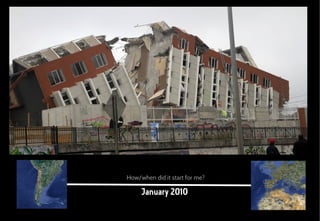
January 2010
How/when did it start for me?
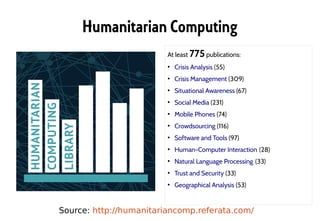
Humanitarian Computing
At least 775publications:
●
Crisis Analysis (55)
●
Crisis Management (309)
●
Situational Awareness (67)
●
Social Media (231)
●
Mobile Phones (74)
●
Crowdsourcing (116)
●
Software and Tools (97)
●
Human-Computer Interaction (28) 
●
Natural Language Processing (33) 
●
Trust and Security (33)
●
Geographical Analysis (53)
Source: http://humanitariancomp.referata.com/
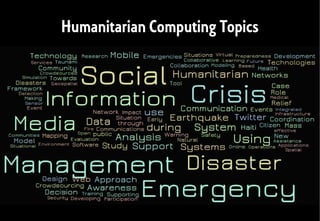
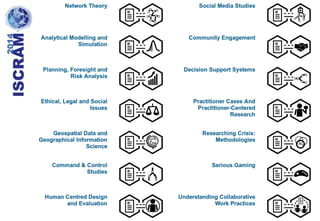
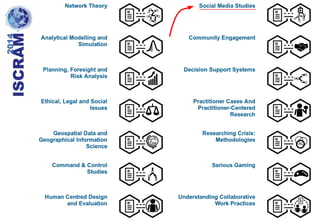
Humanitarian Computing Topics
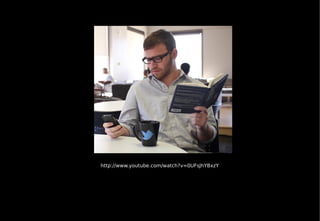
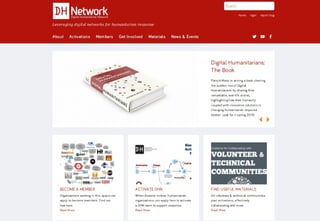
http://www.youtube.com/watch?v=0UFsJhYBxzY
8
Carlos Castillo – chato@acm.org
http://www.chato.cl/research/
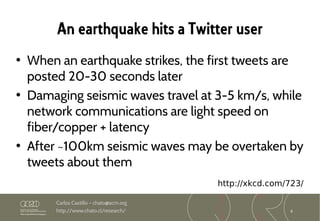
An earthquake hits a Twitter user
• When an earthquake strikes, the first tweets are
posted 20-30 seconds later
• Damaging seismic waves travel at 3-5 km/s, while
network communications are light speed on
fiber/copper + latency
• After ~100km seismic waves may be overtaken by
tweets about them
http://xkcd.com/723/
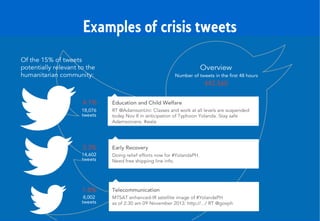
Examples of crisis tweets
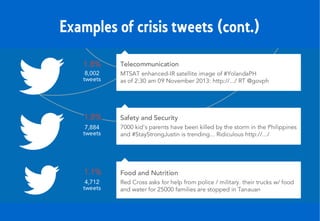
Alexandra Olteanu, Sarah Vieweg and Carlos Castillo: What to Expect When the
Unexpected Happens: Social Media Communications Across Crises.
To appear in CSCW 2015.
Examples of crisis tweets (cont.)
11
Carlos Castillo – chato@acm.org
http://www.chato.cl/research/
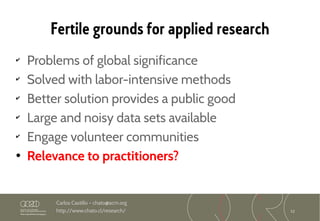
Fertile grounds for applied research
✔
Problems of global significance
✔
Solved with labor-intensive methods
✔
Better solution provides a public good
✔
Large and noisy data sets available
✔
Engage volunteer communities
12
Carlos Castillo – chato@acm.org
http://www.chato.cl/research/
Fertile grounds for applied research
✔
Problems of global significance
✔
Solved with labor-intensive methods
✔
Better solution provides a public good
✔
Large and noisy data sets available
✔
Engage volunteer communities
• Relevance to practitioners?
13
Carlos Castillo – chato@acm.org
http://www.chato.cl/research/
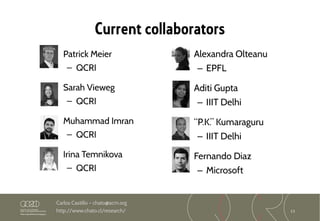
Current collaborators
Patrick Meier
– QCRI
Sarah Vieweg
– QCRI
Muhammad Imran
– QCRI
Irina Temnikova
– QCRI
Alexandra Olteanu
– EPFL
Aditi Gupta
– IIIT Delhi
“P.K.” Kumaraguru
– IIIT Delhi
Fernando Diaz
– Microsoft
14
Carlos Castillo – chato@acm.org
http://www.chato.cl/research/
Outline
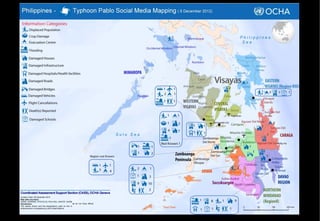
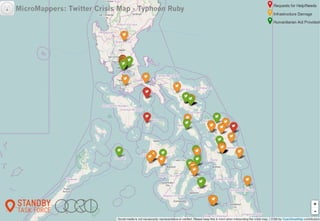
Crisis Maps
Extraction
Matching
Verification
Credibility
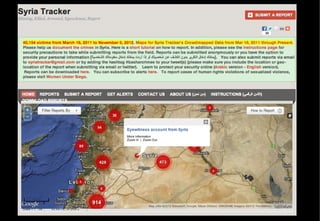
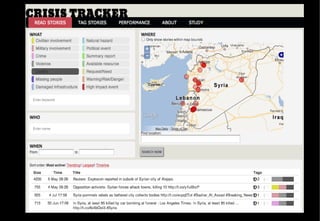
Crisis maps from social media
Carlos Castillo, Fernando Diaz, and Hemant Purohit:
Leveraging Social Media and Web of Data to Assist Crisis Response Coordination
Tutorial at SDM, Philadelphia, PA, USA. April 2014.
Hemant Purohit, Carlos Castillo, Patrick Meier and Amit Sheth:
Crisis Mapping, Citizen Sensing and Social Media Analytics
Tutorial at ICWSM, May 2013.
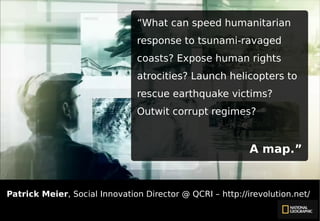
Patrick Meier, Social Innovation Director @ QCRI – http://irevolution.net/
“What can speed humanitarian
response to tsunami-ravaged
coasts? Expose human rights
atrocities? Launch helicopters to
rescue earthquake victims?
Outwit corrupt regimes?
A map.”
21
Carlos Castillo – chato@acm.org
http://www.chato.cl/research/
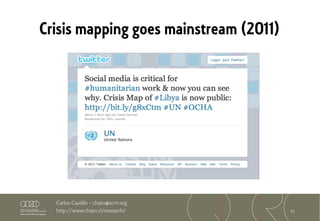
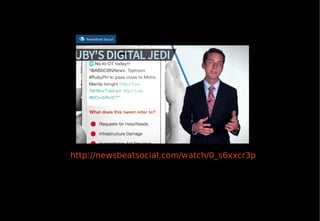
Crisis mapping goes mainstream (2011)
http://newsbeatsocial.com/watch/0_s6xxcr3p
Understanding Crisis Tweets
Alexandra Olteanu, Sarah Vieweg and Carlos Castillo: What to Expect When the
Unexpected Happens: Social Media Communications Across Crises.
To appear in CSCW 2015.
29
Carlos Castillo – chato@acm.org
http://www.chato.cl/research/
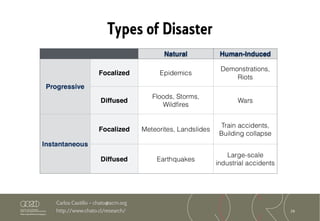
Types of Disaster
30
Carlos Castillo – chato@acm.org
http://www.chato.cl/research/
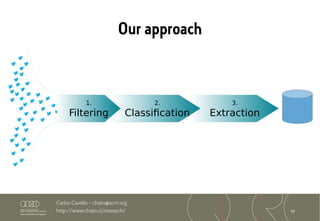
3.
Extraction
Our approach
2.
Classification
1.
Filtering
31
Carlos Castillo – chato@acm.org
http://www.chato.cl/research/
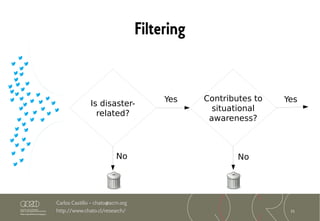
Filtering
Is disaster-
related?
Contributes to
situational
awareness?
Yes Yes
No No
32
Carlos Castillo – chato@acm.org
http://www.chato.cl/research/
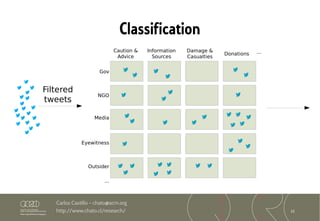
Classification
Caution &
Advice
Information
Sources
Damage &
Casualties
Donations
Gov
Eyewitness
Media
NGO
Outsider
...
...
Filtered
tweets
33
Carlos Castillo – chato@acm.org
http://www.chato.cl/research/
A large-scale study of crisis tweets
• Collect tweets from 26 disasters
• Classify according to:
●
Informative / Not informative
●
Information provided
●
Information source
34
Carlos Castillo – chato@acm.org
http://www.chato.cl/research/
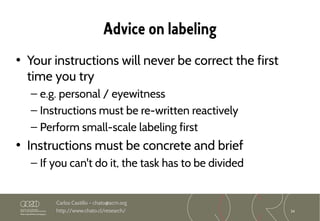
Advice on labeling
• Your instructions will never be correct the first
time you try
– e.g. personal / eyewitness
– Instructions must be re-written reactively
– Perform small-scale labeling first
• Instructions must be concrete and brief
– If you can't do it, the task has to be divided
35
Carlos Castillo – chato@acm.org
http://www.chato.cl/research/
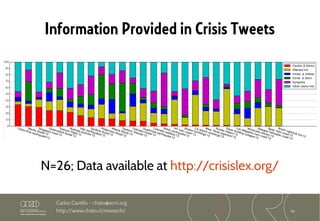
Information Provided in Crisis Tweets
N=26; Data available at http://crisislex.org/
36
Carlos Castillo – chato@acm.org
http://www.chato.cl/research/
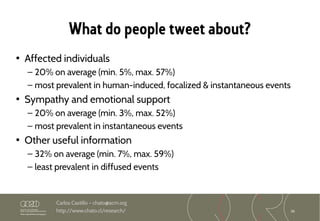
What do people tweet about?
• Affected individuals
– 20% on average (min. 5%, max. 57%)
– most prevalent in human-induced, focalized & instantaneous events
• Sympathy and emotional support
– 20% on average (min. 3%, max. 52%)
– most prevalent in instantaneous events
• Other useful information
– 32% on average (min. 7%, max. 59%)
– least prevalent in diffused events
37
Carlos Castillo – chato@acm.org
http://www.chato.cl/research/
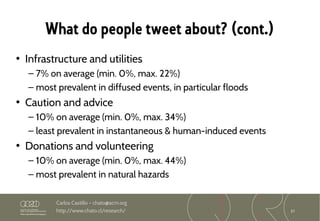
What do people tweet about? (cont.)
• Infrastructure and utilities
– 7% on average (min. 0%, max. 22%)
– most prevalent in diffused events, in particular floods
• Caution and advice
– 10% on average (min. 0%, max. 34%)
– least prevalent in instantaneous & human-induced events
• Donations and volunteering
– 10% on average (min. 0%, max. 44%)
– most prevalent in natural hazards
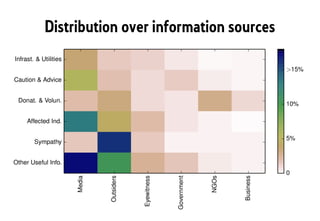
Distribution over information sources
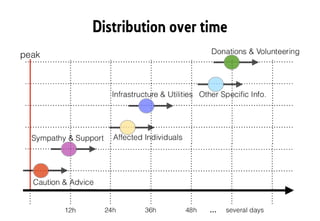
Distribution over time
Extracting information and matching
emergency-related resources
Muhammad Imran, Shady Elbassuoni, Carlos Castillo, Fernando Diaz and Patrick Meier:
Extracting Information Nuggets from Disaster-Related Messages in Social Media
In ISCRAM. Baden-Baden, Germany, 2013. Best paper award.
Hemant Purohit, Amit Sheth, Carlos Castillo, Patrick Meier, Fernando Diaz:
Emergency-Relief Coord. on Social Media: Auto. Matching Resource Requests and Offers
First Monday 19 (1), January 2014
Muhammad Imran, Shady Elbassuoni, Carlos Castillo, Fernando Diaz and Patrick Meier:
Practical Extraction of Disaster-Relevant Information from Social Media
In SWDM. Rio de Janeiro, Brazil, 2013
41
Carlos Castillo – chato@acm.org
http://www.chato.cl/research/
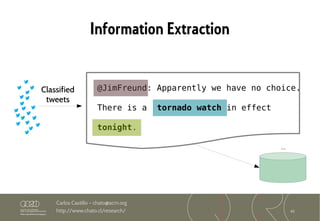
Information Extraction
...
Classified
tweets
@JimFreund: Apparently we have no choice.
There is a tornado watch in effect
tonight.
42
Carlos Castillo – chato@acm.org
http://www.chato.cl/research/
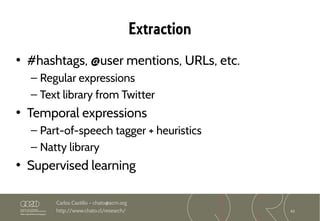
Extraction
• #hashtags, @user mentions, URLs, etc.
– Regular expressions
– Text library from Twitter
• Temporal expressions
– Part-of-speech tagger + heuristics
– Natty library
• Supervised learning
43
Carlos Castillo – chato@acm.org
http://www.chato.cl/research/
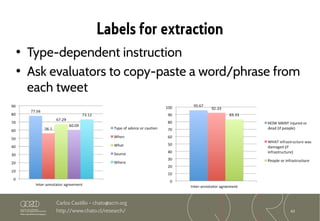
Labels for extraction
• Type-dependent instruction
• Ask evaluators to copy-paste a word/phrase from
each tweet
44
Carlos Castillo – chato@acm.org
http://www.chato.cl/research/
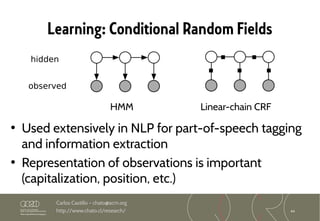
Learning: Conditional Random Fields
• Used extensively in NLP for part-of-speech tagging
and information extraction
• Representation of observations is important
(capitalization, position, etc.)
HMM Linear-chain CRF
hidden
observed
45
Carlos Castillo – chato@acm.org
http://www.chato.cl/research/
Tool
• CMU ARK Twitter NLP
– Tokenization
– Feature extraction
– CRF learning
• Very easy to use: simply change the training set
(part-of-speech tags) into anything, and re-train
46
Carlos Castillo – chato@acm.org
http://www.chato.cl/research/
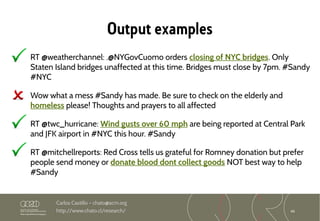
Output examples
RT @weatherchannel: .@NYGovCuomo orders closing of NYC bridges. Only
Staten Island bridges unaffected at this time. Bridges must close by 7pm. #Sandy
#NYC
Wow what a mess #Sandy has made. Be sure to check on the elderly and
homeless please! Thoughts and prayers to all affected
RT @twc_hurricane: Wind gusts over 60 mph are being reported at Central Park
and JFK airport in #NYC this hour. #Sandy
RT @mitchellreports: Red Cross tells us grateful for Romney donation but prefer
people send money or donate blood dont collect goods NOT best way to help
#Sandy
47
Carlos Castillo – chato@acm.org
http://www.chato.cl/research/
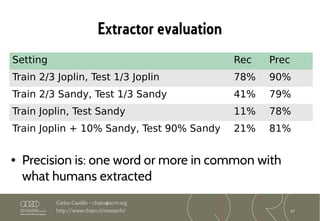
Extractor evaluation
Setting Rec Prec
Train 2/3 Joplin, Test 1/3 Joplin 78% 90%
Train 2/3 Sandy, Test 1/3 Sandy 41% 79%
Train Joplin, Test Sandy 11% 78%
Train Joplin + 10% Sandy, Test 90% Sandy 21% 81%
• Precision is: one word or more in common with
what humans extracted
48
Carlos Castillo – chato@acm.org
http://www.chato.cl/research/
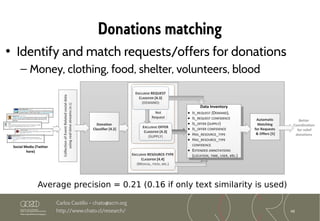
Donations matching
• Identify and match requests/offers for donations
– Money, clothing, food, shelter, volunteers, blood
Average precision = 0.21 (0.16 if only text similarity is used)
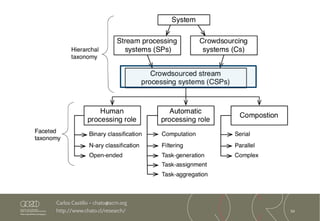
Crowdsourced stream processing systems
Muhammad Imran, Ioanna Lykourentzou and Carlos Castillo:
Engineering Crowdsourced Stream Processing Systems
http://arxiv.org/abs/1310.5463
50
Carlos Castillo – chato@acm.org
http://www.chato.cl/research/
51
Carlos Castillo – chato@acm.org
http://www.chato.cl/research/
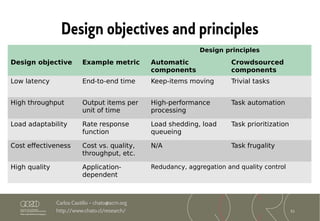
Design objectives and principles
Design principles
Design objective Example metric Automatic
components
Crowdsourced
components
Low latency End-to-end time Keep-items moving Trivial tasks
High throughput Output items per
unit of time
High-performance
processing
Task automation
Load adaptability Rate response
function
Load shedding, load
queueing
Task prioritization
Cost effectiveness Cost vs. quality,
throughput, etc.
N/A Task frugality
High quality Application-
dependent
Redudancy, aggregation and quality control
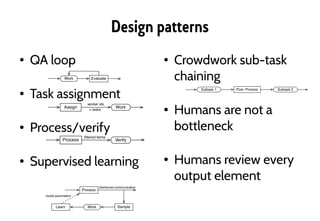
Design patterns
● QA loop
● Task assignment
● Process/verify
● Supervised learning
● Crowdwork sub-task
chaining
● Humans are not a
bottleneck
● Humans review every
output element
53
Carlos Castillo – chato@acm.org
http://www.chato.cl/research/
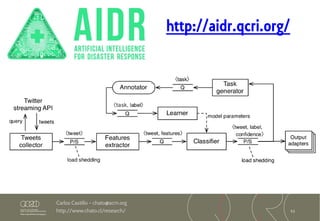
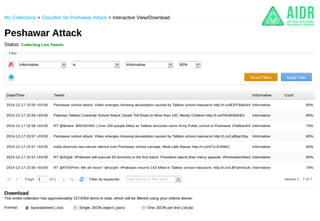
http://aidr.qcri.org/
54
Carlos Castillo – chato@acm.org
http://www.chato.cl/research/
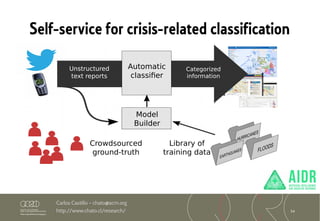
Self-service for crisis-related classification
Unstructured
text reports
Categorized
information
Automatic
classifier
Model
Builder
Crowdsourced
ground-truth
Library of
training data
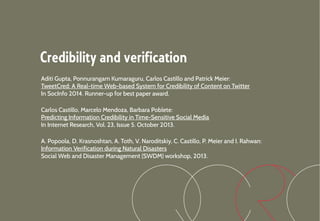
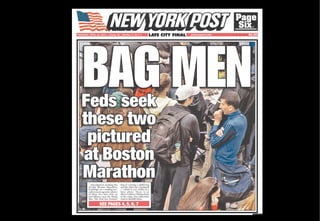
Credibility and verification
Aditi Gupta, Ponnurangam Kumaraguru, Carlos Castillo and Patrick Meier:
TweetCred: A Real-time Web-based System for Credibility of Content on Twitter
In SocInfo 2014. Runner-up for best paper award.
Carlos Castillo, Marcelo Mendoza, Barbara Poblete:
Predicting Information Credibility in Time-Sensitive Social Media
In Internet Research, Vol. 23, Issue 5. October 2013.
A. Popoola, D. Krasnoshtan, A. Toth, V. Naroditskiy, C. Castillo, P. Meier and I. Rahwan:
Information Verification during Natural Disasters
Social Web and Disaster Management (SWDM) workshop, 2013.
3
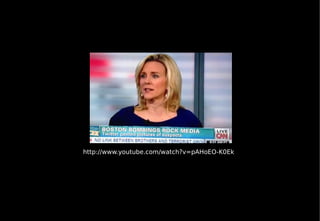
http://www.youtube.com/watch?v=pAHoEO-K0Ek
62
Carlos Castillo – chato@acm.org
http://www.chato.cl/research/
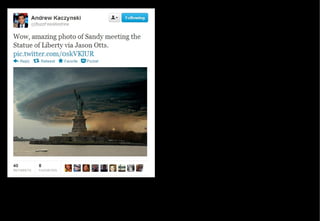
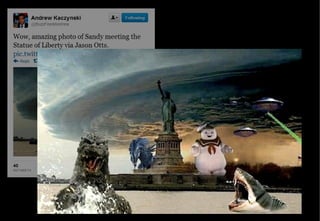
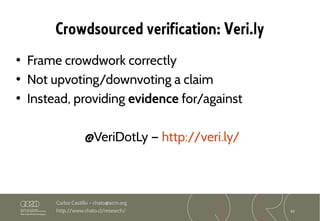
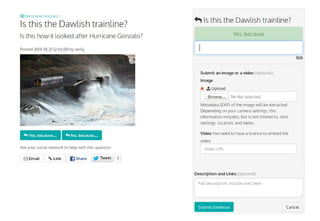
Crowdsourced verification: Veri.ly
• Frame crowdwork correctly
• Not upvoting/downvoting a claim
• Instead, providing evidence for/against
@VeriDotLy — http://veri.ly/
65
Carlos Castillo – chato@acm.org
http://www.chato.cl/research/
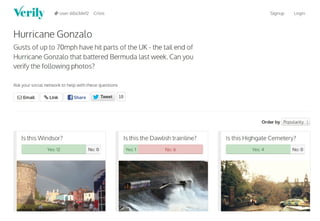
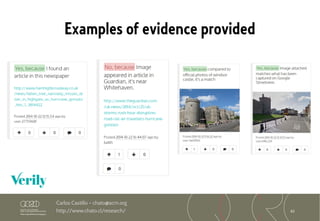
Examples of evidence provided
66
Carlos Castillo – chato@acm.org
http://www.chato.cl/research/
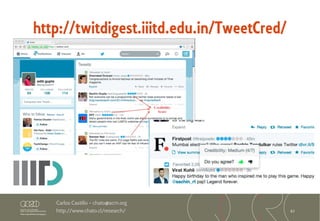
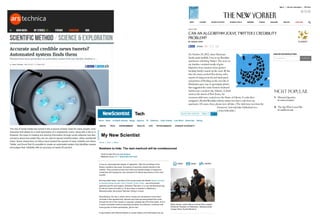
Automatic credibility evaluation: TweetCred
• Real-time web-based service
• Used as a Chrome extension
• Annotates Twitter's timeline with credibility
scores
67
Carlos Castillo – chato@acm.org
http://www.chato.cl/research/
http://twitdigest.iiitd.edu.in/TweetCred/
68
Carlos Castillo – chato@acm.org
http://www.chato.cl/research/
Next steps
• Credibility facets
– Factually written
– Detailed
– Author on the ground
– ...
• Respond to searches about an event
Closing remarks
71
Carlos Castillo – chato@acm.org
http://www.chato.cl/research/
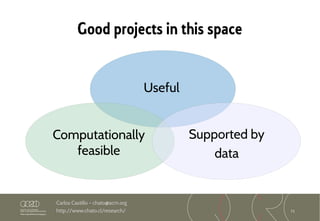
Computationally
feasible
Supported by
data
Useful
Good projects in this space
72
Carlos Castillo – chato@acm.org
http://www.chato.cl/research/
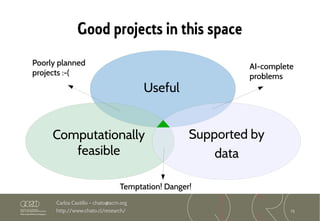
Computationally
feasible
Supported by
data
Useful
Good projects in this space
Temptation! Danger!
Poorly planned
projects :-(
AI-complete
problems
73
Carlos Castillo – chato@acm.org
http://www.chato.cl/research/
Some venues
• SWDM – Workshop on Social Web
for Disaster Management
– Deadline: January 24th
• ISCRAM – International Conference on Information Systems
for Crisis Response and Management
+ the usual suspects, depending on your area ;-)
74
Carlos Castillo – chato@acm.org
http://www.chato.cl/research/
Possibility of large impact by using computer
science to support humanitarian work
=
Applied computing at its best
Thank you!
Carlos Castillo · chato@acm.org
http://www.chato.cl/research/
With thanks to Patrick Meier for several slides

Crisis Computing

  • 1.
    Crisis Computing Finding relevantand credible information on social media during disasters Big Data Analytics Conference Delhi, India, December 2014
  • 2.
    January 2010 How/when didit start for me?
  • 3.
    Humanitarian Computing At least775publications: ● Crisis Analysis (55) ● Crisis Management (309) ● Situational Awareness (67) ● Social Media (231) ● Mobile Phones (74) ● Crowdsourcing (116) ● Software and Tools (97) ● Human-Computer Interaction (28)  ● Natural Language Processing (33)  ● Trust and Security (33) ● Geographical Analysis (53) Source: http://humanitariancomp.referata.com/
  • 4.
  • 7.
  • 8.
    8 Carlos Castillo –chato@acm.org http://www.chato.cl/research/ An earthquake hits a Twitter user • When an earthquake strikes, the first tweets are posted 20-30 seconds later • Damaging seismic waves travel at 3-5 km/s, while network communications are light speed on fiber/copper + latency • After ~100km seismic waves may be overtaken by tweets about them http://xkcd.com/723/
  • 9.
  • 10.
    Alexandra Olteanu, SarahVieweg and Carlos Castillo: What to Expect When the Unexpected Happens: Social Media Communications Across Crises. To appear in CSCW 2015. Examples of crisis tweets (cont.)
  • 11.
    11 Carlos Castillo –chato@acm.org http://www.chato.cl/research/ Fertile grounds for applied research ✔ Problems of global significance ✔ Solved with labor-intensive methods ✔ Better solution provides a public good ✔ Large and noisy data sets available ✔ Engage volunteer communities
  • 12.
    12 Carlos Castillo –chato@acm.org http://www.chato.cl/research/ Fertile grounds for applied research ✔ Problems of global significance ✔ Solved with labor-intensive methods ✔ Better solution provides a public good ✔ Large and noisy data sets available ✔ Engage volunteer communities • Relevance to practitioners?
  • 13.
    13 Carlos Castillo –chato@acm.org http://www.chato.cl/research/ Current collaborators Patrick Meier – QCRI Sarah Vieweg – QCRI Muhammad Imran – QCRI Irina Temnikova – QCRI Alexandra Olteanu – EPFL Aditi Gupta – IIIT Delhi “P.K.” Kumaraguru – IIIT Delhi Fernando Diaz – Microsoft
  • 14.
    14 Carlos Castillo –chato@acm.org http://www.chato.cl/research/ Outline Crisis Maps Extraction Matching Verification Credibility
  • 15.
    Crisis maps fromsocial media Carlos Castillo, Fernando Diaz, and Hemant Purohit: Leveraging Social Media and Web of Data to Assist Crisis Response Coordination Tutorial at SDM, Philadelphia, PA, USA. April 2014. Hemant Purohit, Carlos Castillo, Patrick Meier and Amit Sheth: Crisis Mapping, Citizen Sensing and Social Media Analytics Tutorial at ICWSM, May 2013.
  • 20.
    Patrick Meier, SocialInnovation Director @ QCRI – http://irevolution.net/ “What can speed humanitarian response to tsunami-ravaged coasts? Expose human rights atrocities? Launch helicopters to rescue earthquake victims? Outwit corrupt regimes? A map.”
  • 21.
    21 Carlos Castillo –chato@acm.org http://www.chato.cl/research/ Crisis mapping goes mainstream (2011)
  • 26.
  • 28.
    Understanding Crisis Tweets AlexandraOlteanu, Sarah Vieweg and Carlos Castillo: What to Expect When the Unexpected Happens: Social Media Communications Across Crises. To appear in CSCW 2015.
  • 29.
    29 Carlos Castillo –chato@acm.org http://www.chato.cl/research/ Types of Disaster
  • 30.
    30 Carlos Castillo –chato@acm.org http://www.chato.cl/research/ 3. Extraction Our approach 2. Classification 1. Filtering
  • 31.
    31 Carlos Castillo –chato@acm.org http://www.chato.cl/research/ Filtering Is disaster- related? Contributes to situational awareness? Yes Yes No No
  • 32.
    32 Carlos Castillo –chato@acm.org http://www.chato.cl/research/ Classification Caution & Advice Information Sources Damage & Casualties Donations Gov Eyewitness Media NGO Outsider ... ... Filtered tweets
  • 33.
    33 Carlos Castillo –chato@acm.org http://www.chato.cl/research/ A large-scale study of crisis tweets • Collect tweets from 26 disasters • Classify according to: ● Informative / Not informative ● Information provided ● Information source
  • 34.
    34 Carlos Castillo –chato@acm.org http://www.chato.cl/research/ Advice on labeling • Your instructions will never be correct the first time you try – e.g. personal / eyewitness – Instructions must be re-written reactively – Perform small-scale labeling first • Instructions must be concrete and brief – If you can't do it, the task has to be divided
  • 35.
    35 Carlos Castillo –chato@acm.org http://www.chato.cl/research/ Information Provided in Crisis Tweets N=26; Data available at http://crisislex.org/
  • 36.
    36 Carlos Castillo –chato@acm.org http://www.chato.cl/research/ What do people tweet about? • Affected individuals – 20% on average (min. 5%, max. 57%) – most prevalent in human-induced, focalized & instantaneous events • Sympathy and emotional support – 20% on average (min. 3%, max. 52%) – most prevalent in instantaneous events • Other useful information – 32% on average (min. 7%, max. 59%) – least prevalent in diffused events
  • 37.
    37 Carlos Castillo –chato@acm.org http://www.chato.cl/research/ What do people tweet about? (cont.) • Infrastructure and utilities – 7% on average (min. 0%, max. 22%) – most prevalent in diffused events, in particular floods • Caution and advice – 10% on average (min. 0%, max. 34%) – least prevalent in instantaneous & human-induced events • Donations and volunteering – 10% on average (min. 0%, max. 44%) – most prevalent in natural hazards
  • 38.
  • 39.
  • 40.
    Extracting information andmatching emergency-related resources Muhammad Imran, Shady Elbassuoni, Carlos Castillo, Fernando Diaz and Patrick Meier: Extracting Information Nuggets from Disaster-Related Messages in Social Media In ISCRAM. Baden-Baden, Germany, 2013. Best paper award. Hemant Purohit, Amit Sheth, Carlos Castillo, Patrick Meier, Fernando Diaz: Emergency-Relief Coord. on Social Media: Auto. Matching Resource Requests and Offers First Monday 19 (1), January 2014 Muhammad Imran, Shady Elbassuoni, Carlos Castillo, Fernando Diaz and Patrick Meier: Practical Extraction of Disaster-Relevant Information from Social Media In SWDM. Rio de Janeiro, Brazil, 2013
  • 41.
    41 Carlos Castillo –chato@acm.org http://www.chato.cl/research/ Information Extraction ... Classified tweets @JimFreund: Apparently we have no choice. There is a tornado watch in effect tonight.
  • 42.
    42 Carlos Castillo –chato@acm.org http://www.chato.cl/research/ Extraction • #hashtags, @user mentions, URLs, etc. – Regular expressions – Text library from Twitter • Temporal expressions – Part-of-speech tagger + heuristics – Natty library • Supervised learning
  • 43.
    43 Carlos Castillo –chato@acm.org http://www.chato.cl/research/ Labels for extraction • Type-dependent instruction • Ask evaluators to copy-paste a word/phrase from each tweet
  • 44.
    44 Carlos Castillo –chato@acm.org http://www.chato.cl/research/ Learning: Conditional Random Fields • Used extensively in NLP for part-of-speech tagging and information extraction • Representation of observations is important (capitalization, position, etc.) HMM Linear-chain CRF hidden observed
  • 45.
    45 Carlos Castillo –chato@acm.org http://www.chato.cl/research/ Tool • CMU ARK Twitter NLP – Tokenization – Feature extraction – CRF learning • Very easy to use: simply change the training set (part-of-speech tags) into anything, and re-train
  • 46.
    46 Carlos Castillo –chato@acm.org http://www.chato.cl/research/ Output examples RT @weatherchannel: .@NYGovCuomo orders closing of NYC bridges. Only Staten Island bridges unaffected at this time. Bridges must close by 7pm. #Sandy #NYC Wow what a mess #Sandy has made. Be sure to check on the elderly and homeless please! Thoughts and prayers to all affected RT @twc_hurricane: Wind gusts over 60 mph are being reported at Central Park and JFK airport in #NYC this hour. #Sandy RT @mitchellreports: Red Cross tells us grateful for Romney donation but prefer people send money or donate blood dont collect goods NOT best way to help #Sandy
  • 47.
    47 Carlos Castillo –chato@acm.org http://www.chato.cl/research/ Extractor evaluation Setting Rec Prec Train 2/3 Joplin, Test 1/3 Joplin 78% 90% Train 2/3 Sandy, Test 1/3 Sandy 41% 79% Train Joplin, Test Sandy 11% 78% Train Joplin + 10% Sandy, Test 90% Sandy 21% 81% • Precision is: one word or more in common with what humans extracted
  • 48.
    48 Carlos Castillo –chato@acm.org http://www.chato.cl/research/ Donations matching • Identify and match requests/offers for donations – Money, clothing, food, shelter, volunteers, blood Average precision = 0.21 (0.16 if only text similarity is used)
  • 49.
    Crowdsourced stream processingsystems Muhammad Imran, Ioanna Lykourentzou and Carlos Castillo: Engineering Crowdsourced Stream Processing Systems http://arxiv.org/abs/1310.5463
  • 50.
    50 Carlos Castillo –chato@acm.org http://www.chato.cl/research/
  • 51.
    51 Carlos Castillo –chato@acm.org http://www.chato.cl/research/ Design objectives and principles Design principles Design objective Example metric Automatic components Crowdsourced components Low latency End-to-end time Keep-items moving Trivial tasks High throughput Output items per unit of time High-performance processing Task automation Load adaptability Rate response function Load shedding, load queueing Task prioritization Cost effectiveness Cost vs. quality, throughput, etc. N/A Task frugality High quality Application- dependent Redudancy, aggregation and quality control
  • 52.
    Design patterns ● QAloop ● Task assignment ● Process/verify ● Supervised learning ● Crowdwork sub-task chaining ● Humans are not a bottleneck ● Humans review every output element
  • 53.
    53 Carlos Castillo –chato@acm.org http://www.chato.cl/research/ http://aidr.qcri.org/
  • 54.
    54 Carlos Castillo –chato@acm.org http://www.chato.cl/research/ Self-service for crisis-related classification Unstructured text reports Categorized information Automatic classifier Model Builder Crowdsourced ground-truth Library of training data
  • 57.
    Credibility and verification AditiGupta, Ponnurangam Kumaraguru, Carlos Castillo and Patrick Meier: TweetCred: A Real-time Web-based System for Credibility of Content on Twitter In SocInfo 2014. Runner-up for best paper award. Carlos Castillo, Marcelo Mendoza, Barbara Poblete: Predicting Information Credibility in Time-Sensitive Social Media In Internet Research, Vol. 23, Issue 5. October 2013. A. Popoola, D. Krasnoshtan, A. Toth, V. Naroditskiy, C. Castillo, P. Meier and I. Rahwan: Information Verification during Natural Disasters Social Web and Disaster Management (SWDM) workshop, 2013.
  • 59.
  • 61.
  • 62.
    62 Carlos Castillo –chato@acm.org http://www.chato.cl/research/ Crowdsourced verification: Veri.ly • Frame crowdwork correctly • Not upvoting/downvoting a claim • Instead, providing evidence for/against @VeriDotLy — http://veri.ly/
  • 65.
    65 Carlos Castillo –chato@acm.org http://www.chato.cl/research/ Examples of evidence provided
  • 66.
    66 Carlos Castillo –chato@acm.org http://www.chato.cl/research/ Automatic credibility evaluation: TweetCred • Real-time web-based service • Used as a Chrome extension • Annotates Twitter's timeline with credibility scores
  • 67.
    67 Carlos Castillo –chato@acm.org http://www.chato.cl/research/ http://twitdigest.iiitd.edu.in/TweetCred/
  • 68.
    68 Carlos Castillo –chato@acm.org http://www.chato.cl/research/ Next steps • Credibility facets – Factually written – Detailed – Author on the ground – ... • Respond to searches about an event
  • 70.
  • 71.
    71 Carlos Castillo –chato@acm.org http://www.chato.cl/research/ Computationally feasible Supported by data Useful Good projects in this space
  • 72.
    72 Carlos Castillo –chato@acm.org http://www.chato.cl/research/ Computationally feasible Supported by data Useful Good projects in this space Temptation! Danger! Poorly planned projects :-( AI-complete problems
  • 73.
    73 Carlos Castillo –chato@acm.org http://www.chato.cl/research/ Some venues • SWDM – Workshop on Social Web for Disaster Management – Deadline: January 24th • ISCRAM – International Conference on Information Systems for Crisis Response and Management + the usual suspects, depending on your area ;-)
  • 74.
    74 Carlos Castillo –chato@acm.org http://www.chato.cl/research/ Possibility of large impact by using computer science to support humanitarian work = Applied computing at its best
  • 75.
    Thank you! Carlos Castillo· chato@acm.org http://www.chato.cl/research/ With thanks to Patrick Meier for several slides