Common Alerting Protocol Standard and
Operating Procedures
Nuwan Waidyanatha
Director - Sahana Software Foundation
nuwan[AT]sahanafoundation[DOT]org
http://www.lirneasia.net/profiles/nuwan-waidyanatha
Mobile: +8613888446352 (cn) +94773710394 (lk)
CAP on a Map Kickoff Workshop – Improving Institutional Responsiveness to
Coastal Hazards through Multi Agency Situational Awareness
2015 May 19
PAGASA, Manila, Philippines
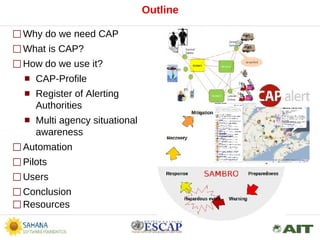
□Why do we need CAP
□What is CAP?
□How do we use it?
■ CAP-Profile
■ Register of Alerting
Authorities
■ Multi agency situational
awareness
□Automation
□Pilots
□Users
□Conclusion
□Resources
Outline
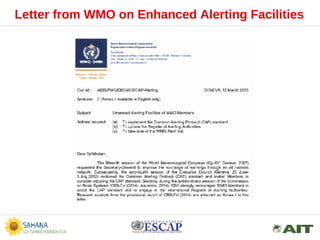
Letter from WMO on Enhanced Alerting Facilities
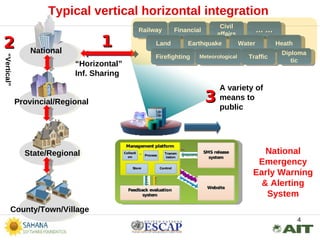
Typical vertical horizontal integration
4
Railway Financial
Civil
affairs … …… …
National
Provincial/Regional
State/Regional
County/Town/Village
Land Earthquake Water Heath
Firefighting Meteorological Traffic
Diploma
tic
“Horizontal”
Inf. Sharing
“Vertical”
A variety of
means to
public
1122
33
Management platformManagement platform
Collecti
on
Collecti
on
WebsiteWebsite
Feedback evaluation
system
Feedback evaluation
system
SMS release
system
SMS release
systemProcessProcess
Transm
ission
Transm
ission
StoreStore ControlControl
National
Emergency
Early Warning
& Alerting
System
□How do we manage the subscribers and publishers?
□How do we deliver early warnings in local language?
□How do we use available technologies?
□How do we disseminate alerts over multiple channels?
□How do we interoperate with incompatible systems?
□How do we effectively communicate the optimal content?
□How do we address the communication strategy?
□How do we accommodate upstream-downstream alerting?
Problem to solve in alerting/warning systems
ANSWER: CAP for all-hazards all-media and
multi-agency alerting and situational awareness
Managed by the Organization for the
Advancement of Structured Information
Standards (OASIS)
Recommended (X.1303) by the International
Telecommunications Union Standardization
Sector (ITU-T) – to align with ASN1 (Abstract
Syntax Notation One) ISO standards notation
Complies with the US National Science and
Technology Council (NSTC) six principles of
alerting, designed for :
• Coordination (avoid duplication)
• Consistency (believable)
• Channels (Multiple)
• Completeness (unabiguity)
• Coverage (Geo-targetting)
• Control (security)
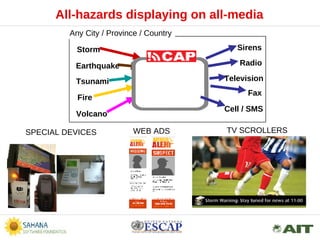
All-hazards displaying on all-media
TV SCROLLERSWEB ADSSPECIAL DEVICES
Any City / Province / Country
Radio
Television
Fax
Cell / SMS
SirensStorm
Earthquake
Fire
Tsunami
Volcano
u
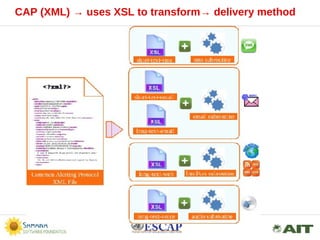
CAP (XML) → uses XSL to transform→ delivery method
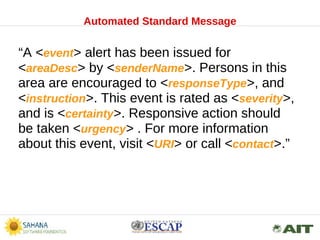
Automated Standard Message
“A <event> alert has been issued for
<areaDesc> by <senderName>. Persons in this
area are encouraged to <responseType>, and
<instruction>. This event is rated as <severity>,
and is <certainty>. Responsive action should
be taken <urgency> . For more information
about this event, visit <URI> or call <contact>.”
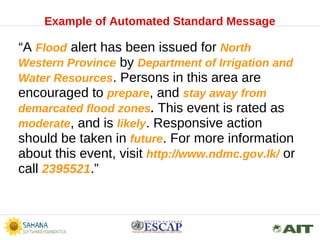
Example of Automated Standard Message
“A Flood alert has been issued for North
Western Province by Department of Irrigation and
Water Resources. Persons in this area are
encouraged to prepare, and stay away from
demarcated flood zones. This event is rated as
moderate, and is likely. Responsive action
should be taken in future. For more information
about this event, visit http://www.ndmc.gov.lk/ or
call 2395521.”
Exercise – SAMBRO message delivery
1) getting a feel for alerts in CAP format for the project focused
coastal hazards (use the SimCAPTool)
INSTRUCTIONS:
- Form four groups and use the same example used in the
discussion to now generate your alert message
- Access: http://cap.ituprojects.org
- Login with sd@gmail.com and 123
2) disseminate alerts in CAP format to the Restricted through
multiple delivery modes for the chosen event
SAMBRO Screen Shots
EMAIL
Tweet
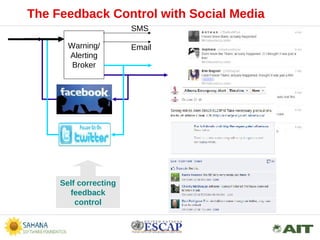
The Feedback Control with Social Media
Warning/
Alerting
Broker
SMS
Email
Self correcting
feedback
control
SHOW 1 MIN VIDEO
Resources
1) Video “Introduction to CAP”, Eliot Christian (WMO): http://www.youtube.com/watch?
v=n0iKp60jjtY
2) Instructions for translating the video to local language:
http://www.wmo.int/pages/prog/www/ISS/Meetings/WIS-CAP_Geneva2011/video.zip
3) Video on the use of CAP in real-time biosurveillance pilot, Nuwan Waidyanatha
(LIRNEasia): http://www.youtube.com/watch?v=G7WOq5giddI
4) CAP implementers workshop, WMO, Geneva, April 2011:
http://www.wmo.int/pages/prog/www/ISS/Meetings/WIS-
CAP_Geneva2011/DocPlan.html
5) CAP Cookbook (wiki):
http://www.incident.com/cookbook/index.php/Welcome_to_the_CAP_Cookbook
6) ITU-T recommendation X.1303: http://www.itu.int/rec/T-REC-X.1303/en
7) TD No. 1556, Administrative Procedure for Registering WMO Alerting Identifiers
(PWS-20): http://www.wmo.int/pages/prog/amp/pwsp/documents/AIR_PWS-20.pdf
8) OASIS EDXL suite of standards (including CAP): http://www.oasis-
open.org/standards#edxl
Thank You
Nuwan Waidyanatha
Nuwan [AT] sahanafoundation [DOT] org
www.sahanafoundation.org

Common Alerting Protocol and Procedures

  • 1.
    Common Alerting ProtocolStandard and Operating Procedures Nuwan Waidyanatha Director - Sahana Software Foundation nuwan[AT]sahanafoundation[DOT]org http://www.lirneasia.net/profiles/nuwan-waidyanatha Mobile: +8613888446352 (cn) +94773710394 (lk) CAP on a Map Kickoff Workshop – Improving Institutional Responsiveness to Coastal Hazards through Multi Agency Situational Awareness 2015 May 19 PAGASA, Manila, Philippines
  • 2.
    □Why do weneed CAP □What is CAP? □How do we use it? ■ CAP-Profile ■ Register of Alerting Authorities ■ Multi agency situational awareness □Automation □Pilots □Users □Conclusion □Resources Outline
  • 3.
    Letter from WMOon Enhanced Alerting Facilities
  • 4.
    Typical vertical horizontalintegration 4 Railway Financial Civil affairs … …… … National Provincial/Regional State/Regional County/Town/Village Land Earthquake Water Heath Firefighting Meteorological Traffic Diploma tic “Horizontal” Inf. Sharing “Vertical” A variety of means to public 1122 33 Management platformManagement platform Collecti on Collecti on WebsiteWebsite Feedback evaluation system Feedback evaluation system SMS release system SMS release systemProcessProcess Transm ission Transm ission StoreStore ControlControl National Emergency Early Warning & Alerting System
  • 5.
    □How do wemanage the subscribers and publishers? □How do we deliver early warnings in local language? □How do we use available technologies? □How do we disseminate alerts over multiple channels? □How do we interoperate with incompatible systems? □How do we effectively communicate the optimal content? □How do we address the communication strategy? □How do we accommodate upstream-downstream alerting? Problem to solve in alerting/warning systems
  • 6.
    ANSWER: CAP forall-hazards all-media and multi-agency alerting and situational awareness Managed by the Organization for the Advancement of Structured Information Standards (OASIS) Recommended (X.1303) by the International Telecommunications Union Standardization Sector (ITU-T) – to align with ASN1 (Abstract Syntax Notation One) ISO standards notation Complies with the US National Science and Technology Council (NSTC) six principles of alerting, designed for : • Coordination (avoid duplication) • Consistency (believable) • Channels (Multiple) • Completeness (unabiguity) • Coverage (Geo-targetting) • Control (security)
  • 7.
    All-hazards displaying onall-media TV SCROLLERSWEB ADSSPECIAL DEVICES Any City / Province / Country Radio Television Fax Cell / SMS SirensStorm Earthquake Fire Tsunami Volcano u
  • 8.
    CAP (XML) →uses XSL to transform→ delivery method
  • 9.
    Automated Standard Message “A<event> alert has been issued for <areaDesc> by <senderName>. Persons in this area are encouraged to <responseType>, and <instruction>. This event is rated as <severity>, and is <certainty>. Responsive action should be taken <urgency> . For more information about this event, visit <URI> or call <contact>.”
  • 10.
    Example of AutomatedStandard Message “A Flood alert has been issued for North Western Province by Department of Irrigation and Water Resources. Persons in this area are encouraged to prepare, and stay away from demarcated flood zones. This event is rated as moderate, and is likely. Responsive action should be taken in future. For more information about this event, visit http://www.ndmc.gov.lk/ or call 2395521.”
  • 11.
    Exercise – SAMBROmessage delivery 1) getting a feel for alerts in CAP format for the project focused coastal hazards (use the SimCAPTool) INSTRUCTIONS: - Form four groups and use the same example used in the discussion to now generate your alert message - Access: http://cap.ituprojects.org - Login with sd@gmail.com and 123 2) disseminate alerts in CAP format to the Restricted through multiple delivery modes for the chosen event
  • 12.
  • 13.
  • 14.
  • 15.
    The Feedback Controlwith Social Media Warning/ Alerting Broker SMS Email Self correcting feedback control
  • 16.
  • 17.
    Resources 1) Video “Introductionto CAP”, Eliot Christian (WMO): http://www.youtube.com/watch? v=n0iKp60jjtY 2) Instructions for translating the video to local language: http://www.wmo.int/pages/prog/www/ISS/Meetings/WIS-CAP_Geneva2011/video.zip 3) Video on the use of CAP in real-time biosurveillance pilot, Nuwan Waidyanatha (LIRNEasia): http://www.youtube.com/watch?v=G7WOq5giddI 4) CAP implementers workshop, WMO, Geneva, April 2011: http://www.wmo.int/pages/prog/www/ISS/Meetings/WIS- CAP_Geneva2011/DocPlan.html 5) CAP Cookbook (wiki): http://www.incident.com/cookbook/index.php/Welcome_to_the_CAP_Cookbook 6) ITU-T recommendation X.1303: http://www.itu.int/rec/T-REC-X.1303/en 7) TD No. 1556, Administrative Procedure for Registering WMO Alerting Identifiers (PWS-20): http://www.wmo.int/pages/prog/amp/pwsp/documents/AIR_PWS-20.pdf 8) OASIS EDXL suite of standards (including CAP): http://www.oasis- open.org/standards#edxl
  • 18.
    Thank You Nuwan Waidyanatha Nuwan[AT] sahanafoundation [DOT] org www.sahanafoundation.org