

CALENDARS
PRESENTED BY:-
PAWAN MISHRA
APTITUDE TRANER
mishrapawan082@gmail.com
INTRODUCTION
The questions on this topic are very
common in in various competitive
exams. The method of solving such
questions lies in the concept of
obtaining the number of odd days.
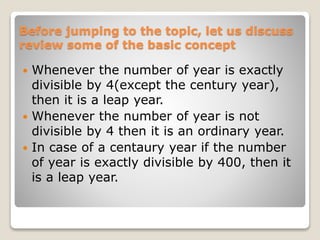
Before jumping to the topic, let us discuss
review some of the basic concept
 Whenever the number of year is exactly
divisible by 4(except the century year),
then it is a leap year.
 Whenever the number of year is not
divisible by 4 then it is an ordinary year.
 In case of a centaury year if the number
of year is exactly divisible by 400, then it
is a leap year.
Ordinary year
An ordinary year can be defined
as the year having 365 days
which is equal to 52 weeks and
an extra days
Century year
A year is a century year if it is
divisible by 100
Non-Century year
A year is a non-century year if it
is not a century year
Leap year
A year is a leap year if it is a non century
year that is divisible by 4, or a century
year that is divisible by 400.
Examples:
1952, 2008, 1680 etc. are leap years.
1991, 2003 etc. are not leap years
400, 800, 1200 etc. are leap years.
100, 200, 1900 etc. are not leap years
How to find the number of
odd days
The total number of days for
a specific period of time is
when divided by 7, the
remainder obtain in such a
case is term as odd day(s).
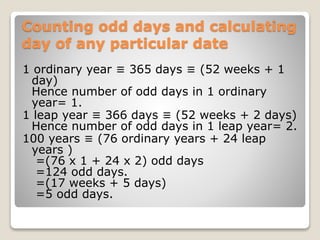
Counting odd days and calculating
day of any particular date
1 ordinary year ≡ 365 days ≡ (52 weeks + 1
day)
Hence number of odd days in 1 ordinary
year= 1.
1 leap year ≡ 366 days ≡ (52 weeks + 2 days)
Hence number of odd days in 1 leap year= 2.
100 years ≡ (76 ordinary years + 24 leap
years )
=(76 x 1 + 24 x 2) odd days
=124 odd days.
=(17 weeks + 5 days)
=5 odd days.
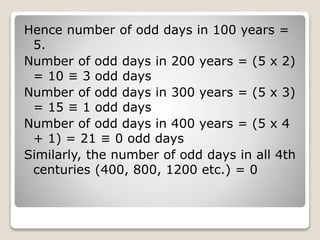
Hence number of odd days in 100 years =
5.
Number of odd days in 200 years = (5 x 2)
= 10 ≡ 3 odd days
Number of odd days in 300 years = (5 x 3)
= 15 ≡ 1 odd days
Number of odd days in 400 years = (5 x 4
+ 1) = 21 ≡ 0 odd days
Similarly, the number of odd days in all 4th
centuries (400, 800, 1200 etc.) = 0
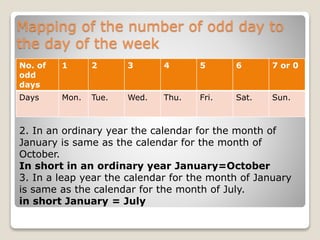
Mapping of the number of odd day to
the day of the week
No. of
odd
days
1 2 3 4 5 6 7 or 0
Days Mon. Tue. Wed. Thu. Fri. Sat. Sun.
2. In an ordinary year the calendar for the month of
January is same as the calendar for the month of
October.
In short in an ordinary year January=October
3. In a leap year the calendar for the month of January
is same as the calendar for the month of July.
in short January = July
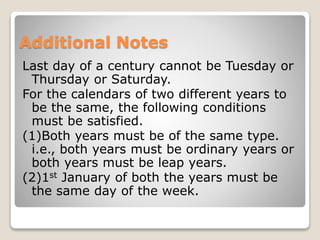
Additional Notes
Last day of a century cannot be Tuesday or
Thursday or Saturday.
For the calendars of two different years to
be the same, the following conditions
must be satisfied.
(1)Both years must be of the same type.
i.e., both years must be ordinary years or
both years must be leap years.
(2)1st January of both the years must be
the same day of the week.
What was the day of the week on,
16th July, 1776?
Explanation:
16th July, 1776 = (1775 years + Period from 1st Jan, 1776
to 16th July, 1776)
Counting of odd days :1600 years have 0 odd day. 100 years
have 5 odd days.
75 years = (18 leap years + 57 ordinary years)
= [(18 x 2) + (57 x 1)] odd days = 93 odd days
= (13 weeks + 2 days) = 2 odd days.
1775 years have (0 + 5 + 2) odd days = 7 odd days = 0 odd
day.
Jan Feb March April May June July
31 + 29 + 31 + 30 + 31 + 30 + 16 = 198days=
(28 weeks + 2 days)
Total number of odd days = (0 + 2) = 2.
January 1, 1992 was a Wednesday. What
day of the week was January 1, 1993
1992 being a leap year, it has 2 odd days.
So, the first day of the year 1993 will be
two days beyond Wednesday. i.e. it will be
Friday
On January 12, 1980, it was Saturday. The day
of the week on January 12, 1979 was :
The year 1979 being an ordinary year, it
has 1 odd day. So, the day on 12th
January 1980 is one day beyond the day
on 12th January, 1979. But, January 12,
1980 being Saturday. January 12, 1979
was Friday
On July 2, 1985, it was Wednesday. The day
of the week on July 2, 1984 was :
Let us calculate the number of odd days
between these two dates. July month of
1984 has 29 days left. So odd days are 1.
Now august 1984 to June 1985 we have 3 +
2 + 3 + 2 + 3 + 2 + 0 + 3 + 2 + 3 +
2. Now July, 1985 till 2nd July contains 2
odd days. Total 29 odd days. or 1 odd
day. So July 2, 1984 is 1 day before
Wednesday. It is Tuesday.
(2nd July 1985 is in fact Tuesday, and 2nd
July 1984 is Monday)
Monday falls on 4th April, 1988. What
was the day on 3rd November, 1987 ?
Ans: Counting the number of days after 3rd
November, 1987 we have :
Nov Dec Jan Feb March
April
days 27 + 31 + 31 +
29 + 3 + 4
= 153 days containing 6 odd days
i.e., (7-6) = 1 day beyond the day on 4th
April, 1988. So, the day was Tuesday.
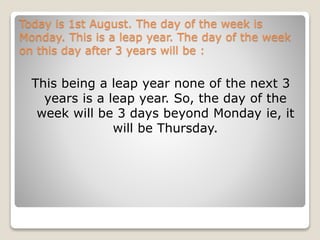
Today is 1st August. The day of the week is
Monday. This is a leap year. The day of the week
on this day after 3 years will be :
This being a leap year none of the next 3
years is a leap year. So, the day of the
week will be 3 days beyond Monday ie, it
will be Thursday.
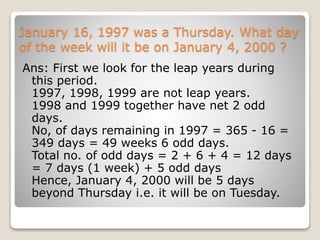
January 16, 1997 was a Thursday. What day
of the week will it be on January 4, 2000 ?
Ans: First we look for the leap years during
this period.
1997, 1998, 1999 are not leap years.
1998 and 1999 together have net 2 odd
days.
No, of days remaining in 1997 = 365 - 16 =
349 days = 49 weeks 6 odd days.
Total no. of odd days = 2 + 6 + 4 = 12 days
= 7 days (1 week) + 5 odd days
Hence, January 4, 2000 will be 5 days
beyond Thursday i.e. it will be on Tuesday.
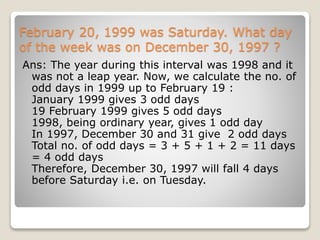
February 20, 1999 was Saturday. What day
of the week was on December 30, 1997 ?
Ans: The year during this interval was 1998 and it
was not a leap year. Now, we calculate the no. of
odd days in 1999 up to February 19 :
January 1999 gives 3 odd days
19 February 1999 gives 5 odd days
1998, being ordinary year, gives 1 odd day
In 1997, December 30 and 31 give 2 odd days
Total no. of odd days = 3 + 5 + 1 + 2 = 11 days
= 4 odd days
Therefore, December 30, 1997 will fall 4 days
before Saturday i.e. on Tuesday.
March 5, 1999 was on Friday, what day of
the week will be on March 5, 2000 ?
Ans: Year 2000 is a leap year
No. of remaining days in 1999 = 365 - [31 days
in January + 28 days in February + 5 days in
March] = 301 days = 43 weeks i.e. 0 odd day.
No. of days passed in 2000 = January (31 days)
gives 3 odd days.
February (29 days, being a leap year) gives 1
odd day March (5 days) gives 5 odd days
Total no. of odd days = 0 + 3 + 1 + 5 = 9 days
i.e. 2 odd days.
Therefore, March 5, 2000 will be two days
beyond Friday, i.e. on Sunday.
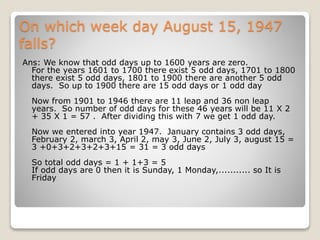
On which week day August 15, 1947
falls?
Ans: We know that odd days up to 1600 years are zero.
For the years 1601 to 1700 there exist 5 odd days, 1701 to 1800
there exist 5 odd days, 1801 to 1900 there are another 5 odd
days. So up to 1900 there are 15 odd days or 1 odd day
Now from 1901 to 1946 there are 11 leap and 36 non leap
years. So number of odd days for these 46 years will be 11 X 2
+ 35 X 1 = 57 . After dividing this with 7 we get 1 odd day.
Now we entered into year 1947. January contains 3 odd days,
February 2, march 3, April 2, may 3, June 2, July 3, august 15 =
3 +0+3+2+3+2+3+15 = 31 = 3 odd days
So total odd days = 1 + 1+3 = 5
If odd days are 0 then it is Sunday, 1 Monday,........... so It is
Friday
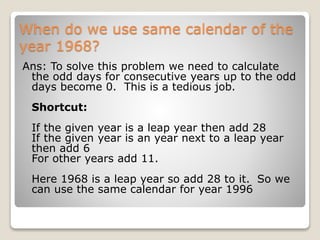
When do we use same calendar of the
year 1968?
Ans: To solve this problem we need to calculate
the odd days for consecutive years up to the odd
days become 0. This is a tedious job.
Shortcut:
If the given year is a leap year then add 28
If the given year is an year next to a leap year
then add 6
For other years add 11.
Here 1968 is a leap year so add 28 to it. So we
can use the same calendar for year 1996

Calendars- Aptitude

  • 1.
    CALENDARS PRESENTED BY:- PAWAN MISHRA APTITUDETRANER mishrapawan082@gmail.com
  • 2.
    INTRODUCTION The questions onthis topic are very common in in various competitive exams. The method of solving such questions lies in the concept of obtaining the number of odd days.
  • 3.
    Before jumping tothe topic, let us discuss review some of the basic concept  Whenever the number of year is exactly divisible by 4(except the century year), then it is a leap year.  Whenever the number of year is not divisible by 4 then it is an ordinary year.  In case of a centaury year if the number of year is exactly divisible by 400, then it is a leap year.
  • 4.
    Ordinary year An ordinaryyear can be defined as the year having 365 days which is equal to 52 weeks and an extra days
  • 5.
    Century year A yearis a century year if it is divisible by 100 Non-Century year A year is a non-century year if it is not a century year
  • 6.
    Leap year A yearis a leap year if it is a non century year that is divisible by 4, or a century year that is divisible by 400. Examples: 1952, 2008, 1680 etc. are leap years. 1991, 2003 etc. are not leap years 400, 800, 1200 etc. are leap years. 100, 200, 1900 etc. are not leap years
  • 7.
    How to findthe number of odd days The total number of days for a specific period of time is when divided by 7, the remainder obtain in such a case is term as odd day(s).
  • 8.
    Counting odd daysand calculating day of any particular date 1 ordinary year ≡ 365 days ≡ (52 weeks + 1 day) Hence number of odd days in 1 ordinary year= 1. 1 leap year ≡ 366 days ≡ (52 weeks + 2 days) Hence number of odd days in 1 leap year= 2. 100 years ≡ (76 ordinary years + 24 leap years ) =(76 x 1 + 24 x 2) odd days =124 odd days. =(17 weeks + 5 days) =5 odd days.
  • 9.
    Hence number ofodd days in 100 years = 5. Number of odd days in 200 years = (5 x 2) = 10 ≡ 3 odd days Number of odd days in 300 years = (5 x 3) = 15 ≡ 1 odd days Number of odd days in 400 years = (5 x 4 + 1) = 21 ≡ 0 odd days Similarly, the number of odd days in all 4th centuries (400, 800, 1200 etc.) = 0
  • 10.
    Mapping of thenumber of odd day to the day of the week No. of odd days 1 2 3 4 5 6 7 or 0 Days Mon. Tue. Wed. Thu. Fri. Sat. Sun. 2. In an ordinary year the calendar for the month of January is same as the calendar for the month of October. In short in an ordinary year January=October 3. In a leap year the calendar for the month of January is same as the calendar for the month of July. in short January = July
  • 11.
    Additional Notes Last dayof a century cannot be Tuesday or Thursday or Saturday. For the calendars of two different years to be the same, the following conditions must be satisfied. (1)Both years must be of the same type. i.e., both years must be ordinary years or both years must be leap years. (2)1st January of both the years must be the same day of the week.
  • 12.
    What was theday of the week on, 16th July, 1776? Explanation: 16th July, 1776 = (1775 years + Period from 1st Jan, 1776 to 16th July, 1776) Counting of odd days :1600 years have 0 odd day. 100 years have 5 odd days. 75 years = (18 leap years + 57 ordinary years) = [(18 x 2) + (57 x 1)] odd days = 93 odd days = (13 weeks + 2 days) = 2 odd days. 1775 years have (0 + 5 + 2) odd days = 7 odd days = 0 odd day. Jan Feb March April May June July 31 + 29 + 31 + 30 + 31 + 30 + 16 = 198days= (28 weeks + 2 days) Total number of odd days = (0 + 2) = 2.
  • 13.
    January 1, 1992was a Wednesday. What day of the week was January 1, 1993 1992 being a leap year, it has 2 odd days. So, the first day of the year 1993 will be two days beyond Wednesday. i.e. it will be Friday
  • 14.
    On January 12,1980, it was Saturday. The day of the week on January 12, 1979 was : The year 1979 being an ordinary year, it has 1 odd day. So, the day on 12th January 1980 is one day beyond the day on 12th January, 1979. But, January 12, 1980 being Saturday. January 12, 1979 was Friday
  • 15.
    On July 2,1985, it was Wednesday. The day of the week on July 2, 1984 was : Let us calculate the number of odd days between these two dates. July month of 1984 has 29 days left. So odd days are 1. Now august 1984 to June 1985 we have 3 + 2 + 3 + 2 + 3 + 2 + 0 + 3 + 2 + 3 + 2. Now July, 1985 till 2nd July contains 2 odd days. Total 29 odd days. or 1 odd day. So July 2, 1984 is 1 day before Wednesday. It is Tuesday. (2nd July 1985 is in fact Tuesday, and 2nd July 1984 is Monday)
  • 16.
    Monday falls on4th April, 1988. What was the day on 3rd November, 1987 ? Ans: Counting the number of days after 3rd November, 1987 we have : Nov Dec Jan Feb March April days 27 + 31 + 31 + 29 + 3 + 4 = 153 days containing 6 odd days i.e., (7-6) = 1 day beyond the day on 4th April, 1988. So, the day was Tuesday.
  • 17.
    Today is 1stAugust. The day of the week is Monday. This is a leap year. The day of the week on this day after 3 years will be : This being a leap year none of the next 3 years is a leap year. So, the day of the week will be 3 days beyond Monday ie, it will be Thursday.
  • 18.
    January 16, 1997was a Thursday. What day of the week will it be on January 4, 2000 ? Ans: First we look for the leap years during this period. 1997, 1998, 1999 are not leap years. 1998 and 1999 together have net 2 odd days. No, of days remaining in 1997 = 365 - 16 = 349 days = 49 weeks 6 odd days. Total no. of odd days = 2 + 6 + 4 = 12 days = 7 days (1 week) + 5 odd days Hence, January 4, 2000 will be 5 days beyond Thursday i.e. it will be on Tuesday.
  • 19.
    February 20, 1999was Saturday. What day of the week was on December 30, 1997 ? Ans: The year during this interval was 1998 and it was not a leap year. Now, we calculate the no. of odd days in 1999 up to February 19 : January 1999 gives 3 odd days 19 February 1999 gives 5 odd days 1998, being ordinary year, gives 1 odd day In 1997, December 30 and 31 give 2 odd days Total no. of odd days = 3 + 5 + 1 + 2 = 11 days = 4 odd days Therefore, December 30, 1997 will fall 4 days before Saturday i.e. on Tuesday.
  • 20.
    March 5, 1999was on Friday, what day of the week will be on March 5, 2000 ? Ans: Year 2000 is a leap year No. of remaining days in 1999 = 365 - [31 days in January + 28 days in February + 5 days in March] = 301 days = 43 weeks i.e. 0 odd day. No. of days passed in 2000 = January (31 days) gives 3 odd days. February (29 days, being a leap year) gives 1 odd day March (5 days) gives 5 odd days Total no. of odd days = 0 + 3 + 1 + 5 = 9 days i.e. 2 odd days. Therefore, March 5, 2000 will be two days beyond Friday, i.e. on Sunday.
  • 21.
    On which weekday August 15, 1947 falls? Ans: We know that odd days up to 1600 years are zero. For the years 1601 to 1700 there exist 5 odd days, 1701 to 1800 there exist 5 odd days, 1801 to 1900 there are another 5 odd days. So up to 1900 there are 15 odd days or 1 odd day Now from 1901 to 1946 there are 11 leap and 36 non leap years. So number of odd days for these 46 years will be 11 X 2 + 35 X 1 = 57 . After dividing this with 7 we get 1 odd day. Now we entered into year 1947. January contains 3 odd days, February 2, march 3, April 2, may 3, June 2, July 3, august 15 = 3 +0+3+2+3+2+3+15 = 31 = 3 odd days So total odd days = 1 + 1+3 = 5 If odd days are 0 then it is Sunday, 1 Monday,........... so It is Friday
  • 22.
    When do weuse same calendar of the year 1968? Ans: To solve this problem we need to calculate the odd days for consecutive years up to the odd days become 0. This is a tedious job. Shortcut: If the given year is a leap year then add 28 If the given year is an year next to a leap year then add 6 For other years add 11. Here 1968 is a leap year so add 28 to it. So we can use the same calendar for year 1996