NUMBER systems
CHAPTER1
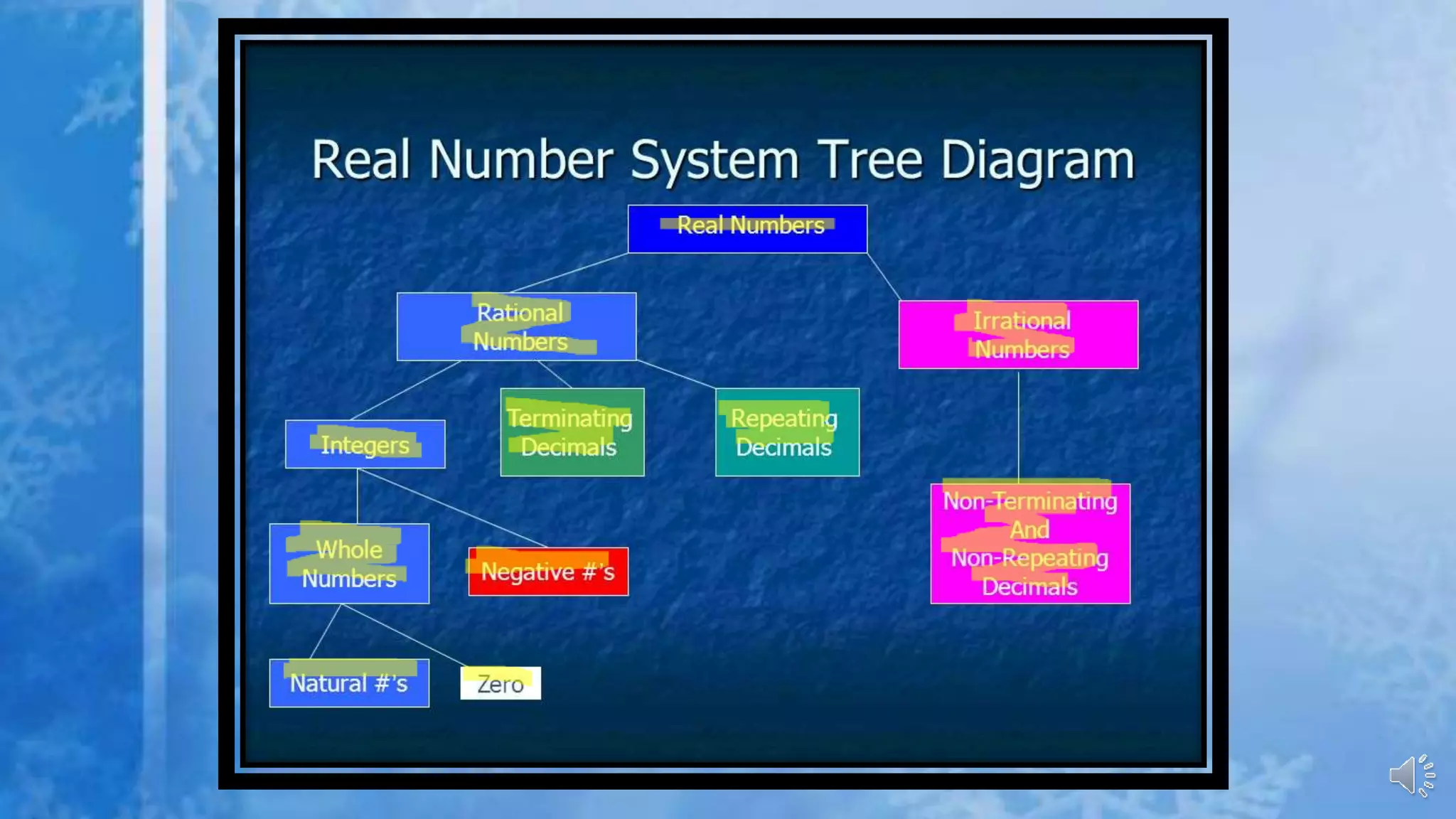
TYPE OF NUMBERS
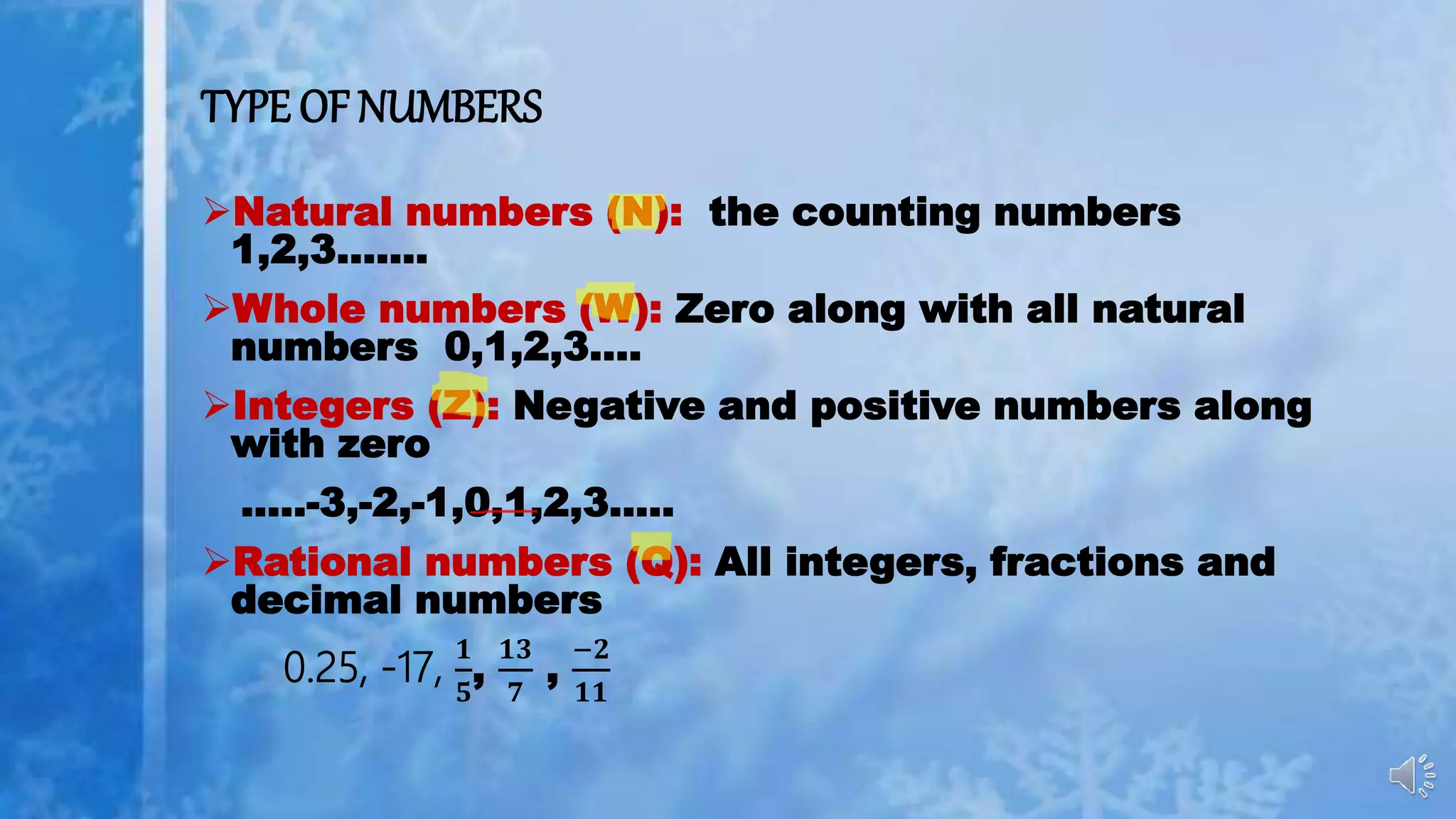
Natural numbers (N): the counting numbers
1,2,3…….
Whole numbers (W): Zero along with all natural
numbers 0,1,2,3….
Integers (Z): Negative and positive numbers along
with zero
…..-3,-2,-1,0,1,2,3…..
Rational numbers (Q): All integers, fractions and
decimal numbers
0.25, -17,
𝟏
𝟓
,
𝟏𝟑
𝟕
,
−𝟐
𝟏𝟏
RATIONAL NUMBERS
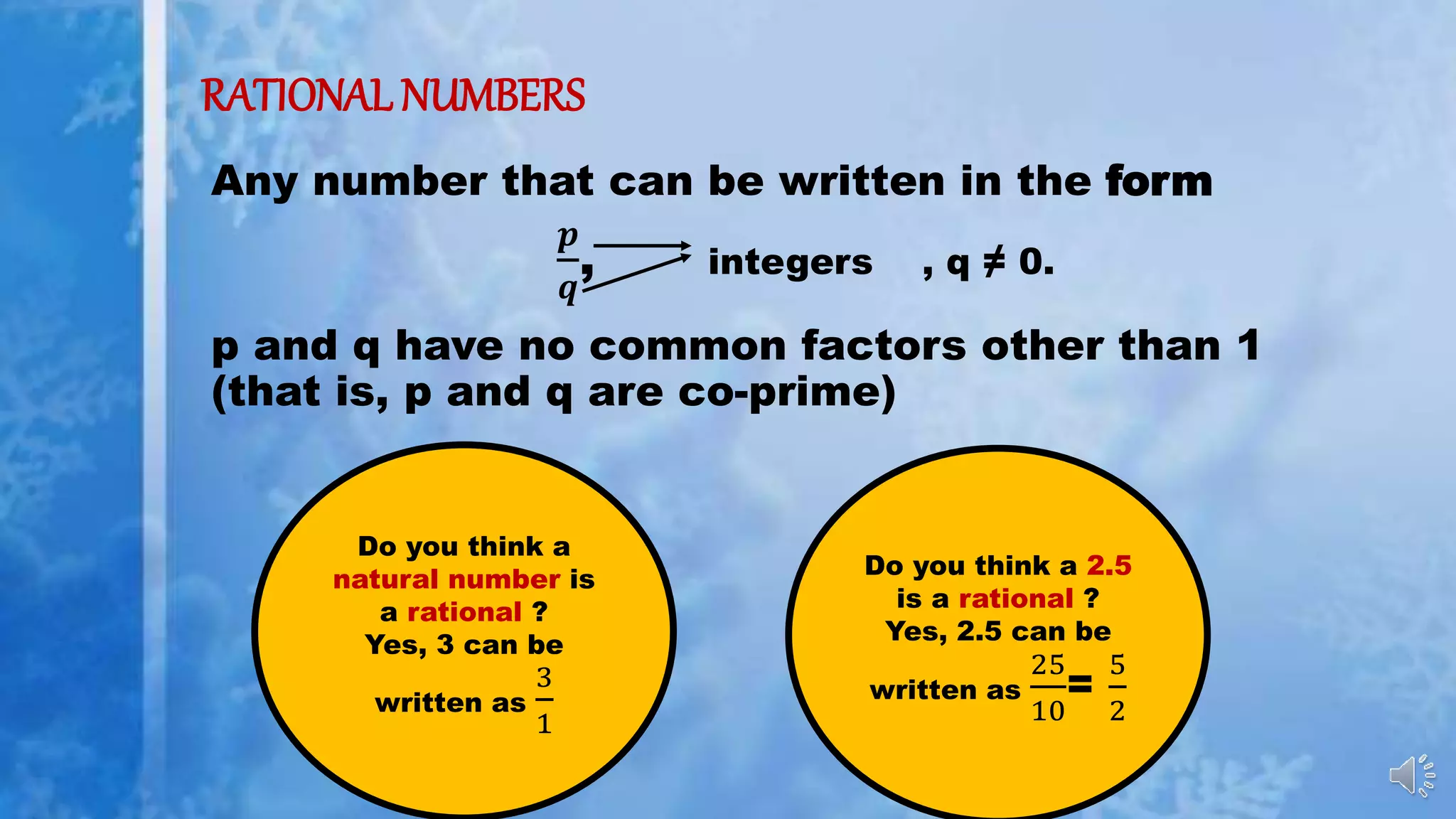
Any number that can be written in the form
𝒑
𝒒
, integers , q ≠ 0.
p and q have no common factors other than 1
(that is, p and q are co-prime)
Do you think a
natural number is
a rational ?
Yes, 3 can be
written as
3
1
Do you think a 2.5
is a rational ?
Yes, 2.5 can be
written as
25
10
=
5
2
NUMBERSYSTEM
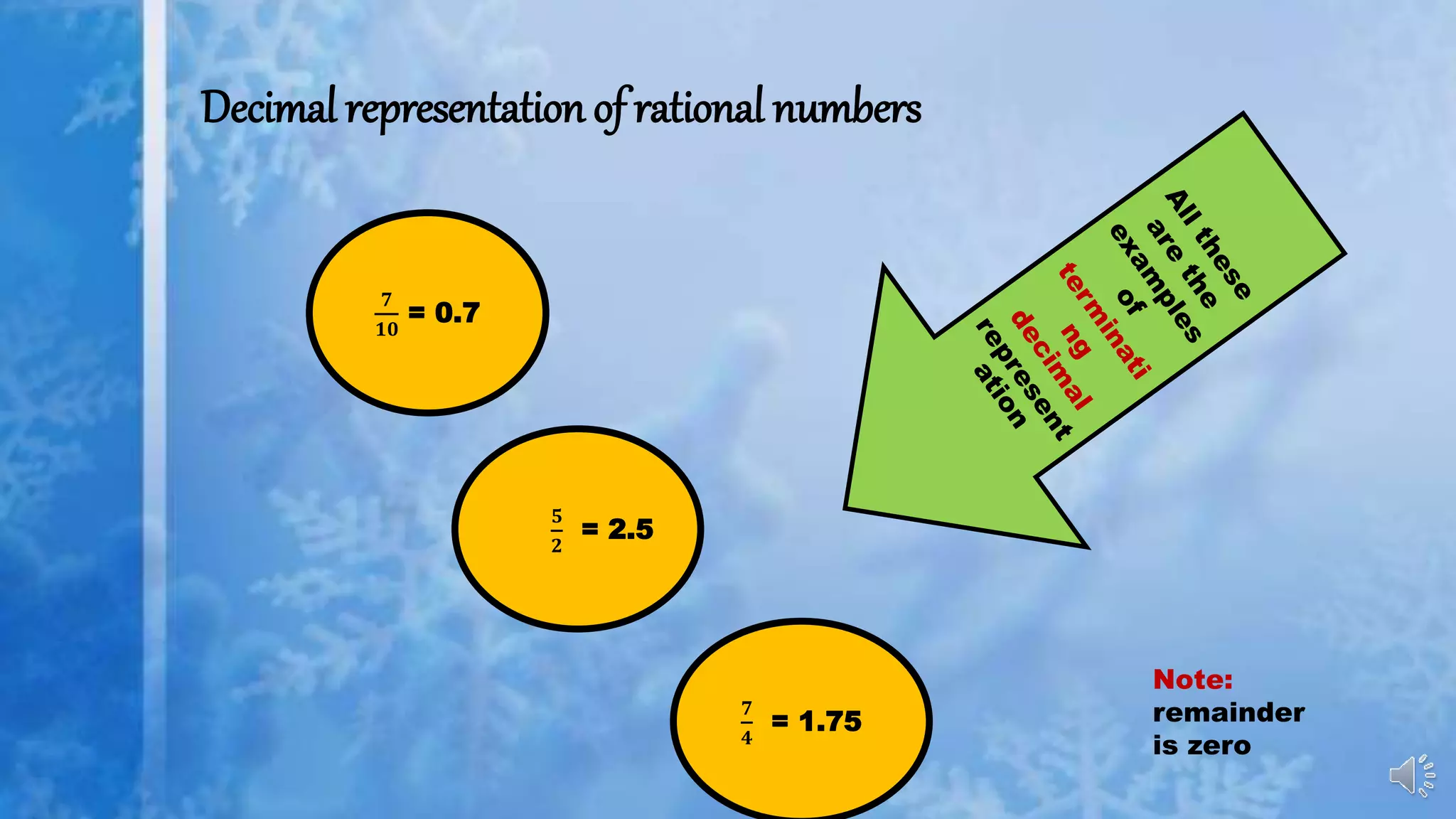
Decimal representation of rational numbers
𝟕
𝟏𝟎
= 0.7
𝟓
𝟐
= 2.5
𝟕
𝟒
= 1.75
Note:
remainder
is zero
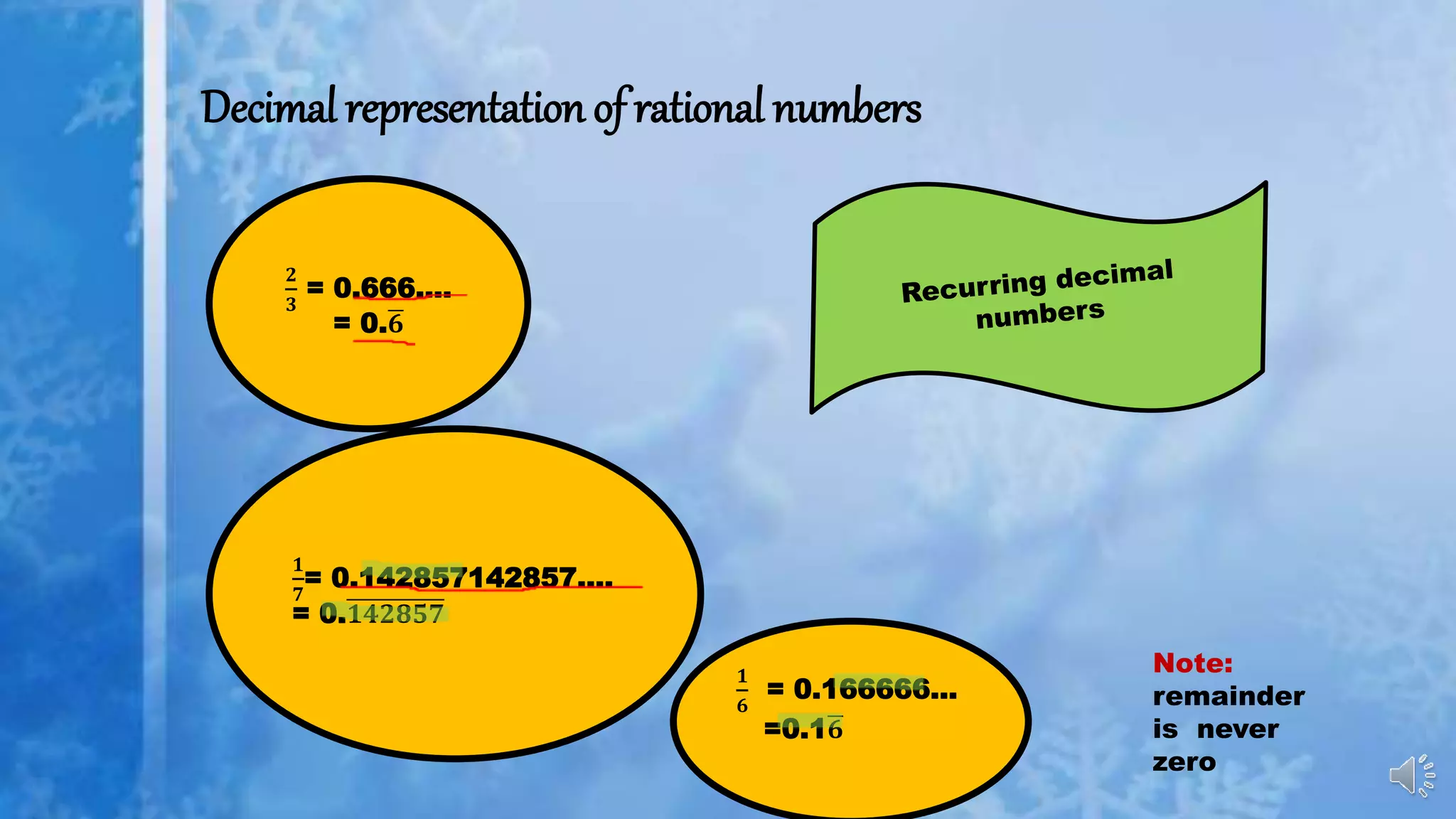
Decimal representation of rational numbers
𝟐
𝟑
= 0.666….
= 0. 𝟔
𝟏
𝟕
= 0.142857142857….
= 0.𝟏𝟒𝟐𝟖𝟓𝟕
𝟏
𝟔
= 0.166666…
=0.1 𝟔
Note:
remainder
is never
zero
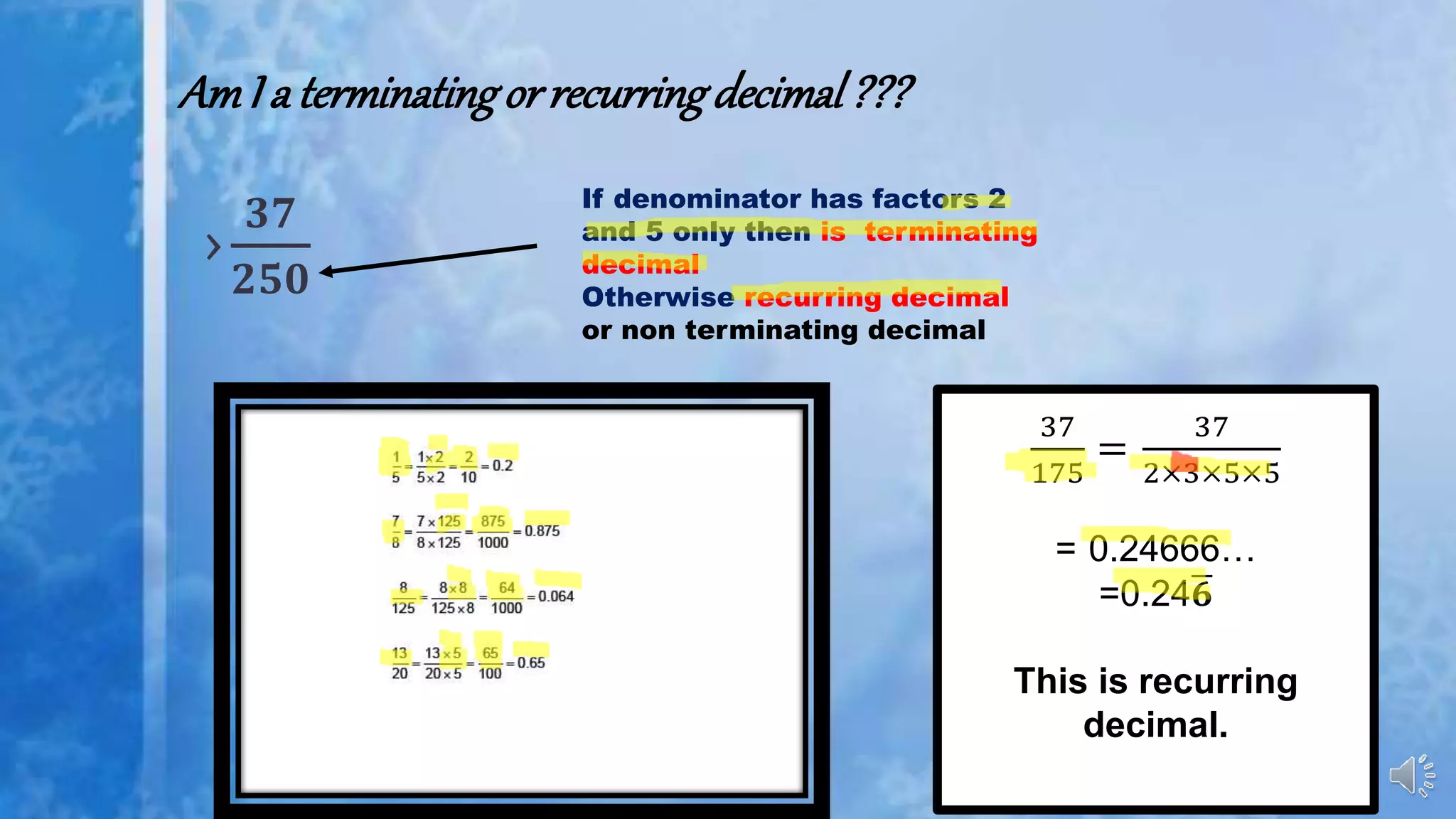
AmI a terminatingorrecurringdecimal???
›
𝟑𝟕
𝟐𝟓𝟎
If denominator has factors 2
and 5 only then is terminating
decimal
Otherwise recurring decimal
or non terminating decimal
37
175
=
37
2×3×5×5
= 0.24666…
=0.24 𝟔
This is recurring
decimal.
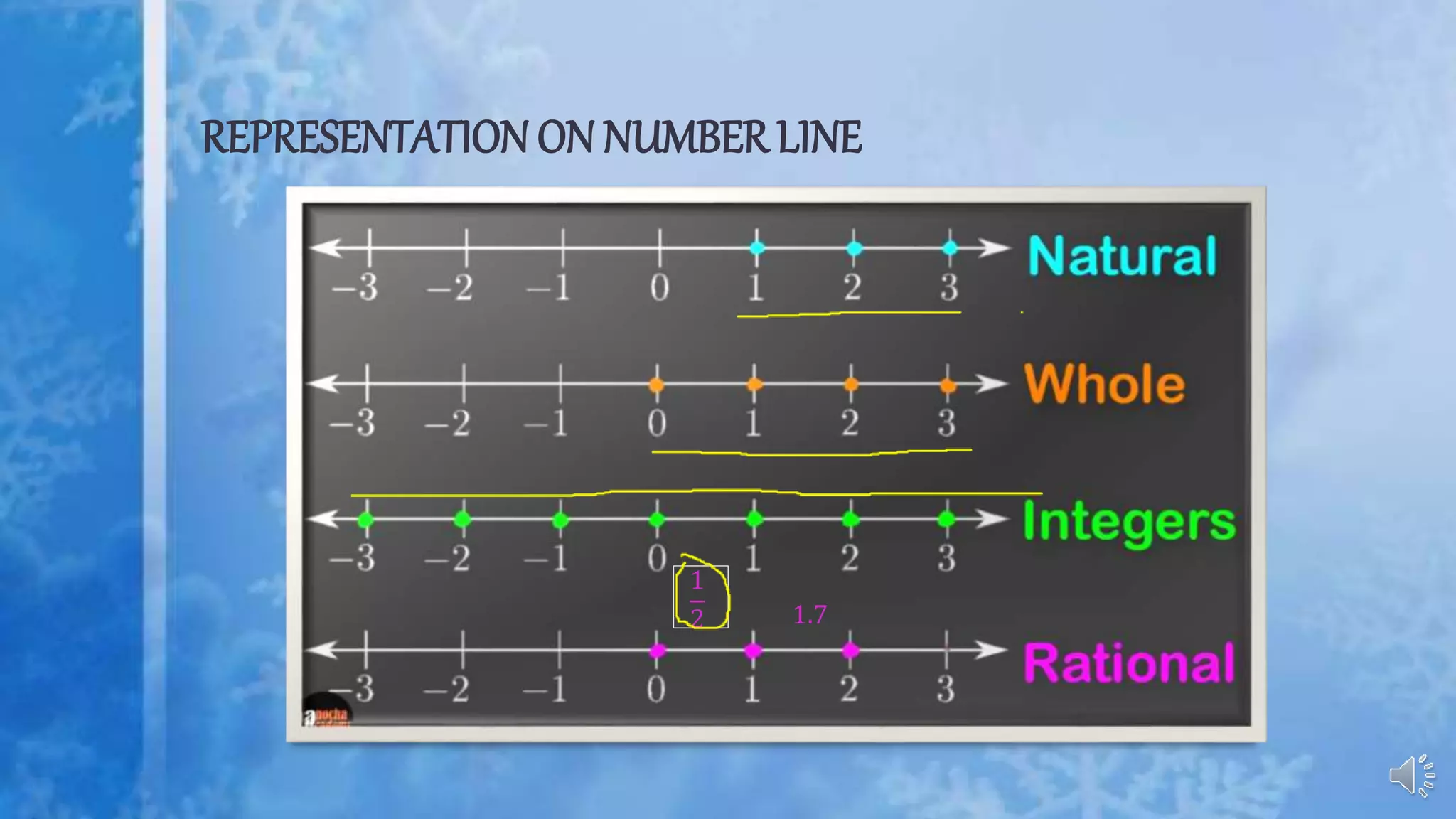
REPRESENTATION ON NUMBERLINE
1
2 1.7
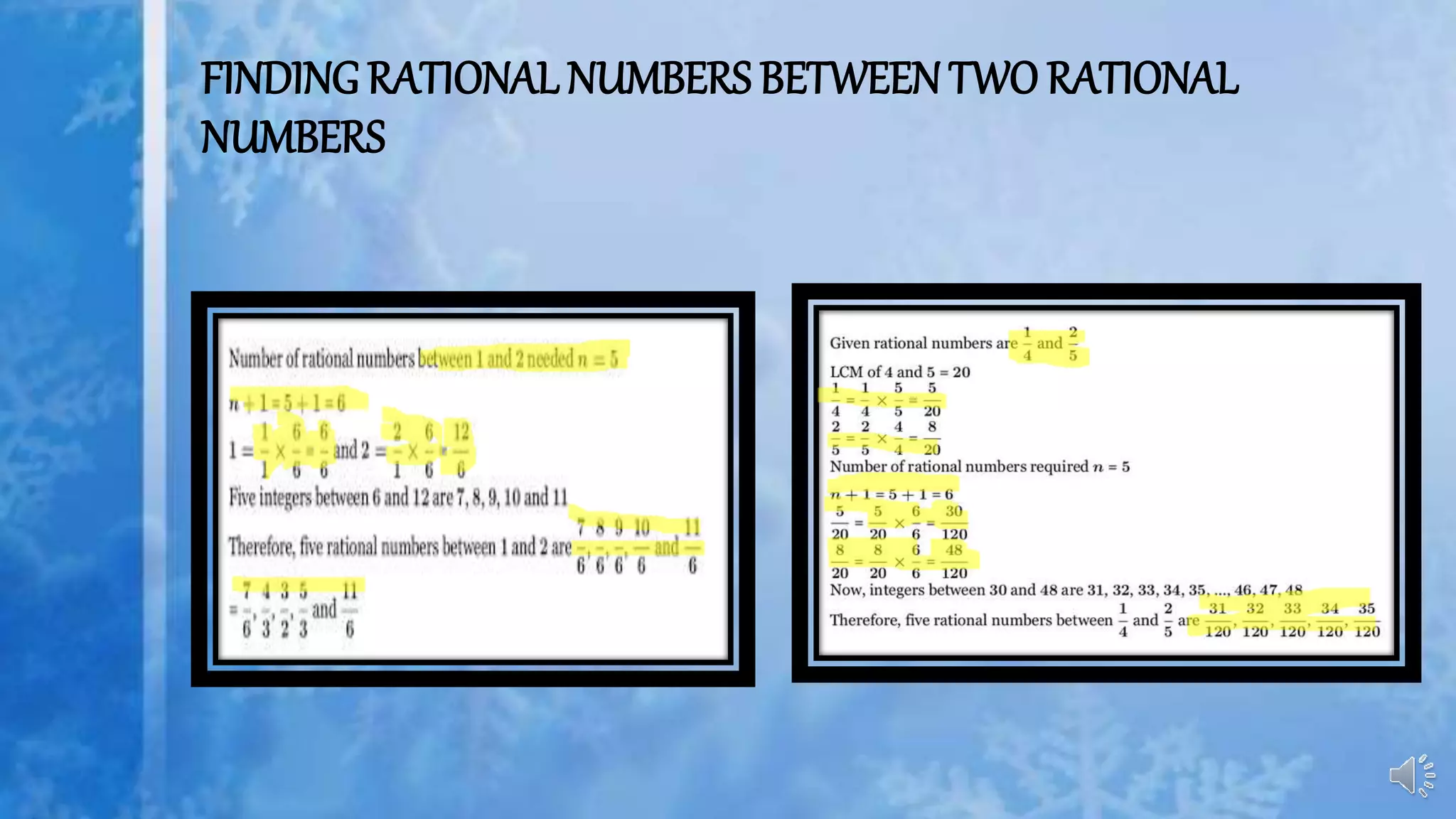
FINDINGRATIONALNUMBERS BETWEENTWO RATIONAL
NUMBERS
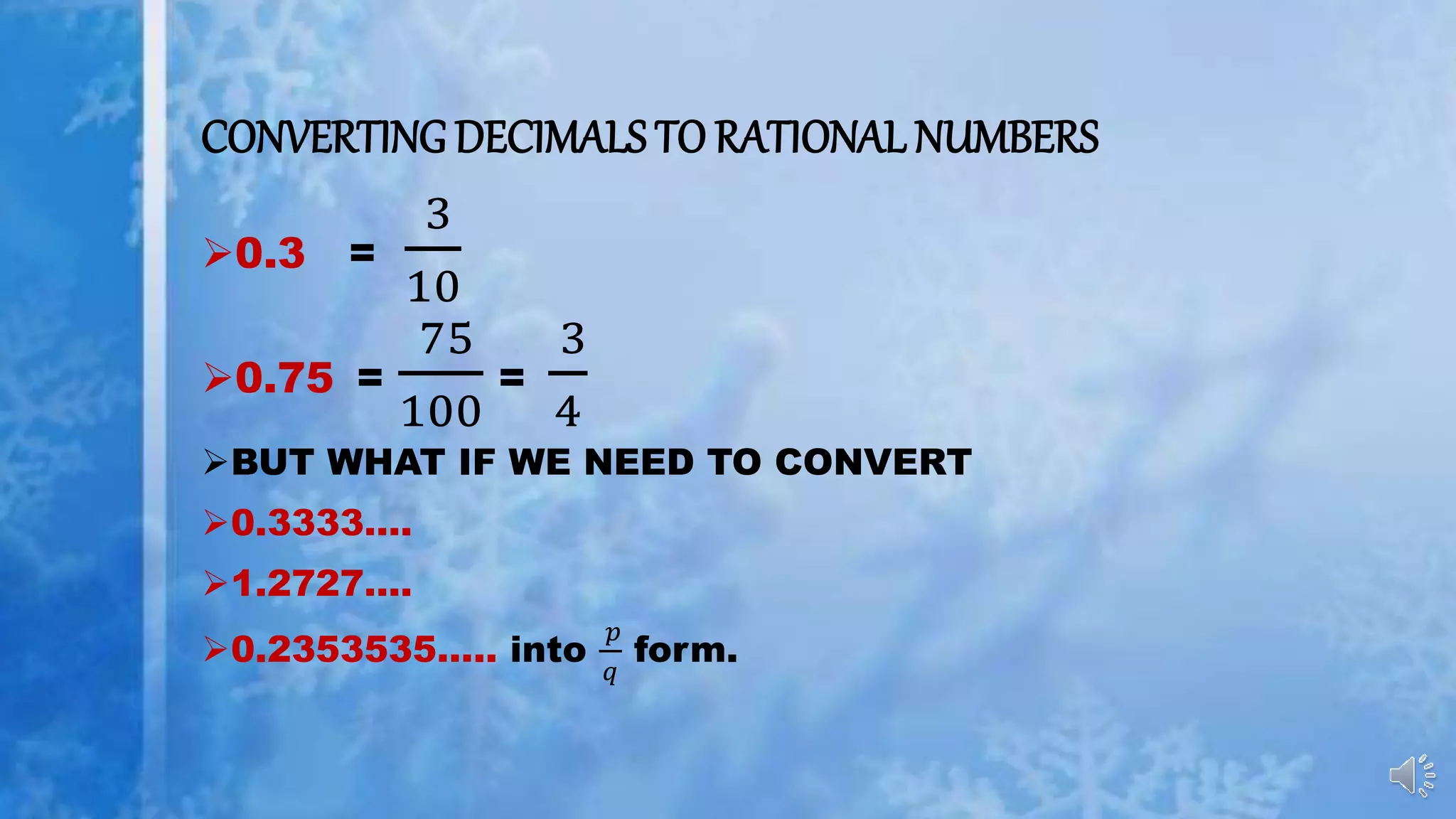
CONVERTING DECIMALS TO RATIONAL NUMBERS
0.3 =
3
10
0.75 =
75
100
=
3
4
BUT WHAT IF WE NEED TO CONVERT
0.3333….
1.2727….
0.2353535….. into
𝑝
𝑞
form.
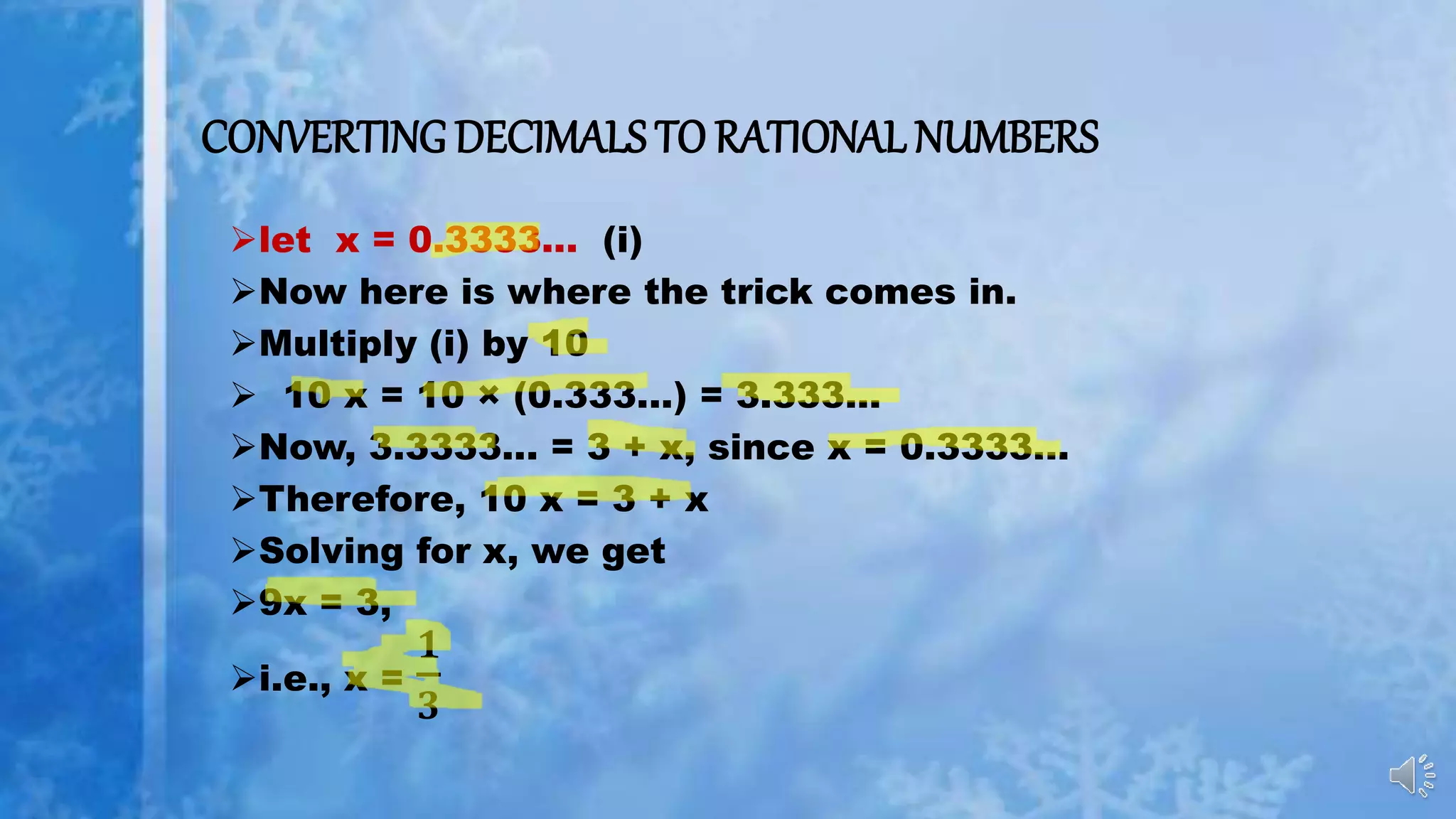
CONVERTING DECIMALS TO RATIONAL NUMBERS
let x = 0.3333... (i)
Now here is where the trick comes in.
Multiply (i) by 10
 10 x = 10 × (0.333...) = 3.333...
Now, 3.3333... = 3 + x, since x = 0.3333...
Therefore, 10 x = 3 + x
Solving for x, we get
9x = 3,
i.e., x =
𝟏
𝟑
CONVERTING DECIMALS TO RATIONAL NUMBERS
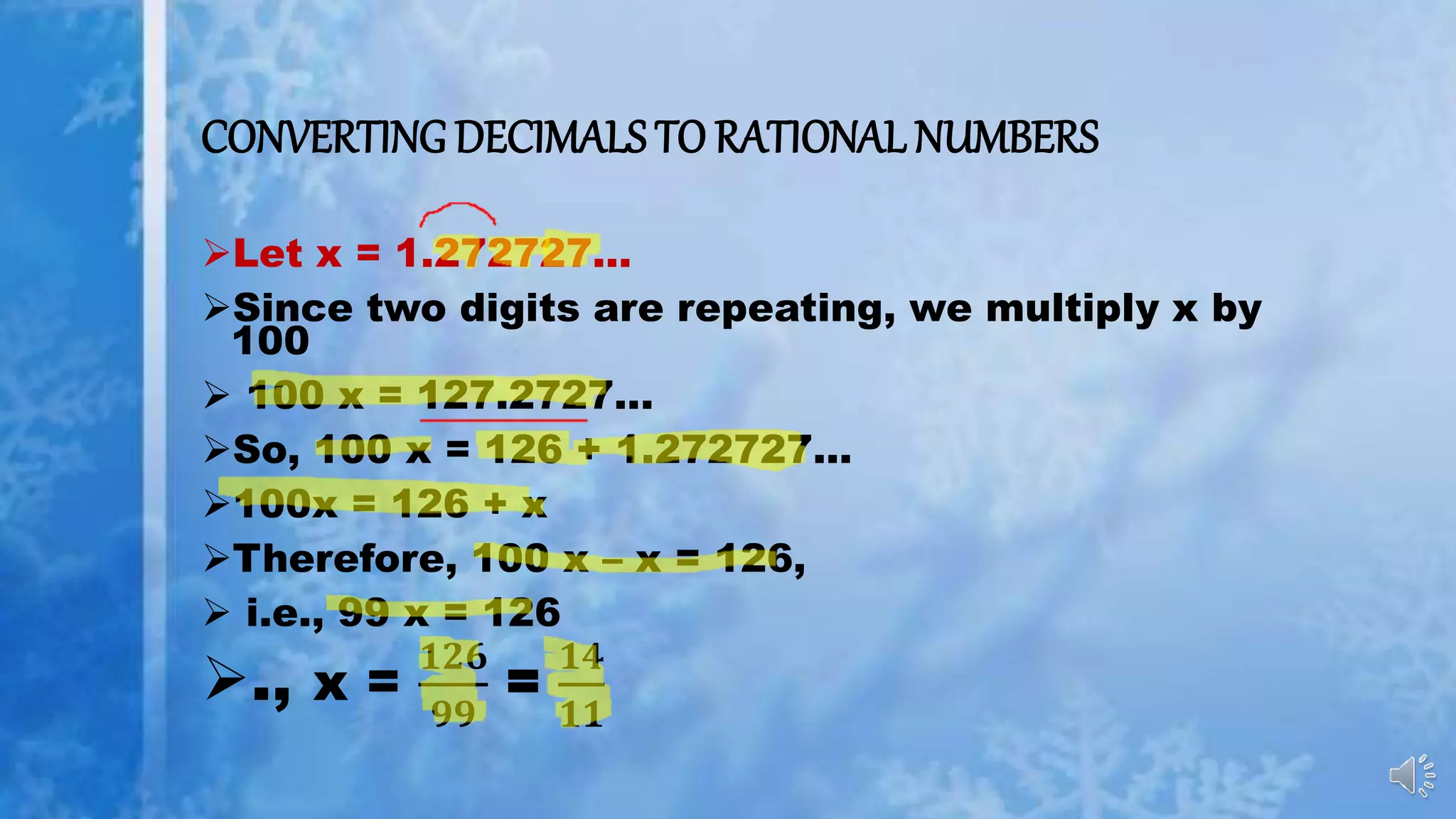
Let x = 1.272727...
Since two digits are repeating, we multiply x by
100
 100 x = 127.2727...
So, 100 x = 126 + 1.272727...
100x = 126 + x
Therefore, 100 x – x = 126,
 i.e., 99 x = 126
., x =
𝟏𝟐𝟔
𝟗𝟗
=
𝟏𝟒
𝟏𝟏
CONVERTING DECIMALS TO RATIONAL NUMBERS
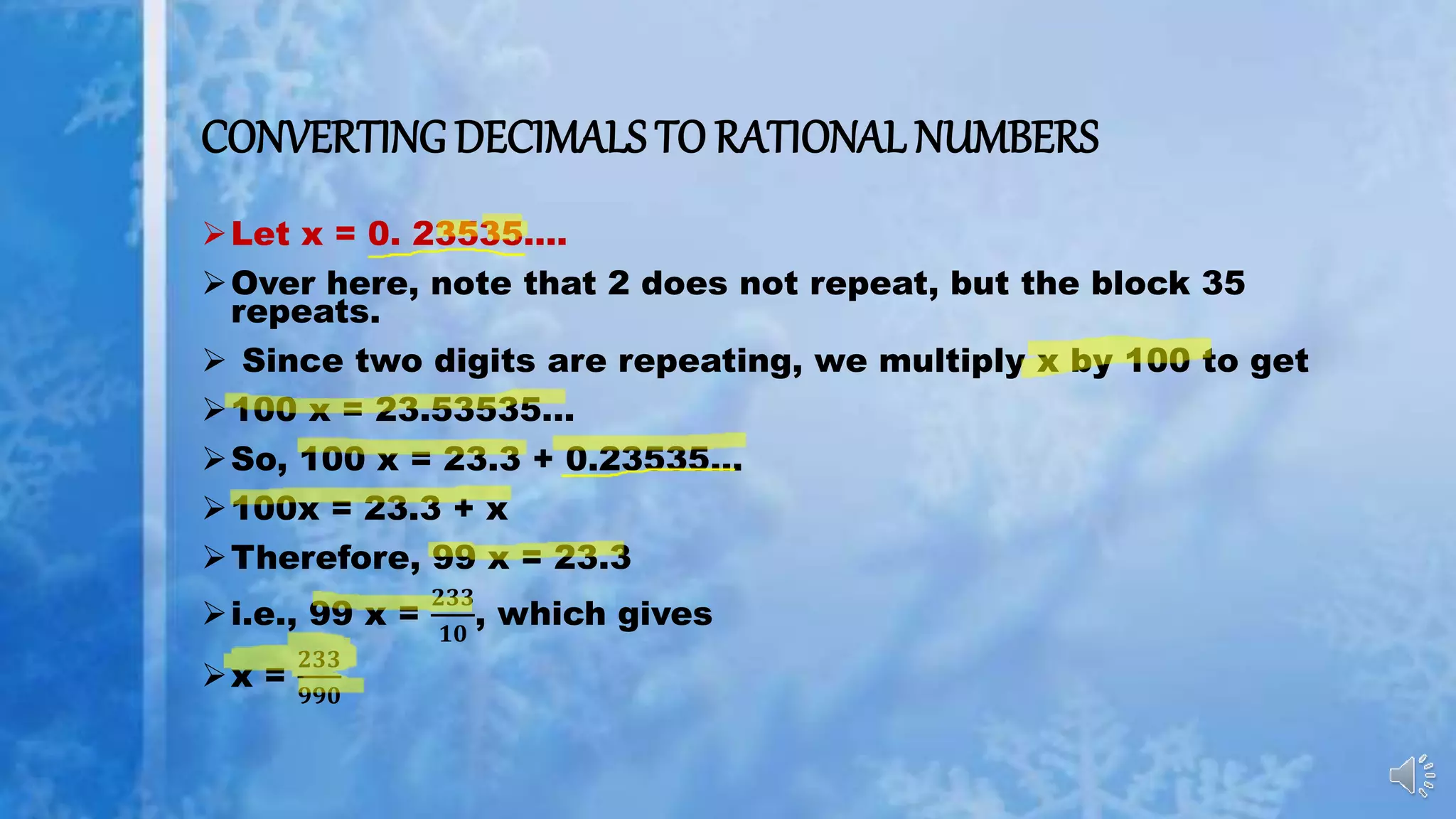
Let x = 0. 23535….
Over here, note that 2 does not repeat, but the block 35
repeats.
 Since two digits are repeating, we multiply x by 100 to get
100 x = 23.53535...
So, 100 x = 23.3 + 0.23535...
100x = 23.3 + x
Therefore, 99 x = 23.3
i.e., 99 x =
𝟐𝟑𝟑
𝟏𝟎
, which gives
x =
𝟐𝟑𝟑
𝟗𝟗𝟎
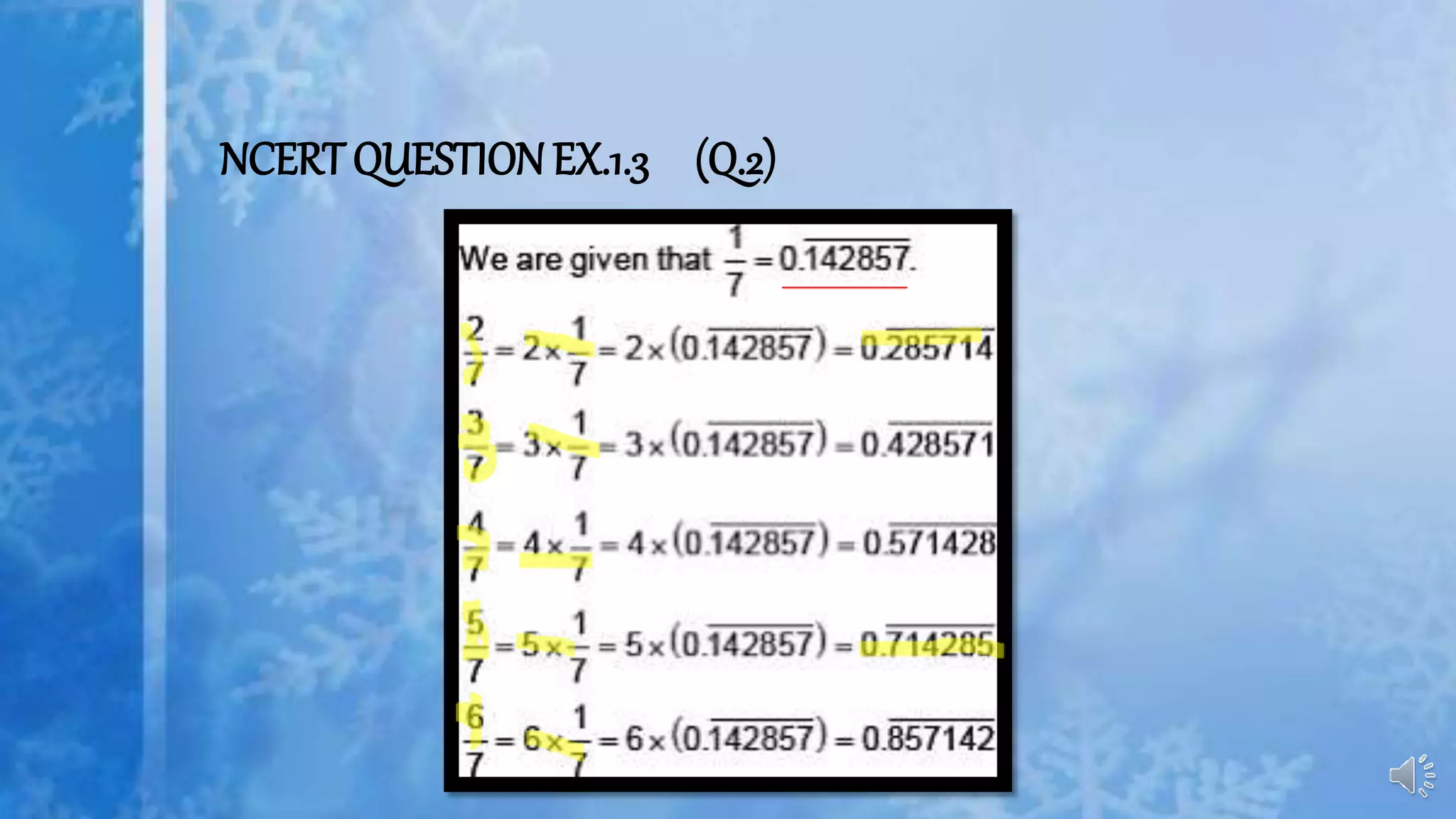
NCERT QUESTIONEX.1.3 (Q.2)

Number system class IX

  • 1.
  • 2.
    TYPE OF NUMBERS Naturalnumbers (N): the counting numbers 1,2,3……. Whole numbers (W): Zero along with all natural numbers 0,1,2,3…. Integers (Z): Negative and positive numbers along with zero …..-3,-2,-1,0,1,2,3….. Rational numbers (Q): All integers, fractions and decimal numbers 0.25, -17, 𝟏 𝟓 , 𝟏𝟑 𝟕 , −𝟐 𝟏𝟏
  • 3.
    RATIONAL NUMBERS Any numberthat can be written in the form 𝒑 𝒒 , integers , q ≠ 0. p and q have no common factors other than 1 (that is, p and q are co-prime) Do you think a natural number is a rational ? Yes, 3 can be written as 3 1 Do you think a 2.5 is a rational ? Yes, 2.5 can be written as 25 10 = 5 2
  • 4.
  • 5.
    Decimal representation ofrational numbers 𝟕 𝟏𝟎 = 0.7 𝟓 𝟐 = 2.5 𝟕 𝟒 = 1.75 Note: remainder is zero
  • 6.
    Decimal representation ofrational numbers 𝟐 𝟑 = 0.666…. = 0. 𝟔 𝟏 𝟕 = 0.142857142857…. = 0.𝟏𝟒𝟐𝟖𝟓𝟕 𝟏 𝟔 = 0.166666… =0.1 𝟔 Note: remainder is never zero
  • 7.
    AmI a terminatingorrecurringdecimal??? › 𝟑𝟕 𝟐𝟓𝟎 Ifdenominator has factors 2 and 5 only then is terminating decimal Otherwise recurring decimal or non terminating decimal 37 175 = 37 2×3×5×5 = 0.24666… =0.24 𝟔 This is recurring decimal.
  • 8.
  • 10.
  • 11.
    CONVERTING DECIMALS TORATIONAL NUMBERS 0.3 = 3 10 0.75 = 75 100 = 3 4 BUT WHAT IF WE NEED TO CONVERT 0.3333…. 1.2727…. 0.2353535….. into 𝑝 𝑞 form.
  • 12.
    CONVERTING DECIMALS TORATIONAL NUMBERS let x = 0.3333... (i) Now here is where the trick comes in. Multiply (i) by 10  10 x = 10 × (0.333...) = 3.333... Now, 3.3333... = 3 + x, since x = 0.3333... Therefore, 10 x = 3 + x Solving for x, we get 9x = 3, i.e., x = 𝟏 𝟑
  • 13.
    CONVERTING DECIMALS TORATIONAL NUMBERS Let x = 1.272727... Since two digits are repeating, we multiply x by 100  100 x = 127.2727... So, 100 x = 126 + 1.272727... 100x = 126 + x Therefore, 100 x – x = 126,  i.e., 99 x = 126 ., x = 𝟏𝟐𝟔 𝟗𝟗 = 𝟏𝟒 𝟏𝟏
  • 14.
    CONVERTING DECIMALS TORATIONAL NUMBERS Let x = 0. 23535…. Over here, note that 2 does not repeat, but the block 35 repeats.  Since two digits are repeating, we multiply x by 100 to get 100 x = 23.53535... So, 100 x = 23.3 + 0.23535... 100x = 23.3 + x Therefore, 99 x = 23.3 i.e., 99 x = 𝟐𝟑𝟑 𝟏𝟎 , which gives x = 𝟐𝟑𝟑 𝟗𝟗𝟎
  • 15.