

1
Energy efficient computing & computational services
David Wallom
Energy Efficiency in Computing
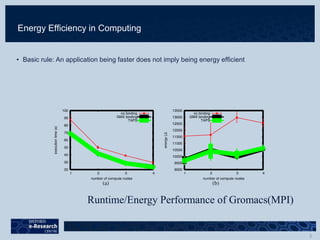
• Basic rule: An application being faster does not imply being energy efficient
Runtime/Energy Performance of Gromacs(MPI)
Energy Efficiency in Computing
• Aim to:
– Achieve best possible balance of performance with energy
consumption
– Use hardware features to achieve this goal. E.g.
• Dynamic Concurrency Throttling (DCT)
• Dynamic Voltage and Frequency Scaling (DVFS)
• Efficient mapping of processes
Achieving Energy Efficiency
• Profiling and Tuning
– Profile applications for their energy/power footprint
– Optimize software components for reducing this footprint
• Operational reduction
– Understand the usage pattern of computing systems
– Manage their usage using algorithms
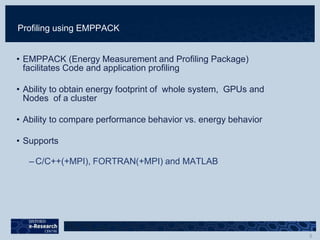
Profiling using EMPPACK
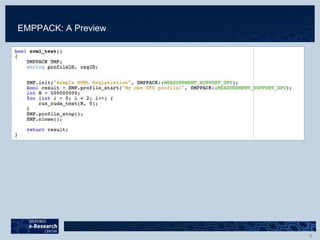
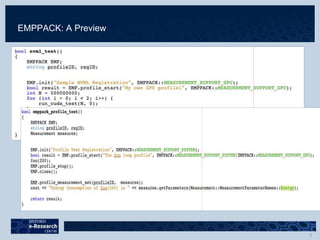
• EMPPACK (Energy Measurement and Profiling Package)
facilitates Code and application profiling
• Ability to obtain energy footprint of whole system, GPUs and
Nodes of a cluster
• Ability to compare performance behavior vs. energy behavior
• Supports
– C/C++(+MPI), FORTRAN(+MPI) and MATLAB
EMPPACK: A Preview
EMPPACK: A Preview
Uses of EMPPACK
• Data processing – ground segments
• Drive on-board software design and improvements
Energy Efficiency in SKA
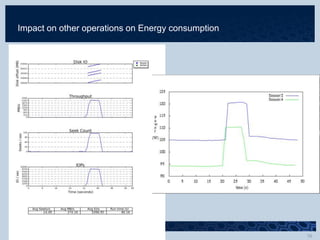
Impact on other operations on Energy consumption
Enhancements
• Power
– In-band
• EMPACK
• Intel tools/API's (http://software.intel.com/en-us/blogs/2013/06/18/measuring-
application-power-consumption-on-linux-operating-system)
– Out of band
• IPMI (Chassis)
• Hardware monitor e.g. Watts-On
• Cycles
– Oprofile
– Perf
– Intel tools/API's
– Paraver (http://www.bsc.es/computer-sciences/performance-tools/paraver)
• Network
– OSU Micro-Benchmarks suite
– Netperf
– Sockperf
Energy Efficiency through Operational Management
• Combining the knowledge of a system with high resolution
energy consumption information
– Use historic data to
• Detect the trend in usage of computing systems
Times of days, days of weeks where systems peaks, idles
etc
• Schedule systems management using a framework
– Holistic investigation to cover all behavior and contributions
• Applied analytics to identify features in data matching
known activities to allow for identification on unknown
activities
Computational Services/Integrated Applications
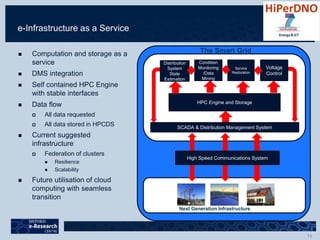
 Computation and storage as a
service
 DMS integration
 Self contained HPC Engine
with stable interfaces
 Data flow
 All data requested
 All data stored in HPCDS
 Current suggested
infrastructure
 Federation of clusters
 Resilience
 Scalability
 Future utilisation of cloud
computing with seamless
transition
e-Infrastructure as a Service
HPC Engine and Storage
Next Generation Infrastructure
The Smart Grid
High Speed Communications System
Service
Restoration
Voltage
Control
Condition
Monitoring
/Data
Mining
Distribution
System
State
Estimation
SCADA & Distribution Management System
myTrustedCloud: Trusted Computing and Cloud
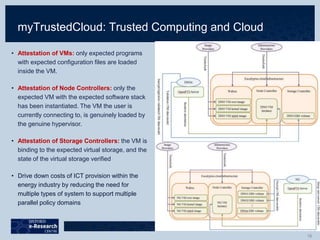
• Attestation of VMs: only expected programs
with expected configuration files are loaded
inside the VM.
• Attestation of Node Controllers: only the
expected VM with the expected software stack
has been instantiated. The VM the user is
currently connecting to, is genuinely loaded by
the genuine hypervisor.
• Attestation of Storage Controllers: the VM is
binding to the expected virtual storage, and the
state of the virtual storage verified
• Drive down costs of ICT provision within the
energy industry by reducing the need for
multiple types of system to support multiple
parallel policy domains
Creating Actionable Information
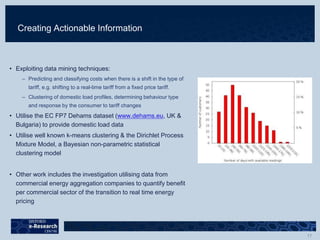
• Exploiting data mining techniques:
– Predicting and classifying costs when there is a shift in the type of
tariff, e.g. shifting to a real-time tariff from a fixed price tariff.
– Clustering of domestic load profiles, determining behaviour type
and response by the consumer to tariff changes
• Utilise the EC FP7 Dehams dataset (www.dehams.eu, UK &
Bulgaria) to provide domestic load data
• Utilise well known k-means clustering & the Dirichlet Process
Mixture Model, a Bayesian non-parametric statistical
clustering model
• Other work includes the investigation utilising data from
commercial energy aggregation companies to quantify benefit
per commercial sector of the transition to real time energy
pricing
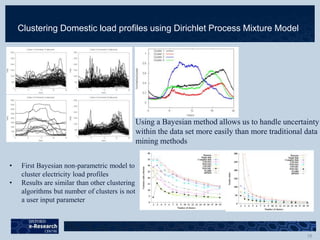
Clustering Domestic load profiles using Dirichlet Process Mixture Model
Using a Bayesian method allows us to handle uncertainty
within the data set more easily than more traditional data
mining methods
• First Bayesian non-parametric model to
cluster electricity load profiles
• Results are similar than other clustering
algorithms but number of clusters is not
a user input parameter
Potential Areas of Collaboration.
• One of the leading groups in the UK and internationally to work on Energy
Efficient Computing
• We do have the most capable energy profiling software (the other one is
PowerPack)
• We have better understanding of software w.r.t to their energy consumption
• EMPPACK is portable, supports C/C++/MATLAB and works on clusters with
GPUs.
• Provide profiling ability to achieve energy efficient computing in large-scale
parallel simulations
• With thanks to;
– J. Thiyagalingam.
– W. Armour
– Anne E Trefethen

Energy efficient computing & computational services

  • 1.
    1 Energy efficient computing& computational services David Wallom
  • 2.
    Energy Efficiency inComputing • Basic rule: An application being faster does not imply being energy efficient Runtime/Energy Performance of Gromacs(MPI)
  • 3.
    Energy Efficiency inComputing • Aim to: – Achieve best possible balance of performance with energy consumption – Use hardware features to achieve this goal. E.g. • Dynamic Concurrency Throttling (DCT) • Dynamic Voltage and Frequency Scaling (DVFS) • Efficient mapping of processes
  • 4.
    Achieving Energy Efficiency •Profiling and Tuning – Profile applications for their energy/power footprint – Optimize software components for reducing this footprint • Operational reduction – Understand the usage pattern of computing systems – Manage their usage using algorithms
  • 5.
    Profiling using EMPPACK •EMPPACK (Energy Measurement and Profiling Package) facilitates Code and application profiling • Ability to obtain energy footprint of whole system, GPUs and Nodes of a cluster • Ability to compare performance behavior vs. energy behavior • Supports – C/C++(+MPI), FORTRAN(+MPI) and MATLAB
  • 6.
  • 7.
  • 8.
    Uses of EMPPACK •Data processing – ground segments • Drive on-board software design and improvements
  • 9.
  • 10.
    Impact on otheroperations on Energy consumption
  • 11.
    Enhancements • Power – In-band •EMPACK • Intel tools/API's (http://software.intel.com/en-us/blogs/2013/06/18/measuring- application-power-consumption-on-linux-operating-system) – Out of band • IPMI (Chassis) • Hardware monitor e.g. Watts-On • Cycles – Oprofile – Perf – Intel tools/API's – Paraver (http://www.bsc.es/computer-sciences/performance-tools/paraver) • Network – OSU Micro-Benchmarks suite – Netperf – Sockperf
  • 12.
    Energy Efficiency throughOperational Management • Combining the knowledge of a system with high resolution energy consumption information – Use historic data to • Detect the trend in usage of computing systems Times of days, days of weeks where systems peaks, idles etc • Schedule systems management using a framework – Holistic investigation to cover all behavior and contributions • Applied analytics to identify features in data matching known activities to allow for identification on unknown activities
  • 14.
  • 15.
     Computation andstorage as a service  DMS integration  Self contained HPC Engine with stable interfaces  Data flow  All data requested  All data stored in HPCDS  Current suggested infrastructure  Federation of clusters  Resilience  Scalability  Future utilisation of cloud computing with seamless transition e-Infrastructure as a Service HPC Engine and Storage Next Generation Infrastructure The Smart Grid High Speed Communications System Service Restoration Voltage Control Condition Monitoring /Data Mining Distribution System State Estimation SCADA & Distribution Management System
  • 16.
    myTrustedCloud: Trusted Computingand Cloud • Attestation of VMs: only expected programs with expected configuration files are loaded inside the VM. • Attestation of Node Controllers: only the expected VM with the expected software stack has been instantiated. The VM the user is currently connecting to, is genuinely loaded by the genuine hypervisor. • Attestation of Storage Controllers: the VM is binding to the expected virtual storage, and the state of the virtual storage verified • Drive down costs of ICT provision within the energy industry by reducing the need for multiple types of system to support multiple parallel policy domains
  • 17.
    Creating Actionable Information •Exploiting data mining techniques: – Predicting and classifying costs when there is a shift in the type of tariff, e.g. shifting to a real-time tariff from a fixed price tariff. – Clustering of domestic load profiles, determining behaviour type and response by the consumer to tariff changes • Utilise the EC FP7 Dehams dataset (www.dehams.eu, UK & Bulgaria) to provide domestic load data • Utilise well known k-means clustering & the Dirichlet Process Mixture Model, a Bayesian non-parametric statistical clustering model • Other work includes the investigation utilising data from commercial energy aggregation companies to quantify benefit per commercial sector of the transition to real time energy pricing
  • 18.
    Clustering Domestic loadprofiles using Dirichlet Process Mixture Model Using a Bayesian method allows us to handle uncertainty within the data set more easily than more traditional data mining methods • First Bayesian non-parametric model to cluster electricity load profiles • Results are similar than other clustering algorithms but number of clusters is not a user input parameter
  • 19.
    Potential Areas ofCollaboration. • One of the leading groups in the UK and internationally to work on Energy Efficient Computing • We do have the most capable energy profiling software (the other one is PowerPack) • We have better understanding of software w.r.t to their energy consumption • EMPPACK is portable, supports C/C++/MATLAB and works on clusters with GPUs. • Provide profiling ability to achieve energy efficient computing in large-scale parallel simulations
  • 20.
    • With thanksto; – J. Thiyagalingam. – W. Armour – Anne E Trefethen

Editor's Notes

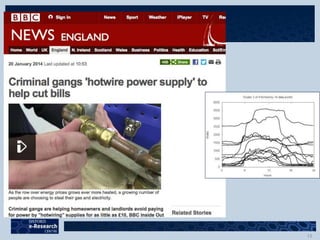
  • #19 Here we have clustered domestic smart meter data from small scale trials, also utilised commercial datasets to establish the impact of the introduction of real-time pricing on different types of business Estimated that energy theft is a £500M/year problem.
  • #20 I’ve included a couple of slides to outline the current status of GPUs