11
Benefits of big data analytics in Smart Metering,
ADEPT, WICKED and beyond
Prof David Wallom
Associate Professor and Associate Director - Innovation
Advanced Dynamic Energy Pricing and Tariffs (ADEPT)
• Objectives
– Understand the limitations that domestic consumers are willing to consider acceptable in terms of
dynamic pricing tariffs
– Investigate the relationship between dynamic electricity tariffs and power network characteristics,
– Design a scalable computational and data platform
• Turning data into actionable information
– Exploiting well known & developing innovative data mining techniques, predicting and classifying costs, determining
behaviour type and response to tariff changes and other inputs
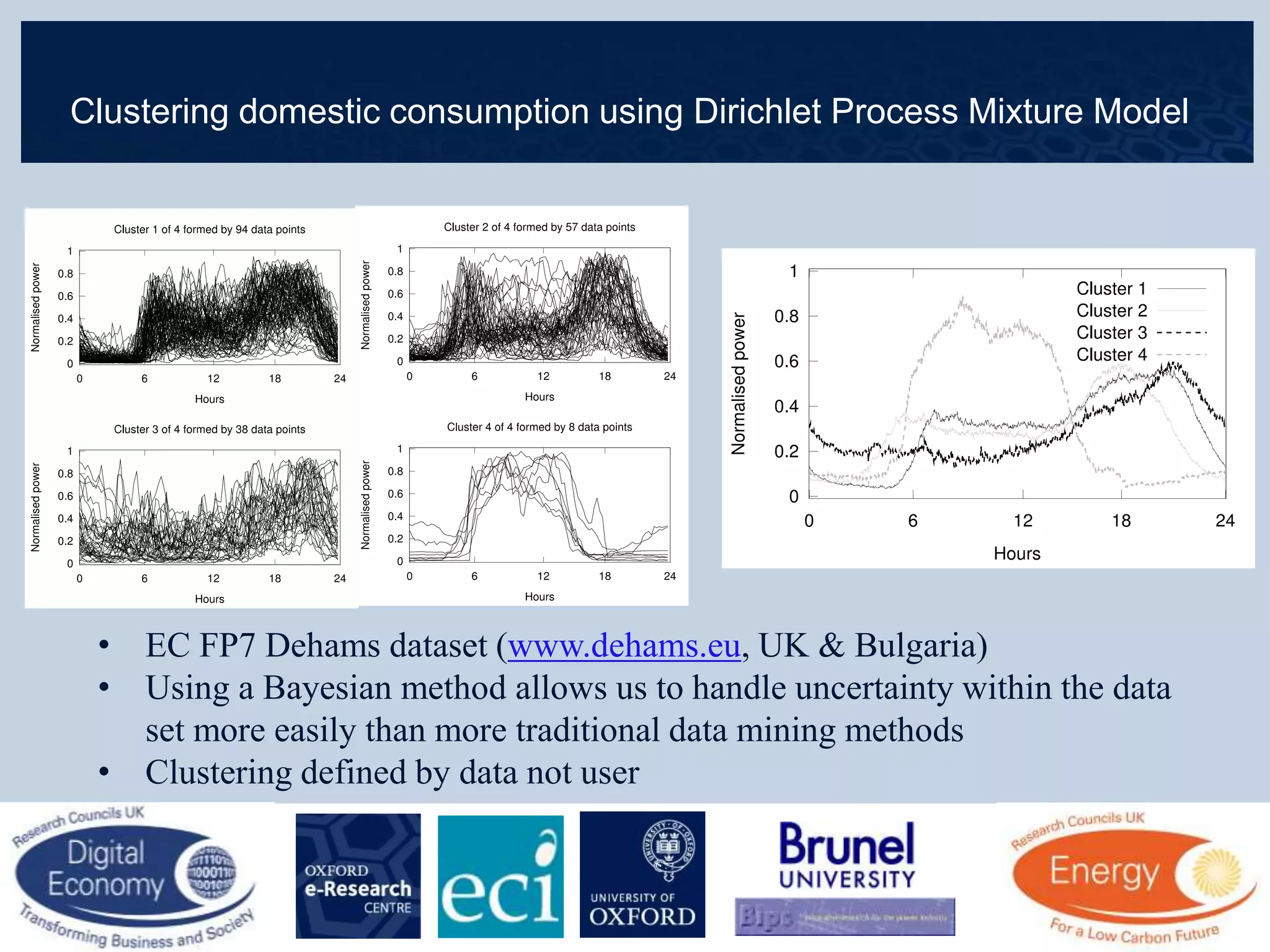
Clustering domestic consumption using Dirichlet Process Mixture Model
• EC FP7 Dehams dataset (www.dehams.eu, UK & Bulgaria)
• Using a Bayesian method allows us to handle uncertainty within the data
set more easily than more traditional data mining methods
• Clustering defined by data not user
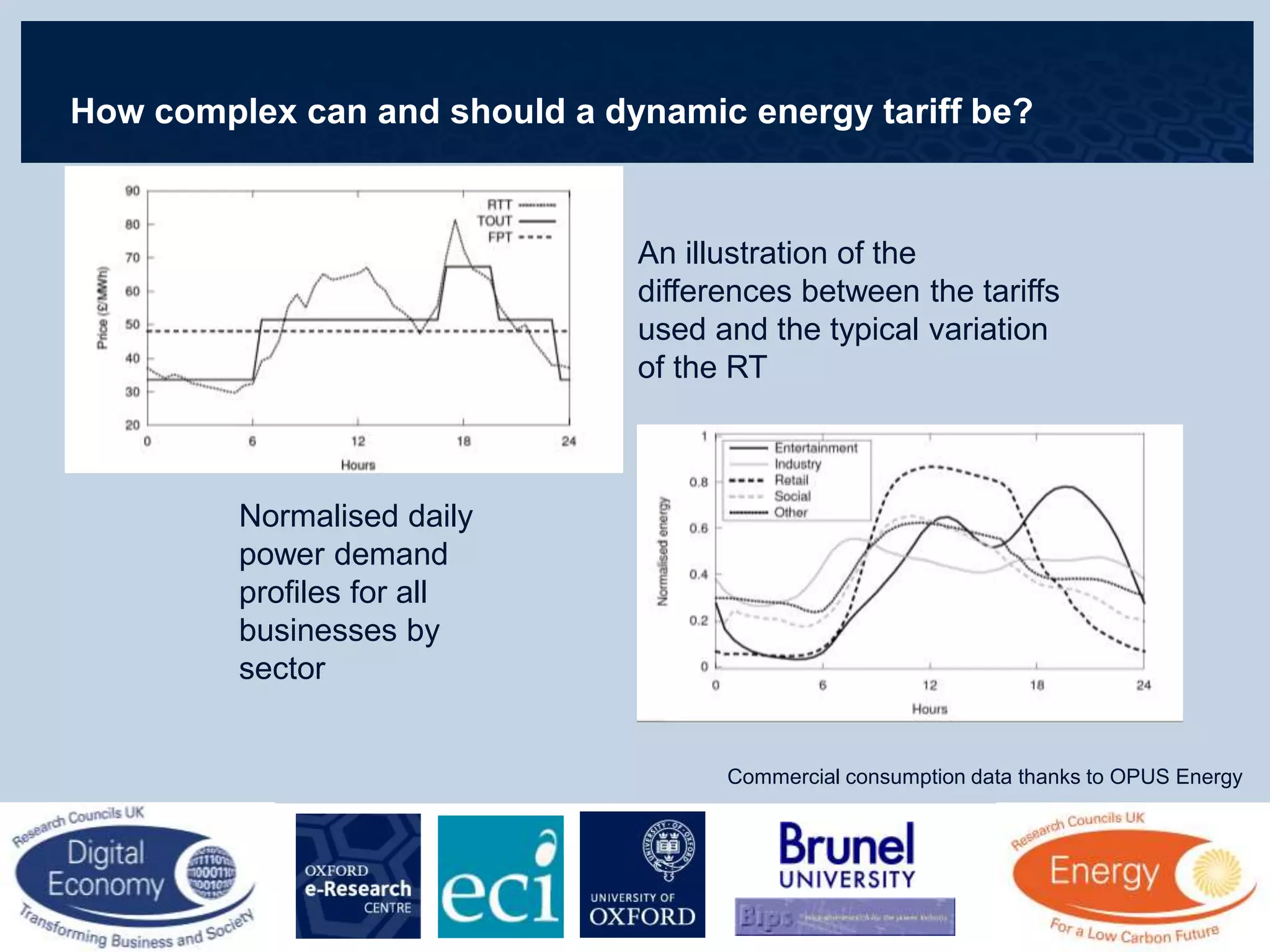
How complex can and should a dynamic energy tariff be?
Normalised daily
power demand
profiles for all
businesses by
sector
An illustration of the
differences between the tariffs
used and the typical variation
of the RT
Commercial consumption data thanks to OPUS Energy
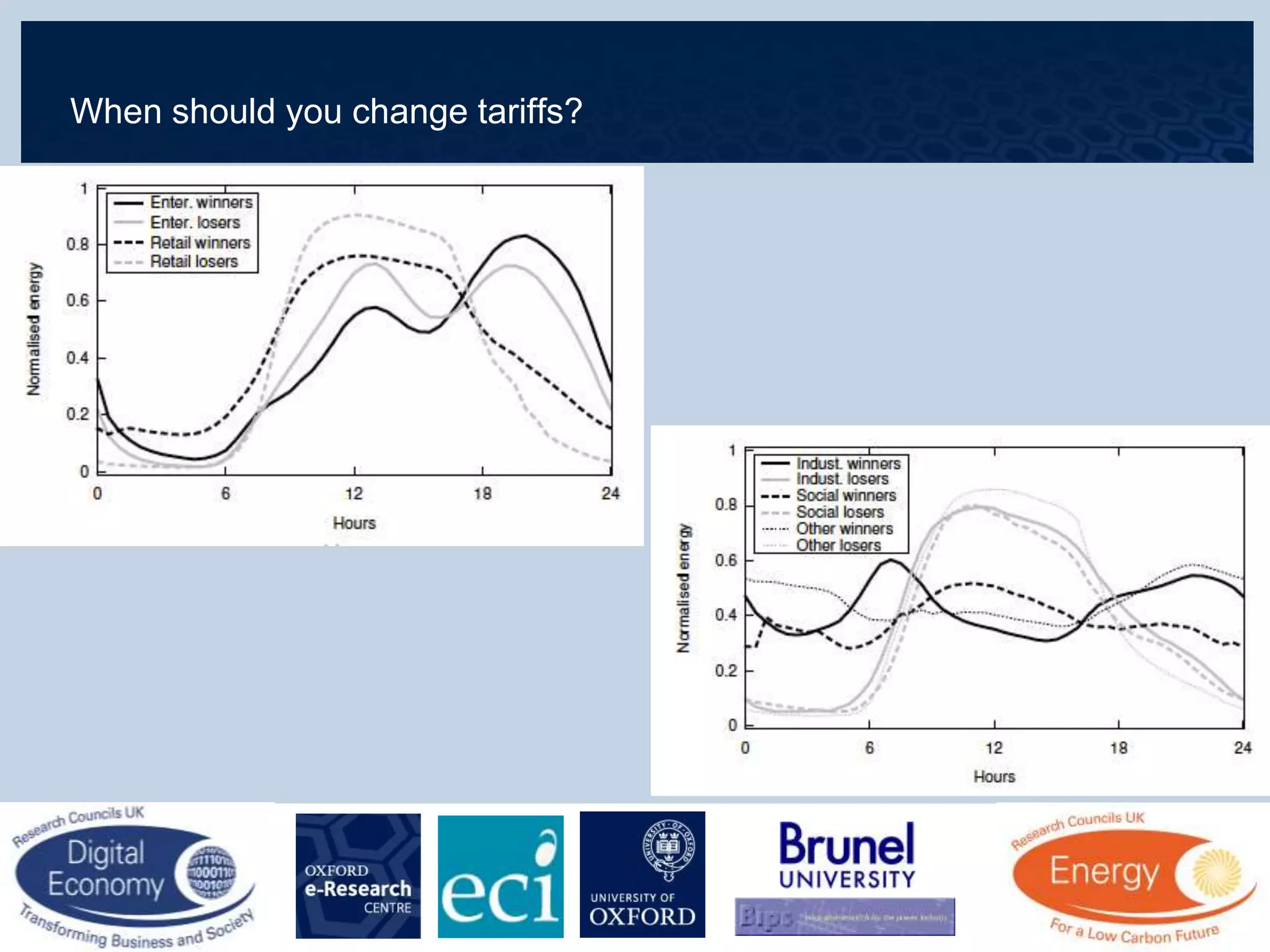
When should you change tariffs?
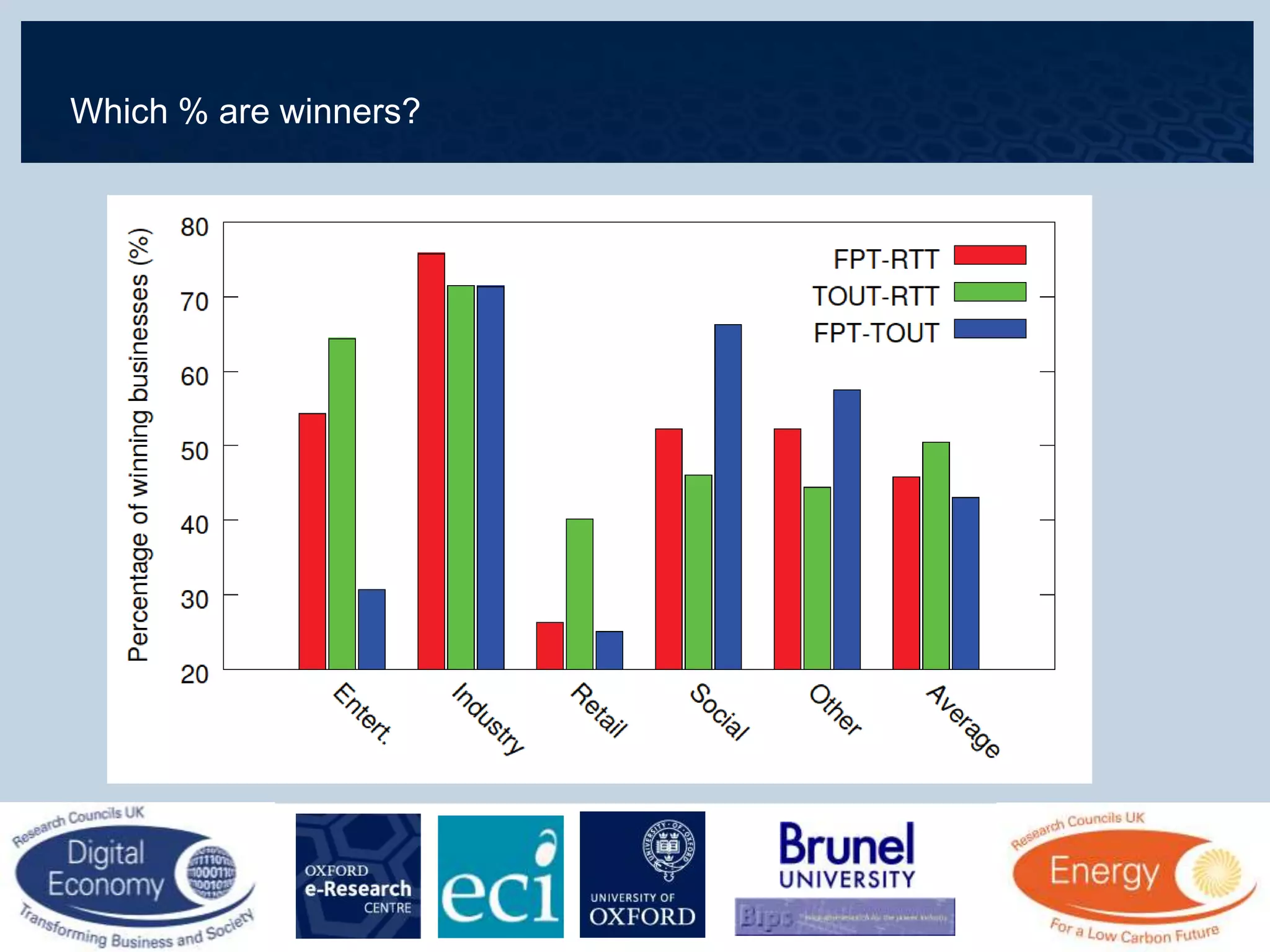
Which % are winners?
Can we predict winners?
• Binary Classification problem Winners (RC <1) & losers (RC>1)
• Three body classification problem Winners (RC<1-e), Neutral (RC<> [1-e, 1+e]) & Losers
(RC>1+e)
• Classification using Machine Learning; Artificial Neural Networks (ANN), Support Vector
Machines (SVM) and Naïve Bayes Classifier (NBC);
FPT-RTT TOUT - RTT
W I
CK
ED
http://www.energy.ox.ac.uk/wicked/
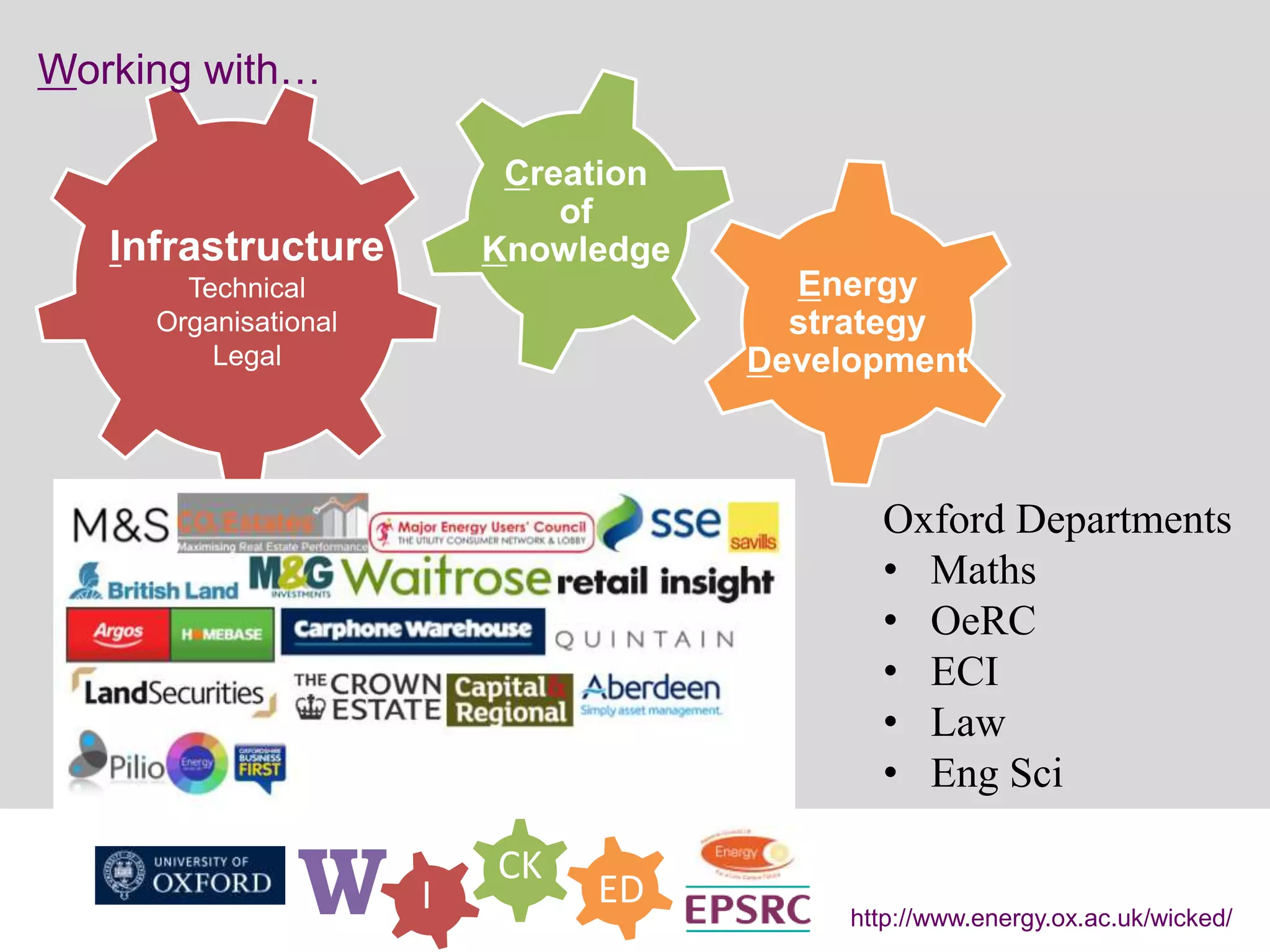
Infrastructure
Technical
Organisational
Legal
Creation
of
Knowledge
Energy
strategy
Development
Working with…
Oxford Departments
• Maths
• OeRC
• ECI
• Law
• Eng Sci
W I
CK
ED
http://www.energy.ox.ac.uk/wicked/
MISSING SLIDE
May 15, 2015
W I
CK
ED
http://www.energy.ox.ac.uk/wicked/
May 15, 2015
W I
CK
ED
http://www.energy.ox.ac.uk/wicked/
May 15, 2015
W I
CK
ED
http://www.energy.ox.ac.uk/wicked/
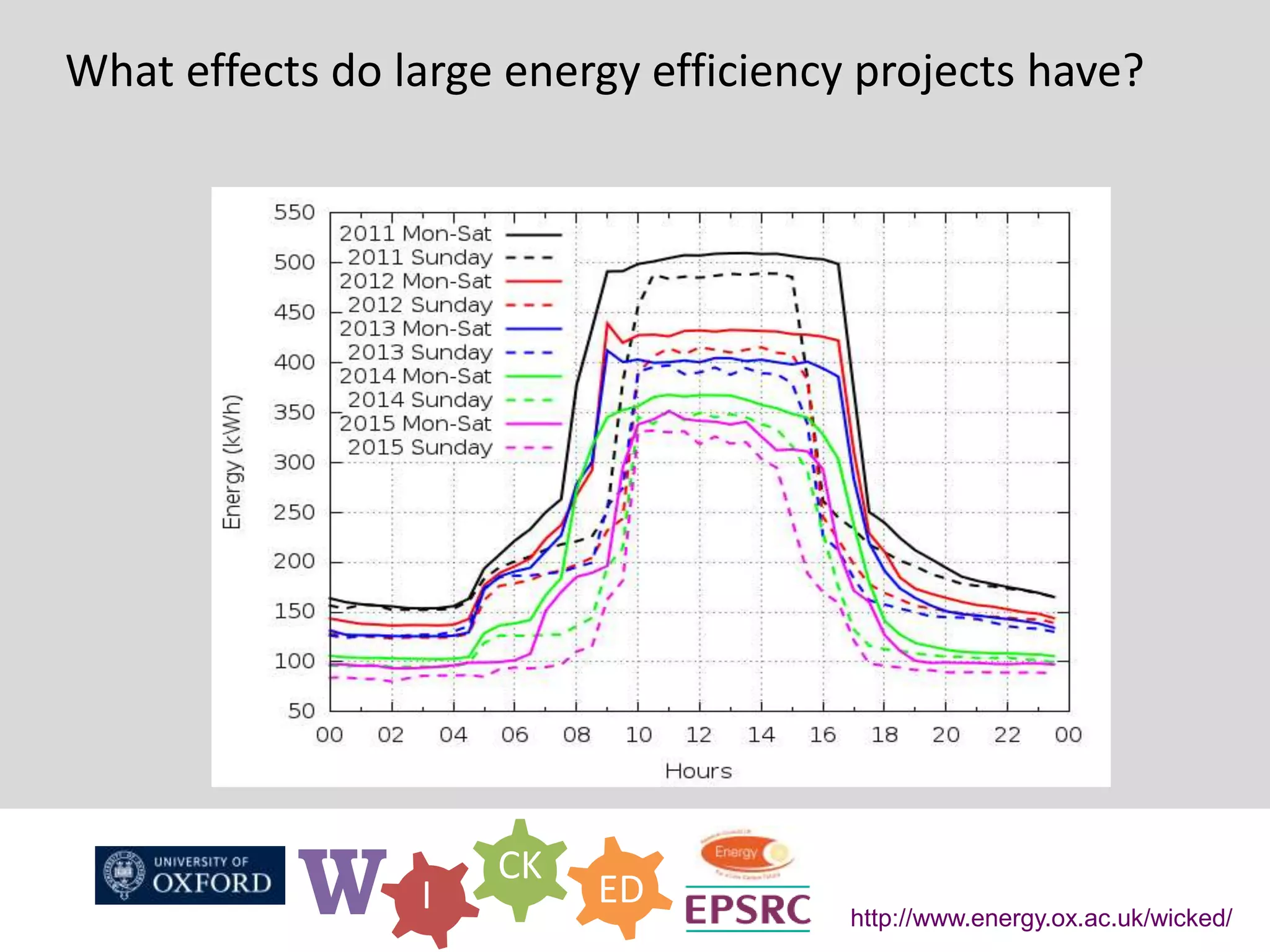
What effects do large energy efficiency projects have?
W I
CK
ED
http://www.energy.ox.ac.uk/wicked/
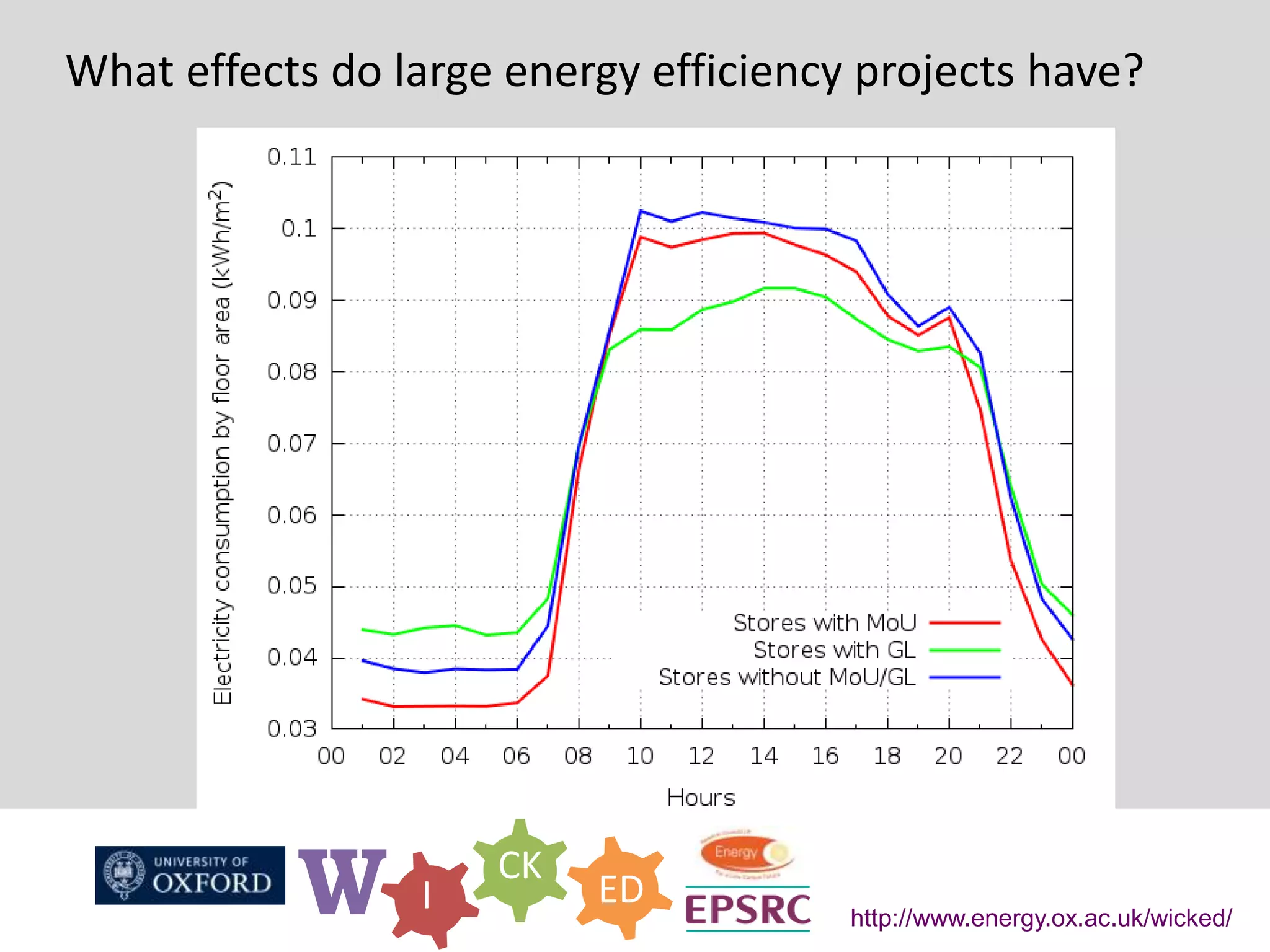
What effects do large energy efficiency projects have?
W I
CK
ED
http://www.energy.ox.ac.uk/wicked/
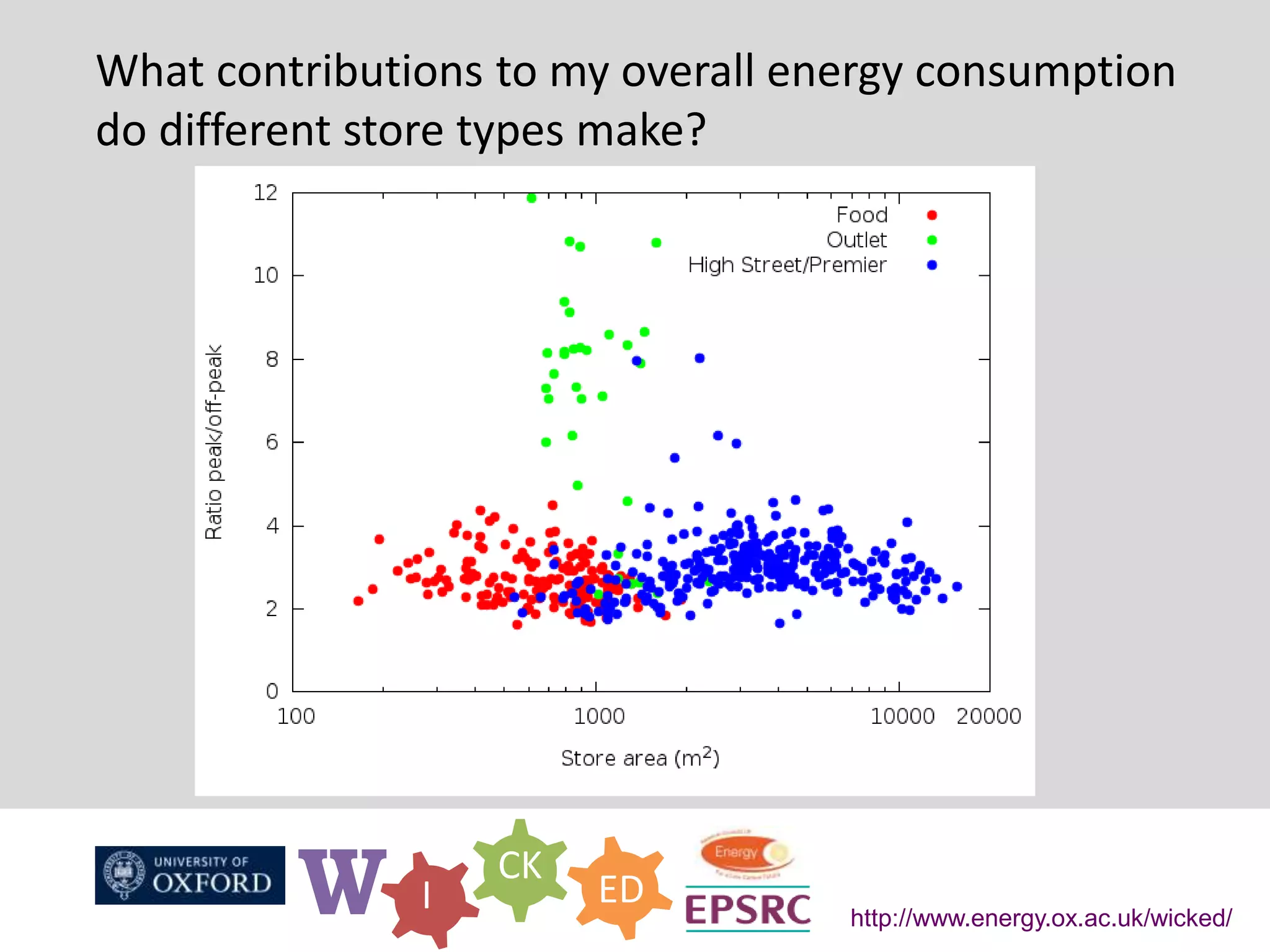
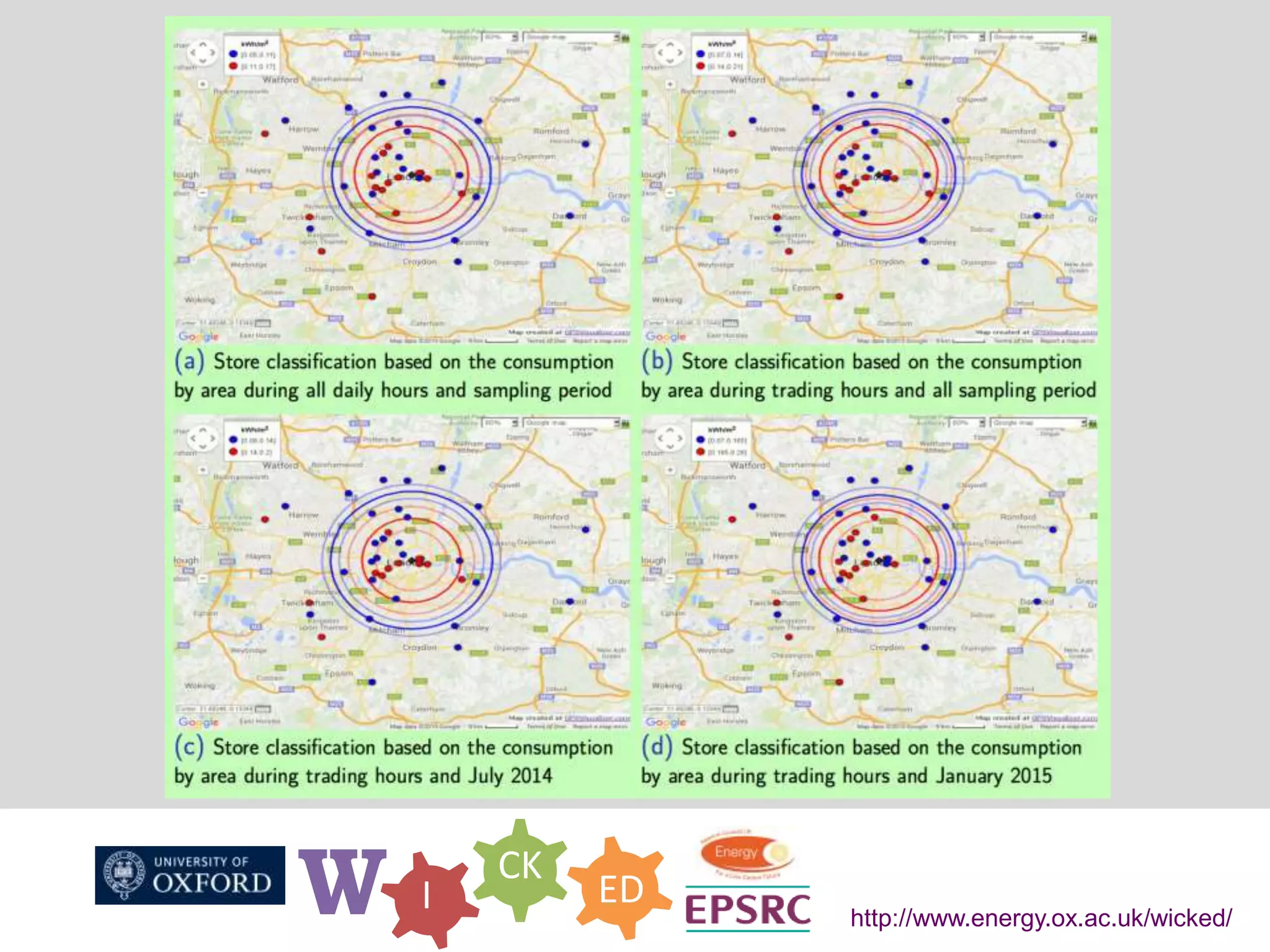
What contributions to my overall energy consumption
do different store types make?
W I
CK
ED
http://www.energy.ox.ac.uk/wicked/
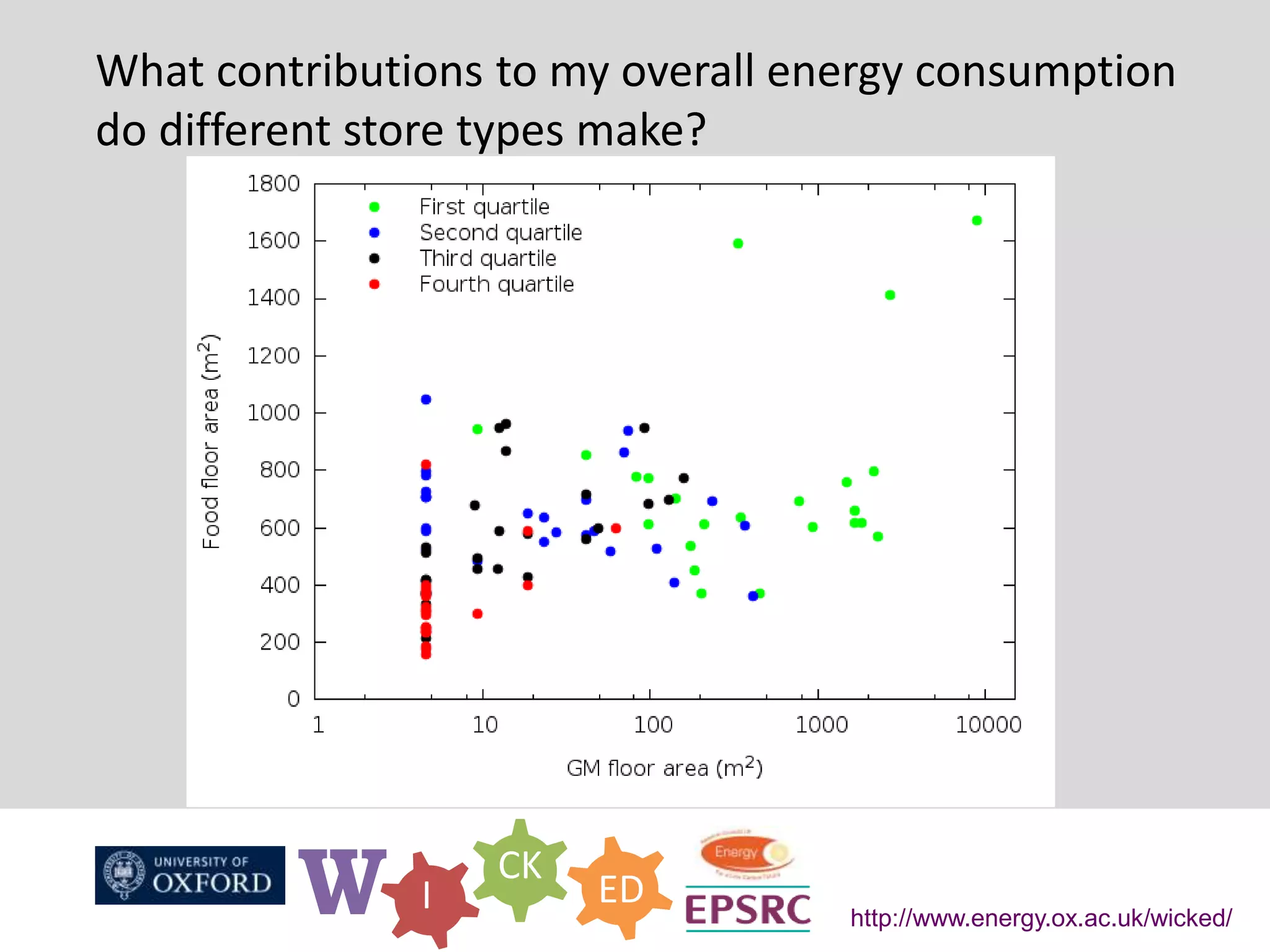
What contributions to my overall energy consumption
do different store types make?
W I
CK
ED
http://www.energy.ox.ac.uk/wicked/
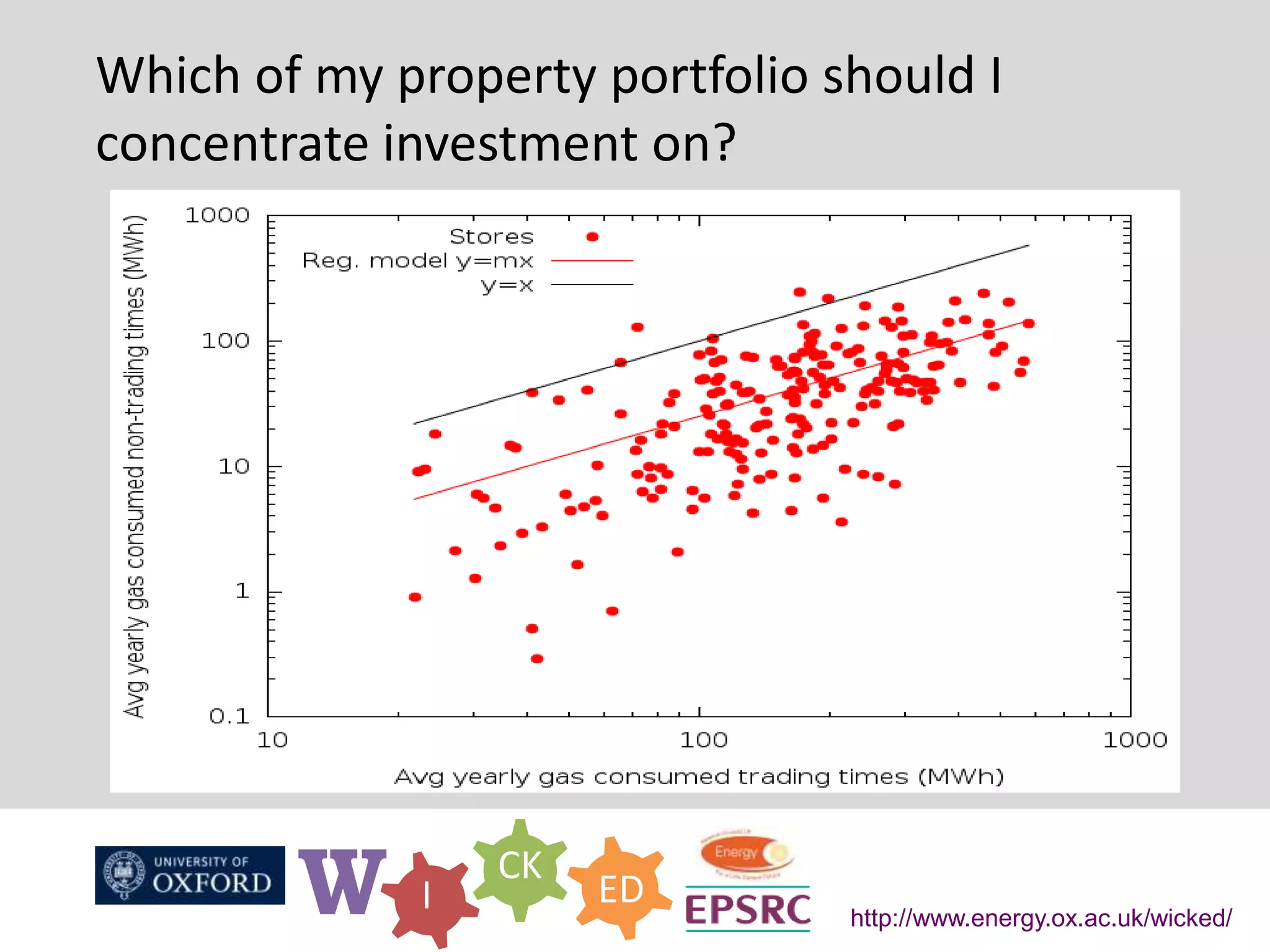
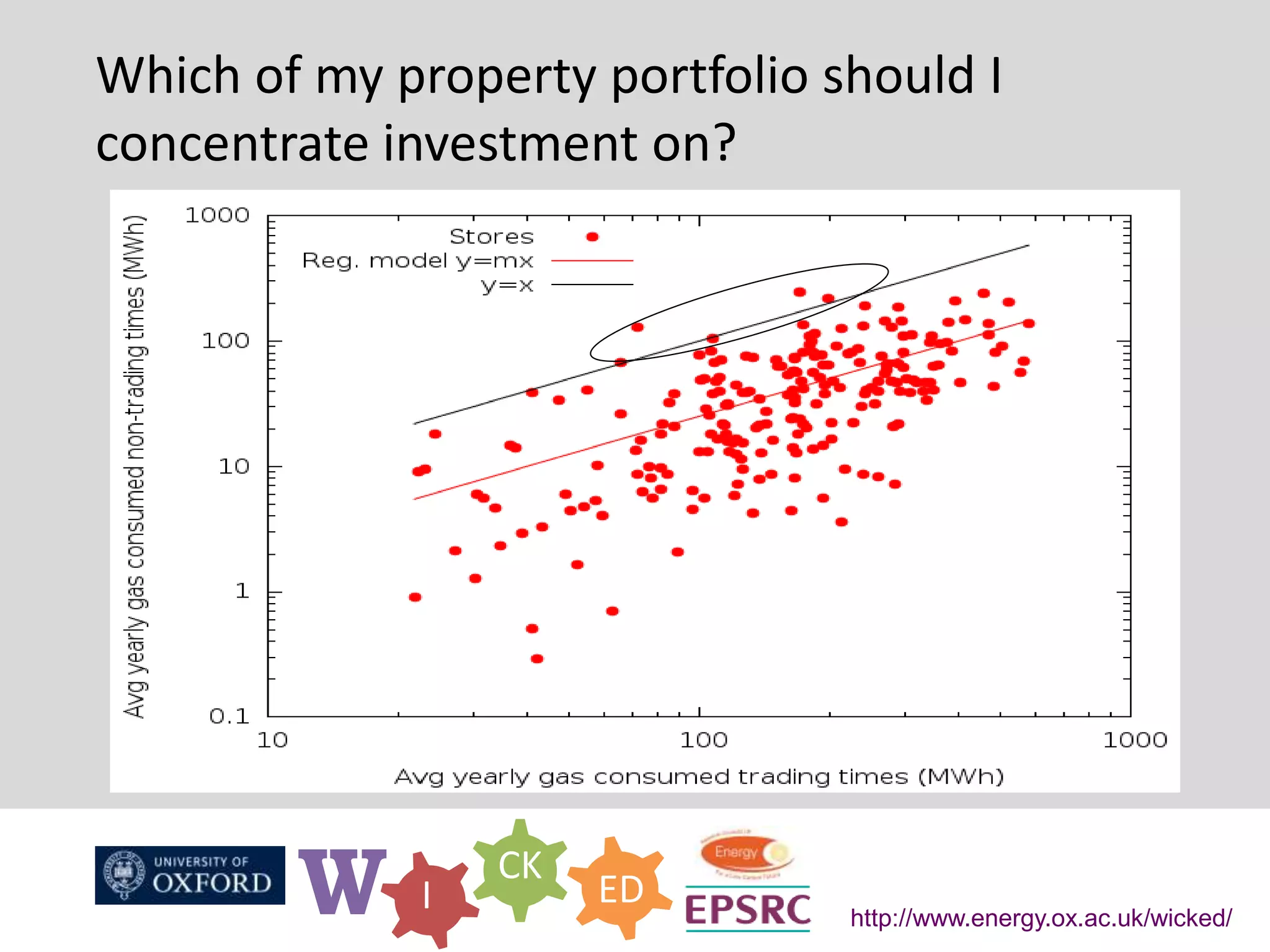
Which of my property portfolio should I
concentrate investment on?
W I
CK
ED
http://www.energy.ox.ac.uk/wicked/
Which of my property portfolio should I
concentrate investment on?
W I
CK
ED
http://www.energy.ox.ac.uk/wicked/
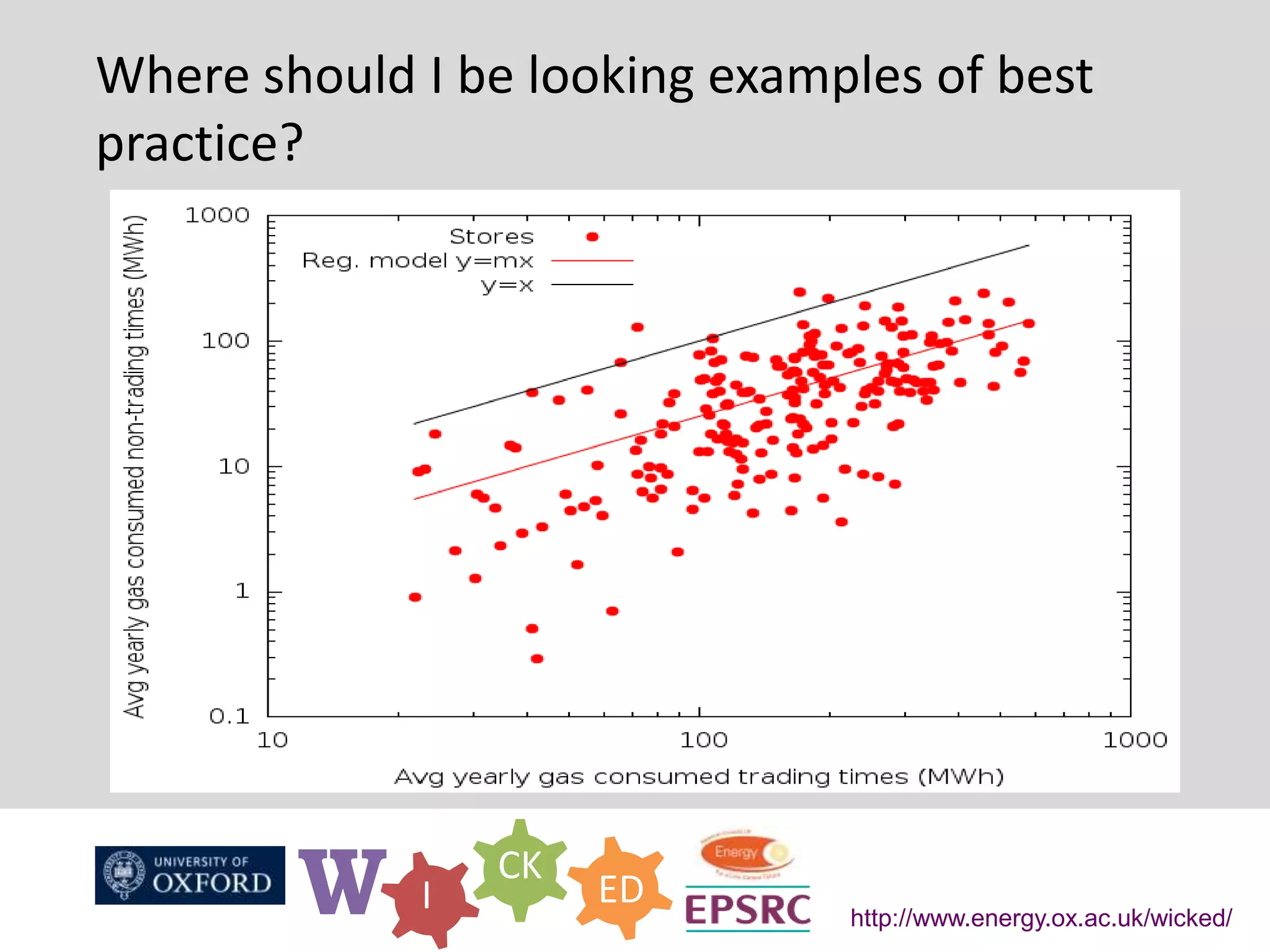
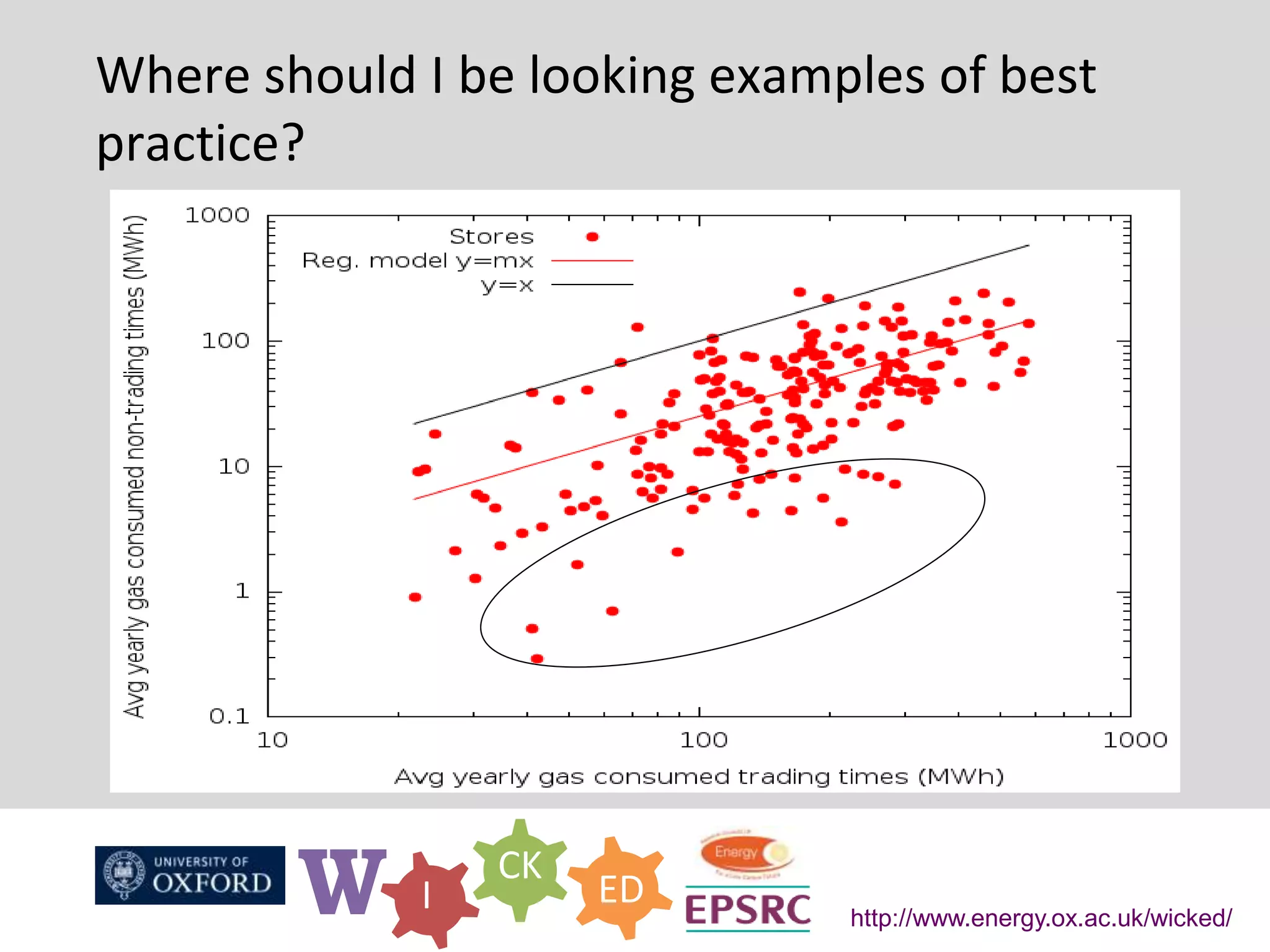
Where should I be looking examples of best
practice?
W I
CK
ED
http://www.energy.ox.ac.uk/wicked/
Where should I be looking examples of best
practice?
W I
CK
ED
http://www.energy.ox.ac.uk/wicked/
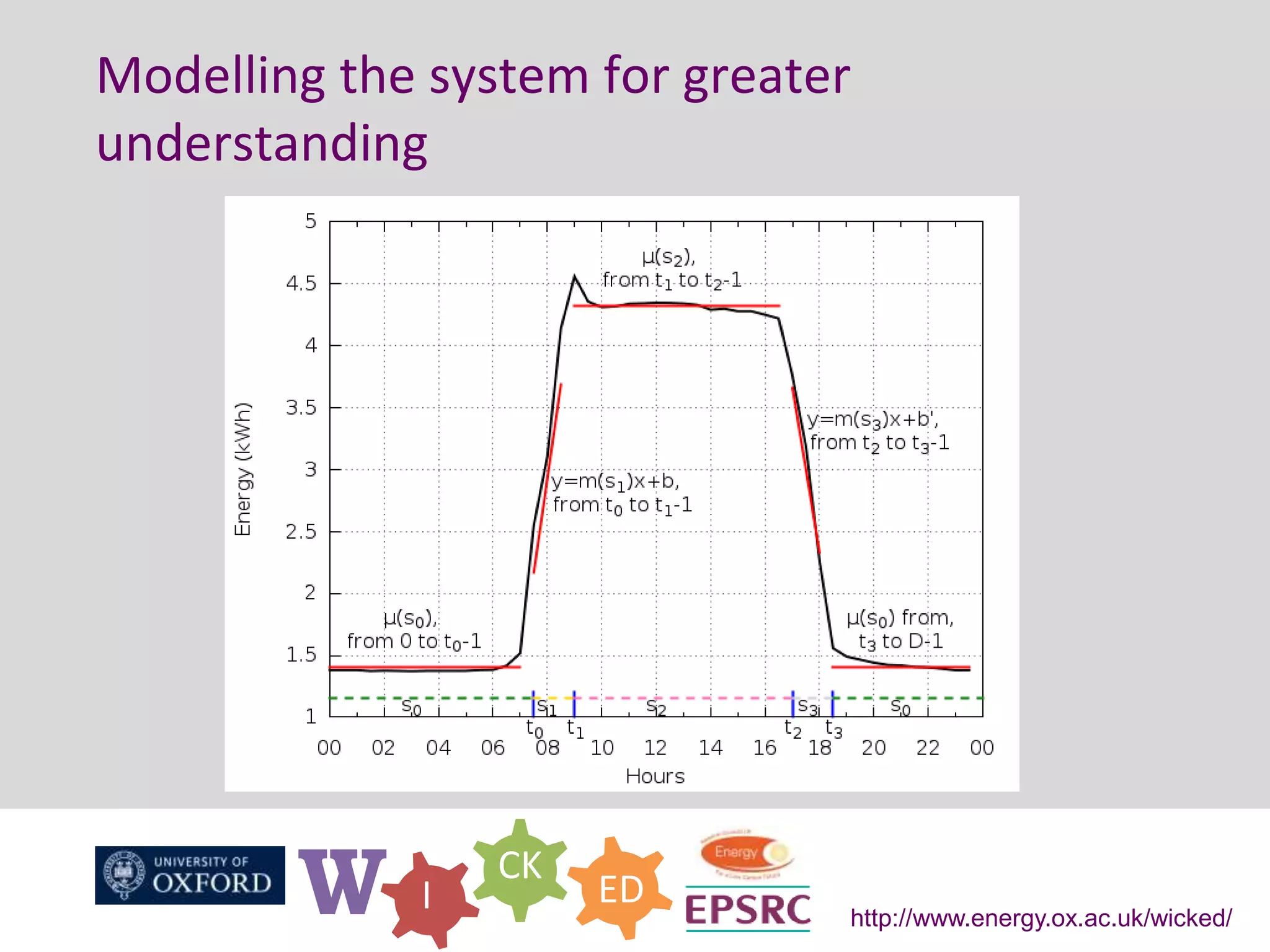
Modelling the system for greater
understanding
W I
CK
ED
http://www.energy.ox.ac.uk/wicked/
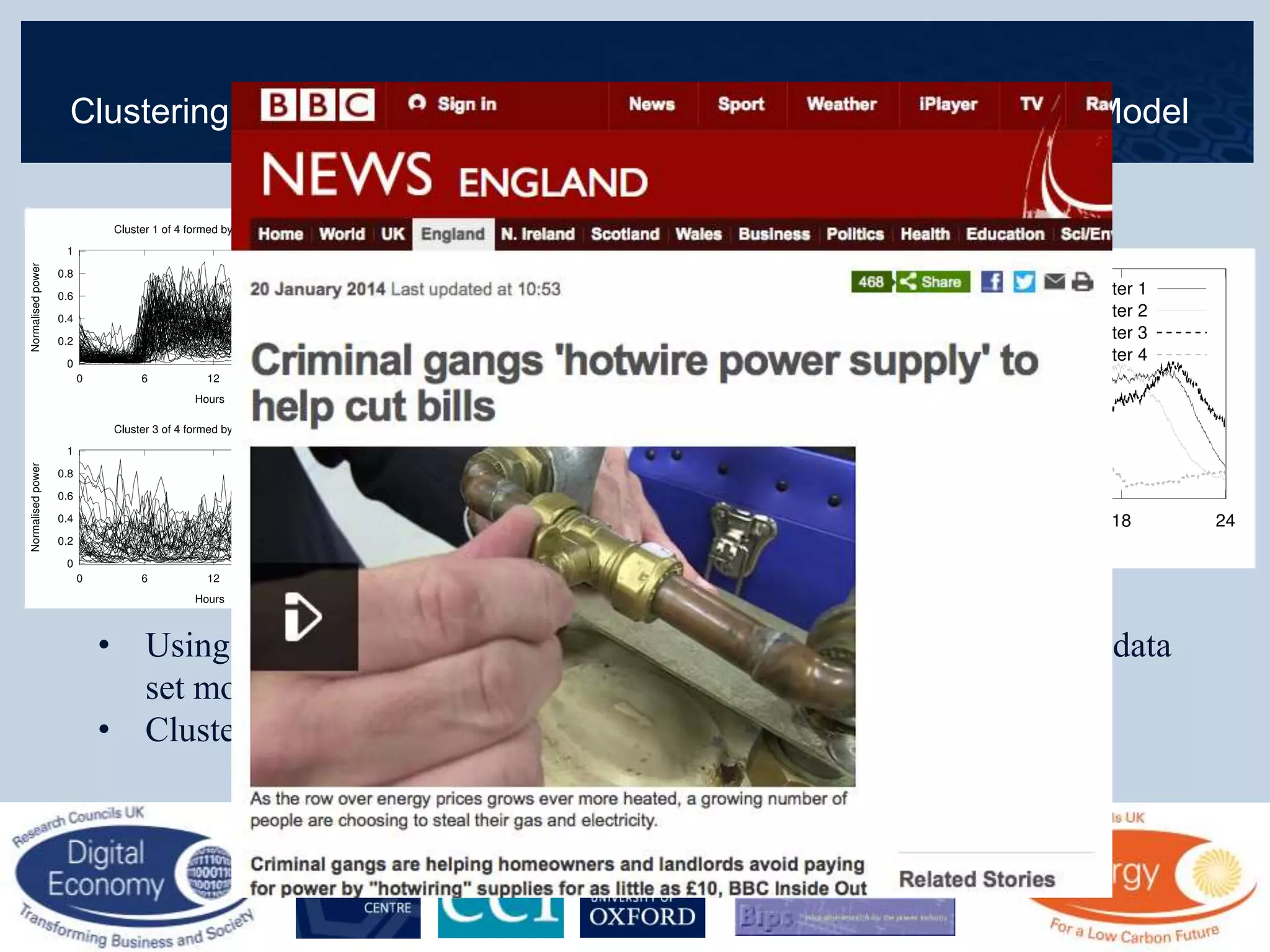
Clustering domestic consumption using Dirichlet Process Mixture Model
• Using a Bayesian method allows us to handle uncertainty within the data
set more easily than more traditional data mining methods
• Clustering defined by data not user
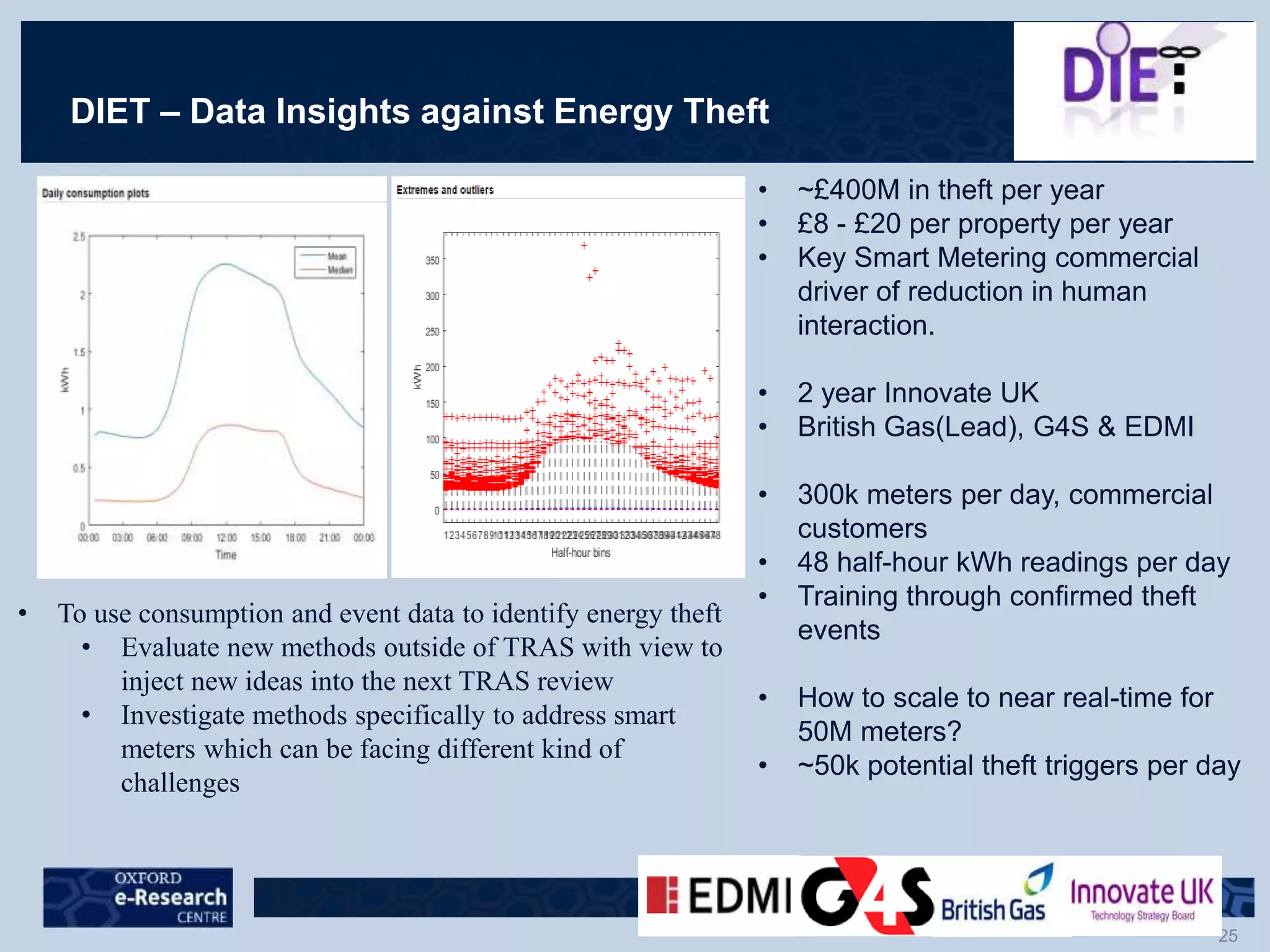
DIET – Data Insights against Energy Theft
• ~£400M in theft per year
• £8 - £20 per property per year
• Key Smart Metering commercial
driver of reduction in human
interaction.
• 2 year Innovate UK
• British Gas(Lead), G4S & EDMI
• 300k meters per day, commercial
customers
• 48 half-hour kWh readings per day
• Training through confirmed theft
events
• How to scale to near real-time for
50M meters?
• ~50k potential theft triggers per day
• To use consumption and event data to identify energy theft
• Evaluate new methods outside of TRAS with view to
inject new ideas into the next TRAS review
• Investigate methods specifically to address smart
meters which can be facing different kind of
challenges
Conclusion
• Utilising analytics to gain understanding of drivers of energy consumption
within domestic and commercial customers requires;
– High quality data (low failure rate, we have seen the opposite)
– Detailed metadata available
• We are able to link business and domestic consumer behaviour to energy
consumption
– Meaningful questions to answer!
• Need to create new algorithms to cater for different and hitherto not well
utilised data sources.
– Link consumption and non-consumption time series data to provide analytic triggers
for a new use case which causes smart meter anxiety
Thank you
Questions?
With thanks to;
• Ramon Granell, Sarah Darby, Katy Janda, Russell Layberry, Peter
Grindrod, Malcolm Muculloch & Sue Bright
• Colin Axon, Ioana Pisica & Gary Taylor
• Opus Energy, M&S, Dixons Carphone, & British Gas
Publications
• Granell, Ramon; Axon, Colin; Janda, Kathryn B.; Wallom, David (2016): Does the London urban heat island affect
electricity consumption of small supermarkets?. figshare. https://dx.doi.org/10.6084/m9.figshare.3423130.v1
• Granell, R., Axon, C.J., Wallom, D.C.H. et al. “Power-use profile analysis of non-domestic consumers for electricity tariff
switching”, Energy Efficiency (2016) 9: 825. https://dx.doi.org/10.1007/s12053-015-9404-9
• Granell, Ramon; Axon, Colin; Wallom, David (2016): Which British SMEs might benefit from electricity dynamic tariffs?.
figshare. https://dx.doi.org/10.6084/m9.figshare.3423139.v1
• R. Granell, C. J. Axon and D. C. H. Wallom, "Impacts of Raw Data Temporal Resolution Using Selected Clustering
Methods on Residential Electricity Load Profiles," in IEEE Transactions on Power Systems, vol. 30, no. 6, pp. 3217-
3224, Nov. 2015. https://dx.doi.org/10.1109/TPWRS.2014.2377213
• R. Granell, C.J. Axon, D.C. H Wallom, “Clustering disaggregated load profiles using a Dirichlet process mixture model”,
Energy Convers Manag, 92 (2015), pp. 507–516
• Wallom, David; Granell, Ramon; Axon, Colin (2015): Feature extraction to characterise and cluster the energy demand
of UK retail premises. figshare., https://dx.doi.org/10.6084/m9.figshare.1541107.v1
• Granell, R.; Axon, C.J.; Wallom, D.C.H. Predicting winning and losing businesses when changing electricity tariffs. Appl.
Energy 2014, 133, 298–307.
• C. J. Axon et al., "Towards an understanding of dynamic energy pricing and tariffs," 2012 47th International Universities
Power Engineering Conference (UPEC), London, 2012, pp. 1-5. https://dx.doi.org/10.1109/UPEC.2012.6398452

Benefits of big data analytics in Smart Metering, ADEPT, WICKED and beyond

  • 1.
    11 Benefits of bigdata analytics in Smart Metering, ADEPT, WICKED and beyond Prof David Wallom Associate Professor and Associate Director - Innovation
  • 2.
    Advanced Dynamic EnergyPricing and Tariffs (ADEPT) • Objectives – Understand the limitations that domestic consumers are willing to consider acceptable in terms of dynamic pricing tariffs – Investigate the relationship between dynamic electricity tariffs and power network characteristics, – Design a scalable computational and data platform • Turning data into actionable information – Exploiting well known & developing innovative data mining techniques, predicting and classifying costs, determining behaviour type and response to tariff changes and other inputs
  • 3.
    Clustering domestic consumptionusing Dirichlet Process Mixture Model • EC FP7 Dehams dataset (www.dehams.eu, UK & Bulgaria) • Using a Bayesian method allows us to handle uncertainty within the data set more easily than more traditional data mining methods • Clustering defined by data not user
  • 4.
    How complex canand should a dynamic energy tariff be? Normalised daily power demand profiles for all businesses by sector An illustration of the differences between the tariffs used and the typical variation of the RT Commercial consumption data thanks to OPUS Energy
  • 5.
    When should youchange tariffs?
  • 6.
    Which % arewinners?
  • 7.
    Can we predictwinners? • Binary Classification problem Winners (RC <1) & losers (RC>1) • Three body classification problem Winners (RC<1-e), Neutral (RC<> [1-e, 1+e]) & Losers (RC>1+e) • Classification using Machine Learning; Artificial Neural Networks (ANN), Support Vector Machines (SVM) and Naïve Bayes Classifier (NBC); FPT-RTT TOUT - RTT
  • 8.
  • 9.
  • 10.
  • 11.
  • 12.
    W I CK ED http://www.energy.ox.ac.uk/wicked/ What effectsdo large energy efficiency projects have?
  • 13.
    W I CK ED http://www.energy.ox.ac.uk/wicked/ What effectsdo large energy efficiency projects have?
  • 14.
    W I CK ED http://www.energy.ox.ac.uk/wicked/ What contributionsto my overall energy consumption do different store types make?
  • 15.
    W I CK ED http://www.energy.ox.ac.uk/wicked/ What contributionsto my overall energy consumption do different store types make?
  • 16.
    W I CK ED http://www.energy.ox.ac.uk/wicked/ Which ofmy property portfolio should I concentrate investment on?
  • 17.
    W I CK ED http://www.energy.ox.ac.uk/wicked/ Which ofmy property portfolio should I concentrate investment on?
  • 18.
    W I CK ED http://www.energy.ox.ac.uk/wicked/ Where shouldI be looking examples of best practice?
  • 19.
    W I CK ED http://www.energy.ox.ac.uk/wicked/ Where shouldI be looking examples of best practice?
  • 20.
  • 21.
  • 22.
    Clustering domestic consumptionusing Dirichlet Process Mixture Model • Using a Bayesian method allows us to handle uncertainty within the data set more easily than more traditional data mining methods • Clustering defined by data not user
  • 23.
    DIET – DataInsights against Energy Theft • ~£400M in theft per year • £8 - £20 per property per year • Key Smart Metering commercial driver of reduction in human interaction. • 2 year Innovate UK • British Gas(Lead), G4S & EDMI • 300k meters per day, commercial customers • 48 half-hour kWh readings per day • Training through confirmed theft events • How to scale to near real-time for 50M meters? • ~50k potential theft triggers per day • To use consumption and event data to identify energy theft • Evaluate new methods outside of TRAS with view to inject new ideas into the next TRAS review • Investigate methods specifically to address smart meters which can be facing different kind of challenges
  • 24.
    Conclusion • Utilising analyticsto gain understanding of drivers of energy consumption within domestic and commercial customers requires; – High quality data (low failure rate, we have seen the opposite) – Detailed metadata available • We are able to link business and domestic consumer behaviour to energy consumption – Meaningful questions to answer! • Need to create new algorithms to cater for different and hitherto not well utilised data sources. – Link consumption and non-consumption time series data to provide analytic triggers for a new use case which causes smart meter anxiety
  • 25.
    Thank you Questions? With thanksto; • Ramon Granell, Sarah Darby, Katy Janda, Russell Layberry, Peter Grindrod, Malcolm Muculloch & Sue Bright • Colin Axon, Ioana Pisica & Gary Taylor • Opus Energy, M&S, Dixons Carphone, & British Gas
  • 26.
    Publications • Granell, Ramon;Axon, Colin; Janda, Kathryn B.; Wallom, David (2016): Does the London urban heat island affect electricity consumption of small supermarkets?. figshare. https://dx.doi.org/10.6084/m9.figshare.3423130.v1 • Granell, R., Axon, C.J., Wallom, D.C.H. et al. “Power-use profile analysis of non-domestic consumers for electricity tariff switching”, Energy Efficiency (2016) 9: 825. https://dx.doi.org/10.1007/s12053-015-9404-9 • Granell, Ramon; Axon, Colin; Wallom, David (2016): Which British SMEs might benefit from electricity dynamic tariffs?. figshare. https://dx.doi.org/10.6084/m9.figshare.3423139.v1 • R. Granell, C. J. Axon and D. C. H. Wallom, "Impacts of Raw Data Temporal Resolution Using Selected Clustering Methods on Residential Electricity Load Profiles," in IEEE Transactions on Power Systems, vol. 30, no. 6, pp. 3217- 3224, Nov. 2015. https://dx.doi.org/10.1109/TPWRS.2014.2377213 • R. Granell, C.J. Axon, D.C. H Wallom, “Clustering disaggregated load profiles using a Dirichlet process mixture model”, Energy Convers Manag, 92 (2015), pp. 507–516 • Wallom, David; Granell, Ramon; Axon, Colin (2015): Feature extraction to characterise and cluster the energy demand of UK retail premises. figshare., https://dx.doi.org/10.6084/m9.figshare.1541107.v1 • Granell, R.; Axon, C.J.; Wallom, D.C.H. Predicting winning and losing businesses when changing electricity tariffs. Appl. Energy 2014, 133, 298–307. • C. J. Axon et al., "Towards an understanding of dynamic energy pricing and tariffs," 2012 47th International Universities Power Engineering Conference (UPEC), London, 2012, pp. 1-5. https://dx.doi.org/10.1109/UPEC.2012.6398452

Editor's Notes

  • #3 Emergent behaviour that can be identified from such potentially complex systems Cloud and/or cluster computing High speed communications technology platforms Large-scale learning machines
  • #7 Emergent behaviour that can be identified from such potentially complex systems Cloud and/or cluster computing High speed communications technology platforms Large-scale learning machines
  • #13 Automated regular measurement and collection of energy consumption Centralised recording, access and distribution to stakeholders Accessible Metadata providing wider context