The Power to Change


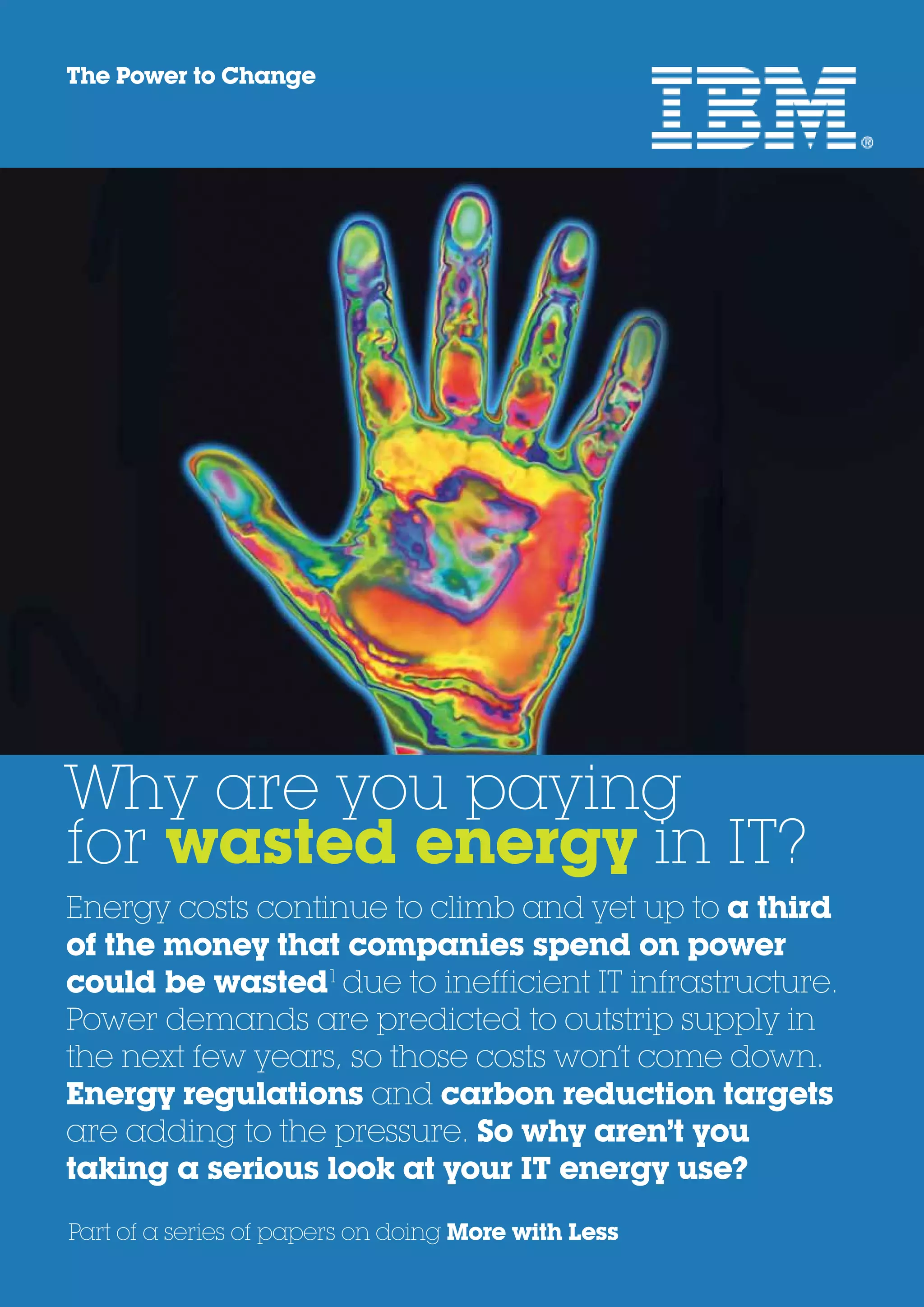
Why are you paying
for wasted energy in IT?
Energy costs continue to climb and yet up to a third
of the money that companies spend on power
could be wasted1 due to inefficient IT infrastructure.
Power demands are predicted to outstrip supply in
the next few years, so those costs won’t come down.
Energy regulations and carbon reduction targets
are adding to the pressure. So why aren’t you
taking a serious look at your IT energy use?
Part of a series of papers on doing More with Less
The Power to Change


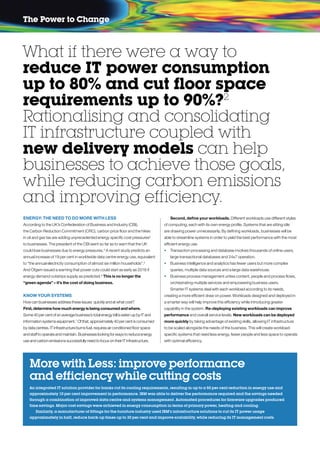
What if there were a way to
reduce IT power consumption
up to 80% and cut floor space
requirements up to 90%?2
Rationalising and consolidating
IT infrastructure coupled with
new delivery models can help
businesses to achieve those goals,
while reducing carbon emissions
and improving efficiency.
ENERGY: THE NEED TO DO MORE WITH LESS                                                    Second, define your workloads. Different workloads use different styles
According to the UK’s Confederation of Business and Industry (CBI),                   of computing, each with its own energy profile. Systems that are sitting idle
the Carbon Reduction Commitment (CRC), carbon price floor and the hikes               are drawing power unnecessarily. By defining workloads, businesses will be
in oil and gas tax are adding unprecedented energy specific cost pressures3           able to streamline systems in order to yield the best performance with the most
to businesses. The president of the CBI went so far as to warn that the UK            efficient energy use.
could lose businesses due to energy pressures.4 A recent study predicts an            •	 Transaction processing and database involves thousands of online users,
annual increase of 19 per cent in worldwide data centre energy use, equivalent           large transactional databases and 24x7 operation.
to “the annual electricity consumption of almost six million households”.5            •	 Business intelligence and analytics has fewer users but more complex
And Ofgem issued a warning that power cuts could start as early as 2016 if               queries, multiple data sources and a large data warehouse.
energy demand outstrips supply as predicted.6 This is no longer the                   •	 Business process management unites content, people and process flows,
“green agenda” – it’s the cost of doing business.                                        orchestrating multiple services and empowering business users.
                                                                                         Smarter IT systems deal with each workload according to its needs,
KNOW YOUR SYSTEMS                                                                     creating a more efficient draw on power. Workloads designed and deployed in
How can businesses address these issues quickly and at what cost?                     a smarter way will help improve this efficiency while introducing greater
First, determine how much energy is being consumed and where.                         capability in the system. Re-deploying existing workloads can improve
Some 40 per cent of an average business’s total energy bill is eaten up by IT and     performance and overall service levels. New workloads can be deployed
information systems equipment.7 Of that, approximately 40 per cent is consumed        more quickly by taking advantage of existing skills, allowing IT infrastructure
by data centres. IT infrastructure burns fuel, requires air conditioned floor space   to be scaled alongside the needs of the business. This will create workload-
and staff to operate and maintain. Businesses looking for ways to reduce energy       specific systems that need less energy, fewer people and less space to operate
use and carbon emissions successfully need to focus on their IT infrastructure.       with optimal efficiency.


    More with Less: improve performance
    and efficiency while cutting costs
    An integrated IT solution provider for banks cut its cooling requirements, resulting in up to a 50 per cent reduction in energy use and
    approximately 10 per cent improvement in performance. IBM was able to deliver the performance required and the savings needed
    through a combination of improved data centre and systems management. Automated procedures for firmware upgrades produced
    time savings. Major cost savings were achieved in energy consumption in terms of primary power, heating and cooling.
        Similarly, a manufacturer of fittings for the furniture industry used IBM’s infrastructure solutions to cut its IT power usage
    approximately in half, reduce back-up times up to 30 per cent and improve scalability, while reducing its IT management costs.
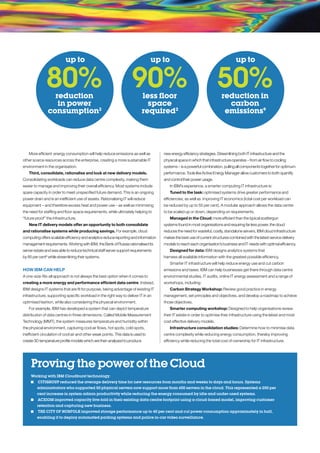
up to                                                  up to                                             up to


               80%reduction
                                                                     90%    less floor
                                                                                                                        50%reduction in
                   in power                                                   space                                          carbon
                consumption2                                                required2                                       emissions9


   More efficient energy consumption will help reduce emissions as well as            new energy efficiency strategies. Streamlining both IT infrastructure and the
other scarce resources across the enterprise, creating a more sustainable IT          physical space in which that infrastructure operates – from air flow to cooling
environment in the organisation.                                                      systems – is a powerful combination, pulling all components together for optimum
   Third, consolidate, rationalise and look at new delivery models.                   performance. Tools like Active Energy Manager allow customers to both quantify
Consolidating workloads can reduce data centre complexity, making them                and control their power usage.
easier to manage and improving their overall efficiency. Most systems include             In IBM’s experience, a smarter computing IT infrastructure is:
spare capacity in order to meet unspecified future demand. This is an ongoing             Tuned to the task: optimised systems drive greater performance and
power drain and is an inefficient use of assets. Rationalising IT will reduce         efficiencies, as well as improving IT economics (total cost per workload can
equipment – and therefore excess heat and power use – as well as minimising           be reduced by up to 55 per cent). A modular approach allows the data centre
the need for staffing and floor space requirements, while ultimately helping to       to be scaled up or down, depending on requirements.
“future proof” the infrastructure.                                                        Managed in the Cloud: more efficient than the typical scattergun
   New IT delivery models offer an opportunity to both consolidate                    systems found in most organisations and requiring far less power, the cloud
and rationalise systems while producing savings. For example, cloud                   reduces the need for wasteful, costly, standalone servers. IBM cloud infrastructure
computing offers scalable efficiency and analytics reduce reporting and information   makes the best use of current structures combined with the latest service delivery
management requirements. Working with IBM, the Bank of Russia rationalised its        models to reach each organisation’s business and IT needs with optimal efficiency.
server estate and was able to reduce technical staff server support requirements          Designed for data: IBM designs analytics systems that
by 85 per cent8 while streamlining their systems.                                     harness all available information with the greatest possible efficiency.
                                                                                          Smarter IT infrastructure will help reduce energy use and cut carbon
HOW IBM CAN HELP                                                                      emissions and taxes. IBM can help businesses get there through data centre
A one-size-fits-all approach is not always the best option when it comes to           environmental studies, IT audits, online IT energy assessment and a range of
creating a more energy and performance efficient data centre. Instead,                workshops, including:
IBM designs IT systems that are fit for purpose, taking advantage of existing IT          Carbon Strategy Workshop: Review good practice in energy
infrastructure, supporting specific workload in the right way to deliver IT in an     management, set principles and objectives, and develop a roadmap to achieve
optimised fashion, while also considering the physical environment.                   those objectives.
   For example, IBM has developed a system that can depict temperature                    Smarter computing workshop: Designed to help organisations review
distribution of data centres in three dimensions. Called Mobile Measurement           their IT estate in order to optimise their infrastructure using the latest and most
Technology (MMT), the system measures temperature and humidity within                 cost effective delivery models.
the physical environment, capturing cool air flows, hot spots, cold spots,                Infrastructure consolidation studies: Determine how to minimise data
inefficient circulation of cool air and other weak points. This data is used to       centre complexity while reducing energy consumption, thereby improving
create 3D temperature profile models which are then analysed to produce               efficiency while reducing the total cost of ownership for IT infrastructure.


     Proving the power of the Cloud
     Working with IBM Cloudburst technology:
         CITIGROUP reduced the average delivery time for new resources from months and weeks to days and hours. Systems
         administrators who supported 50 physical servers now support more than 600 servers in the cloud. This represented a 200 per
         cent increase in system admin productivity while reducing the energy consumed by idle and under-used systems.
         ACXIOM improved capacity five-fold in their existing data centre footprint using a cloud-based model, improving customer
         retention and capturing new business.
         THE CITY OF NORFOLK improved storage performance up to 40 per cent and cut power consumption approximately in half,
         enabling it to deploy automated parking systems and police in-car video surveillance.
CONTACT US
To find out how your organisation could do More with Less,
contact your IBM representative, or:

                                                             © Copyright IBM Corporation 2011
Pete Kearney
Mob: +44 (0) 7802 245354
                                                             IBM United Kingdom Limited
Email: kearnep@uk.ibm.com
                                                             76 Upper Ground
                                                             South Bank
Estelle Andlauer
                                                             London
Mob: +44 (0) 7879 641546
                                                             SE1 9PZ
Email: estelle_andlauer@uk.ibm.com

                                                             The IBM home page can be found at ibm.com


                                                             IBM, the IBM logo and ibm.com are trademarks
                                                             or registered trademarks of International Business
                                                             Machines Corporation in the United States,
                                                             other countries, or both. If these and other IBM
                                                             trademarked terms are marked on their first
                                                             occurrence in this information with a trademark
                                                             symbol (® or ™), these symbols indicate US
                                                             registered or common law trademarks owned by
                                                             IBM at the time this information was published. Such
                                                             trademarks may also be registered or common law
                                                             trademarks in other countries.


                                                             A current list of IBM trademarks is available on the
                                                             Web at “Copyright and trademark information” at
References
                                                             www.ibm.com/legal/copytrade.shtml
1      “Watt a Waste: 32p in every pound powering
       IT and general office equipment”. Richard
                                                             References in this publication to IBM products or
       Lanyon-Hogg, IBM Chief Technology Officer
                                                             services do not imply that IBM intends to make them
       for Energy Efficiency. eGOVMonitor.com. 13
                                                             available in all countries in which IBM operates.
       September 2011. http://www.egovmonitor.
                                                             Copying or downloading the images contained in
       com/node/43723
                                                             this document is expressly prohibited without the
2      “Smarter Computing”. IBM presentation
                                                             written consent of IBM. This publication is for general
       aligned with CIO study. May 2011.
                                                             guidance only.
3      CBI chief calls for Carbon Floor Price
       exemptions for energy intensive industries. CBI
                                                             All rights reserved.
       press release. 14 June 2011. http://www.cbi.
       org.uk/ndbs/press.nsf/0363c1f07c6ca12a80
       25671c00381cc7/470e82f74b3130db80257
       8ae00570348
4      “UK faces job losses as businesses threaten
       to flee abroad to escape green energy
       levies”. Robert Mendick, Edward Malnick
       and Andrew Cave. The Telegraph. 12 June
       2011.
5      “UK datacentre investment is 2nd highest in
       the world – but expansion rate is 2nd slowest”.
       Cliff Saran. ComputerWeekly.com.
       7 September 2011.
6      “Britain ‘facing electricity blackouts’”.
       The Telegraph. 21 April 2010.
7      “Watt a Waste: 32p in every pound powering IT
       and general office equipment”. op cit
8      “Bank of Russia expands services by reducing
       data centers”. IBM case study.
       http://www.ibm.com/smarterplanet/in/en/
       banking_technology/examples/index.html
9      “Energy Efficiency Approaches”. Presentation
       by Nichol Riggott. Executive Consultant,
       IBM GTS.

Ibm low energy_final low res version

  • 1.
    The Power toChange Why are you paying for wasted energy in IT? Energy costs continue to climb and yet up to a third of the money that companies spend on power could be wasted1 due to inefficient IT infrastructure. Power demands are predicted to outstrip supply in the next few years, so those costs won’t come down. Energy regulations and carbon reduction targets are adding to the pressure. So why aren’t you taking a serious look at your IT energy use? Part of a series of papers on doing More with Less
  • 2.
    The Power toChange What if there were a way to reduce IT power consumption up to 80% and cut floor space requirements up to 90%?2 Rationalising and consolidating IT infrastructure coupled with new delivery models can help businesses to achieve those goals, while reducing carbon emissions and improving efficiency. ENERGY: THE NEED TO DO MORE WITH LESS Second, define your workloads. Different workloads use different styles According to the UK’s Confederation of Business and Industry (CBI), of computing, each with its own energy profile. Systems that are sitting idle the Carbon Reduction Commitment (CRC), carbon price floor and the hikes are drawing power unnecessarily. By defining workloads, businesses will be in oil and gas tax are adding unprecedented energy specific cost pressures3 able to streamline systems in order to yield the best performance with the most to businesses. The president of the CBI went so far as to warn that the UK efficient energy use. could lose businesses due to energy pressures.4 A recent study predicts an • Transaction processing and database involves thousands of online users, annual increase of 19 per cent in worldwide data centre energy use, equivalent large transactional databases and 24x7 operation. to “the annual electricity consumption of almost six million households”.5 • Business intelligence and analytics has fewer users but more complex And Ofgem issued a warning that power cuts could start as early as 2016 if queries, multiple data sources and a large data warehouse. energy demand outstrips supply as predicted.6 This is no longer the • Business process management unites content, people and process flows, “green agenda” – it’s the cost of doing business. orchestrating multiple services and empowering business users. Smarter IT systems deal with each workload according to its needs, KNOW YOUR SYSTEMS creating a more efficient draw on power. Workloads designed and deployed in How can businesses address these issues quickly and at what cost? a smarter way will help improve this efficiency while introducing greater First, determine how much energy is being consumed and where. capability in the system. Re-deploying existing workloads can improve Some 40 per cent of an average business’s total energy bill is eaten up by IT and performance and overall service levels. New workloads can be deployed information systems equipment.7 Of that, approximately 40 per cent is consumed more quickly by taking advantage of existing skills, allowing IT infrastructure by data centres. IT infrastructure burns fuel, requires air conditioned floor space to be scaled alongside the needs of the business. This will create workload- and staff to operate and maintain. Businesses looking for ways to reduce energy specific systems that need less energy, fewer people and less space to operate use and carbon emissions successfully need to focus on their IT infrastructure. with optimal efficiency. More with Less: improve performance and efficiency while cutting costs An integrated IT solution provider for banks cut its cooling requirements, resulting in up to a 50 per cent reduction in energy use and approximately 10 per cent improvement in performance. IBM was able to deliver the performance required and the savings needed through a combination of improved data centre and systems management. Automated procedures for firmware upgrades produced time savings. Major cost savings were achieved in energy consumption in terms of primary power, heating and cooling. Similarly, a manufacturer of fittings for the furniture industry used IBM’s infrastructure solutions to cut its IT power usage approximately in half, reduce back-up times up to 30 per cent and improve scalability, while reducing its IT management costs.
  • 3.
    up to up to up to 80%reduction 90% less floor 50%reduction in in power space carbon consumption2 required2 emissions9 More efficient energy consumption will help reduce emissions as well as new energy efficiency strategies. Streamlining both IT infrastructure and the other scarce resources across the enterprise, creating a more sustainable IT physical space in which that infrastructure operates – from air flow to cooling environment in the organisation. systems – is a powerful combination, pulling all components together for optimum Third, consolidate, rationalise and look at new delivery models. performance. Tools like Active Energy Manager allow customers to both quantify Consolidating workloads can reduce data centre complexity, making them and control their power usage. easier to manage and improving their overall efficiency. Most systems include In IBM’s experience, a smarter computing IT infrastructure is: spare capacity in order to meet unspecified future demand. This is an ongoing Tuned to the task: optimised systems drive greater performance and power drain and is an inefficient use of assets. Rationalising IT will reduce efficiencies, as well as improving IT economics (total cost per workload can equipment – and therefore excess heat and power use – as well as minimising be reduced by up to 55 per cent). A modular approach allows the data centre the need for staffing and floor space requirements, while ultimately helping to to be scaled up or down, depending on requirements. “future proof” the infrastructure. Managed in the Cloud: more efficient than the typical scattergun New IT delivery models offer an opportunity to both consolidate systems found in most organisations and requiring far less power, the cloud and rationalise systems while producing savings. For example, cloud reduces the need for wasteful, costly, standalone servers. IBM cloud infrastructure computing offers scalable efficiency and analytics reduce reporting and information makes the best use of current structures combined with the latest service delivery management requirements. Working with IBM, the Bank of Russia rationalised its models to reach each organisation’s business and IT needs with optimal efficiency. server estate and was able to reduce technical staff server support requirements Designed for data: IBM designs analytics systems that by 85 per cent8 while streamlining their systems. harness all available information with the greatest possible efficiency. Smarter IT infrastructure will help reduce energy use and cut carbon HOW IBM CAN HELP emissions and taxes. IBM can help businesses get there through data centre A one-size-fits-all approach is not always the best option when it comes to environmental studies, IT audits, online IT energy assessment and a range of creating a more energy and performance efficient data centre. Instead, workshops, including: IBM designs IT systems that are fit for purpose, taking advantage of existing IT Carbon Strategy Workshop: Review good practice in energy infrastructure, supporting specific workload in the right way to deliver IT in an management, set principles and objectives, and develop a roadmap to achieve optimised fashion, while also considering the physical environment. those objectives. For example, IBM has developed a system that can depict temperature Smarter computing workshop: Designed to help organisations review distribution of data centres in three dimensions. Called Mobile Measurement their IT estate in order to optimise their infrastructure using the latest and most Technology (MMT), the system measures temperature and humidity within cost effective delivery models. the physical environment, capturing cool air flows, hot spots, cold spots, Infrastructure consolidation studies: Determine how to minimise data inefficient circulation of cool air and other weak points. This data is used to centre complexity while reducing energy consumption, thereby improving create 3D temperature profile models which are then analysed to produce efficiency while reducing the total cost of ownership for IT infrastructure. Proving the power of the Cloud Working with IBM Cloudburst technology: CITIGROUP reduced the average delivery time for new resources from months and weeks to days and hours. Systems administrators who supported 50 physical servers now support more than 600 servers in the cloud. This represented a 200 per cent increase in system admin productivity while reducing the energy consumed by idle and under-used systems. ACXIOM improved capacity five-fold in their existing data centre footprint using a cloud-based model, improving customer retention and capturing new business. THE CITY OF NORFOLK improved storage performance up to 40 per cent and cut power consumption approximately in half, enabling it to deploy automated parking systems and police in-car video surveillance.
  • 4.
    CONTACT US To findout how your organisation could do More with Less, contact your IBM representative, or: © Copyright IBM Corporation 2011 Pete Kearney Mob: +44 (0) 7802 245354 IBM United Kingdom Limited Email: kearnep@uk.ibm.com 76 Upper Ground South Bank Estelle Andlauer London Mob: +44 (0) 7879 641546 SE1 9PZ Email: estelle_andlauer@uk.ibm.com The IBM home page can be found at ibm.com IBM, the IBM logo and ibm.com are trademarks or registered trademarks of International Business Machines Corporation in the United States, other countries, or both. If these and other IBM trademarked terms are marked on their first occurrence in this information with a trademark symbol (® or ™), these symbols indicate US registered or common law trademarks owned by IBM at the time this information was published. Such trademarks may also be registered or common law trademarks in other countries. A current list of IBM trademarks is available on the Web at “Copyright and trademark information” at References www.ibm.com/legal/copytrade.shtml 1 “Watt a Waste: 32p in every pound powering IT and general office equipment”. Richard References in this publication to IBM products or Lanyon-Hogg, IBM Chief Technology Officer services do not imply that IBM intends to make them for Energy Efficiency. eGOVMonitor.com. 13 available in all countries in which IBM operates. September 2011. http://www.egovmonitor. Copying or downloading the images contained in com/node/43723 this document is expressly prohibited without the 2 “Smarter Computing”. IBM presentation written consent of IBM. This publication is for general aligned with CIO study. May 2011. guidance only. 3 CBI chief calls for Carbon Floor Price exemptions for energy intensive industries. CBI All rights reserved. press release. 14 June 2011. http://www.cbi. org.uk/ndbs/press.nsf/0363c1f07c6ca12a80 25671c00381cc7/470e82f74b3130db80257 8ae00570348 4 “UK faces job losses as businesses threaten to flee abroad to escape green energy levies”. Robert Mendick, Edward Malnick and Andrew Cave. The Telegraph. 12 June 2011. 5 “UK datacentre investment is 2nd highest in the world – but expansion rate is 2nd slowest”. Cliff Saran. ComputerWeekly.com. 7 September 2011. 6 “Britain ‘facing electricity blackouts’”. The Telegraph. 21 April 2010. 7 “Watt a Waste: 32p in every pound powering IT and general office equipment”. op cit 8 “Bank of Russia expands services by reducing data centers”. IBM case study. http://www.ibm.com/smarterplanet/in/en/ banking_technology/examples/index.html 9 “Energy Efficiency Approaches”. Presentation by Nichol Riggott. Executive Consultant, IBM GTS.