Green Cloud Computing: Energy efficiency
in cloud based data centers
Ramkumar.R
Pope John Paul II College of Education
Introduction
In the last compel of years, Cloud based data centers are
increasing greatly because of the demand for computer resource.
Since more data centers are came into existence the energy
consumption of these data centers are also increased to a great
extent. In addition to high energy consumption there is an addition
impact on the environment by the form of carbon-di-oxide
emissions.
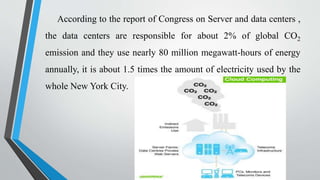
According to the report of Congress on Server and data centers ,
the data centers are responsible for about 2% of global CO2
emission and they use nearly 80 million megawatt-hours of energy
annually, it is about 1.5 times the amount of electricity used by the
whole New York City.
By 2020 the total amount of Carbon-di-oxide emitted by these
data centers will be nearly 359 megatons.
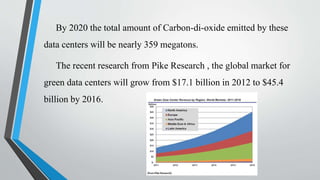
The recent research from Pike Research , the global market for
green data centers will grow from $17.1 billion in 2012 to $45.4
billion by 2016.
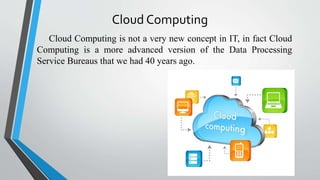
Cloud Computing
Cloud Computing is not a very new concept in IT, in fact Cloud
Computing is a more advanced version of the Data Processing
Service Bureaus that we had 40 years ago.
Cloud model is of three types:
1. Public Cloud: The service is available to public in a pay-as
you-go manner.
2. Private Cloud: Private clouds are deployed within an
organization to provide IT services to its internal user.
3. Hybrid Cloud: Hybrid clouds is emerged due to the diffusion
of both public and private cloud advantages.
Cloud computing also offers different types of service to its customer
and it is of three types:
1. SaaS (Software as a Service): With SaaS, a provider licenses an
application to customers either as a service on demand, through a
subscription, in a "pay-as-you-go" model.
2. IaaS (Infrastructure as a Service): It is typically a platform
virtualization environment - as a service. Rather than purchasing
servers, software, data-center space or network equipment, clients
instead buy those resources as a fully outsourced service.
3. PaaS (Platform as a Service): Itis the delivery of a computing
platform and solution stack as a service.
Green Computing
Green computing is the environmentally responsible and eco-
friendly use of computer and its resources. It is also defined as the
process of designing, manufacturing, and disposing computer
devices which will not affect environment.
Most of the IT companies now started to realize that moving
green computing not only terms of public relation but also it will
reduce the cost.
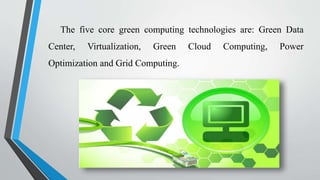
The five core green computing technologies are: Green Data
Center, Virtualization, Green Cloud Computing, Power
Optimization and Grid Computing.
This technology is beneficial as it:
1. Reduce energy consumption of computing resources during
peak operation.
2. Save energy during idle operation.
3. Use eco-friendly sources of energy.
4. Reduce harmful effects of computing resources.
5. Reduce computing wastes.
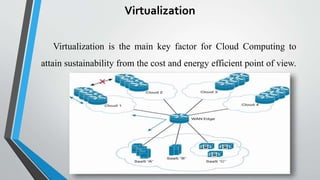
Virtualization
Virtualization is the main key factor for Cloud Computing to
attain sustainability from the cost and energy efficient point of view.
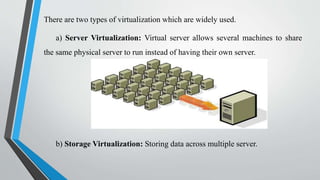
There are two types of virtualization which are widely used.
a) Server Virtualization: Virtual server allows several machines to share
the same physical server to run instead of having their own server.
b) Storage Virtualization: Storing data across multiple server.
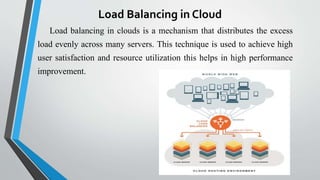
Load Balancing in Cloud
Load balancing in clouds is a mechanism that distributes the excess
load evenly across many servers. This technique is used to achieve high
user satisfaction and resource utilization this helps in high performance
improvement.
a) Reducing Energy Consumption: Load balancing helps in
avoiding overheating by balancing the workload across many
servers.
b) Reducing Carbon Emission: As the energy consumption is
reduced by load balancing. So we can reduce the carbon emission by
which we can achieve green computing.
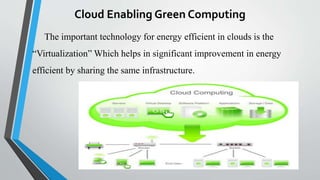
Cloud Enabling Green Computing
The important technology for energy efficient in clouds is the
“Virtualization” Which helps in significant improvement in energy
efficient by sharing the same infrastructure.
1. Dynamic Provision: In traditional computing, datacenters
and private infrastructure used to be maintained to fulfill worst case
demand.
2. Multi-tenancy: Using this approach, we can reduce the
energy usage and associated carbon emissions.
3. Server Utilization: Sometimes on-premise infrastructure runs
with very low utilization. Using virtualization same application can
be hosted and used on the same server thus lead to utilization up to
70%.
4. Datacenter Efficiency: By using the most energy efficient
technologies, cloud providers can improve the PUE of their
datacenters.
PUE- Power Usage Effectiveness
Conclusion
In this paper, I presented a comprehensive energy consumption
analysis of cloud computing and how it can be reduced. By using
techniques like load balancing and virtualization we can reduce the
power consumption of cloud data centers which will in turn reduce
the emission of carbon-di-oxide.
Whatever the technique is been used we have to make some
arrangements to reduce the power consumption in cloud data centers
and also the emission of CO2 should be reduced.
ThankYou

Green cloud computing

  • 1.
    Green Cloud Computing:Energy efficiency in cloud based data centers Ramkumar.R Pope John Paul II College of Education
  • 2.
    Introduction In the lastcompel of years, Cloud based data centers are increasing greatly because of the demand for computer resource. Since more data centers are came into existence the energy consumption of these data centers are also increased to a great extent. In addition to high energy consumption there is an addition impact on the environment by the form of carbon-di-oxide emissions.
  • 3.
    According to thereport of Congress on Server and data centers , the data centers are responsible for about 2% of global CO2 emission and they use nearly 80 million megawatt-hours of energy annually, it is about 1.5 times the amount of electricity used by the whole New York City.
  • 4.
    By 2020 thetotal amount of Carbon-di-oxide emitted by these data centers will be nearly 359 megatons. The recent research from Pike Research , the global market for green data centers will grow from $17.1 billion in 2012 to $45.4 billion by 2016.
  • 5.
    Cloud Computing Cloud Computingis not a very new concept in IT, in fact Cloud Computing is a more advanced version of the Data Processing Service Bureaus that we had 40 years ago.
  • 6.
    Cloud model isof three types: 1. Public Cloud: The service is available to public in a pay-as you-go manner. 2. Private Cloud: Private clouds are deployed within an organization to provide IT services to its internal user. 3. Hybrid Cloud: Hybrid clouds is emerged due to the diffusion of both public and private cloud advantages.
  • 7.
    Cloud computing alsooffers different types of service to its customer and it is of three types: 1. SaaS (Software as a Service): With SaaS, a provider licenses an application to customers either as a service on demand, through a subscription, in a "pay-as-you-go" model.
  • 8.
    2. IaaS (Infrastructureas a Service): It is typically a platform virtualization environment - as a service. Rather than purchasing servers, software, data-center space or network equipment, clients instead buy those resources as a fully outsourced service. 3. PaaS (Platform as a Service): Itis the delivery of a computing platform and solution stack as a service.
  • 9.
    Green Computing Green computingis the environmentally responsible and eco- friendly use of computer and its resources. It is also defined as the process of designing, manufacturing, and disposing computer devices which will not affect environment. Most of the IT companies now started to realize that moving green computing not only terms of public relation but also it will reduce the cost.
  • 10.
    The five coregreen computing technologies are: Green Data Center, Virtualization, Green Cloud Computing, Power Optimization and Grid Computing.
  • 11.
    This technology isbeneficial as it: 1. Reduce energy consumption of computing resources during peak operation. 2. Save energy during idle operation. 3. Use eco-friendly sources of energy. 4. Reduce harmful effects of computing resources. 5. Reduce computing wastes.
  • 12.
    Virtualization Virtualization is themain key factor for Cloud Computing to attain sustainability from the cost and energy efficient point of view.
  • 13.
    There are twotypes of virtualization which are widely used. a) Server Virtualization: Virtual server allows several machines to share the same physical server to run instead of having their own server. b) Storage Virtualization: Storing data across multiple server.
  • 14.
    Load Balancing inCloud Load balancing in clouds is a mechanism that distributes the excess load evenly across many servers. This technique is used to achieve high user satisfaction and resource utilization this helps in high performance improvement.
  • 15.
    a) Reducing EnergyConsumption: Load balancing helps in avoiding overheating by balancing the workload across many servers. b) Reducing Carbon Emission: As the energy consumption is reduced by load balancing. So we can reduce the carbon emission by which we can achieve green computing.
  • 16.
    Cloud Enabling GreenComputing The important technology for energy efficient in clouds is the “Virtualization” Which helps in significant improvement in energy efficient by sharing the same infrastructure.
  • 17.
    1. Dynamic Provision:In traditional computing, datacenters and private infrastructure used to be maintained to fulfill worst case demand. 2. Multi-tenancy: Using this approach, we can reduce the energy usage and associated carbon emissions.
  • 18.
    3. Server Utilization:Sometimes on-premise infrastructure runs with very low utilization. Using virtualization same application can be hosted and used on the same server thus lead to utilization up to 70%. 4. Datacenter Efficiency: By using the most energy efficient technologies, cloud providers can improve the PUE of their datacenters. PUE- Power Usage Effectiveness
  • 19.
    Conclusion In this paper,I presented a comprehensive energy consumption analysis of cloud computing and how it can be reduced. By using techniques like load balancing and virtualization we can reduce the power consumption of cloud data centers which will in turn reduce the emission of carbon-di-oxide.
  • 20.
    Whatever the techniqueis been used we have to make some arrangements to reduce the power consumption in cloud data centers and also the emission of CO2 should be reduced.
  • 21.