Evaluating Garment Quality 
CT 137 Advanced Apparel Construction
OBJECTIVE 
• Acquire most efficient and effective 
apparel construction without 
compromising quality and creative 
vision. 
• Learn appropriate method and 
techniques relevant to producing 
quality garments.
As BS Clothing Tech majors one should ... 
• recognizes the standards at different 
garment construction components 
that affect, to varying degrees, 
appearance and function of garment 
items. 
• be aware that standards will provide 
a better understanding of 
comparable apparel structures as 
well as establishing the company’s 
quality standards.
QUESTION??? 
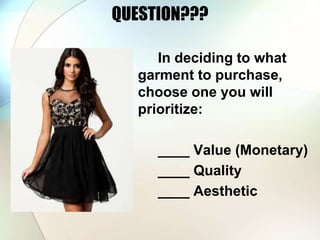
In deciding to what 
garment to purchase, 
choose one you will 
prioritize: 
____ Value (Monetary) 
____ Quality 
____ Aesthetic
Garment Quality 
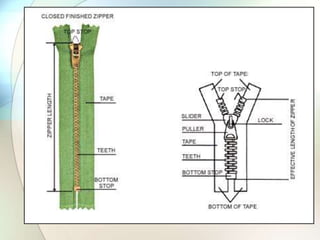
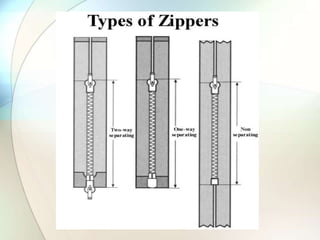
• Interact to affect the final price and 
value of an apparel item. 
• The concept of quality or value as a 
direct correlate of durability may 
appear foremost in the minds of 
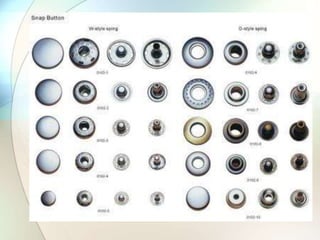
many consumers during a casual 
discussion of term, BUT in fact 
aesthetic concerns actually dominate 
most traditional treatments of 
apparel quality.
Garment Quality 
• Quality then is a broad term, and one 
which encompasses many different 
aspects of garment 
• Cost, because it relates to the factors 
of production, does not always 
reflect aesthetic or durability benefits 
but manufacturing solutions to 
certain production problems.
• Most of the standards will provide an 
in-depth look at construction 
components that affect, to varying 
degrees, appearance, function and 
cost of apparel items. However, none 
of these can be evaluated in 
COMPLETE ISOLATION.
• Some generalizations can be made 
as to comparative cost or quality of 
similar construction components, 
but all the specifics that resulted in 
the garment’s final cost cannot be 
ordered with precision except in 
terms of the particular garment and 
its manufacturer.
• Darts & Dart Equivalent 
• Seams 
• Seam Finishes 
• Collars 
• Hems & Finishes 
• Facings 
• Closures 
• Underlining, Interfacing, Interlining & 
Lining
Darts & Dart Equivalent 
Standards for Evaluating Dart & Dart 
Equivalents 
• Stitch length is appropriate to the 
fabric and expected stress at the 
stitched location. 
• The thread matches the apparel 
fabric 
• No crease or wells are present on the 
right side of the dart.
Darts & Dart Equivalent 
• No dimples or bubbles can be seen 
at the dart point. 
• Matching darts are identical in size 
and angle. 
• Fullness is evenly distributed in dart 
equivalents. 
• Sufficient fabric is allowed to achieve 
the desired design effect in dart 
equivalent.
Seams 
Standards for Evaluating Seams Types 
• Seams should be perfectly even; that 
is the stitching should be exactly the 
same distance from the seam edge 
for the entire length of the seam. 
• Seams should be stitched with the 
correct stitch length.
Seams 
• Seams should be smooth, with no 
puckers or pulls, and should lie flat. 
• The type of seam should be in 
accord with the type of fabric, the 
position of the seam and the 
projected care of the garment.
Seams 
• The seam width should be in accord 
with the type of seam, seam finish 
and garment design. Wider seam 
allowances require more fabric which 
leads to greater cost. 
• Seams should be finished according 
to the dictates of the seam type 
fabric and projected garment care.
Seam Finishes 
Standards for Evaluating Seam 
Finishes 
• The finish selected should prevent 
the fabric from raveling, rolling or 
stretching and should contribute to 
the overall neatness of the garment. 
• The finish should not add bulk to the 
seam.
Seam Finishes 
• The finish should be applied securely 
so that it remains in place during 
normal wear and care. 
• The seam finish should be 
appropriate to the garment fabric, to 
the garment design and to the 
intended use of the garment.
Collars 
Standards for evaluating collars 
• The collar is interfaced, when 
necessary, with appropriate 
interfacing. 
• The outer edges of the collar are 
smooth and even with no seam wells 
or holes.
Collars 
• Enclosed seams have been trimmed 
to reduce bulk. 
• The size and shape of the collar is 
consistent from one end to the other. 
Except for international design 
variations.
Collars 
• The collar fits the neck edge to which 
it is sewn without stretching or 
gathering. 
• The collar assumes the proper 
position on the garment, as intended 
by the designer. For example, a flat 
collar lies flat against the garment 
instead of rolling up.
Collars 
• The placement of the collar is 
symmetrical on the garment. For 
example, notched collars have the 
same size of the notch on each side 
of the center front. 
• All raw edges are carefully concealed 
during collar application so that they 
are not visible when the garment is 
worn.
Hems & Finishes 
Standards for evaluating hems and 
finishes 
• The hemline of the garment is 
parallel to the floor during wear, 
unless the garment design dictates 
an uneven hemline. 
• The hem is even in depth.
Hems & Finishes 
• The hem is flat and smooth, with no 
pulling, ripples, puckers, or pleats. 
• The hem type is appropriate for the 
garment fabric and the hem type. 
• The attachment method is 
appropriate for the garment fabric 
and style.
Hems & Finishes 
• Excess bulk has been eliminated 
from the hem area. 
• Topstitched hems should be evenly 
stitched with appropriate thread and 
stitch length.
Hems & Finishes 
• Blind stitching, fusing, and gluing 
should be inconspicuous on the right 
side of the garment. 
• Thread-covered edges should be 
smooth, well covered, and free from 
frayed or hanging threads.
Hems & Finishes 
• Hems at garments openings should 
be covered by the facing. 
• Hems in linings should allow for ease 
in wearing. 
• Hems in pleats should be handled to 
reinforce the pleat crease.
Facings 
Standards for evaluating facings 
• Facing lie smoothly with no ripples 
or puckers. 
• Facings are secured inconspicuously 
to the garment reverse to prevent 
their rolling to the outside. Top 
stitching, when used, serves as a 
means of securing the facing.
Facings 
• The free edge of the facing is 
finished with an appropriate seam 
finish to prevent raveling. 
• In garments made of thick, spongy 
fabric, the facings are cut from a 
lighter weight but matching fabric.
Facings 
• Facings in transparent or translucent 
fabrics are very narrow or stop at a 
design line of the garment. 
• The facing is understitched.
Facings 
• Most areas that are faced are 
interfaced as well. Bias facings are 
the exception and are not interfaced. 
The extended facing on a cowl 
neckline is not interfaced. Since that 
portion of the neckline is cut on the 
bias and intend to drape softly.
ZIPPER CLOSURES 
Standards for evaluating zippered 
closures 
• The zipper teeth and tape materials 
are suitable for the apparel design 
and fabric. 
• The zipper length is adequate for 
ease in wearing or using the item.
ZIPPER CLOSURES 
• The method of attachment is 
appropriate to the garment design. 
• Any visible stitching is neatly done. 
• The zipper is securely inserted into 
the garment.
ZIPPER CLOSURES 
• Zipper teeth are concealed 
adequately by lapped application. 
• Lapped applications are evenly 
formed.
Snapped & Hooked Closures 
Standards for evaluating snapped and 
hooked closures 
• Fasteners are the correct size for the 
closure requirement. 
• Fasteners are attached securely, 
whether mechanically or by the hand.
Snapped & Hooked Closures 
• Concealed applications of fasteners 
are inconspicuous. 
• Fasteners used in visible 
applications are suitable for the 
apparel design and fabric. 
• Durable coverings (thread or fabric) 
are used when appropriate.
Underlining 
Standards for Evaluating Underlining 
• Fashion fabric and underlining fabric 
relate well – the garment is neither 
over-supported nor under-supported 
for the desired design effect.
Underlining 
• Garment fabric and underlining 
fabric are compatible as to color, 
care requirements and longevity. 
• The two layers of fabric should fit 
smoothly and evenly with no pulls or 
tucks.
Interfacing 
Standards for Evaluating Interfacing 
• The interfacing complements and 
reinforces the garment fabric with 
out overpowering it. 
• Care requirements of the interfacing 
are compatible with those of the 
garment fabric.
Interfacing 
• Heavy interfacings are not caught in 
seams. 
• The interfacing does not show 
through to the right side of the 
garment.
Interfacing 
• Woven interfacings and nonwoven 
oriented interfacings are cut on the 
same grain as the garment to be 
interfaced. 
• Interfacing is used in any areas 
required shape, body, support and 
reinforcement and where seam 
impressions may be a problem.
Interlining 
Standards for Evaluating Interlining 
• Interlinings are of lightweight fabric 
with insulating properties. 
• Interlinings do not add excessive 
dimensions to the garment.
Interlining 
• The interlining’s care requirements 
match those of the rest of the 
garment. 
• The interlined garment has adequate 
wearing ease to accommodate the 
added thickness.
Linings 
Standards for Evaluating Lining 
• The lining fits smoothly inside the 
garment. 
• The lining provides a neat, clean 
inside finish.
Linings 
• The lining is constructed from a 
smooth static free fabric that 
complements the outer fabric. 
• The lined garment allows sufficient 
ease in the lining for the body 
movement without straining the 
fabric.
Linings 
• A partial lining used to maintain the 
shape of a garment extends at least 
far enough to accomplish this 
purpose. 
• On garments lined to the edge, the 
lining does not peek out to the front.
Evaluating Pattern Development (10 points) 
Technique & Execution 
3 points 
Quality of Pattern/ Draping 
3 points 
Cutting 
3 points 
Adherence to Schedule 1 point

Evaluating Garment Quality

  • 1.
    Evaluating Garment Quality CT 137 Advanced Apparel Construction
  • 2.
    OBJECTIVE • Acquiremost efficient and effective apparel construction without compromising quality and creative vision. • Learn appropriate method and techniques relevant to producing quality garments.
  • 3.
    As BS ClothingTech majors one should ... • recognizes the standards at different garment construction components that affect, to varying degrees, appearance and function of garment items. • be aware that standards will provide a better understanding of comparable apparel structures as well as establishing the company’s quality standards.
  • 4.
    QUESTION??? In decidingto what garment to purchase, choose one you will prioritize: ____ Value (Monetary) ____ Quality ____ Aesthetic
  • 5.
    Garment Quality •Interact to affect the final price and value of an apparel item. • The concept of quality or value as a direct correlate of durability may appear foremost in the minds of many consumers during a casual discussion of term, BUT in fact aesthetic concerns actually dominate most traditional treatments of apparel quality.
  • 6.
    Garment Quality •Quality then is a broad term, and one which encompasses many different aspects of garment • Cost, because it relates to the factors of production, does not always reflect aesthetic or durability benefits but manufacturing solutions to certain production problems.
  • 7.
    • Most ofthe standards will provide an in-depth look at construction components that affect, to varying degrees, appearance, function and cost of apparel items. However, none of these can be evaluated in COMPLETE ISOLATION.
  • 8.
    • Some generalizationscan be made as to comparative cost or quality of similar construction components, but all the specifics that resulted in the garment’s final cost cannot be ordered with precision except in terms of the particular garment and its manufacturer.
  • 9.
    • Darts &Dart Equivalent • Seams • Seam Finishes • Collars • Hems & Finishes • Facings • Closures • Underlining, Interfacing, Interlining & Lining
  • 10.
    Darts & DartEquivalent Standards for Evaluating Dart & Dart Equivalents • Stitch length is appropriate to the fabric and expected stress at the stitched location. • The thread matches the apparel fabric • No crease or wells are present on the right side of the dart.
  • 11.
    Darts & DartEquivalent • No dimples or bubbles can be seen at the dart point. • Matching darts are identical in size and angle. • Fullness is evenly distributed in dart equivalents. • Sufficient fabric is allowed to achieve the desired design effect in dart equivalent.
  • 12.
    Seams Standards forEvaluating Seams Types • Seams should be perfectly even; that is the stitching should be exactly the same distance from the seam edge for the entire length of the seam. • Seams should be stitched with the correct stitch length.
  • 13.
    Seams • Seamsshould be smooth, with no puckers or pulls, and should lie flat. • The type of seam should be in accord with the type of fabric, the position of the seam and the projected care of the garment.
  • 14.
    Seams • Theseam width should be in accord with the type of seam, seam finish and garment design. Wider seam allowances require more fabric which leads to greater cost. • Seams should be finished according to the dictates of the seam type fabric and projected garment care.
  • 15.
    Seam Finishes Standardsfor Evaluating Seam Finishes • The finish selected should prevent the fabric from raveling, rolling or stretching and should contribute to the overall neatness of the garment. • The finish should not add bulk to the seam.
  • 16.
    Seam Finishes •The finish should be applied securely so that it remains in place during normal wear and care. • The seam finish should be appropriate to the garment fabric, to the garment design and to the intended use of the garment.
  • 17.
    Collars Standards forevaluating collars • The collar is interfaced, when necessary, with appropriate interfacing. • The outer edges of the collar are smooth and even with no seam wells or holes.
  • 18.
    Collars • Enclosedseams have been trimmed to reduce bulk. • The size and shape of the collar is consistent from one end to the other. Except for international design variations.
  • 19.
    Collars • Thecollar fits the neck edge to which it is sewn without stretching or gathering. • The collar assumes the proper position on the garment, as intended by the designer. For example, a flat collar lies flat against the garment instead of rolling up.
  • 20.
    Collars • Theplacement of the collar is symmetrical on the garment. For example, notched collars have the same size of the notch on each side of the center front. • All raw edges are carefully concealed during collar application so that they are not visible when the garment is worn.
  • 21.
    Hems & Finishes Standards for evaluating hems and finishes • The hemline of the garment is parallel to the floor during wear, unless the garment design dictates an uneven hemline. • The hem is even in depth.
  • 22.
    Hems & Finishes • The hem is flat and smooth, with no pulling, ripples, puckers, or pleats. • The hem type is appropriate for the garment fabric and the hem type. • The attachment method is appropriate for the garment fabric and style.
  • 23.
    Hems & Finishes • Excess bulk has been eliminated from the hem area. • Topstitched hems should be evenly stitched with appropriate thread and stitch length.
  • 24.
    Hems & Finishes • Blind stitching, fusing, and gluing should be inconspicuous on the right side of the garment. • Thread-covered edges should be smooth, well covered, and free from frayed or hanging threads.
  • 25.
    Hems & Finishes • Hems at garments openings should be covered by the facing. • Hems in linings should allow for ease in wearing. • Hems in pleats should be handled to reinforce the pleat crease.
  • 26.
    Facings Standards forevaluating facings • Facing lie smoothly with no ripples or puckers. • Facings are secured inconspicuously to the garment reverse to prevent their rolling to the outside. Top stitching, when used, serves as a means of securing the facing.
  • 27.
    Facings • Thefree edge of the facing is finished with an appropriate seam finish to prevent raveling. • In garments made of thick, spongy fabric, the facings are cut from a lighter weight but matching fabric.
  • 28.
    Facings • Facingsin transparent or translucent fabrics are very narrow or stop at a design line of the garment. • The facing is understitched.
  • 29.
    Facings • Mostareas that are faced are interfaced as well. Bias facings are the exception and are not interfaced. The extended facing on a cowl neckline is not interfaced. Since that portion of the neckline is cut on the bias and intend to drape softly.
  • 30.
    ZIPPER CLOSURES Standardsfor evaluating zippered closures • The zipper teeth and tape materials are suitable for the apparel design and fabric. • The zipper length is adequate for ease in wearing or using the item.
  • 31.
    ZIPPER CLOSURES •The method of attachment is appropriate to the garment design. • Any visible stitching is neatly done. • The zipper is securely inserted into the garment.
  • 32.
    ZIPPER CLOSURES •Zipper teeth are concealed adequately by lapped application. • Lapped applications are evenly formed.
  • 35.
    Snapped & HookedClosures Standards for evaluating snapped and hooked closures • Fasteners are the correct size for the closure requirement. • Fasteners are attached securely, whether mechanically or by the hand.
  • 36.
    Snapped & HookedClosures • Concealed applications of fasteners are inconspicuous. • Fasteners used in visible applications are suitable for the apparel design and fabric. • Durable coverings (thread or fabric) are used when appropriate.
  • 39.
    Underlining Standards forEvaluating Underlining • Fashion fabric and underlining fabric relate well – the garment is neither over-supported nor under-supported for the desired design effect.
  • 40.
    Underlining • Garmentfabric and underlining fabric are compatible as to color, care requirements and longevity. • The two layers of fabric should fit smoothly and evenly with no pulls or tucks.
  • 41.
    Interfacing Standards forEvaluating Interfacing • The interfacing complements and reinforces the garment fabric with out overpowering it. • Care requirements of the interfacing are compatible with those of the garment fabric.
  • 42.
    Interfacing • Heavyinterfacings are not caught in seams. • The interfacing does not show through to the right side of the garment.
  • 43.
    Interfacing • Woveninterfacings and nonwoven oriented interfacings are cut on the same grain as the garment to be interfaced. • Interfacing is used in any areas required shape, body, support and reinforcement and where seam impressions may be a problem.
  • 44.
    Interlining Standards forEvaluating Interlining • Interlinings are of lightweight fabric with insulating properties. • Interlinings do not add excessive dimensions to the garment.
  • 45.
    Interlining • Theinterlining’s care requirements match those of the rest of the garment. • The interlined garment has adequate wearing ease to accommodate the added thickness.
  • 46.
    Linings Standards forEvaluating Lining • The lining fits smoothly inside the garment. • The lining provides a neat, clean inside finish.
  • 47.
    Linings • Thelining is constructed from a smooth static free fabric that complements the outer fabric. • The lined garment allows sufficient ease in the lining for the body movement without straining the fabric.
  • 48.
    Linings • Apartial lining used to maintain the shape of a garment extends at least far enough to accomplish this purpose. • On garments lined to the edge, the lining does not peek out to the front.
  • 49.
    Evaluating Pattern Development(10 points) Technique & Execution 3 points Quality of Pattern/ Draping 3 points Cutting 3 points Adherence to Schedule 1 point