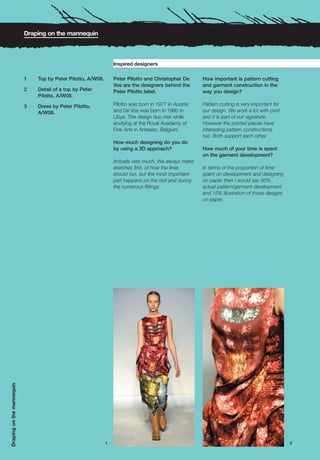
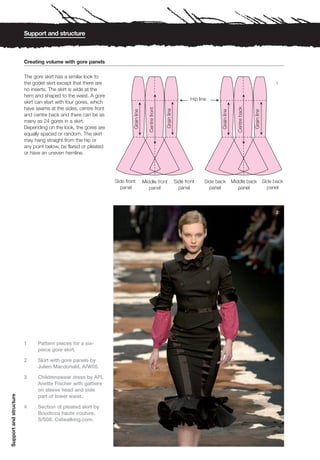
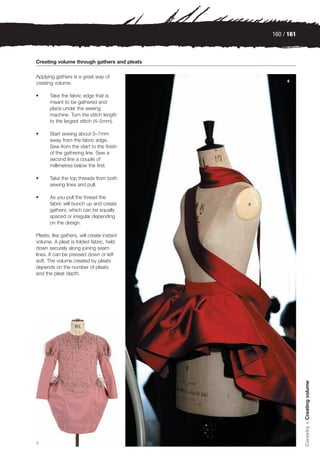
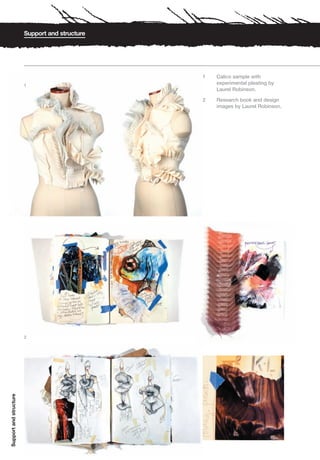
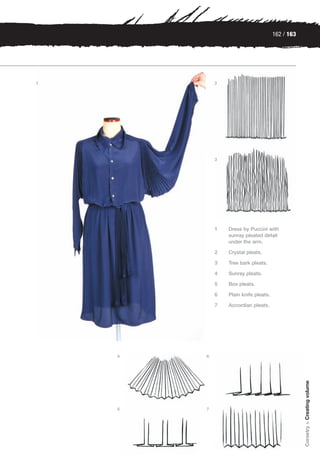
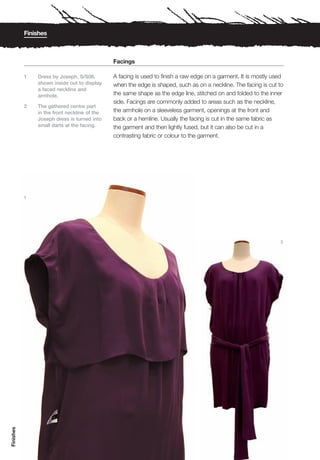
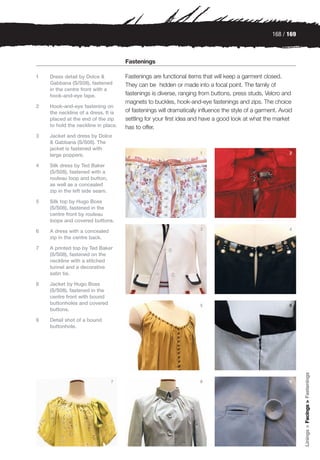
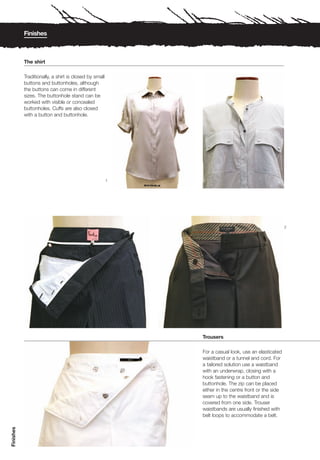
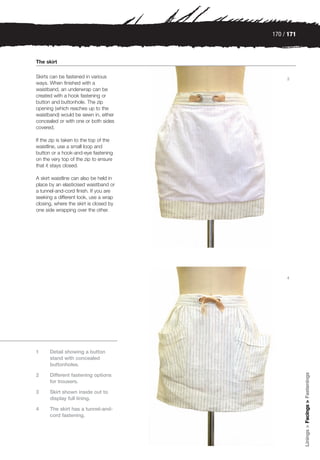
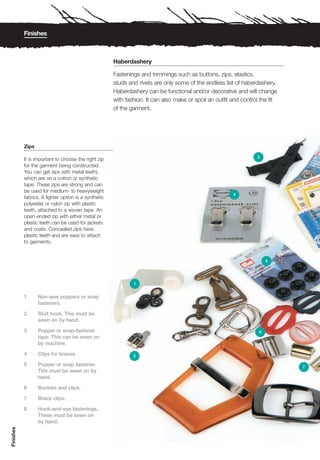
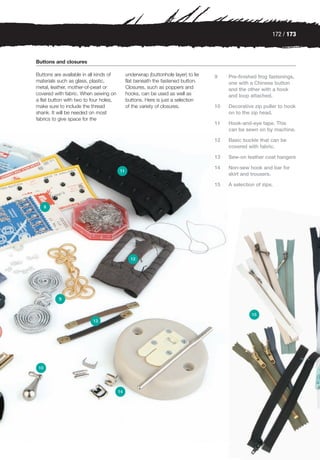
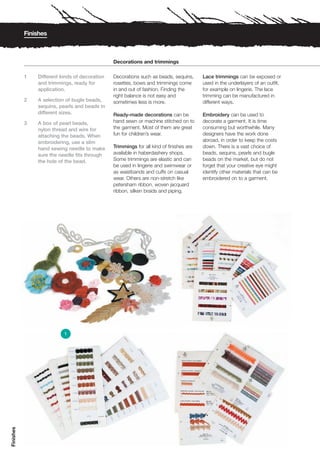
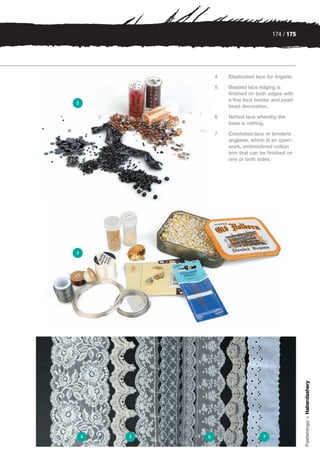
BASICS
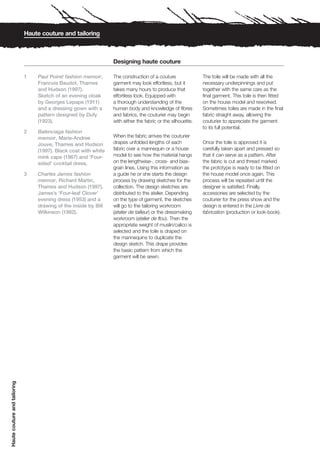
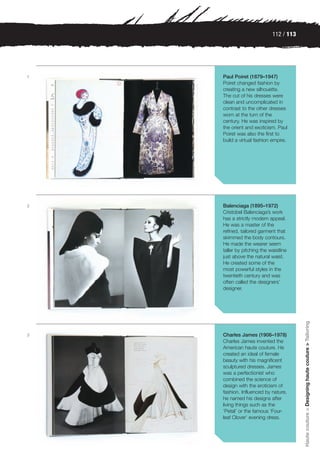
                 Anette Fischer
FASHION DESIGN
      03


     CONSTRUCTION
An AVA Book
Published by AVA Publishing SA
Rue des Fontenailles 16
Case Postale
1000 Lausanne 6
Switzerland
Tel: +41 786 005 109
Email: enquiries@avabooks.ch

Distributed by Thames & Hudson (ex-North America)
181a High Holborn
London WC1V 7QX
United Kingdom
Tel: +44 20 7845 5000
Fax: +44 20 7845 5055
Email: sales@thameshudson.co.uk
www.thamesandhudson.com

Distributed in the USA & Canada by:
Ingram Publisher Services Inc.
1 Ingram Blvd.
La Vergne, TN 37086
USA
Tel: +1 866 400 5351
Fax: +1 800 838 1149
Email: customer.service@ingrampublisherservices.com

English Language Support Office
AVA Publishing (UK) Ltd.
Tel: +44 1903 204 455
Email: enquiries@avabooks.ch

Copyright © AVA Publishing SA 2009

All rights reserved. No part of this publication may be reproduced,
stored in a retrieval system or transmitted in any form or by any means,
electronic, mechanical, photocopying, recording or otherwise, without
permission of the copyright holder.

ISBN 978-2-940373-75-8

10 9 8 7 6 5 4 3 2

Design by Sifer Design

Production by AVA Book Production Pte. Ltd., Singapore
Tel: +65 6334 8173
Fax: +65 6259 9830
Email: production@avabooks.com.sg

All reasonable attempts have been made to trace, clear and credit the
copyright holders of the images reproduced in this book. However, if any
credits have been inadvertently omitted, the publisher will endeavour to
incorporate amendments in future editions.
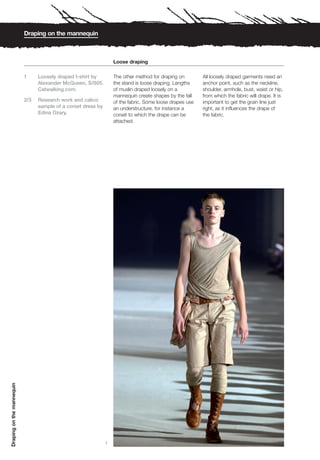
2/3


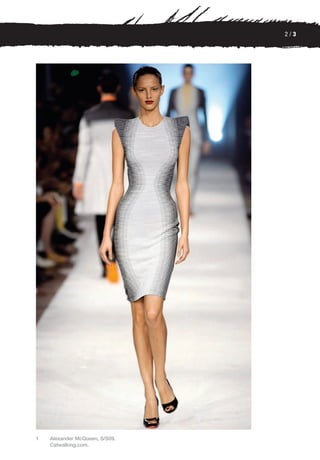
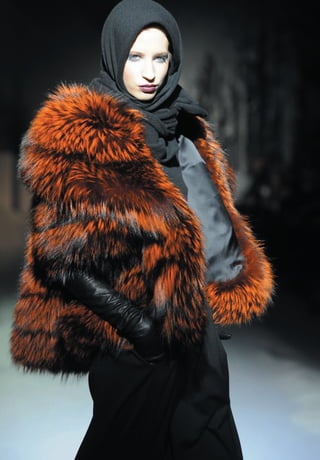
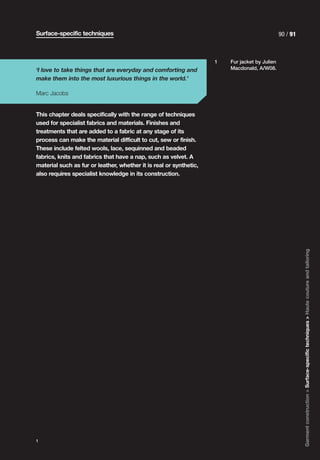
1   Alexander McQueen, S/S09.
    Catwalking.com.
Contents


               Introduction                           6
               How to get the most out of this book   8


                                                          Getting started                        10

                                                          Pattern cutting tools and equipment   12
                                                          Silhouettes                           14
                                                          Sizing and grading                    16
                                                          Blocks and patterns                   20


                                                          Pattern cutting                        24

                                                          How to read a design drawing          26
                                                          Dart manipulation                     30
                                                          Slash and spread                      32
                                                          Sleeves                               34
                                                          Collars                               44
                                                          Pockets                               54
                                                          Bias cut                              56
                                                          Fitting the toile                     58
                                                          Laying a pattern on to fabric         64


                                                          Garment construction                   70

                                                          Tools for the technique               72
                                                          Seams                                 78
                                                          Seam finishes                         82
                                                          Hand sewing techniques                84


                                                          Surface-specific techniques            90

                                                          Felted fabrics                         92
                                                          Lace                                   94
                                                          Leather                                96
                                                          Fur                                    98
                                                          Knits and stretch-woven fabrics       100
                                                          Sequinned and beaded fabrics          102
                                                          Velvet                                104
                                                          Transparent fabrics                   106
Construction
4/5


Haute couture and tailoring            108

Haute couture                          110
Designing haute couture                112
Tailoring                              114
Tailoring techniques                   116


Draping on the mannequin               120

Modelling tools and
equipment                              122
Grain line and draping                 124
Draping style                          126
Geometric shapes                       130
Inspired designers                     132


Support and structure                  136

History of supported
and structured garments                138
Supporting materials                   140
Interlining/fusing                     148
Corsetry                               152
Creating volume                        156


Finishes                               164

Linings                                166
Facings                                168
Fastenings                             169
Haberdashery                           172


Conclusion                             176
Glossary                               178
Bibliography                           182
Useful resources                       184
Canon                                  190
Acknowledgements and picture credits   192
Introduction                                                                                  6/7


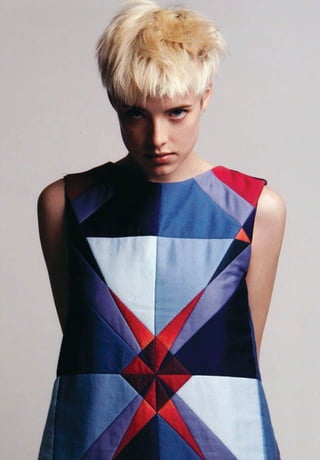
                                                                    1   Sleeveless dress designed
‘Do not quench your inspiration and your imagination;                   by David Bradley.

do not become the slave of your model.’

Vincent Van Gogh


Construction is the foundation of clothing and of fashion design;
it is vital that fashion designers know and understand the
techniques involved in creating a three-dimensional garment
from a two-dimensional design or pattern in order to create a
beautiful shape and fit on a moving body. Garment construction
involves both technical and design issues; the designer can
choose where to construct lines, pockets, collars, how to
finish edges and how to produce volume and structure in
order to create a unique look and experience for the wearer.

From basic block cutting to the smallest finishing
details on a constructed garment, Basics Fashion Design:
Construction leads you through the essential stages of
garment construction and offers you a starting point from
which knowledge can be extended. It introduces you to the
world of pattern cutting, draping on the mannequin and
shows you some techniques for breathing life into a flat
design drawing in order to achieve a three-dimensional
garment. Basic sewing techniques are introduced and you
are shown how to use darts, sleeves, collars, pockets and
the cut of the fabric to add variation to your designs. The
breadth of the subject is illustrated with a history of garment
construction, techniques used in the haute couture and tailoring
crafts and an introduction to supporting and structuring
materials. The book concludes with finishing techniques
and a selection of resources for those wishing to delve
deeper into the world of construction for fashion.

With its inspirational photography and easy-to-follow
diagrams, Construction offers a clear introduction to the
fundamental skills, knowledge and historical background
needed for successful garment construction. I hope it will
awaken your interest and inspire you to create the perfect
silhouette and a beautiful, final piece.
                                                                                                    Introduction


1
How to get the most out of this book


This book introduces different aspects of garment construction
via dedicated chapters for each topic. Each chapter provides
numerous examples of work by leading designers, annotated
to explain the reasons behind the choices made.

Key construction and design principles are isolated so that
the reader can see how they are applied in practice.


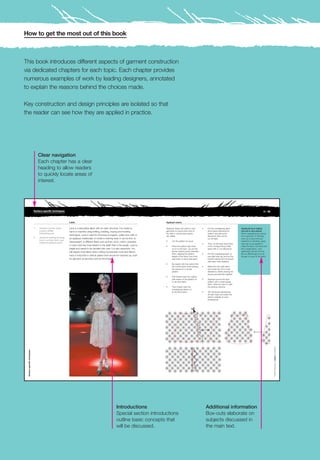
                                   Clear navigation
                                   Each chapter has a clear
                                   heading to allow readers
                                   to quickly locate areas of
                                   interest.


                               Surface-specific techniques                                                                                                                                                                                              94 / 95


                                                                    Lace                                                                       Appliqué seams

                               1   Christian Lacroix, haute         Lace is a decorative fabric with an open structure. It is made by          Appliqué seams are used on lace         •   Cut the overlapping piece         Appliquéd lace edging
                                   couture, S/S08.                  hand or machine using knitting, braiding, looping and knotting             garments to ensure that none of             (front piece) following the       and set-in lace pieces
                                   Catwalking.com                                                                                              the side or centre back seams               pattern and add some              When integrating lace pieces
                                                                    techniques. Lace is used for trimming on lingerie, collars and cuffs or    are visible.                                allowance (this can be            into a garment or finishing,
                               2   Technical drawing showing        as appliqué, traditionally on bridal or evening wear. It can be fine- to                                               cut off later).                   such as on lace-trimmed
                                   how to cut lace fabric and
                                                                    heavyweight, in different fibres such as linen, wool, cotton, polyester    •    Cut the pattern as usual.                                                necklines or hemlines, great
                                   create an appliqué seam.
                                                                                                                                                                                       •   Then cut the back piece (this     care has to be applied to
                                                                    or nylon and has more stretch in the width than in the length. Lace is     •    Place the pattern right-side           is the corresponding under        make the fabric and lace look
                                                                    fragile and needs to be handled with care. It is also expensive. You            up on to the lace. Lay out the         layer) with a 1cm allowance.      like a single piece. Lace
                                                                    will require more fabric when cutting out because most lace fabrics             pieces, leaving space between                                            application should not look
                                                                                                                                                    them, aligning the pattern         •   Put the overlapping layer on      like an afterthought, but as
                                                                    have a horizontal or vertical pattern that should be matched up, both           design of the fabric from front        top (right-side up) and pin the   though it is part of the fabric.
                                                                    for garment construction and for trimmings.                                     side seam to back side seam.           thread-marked front and back
                                                                                                                                                                                           side seam lines together.
                                                                                                                                               •    Be careful with the centre front
                                                                                                                                                    and centre back when placing       •   Baste the new side seam
                                                                                                                                                    the pieces for a central               and check the fit for small
                                                                                                                                                    pattern.                               alterations, before sewing the
                                                                                                                                                                                           pieces permanently together.
                                                                                                                                               •    First thread mark the original
                                                                                                                                                    side seams of the pattern on       •   Appliqué around the lace
                                                                                                                                                    to the lace fabric.                    pattern with a small zigzag
                                                                                                                                                                                           stitch, either by hand or with
                                                                                                                                               •    Then thread mark the                   the sewing machine.
                                                                                                                                                    overlapping pattern on
                                                                                                                                                    to the front panel.                •   Trim all excess allowances
                                                                                                                                                                                           off each layer and press the
                                                                                                                                                                                           seams carefully at a low
                                                                                                                                                                                           temperature.
                                                                                                                                                                                                                                                                  Felted fabrics > Lace > Leather
 Surface-specific techniques


                                                                1


                                                                                                                     Introductions                                                         Additional information
                                                                                                                     Special section introductions                                         Box-outs elaborate on
                                                                                                                     outline basic concepts that                                           subjects discussed in
                                                                                                                     will be discussed.                                                    the main text.
8/9


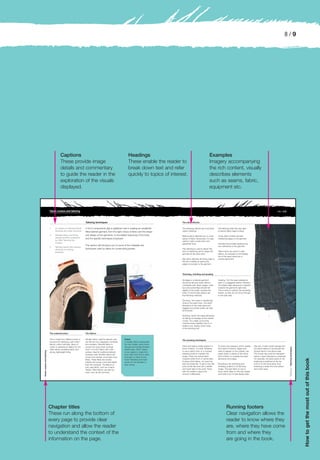
                                          Captions                                                                  Headings                                                          Examples
                                          These provide image                                                       These enable the reader to                                        Imagery accompanying
                                          details and commentary                                                    break down text and refer                                         the rich content, visually
                                          to guide the reader in the                                                quickly to topics of interest.                                    describes elements
                                          exploration of the visuals                                                                                                                  such as seams, fabric,
                                          displayed.                                                                                                                                  equipment etc.


                              Haute couture and tailoring                                                                                                                                                                                                       116 / 117


                                                                      Tailoring techniques                                                          The hand stitches

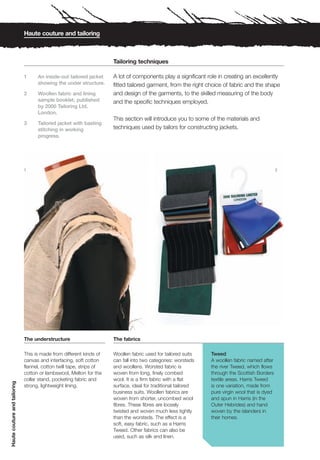
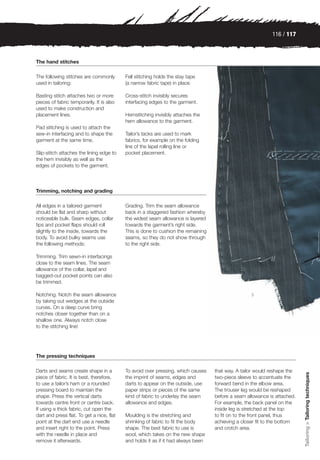
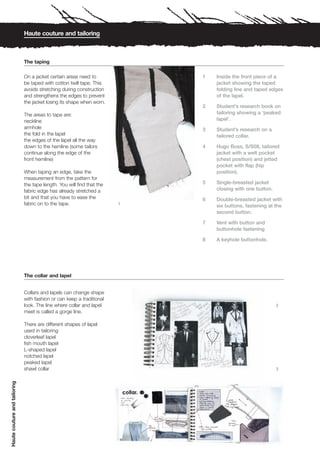
                              1     An inside-out tailored jacket     A lot of components play a significant role in creating an excellently        The following stitches are commonly        Fell stitching holds the stay tape
                                    showing the under structure.      fitted tailored garment, from the right choice of fabric and the shape        used in tailoring:                         (a narrow fabric tape) in place.

                              2     Woollen fabric and lining         and design of the garments, to the skilled measuring of the body              Basting stitch attaches two or more        Cross-stitch invisibly secures
                                    sample booklet, published         and the specific techniques employed.                                         pieces of fabric temporarily. It is also   interfacing edges to the garment.
                                    by 2000 Tailoring Ltd.                                                                                          used to make construction and
                                    London.                                                                                                         placement lines.                           Hemstitching invisibly attaches the
                                                                      This section will introduce you to some of the materials and                                                             hem allowance to the garment.
                              3     Tailored jacket with basting
                                    stitching in working              techniques used by tailors for constructing jackets.                          Pad stitching is used to attach the
                                    progress.                                                                                                       sew-in interfacing and to shape the        Tailor’s tacks are used to mark
                                                                                                                                                    garment at the same time.                  fabrics, for example on the folding
                                                                                                                                                                                               line of the lapel rolling line or
                                                                                                                                                    Slip-stitch attaches the lining edge to    pocket placement.
                                                                                                                                                    the hem invisibly as well as the
                                                                                                                                                    edges of pockets to the garment.
                              1                                                                                                                 2


                                                                                                                                                    Trimming, notching and grading

                                                                                                                                                    All edges in a tailored garment            Grading. Trim the seam allowance
                                                                                                                                                    should be flat and sharp without           back in a staggered fashion whereby
                                                                                                                                                    noticeable bulk. Seam edges, collar        the widest seam allowance is layered
                                                                                                                                                    tips and pocket flaps should roll          towards the garment’s right side.
                                                                                                                                                    slightly to the inside, towards the        This is done to cushion the remaining
                                                                                                                                                    body. To avoid bulky seams use             seams, so they do not show through
                                                                                                                                                    the following methods:                     to the right side.

                                                                                                                                                    Trimming. Trim sewn-in interfacings
                                                                                                                                                    close to the seam lines. The seam
                                                                                                                                                    allowance of the collar, lapel and
                                                                                                                                                    bagged-out pocket points can also
                                                                                                                                                    be trimmed.

                                                                                                                                                    Notching. Notch the seam allowance                                                                 3
                                                                                                                                                    by taking out wedges at the outside
                                                                                                                                                    curves. On a deep curve bring
                                                                                                                                                    notches closer together than on a
                                                                                                                                                    shallow one. Always notch close
                                                                                                                                                    to the stitching line!

                              The understructure                      The fabrics

                              This is made from different kinds of    Woollen fabric used for tailored suits    Tweed                               The pressing techniques
                              canvas and interfacing, soft cotton     can fall into two categories: worsteds    A woollen fabric named after
                              flannel, cotton twill tape, strips of   and woollens. Worsted fabric is           the river Tweed, which flows
                              cotton or lambswool, Melton for the     woven from long, finely combed            through the Scottish Borders        Darts and seams create shape in a          To avoid over pressing, which causes    that way. A tailor would reshape the
                                                                                                                                                                                                                                                                              Tailoring > Tailoring techniques


                              collar stand, pocketing fabric and      wool. It is a firm fabric with a flat     textile areas. Harris Tweed         piece of fabric. It is best, therefore,    the imprint of seams, edges and         two-piece sleeve to accentuate the
Haute couture and tailoring


                              strong, lightweight lining.             surface, ideal for traditional tailored   is one variation, made from         to use a tailor’s ham or a rounded         darts to appear on the outside, use     forward bend in the elbow area.
                                                                      business suits. Woollen fabrics are       pure virgin wool that is dyed       pressing board to maintain the             paper strips or pieces of the same      The trouser leg would be reshaped
                                                                      woven from shorter, uncombed wool         and spun in Harris (in the          shape. Press the vertical darts            kind of fabric to underlay the seam     before a seam allowance is attached.
                                                                                                                                                                                                                                                                                                                 How to get the most out of this book


                                                                      fibres. These fibres are loosely          Outer Hebrides) and hand            towards centre front or centre back.       allowance and edges.                    For example, the back panel on the
                                                                      twisted and woven much less tightly       woven by the islanders in           If using a thick fabric, cut open the                                              inside leg is stretched at the top
                                                                      than the worsteds. The effect is a        their homes.                        dart and press flat. To get a nice, flat   Moulding is the stretching and          to fit on to the front panel, thus
                                                                      soft, easy fabric, such as a Harris                                           point at the dart end use a needle         shrinking of fabric to fit the body     achieving a closer fit to the bottom
                                                                      Tweed. Other fabrics can also be                                              and insert right to the point. Press       shape. The best fabric to use is        and crotch area.
                                                                      used, such as silk and linen.                                                 with the needle in place and               wool, which takes on the new shape
                                                                                                                                                    remove it afterwards.                      and holds it as if it had always been


                              Chapter titles                                                                                                                                                            Running footers
                              These run along the bottom of                                                                                                                                             Clear navigation allows the
                              every page to provide clear                                                                                                                                               reader to know where they
                              navigation and allow the reader                                                                                                                                           are, where they have come
                              to understand the context of the                                                                                                                                          from and where they
                              information on the page.                                                                                                                                                  are going in the book.
Getting started                                                                                 10 / 11


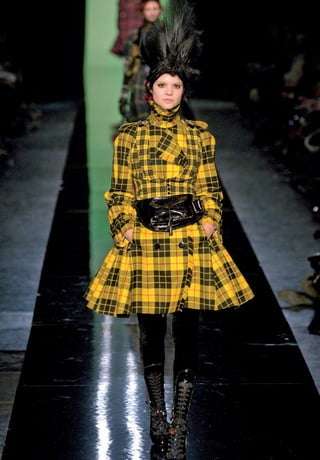
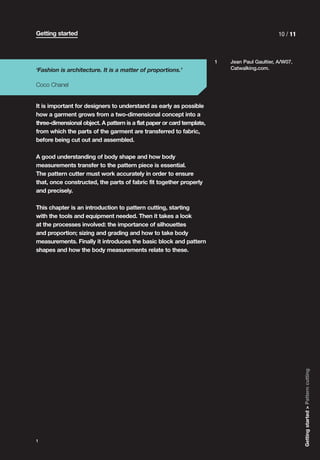
                                                                        1   Jean Paul Gaultier, A/W07.
‘Fashion is architecture. It is a matter of proportions.’                   Catwalking.com.


Coco Chanel


It is important for designers to understand as early as possible
how a garment grows from a two-dimensional concept into a
three-dimensional object. A pattern is a flat paper or card template,
from which the parts of the garment are transferred to fabric,
before being cut out and assembled.

A good understanding of body shape and how body
measurements transfer to the pattern piece is essential.
The pattern cutter must work accurately in order to ensure
that, once constructed, the parts of fabric fit together properly
and precisely.

This chapter is an introduction to pattern cutting, starting
with the tools and equipment needed. Then it takes a look
at the processes involved: the importance of silhouettes
and proportion; sizing and grading and how to take body
measurements. Finally it introduces the basic block and pattern
shapes and how the body measurements relate to these.


                                                                                                          Getting started > Pattern cutting


1
Getting started


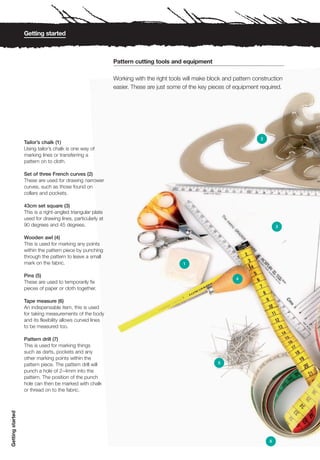
                                                            Pattern cutting tools and equipment

                                                            Working with the right tools will make block and pattern construction
                                                            easier. These are just some of the key pieces of equipment required.


                                                                                                                        2
                  Tailor’s chalk (1)
                  Using tailor’s chalk is one way of
                  marking lines or transferring a
                  pattern on to cloth.

                  Set of three French curves (2)
                  These are used for drawing narrower
                  curves, such as those found on
                  collars and pockets.

                  43cm set square (3)
                  This is a right-angled triangular plate
                  used for drawing lines, particularly at
                  90 degrees and 45 degrees.                                                                                    3

                  Wooden awl (4)
                  This is used for marking any points
                  within the pattern piece by punching
                  through the pattern to leave a small
                  mark on the fabric.                                                   1

                  Pins (5)
                                                                                                              4
                  These are used to temporarily fix
                  pieces of paper or cloth together.

                  Tape measure (6)
                  An indispensable item, this is used
                  for taking measurements of the body
                  and its flexibility allows curved lines
                  to be measured too.

                  Pattern drill (7)
                  This is used for marking things
                  such as darts, pockets and any
                  other marking points within the
                  pattern piece. The pattern drill will                                               5
                  punch a hole of 2–4mm into the
                  pattern. The position of the punch
                  hole can then be marked with chalk
                  or thread on to the fabric.
Getting started


                                                                                                                            6
12 / 13


                  9


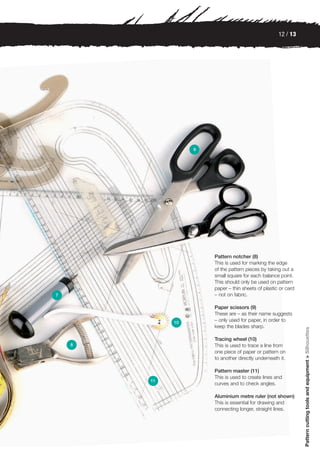
                      Pattern notcher (8)
                      This is used for marking the edge
                      of the pattern pieces by taking out a
                      small square for each balance point.
                      This should only be used on pattern
                      paper – thin sheets of plastic or card
7                     – not on fabric.

                      Paper scissors (9)
                      These are – as their name suggests
             10
                      – only used for paper, in order to
                      keep the blades sharp.
                                                               Pattern cutting tools and equipment > Silhouettes


                      Tracing wheel (10)
    8                 This is used to trace a line from
                      one piece of paper or pattern on
                      to another directly underneath it.

                      Pattern master (11)
                      This is used to create lines and
        11
                      curves and to check angles.

                      Aluminium metre ruler (not shown)
                      This is essential for drawing and
                      connecting longer, straight lines.
Getting started


                                                            Silhouettes

                                                            First impressions of an outfit are created by its silhouette – the overall
                                                            shape created by a garment. This is before qualities conveyed by the
                                                            detail, fabric or texture of the garment can even be acknowledged,
                                                            so the shape and form that a garment takes is a fundamental
                                                            consideration in the design and construction processes.


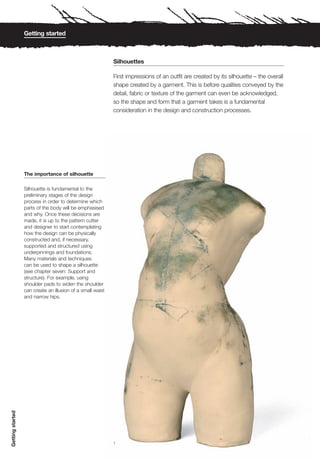
                  The importance of silhouette

                  Silhouette is fundamental to the
                  preliminary stages of the design
                  process in order to determine which
                  parts of the body will be emphasised
                  and why. Once these decisions are
                  made, it is up to the pattern cutter
                  and designer to start contemplating
                  how the design can be physically
                  constructed and, if necessary,
                  supported and structured using
                  underpinnings and foundations.
                  Many materials and techniques
                  can be used to shape a silhouette
                  (see chapter seven: Support and
                  structure). For example, using
                  shoulder pads to widen the shoulder
                  can create an illusion of a small waist
                  and narrow hips.
Getting started


                                                            1
14 / 15


Proportions and bodylines


Proportion refers to the comparative       Proportions can be changed fairly        1     Sculptured ceramic
relations and dimensions of the various    easily using various construction              mannequin by Helen Manley.
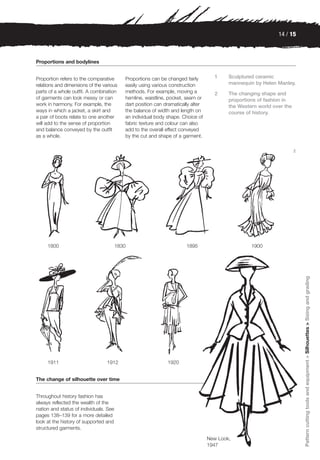
parts of a whole outfit. A combination     methods. For example, moving a           2     The changing shape and
of garments can look messy or can          hemline, waistline, pocket, seam or            proportions of fashion in
work in harmony. For example, the          dart position can dramatically alter           the Western world over the
ways in which a jacket, a skirt and        the balance of width and length on             course of history.
a pair of boots relate to one another      an individual body shape. Choice of
will add to the sense of proportion        fabric texture and colour can also
and balance conveyed by the outfit         add to the overall effect conveyed
as a whole.                                by the cut and shape of a garment.

                                                                                                                       2


     1800                               1830                           1895                        1900


                                                                                                                           Pattern cutting tools and equipment > Silhouettes > Sizing and grading


     1911                         1912                        1920


The change of silhouette over time


Throughout history fashion has
always reflected the wealth of the
nation and status of individuals. See
pages 138–139 for a more detailed
look at the history of supported and
structured garments.

                                                                                  New Look,
                                                                                  1947
Getting started


                                                      Sizing and grading

                                                      Designs for a garment can be cut and made to fit an individual
                                                      customer or they can be graded and altered to fit wearers of differing
                                                      sizes. Either way, a full and detailed knowledge of sizing and grading
                                                      is essential for any designer hoping to create a beautifully fitting
                                                      garment. Being able to translate body proportions to paper and
                                                      back to a three-dimensional garment takes much practice and
                                                      careful attention to detail is fundamental.


                                                      1


                                                      Sizing

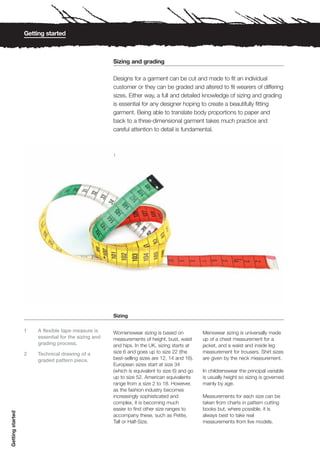
                  1    A flexible tape measure is     Womenswear sizing is based on            Menswear sizing is universally made
                       essential for the sizing and   measurements of height, bust, waist      up of a chest measurement for a
                       grading process.               and hips. In the UK, sizing starts at    jacket, and a waist and inside leg
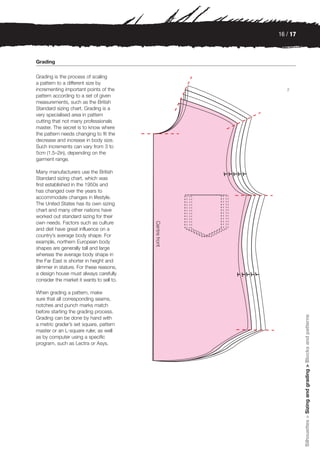
                  2    Technical drawing of a         size 6 and goes up to size 22 (the       measurement for trousers. Shirt sizes
                       graded pattern piece.          best-selling sizes are 12, 14 and 16).   are given by the neck measurement.
                                                      European sizes start at size 34
                                                      (which is equivalent to size 6) and go   In childrenswear the principal variable
                                                      up to size 52. American equivalents      is usually height so sizing is governed
                                                      range from a size 2 to 18. However,      mainly by age.
                                                      as the fashion industry becomes
                                                      increasingly sophisticated and           Measurements for each size can be
                                                      complex, it is becoming much             taken from charts in pattern cutting
                                                      easier to find other size ranges to      books but, where possible, it is
Getting started


                                                      accompany these, such as Petite,         always best to take real
                                                      Tall or Half-Size.                       measurements from live models.
16 / 17


Grading

Grading is the process of scaling
a pattern to a different size by
incrementing important points of the          2
pattern according to a set of given
measurements, such as the British
Standard sizing chart. Grading is a
very specialised area in pattern
cutting that not many professionals
master. The secret is to know where
the pattern needs changing to fit the
decrease and increase in body size.
Such increments can vary from 3 to
5cm (1.5–2in), depending on the
garment range.

Many manufacturers use the British
Standard sizing chart, which was
first established in the 1950s and
has changed over the years to
accommodate changes in lifestyle.
The United States has its own sizing
chart and many other nations have
worked out standard sizing for their
own needs. Factors such as culture
and diet have great influence on a
country’s average body shape. For
example, northern European body
shapes are generally tall and large
whereas the average body shape in
the Far East is shorter in height and
slimmer in stature. For these reasons,
a design house must always carefully
consider the market it wants to sell to.

When grading a pattern, make
sure that all corresponding seams,
notches and punch marks match
before starting the grading process.
                                                     Silhouettes > Sizing and grading > Blocks and patterns

Grading can be done by hand with
a metric grader’s set square, pattern
master or an L-square ruler, as well
as by computer using a specific
program, such as Lectra or Asys.
Getting started


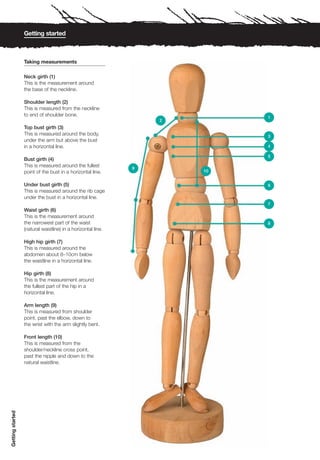
                  Taking measurements

                  Neck girth (1)
                  This is the measurement around
                  the base of the neckline.

                  Shoulder length (2)
                  This is measured from the neckline
                  to end of shoulder bone.                                 1
                                                                  2
                  Top bust girth (3)
                  This is measured around the body,                        3
                  under the arm but above the bust
                  in a horizontal line.                                    4

                                                                           5
                  Bust girth (4)
                  This is measured around the fullest         9
                  point of the bust in a horizontal line.             10


                  Under bust girth (5)                                     6
                  This is measured around the rib cage
                  under the bust in a horizontal line.
                                                                           7
                  Waist girth (6)
                  This is the measurement around
                  the narrowest part of the waist                          8
                  (natural waistline) in a horizontal line.

                  High hip girth (7)
                  This is measured around the
                  abdomen about 8–10cm below
                  the waistline in a horizontal line.

                  Hip girth (8)
                  This is the measurement around
                  the fullest part of the hip in a
                  horizontal line.

                  Arm length (9)
                  This is measured from shoulder
                  point, past the elbow, down to
                  the wrist with the arm slightly bent.

                  Front length (10)
                  This is measured from the
                  shoulder/neckline cross point,
                  past the nipple and down to the
                  natural waistline.
Getting started
18 / 19


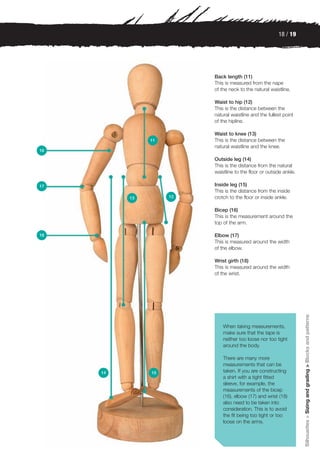
                         Back length (11)
                         This is measured from the nape
                         of the neck to the natural waistline.

                         Waist to hip (12)
                         This is the distance between the
                         natural waistline and the fullest point
                         of the hipline.

                         Waist to knee (13)
               11        This is the distance between the
                         natural waistline and the knee.
16

                         Outside leg (14)
                         This is the distance from the natural
                         waistline to the floor or outside ankle.

17                       Inside leg (15)
                         This is the distance from the inside
          13        12   crotch to the floor or inside ankle.

                         Bicep (16)
                         This is the measurement around the
                         top of the arm.

18                       Elbow (17)
                         This is measured around the width
                         of the elbow.

                         Wrist girth (18)
                         This is measured around the width
                         of the wrist.


                                                                    Silhouettes > Sizing and grading > Blocks and patterns


                             When taking measurements,
                             make sure that the tape is
                             neither too loose nor too tight
                             around the body.

                             There are many more
                             measurements that can be
     14        15            taken. If you are constructing
                             a shirt with a tight fitted
                             sleeve, for example, the
                             measurements of the bicep
                             (16), elbow (17) and wrist (18)
                             also need to be taken into
                             consideration. This is to avoid
                             the fit being too tight or too
                             loose on the arms.
Getting started


                                                           Blocks and patterns

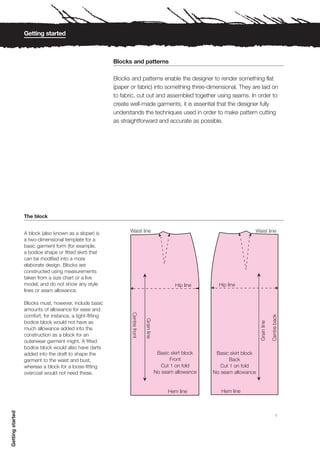
                                                           Blocks and patterns enable the designer to render something flat
                                                           (paper or fabric) into something three-dimensional. They are laid on
                                                           to fabric, cut out and assembled together using seams. In order to
                                                           create well-made garments, it is essential that the designer fully
                                                           understands the techniques used in order to make pattern cutting
                                                           as straightforward and accurate as possible.


                  The block


                  A block (also known as a sloper) is
                  a two-dimensional template for a
                  basic garment form (for example,
                  a bodice shape or fitted skirt) that
                  can be modified into a more
                  elaborate design. Blocks are
                  constructed using measurements
                  taken from a size chart or a live
                  model, and do not show any style
                  lines or seam allowance.

                  Blocks must, however, include basic
                  amounts of allowance for ease and
                  comfort; for instance, a tight-fitting
                  bodice block would not have as
                  much allowance added into the
                  construction as a block for an
                  outerwear garment might. A fitted
                  bodice block would also have darts
                  added into the draft to shape the
                  garment to the waist and bust,
                  whereas a block for a loose-fitting
                  overcoat would not need these.
Getting started


                                                                                                                             1
20 / 21


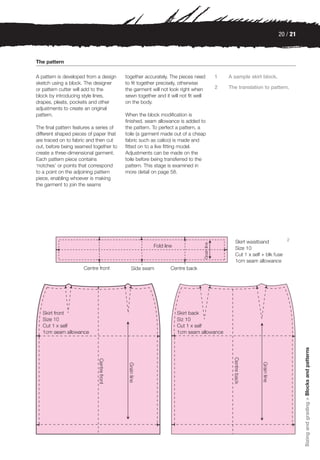
The pattern

A pattern is developed from a design     together accurately. The pieces need     1   A sample skirt block.
sketch using a block. The designer       to fit together precisely, otherwise
or pattern cutter will add to the        the garment will not look right when     2   The translation to pattern.
block by introducing style lines,        sewn together and it will not fit well
drapes, pleats, pockets and other        on the body.
adjustments to create an original
pattern.                                 When the block modification is
                                         finished, seam allowance is added to
The final pattern features a series of   the pattern. To perfect a pattern, a
different shaped pieces of paper that    toile (a garment made out of a cheap
are traced on to fabric and then cut     fabric such as calico) is made and
out, before being seamed together to     fitted on to a live fitting model.
create a three-dimensional garment.      Adjustments can be made on the
Each pattern piece contains              toile before being transferred to the
‘notches’ or points that correspond      pattern. This stage is examined in
to a point on the adjoining pattern      more detail on page 58.
piece, enabling whoever is making
the garment to join the seams


                                                                                                                 2


                                                                                                                        Sizing and grading > Blocks and patterns
Getting started


                                                                                                                         1
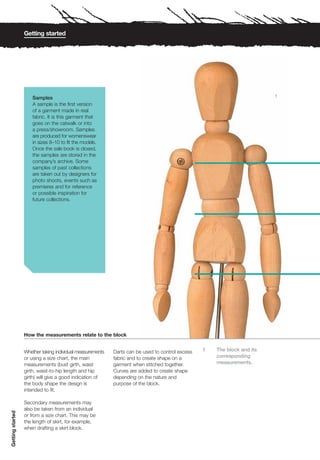
                      Samples
                      A sample is the first version
                      of a garment made in real
                      fabric. It is this garment that
                      goes on the catwalk or into
                      a press/showroom. Samples
                      are produced for womenswear
                      in sizes 8–10 to fit the models.
                      Once the sale book is closed,
                      the samples are stored in the
                      company’s archive. Some
                      samples of past collections
                      are taken out by designers for
                      photo shoots, events such as
                      premieres and for reference
                      or possible inspiration for
                      future collections.


                  How the measurements relate to the block


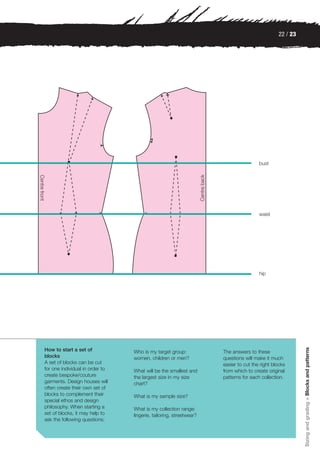
                  Whether taking individual measurements   Darts can be used to control excess   1   The block and its
                  or using a size chart, the main          fabric and to create shape on a           corresponding
                  measurements (bust girth, waist          garment when stitched together.           measurements.
                  girth, waist-to-hip length and hip       Curves are added to create shape
                  girth) will give a good indication of    depending on the nature and
                  the body shape the design is             purpose of the block.
                  intended to fit.

                  Secondary measurements may
                  also be taken from an individual
Getting started


                  or from a size chart. This may be
                  the length of skirt, for example,
                  when drafting a skirt block.
22 / 23


                                                                                     bust


                                                                                     waist


                                                                                     hip


                                                                                                        Sizing and grading > Blocks and patterns


How to start a set of            Who is my target group:            The answers to these
blocks                           women, children or men?            questions will make it much
A set of blocks can be cut                                          easier to cut the right blocks
for one individual in order to   What will be the smallest and      from which to create original
create bespoke/couture           the largest size in my size        patterns for each collection.
garments. Design houses will     chart?
often create their own set of
blocks to complement their       What is my sample size?
special ethos and design
philosophy. When starting a      What is my collection range:
set of blocks, it may help to    lingerie, tailoring, streetwear?
ask the following questions:
Pattern cutting                                                                            24 / 25


                                                                     1   Meadham & Kirchhoff
‘I use the same approach to clothes as I did when I                      A/W07.
                                                                         Catwalking.com.
designed buildings. It is basic geometry: you take a
flat form and revolve it in space.’

Gianfranco Ferre


Like all craft skills, pattern cutting can at first seem difficult
and intimidating. But with a basic understanding of the rules
to be followed (and broken!) the aspiring designer will soon
learn interesting, challenging and creative approaches to pattern
cutting. To draw the right style line in the correct position on a
garment takes experience and practice. Designers who have
been cutting patterns for twenty years can still learn something
new – the process of learning never stops. This makes creative
pattern cutting a fascinating process.

In this chapter we introduce the meaning of a drafted block and
how to turn it into a pattern from a design drawing. We take a
look at dart manipulation as well as pocket, collar and sleeve
construction. You will be introduced to cutting techniques and
bias-cut garments. You will also learn about the fitting process:
how to fit the toile and alter the pattern accordingly. Finally we
take a look at the different ways of laying and cutting patterns
from fabric.


                                                                                                     Getting started > Pattern cutting > Garment construction


1
Pattern cutting


                                                      How to read a design drawing

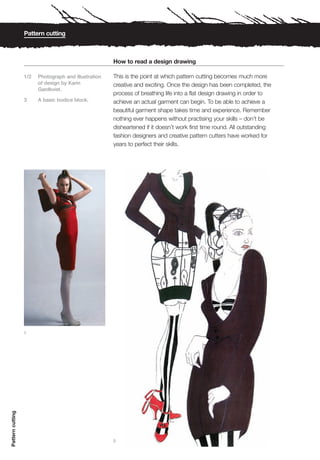
                  1/2   Photograph and illustration   This is the point at which pattern cutting becomes much more
                        of design by Karin            creative and exciting. Once the design has been completed, the
                        Gardkvist.
                                                      process of breathing life into a flat design drawing in order to
                  3     A basic bodice block.         achieve an actual garment can begin. To be able to achieve a
                                                      beautiful garment shape takes time and experience. Remember
                                                      nothing ever happens without practising your skills – don’t be
                                                      disheartened if it doesn’t work first time round. All outstanding
                                                      fashion designers and creative pattern cutters have worked for
                                                      years to perfect their skills.


                  1
Pattern cutting


                                                      2
26 / 27


                                                                                                                            3


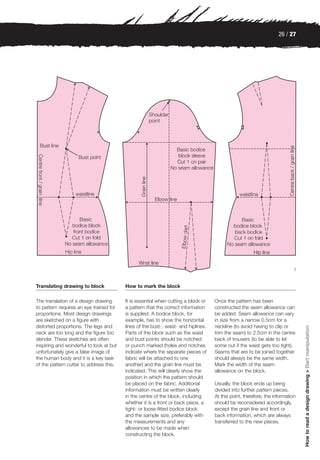
Translating drawing to block             How to mark the block

The translation of a design drawing      It is essential when cutting a block or    Once the pattern has been
to pattern requires an eye trained for   a pattern that the correct information     constructed the seam allowance can
proportions. Most design drawings        is supplied. A bodice block, for           be added. Seam allowance can vary
are sketched on a figure with            example, has to show the horizontal        in size from a narrow 0.5cm for a
distorted proportions. The legs and      lines of the bust-, waist- and hiplines.   neckline (to avoid having to clip or
                                                                                                                                How to read a design drawing > Dart manipulation


neck are too long and the figure too     Parts of the block such as the waist       trim the seam) to 2.5cm in the centre
slender. These sketches are often        and bust points should be notched          back of trousers (to be able to let
inspiring and wonderful to look at but   or punch marked (holes and notches         some out if the waist gets too tight).
unfortunately give a false image of      indicate where the separate pieces of      Seams that are to be joined together
the human body and it is a key task      fabric will be attached to one             should always be the same width.
of the pattern cutter to address this.   another) and the grain line must be        Mark the width of the seam
                                         indicated. This will clearly show the      allowance on the block.
                                         position in which the pattern should
                                         be placed on the fabric. Additional        Usually, the block ends up being
                                         information must be written clearly        divided into further pattern pieces.
                                         in the centre of the block, including      At this point, therefore, the information
                                         whether it is a front or back piece, a     should be reconsidered accordingly,
                                         tight- or loose-fitted bodice block        except the grain line and front or
                                         and the sample size, preferably with       back information, which are always
                                         the measurements and any                   transferred to the new pieces.
                                         allowances to be made when
                                         constructing the block.
Pattern cutting


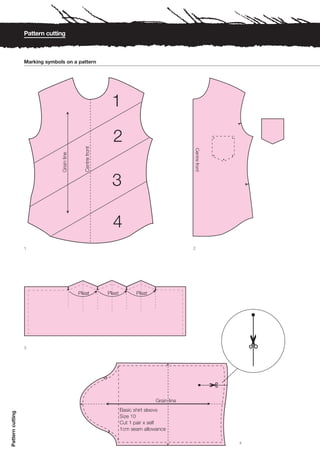
                  Marking symbols on a pattern


                  1                              2


                  3
Pattern cutting


                                                     4
28 / 29


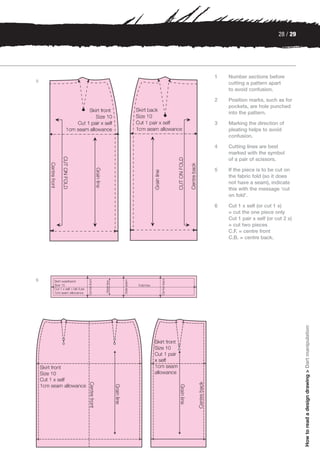
    1   Number sections before
5
        cutting a pattern apart
        to avoid confusion.

    2   Position marks, such as for
        pockets, are hole punched
        into the pattern.

    3   Marking the direction of
        pleating helps to avoid
        confusion.

    4   Cutting lines are best
        marked with the symbol
        of a pair of scissors.

    5   If the piece is to be cut on
        the fabric fold (so it does
        not have a seam), indicate
        this with the message ‘cut
        on fold’.

    6   Cut 1 x self (or cut 1 x)
        = cut the one piece only
        Cut 1 pair x self (or cut 2 x)
        = cut two pieces
        C.F. = centre front
        C.B. = centre back.


6


                                         How to read a design drawing > Dart manipulation
Pattern cutting


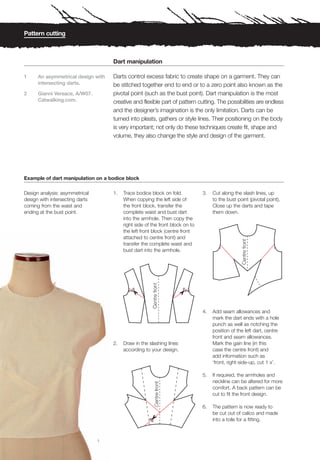
                                     Dart manipulation

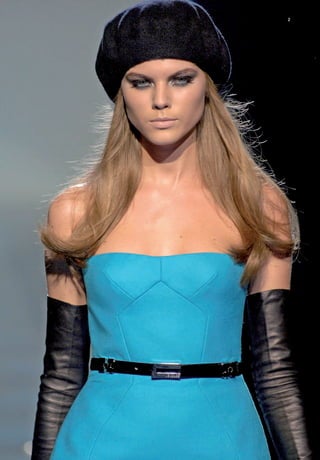
1     An asymmetrical design with    Darts control excess fabric to create shape on a garment. They can
      intersecting darts.            be stitched together end to end or to a zero point also known as the
2     Gianni Versace, A/W07.         pivotal point (such as the bust point). Dart manipulation is the most
      Catwalking.com.                creative and flexible part of pattern cutting. The possibilities are endless
                                     and the designer’s imagination is the only limitation. Darts can be
                                     turned into pleats, gathers or style lines. Their positioning on the body
                                     is very important; not only do these techniques create fit, shape and
                                     volume, they also change the style and design of the garment.


Example of dart manipulation on a bodice block

Design analysis: asymmetrical        1.   Trace bodice block on fold.           3.   Cut along the slash lines, up
design with intersecting darts            When copying the left side of              to the bust point (pivotal point),
coming from the waist and                 the front block, transfer the              Close up the darts and tape
ending at the bust point.                 complete waist and bust dart               them down.
                                          into the armhole. Then copy the
                                          right side of the front block on to
                                          the left front block (centre front
                                          attached to centre front) and
                                          transfer the complete waist and
                                          bust dart into the armhole.


                                                                                4.   Add seam allowances and
                                                                                     mark the dart ends with a hole
                                                                                     punch as well as notching the
                                                                                     position of the left dart, centre
                                                                                     front and seam allowances.
                                     2.   Draw in the slashing lines                 Mark the gain line (in this
                                          according to your design.                  case the centre front) and
                                                                                     add information such as
                                                                                     ‘front, right-side-up, cut 1 x’.

                                                                                5.   If required, the armholes and
                                                                                     neckline can be altered for more
                                                                                     comfort. A back pattern can be
                                                                                     cut to fit the front design.

                                                                                6.   The pattern is now ready to
                                                                                     be cut out of calico and made
                                                                                     into a toile for a fitting.


                                 1
2
Pattern cutting


                                                            Slash and spread

                  1       Skirt constructed by              This method is used to add extra volume and flare. The technique
                          slash and spread                  involves creating slash lines that reach from one end of the pattern
                          method to gain flare.
                                                            to the other, sometimes ending on a pivotal point like a dart ending.
                  2/3     Asymmetric skirt that             These slash lines will then be opened up for added volume and flare.
                          has been opened up
                          on one side only.


                  Using slash and spread
                  techniques
                  Slash and spread techniques can
                  be used to convert a straight skirt
                  pattern into a skirt with flare. The
                  most basic way of doing this is to
                  divide the pattern up into equal
                  pieces from hem to waist and open
                  them up by equal amounts all the
                  way round. Redraw the hemline in
                  a smooth curve.

                  To create asymmetric flare, as shown
                  in 2 and 3, the pattern is divided into
                  two and slash lines are marked on
                  to one of these halves. These are
                  cut along from hem to waist and
                  opened up (spread) with equal
                  amounts added into each ‘slash’.
                  This creates flare on one side of the
                  skirt. Pleats have also been added
                  to the waistline. Drawing in an
                  angular hemline creates the
                  asymmetric point.


                        Tip
                        When using the slash and
                        spread method remember
                        that the position you slash
                        in is the exact position the
                        fabric will flare out. So when
                        slashing into one side only,
                        the flare will not spread
                        across but only appear
Pattern cutting


                        on one side.


                                                                                                                              1
2
                                                 3
                                                     32 / 33


Dart manipulation > Slash and spread > Sleeves
Pattern cutting


                                                     Sleeves

                  1    Christian Dior, haute         Sleeve construction is a very special part of pattern cutting.
                       couture, S/S07.               Sleeves can be part of the bodice (laid-on sleeve) or set into an
                       Catwalking.com.
                                                     armhole (set-in sleeve). Without any other design features added,
                  2    A sleeve block for a set-in   a garment can look outstanding by simply creating an interesting
                       sleeve, showing the part
                       where the sleeve can be       sleeve design. The most basic sleeve block is the one-piece (set-in)
                       eased into the armhole.       sleeve, which can be varied as shown in 3a–f (facing page). Different
                  3    Variations on the one-piece   sleeve blocks can be developed from the one-piece block, such as
                       set-in sleeve:                the two-piece sleeve and laid-on sleeves, including raglan,
                  a    Peak sleeve.                  kimono/batwing and dolman designs.

                  b    Cap sleeve.

                  c    Leg o’ mutton sleeve.

                  d    Juliet sleeve.                                                                                  1

                  e    Trumpet sleeve.

                  f    Bishop sleeve.
Pattern cutting
34 / 35


2                                           3a        3b


                                            3c   3d


Constructing sleeves

When constructing a set-in sleeve,
the measurement of the armhole is
essential. Therefore, the bodice front
and back are constructed first and
once the measurement of the
armhole is established, ease is
added according to the type of block
(jacket block, fitted bodice block and
so on). Ease is added to a pattern to
allow for extra comfort or movement.
As well as allowing the sleeve to sit
comfortably in the armhole, ease will
also affect the fit and silhouette of a
garment. Ease is distributed between
                                            3e        3f
the front notch and the double back
notch of the sleeve (see technical
drawing above). In some set-in
sleeve designs, the ease is taken
                                                                     Slash and spread > Sleeves > Collars


across the shoulder to achieve a
round appearance over the shoulder
point. A sleeve is sitting comfortably
in the armhole when it aligns exactly
with, or is set slightly in front of, the
side seam of the bodice.
Pattern cutting


                  One-piece and two-piece sleeves                                                     Laid-on sleeve

                  There are differences between             the arm side seam position (still not     The laid-on sleeve is part of the
                  one-piece and two-piece sleeves,          visible from the front). The look of a    bodice. Once constructed, either a
                  the major one being the amount of         two-piece sleeve is more shapely          part of the armhole remains or there
                  seams that are used. A one-piece          and it has a slight bend to the front.    is no armhole at all.
                  sleeve has only one seam placed           As such, it is possible to get a closer
                  under the arm at the side seam            fit with a two-piece sleeve because       A laid-on sleeve is most commonly
                  position. Therefore, the seam cannot      of its extra seam. One-piece sleeves      constructed by separating
                  be seen when the arm is relaxed.          are used for a more casual look,          the one-piece sleeve through the
                  The two-piece sleeve has two              whereas two-piece sleeves are             shoulder notch straight down to the
                  seams; one is placed at the back,         mostly seen on garments such as           wristline to gain a front piece and a
                  running from the position of the back     tailored jackets or coats.                back piece (see technical drawing
                  double notch down to the wrist, past                                                below). The next step is to align the
                  the elbow. The second seam is                                                       front piece of the sleeve with the
                  moved a little to the front, from under                                             bodice’s front shoulder and the
                                                                                                      back sleeve with the bodice’s
                                                                                                      back shoulder. From this point
                                                                                                      onwards several styles can be
                                                                                                      developed, such as batwing or
                                                                                                      kimono, raglan, gusset and dolman
                                                                                                      sleeves. The sleeve can be laid on
                                                                                                      at variant angles – the greater the
                                                                                                      angle, the more excess fabric and
                                                                                                      therefore a greater range of arm
                                                                                                      movement.


                    1                                         2                                          3
Pattern cutting
36 / 37


Gusset sleeves

To extend the lift (a technical term                                          4
for moveability of the arm) in a sleeve
a gusset can be added. A gusset is
traditionally a diamond-shaped piece,
which is inserted into a slit in the
underarm section of the sleeve.


                                          5


                                                                                  Slash and spread > Sleeves > Collars


                                              1   Basic one-piece sleeve.

                                              2   Basic two-piece sleeve.

                                              3   Basic split sleeve.

                                              4   Gusset sleeve construction.

                                              5   Christian Lacroix, A/W07.
                                                  Catwalking.com.
Pattern cutting


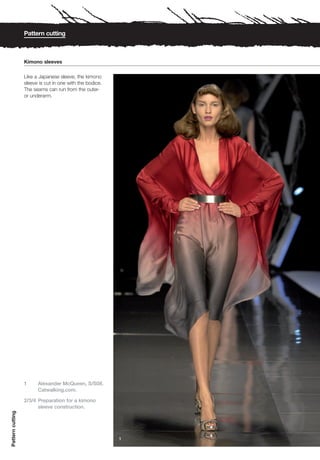
                  Kimono sleeves

                  Like a Japanese sleeve, the kimono
                  sleeve is cut in one with the bodice.
                  The seams can run from the outer-
                  or underarm.


                  1     Alexander McQueen, S/S08.
                        Catwalking.com.

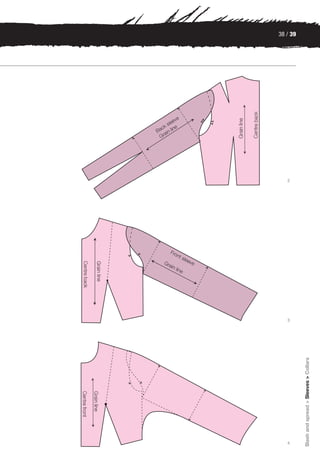
                  2/3/4 Preparation for a kimono
                        sleeve construction.
Pattern cutting


                                                          1
4
                                       3
                                           2
                                               38 / 39


Slash and spread > Sleeves > Collars
Pattern cutting


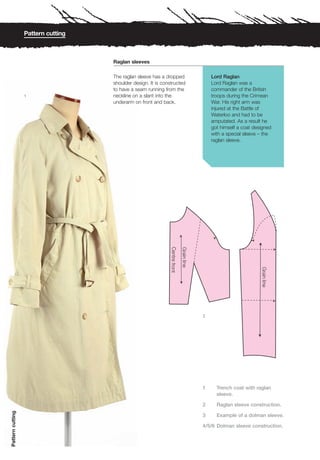
                                    Raglan sleeves

                                    The raglan sleeve has a dropped          Lord Raglan
                                    shoulder design. It is constructed       Lord Raglan was a
                                    to have a seam running from the          commander of the British
                  1                 neckline on a slant into the             troops during the Crimean
                                    underarm on front and back.              War. His right arm was
                                                                             injured at the Battle of
                                                                             Waterloo and had to be
                                                                             amputated. As a result he
                                                                             got himself a coat designed
                                                                             with a special sleeve – the
                                                                             raglan sleeve.


                                                                         2


                                                                         1     Trench coat with raglan
                                                                               sleeve.

                                                                         2     Raglan sleeve construction.
Pattern cutting


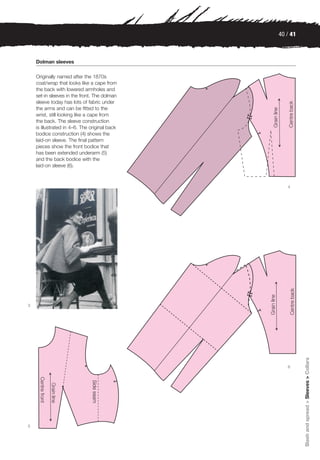
                                                                         3     Example of a dolman sleeve.

                                                                         4/5/6 Dolman sleeve construction.
40 / 41


    Dolman sleeves

    Originally named after the 1870s
    coat/wrap that looks like a cape from
    the back with lowered armholes and
    set-in sleeves in the front. The dolman
    sleeve today has lots of fabric under
    the arms and can be fitted to the
    wrist, still looking like a cape from
    the back. The sleeve construction
    is illustrated in 4–6. The original back
    bodice construction (4) shows the
    laid-on sleeve. The final pattern
    pieces show the front bodice that
    has been extended underarm (5)
    and the back bodice with the
    laid-on sleeve (6).


                                                  4


3                                                        Slash and spread > Sleeves > Collars


                                                  6


5
Pattern cutting


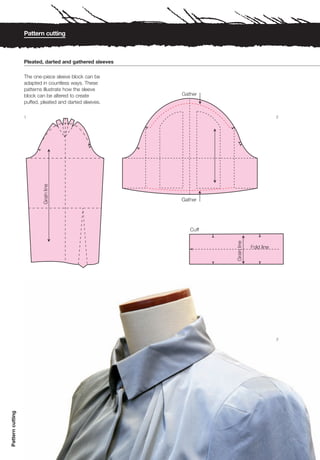
                  Pleated, darted and gathered sleeves

                  The one-piece sleeve block can be
                  adapted in countless ways. These
                  patterns illustrate how the sleeve
                  block can be altered to create
                  puffed, pleated and darted sleeves.

                  1                                      2


                                                         3
Pattern cutting
42 / 43


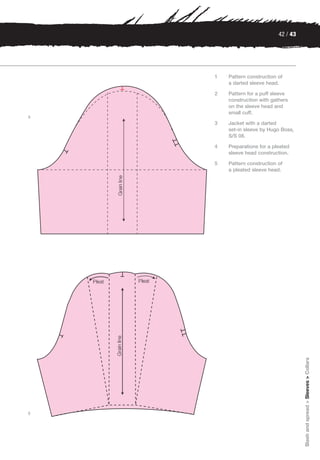
    1   Pattern construction of
        a darted sleeve head.

    2   Pattern for a puff sleeve
        construction with gathers
        on the sleeve head and
        small cuff.
4
    3   Jacket with a darted
        set-in sleeve by Hugo Boss,
        S/S 08.

    4   Preparations for a pleated
        sleeve head construction.

    5   Pattern construction of
        a pleated sleeve head.


                                       Slash and spread > Sleeves > Collars


5
Pattern cutting


                                                     Collars

                                                     The collar is a versatile design feature that will enhance the style of
                                                     a garment. It is attached to the neckline of the garment and allows
                                                     the size and shape of the neckline to vary. Collars come in all shapes
                                                     and sizes and the most common are the stand-up/mandarin, shirt,
                                                     flat, sailor and lapel collar constructions.


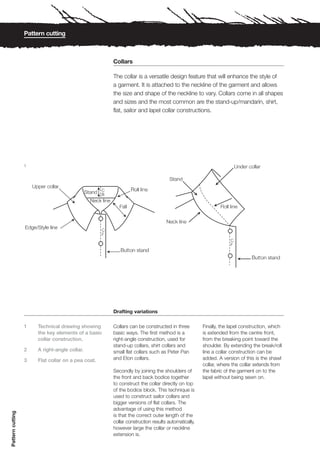
                  1


                                                     Drafting variations

                  1    Technical drawing showing     Collars can be constructed in three          Finally, the lapel construction, which
                       the key elements of a basic   basic ways. The first method is a            is extended from the centre front,
                       collar construction.          right-angle construction, used for           from the breaking point toward the
                                                     stand-up collars, shirt collars and          shoulder. By extending the break/roll
                  2    A right-angle collar.         small flat collars such as Peter Pan         line a collar construction can be
                  3    Flat collar on a pea coat.    and Eton collars.                            added. A version of this is the shawl
                                                                                                  collar, where the collar extends from
                                                     Secondly by joining the shoulders of         the fabric of the garment on to the
                                                     the front and back bodice together           lapel without being sewn on.
                                                     to construct the collar directly on top
                                                     of the bodice block. This technique is
                                                     used to construct sailor collars and
                                                     bigger versions of flat collars. The
                                                     advantage of using this method
Pattern cutting


                                                     is that the correct outer length of the
                                                     collar construction results automatically,
                                                     however large the collar or neckline
                                                     extension is.
44 / 45


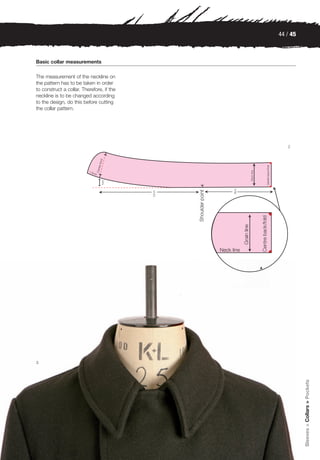
Basic collar measurements

The measurement of the neckline on
the pattern has to be taken in order
to construct a collar. Therefore, if the
neckline is to be changed according
to the design, do this before cutting
the collar pattern.


                                              2


3
                                                     Sleeves > Collars > Pockets
Pattern cutting


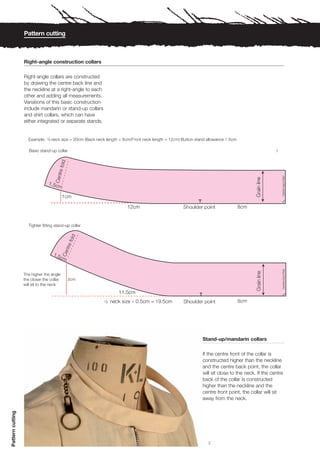
                  Right-angle construction collars

                  Right-angle collars are constructed
                  by drawing the centre back line and
                  the neckline at a right-angle to each
                  other and adding all measurements.
                  Variations of this basic construction
                  include mandarin or stand-up collars
                  and shirt collars, which can have
                  either integrated or separate stands.


                                                                                               1


                                                          Stand-up/mandarin collars

                                                          If the centre front of the collar is
                                                          constructed higher than the neckline
                                                          and the centre back point, the collar
                                                          will sit close to the neck. If the centre
                                                          back of the collar is constructed
                                                          higher than the neckline and the
                                                          centre front point, the collar will sit
                                                          away from the neck.
Pattern cutting


                                                            2
46 / 47


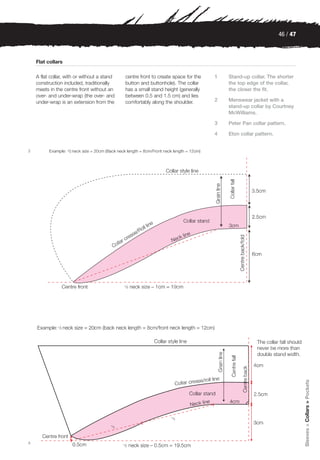
    Flat collars

    A flat collar, with or without a stand   centre front to create space for the   1   Stand-up collar. The shorter
    construction included, traditionally     button and buttonhole). The collar         the top edge of the collar,
    meets in the centre front without an     has a small stand height (generally        the closer the fit.
    over- and under-wrap (the over- and      between 0.5 and 1.5 cm) and lies
    under-wrap is an extension from the      comfortably along the shoulder.        2   Menswear jacket with a
                                                                                        stand-up collar by Courtney
                                                                                        McWilliams.

                                                                                    3   Peter Pan collar pattern.

                                                                                    4   Eton collar pattern.


3


                                                                                                                         Sleeves > Collars > Pockets


4
Pattern cutting


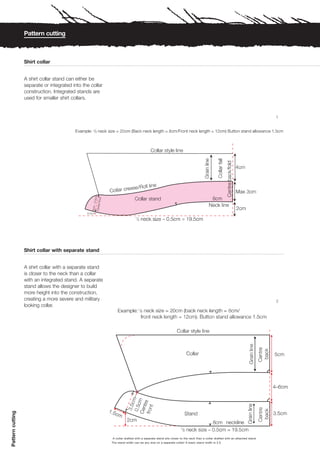
                  Shirt collar


                  A shirt collar stand can either be
                  separate or integrated into the collar
                  construction. Integrated stands are
                  used for smaller shirt collars.


                                                                                                                                                                           1


                  Shirt collar with separate stand


                  A shirt collar with a separate stand
                  is closer to the neck than a collar
                  with an integrated stand. A separate
                  stand allows the designer to build
                  more height into the construction,
                  creating a more severe and military                                                                                                                      2
                  looking collar.
Pattern cutting


                                                            A collar drafted with a separate stand sits closer to the neck than a collar drafted with an attached stand.
                                                           The stand width can be any size on a separate collar! A basic stand width is 2.5.
48 / 49


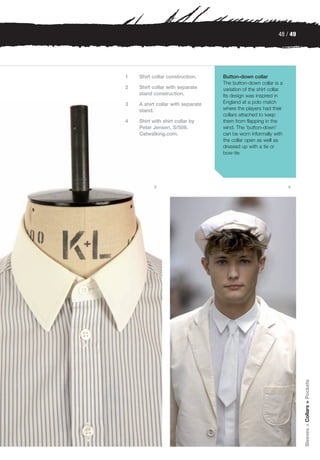
1   Shirt collar construction.     Button-down collar
                                   The button-down collar is a
2   Shirt collar with separate     variation of the shirt collar.
    stand construction.            Its design was inspired in
3   A shirt collar with separate   England at a polo match
    stand.                         where the players had their
                                   collars attached to keep
4   Shirt with shirt collar by     them from flapping in the
    Peter Jensen, S/S08.           wind. The 'button-down'
    Catwalking.com.                can be worn informally with
                                   the collar open as well as
                                   dressed up with a tie or
                                   bow-tie.


          3                                                         4


                                                                        Sleeves > Collars > Pockets
Pattern cutting


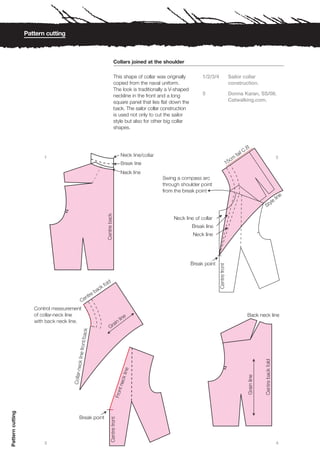
                                    Collars joined at the shoulder

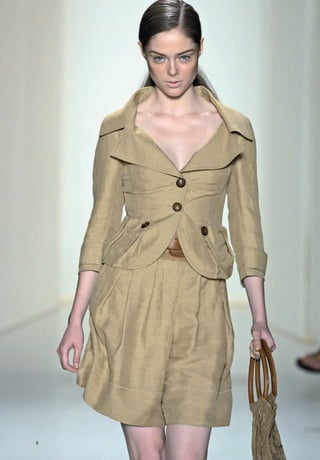
                                    This shape of collar was originally    1/2/3/4   Sailor collar
                                    copied from the naval uniform.                   construction.
                                    The look is traditionally a V-shaped
                                    neckline in the front and a long       5         Donna Karan, SS/08.
                                    square panel that lies flat down the             Catwalking.com.
                                    back. The sailor collar construction
                                    is used not only to cut the sailor
                                    style but also for other big collar
                                    shapes.


                         1                                                                             2
Pattern cutting


                         3                                                                             4
5
Pattern cutting


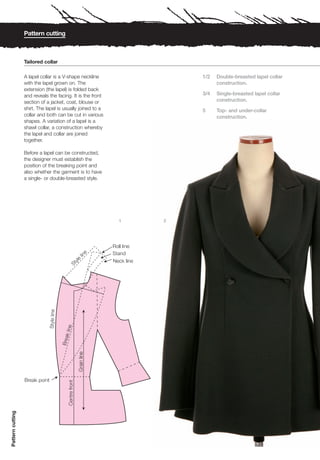
                  Tailored collar

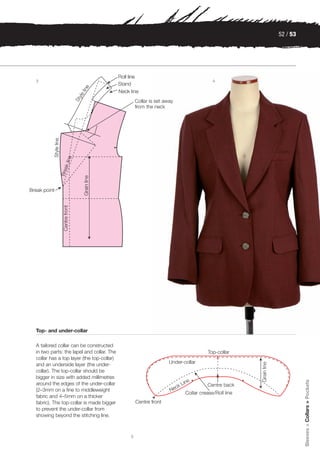
                  A lapel collar is a V-shape neckline              1/2   Double-breasted lapel collar
                  with the lapel grown on. The                            construction.
                  extension (the lapel) is folded back
                  and reveals the facing. It is the front           3/4   Single-breasted lapel collar
                  section of a jacket, coat, blouse or                    construction.
                  shirt. The lapel is usually joined to a           5     Top- and under-collar
                  collar and both can be cut in various                   construction.
                  shapes. A variation of a lapel is a
                  shawl collar, a construction whereby
                  the lapel and collar are joined
                  together.

                  Before a lapel can be constructed,
                  the designer must establish the
                  position of the breaking point and
                  also whether the garment is to have
                  a single- or double-breasted style.


                                                            1   2
Pattern cutting
52 / 53


3                                             4


Top- and under-collar

A tailored collar can be constructed
in two parts: the lapel and collar. The
collar has a top layer (the top-collar)
and an underside layer (the under-
collar). The top-collar should be
bigger in size with added millimetres
                                                            Sleeves > Collars > Pockets


around the edges of the under-collar
(2–3mm on a fine to middleweight
fabric and 4–5mm on a thicker
fabric). The top-collar is made bigger
to prevent the under-collar from
showing beyond the stitching line.


                                          5
Pattern cutting


                                                                 Pockets

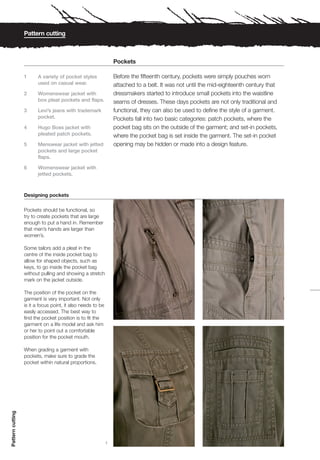
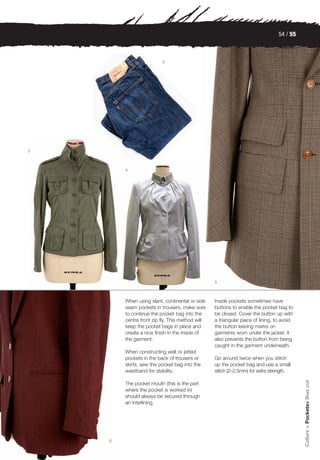
                  1     A variety of pocket styles               Before the fifteenth century, pockets were simply pouches worn
                        used on casual wear.                     attached to a belt. It was not until the mid-eighteenth century that
                  2     Womenswear jacket with                   dressmakers started to introduce small pockets into the waistline
                        box pleat pockets and flaps.             seams of dresses. These days pockets are not only traditional and
                  3     Levi’s jeans with trademark              functional, they can also be used to define the style of a garment.
                        pocket.                                  Pockets fall into two basic categories: patch pockets, where the
                  4     Hugo Boss jacket with                    pocket bag sits on the outside of the garment; and set-in pockets,
                        pleated patch pockets.                   where the pocket bag is set inside the garment. The set-in pocket
                  5     Menswear jacket with jetted              opening may be hidden or made into a design feature.
                        pockets and large pocket
                        flaps.

                  6     Womenswear jacket with
                        jetted pockets.


                  Designing pockets

                  Pockets should be functional, so
                  try to create pockets that are large
                  enough to put a hand in. Remember
                  that men’s hands are larger than
                  women’s.

                  Some tailors add a pleat in the
                  centre of the inside pocket bag to
                  allow for shaped objects, such as
                  keys, to go inside the pocket bag
                  without pulling and showing a stretch
                  mark on the jacket outside.

                  The position of the pocket on the
                  garment is very important. Not only
                  is it a focus point, it also needs to be
                  easily accessed. The best way to
                  find the pocket position is to fit the
                  garment on a life model and ask him
                  or her to point out a comfortable
                  position for the pocket mouth.

                  When grading a garment with
                  pockets, make sure to grade the
                  pocket within natural proportions.
Pattern cutting


                                                             1
54 / 55


                         3


2


        4


                                                 5


        When using slant, continental or side    Inside pockets sometimes have
        seam pockets in trousers, make sure      buttons to enable the pocket bag to
        to continue the pocket bag into the      be closed. Cover the button up with
        centre front zip fly. This method will   a triangular piece of lining, to avoid
        keep the pocket bags in place and        the button leaving marks on
        create a nice finish in the inside of    garments worn under the jacket. It
        the garment.                             also prevents the button from being
                                                 caught in the garment underneath.
        When constructing welt or jetted
        pockets in the back of trousers or       Go around twice when you stitch
        skirts, sew the pocket bag into the      up the pocket bag and use a small
        waistband for stability.                 stitch (2–2.5mm) for extra strength.
                                                                                          Collars > Pockets> Bias cut


        The pocket mouth (this is the part
        where the pocket is worked in)
        should always be secured through
        an interlining.


    6
Pattern cutting


                                                                 Bias cut

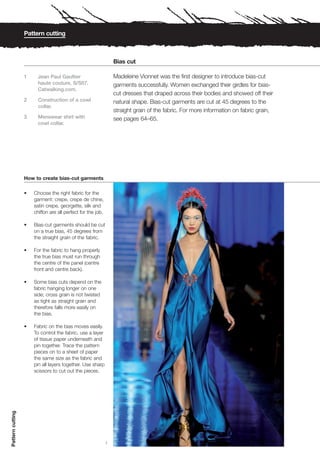
                  1     Jean Paul Gaultier                       Madeleine Vionnet was the first designer to introduce bias-cut
                        haute couture, S/S07.                    garments successfully. Women exchanged their girdles for bias-
                        Catwalking.com.
                                                                 cut dresses that draped across their bodies and showed off their
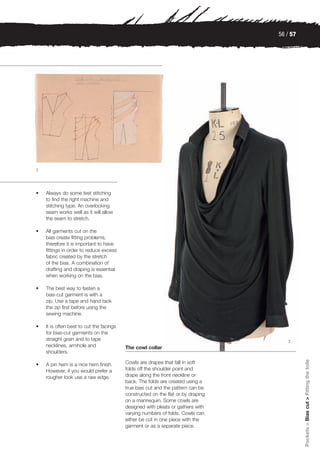
                  2     Construction of a cowl                   natural shape. Bias-cut garments are cut at 45 degrees to the
                        collar.
                                                                 straight grain of the fabric. For more information on fabric grain,
                  3     Menswear shirt with                      see pages 64–65.
                        cowl collar.


                  How to create bias-cut garments

                  •   Choose the right fabric for the
                      garment: crepe, crepe de chine,
                      satin crepe, georgette, silk and
                      chiffon are all perfect for the job.

                  •   Bias-cut garments should be cut
                      on a true bias, 45 degrees from
                      the straight grain of the fabric.

                  •   For the fabric to hang properly
                      the true bias must run through
                      the centre of the panel (centre
                      front and centre back).

                  •   Some bias cuts depend on the
                      fabric hanging longer on one
                      side; cross grain is not twisted
                      as tight as straight grain and
                      therefore falls more easily on
                      the bias.

                  •   Fabric on the bias moves easily.
                      To control the fabric, use a layer
                      of tissue paper underneath and
                      pin together. Trace the pattern
                      pieces on to a sheet of paper
                      the same size as the fabric and
                      pin all layers together. Use sharp
                      scissors to cut out the pieces.
Pattern cutting


                                                             1
56 / 57


2


•   Always do some test stitching
    to find the right machine and
    stitching type. An overlocking
    seam works well as it will allow
    the seam to stretch.

•   All garments cut on the
    bias create fitting problems,
    therefore it is important to have
    fittings in order to reduce excess
    fabric created by the stretch
    of the bias. A combination of
    drafting and draping is essential
    when working on the bias.

•   The best way to fasten a
    bias-cut garment is with a
    zip. Use a tape and hand tack
    the zip first before using the
    sewing machine.

•   It is often best to cut the facings
    for bias-cut garments on the
    straight grain and to tape                                                       3
    necklines, armhole and                The cowl collar
    shoulders.
                                                                                            Pockets > Bias cut > Fitting the toile


•   A pin hem is a nice hem finish.       Cowls are drapes that fall in soft
    However, if you would prefer a        folds off the shoulder point and
    rougher look use a raw edge.          drape along the front neckline or
                                          back. The folds are created using a
                                          true bias cut and the pattern can be
                                          constructed on the flat or by draping
                                          on a mannequin. Some cowls are
                                          designed with pleats or gathers with
                                          varying numbers of folds. Cowls can
                                          either be cut in one piece with the
                                          garment or as a separate piece.
Pattern cutting


                                               Fitting the toile

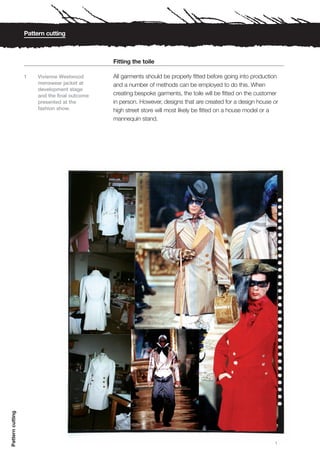
                  1    Vivienne Westwood       All garments should be properly fitted before going into production
                       menswear jacket at      and a number of methods can be employed to do this. When
                       development stage
                       and the final outcome   creating bespoke garments, the toile will be fitted on the customer
                       presented at the        in person. However, designs that are created for a design house or
                       fashion show.           high street store will most likely be fitted on a house model or a
                                               mannequin stand.
Pattern cutting


                                                                                                                1
58 / 59


Carrying out a fitting

A designer will produce a ‘toile’          area. Before starting with the pattern        Tips for the first fitting
for the first fitting. This is a garment   construction make sure that you               When preparing for a toile
made out of a cheaper fabric close         use a well-fitting block to avoid             fitting some parts of the
in weight and behaviour to the final       unnecessary fitting problems and              garment can be hand sewn,
fabric, such as calico. Calico is a        always construct your pattern on              for example, the sleeve into
cheap cotton fabric and comes in           the large side. It is easier to fit a toile   the armhole. The rest of the
different weights: lightweight for         by adjusting the shape to the body            toile should be sewn together
blouses and shirts; medium for             than it is to start opening up seams          with a bigger machine stitch
jackets and trousers and heavy for         and patching in sample fabric to              (3–4mm), as it is easier to
coats or sculptured pieces. A toile        make it bigger.                               unpick the toile after the
has no finished seams, no fastenings,                                                    fitting if necessary.
nor any lining or facings.                 The choice of fabric is important as it
                                           needs to reflect the quality of the final     Mark all the lines necessary
At the first fitting the designer looks    fabric used. If working on a woven            for a fitting, for example
at the proportions and fit of the          style, use a calico in the right weight.      centre front and back, waist
garment. Only once the overall shape       Again, for jersey/knitwear garments,          and hip line, elbow line.
has been established does the              use a jersey of the right weight.             These lines can be marked
attention turn to the details. Such        When cutting out the toile make sure          with a pen or thread.
details might include the position of      to cut in the right grain line; if the
pockets, belt loops, collar size and       garment is meant to be cut on the             If using shoulder pads, use
other detailing. These will usually be     bias then the toile needs to be cut on        the same pair as for the final
marked with a tape, marker pen or          the bias too. The different grain lines       garment. The same applies
pinned-on fabric pieces.                   make the garment drape differently            to any underpinnings such as
                                           on the body. The toile should always          underskirts and corsetry.
A well-fitted garment should               be made out of an unpatterned,
complement the design and the              light-coloured fabric as this shows           The collar can be fitted without
body shape. As such, it is best to fit     off the seams and details of the              an under-collar attached in
on a live model so that it is possible     garment in the best possible way.             the first fitting, as it makes it
to see the movement of the garment.                                                      easier to fit for a better
The most difficult areas of the body                                                     shape.
to fit are the armhole and sleeve, the
trouser crotch and around the bust                                                       Pocket positions can be drawn
                                                                                         on in the fitting. It is easier to
                                                                                         find the right position with the
                                                                                         live model as they can attempt
                                                                                         to put his or her hands into
                                                                                         the pocket. If pocket flaps or
                                                                                         patch pockets are used, cut
                                                                                                                                Bias cut > Fitting the toile > Laying a pattern on to fabric

                                                                                         out shapes of the sample
                                                                                         fabric ready to be pinned
                                                                                         on in the fitting.

                                                                                         If the final fabric has a
                                                                                         pattern, draft parts of it onto
                                                                                         the toile to show off detailing.

                                                                                         All seams or darts on the
                                                                                         toile need to be pressed out
                                                                                         really well and in the same
                                                                                         order as on the final garment.
Pattern cutting


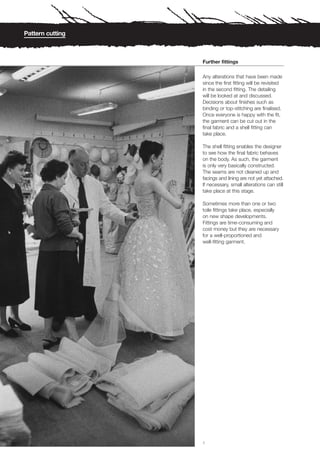
                  Further fittings

                  Any alterations that have been made
                  since the first fitting will be revisited
                  in the second fitting. The detailing
                  will be looked at and discussed.
                  Decisions about finishes such as
                  binding or top-stitching are finalised.
                  Once everyone is happy with the fit,
                  the garment can be cut out in the
                  final fabric and a shell fitting can
                  take place.

                  The shell fitting enables the designer
                  to see how the final fabric behaves
                  on the body. As such, the garment
                  is only very basically constructed.
                  The seams are not cleaned up and
                  facings and lining are not yet attached.
                  If necessary, small alterations can still
                  take place at this stage.

                  Sometimes more than one or two
                  toile fittings take place, especially
                  on new shape developments.
                  Fittings are time-consuming and
                  cost money but they are necessary
                  for a well-proportioned and
                  well-fitting garment.


                  1
60 / 61


Altering the pattern

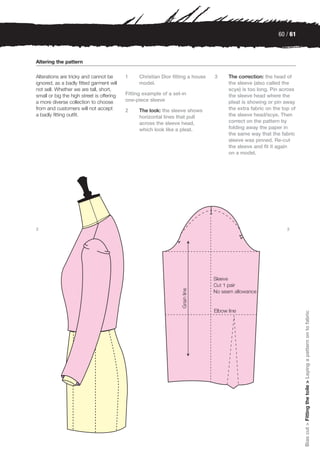
Alterations are tricky and cannot be       1     Christian Dior fitting a house   3   The correction: the head of
ignored, as a badly fitted garment will          model.                               the sleeve (also called the
not sell. Whether we are tall, short,                                                 scye) is too long. Pin across
small or big the high street is offering   Fitting example of a set-in                the sleeve head where the
a more diverse collection to choose        one-piece sleeve                           pleat is showing or pin away
from and customers will not accept         2     The look: the sleeve shows           the extra fabric on the top of
a badly fitting outfit.                          horizontal lines that pull           the sleeve head/scye. Then
                                                 across the sleeve head,              correct on the pattern by
                                                 which look like a pleat.             folding away the paper in
                                                                                      the same way that the fabric
                                                                                      sleeve was pinned. Re-cut
                                                                                      the sleeve and fit it again
                                                                                      on a model.


2                                                                                                               3


                                                                                                                       Bias cut > Fitting the toile > Laying a pattern on to fabric
Pattern cutting


                                    Fitting example of a set-in
                                    one-piece sleeve

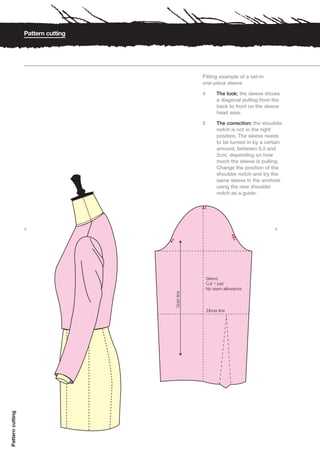
                                    4     The look: the sleeve shows
                                          a diagonal pulling from the
                                          back to front on the sleeve
                                          head area.

                                    5     The correction: the shoulder
                                          notch is not in the right
                                          position. The sleeve needs
                                          to be turned in by a certain
                                          amount, between 0.5 and
                                          2cm, depending on how
                                          much the sleeve is pulling.
                                          Change the position of the
                                          shoulder notch and try the
                                          same sleeve in the armhole
                                          using the new shoulder
                                          notch as a guide.


                  4                                               5
Pattern cutting
62 / 63


    Fitting example of a set-in
    one-piece sleeve

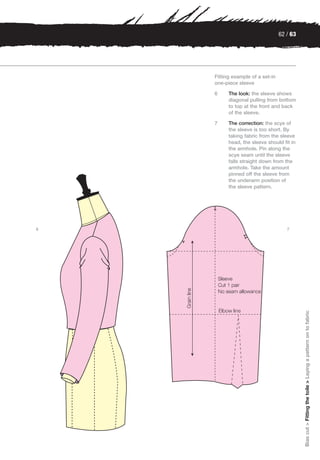
    6     The look: the sleeve shows
          diagonal pulling from bottom
          to top at the front and back
          of the sleeve.

    7     The correction: the scye of
          the sleeve is too short. By
          taking fabric from the sleeve
          head, the sleeve should fit in
          the armhole. Pin along the
          scye seam until the sleeve
          falls straight down from the
          armhole. Take the amount
          pinned off the sleeve from
          the underarm position of
          the sleeve pattern.


6                                    7


                                            Bias cut > Fitting the toile > Laying a pattern on to fabric
Pattern cutting


                                                      Laying a pattern on to fabric

                  1    The cut of a garment in        It takes time and patience to cut out a pattern in fabric. Taking time
                       relation to the direction of   to prepare for cutting and marking the fabric pieces guarantees a
                       the grain line can strongly
                       affect how the fabric hangs    better result when putting the garment together. It is also helpful to
                       on the body.                   have a firm understanding of fabrics and weaving techniques. For
                                                      more information on the specific qualities of various fabrics see
                                                      Basics Fashion Design: Textiles and Fashion.


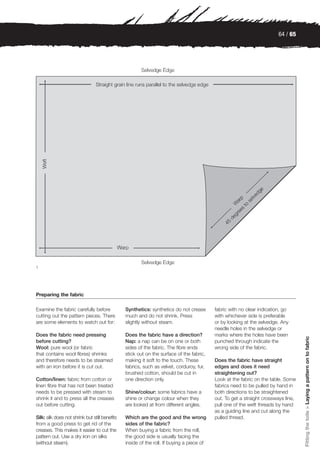
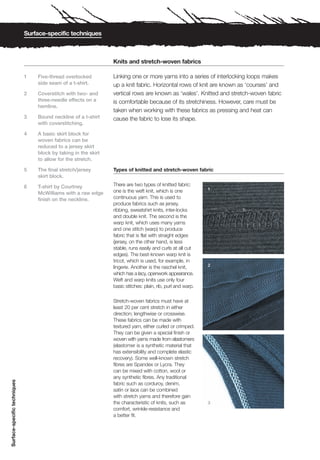
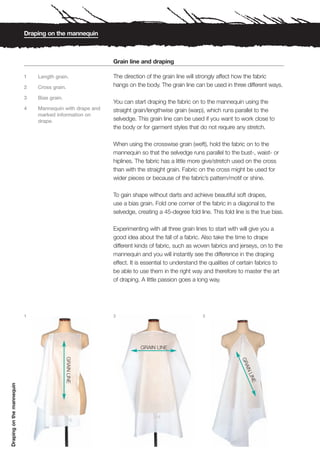
                                                      What is a grain line?

                                                      A material is woven using a yarn           Cross grain – this method uses
                                                      going lengthways (the warp) and            pattern pieces that are cut at a
                                                      crossways (the weft). The lengthways       90-degree angle to the selvedge.
                                                      edge of the fabric is called the           Pieces that are cut crossways are
                                                      selvedge. The cut of a garment in          most likely to be decorative, for
                                                      relation to the direction of the grain     example cuffs, yokes, collars
                                                      line will strongly affect how the fabric   and complex shapes, such as
                                                      hangs on the body. There are three         a whole circle skirt.
                                                      ways of cutting the grain:
                                                                                                 Bias – for a true bias cut, pattern
                                                      Straight grain – this is the most          pieces are cut at 45-degree angle
                                                      common method, whereby the                 to the selvedge and cross grain.
                                                      grain line of the pattern pieces is        Garments cut on the bias are lively
                                                      parallel to the selvedge. The yarn         and drape beautifully around the
                                                      used lengthways (warp) is a                body but will take up a lot more
                                                      stronger yarn than the one                 fabric.
                                                      used crossways (weft).
Pattern cutting
64 / 65


1


Preparing the fabric

Examine the fabric carefully before             Synthetics: synthetics do not crease       fabric with no clear indication, go
cutting out the pattern pieces. There           much and do not shrink. Press              with whichever side is preferable
are some elements to watch out for:             slightly without steam.                    or by looking at the selvedge. Any
                                                                                           needle holes in the selvedge or
Does the fabric need pressing                   Does the fabric have a direction?          marks where the holes have been
                                                                                                                                    Fitting the toile > Laying a pattern on to fabric


before cutting?                                 Nap: a nap can be on one or both           punched through indicate the
Wool: pure wool (or fabric                      sides of the fabric. The fibre ends        wrong side of the fabric.
that contains wool fibres) shrinks              stick out on the surface of the fabric,
and therefore needs to be steamed               making it soft to the touch. These         Does the fabric have straight
with an iron before it is cut out.              fabrics, such as velvet, corduroy, fur,    edges and does it need
                                                brushed cotton, should be cut in           straightening out?
Cotton/linen: fabric from cotton or             one direction only.                        Look at the fabric on the table. Some
linen fibre that has not been treated                                                      fabrics need to be pulled by hand in
needs to be pressed with steam to               Shine/colour: some fabrics have a          both directions to be straightened
shrink it and to press all the creases          shine or change colour when they           out. To get a straight crossways line,
out before cutting.                             are looked at from different angles.       pull one of the weft threads by hand
                                                                                           as a guiding line and cut along the
Silk: silk does not shrink but still benefits   Which are the good and the wrong           pulled thread.
from a good press to get rid of the             sides of the fabric?
creases. This makes it easier to cut the        When buying a fabric from the roll,
pattern out. Use a dry iron on silks            the good side is usually facing the
(without steam).                                inside of the roll. If buying a piece of
Pattern cutting


                  Layout of the pattern – cutting plans


                                        1   2   3   4   5   6   7   8


                                        1   2   3   4   5   6   7   8


                  Laying the pattern pieces on the                      Double layout                              Single layout
                  correct grain line                                    This is the easiest cutting plan of all.   For this layout the pattern has to be
                  To place the pattern pieces correctly                 The pattern is constructed one side        copied open (the whole of the front
                  on to the fabric, use the grain line                  only (one front piece, one sleeve, one     or back) and indicated with the
                  information on your pattern (the long                 back piece, etc) and indicated with        cutting instruction ‘cut 1 x or cut 1
                  arrow through the pattern). Once you                  the message ‘cut 2 x’ or ‘cut a pair’.     self’. This cutting plan is used when
                  have decided which direction to                       Some pattern pieces are half of a          the pattern pieces are asymmetric
                  place the pattern, make sure that                     pattern with a folding line and the        or the fabric has a pattern design.
                  the grain line is parallel to the                     cutting instruction ‘cut on fold’ (half    The fabric is placed openly with
                  selvedge on the fabric. To ensure                     of collar, half of yoke). The fabric is    the selvedge to the right and the left
                  that the pattern piece is laid correctly,             folded exactly in half by placing one      running down lengthways. The
                  measure from both ends of the                         side of the selvedge on to the other       pattern pieces should be laid in
                  arrow/grain line out to the selvedge.                 side throughout its length. The            one direction if there is a one-way
                                                                        pattern is then laid on to the fabric      design on the fabric.
                                                                        as economically as possible. The
                                                                        pieces can be laid in any direction if
                                                                        the fabric has no shine or nap.
Pattern cutting
66 / 67


Layout for fabric with a nap             Crossway layout                         Cutting out checks and stripes
or one-way design                        This method is used when the            Before cutting the fabric ascertain
This can be cut out as a single or       pattern pieces are complex shapes       whether or not the check or stripe
double layout. Decide on the             and do not fit any other way, for       pattern is symmetrical. You can use
direction of the nap or design           example a whole circle skirt. Instead   the double layout or the single layout
of the fabric and mark the top of        of folding the fabric along the long    when the pattern is symmetrical.
the fabric. Then place all the pattern   side, the fabric is folded crossways    When using the double layout make
pieces in one direction, running         with the selvedge on each side          sure you match up by pinning the
from the top downwards along             touching. A fabric with nap needs       checks or stripes together every
the selvedge.                            to be cut along its folding line into   10cm. This will avoid mismatch of
                                         two pieces. Turn one layer around –     the check or stripe pattern on
                                         wrong side facing wrong side of the     symmetric pieces such as sleeves
                                         fabric – so that the nap runs in the    and front pieces. It is important that
                                         same direction.                         the adjoining pattern pieces match
                                                                                 up with the pattern on the fabric.
                                                                                 Therefore mark the dominating
                                                                                                                           Fitting the toile > Laying a pattern on to fabric


                                                                                 bars/stripes on to the pattern and then
                                                                                 match up on to the adjoining pattern
                                                                                 piece. The parts to watch out for are
                                                                                 the side seams, centre front and
                                                                                 back, armhole and sleeve, pockets,
                                                                                 facings, cuffs, yoke and collar.
Pattern cutting


                  Marking the pattern on to the fabric

                  The pattern can be marked on to the          Chalk marks                              1   Chalk marks.
                  fabric once you have decided which           Using a tailor’s chalk to mark certain
                  cutting plan to use. First the pattern       positions such as dart endings and       2   Transferring the pattern
                  pieces are weighed down and/or               pocket position is easy and not very         to fabric.
                  pinned on to the fabric and aligned          time consuming, but be careful that      3   Thread marks.
                  with the grain line. It is best practice     the chalk mark cannot be seen on
                  to mark around the paper pattern             the good side of the fabric.
                  before lifting it off. This helps to avoid
                  cutting into the paper pattern when
                  cutting the fabric. However, it is
                  essential to transfer all information
                  necessary for constructing the
                  garment on to the fabric pieces.
                  There are different ways to do this:


                                                                                                        1
Pattern cutting


                                                                                                        2
68 / 69


    Thread marks
    Double the thread in the sewing
    needle and sew into the fabric to
    mark the points. This method is used
    on fabrics that are very thin, delicate
    or where the tailor’s chalk would not
    show up on the fabric. A thread mark
    is also a very good way to show
    positions on the good and wrong
    side of the fabric at once (chalk
    marks can only be seen on one side
    of the fabric). Also, thread marks can
    be taken out without leaving a trace.


    Laser and hole-punch marking
                                              Fitting the toile > Laying a pattern on to fabric


    This method is common in the
    industry to meet the needs of
    mass production. For example,
    the end of a dart position is marked
    with a hole set half a centimetre
    inside the dart. In this way the hole
    will not show on the good side of the
    garment. Punching a needle through
    layers of fabric or using a laser beam
    creates a hole-punch effect.


3
Garment construction                                                                       70 / 71


                                                                  1   A student at work.
‘What I do is restricted by the cloth and the human body.
My job is to make that cloth give expression to the body.’

Vivienne Westwood


This chapter introduces the different tools and machinery used
to construct a garment. It will look at the numerous techniques
available to hand sew or machine stitch a range of fabrics, and
will take a closer look at the history of haute couture and the
tailoring crafts.

Garment construction can be divided into different specialised
areas. At the top of the manufacturing chain are haute couture
and the tailoring crafts, which involve working with individual
customers. At the lower end of the manufacturing chain are
industrially produced garments. In contrast to tailoring and
haute couture, garments produced in this way are much
quicker to manufacture. A lot of the work is mass produced
by machinery and time-efficient construction methods.

This chapter looks at the various tools and materials used
to construct garments and provides an introduction to
hand sewing and machine sewing techniques.


                                                                                                     Pattern cutting > Garment construction > Surface-specific techniques


1
Garment construction


                                                                  Tools for the technique

                                                                  The following equipment is used in the construction of garments.
                                                                  You will find the necessary items for hand and machine sewing in
                                                                  most haberdashery shops. If you are looking to invest in industrial
                                                                  machinery then talk to a tradesman first (for further information see
                       Fabric scissors/shears (1)                 the list of contacts on page 188).
                       Depending on the weight and
                       thickness of the fabric, different
                       kinds of shears can be used. Look
                       for a medium-size pair of scissors for
                       normal use and another larger pair
                       for heavier fabric. It is important that
                       the scissors/shears lie comfortably in
                       your hand, so try them out before
                       buying them. You should always go
                       for the best quality you can afford
                       when buying a cutting tool. To
                       prolong their life, fabric scissors                                                                                3
                       should only be used on fabrics.

                       Hand-sewing needles (2)
                       There is a big variety of sizes,
                       shapes and points to choose from.
                       For most purposes use a medium
                       length (37mm), thin sewing needle
                       with a round eye.                                                                 2


                       Tape measure (3)
                       You should have one hanging
                       around your neck at all times when
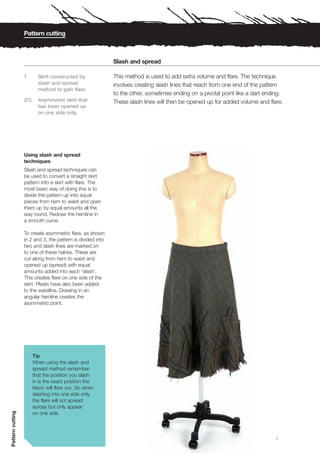
                       sewing together a garment, in order
                       to take control measurements
                       throughout the process.


                                                      1                                                      4                            5
Garment construction
72 / 73


        Embroidery scissors (4)
        These scissors are small and sharp
        with pointed blades. They are good
        to use for small detail cutting or to
        snip threads.

        Tailor’s chalk (5)
        This chalk comes in several colours
        and can be brushed off after
        application. There are also
        wax/synthetic chalks available in
        white and black. These come off
    6   when pressed over by a hot iron.

        Pins (6)
        Pins come in different sizes
        and materials. Stainless steel, 35mm
        dressmaking pins are pleasant to
        handle. When working with knitwear,
        use safety pins – normal pins will
        disappear into the garment.


7


        Machine sewing needles (7)
                                                 Tools for the technique > Seams


8
        You will need these in a variety of
        types and sizes.

        Thimble (8)
        A metal thimble made out of metal
        is best to protect your fingertip.
Garment construction


                       Pressing equipment

                       Point pressing block (1)                   1
                       Good to use on small, sharply angled
                       areas such as cuffs and collars.

                       Needle board (2)
                       The board has fine needles very
                       close together and is used to press
                       fabrics such as velvet, corduroy and
                       brushed fabrics while protecting the       2
                       nap or pile.

                       Tailor’s ham (3)
                       A firmly stuffed cushion that will
                       help to press round shaped parts
                       or seams on a garment (for example
                       around the bust area).                     3

                       Sleeve board (4)
                       A narrow, padded board for long,
                       straight seams. Perfect to use
                       on a sleeve once the seams are
                       closed down.                               4


                       Bobbin and bobbin case for
                       industrial sewing machines.


                                                              6


                        5
Garment construction
74 / 75


Machinery

Industrial flat bed machine (5)          machine, this machine does not cut           and also holds the fabric to the
This machine can sew any type of         off excess fabric.                           ironing board, allowing for easier
fabric using a basic straight stitch.                                                 pressing.
                                         Buttonhole machine (not shown)
Overlocker (6)                           This machine creates two kinds of            Pressing is essential to a garment;
Overlocking stitches are used to         buttonhole: a ‘keyhole’ and a ‘shirt’        fabric will crease and rumple as it is
protect the edges of a fabric. They      buttonhole. Shirt buttonholes are            handled and manipulated under a
can be made up of three, four or         the most common type. Keyhole                machine. Unpressed seams do not
five threads and the type of fabric      buttonholes are mainly used on               lie flat and the garment will look
dictates which to use. An overlocking    tailored garments, such as coats             unfinished if it is not ironed.
stitch is a series of threads that       and suit jackets.
combine to lock the fabric along its                                                  Fusing press (8)
edge. A blade runs along the edge        Industrial iron and vacuum                   A fusing press is the industrial
of the fabric chopping off excess        table (7)                                    machine used to attach (melt)
material and threads.                    An industrial iron is heavier and more       iron-on interfacing to fabric. It is
                                         durable than a domestic iron and the         more efficient and durable than
Coverstitch (not shown)                  steam has a higher pressure. It can          an industrial iron.
A coverstitch machine is used in the     be used with a vacuum table, which
construction and finishing of jersey     is shaped like an ironing board and
fabrics and for lingerie. Twin needles   often has a smaller board for ironing
create two rows of stitching on the      sleeves. A pedal underneath the
right side of the fabric and an          machine allows the user to create
overlocking stitch on the wrong side.    a vacuum while ironing; the air and
A variation of this stitch creates an    steam are sucked through the fabric
overlocking stitch on both sides of      into the bed of the machine. This
the fabric. Unlike an overlocking        reduces the steam in the atmosphere


Zip foot for                                                                                             Teflon foot and
concealed and                                                                                            universal sewing
one/both-sided                                                                                           machine foot.
zips.


 7                                                                                8
                                                                                                                                 Tools for the technique > Seams
Garment construction


                       The right thread for the job

                       These days there are threads in all
                       sorts of colours and thicknesses, for
                       all kind of jobs. The material to spin
                       a thread can be natural (cotton or
                       silk) or synthetic, such as polyester.
                       Cotton thread is used primarily for
                       cotton, linen or wool fabric, whilst
                       silk thread is used for silk or woollen
                       fabrics. This is also a beautiful thread
                       for most kinds of hand sewing, as it
                       glides through any type of fabric. The
                       polyester thread can be used for
                       both natural and synthetic fabrics.


                                                                      1


                       2                                              3
Garment construction


                                                                  4   5
76 / 77


                      Tacking thread is a loosely
             6        twisted cotton thread that
                      breaks easily. It is used for
                      basting stitch, a temporary
                      stitch that can be removed
                      when it is no longer needed.


7
                 1      A selection of threads.

                 2      Thread on cones.

                 3      Silk thread on spools.

                 4      Cotton thread.

                 5      Wool and linen yarn on card.

                 6      Tacking thread and basting
                        stitch.

                 7      Metallic thread.

                 8      Decorative yarn in bundles.

                 9      Top-stitching yarn.

                 10     Nylon thread.

    9                                                     Tools for the technique > Seams


8       10
Garment construction


                                              Seams

                                              Seams are the most basic way of joining two or more pieces of
                                              material together in garment construction. Seam allowance is added;
                                              this usually faces the inside of a garment but varies according to the
                                              type of seam used. Seams are also used to create shape and have
                                              an impact on the design of the garment. Some seams are used to
                                              strengthen parts of a garment (in corsetry, for example) while others
                                              are there simply for design purposes. There are some points to
                                              consider when choosing the right seam for constructing a garment.
                                              Different fabrics and styles require different seams. You will find
                                              various styles of seam to choose from and it is always possible,
                                              of course, to create your own.


                                              Getting started

                                              The seams introduced here are
                                              made using a sewing machine. There
                                              are two ways of preparing a seam.
                                              One is to place the pieces of material
                                              together, using pins to hold them in
                                              place. The other (safer) way is to
                                              place the material together and hold
                                              in place with a hand basting stitch
                                              running along the stitching line (see
                                              page 85).

                                              Once the material is ready to be
                                              taken under the machine, start the
                                              stitching process by taking a couple
                                              of stitches forward and then secure
                                              the stitching by going back in the
                                              same line and forward again. When
                                              coming to the end of the seam,
                                              repeat by going back a couple of
                                              stitches and then forward again.
                                              This will secure the sewing line. Also
                                              make sure that any hanging threads
Garment construction


                                              are neatly cut off before moving on
                                              to the next stage.
                                                                                       1
78 / 79


Running/plain seam

This kind of seam is the most basic     •   The length of the stitch can   1   Machine-stitched tunnel on
and common version, with seam               be changed on the sewing           the bottom of a jacket.
allowances ranging 0.5–2.5cm.               machine from 1mm to 5mm
                                            (basic stitch length is        2   Running seam used to
•     Place two pieces of material          2.5–3mm).                          attach two pieces of fabric.
      together with the right sides                                        3   Running seam pressed open
      facing and use a basting stitch   •   The seam allowance can be          with an iron.
      to hold the seam allowance            overlocked or bound to stop
      together.                             the edge from fraying.         4   Overlocked seam allowance
                                                                               pressed open.
•     Use a flatbed sewing machine      •   This seam can be pressed
      to sew the seam, creating a           open or to one side.           5   Overlocked seam allowance
      straight line of stitches.                                               pressed to one side.


2                                       3


4                                       5
                                                                                                              Tools for the technique > Seams > Seam finishes
Garment construction


                                                           French seam

                       1   Technical drawing of a          The French seam creates a neat           •   Then turn the seam inside out,
                           French seam.                    finish and is primarily used for             placing the right sides of the
                                                           transparent and fine fabrics. It is          fabric together. Stitch the
                       2   Wrong side of the fabric        the favourite of the couture atelier         seam, taking 0.7cm seam
                           showing a French seam           (from where it originated). The seam         allowance and encasing the
                           finish.                         allowances are cut 1.2cm in total.           previously stitched seam.
                       3   Good side of the fabric
                           showing a French seam           •     To start, place the wrong sides    •   Press the seam to one side.
                           finish.                               together. Take a 0.5cm seam
                                                                 allowance and stitch a seam
                       4   Technical drawing of a flat           on the right side of the fabric.
                           fell seam.

                       5   Good side of a flat fell seam
                           on a jeans trouser.

                       6   Technical drawing of a welt
                           seam.


                                                                            2


                       1
Garment construction


                                                                            3
80 / 81


    Flat fell seam

    The flat fell seam is popular on denim   •   Sew a seam taking the 1.7cm
    garments, men’s shirts and work              seam allowance from the outer
    wear. It is a hardwearing, strong            edge.
    self-enclosed seam. It shows two
    rows of stitching on the right side      •   Then fold over the 1cm extra
    and one row of stitching on the              allowance to cover the 0.7cm
    wrong side of the garment. The               allowance and press flat.
    seam allowance is 0.7cm on one
    side and 1.7cm on the other.             •   To finish off, top-stitch 1–2mm
                                                 from the folded edge (edge
    •     Place the wrong sides of the           stitch).
          fabric together. Move the
          piece with the 0.7cm seam
          allowance 1cm further in from
          the other piece.


                                                                             5


4


6


    Welt seam
                                                                                    Tools for the technique > Seams > Seam finishes


    A welt seam can be confused with a       •   Put the right sides together
    top-stitched seam, but when looking          and sew a straight line, taking
    closer, the seam shows a distinct            a 1.5cm allowance.
    ridge on one side. The welt seam is
    one of the strongest seams and is        •   Press the seam to one side.
    used in garments such as designer
    tailored wear or denim wear.             •   Trim off a couple of millimetres
    Depending on the preferred width             from the enclosed seam
    of the welt cut, the seam allowance          allowance.
    is 1.5cm for a finished welt width of
    just under a centimetre.                 •   With right side up, top-stitch
                                                 to enclose the trimmed edge.
Garment construction


                                                         Seam finishes

                       1   Overlocked seam.              The raw edge of a seam allowance usually needs treating to stop the
                       2   French seam.                  fabric from fraying. The technique used to finish a seam allowance
                                                         depends on the style of garment and the budget. Here are some
                       3   Centre back seam with a
                           bound seam finish.            options to choose from:

                       4   Prada dress with bound
                           edges on collar, front        The easiest and cheapest way to clean up an edge is to overlock the
                           and sleeve, S/S08.            edges using a three or four-thread coverstitch machine.
                           Catwalking.com.

                       5   Technical drawing of an       French seams are a seam and seam finish in one. They are more
                           open pressed seam             time consuming and therefore more expensive, but provide a clean
                           allowance with bound
                           edges.                        way to finish off fine and transparent fabrics.

                                                         Bound seam allowances are popular on half-lined jackets or jackets
                                                         without a lining and on trouser seams.


                                                     1


                                                     2


                                                     3
Garment construction
82 / 83


Edge and seam finish with a binding

Any raw edge such as a hem,
neckline or seam allowance can be
finished with a binding. Bindings are
strips of fabric that can be cut to any
width. When using a woven fabric as
a binding, cut the fabric on the true
bias grain line. Bindings are visible on
both sides of the garment.

•     Prepare the edge by cutting off
      the allowance (except if you
      are binding seam allowances).

•     Cut a strip off the chosen
      fabric four times the width of
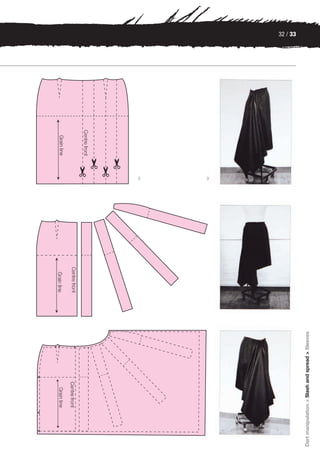
      the finished binding.

•     Press the binding strip
      lengthways in half, with the
      wrong sides together.

•     Open the strip up and fold
      both long sides in to meet the
      pressed centre line and press
      again.

•     Now take the raw seam edge
      and wrap the binding strip
      around it and pin in place.
      The centre pressing line of the
      binding is now aligned with
      the raw edge of the garment.

•     Put under the sewing machine
      and top-stitch the binding
      down at the right side of the
      garment, through all layers
      with an edge stitch, catching
      both binding edges at the
      same time.
                                                         Seams > Seam finishes > Hand sewing techniques


                                                  4


                                           5
Garment construction


                                                          Hand sewing techniques

                       1   Technical drawing showing      Sewing machines are now highly sophisticated and can handle a
                           how to secure the thread at    whole range of very specific sewing tasks. However, there are skill
                           the beginning and end of
                           hand stitching.                areas in garment construction which, either by choice or simply
                                                          because there is no other way, are better addressed with hand
                       2   Lace fabric and organza
                           sewn together with a           sewing. Hand sewing can be relaxing and often helps to create a
                           basting stitch.                special bond between you and the garment. It is important to use
                       3   Technical drawing of a blind   the right needle and thread and also to use a thimble to protect your
                           hemstitch.                     finger. Sit on a good chair with a foot rest so you don’t have to bend
                       4   Blind hemstitching on a        over your work and do not arch your back too much. Make sure
                           hemline of a dress.            you work in good light. Always sew towards yourself and do not cut
                       5   Technical drawing of a         your thread too long, as it gets in knots. Furthermore, do not pull the
                           cross-stitch.                  thread too tight, as this will show on the outside of the garment.


                                                                                                Getting started

                                                                                                First make sure that the thread has
                                                                                                a small knot on the end. Begin your
                                                                                                hand sewing with a backstitch. Pick
                                                                                                a tiny bit of fabric at the starting
                                                                                                point. Pull the thread with the knot
                                                                                                through the fabric and do another
                                                                                                stitch at the same point to create a
                                                                                                loop. Pass the thread back through
                                                                                                the loop, to secure the knot and
                                                                                                prevent it from slipping out.
Garment construction


                                                                                            1
84 / 85


    Basting stitch

    Basting is used to temporarily join      a larger backstitch without a knot. It
    together parts of garments. The          is not secured at the end, making the
    stitches are large, applied without      stitches easily removable. Basting is
    tension and made using tacking           also used to join the edges of two
    thread in a contrasting colour. This     identical pieces of fabric, such as
    process, also known as tacking           organza and satin-duchess, so the
2   stitch or running stitch, starts with    fabrics can be used as one piece.


    Hemming stitches

    Hemming stitches can be used for         of the garment and shows very little
    any kind of hemming (joining two         of the thread on the inside hem.
    layers of fabric), for example on
    trouser, sleeve or skirt hems. The
    stitch is invisible from the outside


    Woven fabrics

3
    Blind hemstitching                       •     Space the stitches about 1cm
                                                   apart. The hemming edge can
    •     Fold approximately 0.5cm of              be overlocked for a flat finish.
          the hem edge back and use a
          blind hemstitch to sew from        •     The hem can be underpressed
          the inside of the garment.               (underpressing is using the
                                                   iron between the hemming
    •     Take a thread or two from                and outer fabric). This means
          the outer fabric (make sure              that the shiny line that can
          that the thread cannot be seen           sometimes appear after
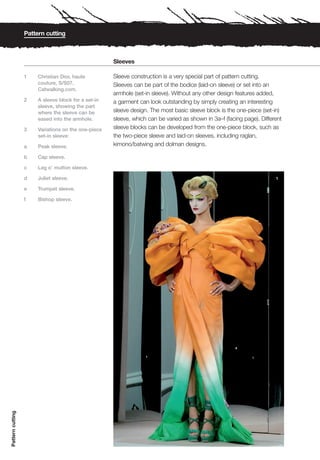
          on the outside of the garment)           pressing will not show through
          and make a tiny stitch from              to the outside of the fabric.
          the hem.

4


    Jersey fabric or knitwear

    Jersey and knitwear fabrics have a       Cross-stitching
    natural stretch. If it is necessary to
                                                                                        Seam finishes > Hand sewing techniques


    finish the hemming lines by hand         •     Turn the garment inside out
    make sure that the stitches are not            and fold the hem allowance
    restricting the stretch of the fabric.         over by 0.5cm.
    A cross-stitch hem, also known as a
    ‘figure-eight’ hem or ‘catch-stitch’     •     Work from left to right.
5   hem, has more stretch than a regular
    blind-stitched hem and is therefore      •     Secure the hem allowance,
    perfect for use on jerseys and                 then catch one or two threads
    knitwear.                                      of the outer fabric.

    If necessary, the hemming edge can       •     Next take a tiny stitch in
    be overlocked before starting the              the hem and continue the
    hand stitches.                                 process. Create a crossover
                                                   with the stitches, leaving
                                                   0.7cm between each one.
Garment construction


                                                           Transparent fabrics and silks

                       1   Technical drawing of a          To achieve an invisible hem finish, use   •   Then slip the needle directly
                           slip-stitch.                    a roll hem and slip-stitch technique.         above it into the turned/rolled
                                                           This kind of hand stitch is common            edge and through the roll by
                       2   Silk scarf with roll hem and    on silk scarves and the cuff openings         a couple of millimetres.
                           slip-stitch finish.             on blouses made of delicate fabrics
                       3   Use a slip-stitch to attach a   but it can be used on anything that       •   Come out of the roll and take
                           lining to a hem.                requires a fine edge finish.                  another thread directly below
                                                                                                         from the outer fabric. Now
                       4   Lining attached to a hemline    •     Secure the thread with a knot           repeat the process and make
                           of a jacket.                          and a backstitch at the                 sure that no thread is visible
                                                                 starting point.                         from the outside or inside of
                       5   Technical drawing of a                                                        the garment.
                           prick-stitch.                   •     Then turn the edge under by
                       6   A zip sewn into a dress               rolling the fabric inwards to       •   When rolling the edge over,
                           using prick-stitching.                the inside (wrong side) of the          make sure not to take too
                                                                 garment. You will create a tiny         much fabric in, as it is a
                                                                 roll by doing so.                       refined finishing method.
                                                                                                         Using a thin needle and fine
                                                           •     Pick a thread from the outer            thread will make the job easier.
                                                                 fabric, making sure the thread
                                                                 is not seen on the outside of
                                                                 the garment.


                                                           1


                                                           2
Garment construction
86 / 87


Linings

When working on a jacket, attach          Slip-stitching                               Prick-stitching
the hem of the jacket first with a
blind hemstitch and then get the          •      Secure your thread at the             •     The prick-stitch is similar
lining ready to be attached to the               starting point and catch a                  to the slip-stitch but it is a
hem. The lining ends about 2cm                   small amount of fabric from                 stronger version of the two.
above the jacket hem and is cut                  the jacket hemming only.                    The difference is that when
with extra length for a fold to provide                                                      applying the stitch into the
lengthways ease (see ‘Linings’ on         •      Avoid taking fabric from the                jacket hem, the prick-stitch
page 166).                                       outside of the jacket.                      needs to go back on itself
                                                                                             (backstitch) before slipping
Fold the lining 1cm over on the hem       •      Then immediately at the point               into the lining.
edge and pin to the jacket hem 1cm               of coming out of the fabric,
below its edge. You can use either               slip into the lining for a couple     •     This stitch can also be used
slip-stitching or prick-stitching to             of millimetres and come out                 for sewing in zips.
attach the lining.                               with the needle to catch
                                                 another small amount of the
                                                 jacket hem. Continue from
                                                 right side front to left side front
                                                 and remember the jacket is
                                                 inside out.


3                                                                5


4                                                                6
                                                                                                                                Seam finishes > Hand sewing techniques
Garment construction


                       Other stitches

                       Other stitches can be used for           1   Using a blanket             4   An arrowhead tack.
                       decorative effects or to secure              stitch technique as a
                       weak points on a garment.                    decorative edge finish on   5   A fagotting stitch.
                                                                    a wool fabric.              6   A version of a hand-sewn
                                                                2   An overcast stitch.             fagotting stitch used as an
                                                                                                    edge finishing.
                                                                3   Wool fabric with overcast
                                                                    stitch to prevent the raw
                                                                    edge from fraying.


                       Blanket stitch

                       •     Blanket stitch is a decorative
                             stitch that can also be used to
                             finish a raw edge.

                       •     Choose the depth and length
                             of your stitch and insert the
                             needle vertically, keeping the
                             same distance and depth
                             throughout.

                       •     Working from left to right, pass
                             the needle through from back
                             to front and bring the needle
                             through the thread loop.           1


                       •     Make sure that the knot lies
                             on the top of the fabric edge.
                                                                2


                       Overcast stitch

                       •     Overcast stitch is used
                             to finish a raw edge.

                       •     Work from right to left.

                       •     Push the needle through the
                             fabric edge from the back to
Garment construction


                             the front, taking a 2–3mm
                             stitch.

                       •     Take the needle pointing left
                             and create slanting stitches of
                             the same distance and depth
                             over the fabric edge.
                                                                3
88 / 89


Arrowhead tack

Specific stitches are used to secure     •   Mark the position of the          •   Then take the needle to
a weak point on a garment. Use an            triangle with thread or chalk.        the lower right corner and
‘arrowhead’ or ‘cow’s-foot tack’ for         Use a buttonhole thread and           complete a stitch from the
example, to reinforce parts that may         secure the thread with a knot.        lower right corner to the
be under a lot of strain such as a                                                 lower left again.
split in a skirt, the ends of a pocket   •   Starting on the lower left
or the tops of pleats.                       corner, push the needle           •   Continue this process from
                                             through from the wrong                right to left, with stitches close
                                             side to the right side.               together, until the triangle is
                                                                                   complete.
                                         •   Working on the right side of
                                             the fabric, tack the needle
                                             through the top point of the
                                             triangle, taking a tiny stitch.


4


Fagotting stitches

Some decorative hand stitches can        •   Start by drawing parallel lines   •   Then start fagotting the two
be used to join two fabric edges             on a piece of paper in the            edges together by taking
together, such as the ‘fagotted              desired width of the fagotting.       slanted stitches from one side
seam’. This is an embroidery stitch                                                to the other and pass the
that creates an open lacy effect.        •   Turn both sides of the                needle under each slanting
                                             adjoining raw edge under.             thread to create a crossover.
                                             Tack these two edges on to
                                                                                                                        Seam finishes > Hand sewing techniques


                                             the paper lines.


                                                   5                                                             6
Surface-specific techniques                                                                    90 / 91


                                                                    1   Fur jacket by Julien
‘I love to take things that are everyday and comforting and             Macdonald, A/W08.

make them into the most luxurious things in the world.’

Marc Jacobs


This chapter deals specifically with the range of techniques
used for specialist fabrics and materials. Finishes and
treatments that are added to a fabric at any stage of its
process can make the material difficult to cut, sew or finish.
These include felted wools, lace, sequinned and beaded
fabrics, knits and fabrics that have a nap, such as velvet. A
material such as fur or leather, whether it is real or synthetic,
also requires specialist knowledge in its construction.


                                                                                                         Garment construction > Surface-specific techniques > Haute couture and tailoring


1
Surface-specific techniques


                                                               Felted fabrics

                              1   An abutted seam.             Felted woven fabrics are shrunk and compressed with heat, moisture
                              2   A top-stitched hem finish.   and friction to produce a dense appearance. Some of the better-
                                                               known felted fabrics are loden, melton or fleece. The edges of a
                              3   A top-stitched hem with
                                  1cm turned under.            felted fabric do not fray so seams can be left unfinished. It is most
                                                               common to use a plain stitched seam with topstitching or a welt
                              4   A flat fell seam.
                                                               seam for light- to medium-weight felted fabric. But there are many
                              5   Calvin Klein dress made of   more techniques to choose from, such as:
                                  felted wool, A/W08.
                                  Catwalking.com.

                                                               Abutted seam                             Topstitched hem

                                                               Abutted seams (or channel seams)         The best way to finish a felted fabric
                                                               can be used as decorative seams,         garment is with a topstitched hem,
                                                               by applying a ribbon or any contrast     but you could also use a blanket
                                                               fabric as an under layer.                stitch, which creates a certain look
                                                                                                        and finishes off the edge.
                                                               •     Prepare a 3cm strip as an
                                                                     under layer and mark the           •     Add allowance for a hem.
                                                                     centre of the strip. You can
                                                                     use contrasting or matching        •     Turn the hem allowance to the
                                                                     fabric.                                  wrong side of the garment.

                                                               •     Place the raw edge of both         •     Top-stitch the hem down. This
                                                                     sides of the garment pieces on           can be done at any width,
                                                                     to the centre line of the strip.         stitch length and row position
                                                                     The strip is lying on the wrong          depending on the design
                                                                     side of the fabric pieces with           choice. Use any type of
                                                                     the right side up.                       thread (colour or thickness)
                                                                                                              or use decorative stitching.
                                                               •     Now top-stitch each side
                                                                     of the garment pieces on to
                                                                     the strip.

                                                               •     If required, you can also leave
                                                                     a gap to show more of the
                                                                     decorative strip.


                                                                                                                                           2
Surface-specific techniques


                                                                                                                                           3


                                                               1
92 / 93


Non-woven flat fell seam

A variation of the flat fell seam is
strong enough for non-woven felted
fabrics.

•     Allow 1.5cm for the seam
      allowance.

•     Put the wrong sides together
      and sew a straight line.

•     Press the seam flat to one
      side.

•     From the inner layer trim off
      2–3mm.

•     Top-stitch the top layer down
      along the edge.

•     To strengthen the seams
      use a fusible web before
      top-stitching.


4                                      5
                                                     Felted fabrics > Lace
Surface-specific techniques


                                                                   Lace

                              1   Christian Lacroix, haute         Lace is a decorative fabric with an open structure. It is made by
                                  couture, S/S08.                  hand or machine using knitting, braiding, looping and knotting
                                  Catwalking.com.
                                                                   techniques. Lace is used for trimming on lingerie, collars and cuffs or
                              2   Technical drawing showing        as appliqué, traditionally on bridal or evening wear. It can be fine- to
                                  how to cut lace fabric and
                                  create an appliqué seam.         heavyweight, in different fibres such as linen, wool, cotton, polyester
                                                                   or nylon and has more stretch in the width than in the length. Lace is
                                                                   fragile and needs to be handled with care. It is also expensive. You
                                                                   will require more fabric when cutting out because most lace fabrics
                                                                   have a horizontal or vertical pattern that should be matched up, both
                                                                   for garment construction and for trimmings.
Surface-specific techniques


                                                               1
94 / 95


Appliqué seams

Appliqué seams are used on lace         •   Cut the overlapping piece         Appliquéd lace edging
garments to ensure that none of             (front piece) following the       and set-in lace pieces
the side or centre back seams               pattern and add some              When integrating lace pieces
are visible.                                allowance (this can be            into a garment or finishing,
                                            cut off later).                   such as on lace-trimmed
•    Cut the pattern as usual.                                                necklines or hemlines, great
                                        •   Then cut the back piece (this     care has to be applied to
•    Place the pattern right-side           is the corresponding under        make the fabric and lace look
     up on to the lace. Lay out the         layer) with a 1cm allowance.      like a single piece. Lace
     pieces, leaving space between                                            application should not look
     them, aligning the pattern         •   Put the overlapping layer on      like an afterthought, but as
     design of the fabric from front        top (right-side up) and pin the   though it is part of the fabric.
     side seam to back side seam.           thread-marked front and back
                                            side seam lines together.
•    Be careful with the centre front
     and centre back when placing       •   Baste the new side seam
     the pieces for a central               and check the fit for small
     pattern.                               alterations, before sewing the
                                            pieces permanently together.
•    First thread mark the original
     side seams of the pattern on       •   Appliqué around the lace
     to the lace fabric.                    pattern with a small zigzag
                                            stitch, either by hand or with
•    Then thread mark the                   the sewing machine.
     overlapping pattern on
     to the front panel.                •   Trim all excess allowances
                                            off each layer and press the
                                            seams carefully at a low
                                            temperature.


                                                                                                                   Felted fabrics > Lace > Leather
Surface-specific techniques


                                                                 Leather

                              1   Leather hand-sewing            Leather is one of the oldest materials used to cover up the human
                                  needles and leather machine    body. It is not a type of fabric but the skin of a mammal or reptile
                                  needles with a wedge point.
                                                                 and is therefore sold by the skin and not by the metre. The hair of
                              2   Welt seam on leather           the skin is removed and the grain revealed by a process called
                                  sample.
                                                                 tanning (leather can be tanned using several products including:
                              3   Leather seam with topstitch.   tannin, chrome, alum or oil). The skin will go through a finishing
                              4   Leather seam with tape         process after the tanning to apply colour or a different surface,
                                  for reinforcement.             for example shiny or matt. It is called leather when the outside of
                              5   Glue and brush to hold         the skin is tanned and finished and known as suede when the inside
                                  down leather seam              is finished.
                                  allowance and hemlines.

                              6   Leather jacket by D&G,
                                  Dolce and Gabbana, S/S08.


                                                                 Sewing leather

                                                                 Leather does not fray and therefore        •   Use a polyester thread (or if
                                                                 the edges do not have to be finished.          the leather is heavy then try a
                                                                 When sewing leather use a special              top-stitching thread, which is
                                                                 leather needle and do not pin the skin         thicker than a normal stitching
                                                                 as it leaves marks. Also, the garment          thread). Do not use cotton or
                                                                 cannot be let out, as it will show the         cotton-wrapped polyester
                                                           1     stitches. Leather is sensitive to heat         thread as the treatment used
                                                                 from the iron and may get stained and          on leather or suede will make
                                                                 creased permanently. When working              the thread rot.
                                                                 with suede, watch out for the nap.
                                                                                                            •   Start by trying a universal
                                                                 A leather or suede garment requires a          machine needle first. If it skips
                                                                 different approach in its construction         stitches use a leather needle
                                                                 compared to one made in fabric.                that is wedge pointed.
                                                                 To avoid disappointment, always
                                                                 experiment with scraps of leather first,   •   Use a Teflon foot, roller or
                                                                 trying out seams and other areas that          leather foot on the sewing
                                                                 can cause problems.                            machine. The foot may leave
                                                                                                                marks on the leather so try
                                                           2
                                                                                                                first on a scrap of leather.
Surface-specific techniques


                                                           3
96 / 97


Seams for leather                        Hems for leather                           Fastenings for leather

Always consider the weight and style     To achieve a flat hem on curved            Suitable fastenings for leather
of garment when choosing the seam        edges, cut out triangular notches.         garments are zips of all kinds and
type. A plain seam works for all thin-                                              bound, slash-stitched buttonholes
to medium-weight leathers. For the       •     Hemlines can be glued or             or buttons with loops. Hook-and-
heavier range of leathers use a                top-stitched. Pound the              loop fastenings and lacings can also
lapped seam, as it will create less            hemline first to get a fold line,    work well. When sewing on the
bulk. Other types of seams are the             then glue or top-stitch close to     buttons and hooks use a leather
plain leather seam, slot seam, welt            the fold lines. This is especially   needle and a waxed thread. Apply
seam or for extra stability and                important when applying a            a small button as a stay button on
reinforcement, the taped seam.                 lining so that the hem edge          the facing side.
                                               is left free, allowing you to
•     Instead of ironing the seams,            machine stitch the lining to it.
      these are pressed down or
      pounded with a cloth-covered       •     For heavier leather use the
      hammer.                                  raw edge facing. If the leather
                                               is nice inside, why not finish
•     Glue (use leather glue, which            off the hemming by turning
      is more flexible) or top-stitch          the hem inside out
      the seams down to keep them              (wrong-side-out hem).
      flat. Skive the edges off the
      seams to avoid bulk.

•     Darts are stitched to the dart
      point, than slashed open and
                                                                                                                     6
      glued or top-stitched down.


4


5
                                                                                                                           Lace > Leather > Fur
Surface-specific techniques


                                                             Fur

                              1   Fur hat and miniskirt by   Real fur, like leather, comes from an animal but with the hair still
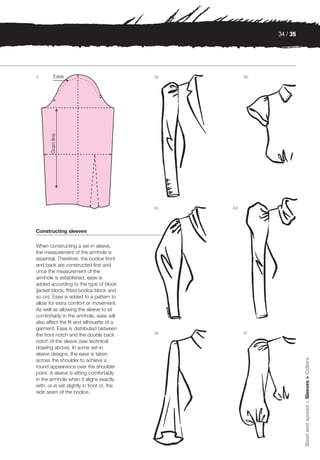
                                  Julien Macdonald, A/W08.   attached. All real furs have dense short hairs called ‘under fur’ and
                                                             longer, softer hairs called ‘guard hairs’. Real fur is very expensive to
                                                             buy and, because of where it comes from, in many countries is
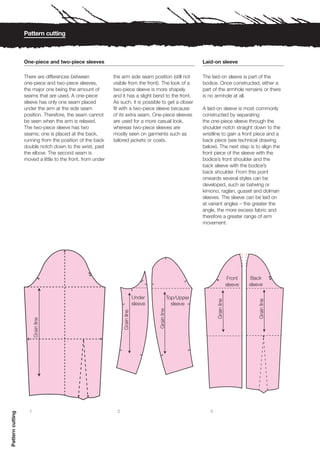
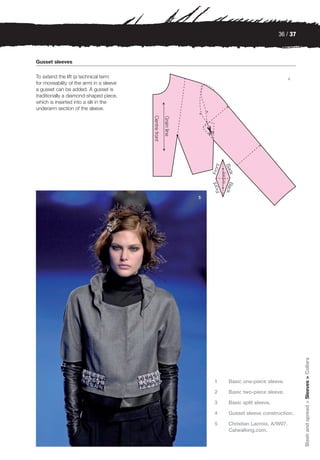
                                                             unpopular to wear. However, manufactured imitations are becoming
                                                             more and more sophisticated. Fake fur fabric is easier to cut as it
                                                             comes on the metre and not in skins. It is also easier to sew. The
                                                             quality is so good that it is often mistaken for real fur.

                                                             Real fur can be processed to make it softer and it can be bleached,
                                                             dyed or stencilled to change its colour. It can also be sheared or
                                                             curled to give it a different texture and look.


                                                             Sewing fur

                                                             A number of methods can be                Tips for working with fur
                                                             employed to make working with             •     Fur has a nap and
                                                             fur easier.                                     sometimes looks
                                                                                                             livelier when cut
                                                             •     Use a polyester thread for                upside down.
                                                                   real fur and any type of thread
                                                                   for fur fabric, as long as the      •     When cutting real or
                                                                   thread is strong enough.                  fake fur, make sure to
                                                                                                             cut the skin only and
                                                             •     For real fur, start by trying a           not the hair. Mark your
                                                                   universal machine needle.                 pattern pieces on the
                                                                   If it skips stitches use a                skin side and slide a
                                                                   wedge-pointed leather needle.             razor blade, mat knife
                                                                   For woven fur fabrics, a                  or scissors carefully
                                                                   universal machine needle                  through just the skin.
                                                                   should work well.

                                                             •     For real fur use a Teflon foot,
                                                                   roller or leather foot on the
                                                                   sewing machine and a
                                                                   standard machine foot for
                                                                   fur fabric.
Surface-specific techniques
98 / 99


Plain seam

To avoid the fur hair being caught in
the seam push the pile towards the
garment, then stitch the seam and
turn around to the fur side. To
release fur pile caught in a seam,
use a pin and carefully pull the pile
out. Also trim away the pile in the
seam allowance to avoid extra bulk.

•     Fake fur fabric can be
      carefully pressed with a
      low-temperature iron on the
      wrong side. If seams do not
      lay flat on a real fur garment
      then use hand stitching to
      flatten the seams down.

•     The best way to hem a fur
      garment is to tape it or face
      it with leather.

•     To fasten a fur garment use
      faced and inseamed
      buttonholes, leather button
      loops, covered hooks and
      eyes or simply wrap the front
      and close with a leather belt.
      Zips should only be used on
      short-haired fur, as long-haired
      furs will get caught in between
      the zip teeth.


                                         Leather > Fur > Knits and stretch-woven fabrics


1
Surface-specific techniques


                                                                 Knits and stretch-woven fabrics

                              1   Five-thread overlocked         Linking one or more yarns into a series of interlocking loops makes
                                  side seam of a t-shirt.        up a knit fabric. Horizontal rows of knit are known as ‘courses’ and
                              2   Coverstitch with two- and      vertical rows are known as ‘wales’. Knitted and stretch-woven fabric
                                  three-needle effects on a      is comfortable because of its stretchiness. However, care must be
                                  hemline.
                                                                 taken when working with these fabrics as pressing and heat can
                              3   Bound neckline of a t-shirt    cause the fabric to lose its shape.
                                  with coverstitching.

                              4   A basic skirt block for
                                  woven fabrics can be
                                  reduced to a jersey skirt
                                  block by taking in the skirt
                                  to allow for the stretch.

                              5   The final stretch/jersey       Types of knitted and stretch-woven fabric
                                  skirt block.

                              6   T-shirt by Courtney            There are two types of knitted fabric:
                                                                                                              1
                                  McWilliams with a raw edge     one is the weft knit, which is one
                                  finish on the neckline.        continuous yarn. This is used to
                                                                 produce fabrics such as jersey,
                                                                 ribbing, sweatshirt knits, inter-locks
                                                                 and double knit. The second is the
                                                                 warp knit, which uses many yarns
                                                                 and one stitch (warp) to produce
                                                                 fabric that is flat with straight edges
                                                                 (jersey, on the other hand, is less
                                                                 stable, runs easily and curls at all cut
                                                                 edges). The best-known warp knit is
                                                                 tricot, which is used, for example, in
                                                                                                              2
                                                                 lingerie. Another is the raschel knit,
                                                                 which has a lacy, openwork appearance.
                                                                 Weft and warp knits use only four
                                                                 basic stitches: plain, rib, purl and warp.

                                                                 Stretch-woven fabrics must have at
                                                                 least 20 per cent stretch in either
                                                                 direction; lengthwise or crosswise.
                                                                 These fabrics can be made with
                                                                 textured yarn, either curled or crimped.
                                                                 They can be given a special finish or
                                                                 woven with yarns made from elastomers
                                                                 (elastomer is a synthetic material that
                                                                 has extensibility and complete elastic
                                                                 recovery). Some well-known stretch
                                                                 fibres are Spandex or Lycra. They
                                                                 can be mixed with cotton, wool or
                                                                 any synthetic fibres. Any traditional
Surface-specific techniques


                                                                 fabric such as corduroy, denim,
                                                                 satin or lace can be combined
                                                                 with stretch yarns and therefore gain
                                                                 the characteristic of knits, such as         3
                                                                 comfort, wrinkle-resistance and
                                                                 a better fit.
100 / 101


Sewing knitted and stretch-woven fabric

Due to its fragile nature, knitted and         Tips for working with knits and        •       Fastenings on knit and
stretch-woven fabric requires some             stretch-woven fabric                           stretch-woven fabrics are
specific construction methods.                 •     When cutting out, make                   tricky. Always use an
                                                     sure you allow the fabric to             interlining or tapes to
•      Use a polyester or cotton-                    relax on the table and don’t             restrict the part where the
       wrapped polyester, woolly                     stretch it at any point of the           fastening is placed. For
       nylon or elasticated thread.                  cutting process. Also use                example, use a decorative
                                                     fine pins and very sharp                 non-stretch tape on the
•      Try a universal machine needle                scissors.                                outside or inside of the
       for stretch-woven fabrics and if                                                       button stand position.
       it skips, use a ballpoint and/or        •     Be careful when pressing                 This will keep the garment
       stretch needle. It may also be                stretch-woven fabrics and                closed and prevent it from
       worth trying twin needles.                    knits as neither will take a             stretching into a different
                                                     hot iron. When pressing,                 size. Zips, Velcro or
•      Seams can be put together                     steam on to the seam and                 magnetic closings can also
       using specialist machinery                    afterwards press down the                be used as fastenings.
       such as the coverstitch or                    seam with the fingers.
       five-thread overlocker, which
       will allow the stretch-woven
       fabric or knit to stretch.

•      The hem finishing, like the
       seams, depends on the style         4                                              5
       of the garment. You can
       choose from a variety of hand
       and machine finishings. For
       example, if you are working by
       hand use a cross-stitch, which
       will give the stretch needed in
       the hemming. If you are
       working on a machine use a
       cover-stitch with twin needle


                                                                                                                              Fur > Knits and stretch-woven fabrics > Sequinned and beaded fabrics
       effects or a zigzag stitch.
       Applying a binding or ribbon
       to finish off the edge works
       well, or try elastic casing and
       elastic lace or any other elastic
       tape. A clean cut raw edge also
       looks interesting if it does not
       allow the knit to run.
                                           6
Surface-specific techniques


                                                            Sequinned and beaded fabrics

                                                            Sequinned and beaded fabrics are glamorous and in the past have
                                                            been used mainly for eveningwear and special occasions. It is now
                                                            much more common to use these fabrics for daywear. Sequins,
                                                            beads and other sparkling stones are sewn or glued on to an
                                                            underlayer of fabric such as chiffon, satin, taffeta or knits.


                                                            Sewing sequinned and beaded fabric

                                                            These fabrics are not easy to handle     Tips for working with
                                                            and extra time and care needs to be      sequinned and beaded
                                                            considered when using them.              fabric
                                                                                                     •      Sequinned fabrics can
                                                            •     Beads and sequins are applied             be uncomfortable on
                                                                  to the fabric with repeated               bare skin, therefore the
                                                                  chain stitch. This means that             garment should be lined.
                                                                  if pulled from one side, it will
                                                                  unravel badly.                     •     Some sequinned and
                                                                                                           beaded fabrics can
                                                            •     The best thread to use is                have a pattern and
                                                                  polyester or cotton-wrapped              will therefore need
                                                                  polyester for both hand and              matching up. The
                                                                  machine sewing.                          fabrics usually have
                                                                                                           a nap/direction and
                                                            •     Use a universal machine                  should be cut from a
                                                                  needle and a hand-sewing                 single layer. Make sure
                                                                  beading needle. When using               to use old but sharp
                                                                  the sewing machine tack the              scissors as the fabric
                                                                  stitch size down to 2.5mm.               dulls scissor blades.

                                                            •     If required, you can also leave
                                                                  a gap to show more of the          •     Avoid darts and add
                                                                  decorative strip.                        flare through slash and
                                                                                                           spread rather than
                                                                                                           gathers and pleats.
                                                                                                           Simple sleeve solutions
                                                                                                           like the kimono or
                                                                                                           raglan show off the
                                                                                                           fabric better than a
                                                                                                           set-in sleeve. Try not to
                                                                                                           break up the fabric
                                                                                                           design unnecessarily.
Surface-specific techniques


                                                                                                     •     Before purchasing a
                                                                                                           sequinned fabric check
                                                                                                           the width, because
                                                                                                           most are very narrow
                                                                                                           (114cm/45in).
102 / 103


Assembling sequinned and beaded fabric garments

These fabrics are used to their best          procedure should be used with     1   Sequinned trouser by
advantage by employing a simple               a beaded fabric.                      Alexander McQueen, A/W08.
style with a minimum of seams.                                                      Catwalking.com.
                                          •   Facing and hemming can be
•     The seams to use are a plain            done by using tapes, bands,
      seam; a double-stitched seam            bindings, ribbing or any
      (two close rows of straight             fabric/lining facings.
      stitch lines); a hairline seam
      (two close rows of straight         •   Another way of finishing
      stitch and zigzag stitch lines)         hemlines is to superlock the
      or you can used a taped seam            edges. Superlock is a very fine
      for reinforcement.                      and tight overlocking stitch.

•     When the garment pieces are         •   Depending on the style of
      cut, take away the sequins              garment use a light zip, hook
      along the seams. Only sew the           and eye or loops and buttons
      underlayer of fabric together, do       to fasten.
      not sew through sequins.

•     Once the seams are closed
      add the missing sequins along
      the seam line by hand (this will
      make the seam disappear) and
      also secure the loose ones
      around the seam. The same


                                                                         1


                                                                                                                Knits and stretch-woven fabrics > Sequinned and beaded fabrics > Velvet
Surface-specific techniques


                                                            Velvet

                              1   Velvet suit by Julien     Napped or pile fabrics go through a process called ‘napping’,
                                  Macdonald, A/W05.         whereby fibre ends are raised to the surface to be either clipped,
                                                            brushed flat or left standing up. This process can be applied on one
                                                            or both sides of woven or knitted fabrics.

                                                            Pile fabrics are woven with an extra set of yarn. Velvet is a popular
                                                            fabric of the napped or pile family. Originally velvet was made from
                                                            silk yarns. Today velvets range from light- to heavyweight and can
                                                            be woven from cotton, rayon or polyester. Velvet has an extra set of
                                                            warp yarns and is woven as two layers of fabric. The pile, which joins
                                                            the layers together, is cut after the fabric is woven. The result is a
                                                            much denser pile, giving the fabric a rich texture.


                                                            Sewing velvet

                                                            Care needs to be taken with velvet        •   Hemming can be sewn by
                                                            once it has been cut as the pile frays        hand with blind hemstitching
                                                            badly at its raw edges. Ironing and           or faced with a lighter fabric
                                                            pressing velvet can also damage the           by machine.
                                                            fabric by flattening the pile so try to
                                                            press on the inside of the garment or     •   Clean up frayed edges on
                                                            use a velvet board to avoid using too         seams by binding or overlocking
                                                            much pressure. Some other tips for            the seam allowance.
                                                            sewing velvet include:

                                                            •     Use a universal machine needle
                                                                  and take the pressure off the
                                                                  sewing foot. Try using a roller
                                                                  or even-feed machine foot or
                                                                  a zipper foot.

                                                            •     When sewing seams, make
Surface-specific techniques


                                                                  sure you hand tack the seams
                                                                  together as velvet creeps badly
                                                                  and sometimes puckers during
                                                                  the sewing process. You can
                                                                  use a plain seam or tape your
                                                                  seams for extra stability.
1
                                                                  104 / 105


Sequinned and beaded fabrics > Velvet > Transparent fabrics
Surface-specific techniques


                                  Transparent fabrics

                                  Beautiful transparent fabrics range from crisp to soft and light- to
                                  heavyweight. The best-known crisp, semi-transparent to transparent
                                  fabrics are organza and organdie made from silk, cotton or
                                  synthetics, as well as marquisette and handkerchief linen. These
                                  types of fabrics are easier to cut and sew then the soft transparent
                                  ones. The most common types of soft, semi-transparent and
                                  transparent fabrics are chiffon, georgette and crepe chiffon. These
                                  fabrics are so lightweight they are tricky to cut and difficult to sew.
                                  You will also find fabrics that you can categorise in between crisp
                                  and soft such as voile, batiste, shirtings or gauze. These fabrics
                                  might be difficult to work with but are worth all the effort, as they
                                  are stunning to look at and delightful to wear.


                                  Sewing transparent fabrics

                                  It is worth noting that the softer the   •   Make sure that all marks within
                                  fabric, the more time and space you          the pattern piece are thread
                                  will need to work with it.                   marked (use a fine needle and
                                                                               extra fine thread). Do not use
                                  •     Use a fine (60–70) universal           chalk marks, which will show
                                        machine needle and reduce              permanently on the good side
                                        the stitch length to 1.25–2mm,         of the fabric.
                                        which is a very small stitch.
                                                                           •   Carefully clean up the inside of
                                  •     Match the thread to the fabric         the garment, as the transparent
                                        and use a fine to extra fine           fabric shows all kinds of hems,
                                        polyester thread or mercerised         seams and facings on the
                                        cotton.                                outside of the garment. There
                                                                               are several methods you can
                                  •     Iron all the creases out of            use for the seams, for example
                                        the fabric with a dry iron.            French seams or bindings. The
                                                                               best method for hemming a
                                                                               chiffon garment is a pin-hem
                                  •     Pin the fabric carefully on to a       and if you work on a budget
                                        piece of thin paper the same           use a superlock as a finishing.
                                        size as the fabric. The paper          Slip-stitch is a nice hand
                                        is supposed to stop the fabric         sewing stitch for hem or edge
                                        from moving around, as it is           finishings.
                                        famously slippery.

                                                                           •   When it comes to pressing the
                                  •     After securing the fabric to           fabric, consider the material
                                        the paper, add a third layer of        and always try first on a scrap
                                        paper with the pattern pieces          piece. Sometimes using a dry
                                        copied on to it. Pin all three         iron makes the fabric static.
                                        layers together and cut out            If this happens, use an
                                        with sharp scissors.                   antistatic spray.


                              1
106 / 107


2


        1   Chiffon dress by Yuki with
            French seam finish and a
            pin hem.

        2   Example of a layout for
            cutting fine fabrics.

        3   Example of a pin hem finish
            on a sleeve hemline.

        4   Sample of a superlock
            finish.

        5   Close-up of the French
            seam finish on the dress
            by Yuki.


3
                                          Velvet > Transparent fabrics


4   5
Haute couture and tailoring                                                               108 / 109


                                                                     1   Backstage image at
‘I created flower women with gentle shoulders and                        Christophe Josse’s haute
                                                                         couture A/W06 show.
generous bosoms, with tiny waists like stems and                         Catwalking.com.
skirts belling out like petals.’

Christian Dior


At the top of the garment manufacturing chain are haute
couture and the tailoring crafts, which involve working with
individual customers. The garments are constructed using
traditional methods such as hand sewing and intricate cuts.
The fabric and finishing can often heavily influence the
designing process and the designs will often work to ensure
that they are displayed to their best advantage on the body.

A lot of time, consideration and energy is put into a couture
or tailored garment. The result is a garment that fits flawlessly,
using the finest luxury fabrics, put together with skillful hands
by dressmakers and tailors who are proud of their work and
the name they work for. To be working as a tailor on Savile
Row, for example, or in an atelier for an haute couture house


                                                                                                      Surface-specific techniques > Haute couture and tailoring > Draping on the mannequin
conveys the feeling of exclusivity through history and tradition.


1
Haute couture and tailoring


                                                                Haute couture

                              1   Monsieur Dior et nous         Translated literally from French into English, the phrase ‘haute
                                  (1947–1957), Esmeralda        couture’ means ‘sewing at a high level’. Couturiers use only the
                                  de Réthy and Jean-Louis
                                  Perreau, Anthese (1999).      finest and most luxurious fabrics. Sometimes these have been
                                                                custom made. A couture garment is meant to fit flawlessly as a result
                              2   Fitting of a dress by Dior.
                                                                of many fittings and will include perfectly designed proportions for
                                                                the individual client. Adjustments are made on garments to balance
                                                                the body shape of the customer. These can include changes to the
                                                                collar, the proportions of the pockets (one can be slightly bigger than
                                                                the other), shoulder seams (one can be narrower than the other), or
                                                                padding in one shoulder to make it higher than the other. For a full
                                                                figure all horizontal seam lines are adjusted, not just the waist and
                                                                hemline. This attention to detail is the essence of haute couture. With
                                                                the help of the toile, every design detail is planned so that any motifs,
                                                                stripes or checks are matched and positioned to the best advantage
                                                                for the client’s figure. At garment openings a motif will match so
                                                                perfectly you have to look twice to discover the fastening. On suits
                                                                and two-piece designs the fabric pattern continues uninterrupted
                                                                from neck to hem.

                                  1


                                  2
Haute couture and tailoring
110 / 111


The history

The origins of haute couture lie in        de commerce et d’industrie de Paris’.     houses also produce prêt-a-porter
the eighteenth century, with many          The rules that define those design        collections. The purpose of a couture
attributing its birth to the couturier,    houses allowed to become an haute         show is to enhance the prestige of
Rose Bertin (the milliner to Marie         couture label were established in         the house.
Antoinette) and Charles Frederick          1945 but have since been updated.
Worth. Prior to this, clothing would       To become a member of the                 In 1946 there were 106 official haute
have been made by the couturier to         ‘Chambre syndicale de la haute            couture houses. Over the course of
the specifications of the customer.        couture’ and to be able to use the        the twentieth century this number
It was not until the mid-nineteenth        term ‘haute couture’ in its label and     dropped dramatically to 18 and today
century that Charles Frederick Worth,      advertising or in any other way, a        there may be as few as ten: Adeline
who was originally from England, first     design house must follow three main       Andre, Chanel, Christian Lacroix, Dior,
introduced his customers to garments       regulations: to provide an atelier in     Dominique Sirop, Emanuel Ungaro,
made up from his own ideas. He             Paris that employs at least 15 people     Frank Sorbier, Givenchy, Jean Paul
showed his collection of finished          full-time; to present a collection with   Gaultier and Jean-Louis Scherrer.
designs on live models – a novel           at least 35 outfits including day- and    There are also three correspondent
exercise at the time. He achieved          eveningwear to the Paris press; and       or foreign member houses: Elie Saab,
colossal success and opened up a           to provide a service to private clients   Giorgio Armani and Valentino.
new direction in fashion. Once the         with bespoke designed garments.
customer had selected an outfit from
the portfolio (today called a look-book)   Across Europe the term couture
and specified the colour and fabric,       has been used loosely to describe
the outfit would be made to measure        tailor-made and high fashion
in the atelier (workshop). This is still   garments, which can lead to
common practice.                           confusion for customers. A collection
                                           of garments produced more than
In France, haute couture is a              once and to a size range is called
protected name and can only be used        prêt-à-porter, the French term for
by companies that work to a certain        ‘ready to wear’. As they struggle with
standard, as defined by the ‘Chambre       their vast costs, these days couture


                                                                                                                               Haute couture > Designing haute couture
Haute couture and tailoring


                                                                  Designing haute couture

                              1   Paul Poiret fashion memoir,     The construction of a couture               The toile will be made with all the
                                  Francois Baudot, Thames         garment may look effortless, but it         necessary underpinnings and put
                                  and Hudson (1997).              takes many hours to produce that            together with the same care as the
                                  Sketch of an evening cloak      effortless look. Equipped with              final garment. This toile is then fitted
                                  by Georges Lepape (1911)        a thorough understanding of the             on the house model and reworked.
                                  and a dressing gown with a      human body and knowledge of fibres          Sometimes toiles are made in the final
                                  pattern designed by Dufy        and fabrics, the couturier may begin        fabric straight away, allowing the
                                  (1923).                         with either the fabric or the silhouette.   couturier to appreciate the garment
                                                                                                              to its full potential.
                              2   Balenciaga fashion
                                  memoir, Marie-Andree            When the fabric arrives the couturier
                                  Jouve, Thames and Hudson        drapes unfolded lengths of each             Once the toile is approved it is
                                  (1997). Black coat with white   fabric over a mannequin or a house          carefully taken apart and pressed so
                                  mink cape (1967) and ‘Four-     model to see how the material hangs         that it can serve as a pattern. After
                                  sided’ cocktail dress.          on the lengthwise-, cross- and bias-        the fabric is cut and thread marked
                                                                  grain lines. Using this information as      the prototype is ready to be fitted on
                              3   Charles James fashion           a guide he or she starts the design         the house model once again. This
                                  memoir, Richard Martin,         process by drawing sketches for the         process will be repeated until the
                                  Thames and Hudson (1997).       collection. The design sketches are         designer is satisfied. Finally,
                                  James’s ‘Four-leaf Clover’      distributed to the atelier. Depending       accessories are selected by the
                                  evening dress (1953) and a      on the type of garment, the sketches        couturier for the press show and the
                                  drawing of the inside by Bill   will go to the tailoring workroom           design is entered in the Livre de
                                  Wilkinson (1982).               (atelier de tailleur) or the dressmaking    fabrication (production or look-book).
                                                                  workroom (atelier de flou). Then the
                                                                  appropriate weight of muslin/calico is
                                                                  selected and the toile is draped on
                                                                  the mannequins to duplicate the
                                                                  design sketch. This drape provides
                                                                  the basic pattern from which the
                                                                  garment will be sewn.
Haute couture and tailoring
112 / 113


1   Paul Poiret (1879–1947)
    Poiret changed fashion by
    creating a new silhouette.
    The cut of his dresses were
    clean and uncomplicated in
    contrast to the other dresses
    worn at the turn of the
    century. He was inspired by
    the orient and exoticism. Paul
    Poiret was also the first to
    build a virtual fashion empire.


2   Balenciaga (1895–1972)
    Cristobel Balenciaga’s work
    has a strictly modern appeal.
    He was a master of the
    refined, tailored garment that
    skimmed the body contours.
    He made the wearer seem
    taller by pitching the waistline
    just above the natural waist.
    He created some of the
    most powerful styles in the
    twentieth century and was
    often called the designers’
    designer.


                                        Haute couture > Designing haute couture > Tailoring


3   Charles James (1906–1978)
    Charles James invented the
    American haute couture. He
    created an ideal of female
    beauty with his magnificent
    sculptured dresses. James
    was a perfectionist who
    combined the science of
    design with the eroticism of
    fashion. Influenced by nature,
    he named his designs after
    living things such as the
    ‘Petal’ or the famous ‘Four-
    leaf Clover’ evening dress.
Haute couture and tailoring


                                                                      Tailoring

                              1   Yves Saint Laurent,                 The term ‘tailoring’ refers not only to specific hand and machine
                                  Backstage, A/W08.                   sewing, and pressing techniques but also to a garment whose form
                                  Catwalking.com.
                                                                      and contours are not influenced solely by the wearer’s body shape.
                              2   Hardy Amies opened on               A tailor has the knowledge to keep the structure of a jacket design
                                  Savile Row in 1946.
                                                                      in place and improve the appearance of the wearer’s natural shape.
                              3   Typical men’s outfit of 1833.       They might, for example, use different materials to underlay and pad
                              4   Typical men’s outfit of 1931.       the shoulder and chest areas with great precision.
Haute couture and tailoring


                                                                  1
114 / 115


A history of tailoring

It is generally agreed that the              In 1969, Tommy Nutter and Edward          Today, tailoring can be split into two
accepted style in menswear in                Sexton opened their shop Nutters.         categories: traditional custom-tailors
the early nineteenth century has             They pioneered shop window display        who continue to practise their craft
remained recognisably similar to the         and revolutionised Savile Row. Today,     more or less as it was a century
present day. There has naturally been        Ozwald Boateng, Richard James and         ago, and industrial tailors, who use
some re-proportioning of length and          Timothy Everest are among a new           speedier and therefore less expensive
silhouette, either more defined or           wave of master tailors who cater for      alternative and construct their jackets
looser, but the components of a              those requiring a perfectly fitted suit   and coats to an industrial tailored
tailored suit – the coat, vest and           of outstanding quality and                finish. This means that the chest
trouser – have a direct line of              craftsmanship.                            pieces, pockets, collar and shoulders
descent from the end of the                                                            are reinforced by an iron-on interlining
Napoleonic wars.                             Tailoring is a time-honoured skill that   and prefabricated pieces. Pad
                                             is complex and specialised in its         stitching (pad stitch is used to join two
What is most surprising is that the          technical knowledge. Many                 layers of materials together using a
colour palette of these early years          professionals in the fashion industry     diagonal stitch which is staggered
has remained virtually unchanged.            worship the tailor’s craft and would      from one row to the next) is replaced
The use of dark, neutrally coloured          not attempt to undertake tailored         by a machine stitch that replicates the
wool juxtaposed with white linen or          apparel. Organised in guilds and          stitching pattern. The shoulder roll is
cotton reflected a new mood in               brotherhoods, the tailoring trade has     machine stitched into the sleeve head
society. A growing awareness of the          been protected by the people working      instead of being hand sewn and can
importance of hygiene made the               in it, who pass on and safeguard          therefore be carefully placed to the
wearing of fresh linen an obvious            knowledge very carefully.                 individual requirements of the
demonstration that cleanliness was                                                     customer. The industrial tailored suit
indeed next to godliness. George             Over time, new machinery and fusing       can be manufactured to a very high
‘Beau’ Brummell, 1778–1840, an               materials have been introduced to the     standard, but will never deliver the
early practitioner of this new concept       tailor’s market. However, many are not    individual fit and exclusive feel of a
of dress, was fastidious in his              convinced and prefer to use only          custom-tailored suit.
cleanliness, discarding several              hand sewing methods to ensure the
cravats at one dressing as not               precise shaping of the fabric. A
being suitably washed, pressed               sewing machine is only used to
and finished. He awakened a more             close up seams and darts.
general interest in neat dressing
and gave a great example of a
well-dressed man himself.

Since the first tailor’s establishment
opened in 1785, London’s Savile                                                                                                    Designing haute couture > Tailoring > Tailoring techniques
Row has become world renowned
for custom-tailored suiting (also
called ‘bespoke’ tailoring, because
cloth reserved for a customer was
‘spoken for’ by him).


2                                        3                                             4
Haute couture and tailoring


                                                                      Tailoring techniques

                              1     An inside-out tailored jacket     A lot of components play a significant role in creating an excellently
                                    showing the under structure.      fitted tailored garment, from the right choice of fabric and the shape
                              2     Woollen fabric and lining         and design of the garments, to the skilled measuring of the body
                                    sample booklet, published         and the specific techniques employed.
                                    by 2000 Tailoring Ltd.
                                    London.
                                                                      This section will introduce you to some of the materials and
                              3     Tailored jacket with basting
                                    stitching in working              techniques used by tailors for constructing jackets.
                                    progress.


                              1                                                                                                                 2


                              The understructure                      The fabrics

                              This is made from different kinds of    Woollen fabric used for tailored suits    Tweed
                              canvas and interfacing, soft cotton     can fall into two categories: worsteds    A woollen fabric named after
                              flannel, cotton twill tape, strips of   and woollens. Worsted fabric is           the river Tweed, which flows
                              cotton or lambswool, Melton for the     woven from long, finely combed            through the Scottish Borders
                              collar stand, pocketing fabric and      wool. It is a firm fabric with a flat     textile areas. Harris Tweed
Haute couture and tailoring


                              strong, lightweight lining.             surface, ideal for traditional tailored   is one variation, made from
                                                                      business suits. Woollen fabrics are       pure virgin wool that is dyed
                                                                      woven from shorter, uncombed wool         and spun in Harris (in the
                                                                      fibres. These fibres are loosely          Outer Hebrides) and hand
                                                                      twisted and woven much less tightly       woven by the islanders in
                                                                      than the worsteds. The effect is a        their homes.
                                                                      soft, easy fabric, such as a Harris
                                                                      Tweed. Other fabrics can also be
                                                                      used, such as silk and linen.
116 / 117


The hand stitches

The following stitches are commonly        Fell stitching holds the stay tape
used in tailoring:                         (a narrow fabric tape) in place.

Basting stitch attaches two or more        Cross-stitch invisibly secures
pieces of fabric temporarily. It is also   interfacing edges to the garment.
used to make construction and
placement lines.                           Hemstitching invisibly attaches the
                                           hem allowance to the garment.
Pad stitching is used to attach the
sew-in interfacing and to shape the        Tailor’s tacks are used to mark
garment at the same time.                  fabrics, for example on the folding
                                           line of the lapel rolling line or
Slip-stitch attaches the lining edge to    pocket placement.
the hem invisibly as well as the
edges of pockets to the garment.


Trimming, notching and grading

All edges in a tailored garment            Grading. Trim the seam allowance
should be flat and sharp without           back in a staggered fashion whereby
noticeable bulk. Seam edges, collar        the widest seam allowance is layered
tips and pocket flaps should roll          towards the garment’s right side.
slightly to the inside, towards the        This is done to cushion the remaining
body. To avoid bulky seams use             seams, so they do not show through
the following methods:                     to the right side.

Trimming. Trim sewn-in interfacings
close to the seam lines. The seam
allowance of the collar, lapel and
bagged-out pocket points can also
be trimmed.

Notching. Notch the seam allowance                                                                 3
by taking out wedges at the outside
curves. On a deep curve bring
notches closer together than on a
shallow one. Always notch close
to the stitching line!


The pressing techniques

Darts and seams create shape in a          To avoid over pressing, which causes    that way. A tailor would reshape the
                                                                                                                          Tailoring > Tailoring techniques


piece of fabric. It is best, therefore,    the imprint of seams, edges and         two-piece sleeve to accentuate the
to use a tailor’s ham or a rounded         darts to appear on the outside, use     forward bend in the elbow area.
pressing board to maintain the             paper strips or pieces of the same      The trouser leg would be reshaped
shape. Press the vertical darts            kind of fabric to underlay the seam     before a seam allowance is attached.
towards centre front or centre back.       allowance and edges.                    For example, the back panel on the
If using a thick fabric, cut open the                                              inside leg is stretched at the top
dart and press flat. To get a nice, flat   Moulding is the stretching and          to fit on to the front panel, thus
point at the dart end use a needle         shrinking of fabric to fit the body     achieving a closer fit to the bottom
and insert right to the point. Press       shape. The best fabric to use is        and crotch area.
with the needle in place and               wool, which takes on the new shape
remove it afterwards.                      and holds it as if it had always been
Haute couture and tailoring


                              The taping

                              On a jacket certain areas need to             1   Inside the front piece of a
                              be taped with cotton twill tape. This             jacket showing the taped
                              avoids stretching during construction             folding line and taped edges
                              and strengthens the edges to prevent              of the lapel.
                              the jacket losing its shape when worn.
                                                                            2   Student’s research book on
                              The areas to tape are:                            tailoring showing a ‘peaked
                              neckline                                          lapel’.
                              armhole                                       3   Student’s research on a
                              the fold in the lapel                             tailored collar.
                              the edges of the lapel all the way
                              down to the hemline (some tailors             4   Hugo Boss, S/S08, tailored
                              continue along the edge of the                    jacket with a welt pocket
                              front hemline)                                    (chest position) and jetted
                                                                                pocket with flap (hip
                              When taping an edge, take the                     position).
                              measurement from the pattern for
                              the tape length. You will find that the       5   Single-breasted jacket
                              fabric edge has already stretched a               closing with one button.
                              bit and that you have to ease the             6   Double-breasted jacket with
                              fabric on to the tape.                    1
                                                                                six buttons, fastening at the
                                                                                second button.

                                                                            7   Vent with button and
                                                                                buttonhole fastening

                                                                            8   A keyhole buttonhole.


                              The collar and lapel


                              Collars and lapels can change shape
                              with fashion or can keep a traditional
                              look. The line where collar and lapel                                        2
                              meet is called a gorge line.

                              There are different shapes of lapel
                              used in tailoring:
                              cloverleaf lapel
                              fish mouth lapel
                              L-shaped lapel
                              notched lapel
                              peaked lapel
                              shawl collar                                                                 3
Haute couture and tailoring
118 / 119


The pocket shapes                       The fastenings

The most popular pocket shapes are:     The placement of buttons is crucial,         Sleeve fastenings are traditionally
welt pocket                             always place a button half an inch           vents, with a button and buttonhole,
jetted pocket/piping pocket             below the natural waistline.                 which sit at the back of the sleeve.
jetted pocket/piping pocket with flap                                                The vent can also be opened with a
patch pocket                            A hand-sewn keyhole buttonhole               zip, or without any fastenings at all.
lining/inside pocket                    with inserted gimp is the tailor’s
                                        choice of fastening on a jacket.

                                        Single-breasted jackets should
                                        have one or three buttons; double-
                                        breasted jackets should have four or
                                        six buttons, fastened at the second
                                        or third.
                                                                                                                        5
                         4


                                                                                 6


                                                                                                                              Tailoring > Tailoring techniques


                                                                             7                                         8
Draping on the mannequin                                                                  120 / 121


                                                                      1   Backstage image at
‘It’s more like engineering than anything else. It’s finding              Boudicca’s couture S/S08
                                                                          show. Catwalking.com.
the limits of what you can do when wrapping the body in
fabric. Everything evolves. Nothing is strictly defined.’

John Galliano


Draping is modelling or shaping a piece of fabric on a
mannequin (also called a model-stand, dress form or dummy)
or a life model. Madeleine Vionnet (in the 1920s) and Madame
Alix Gres (1930s) were the first couture designers to devote
their talent and time to the art of draping. To this day, designers
look back on their achievements and recreate
their techniques.

For the designer who is looking for a more exciting cut and
who is prepared for the unexpected, draping is an excellent
way of approaching design and pattern development. Let
yourself be inspired by the texture, colour and fall of the
fabric and see the design evolve before your eyes.


                                                                                                      Haute couture and tailoring > Draping on the mannequin > Support and structure


1
Draping on the mannequin


                           Marker pen (1)
                           To mark permanent lines on the
                           garment.

                           Scissors and shears (2)
                           Good quality scissors are important.
                           You will need a small pair of scissors
                           (approximately 8–14cm) for trimming
                           and notching the fabric and a larger
                           pair of shears (approximately
                           14–20cm) to reshape the fabric.

                           Tailor’s chalk (3)
                           To mark temporary lines on the
                           garment.                                                     8


                           Camera (4)
                           It is very useful to have a camera to
                           hand to document all the stages,
                           especially the end result of each
                           drape. To recreate a drape without
                           any points of reference is time-                     4
                           consuming and often leads to
                           disappointment.

                           Fine pins (5)
                           Use sharp, fine, non-rusting pins to
                           fix the fabric pieces together and to
                           anchor the fabric to the mannequin.


                                                                    1       3


                                                                                    5


                                                                        2
Draping on the mannequin
122 / 123


Modelling tools and equipment

There is a vast range of mannequins available. It is vital before        Tape measure (6)
starting with the drape to have a close look at the model stand you      Use a 150cm/60in tape measure.

are working on. Take measurements and analyse the general shape          Style tape (7)
of the stand to work out if it covers the look and size you are after.   Use a narrow (fabric or sticky) tape
In addition, you should have the following tools and equipment to        to mark style lines as well as the
                                                                         bust-, waist- and hiplines.
hand before starting to drape.
                                                                         Material for draping (8)
                                                                         The best option is to drape in the
                                                                         final fabric, but this is also the most
                                                                         expensive way. The next best thing
                                                                         is to drape with a material closest in
                                                                         weight, fall and texture to the final
                                                                         fabric. Popular choices are calico,
                                                                         muslin or jersey. These fabrics are
                                                                         inexpensive and the grain line is easy
                                                                         to recognise. Knitwear and jersey
                                                                         garments should always be draped
                                                                         in fabric of a similar character, for
                                                                         example inexpensive knit or jersey.


                                                                                                                   Modelling tools and equipment > Grain line and draping


 6


                               7
Draping on the mannequin


                                                          Grain line and draping

                           1   Length grain.              The direction of the grain line will strongly affect how the fabric
                           2   Cross grain.               hangs on the body. The grain line can be used in three different ways.

                           3   Bias grain.
                                                          You can start draping the fabric on to the mannequin using the
                           4   Mannequin with drape and   straight grain/lengthwise grain (warp), which runs parallel to the
                               marked information on
                               drape.                     selvedge. This grain line can be used if you want to work close to
                                                          the body or for garment styles that do not require any stretch.

                                                          When using the crosswise grain (weft), hold the fabric on to the
                                                          mannequin so that the selvedge runs parallel to the bust-, waist- or
                                                          hiplines. The fabric has a little more give/stretch used on the cross
                                                          than with the straight grain. Fabric on the cross might be used for
                                                          wider pieces or because of the fabric’s pattern/motif or shine.

                                                          To gain shape without darts and achieve beautiful soft drapes,
                                                          use a bias grain. Fold one corner of the fabric in a diagonal to the
                                                          selvedge, creating a 45-degree fold line. This fold line is the true bias.

                                                          Experimenting with all three grain lines to start with will give you a
                                                          good idea about the fall of a fabric. Also take the time to drape
                                                          different kinds of fabric, such as woven fabrics and jerseys, on to the
                                                          mannequin and you will instantly see the difference in the draping
                                                          effect. It is essential to understand the qualities of certain fabrics to
                                                          be able to use them in the right way and therefore to master the art
                                                          of draping. A little passion goes a long way.


                           1                              2                                     3


                                                                     GRAIN LINE
                                             GRAIN LINE


                                                                                                                 GR
                                                                                                                   AIN
                                                                                                                       LIN
                                                                                                                          E
Draping on the mannequin
124 / 125


A balanced pattern

Balancing the pattern of a draped
garment ensures that the garment
                                                    4
will sit comfortably on the body
without swinging to the front, back
or either side. Therefore, the side
seam of a garment will hang straight
up and down and lie correctly on the
body. A good way to maintain the
balance is by keeping the centre
front and centre back on a perfect
grain, using the length grain running
from top to bottom and the cross
grain aligned with the bust line. To
sustain a correct balance between
the front and back, make sure that
the straight grain and the cross grain                  BUST LINE
are positioned at an angle to the
side seam.

Before you take your drape off the
mannequin, make sure that you mark
all information on to the garment,
such as centre front and back, side                     WAIST LINE
seam position, bustline, waistline
hipline and so on.


                                         CENTRE FRONT


                                                                      Modelling tools and equipment > Grain line and draping > Draping style
                                                         HEM LINE
Draping on the mannequin


                                                               Draping style

                           1     Body contour method           Garments can be draped on to the mannequin, close to the body
                                 developed by Tim Williams,    contour or as an actual shape, structured away from the body.
                                 shown on the mannequin.
                                                               Another approach is loose draping whereby the fabric is anchored
                           2/3   Transferring the pattern to   on certain parts of the body, such as the shoulder. The fabric hangs
                                 paper.
                                                               loose and drapes fluently from these points.
Draping on the mannequin


                                                                                                                                1
126 / 127


    Body contour

    During the late 1990s Tim Williams       and increase or decrease any               this simple process relies on the skill
    originated lingerie and swimwear         particular parts of the pattern.           of knowing where to place the lines,
    for, amongst others, Agent               Remember that creating a pattern           aesthetically as well as technically.
    Provocateur and Luella Bartley. He       to fit a dummy is relatively easy. The
    developed a method that enabled          next stage, fitting to a person and        Always approach this method with a
    him to ‘draw’ the seams and              ensuring comfort and movement, is          clear idea of what you want in terms
    edges on the mannequin and from          the most critical application of this      of design. Use a swatch of the final
    this, to quickly and accurately          technique.                                 fabric so that you can lay it on the
    create a pattern. Here he explains                                                  surface of the dummy to check how
    his body contour technique:              When teaching this method I always         much shaping you need to make.
                                             ask the students to make up a              For example, a very rigid fabric with
    ‘For the body contour method you         sample toile as early as possible          little or no stretch will need a lot of
    are essentially using the dress stand    from the first pattern so that they can    seams or darts to follow the contour
    as your basic block. The method          give themselves feedback on how            of the dummy/body. A stretch jersey,
    very accurately follows the silhouette   the dummy shape relates to their           with Lycra for recovery, will form over
    of the dummy you are using, making       model’s shape.                             the body more and so will need
    contours around the body to enable                                                  fewer seams to allow shape on
    a close fitting shape that is then       The equipment needed is primarily          the garment.’
    created by the seams. I have used        your dress stand. If you wish, you
    this method on body suits for the film   can use a shop window stand
    industry, lingerie, swimwear and         (symmetrical ones only) but you must
    sportswear. I like working this way      first cover it in a tight stretch jersey
    because you are ‘drawing’ your           to enable you to place pins. You will
    seams and working in three               also use a selection of coloured
    dimensions from the start.               biros, some paper, non-woven
                                             interfacing and black 6mm stay tape.
    After you have generated a pattern
    that fits the stand, you then use        The principle is simple: you mark on
    pattern manipulation techniques to       the stand where the seams will
    grade the pattern up and down            generate the shape. Like drawing,


                                                                                                                                  Grain line and draping > Draping style > Geometric shapes


2


3
Draping on the mannequin


                                                                   Loose draping

                           1     Loosely draped t-shirt by         The other method for draping on        All loosely draped garments need an
                                 Alexander McQueen, S/S05.         the stand is loose draping. Lengths    anchor point, such as the neckline,
                                 Catwalking.com.                   of muslin draped loosely on a          shoulder, armhole, bust, waist or hip,
                                                                   mannequin create shapes by the fall    from which the fabric will drape. It is
                           2/3   Research work and calico          of the fabric. Some loose drapes use   important to get the grain line just
                                 sample of a corset dress by       an understructure, for instance a      right, as it influences the drape of
                                 Edina Ozary.                      corset to which the drape can be       the fabric.
                                                                   attached.
Draping on the mannequin


                                                               1
128 / 129


    Draping tips

    •       Always use a fabric closest in        •   Understand what makes a
            weight, texture and quality to            garment look old-fashioned or
            the final fabric.                         modern. These days a more
                                                      modern look is achieved by, for
2   •       The selvedge is woven more                example, lowering the waist or
            firmly then the rest of the fabric,       shortening the shoulder length.
            therefore snip in to the selvedge
            to release the tension or cut it      •   Always keep in mind the specific
            off completely.                           style, proportion and detail you
                                                      are working towards.
    •       Always iron the fabric before
            starting the drape, as the fabric     •   Get the shell right first and then
            might shrink.                             concentrate on the details.

    •       Watch the grain line; always use      •   When draping an asymmetric
            the same grain line you intend to         garment, only drape one side
            use in the final garment.                 from centre front to centre back,
                                                      then later on double the pattern
    •       Make sure you use fine pins that          over centre front and centre
            slide into the mannequin easily.          back.

    •       Use a mannequin of the right          •   Avoid stretching the fabric onto
            size and shape.                           the mannequin, be light handed.

    •       Consider shoulder pads or             •   Always step away from your
            padding out certain parts if              work and look at it from a
            necessary before starting                 distance or move it in front of a
            the drape.                                mirror and look at it in reflection.

    •       Do not be worried about cutting       •   Drape for an hour and if it does
            into the fabric, it can be                not work to your satisfaction
            replaced or pinned together if            step away and approach the
            cut too deep.                             drape later after a break.


                                                                                             Grain line and draping > Draping style > Geometric shapes


        3
Draping on the mannequin


                                                      Geometric shapes

                           1                          Using simple geometric shapes can be an exciting way of designing
                                                      on the mannequin. Cut different sized shapes from circles to
                                                      squares. They can be draped on their own or stitched together for
                                                      a different result. Try it out; here are some examples pinned to a
                                                      mannequin.


                                                                                         1    A skirt constructed from a
                                                                                              square.

                                                                                         2    Circle pattern with armholes.

                                                                                         3    Triangle and rectangle
                                                                                              pattern cut on the bias.

                                                                                         4    A pattern of two triangles
                                                                                              and one strip of rectangle
                                                                                              cut on the bias.


                           2                          3                                  4
Draping on the mannequin
130 / 131


    Books to explore
    Some designers like to start                   6
    their ideas with a simple
    shape and then build upon it.
    A lot of well-known designers
    now work with geometrical
    shapes and so did many of
    their famous predecessors.
    Here are some book ideas
    for you to explore.


                                       5


5     Two versions of Pattern
      Magic, Nakamichi Tomoko,
      Vol.1 (2005) and Vol.2 (2007).

6     The Art of Fashion Draping,
      Connie Amaden-Crawford,
      Fairchild Books (2005).
                                                            7
7     A taster of Pattern Magic.

8     From left to right: Pierre
      Cardin: Fifty Years of
      Fashion and Design,
      Elisabeth Langle, Thames
      and Hudson (2005); Roberto
      Capucci al teatro farnese,
      Roberto Capucci, Progretti
      museali (1996); Yeohlee:
      Work Material Architecture,
      John S. Major and Yeohlee
      Teng, Peleus Press (2003).

9     Image from Yeohlee: Work
                                                                   Draping style > Geometric shapes > Inspired designers

      Material Architecture.
                                               8


                                           9
Draping on the mannequin


                                                                  Inspired designers

                           1   Top by Peter Pilotto, A/W08.       Peter Pilotto and Christopher De      How important is pattern cutting
                                                                  Vos are the designers behind the      and garment construction in the
                           2   Detail of a top by Peter           Peter Pilotto label.                  way you design?
                               Pilotto, A/W08.

                           3   Dress by Peter Pilotto,            Pilotto was born in 1977 in Austria   Pattern cutting is very important for
                               A/W08.                             and De Vos was born in 1980 in        our design. We work a lot with print
                                                                  Libya. The design duo met while       and it is part of our signature.
                                                                  studying at the Royal Academy of      However the printed pieces have
                                                                  Fine Arts in Antwerp, Belgium.        interesting pattern constructions
                                                                                                        too. Both support each other.
                                                                  How much designing do you do
                                                                  by using a 3D approach?               How much of your time is spent
                                                                                                        on the garment development?
                                                                  Actually very much. We always make
                                                                  sketches first, of how the lines      In terms of the proportion of time
                                                                  should run, but the most important    spent on development and designing
                                                                  part happens on the doll and during   on paper then I would say 85%
                                                                  the numerous fittings.                actual pattern/garment development
                                                                                                        and 15% illustration of those designs
                                                                                                        on paper.
Draping on the mannequin


                                                              1                                                                                 2
3
                                        132 / 133


Geometric shapes > Inspired designers
Draping on the mannequin


                                                            Inspired designers

                           1   Robert James Curry was       Robert James Curry, lecturer in           away and seams shifted into new
                               designer for the London      three-dimensional design at the           positions, added or taken away.
                               label Unobilie, along with   Academy of Art, University of San         Then it’s on to the next toile. Once
                               Kimino Homma, between        Francisco.                                the design is resolved, then the
                               2003 and 2006. These                                                   whole concern of construction is
                               experimental shapes are      How much designing do you do              addressed. What kind of seam finish
                               by Unobilie. Robert has      by using a 3D approach?                   works best for the fabric, how will it
                               since left London and is                                               be lined, cleaned and finished?
                               now working as a lecturer    The starting point to everything I do
                               in San Francisco.            is three dimensional. I never felt        How much of your time is spent
                                                            comfortable with the approach of          on garment development?
                                                            drawing a design and then making
                                                            that design. The basis of everything      It is the main element in my work and
                                                            I work on is the analysis of form –       therefore takes the most time. I must
                                                            ideas of proportion, the hanging of       say that I enjoy the initial process of
                                                            the cloth, seam placement and             playing with multiple ideas of form,
                                                            volume. Often, the starting point is      sewn in whatever fabric and
                                                            an idea of geometry, which I cut in       moulded on the mannequin in as
                                                            fabric using various scales and           many ways as possible. I take
                                                            proportions. It is the resultant form     hundreds of photographs, then go
                                                            of the connection of two or more          through them and start to edit.
                                                            planes that is then taken to the          Because I don’t draw at any stage,
                                                            mannequin, draped and moulded in          I always say that this is my way of
                                                            various positions and photographed        sketching ideas. I can come up with
                                                            from the relevant angles as the form      multiple design ideas, using scissors
                                                            works on the mannequin. Each              and pins, so much quicker than
                                                            different placement can suggest           someone sketching with a pencil.
                                                            various forms worth pursuing              You see the garment (or a section of
                                                            and developing. These various             it) appear in front of you in three
                                                            placements can suggest either an          dimensions. Also, you’re creating the
                                                            entire silhouette or a specific area      pattern, or the basis of it, as you
                                                            of interest. It’s always about the        build the design. The moulded form
                                                            observation and analysis of the           is then marked up and taken apart to
                                                            relationship of the fabric to the body.   be traced on to paper.

                                                            How important is pattern cutting
                                                            and garment construction in the
                                                            way you design?

                                                            In one sense, it’s everything. Form is
                                                            the basis of my enquiry. I’m not big
                                                            on print, texture or embellishment
                                                            (beading and embroidery). I tend
                                                            towards a fairly monastic colour
                                                            palette too. For me the thrill of the
                                                            whole design process is in the
                                                            development of the pattern and toile.
                                                            I’m a great believer in the idea of
                                                            having to destroy in order to create,
Draping on the mannequin


                                                            so once I have the first toile, it gets
                                                            cut into, pieces added, fabric taken
1
                                            134 / 135


Geometric shapes > Inspired designers
Support and structure                                                                     136 / 137


                                                                    1   Iron pair of stays from the
‘The dress must follow the body of a woman, not the                     early seventeenth century.

body following the shape of the dress.’

Hubert de Givenchy


This chapter offers a brief overview of the history of structured
garments and introduces you to the materials and techniques
that can be used to achieve support.

Naturally a fabric will always hang downwards and, depending
on the weight, thickness, sheerness, drape and stretch, will
align to the body shape. In order to obtain a certain structured
look it is necessary to provide support through other materials
and techniques. Over the years many designers have
complemented or deformed the body shape with the use
of clever cutting and structured foundations.

To get the right structure under a garment is one of the
most challenging, but most enjoyable, aspects of garment
construction. It is important to look into the historical
development of dress underpinnings and tailored foundations.
There is a lot to learn from the old masters and it is up to the
creative people of today to use their legacy to help create
today’s and tomorrow’s fashion.


                                                                                                      Draping on the mannequin > Support and structure > Finishes


1
Support and structure


                                                 History of supported and structured garments

                                                 Throughout history, dressmakers and tailors have been working hard
                                                 to achieve a certain body shape in fashion. Since humans first began
                                                 to cover their bodies, supportive and structured garments have been
                                                 used and modified. At first these garments would have been purely
                                                 for shelter and protection. As time went on however, clothing began
                                                 to be associated with social and/or economic status and the interest
                                                 in structured garments that would accentuate certain parts of the
                                                 body grew and grew.

                                                 By 1860 Britain was approaching the peak of its prosperity as the
                            1800                 most highly industrialised nation of the world and between the
                                                 1860s and the 1880s the Victorian woman’s dress was at its most
                                                 complex. Dresses were supported with increasingly heavy boned
                                                 corsetry, two or three petticoats, hoops and a bustle.

                                                 The crinoline (a stiff petticoat or skirt structure) was out of fashion by
                                                 1865 and replaced by a more substantial bustle. This was solidly
                                                 built from horse hair, steel bones and calico.

                                          1830
                                                 The social roles of men and women were distinct and the
                                                 nineteenth-century female was constrained in her lifestyle choices –
                                                 she was a dutiful wife or daughter. She was assumed to be weak,
                                                 fragile and light-headed, something that was not difficult to achieve,
                                                 as the heavy boned corset would physically weaken women. It was
                                                 considered bad taste for women not to wear a corset and therefore
                                                 they would persist in wearing tightly laced corsets, sometimes to
                             1855                such an extent that they could not breathe properly.

                                                 By the end of the nineteenth century fashion changed and simple
                                                 lines began to be regarded as more beautiful. Women still wore tight
                                                 corsets but the heavy draped bustle was abandoned.

                                                 Edwardian women were characterised by an S-bend figure and a
                                                 large bosom. A corset had to be worn as the Edwardians valued
                                                 a full ‘hourglass’ figure.
                                          1870

                                                 The Edwardian silhouette was soon questioned by Paul Poiret, the
                                                 first designer to build a fashion empire. He replaced the strong
Support and structure


                                                 boned corset with a softer version and created flowing forms that
                                                 utilised the ‘empire’ line.


                             1895
138 / 139


It is a myth of fashion history that women abandoned their corsets
during the 1920s. Women wore cylindrical elastic corsets to fit the
new silhouettes in fashion, to provide an unbroken line down the
whole upper body.

The next major change was heavily influenced by Hollywood and
the film industry. In the 1930s the bosom was back in fashion and
women preferred softly sculptural clothes with accentuated feminine
contours. This new shape was achieved by wearing shaped
brassieres.                                                                    1900–9

In the mid-1930s corseted crinolines and evening gowns with
modified bustles were reintroduced. Royal dressmaker Norman
Hartnell was a key figure in this neo-Victorian movement.

In 1947, at the end of the Second World War, Christian Dior
launched his first and now legendary spring collection immortalised
as the New Look. In fact the look was far from new as it revisited
the tiny waist and whole circle skirts of the nineteenth century. At    1911
the time, everyone wanted to forget about the wartime styles that
had been heavily influenced by the rationing of materials. The idea
of extravagant amounts of fabric, long full skirts and cinching in
women’s waists seemed very new and appealing.

To achieve Dior’s post-war New Look, corseted underwear to tighten


                                                                                              History of supported and structured garments > Supporting materials
                                                                               1912–13
the waist and specially created pads for the hips were used as a
foundation to emphasise a strong feminine shape.

As much as the 1950s were elegant and feminine, the 60s were
characterised by a cool style influenced by the music of the era.
Fashion became youthful: bright colours, pop art, space age
influences and synthetic fabrics were all ‘in’.

By the liberated 1970s corseted bras and underskirts were used only
for special occasions and eveningwear and this is still the case
                                                                       1920
today. Corsets are no longer considered necessary and women
prefer to shape their bodies by means of diet and exercise.


                                                                               New Look
Support and structure


                                                                Supporting materials

                        1   Canvas.                             The range of available supporting materials is vast. These days we
                                                                still use the well-established technique of boning to support corsetry
                        2   Fusible and non-fusible tape.
                                                                and underskirts. Creating thickness and bulk can also be achieved
                        3   Iron-on interlining/fusing.         using wadding as an added layer to fabric.

                        4   Rigid interlining for extreme
                            support.                            You will find different weights of netting under a garment for bulk or
                                                                lift. Padding can also be used to create shape and volume and to
                        5   Tailor’s front supporting piece     emphasise parts of the body. Padding can give more definition and
                            with canvas and wadding.
                                                                form to a garment; quilted fabric will look crisp and stiff, standing
                                                                away from the body and wadding can be used to create structure
                                                                and insulation.

                                                                Interfacing/interlining is primarily used to support and add substance
                                                                to fabric. It comes in two versions: fusible (iron-on) and non-fusible
                                                                (sewn-in). On a traditional shirt, the collar, cuffs and button-fly would
                                                                not be without its use. Canvas is also used as interfacing on parts
                                                                of a garment that require more body, for example the front of a
                                                                tailored jacket.


                                                                                                                    2


                                                                     1


                                                                                                          3
Support and structure


                                                            5                                                               4
140 / 141


Fabrics such as organza, organdie and cotton muslin all work very         6    Tailored shoulder pads.
well as backings for other fabrics that require body and stability.
                                                                          7    Shoulder roll.

Crinoline and rigid interlining stiffen and add solid support to          8    Crinoline.
sculpted garments.
                                                                          9    Boning, plastic and metal
                                                                               with plastic coating.
It is interesting to research upholstery and curtain making to get
some ideas of different materials and techniques. Books on                10   Wadding.

equestrian wear, shoe or bag making also have lots of great ideas         11   Raglan shoulder pads.
for inspiration when designing supported and structured garments.


                                                                                                               History of supported and structured garments > Supporting materials > Interlining/fusing
                                             6

                                                                      7


                                                                               8


                11                                         9


                                       10
Support and structure


                        Netting

                        Net is an open-mesh, transparent          1
                        fabric. It is one of the oldest fabrics
                        known, available in a variety of
                        natural and man-made fibres, such
                        as silk, cotton, rayon, polyester and
                        nylon. It can range from very sheer to
                        stiff and heavy. The finer version of
                        netting is called tulle and shows a
                        hexagonal pattern.

                        Netting is mainly used as a
                        supporting material. It can be made
                        into a petticoat or underskirt by
                        gathering the netting into one or
                        more layers of multi-tiered net.
                        The amount used depends on
                        the volume required. Netting can
                        be used as an interfacing and
                        underlining as it adds crispness
                        without weight. It is also suitable as
                        a base for lace appliqués. Net is not
                                                                  2
                        only used for the inside of garments
                        – some variations give great effects
                        when used for the final garment too.

                        Net has no grain line and has more
                        give in the width than in the length.
                        Remember this when cutting the
                        fabric in order to get the best use
                        out of it. Care must be taken when
                        working with net as it has a tendency
                        to rip easily. It does not fray, but a
                        raw edge may irritate the wearer’s
                        skin. To prevent this, it can be
                        finished with a binding, or a lace
                        or net facing.


                                                                  3
                        1     Givenchy haute couture,
                              A/W03.

                        2     Design inspiration and
                              illustration of a dress in
                              netting for Givenchy haute
                              couture, A/W03.

                        3     Dress made from different
                              weight netting for Givenchy
Support and structure


                              haute couture A/W03.

                        4     Different types of netting.

                        5     Christian Dior skirt with
                              netting inlay attached for
                              more volume.
142 / 143


    Netting varieties
    Illusion is one of the finest
    nets and is often used as
    decoration on garments such
    as bridal veils.

    Maline is a fine netting with
    hexagonal patterned holes. It
    is used mainly for millinery.

    Point d’esprit is a fine net
    with dots on a repeated
    interval; it is mostly used for
    decoration.

    Tulle is also a fine netting and
    can be used as is or it can
    be starched – such as for
4   ballet tutus.


                                         History of supported and structured garments > Supporting materials > Interlining/fusing


5
Support and structure


                        Quilting

                        Quilted fabrics are available in           1   Marios Schwab, A/W07.
                        two-layered and three-layered
                        versions. The two-layered version
                        has a top or face layer made of
                        decorative fabric. The second layer
                        is wadding, which is made out of
                        cotton or synthetic fibre batting.
                        Traditionally, both layers are
                        stitched together in a series of seam
                        diagonals to form a diamond pattern.
                        Two-layered quilting is mostly used
                        for lining to insulate a garment.

                        A three-layered quilted fabric can
                        be single-faced or double-faced.
                        When single-faced the top or face
                        layer is usually a decorative fabric
                        over a lightweight tricot, lining or
                        gauze backing. In between is a layer
                        of wadding and all three layers are
                        machine quilted together. The
                        double-faced quilted fabric has
                        two top or face layers and a layer of
                        wadding sandwiched in between, all
                        of which are machine quilted together.

                        Some quilting fabrics are thicker than
                        others, depending on the separate
                        layers and thickness of wadding. A
                        quilted material appears stiff and crisp
                        and stands away from the body. Some
                        designers create their own quilted
                        fabrics and stitching technique for a
                        unique, decorative effect.

                        Quilt is also used as a means of
                        protection, such as on motorcycling
                        gear and other sports garments.
Support and structure
1
Support and structure


                                                                 Padding

                        1   Evening dress by Elsa                Padding a garment helps to            for a stronger feminine look. Modern
                            Schiaparelli (1890–1973).            emphasise parts of the body, to       designers Victor & Rolf showed an
                                                                 add shape and support or it can       experimental way of using padded
                        2   A tailored shoulder pad (left)       simply make a fashion statement.      sculptured pieces with garments
                            and a raglan shoulder pad            Padding involves creating a tunnel    draped on top in their 1998/1999
                            (right).                             or shape, which then can be stuffed   Autumn/Winter collection. The
                        3   Raglan and tailored shoulder         with lambswool, polyester fleece,     beauty of the concept was that all
                            pads in different shapes and         cotton batting or armo wool. One      the clothes could be worn with or
                            sizes.                               early example of an exceptional use   without the padded pieces.
                                                                 of padding is an evening dress by
                                                                 Elsa Schiaparelli (1890–1973), a      Padding can also be used in
                                                                 designer with a strong interest in    hemlines, to soften and add
                                                                 surrealism. The dress is a black      weight and body to a hem. The
                                                                 skeleton evening gown, with a         advantage of a well-padded hem
                                                                 padded representation of human        is that it provides protection from
                                                                 bones.                                overpressing and keeps its softness
                                                                                                       for the lifetime of the garment.
                                                                 Christian Dior also created
                                                                 exceptional padded designs with his
                                                                 New Look collection. Here, he
                                                                 created pads to emphasise the hip
Support and structure


                                                             1
146 / 147


Shoulder pads

A shoulder pad is used to define the     Regular pads can be bought ready-      Feminine tailoring
shoulder area and create a smooth        made in haberdashery shops or, for     At the beginning of the
appearance over the shoulder and         a better result, can be created from   1980s a new clothing style
collarbone. Pads are used between        scratch using the pattern of the       was born. Famous women in
the garment fabric and the lining, or    garment so that the fit and form       US television programmes,
covered pads can be used inside the      are perfect. Designers have to         such as Dallas and Dynasty,
garment on the shoulder.                 consider the extra costs when          as well as influential women
                                         using a bespoke shoulder pad           in politics and business made
Shoulder pads come in different          but such costs are likely to be        this style successful. It soon
sizes and shapes. Depending on           counterbalanced by the creation        became popularly known as
the sleeve design, there are several     of a better, perhaps more exciting     ‘power dressing’. This is
shapes available. For example, the       silhouette.                            instantly recognisable by the
tailored pad is triangular and made                                             use of expensive materials
from layers of wadding sandwiched        During the 1980s and early 1990s       such as silk and a powerful,
between felt, which is then loosely      shoulder pads were especially          masculine cut. Both men
stitched together. The tailored pads     popular with fashion designers.        and women wore suits and
used in women’s and men’s jackets        Garments such as blouses and           the style was intended to
or coats are approximately 1–1.5cm       jersey pieces were available with      convey an impression of
high over the shoulder point. The        detachable pads. Growing up in         competence and authority.
height can be customised and layers      the 1980s, women would fill their
can be added to accommodate a            accessory drawers with different
different look.                          sizes and shapes of shoulder pads
                                         that could then be added under all
Pads are also available for raglan       kinds of outfits.
sleeves – a raglan sleeve has a much


                                                                                                                   History of supported and structured garments > Supporting materials > Interlining/fusing
softer appearance and therefore the
pad is an oval shape. The tailored
pad used in a set-in sleeve is cut off
at the end of the shoulder to create a
strong and square appearance
whereas the raglan shoulder pad
runs along the shoulder and into the
sleeve for a softer look.


                                                                                                             3


2
Support and structure


                                                             Interlining/fusing

                                                             Interlining/fusing is used at certain parts of the garments to add body
                                                             and stability. It is available as fusible interlining (adhesive dots that
                                                             melt when ironed on to the fabric), or in a non-fusible form for sewing
                                                             in. You will find more information about interlining and fusing on
                                                             pages 166–167.


                                                             Where to use interlining and fusing

                                                             Some parts of a garment need             which are expected to stand up
                                                             reinforcement. Critical points, such     and look the same after several
                                                             as buttonholes and buttons for           launderings, will also need to be
                                                             example, must be strengthened to         reinforced.
                                                             enable them to withstand high levels
                                                             of pulling. Areas such as the            Reinforce the following areas by
                                                             waistband on a skirt or trouser also     fusing:
                                                             need to be tough in order to stand
                                                             up to all the movement experienced
                                                             around this area. Collars and cuffs,


                        Facings                              The shirt                                The trouser
                        Facing. Fuse completely the facing   Shirt collar. Fuse under-collar, top-    Waistband. Fuse the complete
                        around the neckline and armhole.     collar and collar stand.                 waistband.

                                                             Button stand. Fuse complete button       Belt loops. Fuse the complete belt
                                                             stand.                                   loops.

                                                             Cuffs. Fuse complete cuff and cuff fly   Pocket. Fuse the pocket mouth with
                                                             opening.                                 a 2–3cm stripe of fusing.
Support and structure


                                                                                                      Zip fly. Fuse under wrap and over
                                                                                                      wrap of the zip fly.
148 / 149


                                                                                     Working with interlining
                                                                                     When cutting out the
                                                                                     interlining, make sure to cut
                                                                                     the pieces 5mm smaller
                                                                                     around the edges than the
                                                                                     pattern piece itself. This is to
                                                                                     avoid the interfacing hanging
                                                                                     over the fabric edges and
                                                                                     therefore sticking on to the
                                                                                     iron table or fusing machine.
                                                                                     It is also important to avoid a
                                                                                     heavy edging whereby the
                                                                                     fusing runs right up to the
                                                                                     edge. It is much better to
                                                                                     work in layers.


The jacket                               The skirt
Front. Fuse the complete front with a    Waistband. Fuse the complete
fusible interfacing.                     waistband.

Collar. Fuse the collar and lapel with   Pocket. Fuse the pocket mouth and
a stitch-reinforced fusing.              the jets for the jetted pocket.

Front facing. Fuse completely with a     Zip. Cut out a small circular shape of
stitch-reinforced fusing.                fusing and reinforce the zip end.

Pocket. Fuse the pocket mouth            Vent. Fuse the complete under wrap
using a 2–3cm strip of stitch-           of the vent and the facing of the over
reinforced fusing and interface the      wrap.
jets for the jetted pocket.

Back. Fuse the top of the back
panels.

Sleeve. Fuse the top of the sleeve
head and the button fly and hem
                                                                                                                          Supporting materials > Interlining/fusing > Corsetry


facing.

Hem. Fuse the hem facing                                                          Belts
completely and 1cm past the                                                       Belt. Reinforce the complete belt.
breakline.

Vent. Fuse the complete under wrap
of the vent and the facing of the over
wrap.
Support and structure


                        Fusible interlining                                                                      Non-fusible interlining

                        There are three steps to note when          Thread reinforced interlining is also        Non-fusible, sewn-in interlining
                        using a fusible (iron-on) interlining.      available in two versions. The first is      achieves similar effects to the fusible
                                                                    horizontally and vertically reinforced       variety. For a better result, some
                        Heat. The heat of the iron or fusing        interlining, which contains vertical         fabrics should be underlaid with
                        machine has to be compatible with           threads for a high level of stability        materials such as muslin, organza,
                        the adhesive used on the interlining        and horizontal threads for additional        organdie or crinoline. For example, a
                        and the fabric.                             flexibility. The other kind of interlining   full skirt on an evening gown made
                                                                    contains only vertical threads,              from silk duchess would benefit from
                        Pressure. The fusing may not                creating vertical stability. Both            an underlayer of silk organza, which
                        become attached to the fabric if the        versions have a grain line following         adds support and permanent shape
                        pressure is too low.                        the thread so this must be                   to the garment. Similarly, the use of
                                                                    considered when cutting out.                 an open-weave woollen or cotton
                        Time. Depending on the melting                                                           fabric between the lining and outer
                        point of the adhesive and the               A range of specialised interlinings is       fabric in a winter coat would create
                        pressure applied to the lining and          also available. For example, leather         extra warmth.
                        fabric, the time has to be set right. If    and fur are sensitive to heat and
                        too little time is allowed the adhesive     should therefore be fused with an            Classic shirts make extensive use of
                        might not melt to the fabric.               interlining that has an adhesive with a      interlining to support the collar, cuffs
                                                                    low melting point. Stretch fabrics,          and button stand. On a trouser or
                        Fusible interlinings are available in a     jersey and knitwear can be stabilised        skirt the waistband, facing, pocket
                        variety of types to suit all kinds of       in every direction with a jersey fusing.     mouth, zip-fly and sometimes the
                        fabrics. Some have adhesive dots            Jersey fusing is also suitable for           hem are often interlined. The collar,
                        close together for more body cover          interlining loose-woven fabrics in           lapel, facing, pocket mouth,
                        and less movement in the fabric,            order to retain the softness and             fastening, vent and hemline of a
                        which adds stability. Some have             movement of the fabric.                      jacket or coat would also be
                        adhesive dots further apart, which                                                       supported in this way.
                        creates softer and more lightweight
                        fusing in order to allow more flexibility
                        in the fabric.


                                                                                  1                                                3


                                                                                  2
Support and structure
150 / 151


Canvas interfacing

Canvas is another type of interfacing,    Canvas is also used as interfacing     1   Different samples of fusible
which can be set between the lining,      in traditional jackets and coats to        interlining.
facing and outer fabric. It is used       support the shape of the jacket
where the garment requires more           (rather than the shape of the person   2   Different samples of non-
body and long-lasting shape. Canvas       wearing it). The purpose of the            fusible interlining.
is a combination of hair and wool         canvas is to control the fabric and    3   Examples of a jacket that
threads with horsehair twists or          reduce its tendency to wrinkle             has been fused to add
viscose filaments. For supporting the     and stretch.                               support and body to the
pockets, the use of a linen canvas or                                                fabric and shape of the
linen/hair canvas is advisable. It will   Canvas was, and still is, used in          jacket.
support the pocket mouth so that it       corsets and underskirts.
stays permanently in shape.                                                      4   Jacket inside, canvas as
                                                                                     chest piece and shoulder
                                                                                     support.

                                                                                 5   Canvas samples.

                                                                                 6   Pre-finished canvas piece.


                                                4          5


                                                                                                                    Supporting materials > Interlining/fusing > Corsetry


                                                           6
Support and structure


                                                                Corsetry

                        1/2   1940s/50s bras with waist         A corset is a close-fitting bodice, stiffened with boning. The role
                              support.                          of the corset is to shape the body and to impose a fashionable
                        3     1930s girdle with support for     silhouette upon it. The word was used during the seventeenth and
                              waist to hip by elastic fabric.   eighteenth centuries but became more common in the nineteenth
                                                                century, replacing the word ‘corps’. Over time, corsetry would be
                                                                used to control and shape three main areas of a body: the bust,
                                                                waist and hips. Corsetry often worked against nature and therefore
                                                                created an illusion.


                                                         1                                                                       3


                                                         2
Support and structure
152 / 153


Boning

Boning was originally made from           boning can be stitched onto the          4     A selection of traditional and
whalebone in constructed                  foundation and only needs covering             modern boning materials:
undergarments such as corsetry.           up on the cutting-off lines.
Today we have a choice of two                                                            Rigilene (a)
materials: metal or plastic. Rigilene O   Depending on the style of corset,              Metal (b)
is a particular type of plastic boning    boning can be placed from the hip to           Plastic (c)
made from fine polyester rods.            the waist, and into and around the       5/6   Samples of a corset with
                                          bust. The boning can be stitched on            rigilene boning to provide
Metal boning needs a casing or            to the wrong side of the outer fabric          bust, waist and abdomen
tunnel prepared; the bone slides into     as a design effect or worked into the          support.
it and is therefore covered up. Plastic   foundation of the corset.


           a


                                                                               c


                                               b


                                                                                                   4
                                                                                                                          Interlining/fusing > Corsetry > Creating volume


                                   5                                       6
Support and structure


                        Materials for constructing a corset

                        Cotton drill is a strong natural       Interlining/fusing is a woven or non-     materials would be mounted
                        material with flexibility. The twill   woven fabric that can be ironed on        (mounting stitches are medium hand
                        weave is one of the stronger weave     or sewn in to support and add             stitches around the edge of the
                        techniques and fabric made in          substance to any fabric used for          fabric piece) and the two fabrics
                        this way is therefore suitable for a   the foundation of a corset.               used as one.
                        foundation of a corset. It provides
                        the base for applying the boning.      Brushed cotton is a light cotton          Lining is a very thin fabric made of
                                                               fabric that is brushed on one side        silk, viscose or synthetic fibres. Its
                        Mesh is a stretch powernet made of     of the fabric to achieve a soft           purpose is to protect the skin from
                        synthetic fibre, used to give more     and cushioned effect. It is placed        the boned foundation and to clean
                        flexibility.                           between the boned foundation of the       up the inside of the corset for a good
                                                               corset and the outer fabric to prevent    quality finish.
                        Canvas is a substantial material       the boning from showing through.
                        made from a combination of hair and                                              Laces, hook-and-eye fastenings and
                        wool threads with horsehair twists     Supporting materials are used when        zips can all be used to fasten
                        or viscose filaments. It is used in    the natural body of the outer fabric is   corsetry.
                        corsetry to control the fabric and     not strong enough. Fabrics such as
                        reduce its tendency to wrinkle and     muslin, organza and organdie are
                        stretch.                               used for support. The supporting


                        1


                                                                                                                                       c


                                                                      a

                                                                                               b


                                                                                                         1     A selection of materials for
Support and structure


                                                                                                               constructing a corset:

                                                                                                               Cotton drill (a)
                                                                                                               Organza (b)
                                                                                                               Mesh powernet (c)
154 / 155


2   2   One-piece strapless corset
        with lace fastening in the
        back and hook-and-eye in
        the centre front.

    3   Corselet foundation with
        boning, powernet and inner
        belt, fasten by hook-and-eye
        underneath the zip and
        garters.

    4   The inside of a black
        velvet corset by Vivienne
        Westwood, with boning in
        the centre front and centre
        back, powernet as side
        panels and straps and a
        zip fastening.


3


                                       Interlining/fusing > Corsetry > Creating volume


4
Support and structure


                                                               Creating volume

                                                               Adding volume to a garment means changing the dimensions to
                                                               create a larger silhouette. This can be done by adding volume
                                                               through seams and darts or gathers, pleats and drapes, as well
                                                               as by adding flare. The right fabrics can also help to increase the
                                                               volume on a garment.

                        Volume through drapes                  Volume through flare                     Volume through fabric

                        Draping techniques can be used to      A flared garment is fitted at one        Using the right fabric for a garment
                        achieve a soft look with added         point, such as the waist, and            that has been designed to come off
                        volume. A drape is excess fabric       gradually widens to the other end of     the body shape is important. If the
                        falling down (draping) from one        the garment, such as the hemline of      garment achieves more volume
                        anchor point or between two or         a skirt. Flare in a garment is usually   through drapes, gathers or pleats,
                        more anchor points. The cowl drape     loose swinging and not controlled        more fabric needs to be provided.
                        is one of the more controlled drapes   through pleats or gathers. The           On the other hand, if volume is
                        and works well on tops, sleeves or     method used to add flare to a            added by cut and construction, such
                        skirts. Irregular and uncontrolled     garment can be slash and spread or       as for a sculptured piece, the right
                        drapes can also be created. These      by simply adding on flare to the         weight, texture and density of the
                        are done on the mannequin and not      seams, such as the side seam, and        fabric is essential.
                        as a flat pattern construction.        ignoring darts such as the waist dart.


                                                                                                                                        1
Support and structure


                        1     Haute couture dress by
                              Christian Lacroix, S/S08.
                              Catwalking.com.

                        2     Dress by Julien Macdonald.
2
                                 156 / 157


Corsetry > Creating volume
Support and structure


                        Creating volume with godets
                         1


                        Seams and darts are not only used
                        for shaping a garment to the body,       1           2
                        but also for expanding shape away
                        from the body. Seams can be used
                        to add in extra pieces of fabric for
                        more volume, such as godets.

                        A godet is traditionally a triangular-
                        shaped piece of fabric set into a
                        seam or a cut line. Godets are used
                        to add extra fullness as much as
                        being a design feature. The shape of
                        a godet varies – it can be pointed,
                        round or even squared on the top
                        and constructed as a half-, three-
                        quarter- or full-circle.

                        The most common use of godets is
                                                                         3
                        in skirts, but they can also be added
                        into sleeves, trouser bottoms,
                        bodices and so on.

                        When stitching in a pointed godet,
                        extra care needs to be taken with the
                        top point. Seam allowance can be
                        limited and the top point can tear
                        easily and fray. It is therefore             4       5
                        advisable to strengthen the top point
                        with interlining before sewing in the
                        godet. To achieve a pointed top, first
                        stitch one side of the godet from the
                        hemline to the top point and secure,
                        then take it out of the sewing
                        machine and start again on the other
                        side, from hemline to the top point.
                        Try this first on a sample piece of
                        fabric before attempting to sew the
                        final garment.


                        1     Circle-shaped godet.

                        2     Cutting line on garment.

                        3     Straighten out the cutting
                              line to insert the godet.

                        4     Good side of the garment.
Support and structure


                        5     Wrong side of the garment.

                        6     Dress with godets by
                              Julien Macdonald.
6
                                 158 / 159


Corsetry > Creating volume
Support and structure


                        Creating volume with gore panels

                        The gore skirt has a similar look to
                        the godet skirt except that there are    1
                        no inserts. The skirt is wide at the
                        hem and shaped to the waist. A gore
                        skirt can start with four gores, which
                        have seams at the sides, centre front
                        and centre back and there can be as
                        many as 24 gores in a skirt.
                        Depending on the look, the gores are
                        equally spaced or random. The skirt
                        may hang straight from the hip or
                        any point below, be flared or pleated
                        or have an uneven hemline.


                                                                 2


                        1     Pattern pieces for a six-
                              piece gore skirt.

                        2     Skirt with gore panels by
                              Julien Macdonald, A/W05.

                        3     Childrenswear dress by AFI,
                              Anette Fischer with gathers
                              on sleeve head and side
Support and structure


                              part of lower waist.

                        4     Section of pleated skirt by
                              Boudicca haute couture,
                              S/S08. Catwalking.com.
160 / 161


Creating volume through gathers and pleats

Applying gathers is a great way of
                                                  4
creating volume.

•      Take the fabric edge that is
       meant to be gathered and
       place under the sewing
       machine. Turn the stitch length
       to the largest stitch (4–5mm).

•      Start sewing about 5–7mm
       away from the fabric edge.
       Sew from the start to the finish
       of the gathering line. Sew a
       second line a couple of
       millimetres below the first.

•      Take the top threads from both
       sewing lines and pull.

•      As you pull the thread the
       fabric will bunch up and create
       gathers, which can be equally
       spaced or irregular depending
       on the design.

Pleats, like gathers, will create instant
volume. A pleat is folded fabric, held
down securely along joining seam
lines. It can be pressed down or left
soft. The volume created by pleats
depends on the number of pleats
and the pleat depth.


                                                         Corsetry > Creating volume


3
Support and structure


                                                1   Calico sample with
                        1                           experimental pleating by
                                                    Laurel Robinson.

                                                2   Research book and design
                                                    images by Laurel Robinson.


                        2
Support and structure
162 / 163


1           2


            3


            1   Dress by Puccini with
                sunray pleated detail
                under the arm.

            2   Crystal pleats.

            3   Tree bark pleats.

            4   Sunray pleats.

            5   Box pleats.

            6   Plain knife pleats.

            7   Accordian pleats.


    4   6
                                                  Corsetry > Creating volume


    5   7
Finishes                                                                                  164 / 165


                                                                    1   Buttons can be used to
‘I'm a very restless person. I'm always doing something.                great decorative effect.

The creative process never stops.’

Oscar de la Renta


This chapter will look at the ‘finishing touch’. A garment can be
faced, bound or left with a raw edge. The look and feel of the
finishes can make or break a garment. Good knowledge of
fastenings, linings, fabric behaviour, traditional techniques and
specific fabric finishings is always necessary. Some designers
have created their own finishing techniques to give a unique
look to their creations. For example, Levi’s uses its back pocket
stitching as a trademark.


                                                                                                      Support and structure > Finishes


1
Finishes


                                                Linings

           1   Back view of a women’s           A lining can be added to a garment as an extra layer for several
               jacket by Ted Baker (S/S08),     different purposes – to ensure that the shape of the garment is
               shown inside out to expose
               the centre back pleat in the     retained, for warmth or for design and comfort. It will also hide all the
               lining for comfort.              internal construction details. A lining can be worked in and can either
           2   Women’s jacket by Ted            cover the whole of the garment or act as a half lining. It can also be
               Baker (S/S08), shown inside      detachable as a zip-in or button-in version. Usually, jackets, coats,
               out, to expose a lovely          skirts and trousers are lined. The lining fabric can vary from silk and
               finish. Lining and front
               facing are sewn together         cotton to fur.
               with a pink binding in
               between. The inside chest        It is just as important to design the inside of a garment as the
               pocket uses jets and a pink
               lining triangle to cover up      outside. Attention to detail is vital!
               the button (which fastens
               the inside pocket). This
               prevents the button from
               rubbing on the garment and
               damaging it.
                                                                                1                                     2
           3   Men’s jacket by Ted Baker
               (S/S08), shown inside out.
               A men’s jacket offers more
               inside pockets than the
               women’s. This particular
               jacket has a pocket for small
               change with a concealed zip
               on the bottom right side
               between the lining and
               facing. It also has a chest
               pocket for a wallet, a pocket
               for a mobile phone and
               additional spare pockets.

           4   Women’s trousers by Ted
               Baker (S/S08), shown inside
               out to display the half lining
               from waist to knee.


                                                                                3                                     4
Finishes
166 / 167


5                                   6    5   Casual jacket by Joseph
                                             (S/S08).

                                         6   Joseph jacket shown inside
                                             out. It is half lined in the
                                             front, from shoulder to chest
                                             level. The sleeves are lined
                                             for comfort and this also
                                             makes it easier to slip into
                                             the jacket. The seams in the
                                             front and the pocket are
                                             bound for a neat finish.

                                         7   The back of the Joseph
                                             jacket is completely lined.

                                         8   This skirt lining hem has
                                             been finished with a lace
                                             trimming, showing attention
                                             to detail.

7


    How to pattern cut a jacket
    lining
    In most cases, linings have the      •   The lining needs to cover
    same shape as the garment.               the bulk of the seam
                                             allowance inside a
    •     When cutting the pattern           garment, so 1cm is added
          for a jacket, the facings of       to the side seams of the
          the front are taken off the        body and sleeve.
          lining pattern.
                                         •   A pleat is added for
    •     Some tailors add a small           comfort in the centre back
          pleat at mid-armhole level         of the lining pattern.
          on the lining frontpiece, to
8         accommodate the force          •   Sometimes a tough quality
          that the lining pocket             of lining is used for the
          creates.                           sleeve (twill weave, for
                                             example), as there is a lot
    •     At the hemline of the lining       of movement and friction
          pattern, 1cm is added to           around the elbow area.
          the finished hemline of the
          garment in order to create
          a pleat for extra comfort.

    •     The ease provided in the
          sleeve head is taken into a
          pleat or dart in the lining
                                                                             Linings > Facings


          sleeve as the lining fabric
          cannot be eased into the
          armhole as easily as the
          outer garment fabric.
Finishes


                                              Facings

           1   Dress by Joseph, S/S08,        A facing is used to finish a raw edge on a garment. It is mostly used
               shown inside out to display    when the edge is shaped, such as on a neckline. The facing is cut to
               a faced neckline and
               armhole.                       the same shape as the edge line, stitched on and folded to the inner
                                              side. Facings are commonly added to areas such as the neckline,
           2   The gathered centre part
               in the front neckline of the   the armhole on a sleeveless garment, openings at the front and
               Joseph dress is turned into    back or a hemline. Usually the facing is cut in the same fabric as
               small darts at the facing.     the garment and then lightly fused, but it can also be cut in a
                                              contrasting fabric or colour to the garment.


           1


                                                                                                                 2
Finishes
168 / 169


                                     Fastenings

1   Dress detail by Dolce &          Fastenings are functional items that will keep a garment closed.
    Gabbana (S/S08), fastened        They can be hidden or made into a focal point. The family of
    in the centre front with a
    hook-and-eye tape.               fastenings is diverse, ranging from buttons, press studs, Velcro and
                                     magnets to buckles, hook-and-eye fastenings and zips. The choice
2   Hook-and-eye fastening on
    the neckline of a dress. It is   of fastenings will dramatically influence the style of a garment. Avoid
    placed at the end of the zip     settling for your first idea and have a good look at what the market
    to hold the neckline in place.   has to offer.
3   Jacket and dress by Dolce
    & Gabbana (S/S08). The
    jacket is fastened with
                                                                    1                                     2
    large poppers.

4   Silk dress by Ted Baker
    (S/S08), fastened with a
    rouleau loop and button,
    as well as a concealed
    zip in the left side seam.

5   Silk top by Hugo Boss
    (S/S08), fastened in the
    centre front by rouleau
    loops and covered buttons.
                                                                    3                                     4
6   A dress with a concealed
    zip in the centre back.

7   A printed top by Ted Baker
    (S/S08), fastened on the
    neckline with a stitched
    tunnel and a decorative
    satin tie.

8   Jacket by Hugo Boss
    (S/S08), fastened in the
    centre front with bound
    buttonholes and covered                                         5                                     6
    buttons.

9   Detail shot of a bound
    buttonhole.
                                                                                                               Linings > Facings > Fastenings


                                 7                                  8                                     9
Finishes


           The shirt

           Traditionally, a shirt is closed by small
           buttons and buttonholes, although
           the buttons can come in different
           sizes. The buttonhole stand can be
           worked with visible or concealed
           buttonholes. Cuffs are also closed
           with a button and buttonhole.


                                                       1


                                                                                                    2


                                                           Trousers

                                                           For a casual look, use an elasticated
                                                           waistband or a tunnel and cord. For
                                                           a tailored solution use a waistband
                                                           with an underwrap, closing with a
                                                           hook fastening or a button and
                                                           buttonhole. The zip can be placed
                                                           either in the centre front or the side
                                                           seam up to the waistband and is
                                                           covered from one side. Trouser
                                                           waistbands are usually finished with
                                                           belt loops to accommodate a belt.
Finishes
170 / 171


The skirt

Skirts can be fastened in various            3
ways. When finished with a
waistband, an underwrap can be
created with a hook fastening or
button and buttonhole. The zip
opening (which reaches up to the
waistband) would be sewn in, either
concealed or with one or both sides
covered.

If the zip is taken to the top of the
waistline, use a small loop and
button or a hook-and-eye fastening
on the very top of the zip to ensure
that it stays closed.

A skirt waistline can also be held in
place by an elasticised waistband or
a tunnel-and-cord finish. If you are
seeking a different look, use a wrap
closing, where the skirt is closed by
one side wrapping over the other.


                                             4


1     Detail showing a button
      stand with concealed
      buttonholes.
                                                    Linings > Facings > Fastenings


2     Different fastening options
      for trousers.

3     Skirt shown inside out to
      display full lining.

4     The skirt has a tunnel-and-
      cord fastening.
Finishes


                                                      Haberdashery

                                                      Fastenings and trimmings such as buttons, zips, elastics,
                                                      studs and rivets are only some of the endless list of haberdashery.
                                                      Haberdashery can be functional and/or decorative and will change
                                                      with fashion. It can also make or spoil an outfit and control the fit
                                                      of the garment.


           Zips

                                                                                                                  3
           It is important to choose the right zip
           for the garment being constructed.
           You can get zips with metal teeth),
           which are on a cotton or synthetic
           tape. These zips are strong and can
           be used for medium- to heavyweight
                                                                                                        4
           fabrics. A lighter option is a synthetic
           polyester or nylon zip with plastic
           teeth, attached to a woven tape. An
           open-ended zip with either metal or
           plastic teeth can be used for jackets
           and coats. Concealed zips have
           plastic teeth and are easy to attach
           to garments.


                                                                                                                       5


                                                              1


           1      Non-sew poppers or snap
                  fasteners.

           2      Skirt hook. This must be
                  sewn on by hand.

           3      Popper or snap-fastener                                                                          6
                  tape. This can be sewn on
                  by machine.

           4      Clips for braces.                           2

           5      Popper or snap fastener.                                                                                    7
                  This must be sewn on by
                  hand.

           6      Buckles and clips.

           7      Brace clips.

           8      Hook-and-eye fastenings.
                  These must be sewn on
                  by hand.
Finishes
172 / 173


Buttons and closures

Buttons are available in all kinds of        underwrap (buttonhole layer) to lie   9    Pre-finished frog fastenings,
materials such as glass, plastic,            flat beneath the fastened button.          one with a Chinese button
metal, leather, mother-of-pearl or           Closures, such as poppers and              and the other with a hook
covered with fabric. When sewing on          hooks, can be used as well as              and loop attached.
a flat button with two to four holes,        buttons. Here is just a selection
make sure to include the thread              of the variety of closures.           10   Decorative zip puller to hook
shank. It will be needed on most                                                        on to the zip head.
fabrics to give space for the
                                                                                   11   Hook-and-eye tape. This
                                                                                        can be sewn on by machine.

                                                                                   12   Basic buckle that can be
                                                                                        covered with fabric.

                                                                                   13   Sew-on leather coat hangers

                                                                                   14   Non-sew hook and bar for
                                        11
                                                                                        skirt and trousers.

                                                                                   15   A selection of zips.


      8


                                               12


          9


                                                                                                  15
                          13


 10


                                        14
Finishes


                                               Decorations and trimmings

           1   Different kinds of decoration   Decorations such as beads, sequins,      Lace trimmings can be exposed or
               and trimmings, ready for        rosettes, bows and trimmings come        used in the underlayers of an outfit,
               application.                    in and out of fashion. Finding the       for example on lingerie. The lace
                                               right balance is not easy and            trimming can be manufactured in
           2   A selection of bugle beads,     sometimes less is more.                  different ways.
               sequins, pearls and beads in
               different sizes.                Ready-made decorations can be            Embroidery can be used to
           3   A box of pearl beads,           hand sewn or machine stitched on to      decorate a garment. It is time
               nylon thread and wire for       the garment. Most of them are great      consuming but worthwhile. Many
               attaching the beads. When       fun for children’s wear.                 designers have the work done
               embroidering, use a slim                                                 abroad, in order to keep the costs
               hand sewing needle to make      Trimmings for all kind of finishes are   down. There is a vast choice of
               sure the needle fits through    available in haberdashery shops.         beads, sequins, pearls and bugle
               the hole of the bead.           Some trimmings are elastic and can       beads on the market, but do not
                                               be used in lingerie and swimwear or      forget that your creative eye might
                                               as waistbands and cuffs on casual        identify other materials that can be
                                               wear. Others are non-stretch like        embroidered on to a garment.
                                               petersham ribbon, woven jacquard
                                               ribbon, silken braids and piping.


                          1
Finishes
174 / 175


                4   Elasticated lace for lingerie.

                5   Beaded lace edging is
                    finished on both edges with
                    a fine lace border and pearl
2
                    bead decoration.

                6   Netted lace whereby the
                    base is netting.

                7   Crocheted lace or broderie
                    anglaise, which is an open-
                    work, embroidered cotton
                    trim that can be finished on
                    one or both sides.


3


                                                     Fastenings > Haberdashery


    4   5   6                       7
Conclusion


               1            This book has taken a journey through all the most important
                            areas of garment construction, starting with the challenging
                            skill of pattern cutting and moving on to the specialist areas
                            of couture, tailoring and industrial methods, through to
                            draping on the mannequin and a detailed examination of
                            the various tools and techniques that can be employed. I
                            hope that this will awaken your interest and encourage you
                            to try out some exciting shapes on the pattern table and
                            mannequin stand.

                            If you intend to develop your garment construction skills, it is
                            a good idea to start a sample box for collecting all kinds of
                            samples, such as interlinings, shoulder pads, tapes and so
                            on. Make sure that you label your samples so that you know
                            which shop you found them in. This will be very helpful and
                            should, in the long run, save you time running around.

                            It is hoped that this book will encourage you to become more
                            curious about garment construction and inspire you to start
                            your own investigations. However, please remember one
                            thing: learn the basics first and then start experimenting.
                            Always question what you are doing and why you are doing it.
Construction
176 / 177
Glossary


               Batting                                 Bustle                                  Crinoline
               Tangled fibre sheets used in quilting   Nineteenth-century undergarment         Stiff underskirt from the 1840s and
               and stuffing.                           that supported back fullness in         1850s. Stiffness was achieved using
                                                       skirts, using pads, cushions or         crinoline fabric, often combined with
               Bespoke                                 arrangement of steel springs            horsehair for extra rigidity.
               Custom-made, one-off tailored           attached below the waist at the
               garments.                               back of a woman's dress.                Darts
                                                                                               Darts control excess fabric to create
               Block (also known as a sloper)          Canvas                                  shape on a garment when stitched
               A 2D template, constructed using        A combination of hair and wool          together to a zero or pivotal point.
               measurements taken from a size          threads with horsehair twists or
               chart or an individual model. It has    viscose filaments. Canvas is used       Ease
               no style lines or seam allowance.       for creating body and long-lasting      An allowance added to a pattern in
                                                       shape in a garment.                     order to allow for extra comfort or
               Boning                                                                          movement.
               Method for stiffening foundation        Calico
               garments, like bodices for dresses.     A cheap cotton fabric, available in     Elastomers
               The metal or plastic strips called      different weights, used for making      A synthetic material that has
               bones were originally made from         toiles.                                 extensibility with complete elastic
               whalebone.                                                                      recovery.
                                                       Classic
               Brassiere                               A garment that has a widespread         Facing
               An undergarment worn by women           acceptance over a period of time        Used to finish a raw edge of a
               to mould and support the breasts.       and is well known by name (such as      garment. Facings are mostly used
               Now known as the bra.                   the little black dress, for example).   when the edge is shaped, for
                                                                                               example on a neckline.
               Breakline                               Course
               The folding line of a collar.           The horizontal (crosswise) ridge of a   Felting
Construction


                                                       knitted fabric.                         The knotting together of fibres (using
               Breeches                                                                        heat or friction and chemicals) to
               Trousers worn by men until the late                                             produce a matted material.
               nineteenth century.
178 / 179


Finishes                                  Grading                                Hoops
Processes and techniques that             The increase or decrease of a          A hoop-shaped structure made up
are used to manipulate the                pattern size.                          of a series of round or oval circles
appearance, characteristics,                                                     (whalebone, wire, or cane) gradually
performance or handle of a fabric.        Godet                                  increasing in size from top to
Also the way a garment is neatened        Panel of fabric inserted into a        bottom.
during construction, for example          garment, such as a skirt or dress,
with seams and hems.                      to create flare.                       Horsehair
                                                                                 Long, very coarse hair from the
Gathering                                 Gore                                   mane and tail of a horse, used in
Two parallel loosely stitched rows        Fabric panels used in garment          structural fabrics and wadding.
that are pulled up to create fullness     construction to add structure
and a decorative, ruffled effect.         and flare.                             ‘Hourglass’ figure
                                                                                 A body shape or garment with a full
Grain line                                Haute couture                          bust, pinched-in waist and full,
A grain line indicates the direction in   Garments made to measure for a         curving hips, representing the
which a pattern piece is laid onto        specific customer.                     shape of an hourglass.
fabric before being cut out.
                                          Holes and notches                      Interlining/fusing
Girdle                                    These indicate where the separate      This is a woven or non-woven fabric
Ladies’ undergarment created in the       pieces of fabric will be attached to   that is used between the lining and
1930s in order to shape and hold          one another.                           the outer fabric of a garment. It is
the lower part of the female body,                                               either fusible (iron-on) or non-fusible
occasionally including the legs.          House model                            (to be sewn-in).
                                          A male or female model with the
Gauze                                     body shape that a designer works       Knife pleats
Loose-woven fabric made of loosely        towards.                               Pressed pleats that go in one
twisted cotton yarns. Garments are                                               direction.
often given a crinkled finish and are
                                                                                                                           Glossary


worn unpressed.                                                                  Lapel
                                                                                 The decorative rever of a tailored
                                                                                 jacket.
Glossary


               Lining                                     Padding                                 layered version has a top or face
               Fabric used on the inside of a             Extra bulk in a garment used to         layer made of decorative fabric. The
               garment to hide the construction. It       emphasise parts of the body as well     second layer is wadding, made out
               extends the garment’s life as it helps     as adding shape and support.            of cotton or synthetic fibre batting.
               to retain the shape. It also makes the
               garment more comfortable to wear.          Pattern                                 Sample
                                                          Initially developed from a design       The first version of a garment made
               Nap                                        sketch using a block. A designer or     in the main fabric.
               Fibre ends that stick out on the           pattern cutter adapts the block to
               surface of the fabric, making it soft to   create a pattern that includes style    Scye
               the touch. These fabrics, such as          lines, drapes, pleats, pockets and      Technical name for the sleeve head.
               velvet, corduroy, fur and brushed          other adjustments.
               cotton, must be cut in one direction                                               Seam allowance
               only.                                      Petticoat                               Seam allowance is added to seams
                                                          Ladies’ undergarment, firstly worn      to allow for stitching. These
               Netting                                    under the skirt (between the            allowances vary depending on the
               Net is an open-mesh, transparent           sixteenth and seventeenth centuries)    kind of seam used and are usually
               fabric. It can range from very sheer       and later worn visibly as an outer      facing the inside of a garment.
               to stiff and heavy.                        garment (between the seventeenth
                                                          and eighteenth centuries).              Slash and spread
               Overlocking                                                                        A method used to add extra volume
               Quick and efficient way of stitching,      Pret-à-porter                           and flare.
               trimming and edging fabrics in a           French term used in fashion design
               single action to neaten seams.             to describe ready-to-wear.              Stand
                                                                                                  A dressmaking mannequin or
               Pad stitching                              Quilting                                dummy.
               A pad stitch is used to join two           Traditionally, quilting is made up of
               layers of materials together, using        layers that are stitched together in    Superlock
Construction


               a diagonal stitch that is staggered        a series of seam diagonals to form      A very fine and tight overlocking
               from one row to the next.                  a diamond pattern. Quilting fabrics     stitch used on knit and jersey fabrics.
                                                          are available in two-layered and        It creates a wavy edge.
                                                          three-layered variations. The two-
180 / 181


Tanning                                    Underpressing
A process for treating leather by          The action whereby the iron is
removing the hair of the skin and          slipped between the hemming and
revealing the grain.                       outer fabric.

Tier                                       Wales
Originating from the word attire, a tier   The vertical ridges in a knitted fabric.
is headwear made of gold and gems
worn on pomp occasions since the           Welt
fifteenth century.                         The reinforced or decorative border
                                           of a garment or pocket.
Toile
The fabric sample used for fitting a
garment. A toile has no finished
seams, no fastenings such as
buttonholes and buttons and no
lining or facings.

Top-stitch
To stitch on the right side of the
garment.

Tricot
Wrap-knit fabric made with two
different yarns. It has fine wales
on the front and crosswise ribs on
the back.

Trunk hose
                                                                                                  Glossary


A short puffy trouser worn by men,
with a pair of dense tights in the mid-
sixteenth century.
Bibliography


               Aldrich W (2004)                 Cabrera R and Flaherty Meyers P     Creative Publ. Intl. (2005)
               Metric Pattern Cutting           (1983)                              Tailoring: A Step-by-step Guide
               WileyBlackwell                   Classic Tailoring Techniques:       to Creating Beautiful Customised
                                                A Construction Guide for            Garments
               Amaden-Crawford C (2005)         Men’s Wear                          Apple Press
               The Art of Fashion Draping       Fairchild Books
               Fairchild Publications, Inc.                                         de Rethy E and Perreau J (1999)
                                                Cabrera R and Flaherty Meyers P     Monsieur Dior et nous: 1947–1957
               Arnold J (1977)                  (1984)                              Anthese
               Patterns of Fashion:             Classic Tailoring Techniques:
               Englishwomen’s Dresses &         A Construction Guide for            Doyle R (1997)
               Their Construction               Women’s Wear                        Waisted Efforts: An Illustrated
               Drama Publishers                 Fairchild Books                     Guide to Corset Making
                                                                                    Sartorial Press Publications
               Barbier M and Hanif-Boucher S    Capucci R (1996)
               (2005)                           Roberto Capucci al teatro farnese   Hawkins D (1986)
               The Story of Lingerie            Progretti museali                   Creative Cutting, Easy Ways to
               Parkstone Press Ltd                                                  Design and Make Stylish Clothes
                                                Cicolini A (2007)                   Everyman Ltd
               Baudot F (1997)                  The New English Dandy
               Paul Poiret                      Thames and Hudson                   Hunnisett J (1991)
               Thames and Hudson                                                    Period Costume for Stage and
                                                Cloake D (2000)                     Screen: Patterns for Women’s
               Burda (1988)                     Lingerie Design on the Stand:       Dress: 1500–1800
               Burda perfekt selbstschneidern   Designs for Underwear &             Players Press
               (Broschiert)                     Nightwear
               Burda Medien Vertrieb            Batsford                            Jefferys C (2003)
                                                                                    The Complete Book of Sewing
Construction


                                                Coates C (1997)                     DK Publishing
                                                Designer Fact File
                                                British Fashion Council
182 / 183


Jenkyn Jones S (2005)           Mankey C and Tortora P (2003)       Sorger R and Udale J (2006)
Fashion Design                  Fairchild’s Dictionary of Fashion   The Fundamentals of Fashion
Laurence King Publishing        Fairchild Books                     Design
                                                                    AVA Publishing
Joseph-Armstrong H (2005)       Martin R (1997)
Pattern Making for Fashion      Charles James                       Wolff C (1996)
Design                          Thames and Hudson                   The Art of Manipulating Fabric
Pearson Education                                                   KP Books
                                Mendes V (2004)
Jouve M-A (1997)                Black in Fashion
Balenciaga                      V&A Publications
Thames and Hudson
                                Shaeffer C (2001)
Kennett F (1985)                Couture Sewing Techniques
Secrets of the Couturiers       Taunton Press Inc.
Orbis
                                Shaeffer C (2008)
Kirke B (1997)                  Fabric Sewing Guide
Madeleine Vionnet               Krause Publications
Chronicle Books
                                Taylor P and Shoben M (2004)
Langle E (2005)                 Grading for the Fashion Industry:
Pierre Cardin: Fifty Years of   The Theory and Practice
Fashion and Design              Shoben Fashion Media
Thames and Hudson
                                Tomoko N (2005)
Major J and Teng Y (2003)       Pattern Magic Vol. 1
Yeohlee: Work, Material,
                                                                                                       Bibliography


Architecture                    Tomoko N (2007)
Peleus Press                    Pattern Magic Vol. 2
Useful resources


               Bata Shoe Museum                   Galeria del costume          Musée de la mode et du costume
               327 Bloor Street West              Amici di palazzo pitti       10 avenue Pierre 1 er de serbie
               Toronto                            Piazza Pitti 1               75116 Paris
               Ontario                            50125 Firenze                France
               Canada M5S 1W7                     Italy
                                                                               Musée des Arts decoratifs
               www.batashoemuseum.ca              www.polomuseale.firenze.it   Musee des Arts de la mode et du
                                                                               textile
               Costume Gallery                    Kobe Fashion Museum          107 rue de rivoli
               Los Angeles County Museum of Art   Rokko Island                 75001 Paris
               5905 Wilshire Boulevard            Kobe                         France
               Los Angeles                        Japan
               CA 90036                                                        www.ucad.fr
               USA                                www.fashionmuseum.or.jp
                                                                               Musée des tissus et des arts
               www.lacma.org                      Kyoto Costume Institute      decoratifs de Lyon
                                                  103, Shichi-jo               34 rue de la charite
               Costume Institute                  Goshonouchi Minamimachi      F-69002 Lyon
               Metropolitan Museum of Art         Kyoto 600-8864               France
               1000 5th Avenue at 82nd Street     Japan
               New York                                                        www.musee-des-tissus.com
               NY 10028-0198                      www.kci.or.jp
               USA                                                             Museum at the Fashion Institute
                                                  MoMu                         of Technology
               www.metmuseum.org                  Antwerp Fashion Modemuseum   7th Avenue at 27th Street
                                                  Nationalestraat 28           New York
                                                  2000 Antwerpen               NY 10001-5992
                                                  Belgium                      USA
Construction


                                                  www.momu.be                  www.fitnyc.edu/museum
184 / 185


Museum fuer Kunst und         Victoria and Albert Museum (V&A)
Gewerbe Hamburg               Cromwell Road
Steintorplatz                 South Kensington
20099 Hamburg                 London SW7 2RL
Germany                       UK

www.mkg-hamburg.de            www.vam.ac.uk

Museum of Costume             Wien Museum
Assembly Rooms                Fashion collection with public library
Bennett Street                (view by appointment)
Bath, BA1 2QH                 A-1120 Vienna
UK                            Hetzendorfer
                              Strasse 79
www.museumofcostume.co.uk     Austria

Museum of Fine Arts, Boston   www.wienmuseum.at
Avenue of the Arts
465 Huntington Avenue
Boston
Massachusetts 02115-5523
USA

www.mfa.org

Museum Salvatore Ferragamo
                                                                                   Useful resources


Palazzo Spini Feroni
Via Tornabuoni 2
Florence 50123
Italy

www.salvatoreferragamo.it
Useful resources


               PUBLICATIONS AND MAGAZINES                            WEBSITES

               10                           Oyster                   www.costumes.org

               Another Magazine             Pop                      www.fashionoffice.org

               Arena Homme                  Selvedge                 www.promostyl.com

               Bloom                        Tank                     www.fashion.about.com

               Collezioni                   Textile View             www.style.com

               Dazed and Confused           View on Colour           www.fashion-era.com

               Drapers Record               Viewpoint                www.wgsn-edu.com

               Elle                         Visionaire               www.londonfashionweek.co.uk

               Elle Decoration              Vogue                    www.premierevision.fr

               ID                           W                        www.hintmag.com

               In Style                     WWD Women's Wear Daily   www.infomat.com

               International Textiles                                www.catwalking.com

               Marie Claire                                          www.showstudio.com
Construction


               Marmalade

               Numero Magazine
186 / 187


FASHION FORECASTING        FASHION EMPLOYMENT
                           AGENCIES
www.londonapparel.com
                           www.denza.co.uk
www.itbd.co.uk
                           www.smithandpye.com
www.modeinfo.com

www.wgsn-edu.com

www.peclersparis.com

www.edelkoort.com


FASHION TRADE SHOWS

www.premierevision.fr

www.indigosalon.com

www.pittimmagine.com

www.purewomenswear.co.uk
                                                             Useful resources


www.magiconline.com
Useful resources


               SHOPS AND SUPPLIERS                John Lewis                            MacCulloch & Wallis
                                                  (Fabrics, crafts, haberdashery)       (Fabrics, crafts, haberdashery)
               Barnet & Lawson                    Oxford Street, London                 25-26 Dering Street,
               (Beaded trims, lace, ribbon)       Tel: 020 7629 7711                    London W1,
               16-17 Little Portland Street,                                            Tel: 020 7629 0311
               London W1                          Johnson Sewing Machines
               Tel: 020 7636 8591                 (Sewing machine sales and services)   Material World
                                                  106 Woodvile Road,                    (Fabric shop)
               Bead Shop                          New Barnet Herts EN5 5NJ              Camden High Street, London
               (Beads)                            Tel: 020 8441 7603
               Covent Garden, London                                                    Morplan
               Tel: 020 7240 0931                 Kleins                                (Pattern cutting equipment)
                                                  (Haberdashery, adjustable zips)       56 Great Titchfield Street
               D.M Buttons                        5 Noel Street W1                      London, W1W 7DF
               (Buttons)                          Tel: 020 7437 6162                    Tel: 020 7636 1887
               D'arbley Mews, London              (Haberdashery, trimmings)
               Tel: 020 7437 8897                 Tel: 020 7790 2233                    Perivale Guttermann Ltd
                                                                                        (Threads)
               Freudenberg Nonwoven LP            Liberty                               Wandsworth Road Greenford,
               Vilene Interlinings                (Fabrics, crafts, haberdashery)       Middlesex UB6 7JS
               (Iron-on and sewn-in               Regent Street, London                 Tel: 020 8998 5000
               interlining/fusing)                Tel: 020 7734 1234
               Lowfields Business Park, Elland,                                         PFAFF Bellow
               West Yorkshire HX5 5DX             London Graphic Centre                 (Sewing machines and accessories)
               Tel: 01422 327900                  (Artists’ materials)                  Bellow House Ellerby Lane,
               Fax: 01422 327999                  16-18 Shelton Street,                 Leeds L59 8LE
                                                  London WC2H 9JJ                       Tel: 0113 244 2011
               G&I Buttons                        Tel: 020 7240 0095/6
Construction


               (Buttons)
               Wardour Mews, London
Pongees Ltd                     The Button Queen                     William Gee
(Silks)                         (Buttons, buckles, fastenings)       (Haberdashery, trimmings)
28 Hoxton Square,               19 Marylebone Lane, London           520 Kingsland Road,
London EC1                      Tel: 020 7935 1505                   London E8 4AJ
Tel: 020 7739 9130
                                The Cloth House                      2000 Tailoring Ltd
Riri Swiss                      (Fabrics)                            (Buttonholes, zips in any length,
(Zips and runners)              98 Berwick Street,                   canvas, tailoring tools [call first])
E.L. Watson 48 Elm Grove        London W1                            51 Lexington Street,
Orpington Kent BR6 0AD          Tel: 020 7287 1555                   London W1R 3LG
Tel: 01689 836471                                                    Tel: 020 7439 1633
                                The Dover Book Shop
R.D. Franks Ltd                 (Fashion books)
(Fashion books and magazines)   18 Erlham Street,
5 Winsley Street                London WC2H 9LN
London W1W 8HG                  Tel: 020 7836 2111
Tel: 020 7636 1244
                                V.M. Mason
Soho Silks                      (Zips, eyelets, studs, fastenings,
(Fabrics)                       jeans buttons)
24 Berwick Street,              49 Lawrence Road,
London W1                       Tottenham N15 4EJ
Tel: 020 7434 3305              Tel: 020 8802 4227

Textile Kings                   Whaleys Ltd
(Fabrics)                       (Fabrics, samples available)
                                                                                                             Useful resources


81 Berwick Street,              Harris Court Gt Horton,
London W1                       Bradford West Yorks BD7 4EQ
Tel: 020 7437 7372              Tel: 01274 576718
Canon


               Christian Dior                         Donna Karan          Ted Baker


               Marios Schwab                          Calvin Klein         Paul Smith


               Givenchy                               Prada                Dolce & Gabbana


               Elsa Schiaparelli                      Alexander McQueen    Hugo Boss


               Peter Pilotto and Christopher De Vos   Christian Lacroix    Joseph


               Julien Macdonald                       Boudicca             Karin Gardkvist


               Versace                                Christophe Josse     David Bradley


               Meadhamkirchhoff                       Yves Saint Laurent   Hanna Jordan


               Jean Paul Gaultier                     Unobilie             Gary Kaye


               YUKI                                   Puccini              Robert James Curry and Kimino
Construction


                                                                           Homma

               Peter Jensen                           Vivienne Westwood
190 / 191


Tim Williams


Helen Manley


Courtney McWilliams


Edina Ozary


Chloe Belle Rees


Laurel Robinson


Valentina Elizabeth


Anette Fischer
                                  Canon
Acknowledgements and picture credits


               This book is a team effort. A big ‘thank you’ to everyone who shared their
               knowledge, talent and time with me: the students of University College for the
               Creative Arts at Epsom and the students of Middlesex University; the technical
               team of the fashion department in Epsom, in particular Moira Owusu and
               Valentina Elizabeth; the fashion team at Epsom who had to put up with my
               work while I was writing this book and especially John Maclachlan for his
               encouragement and advice on tailoring.

               I was very lucky to have had the help of Peter Close who proofread for me.
               He was always ready to help at a moment’s notice and Peter, I am truly
               grateful for your advice and help, thank you. This book makes a lot more
               sense due to the technical drawings of Hannah Jordan, who is a true
               professional and always in good spirit. Many thanks to you for sharing your
               talent and time with me. A huge thank you to Gary Kaye, who supplied the
               illustrations. His work is perfect for my book and delightful to look at. I am
               glad I had the cheek to ask him to do some work for me; he is a star. Most
               images have been taken by the talented photographer James Stevens. Thank
               you for your patience and good humour. It was a pleasure working with you.

               ‘Vielen Dank’ Elena Logara-Panteli, you are a busy woman and still you
               offered your help, thank you for being there for me. Richard Sorger, you got
               me into this in the first place, thank you for believing in me. I would also like to
               thank the directors of Robert Ashworth Clothing for Men and Women in
               Reigate, Surrey; Elizabeth Long and Richard Clews for letting me use their
               collection for a photo shoot.

               A big thank you to Martin Edwards, Robert James Curry, Tim Williams, Marios
               Schwab, Gemma Ainsworth, Linda Gorbeck, Peter Pilotto, Helen Manley,
               Clover Stones, Courtney McWilliams, Edina Ozary, Laurel Robinson, Chloe
               Belle Rees, Karin Gardkvist, Andrew Baker, Adrien Perry Roberts, Calum
               Mackenzie, Robert Nicolaas de Niet, Vincenza Galati, Sifer Design and the
               team at AVA Publishing, including Rachel Netherwood, Leafy Robinson and
               Brian Morris.

               Apologies to my family and friends who had to do without me for some time!

               Liebe Mama und Papa, danke dass Ihr mich bei meinem Treiben immer
               unterstuetzt habt. Ohne euch waere das alles nicht moeglich gawesen. Ich
               hab euch lieb.

               My lovely Andrew you are simply my rock and you make great cups of tea, I
               love you lots.

               Picture credits

               Cover image courtesy of Rebekah Train; p 3 courtesy of Catwalking.com; p 6 courtesy of David Bradley; p 10 courtesy of Catwalking.com;
               p 24 courtesy of Catwalking.com; p 26 courtesy of Karin Gardkvist; p 31 courtesy of Catwalking.com; p 34 courtesy of Catwalking.com;
               p 37 courtesy of Catwalking.com; p 38 courtesy of Catwalking.com; p 46 courtesy of Courtney McWilliams; p 48 courtesy of
               Catwalking.com; p 51 courtesy of Catwalking.com; p 56 courtesy of Catwalking.com; p 58 courtesy of Vivienne Westwood; p 60 courtesy
               of Getty; p 70 courtesy of Clover Stones; p 74 (1–4) courtesy of Andrew Baker; pp 74–75 (5–8) copyright J. Braithwaite & Co. (Sewing
               Machines Ltd); p 76 courtesy of Martin Edwards; p 78 courtesy of Martin Edwards; p 83 courtesy of Catwalking.com; p 90 courtesy of Julien
               Macdonald; p 93 courtesy of Catwalking.com; p 94 courtesy of Catwalking.com; pp 96–97 courtesy of Valentina Elizabeth; p 99 courtesy of
               Julien Macdonald; p 101 courtesy of Courtney McWilliams; p 103 courtesy of Catwalking.com; p 104 courtesy of Julien Macdonald; p 106
               courtesy of Yuki; p 108 courtesy of Catwalking.com; p 114 courtesy of Catwalking.com; p 120 courtesy of Catwalking.com; pp 126–127
               courtesy of Tim Williams; p 128 courtesy of Catwalking.com; p 129 courtesy of Edina Ozary; pp 132–133 courtesy of Peter Pilotto;
               pp 134–135 courtesy of Robert James Curry and Kimino Homma; p 136 courtesy of Rex Features; p 142 courtesy of Givenchy; p 145
               courtesy of Marios Schwab; p 146 courtesy of V&A Images/Victoria & Albert Museum; p 152 courtesy of Caroline Gilbey; p 156 courtesy of
               Catwalking.com; p 157 courtesy of Julien Macdonald; p 159 courtesy of Julien Macdonald; p 160 Julien Macdonald; p 161 (4) courtesy of
               Catwalking.com; p 162 courtesy of Laurel Robinson; p 163 courtesy of Puccini; pp 166–167 courtesy of Robert Ashworth Collection; pp
               168–169 courtesy of Robert Ashworth Collection; pp 170–171 courtesy of Robert Ashworth Collection; p 177 courtesy of Edina Ozary; p 182
               courtesy of Clover Stones; p 186 courtesy of Clover Stones; p 189 courtesy of Clover Stones; pp 12–13, 14, 16, 18–19, 22, 30, 32–33,
Construction


               40–41, 42, 45, 46, 49, 52–53, 54–55, 57, 68–69, 72–73, 74–75, 77, 79, 80–81, 82, 85, 86, 87, 88, 89, 92, 100–101,106–107, 110, 113,
               115, 116, 117, 118, 119, 122–123, 124, 125, 129, 130, 131, 140, 141, 142, 143, 147, 150, 151, 152, 153, 154, 155, 161 (3), 166, 167,
               168, 169, 170, 171, 172–173, 174, 175, 187, 188 and 191 courtesy of James Stevens; pp 15, 35,115, 138–139, 148–149, 163 illustrations
               by Gary Kaye; pp 17, 20–21, 23, 27, 28–29, 30, 33, 35, 36–37, 39, 40–41, 42–43, 44–45, 46–47, 48, 50, 52–53, 61, 62–63, 66–67, 79,
               80–81, 83, 84–85, 86–87, 88–89, 92–93, 95, 96, 101, 107, 158, 160 technical drawings by Hanna Jordan and Amy Morgan.
Elinor Renfrew
       BASICS                                                                     Colin Renfrew
       FASHION DESIGN
               Working with ethics


Publisher’s note


The subject of ethics is not new,           The introduction is intended
yet its consideration within the applied    to be an accessible snapshot of the
visual arts is perhaps not as prevalent     ethical landscape, both in terms of
as it might be. Our aim here is to help a   historical development and current
new generation of students, educators       dominant themes.
and practitioners find a methodology
                                            The framework positions ethical
for structuring their thoughts and
                                            consideration into four areas and
reflections in this vital area.
                                            poses questions about the practical
AVA Publishing hopes that these             implications that might occur.
Working with ethics pages provide           Marking your response to each of
a platform for consideration and            these questions on the scale shown
a flexible method for incorporating          will allow your reactions to be further
ethical concerns in the work of             explored by comparison.
educators, students and professionals.
                                            The case study sets out a real
Our approach consists of four parts:
                                            project and then poses some ethical
                                            questions for further consideration.
                                            This is a focus point for a debate rather
                                            than a critical analysis so there are no
                                            predetermined right or wrong answers.
                                                                                               Developing a Collection


                                            A selection of further reading
                                            for you to consider areas of particular
                                            interest in more detail.
Introduction


Ethics is a complex subject that           In modern times the most important
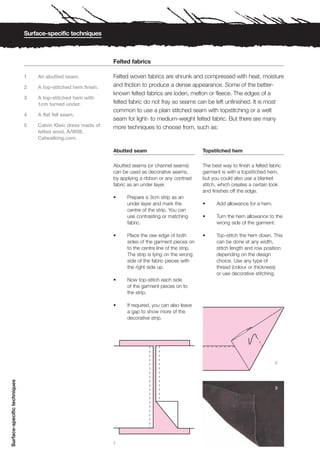
interlaces the idea of responsibilities    and controversial questions in ethics
to society with a wide range of            have been the moral ones. With
considerations relevant to the character   growing populations and improvements
and happiness of the individual. It        in mobility and communications,
concerns virtues of compassion, loyalty    it is not surprising that considerations
and strength, but also of confidence,       about how to structure our lives
imagination, humour and optimism.          together on the planet should come
As introduced in ancient Greek             to the forefront. For visual artists
philosophy, the fundamental ethical        and communicators it should be no
question is what should I do? How          surprise that these considerations will
we might pursue a ‘good’ life not          enter into the creative process.
only raises moral concerns about
                                           Some ethical considerations are
the effects of our actions on others,
                                           already enshrined in government laws
but also personal concerns about
                                           and regulations or in professional codes
our own integrity.
                                           of conduct. For example, plagiarism
                                           and breaches of confidentiality can
                                           be punishable offences. Legislation in
                                           various nations makes it unlawful to
                                           exclude people with disabilities from
                                           accessing information or spaces. The
                                           trade of ivory as a material has been
                                           banned in many countries. In these
                                           cases, a clear line has been drawn
                                           under what is unacceptable.
But most ethical matters remain           Is promoting ethical consequences
open to debate, among experts and         justified even when it requires ethical
lay-people alike, and in the end we       sacrifices along the way? Must there
have to make our own choices on           be a single unifying theory of ethics
the basis of our own guiding principles   (such as the Utilitarian thesis that
or values. Is it more ethical to work     the right course of action is always
for a charity than for a commercial       the one that leads to the greatest
company? Is it unethical to create        happiness of the greatest number),
something that others find ugly or         or might there always be many different
offensive?                                ethical values that pull a person in
                                          various directions?
Specific questions such as these
may lead to other questions that are      As we enter into ethical debate
more abstract. For example, is it only    and engage with these dilemmas on
effects on humans (and what they          a personal and professional level,
care about) that are important, or        we may change our views or change
might effects on the natural world        our view of others. The real test though
require attention too?                    is whether, as we reflect on these
                                          matters, we change the way we act as
                                          well as the way we think. Socrates, the
                                          ‘father’ of philosophy, proposed that
                                          people will naturally do ‘good’ if they
                                          know what is right. But this point might
                                          only lead us to yet another question:
                                          how do we know what is right?


                                                                                     Developing a Collection
A framework for ethics


You                                        Your client
What are your ethical beliefs?             What are your terms?
Central to everything you do will be       Working relationships are central
your attitude to people and issues         to whether ethics can be embedded
around you. For some people their          into a project and your conduct on
ethics are an active part of the           a day-to-day basis is a demonstration
decisions they make everyday as a          of your professional ethics. The
consumer, a voter or a working             decision with the biggest impact is
professional. Others may think about       whom you choose to work with in
ethics very little and yet this does not   the first place. Cigarette companies or
automatically make them unethical.         arms traders are often-cited examples
Personal beliefs, lifestyle, politics,     when talking about where a line might
nationality, religion, gender, class       be drawn, but rarely are real situations
or education can all influence your         so extreme. At what point might you
ethical viewpoint.                         turn down a project on ethical grounds
                                           and how much does the reality of
Using the scale, where would you
                                           having to earn a living effect your
place yourself? What do you take
                                           ability to choose?
into account to make your decision?
Compare results with your friends          Using the scale, where would you
or colleagues.                             place a project? How does this
                                           compare to your personal ethical
                                           level?


01 02 03 04 05 06 07 08 09 10              01 02 03 04 05 06 07 08 09 10
Your specifications                        Your creation
What are the impacts of your              What is the purpose of your work?
materials?
                                          Between you, your colleagues and
In relatively recent times we are         an agreed brief, what will your creation
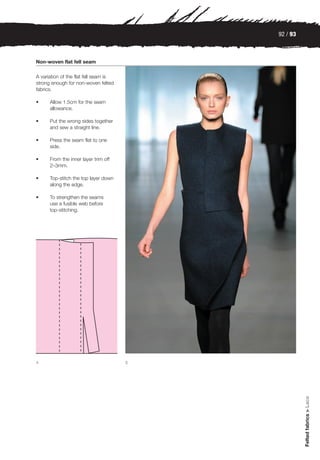
learning that many natural materials      achieve? What purpose will it have in
are in short supply. At the same          society and will it make a positive
time we are increasingly aware that       contribution? Should your work result
some man-made materials can have          in more than commercial success or
harmful, long-term effects on people      industry awards? Might your creation
or the planet. How much do you know       help save lives, educate, protect
about the materials that you use?         or inspire? Form and function are
Do you know where they come from,         two established aspects of judging
how far they travel and under what        a creation, but there is little consensus
conditions they are obtained? When        on the obligations of visual artists
your creation is no longer needed,        and communicators toward society,
will it be easy and safe to recycle?      or the role they might have in solving
Will it disappear without a trace? Are    social or environmental problems.
these considerations the responsibility   If you want recognition for being the
of you or are they out of your hands?     creator, how responsible are you for
                                          what you create and where might that
Using the scale, mark how ethical your
                                          responsibility end?
material choices are.
                                          Using the scale, mark how ethical
                                          the purpose of your work is.


                                                                                      Developing a Collection


01 02 03 04 05 06 07 08 09 10             01 02 03 04 05 06 07 08 09 10
Case study           Feather Capes


One aspect of fashion design that          Traditional Hawaiian feather capes
raises an ethical dilemma is the way       (called `Ahu’ula) were made from
that clothes production has changed        thousands of tiny bird feathers and
in terms of the speed of delivery of       were an essential part of aristocratic
products and the now international         regalia worn by men. Initially they were
chain of suppliers. 'Fast fashion' gives   red (`Ahu’ula literally means ‘red garment’)
shoppers the latest styles sometimes       but yellow feathers, being especially
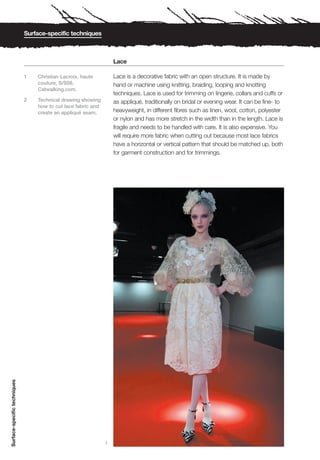
just weeks after they first appeared on     rare, became more highly prized and
the catwalk, at prices that mean they      were introduced to the patterning.
can wear an outfit once or twice and
                                           The significance of the patterns,
then replace it. Due to lower labour
                                           as well as their exact age or place
costs in poorer countries, the vast
                                           of manufacture is largely unknown,
majority of Western clothes are
                                           despite great interest in their
made in Asia, Africa, South America
                                           provenance in more recent times.
or Eastern Europe in potentially hostile
                                           Hawaii was visited in 1778 by English
and sometimes inhumane working
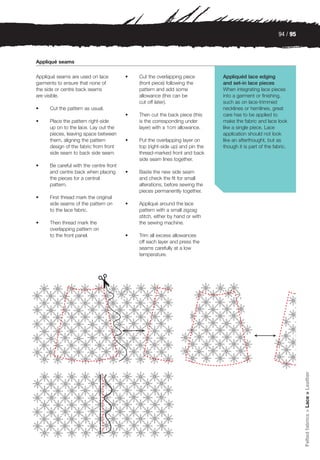
                                           explorer Captain James Cook and
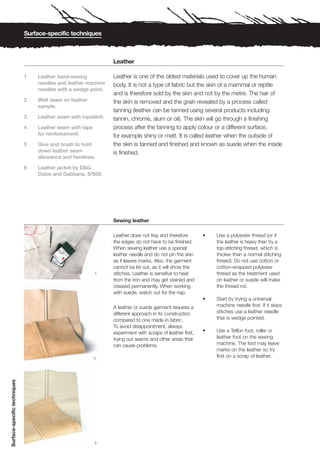
conditions. It can be common for one
                                           feather capes were amongst the
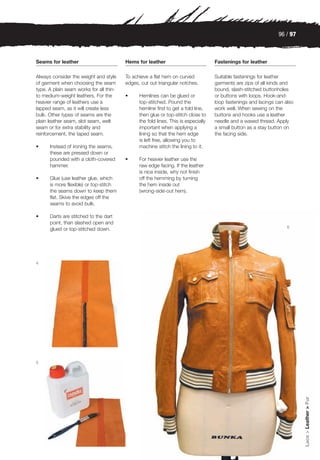
piece of clothing to be made up of
                                           objects taken back to Britain.
components from five or more
countries, often thousands of miles        The basic patterns are thought to
away, before they end up in the high       reflect gods or ancestral spirits, family
street store. How much responsibility      connections and an individual’s rank or
should a fashion designer have in this     position in society. No two `Ahu’ula are
situation if manufacture is controlled     alike (except for late nineteenth-century
by retailers and demand is driven by       replicas). Most capes were designed for
consumers? Even if designers wish to       specific individuals and it is said that no
minimise the social impact of fashion,     evil thoughts should cross the person's
what might they most usefully do?          mind when making the capes; instead
                                           their focus should be on the future love,
                                           long life, good health, honour and success
                                           of the wearer that the cape is for.

                                           The base layer for these garments is a
                                           fibre net, with the surface made up of
                                           bundles of feathers tied to the net in
                                           overlapping rows. Red feathers came
                                           from the 'i'iwi or the 'apapane. Yellow
                                           feathers came from a black bird with
                                           yellow tufts under each wing called
                                           'oo'oo, or a mamo with yellow
                                           feathers above and below the tail.
Thousands of feathers were used             Is it more ethical to create
to make a single cape for a high chief      clothing for the masses rather
(the feather cape of King Kamehameha        than for a few high-ranking
the Great is said to have been made         individuals?
from the feathers of around 80,000
                                            Is it unethical to kill animals
birds). Only the highest ranking chiefs
                                            to make garments?
had the resources to acquire enough
feathers for a full length cape, whereas    Would you design and make
most chiefs wore shorter ones which         a feather cape?
came to the elbow.

The demand for specific feathers
was so great that they acquired
commercial value and provided a
full time job for professional feather-
hunters. These fowlers studied the
birds and caught them with nets or          “Fashion is a form of ugliness
with bird-lime smeared on branches.         so intolerable that we have to
As both the 'i'iwi and apapane were         alter it every six months.”
covered with red feathers, the birds        Oscar Wilde
were killed and skinned. Other birds
were captured at the beginning of the
moulting season, when the yellow
display feathers were loose and easily
removed without damaging the birds.

The royal family of Hawaii eventually
abandoned the feather cape as the
regalia of rank in favour of military and
naval uniforms decorated with braid
and gold. Feather capes were given
away or sold for other items. The 'oo'oo
and the mamo became extinct through
the destruction of their forest feeding-
grounds and imported bird-diseases.
Silver and gold displaced red and
yellow feathers as traded currency
                                                                              Developing a Collection


and the manufacture of feather capes
became a largely forgotten art.
Further reading


AIGA
Design business and ethics
2007, AIGA
Eaton, Marcia Muelder
Aesthetics and the good life
1989, Associated University Press
Ellison, David
Ethics and aesthetics in European modernist literature
2001, Cambridge University Press
Fenner, David EW (Ed.)
Ethics and the arts: an anthology
1995, Garland Reference Library of Social Science
Gini, Al (Ed.)
Case studies in business ethics
2005, Prentice Hall
 McDonough, William and Braungart, Michael
‘Cradle to Cradle: Remaking the Way We Make Things’
 2002
 Papanek, Victor
‘Design for the Real World: Making to Measure’
 1971
United Nations
Global Compact the Ten Principles
www.unglobalcompact.org/AboutTheGC/TheTenPrinciples/index.html

Basics fashion design construction (2009)bbs

  • 2.
    BASICS Anette Fischer FASHION DESIGN 03 CONSTRUCTION
  • 3.
    An AVA Book Publishedby AVA Publishing SA Rue des Fontenailles 16 Case Postale 1000 Lausanne 6 Switzerland Tel: +41 786 005 109 Email: enquiries@avabooks.ch Distributed by Thames & Hudson (ex-North America) 181a High Holborn London WC1V 7QX United Kingdom Tel: +44 20 7845 5000 Fax: +44 20 7845 5055 Email: sales@thameshudson.co.uk www.thamesandhudson.com Distributed in the USA & Canada by: Ingram Publisher Services Inc. 1 Ingram Blvd. La Vergne, TN 37086 USA Tel: +1 866 400 5351 Fax: +1 800 838 1149 Email: customer.service@ingrampublisherservices.com English Language Support Office AVA Publishing (UK) Ltd. Tel: +44 1903 204 455 Email: enquiries@avabooks.ch Copyright © AVA Publishing SA 2009 All rights reserved. No part of this publication may be reproduced, stored in a retrieval system or transmitted in any form or by any means, electronic, mechanical, photocopying, recording or otherwise, without permission of the copyright holder. ISBN 978-2-940373-75-8 10 9 8 7 6 5 4 3 2 Design by Sifer Design Production by AVA Book Production Pte. Ltd., Singapore Tel: +65 6334 8173 Fax: +65 6259 9830 Email: production@avabooks.com.sg All reasonable attempts have been made to trace, clear and credit the copyright holders of the images reproduced in this book. However, if any credits have been inadvertently omitted, the publisher will endeavour to incorporate amendments in future editions.
  • 4.
    2/3 1 Alexander McQueen, S/S09. Catwalking.com.
  • 5.
    Contents Introduction 6 How to get the most out of this book 8 Getting started 10 Pattern cutting tools and equipment 12 Silhouettes 14 Sizing and grading 16 Blocks and patterns 20 Pattern cutting 24 How to read a design drawing 26 Dart manipulation 30 Slash and spread 32 Sleeves 34 Collars 44 Pockets 54 Bias cut 56 Fitting the toile 58 Laying a pattern on to fabric 64 Garment construction 70 Tools for the technique 72 Seams 78 Seam finishes 82 Hand sewing techniques 84 Surface-specific techniques 90 Felted fabrics 92 Lace 94 Leather 96 Fur 98 Knits and stretch-woven fabrics 100 Sequinned and beaded fabrics 102 Velvet 104 Transparent fabrics 106 Construction
  • 6.
    4/5 Haute couture andtailoring 108 Haute couture 110 Designing haute couture 112 Tailoring 114 Tailoring techniques 116 Draping on the mannequin 120 Modelling tools and equipment 122 Grain line and draping 124 Draping style 126 Geometric shapes 130 Inspired designers 132 Support and structure 136 History of supported and structured garments 138 Supporting materials 140 Interlining/fusing 148 Corsetry 152 Creating volume 156 Finishes 164 Linings 166 Facings 168 Fastenings 169 Haberdashery 172 Conclusion 176 Glossary 178 Bibliography 182 Useful resources 184 Canon 190 Acknowledgements and picture credits 192
  • 8.
    Introduction 6/7 1 Sleeveless dress designed ‘Do not quench your inspiration and your imagination; by David Bradley. do not become the slave of your model.’ Vincent Van Gogh Construction is the foundation of clothing and of fashion design; it is vital that fashion designers know and understand the techniques involved in creating a three-dimensional garment from a two-dimensional design or pattern in order to create a beautiful shape and fit on a moving body. Garment construction involves both technical and design issues; the designer can choose where to construct lines, pockets, collars, how to finish edges and how to produce volume and structure in order to create a unique look and experience for the wearer. From basic block cutting to the smallest finishing details on a constructed garment, Basics Fashion Design: Construction leads you through the essential stages of garment construction and offers you a starting point from which knowledge can be extended. It introduces you to the world of pattern cutting, draping on the mannequin and shows you some techniques for breathing life into a flat design drawing in order to achieve a three-dimensional garment. Basic sewing techniques are introduced and you are shown how to use darts, sleeves, collars, pockets and the cut of the fabric to add variation to your designs. The breadth of the subject is illustrated with a history of garment construction, techniques used in the haute couture and tailoring crafts and an introduction to supporting and structuring materials. The book concludes with finishing techniques and a selection of resources for those wishing to delve deeper into the world of construction for fashion. With its inspirational photography and easy-to-follow diagrams, Construction offers a clear introduction to the fundamental skills, knowledge and historical background needed for successful garment construction. I hope it will awaken your interest and inspire you to create the perfect silhouette and a beautiful, final piece. Introduction 1
  • 9.
    How to getthe most out of this book This book introduces different aspects of garment construction via dedicated chapters for each topic. Each chapter provides numerous examples of work by leading designers, annotated to explain the reasons behind the choices made. Key construction and design principles are isolated so that the reader can see how they are applied in practice. Clear navigation Each chapter has a clear heading to allow readers to quickly locate areas of interest. Surface-specific techniques 94 / 95 Lace Appliqué seams 1 Christian Lacroix, haute Lace is a decorative fabric with an open structure. It is made by Appliqué seams are used on lace • Cut the overlapping piece Appliquéd lace edging couture, S/S08. hand or machine using knitting, braiding, looping and knotting garments to ensure that none of (front piece) following the and set-in lace pieces Catwalking.com the side or centre back seams pattern and add some When integrating lace pieces techniques. Lace is used for trimming on lingerie, collars and cuffs or are visible. allowance (this can be into a garment or finishing, 2 Technical drawing showing as appliqué, traditionally on bridal or evening wear. It can be fine- to cut off later). such as on lace-trimmed how to cut lace fabric and heavyweight, in different fibres such as linen, wool, cotton, polyester • Cut the pattern as usual. necklines or hemlines, great create an appliqué seam. • Then cut the back piece (this care has to be applied to or nylon and has more stretch in the width than in the length. Lace is • Place the pattern right-side is the corresponding under make the fabric and lace look fragile and needs to be handled with care. It is also expensive. You up on to the lace. Lay out the layer) with a 1cm allowance. like a single piece. Lace will require more fabric when cutting out because most lace fabrics pieces, leaving space between application should not look them, aligning the pattern • Put the overlapping layer on like an afterthought, but as have a horizontal or vertical pattern that should be matched up, both design of the fabric from front top (right-side up) and pin the though it is part of the fabric. for garment construction and for trimmings. side seam to back side seam. thread-marked front and back side seam lines together. • Be careful with the centre front and centre back when placing • Baste the new side seam the pieces for a central and check the fit for small pattern. alterations, before sewing the pieces permanently together. • First thread mark the original side seams of the pattern on • Appliqué around the lace to the lace fabric. pattern with a small zigzag stitch, either by hand or with • Then thread mark the the sewing machine. overlapping pattern on to the front panel. • Trim all excess allowances off each layer and press the seams carefully at a low temperature. Felted fabrics > Lace > Leather Surface-specific techniques 1 Introductions Additional information Special section introductions Box-outs elaborate on outline basic concepts that subjects discussed in will be discussed. the main text.
  • 10.
    8/9 Captions Headings Examples These provide image These enable the reader to Imagery accompanying details and commentary break down text and refer the rich content, visually to guide the reader in the quickly to topics of interest. describes elements exploration of the visuals such as seams, fabric, displayed. equipment etc. Haute couture and tailoring 116 / 117 Tailoring techniques The hand stitches 1 An inside-out tailored jacket A lot of components play a significant role in creating an excellently The following stitches are commonly Fell stitching holds the stay tape showing the under structure. fitted tailored garment, from the right choice of fabric and the shape used in tailoring: (a narrow fabric tape) in place. 2 Woollen fabric and lining and design of the garments, to the skilled measuring of the body Basting stitch attaches two or more Cross-stitch invisibly secures sample booklet, published and the specific techniques employed. pieces of fabric temporarily. It is also interfacing edges to the garment. by 2000 Tailoring Ltd. used to make construction and London. placement lines. Hemstitching invisibly attaches the This section will introduce you to some of the materials and hem allowance to the garment. 3 Tailored jacket with basting stitching in working techniques used by tailors for constructing jackets. Pad stitching is used to attach the progress. sew-in interfacing and to shape the Tailor’s tacks are used to mark garment at the same time. fabrics, for example on the folding line of the lapel rolling line or Slip-stitch attaches the lining edge to pocket placement. the hem invisibly as well as the edges of pockets to the garment. 1 2 Trimming, notching and grading All edges in a tailored garment Grading. Trim the seam allowance should be flat and sharp without back in a staggered fashion whereby noticeable bulk. Seam edges, collar the widest seam allowance is layered tips and pocket flaps should roll towards the garment’s right side. slightly to the inside, towards the This is done to cushion the remaining body. To avoid bulky seams use seams, so they do not show through the following methods: to the right side. Trimming. Trim sewn-in interfacings close to the seam lines. The seam allowance of the collar, lapel and bagged-out pocket points can also be trimmed. Notching. Notch the seam allowance 3 by taking out wedges at the outside curves. On a deep curve bring notches closer together than on a shallow one. Always notch close to the stitching line! The understructure The fabrics This is made from different kinds of Woollen fabric used for tailored suits Tweed The pressing techniques canvas and interfacing, soft cotton can fall into two categories: worsteds A woollen fabric named after flannel, cotton twill tape, strips of and woollens. Worsted fabric is the river Tweed, which flows cotton or lambswool, Melton for the woven from long, finely combed through the Scottish Borders Darts and seams create shape in a To avoid over pressing, which causes that way. A tailor would reshape the Tailoring > Tailoring techniques collar stand, pocketing fabric and wool. It is a firm fabric with a flat textile areas. Harris Tweed piece of fabric. It is best, therefore, the imprint of seams, edges and two-piece sleeve to accentuate the Haute couture and tailoring strong, lightweight lining. surface, ideal for traditional tailored is one variation, made from to use a tailor’s ham or a rounded darts to appear on the outside, use forward bend in the elbow area. business suits. Woollen fabrics are pure virgin wool that is dyed pressing board to maintain the paper strips or pieces of the same The trouser leg would be reshaped woven from shorter, uncombed wool and spun in Harris (in the shape. Press the vertical darts kind of fabric to underlay the seam before a seam allowance is attached. How to get the most out of this book fibres. These fibres are loosely Outer Hebrides) and hand towards centre front or centre back. allowance and edges. For example, the back panel on the twisted and woven much less tightly woven by the islanders in If using a thick fabric, cut open the inside leg is stretched at the top than the worsteds. The effect is a their homes. dart and press flat. To get a nice, flat Moulding is the stretching and to fit on to the front panel, thus soft, easy fabric, such as a Harris point at the dart end use a needle shrinking of fabric to fit the body achieving a closer fit to the bottom Tweed. Other fabrics can also be and insert right to the point. Press shape. The best fabric to use is and crotch area. used, such as silk and linen. with the needle in place and wool, which takes on the new shape remove it afterwards. and holds it as if it had always been Chapter titles Running footers These run along the bottom of Clear navigation allows the every page to provide clear reader to know where they navigation and allow the reader are, where they have come to understand the context of the from and where they information on the page. are going in the book.
  • 12.
    Getting started 10 / 11 1 Jean Paul Gaultier, A/W07. ‘Fashion is architecture. It is a matter of proportions.’ Catwalking.com. Coco Chanel It is important for designers to understand as early as possible how a garment grows from a two-dimensional concept into a three-dimensional object. A pattern is a flat paper or card template, from which the parts of the garment are transferred to fabric, before being cut out and assembled. A good understanding of body shape and how body measurements transfer to the pattern piece is essential. The pattern cutter must work accurately in order to ensure that, once constructed, the parts of fabric fit together properly and precisely. This chapter is an introduction to pattern cutting, starting with the tools and equipment needed. Then it takes a look at the processes involved: the importance of silhouettes and proportion; sizing and grading and how to take body measurements. Finally it introduces the basic block and pattern shapes and how the body measurements relate to these. Getting started > Pattern cutting 1
  • 13.
    Getting started Pattern cutting tools and equipment Working with the right tools will make block and pattern construction easier. These are just some of the key pieces of equipment required. 2 Tailor’s chalk (1) Using tailor’s chalk is one way of marking lines or transferring a pattern on to cloth. Set of three French curves (2) These are used for drawing narrower curves, such as those found on collars and pockets. 43cm set square (3) This is a right-angled triangular plate used for drawing lines, particularly at 90 degrees and 45 degrees. 3 Wooden awl (4) This is used for marking any points within the pattern piece by punching through the pattern to leave a small mark on the fabric. 1 Pins (5) 4 These are used to temporarily fix pieces of paper or cloth together. Tape measure (6) An indispensable item, this is used for taking measurements of the body and its flexibility allows curved lines to be measured too. Pattern drill (7) This is used for marking things such as darts, pockets and any other marking points within the pattern piece. The pattern drill will 5 punch a hole of 2–4mm into the pattern. The position of the punch hole can then be marked with chalk or thread on to the fabric. Getting started 6
  • 14.
    12 / 13 9 Pattern notcher (8) This is used for marking the edge of the pattern pieces by taking out a small square for each balance point. This should only be used on pattern paper – thin sheets of plastic or card 7 – not on fabric. Paper scissors (9) These are – as their name suggests 10 – only used for paper, in order to keep the blades sharp. Pattern cutting tools and equipment > Silhouettes Tracing wheel (10) 8 This is used to trace a line from one piece of paper or pattern on to another directly underneath it. Pattern master (11) This is used to create lines and 11 curves and to check angles. Aluminium metre ruler (not shown) This is essential for drawing and connecting longer, straight lines.
  • 15.
    Getting started Silhouettes First impressions of an outfit are created by its silhouette – the overall shape created by a garment. This is before qualities conveyed by the detail, fabric or texture of the garment can even be acknowledged, so the shape and form that a garment takes is a fundamental consideration in the design and construction processes. The importance of silhouette Silhouette is fundamental to the preliminary stages of the design process in order to determine which parts of the body will be emphasised and why. Once these decisions are made, it is up to the pattern cutter and designer to start contemplating how the design can be physically constructed and, if necessary, supported and structured using underpinnings and foundations. Many materials and techniques can be used to shape a silhouette (see chapter seven: Support and structure). For example, using shoulder pads to widen the shoulder can create an illusion of a small waist and narrow hips. Getting started 1
  • 16.
    14 / 15 Proportionsand bodylines Proportion refers to the comparative Proportions can be changed fairly 1 Sculptured ceramic relations and dimensions of the various easily using various construction mannequin by Helen Manley. parts of a whole outfit. A combination methods. For example, moving a 2 The changing shape and of garments can look messy or can hemline, waistline, pocket, seam or proportions of fashion in work in harmony. For example, the dart position can dramatically alter the Western world over the ways in which a jacket, a skirt and the balance of width and length on course of history. a pair of boots relate to one another an individual body shape. Choice of will add to the sense of proportion fabric texture and colour can also and balance conveyed by the outfit add to the overall effect conveyed as a whole. by the cut and shape of a garment. 2 1800 1830 1895 1900 Pattern cutting tools and equipment > Silhouettes > Sizing and grading 1911 1912 1920 The change of silhouette over time Throughout history fashion has always reflected the wealth of the nation and status of individuals. See pages 138–139 for a more detailed look at the history of supported and structured garments. New Look, 1947
  • 17.
    Getting started Sizing and grading Designs for a garment can be cut and made to fit an individual customer or they can be graded and altered to fit wearers of differing sizes. Either way, a full and detailed knowledge of sizing and grading is essential for any designer hoping to create a beautifully fitting garment. Being able to translate body proportions to paper and back to a three-dimensional garment takes much practice and careful attention to detail is fundamental. 1 Sizing 1 A flexible tape measure is Womenswear sizing is based on Menswear sizing is universally made essential for the sizing and measurements of height, bust, waist up of a chest measurement for a grading process. and hips. In the UK, sizing starts at jacket, and a waist and inside leg 2 Technical drawing of a size 6 and goes up to size 22 (the measurement for trousers. Shirt sizes graded pattern piece. best-selling sizes are 12, 14 and 16). are given by the neck measurement. European sizes start at size 34 (which is equivalent to size 6) and go In childrenswear the principal variable up to size 52. American equivalents is usually height so sizing is governed range from a size 2 to 18. However, mainly by age. as the fashion industry becomes increasingly sophisticated and Measurements for each size can be complex, it is becoming much taken from charts in pattern cutting easier to find other size ranges to books but, where possible, it is Getting started accompany these, such as Petite, always best to take real Tall or Half-Size. measurements from live models.
  • 18.
    16 / 17 Grading Gradingis the process of scaling a pattern to a different size by incrementing important points of the 2 pattern according to a set of given measurements, such as the British Standard sizing chart. Grading is a very specialised area in pattern cutting that not many professionals master. The secret is to know where the pattern needs changing to fit the decrease and increase in body size. Such increments can vary from 3 to 5cm (1.5–2in), depending on the garment range. Many manufacturers use the British Standard sizing chart, which was first established in the 1950s and has changed over the years to accommodate changes in lifestyle. The United States has its own sizing chart and many other nations have worked out standard sizing for their own needs. Factors such as culture and diet have great influence on a country’s average body shape. For example, northern European body shapes are generally tall and large whereas the average body shape in the Far East is shorter in height and slimmer in stature. For these reasons, a design house must always carefully consider the market it wants to sell to. When grading a pattern, make sure that all corresponding seams, notches and punch marks match before starting the grading process. Silhouettes > Sizing and grading > Blocks and patterns Grading can be done by hand with a metric grader’s set square, pattern master or an L-square ruler, as well as by computer using a specific program, such as Lectra or Asys.
  • 19.
    Getting started Taking measurements Neck girth (1) This is the measurement around the base of the neckline. Shoulder length (2) This is measured from the neckline to end of shoulder bone. 1 2 Top bust girth (3) This is measured around the body, 3 under the arm but above the bust in a horizontal line. 4 5 Bust girth (4) This is measured around the fullest 9 point of the bust in a horizontal line. 10 Under bust girth (5) 6 This is measured around the rib cage under the bust in a horizontal line. 7 Waist girth (6) This is the measurement around the narrowest part of the waist 8 (natural waistline) in a horizontal line. High hip girth (7) This is measured around the abdomen about 8–10cm below the waistline in a horizontal line. Hip girth (8) This is the measurement around the fullest part of the hip in a horizontal line. Arm length (9) This is measured from shoulder point, past the elbow, down to the wrist with the arm slightly bent. Front length (10) This is measured from the shoulder/neckline cross point, past the nipple and down to the natural waistline. Getting started
  • 20.
    18 / 19 Back length (11) This is measured from the nape of the neck to the natural waistline. Waist to hip (12) This is the distance between the natural waistline and the fullest point of the hipline. Waist to knee (13) 11 This is the distance between the natural waistline and the knee. 16 Outside leg (14) This is the distance from the natural waistline to the floor or outside ankle. 17 Inside leg (15) This is the distance from the inside 13 12 crotch to the floor or inside ankle. Bicep (16) This is the measurement around the top of the arm. 18 Elbow (17) This is measured around the width of the elbow. Wrist girth (18) This is measured around the width of the wrist. Silhouettes > Sizing and grading > Blocks and patterns When taking measurements, make sure that the tape is neither too loose nor too tight around the body. There are many more measurements that can be 14 15 taken. If you are constructing a shirt with a tight fitted sleeve, for example, the measurements of the bicep (16), elbow (17) and wrist (18) also need to be taken into consideration. This is to avoid the fit being too tight or too loose on the arms.
  • 21.
    Getting started Blocks and patterns Blocks and patterns enable the designer to render something flat (paper or fabric) into something three-dimensional. They are laid on to fabric, cut out and assembled together using seams. In order to create well-made garments, it is essential that the designer fully understands the techniques used in order to make pattern cutting as straightforward and accurate as possible. The block A block (also known as a sloper) is a two-dimensional template for a basic garment form (for example, a bodice shape or fitted skirt) that can be modified into a more elaborate design. Blocks are constructed using measurements taken from a size chart or a live model, and do not show any style lines or seam allowance. Blocks must, however, include basic amounts of allowance for ease and comfort; for instance, a tight-fitting bodice block would not have as much allowance added into the construction as a block for an outerwear garment might. A fitted bodice block would also have darts added into the draft to shape the garment to the waist and bust, whereas a block for a loose-fitting overcoat would not need these. Getting started 1
  • 22.
    20 / 21 Thepattern A pattern is developed from a design together accurately. The pieces need 1 A sample skirt block. sketch using a block. The designer to fit together precisely, otherwise or pattern cutter will add to the the garment will not look right when 2 The translation to pattern. block by introducing style lines, sewn together and it will not fit well drapes, pleats, pockets and other on the body. adjustments to create an original pattern. When the block modification is finished, seam allowance is added to The final pattern features a series of the pattern. To perfect a pattern, a different shaped pieces of paper that toile (a garment made out of a cheap are traced on to fabric and then cut fabric such as calico) is made and out, before being seamed together to fitted on to a live fitting model. create a three-dimensional garment. Adjustments can be made on the Each pattern piece contains toile before being transferred to the ‘notches’ or points that correspond pattern. This stage is examined in to a point on the adjoining pattern more detail on page 58. piece, enabling whoever is making the garment to join the seams 2 Sizing and grading > Blocks and patterns
  • 23.
    Getting started 1 Samples A sample is the first version of a garment made in real fabric. It is this garment that goes on the catwalk or into a press/showroom. Samples are produced for womenswear in sizes 8–10 to fit the models. Once the sale book is closed, the samples are stored in the company’s archive. Some samples of past collections are taken out by designers for photo shoots, events such as premieres and for reference or possible inspiration for future collections. How the measurements relate to the block Whether taking individual measurements Darts can be used to control excess 1 The block and its or using a size chart, the main fabric and to create shape on a corresponding measurements (bust girth, waist garment when stitched together. measurements. girth, waist-to-hip length and hip Curves are added to create shape girth) will give a good indication of depending on the nature and the body shape the design is purpose of the block. intended to fit. Secondary measurements may also be taken from an individual Getting started or from a size chart. This may be the length of skirt, for example, when drafting a skirt block.
  • 24.
    22 / 23 bust waist hip Sizing and grading > Blocks and patterns How to start a set of Who is my target group: The answers to these blocks women, children or men? questions will make it much A set of blocks can be cut easier to cut the right blocks for one individual in order to What will be the smallest and from which to create original create bespoke/couture the largest size in my size patterns for each collection. garments. Design houses will chart? often create their own set of blocks to complement their What is my sample size? special ethos and design philosophy. When starting a What is my collection range: set of blocks, it may help to lingerie, tailoring, streetwear? ask the following questions:
  • 26.
    Pattern cutting 24 / 25 1 Meadham & Kirchhoff ‘I use the same approach to clothes as I did when I A/W07. Catwalking.com. designed buildings. It is basic geometry: you take a flat form and revolve it in space.’ Gianfranco Ferre Like all craft skills, pattern cutting can at first seem difficult and intimidating. But with a basic understanding of the rules to be followed (and broken!) the aspiring designer will soon learn interesting, challenging and creative approaches to pattern cutting. To draw the right style line in the correct position on a garment takes experience and practice. Designers who have been cutting patterns for twenty years can still learn something new – the process of learning never stops. This makes creative pattern cutting a fascinating process. In this chapter we introduce the meaning of a drafted block and how to turn it into a pattern from a design drawing. We take a look at dart manipulation as well as pocket, collar and sleeve construction. You will be introduced to cutting techniques and bias-cut garments. You will also learn about the fitting process: how to fit the toile and alter the pattern accordingly. Finally we take a look at the different ways of laying and cutting patterns from fabric. Getting started > Pattern cutting > Garment construction 1
  • 27.
    Pattern cutting How to read a design drawing 1/2 Photograph and illustration This is the point at which pattern cutting becomes much more of design by Karin creative and exciting. Once the design has been completed, the Gardkvist. process of breathing life into a flat design drawing in order to 3 A basic bodice block. achieve an actual garment can begin. To be able to achieve a beautiful garment shape takes time and experience. Remember nothing ever happens without practising your skills – don’t be disheartened if it doesn’t work first time round. All outstanding fashion designers and creative pattern cutters have worked for years to perfect their skills. 1 Pattern cutting 2
  • 28.
    26 / 27 3 Translating drawing to block How to mark the block The translation of a design drawing It is essential when cutting a block or Once the pattern has been to pattern requires an eye trained for a pattern that the correct information constructed the seam allowance can proportions. Most design drawings is supplied. A bodice block, for be added. Seam allowance can vary are sketched on a figure with example, has to show the horizontal in size from a narrow 0.5cm for a distorted proportions. The legs and lines of the bust-, waist- and hiplines. neckline (to avoid having to clip or How to read a design drawing > Dart manipulation neck are too long and the figure too Parts of the block such as the waist trim the seam) to 2.5cm in the centre slender. These sketches are often and bust points should be notched back of trousers (to be able to let inspiring and wonderful to look at but or punch marked (holes and notches some out if the waist gets too tight). unfortunately give a false image of indicate where the separate pieces of Seams that are to be joined together the human body and it is a key task fabric will be attached to one should always be the same width. of the pattern cutter to address this. another) and the grain line must be Mark the width of the seam indicated. This will clearly show the allowance on the block. position in which the pattern should be placed on the fabric. Additional Usually, the block ends up being information must be written clearly divided into further pattern pieces. in the centre of the block, including At this point, therefore, the information whether it is a front or back piece, a should be reconsidered accordingly, tight- or loose-fitted bodice block except the grain line and front or and the sample size, preferably with back information, which are always the measurements and any transferred to the new pieces. allowances to be made when constructing the block.
  • 29.
    Pattern cutting Marking symbols on a pattern 1 2 3 Pattern cutting 4
  • 30.
    28 / 29 1 Number sections before 5 cutting a pattern apart to avoid confusion. 2 Position marks, such as for pockets, are hole punched into the pattern. 3 Marking the direction of pleating helps to avoid confusion. 4 Cutting lines are best marked with the symbol of a pair of scissors. 5 If the piece is to be cut on the fabric fold (so it does not have a seam), indicate this with the message ‘cut on fold’. 6 Cut 1 x self (or cut 1 x) = cut the one piece only Cut 1 pair x self (or cut 2 x) = cut two pieces C.F. = centre front C.B. = centre back. 6 How to read a design drawing > Dart manipulation
  • 31.
    Pattern cutting Dart manipulation 1 An asymmetrical design with Darts control excess fabric to create shape on a garment. They can intersecting darts. be stitched together end to end or to a zero point also known as the 2 Gianni Versace, A/W07. pivotal point (such as the bust point). Dart manipulation is the most Catwalking.com. creative and flexible part of pattern cutting. The possibilities are endless and the designer’s imagination is the only limitation. Darts can be turned into pleats, gathers or style lines. Their positioning on the body is very important; not only do these techniques create fit, shape and volume, they also change the style and design of the garment. Example of dart manipulation on a bodice block Design analysis: asymmetrical 1. Trace bodice block on fold. 3. Cut along the slash lines, up design with intersecting darts When copying the left side of to the bust point (pivotal point), coming from the waist and the front block, transfer the Close up the darts and tape ending at the bust point. complete waist and bust dart them down. into the armhole. Then copy the right side of the front block on to the left front block (centre front attached to centre front) and transfer the complete waist and bust dart into the armhole. 4. Add seam allowances and mark the dart ends with a hole punch as well as notching the position of the left dart, centre front and seam allowances. 2. Draw in the slashing lines Mark the gain line (in this according to your design. case the centre front) and add information such as ‘front, right-side-up, cut 1 x’. 5. If required, the armholes and neckline can be altered for more comfort. A back pattern can be cut to fit the front design. 6. The pattern is now ready to be cut out of calico and made into a toile for a fitting. 1
  • 32.
  • 33.
    Pattern cutting Slash and spread 1 Skirt constructed by This method is used to add extra volume and flare. The technique slash and spread involves creating slash lines that reach from one end of the pattern method to gain flare. to the other, sometimes ending on a pivotal point like a dart ending. 2/3 Asymmetric skirt that These slash lines will then be opened up for added volume and flare. has been opened up on one side only. Using slash and spread techniques Slash and spread techniques can be used to convert a straight skirt pattern into a skirt with flare. The most basic way of doing this is to divide the pattern up into equal pieces from hem to waist and open them up by equal amounts all the way round. Redraw the hemline in a smooth curve. To create asymmetric flare, as shown in 2 and 3, the pattern is divided into two and slash lines are marked on to one of these halves. These are cut along from hem to waist and opened up (spread) with equal amounts added into each ‘slash’. This creates flare on one side of the skirt. Pleats have also been added to the waistline. Drawing in an angular hemline creates the asymmetric point. Tip When using the slash and spread method remember that the position you slash in is the exact position the fabric will flare out. So when slashing into one side only, the flare will not spread across but only appear Pattern cutting on one side. 1
  • 34.
    2 3 32 / 33 Dart manipulation > Slash and spread > Sleeves
  • 35.
    Pattern cutting Sleeves 1 Christian Dior, haute Sleeve construction is a very special part of pattern cutting. couture, S/S07. Sleeves can be part of the bodice (laid-on sleeve) or set into an Catwalking.com. armhole (set-in sleeve). Without any other design features added, 2 A sleeve block for a set-in a garment can look outstanding by simply creating an interesting sleeve, showing the part where the sleeve can be sleeve design. The most basic sleeve block is the one-piece (set-in) eased into the armhole. sleeve, which can be varied as shown in 3a–f (facing page). Different 3 Variations on the one-piece sleeve blocks can be developed from the one-piece block, such as set-in sleeve: the two-piece sleeve and laid-on sleeves, including raglan, a Peak sleeve. kimono/batwing and dolman designs. b Cap sleeve. c Leg o’ mutton sleeve. d Juliet sleeve. 1 e Trumpet sleeve. f Bishop sleeve. Pattern cutting
  • 36.
    34 / 35 2 3a 3b 3c 3d Constructing sleeves When constructing a set-in sleeve, the measurement of the armhole is essential. Therefore, the bodice front and back are constructed first and once the measurement of the armhole is established, ease is added according to the type of block (jacket block, fitted bodice block and so on). Ease is added to a pattern to allow for extra comfort or movement. As well as allowing the sleeve to sit comfortably in the armhole, ease will also affect the fit and silhouette of a garment. Ease is distributed between 3e 3f the front notch and the double back notch of the sleeve (see technical drawing above). In some set-in sleeve designs, the ease is taken Slash and spread > Sleeves > Collars across the shoulder to achieve a round appearance over the shoulder point. A sleeve is sitting comfortably in the armhole when it aligns exactly with, or is set slightly in front of, the side seam of the bodice.
  • 37.
    Pattern cutting One-piece and two-piece sleeves Laid-on sleeve There are differences between the arm side seam position (still not The laid-on sleeve is part of the one-piece and two-piece sleeves, visible from the front). The look of a bodice. Once constructed, either a the major one being the amount of two-piece sleeve is more shapely part of the armhole remains or there seams that are used. A one-piece and it has a slight bend to the front. is no armhole at all. sleeve has only one seam placed As such, it is possible to get a closer under the arm at the side seam fit with a two-piece sleeve because A laid-on sleeve is most commonly position. Therefore, the seam cannot of its extra seam. One-piece sleeves constructed by separating be seen when the arm is relaxed. are used for a more casual look, the one-piece sleeve through the The two-piece sleeve has two whereas two-piece sleeves are shoulder notch straight down to the seams; one is placed at the back, mostly seen on garments such as wristline to gain a front piece and a running from the position of the back tailored jackets or coats. back piece (see technical drawing double notch down to the wrist, past below). The next step is to align the the elbow. The second seam is front piece of the sleeve with the moved a little to the front, from under bodice’s front shoulder and the back sleeve with the bodice’s back shoulder. From this point onwards several styles can be developed, such as batwing or kimono, raglan, gusset and dolman sleeves. The sleeve can be laid on at variant angles – the greater the angle, the more excess fabric and therefore a greater range of arm movement. 1 2 3 Pattern cutting
  • 38.
    36 / 37 Gussetsleeves To extend the lift (a technical term 4 for moveability of the arm) in a sleeve a gusset can be added. A gusset is traditionally a diamond-shaped piece, which is inserted into a slit in the underarm section of the sleeve. 5 Slash and spread > Sleeves > Collars 1 Basic one-piece sleeve. 2 Basic two-piece sleeve. 3 Basic split sleeve. 4 Gusset sleeve construction. 5 Christian Lacroix, A/W07. Catwalking.com.
  • 39.
    Pattern cutting Kimono sleeves Like a Japanese sleeve, the kimono sleeve is cut in one with the bodice. The seams can run from the outer- or underarm. 1 Alexander McQueen, S/S08. Catwalking.com. 2/3/4 Preparation for a kimono sleeve construction. Pattern cutting 1
  • 40.
    4 3 2 38 / 39 Slash and spread > Sleeves > Collars
  • 41.
    Pattern cutting Raglan sleeves The raglan sleeve has a dropped Lord Raglan shoulder design. It is constructed Lord Raglan was a to have a seam running from the commander of the British 1 neckline on a slant into the troops during the Crimean underarm on front and back. War. His right arm was injured at the Battle of Waterloo and had to be amputated. As a result he got himself a coat designed with a special sleeve – the raglan sleeve. 2 1 Trench coat with raglan sleeve. 2 Raglan sleeve construction. Pattern cutting 3 Example of a dolman sleeve. 4/5/6 Dolman sleeve construction.
  • 42.
    40 / 41 Dolman sleeves Originally named after the 1870s coat/wrap that looks like a cape from the back with lowered armholes and set-in sleeves in the front. The dolman sleeve today has lots of fabric under the arms and can be fitted to the wrist, still looking like a cape from the back. The sleeve construction is illustrated in 4–6. The original back bodice construction (4) shows the laid-on sleeve. The final pattern pieces show the front bodice that has been extended underarm (5) and the back bodice with the laid-on sleeve (6). 4 3 Slash and spread > Sleeves > Collars 6 5
  • 43.
    Pattern cutting Pleated, darted and gathered sleeves The one-piece sleeve block can be adapted in countless ways. These patterns illustrate how the sleeve block can be altered to create puffed, pleated and darted sleeves. 1 2 3 Pattern cutting
  • 44.
    42 / 43 1 Pattern construction of a darted sleeve head. 2 Pattern for a puff sleeve construction with gathers on the sleeve head and small cuff. 4 3 Jacket with a darted set-in sleeve by Hugo Boss, S/S 08. 4 Preparations for a pleated sleeve head construction. 5 Pattern construction of a pleated sleeve head. Slash and spread > Sleeves > Collars 5
  • 45.
    Pattern cutting Collars The collar is a versatile design feature that will enhance the style of a garment. It is attached to the neckline of the garment and allows the size and shape of the neckline to vary. Collars come in all shapes and sizes and the most common are the stand-up/mandarin, shirt, flat, sailor and lapel collar constructions. 1 Drafting variations 1 Technical drawing showing Collars can be constructed in three Finally, the lapel construction, which the key elements of a basic basic ways. The first method is a is extended from the centre front, collar construction. right-angle construction, used for from the breaking point toward the stand-up collars, shirt collars and shoulder. By extending the break/roll 2 A right-angle collar. small flat collars such as Peter Pan line a collar construction can be 3 Flat collar on a pea coat. and Eton collars. added. A version of this is the shawl collar, where the collar extends from Secondly by joining the shoulders of the fabric of the garment on to the the front and back bodice together lapel without being sewn on. to construct the collar directly on top of the bodice block. This technique is used to construct sailor collars and bigger versions of flat collars. The advantage of using this method Pattern cutting is that the correct outer length of the collar construction results automatically, however large the collar or neckline extension is.
  • 46.
    44 / 45 Basiccollar measurements The measurement of the neckline on the pattern has to be taken in order to construct a collar. Therefore, if the neckline is to be changed according to the design, do this before cutting the collar pattern. 2 3 Sleeves > Collars > Pockets
  • 47.
    Pattern cutting Right-angle construction collars Right-angle collars are constructed by drawing the centre back line and the neckline at a right-angle to each other and adding all measurements. Variations of this basic construction include mandarin or stand-up collars and shirt collars, which can have either integrated or separate stands. 1 Stand-up/mandarin collars If the centre front of the collar is constructed higher than the neckline and the centre back point, the collar will sit close to the neck. If the centre back of the collar is constructed higher than the neckline and the centre front point, the collar will sit away from the neck. Pattern cutting 2
  • 48.
    46 / 47 Flat collars A flat collar, with or without a stand centre front to create space for the 1 Stand-up collar. The shorter construction included, traditionally button and buttonhole). The collar the top edge of the collar, meets in the centre front without an has a small stand height (generally the closer the fit. over- and under-wrap (the over- and between 0.5 and 1.5 cm) and lies under-wrap is an extension from the comfortably along the shoulder. 2 Menswear jacket with a stand-up collar by Courtney McWilliams. 3 Peter Pan collar pattern. 4 Eton collar pattern. 3 Sleeves > Collars > Pockets 4
  • 49.
    Pattern cutting Shirt collar A shirt collar stand can either be separate or integrated into the collar construction. Integrated stands are used for smaller shirt collars. 1 Shirt collar with separate stand A shirt collar with a separate stand is closer to the neck than a collar with an integrated stand. A separate stand allows the designer to build more height into the construction, creating a more severe and military 2 looking collar. Pattern cutting A collar drafted with a separate stand sits closer to the neck than a collar drafted with an attached stand. The stand width can be any size on a separate collar! A basic stand width is 2.5.
  • 50.
    48 / 49 1 Shirt collar construction. Button-down collar The button-down collar is a 2 Shirt collar with separate variation of the shirt collar. stand construction. Its design was inspired in 3 A shirt collar with separate England at a polo match stand. where the players had their collars attached to keep 4 Shirt with shirt collar by them from flapping in the Peter Jensen, S/S08. wind. The 'button-down' Catwalking.com. can be worn informally with the collar open as well as dressed up with a tie or bow-tie. 3 4 Sleeves > Collars > Pockets
  • 51.
    Pattern cutting Collars joined at the shoulder This shape of collar was originally 1/2/3/4 Sailor collar copied from the naval uniform. construction. The look is traditionally a V-shaped neckline in the front and a long 5 Donna Karan, SS/08. square panel that lies flat down the Catwalking.com. back. The sailor collar construction is used not only to cut the sailor style but also for other big collar shapes. 1 2 Pattern cutting 3 4
  • 52.
  • 53.
    Pattern cutting Tailored collar A lapel collar is a V-shape neckline 1/2 Double-breasted lapel collar with the lapel grown on. The construction. extension (the lapel) is folded back and reveals the facing. It is the front 3/4 Single-breasted lapel collar section of a jacket, coat, blouse or construction. shirt. The lapel is usually joined to a 5 Top- and under-collar collar and both can be cut in various construction. shapes. A variation of a lapel is a shawl collar, a construction whereby the lapel and collar are joined together. Before a lapel can be constructed, the designer must establish the position of the breaking point and also whether the garment is to have a single- or double-breasted style. 1 2 Pattern cutting
  • 54.
    52 / 53 3 4 Top- and under-collar A tailored collar can be constructed in two parts: the lapel and collar. The collar has a top layer (the top-collar) and an underside layer (the under- collar). The top-collar should be bigger in size with added millimetres Sleeves > Collars > Pockets around the edges of the under-collar (2–3mm on a fine to middleweight fabric and 4–5mm on a thicker fabric). The top-collar is made bigger to prevent the under-collar from showing beyond the stitching line. 5
  • 55.
    Pattern cutting Pockets 1 A variety of pocket styles Before the fifteenth century, pockets were simply pouches worn used on casual wear. attached to a belt. It was not until the mid-eighteenth century that 2 Womenswear jacket with dressmakers started to introduce small pockets into the waistline box pleat pockets and flaps. seams of dresses. These days pockets are not only traditional and 3 Levi’s jeans with trademark functional, they can also be used to define the style of a garment. pocket. Pockets fall into two basic categories: patch pockets, where the 4 Hugo Boss jacket with pocket bag sits on the outside of the garment; and set-in pockets, pleated patch pockets. where the pocket bag is set inside the garment. The set-in pocket 5 Menswear jacket with jetted opening may be hidden or made into a design feature. pockets and large pocket flaps. 6 Womenswear jacket with jetted pockets. Designing pockets Pockets should be functional, so try to create pockets that are large enough to put a hand in. Remember that men’s hands are larger than women’s. Some tailors add a pleat in the centre of the inside pocket bag to allow for shaped objects, such as keys, to go inside the pocket bag without pulling and showing a stretch mark on the jacket outside. The position of the pocket on the garment is very important. Not only is it a focus point, it also needs to be easily accessed. The best way to find the pocket position is to fit the garment on a life model and ask him or her to point out a comfortable position for the pocket mouth. When grading a garment with pockets, make sure to grade the pocket within natural proportions. Pattern cutting 1
  • 56.
    54 / 55 3 2 4 5 When using slant, continental or side Inside pockets sometimes have seam pockets in trousers, make sure buttons to enable the pocket bag to to continue the pocket bag into the be closed. Cover the button up with centre front zip fly. This method will a triangular piece of lining, to avoid keep the pocket bags in place and the button leaving marks on create a nice finish in the inside of garments worn under the jacket. It the garment. also prevents the button from being caught in the garment underneath. When constructing welt or jetted pockets in the back of trousers or Go around twice when you stitch skirts, sew the pocket bag into the up the pocket bag and use a small waistband for stability. stitch (2–2.5mm) for extra strength. Collars > Pockets> Bias cut The pocket mouth (this is the part where the pocket is worked in) should always be secured through an interlining. 6
  • 57.
    Pattern cutting Bias cut 1 Jean Paul Gaultier Madeleine Vionnet was the first designer to introduce bias-cut haute couture, S/S07. garments successfully. Women exchanged their girdles for bias- Catwalking.com. cut dresses that draped across their bodies and showed off their 2 Construction of a cowl natural shape. Bias-cut garments are cut at 45 degrees to the collar. straight grain of the fabric. For more information on fabric grain, 3 Menswear shirt with see pages 64–65. cowl collar. How to create bias-cut garments • Choose the right fabric for the garment: crepe, crepe de chine, satin crepe, georgette, silk and chiffon are all perfect for the job. • Bias-cut garments should be cut on a true bias, 45 degrees from the straight grain of the fabric. • For the fabric to hang properly the true bias must run through the centre of the panel (centre front and centre back). • Some bias cuts depend on the fabric hanging longer on one side; cross grain is not twisted as tight as straight grain and therefore falls more easily on the bias. • Fabric on the bias moves easily. To control the fabric, use a layer of tissue paper underneath and pin together. Trace the pattern pieces on to a sheet of paper the same size as the fabric and pin all layers together. Use sharp scissors to cut out the pieces. Pattern cutting 1
  • 58.
    56 / 57 2 • Always do some test stitching to find the right machine and stitching type. An overlocking seam works well as it will allow the seam to stretch. • All garments cut on the bias create fitting problems, therefore it is important to have fittings in order to reduce excess fabric created by the stretch of the bias. A combination of drafting and draping is essential when working on the bias. • The best way to fasten a bias-cut garment is with a zip. Use a tape and hand tack the zip first before using the sewing machine. • It is often best to cut the facings for bias-cut garments on the straight grain and to tape 3 necklines, armhole and The cowl collar shoulders. Pockets > Bias cut > Fitting the toile • A pin hem is a nice hem finish. Cowls are drapes that fall in soft However, if you would prefer a folds off the shoulder point and rougher look use a raw edge. drape along the front neckline or back. The folds are created using a true bias cut and the pattern can be constructed on the flat or by draping on a mannequin. Some cowls are designed with pleats or gathers with varying numbers of folds. Cowls can either be cut in one piece with the garment or as a separate piece.
  • 59.
    Pattern cutting Fitting the toile 1 Vivienne Westwood All garments should be properly fitted before going into production menswear jacket at and a number of methods can be employed to do this. When development stage and the final outcome creating bespoke garments, the toile will be fitted on the customer presented at the in person. However, designs that are created for a design house or fashion show. high street store will most likely be fitted on a house model or a mannequin stand. Pattern cutting 1
  • 60.
    58 / 59 Carryingout a fitting A designer will produce a ‘toile’ area. Before starting with the pattern Tips for the first fitting for the first fitting. This is a garment construction make sure that you When preparing for a toile made out of a cheaper fabric close use a well-fitting block to avoid fitting some parts of the in weight and behaviour to the final unnecessary fitting problems and garment can be hand sewn, fabric, such as calico. Calico is a always construct your pattern on for example, the sleeve into cheap cotton fabric and comes in the large side. It is easier to fit a toile the armhole. The rest of the different weights: lightweight for by adjusting the shape to the body toile should be sewn together blouses and shirts; medium for than it is to start opening up seams with a bigger machine stitch jackets and trousers and heavy for and patching in sample fabric to (3–4mm), as it is easier to coats or sculptured pieces. A toile make it bigger. unpick the toile after the has no finished seams, no fastenings, fitting if necessary. nor any lining or facings. The choice of fabric is important as it needs to reflect the quality of the final Mark all the lines necessary At the first fitting the designer looks fabric used. If working on a woven for a fitting, for example at the proportions and fit of the style, use a calico in the right weight. centre front and back, waist garment. Only once the overall shape Again, for jersey/knitwear garments, and hip line, elbow line. has been established does the use a jersey of the right weight. These lines can be marked attention turn to the details. Such When cutting out the toile make sure with a pen or thread. details might include the position of to cut in the right grain line; if the pockets, belt loops, collar size and garment is meant to be cut on the If using shoulder pads, use other detailing. These will usually be bias then the toile needs to be cut on the same pair as for the final marked with a tape, marker pen or the bias too. The different grain lines garment. The same applies pinned-on fabric pieces. make the garment drape differently to any underpinnings such as on the body. The toile should always underskirts and corsetry. A well-fitted garment should be made out of an unpatterned, complement the design and the light-coloured fabric as this shows The collar can be fitted without body shape. As such, it is best to fit off the seams and details of the an under-collar attached in on a live model so that it is possible garment in the best possible way. the first fitting, as it makes it to see the movement of the garment. easier to fit for a better The most difficult areas of the body shape. to fit are the armhole and sleeve, the trouser crotch and around the bust Pocket positions can be drawn on in the fitting. It is easier to find the right position with the live model as they can attempt to put his or her hands into the pocket. If pocket flaps or patch pockets are used, cut Bias cut > Fitting the toile > Laying a pattern on to fabric out shapes of the sample fabric ready to be pinned on in the fitting. If the final fabric has a pattern, draft parts of it onto the toile to show off detailing. All seams or darts on the toile need to be pressed out really well and in the same order as on the final garment.
  • 61.
    Pattern cutting Further fittings Any alterations that have been made since the first fitting will be revisited in the second fitting. The detailing will be looked at and discussed. Decisions about finishes such as binding or top-stitching are finalised. Once everyone is happy with the fit, the garment can be cut out in the final fabric and a shell fitting can take place. The shell fitting enables the designer to see how the final fabric behaves on the body. As such, the garment is only very basically constructed. The seams are not cleaned up and facings and lining are not yet attached. If necessary, small alterations can still take place at this stage. Sometimes more than one or two toile fittings take place, especially on new shape developments. Fittings are time-consuming and cost money but they are necessary for a well-proportioned and well-fitting garment. 1
  • 62.
    60 / 61 Alteringthe pattern Alterations are tricky and cannot be 1 Christian Dior fitting a house 3 The correction: the head of ignored, as a badly fitted garment will model. the sleeve (also called the not sell. Whether we are tall, short, scye) is too long. Pin across small or big the high street is offering Fitting example of a set-in the sleeve head where the a more diverse collection to choose one-piece sleeve pleat is showing or pin away from and customers will not accept 2 The look: the sleeve shows the extra fabric on the top of a badly fitting outfit. horizontal lines that pull the sleeve head/scye. Then across the sleeve head, correct on the pattern by which look like a pleat. folding away the paper in the same way that the fabric sleeve was pinned. Re-cut the sleeve and fit it again on a model. 2 3 Bias cut > Fitting the toile > Laying a pattern on to fabric
  • 63.
    Pattern cutting Fitting example of a set-in one-piece sleeve 4 The look: the sleeve shows a diagonal pulling from the back to front on the sleeve head area. 5 The correction: the shoulder notch is not in the right position. The sleeve needs to be turned in by a certain amount, between 0.5 and 2cm, depending on how much the sleeve is pulling. Change the position of the shoulder notch and try the same sleeve in the armhole using the new shoulder notch as a guide. 4 5 Pattern cutting
  • 64.
    62 / 63 Fitting example of a set-in one-piece sleeve 6 The look: the sleeve shows diagonal pulling from bottom to top at the front and back of the sleeve. 7 The correction: the scye of the sleeve is too short. By taking fabric from the sleeve head, the sleeve should fit in the armhole. Pin along the scye seam until the sleeve falls straight down from the armhole. Take the amount pinned off the sleeve from the underarm position of the sleeve pattern. 6 7 Bias cut > Fitting the toile > Laying a pattern on to fabric
  • 65.
    Pattern cutting Laying a pattern on to fabric 1 The cut of a garment in It takes time and patience to cut out a pattern in fabric. Taking time relation to the direction of to prepare for cutting and marking the fabric pieces guarantees a the grain line can strongly affect how the fabric hangs better result when putting the garment together. It is also helpful to on the body. have a firm understanding of fabrics and weaving techniques. For more information on the specific qualities of various fabrics see Basics Fashion Design: Textiles and Fashion. What is a grain line? A material is woven using a yarn Cross grain – this method uses going lengthways (the warp) and pattern pieces that are cut at a crossways (the weft). The lengthways 90-degree angle to the selvedge. edge of the fabric is called the Pieces that are cut crossways are selvedge. The cut of a garment in most likely to be decorative, for relation to the direction of the grain example cuffs, yokes, collars line will strongly affect how the fabric and complex shapes, such as hangs on the body. There are three a whole circle skirt. ways of cutting the grain: Bias – for a true bias cut, pattern Straight grain – this is the most pieces are cut at 45-degree angle common method, whereby the to the selvedge and cross grain. grain line of the pattern pieces is Garments cut on the bias are lively parallel to the selvedge. The yarn and drape beautifully around the used lengthways (warp) is a body but will take up a lot more stronger yarn than the one fabric. used crossways (weft). Pattern cutting
  • 66.
    64 / 65 1 Preparingthe fabric Examine the fabric carefully before Synthetics: synthetics do not crease fabric with no clear indication, go cutting out the pattern pieces. There much and do not shrink. Press with whichever side is preferable are some elements to watch out for: slightly without steam. or by looking at the selvedge. Any needle holes in the selvedge or Does the fabric need pressing Does the fabric have a direction? marks where the holes have been Fitting the toile > Laying a pattern on to fabric before cutting? Nap: a nap can be on one or both punched through indicate the Wool: pure wool (or fabric sides of the fabric. The fibre ends wrong side of the fabric. that contains wool fibres) shrinks stick out on the surface of the fabric, and therefore needs to be steamed making it soft to the touch. These Does the fabric have straight with an iron before it is cut out. fabrics, such as velvet, corduroy, fur, edges and does it need brushed cotton, should be cut in straightening out? Cotton/linen: fabric from cotton or one direction only. Look at the fabric on the table. Some linen fibre that has not been treated fabrics need to be pulled by hand in needs to be pressed with steam to Shine/colour: some fabrics have a both directions to be straightened shrink it and to press all the creases shine or change colour when they out. To get a straight crossways line, out before cutting. are looked at from different angles. pull one of the weft threads by hand as a guiding line and cut along the Silk: silk does not shrink but still benefits Which are the good and the wrong pulled thread. from a good press to get rid of the sides of the fabric? creases. This makes it easier to cut the When buying a fabric from the roll, pattern out. Use a dry iron on silks the good side is usually facing the (without steam). inside of the roll. If buying a piece of
  • 67.
    Pattern cutting Layout of the pattern – cutting plans 1 2 3 4 5 6 7 8 1 2 3 4 5 6 7 8 Laying the pattern pieces on the Double layout Single layout correct grain line This is the easiest cutting plan of all. For this layout the pattern has to be To place the pattern pieces correctly The pattern is constructed one side copied open (the whole of the front on to the fabric, use the grain line only (one front piece, one sleeve, one or back) and indicated with the information on your pattern (the long back piece, etc) and indicated with cutting instruction ‘cut 1 x or cut 1 arrow through the pattern). Once you the message ‘cut 2 x’ or ‘cut a pair’. self’. This cutting plan is used when have decided which direction to Some pattern pieces are half of a the pattern pieces are asymmetric place the pattern, make sure that pattern with a folding line and the or the fabric has a pattern design. the grain line is parallel to the cutting instruction ‘cut on fold’ (half The fabric is placed openly with selvedge on the fabric. To ensure of collar, half of yoke). The fabric is the selvedge to the right and the left that the pattern piece is laid correctly, folded exactly in half by placing one running down lengthways. The measure from both ends of the side of the selvedge on to the other pattern pieces should be laid in arrow/grain line out to the selvedge. side throughout its length. The one direction if there is a one-way pattern is then laid on to the fabric design on the fabric. as economically as possible. The pieces can be laid in any direction if the fabric has no shine or nap. Pattern cutting
  • 68.
    66 / 67 Layoutfor fabric with a nap Crossway layout Cutting out checks and stripes or one-way design This method is used when the Before cutting the fabric ascertain This can be cut out as a single or pattern pieces are complex shapes whether or not the check or stripe double layout. Decide on the and do not fit any other way, for pattern is symmetrical. You can use direction of the nap or design example a whole circle skirt. Instead the double layout or the single layout of the fabric and mark the top of of folding the fabric along the long when the pattern is symmetrical. the fabric. Then place all the pattern side, the fabric is folded crossways When using the double layout make pieces in one direction, running with the selvedge on each side sure you match up by pinning the from the top downwards along touching. A fabric with nap needs checks or stripes together every the selvedge. to be cut along its folding line into 10cm. This will avoid mismatch of two pieces. Turn one layer around – the check or stripe pattern on wrong side facing wrong side of the symmetric pieces such as sleeves fabric – so that the nap runs in the and front pieces. It is important that same direction. the adjoining pattern pieces match up with the pattern on the fabric. Therefore mark the dominating Fitting the toile > Laying a pattern on to fabric bars/stripes on to the pattern and then match up on to the adjoining pattern piece. The parts to watch out for are the side seams, centre front and back, armhole and sleeve, pockets, facings, cuffs, yoke and collar.
  • 69.
    Pattern cutting Marking the pattern on to the fabric The pattern can be marked on to the Chalk marks 1 Chalk marks. fabric once you have decided which Using a tailor’s chalk to mark certain cutting plan to use. First the pattern positions such as dart endings and 2 Transferring the pattern pieces are weighed down and/or pocket position is easy and not very to fabric. pinned on to the fabric and aligned time consuming, but be careful that 3 Thread marks. with the grain line. It is best practice the chalk mark cannot be seen on to mark around the paper pattern the good side of the fabric. before lifting it off. This helps to avoid cutting into the paper pattern when cutting the fabric. However, it is essential to transfer all information necessary for constructing the garment on to the fabric pieces. There are different ways to do this: 1 Pattern cutting 2
  • 70.
    68 / 69 Thread marks Double the thread in the sewing needle and sew into the fabric to mark the points. This method is used on fabrics that are very thin, delicate or where the tailor’s chalk would not show up on the fabric. A thread mark is also a very good way to show positions on the good and wrong side of the fabric at once (chalk marks can only be seen on one side of the fabric). Also, thread marks can be taken out without leaving a trace. Laser and hole-punch marking Fitting the toile > Laying a pattern on to fabric This method is common in the industry to meet the needs of mass production. For example, the end of a dart position is marked with a hole set half a centimetre inside the dart. In this way the hole will not show on the good side of the garment. Punching a needle through layers of fabric or using a laser beam creates a hole-punch effect. 3
  • 72.
    Garment construction 70 / 71 1 A student at work. ‘What I do is restricted by the cloth and the human body. My job is to make that cloth give expression to the body.’ Vivienne Westwood This chapter introduces the different tools and machinery used to construct a garment. It will look at the numerous techniques available to hand sew or machine stitch a range of fabrics, and will take a closer look at the history of haute couture and the tailoring crafts. Garment construction can be divided into different specialised areas. At the top of the manufacturing chain are haute couture and the tailoring crafts, which involve working with individual customers. At the lower end of the manufacturing chain are industrially produced garments. In contrast to tailoring and haute couture, garments produced in this way are much quicker to manufacture. A lot of the work is mass produced by machinery and time-efficient construction methods. This chapter looks at the various tools and materials used to construct garments and provides an introduction to hand sewing and machine sewing techniques. Pattern cutting > Garment construction > Surface-specific techniques 1
  • 73.
    Garment construction Tools for the technique The following equipment is used in the construction of garments. You will find the necessary items for hand and machine sewing in most haberdashery shops. If you are looking to invest in industrial machinery then talk to a tradesman first (for further information see Fabric scissors/shears (1) the list of contacts on page 188). Depending on the weight and thickness of the fabric, different kinds of shears can be used. Look for a medium-size pair of scissors for normal use and another larger pair for heavier fabric. It is important that the scissors/shears lie comfortably in your hand, so try them out before buying them. You should always go for the best quality you can afford when buying a cutting tool. To prolong their life, fabric scissors 3 should only be used on fabrics. Hand-sewing needles (2) There is a big variety of sizes, shapes and points to choose from. For most purposes use a medium length (37mm), thin sewing needle with a round eye. 2 Tape measure (3) You should have one hanging around your neck at all times when sewing together a garment, in order to take control measurements throughout the process. 1 4 5 Garment construction
  • 74.
    72 / 73 Embroidery scissors (4) These scissors are small and sharp with pointed blades. They are good to use for small detail cutting or to snip threads. Tailor’s chalk (5) This chalk comes in several colours and can be brushed off after application. There are also wax/synthetic chalks available in white and black. These come off 6 when pressed over by a hot iron. Pins (6) Pins come in different sizes and materials. Stainless steel, 35mm dressmaking pins are pleasant to handle. When working with knitwear, use safety pins – normal pins will disappear into the garment. 7 Machine sewing needles (7) Tools for the technique > Seams 8 You will need these in a variety of types and sizes. Thimble (8) A metal thimble made out of metal is best to protect your fingertip.
  • 75.
    Garment construction Pressing equipment Point pressing block (1) 1 Good to use on small, sharply angled areas such as cuffs and collars. Needle board (2) The board has fine needles very close together and is used to press fabrics such as velvet, corduroy and brushed fabrics while protecting the 2 nap or pile. Tailor’s ham (3) A firmly stuffed cushion that will help to press round shaped parts or seams on a garment (for example around the bust area). 3 Sleeve board (4) A narrow, padded board for long, straight seams. Perfect to use on a sleeve once the seams are closed down. 4 Bobbin and bobbin case for industrial sewing machines. 6 5 Garment construction
  • 76.
    74 / 75 Machinery Industrialflat bed machine (5) machine, this machine does not cut and also holds the fabric to the This machine can sew any type of off excess fabric. ironing board, allowing for easier fabric using a basic straight stitch. pressing. Buttonhole machine (not shown) Overlocker (6) This machine creates two kinds of Pressing is essential to a garment; Overlocking stitches are used to buttonhole: a ‘keyhole’ and a ‘shirt’ fabric will crease and rumple as it is protect the edges of a fabric. They buttonhole. Shirt buttonholes are handled and manipulated under a can be made up of three, four or the most common type. Keyhole machine. Unpressed seams do not five threads and the type of fabric buttonholes are mainly used on lie flat and the garment will look dictates which to use. An overlocking tailored garments, such as coats unfinished if it is not ironed. stitch is a series of threads that and suit jackets. combine to lock the fabric along its Fusing press (8) edge. A blade runs along the edge Industrial iron and vacuum A fusing press is the industrial of the fabric chopping off excess table (7) machine used to attach (melt) material and threads. An industrial iron is heavier and more iron-on interfacing to fabric. It is durable than a domestic iron and the more efficient and durable than Coverstitch (not shown) steam has a higher pressure. It can an industrial iron. A coverstitch machine is used in the be used with a vacuum table, which construction and finishing of jersey is shaped like an ironing board and fabrics and for lingerie. Twin needles often has a smaller board for ironing create two rows of stitching on the sleeves. A pedal underneath the right side of the fabric and an machine allows the user to create overlocking stitch on the wrong side. a vacuum while ironing; the air and A variation of this stitch creates an steam are sucked through the fabric overlocking stitch on both sides of into the bed of the machine. This the fabric. Unlike an overlocking reduces the steam in the atmosphere Zip foot for Teflon foot and concealed and universal sewing one/both-sided machine foot. zips. 7 8 Tools for the technique > Seams
  • 77.
    Garment construction The right thread for the job These days there are threads in all sorts of colours and thicknesses, for all kind of jobs. The material to spin a thread can be natural (cotton or silk) or synthetic, such as polyester. Cotton thread is used primarily for cotton, linen or wool fabric, whilst silk thread is used for silk or woollen fabrics. This is also a beautiful thread for most kinds of hand sewing, as it glides through any type of fabric. The polyester thread can be used for both natural and synthetic fabrics. 1 2 3 Garment construction 4 5
  • 78.
    76 / 77 Tacking thread is a loosely 6 twisted cotton thread that breaks easily. It is used for basting stitch, a temporary stitch that can be removed when it is no longer needed. 7 1 A selection of threads. 2 Thread on cones. 3 Silk thread on spools. 4 Cotton thread. 5 Wool and linen yarn on card. 6 Tacking thread and basting stitch. 7 Metallic thread. 8 Decorative yarn in bundles. 9 Top-stitching yarn. 10 Nylon thread. 9 Tools for the technique > Seams 8 10
  • 79.
    Garment construction Seams Seams are the most basic way of joining two or more pieces of material together in garment construction. Seam allowance is added; this usually faces the inside of a garment but varies according to the type of seam used. Seams are also used to create shape and have an impact on the design of the garment. Some seams are used to strengthen parts of a garment (in corsetry, for example) while others are there simply for design purposes. There are some points to consider when choosing the right seam for constructing a garment. Different fabrics and styles require different seams. You will find various styles of seam to choose from and it is always possible, of course, to create your own. Getting started The seams introduced here are made using a sewing machine. There are two ways of preparing a seam. One is to place the pieces of material together, using pins to hold them in place. The other (safer) way is to place the material together and hold in place with a hand basting stitch running along the stitching line (see page 85). Once the material is ready to be taken under the machine, start the stitching process by taking a couple of stitches forward and then secure the stitching by going back in the same line and forward again. When coming to the end of the seam, repeat by going back a couple of stitches and then forward again. This will secure the sewing line. Also make sure that any hanging threads Garment construction are neatly cut off before moving on to the next stage. 1
  • 80.
    78 / 79 Running/plainseam This kind of seam is the most basic • The length of the stitch can 1 Machine-stitched tunnel on and common version, with seam be changed on the sewing the bottom of a jacket. allowances ranging 0.5–2.5cm. machine from 1mm to 5mm (basic stitch length is 2 Running seam used to • Place two pieces of material 2.5–3mm). attach two pieces of fabric. together with the right sides 3 Running seam pressed open facing and use a basting stitch • The seam allowance can be with an iron. to hold the seam allowance overlocked or bound to stop together. the edge from fraying. 4 Overlocked seam allowance pressed open. • Use a flatbed sewing machine • This seam can be pressed to sew the seam, creating a open or to one side. 5 Overlocked seam allowance straight line of stitches. pressed to one side. 2 3 4 5 Tools for the technique > Seams > Seam finishes
  • 81.
    Garment construction French seam 1 Technical drawing of a The French seam creates a neat • Then turn the seam inside out, French seam. finish and is primarily used for placing the right sides of the transparent and fine fabrics. It is fabric together. Stitch the 2 Wrong side of the fabric the favourite of the couture atelier seam, taking 0.7cm seam showing a French seam (from where it originated). The seam allowance and encasing the finish. allowances are cut 1.2cm in total. previously stitched seam. 3 Good side of the fabric showing a French seam • To start, place the wrong sides • Press the seam to one side. finish. together. Take a 0.5cm seam allowance and stitch a seam 4 Technical drawing of a flat on the right side of the fabric. fell seam. 5 Good side of a flat fell seam on a jeans trouser. 6 Technical drawing of a welt seam. 2 1 Garment construction 3
  • 82.
    80 / 81 Flat fell seam The flat fell seam is popular on denim • Sew a seam taking the 1.7cm garments, men’s shirts and work seam allowance from the outer wear. It is a hardwearing, strong edge. self-enclosed seam. It shows two rows of stitching on the right side • Then fold over the 1cm extra and one row of stitching on the allowance to cover the 0.7cm wrong side of the garment. The allowance and press flat. seam allowance is 0.7cm on one side and 1.7cm on the other. • To finish off, top-stitch 1–2mm from the folded edge (edge • Place the wrong sides of the stitch). fabric together. Move the piece with the 0.7cm seam allowance 1cm further in from the other piece. 5 4 6 Welt seam Tools for the technique > Seams > Seam finishes A welt seam can be confused with a • Put the right sides together top-stitched seam, but when looking and sew a straight line, taking closer, the seam shows a distinct a 1.5cm allowance. ridge on one side. The welt seam is one of the strongest seams and is • Press the seam to one side. used in garments such as designer tailored wear or denim wear. • Trim off a couple of millimetres Depending on the preferred width from the enclosed seam of the welt cut, the seam allowance allowance. is 1.5cm for a finished welt width of just under a centimetre. • With right side up, top-stitch to enclose the trimmed edge.
  • 83.
    Garment construction Seam finishes 1 Overlocked seam. The raw edge of a seam allowance usually needs treating to stop the 2 French seam. fabric from fraying. The technique used to finish a seam allowance depends on the style of garment and the budget. Here are some 3 Centre back seam with a bound seam finish. options to choose from: 4 Prada dress with bound edges on collar, front The easiest and cheapest way to clean up an edge is to overlock the and sleeve, S/S08. edges using a three or four-thread coverstitch machine. Catwalking.com. 5 Technical drawing of an French seams are a seam and seam finish in one. They are more open pressed seam time consuming and therefore more expensive, but provide a clean allowance with bound edges. way to finish off fine and transparent fabrics. Bound seam allowances are popular on half-lined jackets or jackets without a lining and on trouser seams. 1 2 3 Garment construction
  • 84.
    82 / 83 Edgeand seam finish with a binding Any raw edge such as a hem, neckline or seam allowance can be finished with a binding. Bindings are strips of fabric that can be cut to any width. When using a woven fabric as a binding, cut the fabric on the true bias grain line. Bindings are visible on both sides of the garment. • Prepare the edge by cutting off the allowance (except if you are binding seam allowances). • Cut a strip off the chosen fabric four times the width of the finished binding. • Press the binding strip lengthways in half, with the wrong sides together. • Open the strip up and fold both long sides in to meet the pressed centre line and press again. • Now take the raw seam edge and wrap the binding strip around it and pin in place. The centre pressing line of the binding is now aligned with the raw edge of the garment. • Put under the sewing machine and top-stitch the binding down at the right side of the garment, through all layers with an edge stitch, catching both binding edges at the same time. Seams > Seam finishes > Hand sewing techniques 4 5
  • 85.
    Garment construction Hand sewing techniques 1 Technical drawing showing Sewing machines are now highly sophisticated and can handle a how to secure the thread at whole range of very specific sewing tasks. However, there are skill the beginning and end of hand stitching. areas in garment construction which, either by choice or simply because there is no other way, are better addressed with hand 2 Lace fabric and organza sewn together with a sewing. Hand sewing can be relaxing and often helps to create a basting stitch. special bond between you and the garment. It is important to use 3 Technical drawing of a blind the right needle and thread and also to use a thimble to protect your hemstitch. finger. Sit on a good chair with a foot rest so you don’t have to bend 4 Blind hemstitching on a over your work and do not arch your back too much. Make sure hemline of a dress. you work in good light. Always sew towards yourself and do not cut 5 Technical drawing of a your thread too long, as it gets in knots. Furthermore, do not pull the cross-stitch. thread too tight, as this will show on the outside of the garment. Getting started First make sure that the thread has a small knot on the end. Begin your hand sewing with a backstitch. Pick a tiny bit of fabric at the starting point. Pull the thread with the knot through the fabric and do another stitch at the same point to create a loop. Pass the thread back through the loop, to secure the knot and prevent it from slipping out. Garment construction 1
  • 86.
    84 / 85 Basting stitch Basting is used to temporarily join a larger backstitch without a knot. It together parts of garments. The is not secured at the end, making the stitches are large, applied without stitches easily removable. Basting is tension and made using tacking also used to join the edges of two thread in a contrasting colour. This identical pieces of fabric, such as process, also known as tacking organza and satin-duchess, so the 2 stitch or running stitch, starts with fabrics can be used as one piece. Hemming stitches Hemming stitches can be used for of the garment and shows very little any kind of hemming (joining two of the thread on the inside hem. layers of fabric), for example on trouser, sleeve or skirt hems. The stitch is invisible from the outside Woven fabrics 3 Blind hemstitching • Space the stitches about 1cm apart. The hemming edge can • Fold approximately 0.5cm of be overlocked for a flat finish. the hem edge back and use a blind hemstitch to sew from • The hem can be underpressed the inside of the garment. (underpressing is using the iron between the hemming • Take a thread or two from and outer fabric). This means the outer fabric (make sure that the shiny line that can that the thread cannot be seen sometimes appear after on the outside of the garment) pressing will not show through and make a tiny stitch from to the outside of the fabric. the hem. 4 Jersey fabric or knitwear Jersey and knitwear fabrics have a Cross-stitching natural stretch. If it is necessary to Seam finishes > Hand sewing techniques finish the hemming lines by hand • Turn the garment inside out make sure that the stitches are not and fold the hem allowance restricting the stretch of the fabric. over by 0.5cm. A cross-stitch hem, also known as a ‘figure-eight’ hem or ‘catch-stitch’ • Work from left to right. 5 hem, has more stretch than a regular blind-stitched hem and is therefore • Secure the hem allowance, perfect for use on jerseys and then catch one or two threads knitwear. of the outer fabric. If necessary, the hemming edge can • Next take a tiny stitch in be overlocked before starting the the hem and continue the hand stitches. process. Create a crossover with the stitches, leaving 0.7cm between each one.
  • 87.
    Garment construction Transparent fabrics and silks 1 Technical drawing of a To achieve an invisible hem finish, use • Then slip the needle directly slip-stitch. a roll hem and slip-stitch technique. above it into the turned/rolled This kind of hand stitch is common edge and through the roll by 2 Silk scarf with roll hem and on silk scarves and the cuff openings a couple of millimetres. slip-stitch finish. on blouses made of delicate fabrics 3 Use a slip-stitch to attach a but it can be used on anything that • Come out of the roll and take lining to a hem. requires a fine edge finish. another thread directly below from the outer fabric. Now 4 Lining attached to a hemline • Secure the thread with a knot repeat the process and make of a jacket. and a backstitch at the sure that no thread is visible starting point. from the outside or inside of 5 Technical drawing of a the garment. prick-stitch. • Then turn the edge under by 6 A zip sewn into a dress rolling the fabric inwards to • When rolling the edge over, using prick-stitching. the inside (wrong side) of the make sure not to take too garment. You will create a tiny much fabric in, as it is a roll by doing so. refined finishing method. Using a thin needle and fine • Pick a thread from the outer thread will make the job easier. fabric, making sure the thread is not seen on the outside of the garment. 1 2 Garment construction
  • 88.
    86 / 87 Linings Whenworking on a jacket, attach Slip-stitching Prick-stitching the hem of the jacket first with a blind hemstitch and then get the • Secure your thread at the • The prick-stitch is similar lining ready to be attached to the starting point and catch a to the slip-stitch but it is a hem. The lining ends about 2cm small amount of fabric from stronger version of the two. above the jacket hem and is cut the jacket hemming only. The difference is that when with extra length for a fold to provide applying the stitch into the lengthways ease (see ‘Linings’ on • Avoid taking fabric from the jacket hem, the prick-stitch page 166). outside of the jacket. needs to go back on itself (backstitch) before slipping Fold the lining 1cm over on the hem • Then immediately at the point into the lining. edge and pin to the jacket hem 1cm of coming out of the fabric, below its edge. You can use either slip into the lining for a couple • This stitch can also be used slip-stitching or prick-stitching to of millimetres and come out for sewing in zips. attach the lining. with the needle to catch another small amount of the jacket hem. Continue from right side front to left side front and remember the jacket is inside out. 3 5 4 6 Seam finishes > Hand sewing techniques
  • 89.
    Garment construction Other stitches Other stitches can be used for 1 Using a blanket 4 An arrowhead tack. decorative effects or to secure stitch technique as a weak points on a garment. decorative edge finish on 5 A fagotting stitch. a wool fabric. 6 A version of a hand-sewn 2 An overcast stitch. fagotting stitch used as an edge finishing. 3 Wool fabric with overcast stitch to prevent the raw edge from fraying. Blanket stitch • Blanket stitch is a decorative stitch that can also be used to finish a raw edge. • Choose the depth and length of your stitch and insert the needle vertically, keeping the same distance and depth throughout. • Working from left to right, pass the needle through from back to front and bring the needle through the thread loop. 1 • Make sure that the knot lies on the top of the fabric edge. 2 Overcast stitch • Overcast stitch is used to finish a raw edge. • Work from right to left. • Push the needle through the fabric edge from the back to Garment construction the front, taking a 2–3mm stitch. • Take the needle pointing left and create slanting stitches of the same distance and depth over the fabric edge. 3
  • 90.
    88 / 89 Arrowheadtack Specific stitches are used to secure • Mark the position of the • Then take the needle to a weak point on a garment. Use an triangle with thread or chalk. the lower right corner and ‘arrowhead’ or ‘cow’s-foot tack’ for Use a buttonhole thread and complete a stitch from the example, to reinforce parts that may secure the thread with a knot. lower right corner to the be under a lot of strain such as a lower left again. split in a skirt, the ends of a pocket • Starting on the lower left or the tops of pleats. corner, push the needle • Continue this process from through from the wrong right to left, with stitches close side to the right side. together, until the triangle is complete. • Working on the right side of the fabric, tack the needle through the top point of the triangle, taking a tiny stitch. 4 Fagotting stitches Some decorative hand stitches can • Start by drawing parallel lines • Then start fagotting the two be used to join two fabric edges on a piece of paper in the edges together by taking together, such as the ‘fagotted desired width of the fagotting. slanted stitches from one side seam’. This is an embroidery stitch to the other and pass the that creates an open lacy effect. • Turn both sides of the needle under each slanting adjoining raw edge under. thread to create a crossover. Tack these two edges on to Seam finishes > Hand sewing techniques the paper lines. 5 6
  • 92.
    Surface-specific techniques 90 / 91 1 Fur jacket by Julien ‘I love to take things that are everyday and comforting and Macdonald, A/W08. make them into the most luxurious things in the world.’ Marc Jacobs This chapter deals specifically with the range of techniques used for specialist fabrics and materials. Finishes and treatments that are added to a fabric at any stage of its process can make the material difficult to cut, sew or finish. These include felted wools, lace, sequinned and beaded fabrics, knits and fabrics that have a nap, such as velvet. A material such as fur or leather, whether it is real or synthetic, also requires specialist knowledge in its construction. Garment construction > Surface-specific techniques > Haute couture and tailoring 1
  • 93.
    Surface-specific techniques Felted fabrics 1 An abutted seam. Felted woven fabrics are shrunk and compressed with heat, moisture 2 A top-stitched hem finish. and friction to produce a dense appearance. Some of the better- known felted fabrics are loden, melton or fleece. The edges of a 3 A top-stitched hem with 1cm turned under. felted fabric do not fray so seams can be left unfinished. It is most common to use a plain stitched seam with topstitching or a welt 4 A flat fell seam. seam for light- to medium-weight felted fabric. But there are many 5 Calvin Klein dress made of more techniques to choose from, such as: felted wool, A/W08. Catwalking.com. Abutted seam Topstitched hem Abutted seams (or channel seams) The best way to finish a felted fabric can be used as decorative seams, garment is with a topstitched hem, by applying a ribbon or any contrast but you could also use a blanket fabric as an under layer. stitch, which creates a certain look and finishes off the edge. • Prepare a 3cm strip as an under layer and mark the • Add allowance for a hem. centre of the strip. You can use contrasting or matching • Turn the hem allowance to the fabric. wrong side of the garment. • Place the raw edge of both • Top-stitch the hem down. This sides of the garment pieces on can be done at any width, to the centre line of the strip. stitch length and row position The strip is lying on the wrong depending on the design side of the fabric pieces with choice. Use any type of the right side up. thread (colour or thickness) or use decorative stitching. • Now top-stitch each side of the garment pieces on to the strip. • If required, you can also leave a gap to show more of the decorative strip. 2 Surface-specific techniques 3 1
  • 94.
    92 / 93 Non-wovenflat fell seam A variation of the flat fell seam is strong enough for non-woven felted fabrics. • Allow 1.5cm for the seam allowance. • Put the wrong sides together and sew a straight line. • Press the seam flat to one side. • From the inner layer trim off 2–3mm. • Top-stitch the top layer down along the edge. • To strengthen the seams use a fusible web before top-stitching. 4 5 Felted fabrics > Lace
  • 95.
    Surface-specific techniques Lace 1 Christian Lacroix, haute Lace is a decorative fabric with an open structure. It is made by couture, S/S08. hand or machine using knitting, braiding, looping and knotting Catwalking.com. techniques. Lace is used for trimming on lingerie, collars and cuffs or 2 Technical drawing showing as appliqué, traditionally on bridal or evening wear. It can be fine- to how to cut lace fabric and create an appliqué seam. heavyweight, in different fibres such as linen, wool, cotton, polyester or nylon and has more stretch in the width than in the length. Lace is fragile and needs to be handled with care. It is also expensive. You will require more fabric when cutting out because most lace fabrics have a horizontal or vertical pattern that should be matched up, both for garment construction and for trimmings. Surface-specific techniques 1
  • 96.
    94 / 95 Appliquéseams Appliqué seams are used on lace • Cut the overlapping piece Appliquéd lace edging garments to ensure that none of (front piece) following the and set-in lace pieces the side or centre back seams pattern and add some When integrating lace pieces are visible. allowance (this can be into a garment or finishing, cut off later). such as on lace-trimmed • Cut the pattern as usual. necklines or hemlines, great • Then cut the back piece (this care has to be applied to • Place the pattern right-side is the corresponding under make the fabric and lace look up on to the lace. Lay out the layer) with a 1cm allowance. like a single piece. Lace pieces, leaving space between application should not look them, aligning the pattern • Put the overlapping layer on like an afterthought, but as design of the fabric from front top (right-side up) and pin the though it is part of the fabric. side seam to back side seam. thread-marked front and back side seam lines together. • Be careful with the centre front and centre back when placing • Baste the new side seam the pieces for a central and check the fit for small pattern. alterations, before sewing the pieces permanently together. • First thread mark the original side seams of the pattern on • Appliqué around the lace to the lace fabric. pattern with a small zigzag stitch, either by hand or with • Then thread mark the the sewing machine. overlapping pattern on to the front panel. • Trim all excess allowances off each layer and press the seams carefully at a low temperature. Felted fabrics > Lace > Leather
  • 97.
    Surface-specific techniques Leather 1 Leather hand-sewing Leather is one of the oldest materials used to cover up the human needles and leather machine body. It is not a type of fabric but the skin of a mammal or reptile needles with a wedge point. and is therefore sold by the skin and not by the metre. The hair of 2 Welt seam on leather the skin is removed and the grain revealed by a process called sample. tanning (leather can be tanned using several products including: 3 Leather seam with topstitch. tannin, chrome, alum or oil). The skin will go through a finishing 4 Leather seam with tape process after the tanning to apply colour or a different surface, for reinforcement. for example shiny or matt. It is called leather when the outside of 5 Glue and brush to hold the skin is tanned and finished and known as suede when the inside down leather seam is finished. allowance and hemlines. 6 Leather jacket by D&G, Dolce and Gabbana, S/S08. Sewing leather Leather does not fray and therefore • Use a polyester thread (or if the edges do not have to be finished. the leather is heavy then try a When sewing leather use a special top-stitching thread, which is leather needle and do not pin the skin thicker than a normal stitching as it leaves marks. Also, the garment thread). Do not use cotton or cannot be let out, as it will show the cotton-wrapped polyester 1 stitches. Leather is sensitive to heat thread as the treatment used from the iron and may get stained and on leather or suede will make creased permanently. When working the thread rot. with suede, watch out for the nap. • Start by trying a universal A leather or suede garment requires a machine needle first. If it skips different approach in its construction stitches use a leather needle compared to one made in fabric. that is wedge pointed. To avoid disappointment, always experiment with scraps of leather first, • Use a Teflon foot, roller or trying out seams and other areas that leather foot on the sewing can cause problems. machine. The foot may leave marks on the leather so try 2 first on a scrap of leather. Surface-specific techniques 3
  • 98.
    96 / 97 Seamsfor leather Hems for leather Fastenings for leather Always consider the weight and style To achieve a flat hem on curved Suitable fastenings for leather of garment when choosing the seam edges, cut out triangular notches. garments are zips of all kinds and type. A plain seam works for all thin- bound, slash-stitched buttonholes to medium-weight leathers. For the • Hemlines can be glued or or buttons with loops. Hook-and- heavier range of leathers use a top-stitched. Pound the loop fastenings and lacings can also lapped seam, as it will create less hemline first to get a fold line, work well. When sewing on the bulk. Other types of seams are the then glue or top-stitch close to buttons and hooks use a leather plain leather seam, slot seam, welt the fold lines. This is especially needle and a waxed thread. Apply seam or for extra stability and important when applying a a small button as a stay button on reinforcement, the taped seam. lining so that the hem edge the facing side. is left free, allowing you to • Instead of ironing the seams, machine stitch the lining to it. these are pressed down or pounded with a cloth-covered • For heavier leather use the hammer. raw edge facing. If the leather is nice inside, why not finish • Glue (use leather glue, which off the hemming by turning is more flexible) or top-stitch the hem inside out the seams down to keep them (wrong-side-out hem). flat. Skive the edges off the seams to avoid bulk. • Darts are stitched to the dart point, than slashed open and 6 glued or top-stitched down. 4 5 Lace > Leather > Fur
  • 99.
    Surface-specific techniques Fur 1 Fur hat and miniskirt by Real fur, like leather, comes from an animal but with the hair still Julien Macdonald, A/W08. attached. All real furs have dense short hairs called ‘under fur’ and longer, softer hairs called ‘guard hairs’. Real fur is very expensive to buy and, because of where it comes from, in many countries is unpopular to wear. However, manufactured imitations are becoming more and more sophisticated. Fake fur fabric is easier to cut as it comes on the metre and not in skins. It is also easier to sew. The quality is so good that it is often mistaken for real fur. Real fur can be processed to make it softer and it can be bleached, dyed or stencilled to change its colour. It can also be sheared or curled to give it a different texture and look. Sewing fur A number of methods can be Tips for working with fur employed to make working with • Fur has a nap and fur easier. sometimes looks livelier when cut • Use a polyester thread for upside down. real fur and any type of thread for fur fabric, as long as the • When cutting real or thread is strong enough. fake fur, make sure to cut the skin only and • For real fur, start by trying a not the hair. Mark your universal machine needle. pattern pieces on the If it skips stitches use a skin side and slide a wedge-pointed leather needle. razor blade, mat knife For woven fur fabrics, a or scissors carefully universal machine needle through just the skin. should work well. • For real fur use a Teflon foot, roller or leather foot on the sewing machine and a standard machine foot for fur fabric. Surface-specific techniques
  • 100.
    98 / 99 Plainseam To avoid the fur hair being caught in the seam push the pile towards the garment, then stitch the seam and turn around to the fur side. To release fur pile caught in a seam, use a pin and carefully pull the pile out. Also trim away the pile in the seam allowance to avoid extra bulk. • Fake fur fabric can be carefully pressed with a low-temperature iron on the wrong side. If seams do not lay flat on a real fur garment then use hand stitching to flatten the seams down. • The best way to hem a fur garment is to tape it or face it with leather. • To fasten a fur garment use faced and inseamed buttonholes, leather button loops, covered hooks and eyes or simply wrap the front and close with a leather belt. Zips should only be used on short-haired fur, as long-haired furs will get caught in between the zip teeth. Leather > Fur > Knits and stretch-woven fabrics 1
  • 101.
    Surface-specific techniques Knits and stretch-woven fabrics 1 Five-thread overlocked Linking one or more yarns into a series of interlocking loops makes side seam of a t-shirt. up a knit fabric. Horizontal rows of knit are known as ‘courses’ and 2 Coverstitch with two- and vertical rows are known as ‘wales’. Knitted and stretch-woven fabric three-needle effects on a is comfortable because of its stretchiness. However, care must be hemline. taken when working with these fabrics as pressing and heat can 3 Bound neckline of a t-shirt cause the fabric to lose its shape. with coverstitching. 4 A basic skirt block for woven fabrics can be reduced to a jersey skirt block by taking in the skirt to allow for the stretch. 5 The final stretch/jersey Types of knitted and stretch-woven fabric skirt block. 6 T-shirt by Courtney There are two types of knitted fabric: 1 McWilliams with a raw edge one is the weft knit, which is one finish on the neckline. continuous yarn. This is used to produce fabrics such as jersey, ribbing, sweatshirt knits, inter-locks and double knit. The second is the warp knit, which uses many yarns and one stitch (warp) to produce fabric that is flat with straight edges (jersey, on the other hand, is less stable, runs easily and curls at all cut edges). The best-known warp knit is tricot, which is used, for example, in 2 lingerie. Another is the raschel knit, which has a lacy, openwork appearance. Weft and warp knits use only four basic stitches: plain, rib, purl and warp. Stretch-woven fabrics must have at least 20 per cent stretch in either direction; lengthwise or crosswise. These fabrics can be made with textured yarn, either curled or crimped. They can be given a special finish or woven with yarns made from elastomers (elastomer is a synthetic material that has extensibility and complete elastic recovery). Some well-known stretch fibres are Spandex or Lycra. They can be mixed with cotton, wool or any synthetic fibres. Any traditional Surface-specific techniques fabric such as corduroy, denim, satin or lace can be combined with stretch yarns and therefore gain the characteristic of knits, such as 3 comfort, wrinkle-resistance and a better fit.
  • 102.
    100 / 101 Sewingknitted and stretch-woven fabric Due to its fragile nature, knitted and Tips for working with knits and • Fastenings on knit and stretch-woven fabric requires some stretch-woven fabric stretch-woven fabrics are specific construction methods. • When cutting out, make tricky. Always use an sure you allow the fabric to interlining or tapes to • Use a polyester or cotton- relax on the table and don’t restrict the part where the wrapped polyester, woolly stretch it at any point of the fastening is placed. For nylon or elasticated thread. cutting process. Also use example, use a decorative fine pins and very sharp non-stretch tape on the • Try a universal machine needle scissors. outside or inside of the for stretch-woven fabrics and if button stand position. it skips, use a ballpoint and/or • Be careful when pressing This will keep the garment stretch needle. It may also be stretch-woven fabrics and closed and prevent it from worth trying twin needles. knits as neither will take a stretching into a different hot iron. When pressing, size. Zips, Velcro or • Seams can be put together steam on to the seam and magnetic closings can also using specialist machinery afterwards press down the be used as fastenings. such as the coverstitch or seam with the fingers. five-thread overlocker, which will allow the stretch-woven fabric or knit to stretch. • The hem finishing, like the seams, depends on the style 4 5 of the garment. You can choose from a variety of hand and machine finishings. For example, if you are working by hand use a cross-stitch, which will give the stretch needed in the hemming. If you are working on a machine use a cover-stitch with twin needle Fur > Knits and stretch-woven fabrics > Sequinned and beaded fabrics effects or a zigzag stitch. Applying a binding or ribbon to finish off the edge works well, or try elastic casing and elastic lace or any other elastic tape. A clean cut raw edge also looks interesting if it does not allow the knit to run. 6
  • 103.
    Surface-specific techniques Sequinned and beaded fabrics Sequinned and beaded fabrics are glamorous and in the past have been used mainly for eveningwear and special occasions. It is now much more common to use these fabrics for daywear. Sequins, beads and other sparkling stones are sewn or glued on to an underlayer of fabric such as chiffon, satin, taffeta or knits. Sewing sequinned and beaded fabric These fabrics are not easy to handle Tips for working with and extra time and care needs to be sequinned and beaded considered when using them. fabric • Sequinned fabrics can • Beads and sequins are applied be uncomfortable on to the fabric with repeated bare skin, therefore the chain stitch. This means that garment should be lined. if pulled from one side, it will unravel badly. • Some sequinned and beaded fabrics can • The best thread to use is have a pattern and polyester or cotton-wrapped will therefore need polyester for both hand and matching up. The machine sewing. fabrics usually have a nap/direction and • Use a universal machine should be cut from a needle and a hand-sewing single layer. Make sure beading needle. When using to use old but sharp the sewing machine tack the scissors as the fabric stitch size down to 2.5mm. dulls scissor blades. • If required, you can also leave a gap to show more of the • Avoid darts and add decorative strip. flare through slash and spread rather than gathers and pleats. Simple sleeve solutions like the kimono or raglan show off the fabric better than a set-in sleeve. Try not to break up the fabric design unnecessarily. Surface-specific techniques • Before purchasing a sequinned fabric check the width, because most are very narrow (114cm/45in).
  • 104.
    102 / 103 Assemblingsequinned and beaded fabric garments These fabrics are used to their best procedure should be used with 1 Sequinned trouser by advantage by employing a simple a beaded fabric. Alexander McQueen, A/W08. style with a minimum of seams. Catwalking.com. • Facing and hemming can be • The seams to use are a plain done by using tapes, bands, seam; a double-stitched seam bindings, ribbing or any (two close rows of straight fabric/lining facings. stitch lines); a hairline seam (two close rows of straight • Another way of finishing stitch and zigzag stitch lines) hemlines is to superlock the or you can used a taped seam edges. Superlock is a very fine for reinforcement. and tight overlocking stitch. • When the garment pieces are • Depending on the style of cut, take away the sequins garment use a light zip, hook along the seams. Only sew the and eye or loops and buttons underlayer of fabric together, do to fasten. not sew through sequins. • Once the seams are closed add the missing sequins along the seam line by hand (this will make the seam disappear) and also secure the loose ones around the seam. The same 1 Knits and stretch-woven fabrics > Sequinned and beaded fabrics > Velvet
  • 105.
    Surface-specific techniques Velvet 1 Velvet suit by Julien Napped or pile fabrics go through a process called ‘napping’, Macdonald, A/W05. whereby fibre ends are raised to the surface to be either clipped, brushed flat or left standing up. This process can be applied on one or both sides of woven or knitted fabrics. Pile fabrics are woven with an extra set of yarn. Velvet is a popular fabric of the napped or pile family. Originally velvet was made from silk yarns. Today velvets range from light- to heavyweight and can be woven from cotton, rayon or polyester. Velvet has an extra set of warp yarns and is woven as two layers of fabric. The pile, which joins the layers together, is cut after the fabric is woven. The result is a much denser pile, giving the fabric a rich texture. Sewing velvet Care needs to be taken with velvet • Hemming can be sewn by once it has been cut as the pile frays hand with blind hemstitching badly at its raw edges. Ironing and or faced with a lighter fabric pressing velvet can also damage the by machine. fabric by flattening the pile so try to press on the inside of the garment or • Clean up frayed edges on use a velvet board to avoid using too seams by binding or overlocking much pressure. Some other tips for the seam allowance. sewing velvet include: • Use a universal machine needle and take the pressure off the sewing foot. Try using a roller or even-feed machine foot or a zipper foot. • When sewing seams, make Surface-specific techniques sure you hand tack the seams together as velvet creeps badly and sometimes puckers during the sewing process. You can use a plain seam or tape your seams for extra stability.
  • 106.
    1 104 / 105 Sequinned and beaded fabrics > Velvet > Transparent fabrics
  • 107.
    Surface-specific techniques Transparent fabrics Beautiful transparent fabrics range from crisp to soft and light- to heavyweight. The best-known crisp, semi-transparent to transparent fabrics are organza and organdie made from silk, cotton or synthetics, as well as marquisette and handkerchief linen. These types of fabrics are easier to cut and sew then the soft transparent ones. The most common types of soft, semi-transparent and transparent fabrics are chiffon, georgette and crepe chiffon. These fabrics are so lightweight they are tricky to cut and difficult to sew. You will also find fabrics that you can categorise in between crisp and soft such as voile, batiste, shirtings or gauze. These fabrics might be difficult to work with but are worth all the effort, as they are stunning to look at and delightful to wear. Sewing transparent fabrics It is worth noting that the softer the • Make sure that all marks within fabric, the more time and space you the pattern piece are thread will need to work with it. marked (use a fine needle and extra fine thread). Do not use • Use a fine (60–70) universal chalk marks, which will show machine needle and reduce permanently on the good side the stitch length to 1.25–2mm, of the fabric. which is a very small stitch. • Carefully clean up the inside of • Match the thread to the fabric the garment, as the transparent and use a fine to extra fine fabric shows all kinds of hems, polyester thread or mercerised seams and facings on the cotton. outside of the garment. There are several methods you can • Iron all the creases out of use for the seams, for example the fabric with a dry iron. French seams or bindings. The best method for hemming a chiffon garment is a pin-hem • Pin the fabric carefully on to a and if you work on a budget piece of thin paper the same use a superlock as a finishing. size as the fabric. The paper Slip-stitch is a nice hand is supposed to stop the fabric sewing stitch for hem or edge from moving around, as it is finishings. famously slippery. • When it comes to pressing the • After securing the fabric to fabric, consider the material the paper, add a third layer of and always try first on a scrap paper with the pattern pieces piece. Sometimes using a dry copied on to it. Pin all three iron makes the fabric static. layers together and cut out If this happens, use an with sharp scissors. antistatic spray. 1
  • 108.
    106 / 107 2 1 Chiffon dress by Yuki with French seam finish and a pin hem. 2 Example of a layout for cutting fine fabrics. 3 Example of a pin hem finish on a sleeve hemline. 4 Sample of a superlock finish. 5 Close-up of the French seam finish on the dress by Yuki. 3 Velvet > Transparent fabrics 4 5
  • 110.
    Haute couture andtailoring 108 / 109 1 Backstage image at ‘I created flower women with gentle shoulders and Christophe Josse’s haute couture A/W06 show. generous bosoms, with tiny waists like stems and Catwalking.com. skirts belling out like petals.’ Christian Dior At the top of the garment manufacturing chain are haute couture and the tailoring crafts, which involve working with individual customers. The garments are constructed using traditional methods such as hand sewing and intricate cuts. The fabric and finishing can often heavily influence the designing process and the designs will often work to ensure that they are displayed to their best advantage on the body. A lot of time, consideration and energy is put into a couture or tailored garment. The result is a garment that fits flawlessly, using the finest luxury fabrics, put together with skillful hands by dressmakers and tailors who are proud of their work and the name they work for. To be working as a tailor on Savile Row, for example, or in an atelier for an haute couture house Surface-specific techniques > Haute couture and tailoring > Draping on the mannequin conveys the feeling of exclusivity through history and tradition. 1
  • 111.
    Haute couture andtailoring Haute couture 1 Monsieur Dior et nous Translated literally from French into English, the phrase ‘haute (1947–1957), Esmeralda couture’ means ‘sewing at a high level’. Couturiers use only the de Réthy and Jean-Louis Perreau, Anthese (1999). finest and most luxurious fabrics. Sometimes these have been custom made. A couture garment is meant to fit flawlessly as a result 2 Fitting of a dress by Dior. of many fittings and will include perfectly designed proportions for the individual client. Adjustments are made on garments to balance the body shape of the customer. These can include changes to the collar, the proportions of the pockets (one can be slightly bigger than the other), shoulder seams (one can be narrower than the other), or padding in one shoulder to make it higher than the other. For a full figure all horizontal seam lines are adjusted, not just the waist and hemline. This attention to detail is the essence of haute couture. With the help of the toile, every design detail is planned so that any motifs, stripes or checks are matched and positioned to the best advantage for the client’s figure. At garment openings a motif will match so perfectly you have to look twice to discover the fastening. On suits and two-piece designs the fabric pattern continues uninterrupted from neck to hem. 1 2 Haute couture and tailoring
  • 112.
    110 / 111 Thehistory The origins of haute couture lie in de commerce et d’industrie de Paris’. houses also produce prêt-a-porter the eighteenth century, with many The rules that define those design collections. The purpose of a couture attributing its birth to the couturier, houses allowed to become an haute show is to enhance the prestige of Rose Bertin (the milliner to Marie couture label were established in the house. Antoinette) and Charles Frederick 1945 but have since been updated. Worth. Prior to this, clothing would To become a member of the In 1946 there were 106 official haute have been made by the couturier to ‘Chambre syndicale de la haute couture houses. Over the course of the specifications of the customer. couture’ and to be able to use the the twentieth century this number It was not until the mid-nineteenth term ‘haute couture’ in its label and dropped dramatically to 18 and today century that Charles Frederick Worth, advertising or in any other way, a there may be as few as ten: Adeline who was originally from England, first design house must follow three main Andre, Chanel, Christian Lacroix, Dior, introduced his customers to garments regulations: to provide an atelier in Dominique Sirop, Emanuel Ungaro, made up from his own ideas. He Paris that employs at least 15 people Frank Sorbier, Givenchy, Jean Paul showed his collection of finished full-time; to present a collection with Gaultier and Jean-Louis Scherrer. designs on live models – a novel at least 35 outfits including day- and There are also three correspondent exercise at the time. He achieved eveningwear to the Paris press; and or foreign member houses: Elie Saab, colossal success and opened up a to provide a service to private clients Giorgio Armani and Valentino. new direction in fashion. Once the with bespoke designed garments. customer had selected an outfit from the portfolio (today called a look-book) Across Europe the term couture and specified the colour and fabric, has been used loosely to describe the outfit would be made to measure tailor-made and high fashion in the atelier (workshop). This is still garments, which can lead to common practice. confusion for customers. A collection of garments produced more than In France, haute couture is a once and to a size range is called protected name and can only be used prêt-à-porter, the French term for by companies that work to a certain ‘ready to wear’. As they struggle with standard, as defined by the ‘Chambre their vast costs, these days couture Haute couture > Designing haute couture
  • 113.
    Haute couture andtailoring Designing haute couture 1 Paul Poiret fashion memoir, The construction of a couture The toile will be made with all the Francois Baudot, Thames garment may look effortless, but it necessary underpinnings and put and Hudson (1997). takes many hours to produce that together with the same care as the Sketch of an evening cloak effortless look. Equipped with final garment. This toile is then fitted by Georges Lepape (1911) a thorough understanding of the on the house model and reworked. and a dressing gown with a human body and knowledge of fibres Sometimes toiles are made in the final pattern designed by Dufy and fabrics, the couturier may begin fabric straight away, allowing the (1923). with either the fabric or the silhouette. couturier to appreciate the garment to its full potential. 2 Balenciaga fashion memoir, Marie-Andree When the fabric arrives the couturier Jouve, Thames and Hudson drapes unfolded lengths of each Once the toile is approved it is (1997). Black coat with white fabric over a mannequin or a house carefully taken apart and pressed so mink cape (1967) and ‘Four- model to see how the material hangs that it can serve as a pattern. After sided’ cocktail dress. on the lengthwise-, cross- and bias- the fabric is cut and thread marked grain lines. Using this information as the prototype is ready to be fitted on 3 Charles James fashion a guide he or she starts the design the house model once again. This memoir, Richard Martin, process by drawing sketches for the process will be repeated until the Thames and Hudson (1997). collection. The design sketches are designer is satisfied. Finally, James’s ‘Four-leaf Clover’ distributed to the atelier. Depending accessories are selected by the evening dress (1953) and a on the type of garment, the sketches couturier for the press show and the drawing of the inside by Bill will go to the tailoring workroom design is entered in the Livre de Wilkinson (1982). (atelier de tailleur) or the dressmaking fabrication (production or look-book). workroom (atelier de flou). Then the appropriate weight of muslin/calico is selected and the toile is draped on the mannequins to duplicate the design sketch. This drape provides the basic pattern from which the garment will be sewn. Haute couture and tailoring
  • 114.
    112 / 113 1 Paul Poiret (1879–1947) Poiret changed fashion by creating a new silhouette. The cut of his dresses were clean and uncomplicated in contrast to the other dresses worn at the turn of the century. He was inspired by the orient and exoticism. Paul Poiret was also the first to build a virtual fashion empire. 2 Balenciaga (1895–1972) Cristobel Balenciaga’s work has a strictly modern appeal. He was a master of the refined, tailored garment that skimmed the body contours. He made the wearer seem taller by pitching the waistline just above the natural waist. He created some of the most powerful styles in the twentieth century and was often called the designers’ designer. Haute couture > Designing haute couture > Tailoring 3 Charles James (1906–1978) Charles James invented the American haute couture. He created an ideal of female beauty with his magnificent sculptured dresses. James was a perfectionist who combined the science of design with the eroticism of fashion. Influenced by nature, he named his designs after living things such as the ‘Petal’ or the famous ‘Four- leaf Clover’ evening dress.
  • 115.
    Haute couture andtailoring Tailoring 1 Yves Saint Laurent, The term ‘tailoring’ refers not only to specific hand and machine Backstage, A/W08. sewing, and pressing techniques but also to a garment whose form Catwalking.com. and contours are not influenced solely by the wearer’s body shape. 2 Hardy Amies opened on A tailor has the knowledge to keep the structure of a jacket design Savile Row in 1946. in place and improve the appearance of the wearer’s natural shape. 3 Typical men’s outfit of 1833. They might, for example, use different materials to underlay and pad 4 Typical men’s outfit of 1931. the shoulder and chest areas with great precision. Haute couture and tailoring 1
  • 116.
    114 / 115 Ahistory of tailoring It is generally agreed that the In 1969, Tommy Nutter and Edward Today, tailoring can be split into two accepted style in menswear in Sexton opened their shop Nutters. categories: traditional custom-tailors the early nineteenth century has They pioneered shop window display who continue to practise their craft remained recognisably similar to the and revolutionised Savile Row. Today, more or less as it was a century present day. There has naturally been Ozwald Boateng, Richard James and ago, and industrial tailors, who use some re-proportioning of length and Timothy Everest are among a new speedier and therefore less expensive silhouette, either more defined or wave of master tailors who cater for alternative and construct their jackets looser, but the components of a those requiring a perfectly fitted suit and coats to an industrial tailored tailored suit – the coat, vest and of outstanding quality and finish. This means that the chest trouser – have a direct line of craftsmanship. pieces, pockets, collar and shoulders descent from the end of the are reinforced by an iron-on interlining Napoleonic wars. Tailoring is a time-honoured skill that and prefabricated pieces. Pad is complex and specialised in its stitching (pad stitch is used to join two What is most surprising is that the technical knowledge. Many layers of materials together using a colour palette of these early years professionals in the fashion industry diagonal stitch which is staggered has remained virtually unchanged. worship the tailor’s craft and would from one row to the next) is replaced The use of dark, neutrally coloured not attempt to undertake tailored by a machine stitch that replicates the wool juxtaposed with white linen or apparel. Organised in guilds and stitching pattern. The shoulder roll is cotton reflected a new mood in brotherhoods, the tailoring trade has machine stitched into the sleeve head society. A growing awareness of the been protected by the people working instead of being hand sewn and can importance of hygiene made the in it, who pass on and safeguard therefore be carefully placed to the wearing of fresh linen an obvious knowledge very carefully. individual requirements of the demonstration that cleanliness was customer. The industrial tailored suit indeed next to godliness. George Over time, new machinery and fusing can be manufactured to a very high ‘Beau’ Brummell, 1778–1840, an materials have been introduced to the standard, but will never deliver the early practitioner of this new concept tailor’s market. However, many are not individual fit and exclusive feel of a of dress, was fastidious in his convinced and prefer to use only custom-tailored suit. cleanliness, discarding several hand sewing methods to ensure the cravats at one dressing as not precise shaping of the fabric. A being suitably washed, pressed sewing machine is only used to and finished. He awakened a more close up seams and darts. general interest in neat dressing and gave a great example of a well-dressed man himself. Since the first tailor’s establishment opened in 1785, London’s Savile Designing haute couture > Tailoring > Tailoring techniques Row has become world renowned for custom-tailored suiting (also called ‘bespoke’ tailoring, because cloth reserved for a customer was ‘spoken for’ by him). 2 3 4
  • 117.
    Haute couture andtailoring Tailoring techniques 1 An inside-out tailored jacket A lot of components play a significant role in creating an excellently showing the under structure. fitted tailored garment, from the right choice of fabric and the shape 2 Woollen fabric and lining and design of the garments, to the skilled measuring of the body sample booklet, published and the specific techniques employed. by 2000 Tailoring Ltd. London. This section will introduce you to some of the materials and 3 Tailored jacket with basting stitching in working techniques used by tailors for constructing jackets. progress. 1 2 The understructure The fabrics This is made from different kinds of Woollen fabric used for tailored suits Tweed canvas and interfacing, soft cotton can fall into two categories: worsteds A woollen fabric named after flannel, cotton twill tape, strips of and woollens. Worsted fabric is the river Tweed, which flows cotton or lambswool, Melton for the woven from long, finely combed through the Scottish Borders collar stand, pocketing fabric and wool. It is a firm fabric with a flat textile areas. Harris Tweed Haute couture and tailoring strong, lightweight lining. surface, ideal for traditional tailored is one variation, made from business suits. Woollen fabrics are pure virgin wool that is dyed woven from shorter, uncombed wool and spun in Harris (in the fibres. These fibres are loosely Outer Hebrides) and hand twisted and woven much less tightly woven by the islanders in than the worsteds. The effect is a their homes. soft, easy fabric, such as a Harris Tweed. Other fabrics can also be used, such as silk and linen.
  • 118.
    116 / 117 Thehand stitches The following stitches are commonly Fell stitching holds the stay tape used in tailoring: (a narrow fabric tape) in place. Basting stitch attaches two or more Cross-stitch invisibly secures pieces of fabric temporarily. It is also interfacing edges to the garment. used to make construction and placement lines. Hemstitching invisibly attaches the hem allowance to the garment. Pad stitching is used to attach the sew-in interfacing and to shape the Tailor’s tacks are used to mark garment at the same time. fabrics, for example on the folding line of the lapel rolling line or Slip-stitch attaches the lining edge to pocket placement. the hem invisibly as well as the edges of pockets to the garment. Trimming, notching and grading All edges in a tailored garment Grading. Trim the seam allowance should be flat and sharp without back in a staggered fashion whereby noticeable bulk. Seam edges, collar the widest seam allowance is layered tips and pocket flaps should roll towards the garment’s right side. slightly to the inside, towards the This is done to cushion the remaining body. To avoid bulky seams use seams, so they do not show through the following methods: to the right side. Trimming. Trim sewn-in interfacings close to the seam lines. The seam allowance of the collar, lapel and bagged-out pocket points can also be trimmed. Notching. Notch the seam allowance 3 by taking out wedges at the outside curves. On a deep curve bring notches closer together than on a shallow one. Always notch close to the stitching line! The pressing techniques Darts and seams create shape in a To avoid over pressing, which causes that way. A tailor would reshape the Tailoring > Tailoring techniques piece of fabric. It is best, therefore, the imprint of seams, edges and two-piece sleeve to accentuate the to use a tailor’s ham or a rounded darts to appear on the outside, use forward bend in the elbow area. pressing board to maintain the paper strips or pieces of the same The trouser leg would be reshaped shape. Press the vertical darts kind of fabric to underlay the seam before a seam allowance is attached. towards centre front or centre back. allowance and edges. For example, the back panel on the If using a thick fabric, cut open the inside leg is stretched at the top dart and press flat. To get a nice, flat Moulding is the stretching and to fit on to the front panel, thus point at the dart end use a needle shrinking of fabric to fit the body achieving a closer fit to the bottom and insert right to the point. Press shape. The best fabric to use is and crotch area. with the needle in place and wool, which takes on the new shape remove it afterwards. and holds it as if it had always been
  • 119.
    Haute couture andtailoring The taping On a jacket certain areas need to 1 Inside the front piece of a be taped with cotton twill tape. This jacket showing the taped avoids stretching during construction folding line and taped edges and strengthens the edges to prevent of the lapel. the jacket losing its shape when worn. 2 Student’s research book on The areas to tape are: tailoring showing a ‘peaked neckline lapel’. armhole 3 Student’s research on a the fold in the lapel tailored collar. the edges of the lapel all the way down to the hemline (some tailors 4 Hugo Boss, S/S08, tailored continue along the edge of the jacket with a welt pocket front hemline) (chest position) and jetted pocket with flap (hip When taping an edge, take the position). measurement from the pattern for the tape length. You will find that the 5 Single-breasted jacket fabric edge has already stretched a closing with one button. bit and that you have to ease the 6 Double-breasted jacket with fabric on to the tape. 1 six buttons, fastening at the second button. 7 Vent with button and buttonhole fastening 8 A keyhole buttonhole. The collar and lapel Collars and lapels can change shape with fashion or can keep a traditional look. The line where collar and lapel 2 meet is called a gorge line. There are different shapes of lapel used in tailoring: cloverleaf lapel fish mouth lapel L-shaped lapel notched lapel peaked lapel shawl collar 3 Haute couture and tailoring
  • 120.
    118 / 119 Thepocket shapes The fastenings The most popular pocket shapes are: The placement of buttons is crucial, Sleeve fastenings are traditionally welt pocket always place a button half an inch vents, with a button and buttonhole, jetted pocket/piping pocket below the natural waistline. which sit at the back of the sleeve. jetted pocket/piping pocket with flap The vent can also be opened with a patch pocket A hand-sewn keyhole buttonhole zip, or without any fastenings at all. lining/inside pocket with inserted gimp is the tailor’s choice of fastening on a jacket. Single-breasted jackets should have one or three buttons; double- breasted jackets should have four or six buttons, fastened at the second or third. 5 4 6 Tailoring > Tailoring techniques 7 8
  • 122.
    Draping on themannequin 120 / 121 1 Backstage image at ‘It’s more like engineering than anything else. It’s finding Boudicca’s couture S/S08 show. Catwalking.com. the limits of what you can do when wrapping the body in fabric. Everything evolves. Nothing is strictly defined.’ John Galliano Draping is modelling or shaping a piece of fabric on a mannequin (also called a model-stand, dress form or dummy) or a life model. Madeleine Vionnet (in the 1920s) and Madame Alix Gres (1930s) were the first couture designers to devote their talent and time to the art of draping. To this day, designers look back on their achievements and recreate their techniques. For the designer who is looking for a more exciting cut and who is prepared for the unexpected, draping is an excellent way of approaching design and pattern development. Let yourself be inspired by the texture, colour and fall of the fabric and see the design evolve before your eyes. Haute couture and tailoring > Draping on the mannequin > Support and structure 1
  • 123.
    Draping on themannequin Marker pen (1) To mark permanent lines on the garment. Scissors and shears (2) Good quality scissors are important. You will need a small pair of scissors (approximately 8–14cm) for trimming and notching the fabric and a larger pair of shears (approximately 14–20cm) to reshape the fabric. Tailor’s chalk (3) To mark temporary lines on the garment. 8 Camera (4) It is very useful to have a camera to hand to document all the stages, especially the end result of each drape. To recreate a drape without any points of reference is time- 4 consuming and often leads to disappointment. Fine pins (5) Use sharp, fine, non-rusting pins to fix the fabric pieces together and to anchor the fabric to the mannequin. 1 3 5 2 Draping on the mannequin
  • 124.
    122 / 123 Modellingtools and equipment There is a vast range of mannequins available. It is vital before Tape measure (6) starting with the drape to have a close look at the model stand you Use a 150cm/60in tape measure. are working on. Take measurements and analyse the general shape Style tape (7) of the stand to work out if it covers the look and size you are after. Use a narrow (fabric or sticky) tape In addition, you should have the following tools and equipment to to mark style lines as well as the bust-, waist- and hiplines. hand before starting to drape. Material for draping (8) The best option is to drape in the final fabric, but this is also the most expensive way. The next best thing is to drape with a material closest in weight, fall and texture to the final fabric. Popular choices are calico, muslin or jersey. These fabrics are inexpensive and the grain line is easy to recognise. Knitwear and jersey garments should always be draped in fabric of a similar character, for example inexpensive knit or jersey. Modelling tools and equipment > Grain line and draping 6 7
  • 125.
    Draping on themannequin Grain line and draping 1 Length grain. The direction of the grain line will strongly affect how the fabric 2 Cross grain. hangs on the body. The grain line can be used in three different ways. 3 Bias grain. You can start draping the fabric on to the mannequin using the 4 Mannequin with drape and straight grain/lengthwise grain (warp), which runs parallel to the marked information on drape. selvedge. This grain line can be used if you want to work close to the body or for garment styles that do not require any stretch. When using the crosswise grain (weft), hold the fabric on to the mannequin so that the selvedge runs parallel to the bust-, waist- or hiplines. The fabric has a little more give/stretch used on the cross than with the straight grain. Fabric on the cross might be used for wider pieces or because of the fabric’s pattern/motif or shine. To gain shape without darts and achieve beautiful soft drapes, use a bias grain. Fold one corner of the fabric in a diagonal to the selvedge, creating a 45-degree fold line. This fold line is the true bias. Experimenting with all three grain lines to start with will give you a good idea about the fall of a fabric. Also take the time to drape different kinds of fabric, such as woven fabrics and jerseys, on to the mannequin and you will instantly see the difference in the draping effect. It is essential to understand the qualities of certain fabrics to be able to use them in the right way and therefore to master the art of draping. A little passion goes a long way. 1 2 3 GRAIN LINE GRAIN LINE GR AIN LIN E Draping on the mannequin
  • 126.
    124 / 125 Abalanced pattern Balancing the pattern of a draped garment ensures that the garment 4 will sit comfortably on the body without swinging to the front, back or either side. Therefore, the side seam of a garment will hang straight up and down and lie correctly on the body. A good way to maintain the balance is by keeping the centre front and centre back on a perfect grain, using the length grain running from top to bottom and the cross grain aligned with the bust line. To sustain a correct balance between the front and back, make sure that the straight grain and the cross grain BUST LINE are positioned at an angle to the side seam. Before you take your drape off the mannequin, make sure that you mark all information on to the garment, such as centre front and back, side WAIST LINE seam position, bustline, waistline hipline and so on. CENTRE FRONT Modelling tools and equipment > Grain line and draping > Draping style HEM LINE
  • 127.
    Draping on themannequin Draping style 1 Body contour method Garments can be draped on to the mannequin, close to the body developed by Tim Williams, contour or as an actual shape, structured away from the body. shown on the mannequin. Another approach is loose draping whereby the fabric is anchored 2/3 Transferring the pattern to on certain parts of the body, such as the shoulder. The fabric hangs paper. loose and drapes fluently from these points. Draping on the mannequin 1
  • 128.
    126 / 127 Body contour During the late 1990s Tim Williams and increase or decrease any this simple process relies on the skill originated lingerie and swimwear particular parts of the pattern. of knowing where to place the lines, for, amongst others, Agent Remember that creating a pattern aesthetically as well as technically. Provocateur and Luella Bartley. He to fit a dummy is relatively easy. The developed a method that enabled next stage, fitting to a person and Always approach this method with a him to ‘draw’ the seams and ensuring comfort and movement, is clear idea of what you want in terms edges on the mannequin and from the most critical application of this of design. Use a swatch of the final this, to quickly and accurately technique. fabric so that you can lay it on the create a pattern. Here he explains surface of the dummy to check how his body contour technique: When teaching this method I always much shaping you need to make. ask the students to make up a For example, a very rigid fabric with ‘For the body contour method you sample toile as early as possible little or no stretch will need a lot of are essentially using the dress stand from the first pattern so that they can seams or darts to follow the contour as your basic block. The method give themselves feedback on how of the dummy/body. A stretch jersey, very accurately follows the silhouette the dummy shape relates to their with Lycra for recovery, will form over of the dummy you are using, making model’s shape. the body more and so will need contours around the body to enable fewer seams to allow shape on a close fitting shape that is then The equipment needed is primarily the garment.’ created by the seams. I have used your dress stand. If you wish, you this method on body suits for the film can use a shop window stand industry, lingerie, swimwear and (symmetrical ones only) but you must sportswear. I like working this way first cover it in a tight stretch jersey because you are ‘drawing’ your to enable you to place pins. You will seams and working in three also use a selection of coloured dimensions from the start. biros, some paper, non-woven interfacing and black 6mm stay tape. After you have generated a pattern that fits the stand, you then use The principle is simple: you mark on pattern manipulation techniques to the stand where the seams will grade the pattern up and down generate the shape. Like drawing, Grain line and draping > Draping style > Geometric shapes 2 3
  • 129.
    Draping on themannequin Loose draping 1 Loosely draped t-shirt by The other method for draping on All loosely draped garments need an Alexander McQueen, S/S05. the stand is loose draping. Lengths anchor point, such as the neckline, Catwalking.com. of muslin draped loosely on a shoulder, armhole, bust, waist or hip, mannequin create shapes by the fall from which the fabric will drape. It is 2/3 Research work and calico of the fabric. Some loose drapes use important to get the grain line just sample of a corset dress by an understructure, for instance a right, as it influences the drape of Edina Ozary. corset to which the drape can be the fabric. attached. Draping on the mannequin 1
  • 130.
    128 / 129 Draping tips • Always use a fabric closest in • Understand what makes a weight, texture and quality to garment look old-fashioned or the final fabric. modern. These days a more modern look is achieved by, for 2 • The selvedge is woven more example, lowering the waist or firmly then the rest of the fabric, shortening the shoulder length. therefore snip in to the selvedge to release the tension or cut it • Always keep in mind the specific off completely. style, proportion and detail you are working towards. • Always iron the fabric before starting the drape, as the fabric • Get the shell right first and then might shrink. concentrate on the details. • Watch the grain line; always use • When draping an asymmetric the same grain line you intend to garment, only drape one side use in the final garment. from centre front to centre back, then later on double the pattern • Make sure you use fine pins that over centre front and centre slide into the mannequin easily. back. • Use a mannequin of the right • Avoid stretching the fabric onto size and shape. the mannequin, be light handed. • Consider shoulder pads or • Always step away from your padding out certain parts if work and look at it from a necessary before starting distance or move it in front of a the drape. mirror and look at it in reflection. • Do not be worried about cutting • Drape for an hour and if it does into the fabric, it can be not work to your satisfaction replaced or pinned together if step away and approach the cut too deep. drape later after a break. Grain line and draping > Draping style > Geometric shapes 3
  • 131.
    Draping on themannequin Geometric shapes 1 Using simple geometric shapes can be an exciting way of designing on the mannequin. Cut different sized shapes from circles to squares. They can be draped on their own or stitched together for a different result. Try it out; here are some examples pinned to a mannequin. 1 A skirt constructed from a square. 2 Circle pattern with armholes. 3 Triangle and rectangle pattern cut on the bias. 4 A pattern of two triangles and one strip of rectangle cut on the bias. 2 3 4 Draping on the mannequin
  • 132.
    130 / 131 Books to explore Some designers like to start 6 their ideas with a simple shape and then build upon it. A lot of well-known designers now work with geometrical shapes and so did many of their famous predecessors. Here are some book ideas for you to explore. 5 5 Two versions of Pattern Magic, Nakamichi Tomoko, Vol.1 (2005) and Vol.2 (2007). 6 The Art of Fashion Draping, Connie Amaden-Crawford, Fairchild Books (2005). 7 7 A taster of Pattern Magic. 8 From left to right: Pierre Cardin: Fifty Years of Fashion and Design, Elisabeth Langle, Thames and Hudson (2005); Roberto Capucci al teatro farnese, Roberto Capucci, Progretti museali (1996); Yeohlee: Work Material Architecture, John S. Major and Yeohlee Teng, Peleus Press (2003). 9 Image from Yeohlee: Work Draping style > Geometric shapes > Inspired designers Material Architecture. 8 9
  • 133.
    Draping on themannequin Inspired designers 1 Top by Peter Pilotto, A/W08. Peter Pilotto and Christopher De How important is pattern cutting Vos are the designers behind the and garment construction in the 2 Detail of a top by Peter Peter Pilotto label. way you design? Pilotto, A/W08. 3 Dress by Peter Pilotto, Pilotto was born in 1977 in Austria Pattern cutting is very important for A/W08. and De Vos was born in 1980 in our design. We work a lot with print Libya. The design duo met while and it is part of our signature. studying at the Royal Academy of However the printed pieces have Fine Arts in Antwerp, Belgium. interesting pattern constructions too. Both support each other. How much designing do you do by using a 3D approach? How much of your time is spent on the garment development? Actually very much. We always make sketches first, of how the lines In terms of the proportion of time should run, but the most important spent on development and designing part happens on the doll and during on paper then I would say 85% the numerous fittings. actual pattern/garment development and 15% illustration of those designs on paper. Draping on the mannequin 1 2
  • 134.
    3 132 / 133 Geometric shapes > Inspired designers
  • 135.
    Draping on themannequin Inspired designers 1 Robert James Curry was Robert James Curry, lecturer in away and seams shifted into new designer for the London three-dimensional design at the positions, added or taken away. label Unobilie, along with Academy of Art, University of San Then it’s on to the next toile. Once Kimino Homma, between Francisco. the design is resolved, then the 2003 and 2006. These whole concern of construction is experimental shapes are How much designing do you do addressed. What kind of seam finish by Unobilie. Robert has by using a 3D approach? works best for the fabric, how will it since left London and is be lined, cleaned and finished? now working as a lecturer The starting point to everything I do in San Francisco. is three dimensional. I never felt How much of your time is spent comfortable with the approach of on garment development? drawing a design and then making that design. The basis of everything It is the main element in my work and I work on is the analysis of form – therefore takes the most time. I must ideas of proportion, the hanging of say that I enjoy the initial process of the cloth, seam placement and playing with multiple ideas of form, volume. Often, the starting point is sewn in whatever fabric and an idea of geometry, which I cut in moulded on the mannequin in as fabric using various scales and many ways as possible. I take proportions. It is the resultant form hundreds of photographs, then go of the connection of two or more through them and start to edit. planes that is then taken to the Because I don’t draw at any stage, mannequin, draped and moulded in I always say that this is my way of various positions and photographed sketching ideas. I can come up with from the relevant angles as the form multiple design ideas, using scissors works on the mannequin. Each and pins, so much quicker than different placement can suggest someone sketching with a pencil. various forms worth pursuing You see the garment (or a section of and developing. These various it) appear in front of you in three placements can suggest either an dimensions. Also, you’re creating the entire silhouette or a specific area pattern, or the basis of it, as you of interest. It’s always about the build the design. The moulded form observation and analysis of the is then marked up and taken apart to relationship of the fabric to the body. be traced on to paper. How important is pattern cutting and garment construction in the way you design? In one sense, it’s everything. Form is the basis of my enquiry. I’m not big on print, texture or embellishment (beading and embroidery). I tend towards a fairly monastic colour palette too. For me the thrill of the whole design process is in the development of the pattern and toile. I’m a great believer in the idea of having to destroy in order to create, Draping on the mannequin so once I have the first toile, it gets cut into, pieces added, fabric taken
  • 136.
    1 134 / 135 Geometric shapes > Inspired designers
  • 138.
    Support and structure 136 / 137 1 Iron pair of stays from the ‘The dress must follow the body of a woman, not the early seventeenth century. body following the shape of the dress.’ Hubert de Givenchy This chapter offers a brief overview of the history of structured garments and introduces you to the materials and techniques that can be used to achieve support. Naturally a fabric will always hang downwards and, depending on the weight, thickness, sheerness, drape and stretch, will align to the body shape. In order to obtain a certain structured look it is necessary to provide support through other materials and techniques. Over the years many designers have complemented or deformed the body shape with the use of clever cutting and structured foundations. To get the right structure under a garment is one of the most challenging, but most enjoyable, aspects of garment construction. It is important to look into the historical development of dress underpinnings and tailored foundations. There is a lot to learn from the old masters and it is up to the creative people of today to use their legacy to help create today’s and tomorrow’s fashion. Draping on the mannequin > Support and structure > Finishes 1
  • 139.
    Support and structure History of supported and structured garments Throughout history, dressmakers and tailors have been working hard to achieve a certain body shape in fashion. Since humans first began to cover their bodies, supportive and structured garments have been used and modified. At first these garments would have been purely for shelter and protection. As time went on however, clothing began to be associated with social and/or economic status and the interest in structured garments that would accentuate certain parts of the body grew and grew. By 1860 Britain was approaching the peak of its prosperity as the 1800 most highly industrialised nation of the world and between the 1860s and the 1880s the Victorian woman’s dress was at its most complex. Dresses were supported with increasingly heavy boned corsetry, two or three petticoats, hoops and a bustle. The crinoline (a stiff petticoat or skirt structure) was out of fashion by 1865 and replaced by a more substantial bustle. This was solidly built from horse hair, steel bones and calico. 1830 The social roles of men and women were distinct and the nineteenth-century female was constrained in her lifestyle choices – she was a dutiful wife or daughter. She was assumed to be weak, fragile and light-headed, something that was not difficult to achieve, as the heavy boned corset would physically weaken women. It was considered bad taste for women not to wear a corset and therefore they would persist in wearing tightly laced corsets, sometimes to 1855 such an extent that they could not breathe properly. By the end of the nineteenth century fashion changed and simple lines began to be regarded as more beautiful. Women still wore tight corsets but the heavy draped bustle was abandoned. Edwardian women were characterised by an S-bend figure and a large bosom. A corset had to be worn as the Edwardians valued a full ‘hourglass’ figure. 1870 The Edwardian silhouette was soon questioned by Paul Poiret, the first designer to build a fashion empire. He replaced the strong Support and structure boned corset with a softer version and created flowing forms that utilised the ‘empire’ line. 1895
  • 140.
    138 / 139 Itis a myth of fashion history that women abandoned their corsets during the 1920s. Women wore cylindrical elastic corsets to fit the new silhouettes in fashion, to provide an unbroken line down the whole upper body. The next major change was heavily influenced by Hollywood and the film industry. In the 1930s the bosom was back in fashion and women preferred softly sculptural clothes with accentuated feminine contours. This new shape was achieved by wearing shaped brassieres. 1900–9 In the mid-1930s corseted crinolines and evening gowns with modified bustles were reintroduced. Royal dressmaker Norman Hartnell was a key figure in this neo-Victorian movement. In 1947, at the end of the Second World War, Christian Dior launched his first and now legendary spring collection immortalised as the New Look. In fact the look was far from new as it revisited the tiny waist and whole circle skirts of the nineteenth century. At 1911 the time, everyone wanted to forget about the wartime styles that had been heavily influenced by the rationing of materials. The idea of extravagant amounts of fabric, long full skirts and cinching in women’s waists seemed very new and appealing. To achieve Dior’s post-war New Look, corseted underwear to tighten History of supported and structured garments > Supporting materials 1912–13 the waist and specially created pads for the hips were used as a foundation to emphasise a strong feminine shape. As much as the 1950s were elegant and feminine, the 60s were characterised by a cool style influenced by the music of the era. Fashion became youthful: bright colours, pop art, space age influences and synthetic fabrics were all ‘in’. By the liberated 1970s corseted bras and underskirts were used only for special occasions and eveningwear and this is still the case 1920 today. Corsets are no longer considered necessary and women prefer to shape their bodies by means of diet and exercise. New Look
  • 141.
    Support and structure Supporting materials 1 Canvas. The range of available supporting materials is vast. These days we still use the well-established technique of boning to support corsetry 2 Fusible and non-fusible tape. and underskirts. Creating thickness and bulk can also be achieved 3 Iron-on interlining/fusing. using wadding as an added layer to fabric. 4 Rigid interlining for extreme support. You will find different weights of netting under a garment for bulk or lift. Padding can also be used to create shape and volume and to 5 Tailor’s front supporting piece emphasise parts of the body. Padding can give more definition and with canvas and wadding. form to a garment; quilted fabric will look crisp and stiff, standing away from the body and wadding can be used to create structure and insulation. Interfacing/interlining is primarily used to support and add substance to fabric. It comes in two versions: fusible (iron-on) and non-fusible (sewn-in). On a traditional shirt, the collar, cuffs and button-fly would not be without its use. Canvas is also used as interfacing on parts of a garment that require more body, for example the front of a tailored jacket. 2 1 3 Support and structure 5 4
  • 142.
    140 / 141 Fabricssuch as organza, organdie and cotton muslin all work very 6 Tailored shoulder pads. well as backings for other fabrics that require body and stability. 7 Shoulder roll. Crinoline and rigid interlining stiffen and add solid support to 8 Crinoline. sculpted garments. 9 Boning, plastic and metal with plastic coating. It is interesting to research upholstery and curtain making to get some ideas of different materials and techniques. Books on 10 Wadding. equestrian wear, shoe or bag making also have lots of great ideas 11 Raglan shoulder pads. for inspiration when designing supported and structured garments. History of supported and structured garments > Supporting materials > Interlining/fusing 6 7 8 11 9 10
  • 143.
    Support and structure Netting Net is an open-mesh, transparent 1 fabric. It is one of the oldest fabrics known, available in a variety of natural and man-made fibres, such as silk, cotton, rayon, polyester and nylon. It can range from very sheer to stiff and heavy. The finer version of netting is called tulle and shows a hexagonal pattern. Netting is mainly used as a supporting material. It can be made into a petticoat or underskirt by gathering the netting into one or more layers of multi-tiered net. The amount used depends on the volume required. Netting can be used as an interfacing and underlining as it adds crispness without weight. It is also suitable as a base for lace appliqués. Net is not 2 only used for the inside of garments – some variations give great effects when used for the final garment too. Net has no grain line and has more give in the width than in the length. Remember this when cutting the fabric in order to get the best use out of it. Care must be taken when working with net as it has a tendency to rip easily. It does not fray, but a raw edge may irritate the wearer’s skin. To prevent this, it can be finished with a binding, or a lace or net facing. 3 1 Givenchy haute couture, A/W03. 2 Design inspiration and illustration of a dress in netting for Givenchy haute couture, A/W03. 3 Dress made from different weight netting for Givenchy Support and structure haute couture A/W03. 4 Different types of netting. 5 Christian Dior skirt with netting inlay attached for more volume.
  • 144.
    142 / 143 Netting varieties Illusion is one of the finest nets and is often used as decoration on garments such as bridal veils. Maline is a fine netting with hexagonal patterned holes. It is used mainly for millinery. Point d’esprit is a fine net with dots on a repeated interval; it is mostly used for decoration. Tulle is also a fine netting and can be used as is or it can be starched – such as for 4 ballet tutus. History of supported and structured garments > Supporting materials > Interlining/fusing 5
  • 145.
    Support and structure Quilting Quilted fabrics are available in 1 Marios Schwab, A/W07. two-layered and three-layered versions. The two-layered version has a top or face layer made of decorative fabric. The second layer is wadding, which is made out of cotton or synthetic fibre batting. Traditionally, both layers are stitched together in a series of seam diagonals to form a diamond pattern. Two-layered quilting is mostly used for lining to insulate a garment. A three-layered quilted fabric can be single-faced or double-faced. When single-faced the top or face layer is usually a decorative fabric over a lightweight tricot, lining or gauze backing. In between is a layer of wadding and all three layers are machine quilted together. The double-faced quilted fabric has two top or face layers and a layer of wadding sandwiched in between, all of which are machine quilted together. Some quilting fabrics are thicker than others, depending on the separate layers and thickness of wadding. A quilted material appears stiff and crisp and stands away from the body. Some designers create their own quilted fabrics and stitching technique for a unique, decorative effect. Quilt is also used as a means of protection, such as on motorcycling gear and other sports garments. Support and structure
  • 146.
  • 147.
    Support and structure Padding 1 Evening dress by Elsa Padding a garment helps to for a stronger feminine look. Modern Schiaparelli (1890–1973). emphasise parts of the body, to designers Victor & Rolf showed an add shape and support or it can experimental way of using padded 2 A tailored shoulder pad (left) simply make a fashion statement. sculptured pieces with garments and a raglan shoulder pad Padding involves creating a tunnel draped on top in their 1998/1999 (right). or shape, which then can be stuffed Autumn/Winter collection. The 3 Raglan and tailored shoulder with lambswool, polyester fleece, beauty of the concept was that all pads in different shapes and cotton batting or armo wool. One the clothes could be worn with or sizes. early example of an exceptional use without the padded pieces. of padding is an evening dress by Elsa Schiaparelli (1890–1973), a Padding can also be used in designer with a strong interest in hemlines, to soften and add surrealism. The dress is a black weight and body to a hem. The skeleton evening gown, with a advantage of a well-padded hem padded representation of human is that it provides protection from bones. overpressing and keeps its softness for the lifetime of the garment. Christian Dior also created exceptional padded designs with his New Look collection. Here, he created pads to emphasise the hip Support and structure 1
  • 148.
    146 / 147 Shoulderpads A shoulder pad is used to define the Regular pads can be bought ready- Feminine tailoring shoulder area and create a smooth made in haberdashery shops or, for At the beginning of the appearance over the shoulder and a better result, can be created from 1980s a new clothing style collarbone. Pads are used between scratch using the pattern of the was born. Famous women in the garment fabric and the lining, or garment so that the fit and form US television programmes, covered pads can be used inside the are perfect. Designers have to such as Dallas and Dynasty, garment on the shoulder. consider the extra costs when as well as influential women using a bespoke shoulder pad in politics and business made Shoulder pads come in different but such costs are likely to be this style successful. It soon sizes and shapes. Depending on counterbalanced by the creation became popularly known as the sleeve design, there are several of a better, perhaps more exciting ‘power dressing’. This is shapes available. For example, the silhouette. instantly recognisable by the tailored pad is triangular and made use of expensive materials from layers of wadding sandwiched During the 1980s and early 1990s such as silk and a powerful, between felt, which is then loosely shoulder pads were especially masculine cut. Both men stitched together. The tailored pads popular with fashion designers. and women wore suits and used in women’s and men’s jackets Garments such as blouses and the style was intended to or coats are approximately 1–1.5cm jersey pieces were available with convey an impression of high over the shoulder point. The detachable pads. Growing up in competence and authority. height can be customised and layers the 1980s, women would fill their can be added to accommodate a accessory drawers with different different look. sizes and shapes of shoulder pads that could then be added under all Pads are also available for raglan kinds of outfits. sleeves – a raglan sleeve has a much History of supported and structured garments > Supporting materials > Interlining/fusing softer appearance and therefore the pad is an oval shape. The tailored pad used in a set-in sleeve is cut off at the end of the shoulder to create a strong and square appearance whereas the raglan shoulder pad runs along the shoulder and into the sleeve for a softer look. 3 2
  • 149.
    Support and structure Interlining/fusing Interlining/fusing is used at certain parts of the garments to add body and stability. It is available as fusible interlining (adhesive dots that melt when ironed on to the fabric), or in a non-fusible form for sewing in. You will find more information about interlining and fusing on pages 166–167. Where to use interlining and fusing Some parts of a garment need which are expected to stand up reinforcement. Critical points, such and look the same after several as buttonholes and buttons for launderings, will also need to be example, must be strengthened to reinforced. enable them to withstand high levels of pulling. Areas such as the Reinforce the following areas by waistband on a skirt or trouser also fusing: need to be tough in order to stand up to all the movement experienced around this area. Collars and cuffs, Facings The shirt The trouser Facing. Fuse completely the facing Shirt collar. Fuse under-collar, top- Waistband. Fuse the complete around the neckline and armhole. collar and collar stand. waistband. Button stand. Fuse complete button Belt loops. Fuse the complete belt stand. loops. Cuffs. Fuse complete cuff and cuff fly Pocket. Fuse the pocket mouth with opening. a 2–3cm stripe of fusing. Support and structure Zip fly. Fuse under wrap and over wrap of the zip fly.
  • 150.
    148 / 149 Working with interlining When cutting out the interlining, make sure to cut the pieces 5mm smaller around the edges than the pattern piece itself. This is to avoid the interfacing hanging over the fabric edges and therefore sticking on to the iron table or fusing machine. It is also important to avoid a heavy edging whereby the fusing runs right up to the edge. It is much better to work in layers. The jacket The skirt Front. Fuse the complete front with a Waistband. Fuse the complete fusible interfacing. waistband. Collar. Fuse the collar and lapel with Pocket. Fuse the pocket mouth and a stitch-reinforced fusing. the jets for the jetted pocket. Front facing. Fuse completely with a Zip. Cut out a small circular shape of stitch-reinforced fusing. fusing and reinforce the zip end. Pocket. Fuse the pocket mouth Vent. Fuse the complete under wrap using a 2–3cm strip of stitch- of the vent and the facing of the over reinforced fusing and interface the wrap. jets for the jetted pocket. Back. Fuse the top of the back panels. Sleeve. Fuse the top of the sleeve head and the button fly and hem Supporting materials > Interlining/fusing > Corsetry facing. Hem. Fuse the hem facing Belts completely and 1cm past the Belt. Reinforce the complete belt. breakline. Vent. Fuse the complete under wrap of the vent and the facing of the over wrap.
  • 151.
    Support and structure Fusible interlining Non-fusible interlining There are three steps to note when Thread reinforced interlining is also Non-fusible, sewn-in interlining using a fusible (iron-on) interlining. available in two versions. The first is achieves similar effects to the fusible horizontally and vertically reinforced variety. For a better result, some Heat. The heat of the iron or fusing interlining, which contains vertical fabrics should be underlaid with machine has to be compatible with threads for a high level of stability materials such as muslin, organza, the adhesive used on the interlining and horizontal threads for additional organdie or crinoline. For example, a and the fabric. flexibility. The other kind of interlining full skirt on an evening gown made contains only vertical threads, from silk duchess would benefit from Pressure. The fusing may not creating vertical stability. Both an underlayer of silk organza, which become attached to the fabric if the versions have a grain line following adds support and permanent shape pressure is too low. the thread so this must be to the garment. Similarly, the use of considered when cutting out. an open-weave woollen or cotton Time. Depending on the melting fabric between the lining and outer point of the adhesive and the A range of specialised interlinings is fabric in a winter coat would create pressure applied to the lining and also available. For example, leather extra warmth. fabric, the time has to be set right. If and fur are sensitive to heat and too little time is allowed the adhesive should therefore be fused with an Classic shirts make extensive use of might not melt to the fabric. interlining that has an adhesive with a interlining to support the collar, cuffs low melting point. Stretch fabrics, and button stand. On a trouser or Fusible interlinings are available in a jersey and knitwear can be stabilised skirt the waistband, facing, pocket variety of types to suit all kinds of in every direction with a jersey fusing. mouth, zip-fly and sometimes the fabrics. Some have adhesive dots Jersey fusing is also suitable for hem are often interlined. The collar, close together for more body cover interlining loose-woven fabrics in lapel, facing, pocket mouth, and less movement in the fabric, order to retain the softness and fastening, vent and hemline of a which adds stability. Some have movement of the fabric. jacket or coat would also be adhesive dots further apart, which supported in this way. creates softer and more lightweight fusing in order to allow more flexibility in the fabric. 1 3 2 Support and structure
  • 152.
    150 / 151 Canvasinterfacing Canvas is another type of interfacing, Canvas is also used as interfacing 1 Different samples of fusible which can be set between the lining, in traditional jackets and coats to interlining. facing and outer fabric. It is used support the shape of the jacket where the garment requires more (rather than the shape of the person 2 Different samples of non- body and long-lasting shape. Canvas wearing it). The purpose of the fusible interlining. is a combination of hair and wool canvas is to control the fabric and 3 Examples of a jacket that threads with horsehair twists or reduce its tendency to wrinkle has been fused to add viscose filaments. For supporting the and stretch. support and body to the pockets, the use of a linen canvas or fabric and shape of the linen/hair canvas is advisable. It will Canvas was, and still is, used in jacket. support the pocket mouth so that it corsets and underskirts. stays permanently in shape. 4 Jacket inside, canvas as chest piece and shoulder support. 5 Canvas samples. 6 Pre-finished canvas piece. 4 5 Supporting materials > Interlining/fusing > Corsetry 6
  • 153.
    Support and structure Corsetry 1/2 1940s/50s bras with waist A corset is a close-fitting bodice, stiffened with boning. The role support. of the corset is to shape the body and to impose a fashionable 3 1930s girdle with support for silhouette upon it. The word was used during the seventeenth and waist to hip by elastic fabric. eighteenth centuries but became more common in the nineteenth century, replacing the word ‘corps’. Over time, corsetry would be used to control and shape three main areas of a body: the bust, waist and hips. Corsetry often worked against nature and therefore created an illusion. 1 3 2 Support and structure
  • 154.
    152 / 153 Boning Boningwas originally made from boning can be stitched onto the 4 A selection of traditional and whalebone in constructed foundation and only needs covering modern boning materials: undergarments such as corsetry. up on the cutting-off lines. Today we have a choice of two Rigilene (a) materials: metal or plastic. Rigilene O Depending on the style of corset, Metal (b) is a particular type of plastic boning boning can be placed from the hip to Plastic (c) made from fine polyester rods. the waist, and into and around the 5/6 Samples of a corset with bust. The boning can be stitched on rigilene boning to provide Metal boning needs a casing or to the wrong side of the outer fabric bust, waist and abdomen tunnel prepared; the bone slides into as a design effect or worked into the support. it and is therefore covered up. Plastic foundation of the corset. a c b 4 Interlining/fusing > Corsetry > Creating volume 5 6
  • 155.
    Support and structure Materials for constructing a corset Cotton drill is a strong natural Interlining/fusing is a woven or non- materials would be mounted material with flexibility. The twill woven fabric that can be ironed on (mounting stitches are medium hand weave is one of the stronger weave or sewn in to support and add stitches around the edge of the techniques and fabric made in substance to any fabric used for fabric piece) and the two fabrics this way is therefore suitable for a the foundation of a corset. used as one. foundation of a corset. It provides the base for applying the boning. Brushed cotton is a light cotton Lining is a very thin fabric made of fabric that is brushed on one side silk, viscose or synthetic fibres. Its Mesh is a stretch powernet made of of the fabric to achieve a soft purpose is to protect the skin from synthetic fibre, used to give more and cushioned effect. It is placed the boned foundation and to clean flexibility. between the boned foundation of the up the inside of the corset for a good corset and the outer fabric to prevent quality finish. Canvas is a substantial material the boning from showing through. made from a combination of hair and Laces, hook-and-eye fastenings and wool threads with horsehair twists Supporting materials are used when zips can all be used to fasten or viscose filaments. It is used in the natural body of the outer fabric is corsetry. corsetry to control the fabric and not strong enough. Fabrics such as reduce its tendency to wrinkle and muslin, organza and organdie are stretch. used for support. The supporting 1 c a b 1 A selection of materials for Support and structure constructing a corset: Cotton drill (a) Organza (b) Mesh powernet (c)
  • 156.
    154 / 155 2 2 One-piece strapless corset with lace fastening in the back and hook-and-eye in the centre front. 3 Corselet foundation with boning, powernet and inner belt, fasten by hook-and-eye underneath the zip and garters. 4 The inside of a black velvet corset by Vivienne Westwood, with boning in the centre front and centre back, powernet as side panels and straps and a zip fastening. 3 Interlining/fusing > Corsetry > Creating volume 4
  • 157.
    Support and structure Creating volume Adding volume to a garment means changing the dimensions to create a larger silhouette. This can be done by adding volume through seams and darts or gathers, pleats and drapes, as well as by adding flare. The right fabrics can also help to increase the volume on a garment. Volume through drapes Volume through flare Volume through fabric Draping techniques can be used to A flared garment is fitted at one Using the right fabric for a garment achieve a soft look with added point, such as the waist, and that has been designed to come off volume. A drape is excess fabric gradually widens to the other end of the body shape is important. If the falling down (draping) from one the garment, such as the hemline of garment achieves more volume anchor point or between two or a skirt. Flare in a garment is usually through drapes, gathers or pleats, more anchor points. The cowl drape loose swinging and not controlled more fabric needs to be provided. is one of the more controlled drapes through pleats or gathers. The On the other hand, if volume is and works well on tops, sleeves or method used to add flare to a added by cut and construction, such skirts. Irregular and uncontrolled garment can be slash and spread or as for a sculptured piece, the right drapes can also be created. These by simply adding on flare to the weight, texture and density of the are done on the mannequin and not seams, such as the side seam, and fabric is essential. as a flat pattern construction. ignoring darts such as the waist dart. 1 Support and structure 1 Haute couture dress by Christian Lacroix, S/S08. Catwalking.com. 2 Dress by Julien Macdonald.
  • 158.
    2 156 / 157 Corsetry > Creating volume
  • 159.
    Support and structure Creating volume with godets 1 Seams and darts are not only used for shaping a garment to the body, 1 2 but also for expanding shape away from the body. Seams can be used to add in extra pieces of fabric for more volume, such as godets. A godet is traditionally a triangular- shaped piece of fabric set into a seam or a cut line. Godets are used to add extra fullness as much as being a design feature. The shape of a godet varies – it can be pointed, round or even squared on the top and constructed as a half-, three- quarter- or full-circle. The most common use of godets is 3 in skirts, but they can also be added into sleeves, trouser bottoms, bodices and so on. When stitching in a pointed godet, extra care needs to be taken with the top point. Seam allowance can be limited and the top point can tear easily and fray. It is therefore 4 5 advisable to strengthen the top point with interlining before sewing in the godet. To achieve a pointed top, first stitch one side of the godet from the hemline to the top point and secure, then take it out of the sewing machine and start again on the other side, from hemline to the top point. Try this first on a sample piece of fabric before attempting to sew the final garment. 1 Circle-shaped godet. 2 Cutting line on garment. 3 Straighten out the cutting line to insert the godet. 4 Good side of the garment. Support and structure 5 Wrong side of the garment. 6 Dress with godets by Julien Macdonald.
  • 160.
    6 158 / 159 Corsetry > Creating volume
  • 161.
    Support and structure Creating volume with gore panels The gore skirt has a similar look to the godet skirt except that there are 1 no inserts. The skirt is wide at the hem and shaped to the waist. A gore skirt can start with four gores, which have seams at the sides, centre front and centre back and there can be as many as 24 gores in a skirt. Depending on the look, the gores are equally spaced or random. The skirt may hang straight from the hip or any point below, be flared or pleated or have an uneven hemline. 2 1 Pattern pieces for a six- piece gore skirt. 2 Skirt with gore panels by Julien Macdonald, A/W05. 3 Childrenswear dress by AFI, Anette Fischer with gathers on sleeve head and side Support and structure part of lower waist. 4 Section of pleated skirt by Boudicca haute couture, S/S08. Catwalking.com.
  • 162.
    160 / 161 Creatingvolume through gathers and pleats Applying gathers is a great way of 4 creating volume. • Take the fabric edge that is meant to be gathered and place under the sewing machine. Turn the stitch length to the largest stitch (4–5mm). • Start sewing about 5–7mm away from the fabric edge. Sew from the start to the finish of the gathering line. Sew a second line a couple of millimetres below the first. • Take the top threads from both sewing lines and pull. • As you pull the thread the fabric will bunch up and create gathers, which can be equally spaced or irregular depending on the design. Pleats, like gathers, will create instant volume. A pleat is folded fabric, held down securely along joining seam lines. It can be pressed down or left soft. The volume created by pleats depends on the number of pleats and the pleat depth. Corsetry > Creating volume 3
  • 163.
    Support and structure 1 Calico sample with 1 experimental pleating by Laurel Robinson. 2 Research book and design images by Laurel Robinson. 2 Support and structure
  • 164.
    162 / 163 1 2 3 1 Dress by Puccini with sunray pleated detail under the arm. 2 Crystal pleats. 3 Tree bark pleats. 4 Sunray pleats. 5 Box pleats. 6 Plain knife pleats. 7 Accordian pleats. 4 6 Corsetry > Creating volume 5 7
  • 166.
    Finishes 164 / 165 1 Buttons can be used to ‘I'm a very restless person. I'm always doing something. great decorative effect. The creative process never stops.’ Oscar de la Renta This chapter will look at the ‘finishing touch’. A garment can be faced, bound or left with a raw edge. The look and feel of the finishes can make or break a garment. Good knowledge of fastenings, linings, fabric behaviour, traditional techniques and specific fabric finishings is always necessary. Some designers have created their own finishing techniques to give a unique look to their creations. For example, Levi’s uses its back pocket stitching as a trademark. Support and structure > Finishes 1
  • 167.
    Finishes Linings 1 Back view of a women’s A lining can be added to a garment as an extra layer for several jacket by Ted Baker (S/S08), different purposes – to ensure that the shape of the garment is shown inside out to expose the centre back pleat in the retained, for warmth or for design and comfort. It will also hide all the lining for comfort. internal construction details. A lining can be worked in and can either 2 Women’s jacket by Ted cover the whole of the garment or act as a half lining. It can also be Baker (S/S08), shown inside detachable as a zip-in or button-in version. Usually, jackets, coats, out, to expose a lovely skirts and trousers are lined. The lining fabric can vary from silk and finish. Lining and front facing are sewn together cotton to fur. with a pink binding in between. The inside chest It is just as important to design the inside of a garment as the pocket uses jets and a pink lining triangle to cover up outside. Attention to detail is vital! the button (which fastens the inside pocket). This prevents the button from rubbing on the garment and damaging it. 1 2 3 Men’s jacket by Ted Baker (S/S08), shown inside out. A men’s jacket offers more inside pockets than the women’s. This particular jacket has a pocket for small change with a concealed zip on the bottom right side between the lining and facing. It also has a chest pocket for a wallet, a pocket for a mobile phone and additional spare pockets. 4 Women’s trousers by Ted Baker (S/S08), shown inside out to display the half lining from waist to knee. 3 4 Finishes
  • 168.
    166 / 167 5 6 5 Casual jacket by Joseph (S/S08). 6 Joseph jacket shown inside out. It is half lined in the front, from shoulder to chest level. The sleeves are lined for comfort and this also makes it easier to slip into the jacket. The seams in the front and the pocket are bound for a neat finish. 7 The back of the Joseph jacket is completely lined. 8 This skirt lining hem has been finished with a lace trimming, showing attention to detail. 7 How to pattern cut a jacket lining In most cases, linings have the • The lining needs to cover same shape as the garment. the bulk of the seam allowance inside a • When cutting the pattern garment, so 1cm is added for a jacket, the facings of to the side seams of the the front are taken off the body and sleeve. lining pattern. • A pleat is added for • Some tailors add a small comfort in the centre back pleat at mid-armhole level of the lining pattern. on the lining frontpiece, to 8 accommodate the force • Sometimes a tough quality that the lining pocket of lining is used for the creates. sleeve (twill weave, for example), as there is a lot • At the hemline of the lining of movement and friction pattern, 1cm is added to around the elbow area. the finished hemline of the garment in order to create a pleat for extra comfort. • The ease provided in the sleeve head is taken into a pleat or dart in the lining Linings > Facings sleeve as the lining fabric cannot be eased into the armhole as easily as the outer garment fabric.
  • 169.
    Finishes Facings 1 Dress by Joseph, S/S08, A facing is used to finish a raw edge on a garment. It is mostly used shown inside out to display when the edge is shaped, such as on a neckline. The facing is cut to a faced neckline and armhole. the same shape as the edge line, stitched on and folded to the inner side. Facings are commonly added to areas such as the neckline, 2 The gathered centre part in the front neckline of the the armhole on a sleeveless garment, openings at the front and Joseph dress is turned into back or a hemline. Usually the facing is cut in the same fabric as small darts at the facing. the garment and then lightly fused, but it can also be cut in a contrasting fabric or colour to the garment. 1 2 Finishes
  • 170.
    168 / 169 Fastenings 1 Dress detail by Dolce & Fastenings are functional items that will keep a garment closed. Gabbana (S/S08), fastened They can be hidden or made into a focal point. The family of in the centre front with a hook-and-eye tape. fastenings is diverse, ranging from buttons, press studs, Velcro and magnets to buckles, hook-and-eye fastenings and zips. The choice 2 Hook-and-eye fastening on the neckline of a dress. It is of fastenings will dramatically influence the style of a garment. Avoid placed at the end of the zip settling for your first idea and have a good look at what the market to hold the neckline in place. has to offer. 3 Jacket and dress by Dolce & Gabbana (S/S08). The jacket is fastened with 1 2 large poppers. 4 Silk dress by Ted Baker (S/S08), fastened with a rouleau loop and button, as well as a concealed zip in the left side seam. 5 Silk top by Hugo Boss (S/S08), fastened in the centre front by rouleau loops and covered buttons. 3 4 6 A dress with a concealed zip in the centre back. 7 A printed top by Ted Baker (S/S08), fastened on the neckline with a stitched tunnel and a decorative satin tie. 8 Jacket by Hugo Boss (S/S08), fastened in the centre front with bound buttonholes and covered 5 6 buttons. 9 Detail shot of a bound buttonhole. Linings > Facings > Fastenings 7 8 9
  • 171.
    Finishes The shirt Traditionally, a shirt is closed by small buttons and buttonholes, although the buttons can come in different sizes. The buttonhole stand can be worked with visible or concealed buttonholes. Cuffs are also closed with a button and buttonhole. 1 2 Trousers For a casual look, use an elasticated waistband or a tunnel and cord. For a tailored solution use a waistband with an underwrap, closing with a hook fastening or a button and buttonhole. The zip can be placed either in the centre front or the side seam up to the waistband and is covered from one side. Trouser waistbands are usually finished with belt loops to accommodate a belt. Finishes
  • 172.
    170 / 171 Theskirt Skirts can be fastened in various 3 ways. When finished with a waistband, an underwrap can be created with a hook fastening or button and buttonhole. The zip opening (which reaches up to the waistband) would be sewn in, either concealed or with one or both sides covered. If the zip is taken to the top of the waistline, use a small loop and button or a hook-and-eye fastening on the very top of the zip to ensure that it stays closed. A skirt waistline can also be held in place by an elasticised waistband or a tunnel-and-cord finish. If you are seeking a different look, use a wrap closing, where the skirt is closed by one side wrapping over the other. 4 1 Detail showing a button stand with concealed buttonholes. Linings > Facings > Fastenings 2 Different fastening options for trousers. 3 Skirt shown inside out to display full lining. 4 The skirt has a tunnel-and- cord fastening.
  • 173.
    Finishes Haberdashery Fastenings and trimmings such as buttons, zips, elastics, studs and rivets are only some of the endless list of haberdashery. Haberdashery can be functional and/or decorative and will change with fashion. It can also make or spoil an outfit and control the fit of the garment. Zips 3 It is important to choose the right zip for the garment being constructed. You can get zips with metal teeth), which are on a cotton or synthetic tape. These zips are strong and can be used for medium- to heavyweight 4 fabrics. A lighter option is a synthetic polyester or nylon zip with plastic teeth, attached to a woven tape. An open-ended zip with either metal or plastic teeth can be used for jackets and coats. Concealed zips have plastic teeth and are easy to attach to garments. 5 1 1 Non-sew poppers or snap fasteners. 2 Skirt hook. This must be sewn on by hand. 3 Popper or snap-fastener 6 tape. This can be sewn on by machine. 4 Clips for braces. 2 5 Popper or snap fastener. 7 This must be sewn on by hand. 6 Buckles and clips. 7 Brace clips. 8 Hook-and-eye fastenings. These must be sewn on by hand. Finishes
  • 174.
    172 / 173 Buttonsand closures Buttons are available in all kinds of underwrap (buttonhole layer) to lie 9 Pre-finished frog fastenings, materials such as glass, plastic, flat beneath the fastened button. one with a Chinese button metal, leather, mother-of-pearl or Closures, such as poppers and and the other with a hook covered with fabric. When sewing on hooks, can be used as well as and loop attached. a flat button with two to four holes, buttons. Here is just a selection make sure to include the thread of the variety of closures. 10 Decorative zip puller to hook shank. It will be needed on most on to the zip head. fabrics to give space for the 11 Hook-and-eye tape. This can be sewn on by machine. 12 Basic buckle that can be covered with fabric. 13 Sew-on leather coat hangers 14 Non-sew hook and bar for 11 skirt and trousers. 15 A selection of zips. 8 12 9 15 13 10 14
  • 175.
    Finishes Decorations and trimmings 1 Different kinds of decoration Decorations such as beads, sequins, Lace trimmings can be exposed or and trimmings, ready for rosettes, bows and trimmings come used in the underlayers of an outfit, application. in and out of fashion. Finding the for example on lingerie. The lace right balance is not easy and trimming can be manufactured in 2 A selection of bugle beads, sometimes less is more. different ways. sequins, pearls and beads in different sizes. Ready-made decorations can be Embroidery can be used to 3 A box of pearl beads, hand sewn or machine stitched on to decorate a garment. It is time nylon thread and wire for the garment. Most of them are great consuming but worthwhile. Many attaching the beads. When fun for children’s wear. designers have the work done embroidering, use a slim abroad, in order to keep the costs hand sewing needle to make Trimmings for all kind of finishes are down. There is a vast choice of sure the needle fits through available in haberdashery shops. beads, sequins, pearls and bugle the hole of the bead. Some trimmings are elastic and can beads on the market, but do not be used in lingerie and swimwear or forget that your creative eye might as waistbands and cuffs on casual identify other materials that can be wear. Others are non-stretch like embroidered on to a garment. petersham ribbon, woven jacquard ribbon, silken braids and piping. 1 Finishes
  • 176.
    174 / 175 4 Elasticated lace for lingerie. 5 Beaded lace edging is finished on both edges with a fine lace border and pearl 2 bead decoration. 6 Netted lace whereby the base is netting. 7 Crocheted lace or broderie anglaise, which is an open- work, embroidered cotton trim that can be finished on one or both sides. 3 Fastenings > Haberdashery 4 5 6 7
  • 177.
    Conclusion 1 This book has taken a journey through all the most important areas of garment construction, starting with the challenging skill of pattern cutting and moving on to the specialist areas of couture, tailoring and industrial methods, through to draping on the mannequin and a detailed examination of the various tools and techniques that can be employed. I hope that this will awaken your interest and encourage you to try out some exciting shapes on the pattern table and mannequin stand. If you intend to develop your garment construction skills, it is a good idea to start a sample box for collecting all kinds of samples, such as interlinings, shoulder pads, tapes and so on. Make sure that you label your samples so that you know which shop you found them in. This will be very helpful and should, in the long run, save you time running around. It is hoped that this book will encourage you to become more curious about garment construction and inspire you to start your own investigations. However, please remember one thing: learn the basics first and then start experimenting. Always question what you are doing and why you are doing it. Construction
  • 178.
  • 179.
    Glossary Batting Bustle Crinoline Tangled fibre sheets used in quilting Nineteenth-century undergarment Stiff underskirt from the 1840s and and stuffing. that supported back fullness in 1850s. Stiffness was achieved using skirts, using pads, cushions or crinoline fabric, often combined with Bespoke arrangement of steel springs horsehair for extra rigidity. Custom-made, one-off tailored attached below the waist at the garments. back of a woman's dress. Darts Darts control excess fabric to create Block (also known as a sloper) Canvas shape on a garment when stitched A 2D template, constructed using A combination of hair and wool together to a zero or pivotal point. measurements taken from a size threads with horsehair twists or chart or an individual model. It has viscose filaments. Canvas is used Ease no style lines or seam allowance. for creating body and long-lasting An allowance added to a pattern in shape in a garment. order to allow for extra comfort or Boning movement. Method for stiffening foundation Calico garments, like bodices for dresses. A cheap cotton fabric, available in Elastomers The metal or plastic strips called different weights, used for making A synthetic material that has bones were originally made from toiles. extensibility with complete elastic whalebone. recovery. Classic Brassiere A garment that has a widespread Facing An undergarment worn by women acceptance over a period of time Used to finish a raw edge of a to mould and support the breasts. and is well known by name (such as garment. Facings are mostly used Now known as the bra. the little black dress, for example). when the edge is shaped, for example on a neckline. Breakline Course The folding line of a collar. The horizontal (crosswise) ridge of a Felting Construction knitted fabric. The knotting together of fibres (using Breeches heat or friction and chemicals) to Trousers worn by men until the late produce a matted material. nineteenth century.
  • 180.
    178 / 179 Finishes Grading Hoops Processes and techniques that The increase or decrease of a A hoop-shaped structure made up are used to manipulate the pattern size. of a series of round or oval circles appearance, characteristics, (whalebone, wire, or cane) gradually performance or handle of a fabric. Godet increasing in size from top to Also the way a garment is neatened Panel of fabric inserted into a bottom. during construction, for example garment, such as a skirt or dress, with seams and hems. to create flare. Horsehair Long, very coarse hair from the Gathering Gore mane and tail of a horse, used in Two parallel loosely stitched rows Fabric panels used in garment structural fabrics and wadding. that are pulled up to create fullness construction to add structure and a decorative, ruffled effect. and flare. ‘Hourglass’ figure A body shape or garment with a full Grain line Haute couture bust, pinched-in waist and full, A grain line indicates the direction in Garments made to measure for a curving hips, representing the which a pattern piece is laid onto specific customer. shape of an hourglass. fabric before being cut out. Holes and notches Interlining/fusing Girdle These indicate where the separate This is a woven or non-woven fabric Ladies’ undergarment created in the pieces of fabric will be attached to that is used between the lining and 1930s in order to shape and hold one another. the outer fabric of a garment. It is the lower part of the female body, either fusible (iron-on) or non-fusible occasionally including the legs. House model (to be sewn-in). A male or female model with the Gauze body shape that a designer works Knife pleats Loose-woven fabric made of loosely towards. Pressed pleats that go in one twisted cotton yarns. Garments are direction. often given a crinkled finish and are Glossary worn unpressed. Lapel The decorative rever of a tailored jacket.
  • 181.
    Glossary Lining Padding layered version has a top or face Fabric used on the inside of a Extra bulk in a garment used to layer made of decorative fabric. The garment to hide the construction. It emphasise parts of the body as well second layer is wadding, made out extends the garment’s life as it helps as adding shape and support. of cotton or synthetic fibre batting. to retain the shape. It also makes the garment more comfortable to wear. Pattern Sample Initially developed from a design The first version of a garment made Nap sketch using a block. A designer or in the main fabric. Fibre ends that stick out on the pattern cutter adapts the block to surface of the fabric, making it soft to create a pattern that includes style Scye the touch. These fabrics, such as lines, drapes, pleats, pockets and Technical name for the sleeve head. velvet, corduroy, fur and brushed other adjustments. cotton, must be cut in one direction Seam allowance only. Petticoat Seam allowance is added to seams Ladies’ undergarment, firstly worn to allow for stitching. These Netting under the skirt (between the allowances vary depending on the Net is an open-mesh, transparent sixteenth and seventeenth centuries) kind of seam used and are usually fabric. It can range from very sheer and later worn visibly as an outer facing the inside of a garment. to stiff and heavy. garment (between the seventeenth and eighteenth centuries). Slash and spread Overlocking A method used to add extra volume Quick and efficient way of stitching, Pret-à-porter and flare. trimming and edging fabrics in a French term used in fashion design single action to neaten seams. to describe ready-to-wear. Stand A dressmaking mannequin or Pad stitching Quilting dummy. A pad stitch is used to join two Traditionally, quilting is made up of layers of materials together, using layers that are stitched together in Superlock Construction a diagonal stitch that is staggered a series of seam diagonals to form A very fine and tight overlocking from one row to the next. a diamond pattern. Quilting fabrics stitch used on knit and jersey fabrics. are available in two-layered and It creates a wavy edge. three-layered variations. The two-
  • 182.
    180 / 181 Tanning Underpressing A process for treating leather by The action whereby the iron is removing the hair of the skin and slipped between the hemming and revealing the grain. outer fabric. Tier Wales Originating from the word attire, a tier The vertical ridges in a knitted fabric. is headwear made of gold and gems worn on pomp occasions since the Welt fifteenth century. The reinforced or decorative border of a garment or pocket. Toile The fabric sample used for fitting a garment. A toile has no finished seams, no fastenings such as buttonholes and buttons and no lining or facings. Top-stitch To stitch on the right side of the garment. Tricot Wrap-knit fabric made with two different yarns. It has fine wales on the front and crosswise ribs on the back. Trunk hose Glossary A short puffy trouser worn by men, with a pair of dense tights in the mid- sixteenth century.
  • 183.
    Bibliography Aldrich W (2004) Cabrera R and Flaherty Meyers P Creative Publ. Intl. (2005) Metric Pattern Cutting (1983) Tailoring: A Step-by-step Guide WileyBlackwell Classic Tailoring Techniques: to Creating Beautiful Customised A Construction Guide for Garments Amaden-Crawford C (2005) Men’s Wear Apple Press The Art of Fashion Draping Fairchild Books Fairchild Publications, Inc. de Rethy E and Perreau J (1999) Cabrera R and Flaherty Meyers P Monsieur Dior et nous: 1947–1957 Arnold J (1977) (1984) Anthese Patterns of Fashion: Classic Tailoring Techniques: Englishwomen’s Dresses & A Construction Guide for Doyle R (1997) Their Construction Women’s Wear Waisted Efforts: An Illustrated Drama Publishers Fairchild Books Guide to Corset Making Sartorial Press Publications Barbier M and Hanif-Boucher S Capucci R (1996) (2005) Roberto Capucci al teatro farnese Hawkins D (1986) The Story of Lingerie Progretti museali Creative Cutting, Easy Ways to Parkstone Press Ltd Design and Make Stylish Clothes Cicolini A (2007) Everyman Ltd Baudot F (1997) The New English Dandy Paul Poiret Thames and Hudson Hunnisett J (1991) Thames and Hudson Period Costume for Stage and Cloake D (2000) Screen: Patterns for Women’s Burda (1988) Lingerie Design on the Stand: Dress: 1500–1800 Burda perfekt selbstschneidern Designs for Underwear & Players Press (Broschiert) Nightwear Burda Medien Vertrieb Batsford Jefferys C (2003) The Complete Book of Sewing Construction Coates C (1997) DK Publishing Designer Fact File British Fashion Council
  • 184.
    182 / 183 JenkynJones S (2005) Mankey C and Tortora P (2003) Sorger R and Udale J (2006) Fashion Design Fairchild’s Dictionary of Fashion The Fundamentals of Fashion Laurence King Publishing Fairchild Books Design AVA Publishing Joseph-Armstrong H (2005) Martin R (1997) Pattern Making for Fashion Charles James Wolff C (1996) Design Thames and Hudson The Art of Manipulating Fabric Pearson Education KP Books Mendes V (2004) Jouve M-A (1997) Black in Fashion Balenciaga V&A Publications Thames and Hudson Shaeffer C (2001) Kennett F (1985) Couture Sewing Techniques Secrets of the Couturiers Taunton Press Inc. Orbis Shaeffer C (2008) Kirke B (1997) Fabric Sewing Guide Madeleine Vionnet Krause Publications Chronicle Books Taylor P and Shoben M (2004) Langle E (2005) Grading for the Fashion Industry: Pierre Cardin: Fifty Years of The Theory and Practice Fashion and Design Shoben Fashion Media Thames and Hudson Tomoko N (2005) Major J and Teng Y (2003) Pattern Magic Vol. 1 Yeohlee: Work, Material, Bibliography Architecture Tomoko N (2007) Peleus Press Pattern Magic Vol. 2
  • 185.
    Useful resources Bata Shoe Museum Galeria del costume Musée de la mode et du costume 327 Bloor Street West Amici di palazzo pitti 10 avenue Pierre 1 er de serbie Toronto Piazza Pitti 1 75116 Paris Ontario 50125 Firenze France Canada M5S 1W7 Italy Musée des Arts decoratifs www.batashoemuseum.ca www.polomuseale.firenze.it Musee des Arts de la mode et du textile Costume Gallery Kobe Fashion Museum 107 rue de rivoli Los Angeles County Museum of Art Rokko Island 75001 Paris 5905 Wilshire Boulevard Kobe France Los Angeles Japan CA 90036 www.ucad.fr USA www.fashionmuseum.or.jp Musée des tissus et des arts www.lacma.org Kyoto Costume Institute decoratifs de Lyon 103, Shichi-jo 34 rue de la charite Costume Institute Goshonouchi Minamimachi F-69002 Lyon Metropolitan Museum of Art Kyoto 600-8864 France 1000 5th Avenue at 82nd Street Japan New York www.musee-des-tissus.com NY 10028-0198 www.kci.or.jp USA Museum at the Fashion Institute MoMu of Technology www.metmuseum.org Antwerp Fashion Modemuseum 7th Avenue at 27th Street Nationalestraat 28 New York 2000 Antwerpen NY 10001-5992 Belgium USA Construction www.momu.be www.fitnyc.edu/museum
  • 186.
    184 / 185 Museumfuer Kunst und Victoria and Albert Museum (V&A) Gewerbe Hamburg Cromwell Road Steintorplatz South Kensington 20099 Hamburg London SW7 2RL Germany UK www.mkg-hamburg.de www.vam.ac.uk Museum of Costume Wien Museum Assembly Rooms Fashion collection with public library Bennett Street (view by appointment) Bath, BA1 2QH A-1120 Vienna UK Hetzendorfer Strasse 79 www.museumofcostume.co.uk Austria Museum of Fine Arts, Boston www.wienmuseum.at Avenue of the Arts 465 Huntington Avenue Boston Massachusetts 02115-5523 USA www.mfa.org Museum Salvatore Ferragamo Useful resources Palazzo Spini Feroni Via Tornabuoni 2 Florence 50123 Italy www.salvatoreferragamo.it
  • 187.
    Useful resources PUBLICATIONS AND MAGAZINES WEBSITES 10 Oyster www.costumes.org Another Magazine Pop www.fashionoffice.org Arena Homme Selvedge www.promostyl.com Bloom Tank www.fashion.about.com Collezioni Textile View www.style.com Dazed and Confused View on Colour www.fashion-era.com Drapers Record Viewpoint www.wgsn-edu.com Elle Visionaire www.londonfashionweek.co.uk Elle Decoration Vogue www.premierevision.fr ID W www.hintmag.com In Style WWD Women's Wear Daily www.infomat.com International Textiles www.catwalking.com Marie Claire www.showstudio.com Construction Marmalade Numero Magazine
  • 188.
    186 / 187 FASHIONFORECASTING FASHION EMPLOYMENT AGENCIES www.londonapparel.com www.denza.co.uk www.itbd.co.uk www.smithandpye.com www.modeinfo.com www.wgsn-edu.com www.peclersparis.com www.edelkoort.com FASHION TRADE SHOWS www.premierevision.fr www.indigosalon.com www.pittimmagine.com www.purewomenswear.co.uk Useful resources www.magiconline.com
  • 189.
    Useful resources SHOPS AND SUPPLIERS John Lewis MacCulloch & Wallis (Fabrics, crafts, haberdashery) (Fabrics, crafts, haberdashery) Barnet & Lawson Oxford Street, London 25-26 Dering Street, (Beaded trims, lace, ribbon) Tel: 020 7629 7711 London W1, 16-17 Little Portland Street, Tel: 020 7629 0311 London W1 Johnson Sewing Machines Tel: 020 7636 8591 (Sewing machine sales and services) Material World 106 Woodvile Road, (Fabric shop) Bead Shop New Barnet Herts EN5 5NJ Camden High Street, London (Beads) Tel: 020 8441 7603 Covent Garden, London Morplan Tel: 020 7240 0931 Kleins (Pattern cutting equipment) (Haberdashery, adjustable zips) 56 Great Titchfield Street D.M Buttons 5 Noel Street W1 London, W1W 7DF (Buttons) Tel: 020 7437 6162 Tel: 020 7636 1887 D'arbley Mews, London (Haberdashery, trimmings) Tel: 020 7437 8897 Tel: 020 7790 2233 Perivale Guttermann Ltd (Threads) Freudenberg Nonwoven LP Liberty Wandsworth Road Greenford, Vilene Interlinings (Fabrics, crafts, haberdashery) Middlesex UB6 7JS (Iron-on and sewn-in Regent Street, London Tel: 020 8998 5000 interlining/fusing) Tel: 020 7734 1234 Lowfields Business Park, Elland, PFAFF Bellow West Yorkshire HX5 5DX London Graphic Centre (Sewing machines and accessories) Tel: 01422 327900 (Artists’ materials) Bellow House Ellerby Lane, Fax: 01422 327999 16-18 Shelton Street, Leeds L59 8LE London WC2H 9JJ Tel: 0113 244 2011 G&I Buttons Tel: 020 7240 0095/6 Construction (Buttons) Wardour Mews, London
  • 190.
    Pongees Ltd The Button Queen William Gee (Silks) (Buttons, buckles, fastenings) (Haberdashery, trimmings) 28 Hoxton Square, 19 Marylebone Lane, London 520 Kingsland Road, London EC1 Tel: 020 7935 1505 London E8 4AJ Tel: 020 7739 9130 The Cloth House 2000 Tailoring Ltd Riri Swiss (Fabrics) (Buttonholes, zips in any length, (Zips and runners) 98 Berwick Street, canvas, tailoring tools [call first]) E.L. Watson 48 Elm Grove London W1 51 Lexington Street, Orpington Kent BR6 0AD Tel: 020 7287 1555 London W1R 3LG Tel: 01689 836471 Tel: 020 7439 1633 The Dover Book Shop R.D. Franks Ltd (Fashion books) (Fashion books and magazines) 18 Erlham Street, 5 Winsley Street London WC2H 9LN London W1W 8HG Tel: 020 7836 2111 Tel: 020 7636 1244 V.M. Mason Soho Silks (Zips, eyelets, studs, fastenings, (Fabrics) jeans buttons) 24 Berwick Street, 49 Lawrence Road, London W1 Tottenham N15 4EJ Tel: 020 7434 3305 Tel: 020 8802 4227 Textile Kings Whaleys Ltd (Fabrics) (Fabrics, samples available) Useful resources 81 Berwick Street, Harris Court Gt Horton, London W1 Bradford West Yorks BD7 4EQ Tel: 020 7437 7372 Tel: 01274 576718
  • 191.
    Canon Christian Dior Donna Karan Ted Baker Marios Schwab Calvin Klein Paul Smith Givenchy Prada Dolce & Gabbana Elsa Schiaparelli Alexander McQueen Hugo Boss Peter Pilotto and Christopher De Vos Christian Lacroix Joseph Julien Macdonald Boudicca Karin Gardkvist Versace Christophe Josse David Bradley Meadhamkirchhoff Yves Saint Laurent Hanna Jordan Jean Paul Gaultier Unobilie Gary Kaye YUKI Puccini Robert James Curry and Kimino Construction Homma Peter Jensen Vivienne Westwood
  • 192.
    190 / 191 TimWilliams Helen Manley Courtney McWilliams Edina Ozary Chloe Belle Rees Laurel Robinson Valentina Elizabeth Anette Fischer Canon
  • 193.
    Acknowledgements and picturecredits This book is a team effort. A big ‘thank you’ to everyone who shared their knowledge, talent and time with me: the students of University College for the Creative Arts at Epsom and the students of Middlesex University; the technical team of the fashion department in Epsom, in particular Moira Owusu and Valentina Elizabeth; the fashion team at Epsom who had to put up with my work while I was writing this book and especially John Maclachlan for his encouragement and advice on tailoring. I was very lucky to have had the help of Peter Close who proofread for me. He was always ready to help at a moment’s notice and Peter, I am truly grateful for your advice and help, thank you. This book makes a lot more sense due to the technical drawings of Hannah Jordan, who is a true professional and always in good spirit. Many thanks to you for sharing your talent and time with me. A huge thank you to Gary Kaye, who supplied the illustrations. His work is perfect for my book and delightful to look at. I am glad I had the cheek to ask him to do some work for me; he is a star. Most images have been taken by the talented photographer James Stevens. Thank you for your patience and good humour. It was a pleasure working with you. ‘Vielen Dank’ Elena Logara-Panteli, you are a busy woman and still you offered your help, thank you for being there for me. Richard Sorger, you got me into this in the first place, thank you for believing in me. I would also like to thank the directors of Robert Ashworth Clothing for Men and Women in Reigate, Surrey; Elizabeth Long and Richard Clews for letting me use their collection for a photo shoot. A big thank you to Martin Edwards, Robert James Curry, Tim Williams, Marios Schwab, Gemma Ainsworth, Linda Gorbeck, Peter Pilotto, Helen Manley, Clover Stones, Courtney McWilliams, Edina Ozary, Laurel Robinson, Chloe Belle Rees, Karin Gardkvist, Andrew Baker, Adrien Perry Roberts, Calum Mackenzie, Robert Nicolaas de Niet, Vincenza Galati, Sifer Design and the team at AVA Publishing, including Rachel Netherwood, Leafy Robinson and Brian Morris. Apologies to my family and friends who had to do without me for some time! Liebe Mama und Papa, danke dass Ihr mich bei meinem Treiben immer unterstuetzt habt. Ohne euch waere das alles nicht moeglich gawesen. Ich hab euch lieb. My lovely Andrew you are simply my rock and you make great cups of tea, I love you lots. Picture credits Cover image courtesy of Rebekah Train; p 3 courtesy of Catwalking.com; p 6 courtesy of David Bradley; p 10 courtesy of Catwalking.com; p 24 courtesy of Catwalking.com; p 26 courtesy of Karin Gardkvist; p 31 courtesy of Catwalking.com; p 34 courtesy of Catwalking.com; p 37 courtesy of Catwalking.com; p 38 courtesy of Catwalking.com; p 46 courtesy of Courtney McWilliams; p 48 courtesy of Catwalking.com; p 51 courtesy of Catwalking.com; p 56 courtesy of Catwalking.com; p 58 courtesy of Vivienne Westwood; p 60 courtesy of Getty; p 70 courtesy of Clover Stones; p 74 (1–4) courtesy of Andrew Baker; pp 74–75 (5–8) copyright J. Braithwaite & Co. (Sewing Machines Ltd); p 76 courtesy of Martin Edwards; p 78 courtesy of Martin Edwards; p 83 courtesy of Catwalking.com; p 90 courtesy of Julien Macdonald; p 93 courtesy of Catwalking.com; p 94 courtesy of Catwalking.com; pp 96–97 courtesy of Valentina Elizabeth; p 99 courtesy of Julien Macdonald; p 101 courtesy of Courtney McWilliams; p 103 courtesy of Catwalking.com; p 104 courtesy of Julien Macdonald; p 106 courtesy of Yuki; p 108 courtesy of Catwalking.com; p 114 courtesy of Catwalking.com; p 120 courtesy of Catwalking.com; pp 126–127 courtesy of Tim Williams; p 128 courtesy of Catwalking.com; p 129 courtesy of Edina Ozary; pp 132–133 courtesy of Peter Pilotto; pp 134–135 courtesy of Robert James Curry and Kimino Homma; p 136 courtesy of Rex Features; p 142 courtesy of Givenchy; p 145 courtesy of Marios Schwab; p 146 courtesy of V&A Images/Victoria & Albert Museum; p 152 courtesy of Caroline Gilbey; p 156 courtesy of Catwalking.com; p 157 courtesy of Julien Macdonald; p 159 courtesy of Julien Macdonald; p 160 Julien Macdonald; p 161 (4) courtesy of Catwalking.com; p 162 courtesy of Laurel Robinson; p 163 courtesy of Puccini; pp 166–167 courtesy of Robert Ashworth Collection; pp 168–169 courtesy of Robert Ashworth Collection; pp 170–171 courtesy of Robert Ashworth Collection; p 177 courtesy of Edina Ozary; p 182 courtesy of Clover Stones; p 186 courtesy of Clover Stones; p 189 courtesy of Clover Stones; pp 12–13, 14, 16, 18–19, 22, 30, 32–33, Construction 40–41, 42, 45, 46, 49, 52–53, 54–55, 57, 68–69, 72–73, 74–75, 77, 79, 80–81, 82, 85, 86, 87, 88, 89, 92, 100–101,106–107, 110, 113, 115, 116, 117, 118, 119, 122–123, 124, 125, 129, 130, 131, 140, 141, 142, 143, 147, 150, 151, 152, 153, 154, 155, 161 (3), 166, 167, 168, 169, 170, 171, 172–173, 174, 175, 187, 188 and 191 courtesy of James Stevens; pp 15, 35,115, 138–139, 148–149, 163 illustrations by Gary Kaye; pp 17, 20–21, 23, 27, 28–29, 30, 33, 35, 36–37, 39, 40–41, 42–43, 44–45, 46–47, 48, 50, 52–53, 61, 62–63, 66–67, 79, 80–81, 83, 84–85, 86–87, 88–89, 92–93, 95, 96, 101, 107, 158, 160 technical drawings by Hanna Jordan and Amy Morgan.
  • 194.
    Elinor Renfrew BASICS Colin Renfrew FASHION DESIGN Working with ethics Publisher’s note The subject of ethics is not new, The introduction is intended yet its consideration within the applied to be an accessible snapshot of the visual arts is perhaps not as prevalent ethical landscape, both in terms of as it might be. Our aim here is to help a historical development and current new generation of students, educators dominant themes. and practitioners find a methodology The framework positions ethical for structuring their thoughts and consideration into four areas and reflections in this vital area. poses questions about the practical AVA Publishing hopes that these implications that might occur. Working with ethics pages provide Marking your response to each of a platform for consideration and these questions on the scale shown a flexible method for incorporating will allow your reactions to be further ethical concerns in the work of explored by comparison. educators, students and professionals. The case study sets out a real Our approach consists of four parts: project and then poses some ethical questions for further consideration. This is a focus point for a debate rather than a critical analysis so there are no predetermined right or wrong answers. Developing a Collection A selection of further reading for you to consider areas of particular interest in more detail.
  • 195.
    Introduction Ethics is acomplex subject that In modern times the most important interlaces the idea of responsibilities and controversial questions in ethics to society with a wide range of have been the moral ones. With considerations relevant to the character growing populations and improvements and happiness of the individual. It in mobility and communications, concerns virtues of compassion, loyalty it is not surprising that considerations and strength, but also of confidence, about how to structure our lives imagination, humour and optimism. together on the planet should come As introduced in ancient Greek to the forefront. For visual artists philosophy, the fundamental ethical and communicators it should be no question is what should I do? How surprise that these considerations will we might pursue a ‘good’ life not enter into the creative process. only raises moral concerns about Some ethical considerations are the effects of our actions on others, already enshrined in government laws but also personal concerns about and regulations or in professional codes our own integrity. of conduct. For example, plagiarism and breaches of confidentiality can be punishable offences. Legislation in various nations makes it unlawful to exclude people with disabilities from accessing information or spaces. The trade of ivory as a material has been banned in many countries. In these cases, a clear line has been drawn under what is unacceptable.
  • 196.
    But most ethicalmatters remain Is promoting ethical consequences open to debate, among experts and justified even when it requires ethical lay-people alike, and in the end we sacrifices along the way? Must there have to make our own choices on be a single unifying theory of ethics the basis of our own guiding principles (such as the Utilitarian thesis that or values. Is it more ethical to work the right course of action is always for a charity than for a commercial the one that leads to the greatest company? Is it unethical to create happiness of the greatest number), something that others find ugly or or might there always be many different offensive? ethical values that pull a person in various directions? Specific questions such as these may lead to other questions that are As we enter into ethical debate more abstract. For example, is it only and engage with these dilemmas on effects on humans (and what they a personal and professional level, care about) that are important, or we may change our views or change might effects on the natural world our view of others. The real test though require attention too? is whether, as we reflect on these matters, we change the way we act as well as the way we think. Socrates, the ‘father’ of philosophy, proposed that people will naturally do ‘good’ if they know what is right. But this point might only lead us to yet another question: how do we know what is right? Developing a Collection
  • 197.
    A framework forethics You Your client What are your ethical beliefs? What are your terms? Central to everything you do will be Working relationships are central your attitude to people and issues to whether ethics can be embedded around you. For some people their into a project and your conduct on ethics are an active part of the a day-to-day basis is a demonstration decisions they make everyday as a of your professional ethics. The consumer, a voter or a working decision with the biggest impact is professional. Others may think about whom you choose to work with in ethics very little and yet this does not the first place. Cigarette companies or automatically make them unethical. arms traders are often-cited examples Personal beliefs, lifestyle, politics, when talking about where a line might nationality, religion, gender, class be drawn, but rarely are real situations or education can all influence your so extreme. At what point might you ethical viewpoint. turn down a project on ethical grounds and how much does the reality of Using the scale, where would you having to earn a living effect your place yourself? What do you take ability to choose? into account to make your decision? Compare results with your friends Using the scale, where would you or colleagues. place a project? How does this compare to your personal ethical level? 01 02 03 04 05 06 07 08 09 10 01 02 03 04 05 06 07 08 09 10
  • 198.
    Your specifications Your creation What are the impacts of your What is the purpose of your work? materials? Between you, your colleagues and In relatively recent times we are an agreed brief, what will your creation learning that many natural materials achieve? What purpose will it have in are in short supply. At the same society and will it make a positive time we are increasingly aware that contribution? Should your work result some man-made materials can have in more than commercial success or harmful, long-term effects on people industry awards? Might your creation or the planet. How much do you know help save lives, educate, protect about the materials that you use? or inspire? Form and function are Do you know where they come from, two established aspects of judging how far they travel and under what a creation, but there is little consensus conditions they are obtained? When on the obligations of visual artists your creation is no longer needed, and communicators toward society, will it be easy and safe to recycle? or the role they might have in solving Will it disappear without a trace? Are social or environmental problems. these considerations the responsibility If you want recognition for being the of you or are they out of your hands? creator, how responsible are you for what you create and where might that Using the scale, mark how ethical your responsibility end? material choices are. Using the scale, mark how ethical the purpose of your work is. Developing a Collection 01 02 03 04 05 06 07 08 09 10 01 02 03 04 05 06 07 08 09 10
  • 199.
    Case study Feather Capes One aspect of fashion design that Traditional Hawaiian feather capes raises an ethical dilemma is the way (called `Ahu’ula) were made from that clothes production has changed thousands of tiny bird feathers and in terms of the speed of delivery of were an essential part of aristocratic products and the now international regalia worn by men. Initially they were chain of suppliers. 'Fast fashion' gives red (`Ahu’ula literally means ‘red garment’) shoppers the latest styles sometimes but yellow feathers, being especially just weeks after they first appeared on rare, became more highly prized and the catwalk, at prices that mean they were introduced to the patterning. can wear an outfit once or twice and The significance of the patterns, then replace it. Due to lower labour as well as their exact age or place costs in poorer countries, the vast of manufacture is largely unknown, majority of Western clothes are despite great interest in their made in Asia, Africa, South America provenance in more recent times. or Eastern Europe in potentially hostile Hawaii was visited in 1778 by English and sometimes inhumane working explorer Captain James Cook and conditions. It can be common for one feather capes were amongst the piece of clothing to be made up of objects taken back to Britain. components from five or more countries, often thousands of miles The basic patterns are thought to away, before they end up in the high reflect gods or ancestral spirits, family street store. How much responsibility connections and an individual’s rank or should a fashion designer have in this position in society. No two `Ahu’ula are situation if manufacture is controlled alike (except for late nineteenth-century by retailers and demand is driven by replicas). Most capes were designed for consumers? Even if designers wish to specific individuals and it is said that no minimise the social impact of fashion, evil thoughts should cross the person's what might they most usefully do? mind when making the capes; instead their focus should be on the future love, long life, good health, honour and success of the wearer that the cape is for. The base layer for these garments is a fibre net, with the surface made up of bundles of feathers tied to the net in overlapping rows. Red feathers came from the 'i'iwi or the 'apapane. Yellow feathers came from a black bird with yellow tufts under each wing called 'oo'oo, or a mamo with yellow feathers above and below the tail.
  • 200.
    Thousands of featherswere used Is it more ethical to create to make a single cape for a high chief clothing for the masses rather (the feather cape of King Kamehameha than for a few high-ranking the Great is said to have been made individuals? from the feathers of around 80,000 Is it unethical to kill animals birds). Only the highest ranking chiefs to make garments? had the resources to acquire enough feathers for a full length cape, whereas Would you design and make most chiefs wore shorter ones which a feather cape? came to the elbow. The demand for specific feathers was so great that they acquired commercial value and provided a full time job for professional feather- hunters. These fowlers studied the birds and caught them with nets or “Fashion is a form of ugliness with bird-lime smeared on branches. so intolerable that we have to As both the 'i'iwi and apapane were alter it every six months.” covered with red feathers, the birds Oscar Wilde were killed and skinned. Other birds were captured at the beginning of the moulting season, when the yellow display feathers were loose and easily removed without damaging the birds. The royal family of Hawaii eventually abandoned the feather cape as the regalia of rank in favour of military and naval uniforms decorated with braid and gold. Feather capes were given away or sold for other items. The 'oo'oo and the mamo became extinct through the destruction of their forest feeding- grounds and imported bird-diseases. Silver and gold displaced red and yellow feathers as traded currency Developing a Collection and the manufacture of feather capes became a largely forgotten art.
  • 201.
    Further reading AIGA Design businessand ethics 2007, AIGA Eaton, Marcia Muelder Aesthetics and the good life 1989, Associated University Press Ellison, David Ethics and aesthetics in European modernist literature 2001, Cambridge University Press Fenner, David EW (Ed.) Ethics and the arts: an anthology 1995, Garland Reference Library of Social Science Gini, Al (Ed.) Case studies in business ethics 2005, Prentice Hall McDonough, William and Braungart, Michael ‘Cradle to Cradle: Remaking the Way We Make Things’ 2002 Papanek, Victor ‘Design for the Real World: Making to Measure’ 1971 United Nations Global Compact the Ten Principles www.unglobalcompact.org/AboutTheGC/TheTenPrinciples/index.html