Mechanical vibration is the motion of a particle or body which oscillates
about a position of equilibrium.
Time interval required for a system to complete a full cycle of the motion is the period
of the vibration.
Number of cycles per unit time defines the frequency of the vibrations.
Maximum displacement of the system from the equilibrium position is the amplitude
of the vibration.
When the motion is maintained by the restoring forces only, the vibration is
called free vibration. When a periodic force is applied to the system, the
motion is described as forced vibration.
When the frictional dissipation of energy is neglected, the motion is said to
be undamped. Actually, all vibrations are damped to some degree.
• If a particle is displaced through a distance xm
from its equilibrium position and released with no
velocity, the particle will undergo simple harmonic
motion,
 
0








kx
x
m
kx
x
k
W
F
ma st



• General solution is the sum of two particular
solutions,
   
t
C
t
C
t
m
k
C
t
m
k
C
x
n
n 
 cos
sin
cos
sin
2
1
2
1




















• x is a periodic function and n is the natural
circular frequency of the motion.
• C1 and C2 are determined by the initial conditions:
   
t
C
t
C
x n
n 
 cos
sin 2
1 
 0
2 x
C 
n
v
C 
0
1 
   
t
C
t
C
x
v n
n
n
n 


 sin
cos 2
1 

 
 

 
 t
x
x n
m sin


n
n



2 period





 2
1 n
n
n
f natural frequency
  

 2
0
2
0 x
v
x n
m  amplitude
 
 
n
x
v 
 0
0
1
tan phase angle
• Displacement is equivalent to the x component of the sum of two vectors
which rotate with constant angular velocity
2
1 C
C



.
n

0
2
0
1
x
C
v
C
n



 

 
 t
x
x n
m sin
• Velocity-time and acceleration-time curves can
be represented by sine curves of the same
period as the displacement-time curve but
different phase angles.
 
 
2
sin
cos













t
x
t
x
x
v
n
n
m
n
n
m

 
 














t
x
t
x
x
a
n
n
m
n
n
m
sin
sin
2
2


• Results obtained for the spring-mass system can
be applied whenever the resultant force on a
particle is proportional to the displacement and
directed towards the equilibrium position.
for small
angles,
 
g
l
t
l
g
n
n
n
m










2
2
sin
0








:
t
t ma
F 

• Consider tangential components of acceleration
and force for a simple pendulum,
0
sin
sin








l
g
ml
W




0
sin 
 

l
g


An exact solution
for
leads to
 



2
0
2
2
sin
2
sin
1
4





m
n
d
g
l
which requires numerical solution.









g
l
K
n 

 2
2
• If an equation of motion takes the form
0
or
0 2
2



 


 n
n x
x 



the corresponding motion may be
considered as simple harmonic motion.
• Analysis objective is to determine n.
   
  mg
W
mb
b
b
m
I 


 ,
2
2
but 2
3
2
2
2
12
1
0
5
3
sin
5
3



 



b
g
b
g 



g
b
b
g
n
n
n
3
5
2
2
,
5
3
then 



 


• For an equivalent simple pendulum,
3
5b
l 
• Consider the oscillations of a square plate
    

 


 I
mb
b
W 

 sin
• Resultant force on a mass in simple harmonic
motion is conservative - total energy is
conserved.
constant

V
T




2
2
2
2
2
1
2
2
1 constant
x
x
kx
x
m
n



• Consider simple harmonic motion of the square
plate,
0
1 
T
   
 
2
2
1
2
1 2
sin
2
cos
1
m
m
Wb
Wb
Wb
V







   
  2
2
3
5
2
1
2
2
3
2
2
1
2
2
1
2
2
1
2
2
1
2
m
m
m
m
m
mb
mb
b
m
I
v
m
T










 0
2 
V
  0
0 2
2
2
3
5
2
1
2
2
1
2
2
1
1






n
m
m mb
Wb
V
T
V
T


 b
g
n 5
3


:
ma
F 

  x
m
x
k
W
t
P st
f
m 




 

sin
t
P
kx
x
m f
m 
sin




  x
m
t
x
k
W f
m
st 




 

 sin
t
k
kx
x
m f
m 
 sin




Forced vibrations - Occur
when a system is subjected
to a periodic force or a
periodic displacement of a
support.

f
 forced frequency
  t
x
t
C
t
C
x
x
x
f
m
n
n
particular
ary
complement


 sin
cos
sin 2
1 




   2
2
2
1
1 n
f
m
n
f
m
f
m
m
k
P
m
k
P
x





 





t
k
kx
x
m f
m 
 sin




t
P
kx
x
m f
m 
sin




At f = n, forcing input is in
resonance with the system.
t
P
t
kx
t
x
m f
m
f
m
f
m
f 


 sin
sin
sin
2



Substituting particular solution into governing
equation,
• With viscous damping due to fluid friction,
:
ma
F 
  
0







kx
x
c
x
m
x
m
x
c
x
k
W st







• Substituting x = elt and dividing through by
elt yields the characteristic equation,
m
k
m
c
m
c
k
c
m 












2
2
2
2
0 l
l
l
• Define the critical damping coefficient such
that
n
c
c m
m
k
m
c
m
k
m
c

2
2
0
2
2










• All vibrations are damped to some degree by
forces due to dry friction, fluid friction, or
internal friction.
• Characteristic equation,
m
k
m
c
m
c
k
c
m 












2
2
2
2
0 l
l
l

 n
c m
c 
2 critical damping coefficient
• Heavy damping: c > cc
t
t
e
C
e
C
x 2
1
2
1
l
l

 - negative roots
- nonvibratory motion
• Critical damping: c = cc
  t
n
e
t
C
C
x 


 2
1 - double roots
- non-vibratory motion
• Light damping: c < cc
   
t
C
t
C
e
x d
d
t
m
c

 cos
sin 2
1
2

 











2
1
c
n
d
c
c

 damped
frequency
 
    
 
  
 








2
2
2
2
1
2
tan
2
1
1
n
f
n
f
c
n
f
c
n
f
m
m
m
c
c
c
c
x
k
P
x










magnification
factor
phase difference between forcing and
steady state response
t
P
kx
x
c
x
m f
m 
sin


 

 particular
ary
complement x
x
x 

• Consider an electrical circuit consisting of an
inductor, resistor and capacitor with a source of
alternating voltage
0
sin 



C
q
Ri
dt
di
L
t
E f
m 
• Oscillations of the electrical system are analogous to
damped forced vibrations of a mechanical system.
t
E
q
C
q
R
q
L f
m 
sin
1


 


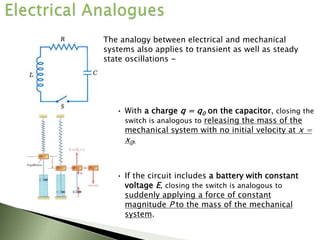
The analogy between electrical and mechanical
systems also applies to transient as well as steady
state oscillations -
• With a charge q = q0 on the capacitor, closing the
switch is analogous to releasing the mass of the
mechanical system with no initial velocity at x =
x0.
• If the circuit includes a battery with constant
voltage E, closing the switch is analogous to
suddenly applying a force of constant
magnitude P to the mass of the mechanical
system.
• The electrical system analogy provides a means of
experimentally determining the characteristics of a
given mechanical system.
• For the mechanical system,
    0
2
1
2
1
1
2
1
2
1
1
1
1 





 x
x
k
x
k
x
x
c
x
c
x
m 




    t
P
x
x
k
x
x
c
x
m f
m 
sin
1
2
2
1
2
2
2
2 



 



• For the electrical system,
  0
2
2
1
1
1
2
1
1
1
1 





C
q
q
C
q
q
q
R
q
L 



  t
E
C
q
q
q
q
R
q
L f
m 
sin
2
1
2
1
2
2
2
2 



 



• The governing equations are equivalent. The
characteristics of the vibrations of the mechanical
system may be inferred from the oscillations of the
electrical system.
Chandan Pal
Roll-10800711025
Reg. No.- 111080110392

13200777.ppt

  • 2.
    Mechanical vibration isthe motion of a particle or body which oscillates about a position of equilibrium. Time interval required for a system to complete a full cycle of the motion is the period of the vibration. Number of cycles per unit time defines the frequency of the vibrations. Maximum displacement of the system from the equilibrium position is the amplitude of the vibration. When the motion is maintained by the restoring forces only, the vibration is called free vibration. When a periodic force is applied to the system, the motion is described as forced vibration. When the frictional dissipation of energy is neglected, the motion is said to be undamped. Actually, all vibrations are damped to some degree.
  • 3.
    • If aparticle is displaced through a distance xm from its equilibrium position and released with no velocity, the particle will undergo simple harmonic motion,   0         kx x m kx x k W F ma st    • General solution is the sum of two particular solutions,     t C t C t m k C t m k C x n n   cos sin cos sin 2 1 2 1                     • x is a periodic function and n is the natural circular frequency of the motion. • C1 and C2 are determined by the initial conditions:     t C t C x n n   cos sin 2 1   0 2 x C  n v C  0 1      t C t C x v n n n n     sin cos 2 1    
  • 4.
         t x x n m sin   n n    2 period       2 1 n n n f natural frequency      2 0 2 0 x v x n m  amplitude     n x v   0 0 1 tan phase angle • Displacement is equivalent to the x component of the sum of two vectors which rotate with constant angular velocity 2 1 C C    . n  0 2 0 1 x C v C n   
  • 5.
         t x x n m sin • Velocity-time and acceleration-time curves can be represented by sine curves of the same period as the displacement-time curve but different phase angles.     2 sin cos              t x t x x v n n m n n m                    t x t x x a n n m n n m sin sin 2 2  
  • 6.
    • Results obtainedfor the spring-mass system can be applied whenever the resultant force on a particle is proportional to the displacement and directed towards the equilibrium position. for small angles,   g l t l g n n n m           2 2 sin 0         : t t ma F   • Consider tangential components of acceleration and force for a simple pendulum, 0 sin sin         l g ml W    
  • 7.
    0 sin     l g   Anexact solution for leads to      2 0 2 2 sin 2 sin 1 4      m n d g l which requires numerical solution.          g l K n    2 2
  • 8.
    • If anequation of motion takes the form 0 or 0 2 2         n n x x     the corresponding motion may be considered as simple harmonic motion. • Analysis objective is to determine n.       mg W mb b b m I     , 2 2 but 2 3 2 2 2 12 1 0 5 3 sin 5 3         b g b g     g b b g n n n 3 5 2 2 , 5 3 then         • For an equivalent simple pendulum, 3 5b l  • Consider the oscillations of a square plate            I mb b W    sin
  • 9.
    • Resultant forceon a mass in simple harmonic motion is conservative - total energy is conserved. constant  V T     2 2 2 2 2 1 2 2 1 constant x x kx x m n    • Consider simple harmonic motion of the square plate, 0 1  T       2 2 1 2 1 2 sin 2 cos 1 m m Wb Wb Wb V              2 2 3 5 2 1 2 2 3 2 2 1 2 2 1 2 2 1 2 2 1 2 m m m m m mb mb b m I v m T            0 2  V   0 0 2 2 2 3 5 2 1 2 2 1 2 2 1 1       n m m mb Wb V T V T    b g n 5 3  
  • 10.
    : ma F    x m x k W t P st f m         sin t P kx x m f m  sin       x m t x k W f m st          sin t k kx x m f m   sin     Forced vibrations - Occur when a system is subjected to a periodic force or a periodic displacement of a support.  f  forced frequency
  • 11.
      t x t C t C x x x f m n n particular ary complement   sin cos sin 2 1         2 2 2 1 1 n f m n f m f m m k P m k P x             t k kx x m f m   sin     t P kx x m f m  sin     At f = n, forcing input is in resonance with the system. t P t kx t x m f m f m f m f     sin sin sin 2    Substituting particular solution into governing equation,
  • 12.
    • With viscousdamping due to fluid friction, : ma F     0        kx x c x m x m x c x k W st        • Substituting x = elt and dividing through by elt yields the characteristic equation, m k m c m c k c m              2 2 2 2 0 l l l • Define the critical damping coefficient such that n c c m m k m c m k m c  2 2 0 2 2           • All vibrations are damped to some degree by forces due to dry friction, fluid friction, or internal friction.
  • 13.
    • Characteristic equation, m k m c m c k c m             2 2 2 2 0 l l l   n c m c  2 critical damping coefficient • Heavy damping: c > cc t t e C e C x 2 1 2 1 l l   - negative roots - nonvibratory motion • Critical damping: c = cc   t n e t C C x     2 1 - double roots - non-vibratory motion • Light damping: c < cc     t C t C e x d d t m c   cos sin 2 1 2               2 1 c n d c c   damped frequency
  • 14.
                         2 2 2 2 1 2 tan 2 1 1 n f n f c n f c n f m m m c c c c x k P x           magnification factor phase difference between forcing and steady state response t P kx x c x m f m  sin       particular ary complement x x x  
  • 15.
    • Consider anelectrical circuit consisting of an inductor, resistor and capacitor with a source of alternating voltage 0 sin     C q Ri dt di L t E f m  • Oscillations of the electrical system are analogous to damped forced vibrations of a mechanical system. t E q C q R q L f m  sin 1      
  • 16.
    The analogy betweenelectrical and mechanical systems also applies to transient as well as steady state oscillations - • With a charge q = q0 on the capacitor, closing the switch is analogous to releasing the mass of the mechanical system with no initial velocity at x = x0. • If the circuit includes a battery with constant voltage E, closing the switch is analogous to suddenly applying a force of constant magnitude P to the mass of the mechanical system.
  • 17.
    • The electricalsystem analogy provides a means of experimentally determining the characteristics of a given mechanical system. • For the mechanical system,     0 2 1 2 1 1 2 1 2 1 1 1 1        x x k x k x x c x c x m          t P x x k x x c x m f m  sin 1 2 2 1 2 2 2 2          • For the electrical system,   0 2 2 1 1 1 2 1 1 1 1       C q q C q q q R q L       t E C q q q q R q L f m  sin 2 1 2 1 2 2 2 2          • The governing equations are equivalent. The characteristics of the vibrations of the mechanical system may be inferred from the oscillations of the electrical system.
  • 18.