12/14/2014 Data Mining: Principles and Algorithms 1
Multimedia Data Mining
Data Mining
 Data Mining definition:
 A class of database applications that look for
hidden patterns in a group of data.
 Finding rules of the game knowing the moves
of the game
 Unifying framework for data representation
and problem solving in order to learn and
discover from large amounts of different types
of data.
12/14/2014 Data Mining: Principles and Algorithms 2
Multimedia Data Mining
 Multimedia data types
 any type of information medium that can be
represented, processed, stored and
transmitted over network in digital form
 Multi-lingual text, numeric, images, video,
audio, graphical, temporal, relational, and
categorical data.
 Relation with conventional data mining term
12/14/2014 Data Mining: Principles and Algorithms 3
Definitions
 Subfield of data mining that deals with an
extraction of implicit knowledge, multimedia data
relationships, or other patterns not explicitly
stored in multimedia databases
 Influence on related interdisciplinary fields
 Databases – extension of the KDD (rule
patterns)
 Information systems – multimedia information
analysis and retrieval – content-based image
and video search and efficient storage
organization
12/14/2014 Data Mining: Principles and Algorithms 4
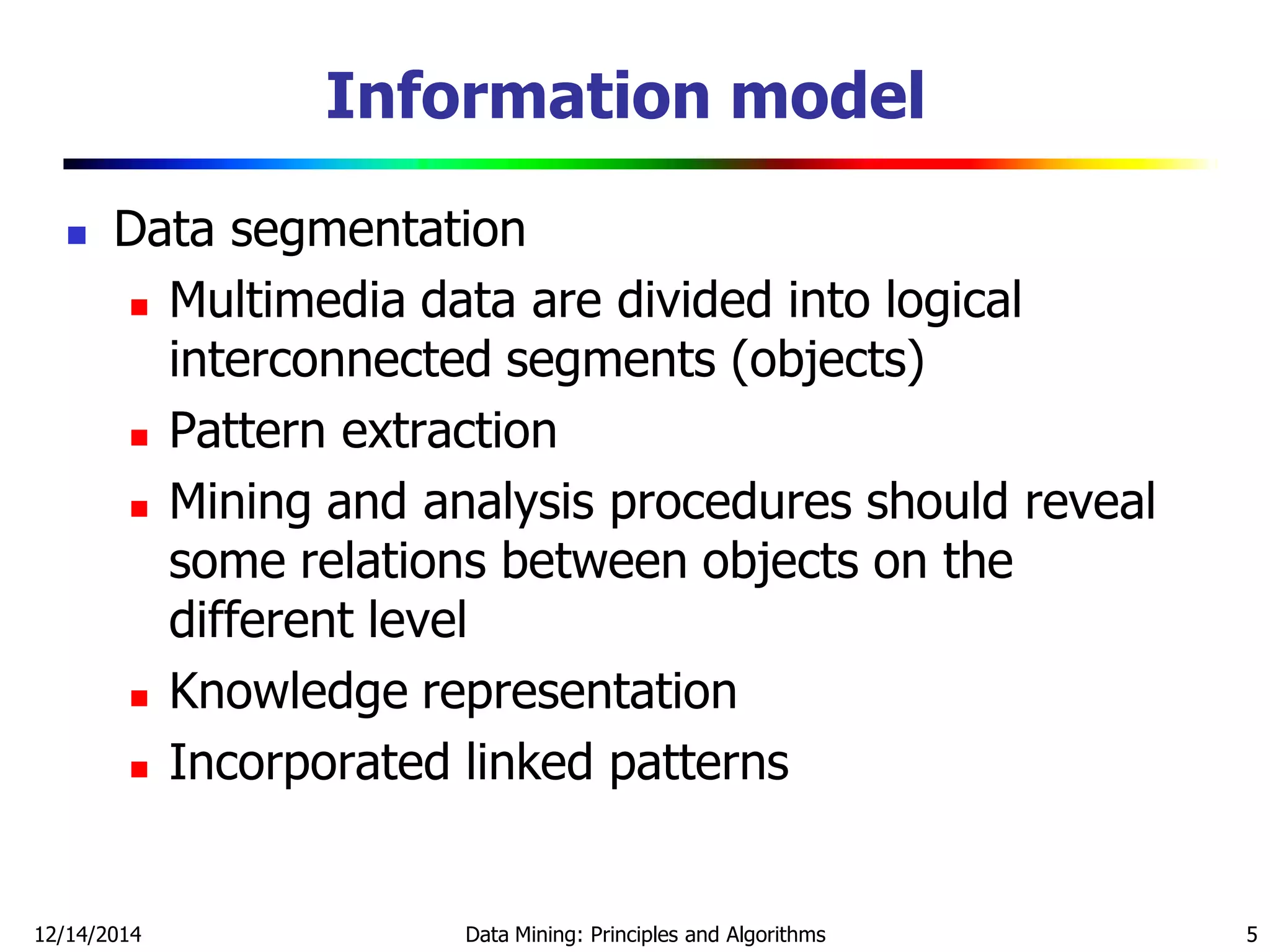
Information model
 Data segmentation
 Multimedia data are divided into logical
interconnected segments (objects)
 Pattern extraction
 Mining and analysis procedures should reveal
some relations between objects on the
different level
 Knowledge representation
 Incorporated linked patterns
12/14/2014 Data Mining: Principles and Algorithms 5
12/14/2014 Data Mining: Principles and Algorithms 6
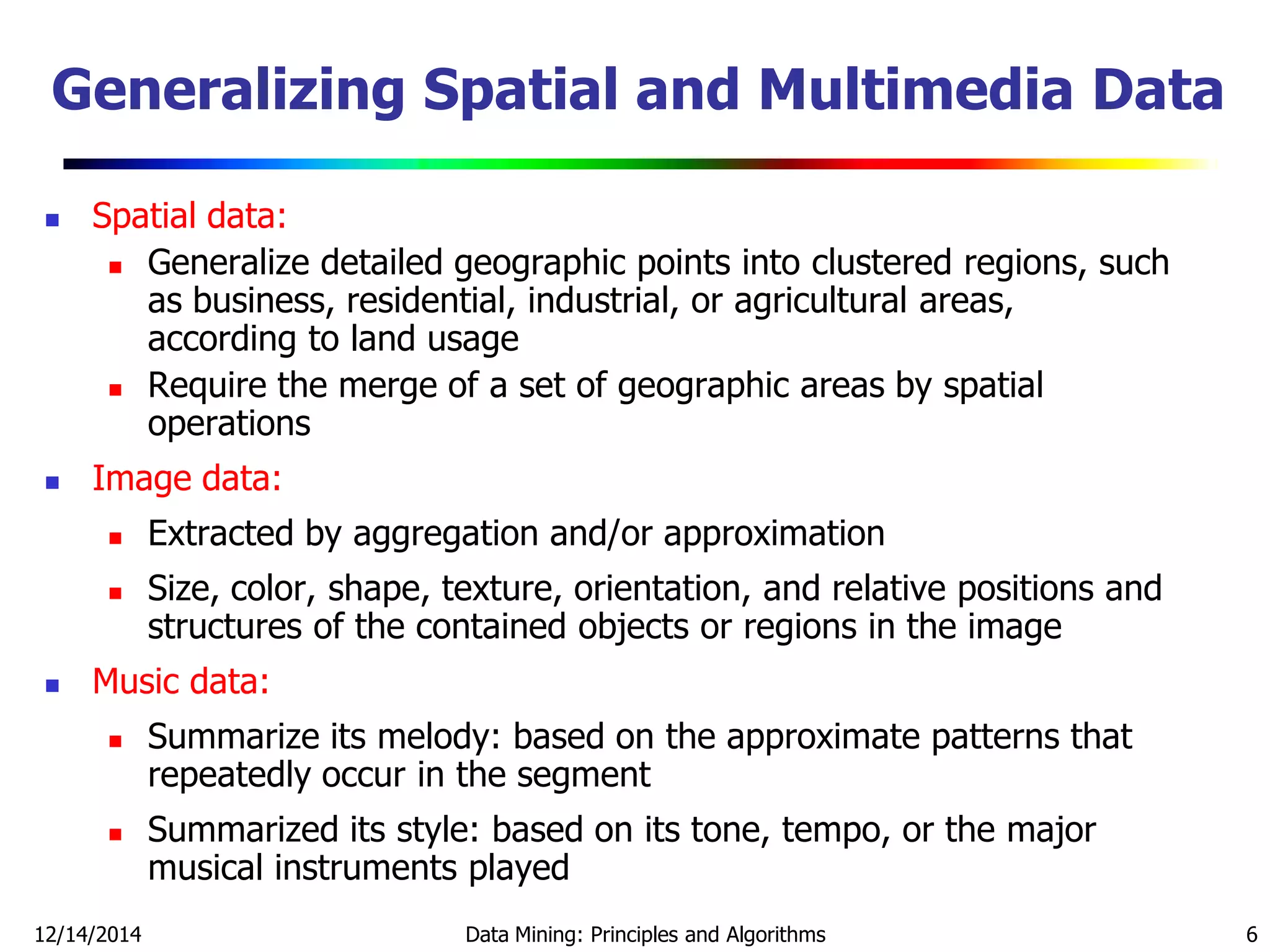
Generalizing Spatial and Multimedia Data
 Spatial data:
 Generalize detailed geographic points into clustered regions, such
as business, residential, industrial, or agricultural areas,
according to land usage
 Require the merge of a set of geographic areas by spatial
operations
 Image data:
 Extracted by aggregation and/or approximation
 Size, color, shape, texture, orientation, and relative positions and
structures of the contained objects or regions in the image
 Music data:
 Summarize its melody: based on the approximate patterns that
repeatedly occur in the segment
 Summarized its style: based on its tone, tempo, or the major
musical instruments played
12/14/2014 Data Mining: Principles and Algorithms 7
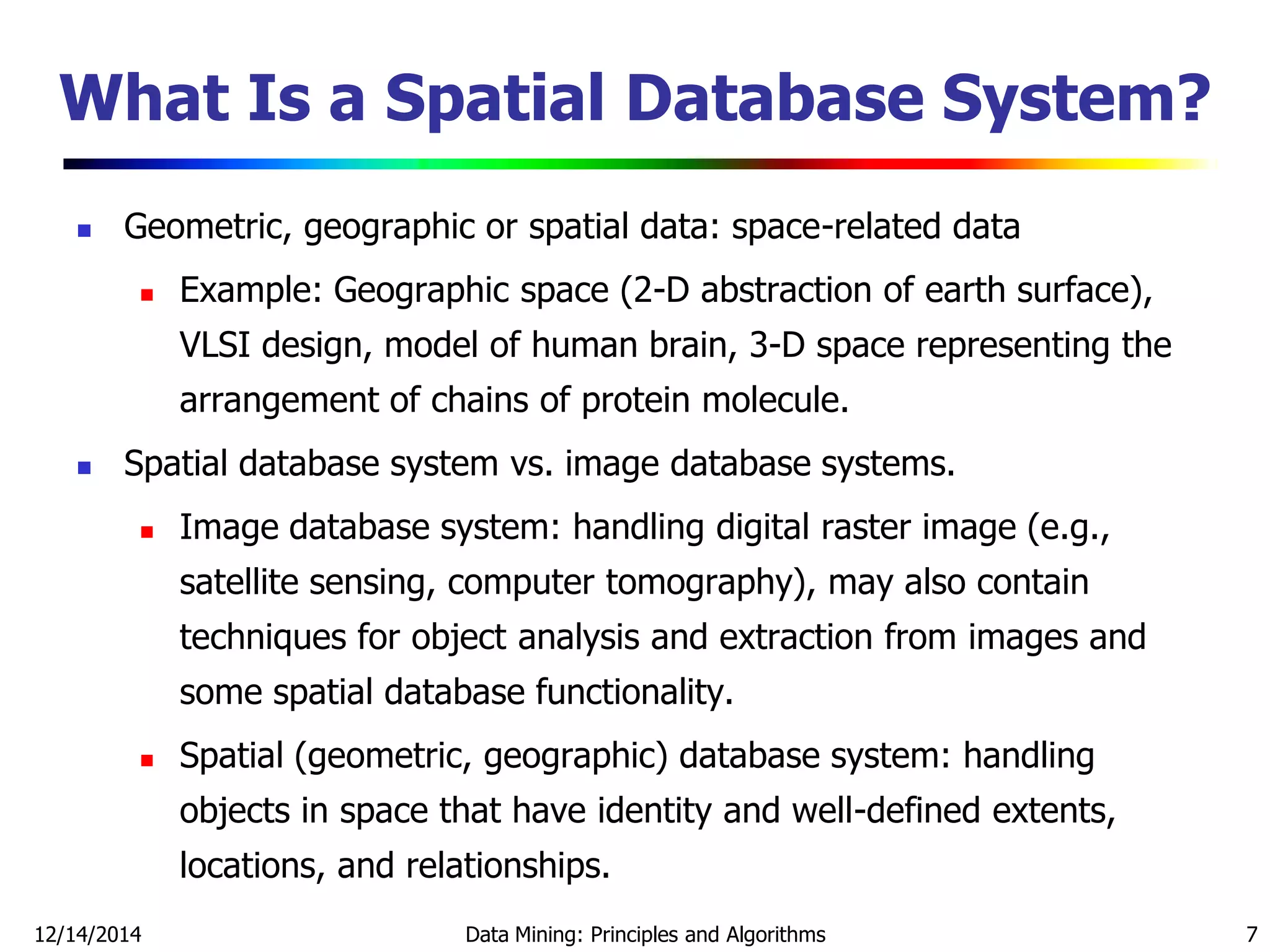
What Is a Spatial Database System?
 Geometric, geographic or spatial data: space-related data
 Example: Geographic space (2-D abstraction of earth surface),
VLSI design, model of human brain, 3-D space representing the
arrangement of chains of protein molecule.
 Spatial database system vs. image database systems.
 Image database system: handling digital raster image (e.g.,
satellite sensing, computer tomography), may also contain
techniques for object analysis and extraction from images and
some spatial database functionality.
 Spatial (geometric, geographic) database system: handling
objects in space that have identity and well-defined extents,
locations, and relationships.
12/14/2014 Data Mining: Principles and Algorithms 8
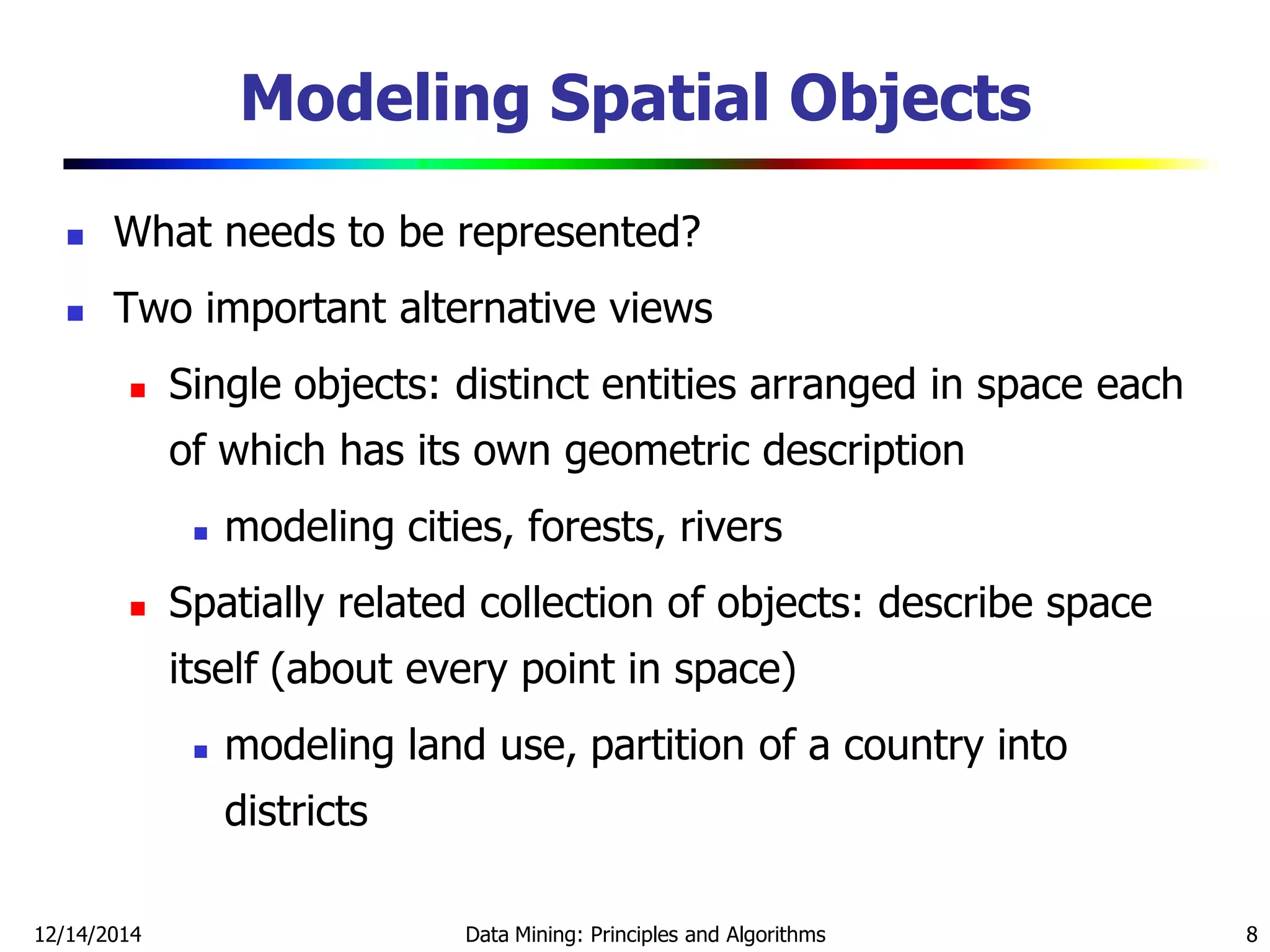
Modeling Spatial Objects
 What needs to be represented?
 Two important alternative views
 Single objects: distinct entities arranged in space each
of which has its own geometric description
 modeling cities, forests, rivers
 Spatially related collection of objects: describe space
itself (about every point in space)
 modeling land use, partition of a country into
districts
12/14/2014 Data Mining: Principles and Algorithms 9
Modeling Single Objects: Point, Line and Region
 Point: location only but not extent
 Line (or a curve usually represented by a polyline, a
sequence of line segment):
 moving through space, or connections in space (roads,
rivers, cables, etc.)
 Region:
 Something having extent in 2D-space (country, lake,
park). It may have a hole or consist of several disjoint
pieces.
12/14/2014 Data Mining: Principles and Algorithms 10
Spatial Association Analysis
 Spatial association rule: A  B [s%, c%]
 A and B are sets of spatial or non-spatial predicates
 Topological relations: intersects, overlaps, disjoint, etc.
 Spatial orientations: left_of, west_of, under, etc.
 Distance information: close_to, within_distance, etc.
 s% is the support and c% is the confidence of the rule
 Examples
1) is_a(x, large_town) ^ intersect(x, highway)  adjacent_to(x, water)
[7%, 85%]
2) What kinds of objects are typically located close to golf courses?
12/14/2014 Data Mining: Principles and Algorithms 11
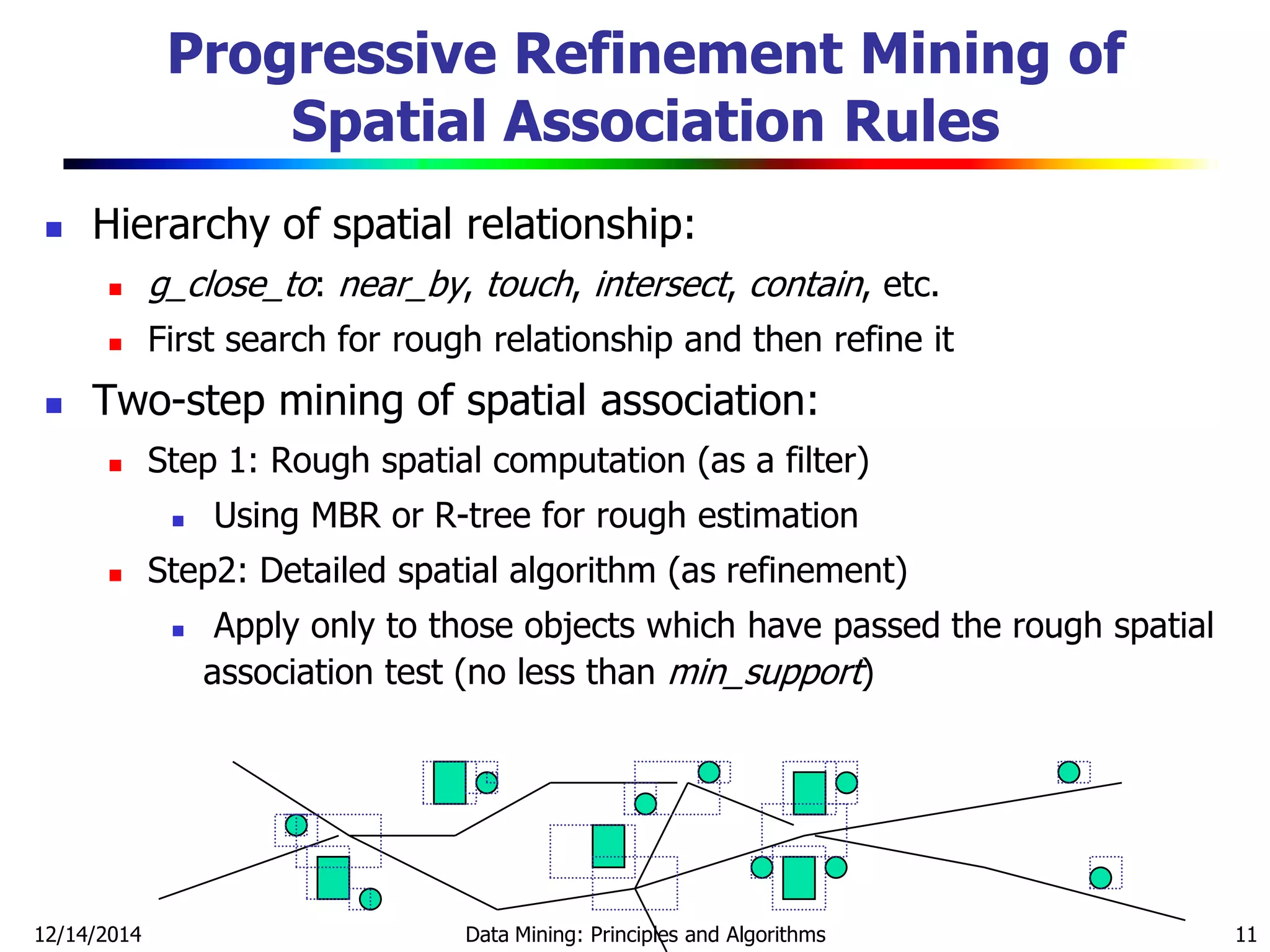
Progressive Refinement Mining of
Spatial Association Rules
 Hierarchy of spatial relationship:
 g_close_to: near_by, touch, intersect, contain, etc.
 First search for rough relationship and then refine it
 Two-step mining of spatial association:
 Step 1: Rough spatial computation (as a filter)
 Using MBR or R-tree for rough estimation
 Step2: Detailed spatial algorithm (as refinement)
 Apply only to those objects which have passed the rough spatial
association test (no less than min_support)
12/14/2014 Data Mining: Principles and Algorithms 12
Mining Spatial Co-location Rules
 Co-location rule is similar to association rule but explore
more relying spatial auto-correlation
 It leads to efficient processing
 It can be integrated with progressive refinement to
further improve its performance
 Spatial co-location mining idea can be applied to
clustering, classification, outlier analysis and other
potential mining tasks
12/14/2014 Data Mining: Principles and Algorithms 13
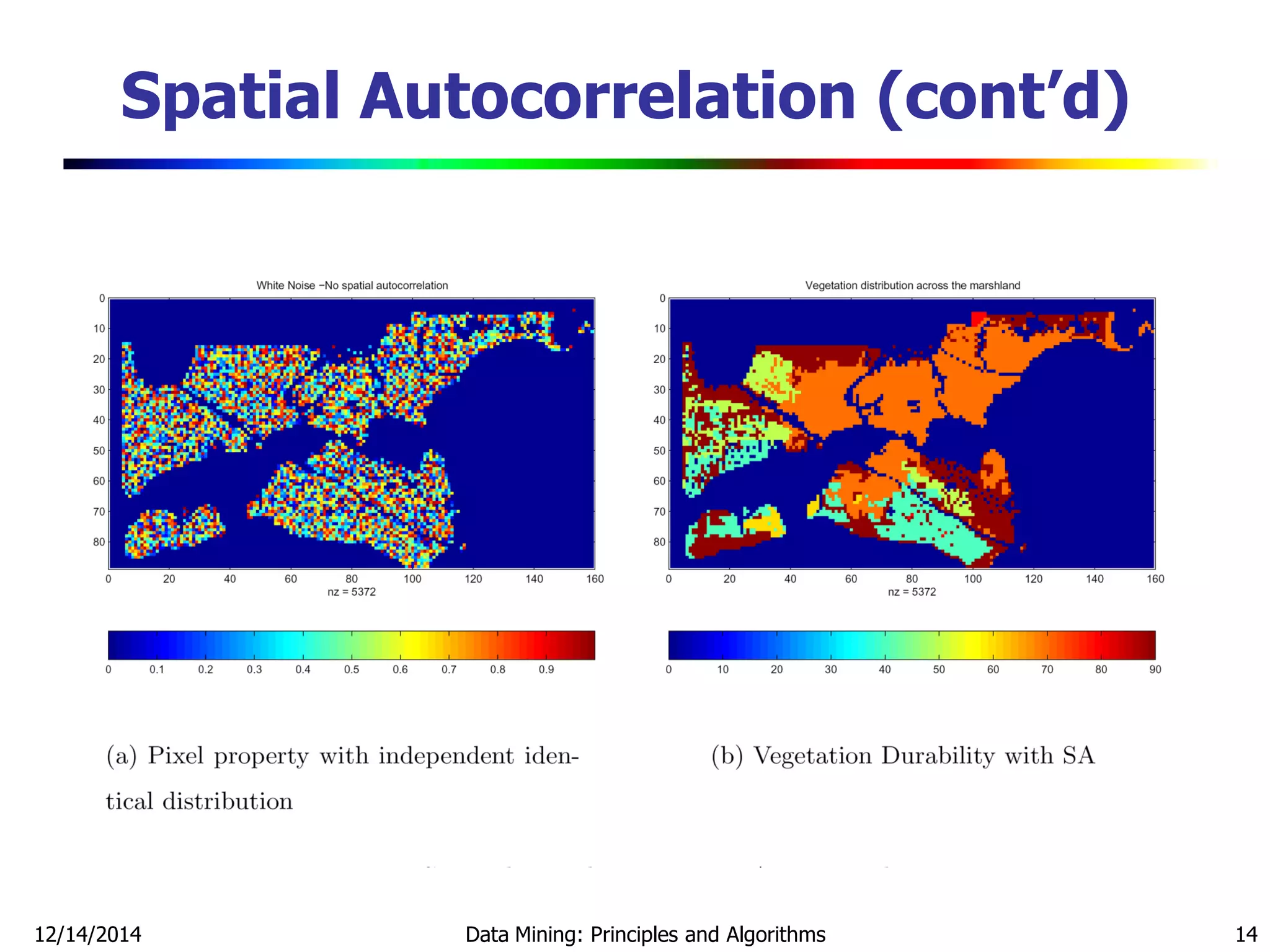
Spatial Autocorrelation
 Spatial data tends to be highly self-correlated
 Example: Neighborhood, Temperature
 Items in a traditional data are independent of each
other, whereas properties of locations in a map are
often ―auto-correlated‖.
 First law of geography:
―Everything is related to everything, but nearby things are
more related than distant things.‖
12/14/2014 Data Mining: Principles and Algorithms 14
Spatial Autocorrelation (cont’d)
12/14/2014 Data Mining: Principles and Algorithms 15
 Methods in classification
 Decision-tree classification, Naïve-Bayesian classifier +
boosting, neural network, logistic regression, etc.
 Association-based multi-dimensional classification -
Example: classifying house value based on proximity to
lakes, highways, mountains, etc.
 Assuming learning samples are independent of each other
 Spatial auto-correlation violates this assumption!
 Popular spatial classification methods
 Spatial auto-regression (SAR)
 Markov random field (MRF)
Spatial Classification
12/14/2014 Data Mining: Principles and Algorithms 16
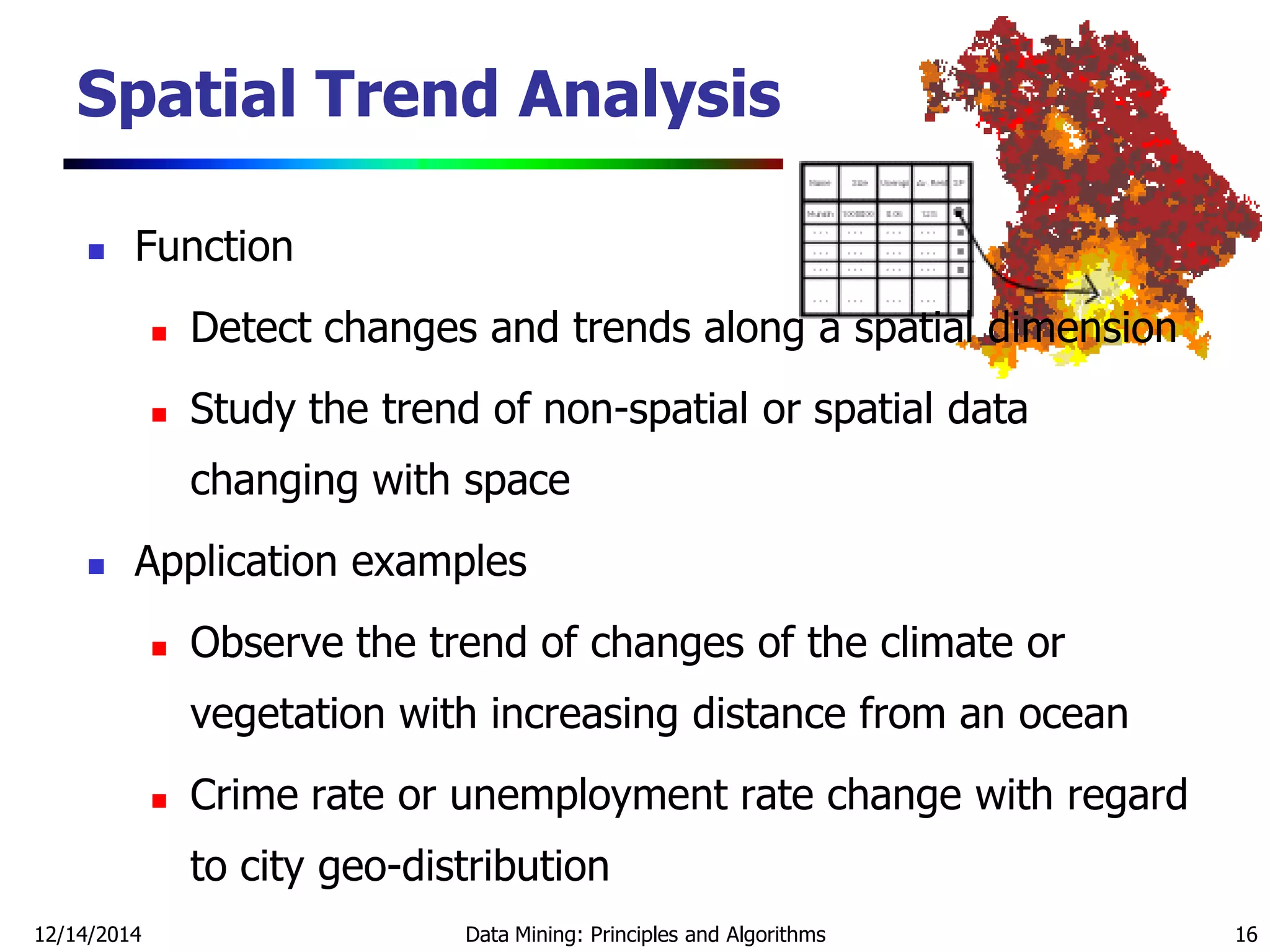
 Function
 Detect changes and trends along a spatial dimension
 Study the trend of non-spatial or spatial data
changing with space
 Application examples
 Observe the trend of changes of the climate or
vegetation with increasing distance from an ocean
 Crime rate or unemployment rate change with regard
to city geo-distribution
Spatial Trend Analysis
12/14/2014 Data Mining: Principles and Algorithms 17
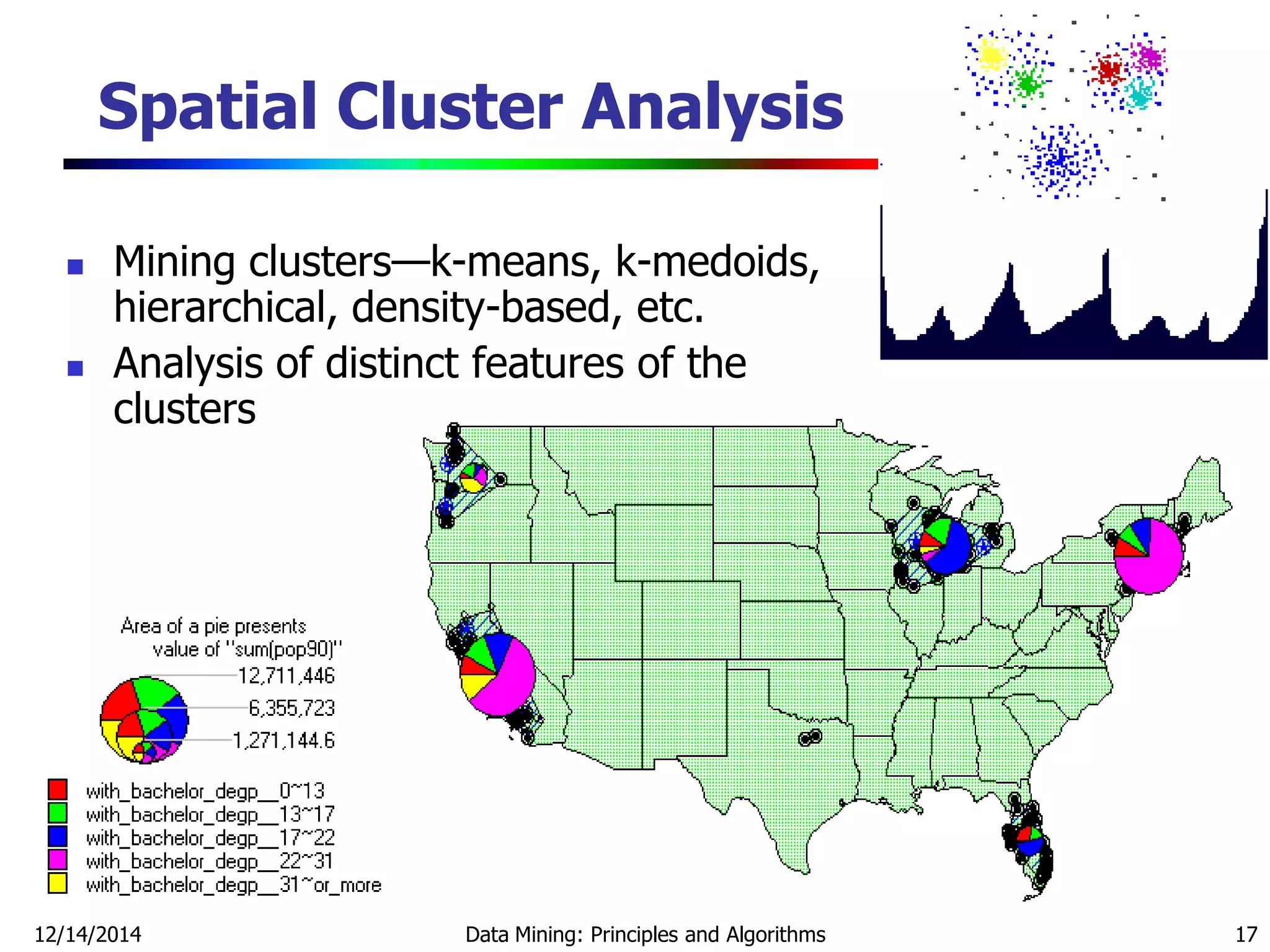
Spatial Cluster Analysis
 Mining clusters—k-means, k-medoids,
hierarchical, density-based, etc.
 Analysis of distinct features of the
clusters
12/14/2014 Data Mining: Principles and Algorithms 18
Constraints-Based Clustering
 Constraints on individual objects
 Simple selection of relevant objects before clustering
 Clustering parameters as constraints
 K-means, density-based: radius, min-# of points
 Constraints specified on clusters using SQL
aggregates
 Sum of the profits in each cluster > $1 million
 Constraints imposed by physical obstacles
 Clustering with obstructed distance
12/14/2014 Data Mining: Principles and Algorithms 19
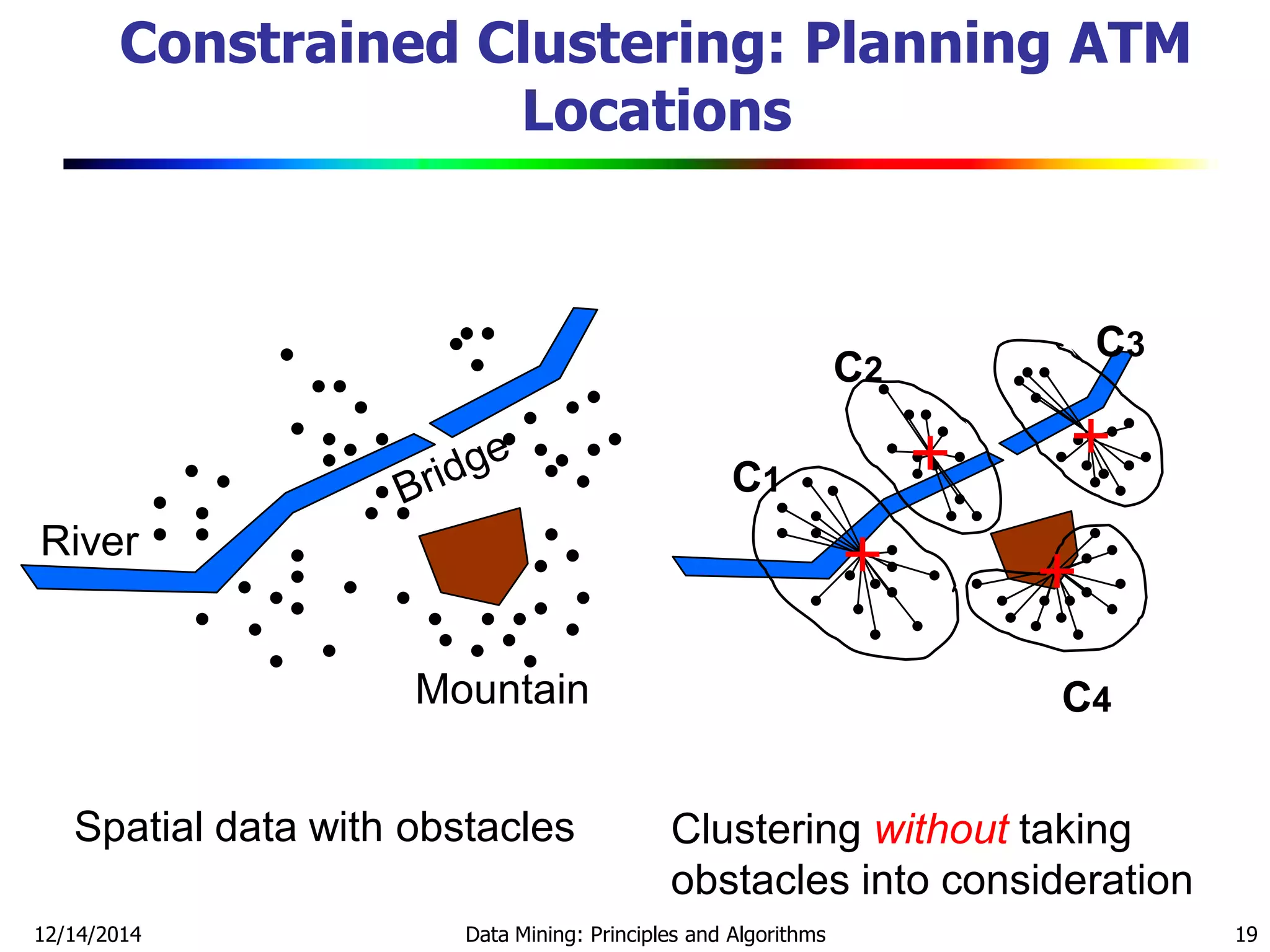
Constrained Clustering: Planning ATM
Locations
Mountain
River
Spatial data with obstacles
C1
C2
C3
C4
Clustering without taking
obstacles into consideration
12/14/2014 Data Mining: Principles and Algorithms 20
Mining Spatiotemporal Data
 Spatiotemporal data
 Data has spatial extensions and changes with
time
 Ex: Forest fire, moving objects, hurricane &
earthquakes
 Automatic anomaly detection in massive moving
objects
 Moving objects are ubiquitous: GPS, radar, etc.
 Ex: Maritime vessel surveillance
 Problem: Automatic anomaly detection
12/14/2014 Data Mining: Principles and Algorithms 21
Analysis: Mining Anomaly in Moving Objects
 Raw analysis of collected data does not fully
convey ―anomaly‖ information
 More effective analysis relies on higher semantic
features
 Examples:
 A speed boat moving quickly in open water
 A fishing boat moving slowly into the docks
 A yacht circling slowly around landmark during
night hours
12/14/2014 Data Mining: Principles and Algorithms 22
Framework: Motif-Based Feature Analysis
 Motif-based representation
 A motif is a prototypical movement pattern
 View a movement path as a sequence of motif
expressions
 Motif-oriented feature space
 Automated motif feature extraction
 Semantic-level features
 Classification
 Anomaly detection via classification
 High dimensional classifier
12/14/2014 Data Mining: Principles and Algorithms 23
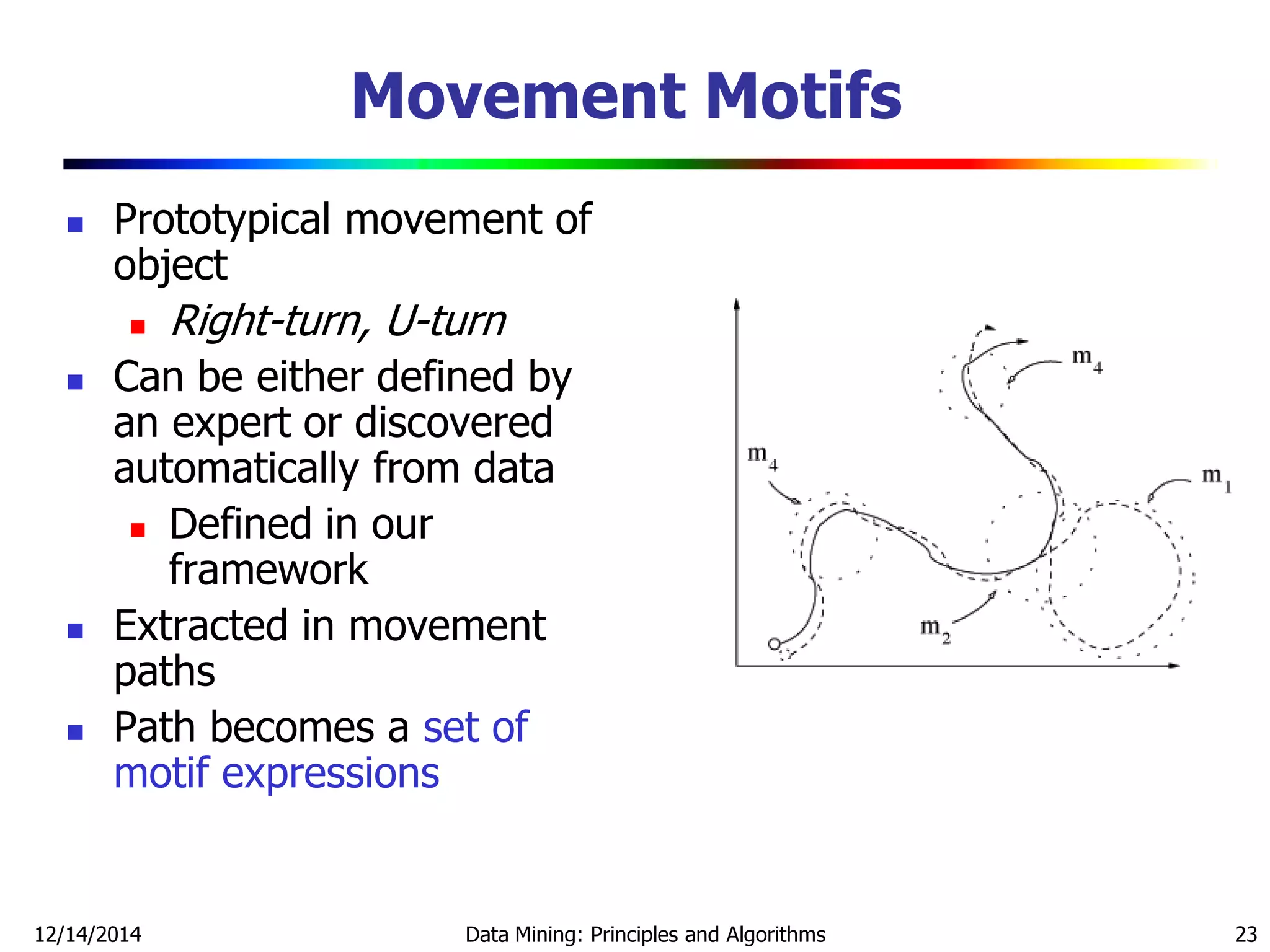
Movement Motifs
 Prototypical movement of
object
 Right-turn, U-turn
 Can be either defined by
an expert or discovered
automatically from data
 Defined in our
framework
 Extracted in movement
paths
 Path becomes a set of
motif expressions
12/14/2014 Data Mining: Principles and Algorithms 24
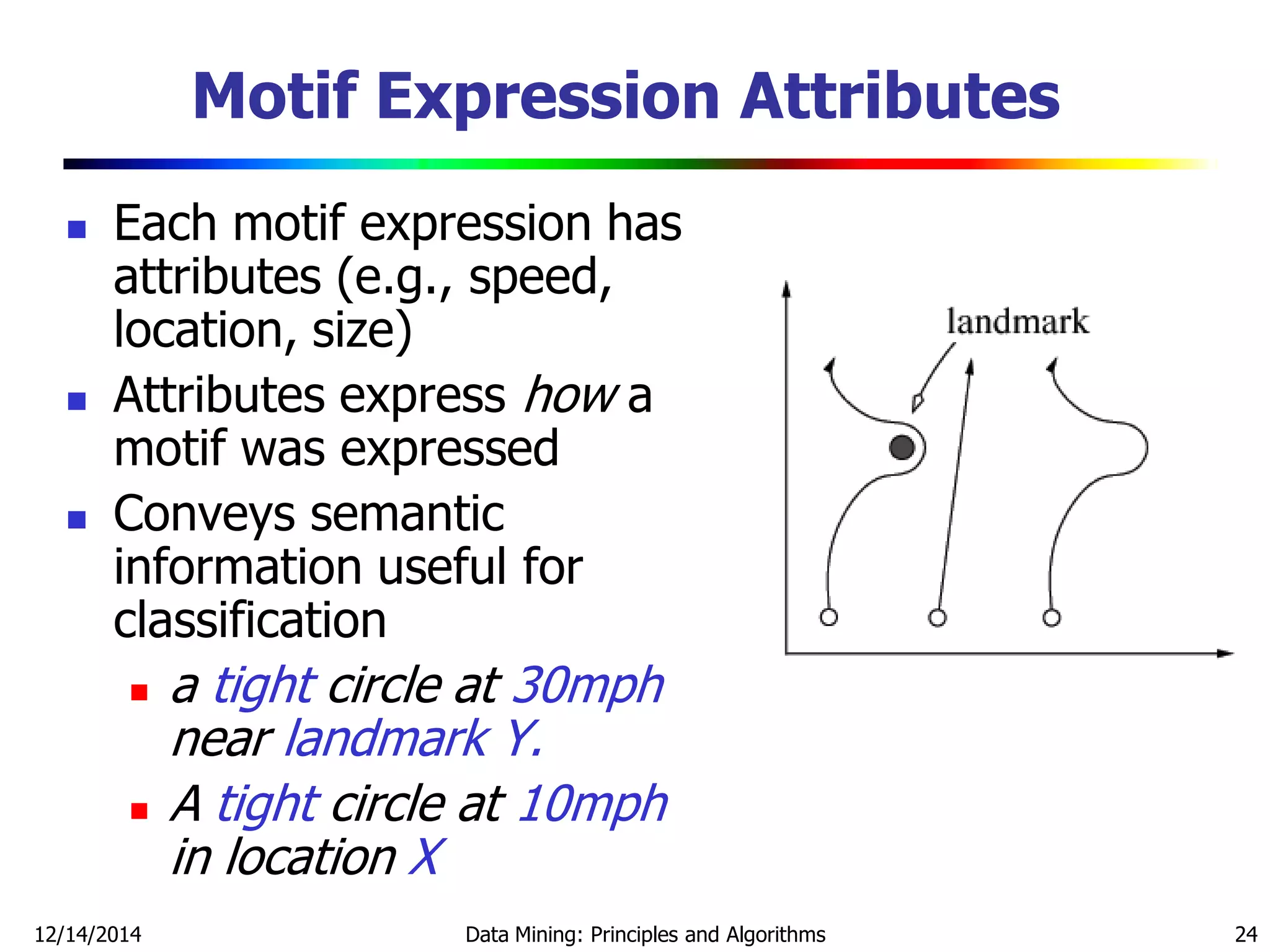
Motif Expression Attributes
 Each motif expression has
attributes (e.g., speed,
location, size)
 Attributes express how a
motif was expressed
 Conveys semantic
information useful for
classification
 a tight circle at 30mph
near landmark Y.
 A tight circle at 10mph
in location X
12/14/2014 Data Mining: Principles and Algorithms 25
Motif-Oriented Feature Space
 Attributes describe how motifs are expressed
 Let there be A attributes, each path is a set of
(A+1)-tuples
{(mi, v1, v2, …, vA), (mj, v1, v2, …, vA)}
 Naïve Feature space construction
1. Let each distinct (mj, v1, v2, …, vA) be a
feature
2. If path exhibits a particular motif-expression,
its value is 1. Otherwise, its value is 0.
12/14/2014 Data Mining: Principles and Algorithms 26
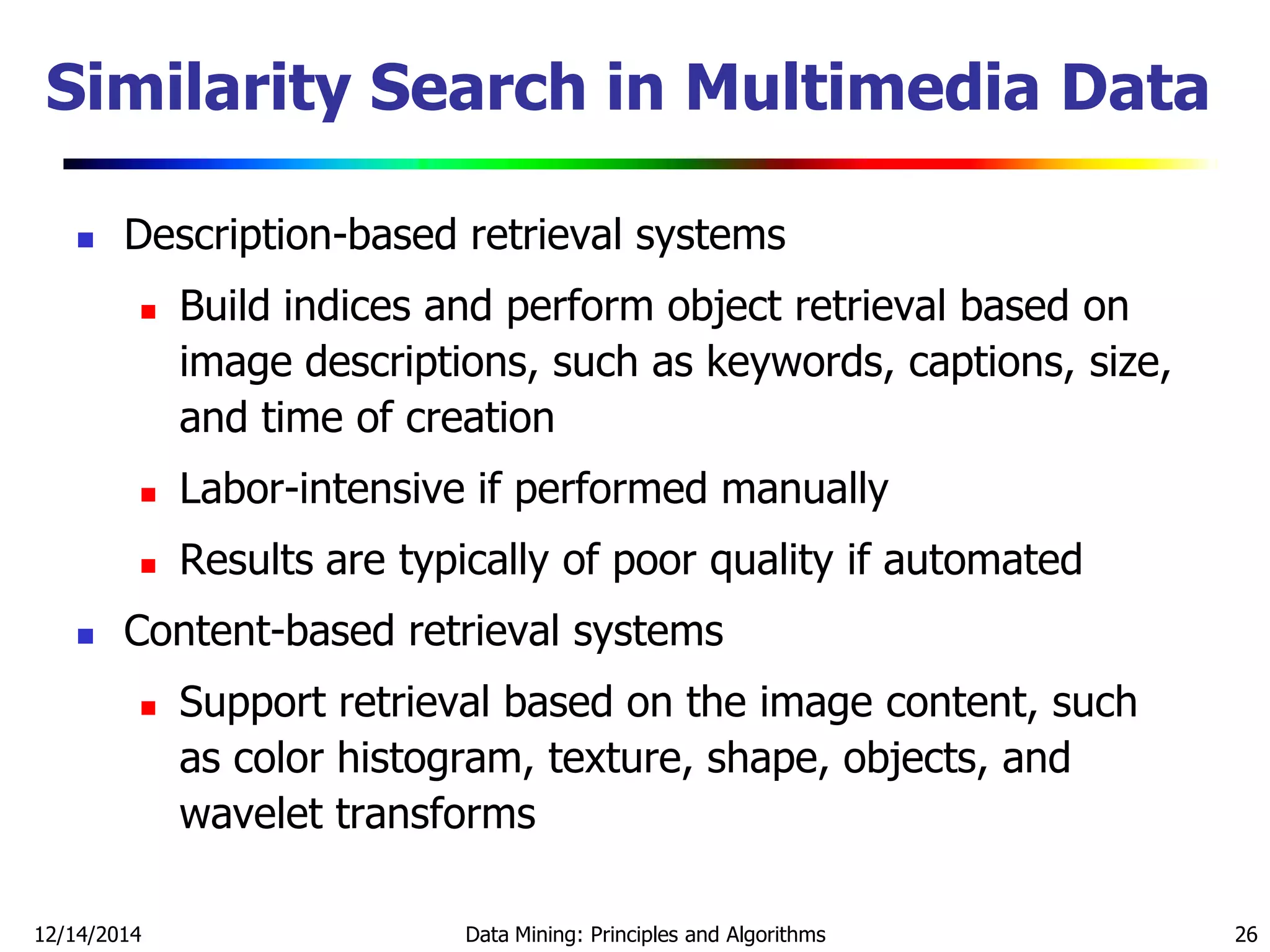
Similarity Search in Multimedia Data
 Description-based retrieval systems
 Build indices and perform object retrieval based on
image descriptions, such as keywords, captions, size,
and time of creation
 Labor-intensive if performed manually
 Results are typically of poor quality if automated
 Content-based retrieval systems
 Support retrieval based on the image content, such
as color histogram, texture, shape, objects, and
wavelet transforms
12/14/2014 Data Mining: Principles and Algorithms 27
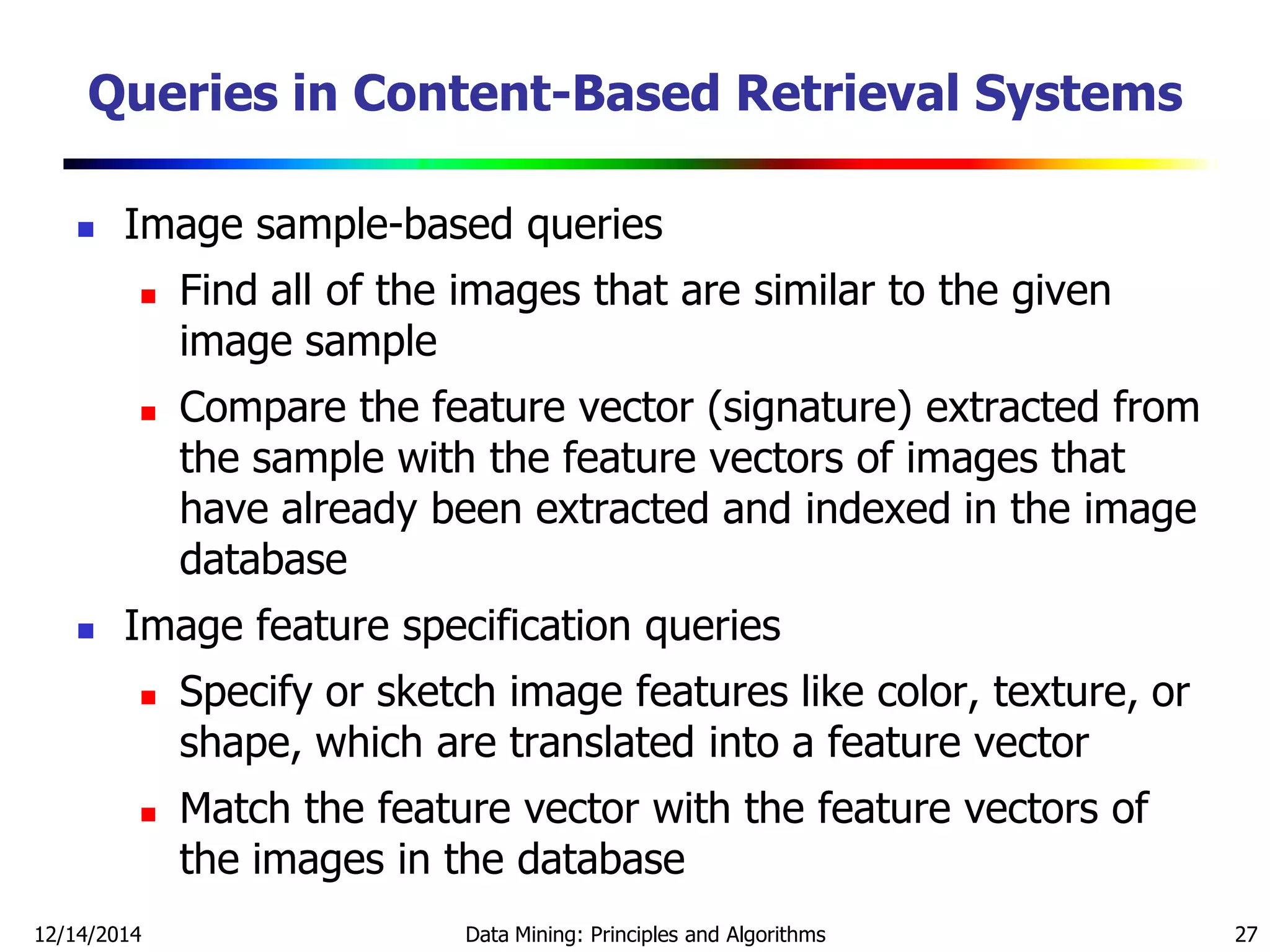
Queries in Content-Based Retrieval Systems
 Image sample-based queries
 Find all of the images that are similar to the given
image sample
 Compare the feature vector (signature) extracted from
the sample with the feature vectors of images that
have already been extracted and indexed in the image
database
 Image feature specification queries
 Specify or sketch image features like color, texture, or
shape, which are translated into a feature vector
 Match the feature vector with the feature vectors of
the images in the database
12/14/2014 Data Mining: Principles and Algorithms 28
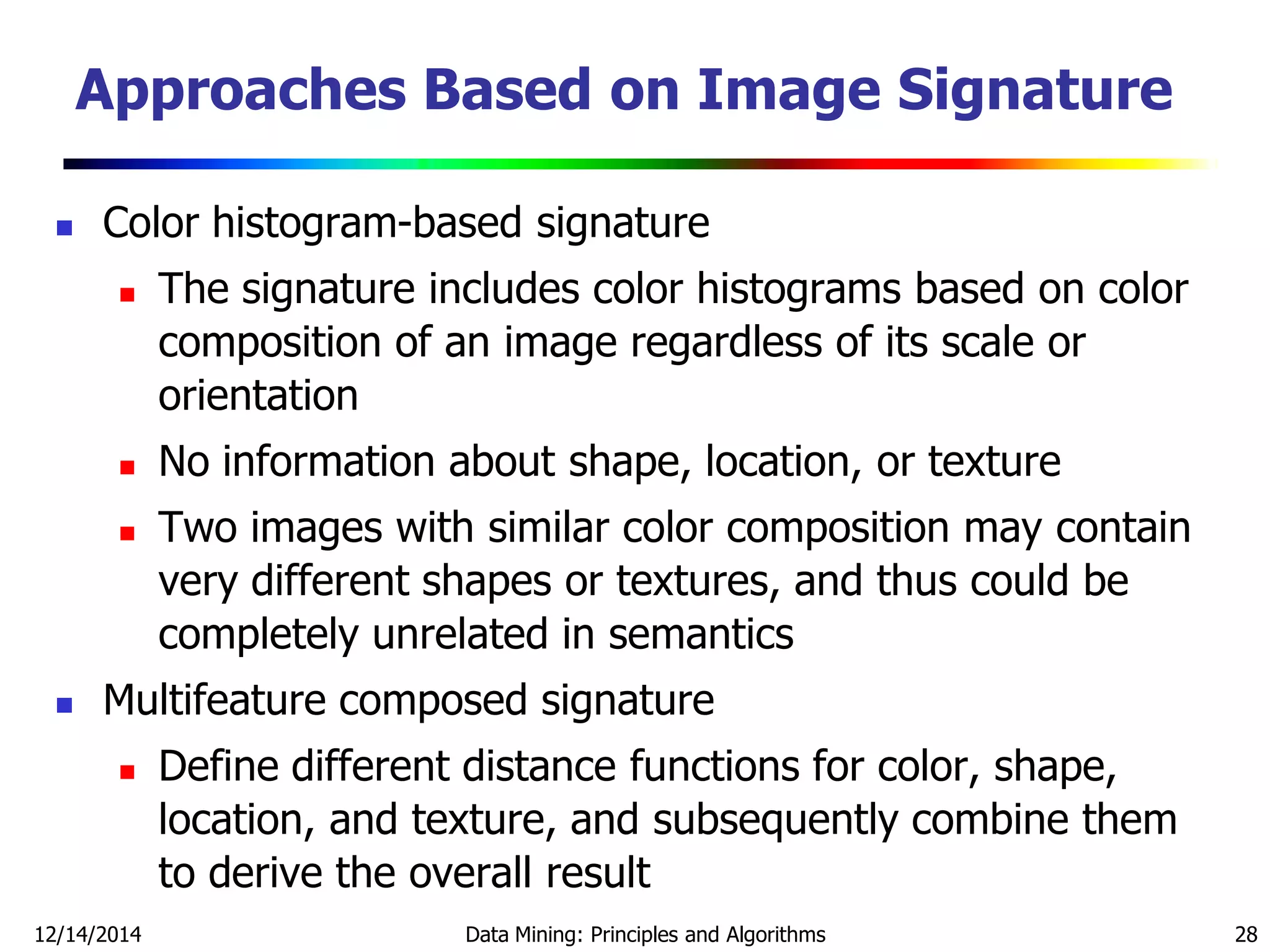
Approaches Based on Image Signature
 Color histogram-based signature
 The signature includes color histograms based on color
composition of an image regardless of its scale or
orientation
 No information about shape, location, or texture
 Two images with similar color composition may contain
very different shapes or textures, and thus could be
completely unrelated in semantics
 Multifeature composed signature
 Define different distance functions for color, shape,
location, and texture, and subsequently combine them
to derive the overall result
12/14/2014 Data Mining: Principles and Algorithms 29
Wavelet Analysis
 Wavelet-based signature
 Use the dominant wavelet coefficients of an image as
its signature
 Wavelets capture shape, texture, and location
information in a single unified framework
 Improved efficiency and reduced the need for
providing multiple search primitives
 May fail to identify images containing similar objects
that are in different locations.
12/14/2014 Data Mining: Principles and Algorithms 30
One Signature for the Entire Image?
 Walnus: [NRS99] by Natsev, Rastogi, and Shim
 Similar images may contain similar regions, but a region
in one image could be a translation or scaling of a
matching region in the other
 Wavelet-based signature with region-based granularity
 Define regions by clustering signatures of windows of
varying sizes within the image
 Signature of a region is the centroid of the cluster
 Similarity is defined in terms of the fraction of the area
of the two images covered by matching pairs of
regions from two images
12/14/2014 Data Mining: Principles and Algorithms 31
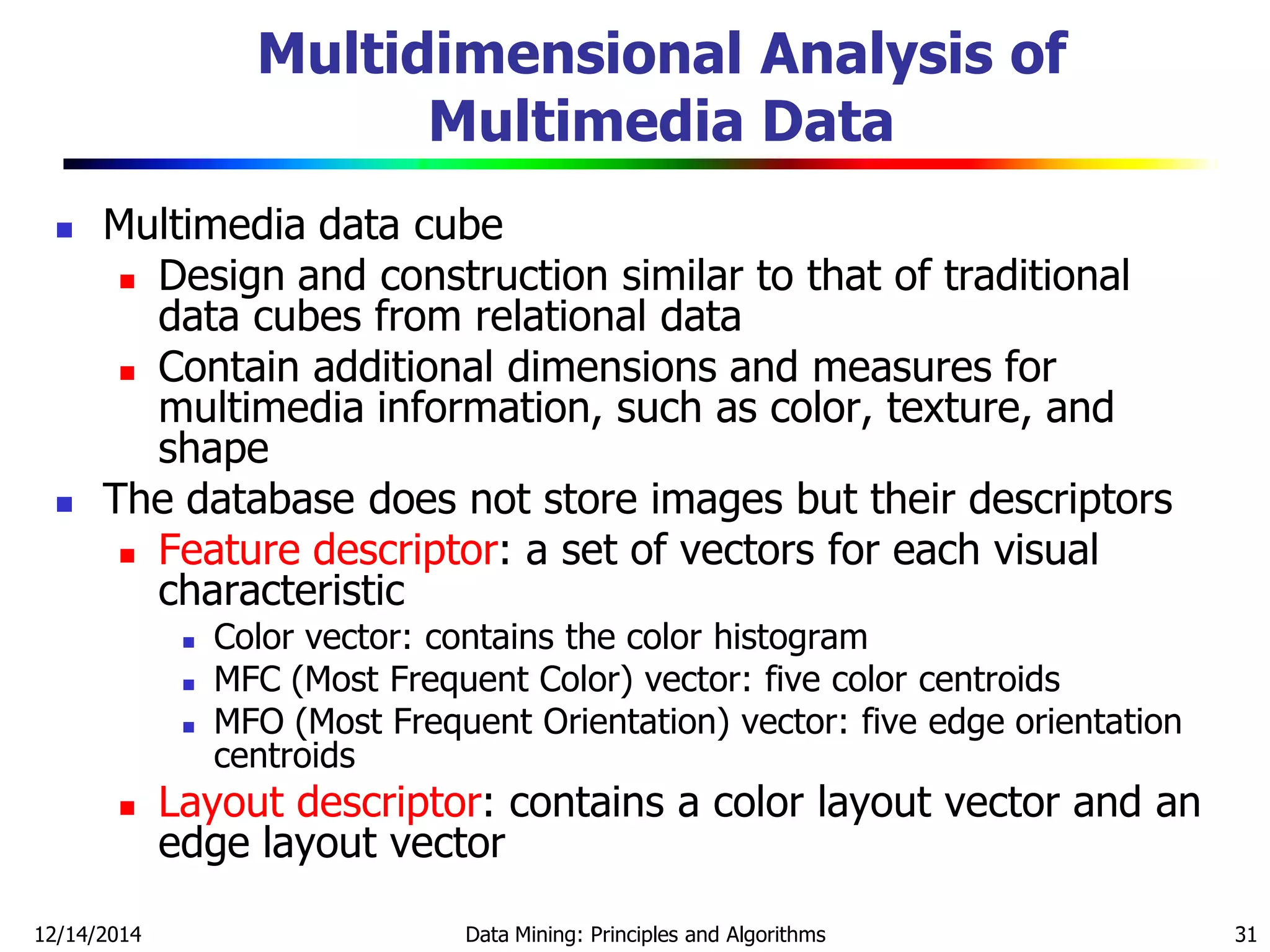
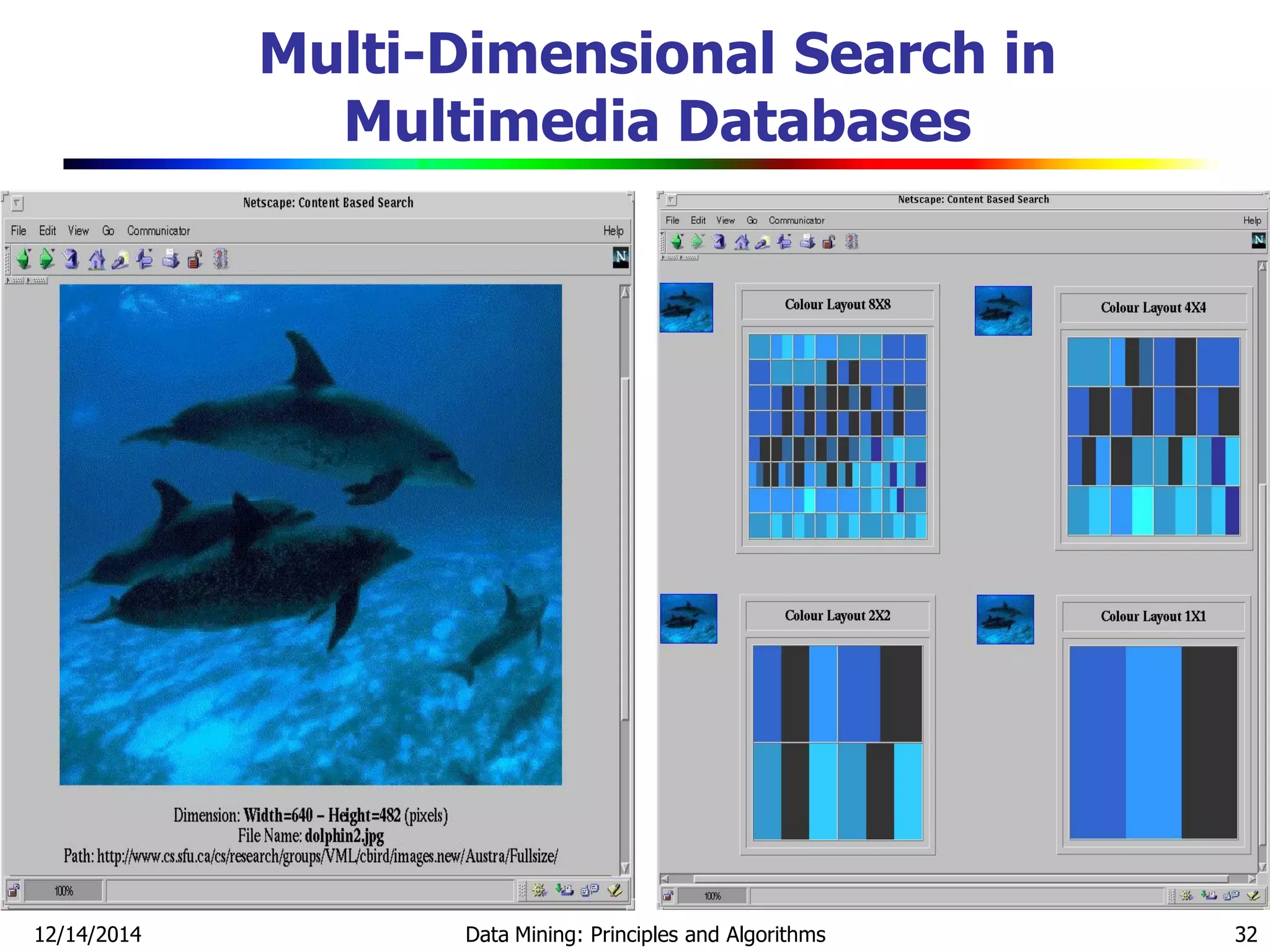
Multidimensional Analysis of
Multimedia Data
 Multimedia data cube
 Design and construction similar to that of traditional
data cubes from relational data
 Contain additional dimensions and measures for
multimedia information, such as color, texture, and
shape
 The database does not store images but their descriptors
 Feature descriptor: a set of vectors for each visual
characteristic
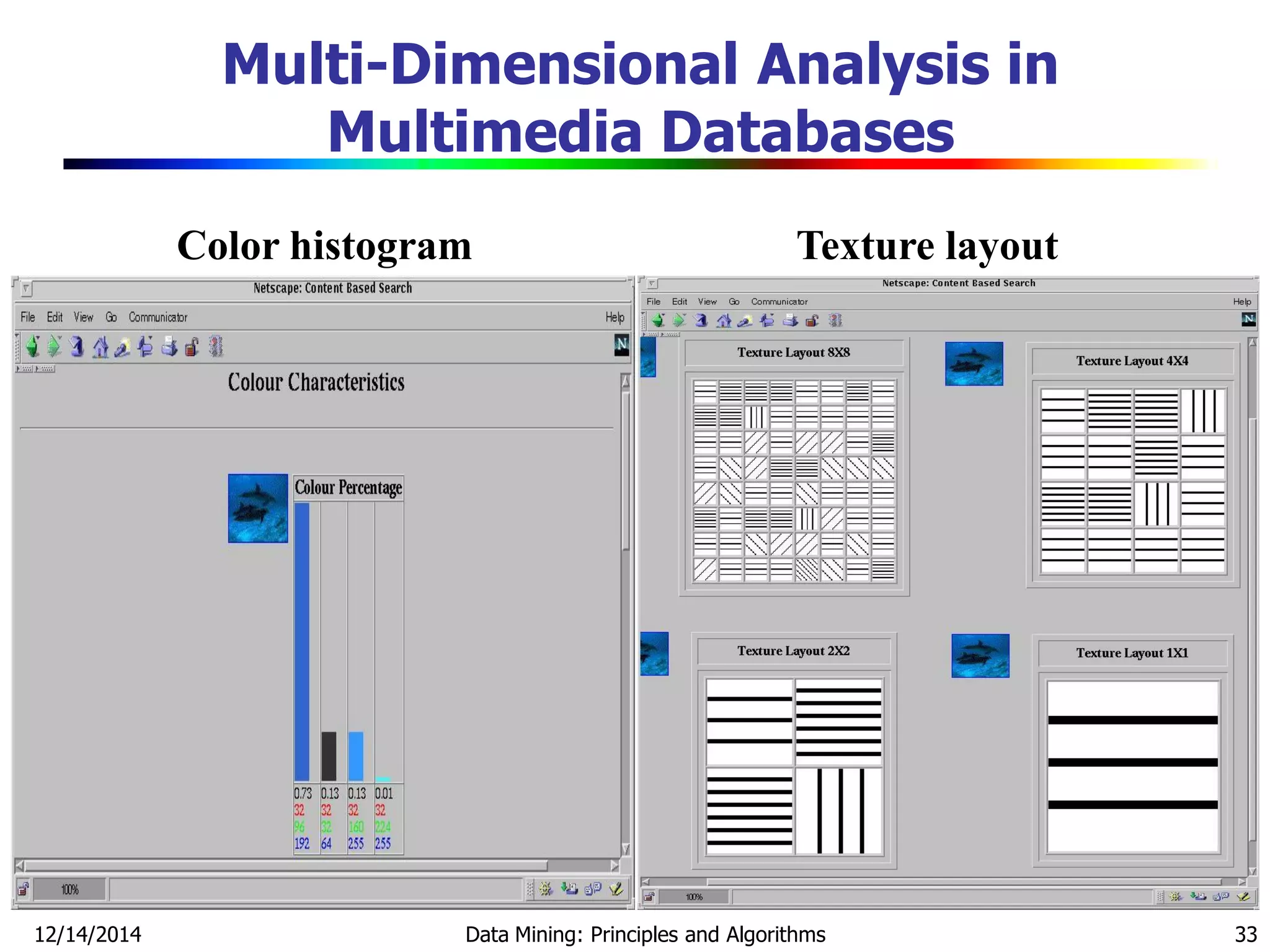
 Color vector: contains the color histogram
 MFC (Most Frequent Color) vector: five color centroids
 MFO (Most Frequent Orientation) vector: five edge orientation
centroids
 Layout descriptor: contains a color layout vector and an
edge layout vector
12/14/2014 Data Mining: Principles and Algorithms 32
Multi-Dimensional Search in
Multimedia Databases
12/14/2014 Data Mining: Principles and Algorithms 33
Color histogram Texture layout
Multi-Dimensional Analysis in
Multimedia Databases
12/14/2014 Data Mining: Principles and Algorithms 34
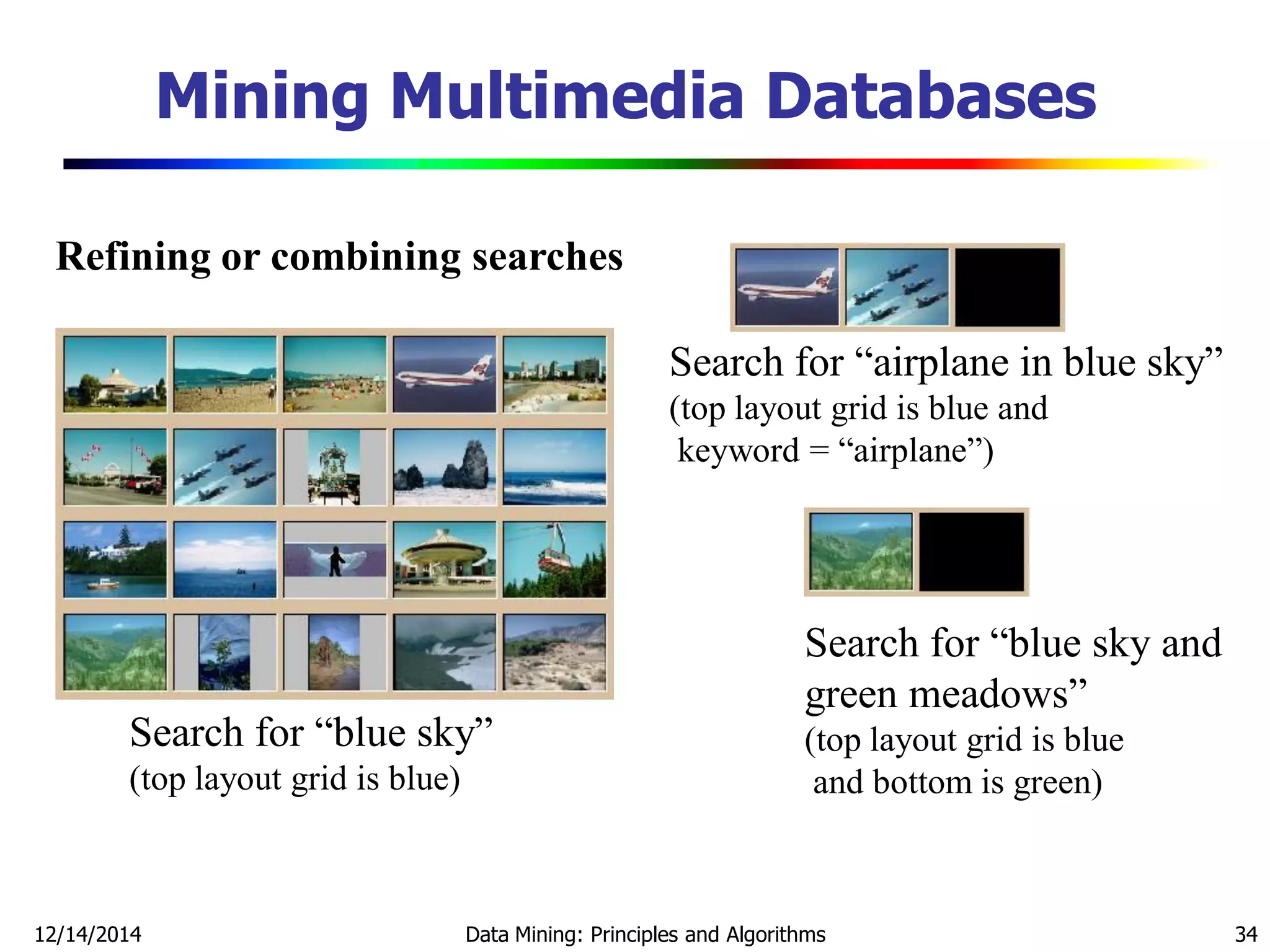
Refining or combining searches
Search for “blue sky”
(top layout grid is blue)
Search for “blue sky and
green meadows”
(top layout grid is blue
and bottom is green)
Search for “airplane in blue sky”
(top layout grid is blue and
keyword = “airplane”)
Mining Multimedia Databases
12/14/2014 Data Mining: Principles and Algorithms 35
RED
WHITE
BLUE
GIFJPEG
By Format
By Colour
Sum
Cross Tab
RED
WHITE
BLUE
Colour
Sum
Group By
Measurement
RED
WHITE
BLUE
By Colour
By Format & Colour
By Format & Size
By Colour & Size
By Format
By Size
Sum
The Data Cube and
the Sub-Space Measurements
• Format of image
• Duration
• Colors
• Textures
• Keywords
• Size
• Width
• Height
• Internet domain of image
• Internet domain of parent pages
• Image popularity
Mining Multimedia Databases
12/14/2014 Data Mining: Principles and Algorithms 36
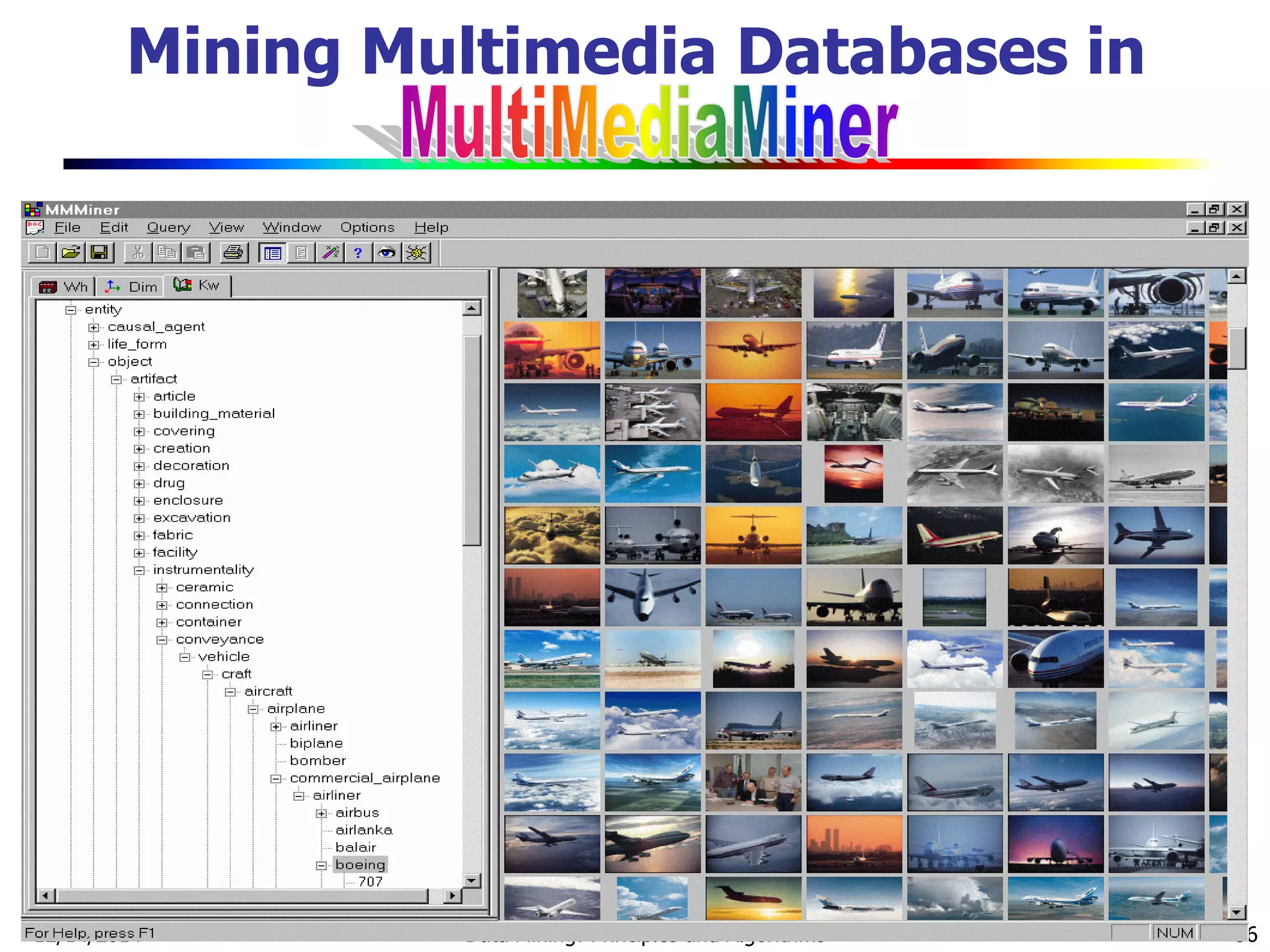
Mining Multimedia Databases in
12/14/2014 Data Mining: Principles and Algorithms 37
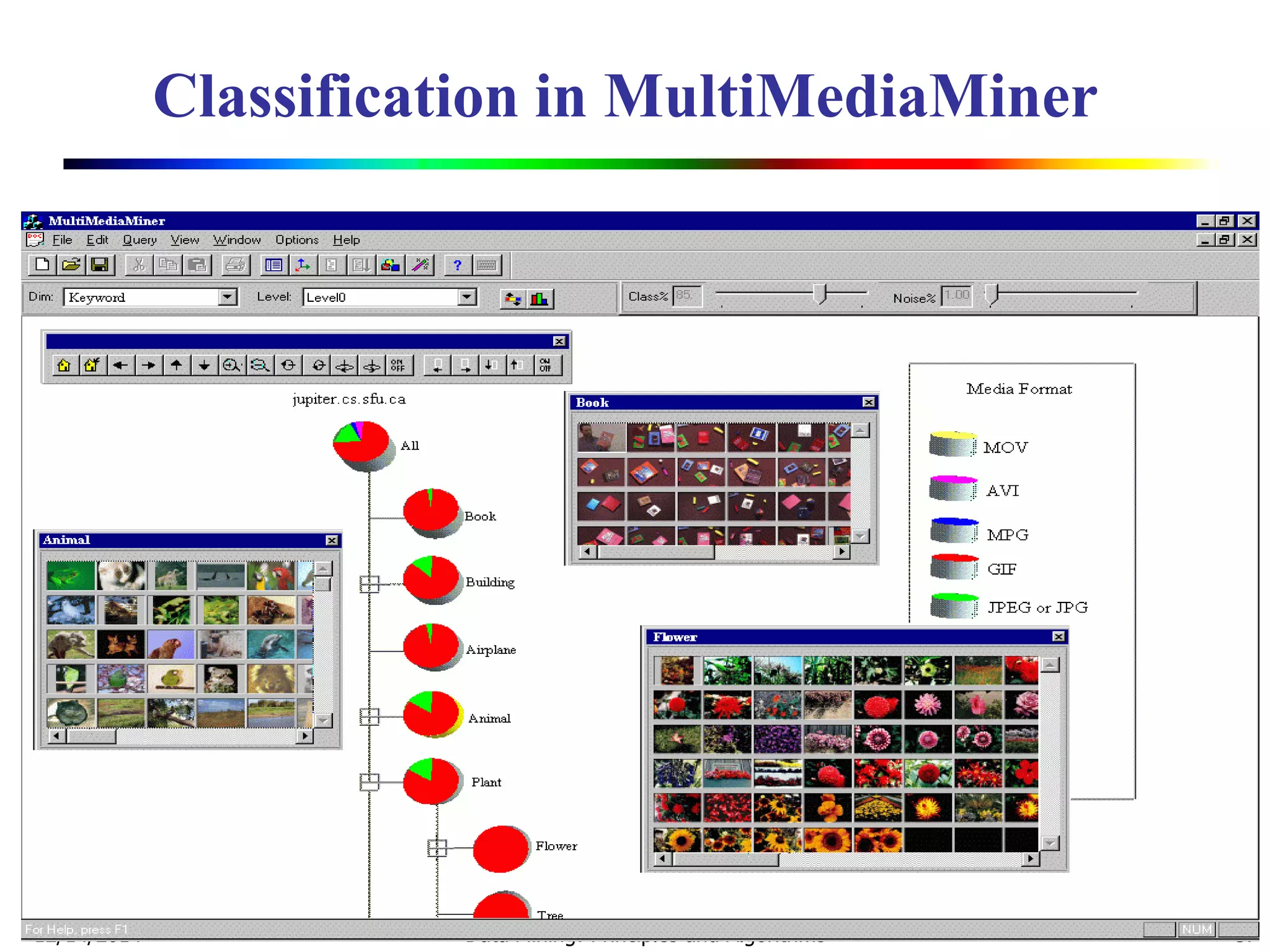
Classification in MultiMediaMiner
Mining Associations in Multimedia Data
 Associations between image content and non-image content
features
 ―If at least 50% of the upper part of the picture is blue, then it is
likely to represent sky.‖
 Associations among image contents that are not related to
spatial relationships
 ―If a picture contains two blue squares, then it is likely to contain one
red circle as well.‖
 Associations among image contents related to spatial
relationships
 ―If a red triangle is between two yellow squares, then it is likely a big
oval-shaped object is underneath.‖
12/14/2014 Data Mining: Principles and Algorithms 38
12/14/2014 Data Mining: Principles and Algorithms 39
 Special features:
 Need # of occurrences besides Boolean existence, e.g.,
 ―Two red square and one blue circle‖ implies theme
―air-show‖
 Need spatial relationships
 Blue on top of white squared object is associated
with brown bottom
 Need multi-resolution and progressive refinement
mining
 It is expensive to explore detailed associations
among objects at high resolution
 It is crucial to ensure the completeness of search at
multi-resolution space
Mining Associations in Multimedia Data
12/14/2014 Data Mining: Principles and Algorithms 40
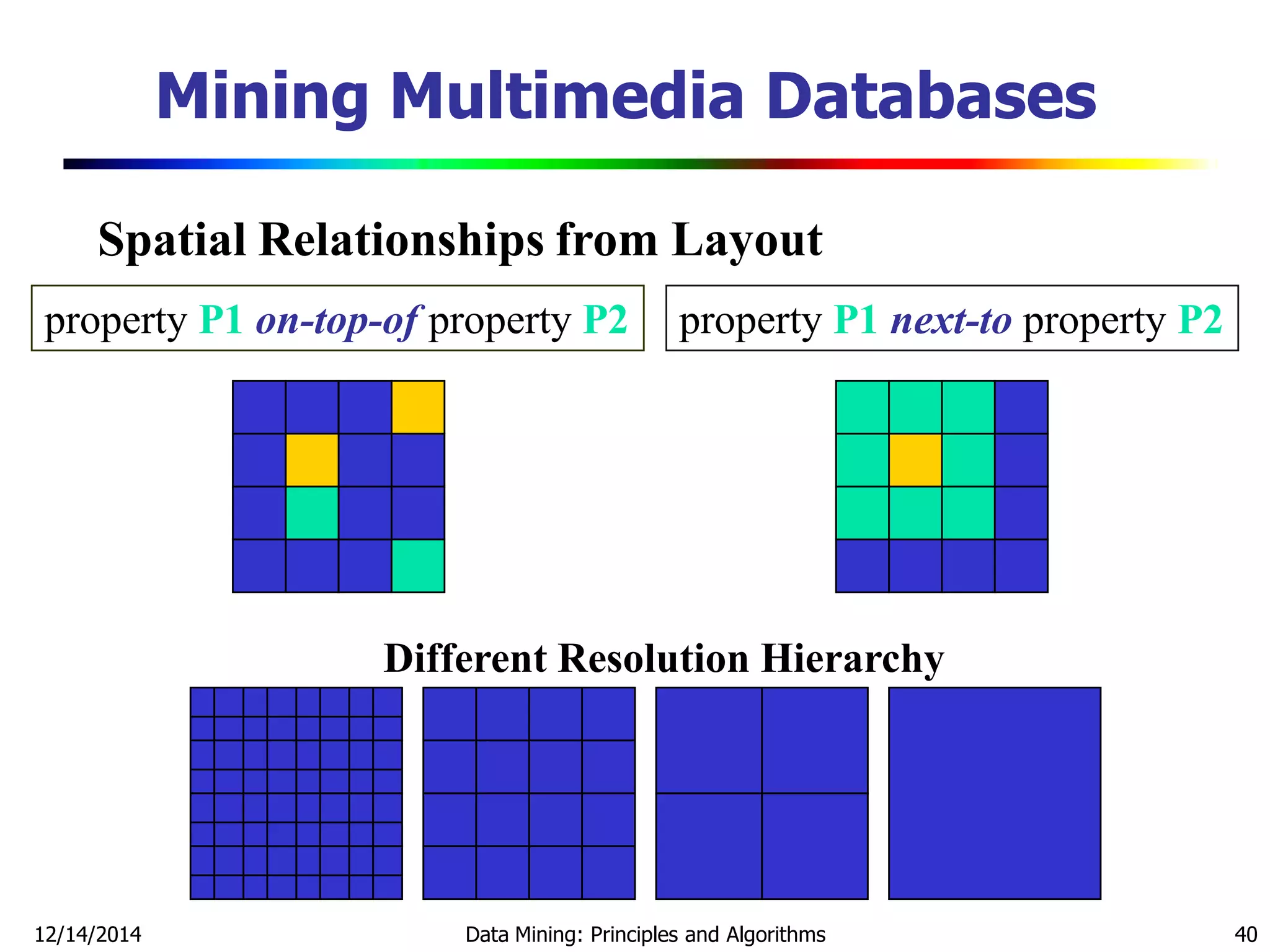
Spatial Relationships from Layout
property P1 next-to property P2property P1 on-top-of property P2
Different Resolution Hierarchy
Mining Multimedia Databases
12/14/2014 Data Mining: Principles and Algorithms 41
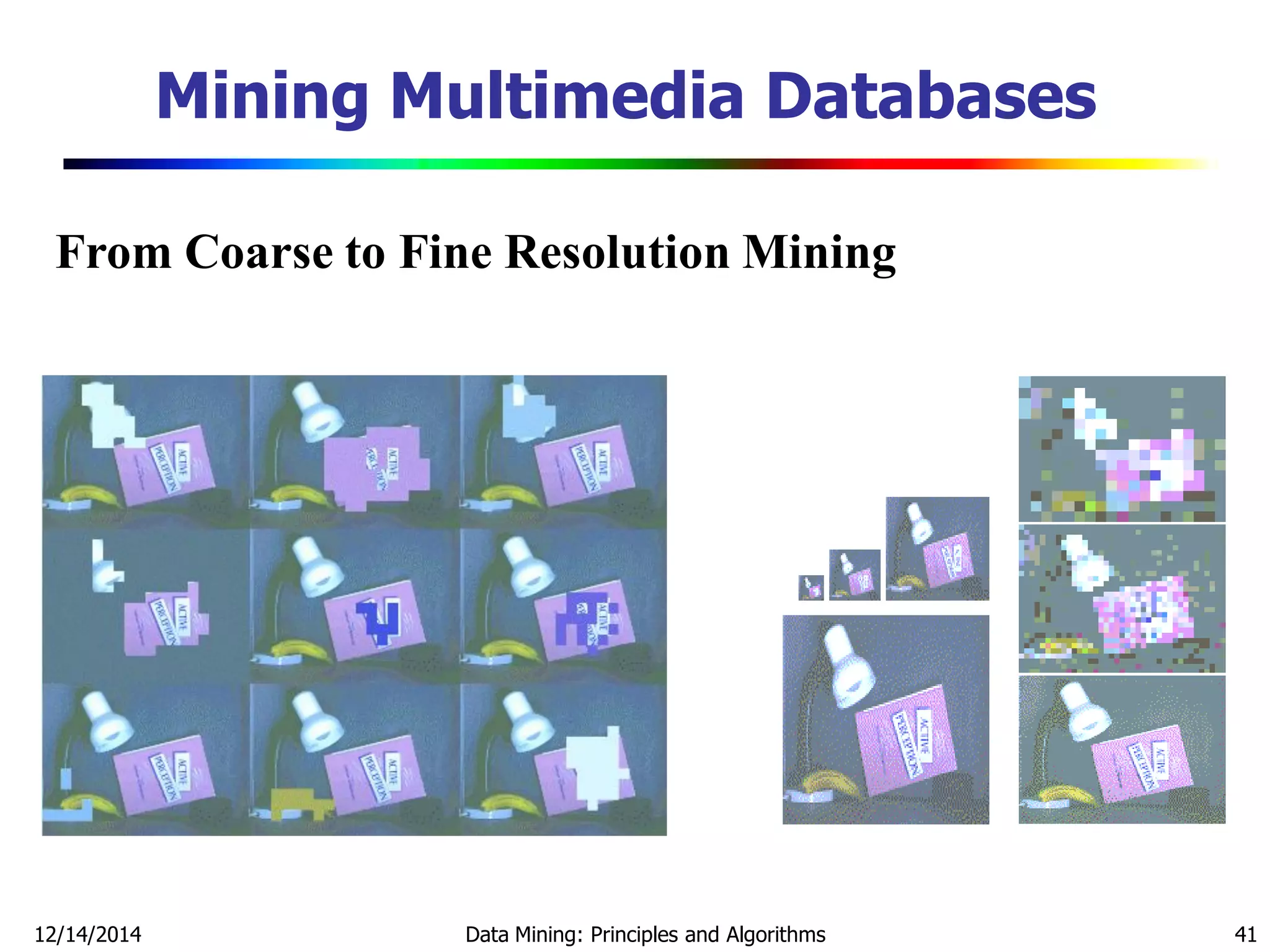
From Coarse to Fine Resolution Mining
Mining Multimedia Databases
12/14/2014 Data Mining: Principles and Algorithms 42
Challenge: Curse of Dimensionality
 Difficult to implement a data cube efficiently given a large
number of dimensions, especially serious in the case of
multimedia data cubes
 Many of these attributes are set-oriented instead of
single-valued
 Restricting number of dimensions may lead to the
modeling of an image at a rather rough, limited, and
imprecise scale
 More research is needed to strike a balance between
efficiency and power of representation
12/14/2014 Data Mining: Principles and Algorithms 43
Summary
 Mining object data needs feature/attribute-based
generalization methods
 Spatial, spatiotemporal and multimedia data mining is one
of important research frontiers in data mining with broad
applications
 Spatial data warehousing, OLAP and mining facilitates
multidimensional spatial analysis and finding spatial
associations, classifications and trends
 Multimedia data mining needs content-based retrieval and
similarity search integrated with mining methods

13584 27 multimedia mining

  • 1.
    12/14/2014 Data Mining:Principles and Algorithms 1 Multimedia Data Mining
  • 2.
    Data Mining  DataMining definition:  A class of database applications that look for hidden patterns in a group of data.  Finding rules of the game knowing the moves of the game  Unifying framework for data representation and problem solving in order to learn and discover from large amounts of different types of data. 12/14/2014 Data Mining: Principles and Algorithms 2
  • 3.
    Multimedia Data Mining Multimedia data types  any type of information medium that can be represented, processed, stored and transmitted over network in digital form  Multi-lingual text, numeric, images, video, audio, graphical, temporal, relational, and categorical data.  Relation with conventional data mining term 12/14/2014 Data Mining: Principles and Algorithms 3
  • 4.
    Definitions  Subfield ofdata mining that deals with an extraction of implicit knowledge, multimedia data relationships, or other patterns not explicitly stored in multimedia databases  Influence on related interdisciplinary fields  Databases – extension of the KDD (rule patterns)  Information systems – multimedia information analysis and retrieval – content-based image and video search and efficient storage organization 12/14/2014 Data Mining: Principles and Algorithms 4
  • 5.
    Information model  Datasegmentation  Multimedia data are divided into logical interconnected segments (objects)  Pattern extraction  Mining and analysis procedures should reveal some relations between objects on the different level  Knowledge representation  Incorporated linked patterns 12/14/2014 Data Mining: Principles and Algorithms 5
  • 6.
    12/14/2014 Data Mining:Principles and Algorithms 6 Generalizing Spatial and Multimedia Data  Spatial data:  Generalize detailed geographic points into clustered regions, such as business, residential, industrial, or agricultural areas, according to land usage  Require the merge of a set of geographic areas by spatial operations  Image data:  Extracted by aggregation and/or approximation  Size, color, shape, texture, orientation, and relative positions and structures of the contained objects or regions in the image  Music data:  Summarize its melody: based on the approximate patterns that repeatedly occur in the segment  Summarized its style: based on its tone, tempo, or the major musical instruments played
  • 7.
    12/14/2014 Data Mining:Principles and Algorithms 7 What Is a Spatial Database System?  Geometric, geographic or spatial data: space-related data  Example: Geographic space (2-D abstraction of earth surface), VLSI design, model of human brain, 3-D space representing the arrangement of chains of protein molecule.  Spatial database system vs. image database systems.  Image database system: handling digital raster image (e.g., satellite sensing, computer tomography), may also contain techniques for object analysis and extraction from images and some spatial database functionality.  Spatial (geometric, geographic) database system: handling objects in space that have identity and well-defined extents, locations, and relationships.
  • 8.
    12/14/2014 Data Mining:Principles and Algorithms 8 Modeling Spatial Objects  What needs to be represented?  Two important alternative views  Single objects: distinct entities arranged in space each of which has its own geometric description  modeling cities, forests, rivers  Spatially related collection of objects: describe space itself (about every point in space)  modeling land use, partition of a country into districts
  • 9.
    12/14/2014 Data Mining:Principles and Algorithms 9 Modeling Single Objects: Point, Line and Region  Point: location only but not extent  Line (or a curve usually represented by a polyline, a sequence of line segment):  moving through space, or connections in space (roads, rivers, cables, etc.)  Region:  Something having extent in 2D-space (country, lake, park). It may have a hole or consist of several disjoint pieces.
  • 10.
    12/14/2014 Data Mining:Principles and Algorithms 10 Spatial Association Analysis  Spatial association rule: A  B [s%, c%]  A and B are sets of spatial or non-spatial predicates  Topological relations: intersects, overlaps, disjoint, etc.  Spatial orientations: left_of, west_of, under, etc.  Distance information: close_to, within_distance, etc.  s% is the support and c% is the confidence of the rule  Examples 1) is_a(x, large_town) ^ intersect(x, highway)  adjacent_to(x, water) [7%, 85%] 2) What kinds of objects are typically located close to golf courses?
  • 11.
    12/14/2014 Data Mining:Principles and Algorithms 11 Progressive Refinement Mining of Spatial Association Rules  Hierarchy of spatial relationship:  g_close_to: near_by, touch, intersect, contain, etc.  First search for rough relationship and then refine it  Two-step mining of spatial association:  Step 1: Rough spatial computation (as a filter)  Using MBR or R-tree for rough estimation  Step2: Detailed spatial algorithm (as refinement)  Apply only to those objects which have passed the rough spatial association test (no less than min_support)
  • 12.
    12/14/2014 Data Mining:Principles and Algorithms 12 Mining Spatial Co-location Rules  Co-location rule is similar to association rule but explore more relying spatial auto-correlation  It leads to efficient processing  It can be integrated with progressive refinement to further improve its performance  Spatial co-location mining idea can be applied to clustering, classification, outlier analysis and other potential mining tasks
  • 13.
    12/14/2014 Data Mining:Principles and Algorithms 13 Spatial Autocorrelation  Spatial data tends to be highly self-correlated  Example: Neighborhood, Temperature  Items in a traditional data are independent of each other, whereas properties of locations in a map are often ―auto-correlated‖.  First law of geography: ―Everything is related to everything, but nearby things are more related than distant things.‖
  • 14.
    12/14/2014 Data Mining:Principles and Algorithms 14 Spatial Autocorrelation (cont’d)
  • 15.
    12/14/2014 Data Mining:Principles and Algorithms 15  Methods in classification  Decision-tree classification, Naïve-Bayesian classifier + boosting, neural network, logistic regression, etc.  Association-based multi-dimensional classification - Example: classifying house value based on proximity to lakes, highways, mountains, etc.  Assuming learning samples are independent of each other  Spatial auto-correlation violates this assumption!  Popular spatial classification methods  Spatial auto-regression (SAR)  Markov random field (MRF) Spatial Classification
  • 16.
    12/14/2014 Data Mining:Principles and Algorithms 16  Function  Detect changes and trends along a spatial dimension  Study the trend of non-spatial or spatial data changing with space  Application examples  Observe the trend of changes of the climate or vegetation with increasing distance from an ocean  Crime rate or unemployment rate change with regard to city geo-distribution Spatial Trend Analysis
  • 17.
    12/14/2014 Data Mining:Principles and Algorithms 17 Spatial Cluster Analysis  Mining clusters—k-means, k-medoids, hierarchical, density-based, etc.  Analysis of distinct features of the clusters
  • 18.
    12/14/2014 Data Mining:Principles and Algorithms 18 Constraints-Based Clustering  Constraints on individual objects  Simple selection of relevant objects before clustering  Clustering parameters as constraints  K-means, density-based: radius, min-# of points  Constraints specified on clusters using SQL aggregates  Sum of the profits in each cluster > $1 million  Constraints imposed by physical obstacles  Clustering with obstructed distance
  • 19.
    12/14/2014 Data Mining:Principles and Algorithms 19 Constrained Clustering: Planning ATM Locations Mountain River Spatial data with obstacles C1 C2 C3 C4 Clustering without taking obstacles into consideration
  • 20.
    12/14/2014 Data Mining:Principles and Algorithms 20 Mining Spatiotemporal Data  Spatiotemporal data  Data has spatial extensions and changes with time  Ex: Forest fire, moving objects, hurricane & earthquakes  Automatic anomaly detection in massive moving objects  Moving objects are ubiquitous: GPS, radar, etc.  Ex: Maritime vessel surveillance  Problem: Automatic anomaly detection
  • 21.
    12/14/2014 Data Mining:Principles and Algorithms 21 Analysis: Mining Anomaly in Moving Objects  Raw analysis of collected data does not fully convey ―anomaly‖ information  More effective analysis relies on higher semantic features  Examples:  A speed boat moving quickly in open water  A fishing boat moving slowly into the docks  A yacht circling slowly around landmark during night hours
  • 22.
    12/14/2014 Data Mining:Principles and Algorithms 22 Framework: Motif-Based Feature Analysis  Motif-based representation  A motif is a prototypical movement pattern  View a movement path as a sequence of motif expressions  Motif-oriented feature space  Automated motif feature extraction  Semantic-level features  Classification  Anomaly detection via classification  High dimensional classifier
  • 23.
    12/14/2014 Data Mining:Principles and Algorithms 23 Movement Motifs  Prototypical movement of object  Right-turn, U-turn  Can be either defined by an expert or discovered automatically from data  Defined in our framework  Extracted in movement paths  Path becomes a set of motif expressions
  • 24.
    12/14/2014 Data Mining:Principles and Algorithms 24 Motif Expression Attributes  Each motif expression has attributes (e.g., speed, location, size)  Attributes express how a motif was expressed  Conveys semantic information useful for classification  a tight circle at 30mph near landmark Y.  A tight circle at 10mph in location X
  • 25.
    12/14/2014 Data Mining:Principles and Algorithms 25 Motif-Oriented Feature Space  Attributes describe how motifs are expressed  Let there be A attributes, each path is a set of (A+1)-tuples {(mi, v1, v2, …, vA), (mj, v1, v2, …, vA)}  Naïve Feature space construction 1. Let each distinct (mj, v1, v2, …, vA) be a feature 2. If path exhibits a particular motif-expression, its value is 1. Otherwise, its value is 0.
  • 26.
    12/14/2014 Data Mining:Principles and Algorithms 26 Similarity Search in Multimedia Data  Description-based retrieval systems  Build indices and perform object retrieval based on image descriptions, such as keywords, captions, size, and time of creation  Labor-intensive if performed manually  Results are typically of poor quality if automated  Content-based retrieval systems  Support retrieval based on the image content, such as color histogram, texture, shape, objects, and wavelet transforms
  • 27.
    12/14/2014 Data Mining:Principles and Algorithms 27 Queries in Content-Based Retrieval Systems  Image sample-based queries  Find all of the images that are similar to the given image sample  Compare the feature vector (signature) extracted from the sample with the feature vectors of images that have already been extracted and indexed in the image database  Image feature specification queries  Specify or sketch image features like color, texture, or shape, which are translated into a feature vector  Match the feature vector with the feature vectors of the images in the database
  • 28.
    12/14/2014 Data Mining:Principles and Algorithms 28 Approaches Based on Image Signature  Color histogram-based signature  The signature includes color histograms based on color composition of an image regardless of its scale or orientation  No information about shape, location, or texture  Two images with similar color composition may contain very different shapes or textures, and thus could be completely unrelated in semantics  Multifeature composed signature  Define different distance functions for color, shape, location, and texture, and subsequently combine them to derive the overall result
  • 29.
    12/14/2014 Data Mining:Principles and Algorithms 29 Wavelet Analysis  Wavelet-based signature  Use the dominant wavelet coefficients of an image as its signature  Wavelets capture shape, texture, and location information in a single unified framework  Improved efficiency and reduced the need for providing multiple search primitives  May fail to identify images containing similar objects that are in different locations.
  • 30.
    12/14/2014 Data Mining:Principles and Algorithms 30 One Signature for the Entire Image?  Walnus: [NRS99] by Natsev, Rastogi, and Shim  Similar images may contain similar regions, but a region in one image could be a translation or scaling of a matching region in the other  Wavelet-based signature with region-based granularity  Define regions by clustering signatures of windows of varying sizes within the image  Signature of a region is the centroid of the cluster  Similarity is defined in terms of the fraction of the area of the two images covered by matching pairs of regions from two images
  • 31.
    12/14/2014 Data Mining:Principles and Algorithms 31 Multidimensional Analysis of Multimedia Data  Multimedia data cube  Design and construction similar to that of traditional data cubes from relational data  Contain additional dimensions and measures for multimedia information, such as color, texture, and shape  The database does not store images but their descriptors  Feature descriptor: a set of vectors for each visual characteristic  Color vector: contains the color histogram  MFC (Most Frequent Color) vector: five color centroids  MFO (Most Frequent Orientation) vector: five edge orientation centroids  Layout descriptor: contains a color layout vector and an edge layout vector
  • 32.
    12/14/2014 Data Mining:Principles and Algorithms 32 Multi-Dimensional Search in Multimedia Databases
  • 33.
    12/14/2014 Data Mining:Principles and Algorithms 33 Color histogram Texture layout Multi-Dimensional Analysis in Multimedia Databases
  • 34.
    12/14/2014 Data Mining:Principles and Algorithms 34 Refining or combining searches Search for “blue sky” (top layout grid is blue) Search for “blue sky and green meadows” (top layout grid is blue and bottom is green) Search for “airplane in blue sky” (top layout grid is blue and keyword = “airplane”) Mining Multimedia Databases
  • 35.
    12/14/2014 Data Mining:Principles and Algorithms 35 RED WHITE BLUE GIFJPEG By Format By Colour Sum Cross Tab RED WHITE BLUE Colour Sum Group By Measurement RED WHITE BLUE By Colour By Format & Colour By Format & Size By Colour & Size By Format By Size Sum The Data Cube and the Sub-Space Measurements • Format of image • Duration • Colors • Textures • Keywords • Size • Width • Height • Internet domain of image • Internet domain of parent pages • Image popularity Mining Multimedia Databases
  • 36.
    12/14/2014 Data Mining:Principles and Algorithms 36 Mining Multimedia Databases in
  • 37.
    12/14/2014 Data Mining:Principles and Algorithms 37 Classification in MultiMediaMiner
  • 38.
    Mining Associations inMultimedia Data  Associations between image content and non-image content features  ―If at least 50% of the upper part of the picture is blue, then it is likely to represent sky.‖  Associations among image contents that are not related to spatial relationships  ―If a picture contains two blue squares, then it is likely to contain one red circle as well.‖  Associations among image contents related to spatial relationships  ―If a red triangle is between two yellow squares, then it is likely a big oval-shaped object is underneath.‖ 12/14/2014 Data Mining: Principles and Algorithms 38
  • 39.
    12/14/2014 Data Mining:Principles and Algorithms 39  Special features:  Need # of occurrences besides Boolean existence, e.g.,  ―Two red square and one blue circle‖ implies theme ―air-show‖  Need spatial relationships  Blue on top of white squared object is associated with brown bottom  Need multi-resolution and progressive refinement mining  It is expensive to explore detailed associations among objects at high resolution  It is crucial to ensure the completeness of search at multi-resolution space Mining Associations in Multimedia Data
  • 40.
    12/14/2014 Data Mining:Principles and Algorithms 40 Spatial Relationships from Layout property P1 next-to property P2property P1 on-top-of property P2 Different Resolution Hierarchy Mining Multimedia Databases
  • 41.
    12/14/2014 Data Mining:Principles and Algorithms 41 From Coarse to Fine Resolution Mining Mining Multimedia Databases
  • 42.
    12/14/2014 Data Mining:Principles and Algorithms 42 Challenge: Curse of Dimensionality  Difficult to implement a data cube efficiently given a large number of dimensions, especially serious in the case of multimedia data cubes  Many of these attributes are set-oriented instead of single-valued  Restricting number of dimensions may lead to the modeling of an image at a rather rough, limited, and imprecise scale  More research is needed to strike a balance between efficiency and power of representation
  • 43.
    12/14/2014 Data Mining:Principles and Algorithms 43 Summary  Mining object data needs feature/attribute-based generalization methods  Spatial, spatiotemporal and multimedia data mining is one of important research frontiers in data mining with broad applications  Spatial data warehousing, OLAP and mining facilitates multidimensional spatial analysis and finding spatial associations, classifications and trends  Multimedia data mining needs content-based retrieval and similarity search integrated with mining methods