Prakash.g
• Lean production focuses on eliminating waste in processes (i.e. the
waste of work in progress and finished good inventories)
• Lean production is about expanding capacity by reducing costs and
shortening cycle times between order and ship date
• Lean is about understanding what is important to the customer
• Lean production is not about eliminating people
2
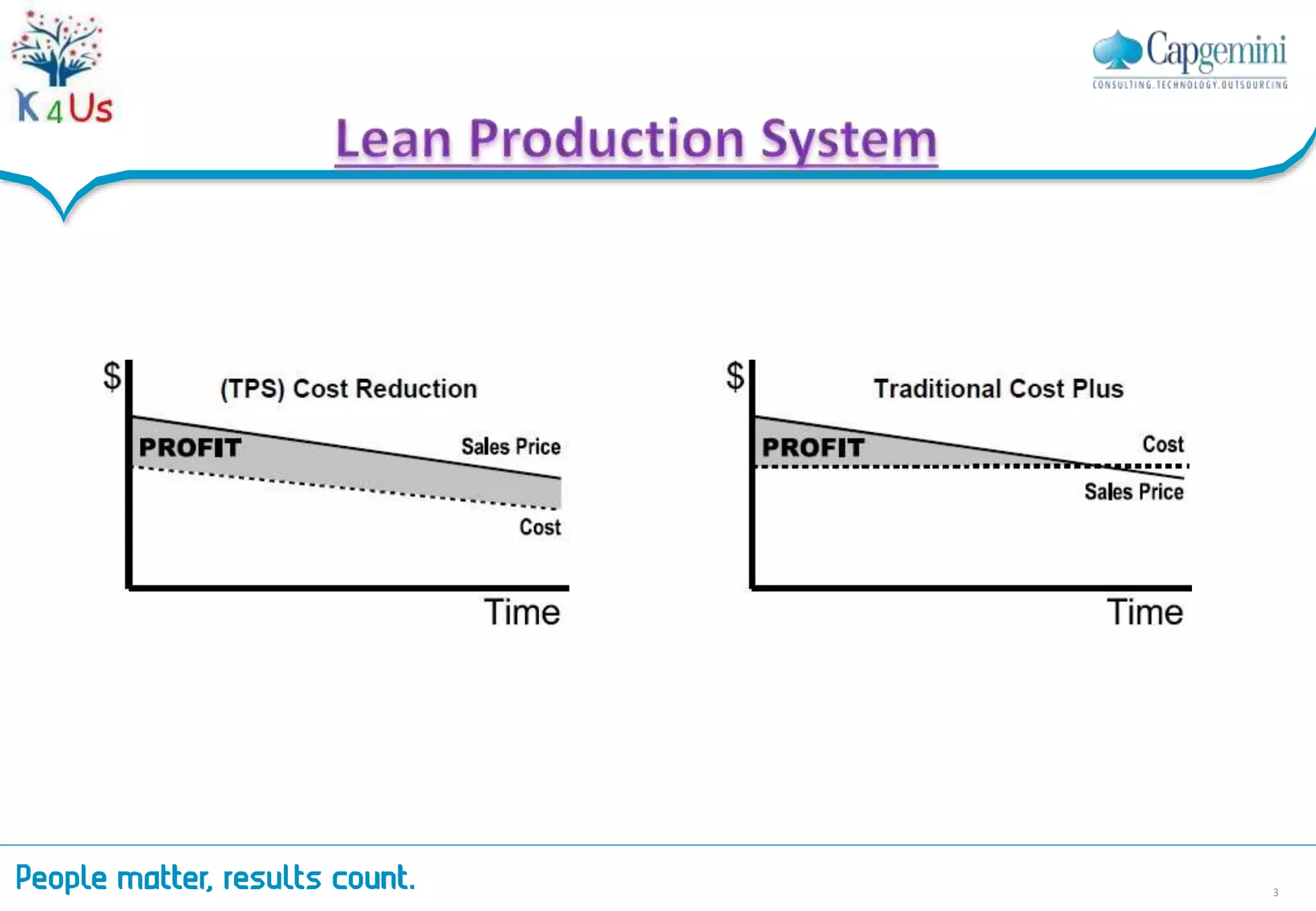
3
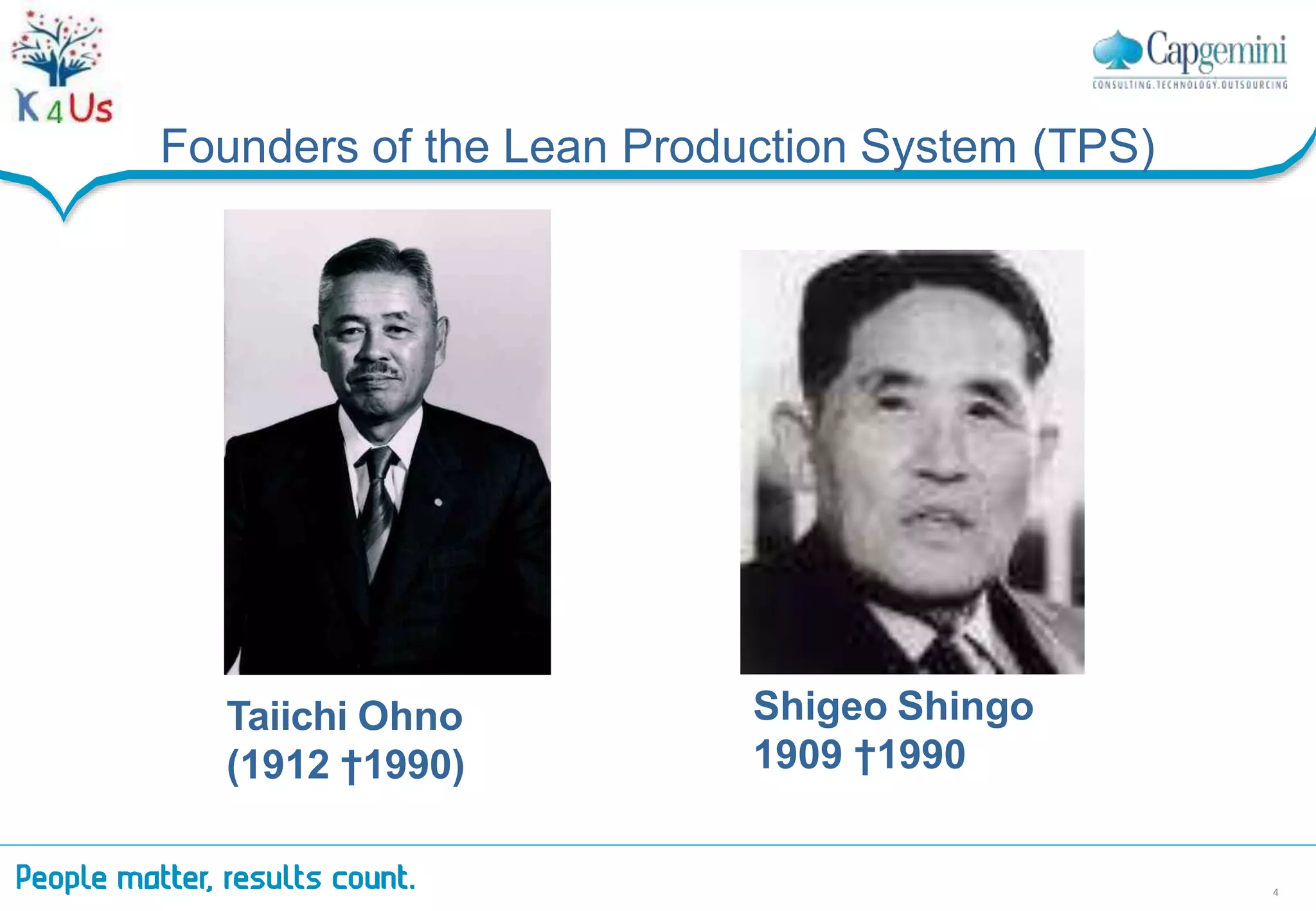
Taiichi Ohno
(1912 †1990)
Shigeo Shingo
1909 †1990
4
Founders of the Lean Production System (TPS)
Lean Production System
5
• The production system developed by Toyota motor corporation to
provide best quality, lowest cost, and shortest lead time through the
eliminating of waste.
• The Lean production system was established on two concepts:
– JIDOKA: Automation with a human touch, means that when the problem
occurs, the equipment stops immediately, preventing defective product from
being produced.
– JUST-IN-TIME: In which each process produces only what is needed by the
next process in a continuous flow.
Toyota/Lean Production System house
6
Just-In-Time Systems
What is JIT ?
JIT is a philosophy of continuous improvement in which
non-value-adding activities (or wastes) are identified and removed for the purposes
of:
 Reducing Cost
 Improving Quality
 Improving Performance
 Improving Delivery
 Adding Flexibility
 Increase innovativeness
7
 Producing only what is needed, when it is needed
(not early, not late; not less, not more)
 Achieving high volume production using minimal
inventories
 An integrated but simplified system
 JIT’s mandate:
Elimination of all waste in production effort
Just-In-Time Systems
8
 Attacks waste (anything not adding value to the product)
 Achieves streamlined production by reducing inventory
 Exposes problems and bottlenecks caused by variability
9
What Does Just-in-Time Do?
Waste (“muda” in Japanese) is ‘anything other than the minimum
amount of equipment, materials, parts, space, and worker’s time,
which are absolutely essential to add value to the product.’
— Shoichiro Toyoda
Founder, Toyota
© 1995 Corel Corp.
10
What is Waste?
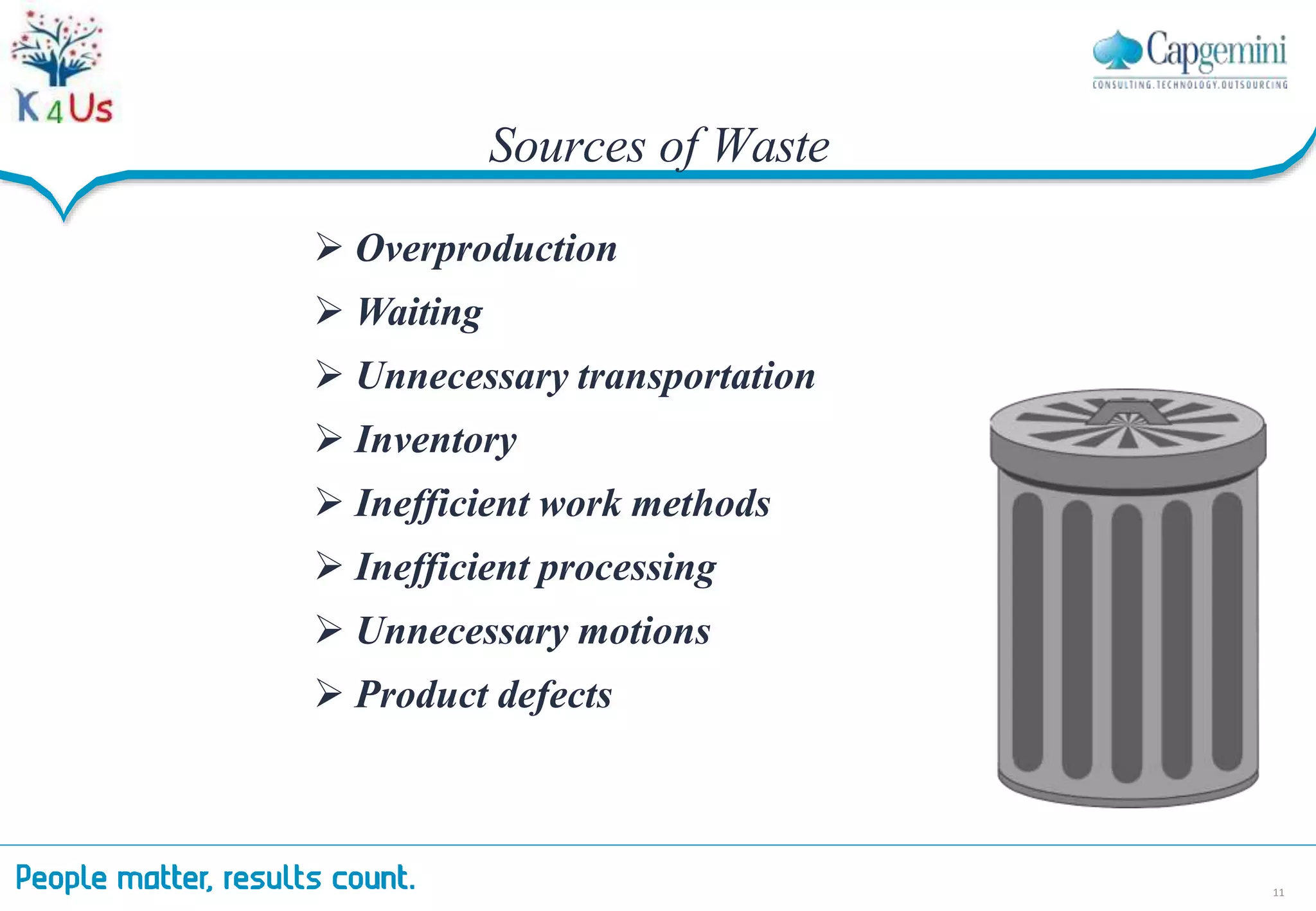
Sources of Waste
 Overproduction
 Waiting
 Unnecessary transportation
 Inventory
 Inefficient work methods
 Inefficient processing
 Unnecessary motions
 Product defects
11
Waste in Operations (1 of 3)
12
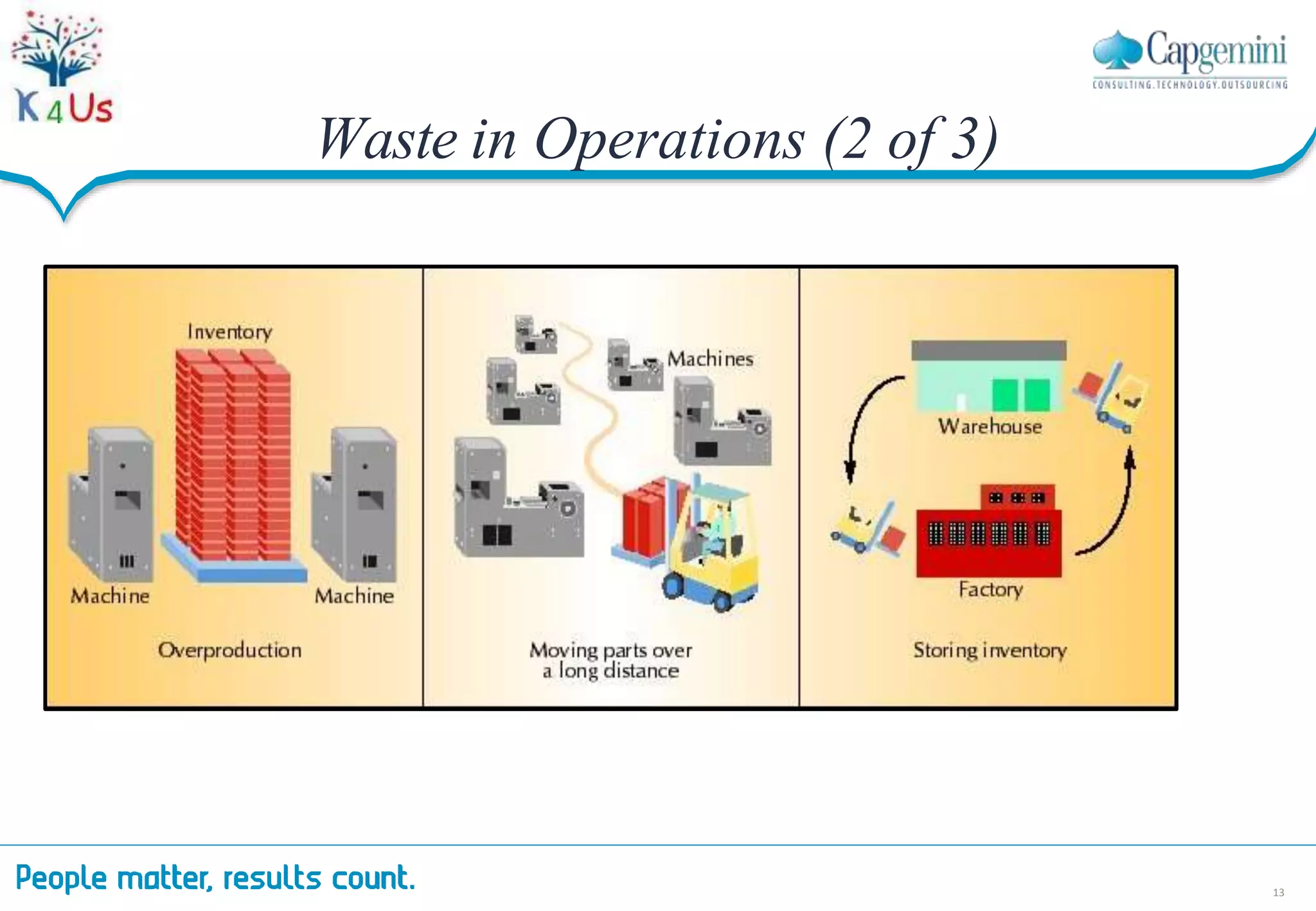
Waste in Operations (2 of 3)
13
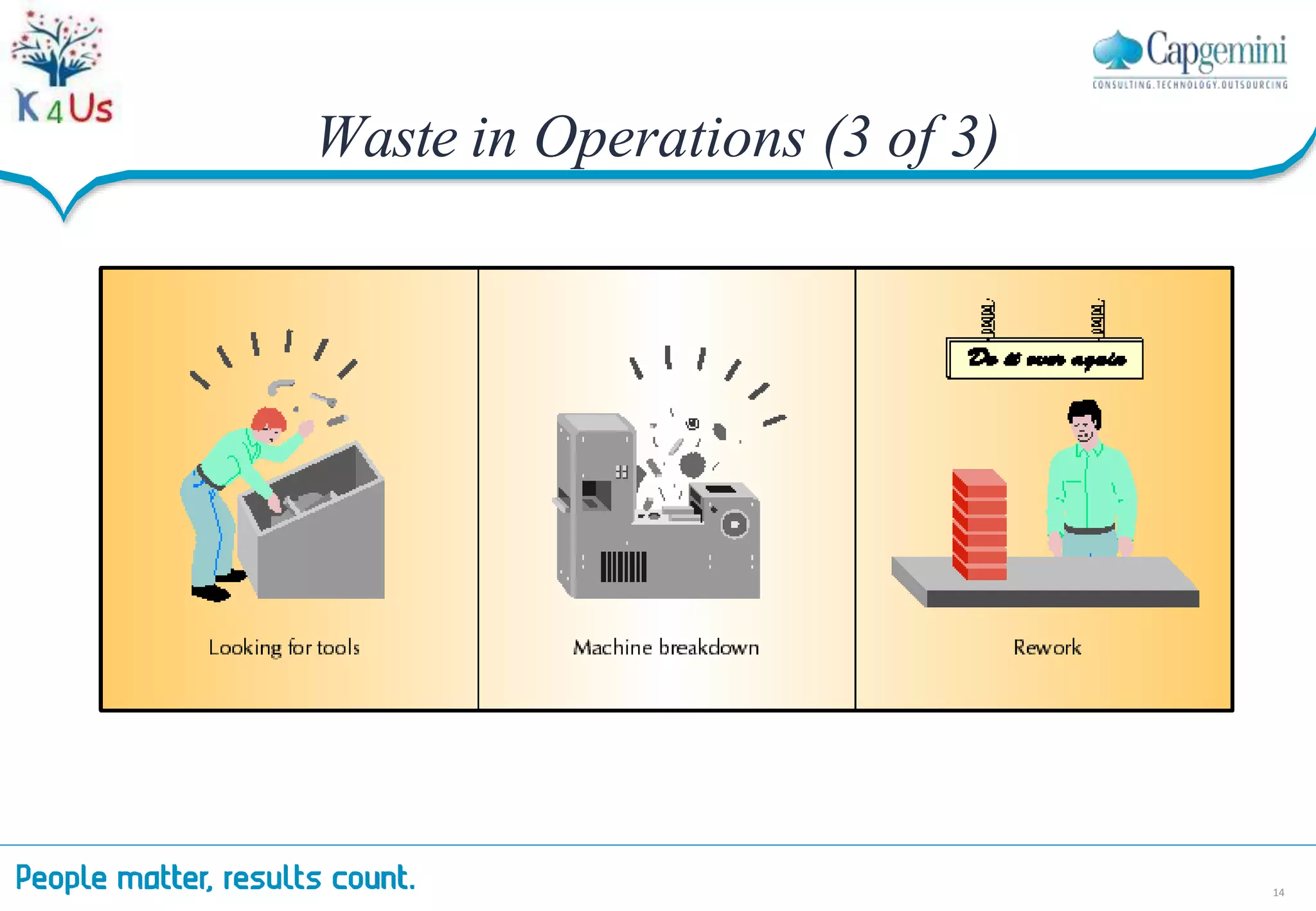
Waste in Operations (3 of 3)
14
Main Components of JIT
 Pull System
 Continuous Flow Processing
 Takt Time
 Flexible Workforce (Shojinka)
 3 M’s
15
Just-In-Time
The Pull System
16
Pull System is a flexible and simple method of controlling/balancing the
flow of resources.
Produce only when your customer demands the product in the required
quantity.
Run the production according to this demand
Pull System consists of:
– Production based on actual consumption
– Small Lots
– Low inventories
– Management by Sight
– Better Communication
The Pull & Push System
17
Continuous/One-Piece Flow
18
Producing and moving one item at a time (or a small and consistent batch of
items) through a series of processing steps as continuously as possible, with
each step making just what is requested by the next step.
It is also called the one-piece flow, single-piece flow, and make one & move
one.
Continuous/One-Piece Flow
19
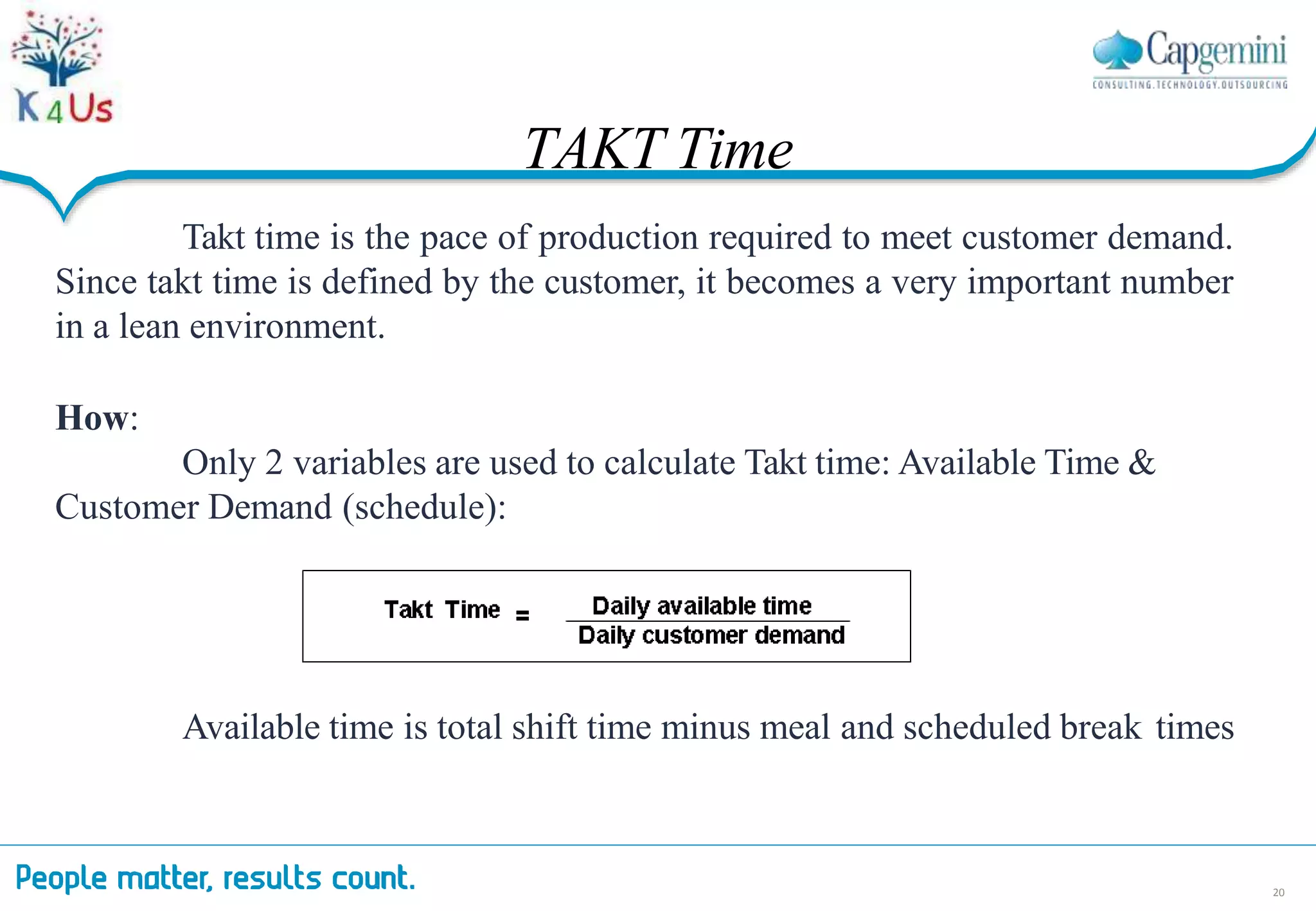
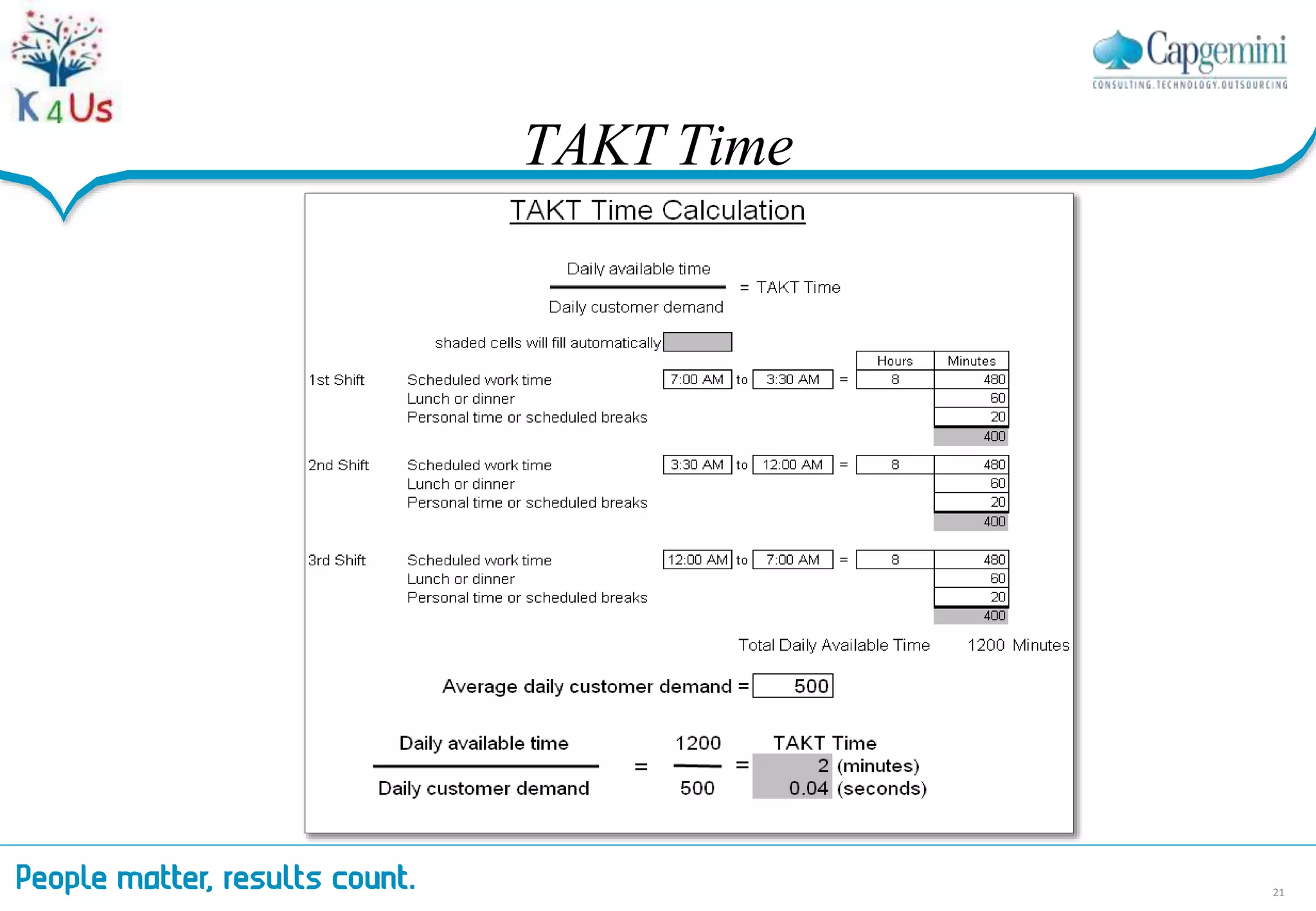
Takt time is the pace of production required to meet customer demand.
Since takt time is defined by the customer, it becomes a very important number
in a lean environment.
How:
Only 2 variables are used to calculate Takt time: Available Time &
Customer Demand (schedule):
Available time is total shift time minus meal and scheduled break times
TAKT Time
20
TAKT Time
21
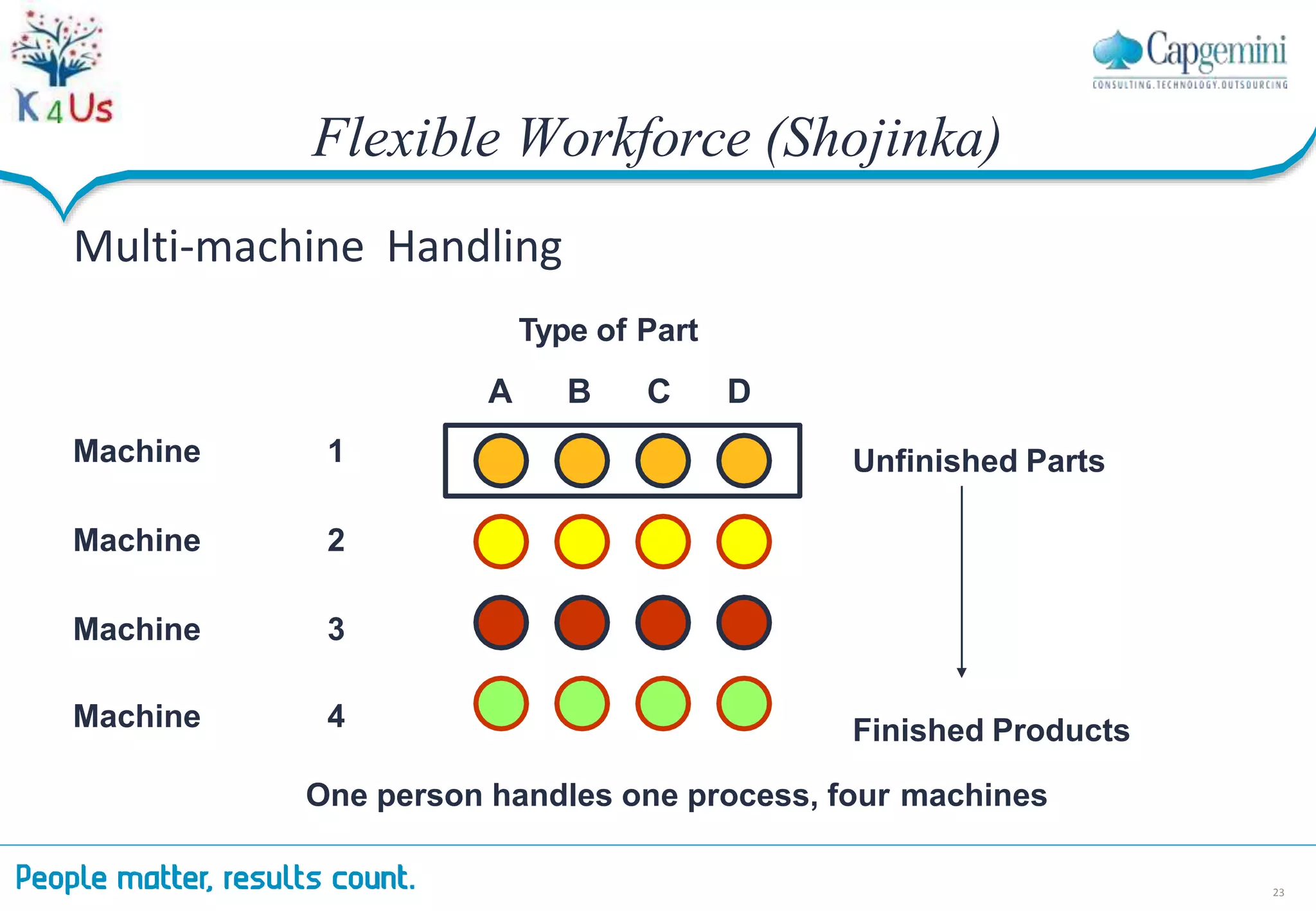
Flexible Workforce (Shojinka):
Flexible workforce or shojinka means to alter (decrease or increase)
the number of operators within a shop, to equip with demand changes.
Continually optimizing the number of workers in a work center to
meet the type and volume of demand imposed on the work center. Creating
Flow and Eliminating Waste.
22
Flexible Workforce (Shojinka)
Multi-machine Handling
Type of Part
A B C D
Machine 1
Machine 2
Machine 3
Machine 4
One person handles one process, four machines
Unfinished Parts
Finished Products
Flexible Workforce (Shojinka)
23
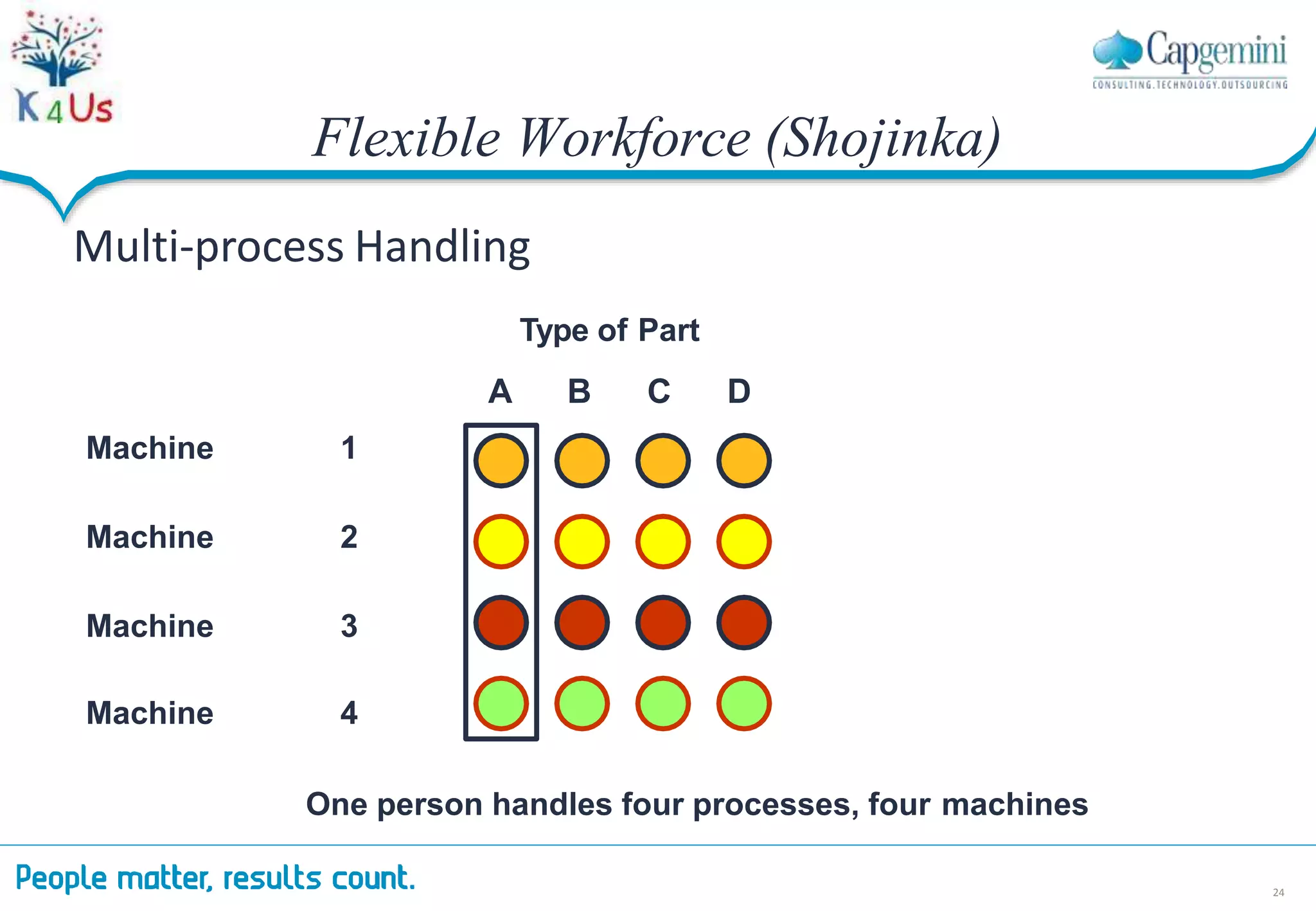
Flexible Workforce (Shojinka)
24
Multi-process Handling
Type of Part
A B C D
Machine 1
Machine 2
Machine 3
Machine 4
One person handles four processes, four machines
3 M’s
MUDA = Non-Value Added
MURA = Overburden
MURI = Unevenness
25
3 M’s
1 TON
4 ton
26
Capacity : 4 tons
Muda . Mura . Muri
12 TONS
X 2 = MURI (OVERBURDEN)
27
X 6 = MUDA (NON-VALUE ADDED)
= MURA (UNEVENNESS)
Muda . Mura . Muri
The most efficient way to deliver 12 tons of good to the destination is:
NO MURI (OVERBURDEN)
X 3 = NO MUDA (NO WASTAGE)
NO MURA (NO UNEVENNESS)
28
Muda . Mura . Muri
Kanban
What is Kanban?
• Card system that controls production & inventory
•Communicates demand for work or materials from the preceding station
29
Kanban is one of the Lean tools designed to reduce the idle time in a production
process. The main idea behind the Kanban system is to deliver what the process
needs exactly when it needs it.
In Japanese, the word “Kan” means “card" and "ban" means “signal," so Kanban
refers to signal cards. Lean uses visual cards as a signaling system that triggers an
action to supply the process with its needs either from an external supplier or from
a warehouse.
30
Kanban
Kanban
31
 Reduction of eliminating non-value added activities
 Reduction of floor space and warehouse space per unit of output
 Reduction of setup time and schedule delays as the factory becomes a
continuous production process.
 Reduction of waste and rework by detecting errors at the source.
 Better utilization of machines and facilities.
 Better integration of and communication between functions such as
marketing, purchasing, design, and production.
 Quality control built into the process.
32
Benefits of JIT
Jidoka - Automation
33
What is Jidoka/Automation?
Providing machines and operators the ability to detect when an abnormal
condition has occurred and immediately stop work. This enables operations
to build in quality at each process and to separate men and machines for
more efficient work.
Jidoka highlights the causes of problems because work stops immediately
when a problem first occurs. This leads to improvements in the processes
that build in quality by eliminating the root causes of defects.
Jidoka - Automation
34
Jidoka - Automation
35
Jidoka Steps
1. Detect the abnormality.
2. Stop.
3. Fix or correct the immediate condition.
4. Investigate the root cause and install a countermeasure.
Why Jidoka?
• Increase quality
• Lower costs
• Improve customer service
• Reduce lead time
36
Jidoka - Automation
Prevention Techniques
37
• Poka Yoke - Mistake-Proofing
– Visual control of quality
– Prevents defects from happening
• Andons
– Commonly lights to signal production line status
• Red: line stopped
• Yellow: call for help
• Green: all normal
– Andon signals require immediate attention
Poka Yoke – Mistake Proofing
38
What is it for?
• To eliminate the possibility or opportunity for passing on errors or
making mistakes in a process.
Where could we use it?
• In the development or improvement of any process.
• When you want to make wrong actions impossible or more difficult to do.
• When there is a need to make it possible to reverse actions
• When you need to make it easier to discover that errors occur.
Poka Yoke - Examples
Spellcheck:
39
Andon
Andon is an information tool which provides instant, visible and audible
warning to the Operations team that there is a abnormality within that
area.
When the equipment shuts down because of a quality problem, flags or light,
usually with accompanying music, signal that help is needed to solve the
problem.
This signaling system is called the andon system.
40
Visual Management Andon Lamp
• Red - line stoppage
• Yellow - call for help
• Green - normal operation
41
Benefits of Lean Production
42
Lean will improve:
Quality performance, fewer defects and rework.
Fewer Machine and Process Breakdowns.
Lower levels of Inventory.
Greater levels of Stock Turnover.
Less Space Required.
Higher efficiencies, more output per man hour.
Improved delivery performance.
Faster Development.
Greater Customer Satisfaction.
HIGHER PROFITS!
INCREASED BUSINESS!
43
44
45

13. lean production system pgp

  • 1.
  • 2.
    • Lean productionfocuses on eliminating waste in processes (i.e. the waste of work in progress and finished good inventories) • Lean production is about expanding capacity by reducing costs and shortening cycle times between order and ship date • Lean is about understanding what is important to the customer • Lean production is not about eliminating people 2
  • 3.
  • 4.
    Taiichi Ohno (1912 †1990) ShigeoShingo 1909 †1990 4 Founders of the Lean Production System (TPS)
  • 5.
    Lean Production System 5 •The production system developed by Toyota motor corporation to provide best quality, lowest cost, and shortest lead time through the eliminating of waste. • The Lean production system was established on two concepts: – JIDOKA: Automation with a human touch, means that when the problem occurs, the equipment stops immediately, preventing defective product from being produced. – JUST-IN-TIME: In which each process produces only what is needed by the next process in a continuous flow.
  • 6.
  • 7.
    Just-In-Time Systems What isJIT ? JIT is a philosophy of continuous improvement in which non-value-adding activities (or wastes) are identified and removed for the purposes of:  Reducing Cost  Improving Quality  Improving Performance  Improving Delivery  Adding Flexibility  Increase innovativeness 7
  • 8.
     Producing onlywhat is needed, when it is needed (not early, not late; not less, not more)  Achieving high volume production using minimal inventories  An integrated but simplified system  JIT’s mandate: Elimination of all waste in production effort Just-In-Time Systems 8
  • 9.
     Attacks waste(anything not adding value to the product)  Achieves streamlined production by reducing inventory  Exposes problems and bottlenecks caused by variability 9 What Does Just-in-Time Do?
  • 10.
    Waste (“muda” inJapanese) is ‘anything other than the minimum amount of equipment, materials, parts, space, and worker’s time, which are absolutely essential to add value to the product.’ — Shoichiro Toyoda Founder, Toyota © 1995 Corel Corp. 10 What is Waste?
  • 11.
    Sources of Waste Overproduction  Waiting  Unnecessary transportation  Inventory  Inefficient work methods  Inefficient processing  Unnecessary motions  Product defects 11
  • 12.
  • 13.
  • 14.
  • 15.
    Main Components ofJIT  Pull System  Continuous Flow Processing  Takt Time  Flexible Workforce (Shojinka)  3 M’s 15 Just-In-Time
  • 16.
    The Pull System 16 PullSystem is a flexible and simple method of controlling/balancing the flow of resources. Produce only when your customer demands the product in the required quantity. Run the production according to this demand Pull System consists of: – Production based on actual consumption – Small Lots – Low inventories – Management by Sight – Better Communication
  • 17.
    The Pull &Push System 17
  • 18.
    Continuous/One-Piece Flow 18 Producing andmoving one item at a time (or a small and consistent batch of items) through a series of processing steps as continuously as possible, with each step making just what is requested by the next step. It is also called the one-piece flow, single-piece flow, and make one & move one.
  • 19.
  • 20.
    Takt time isthe pace of production required to meet customer demand. Since takt time is defined by the customer, it becomes a very important number in a lean environment. How: Only 2 variables are used to calculate Takt time: Available Time & Customer Demand (schedule): Available time is total shift time minus meal and scheduled break times TAKT Time 20
  • 21.
  • 22.
    Flexible Workforce (Shojinka): Flexibleworkforce or shojinka means to alter (decrease or increase) the number of operators within a shop, to equip with demand changes. Continually optimizing the number of workers in a work center to meet the type and volume of demand imposed on the work center. Creating Flow and Eliminating Waste. 22 Flexible Workforce (Shojinka)
  • 23.
    Multi-machine Handling Type ofPart A B C D Machine 1 Machine 2 Machine 3 Machine 4 One person handles one process, four machines Unfinished Parts Finished Products Flexible Workforce (Shojinka) 23
  • 24.
    Flexible Workforce (Shojinka) 24 Multi-processHandling Type of Part A B C D Machine 1 Machine 2 Machine 3 Machine 4 One person handles four processes, four machines
  • 25.
    3 M’s MUDA =Non-Value Added MURA = Overburden MURI = Unevenness 25 3 M’s
  • 26.
    1 TON 4 ton 26 Capacity: 4 tons Muda . Mura . Muri 12 TONS
  • 27.
    X 2 =MURI (OVERBURDEN) 27 X 6 = MUDA (NON-VALUE ADDED) = MURA (UNEVENNESS) Muda . Mura . Muri
  • 28.
    The most efficientway to deliver 12 tons of good to the destination is: NO MURI (OVERBURDEN) X 3 = NO MUDA (NO WASTAGE) NO MURA (NO UNEVENNESS) 28 Muda . Mura . Muri
  • 29.
    Kanban What is Kanban? •Card system that controls production & inventory •Communicates demand for work or materials from the preceding station 29
  • 30.
    Kanban is oneof the Lean tools designed to reduce the idle time in a production process. The main idea behind the Kanban system is to deliver what the process needs exactly when it needs it. In Japanese, the word “Kan” means “card" and "ban" means “signal," so Kanban refers to signal cards. Lean uses visual cards as a signaling system that triggers an action to supply the process with its needs either from an external supplier or from a warehouse. 30 Kanban
  • 31.
  • 32.
     Reduction ofeliminating non-value added activities  Reduction of floor space and warehouse space per unit of output  Reduction of setup time and schedule delays as the factory becomes a continuous production process.  Reduction of waste and rework by detecting errors at the source.  Better utilization of machines and facilities.  Better integration of and communication between functions such as marketing, purchasing, design, and production.  Quality control built into the process. 32 Benefits of JIT
  • 33.
    Jidoka - Automation 33 Whatis Jidoka/Automation? Providing machines and operators the ability to detect when an abnormal condition has occurred and immediately stop work. This enables operations to build in quality at each process and to separate men and machines for more efficient work. Jidoka highlights the causes of problems because work stops immediately when a problem first occurs. This leads to improvements in the processes that build in quality by eliminating the root causes of defects.
  • 34.
  • 35.
  • 36.
    Jidoka Steps 1. Detectthe abnormality. 2. Stop. 3. Fix or correct the immediate condition. 4. Investigate the root cause and install a countermeasure. Why Jidoka? • Increase quality • Lower costs • Improve customer service • Reduce lead time 36 Jidoka - Automation
  • 37.
    Prevention Techniques 37 • PokaYoke - Mistake-Proofing – Visual control of quality – Prevents defects from happening • Andons – Commonly lights to signal production line status • Red: line stopped • Yellow: call for help • Green: all normal – Andon signals require immediate attention
  • 38.
    Poka Yoke –Mistake Proofing 38 What is it for? • To eliminate the possibility or opportunity for passing on errors or making mistakes in a process. Where could we use it? • In the development or improvement of any process. • When you want to make wrong actions impossible or more difficult to do. • When there is a need to make it possible to reverse actions • When you need to make it easier to discover that errors occur.
  • 39.
    Poka Yoke -Examples Spellcheck: 39
  • 40.
    Andon Andon is aninformation tool which provides instant, visible and audible warning to the Operations team that there is a abnormality within that area. When the equipment shuts down because of a quality problem, flags or light, usually with accompanying music, signal that help is needed to solve the problem. This signaling system is called the andon system. 40
  • 41.
    Visual Management AndonLamp • Red - line stoppage • Yellow - call for help • Green - normal operation 41
  • 42.
    Benefits of LeanProduction 42 Lean will improve: Quality performance, fewer defects and rework. Fewer Machine and Process Breakdowns. Lower levels of Inventory. Greater levels of Stock Turnover. Less Space Required. Higher efficiencies, more output per man hour. Improved delivery performance. Faster Development. Greater Customer Satisfaction. HIGHER PROFITS! INCREASED BUSINESS!
  • 43.
  • 44.
  • 45.