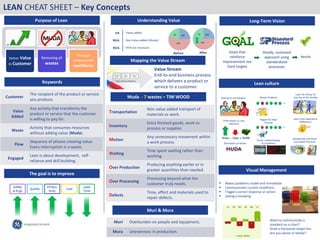
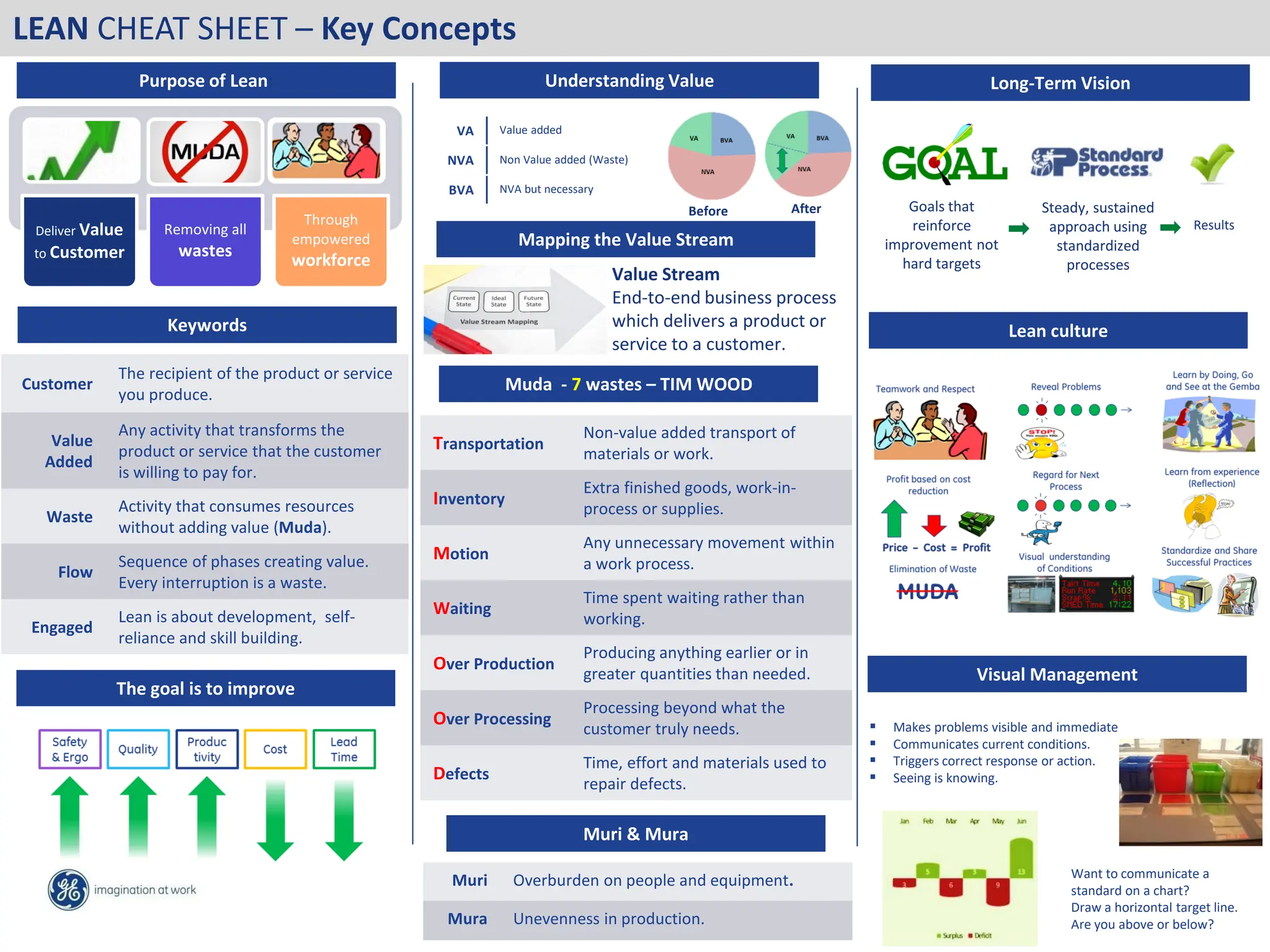
LEAN CHEAT SHEET – Key Concepts
Purpose of Lean:
Deliver Value
to Customer
Removing all
wastes
Through
empowered
workforce
Customer
The recipient of the product or service
you produce.
Value
Added
Any activity that transforms the
product or service that the customer
is willing to pay for.
Waste
Activity that consumes resources
without adding value (Muda).
Flow
Sequence of phases creating value.
Every interruption is a waste.
Engaged
Lean is about development, self-
reliance and skill building.
The goal is to improve
Understanding Value
Mapping the Value Stream
Value Stream
End-to-end business process
which delivers a product or
service to a customer.
Muda - 7 wastes – TIM WOOD
Muri Overburden on people and equipment.
Mura Unevenness in production.
Lean culture
Long-Term Vision
Goals that
reinforce
improvement not
hard targets
Steady, sustained
approach using
standardized
processes
Results
Keywords
Muri & Mura
Before After
VA Value added
NVA Non Value added (Waste)
BVA NVA but necessary
Transportation
Non-value added transport of
materials or work.
Inventory
Extra finished goods, work-in-
process or supplies.
Motion
Any unnecessary movement within
a work process.
Waiting
Time spent waiting rather than
working.
Over Production
Producing anything earlier or in
greater quantities than needed.
Over Processing
Processing beyond what the
customer truly needs.
Defects
Time, effort and materials used to
repair defects.
Visual Management
▪ Makes problems visible and immediate
▪ Communicates current conditions.
▪ Triggers correct response or action.
▪ Seeing is knowing.
Want to communicate a
standard on a chart?
Draw a horizontal target line.
Are you above or below?
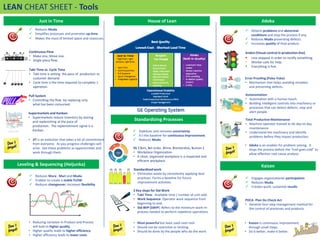
LEAN CHEAT SHEET - Tools
Leveling & Sequencing (Heijunka)
Standardizing Processes
Just in Time
✓ Reduces Mura , Muri and Muda.
✓ Enabler to create a stable FLOW.
✓ Reduces changeover; increases flexibility.
✓ Stabilizes and removes uncertainty.
✓ It’s the baseline for continuous improvement.
✓ Reduces Muda.
• Most powerful but least used Lean tool.
• Should not be restrictive or limiting.
• Should be done by the people who do the work.
House of Lean Jidoka
Andon (Visual control in production line)
Error Proofing (Poka-Yoke)
• Mechanism that helps avoiding mistakes
and preventing defects.
Autonomation
• Automation with a human touch.
• Building intelligent controls into machinery or
processes that can detect defects, stop and
alert people.
Total Productive Maintenance
• Machine operator trained to do day-to-day
maintenance.
• Understand the machinery and identify
problems before they impact production.
✓ Detects problems and abnormal
conditions and stop the process if any.
✓ Reduces Muda preventing defects.
✓ Increases quality of final product.
• Jidoka is an enabler for problem solving. It
stops the process before the “trail goes cold” to
allow effective root cause analysis.
Takt Time vs. Cycle Time
• Takt time is setting the pace of production to
customer demand
• Cycle time is the time required to complete 1
operation.
Continuous Flow
• Make one, Move one.
• Single piece flow.
Pull System
• Controlling the flow by replacing only
what has been consumed.
5S ( Sort, Set order, Shine, Standardize, Sustain )
• Workplace Organization
• A clean, organized workplace is a respected and
efficient workplace.
✓ Reduces Muda.
✓ Simplifies processes and promotes up-time.
✓ Makes the most of limited space and resources.
• JIT is an evolution that takes a lot of commitment
from everyone. As you progress challenges will
arise. See these problems as opportunities and
work through them.
Supermarkets and Kanban
• Supermarkets reduce inventory by storing
and replenishing at the pace of
production. The replenishment signal is a
Kanban.
• Reducing variation in Product and Process
will lead to higher quality.
• Higher quality leads to higher efficiency.
• Higher efficiency leads to lower costs.
Standardized work
• Eliminates waste by consistently applying best
practices. Forms a baseline for future
improvement activities.
▪ Line stopped in order to rectify something.
▪ Worker calls for help.
▪ Everything is fine.
Kaizen
• Kaizen is continuous improvement
through small Steps.
• Do it better, make it better.
✓ Engages organizational participation
✓ Reduces Muda.
✓ Creates quick, sustained results
PDCA- Plan Do Check Act
• Iterative four-step management method for
the control of processes and products.
3 Key steps for Std Work
• Takt Time: Available time / number of unit sold.
• Work Sequence: Operator work sequence from
beginning to end.
• Std WIP (SWIP): Refers to the minimum work-in-
process needed to perform repetitive operations.

Understanding and concept Lean cheat sheet.pdf

  • 1.
    LEAN CHEAT SHEET– Key Concepts Purpose of Lean: Deliver Value to Customer Removing all wastes Through empowered workforce Customer The recipient of the product or service you produce. Value Added Any activity that transforms the product or service that the customer is willing to pay for. Waste Activity that consumes resources without adding value (Muda). Flow Sequence of phases creating value. Every interruption is a waste. Engaged Lean is about development, self- reliance and skill building. The goal is to improve Understanding Value Mapping the Value Stream Value Stream End-to-end business process which delivers a product or service to a customer. Muda - 7 wastes – TIM WOOD Muri Overburden on people and equipment. Mura Unevenness in production. Lean culture Long-Term Vision Goals that reinforce improvement not hard targets Steady, sustained approach using standardized processes Results Keywords Muri & Mura Before After VA Value added NVA Non Value added (Waste) BVA NVA but necessary Transportation Non-value added transport of materials or work. Inventory Extra finished goods, work-in- process or supplies. Motion Any unnecessary movement within a work process. Waiting Time spent waiting rather than working. Over Production Producing anything earlier or in greater quantities than needed. Over Processing Processing beyond what the customer truly needs. Defects Time, effort and materials used to repair defects. Visual Management ▪ Makes problems visible and immediate ▪ Communicates current conditions. ▪ Triggers correct response or action. ▪ Seeing is knowing. Want to communicate a standard on a chart? Draw a horizontal target line. Are you above or below?
  • 2.
    LEAN CHEAT SHEET- Tools Leveling & Sequencing (Heijunka) Standardizing Processes Just in Time ✓ Reduces Mura , Muri and Muda. ✓ Enabler to create a stable FLOW. ✓ Reduces changeover; increases flexibility. ✓ Stabilizes and removes uncertainty. ✓ It’s the baseline for continuous improvement. ✓ Reduces Muda. • Most powerful but least used Lean tool. • Should not be restrictive or limiting. • Should be done by the people who do the work. House of Lean Jidoka Andon (Visual control in production line) Error Proofing (Poka-Yoke) • Mechanism that helps avoiding mistakes and preventing defects. Autonomation • Automation with a human touch. • Building intelligent controls into machinery or processes that can detect defects, stop and alert people. Total Productive Maintenance • Machine operator trained to do day-to-day maintenance. • Understand the machinery and identify problems before they impact production. ✓ Detects problems and abnormal conditions and stop the process if any. ✓ Reduces Muda preventing defects. ✓ Increases quality of final product. • Jidoka is an enabler for problem solving. It stops the process before the “trail goes cold” to allow effective root cause analysis. Takt Time vs. Cycle Time • Takt time is setting the pace of production to customer demand • Cycle time is the time required to complete 1 operation. Continuous Flow • Make one, Move one. • Single piece flow. Pull System • Controlling the flow by replacing only what has been consumed. 5S ( Sort, Set order, Shine, Standardize, Sustain ) • Workplace Organization • A clean, organized workplace is a respected and efficient workplace. ✓ Reduces Muda. ✓ Simplifies processes and promotes up-time. ✓ Makes the most of limited space and resources. • JIT is an evolution that takes a lot of commitment from everyone. As you progress challenges will arise. See these problems as opportunities and work through them. Supermarkets and Kanban • Supermarkets reduce inventory by storing and replenishing at the pace of production. The replenishment signal is a Kanban. • Reducing variation in Product and Process will lead to higher quality. • Higher quality leads to higher efficiency. • Higher efficiency leads to lower costs. Standardized work • Eliminates waste by consistently applying best practices. Forms a baseline for future improvement activities. ▪ Line stopped in order to rectify something. ▪ Worker calls for help. ▪ Everything is fine. Kaizen • Kaizen is continuous improvement through small Steps. • Do it better, make it better. ✓ Engages organizational participation ✓ Reduces Muda. ✓ Creates quick, sustained results PDCA- Plan Do Check Act • Iterative four-step management method for the control of processes and products. 3 Key steps for Std Work • Takt Time: Available time / number of unit sold. • Work Sequence: Operator work sequence from beginning to end. • Std WIP (SWIP): Refers to the minimum work-in- process needed to perform repetitive operations.