PROBABILISTIC CONSOLIDATION OF VIRTUAL 
MACHINES IN SELF-ORGANIZING CLOUD DATA 
CENTERS 
ABSTRACT: 
Power efficiency is one of the main issues that will drive 
the design of data centers, especially of those devoted to provide 
Cloud computing services. In virtualized data centers, 
consolidation of Virtual Machines (VMs) on the minimum 
number of physical servers has been recognized as a very 
efficient approach, as this allows unloaded servers to be 
switched off or used to accommodate more load, which is 
clearly a cheaper alternative to buy more resources. The 
consolidation problem must be solved on multiple dimensions, 
since in modern data centers CPU is not the only critical 
resource: depending on the characteristics of the workload other 
resources, for example, RAM and bandwidth, can become the 
bottleneck. The problem is so complex that centralized and 
deterministic solutions are practically useless in large data
centers with hundreds or thousands of servers. This paper 
presents ecoCloud, a selforganizing and adaptive approach for 
the consolidation of VMs on two resources, namely CPU and 
RAM. Decisions on the assignment and migration of VMs are 
driven by probabilistic processes and are based exclusively on 
local information, which makes the approach very simple to 
implement. Both a fluid-like mathematical model and 
experiments on a real data center show that the approach rapidly 
consolidates the workload, and CPU-bound and RAM-bound 
VMs are balanced, so that both resources are exploited 
efficiently. 
EXISTING SYSTEM: 
In the past few years important results have been achieved 
in terms of energy consumption reduction, especially by 
improving the efficiency of cooling and power supplying 
facilities in data centers. The Power Usage Effectiveness (PUE) 
index, defined as the ratio of the overall power entering the data
center and the power devoted to computing facilities, had typical 
values between 2 and 3 only a few years ago, while now big 
Cloud companies have reached values lower than 1.1. However, 
much space remains for the optimization of the computing 
facilities themselves. It has been estimated that most of the time 
servers operate at 10-50 percent of their full capacity [2], [3]. 
This low utilization is also caused by the intrinsic variability of 
VMs’ workload: the data center is planned to sustain the peaks 
of load, while for long periods of time (for example, during 
nights and weekends), the load is much lower [4], [5]. Since an 
active but idle server consumes between 50 and 70 percent of 
the power consumed when it is fully utilized [6], a large amount 
of energy is used even at low utilization. 
DISADVANTAGES OF EXISTING SYSTEM: 
· It is power consuming. 
· Large amount of energy is used even at low utilization.
PROBLEM STATEMENT: 
The ever increasing demand for computing resources has 
led companies and resource providers to build large warehouse-sized 
data centers, which require a significant amount of power 
to be operated and hence consume a lot of energy. 
SCOPE: 
The optimal assignment of VM’s to reduce the power 
consumption. 
PROPOSED SYSTEM: 
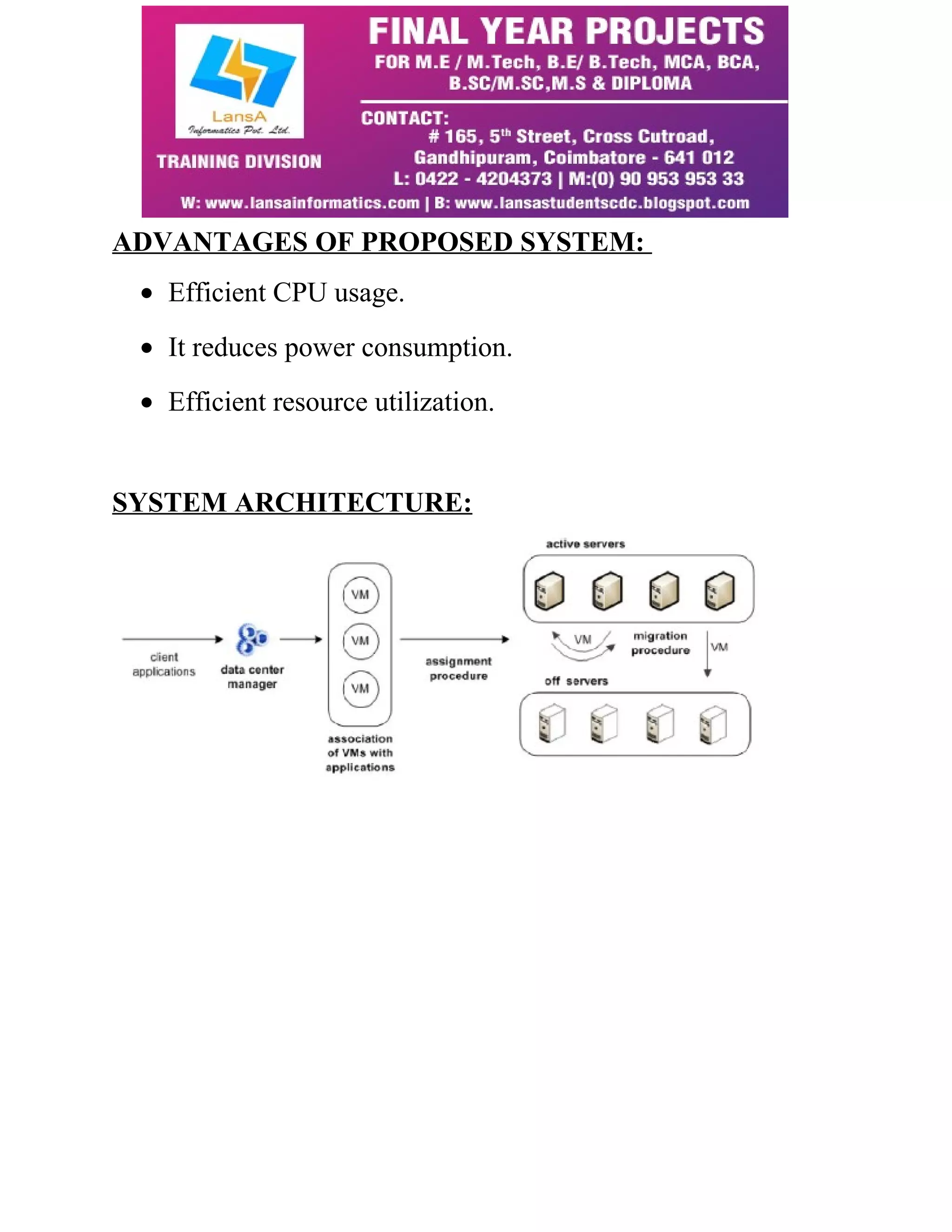
We presented ecoCloud, an approach for consolidating 
VMs on a single computing resource, i.e., the CPU. Here, the 
approach is extended to the multidimension problem, and is 
presented for the specific case in which VMs are consolidated 
with respect to two resources: CPU and RAM. With ecoCloud, 
VMs are consolidated using two types of probabilistic 
procedures, for the assignment and the migration of VMs. Both 
procedures aim at increasing the utilization of servers and 
consolidating the workload dynamically, with the twofold
objective of saving electrical costs and respecting the Service 
Level Agreements stipulated with users. All this is done by 
demanding the key decisions to single servers, while the data 
center manager is only requested to properly combine such local 
decisions. The approach is partly inspired by the ant algorithms 
used first by Deneubourg et al. [9], and subsequently by a wide 
research community, to model the behavior of ant colonies and 
solve many complex distributed problems. The characteristics 
inherited by such algorithms make ecoCloud novel and different 
from other solutions. Among such characteristics: 1) the use of 
the swarm intelligence paradigm, which allows a complex 
problem to be solved by combining simple operations performed 
by many autonomous actors (the single servers in our case); 2) 
the use of probabilistic procedures, inspired by those that model 
the operations of real ants; and 3) the self-organizing behavior of 
system, which ensures that the assignment of VMs to servers 
dynamically adapts to the varying workload.
ADVANTAGES OF PROPOSED SYSTEM: 
· Efficient CPU usage. 
· It reduces power consumption. 
· Efficient resource utilization. 
SYSTEM ARCHITECTURE:
SYSTEM CONFIGURATION:- 
HARDWARE REQUIREMENTS:- 
 Processor - Pentium –IV 
 Speed - 1.1 Ghz 
 RAM - 512 MB(min) 
 Hard Disk - 40 GB 
 Key Board - Standard Windows Keyboard 
 Mouse - Two or Three Button Mouse 
 Monitor - LCD/LED 
SOFTWARE REQUIREMENTS: 
• Operating system : Windows XP 
• Coding Language : Java 
• Data Base : MySQL 
• Tool : Net Beans IDE
REFERENCE: 
Carlo Mastroianni, Michela Meo and Giuseppe Papuzzo “Probabilistic 
Consolidation of Virtual Machines in Self-Organizing Cloud Data Centers” 
IEEE TRANSACTIONS ON CLOUD COMPUTING, VOL. 1, NO. 2, JULY-DECEMBER 
2013.

Probabilistic consolidation of virtual machines in self organizing cloud data centers

  • 1.
    PROBABILISTIC CONSOLIDATION OFVIRTUAL MACHINES IN SELF-ORGANIZING CLOUD DATA CENTERS ABSTRACT: Power efficiency is one of the main issues that will drive the design of data centers, especially of those devoted to provide Cloud computing services. In virtualized data centers, consolidation of Virtual Machines (VMs) on the minimum number of physical servers has been recognized as a very efficient approach, as this allows unloaded servers to be switched off or used to accommodate more load, which is clearly a cheaper alternative to buy more resources. The consolidation problem must be solved on multiple dimensions, since in modern data centers CPU is not the only critical resource: depending on the characteristics of the workload other resources, for example, RAM and bandwidth, can become the bottleneck. The problem is so complex that centralized and deterministic solutions are practically useless in large data
  • 2.
    centers with hundredsor thousands of servers. This paper presents ecoCloud, a selforganizing and adaptive approach for the consolidation of VMs on two resources, namely CPU and RAM. Decisions on the assignment and migration of VMs are driven by probabilistic processes and are based exclusively on local information, which makes the approach very simple to implement. Both a fluid-like mathematical model and experiments on a real data center show that the approach rapidly consolidates the workload, and CPU-bound and RAM-bound VMs are balanced, so that both resources are exploited efficiently. EXISTING SYSTEM: In the past few years important results have been achieved in terms of energy consumption reduction, especially by improving the efficiency of cooling and power supplying facilities in data centers. The Power Usage Effectiveness (PUE) index, defined as the ratio of the overall power entering the data
  • 3.
    center and thepower devoted to computing facilities, had typical values between 2 and 3 only a few years ago, while now big Cloud companies have reached values lower than 1.1. However, much space remains for the optimization of the computing facilities themselves. It has been estimated that most of the time servers operate at 10-50 percent of their full capacity [2], [3]. This low utilization is also caused by the intrinsic variability of VMs’ workload: the data center is planned to sustain the peaks of load, while for long periods of time (for example, during nights and weekends), the load is much lower [4], [5]. Since an active but idle server consumes between 50 and 70 percent of the power consumed when it is fully utilized [6], a large amount of energy is used even at low utilization. DISADVANTAGES OF EXISTING SYSTEM: · It is power consuming. · Large amount of energy is used even at low utilization.
  • 4.
    PROBLEM STATEMENT: Theever increasing demand for computing resources has led companies and resource providers to build large warehouse-sized data centers, which require a significant amount of power to be operated and hence consume a lot of energy. SCOPE: The optimal assignment of VM’s to reduce the power consumption. PROPOSED SYSTEM: We presented ecoCloud, an approach for consolidating VMs on a single computing resource, i.e., the CPU. Here, the approach is extended to the multidimension problem, and is presented for the specific case in which VMs are consolidated with respect to two resources: CPU and RAM. With ecoCloud, VMs are consolidated using two types of probabilistic procedures, for the assignment and the migration of VMs. Both procedures aim at increasing the utilization of servers and consolidating the workload dynamically, with the twofold
  • 5.
    objective of savingelectrical costs and respecting the Service Level Agreements stipulated with users. All this is done by demanding the key decisions to single servers, while the data center manager is only requested to properly combine such local decisions. The approach is partly inspired by the ant algorithms used first by Deneubourg et al. [9], and subsequently by a wide research community, to model the behavior of ant colonies and solve many complex distributed problems. The characteristics inherited by such algorithms make ecoCloud novel and different from other solutions. Among such characteristics: 1) the use of the swarm intelligence paradigm, which allows a complex problem to be solved by combining simple operations performed by many autonomous actors (the single servers in our case); 2) the use of probabilistic procedures, inspired by those that model the operations of real ants; and 3) the self-organizing behavior of system, which ensures that the assignment of VMs to servers dynamically adapts to the varying workload.
  • 6.
    ADVANTAGES OF PROPOSEDSYSTEM: · Efficient CPU usage. · It reduces power consumption. · Efficient resource utilization. SYSTEM ARCHITECTURE:
  • 7.
    SYSTEM CONFIGURATION:- HARDWAREREQUIREMENTS:-  Processor - Pentium –IV  Speed - 1.1 Ghz  RAM - 512 MB(min)  Hard Disk - 40 GB  Key Board - Standard Windows Keyboard  Mouse - Two or Three Button Mouse  Monitor - LCD/LED SOFTWARE REQUIREMENTS: • Operating system : Windows XP • Coding Language : Java • Data Base : MySQL • Tool : Net Beans IDE
  • 8.
    REFERENCE: Carlo Mastroianni,Michela Meo and Giuseppe Papuzzo “Probabilistic Consolidation of Virtual Machines in Self-Organizing Cloud Data Centers” IEEE TRANSACTIONS ON CLOUD COMPUTING, VOL. 1, NO. 2, JULY-DECEMBER 2013.