Class : MCA 2nd (2014 - 2015) 
Topics : Transection System Concepts 
. 
1 
By : Mr Jitendra Thakur
TRANSECTION 
SYSTEM CONCEPTS
» Introduction : 
» Operation of Transaction : 
» Properties of Transaction : 
» Transaction System State : 
» Explanation : 
» Transaction Process System : 
» Recovery from Transaction Failure : 
» Types of Failure : 
» Recovery Method : 
» Example : 
» Recoverably Schedule : 
» Example : 
» Thank you :
» Collection of operation that from a single 
logical unit of work is called transection 
» A transection is a unit of program 
execution that access and possibly obtain 
various data item
» Main operation of transection : 
I. Read (X) ; -which transfer the data item X 
from the data base to a logical buffer 
belonging to a transection that execute the 
read operation 
II. Write (x); -which transfer the data item from 
the logical buffer of the transection that 
executed if write back to the data base
» Transection have 4 properties : likely 
» ACID TEST 
I. Atomicity 
II. Consistency 
III. Isolation 
IV.Durability –after commit it will be stable
Partially 
committ 
ed 
Failed 
Commi 
tted 
Aborted 
Active
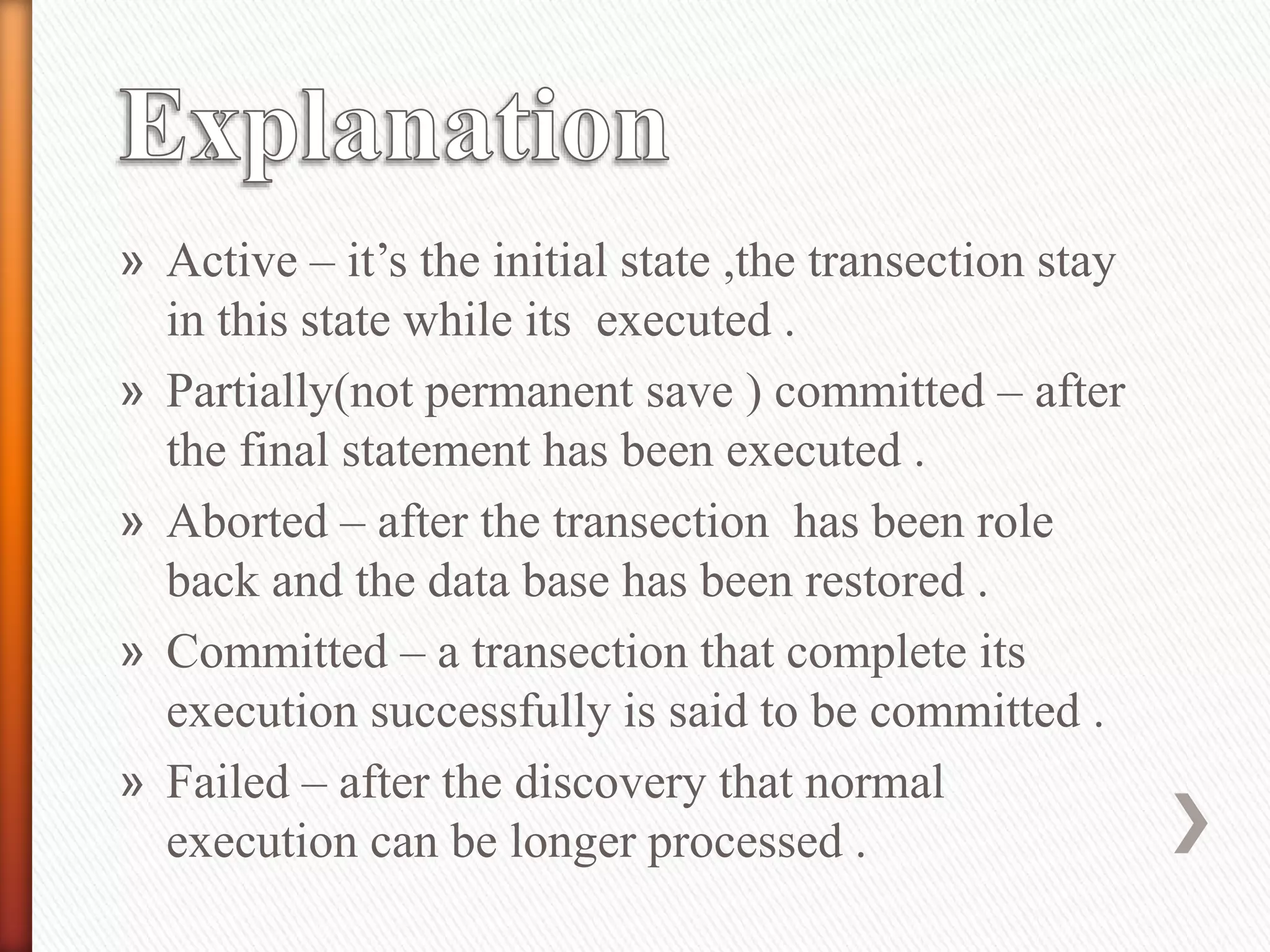
» Active – it’s the initial state ,the transection stay 
in this state while its executed . 
» Partially(not permanent save ) committed – after 
the final statement has been executed . 
» Aborted – after the transection has been role 
back and the data base has been restored . 
» Committed – a transection that complete its 
execution successfully is said to be committed . 
» Failed – after the discovery that normal 
execution can be longer processed .
TPS are the system which include large size data base and 
allow many users to use same data base concurrently 
Example 1-railway reservation system 
2-credit card system 
Other similar system is called TPS .
» Computer like any other device to subject to 
failure include power failure disk crash software 
error etc 
» In this case the database patterning the database 
is lost
» Lose of volatize storage –log based recovery , 
buffered management , check points and 
pshadaw paging techniques. 
» Non volatize storage lose – hard disk ,magnetic 
disk and tape ,if a failure occur the data is used 
in restoring concept in the data base
» Cascading recovery (roll back )- a single 
transaction failure follow a series of transaction 
roll back is called cascading roll back . 
» If T1 is failure then the all series of transaction 
will be failed because hare in this ex T3 is 
depend on T2 and T2 depend on T1.
» T1 T2 T3 
» Read (x); 
» Read(y); 
» Z=x+y; 
» Write(z); 
-------------------------------------------------------------- 
» Read (z); 
» Write(z); 
--------------------------------- 
Read(z) 
Depend Depend
» In this schedule T3 transaction perform only one 
transaction read(z) 
» T3 is not dependent to transaction T1 and T2 
» All transaction work as a separately . 
» Not depend with each others. 
» Consider following example .
» T1 T2 T3 
Independent Independent 
» Read(x); 
» Write(x); 
» ---------------------------------------------------------------- 
» Read(x); 
------------------------------------------ 
Read(x); 
(committed)
Transaction Process System and Recovery

Transaction Process System and Recovery

  • 1.
    Class : MCA2nd (2014 - 2015) Topics : Transection System Concepts . 1 By : Mr Jitendra Thakur
  • 2.
  • 3.
    » Introduction : » Operation of Transaction : » Properties of Transaction : » Transaction System State : » Explanation : » Transaction Process System : » Recovery from Transaction Failure : » Types of Failure : » Recovery Method : » Example : » Recoverably Schedule : » Example : » Thank you :
  • 4.
    » Collection ofoperation that from a single logical unit of work is called transection » A transection is a unit of program execution that access and possibly obtain various data item
  • 5.
    » Main operationof transection : I. Read (X) ; -which transfer the data item X from the data base to a logical buffer belonging to a transection that execute the read operation II. Write (x); -which transfer the data item from the logical buffer of the transection that executed if write back to the data base
  • 6.
    » Transection have4 properties : likely » ACID TEST I. Atomicity II. Consistency III. Isolation IV.Durability –after commit it will be stable
  • 7.
    Partially committ ed Failed Commi tted Aborted Active
  • 8.
    » Active –it’s the initial state ,the transection stay in this state while its executed . » Partially(not permanent save ) committed – after the final statement has been executed . » Aborted – after the transection has been role back and the data base has been restored . » Committed – a transection that complete its execution successfully is said to be committed . » Failed – after the discovery that normal execution can be longer processed .
  • 9.
    TPS are thesystem which include large size data base and allow many users to use same data base concurrently Example 1-railway reservation system 2-credit card system Other similar system is called TPS .
  • 10.
    » Computer likeany other device to subject to failure include power failure disk crash software error etc » In this case the database patterning the database is lost
  • 11.
    » Lose ofvolatize storage –log based recovery , buffered management , check points and pshadaw paging techniques. » Non volatize storage lose – hard disk ,magnetic disk and tape ,if a failure occur the data is used in restoring concept in the data base
  • 12.
    » Cascading recovery(roll back )- a single transaction failure follow a series of transaction roll back is called cascading roll back . » If T1 is failure then the all series of transaction will be failed because hare in this ex T3 is depend on T2 and T2 depend on T1.
  • 13.
    » T1 T2T3 » Read (x); » Read(y); » Z=x+y; » Write(z); -------------------------------------------------------------- » Read (z); » Write(z); --------------------------------- Read(z) Depend Depend
  • 14.
    » In thisschedule T3 transaction perform only one transaction read(z) » T3 is not dependent to transaction T1 and T2 » All transaction work as a separately . » Not depend with each others. » Consider following example .
  • 15.
    » T1 T2T3 Independent Independent » Read(x); » Write(x); » ---------------------------------------------------------------- » Read(x); ------------------------------------------ Read(x); (committed)