9011041155 / 9011031155

Current Electricity
Exercises
1.

State and explain Kirchhoff’s law for electrical circuit.

Ans: Kirchhoff’s first law or current law (or) junction law :
The algebraic sum of electric currents at any junction is always equal to zero
i.e. ∑I = 0.
Sign Conventions :
1.

Current entering the junction in the circuit are taken positive.

2.

Current leaving the junction are taken negative,

Explanation :
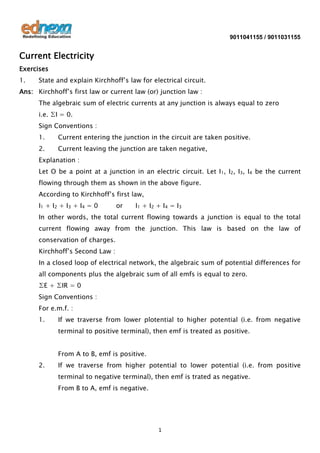
Let O be a point at a junction in an electric circuit. Let I1, I2, I3, I4 be the current
flowing through them as shown in the above figure.
According to Kirchhoff’s first law,
I1 + I 2 + I 3 + I 4 = 0

or

I1 + I 2 + I 4 = I 3

In other words, the total current flowing towards a junction is equal to the total
current flowing away from the junction. This law is based on the law of
conservation of charges.
Kirchhoff’s Second Law :
In a closed loop of electrical network, the algebraic sum of potential differences for
all components plus the algebraic sum of all emfs is equal to zero.
∑E + ∑IR = 0
Sign Conventions :
For e.m.f. :
1.

If we traverse from lower plotential to higher potential (i.e. from negative
terminal to positive terminal), then emf is treated as positive.
From A to B, emf is positive.

2.

If we traverse from higher potential to lower potential (i.e. from positive
terminal to negative terminal), then emf is trated as negative.
From B to A, emf is negative.

1
9011041155 / 9011031155

For Potential Difference :
1.

If we traverse along the direction of current then potential difference
across the resistance is treated as negative.
From A to B potential difference is -- IR.

2.

If we traverse opposite to the direction of current then potential
difference across the resistance is treated as positive.
From B to A potential difference is + IR.
Explanation :
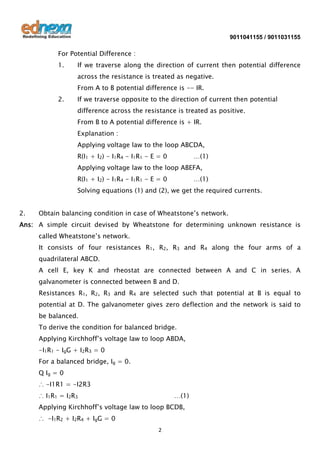
Applying voltage law to the loop ABCDA,
R(I1 + I2) - I1R4 - I1R1 - E = 0

…(1)

Applying voltage law to the loop ABEFA,
R(I1 + I2) - I1R4 - I1R1 - E = 0

…(1)

Solving equations (1) and (2), we get the required currents.
2.

Obtain balancing condition in case of Wheatstone’s network.

Ans: A simple circuit devised by Wheatstone for determining unknown resistance is
called Wheatstone’s network.
It consists of four resistances R1, R2, R3 and R4 along the four arms of a
quadrilateral ABCD.
A cell E, key K and rheostat are connected between A and C in series. A
galvanometer is connected between B and D.
Resistances R1, R2, R3 and R4 are selected such that potential at B is equal to
potential at D. The galvanometer gives zero deflection and the network is said to
be balanced.
To derive the condition for balanced bridge.
Applying Kirchhoff’s voltage law to loop ABDA,
-I1R1 - IgG + I2R3 = 0
For a balanced bridge, Ig = 0.
Q Ig = 0
∴ -I1R1 = -I2R3
∴ I1R1 = I2R3

…(1)

Applying Kirchhoff’s voltage law to loop BCDB,
∴ -I1R2 + I2R4 + IgG = 0
2
9011041155 / 9011031155

For a balanced bridge, Ig = 0.
O Ig = 0
∴ -I1R2 = -I2R4
∴ I1R2 = I2R4

…(2)

Dividing equation (1) by equation (2),
I 2 I3
I1R1
I1R 2 I 2 I 4
R1
R2

R3
R4

If any three resistance are known, we can determine the fourth resistance. This is
called balancing condition.
3.

Explain with neat circuit diagram, how will you determine the unknown resistance
by using a meter-bridge.

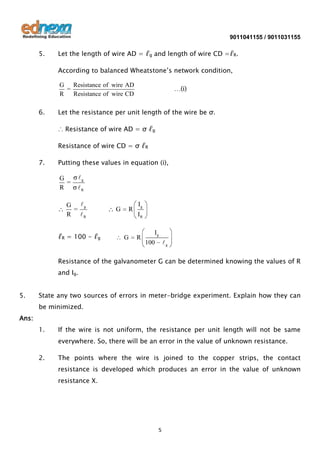
Ans: Meter bridge is a Wheatstone’s network used to determine unknown resistance.
R3
R
.
It works on the principle of balanced Wheatstone’s network, i.e. 1
R2 R4
Construction :
i.

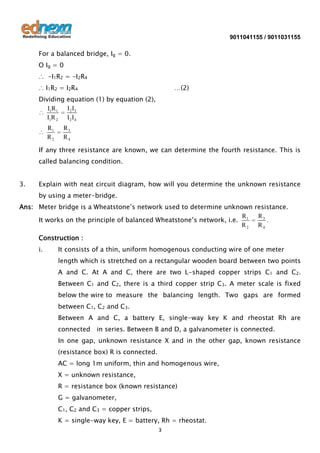
It consists of a thin, uniform homogenous conducting wire of one meter
length which is stretched on a rectangular wooden board between two points
A and C. At A and C, there are two L-shaped copper strips C1 and C2.
Between C1 and C2, there is a third copper strip C3. A meter scale is fixed
below the wire to measure the balancing length. Two gaps are formed
between C1, C2 and C3.
Between A and C, a battery E, single-way key K and rheostat Rh are
connected

in series. Between B and D, a galvanometer is connected.

In one gap, unknown resistance X and in the other gap, known resistance
(resistance box) R is connected.
AC = long 1m uniform, thin and homogenous wire,
X = unknown resistance,
R = resistance box (known resistance)
G = galvanometer,
C1, C2 and C3 = copper strips,
K = single-way key, E = battery, Rh = rheostat.
3
9011041155 / 9011031155

1.

When the key K is closed, the current starts flowing through the circuit. The
current can be controlled by rheostat Rh.

2.

The jockey is touched at difference points of the wire and a point on the wire
is

4.

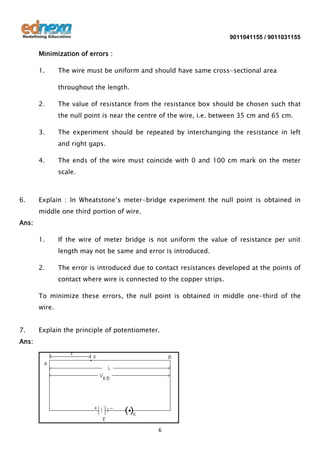
Describe Kelvin’s method to determine the resistance of galvanometer by using
meter-bridge.

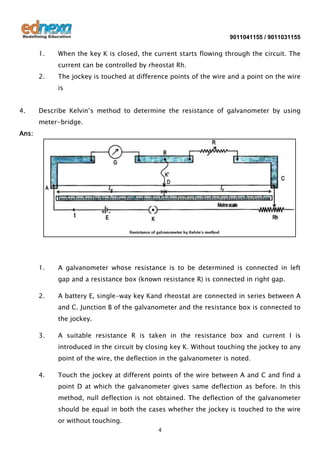
Ans:

1.

A galvanometer whose resistance is to be determined is connected in left
gap and a resistance box (known resistance R) is connected in right gap.

2.

A battery E, single-way key Kand rheostat are connected in series between A
and C. Junction B of the galvanometer and the resistance box is connected to
the jockey.

3.

A suitable resistance R is taken in the resistance box and current I is
introduced in the circuit by closing key K. Without touching the jockey to any
point of the wire, the deflection in the galvanometer is noted.

4.

Touch the jockey at different points of the wire between A and C and find a
point D at which the galvanometer gives same deflection as before. In this
method, null deflection is not obtained. The deflection of the galvanometer
should be equal in both the cases whether the jockey is touched to the wire
or without touching.
4
9011041155 / 9011031155

5.

Let the length of wire AD = ℓg and length of wire CD =ℓR.
According to balanced Wheatstone’s network condition,
G Resistance of wire AD
=
R
Resistance of wire CD

6.

…(i)

Let the resistance per unit length of the wire be σ.
∴ Resistance of wire AD = σ ℓg
Resistance of wire CD = σ ℓR

7.

Putting these values in equation (i),

G
=
R

g
R

G g
=
R R
ℓR = 100 - ℓg

G

R

G

Ig
IR
R

Ig
g

100

Resistance of the galvanometer G can be determined knowing the values of R
and Ig.
5.

State any two sources of errors in meter-bridge experiment. Explain how they can
be minimized.

Ans:
1.

If the wire is not uniform, the resistance per unit length will not be same
everywhere. So, there will be an error in the value of unknown resistance.

2.

The points where the wire is joined to the copper strips, the contact
resistance is developed which produces an error in the value of unknown
resistance X.

5
9011041155 / 9011031155

Minimization of errors :
1.

The wire must be uniform and should have same cross-sectional area
throughout the length.

2.

The value of resistance from the resistance box should be chosen such that
the null point is near the centre of the wire, i.e. between 35 cm and 65 cm.

3.

The experiment should be repeated by interchanging the resistance in left
and right gaps.

4.

The ends of the wire must coincide with 0 and 100 cm mark on the meter
scale.

6.

Explain : In Wheatstone’s meter-bridge experiment the null point is obtained in
middle one third portion of wire.

Ans:
1.

If the wire of meter bridge is not uniform the value of resistance per unit
length may not be same and error is introduced.

2.

The error is introduced due to contact resistances developed at the points of
contact where wire is connected to the copper strips.

To minimize these errors, the null point is obtained in middle one-third of the
wire.
7.

Explain the principle of potentiometer.

Ans:

6
9011041155 / 9011031155

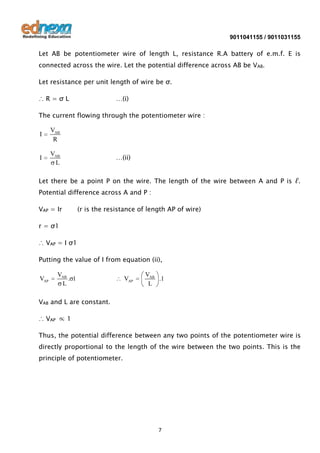
Let AB be potentiometer wire of length L, resistance R.A battery of e.m.f. E is
connected across the wire. Let the potential difference across AB be VAB.
Let resistance per unit length of wire be σ.
∴R=σL

…(i)

The current flowing through the potentiometer wire :

I

VAB
R

I

VAB
L

…(ii)

Let there be a point P on the wire. The length of the wire between A and P is ℓ.
Potential difference across A and P :
VAP = Ir

(r is the resistance of length AP of wire)

r = σ1
∴ VAP = I σ1
Putting the value of I from equation (ii),
VAP

VAB
. 1
L

VAP

VAB
.1
L

VAB and L are constant.
∴ VAP ∝ 1
Thus, the potential difference between any two points of the potentiometer wire is
directly proportional to the length of the wire between the two points. This is the
principle of potentiometer.

7
9011041155 / 9011031155

8.

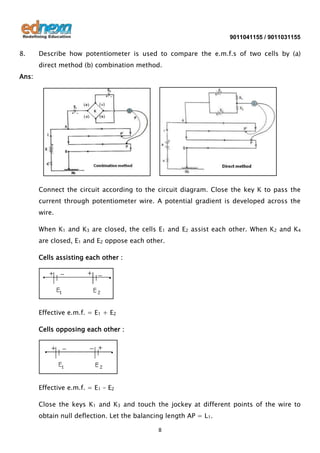
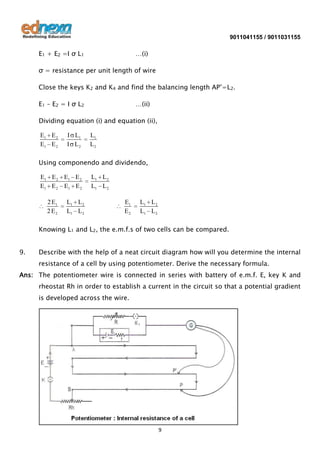
Describe how potentiometer is used to compare the e.m.f.s of two cells by (a)
direct method (b) combination method.

Ans:

Connect the circuit according to the circuit diagram. Close the key K to pass the
current through potentiometer wire. A potential gradient is developed across the
wire.
When K1 and K3 are closed, the cells E1 and E2 assist each other. When K2 and K4
are closed, E1 and E2 oppose each other.
Cells assisting each other :

Effective e.m.f. = E1 + E2
Cells opposing each other :

Effective e.m.f. = E1 – E2
Close the keys K1 and K3 and touch the jockey at different points of the wire to
obtain null deflection. Let the balancing length AP = L1.
8
9011041155 / 9011031155

E1 + E2 =I σ L1

…(i)

σ = resistance per unit length of wire
Close the keys K2 and K4 and find the balancing length AP’=L2.
E1 – E2 = I σ L2

…(ii)

Dividing equation (i) and equation (ii),
E1 E 2
E1 E 2

I L1
I L2

L1
L2

Using componendo and dividendo,
E1 E 2 E1 E 2
E1 E 2 E1 E 2
2 E1
2 E2

L1 L 2
L1 L 2

L1 L 2
L1 L 2
E1
E2

L1 L 2
L1 L 2

Knowing L1 and L2, the e.m.f.s of two cells can be compared.
9.

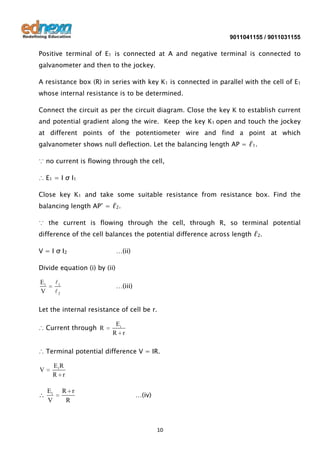
Describe with the help of a neat circuit diagram how will you determine the internal
resistance of a cell by using potentiometer. Derive the necessary formula.

Ans: The potentiometer wire is connected in series with battery of e.m.f. E, key K and
rheostat Rh in order to establish a current in the circuit so that a potential gradient
is developed across the wire.

9
9011041155 / 9011031155

Positive terminal of E1 is connected at A and negative terminal is connected to
galvanometer and then to the jockey.
A resistance box (R) in series with key K1 is connected in parallel with the cell of E1
whose internal resistance is to be determined.
Connect the circuit as per the circuit diagram. Close the key K to establish current
and potential gradient along the wire. Keep the key K1 open and touch the jockey
at different points of the potentiometer wire and find a point at which
galvanometer shows null deflection. Let the balancing length AP = ℓ1.
∵ no current is flowing through the cell,
∴ E1 = I σ I1
Close key K1 and take some suitable resistance from resistance box. Find the
balancing length AP’ = ℓ2.
∵ the current is flowing through the cell, through R, so terminal potential
difference of the cell balances the potential difference across length ℓ2.
V = I σ I2

…(ii)

Divide equation (i) by (ii)
1
2

E1
V

…(iii)

Let the internal resistance of cell be r.
∴ Current through R

Ei
R r

∴ Terminal potential difference V = IR.
V

E1 R
R r

E1
V

R r
R

…(iv)

10
9011041155 / 9011031155

From equations (iii) and (iv),
R r
R

1
2

∴ Rℓ2 + rℓ2 = Rℓ1
∴ rℓ2 = Rℓ1 - Rℓ2 = R (ℓ1 - ℓ2)
r

R ( 1  2 )
2

r

R

1
2

…(v)

1

r

R

E
V

1

Using equation (v), knowing the value of R, ℓ1 and ℓ2, the internal resistance of cell
(r) can be determined.

10.

State the precautions which must be taken while performing experiment with
potentiometer.

Ans: Precautions to be taken :
1.

The wire used must be uniform i.e. of same cross section.

2.

The value of ‘R’ should be so chosen that the null point is obtained as
near(close) to the centre of wire as possible. (Middle one-third of wire i.e.
between 33.33 cm and 66.67 cm)

3.

The experiment should be repeated by interchanging the positions of X and
R to minimize an error due to contact resistance.

11
9011041155 / 9011031155

11.

State the advantages of potentiometer over voltmeter.

Ans:
Advantages of potentiometer :
1.

The voltmeter is used only to measure the terminal potential difference
whereas the potentiometer measures the small potential difference and the
e.m.f. of the cell.

2.

Accuracy of potentiometer can be increased by increasing its length. The
accuracy of voltmeter cannot be increased beyond a certain limit.

3.

Internal resistance of cell can be measured with potentiometer but it cannot
be measured with voltmeter.

4.

A small potential difference can be measured accurately with the help of
potentiometer. The resistance of voltmeter is not infinity to work as an ideal
voltmeter.

12
9011041155 / 9011031155

Problem for Practice
1.

A cell of e.m.f. 3V and internal resistance 4Ω is connected to two resistances 10Ω
and 24Ω joined in parallel. Find the current through each resistance using
Kirchhoff’s laws.

Ans: Given : E = 3V, r = 4Ω, R1 = 10Ω, R2 = 24 Ω
To find : I1 = ?, I2 = ?
Let I1 and I2 be the currents through the resistor R1 and R2 respectively. I be the
current drawn from the cell.
At junction B, applying Kirchhoff’s law we get
I - I1 - I2 = 0

or

I = I 1 + I2

…(I)

Applying Kirchhoff’s voltage law to loop ABCDEFA, we get,
-I1R1 - Ir + E = 0
-10(I1) - 4 (I1 + I2) + 3 = 0
-10I1 - 4I1 - 4I2 = -3
-14I1 - 4I2 = -3
14I1 + 4I2 = 3

…(II)

Applying Kirchhoff’s voltage law to loop BDECB, we get,
-I2R2 + I1 + R1 = 0
-24I2 + 10I1 = 0
- 24I2 = -10I1
24I2 = 10I1
∴ I1 = 2.4I2

…(III)

Substituting eq. (III) in eq. (II), we get
14(2.4I2) + 4I2 = 3
37.6I2 = 3
3
I2
37.6
∴ I2 = 0.0798 A
Substituting eq. (IV) in eq. (III), we get
I1 = 2.4 × 0.0798 = 0.1915 A
Thus, I = I1 + I2 = 0.1915 + 0.0798 = 0.2713A

13
9011041155 / 9011031155

2.

The current flowing through an external resistance of 2Ω is 0.5 A when it is
connected to the terminals of a cell. This current reduces to 0.25 A when the
external resistance is 5Ω. Use Kirchhoff’s laws to find e.m.f. of cell.

Ans: Given : R = 2Ω, I = 0.5A : Ist case
R = 5Ω, I = 0.25 A : IInd case
To find : E = ?
Let I be the current, r and E be the internal resistance and emf of the cell. R be the
external resistance.
According to Kirchhoff’s voltage law :
E = I (R + r) = 0 i.e. E = I (R + r)
In first case,
E = 0.5 (2 + r)
In second case,
E = 0.25 (5 + r)
From equation I and II, we get
0.5 (2 + r) = 0.25 (5 + r)
∴ 2(2 + r) = (5 + r)
∴ 4 + 2r = 5 + r
∴ r = 1Ω
Substituting r in eq. (1) we get
E = 0.5 (2 + 1) = 0.5 (3)
∴ E = 1.5V
3.

Four resistances 5Ω, 10Ω, 15Ω and an unknown XΩ are connected in series so as
to form Wheatstone’s network. Determine the unknown resistance X, if the network
is balanced with these numerical values of resistances.

Ans: Given :
R1 = 5Ω, R2 = 10Ω, R4 = 15Ω, R3 = X
To find : Unknown resistance R3 = X = ?
Since the network is balanced.
5
X
R3
R1
R2 R4
10 15

X

∴ X = 7.5Ω
14

5 15
10

75
10
9011041155 / 9011031155

4.

In a meter-bridge experiment with resistance R1 in left gap and resistance X in
right gap, null point is obtained at 40 cm from left end. With a resistance R 2 in left
gap and same resistance X in right gap, null point is obtained at 50 cm from left
end. Where will be null point if R1 and R2 are put first in series and then in parallel,
in the left gap and right gap still containing X?

Ans: Given : I case : ℓX = 40cm, ℓR = 60cm
II case : ℓX = 50cm, ℓR = 50cm
To find : ℓ1 = ? when R1 and R2 are in series ℓ2 = ? when R1 and R2 are in parallel
X
1R ,
R
50
II case : 2
X
50
I case :

i.

R1
X

R1
X

40
60

2
3

R1
R2

2
X
3

X

When R1 and R2 are connected in series the effective resistance is
2
2X 3X
5X
RS R1 R 2
X X
RS
3
3
3
Let the corresponding null point be at a distance from ℓ1 from the left end
of the wire.
RS
1
X 100 1
5
3

1
100 1

∴ 500 - 5ℓ1 = 3ℓ1
500
1
8
ii.

5X / 3
X

1
100 1

5 100

1

31

∴ 500 = 8ℓ1

1

62.5cm

When R1 and R2 are connected in parallel the effective resistance is
2
X.X
R1 R 2
2X
3
RP
2
R1 R 2
5
X X
3
Let the corresponding null point be at a distance ℓ2 from the left end of the
wire.
RP
X
2
5

2
100  2

2
100  2

∴ 200 - 2ℓ2 = 42

2X / 5
X

2
100  2

2 100

2

∴ 200 = 7ℓ2
15

5 2

2

200
7

28.6cm
9011041155 / 9011031155

5.

A potentiometer wire has a length of 2m and resistance 10Ω. It is connected in
series with resistance 990Ω and a cell of e.m.f. 2V. Calculate the potential gradient
along the wire.

Ans: We have L = 10m, r = 10Ω, R = 990 Ω, E = 2V
Let,
I

E
r

2
10 990

R

2
1000

2

10

3

A

The potential difference across the wire is
But,
V = Ir = 2 × 10-3 × 10 = 2 × 10⁻² V
∴ Potential gradient along the wire
V
L

6.

2

10
10

2

2

10

3

V/m

Two cells having unknown e.m.f.s E1 and E2 (E1 > E2) are connected in
potentiometer circuit so as to assist each other. The null point is obtained at 8.125
m from the higher potential end. When cell E2 is connected so as to oppose cell E1,
the null point is obtained at 1.25m from same end. Compare the e.m.f.s of two
cells.

Ans:
ℓ1 = 8.125 m (cells assisting), ℓ2 = 1.25 m (cells opposing)
E1 + E2 = kℓ1

and

E1 – E2 = k ℓ2

Where k is the potential gradient.
E1 E2
1
E1 E2
2

E1
E2

1
1

2
2

8.125
8.125

1.25
1.25

9.375
6.875

15
11

1.364

16
9011041155 / 9011031155

7.

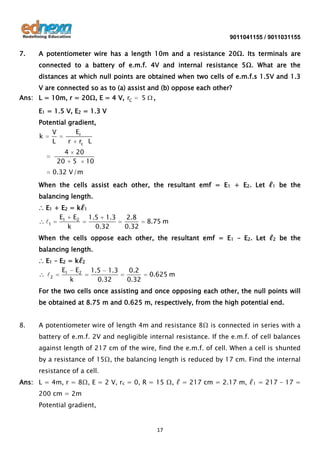
A potentiometer wire has a length 10m and a resistance 20Ω. Its terminals are
connected to a battery of e.m.f. 4V and internal resistance 5Ω. What are the
distances at which null points are obtained when two cells of e.m.f.s 1.5V and 1.3
V are connected so as to (a) assist and (b) oppose each other?

Ans: L = 10m, r = 20Ω, E = 4 V, rC

5 Ω,

E1 = 1.5 V, E2 = 1.3 V
Potential gradient,
Er
V
k
L
r rc L

4 20
20 5 10
0.32 V/m
When the cells assist each other, the resultant emf = E1 + E2. Let ℓ1 be the
balancing length.
∴ E1 + E2 = kℓ1
E1 E2 1.5 1.3
1
k
0.32

2.8
0.32

8.75 m

When the cells oppose each other, the resultant emf = E1 – E2. Let ℓ2 be the
balancing length.
∴ E1 – E2 = kℓ2
E1 E2 1.5 1.3
2
k
0.32

0.2
0.32

0.625 m

For the two cells once assisting and once opposing each other, the null points will
be obtained at 8.75 m and 0.625 m, respectively, from the high potential end.
8.

A potentiometer wire of length 4m and resistance 8Ω is connected in series with a
battery of e.m.f. 2V and negligible internal resistance. If the e.m.f. of cell balances
against length of 217 cm of the wire, find the e.m.f. of cell. When a cell is shunted
by a resistance of 15Ω, the balancing length is reduced by 17 cm. Find the internal
resistance of a cell.

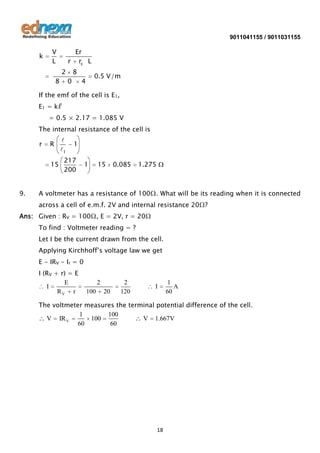
Ans: L = 4m, r = 8Ω, E = 2 V, rc = 0, R = 15 Ω, ℓ = 217 cm = 2.17 m, ℓ1 = 217 – 17 =
200 cm = 2m
Potential gradient,

17
9011041155 / 9011031155

k

V
L

Er
r rc L
2

8

8
0

0.5 V/m

4

If the emf of the cell is E1,
E1 = kℓ
= 0.5 × 2.17 = 1.085 V
The internal resistance of the cell is

r

R
15

9.


1

1

217
200

1

15

0.085

1.275

A voltmeter has a resistance of 100Ω. What will be its reading when it is connected
across a cell of e.m.f. 2V and internal resistance 20Ω?

Ans: Given : RV = 100Ω, E = 2V, r = 20Ω
To find : Voltmeter reading = ?
Let I be the current drawn from the cell.
Applying Kirchhoff’s voltage law we get
E - IRV - Ir = 0
I (RV + r) = E
E
I
RV r

2
100

20

2
120

I

1
A
60

The voltmeter measures the terminal potential difference of the cell.
1
100
V IR V
100
V 1.667V
60
60

18
9011041155 / 9011031155

10.

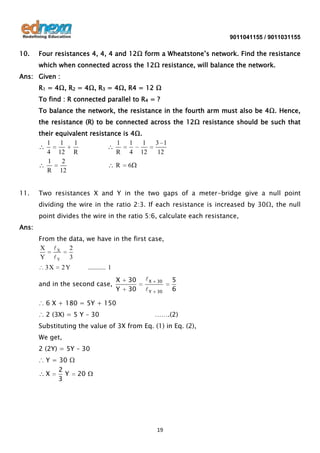
Four resistances 4, 4, 4 and 12Ω form a Wheatstone’s network. Find the resistance
which when connected across the 12Ω resistance, will balance the network.

Ans: Given :
R1 = 4Ω, R2 = 4Ω, R3 = 4Ω, R4 = 12 Ω
To find : R connected parallel to R4 = ?
To balance the network, the resistance in the fourth arm must also be 4Ω. Hence,
the resistance (R) to be connected across the 12Ω resistance should be such that
their equivalent resistance is 4Ω.
1
1
1
1 1
1
4 12 R
R 4 12
1
2
R 6
R 12
11.

3 1
12

Two resistances X and Y in the two gaps of a meter-bridge give a null point
dividing the wire in the ratio 2:3. If each resistance is increased by 30Ω, the null
point divides the wire in the ratio 5:6, calculate each resistance,

Ans:
From the data, we have in the first case,
X X 2
Y Y 3

3X

2Y

........... 1

and in the second case,

X
Y

30
30

X

30

Y

30

5
6

∴ 6 X + 180 = 5Y + 150
∴ 2 (3X) = 5 Y – 30

…….(2)

Substituting the value of 3X from Eq. (1) in Eq. (2),
We get,
2 (2Y) = 5Y – 30
∴ Y = 30 Ω
2
X
Y 20
3

19
9011041155 / 9011031155

12.

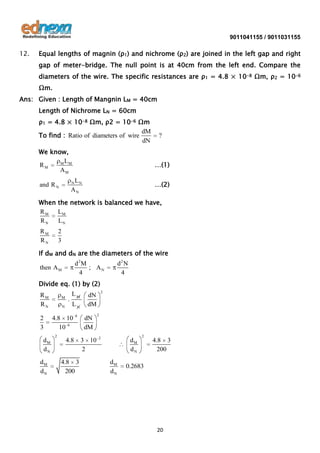
Equal lengths of magnin (ρ1) and nichrome (ρ2) are joined in the left gap and right
gap of meter-bridge. The null point is at 40cm from the left end. Compare the
diameters of the wire. The specific resistances are ρ1 = 4.8 × 10⁻⁸ Ωm, ρ2 = 10-6
Ωm.

Ans: Given : Length of Mangnin LM = 40cm
Length of Nichrome LN = 60cm
ρ1 = 4.8 × 10⁻⁸ Ωm, ρ2 = 10-6 Ωm
dM
To find : Ratio of diameters of wire
dN
We know,
M LM
RM
AM

…(1)

LN
AN

…(2)

N

and R N

?

When the network is balanced we have,
R M LM
RN
LN
RM
RN

2
3

If dM and dN are the diameters of the wire
d2M
; AN
4

then A M

d2 N
4

Divide eq. (1) by (2)
RM
RN

2
3
dM
dN

dM
dN

M
N

.

LM
LN

4.8 10
10 6
2

8

4.8

4.8 3
200

2

dN
dM

dN
dM
3 10
2

2

2

dM
dN

dM
dN

2

4.8 3
200

0.2683

20
9011041155 / 9011031155

13.

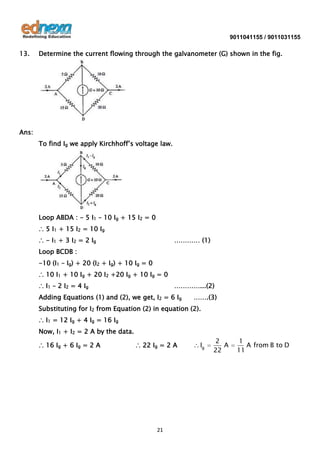
Determine the current flowing through the galvanometer (G) shown in the fig.

Ans:
To find Ig we apply Kirchhoff’s voltage law.

Loop ABDA : - 5 I1 – 10 Ig + 15 I2 = 0
∴ 5 I1 + 15 I2 = 10 Ig
∴ - I1 + 3 I2 = 2 Ig

………… (1)

Loop BCDB :
-10 (I1 – Ig) + 20 (I2 + Ig) + 10 Ig = 0
∴ 10 I1 + 10 Ig + 20 I2 +20 Ig + 10 Ig = 0
∴ I1 – 2 I2 = 4 Ig

…………...(2)

Adding Equations (1) and (2), we get, I2 = 6 Ig

…….(3)

Substituting for I2 from Equation (2) in equation (2).
∴ I1 = 12 Ig + 4 Ig = 16 Ig
Now, I1 + I2 = 2 A by the data.
∴ 16 Ig + 6 Ig = 2 A

∴ 22 Ig = 2 A

21

Ig

2
A
22

1
A from B to D
11
9011041155 / 9011031155

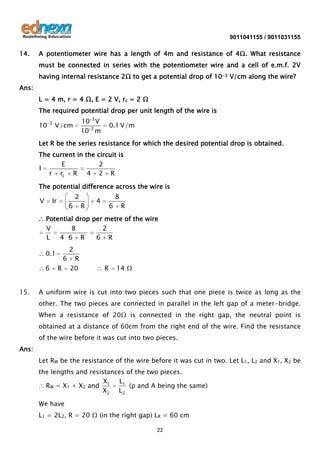
14.

A potentiometer wire has a length of 4m and resistance of 4Ω. What resistance
must be connected in series with the potentiometer wire and a cell of e.m.f. 2V
having internal resistance 2Ω to get a potential drop of 10-3 V/cm along the wire?

Ans:
L = 4 m, r = 4 Ω, E = 2 V, rc = 2 Ω
The required potential drop per unit length of the wire is
10

3

10 3 V
10 2 m

V/cm

0.1 V/m

Let R be the series resistance for which the desired potential drop is obtained.
The current in the circuit is
E
2
I
r rc R 4 2 R
The potential difference across the wire is

V

2

Ir

6

R

8

4

6

R

∴ Potential drop per metre of the wire
V
8
2
L
4 6 R
6 R

2

0.1
6
15.

6
R

R
20

R

14

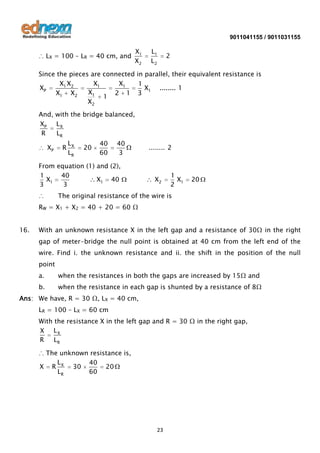
A uniform wire is cut into two pieces such that one piece is twice as long as the
other. The two pieces are connected in parallel in the left gap of a meter-bridge.
When a resistance of 20Ω is connected in the right gap, the neutral point is
obtained at a distance of 60cm from the right end of the wire. Find the resistance
of the wire before it was cut into two pieces.

Ans:
Let RW be the resistance of the wire before it was cut in two. Let L1, L2 and X1, X2 be
the lengths and resistances of the two pieces.
X
L1
∴ RW = X1 + X2 and 1
(ρ and A being the same)
X2 L2
We have
L1 = 2L2, R = 20 Ω (in the right gap) LR = 60 cm
22
9011041155 / 9011031155

∴ LX = 100 – LR = 40 cm, and

X1
X2

L1
L2

2

Since the pieces are connected in parallel, their equivalent resistance is
X1 X2
X1
X1
1
XP
X
........ 1
X1
X1 X2
2 1 3 1
1
X2
And, with the bridge balanced,
XP
LX
R
LR
XP

R

LX
LR

20

40
60

40
3

From equation (1) and (2),
1
40
X1
X1 40
3
3
∴

........ 2

X2

1
X
2 1

20

The original resistance of the wire is

RW = X1 + X2 = 40 + 20 = 60 Ω
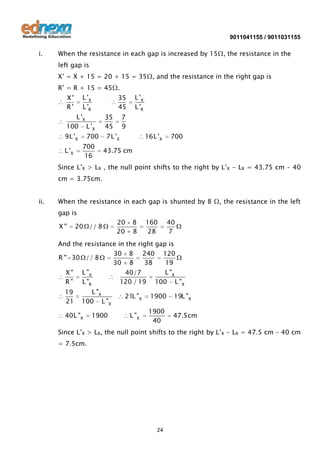
16.

With an unknown resistance X in the left gap and a resistance of 30Ω in the right
gap of meter-bridge the null point is obtained at 40 cm from the left end of the
wire. Find i. the unknown resistance and ii. the shift in the position of the null
point
a.

when the resistances in both the gaps are increased by 15Ω and

b.

when the resistance in each gap is shunted by a resistance of 8Ω

Ans: We have, R = 30 Ω, LX = 40 cm,
LR = 100 – LX = 60 cm
With the resistance X in the left gap and R = 30 Ω in the right gap,
X LX
R
LR
∴ The unknown resistance is,
L
40
X R X 30
20
LR
60

23
9011041155 / 9011031155

i.

When the resistance in each gap is increased by 15Ω, the resistance in the
left gap is
X’ = X + 15 = 20 + 15 = 35Ω, and the resistance in the right gap is
R’ = R + 15 = 45Ω.
L 'X
L 'R

X'
R'

L 'X
L 'R

35
45

L 'X
100 L 'X

35
45

9L 'X

7L 'X

700
700
16

L 'X

7
9
16L 'X

700

43.75 cm

Since L’X > LX , the null point shifts to the right by L’X - LX = 43.75 cm – 40
cm = 3.75cm.
ii.

When the resistance in each gap is shunted by 8 Ω, the resistance in the left
gap is
X ''

20 // 8

20
20

8
8

160
28

40
7

And the resistance in the right gap is
30 8 240 120
R '' 30 // 8
30 8
38
19

X"
R"

L "X
L "R

19
21

L "X
100 L "X

40L "X

1900

40/7
120 / 19

L "X
100 L "X

21L "X

1900

19L "X

L "X

1900
40

47.5cm

Since L’X > LX, the null point shifts to the right by L’X - LX = 47.5 cm – 40 cm
= 7.5cm.

24
9011041155 / 9011031155

17.

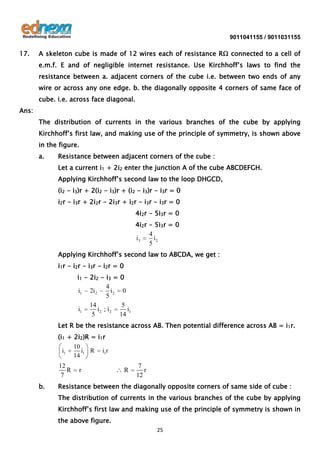
A skeleton cube is made of 12 wires each of resistance RΩ connected to a cell of
e.m.f. E and of negligible internet resistance. Use Kirchhoff’s laws to find the
resistance between a. adjacent corners of the cube i.e. between two ends of any
wire or across any one edge. b. the diagonally opposite 4 corners of same face of
cube. i.e. across face diagonal.

Ans:
The distribution of currents in the various branches of the cube by applying
Kirchhoff’s first law, and making use of the principle of symmetry, is shown above
in the figure.
a.

Resistance between adjacent corners of the cube :
Let a current i1 + 2i2 enter the junction A of the cube ABCDEFGH.
Applying Kirchhoff’s second law to the loop DHGCD,
(i2 - i3)r + 2(i2 - i3)r + (i2 - i3)r - i3r = 0
i2r - i3r + 2i2r - 2i3r + i2r - i3r - i3r = 0
4i2r - 5i3r = 0
4i2r - 5i3r = 0
4
i3
i2
5
Applying Kirchhoff’s second law to ABCDA, we get :
i1r - i2r - i3r - i2r = 0
i1 - 2i2 - i3 = 0
4
i1 2i 2
i2 0
5
14
5
i1
i2 ; i2
i1
5
14
Let R be the resistance across AB. Then potential difference across AB = i1r.
(i1 + 2i2)R = i1r
10
i1
i1 R i1r
14

12
R
7
b.

r

R

7
r
12

Resistance between the diagonally opposite corners of same side of cube :
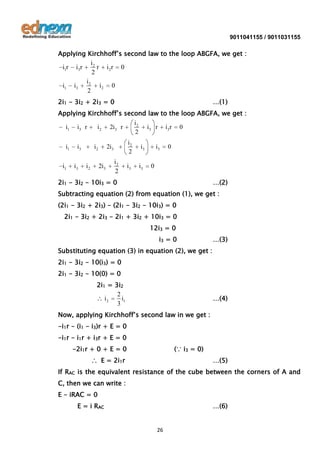
The distribution of currents in the various branches of the cube by applying
Kirchhoff’s first law and making use of the principle of symmetry is shown in
the above figure.
25
9011041155 / 9011031155

Applying Kirchhoff’s second law to the loop ABGFA, we get :
i2
i1r i3r
r i 2r 0
2
i2
i1 i3
i2 0
2
2i1 - 3i2 + 2i3 = 0

…(1)

Applying Kirchhoff’s second law to the loop ABGFA, we get :
i2
i1 i3 r
i 2 2i3 r
i3 r i3r 0
2
i1

i1

i3

i3

i2

i2

i2
2

2i3

2i3

i2
2

i3

i3

i3

i3

0

0

2i1 - 3i2 - 10i3 = 0

…(2)

Subtracting equation (2) from equation (1), we get :
(2i1 - 3i2 + 2i3) - (2i1 - 3i2 - 10i3) = 0
2i1 - 3i2 + 2i3 - 2i1 + 3i2 + 10i3 = 0
12i3 = 0
i3 = 0

…(3)

Substituting equation (3) in equation (2), we get :
2i1 - 3i2 - 10(i3) = 0
2i1 - 3i2 - 10(0) = 0
2i1 = 3i2
2
i2
i1
3

…(4)

Now, applying Kirchhoff’s second law in we get :
-i1r - (i1 - i3)r + E = 0
-i1r - i1r + i3r + E = 0
-2i1r + 0 + E = 0

(∵ i3 = 0)

∴ E = 2i1r

…(5)

If RAC is the equivalent resistance of the cube between the corners of A and
C, then we can write :
E - iRAC = 0
E = i RAC

…(6)

26
9011041155 / 9011031155

Comparing equations (5) and (6), we get :
2i1r = i RAC
Now, applying Kirchhoff’s first law at junction A, we get :
i = i 1 + i1 + i 2
= 2i1 + i2
2
2i1
i1
3
8
i
i1
3
Substituting equation (8) in equation (7) get :
2i1r = i RAC
8
2i1r
i1 R AC
3
6
R AC
r
8
3
R AC
R
4
18.

Two coils are connected in series in one gap of a meter bridge and the null point is
obtained in the middle of the wire by putting 75Ω in the other gap. Two coils aare
then connected in parallel and the null point is obtained again in the middle of the
wire, the resistance in the other gap is changed by 57Ω. Find the resistance of
each coil.

Ans: Let X1 and X2 be the resistances of the two coils. Let XS and XP be the equivalent
resistances of their series and parallel combinations, respectively.
∴ XS = X1 + X2 and XP = (X1 . X2) / (X1 + X2)
When the coils are connected in series in one gap, let the resistance in the other
gap be R1, and when the coils are connected in parallel in one gap, let the
resistance in the other gap be R2. Since, XP < XS, R2 < R1.
We have , R1 = 75 Ω, R2 = R1 – 57 = 75 – 57 = 18 Ω,
L 'X L 'R ' L ''X L "R

XS
R1

L 'X
L 'R

∴

XS = X1 + X2 = R1 = 75 Ω

1

and

XP
R2

L ''X
L ''R

1
or X2 = 75 – X1 ….. (1)

27
9011041155 / 9011031155

X1 X2
X1 X2

And XP

18

18 or X1X2

Now,
X1 X2
75

R2

75

18

1350 ....... 2

Substituting the value of X2 from Eq. (2) into Eq. (1),
X1 (75 – X1) = 1350

or

X21 – 75 X1 + 1350 = 0

∴ (X1 – 45) (X1 – 30) = 0
∴ X1 = 45 Ω
19.

or

X1 = 30Ω

∴ X2 = 30 Ω

or

X2 = 45 Ω

Find the radius of the wire of length 25m needed to prepare a coil of resistance
25Ω (Resistivity of material of wire is 3.142 × 10⁻⁷Ωm)

Ans: Given : ℓ = 25m, R = 25Ω,
ρ = 3.142 × 10⁻⁷Ωm
To find : r = ?


A

We know, R

r2

R


R

r2
r

10

r2

For a wire A

3

3.142 10 7 25
3.142 25
1

10

10

3

0.1

r2
10

3

10

0.3162

∴ r = 0.3162mm

28

7
9011041155 / 9011031155

20.

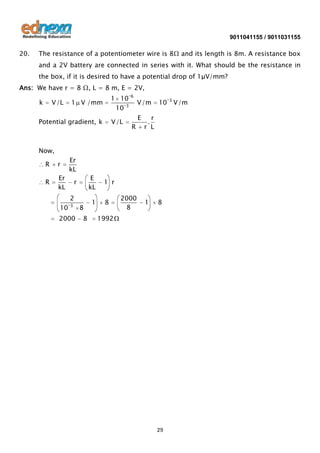
The resistance of a potentiometer wire is 8Ω and its length is 8m. A resistance box
and a 2V battery are connected in series with it. What should be the resistance in
the box, if it is desired to have a potential drop of 1μV/mm?

Ans: We have r = 8 Ω, L = 8 m, E = 2V,
k

V/L

1 10
10 3

1 V /mm

Potential gradient, k

V /L

6

V/m
E

R

10

r
r L
.

Now,
R

r

R

Er
kL

Er
kL

E
kL

r
2

10

3

2000

8
8

1

1 r
8

2000
8

1

8

1992

29

3

V/m

12th Physics - Current Electricity - Q & A

  • 1.
    9011041155 / 9011031155 CurrentElectricity Exercises 1. State and explain Kirchhoff’s law for electrical circuit. Ans: Kirchhoff’s first law or current law (or) junction law : The algebraic sum of electric currents at any junction is always equal to zero i.e. ∑I = 0. Sign Conventions : 1. Current entering the junction in the circuit are taken positive. 2. Current leaving the junction are taken negative, Explanation : Let O be a point at a junction in an electric circuit. Let I1, I2, I3, I4 be the current flowing through them as shown in the above figure. According to Kirchhoff’s first law, I1 + I 2 + I 3 + I 4 = 0 or I1 + I 2 + I 4 = I 3 In other words, the total current flowing towards a junction is equal to the total current flowing away from the junction. This law is based on the law of conservation of charges. Kirchhoff’s Second Law : In a closed loop of electrical network, the algebraic sum of potential differences for all components plus the algebraic sum of all emfs is equal to zero. ∑E + ∑IR = 0 Sign Conventions : For e.m.f. : 1. If we traverse from lower plotential to higher potential (i.e. from negative terminal to positive terminal), then emf is treated as positive. From A to B, emf is positive. 2. If we traverse from higher potential to lower potential (i.e. from positive terminal to negative terminal), then emf is trated as negative. From B to A, emf is negative. 1
  • 2.
    9011041155 / 9011031155 ForPotential Difference : 1. If we traverse along the direction of current then potential difference across the resistance is treated as negative. From A to B potential difference is -- IR. 2. If we traverse opposite to the direction of current then potential difference across the resistance is treated as positive. From B to A potential difference is + IR. Explanation : Applying voltage law to the loop ABCDA, R(I1 + I2) - I1R4 - I1R1 - E = 0 …(1) Applying voltage law to the loop ABEFA, R(I1 + I2) - I1R4 - I1R1 - E = 0 …(1) Solving equations (1) and (2), we get the required currents. 2. Obtain balancing condition in case of Wheatstone’s network. Ans: A simple circuit devised by Wheatstone for determining unknown resistance is called Wheatstone’s network. It consists of four resistances R1, R2, R3 and R4 along the four arms of a quadrilateral ABCD. A cell E, key K and rheostat are connected between A and C in series. A galvanometer is connected between B and D. Resistances R1, R2, R3 and R4 are selected such that potential at B is equal to potential at D. The galvanometer gives zero deflection and the network is said to be balanced. To derive the condition for balanced bridge. Applying Kirchhoff’s voltage law to loop ABDA, -I1R1 - IgG + I2R3 = 0 For a balanced bridge, Ig = 0. Q Ig = 0 ∴ -I1R1 = -I2R3 ∴ I1R1 = I2R3 …(1) Applying Kirchhoff’s voltage law to loop BCDB, ∴ -I1R2 + I2R4 + IgG = 0 2
  • 3.
    9011041155 / 9011031155 Fora balanced bridge, Ig = 0. O Ig = 0 ∴ -I1R2 = -I2R4 ∴ I1R2 = I2R4 …(2) Dividing equation (1) by equation (2), I 2 I3 I1R1 I1R 2 I 2 I 4 R1 R2 R3 R4 If any three resistance are known, we can determine the fourth resistance. This is called balancing condition. 3. Explain with neat circuit diagram, how will you determine the unknown resistance by using a meter-bridge. Ans: Meter bridge is a Wheatstone’s network used to determine unknown resistance. R3 R . It works on the principle of balanced Wheatstone’s network, i.e. 1 R2 R4 Construction : i. It consists of a thin, uniform homogenous conducting wire of one meter length which is stretched on a rectangular wooden board between two points A and C. At A and C, there are two L-shaped copper strips C1 and C2. Between C1 and C2, there is a third copper strip C3. A meter scale is fixed below the wire to measure the balancing length. Two gaps are formed between C1, C2 and C3. Between A and C, a battery E, single-way key K and rheostat Rh are connected in series. Between B and D, a galvanometer is connected. In one gap, unknown resistance X and in the other gap, known resistance (resistance box) R is connected. AC = long 1m uniform, thin and homogenous wire, X = unknown resistance, R = resistance box (known resistance) G = galvanometer, C1, C2 and C3 = copper strips, K = single-way key, E = battery, Rh = rheostat. 3
  • 4.
    9011041155 / 9011031155 1. Whenthe key K is closed, the current starts flowing through the circuit. The current can be controlled by rheostat Rh. 2. The jockey is touched at difference points of the wire and a point on the wire is 4. Describe Kelvin’s method to determine the resistance of galvanometer by using meter-bridge. Ans: 1. A galvanometer whose resistance is to be determined is connected in left gap and a resistance box (known resistance R) is connected in right gap. 2. A battery E, single-way key Kand rheostat are connected in series between A and C. Junction B of the galvanometer and the resistance box is connected to the jockey. 3. A suitable resistance R is taken in the resistance box and current I is introduced in the circuit by closing key K. Without touching the jockey to any point of the wire, the deflection in the galvanometer is noted. 4. Touch the jockey at different points of the wire between A and C and find a point D at which the galvanometer gives same deflection as before. In this method, null deflection is not obtained. The deflection of the galvanometer should be equal in both the cases whether the jockey is touched to the wire or without touching. 4
  • 5.
    9011041155 / 9011031155 5. Letthe length of wire AD = ℓg and length of wire CD =ℓR. According to balanced Wheatstone’s network condition, G Resistance of wire AD = R Resistance of wire CD 6. …(i) Let the resistance per unit length of the wire be σ. ∴ Resistance of wire AD = σ ℓg Resistance of wire CD = σ ℓR 7. Putting these values in equation (i), G = R g R G g = R R ℓR = 100 - ℓg G R G Ig IR R Ig g 100 Resistance of the galvanometer G can be determined knowing the values of R and Ig. 5. State any two sources of errors in meter-bridge experiment. Explain how they can be minimized. Ans: 1. If the wire is not uniform, the resistance per unit length will not be same everywhere. So, there will be an error in the value of unknown resistance. 2. The points where the wire is joined to the copper strips, the contact resistance is developed which produces an error in the value of unknown resistance X. 5
  • 6.
    9011041155 / 9011031155 Minimizationof errors : 1. The wire must be uniform and should have same cross-sectional area throughout the length. 2. The value of resistance from the resistance box should be chosen such that the null point is near the centre of the wire, i.e. between 35 cm and 65 cm. 3. The experiment should be repeated by interchanging the resistance in left and right gaps. 4. The ends of the wire must coincide with 0 and 100 cm mark on the meter scale. 6. Explain : In Wheatstone’s meter-bridge experiment the null point is obtained in middle one third portion of wire. Ans: 1. If the wire of meter bridge is not uniform the value of resistance per unit length may not be same and error is introduced. 2. The error is introduced due to contact resistances developed at the points of contact where wire is connected to the copper strips. To minimize these errors, the null point is obtained in middle one-third of the wire. 7. Explain the principle of potentiometer. Ans: 6
  • 7.
    9011041155 / 9011031155 LetAB be potentiometer wire of length L, resistance R.A battery of e.m.f. E is connected across the wire. Let the potential difference across AB be VAB. Let resistance per unit length of wire be σ. ∴R=σL …(i) The current flowing through the potentiometer wire : I VAB R I VAB L …(ii) Let there be a point P on the wire. The length of the wire between A and P is ℓ. Potential difference across A and P : VAP = Ir (r is the resistance of length AP of wire) r = σ1 ∴ VAP = I σ1 Putting the value of I from equation (ii), VAP VAB . 1 L VAP VAB .1 L VAB and L are constant. ∴ VAP ∝ 1 Thus, the potential difference between any two points of the potentiometer wire is directly proportional to the length of the wire between the two points. This is the principle of potentiometer. 7
  • 8.
    9011041155 / 9011031155 8. Describehow potentiometer is used to compare the e.m.f.s of two cells by (a) direct method (b) combination method. Ans: Connect the circuit according to the circuit diagram. Close the key K to pass the current through potentiometer wire. A potential gradient is developed across the wire. When K1 and K3 are closed, the cells E1 and E2 assist each other. When K2 and K4 are closed, E1 and E2 oppose each other. Cells assisting each other : Effective e.m.f. = E1 + E2 Cells opposing each other : Effective e.m.f. = E1 – E2 Close the keys K1 and K3 and touch the jockey at different points of the wire to obtain null deflection. Let the balancing length AP = L1. 8
  • 9.
    9011041155 / 9011031155 E1+ E2 =I σ L1 …(i) σ = resistance per unit length of wire Close the keys K2 and K4 and find the balancing length AP’=L2. E1 – E2 = I σ L2 …(ii) Dividing equation (i) and equation (ii), E1 E 2 E1 E 2 I L1 I L2 L1 L2 Using componendo and dividendo, E1 E 2 E1 E 2 E1 E 2 E1 E 2 2 E1 2 E2 L1 L 2 L1 L 2 L1 L 2 L1 L 2 E1 E2 L1 L 2 L1 L 2 Knowing L1 and L2, the e.m.f.s of two cells can be compared. 9. Describe with the help of a neat circuit diagram how will you determine the internal resistance of a cell by using potentiometer. Derive the necessary formula. Ans: The potentiometer wire is connected in series with battery of e.m.f. E, key K and rheostat Rh in order to establish a current in the circuit so that a potential gradient is developed across the wire. 9
  • 10.
    9011041155 / 9011031155 Positiveterminal of E1 is connected at A and negative terminal is connected to galvanometer and then to the jockey. A resistance box (R) in series with key K1 is connected in parallel with the cell of E1 whose internal resistance is to be determined. Connect the circuit as per the circuit diagram. Close the key K to establish current and potential gradient along the wire. Keep the key K1 open and touch the jockey at different points of the potentiometer wire and find a point at which galvanometer shows null deflection. Let the balancing length AP = ℓ1. ∵ no current is flowing through the cell, ∴ E1 = I σ I1 Close key K1 and take some suitable resistance from resistance box. Find the balancing length AP’ = ℓ2. ∵ the current is flowing through the cell, through R, so terminal potential difference of the cell balances the potential difference across length ℓ2. V = I σ I2 …(ii) Divide equation (i) by (ii) 1 2 E1 V …(iii) Let the internal resistance of cell be r. ∴ Current through R Ei R r ∴ Terminal potential difference V = IR. V E1 R R r E1 V R r R …(iv) 10
  • 11.
    9011041155 / 9011031155 Fromequations (iii) and (iv), R r R 1 2 ∴ Rℓ2 + rℓ2 = Rℓ1 ∴ rℓ2 = Rℓ1 - Rℓ2 = R (ℓ1 - ℓ2) r R ( 1  2 ) 2 r R 1 2 …(v) 1 r R E V 1 Using equation (v), knowing the value of R, ℓ1 and ℓ2, the internal resistance of cell (r) can be determined. 10. State the precautions which must be taken while performing experiment with potentiometer. Ans: Precautions to be taken : 1. The wire used must be uniform i.e. of same cross section. 2. The value of ‘R’ should be so chosen that the null point is obtained as near(close) to the centre of wire as possible. (Middle one-third of wire i.e. between 33.33 cm and 66.67 cm) 3. The experiment should be repeated by interchanging the positions of X and R to minimize an error due to contact resistance. 11
  • 12.
    9011041155 / 9011031155 11. Statethe advantages of potentiometer over voltmeter. Ans: Advantages of potentiometer : 1. The voltmeter is used only to measure the terminal potential difference whereas the potentiometer measures the small potential difference and the e.m.f. of the cell. 2. Accuracy of potentiometer can be increased by increasing its length. The accuracy of voltmeter cannot be increased beyond a certain limit. 3. Internal resistance of cell can be measured with potentiometer but it cannot be measured with voltmeter. 4. A small potential difference can be measured accurately with the help of potentiometer. The resistance of voltmeter is not infinity to work as an ideal voltmeter. 12
  • 13.
    9011041155 / 9011031155 Problemfor Practice 1. A cell of e.m.f. 3V and internal resistance 4Ω is connected to two resistances 10Ω and 24Ω joined in parallel. Find the current through each resistance using Kirchhoff’s laws. Ans: Given : E = 3V, r = 4Ω, R1 = 10Ω, R2 = 24 Ω To find : I1 = ?, I2 = ? Let I1 and I2 be the currents through the resistor R1 and R2 respectively. I be the current drawn from the cell. At junction B, applying Kirchhoff’s law we get I - I1 - I2 = 0 or I = I 1 + I2 …(I) Applying Kirchhoff’s voltage law to loop ABCDEFA, we get, -I1R1 - Ir + E = 0 -10(I1) - 4 (I1 + I2) + 3 = 0 -10I1 - 4I1 - 4I2 = -3 -14I1 - 4I2 = -3 14I1 + 4I2 = 3 …(II) Applying Kirchhoff’s voltage law to loop BDECB, we get, -I2R2 + I1 + R1 = 0 -24I2 + 10I1 = 0 - 24I2 = -10I1 24I2 = 10I1 ∴ I1 = 2.4I2 …(III) Substituting eq. (III) in eq. (II), we get 14(2.4I2) + 4I2 = 3 37.6I2 = 3 3 I2 37.6 ∴ I2 = 0.0798 A Substituting eq. (IV) in eq. (III), we get I1 = 2.4 × 0.0798 = 0.1915 A Thus, I = I1 + I2 = 0.1915 + 0.0798 = 0.2713A 13
  • 14.
    9011041155 / 9011031155 2. Thecurrent flowing through an external resistance of 2Ω is 0.5 A when it is connected to the terminals of a cell. This current reduces to 0.25 A when the external resistance is 5Ω. Use Kirchhoff’s laws to find e.m.f. of cell. Ans: Given : R = 2Ω, I = 0.5A : Ist case R = 5Ω, I = 0.25 A : IInd case To find : E = ? Let I be the current, r and E be the internal resistance and emf of the cell. R be the external resistance. According to Kirchhoff’s voltage law : E = I (R + r) = 0 i.e. E = I (R + r) In first case, E = 0.5 (2 + r) In second case, E = 0.25 (5 + r) From equation I and II, we get 0.5 (2 + r) = 0.25 (5 + r) ∴ 2(2 + r) = (5 + r) ∴ 4 + 2r = 5 + r ∴ r = 1Ω Substituting r in eq. (1) we get E = 0.5 (2 + 1) = 0.5 (3) ∴ E = 1.5V 3. Four resistances 5Ω, 10Ω, 15Ω and an unknown XΩ are connected in series so as to form Wheatstone’s network. Determine the unknown resistance X, if the network is balanced with these numerical values of resistances. Ans: Given : R1 = 5Ω, R2 = 10Ω, R4 = 15Ω, R3 = X To find : Unknown resistance R3 = X = ? Since the network is balanced. 5 X R3 R1 R2 R4 10 15 X ∴ X = 7.5Ω 14 5 15 10 75 10
  • 15.
    9011041155 / 9011031155 4. Ina meter-bridge experiment with resistance R1 in left gap and resistance X in right gap, null point is obtained at 40 cm from left end. With a resistance R 2 in left gap and same resistance X in right gap, null point is obtained at 50 cm from left end. Where will be null point if R1 and R2 are put first in series and then in parallel, in the left gap and right gap still containing X? Ans: Given : I case : ℓX = 40cm, ℓR = 60cm II case : ℓX = 50cm, ℓR = 50cm To find : ℓ1 = ? when R1 and R2 are in series ℓ2 = ? when R1 and R2 are in parallel X 1R , R 50 II case : 2 X 50 I case : i. R1 X R1 X 40 60 2 3 R1 R2 2 X 3 X When R1 and R2 are connected in series the effective resistance is 2 2X 3X 5X RS R1 R 2 X X RS 3 3 3 Let the corresponding null point be at a distance from ℓ1 from the left end of the wire. RS 1 X 100 1 5 3 1 100 1 ∴ 500 - 5ℓ1 = 3ℓ1 500 1 8 ii. 5X / 3 X 1 100 1 5 100 1 31 ∴ 500 = 8ℓ1 1 62.5cm When R1 and R2 are connected in parallel the effective resistance is 2 X.X R1 R 2 2X 3 RP 2 R1 R 2 5 X X 3 Let the corresponding null point be at a distance ℓ2 from the left end of the wire. RP X 2 5 2 100  2 2 100  2 ∴ 200 - 2ℓ2 = 42 2X / 5 X 2 100  2 2 100 2 ∴ 200 = 7ℓ2 15 5 2 2 200 7 28.6cm
  • 16.
    9011041155 / 9011031155 5. Apotentiometer wire has a length of 2m and resistance 10Ω. It is connected in series with resistance 990Ω and a cell of e.m.f. 2V. Calculate the potential gradient along the wire. Ans: We have L = 10m, r = 10Ω, R = 990 Ω, E = 2V Let, I E r 2 10 990 R 2 1000 2 10 3 A The potential difference across the wire is But, V = Ir = 2 × 10-3 × 10 = 2 × 10⁻² V ∴ Potential gradient along the wire V L 6. 2 10 10 2 2 10 3 V/m Two cells having unknown e.m.f.s E1 and E2 (E1 > E2) are connected in potentiometer circuit so as to assist each other. The null point is obtained at 8.125 m from the higher potential end. When cell E2 is connected so as to oppose cell E1, the null point is obtained at 1.25m from same end. Compare the e.m.f.s of two cells. Ans: ℓ1 = 8.125 m (cells assisting), ℓ2 = 1.25 m (cells opposing) E1 + E2 = kℓ1 and E1 – E2 = k ℓ2 Where k is the potential gradient. E1 E2 1 E1 E2 2 E1 E2 1 1 2 2 8.125 8.125 1.25 1.25 9.375 6.875 15 11 1.364 16
  • 17.
    9011041155 / 9011031155 7. Apotentiometer wire has a length 10m and a resistance 20Ω. Its terminals are connected to a battery of e.m.f. 4V and internal resistance 5Ω. What are the distances at which null points are obtained when two cells of e.m.f.s 1.5V and 1.3 V are connected so as to (a) assist and (b) oppose each other? Ans: L = 10m, r = 20Ω, E = 4 V, rC 5 Ω, E1 = 1.5 V, E2 = 1.3 V Potential gradient, Er V k L r rc L 4 20 20 5 10 0.32 V/m When the cells assist each other, the resultant emf = E1 + E2. Let ℓ1 be the balancing length. ∴ E1 + E2 = kℓ1 E1 E2 1.5 1.3 1 k 0.32 2.8 0.32 8.75 m When the cells oppose each other, the resultant emf = E1 – E2. Let ℓ2 be the balancing length. ∴ E1 – E2 = kℓ2 E1 E2 1.5 1.3 2 k 0.32 0.2 0.32 0.625 m For the two cells once assisting and once opposing each other, the null points will be obtained at 8.75 m and 0.625 m, respectively, from the high potential end. 8. A potentiometer wire of length 4m and resistance 8Ω is connected in series with a battery of e.m.f. 2V and negligible internal resistance. If the e.m.f. of cell balances against length of 217 cm of the wire, find the e.m.f. of cell. When a cell is shunted by a resistance of 15Ω, the balancing length is reduced by 17 cm. Find the internal resistance of a cell. Ans: L = 4m, r = 8Ω, E = 2 V, rc = 0, R = 15 Ω, ℓ = 217 cm = 2.17 m, ℓ1 = 217 – 17 = 200 cm = 2m Potential gradient, 17
  • 18.
    9011041155 / 9011031155 k V L Er rrc L 2 8 8 0 0.5 V/m 4 If the emf of the cell is E1, E1 = kℓ = 0.5 × 2.17 = 1.085 V The internal resistance of the cell is r R 15 9.  1 1 217 200 1 15 0.085 1.275 A voltmeter has a resistance of 100Ω. What will be its reading when it is connected across a cell of e.m.f. 2V and internal resistance 20Ω? Ans: Given : RV = 100Ω, E = 2V, r = 20Ω To find : Voltmeter reading = ? Let I be the current drawn from the cell. Applying Kirchhoff’s voltage law we get E - IRV - Ir = 0 I (RV + r) = E E I RV r 2 100 20 2 120 I 1 A 60 The voltmeter measures the terminal potential difference of the cell. 1 100 V IR V 100 V 1.667V 60 60 18
  • 19.
    9011041155 / 9011031155 10. Fourresistances 4, 4, 4 and 12Ω form a Wheatstone’s network. Find the resistance which when connected across the 12Ω resistance, will balance the network. Ans: Given : R1 = 4Ω, R2 = 4Ω, R3 = 4Ω, R4 = 12 Ω To find : R connected parallel to R4 = ? To balance the network, the resistance in the fourth arm must also be 4Ω. Hence, the resistance (R) to be connected across the 12Ω resistance should be such that their equivalent resistance is 4Ω. 1 1 1 1 1 1 4 12 R R 4 12 1 2 R 6 R 12 11. 3 1 12 Two resistances X and Y in the two gaps of a meter-bridge give a null point dividing the wire in the ratio 2:3. If each resistance is increased by 30Ω, the null point divides the wire in the ratio 5:6, calculate each resistance, Ans: From the data, we have in the first case, X X 2 Y Y 3 3X 2Y ........... 1 and in the second case, X Y 30 30 X 30 Y 30 5 6 ∴ 6 X + 180 = 5Y + 150 ∴ 2 (3X) = 5 Y – 30 …….(2) Substituting the value of 3X from Eq. (1) in Eq. (2), We get, 2 (2Y) = 5Y – 30 ∴ Y = 30 Ω 2 X Y 20 3 19
  • 20.
    9011041155 / 9011031155 12. Equallengths of magnin (ρ1) and nichrome (ρ2) are joined in the left gap and right gap of meter-bridge. The null point is at 40cm from the left end. Compare the diameters of the wire. The specific resistances are ρ1 = 4.8 × 10⁻⁸ Ωm, ρ2 = 10-6 Ωm. Ans: Given : Length of Mangnin LM = 40cm Length of Nichrome LN = 60cm ρ1 = 4.8 × 10⁻⁸ Ωm, ρ2 = 10-6 Ωm dM To find : Ratio of diameters of wire dN We know, M LM RM AM …(1) LN AN …(2) N and R N ? When the network is balanced we have, R M LM RN LN RM RN 2 3 If dM and dN are the diameters of the wire d2M ; AN 4 then A M d2 N 4 Divide eq. (1) by (2) RM RN 2 3 dM dN dM dN M N . LM LN 4.8 10 10 6 2 8 4.8 4.8 3 200 2 dN dM dN dM 3 10 2 2 2 dM dN dM dN 2 4.8 3 200 0.2683 20
  • 21.
    9011041155 / 9011031155 13. Determinethe current flowing through the galvanometer (G) shown in the fig. Ans: To find Ig we apply Kirchhoff’s voltage law. Loop ABDA : - 5 I1 – 10 Ig + 15 I2 = 0 ∴ 5 I1 + 15 I2 = 10 Ig ∴ - I1 + 3 I2 = 2 Ig ………… (1) Loop BCDB : -10 (I1 – Ig) + 20 (I2 + Ig) + 10 Ig = 0 ∴ 10 I1 + 10 Ig + 20 I2 +20 Ig + 10 Ig = 0 ∴ I1 – 2 I2 = 4 Ig …………...(2) Adding Equations (1) and (2), we get, I2 = 6 Ig …….(3) Substituting for I2 from Equation (2) in equation (2). ∴ I1 = 12 Ig + 4 Ig = 16 Ig Now, I1 + I2 = 2 A by the data. ∴ 16 Ig + 6 Ig = 2 A ∴ 22 Ig = 2 A 21 Ig 2 A 22 1 A from B to D 11
  • 22.
    9011041155 / 9011031155 14. Apotentiometer wire has a length of 4m and resistance of 4Ω. What resistance must be connected in series with the potentiometer wire and a cell of e.m.f. 2V having internal resistance 2Ω to get a potential drop of 10-3 V/cm along the wire? Ans: L = 4 m, r = 4 Ω, E = 2 V, rc = 2 Ω The required potential drop per unit length of the wire is 10 3 10 3 V 10 2 m V/cm 0.1 V/m Let R be the series resistance for which the desired potential drop is obtained. The current in the circuit is E 2 I r rc R 4 2 R The potential difference across the wire is V 2 Ir 6 R 8 4 6 R ∴ Potential drop per metre of the wire V 8 2 L 4 6 R 6 R 2 0.1 6 15. 6 R R 20 R 14 A uniform wire is cut into two pieces such that one piece is twice as long as the other. The two pieces are connected in parallel in the left gap of a meter-bridge. When a resistance of 20Ω is connected in the right gap, the neutral point is obtained at a distance of 60cm from the right end of the wire. Find the resistance of the wire before it was cut into two pieces. Ans: Let RW be the resistance of the wire before it was cut in two. Let L1, L2 and X1, X2 be the lengths and resistances of the two pieces. X L1 ∴ RW = X1 + X2 and 1 (ρ and A being the same) X2 L2 We have L1 = 2L2, R = 20 Ω (in the right gap) LR = 60 cm 22
  • 23.
    9011041155 / 9011031155 ∴LX = 100 – LR = 40 cm, and X1 X2 L1 L2 2 Since the pieces are connected in parallel, their equivalent resistance is X1 X2 X1 X1 1 XP X ........ 1 X1 X1 X2 2 1 3 1 1 X2 And, with the bridge balanced, XP LX R LR XP R LX LR 20 40 60 40 3 From equation (1) and (2), 1 40 X1 X1 40 3 3 ∴ ........ 2 X2 1 X 2 1 20 The original resistance of the wire is RW = X1 + X2 = 40 + 20 = 60 Ω 16. With an unknown resistance X in the left gap and a resistance of 30Ω in the right gap of meter-bridge the null point is obtained at 40 cm from the left end of the wire. Find i. the unknown resistance and ii. the shift in the position of the null point a. when the resistances in both the gaps are increased by 15Ω and b. when the resistance in each gap is shunted by a resistance of 8Ω Ans: We have, R = 30 Ω, LX = 40 cm, LR = 100 – LX = 60 cm With the resistance X in the left gap and R = 30 Ω in the right gap, X LX R LR ∴ The unknown resistance is, L 40 X R X 30 20 LR 60 23
  • 24.
    9011041155 / 9011031155 i. Whenthe resistance in each gap is increased by 15Ω, the resistance in the left gap is X’ = X + 15 = 20 + 15 = 35Ω, and the resistance in the right gap is R’ = R + 15 = 45Ω. L 'X L 'R X' R' L 'X L 'R 35 45 L 'X 100 L 'X 35 45 9L 'X 7L 'X 700 700 16 L 'X 7 9 16L 'X 700 43.75 cm Since L’X > LX , the null point shifts to the right by L’X - LX = 43.75 cm – 40 cm = 3.75cm. ii. When the resistance in each gap is shunted by 8 Ω, the resistance in the left gap is X '' 20 // 8 20 20 8 8 160 28 40 7 And the resistance in the right gap is 30 8 240 120 R '' 30 // 8 30 8 38 19 X" R" L "X L "R 19 21 L "X 100 L "X 40L "X 1900 40/7 120 / 19 L "X 100 L "X 21L "X 1900 19L "X L "X 1900 40 47.5cm Since L’X > LX, the null point shifts to the right by L’X - LX = 47.5 cm – 40 cm = 7.5cm. 24
  • 25.
    9011041155 / 9011031155 17. Askeleton cube is made of 12 wires each of resistance RΩ connected to a cell of e.m.f. E and of negligible internet resistance. Use Kirchhoff’s laws to find the resistance between a. adjacent corners of the cube i.e. between two ends of any wire or across any one edge. b. the diagonally opposite 4 corners of same face of cube. i.e. across face diagonal. Ans: The distribution of currents in the various branches of the cube by applying Kirchhoff’s first law, and making use of the principle of symmetry, is shown above in the figure. a. Resistance between adjacent corners of the cube : Let a current i1 + 2i2 enter the junction A of the cube ABCDEFGH. Applying Kirchhoff’s second law to the loop DHGCD, (i2 - i3)r + 2(i2 - i3)r + (i2 - i3)r - i3r = 0 i2r - i3r + 2i2r - 2i3r + i2r - i3r - i3r = 0 4i2r - 5i3r = 0 4i2r - 5i3r = 0 4 i3 i2 5 Applying Kirchhoff’s second law to ABCDA, we get : i1r - i2r - i3r - i2r = 0 i1 - 2i2 - i3 = 0 4 i1 2i 2 i2 0 5 14 5 i1 i2 ; i2 i1 5 14 Let R be the resistance across AB. Then potential difference across AB = i1r. (i1 + 2i2)R = i1r 10 i1 i1 R i1r 14 12 R 7 b. r R 7 r 12 Resistance between the diagonally opposite corners of same side of cube : The distribution of currents in the various branches of the cube by applying Kirchhoff’s first law and making use of the principle of symmetry is shown in the above figure. 25
  • 26.
    9011041155 / 9011031155 ApplyingKirchhoff’s second law to the loop ABGFA, we get : i2 i1r i3r r i 2r 0 2 i2 i1 i3 i2 0 2 2i1 - 3i2 + 2i3 = 0 …(1) Applying Kirchhoff’s second law to the loop ABGFA, we get : i2 i1 i3 r i 2 2i3 r i3 r i3r 0 2 i1 i1 i3 i3 i2 i2 i2 2 2i3 2i3 i2 2 i3 i3 i3 i3 0 0 2i1 - 3i2 - 10i3 = 0 …(2) Subtracting equation (2) from equation (1), we get : (2i1 - 3i2 + 2i3) - (2i1 - 3i2 - 10i3) = 0 2i1 - 3i2 + 2i3 - 2i1 + 3i2 + 10i3 = 0 12i3 = 0 i3 = 0 …(3) Substituting equation (3) in equation (2), we get : 2i1 - 3i2 - 10(i3) = 0 2i1 - 3i2 - 10(0) = 0 2i1 = 3i2 2 i2 i1 3 …(4) Now, applying Kirchhoff’s second law in we get : -i1r - (i1 - i3)r + E = 0 -i1r - i1r + i3r + E = 0 -2i1r + 0 + E = 0 (∵ i3 = 0) ∴ E = 2i1r …(5) If RAC is the equivalent resistance of the cube between the corners of A and C, then we can write : E - iRAC = 0 E = i RAC …(6) 26
  • 27.
    9011041155 / 9011031155 Comparingequations (5) and (6), we get : 2i1r = i RAC Now, applying Kirchhoff’s first law at junction A, we get : i = i 1 + i1 + i 2 = 2i1 + i2 2 2i1 i1 3 8 i i1 3 Substituting equation (8) in equation (7) get : 2i1r = i RAC 8 2i1r i1 R AC 3 6 R AC r 8 3 R AC R 4 18. Two coils are connected in series in one gap of a meter bridge and the null point is obtained in the middle of the wire by putting 75Ω in the other gap. Two coils aare then connected in parallel and the null point is obtained again in the middle of the wire, the resistance in the other gap is changed by 57Ω. Find the resistance of each coil. Ans: Let X1 and X2 be the resistances of the two coils. Let XS and XP be the equivalent resistances of their series and parallel combinations, respectively. ∴ XS = X1 + X2 and XP = (X1 . X2) / (X1 + X2) When the coils are connected in series in one gap, let the resistance in the other gap be R1, and when the coils are connected in parallel in one gap, let the resistance in the other gap be R2. Since, XP < XS, R2 < R1. We have , R1 = 75 Ω, R2 = R1 – 57 = 75 – 57 = 18 Ω, L 'X L 'R ' L ''X L "R XS R1 L 'X L 'R ∴ XS = X1 + X2 = R1 = 75 Ω 1 and XP R2 L ''X L ''R 1 or X2 = 75 – X1 ….. (1) 27
  • 28.
    9011041155 / 9011031155 X1X2 X1 X2 And XP 18 18 or X1X2 Now, X1 X2 75 R2 75 18 1350 ....... 2 Substituting the value of X2 from Eq. (2) into Eq. (1), X1 (75 – X1) = 1350 or X21 – 75 X1 + 1350 = 0 ∴ (X1 – 45) (X1 – 30) = 0 ∴ X1 = 45 Ω 19. or X1 = 30Ω ∴ X2 = 30 Ω or X2 = 45 Ω Find the radius of the wire of length 25m needed to prepare a coil of resistance 25Ω (Resistivity of material of wire is 3.142 × 10⁻⁷Ωm) Ans: Given : ℓ = 25m, R = 25Ω, ρ = 3.142 × 10⁻⁷Ωm To find : r = ?  A We know, R  r2 R  R r2 r 10 r2 For a wire A 3 3.142 10 7 25 3.142 25 1 10 10 3 0.1 r2 10 3 10 0.3162 ∴ r = 0.3162mm 28 7
  • 29.
    9011041155 / 9011031155 20. Theresistance of a potentiometer wire is 8Ω and its length is 8m. A resistance box and a 2V battery are connected in series with it. What should be the resistance in the box, if it is desired to have a potential drop of 1μV/mm? Ans: We have r = 8 Ω, L = 8 m, E = 2V, k V/L 1 10 10 3 1 V /mm Potential gradient, k V /L 6 V/m E R 10 r r L . Now, R r R Er kL Er kL E kL r 2 10 3 2000 8 8 1 1 r 8 2000 8 1 8 1992 29 3 V/m