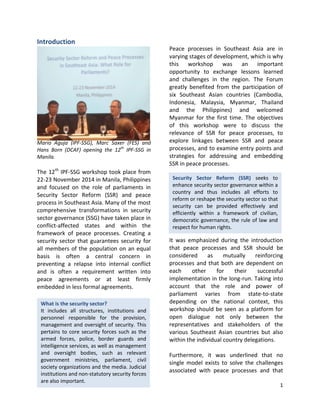
12th Inter-Parliamentary Forum on Security Sector
Governance in Southeast Asia
Workshop Report
“Security Sector Reform and Peace Processes in Southeast Asia:
What Role for Parliaments?”
22-23 November 2014
Manila, Philippines
Executive Summary
The 12th
Inter-Parliamentary Forum on Security Sector Governance in Southeast Asia
(IPF-SSG) in Manila, Philippines focused on the role of parliaments in Security Sector
Reform (SSR) and peace processes in the region. Participants from Cambodia,
Indonesia, Malaysia, Myanmar, Thailand and the Philippines included members and
staff of parliament, the security sector, academia, think tanks and civil society.
The exchange of experiences and lessons learned generated by the presentations and
the moderated dialogue among the participants revealed the following:
 Peace processes and SSR are mutually reinforcing and non-linear processes
that need to be specifically adapted to the local conflict-affected area and are
impacted by the level of economic development and democratization and by
the regime type.
 The role of parliament in peace processes and SSR also varies depending on
the national context and is important because parliament represents the
wider public. In most Southeast Asian countries, there is a potential for
parliament to become more engaged in peace processes and SSR through:
o Building capacity and expertise on security issues and peace processes
o Providing staff training on peace processes and SSR
o Informing public about peace processes and SSR
o Debating and enacting legislation on SSR and peace agreements
o Supervising and conducting oversight of budget in SSR and peace
processes
o Endorsing peace processes and representing concerns of citizens
o Holding government accountable to peace agreement provisions
 Key lessons from regional peace processes and SSR can enhance the
sustainability and effectiveness of both processes in the long-run:
o Trust-building between the stakeholders
o National and local ownership
o Inclusion of a wide range of stakeholders and segments of society
o Implementation as the end goal of peace processes and SSR
o Formation of a comprehensive and holistic peace process and SSR
agenda
o Management of stakeholder and community expectations
 The role of the Association of Southeast Asian Nations (ASEAN) in regional
peace processes is limited but there is potential for ASEAN to be involved
through taking advantage of the institutional mandates of existing ASEAN
organizations with regard to conflict and peace issues.
Table of Contents
Introduction 1
Why does SSR Matter for Peace Processes? 2
SSR in the Context of Peace Processes in Southeast Asia 3
Peace Processes and SSR 3
Role of Parliament 4
Stakeholders in SSR and Peace Processes 5
External Support to Peace Processes and SSR 5
Importance of a Comprehensive Approach 6
Peace Dividends 6
Normalization 7
ASEAN and Peace Processes in Southeast Asia 7
Recent Developments in SSR in Southeast Asia 8
Closing Session: Wrap-up and Way Ahead 9
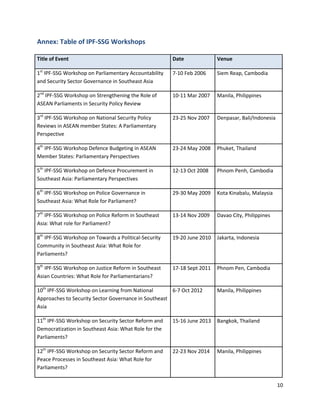
Annex: Table of IPF-SSG Workshops 10
1
What is the security sector?
It includes all structures, institutions and
personnel responsible for the provision,
management and oversight of security. This
pertains to core security forces such as the
armed forces, police, border guards and
intelligence services, as well as management
and oversight bodies, such as relevant
government ministries, parliament, civil
society organizations and the media. Judicial
institutions and non-statutory security forces
are also important.
Security Sector Reform (SSR) seeks to
enhance security sector governance within a
country and thus includes all efforts to
reform or reshape the security sector so that
security can be provided effectively and
efficiently within a framework of civilian,
democratic governance, the rule of law and
respect for human rights.
Introduction
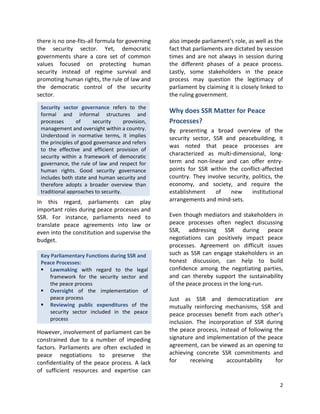
Mario Aguja (IPF-SSG), Marc Saxer (FES) and
Hans Born (DCAF) opening the 12th
IPF-SSG in
Manila.
The 12th
IPF-SSG workshop took place from
22-23 November 2014 in Manila, Philippines
and focused on the role of parliaments in
Security Sector Reform (SSR) and peace
process in Southeast Asia. Many of the most
comprehensive transformations in security
sector governance (SSG) have taken place in
conflict-affected states and within the
framework of peace processes. Creating a
security sector that guarantees security for
all members of the population on an equal
basis is often a central concern in
preventing a relapse into internal conflict
and is often a requirement written into
peace agreements or at least firmly
embedded in less formal agreements.
Peace processes in Southeast Asia are in
varying stages of development, which is why
this workshop was an important
opportunity to exchange lessons learned
and challenges in the region. The Forum
greatly benefited from the participation of
six Southeast Asian countries (Cambodia,
Indonesia, Malaysia, Myanmar, Thailand
and the Philippines) and welcomed
Myanmar for the first time. The objectives
of this workshop were to discuss the
relevance of SSR for peace processes, to
explore linkages between SSR and peace
processes, and to examine entry points and
strategies for addressing and embedding
SSR in peace processes.
It was emphasized during the introduction
that peace processes and SSR should be
considered as mutually reinforcing
processes and that both are dependent on
each other for their successful
implementation in the long-run. Taking into
account that the role and power of
parliament varies from state-to-state
depending on the national context, this
workshop should be seen as a platform for
open dialogue not only between the
representatives and stakeholders of the
various Southeast Asian countries but also
within the individual country delegations.
Furthermore, it was underlined that no
single model exists to solve the challenges
associated with peace processes and that
2
Key Parliamentary Functions during SSR and
Peace Processes:
 Lawmaking with regard to the legal
framework for the security sector and
the peace process
 Oversight of the implementation of
peace process
 Reviewing public expenditures of the
security sector included in the peace
process
Security sector governance refers to the
formal and informal structures and
processes of security provision,
management and oversight within a country.
Understood in normative terms, it implies
the principles of good governance and refers
to the effective and efficient provision of
security within a framework of democratic
governance, the rule of law and respect for
human rights. Good security governance
includes both state and human security and
therefore adopts a broader overview than
traditional approaches to security.
there is no one-fits-all formula for governing
the security sector. Yet, democratic
governments share a core set of common
values focused on protecting human
security instead of regime survival and
promoting human rights, the rule of law and
the democratic control of the security
sector.
In this regard, parliaments can play
important roles during peace processes and
SSR. For instance, parliaments need to
translate peace agreements into law or
even into the constitution and supervise the
budget.
However, involvement of parliament can be
constrained due to a number of impeding
factors. Parliaments are often excluded in
peace negotiations to preserve the
confidentiality of the peace process. A lack
of sufficient resources and expertise can
also impede parliament’s role, as well as the
fact that parliaments are dictated by session
times and are not always in session during
the different phases of a peace process.
Lastly, some stakeholders in the peace
process may question the legitimacy of
parliament by claiming it is closely linked to
the ruling government.
Why does SSR Matter for Peace
Processes?
By presenting a broad overview of the
security sector, SSR and peacebuilding, it
was noted that peace processes are
characterized as multi-dimensional, long-
term and non-linear and can offer entry-
points for SSR within the conflict-affected
country. They involve security, politics, the
economy, and society, and require the
establishment of new institutional
arrangements and mind-sets.
Even though mediators and stakeholders in
peace processes often neglect discussing
SSR, addressing SSR during peace
negotiations can positively impact peace
processes. Agreement on difficult issues
such as SSR can engage stakeholders in an
honest discussion, can help to build
confidence among the negotiating parties,
and can thereby support the sustainability
of the peace process in the long-run.
Just as SSR and democratization are
mutually reinforcing mechanisms, SSR and
peace processes benefit from each other’s
inclusion. The incorporation of SSR during
the peace process, instead of following the
signature and implementation of the peace
agreement, can be viewed as an opening to
achieving concrete SSR commitments and
for receiving accountability for
3
Current State of Peace Processes in
Southeast Asia:
Philippines: Outcome unknown
 Many peace negotiations with different
groups and with different levels of
integration of SSR
Indonesia: Completed in Aceh
Cambodia: Incomplete
 Stability but SSR needs to be
implemented
Myanmar: Beginning stages
 Process of negotiating peace
agreements
Thailand: Stalled
 Need to re-start peace process
Key Lessons from Peace Processes in
Southeast Asia:
 Building trust between stakeholders
 National and local ownership
 Generating political will
 Engaging civil society
 Implementation as end goal
 All-inclusive of society
 As comprehensive as possible
 Recognizing that setbacks occur
 Reforms required at national level
 Dealing with splinter groups
 Managing expectations
SSR in the Peace Process Phases
1. Pre-negotiation activities
 Understand factors driving need for SSR
 Understand what role SSR should play in
peace process
 Reduce sensitivity to SSR
2. Negotiation activities
 Generate support and future
commitment for SSR
 Ensure inclusive approach through
consultations and national dialogue
3. Drafting a conclusion following
negotiations
 Clarify key issues and benefits of SSR
reflected in agreement
 Consider financially sustainability of SSR
4. Implementation
 Consider how to support
implementation of SSR
implementing SSR after the completion of
the initial peace process.
SSR in the Context of Peace
Processes in Southeast Asia
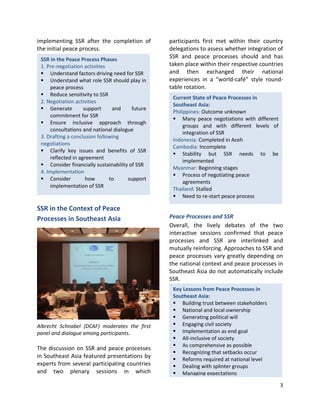
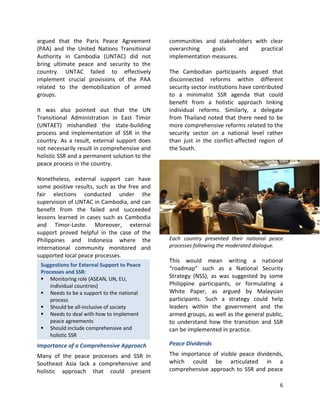
Albrecht Schnabel (DCAF) moderates the first
panel and dialogue among participants.
The discussion on SSR and peace processes
in Southeast Asia featured presentations by
experts from several participating countries
and two plenary sessions in which
participants first met within their country
delegations to assess whether integration of
SSR and peace processes should and has
taken place within their respective countries
and then exchanged their national
experiences in a “world-café” style round-
table rotation.
Peace Processes and SSR
Overall, the lively debates of the two
interactive sessions confirmed that peace
processes and SSR are interlinked and
mutually reinforcing. Approaches to SSR and
peace processes vary greatly depending on
the national context and peace processes in
Southeast Asia do not automatically include
SSR.
4
Examples of Parliamentary Involvement in
the Peace Process in Southeast Asia:
 Oversight and budgeting (Indonesia)
 Drafting and implementing law on peace
agreement (Indonesia)
 Legislating peace agreement
(Philippines)
 Committees tasked with peace
processes (limited in Thailand)
Addressing SSR and other security-related
issues such as demobilization, disarmament
and reintegration (DDR) in conflict-affected
areas of Southeast Asia requires the
negotiating parties to adapt reforms to the
local context in each conflict. Furthermore,
the differences in regional peace processes
indicate that the level of democratization,
as well as the broader political process, and
development impact the pace and success
of peace negotiations and SSR.
For example, the experience of Indonesia
demonstrates that broader national political
reforms can facilitate both peace processes
and SSR. Similarly, changes in the political
landscape in Myanmar have supported the
beginning stages of peace processes with
the various armed groups in the country
with the goal of a national ceasefire
agreement. During the interactive exchange
of experiences, a participant from Malaysia
argued that political reforms are needed in
the country in order to begin discussing SSR.
Since SSR and peace processes can both
experience setbacks and peace processes
might need to be negotiated multiple times,
it was highlighted that longstanding peace
processes can be solved over time and that
the stakeholders should focus on the small
victories to be gained.
Role of Parliament
Parliamentary involvement in peace
processes is also impacted by domestic
conditions, and, as a result, the role of
parliamentarians differs greatly from
country-to-country depending on the
political system and the level of
development.
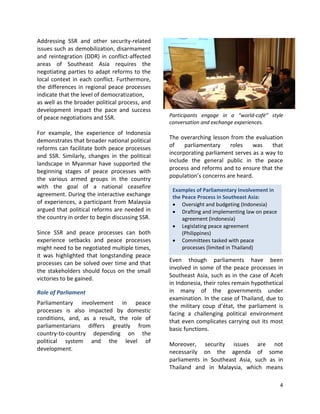
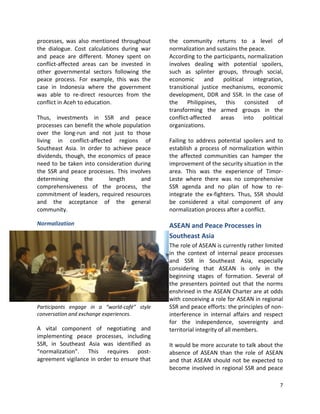
Participants engage in a “world-café” style
conversation and exchange experiences.
The overarching lesson from the evaluation
of parliamentary roles was that
incorporating parliament serves as a way to
include the general public in the peace
process and reforms and to ensure that the
population’s concerns are heard.
Even though parliaments have been
involved in some of the peace processes in
Southeast Asia, such as in the case of Aceh
in Indonesia, their roles remain hypothetical
in many of the governments under
examination. In the case of Thailand, due to
the military coup d’état, the parliament is
facing a challenging political environment
that even complicates carrying out its most
basic functions.
Moreover, security issues are not
necessarily on the agenda of some
parliaments in Southeast Asia, such as in
Thailand and in Malaysia, which means
5
Recommendations for Parliamentary
Engagement in Peace Processes and SSR
 Increase awareness on security issues
and peace processes
 Build capacity and expertise on peace
processes and SSR
 Provide training for members of
parliament and their staffers
 Inform the public about peace processes
and SSR
 Debate and enact legislation on SSR and
peace agreements
 Supervise and conduct oversight of
budget
 Endorse peace agreements
 Convey needs and concerns of
constituents during negotiations
 Coordinate between branches of
government
 Hold executive accountable to peace
agreement provisions
some parliaments lack any expertise in the
area and have little power to discuss
security matters. Nevertheless, the majority
of participants expressed their aspirations
for greater parliamentary engagement in
peace processes and SSR while
acknowledging that it is often limited.
Most parliamentary roles appear to be
concentrated in the last two phases of the
peace process, during the drafting of an
agreement following negotiations and the
implementation. Yet, it was suggested that
parliament could strengthen its presence in
the first two phases of the peace process by
enhancing parliament’s general awareness
of security issues and by building capacity
and expertise in the areas of peace
negotiations and SSR.
Stakeholders in SSR and Peace Processes
A major factor in the sustainability and drive
of SSR and peace processes is the inclusion
and consultation of a wide range of
stakeholders and segments of society.
The involvement of civil society, for
example, is considered as a driving factor
behind SSR initiatives in the Philippines
because civil society actors persistently
pushed for a new SSR agenda. Conversely, it
was identified in the Cambodian
presentation that civil society engagement
is missing in the country and that it could be
beneficial for the peace process and SSR.
Ensuring that all segments of society are
represented in peace processes is also
crucial. This point was illustrated in the
discussions on Thailand and Timor-Leste.
For example, the Thai case demonstrated
that the elite approach to the peace process
in Southern Thailand marginalized the
majority of the population in the South.
Rather than recognizing the various
backgrounds of the Thai populace,
especially those living in the South, the
government wanted to create one “Thai”
identity, alienating citizens in the South and
acting as a spoiler to the peace process.
External Support to Peace Processes and
SSR
The presentation of the Philippines
illustrated that SSR and the national peace
processes can be negotiated and
implemented through a locally-owned
approach, but the general discussion
revealed that this is not always the case in
Southeast Asian countries. Several of the
participating countries received external
support, ranging from individual countries
assuming monitoring roles to major
international interventions.
In particular, United Nations (UN)
peacekeeping missions in Cambodia and
Timor-Leste did not result in lasting peace
and in a substantial improvement in overall
security. The representatives of Cambodia
6
Suggestions for External Support to Peace
Processes and SSR:
 Monitoring role (ASEAN, UN, EU,
individual countries)
 Needs to be a support to the national
process
 Should be all-inclusive of society
 Needs to deal with how to implement
peace agreements
 Should include comprehensive and
holistic SSR
argued that the Paris Peace Agreement
(PAA) and the United Nations Transitional
Authority in Cambodia (UNTAC) did not
bring ultimate peace and security to the
country. UNTAC failed to effectively
implement crucial provisions of the PAA
related to the demobilization of armed
groups.
It was also pointed out that the UN
Transitional Administration in East Timor
(UNTAET) mishandled the state-building
process and implementation of SSR in the
country. As a result, external support does
not necessarily result in comprehensive and
holistic SSR and a permanent solution to the
peace process in the country.
Nonetheless, external support can have
some positive results, such as the free and
fair elections conducted under the
supervision of UNTAC in Cambodia, and can
benefit from the failed and succeeded
lessons learned in cases such as Cambodia
and Timor-Leste. Moreover, external
support proved helpful in the case of the
Philippines and Indonesia where the
international community monitored and
supported local peace processes.
Importance of a Comprehensive Approach
Many of the peace processes and SSR in
Southeast Asia lack a comprehensive and
holistic approach that could present
communities and stakeholders with clear
overarching goals and practical
implementation measures.
The Cambodian participants argued that
disconnected reforms within different
security sector institutions have contributed
to a minimalist SSR agenda that could
benefit from a holistic approach linking
individual reforms. Similarly, a delegate
from Thailand noted that there need to be
more comprehensive reforms related to the
security sector on a national level rather
than just in the conflict-affected region of
the South.
Each country presented their national peace
processes following the moderated dialogue.
This would mean writing a national
“roadmap” such as a National Security
Strategy (NSS), as was suggested by some
Philippine participants, or formulating a
White Paper, as argued by Malaysian
participants. Such a strategy could help
leaders within the government and the
armed groups, as well as the general public,
to understand how the transition and SSR
can be implemented in practice.
Peace Dividends
The importance of visible peace dividends,
which could be articulated in a
comprehensive approach to SSR and peace
7
processes, was also mentioned throughout
the dialogue. Cost calculations during war
and peace are different. Money spent on
conflict-affected areas can be invested in
other governmental sectors following the
peace process. For example, this was the
case in Indonesia where the government
was able to re-direct resources from the
conflict in Aceh to education.
Thus, investments in SSR and peace
processes can benefit the whole population
over the long-run and not just to those
living in conflict-affected regions of
Southeast Asia. In order to achieve peace
dividends, though, the economics of peace
need to be taken into consideration during
the SSR and peace processes. This involves
determining the length and
comprehensiveness of the process, the
commitment of leaders, required resources
and the acceptance of the general
community.
Normalization
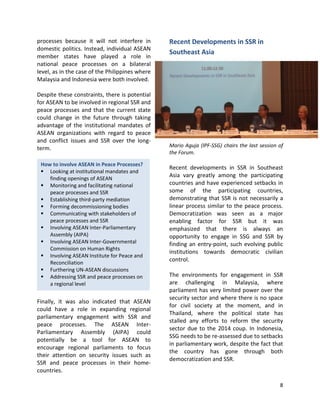
Participants engage in a “world-café” style
conversation and exchange experiences.
A vital component of negotiating and
implementing peace processes, including
SSR, in Southeast Asia was identified as
“normalization”. This requires post-
agreement vigilance in order to ensure that
the community returns to a level of
normalization and sustains the peace.
According to the participants, normalization
involves dealing with potential spoilers,
such as splinter groups, through social,
economic and political integration,
transitional justice mechanisms, economic
development, DDR and SSR. In the case of
the Philippines, this consisted of
transforming the armed groups in the
conflict-affected areas into political
organizations.
Failing to address potential spoilers and to
establish a process of normalization within
the affected communities can hamper the
improvement of the security situation in the
area. This was the experience of Timor-
Leste where there was no comprehensive
SSR agenda and no plan of how to re-
integrate the ex-fighters. Thus, SSR should
be considered a vital component of any
normalization process after a conflict.
ASEAN and Peace Processes in
Southeast Asia
The role of ASEAN is currently rather limited
in the context of internal peace processes
and SSR in Southeast Asia, especially
considering that ASEAN is only in the
beginning stages of formation. Several of
the presenters pointed out that the norms
enshrined in the ASEAN Charter are at odds
with conceiving a role for ASEAN in regional
SSR and peace efforts: the principles of non-
interference in internal affairs and respect
for the independence, sovereignty and
territorial integrity of all members.
It would be more accurate to talk about the
absence of ASEAN than the role of ASEAN
and that ASEAN should not be expected to
become involved in regional SSR and peace
8
How to involve ASEAN in Peace Processes?
 Looking at institutional mandates and
finding openings of ASEAN
 Monitoring and facilitating national
peace processes and SSR
 Establishing third-party mediation
 Forming decommissioning bodies
 Communicating with stakeholders of
peace processes and SSR
 Involving ASEAN Inter-Parliamentary
Assembly (AIPA)
 Involving ASEAN Inter-Governmental
Commission on Human Rights
 Involving ASEAN Institute for Peace and
Reconciliation
 Furthering UN-ASEAN discussions
 Addressing SSR and peace processes on
a regional level
processes because it will not interfere in
domestic politics. Instead, individual ASEAN
member states have played a role in
national peace processes on a bilateral
level, as in the case of the Philippines where
Malaysia and Indonesia were both involved.
Despite these constraints, there is potential
for ASEAN to be involved in regional SSR and
peace processes and that the current state
could change in the future through taking
advantage of the institutional mandates of
ASEAN organizations with regard to peace
and conflict issues and SSR over the long-
term.
Finally, it was also indicated that ASEAN
could have a role in expanding regional
parliamentary engagement with SSR and
peace processes. The ASEAN Inter-
Parliamentary Assembly (AIPA) could
potentially be a tool for ASEAN to
encourage regional parliaments to focus
their attention on security issues such as
SSR and peace processes in their home-
countries.
Recent Developments in SSR in
Southeast Asia
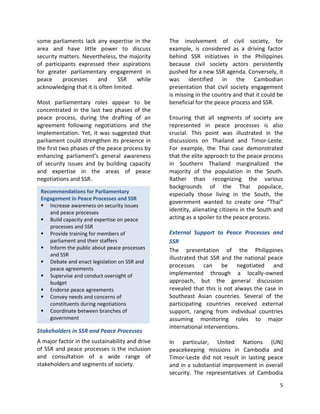
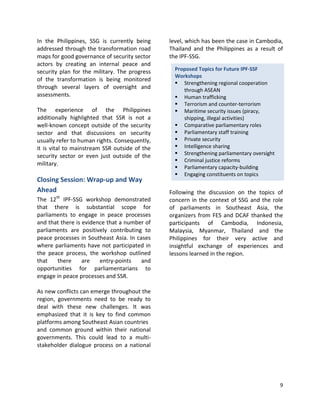
Mario Aguja (IPF-SSG) chairs the last session of
the Forum.
Recent developments in SSR in Southeast
Asia vary greatly among the participating
countries and have experienced setbacks in
some of the participating countries,
demonstrating that SSR is not necessarily a
linear process similar to the peace process.
Democratization was seen as a major
enabling factor for SSR but it was
emphasized that there is always an
opportunity to engage in SSG and SSR by
finding an entry-point, such evolving public
institutions towards democratic civilian
control.
The environments for engagement in SSR
are challenging in Malaysia, where
parliament has very limited power over the
security sector and where there is no space
for civil society at the moment, and in
Thailand, where the political state has
stalled any efforts to reform the security
sector due to the 2014 coup. In Indonesia,
SSG needs to be re-assessed due to setbacks
in parliamentary work, despite the fact that
the country has gone through both
democratization and SSR.
9
In the Philippines, SSG is currently being
addressed through the transformation road
maps for good governance of security sector
actors by creating an internal peace and
security plan for the military. The progress
of the transformation is being monitored
through several layers of oversight and
assessments.
The experience of the Philippines
additionally highlighted that SSR is not a
well-known concept outside of the security
sector and that discussions on security
usually refer to human rights. Consequently,
it is vital to mainstream SSR outside of the
security sector or even just outside of the
military.
Closing Session: Wrap-up and Way
Ahead
The 12th
IPF-SSG workshop demonstrated
that there is substantial scope for
parliaments to engage in peace processes
and that there is evidence that a number of
parliaments are positively contributing to
peace processes in Southeast Asia. In cases
where parliaments have not participated in
the peace process, the workshop outlined
that there are entry-points and
opportunities for parliamentarians to
engage in peace processes and SSR.
As new conflicts can emerge throughout the
region, governments need to be ready to
deal with these new challenges. It was
emphasized that it is key to find common
platforms among Southeast Asian countries
and common ground within their national
governments. This could lead to a multi-
stakeholder dialogue process on a national
level, which has been the case in Cambodia,
Thailand and the Philippines as a result of
the IPF-SSG.
Following the discussion on the topics of
concern in the context of SSG and the role
of parliaments in Southeast Asia, the
organizers from FES and DCAF thanked the
participants of Cambodia, Indonesia,
Malaysia, Myanmar, Thailand and the
Philippines for their very active and
insightful exchange of experiences and
lessons learned in the region.
Proposed Topics for Future IPF-SSF
Workshops
 Strengthening regional cooperation
through ASEAN
 Human trafficking
 Terrorism and counter-terrorism
 Maritime security issues (piracy,
shipping, illegal activities)
 Comparative parliamentary roles
 Parliamentary staff training
 Private security
 Intelligence sharing
 Strengthening parliamentary oversight
 Criminal justice reforms
 Parliamentary capacity-building
 Engaging constituents on topics
10
Annex: Table of IPF-SSG Workshops
Title of Event Date Venue
1st
IPF-SSG Workshop on Parliamentary Accountability
and Security Sector Governance in Southeast Asia
7-10 Feb 2006 Siem Reap, Cambodia
2nd
IPF-SSG Workshop on Strengthening the Role of
ASEAN Parliaments in Security Policy Review
10-11 Mar 2007 Manila, Philippines
3rd
IPF-SSG Workshop on National Security Policy
Reviews in ASEAN member States: A Parliamentary
Perspective
23-25 Nov 2007 Denpasar, Bali/Indonesia
4th
IPF-SSG Workshop Defence Budgeting in ASEAN
Member States: Parliamentary Perspectives
23-24 May 2008 Phuket, Thailand
5th
IPF-SSG Workshop on Defence Procurement in
Southeast Asia: Parliamentary Perspectives
12-13 Oct 2008 Phnom Penh, Cambodia
6th
IPF-SSG Workshop on Police Governance in
Southeast Asia: What Role for Parliament?
29-30 May 2009 Kota Kinabalu, Malaysia
7th
IPF-SSG Workshop on Police Reform in Southeast
Asia: What role for Parliament?
13-14 Nov 2009 Davao City, Philippines
8th
IPF-SSG Workshop on Towards a Political-Security
Community in Southeast Asia: What Role for
Parliaments?
19-20 June 2010 Jakarta, Indonesia
9th
IPF-SSG Workshop on Justice Reform in Southeast
Asian Countries: What Role for Parliamentarians?
17-18 Sept 2011 Phnom Pen, Cambodia
10th
IPF-SSG Workshop on Learning from National
Approaches to Security Sector Governance in Southeast
Asia
6-7 Oct 2012 Manila, Philippines
11th
IPF-SSG Workshop on Security Sector Reform and
Democratization in Southeast Asia: What Role for the
Parliaments?
15-16 June 2013 Bangkok, Thailand
12th
IPF-SSG Workshop on Security Sector Reform and
Peace Processes in Southeast Asia: What Role for
Parliaments?
22-23 Nov 2014 Manila, Philippines
11
The Inter-Parliamentary Forum on Security Sector Governance in
Southeast Asia (IPF-SSG) aims to promote ongoing dialogue and
exchange of good practices among members of parliament in Southeast
Asian countries. The Forum aims to enhance civilian oversight and
national parliamentary involvement in security sector governance and features
regular workshops, publications, its own website, as well as activities of national caucuses in
participating countries. Participants include parliamentarians and staffers, as well as
government officials and members of security forces, academic experts and civil society
representatives from several Southeast Asian countries. The IPF-SSG is supported by the
Friedrich-Ebert Foundation (FES) and the Geneva Centre for the Democratic Control of Armed
Forces (DCAF). For further information on the Forum see: www.ipf-ssg-sea.net
The Friedrich Ebert Stiftung (FES) was founded in 1925 as a political legacy of
Germany’s first democratically elected president, Friedrich Ebert. The Office
for Regional Cooperation in Asia focuses on reinforcing social justice as a key
factor for inclusive growth and as a core element of political processes in Asia.
It cooperates with its partners aiming at strengthening democratic governance and
incorporating features of social justice in political and economic processes. The Foundation
actively supports dialogue platforms and stakeholder processes for trade unions and civil society
organizations related to the Association of Southeast Asian Nations (ASEAN) and the Asia-
Europe Meeting (ASEM). FES works with partners from political parties, parliaments and
ministries, trade unions, non-governmental and media organizations, as well as academics and
political think tanks. www.fes-asia.org
DCAF is an international foundation established in 2000 on the initiative of the
Swiss Confederation as the ‘Geneva Centre for the Democratic Control of Armed
Forces’. DCAF contributes to enhancing security sector governance through
security sector reform. The Centre’s work to support effective, efficient security
sectors which are accountable to the state and its citizens is underpinned by the
acknowledgement that security, development and the rule of law are essential preconditions for
sustainable peace. DCAF is guided by the principles of neutrality, impartiality, gender sensitivity,
and local ownership as the basis for supporting legitimate, sustainable reform processes.
www.dcaf.ch

12th ipf ssg report

  • 1.
    12th Inter-Parliamentary Forumon Security Sector Governance in Southeast Asia Workshop Report “Security Sector Reform and Peace Processes in Southeast Asia: What Role for Parliaments?” 22-23 November 2014 Manila, Philippines
  • 2.
    Executive Summary The 12th Inter-ParliamentaryForum on Security Sector Governance in Southeast Asia (IPF-SSG) in Manila, Philippines focused on the role of parliaments in Security Sector Reform (SSR) and peace processes in the region. Participants from Cambodia, Indonesia, Malaysia, Myanmar, Thailand and the Philippines included members and staff of parliament, the security sector, academia, think tanks and civil society. The exchange of experiences and lessons learned generated by the presentations and the moderated dialogue among the participants revealed the following:  Peace processes and SSR are mutually reinforcing and non-linear processes that need to be specifically adapted to the local conflict-affected area and are impacted by the level of economic development and democratization and by the regime type.  The role of parliament in peace processes and SSR also varies depending on the national context and is important because parliament represents the wider public. In most Southeast Asian countries, there is a potential for parliament to become more engaged in peace processes and SSR through: o Building capacity and expertise on security issues and peace processes o Providing staff training on peace processes and SSR o Informing public about peace processes and SSR o Debating and enacting legislation on SSR and peace agreements o Supervising and conducting oversight of budget in SSR and peace processes o Endorsing peace processes and representing concerns of citizens o Holding government accountable to peace agreement provisions  Key lessons from regional peace processes and SSR can enhance the sustainability and effectiveness of both processes in the long-run: o Trust-building between the stakeholders o National and local ownership o Inclusion of a wide range of stakeholders and segments of society o Implementation as the end goal of peace processes and SSR o Formation of a comprehensive and holistic peace process and SSR agenda o Management of stakeholder and community expectations  The role of the Association of Southeast Asian Nations (ASEAN) in regional peace processes is limited but there is potential for ASEAN to be involved through taking advantage of the institutional mandates of existing ASEAN organizations with regard to conflict and peace issues.
  • 3.
    Table of Contents Introduction1 Why does SSR Matter for Peace Processes? 2 SSR in the Context of Peace Processes in Southeast Asia 3 Peace Processes and SSR 3 Role of Parliament 4 Stakeholders in SSR and Peace Processes 5 External Support to Peace Processes and SSR 5 Importance of a Comprehensive Approach 6 Peace Dividends 6 Normalization 7 ASEAN and Peace Processes in Southeast Asia 7 Recent Developments in SSR in Southeast Asia 8 Closing Session: Wrap-up and Way Ahead 9 Annex: Table of IPF-SSG Workshops 10
  • 4.
    1 What is thesecurity sector? It includes all structures, institutions and personnel responsible for the provision, management and oversight of security. This pertains to core security forces such as the armed forces, police, border guards and intelligence services, as well as management and oversight bodies, such as relevant government ministries, parliament, civil society organizations and the media. Judicial institutions and non-statutory security forces are also important. Security Sector Reform (SSR) seeks to enhance security sector governance within a country and thus includes all efforts to reform or reshape the security sector so that security can be provided effectively and efficiently within a framework of civilian, democratic governance, the rule of law and respect for human rights. Introduction Mario Aguja (IPF-SSG), Marc Saxer (FES) and Hans Born (DCAF) opening the 12th IPF-SSG in Manila. The 12th IPF-SSG workshop took place from 22-23 November 2014 in Manila, Philippines and focused on the role of parliaments in Security Sector Reform (SSR) and peace process in Southeast Asia. Many of the most comprehensive transformations in security sector governance (SSG) have taken place in conflict-affected states and within the framework of peace processes. Creating a security sector that guarantees security for all members of the population on an equal basis is often a central concern in preventing a relapse into internal conflict and is often a requirement written into peace agreements or at least firmly embedded in less formal agreements. Peace processes in Southeast Asia are in varying stages of development, which is why this workshop was an important opportunity to exchange lessons learned and challenges in the region. The Forum greatly benefited from the participation of six Southeast Asian countries (Cambodia, Indonesia, Malaysia, Myanmar, Thailand and the Philippines) and welcomed Myanmar for the first time. The objectives of this workshop were to discuss the relevance of SSR for peace processes, to explore linkages between SSR and peace processes, and to examine entry points and strategies for addressing and embedding SSR in peace processes. It was emphasized during the introduction that peace processes and SSR should be considered as mutually reinforcing processes and that both are dependent on each other for their successful implementation in the long-run. Taking into account that the role and power of parliament varies from state-to-state depending on the national context, this workshop should be seen as a platform for open dialogue not only between the representatives and stakeholders of the various Southeast Asian countries but also within the individual country delegations. Furthermore, it was underlined that no single model exists to solve the challenges associated with peace processes and that
  • 5.
    2 Key Parliamentary Functionsduring SSR and Peace Processes:  Lawmaking with regard to the legal framework for the security sector and the peace process  Oversight of the implementation of peace process  Reviewing public expenditures of the security sector included in the peace process Security sector governance refers to the formal and informal structures and processes of security provision, management and oversight within a country. Understood in normative terms, it implies the principles of good governance and refers to the effective and efficient provision of security within a framework of democratic governance, the rule of law and respect for human rights. Good security governance includes both state and human security and therefore adopts a broader overview than traditional approaches to security. there is no one-fits-all formula for governing the security sector. Yet, democratic governments share a core set of common values focused on protecting human security instead of regime survival and promoting human rights, the rule of law and the democratic control of the security sector. In this regard, parliaments can play important roles during peace processes and SSR. For instance, parliaments need to translate peace agreements into law or even into the constitution and supervise the budget. However, involvement of parliament can be constrained due to a number of impeding factors. Parliaments are often excluded in peace negotiations to preserve the confidentiality of the peace process. A lack of sufficient resources and expertise can also impede parliament’s role, as well as the fact that parliaments are dictated by session times and are not always in session during the different phases of a peace process. Lastly, some stakeholders in the peace process may question the legitimacy of parliament by claiming it is closely linked to the ruling government. Why does SSR Matter for Peace Processes? By presenting a broad overview of the security sector, SSR and peacebuilding, it was noted that peace processes are characterized as multi-dimensional, long- term and non-linear and can offer entry- points for SSR within the conflict-affected country. They involve security, politics, the economy, and society, and require the establishment of new institutional arrangements and mind-sets. Even though mediators and stakeholders in peace processes often neglect discussing SSR, addressing SSR during peace negotiations can positively impact peace processes. Agreement on difficult issues such as SSR can engage stakeholders in an honest discussion, can help to build confidence among the negotiating parties, and can thereby support the sustainability of the peace process in the long-run. Just as SSR and democratization are mutually reinforcing mechanisms, SSR and peace processes benefit from each other’s inclusion. The incorporation of SSR during the peace process, instead of following the signature and implementation of the peace agreement, can be viewed as an opening to achieving concrete SSR commitments and for receiving accountability for
  • 6.
    3 Current State ofPeace Processes in Southeast Asia: Philippines: Outcome unknown  Many peace negotiations with different groups and with different levels of integration of SSR Indonesia: Completed in Aceh Cambodia: Incomplete  Stability but SSR needs to be implemented Myanmar: Beginning stages  Process of negotiating peace agreements Thailand: Stalled  Need to re-start peace process Key Lessons from Peace Processes in Southeast Asia:  Building trust between stakeholders  National and local ownership  Generating political will  Engaging civil society  Implementation as end goal  All-inclusive of society  As comprehensive as possible  Recognizing that setbacks occur  Reforms required at national level  Dealing with splinter groups  Managing expectations SSR in the Peace Process Phases 1. Pre-negotiation activities  Understand factors driving need for SSR  Understand what role SSR should play in peace process  Reduce sensitivity to SSR 2. Negotiation activities  Generate support and future commitment for SSR  Ensure inclusive approach through consultations and national dialogue 3. Drafting a conclusion following negotiations  Clarify key issues and benefits of SSR reflected in agreement  Consider financially sustainability of SSR 4. Implementation  Consider how to support implementation of SSR implementing SSR after the completion of the initial peace process. SSR in the Context of Peace Processes in Southeast Asia Albrecht Schnabel (DCAF) moderates the first panel and dialogue among participants. The discussion on SSR and peace processes in Southeast Asia featured presentations by experts from several participating countries and two plenary sessions in which participants first met within their country delegations to assess whether integration of SSR and peace processes should and has taken place within their respective countries and then exchanged their national experiences in a “world-café” style round- table rotation. Peace Processes and SSR Overall, the lively debates of the two interactive sessions confirmed that peace processes and SSR are interlinked and mutually reinforcing. Approaches to SSR and peace processes vary greatly depending on the national context and peace processes in Southeast Asia do not automatically include SSR.
  • 7.
    4 Examples of ParliamentaryInvolvement in the Peace Process in Southeast Asia:  Oversight and budgeting (Indonesia)  Drafting and implementing law on peace agreement (Indonesia)  Legislating peace agreement (Philippines)  Committees tasked with peace processes (limited in Thailand) Addressing SSR and other security-related issues such as demobilization, disarmament and reintegration (DDR) in conflict-affected areas of Southeast Asia requires the negotiating parties to adapt reforms to the local context in each conflict. Furthermore, the differences in regional peace processes indicate that the level of democratization, as well as the broader political process, and development impact the pace and success of peace negotiations and SSR. For example, the experience of Indonesia demonstrates that broader national political reforms can facilitate both peace processes and SSR. Similarly, changes in the political landscape in Myanmar have supported the beginning stages of peace processes with the various armed groups in the country with the goal of a national ceasefire agreement. During the interactive exchange of experiences, a participant from Malaysia argued that political reforms are needed in the country in order to begin discussing SSR. Since SSR and peace processes can both experience setbacks and peace processes might need to be negotiated multiple times, it was highlighted that longstanding peace processes can be solved over time and that the stakeholders should focus on the small victories to be gained. Role of Parliament Parliamentary involvement in peace processes is also impacted by domestic conditions, and, as a result, the role of parliamentarians differs greatly from country-to-country depending on the political system and the level of development. Participants engage in a “world-café” style conversation and exchange experiences. The overarching lesson from the evaluation of parliamentary roles was that incorporating parliament serves as a way to include the general public in the peace process and reforms and to ensure that the population’s concerns are heard. Even though parliaments have been involved in some of the peace processes in Southeast Asia, such as in the case of Aceh in Indonesia, their roles remain hypothetical in many of the governments under examination. In the case of Thailand, due to the military coup d’état, the parliament is facing a challenging political environment that even complicates carrying out its most basic functions. Moreover, security issues are not necessarily on the agenda of some parliaments in Southeast Asia, such as in Thailand and in Malaysia, which means
  • 8.
    5 Recommendations for Parliamentary Engagementin Peace Processes and SSR  Increase awareness on security issues and peace processes  Build capacity and expertise on peace processes and SSR  Provide training for members of parliament and their staffers  Inform the public about peace processes and SSR  Debate and enact legislation on SSR and peace agreements  Supervise and conduct oversight of budget  Endorse peace agreements  Convey needs and concerns of constituents during negotiations  Coordinate between branches of government  Hold executive accountable to peace agreement provisions some parliaments lack any expertise in the area and have little power to discuss security matters. Nevertheless, the majority of participants expressed their aspirations for greater parliamentary engagement in peace processes and SSR while acknowledging that it is often limited. Most parliamentary roles appear to be concentrated in the last two phases of the peace process, during the drafting of an agreement following negotiations and the implementation. Yet, it was suggested that parliament could strengthen its presence in the first two phases of the peace process by enhancing parliament’s general awareness of security issues and by building capacity and expertise in the areas of peace negotiations and SSR. Stakeholders in SSR and Peace Processes A major factor in the sustainability and drive of SSR and peace processes is the inclusion and consultation of a wide range of stakeholders and segments of society. The involvement of civil society, for example, is considered as a driving factor behind SSR initiatives in the Philippines because civil society actors persistently pushed for a new SSR agenda. Conversely, it was identified in the Cambodian presentation that civil society engagement is missing in the country and that it could be beneficial for the peace process and SSR. Ensuring that all segments of society are represented in peace processes is also crucial. This point was illustrated in the discussions on Thailand and Timor-Leste. For example, the Thai case demonstrated that the elite approach to the peace process in Southern Thailand marginalized the majority of the population in the South. Rather than recognizing the various backgrounds of the Thai populace, especially those living in the South, the government wanted to create one “Thai” identity, alienating citizens in the South and acting as a spoiler to the peace process. External Support to Peace Processes and SSR The presentation of the Philippines illustrated that SSR and the national peace processes can be negotiated and implemented through a locally-owned approach, but the general discussion revealed that this is not always the case in Southeast Asian countries. Several of the participating countries received external support, ranging from individual countries assuming monitoring roles to major international interventions. In particular, United Nations (UN) peacekeeping missions in Cambodia and Timor-Leste did not result in lasting peace and in a substantial improvement in overall security. The representatives of Cambodia
  • 9.
    6 Suggestions for ExternalSupport to Peace Processes and SSR:  Monitoring role (ASEAN, UN, EU, individual countries)  Needs to be a support to the national process  Should be all-inclusive of society  Needs to deal with how to implement peace agreements  Should include comprehensive and holistic SSR argued that the Paris Peace Agreement (PAA) and the United Nations Transitional Authority in Cambodia (UNTAC) did not bring ultimate peace and security to the country. UNTAC failed to effectively implement crucial provisions of the PAA related to the demobilization of armed groups. It was also pointed out that the UN Transitional Administration in East Timor (UNTAET) mishandled the state-building process and implementation of SSR in the country. As a result, external support does not necessarily result in comprehensive and holistic SSR and a permanent solution to the peace process in the country. Nonetheless, external support can have some positive results, such as the free and fair elections conducted under the supervision of UNTAC in Cambodia, and can benefit from the failed and succeeded lessons learned in cases such as Cambodia and Timor-Leste. Moreover, external support proved helpful in the case of the Philippines and Indonesia where the international community monitored and supported local peace processes. Importance of a Comprehensive Approach Many of the peace processes and SSR in Southeast Asia lack a comprehensive and holistic approach that could present communities and stakeholders with clear overarching goals and practical implementation measures. The Cambodian participants argued that disconnected reforms within different security sector institutions have contributed to a minimalist SSR agenda that could benefit from a holistic approach linking individual reforms. Similarly, a delegate from Thailand noted that there need to be more comprehensive reforms related to the security sector on a national level rather than just in the conflict-affected region of the South. Each country presented their national peace processes following the moderated dialogue. This would mean writing a national “roadmap” such as a National Security Strategy (NSS), as was suggested by some Philippine participants, or formulating a White Paper, as argued by Malaysian participants. Such a strategy could help leaders within the government and the armed groups, as well as the general public, to understand how the transition and SSR can be implemented in practice. Peace Dividends The importance of visible peace dividends, which could be articulated in a comprehensive approach to SSR and peace
  • 10.
    7 processes, was alsomentioned throughout the dialogue. Cost calculations during war and peace are different. Money spent on conflict-affected areas can be invested in other governmental sectors following the peace process. For example, this was the case in Indonesia where the government was able to re-direct resources from the conflict in Aceh to education. Thus, investments in SSR and peace processes can benefit the whole population over the long-run and not just to those living in conflict-affected regions of Southeast Asia. In order to achieve peace dividends, though, the economics of peace need to be taken into consideration during the SSR and peace processes. This involves determining the length and comprehensiveness of the process, the commitment of leaders, required resources and the acceptance of the general community. Normalization Participants engage in a “world-café” style conversation and exchange experiences. A vital component of negotiating and implementing peace processes, including SSR, in Southeast Asia was identified as “normalization”. This requires post- agreement vigilance in order to ensure that the community returns to a level of normalization and sustains the peace. According to the participants, normalization involves dealing with potential spoilers, such as splinter groups, through social, economic and political integration, transitional justice mechanisms, economic development, DDR and SSR. In the case of the Philippines, this consisted of transforming the armed groups in the conflict-affected areas into political organizations. Failing to address potential spoilers and to establish a process of normalization within the affected communities can hamper the improvement of the security situation in the area. This was the experience of Timor- Leste where there was no comprehensive SSR agenda and no plan of how to re- integrate the ex-fighters. Thus, SSR should be considered a vital component of any normalization process after a conflict. ASEAN and Peace Processes in Southeast Asia The role of ASEAN is currently rather limited in the context of internal peace processes and SSR in Southeast Asia, especially considering that ASEAN is only in the beginning stages of formation. Several of the presenters pointed out that the norms enshrined in the ASEAN Charter are at odds with conceiving a role for ASEAN in regional SSR and peace efforts: the principles of non- interference in internal affairs and respect for the independence, sovereignty and territorial integrity of all members. It would be more accurate to talk about the absence of ASEAN than the role of ASEAN and that ASEAN should not be expected to become involved in regional SSR and peace
  • 11.
    8 How to involveASEAN in Peace Processes?  Looking at institutional mandates and finding openings of ASEAN  Monitoring and facilitating national peace processes and SSR  Establishing third-party mediation  Forming decommissioning bodies  Communicating with stakeholders of peace processes and SSR  Involving ASEAN Inter-Parliamentary Assembly (AIPA)  Involving ASEAN Inter-Governmental Commission on Human Rights  Involving ASEAN Institute for Peace and Reconciliation  Furthering UN-ASEAN discussions  Addressing SSR and peace processes on a regional level processes because it will not interfere in domestic politics. Instead, individual ASEAN member states have played a role in national peace processes on a bilateral level, as in the case of the Philippines where Malaysia and Indonesia were both involved. Despite these constraints, there is potential for ASEAN to be involved in regional SSR and peace processes and that the current state could change in the future through taking advantage of the institutional mandates of ASEAN organizations with regard to peace and conflict issues and SSR over the long- term. Finally, it was also indicated that ASEAN could have a role in expanding regional parliamentary engagement with SSR and peace processes. The ASEAN Inter- Parliamentary Assembly (AIPA) could potentially be a tool for ASEAN to encourage regional parliaments to focus their attention on security issues such as SSR and peace processes in their home- countries. Recent Developments in SSR in Southeast Asia Mario Aguja (IPF-SSG) chairs the last session of the Forum. Recent developments in SSR in Southeast Asia vary greatly among the participating countries and have experienced setbacks in some of the participating countries, demonstrating that SSR is not necessarily a linear process similar to the peace process. Democratization was seen as a major enabling factor for SSR but it was emphasized that there is always an opportunity to engage in SSG and SSR by finding an entry-point, such evolving public institutions towards democratic civilian control. The environments for engagement in SSR are challenging in Malaysia, where parliament has very limited power over the security sector and where there is no space for civil society at the moment, and in Thailand, where the political state has stalled any efforts to reform the security sector due to the 2014 coup. In Indonesia, SSG needs to be re-assessed due to setbacks in parliamentary work, despite the fact that the country has gone through both democratization and SSR.
  • 12.
    9 In the Philippines,SSG is currently being addressed through the transformation road maps for good governance of security sector actors by creating an internal peace and security plan for the military. The progress of the transformation is being monitored through several layers of oversight and assessments. The experience of the Philippines additionally highlighted that SSR is not a well-known concept outside of the security sector and that discussions on security usually refer to human rights. Consequently, it is vital to mainstream SSR outside of the security sector or even just outside of the military. Closing Session: Wrap-up and Way Ahead The 12th IPF-SSG workshop demonstrated that there is substantial scope for parliaments to engage in peace processes and that there is evidence that a number of parliaments are positively contributing to peace processes in Southeast Asia. In cases where parliaments have not participated in the peace process, the workshop outlined that there are entry-points and opportunities for parliamentarians to engage in peace processes and SSR. As new conflicts can emerge throughout the region, governments need to be ready to deal with these new challenges. It was emphasized that it is key to find common platforms among Southeast Asian countries and common ground within their national governments. This could lead to a multi- stakeholder dialogue process on a national level, which has been the case in Cambodia, Thailand and the Philippines as a result of the IPF-SSG. Following the discussion on the topics of concern in the context of SSG and the role of parliaments in Southeast Asia, the organizers from FES and DCAF thanked the participants of Cambodia, Indonesia, Malaysia, Myanmar, Thailand and the Philippines for their very active and insightful exchange of experiences and lessons learned in the region. Proposed Topics for Future IPF-SSF Workshops  Strengthening regional cooperation through ASEAN  Human trafficking  Terrorism and counter-terrorism  Maritime security issues (piracy, shipping, illegal activities)  Comparative parliamentary roles  Parliamentary staff training  Private security  Intelligence sharing  Strengthening parliamentary oversight  Criminal justice reforms  Parliamentary capacity-building  Engaging constituents on topics
  • 13.
    10 Annex: Table ofIPF-SSG Workshops Title of Event Date Venue 1st IPF-SSG Workshop on Parliamentary Accountability and Security Sector Governance in Southeast Asia 7-10 Feb 2006 Siem Reap, Cambodia 2nd IPF-SSG Workshop on Strengthening the Role of ASEAN Parliaments in Security Policy Review 10-11 Mar 2007 Manila, Philippines 3rd IPF-SSG Workshop on National Security Policy Reviews in ASEAN member States: A Parliamentary Perspective 23-25 Nov 2007 Denpasar, Bali/Indonesia 4th IPF-SSG Workshop Defence Budgeting in ASEAN Member States: Parliamentary Perspectives 23-24 May 2008 Phuket, Thailand 5th IPF-SSG Workshop on Defence Procurement in Southeast Asia: Parliamentary Perspectives 12-13 Oct 2008 Phnom Penh, Cambodia 6th IPF-SSG Workshop on Police Governance in Southeast Asia: What Role for Parliament? 29-30 May 2009 Kota Kinabalu, Malaysia 7th IPF-SSG Workshop on Police Reform in Southeast Asia: What role for Parliament? 13-14 Nov 2009 Davao City, Philippines 8th IPF-SSG Workshop on Towards a Political-Security Community in Southeast Asia: What Role for Parliaments? 19-20 June 2010 Jakarta, Indonesia 9th IPF-SSG Workshop on Justice Reform in Southeast Asian Countries: What Role for Parliamentarians? 17-18 Sept 2011 Phnom Pen, Cambodia 10th IPF-SSG Workshop on Learning from National Approaches to Security Sector Governance in Southeast Asia 6-7 Oct 2012 Manila, Philippines 11th IPF-SSG Workshop on Security Sector Reform and Democratization in Southeast Asia: What Role for the Parliaments? 15-16 June 2013 Bangkok, Thailand 12th IPF-SSG Workshop on Security Sector Reform and Peace Processes in Southeast Asia: What Role for Parliaments? 22-23 Nov 2014 Manila, Philippines
  • 14.
    11 The Inter-Parliamentary Forumon Security Sector Governance in Southeast Asia (IPF-SSG) aims to promote ongoing dialogue and exchange of good practices among members of parliament in Southeast Asian countries. The Forum aims to enhance civilian oversight and national parliamentary involvement in security sector governance and features regular workshops, publications, its own website, as well as activities of national caucuses in participating countries. Participants include parliamentarians and staffers, as well as government officials and members of security forces, academic experts and civil society representatives from several Southeast Asian countries. The IPF-SSG is supported by the Friedrich-Ebert Foundation (FES) and the Geneva Centre for the Democratic Control of Armed Forces (DCAF). For further information on the Forum see: www.ipf-ssg-sea.net The Friedrich Ebert Stiftung (FES) was founded in 1925 as a political legacy of Germany’s first democratically elected president, Friedrich Ebert. The Office for Regional Cooperation in Asia focuses on reinforcing social justice as a key factor for inclusive growth and as a core element of political processes in Asia. It cooperates with its partners aiming at strengthening democratic governance and incorporating features of social justice in political and economic processes. The Foundation actively supports dialogue platforms and stakeholder processes for trade unions and civil society organizations related to the Association of Southeast Asian Nations (ASEAN) and the Asia- Europe Meeting (ASEM). FES works with partners from political parties, parliaments and ministries, trade unions, non-governmental and media organizations, as well as academics and political think tanks. www.fes-asia.org DCAF is an international foundation established in 2000 on the initiative of the Swiss Confederation as the ‘Geneva Centre for the Democratic Control of Armed Forces’. DCAF contributes to enhancing security sector governance through security sector reform. The Centre’s work to support effective, efficient security sectors which are accountable to the state and its citizens is underpinned by the acknowledgement that security, development and the rule of law are essential preconditions for sustainable peace. DCAF is guided by the principles of neutrality, impartiality, gender sensitivity, and local ownership as the basis for supporting legitimate, sustainable reform processes. www.dcaf.ch