GARY DESSLER
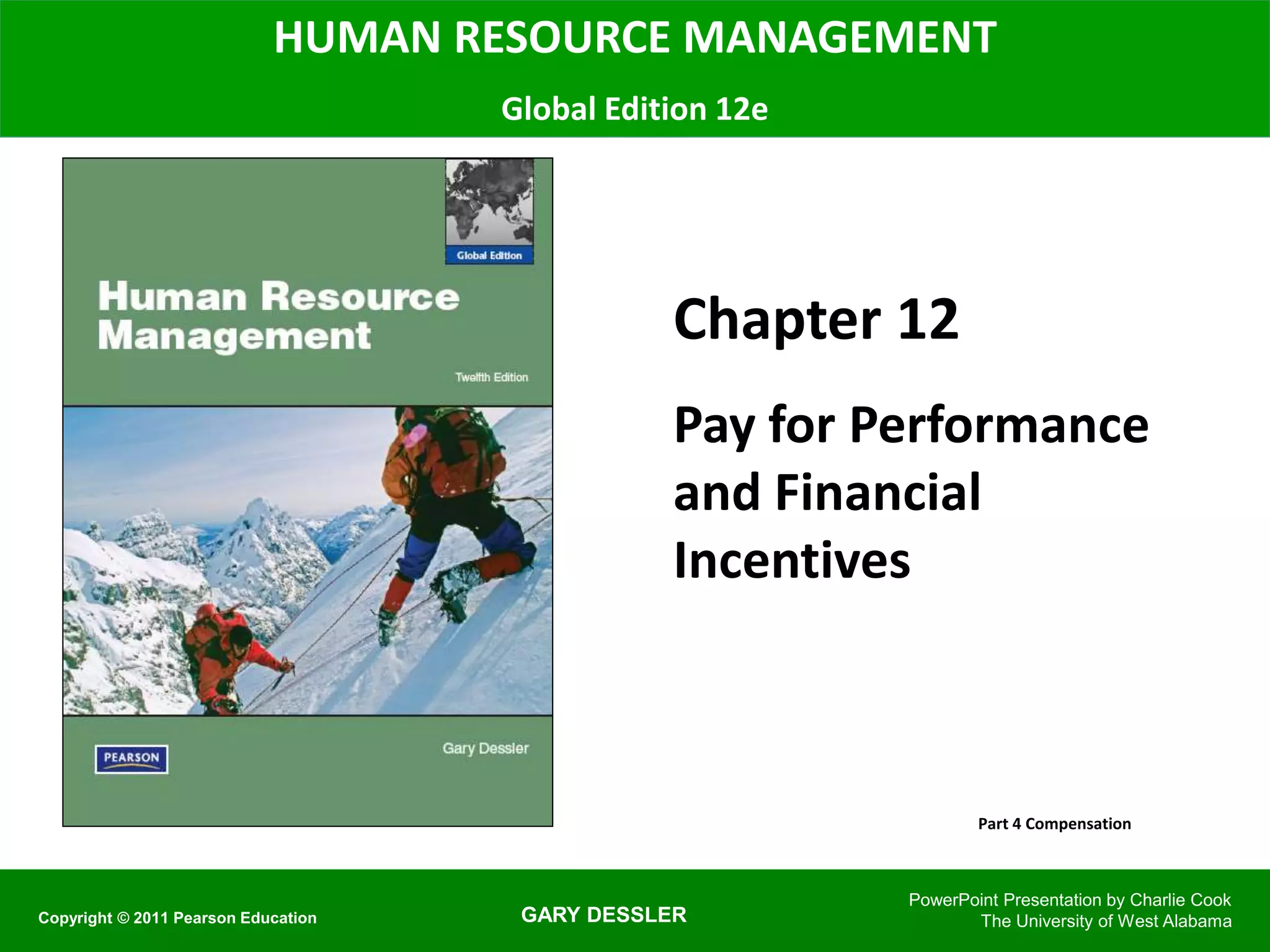
HUMAN RESOURCE MANAGEMENT
Global Edition 12e
Chapter 12
Pay for Performance
and Financial
Incentives
PowerPoint Presentation by Charlie Cook
The University of West Alabama
Copyright © 2011 Pearson Education
Part 4 Compensation
Copyright © 2011 Pearson Education 12–2
Motivation, Performance, and Pay
• Incentives
 Financial rewards paid to workers whose production exceeds a
predetermined standard.
• Frederick Taylor
 Popularized scientific management and the use of financial
incentives in the late 1800s.
 Systematic soldiering
 Fair day’s work
• Linking Pay and Performance
 Understanding the motivational
bases of incentive plans
Copyright © 2011 Pearson Education 12–3
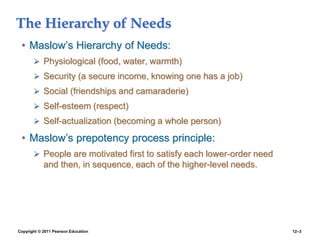
The Hierarchy of Needs
• Maslow’s Hierarchy of Needs:
 Physiological (food, water, warmth)
 Security (a secure income, knowing one has a job)
 Social (friendships and camaraderie)
 Self-esteem (respect)
 Self-actualization (becoming a whole person)
• Maslow’s prepotency process principle:
 People are motivated first to satisfy each lower-order need
and then, in sequence, each of the higher-level needs.
Copyright © 2011 Pearson Education 12–4
Herzberg’s Hygiene–Motivator Theory
• Hygienes (extrinsic job factors)
 Satisfy lower-level needs
 Inadequate working conditions, salary, and incentive pay can
cause dissatisfaction and prevent satisfaction.
• Motivators (intrinsic job factors)
 Satisfy higher-level needs
 Job enrichment (challenging job, feedback, and recognition)
addresses higher-level (achievement, self-actualization) needs.
• Premise:
 The best way to motivate someone is to organize the job so that
doing it provides feedback and challenge that helps satisfy the
person’s higher-level needs.
Copyright © 2011 Pearson Education 12–5
Demotivators and Edward Deci
• Intrinsically motivated behaviors are motivated by the
individual’s underlying need for competence and self-
determination.
 Offering an extrinsic reward for an intrinsically-motivated act
can conflict with the acting individual’s internal sense of
responsibility.
 Some behaviors are best motivated by job challenge and
recognition, others by financial rewards.
Copyright © 2011 Pearson Education 12–6
Victor Vroom’s Expectancy Theory
• Motivation is a function of:
 Expectancy: the belief that effort will lead to performance.
 Instrumentality: the connection between performance and
the appropriate reward.
 Valence: the value the person places on the reward.
• Motivation = (E x I x V)
 If any factor (E, I, or V) is zero, then there is no motivation
to work toward the reward.
 Employee confidence building and training, accurate
appraisals, and knowledge of workers’ desired rewards can
increase employee motivation.
Copyright © 2011 Pearson Education 12–7
Behavior Modification /
Reinforcement Theory
• B. F. Skinner’s Principles
 To understand behavior one must understand
the consequences of that behavior.
 Behavior that leads to a positive consequence (reward)
tends to be repeated, while behavior that leads to a negative
consequence (punishment) tends not to be repeated.
 Behavior can be changed by providing properly scheduled
rewards (or punishments).
Copyright © 2011 Pearson Education 12–8
Incentive Pay Terminology
• Pay-for-Performance Plan
 Ties employee’s pay to the employee’s performance
• Variable Pay Plan
 Is an incentive plan that ties a group or team’s pay to some
measure of the firm’s (or the facility’s) overall profitability
 Example: profit-sharing plans
 May include incentive plans for individual employees
Copyright © 2011 Pearson Education 12–9
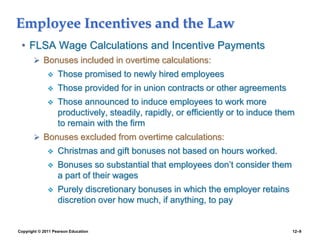
Employee Incentives and the Law
• FLSA Wage Calculations and Incentive Payments
 Bonuses included in overtime calculations:
 Those promised to newly hired employees
 Those provided for in union contracts or other agreements
 Those announced to induce employees to work more
productively, steadily, rapidly, or efficiently or to induce them
to remain with the firm
 Bonuses excluded from overtime calculations:
 Christmas and gift bonuses not based on hours worked.
 Bonuses so substantial that employees don’t consider them
a part of their wages
 Purely discretionary bonuses in which the employer retains
discretion over how much, if anything, to pay
Copyright © 2011 Pearson Education 12–10
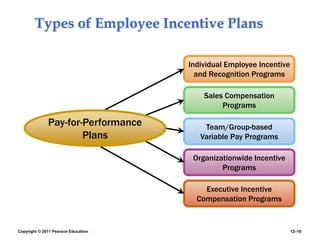
Types of Employee Incentive Plans
Individual Employee Incentive
and Recognition Programs
Sales Compensation
Programs
Organizationwide Incentive
Programs
Executive Incentive
Compensation Programs
Team/Group-based
Variable Pay Programs
Pay-for-Performance
Plans
Copyright © 2011 Pearson Education 12–11
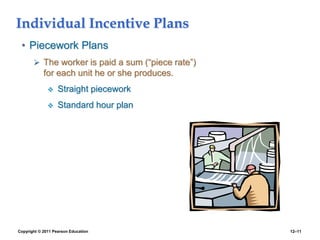
Individual Incentive Plans
• Piecework Plans
 The worker is paid a sum (“piece rate”)
for each unit he or she produces.
 Straight piecework
 Standard hour plan
Copyright © 2011 Pearson Education 12–12
Pros and Cons of Piecework
• Easily understandable, equitable,
and powerful incentives
• Employee resistance to changes
in standards or work processes
affecting output
• Quality problems caused by
an overriding output focus
• Possibility of violating minimum
wage standards
• Employee dissatisfaction when
incentives either cannot be earned
or are withdrawn
Copyright © 2011 Pearson Education 12–13
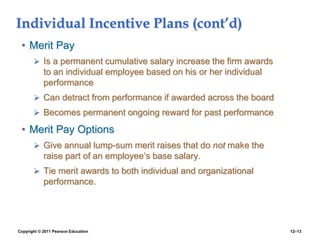
Individual Incentive Plans (cont’d)
• Merit Pay
 Is a permanent cumulative salary increase the firm awards
to an individual employee based on his or her individual
performance
 Can detract from performance if awarded across the board
 Becomes permanent ongoing reward for past performance
• Merit Pay Options
 Give annual lump-sum merit raises that do not make the
raise part of an employee’s base salary.
 Tie merit awards to both individual and organizational
performance.
Copyright © 2011 Pearson Education 12–14
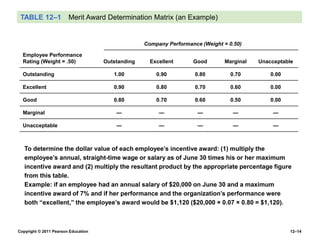
TABLE 12–1 Merit Award Determination Matrix (an Example)
To determine the dollar value of each employee’s incentive award: (1) multiply the
employee’s annual, straight-time wage or salary as of June 30 times his or her maximum
incentive award and (2) multiply the resultant product by the appropriate percentage figure
from this table.
Example: if an employee had an annual salary of $20,000 on June 30 and a maximum
incentive award of 7% and if her performance and the organization’s performance were
both “excellent,” the employee’s award would be $1,120 ($20,000 × 0.07 × 0.80 = $1,120).
Company Performance (Weight = 0.50)
Employee Performance
Rating (Weight = .50) Outstanding Excellent Good Marginal Unacceptable
Outstanding 1.00 0.90 0.80 0.70 0.00
Excellent 0.90 0.80 0.70 0.60 0.00
Good 0.80 0.70 0.60 0.50 0.00
Marginal — — — — —
Unacceptable — — — — —
Copyright © 2011 Pearson Education 12–15
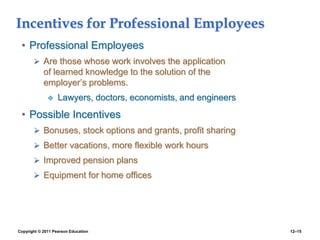
Incentives for Professional Employees
• Professional Employees
 Are those whose work involves the application
of learned knowledge to the solution of the
employer’s problems.
 Lawyers, doctors, economists, and engineers
• Possible Incentives
 Bonuses, stock options and grants, profit sharing
 Better vacations, more flexible work hours
 Improved pension plans
 Equipment for home offices
Copyright © 2011 Pearson Education 12–16
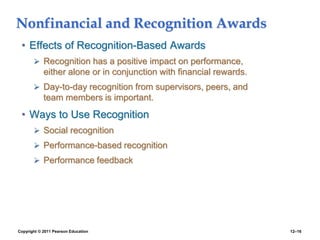
Nonfinancial and Recognition Awards
• Effects of Recognition-Based Awards
 Recognition has a positive impact on performance,
either alone or in conjunction with financial rewards.
 Day-to-day recognition from supervisors, peers, and
team members is important.
• Ways to Use Recognition
 Social recognition
 Performance-based recognition
 Performance feedback
Copyright © 2011 Pearson Education 12–17
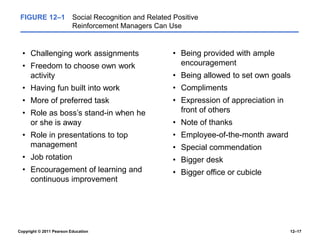
FIGURE 12–1 Social Recognition and Related Positive
Reinforcement Managers Can Use
• Challenging work assignments
• Freedom to choose own work
activity
• Having fun built into work
• More of preferred task
• Role as boss’s stand-in when he
or she is away
• Role in presentations to top
management
• Job rotation
• Encouragement of learning and
continuous improvement
• Being provided with ample
encouragement
• Being allowed to set own goals
• Compliments
• Expression of appreciation in
front of others
• Note of thanks
• Employee-of-the-month award
• Special commendation
• Bigger desk
• Bigger office or cubicle
Copyright © 2011 Pearson Education 12–18
Online and IT-Supported Awards
• Information Technology and Incentives
 Enterprise incentive management (EIM)
 Software that automates planning, calculation,
modeling, and management of incentive
compensation plans
 Enabling companies to align their employees
with corporate strategy and goals
• Online Award Programs
 Programs offered by online incentives firms that
improve and expedite the awards process
 Broader range of awards
 More immediate rewards
Copyright © 2011 Pearson Education 12–19
Incentives for Salespeople
• Salary Plan
 Straight salaries
 Best for: prospecting (finding new clients),
account servicing, training customer’s sales force,
or participating in national and local trade shows
• Commission Plan
 Pay is a percentage of sales results.
 Keeps sales costs proportionate to sales revenues
 May cause a neglect of nonselling duties
 Can create wide variation in salesperson’s income
 Likelihood of sales success may be linked to external
factors rather than to salesperson’s performance
 Can increase turnover of salespeople
Copyright © 2011 Pearson Education 12–20
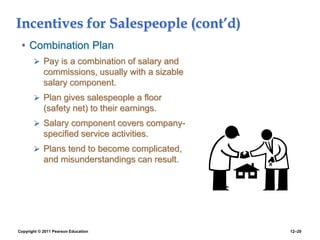
Incentives for Salespeople (cont’d)
• Combination Plan
 Pay is a combination of salary and
commissions, usually with a sizable
salary component.
 Plan gives salespeople a floor
(safety net) to their earnings.
 Salary component covers company-
specified service activities.
 Plans tend to become complicated,
and misunderstandings can result.
Copyright © 2011 Pearson Education 12–21
Specialized Commission Plans
• Commission-plus-Drawing-Account Plan
 Commissions are paid but a draw on future
earnings helps the salesperson to get through
low sales periods.
• Commission-plus-Bonus Plan
 Pay is mostly based on commissions.
 Small bonuses (“spiffs”) are paid for directed
activities like selling add-ons or slow-moving
items.
Copyright © 2011 Pearson Education 12–22
Maximizing Sales Force Results: Setting Sales Quotas
• Should quotas be locked in for a period of time?
• Have quotas been communicated to the sales force
within one month of the start of the period?
• Does the sales force know exactly how its quotas are set?
• Do you combine bottom-up information (like account forecasts)
with top-down requirements (like the company business plan)?
• Do 60% to 70% of the sales force generally hit their quota?
• Do high performers hit their targets consistently?
• Do low performers show improvement over time?
• Are quotas stable through the performance period?
• Are returns and debookings reasonably low?
• Has your firm generally avoided compensation-related lawsuits?
• Is 10% of the sales force achieving higher performance than previously?
• Is 5% to 10% of the sales force achieving below-quota performance
and receiving coaching?
Copyright © 2011 Pearson Education 12–23
Incentives for Managers and Executives
• Executive Total Reward Package
 Base salary (cash)
 Short-term incentives (bonuses)
 Long-term incentives (e.g., stock options)
• Sarbanes-Oxley Act of 2002
 Makes executives and the board of directors
personally liable for violating their fiduciary
responsibilities to their shareholders.
 Requires the CEO and CFO to repay bonuses,
incentives, or equity-based compensation
received following issuance of a financial
statement that the firm must restate.
Copyright © 2011 Pearson Education 12–24
Short- and Long-Term Incentives
• Short-Term Incentives: The Annual Bonus
 Plans intended to motivate short-term performance
of managers and tied to company profitability.
 Issues in awarding bonuses
 Eligibility basis
 Fund size basis
 Individual performance award
 Long-term incentives
 Stock options
 Performance shares
 Indexed options
 Premium price options
 Stock appreciation rights
 Perks
Copyright © 2011 Pearson Education 12–25
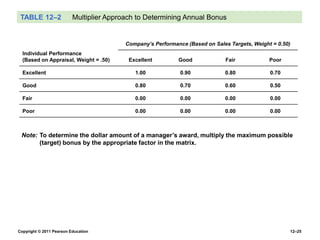
TABLE 12–2 Multiplier Approach to Determining Annual Bonus
Company’s Performance (Based on Sales Targets, Weight = 0.50)
Individual Performance
(Based on Appraisal, Weight = .50) Excellent Good Fair Poor
Excellent 1.00 0.90 0.80 0.70
Good 0.80 0.70 0.60 0.50
Fair 0.00 0.00 0.00 0.00
Poor 0.00 0.00 0.00 0.00
Note: To determine the dollar amount of a manager’s award, multiply the maximum possible
(target) bonus by the appropriate factor in the matrix.
Copyright © 2011 Pearson Education 12–26
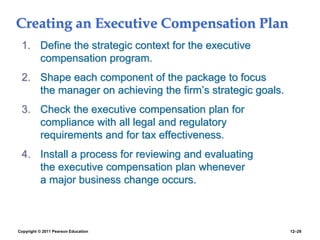
Creating an Executive Compensation Plan
1. Define the strategic context for the executive
compensation program.
2. Shape each component of the package to focus
the manager on achieving the firm’s strategic goals.
3. Check the executive compensation plan for
compliance with all legal and regulatory
requirements and for tax effectiveness.
4. Install a process for reviewing and evaluating
the executive compensation plan whenever
a major business change occurs.
Copyright © 2011 Pearson Education 12–27
Team/Group Incentive Plans
• Team (or Group) Incentive Plans
 Incentives are based on team’s performance.
• How to Design Team Incentives
 Set individual work standards.
 Set work standards for each team member
and then calculate each member’s output.
 Members are paid based on one of three formulas:
 All receive the same pay earned by the highest producer.
 All receive the same pay earned by the lowest producer.
 All receive the same pay equal to the average pay
earned by the group.
Copyright © 2011 Pearson Education 12–28
Pros and Cons of Team Incentives
• Pros
 Reinforces team planning and problem solving
 Helps ensure collaboration
 Encourages a sense of cooperation
 Encourages rapid training of new members
• Cons
 Pay is not proportionate to an individual’s effort
 Rewards “free riders”
Copyright © 2011 Pearson Education 12–29
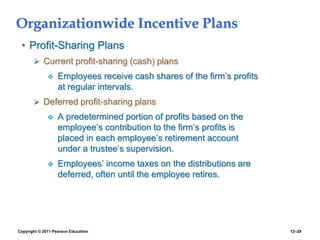
Organizationwide Incentive Plans
• Profit-Sharing Plans
 Current profit-sharing (cash) plans
 Employees receive cash shares of the firm’s profits
at regular intervals.
 Deferred profit-sharing plans
 A predetermined portion of profits based on the
employee’s contribution to the firm’s profits is
placed in each employee’s retirement account
under a trustee’s supervision.
 Employees’ income taxes on the distributions are
deferred, often until the employee retires.
Copyright © 2011 Pearson Education 12–30
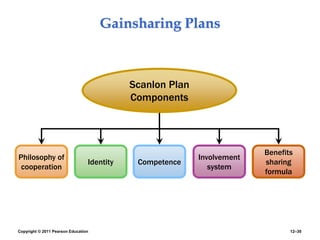
Gainsharing Plans
Philosophy of
cooperation
Involvement
system
Identity
Scanlon Plan
Components
Competence
Benefits
sharing
formula
Copyright © 2011 Pearson Education 12–31
Implementing a Gainsharing Plan
1. Establish general plan objectives.
2. Choose specific performance measures.
3. Decide on a funding formula.
4. Decide on a method for dividing and distributing
the employees’ share of the gains.
5. Choose the form of payment.
6. Decide how often to pay bonuses.
7. Develop the involvement system.
8. Implement the plan.
Copyright © 2011 Pearson Education 12–32
At-Risk Variable Pay Plans
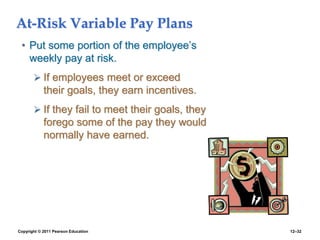
• Put some portion of the employee’s
weekly pay at risk.
 If employees meet or exceed
their goals, they earn incentives.
 If they fail to meet their goals, they
forego some of the pay they would
normally have earned.
Copyright © 2011 Pearson Education 12–33
Organizationwide Incentive Plans (cont’d)
• Employee Stock Ownership Plan (ESOP)
 A firm annually contributes its own stock—or cash
(with a limit of 15% of compensation) to be used to
purchase the stock—to a trust established for the
employees.
 The trust holds the stock in individual employee
accounts and distributes it to employees upon
separation from the firm if the employee has worked
long enough to earn ownership of the stock.
Copyright © 2011 Pearson Education 12–34
Advantages of ESOPs
• For the Company
 Can take a tax deduction equal to the fair market value
of the shares transferred to the ESOP trustee
 Gets an income tax deduction for dividends paid
on ESOP-owned stock
 Can borrow against ESOP in trust and then repay
the loan in pretax rather than after-tax dollars
• For the Employees
 Develop a sense of ownership in and commitment to the firm.
 Do not pay taxes on ESOP earnings until they receive
a distribution.
• For the Shareholders of Closely-Held Corporations
 Can place assets into an ESOP trust which will allow them to
purchase other marketable securities to diversify their holdings
Copyright © 2011 Pearson Education 12–35
Implementing an Effective Incentive Plan
1. Ask: Does it make sense to use an incentive here?
2. Link the incentive with your strategy.
3. Make sure the program is motivational.
4. Set complete standards.
5. Be scientific in analyzing the effects of the plan.
Copyright © 2011 Pearson Education 12–36
Why Incentive Plans Fail
• Performance pay can’t replace good management.
• You get what you pay for.
• “Pay is not a motivator.”
• Rewards punish.
• Rewards rupture relationships.
• Rewards can have unintended consequences.
• Rewards may undermine responsiveness.
• Rewards undermine intrinsic motivation.
Copyright © 2011 Pearson Education 12–37
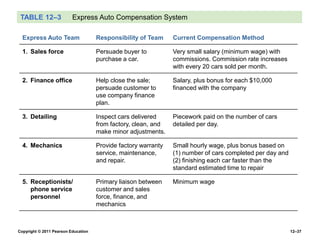
TABLE 12–3 Express Auto Compensation System
Express Auto Team Responsibility of Team Current Compensation Method
1. Sales force Persuade buyer to
purchase a car.
Very small salary (minimum wage) with
commissions. Commission rate increases
with every 20 cars sold per month.
2. Finance office Help close the sale;
persuade customer to
use company finance
plan.
Salary, plus bonus for each $10,000
financed with the company
3. Detailing Inspect cars delivered
from factory, clean, and
make minor adjustments.
Piecework paid on the number of cars
detailed per day.
4. Mechanics Provide factory warranty
service, maintenance,
and repair.
Small hourly wage, plus bonus based on
(1) number of cars completed per day and
(2) finishing each car faster than the
standard estimated time to repair
5. Receptionists/
phone service
personnel
Primary liaison between
customer and sales
force, finance, and
mechanics
Minimum wage

12.ppt

  • 1.
    GARY DESSLER HUMAN RESOURCEMANAGEMENT Global Edition 12e Chapter 12 Pay for Performance and Financial Incentives PowerPoint Presentation by Charlie Cook The University of West Alabama Copyright © 2011 Pearson Education Part 4 Compensation
  • 2.
    Copyright © 2011Pearson Education 12–2 Motivation, Performance, and Pay • Incentives  Financial rewards paid to workers whose production exceeds a predetermined standard. • Frederick Taylor  Popularized scientific management and the use of financial incentives in the late 1800s.  Systematic soldiering  Fair day’s work • Linking Pay and Performance  Understanding the motivational bases of incentive plans
  • 3.
    Copyright © 2011Pearson Education 12–3 The Hierarchy of Needs • Maslow’s Hierarchy of Needs:  Physiological (food, water, warmth)  Security (a secure income, knowing one has a job)  Social (friendships and camaraderie)  Self-esteem (respect)  Self-actualization (becoming a whole person) • Maslow’s prepotency process principle:  People are motivated first to satisfy each lower-order need and then, in sequence, each of the higher-level needs.
  • 4.
    Copyright © 2011Pearson Education 12–4 Herzberg’s Hygiene–Motivator Theory • Hygienes (extrinsic job factors)  Satisfy lower-level needs  Inadequate working conditions, salary, and incentive pay can cause dissatisfaction and prevent satisfaction. • Motivators (intrinsic job factors)  Satisfy higher-level needs  Job enrichment (challenging job, feedback, and recognition) addresses higher-level (achievement, self-actualization) needs. • Premise:  The best way to motivate someone is to organize the job so that doing it provides feedback and challenge that helps satisfy the person’s higher-level needs.
  • 5.
    Copyright © 2011Pearson Education 12–5 Demotivators and Edward Deci • Intrinsically motivated behaviors are motivated by the individual’s underlying need for competence and self- determination.  Offering an extrinsic reward for an intrinsically-motivated act can conflict with the acting individual’s internal sense of responsibility.  Some behaviors are best motivated by job challenge and recognition, others by financial rewards.
  • 6.
    Copyright © 2011Pearson Education 12–6 Victor Vroom’s Expectancy Theory • Motivation is a function of:  Expectancy: the belief that effort will lead to performance.  Instrumentality: the connection between performance and the appropriate reward.  Valence: the value the person places on the reward. • Motivation = (E x I x V)  If any factor (E, I, or V) is zero, then there is no motivation to work toward the reward.  Employee confidence building and training, accurate appraisals, and knowledge of workers’ desired rewards can increase employee motivation.
  • 7.
    Copyright © 2011Pearson Education 12–7 Behavior Modification / Reinforcement Theory • B. F. Skinner’s Principles  To understand behavior one must understand the consequences of that behavior.  Behavior that leads to a positive consequence (reward) tends to be repeated, while behavior that leads to a negative consequence (punishment) tends not to be repeated.  Behavior can be changed by providing properly scheduled rewards (or punishments).
  • 8.
    Copyright © 2011Pearson Education 12–8 Incentive Pay Terminology • Pay-for-Performance Plan  Ties employee’s pay to the employee’s performance • Variable Pay Plan  Is an incentive plan that ties a group or team’s pay to some measure of the firm’s (or the facility’s) overall profitability  Example: profit-sharing plans  May include incentive plans for individual employees
  • 9.
    Copyright © 2011Pearson Education 12–9 Employee Incentives and the Law • FLSA Wage Calculations and Incentive Payments  Bonuses included in overtime calculations:  Those promised to newly hired employees  Those provided for in union contracts or other agreements  Those announced to induce employees to work more productively, steadily, rapidly, or efficiently or to induce them to remain with the firm  Bonuses excluded from overtime calculations:  Christmas and gift bonuses not based on hours worked.  Bonuses so substantial that employees don’t consider them a part of their wages  Purely discretionary bonuses in which the employer retains discretion over how much, if anything, to pay
  • 10.
    Copyright © 2011Pearson Education 12–10 Types of Employee Incentive Plans Individual Employee Incentive and Recognition Programs Sales Compensation Programs Organizationwide Incentive Programs Executive Incentive Compensation Programs Team/Group-based Variable Pay Programs Pay-for-Performance Plans
  • 11.
    Copyright © 2011Pearson Education 12–11 Individual Incentive Plans • Piecework Plans  The worker is paid a sum (“piece rate”) for each unit he or she produces.  Straight piecework  Standard hour plan
  • 12.
    Copyright © 2011Pearson Education 12–12 Pros and Cons of Piecework • Easily understandable, equitable, and powerful incentives • Employee resistance to changes in standards or work processes affecting output • Quality problems caused by an overriding output focus • Possibility of violating minimum wage standards • Employee dissatisfaction when incentives either cannot be earned or are withdrawn
  • 13.
    Copyright © 2011Pearson Education 12–13 Individual Incentive Plans (cont’d) • Merit Pay  Is a permanent cumulative salary increase the firm awards to an individual employee based on his or her individual performance  Can detract from performance if awarded across the board  Becomes permanent ongoing reward for past performance • Merit Pay Options  Give annual lump-sum merit raises that do not make the raise part of an employee’s base salary.  Tie merit awards to both individual and organizational performance.
  • 14.
    Copyright © 2011Pearson Education 12–14 TABLE 12–1 Merit Award Determination Matrix (an Example) To determine the dollar value of each employee’s incentive award: (1) multiply the employee’s annual, straight-time wage or salary as of June 30 times his or her maximum incentive award and (2) multiply the resultant product by the appropriate percentage figure from this table. Example: if an employee had an annual salary of $20,000 on June 30 and a maximum incentive award of 7% and if her performance and the organization’s performance were both “excellent,” the employee’s award would be $1,120 ($20,000 × 0.07 × 0.80 = $1,120). Company Performance (Weight = 0.50) Employee Performance Rating (Weight = .50) Outstanding Excellent Good Marginal Unacceptable Outstanding 1.00 0.90 0.80 0.70 0.00 Excellent 0.90 0.80 0.70 0.60 0.00 Good 0.80 0.70 0.60 0.50 0.00 Marginal — — — — — Unacceptable — — — — —
  • 15.
    Copyright © 2011Pearson Education 12–15 Incentives for Professional Employees • Professional Employees  Are those whose work involves the application of learned knowledge to the solution of the employer’s problems.  Lawyers, doctors, economists, and engineers • Possible Incentives  Bonuses, stock options and grants, profit sharing  Better vacations, more flexible work hours  Improved pension plans  Equipment for home offices
  • 16.
    Copyright © 2011Pearson Education 12–16 Nonfinancial and Recognition Awards • Effects of Recognition-Based Awards  Recognition has a positive impact on performance, either alone or in conjunction with financial rewards.  Day-to-day recognition from supervisors, peers, and team members is important. • Ways to Use Recognition  Social recognition  Performance-based recognition  Performance feedback
  • 17.
    Copyright © 2011Pearson Education 12–17 FIGURE 12–1 Social Recognition and Related Positive Reinforcement Managers Can Use • Challenging work assignments • Freedom to choose own work activity • Having fun built into work • More of preferred task • Role as boss’s stand-in when he or she is away • Role in presentations to top management • Job rotation • Encouragement of learning and continuous improvement • Being provided with ample encouragement • Being allowed to set own goals • Compliments • Expression of appreciation in front of others • Note of thanks • Employee-of-the-month award • Special commendation • Bigger desk • Bigger office or cubicle
  • 18.
    Copyright © 2011Pearson Education 12–18 Online and IT-Supported Awards • Information Technology and Incentives  Enterprise incentive management (EIM)  Software that automates planning, calculation, modeling, and management of incentive compensation plans  Enabling companies to align their employees with corporate strategy and goals • Online Award Programs  Programs offered by online incentives firms that improve and expedite the awards process  Broader range of awards  More immediate rewards
  • 19.
    Copyright © 2011Pearson Education 12–19 Incentives for Salespeople • Salary Plan  Straight salaries  Best for: prospecting (finding new clients), account servicing, training customer’s sales force, or participating in national and local trade shows • Commission Plan  Pay is a percentage of sales results.  Keeps sales costs proportionate to sales revenues  May cause a neglect of nonselling duties  Can create wide variation in salesperson’s income  Likelihood of sales success may be linked to external factors rather than to salesperson’s performance  Can increase turnover of salespeople
  • 20.
    Copyright © 2011Pearson Education 12–20 Incentives for Salespeople (cont’d) • Combination Plan  Pay is a combination of salary and commissions, usually with a sizable salary component.  Plan gives salespeople a floor (safety net) to their earnings.  Salary component covers company- specified service activities.  Plans tend to become complicated, and misunderstandings can result.
  • 21.
    Copyright © 2011Pearson Education 12–21 Specialized Commission Plans • Commission-plus-Drawing-Account Plan  Commissions are paid but a draw on future earnings helps the salesperson to get through low sales periods. • Commission-plus-Bonus Plan  Pay is mostly based on commissions.  Small bonuses (“spiffs”) are paid for directed activities like selling add-ons or slow-moving items.
  • 22.
    Copyright © 2011Pearson Education 12–22 Maximizing Sales Force Results: Setting Sales Quotas • Should quotas be locked in for a period of time? • Have quotas been communicated to the sales force within one month of the start of the period? • Does the sales force know exactly how its quotas are set? • Do you combine bottom-up information (like account forecasts) with top-down requirements (like the company business plan)? • Do 60% to 70% of the sales force generally hit their quota? • Do high performers hit their targets consistently? • Do low performers show improvement over time? • Are quotas stable through the performance period? • Are returns and debookings reasonably low? • Has your firm generally avoided compensation-related lawsuits? • Is 10% of the sales force achieving higher performance than previously? • Is 5% to 10% of the sales force achieving below-quota performance and receiving coaching?
  • 23.
    Copyright © 2011Pearson Education 12–23 Incentives for Managers and Executives • Executive Total Reward Package  Base salary (cash)  Short-term incentives (bonuses)  Long-term incentives (e.g., stock options) • Sarbanes-Oxley Act of 2002  Makes executives and the board of directors personally liable for violating their fiduciary responsibilities to their shareholders.  Requires the CEO and CFO to repay bonuses, incentives, or equity-based compensation received following issuance of a financial statement that the firm must restate.
  • 24.
    Copyright © 2011Pearson Education 12–24 Short- and Long-Term Incentives • Short-Term Incentives: The Annual Bonus  Plans intended to motivate short-term performance of managers and tied to company profitability.  Issues in awarding bonuses  Eligibility basis  Fund size basis  Individual performance award  Long-term incentives  Stock options  Performance shares  Indexed options  Premium price options  Stock appreciation rights  Perks
  • 25.
    Copyright © 2011Pearson Education 12–25 TABLE 12–2 Multiplier Approach to Determining Annual Bonus Company’s Performance (Based on Sales Targets, Weight = 0.50) Individual Performance (Based on Appraisal, Weight = .50) Excellent Good Fair Poor Excellent 1.00 0.90 0.80 0.70 Good 0.80 0.70 0.60 0.50 Fair 0.00 0.00 0.00 0.00 Poor 0.00 0.00 0.00 0.00 Note: To determine the dollar amount of a manager’s award, multiply the maximum possible (target) bonus by the appropriate factor in the matrix.
  • 26.
    Copyright © 2011Pearson Education 12–26 Creating an Executive Compensation Plan 1. Define the strategic context for the executive compensation program. 2. Shape each component of the package to focus the manager on achieving the firm’s strategic goals. 3. Check the executive compensation plan for compliance with all legal and regulatory requirements and for tax effectiveness. 4. Install a process for reviewing and evaluating the executive compensation plan whenever a major business change occurs.
  • 27.
    Copyright © 2011Pearson Education 12–27 Team/Group Incentive Plans • Team (or Group) Incentive Plans  Incentives are based on team’s performance. • How to Design Team Incentives  Set individual work standards.  Set work standards for each team member and then calculate each member’s output.  Members are paid based on one of three formulas:  All receive the same pay earned by the highest producer.  All receive the same pay earned by the lowest producer.  All receive the same pay equal to the average pay earned by the group.
  • 28.
    Copyright © 2011Pearson Education 12–28 Pros and Cons of Team Incentives • Pros  Reinforces team planning and problem solving  Helps ensure collaboration  Encourages a sense of cooperation  Encourages rapid training of new members • Cons  Pay is not proportionate to an individual’s effort  Rewards “free riders”
  • 29.
    Copyright © 2011Pearson Education 12–29 Organizationwide Incentive Plans • Profit-Sharing Plans  Current profit-sharing (cash) plans  Employees receive cash shares of the firm’s profits at regular intervals.  Deferred profit-sharing plans  A predetermined portion of profits based on the employee’s contribution to the firm’s profits is placed in each employee’s retirement account under a trustee’s supervision.  Employees’ income taxes on the distributions are deferred, often until the employee retires.
  • 30.
    Copyright © 2011Pearson Education 12–30 Gainsharing Plans Philosophy of cooperation Involvement system Identity Scanlon Plan Components Competence Benefits sharing formula
  • 31.
    Copyright © 2011Pearson Education 12–31 Implementing a Gainsharing Plan 1. Establish general plan objectives. 2. Choose specific performance measures. 3. Decide on a funding formula. 4. Decide on a method for dividing and distributing the employees’ share of the gains. 5. Choose the form of payment. 6. Decide how often to pay bonuses. 7. Develop the involvement system. 8. Implement the plan.
  • 32.
    Copyright © 2011Pearson Education 12–32 At-Risk Variable Pay Plans • Put some portion of the employee’s weekly pay at risk.  If employees meet or exceed their goals, they earn incentives.  If they fail to meet their goals, they forego some of the pay they would normally have earned.
  • 33.
    Copyright © 2011Pearson Education 12–33 Organizationwide Incentive Plans (cont’d) • Employee Stock Ownership Plan (ESOP)  A firm annually contributes its own stock—or cash (with a limit of 15% of compensation) to be used to purchase the stock—to a trust established for the employees.  The trust holds the stock in individual employee accounts and distributes it to employees upon separation from the firm if the employee has worked long enough to earn ownership of the stock.
  • 34.
    Copyright © 2011Pearson Education 12–34 Advantages of ESOPs • For the Company  Can take a tax deduction equal to the fair market value of the shares transferred to the ESOP trustee  Gets an income tax deduction for dividends paid on ESOP-owned stock  Can borrow against ESOP in trust and then repay the loan in pretax rather than after-tax dollars • For the Employees  Develop a sense of ownership in and commitment to the firm.  Do not pay taxes on ESOP earnings until they receive a distribution. • For the Shareholders of Closely-Held Corporations  Can place assets into an ESOP trust which will allow them to purchase other marketable securities to diversify their holdings
  • 35.
    Copyright © 2011Pearson Education 12–35 Implementing an Effective Incentive Plan 1. Ask: Does it make sense to use an incentive here? 2. Link the incentive with your strategy. 3. Make sure the program is motivational. 4. Set complete standards. 5. Be scientific in analyzing the effects of the plan.
  • 36.
    Copyright © 2011Pearson Education 12–36 Why Incentive Plans Fail • Performance pay can’t replace good management. • You get what you pay for. • “Pay is not a motivator.” • Rewards punish. • Rewards rupture relationships. • Rewards can have unintended consequences. • Rewards may undermine responsiveness. • Rewards undermine intrinsic motivation.
  • 37.
    Copyright © 2011Pearson Education 12–37 TABLE 12–3 Express Auto Compensation System Express Auto Team Responsibility of Team Current Compensation Method 1. Sales force Persuade buyer to purchase a car. Very small salary (minimum wage) with commissions. Commission rate increases with every 20 cars sold per month. 2. Finance office Help close the sale; persuade customer to use company finance plan. Salary, plus bonus for each $10,000 financed with the company 3. Detailing Inspect cars delivered from factory, clean, and make minor adjustments. Piecework paid on the number of cars detailed per day. 4. Mechanics Provide factory warranty service, maintenance, and repair. Small hourly wage, plus bonus based on (1) number of cars completed per day and (2) finishing each car faster than the standard estimated time to repair 5. Receptionists/ phone service personnel Primary liaison between customer and sales force, finance, and mechanics Minimum wage

Editor's Notes

  • #2 Copyright © 2011 Pearson Education
  • #3 Copyright © 2011 Pearson Education
  • #4 Copyright © 2011 Pearson Education
  • #5 Copyright © 2011 Pearson Education
  • #6 Copyright © 2011 Pearson Education
  • #7 Copyright © 2011 Pearson Education
  • #8 Copyright © 2011 Pearson Education
  • #9 Copyright © 2011 Pearson Education
  • #10 Copyright © 2011 Pearson Education
  • #11 Copyright © 2011 Pearson Education
  • #12 Copyright © 2011 Pearson Education
  • #13 Copyright © 2011 Pearson Education
  • #14 Copyright © 2011 Pearson Education
  • #15 Copyright © 2011 Pearson Education
  • #16 Copyright © 2011 Pearson Education
  • #17 Copyright © 2011 Pearson Education
  • #18 Copyright © 2011 Pearson Education
  • #19 Copyright © 2011 Pearson Education
  • #20 Copyright © 2011 Pearson Education
  • #21 Copyright © 2011 Pearson Education
  • #22 Copyright © 2011 Pearson Education
  • #23 Copyright © 2011 Pearson Education
  • #24 Copyright © 2011 Pearson Education
  • #25 Copyright © 2011 Pearson Education
  • #26 Copyright © 2011 Pearson Education
  • #27 Copyright © 2011 Pearson Education
  • #28 Copyright © 2011 Pearson Education
  • #29 Copyright © 2011 Pearson Education
  • #30 Copyright © 2011 Pearson Education
  • #31 Copyright © 2011 Pearson Education
  • #32 Copyright © 2011 Pearson Education
  • #33 Copyright © 2011 Pearson Education
  • #34 Copyright © 2011 Pearson Education
  • #35 Copyright © 2011 Pearson Education
  • #36 Copyright © 2011 Pearson Education
  • #37 Copyright © 2011 Pearson Education
  • #38 Copyright © 2011 Pearson Education