2
Chapter 13
Recognizing Employee Contributions
with Pay
freesoulproduction/Shutterstock
© 2022 McGraw Hill. All rights reserved. Authorized only for instructor use in the classroom. No reproduction or further distribution permitted without the prior written consent of McGraw Hill.
© McGraw Hill 3
What Do I Need to Know? 1
LO 13-1 Discuss the connection between incentive pay and employee performance.
LO 13-2 Describe how organizations recognize individual performance.
LO 13-3 Identify ways to recognize group performance.
LO 13-4 Explain how organizations link pay to their overall performance.
LO 13-5 Describe how organizations combine incentive plans in a “balanced scorecard.”
LO 13-6 Summarize processes that can contribute to the success of incentive programs.
LO 13-7 Discuss issues related to performance-based pay for executives.
© McGraw Hill 4
Incentive Pay 1
Incentive Pay
• Forms of pay designed to energize, direct, or control employees’ behavior.
• Often linked to employee’s performance as an individual, group member, or
organization member.
• May be in the form of a commission or bonus.
• Organizations may combine a number of incentives so employees do not focus on
one measure to the exclusion of others.
• Employees compare their efforts and rewards with those of other employees,
considering a plan to be fair when the rewards are distributed according to what the
employees contribute.
© McGraw Hill 5
Incentive Pay 2
Effective Incentive Pay Plan Requirements
1. Performance measurements are linked to company goals.
2. Employees believe they can meet performance standards.
3. Employees are given resources needed to meet goals.
4. Employees value rewards given.
5. Employees believe the reward system is fair.
6. Pay plans consider that employees may ignore any goals that are not rewarded.
© McGraw Hill 6
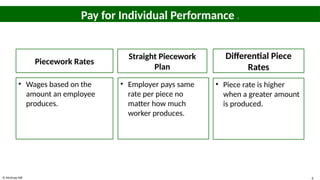
Pay for Individual Performance 1
Piecework Rates
• Wages based on the
amount an employee
produces.
Straight Piecework
Plan
• Employer pays same
rate per piece no
matter how much
worker produces.
Differential Piece
Rates
• Piece rate is higher
when a greater amount
is produced.
© McGraw Hill 7
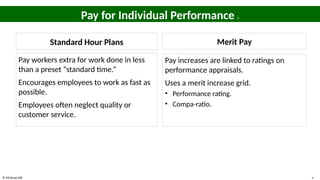
Pay for Individual Performance 2
Standard Hour Plans
Pay workers extra for work done in less
than a preset “standard time.”
Encourages employees to work as fast as
possible.
Employees often neglect quality or
customer service.
Merit Pay
Pay increases are linked to ratings on
performance appraisals.
Uses a merit increase grid.
• Performance rating.
• Compa-ratio.
© McGraw Hill 8
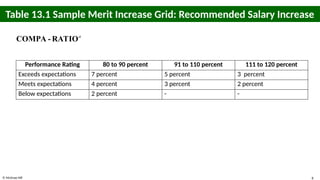
Table 13.1 Sample Merit Increase Grid: Recommended Salary Increase
a
COMPA - RATIO
Performance Rating 80 to 90 percent 91 to 110 percent 111 to 120 percent
Exceeds expectations 7 percent 5 percent 3 percent
Meets expectations 4 percent 3 percent 2 percent
Below expectations 2 percent - -
© McGraw Hill 9
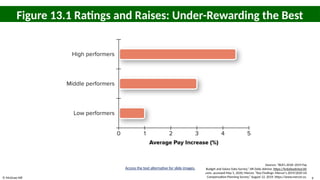
Figure 13.1 Ratings and Raises: Under-Rewarding the Best
Access the text alternative for slide images.
Sources: “BLR’s 2018–2019 Pay
Budget and Salary Data Survey,” HR Daily Advisor, https://hrdailyadvisor.blr
.com, accessed May 5, 2020; Mercer, “Key Findings: Mercer’s 2019/2020 US
Compensation Planning Survey,” August 12, 2019, https://www.mercer.us.
© McGraw Hill 10
Pay for Individual Performance 3
Performance Bonuses
• Not rolled into base pay.
• Employee must re-earn bonus during each period.
• May be a one-time reward.
• May be linked to objective performance measures.
• Retention bonuses give employees a reason to stay.
© McGraw Hill 11
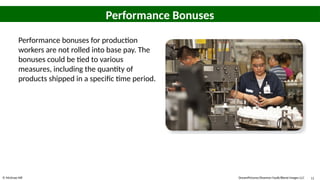
Performance Bonuses
Performance bonuses for production
workers are not rolled into base pay. The
bonuses could be tied to various
measures, including the quantity of
products shipped in a specific time period.
DreamPictures/Shannon Faulk/Blend Images LLC
© McGraw Hill 12
Pay for Individual Performance 4
Sales Commissions
• Incentive pay calculated as a percentage of sales.
• Some earn commission in addition to base salary.
• Some work on straight commission plan with no salary.
• Some earn no commissions at all.
© McGraw Hill 13
POLLING
QUESTION
1
John works twisting pretzels in a pretzel factory. Pablo works on
IT systems integration at a credit card company. The best pay
plans for these individuals would most likely be _____ and
_____, respectively.
A. merit pay; individual bonus
B. sales commissions; merit pay
C. piecework; merit pay
D. individual bonus; sales commissions
© McGraw Hill 14
Pay for Group Performance 1
Gainsharing
• Measures improvements in productivity and effectiveness and distributes portion of
each gain to employees.
• Addresses challenge of identifying appropriate performance measures for complex
jobs.
• Employees determine how to improve own and group’s performance.
© McGraw Hill 15
Pay for Group Performance 2
Conditions for Effective Gainsharing
1. Management commitment.
2. Need for change or commitment to
continuous improvement.
3. Management acceptance and
encouragement of worker input.
4. High levels of cooperation and
interaction.
5. Employment security.
6. Information sharing on productivity and
costs.
7. Goal setting.
8. Commitment of all parties to process
improvement.
9. Performance standards and calculations
that are fair, relevant, and
understandable.
10.Employees who value working in
groups.
© McGraw Hill 16
Pay for Group Performance 3
Group Bonuses
• Used in smaller work groups.
• Reward members of group for attaining
a specific goal.
• Usually measured in terms of physical
output.
Team Awards
• Similar to group bonuses.
• Likely to use a broad range of
performance measures.
• Cost savings.
• Completion of project.
• Meeting deadlines.
© McGraw Hill 17
Pay for Organizational Performance 1
Profit Sharing
• Payments are a percentage of organization’s profits and are not part of employees’
base salary.
• May encourage employees to think like owners.
• Evidence not clear whether profit sharing is effective in improving performance.
© McGraw Hill 18
Pay for Organizational Performance 2
Stock Ownership
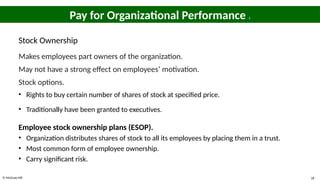
Makes employees part owners of the organization.
May not have a strong effect on employees’ motivation.
Stock options.
• Rights to buy certain number of shares of stock at specified price.
• Traditionally have been granted to executives.
Employee stock ownership plans (ESOP).
• Organization distributes shares of stock to all its employees by placing them in a trust.
• Most common form of employee ownership.
• Carry significant risk.
© McGraw Hill 19
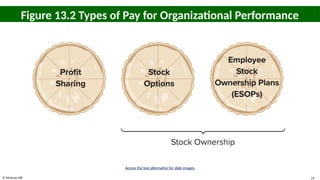
Figure 13.2 Types of Pay for Organizational Performance
Access the text alternative for slide images.
© McGraw Hill 20
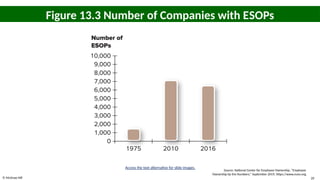
Figure 13.3 Number of Companies with ESOPs
Access the text alternative for slide images.
Source: National Center for Employee Ownership, “Employee
Ownership by the Numbers,” September 2019, https://www.nceo.org.
© McGraw Hill 21
POLLING
QUESTION
2
Josh is the Director of Marketing at global company. Identify
the best type of incentive pay for him.
A. Individual performance, for getting half of his team members to hit their
individual targets.
B. Group performance, for getting his whole team to cooperate and hit the
Marketing Department’s targets.
C. Organizational performance, for increasing the company’s profits 20
percent through their marketing efforts.
© McGraw Hill 22
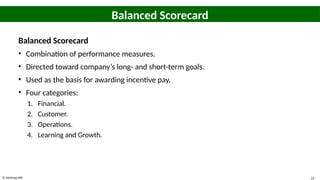
Balanced Scorecard
Balanced Scorecard
• Combination of performance measures.
• Directed toward company’s long- and short-term goals.
• Used as the basis for awarding incentive pay.
• Four categories:
1. Financial.
2. Customer.
3. Operations.
4. Learning and Growth.
© McGraw Hill 23
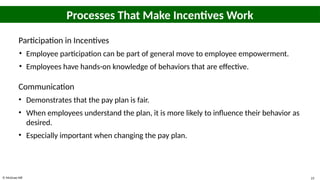
Processes That Make Incentives Work
Participation in Incentives
• Employee participation can be part of general move to employee empowerment.
• Employees have hands-on knowledge of behaviors that are effective.
Communication
• Demonstrates that the pay plan is fair.
• When employees understand the plan, it is more likely to influence their behavior as
desired.
• Especially important when changing the pay plan.
© McGraw Hill 24
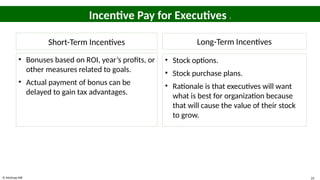
Incentive Pay for Executives 1
Short-Term Incentives
• Bonuses based on ROI, year’s profits, or
other measures related to goals.
• Actual payment of bonus can be
delayed to gain tax advantages.
Long-Term Incentives
• Stock options.
• Stock purchase plans.
• Rationale is that executives will want
what is best for organization because
that will cause the value of their stock
to grow.
© McGraw Hill 25
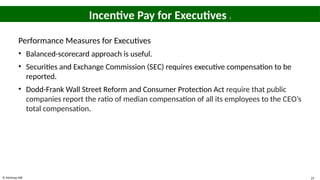
Incentive Pay for Executives 2
Performance Measures for Executives
• Balanced-scorecard approach is useful.
• Securities and Exchange Commission (SEC) requires executive compensation to be
reported.
• Dodd-Frank Wall Street Reform and Consumer Protection Act require that public
companies report the ratio of median compensation of all its employees to the CEO’s
total compensation.
© McGraw Hill 26
Incentive Pay for Executives 3
Ethical Issues
• Occur when company links pay to stock performance.
• Executives may be tempted to lie about company’s performance due to potential for
large earnings.
• Insider trading gives unethical advantage.
© McGraw Hill 27
Consequences for Executives
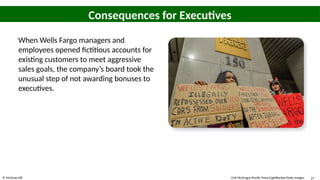
When Wells Fargo managers and
employees opened fictitious accounts for
existing customers to meet aggressive
sales goals, the company’s board took the
unusual step of not awarding bonuses to
executives.
Erik McGregor/Pacific Press/LightRocket/Getty Images
28
End of Chapter 13
© 2022 McGraw Hill. All rights reserved. Authorized only for instructor use in the classroom. No reproduction or further distribution permitted without the prior written consent of McGraw Hill.

Noe_FHRM9e_PPT_Ch13_accessible.pptxSHRM.

  • 1.
    2 Chapter 13 Recognizing EmployeeContributions with Pay freesoulproduction/Shutterstock © 2022 McGraw Hill. All rights reserved. Authorized only for instructor use in the classroom. No reproduction or further distribution permitted without the prior written consent of McGraw Hill.
  • 2.
    © McGraw Hill3 What Do I Need to Know? 1 LO 13-1 Discuss the connection between incentive pay and employee performance. LO 13-2 Describe how organizations recognize individual performance. LO 13-3 Identify ways to recognize group performance. LO 13-4 Explain how organizations link pay to their overall performance. LO 13-5 Describe how organizations combine incentive plans in a “balanced scorecard.” LO 13-6 Summarize processes that can contribute to the success of incentive programs. LO 13-7 Discuss issues related to performance-based pay for executives.
  • 3.
    © McGraw Hill4 Incentive Pay 1 Incentive Pay • Forms of pay designed to energize, direct, or control employees’ behavior. • Often linked to employee’s performance as an individual, group member, or organization member. • May be in the form of a commission or bonus. • Organizations may combine a number of incentives so employees do not focus on one measure to the exclusion of others. • Employees compare their efforts and rewards with those of other employees, considering a plan to be fair when the rewards are distributed according to what the employees contribute.
  • 4.
    © McGraw Hill5 Incentive Pay 2 Effective Incentive Pay Plan Requirements 1. Performance measurements are linked to company goals. 2. Employees believe they can meet performance standards. 3. Employees are given resources needed to meet goals. 4. Employees value rewards given. 5. Employees believe the reward system is fair. 6. Pay plans consider that employees may ignore any goals that are not rewarded.
  • 5.
    © McGraw Hill6 Pay for Individual Performance 1 Piecework Rates • Wages based on the amount an employee produces. Straight Piecework Plan • Employer pays same rate per piece no matter how much worker produces. Differential Piece Rates • Piece rate is higher when a greater amount is produced.
  • 6.
    © McGraw Hill7 Pay for Individual Performance 2 Standard Hour Plans Pay workers extra for work done in less than a preset “standard time.” Encourages employees to work as fast as possible. Employees often neglect quality or customer service. Merit Pay Pay increases are linked to ratings on performance appraisals. Uses a merit increase grid. • Performance rating. • Compa-ratio.
  • 7.
    © McGraw Hill8 Table 13.1 Sample Merit Increase Grid: Recommended Salary Increase a COMPA - RATIO Performance Rating 80 to 90 percent 91 to 110 percent 111 to 120 percent Exceeds expectations 7 percent 5 percent 3 percent Meets expectations 4 percent 3 percent 2 percent Below expectations 2 percent - -
  • 8.
    © McGraw Hill9 Figure 13.1 Ratings and Raises: Under-Rewarding the Best Access the text alternative for slide images. Sources: “BLR’s 2018–2019 Pay Budget and Salary Data Survey,” HR Daily Advisor, https://hrdailyadvisor.blr .com, accessed May 5, 2020; Mercer, “Key Findings: Mercer’s 2019/2020 US Compensation Planning Survey,” August 12, 2019, https://www.mercer.us.
  • 9.
    © McGraw Hill10 Pay for Individual Performance 3 Performance Bonuses • Not rolled into base pay. • Employee must re-earn bonus during each period. • May be a one-time reward. • May be linked to objective performance measures. • Retention bonuses give employees a reason to stay.
  • 10.
    © McGraw Hill11 Performance Bonuses Performance bonuses for production workers are not rolled into base pay. The bonuses could be tied to various measures, including the quantity of products shipped in a specific time period. DreamPictures/Shannon Faulk/Blend Images LLC
  • 11.
    © McGraw Hill12 Pay for Individual Performance 4 Sales Commissions • Incentive pay calculated as a percentage of sales. • Some earn commission in addition to base salary. • Some work on straight commission plan with no salary. • Some earn no commissions at all.
  • 12.
    © McGraw Hill13 POLLING QUESTION 1 John works twisting pretzels in a pretzel factory. Pablo works on IT systems integration at a credit card company. The best pay plans for these individuals would most likely be _____ and _____, respectively. A. merit pay; individual bonus B. sales commissions; merit pay C. piecework; merit pay D. individual bonus; sales commissions
  • 13.
    © McGraw Hill14 Pay for Group Performance 1 Gainsharing • Measures improvements in productivity and effectiveness and distributes portion of each gain to employees. • Addresses challenge of identifying appropriate performance measures for complex jobs. • Employees determine how to improve own and group’s performance.
  • 14.
    © McGraw Hill15 Pay for Group Performance 2 Conditions for Effective Gainsharing 1. Management commitment. 2. Need for change or commitment to continuous improvement. 3. Management acceptance and encouragement of worker input. 4. High levels of cooperation and interaction. 5. Employment security. 6. Information sharing on productivity and costs. 7. Goal setting. 8. Commitment of all parties to process improvement. 9. Performance standards and calculations that are fair, relevant, and understandable. 10.Employees who value working in groups.
  • 15.
    © McGraw Hill16 Pay for Group Performance 3 Group Bonuses • Used in smaller work groups. • Reward members of group for attaining a specific goal. • Usually measured in terms of physical output. Team Awards • Similar to group bonuses. • Likely to use a broad range of performance measures. • Cost savings. • Completion of project. • Meeting deadlines.
  • 16.
    © McGraw Hill17 Pay for Organizational Performance 1 Profit Sharing • Payments are a percentage of organization’s profits and are not part of employees’ base salary. • May encourage employees to think like owners. • Evidence not clear whether profit sharing is effective in improving performance.
  • 17.
    © McGraw Hill18 Pay for Organizational Performance 2 Stock Ownership Makes employees part owners of the organization. May not have a strong effect on employees’ motivation. Stock options. • Rights to buy certain number of shares of stock at specified price. • Traditionally have been granted to executives. Employee stock ownership plans (ESOP). • Organization distributes shares of stock to all its employees by placing them in a trust. • Most common form of employee ownership. • Carry significant risk.
  • 18.
    © McGraw Hill19 Figure 13.2 Types of Pay for Organizational Performance Access the text alternative for slide images.
  • 19.
    © McGraw Hill20 Figure 13.3 Number of Companies with ESOPs Access the text alternative for slide images. Source: National Center for Employee Ownership, “Employee Ownership by the Numbers,” September 2019, https://www.nceo.org.
  • 20.
    © McGraw Hill21 POLLING QUESTION 2 Josh is the Director of Marketing at global company. Identify the best type of incentive pay for him. A. Individual performance, for getting half of his team members to hit their individual targets. B. Group performance, for getting his whole team to cooperate and hit the Marketing Department’s targets. C. Organizational performance, for increasing the company’s profits 20 percent through their marketing efforts.
  • 21.
    © McGraw Hill22 Balanced Scorecard Balanced Scorecard • Combination of performance measures. • Directed toward company’s long- and short-term goals. • Used as the basis for awarding incentive pay. • Four categories: 1. Financial. 2. Customer. 3. Operations. 4. Learning and Growth.
  • 22.
    © McGraw Hill23 Processes That Make Incentives Work Participation in Incentives • Employee participation can be part of general move to employee empowerment. • Employees have hands-on knowledge of behaviors that are effective. Communication • Demonstrates that the pay plan is fair. • When employees understand the plan, it is more likely to influence their behavior as desired. • Especially important when changing the pay plan.
  • 23.
    © McGraw Hill24 Incentive Pay for Executives 1 Short-Term Incentives • Bonuses based on ROI, year’s profits, or other measures related to goals. • Actual payment of bonus can be delayed to gain tax advantages. Long-Term Incentives • Stock options. • Stock purchase plans. • Rationale is that executives will want what is best for organization because that will cause the value of their stock to grow.
  • 24.
    © McGraw Hill25 Incentive Pay for Executives 2 Performance Measures for Executives • Balanced-scorecard approach is useful. • Securities and Exchange Commission (SEC) requires executive compensation to be reported. • Dodd-Frank Wall Street Reform and Consumer Protection Act require that public companies report the ratio of median compensation of all its employees to the CEO’s total compensation.
  • 25.
    © McGraw Hill26 Incentive Pay for Executives 3 Ethical Issues • Occur when company links pay to stock performance. • Executives may be tempted to lie about company’s performance due to potential for large earnings. • Insider trading gives unethical advantage.
  • 26.
    © McGraw Hill27 Consequences for Executives When Wells Fargo managers and employees opened fictitious accounts for existing customers to meet aggressive sales goals, the company’s board took the unusual step of not awarding bonuses to executives. Erik McGregor/Pacific Press/LightRocket/Getty Images
  • 27.
    28 End of Chapter13 © 2022 McGraw Hill. All rights reserved. Authorized only for instructor use in the classroom. No reproduction or further distribution permitted without the prior written consent of McGraw Hill.

Editor's Notes

  • #1 NOTE TO INSTRUCTORS: If your class has fewer than 40 students per poll, Poll Everywhere is free (as of production of these slides). For current pricing please visit: https://www.polleverywhere.com/plans If you have more than 40 students per poll, please talk to your McGraw-Hill rep as we have negotiated a discount on this tool for you that we are happy to pass on: http://www.mhhe.com/rep.
  • #4 LO 13-1 Discuss the connection between incentive pay and employee performance. Along with wages and salaries, many organizations offer incentive pay—that is, pay specifically designed to energize, direct, or control employees’ behavior. Incentive pay is a form of pay linked to an employee’s performance as an individual, group member, or organization member.
  • #5 For incentive pay to motivate employees to contribute to the organization’s success, the pay plans must be well designed. In particular, effective plans meet the six requirements listed on this slide.
  • #6 LO 13-2 Describe how organizations recognize individual performance. The many kinds of incentive pay fall into three broad categories: incentives linked to individual, group, or organizational performance. Choices from these categories should consider not only their strengths and weaknesses, but also their fit with the organization’s goals. The choice of incentive pay may affect not only the level of motivation but also the kinds of employees who are attracted to and stay with the organization. Given the potential impact, organizations not only should weigh the strengths and weaknesses in selecting types of incentive pay but also should measure the results of these programs. Piecework rate is the rate of pay per unit produced. Straight piecework plan is incentive pay in which the employer pays the same rate per piece, no matter how much the worker produces. Differential piece rates is Incentive pay in which the piece rate is higher when a greater amount is produced.
  • #7 Standard hour plan is an incentive plan that pays workers extra for work done in less than a preset “standard time.” Much like piecework plans, standard hour plans encourage employees to work as fast as they can, but not necessarily to care about quality or service. Merit pay is a system of linking pay increases to ratings on performance appraisals. Merit pay systems gives lowest paid best performers the biggest pay increases.
  • #8 Compa-ratioa is the employee’s salary divided by the midpoint of his or her salary range. To make the merit increases consistent, so they will be seen as fair, many merit pay programs use a merit increase grid, such as the sample in Table 13.1.
  • #9 As Figure 13.1 shows, a typical spread of pay raises across all employees is just a few percentage points. However, experts advise making pay increases far greater for top performers than for average employees—and not rewarding the poor performers with a raise at all.11 Imagine if the raises given to the bottom two categories in Figure 13.1 instead went toward 7% or greater raises for the one-quarter of employees who are high performers. This type of decision signals that excellence is rewarded. As the unemployment rate continues to fall, upward pressure on wages may increase the possible range for merit increases. If average pay rises by 4% or more, there are more dollars to distribute among high- and middle-performing employees.
  • #10 Bonuses for individual performance can be extremely effective and give the organization great flexibility in deciding what kinds of behavior to reward. organizations also may motivate employees with one-time bonuses. When one organization acquires another, it usually wants to retain certain valuable employees in the organization it is buying, so organizations involved in an acquisition may pay retention bonuses—one-time incentives paid in exchange for remaining with the company—to top managers, engineers, top-performing salespeople, and information technology specialists.
  • #12 A variation on piece rates and bonuses is the payment of commissions, or pay calculated as a percentage of sales. Commission rates vary tremendously from one industry and company to another. Paying most or all of a salesperson’s compensation in the form of salary frees the salesperson to focus on developing customer goodwill. Paying most or all of a salesperson’s compensation in the form of commissions encourages the salesperson to focus on closing sales. In this way, differences in salespeople’s compensation directly influence how they spend their time, how they treat customers, and how much the organization sells. The nature of salespeople’s compensation also affects the kinds of people who will want to take and keep sales jobs with the organization.
  • #13 John works twisting pretzels in a pretzel factory. Pablo works on IT systems integration at a credit card company. The best pay plans for these individuals would most likely be _____ and _____, respectively. merit pay; individual bonus sales commissions; merit pay piecework; merit pay individual bonus; sales commissions Answer: C Piece-rate pay plans typically are suited for routine, standardized jobs with output that is easy to measure, such as the number of pretzels twisted. Merit pay rewards employees based on performance appraisals.
  • #14 LO 13-3 Identify ways to recognize group performance. Organizations that want employees to focus on efficiency may adopt a gainsharing program. Gainsharing is a group incentive program that measures improvements in productivity and effectiveness objectives and distributes a portion of each gain to employees. Knowing they can enjoy a financial benefit from helping the company be more productive, employees supposedly will look for ways to improve and work more efficiently.
  • #15 Gainsharing is most likely to succeed when organizations provide the right conditions. Among the conditions identified, the ones listed on this slide are among the most common.
  • #16 Both types of incentives have the advantage that they encourage group or team members to cooperate so that they can achieve their goal. Depending on the reward system, competition among individuals may be replaced by competition among groups. The organization should carefully set the performance goals for these incentives so that concern for costs or sales does not obscure other objectives, such as quality, customer service, and ethical behavior.
  • #17 13-4 Explain how organizations link pay to their overall performance. Profit sharing is an incentive pay in which payments are a percentage of the organization’s profits and do not become part of the employees’ base salary. Given the limitations of profit sharing plans, one strategy is to use them as a component of a pay system that includes other kinds of pay more directly linked to individual behavior. This increases employees’ commitment to organizational goals while addressing concerns about fairness.
  • #18 While profit-sharing plans are intended to encourage employees to “think like owners,” a stock ownership plan actually makes employees part owners of the organization. Stock options are rights to buy a certain number of shares of stock at a specified price. Like profit sharing, employee ownership is intended as a way to encourage employees to focus on the success of the organization as a whole. Employee stock ownership plan (ESOP) is an arrangement in which the organization distributes shares of stock to all its employees by placing it in a trust. Some companies are trying to push eligibility for options further down the organization’s structure.
  • #19 Ownership programs usually take the form of stock options or employee stock ownership plans. These are illustrated in Figure 13.2.
  • #20 In an ESOP, the organization distributes shares of stock to its employees by placing the stock into a trust managed on the employees’ behalf. Employees receive regular reports on the value of their stock, and when they leave the organization, they may sell the stock to the organization or (if it is a publicly traded company) on the open market. ESOPs are the most common form of employee ownership, with the number of employees in such plans increasing from approximately 250,000 in 1975 to more than 10 million active participants (those who are currently employed and earning benefits). The number of participants has grown even while the number of companies offering ESOPs has shrunk somewhat, as shown in Figure 13.3.
  • #21 Josh is the Director of Marketing at global company. Identify the best type of incentive for him: individual, group, or organizational. Individual performance, for getting half of his team members to hit their individual targets. Group performance, for getting his whole team to cooperate and hit the Marketing Department’s targets. Organizational performance, for increasing the company’s profits 20 percent through their marketing efforts. Student answers will vary. Individual is not likely since Josh is a Director; however, he could be rewarded based on how well individual members of his team do. Group is more likely because he could be measured by the success of the marketing team as a whole. Or Organizational is also likely as he could receive a portion of the proceeds attributed to an increased market share due to his team’s efforts.
  • #22 LO 13-5 Describe how organizations combine incentive plans in a “balanced scorecard.” Any form of incentive pay has advantages and disadvantages. Because of this, many organizations design a mix of pay programs. The aim is to balance the disadvantages of one type of incentive pay with the advantages of another type. One way of accomplishing this goal is to design a balanced scorecard—a combination of performance measures directed toward the company’s long- and short-term goals and used as the basis for awarding incentive pay.
  • #23 LO 13-6 Summarize processes that can contribute to the success of incentive programs. Communication and employee participation can contribute to the belief that the organization’s pay structure is fair. The process by which the organization creates and administers incentive pay can help it use incentives to achieve the goal of motivating employees. It is particularly important to communicate with employees when changing the plan. Employees tend to feel concerned about changes. Pay is a frequent topic of rumors and assumptions based on incomplete information, partly because of pay’s importance to employees. When making any changes, the human resource department should determine the best ways to communicate the reasons for the change.
  • #24 LO 13-7 Discuss issues related to performance-based pay for executives. Because executives have a much stronger influence over the organization’s performance than other employees do, incentive pay for executives warrants special attention. To encourage executives to develop a commitment to the organization’s long-term success, executive compensation often combines short-term and long-term incentives. Short-term incentives include bonuses based on the year’s profits, return on investment, or other measures related to the organization’s goals. Sometimes, to gain tax advantages, the actual payment of the bonus is deferred (for example, by making it part of a retirement plan). Long-term incentives include stock options and stock purchase plans. The rationale for these long-term incentives is that executives will want to do what is best for the organization because that will cause the value of their stock to grow.
  • #25 Regulators and shareholders have pressured companies to do a better job of linking executive pay and performance.