Drug Calculations
Rami AL-Khateeb
Outlines
Introduction
Metric Conversions
MG/KG Dose Conversion
Flow Infusion Rates
Introduction
When calculating how much of a drug is
required, working with the formula helps the
accuracy of the calculation.
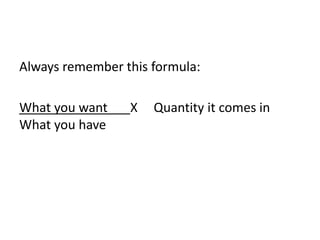
Always remember this formula:
What you want X Quantity it comes in
What you have
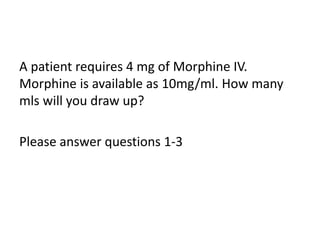
A patient requires 4 mg of Morphine IV.
Morphine is available as 10mg/ml. How many
mls will you draw up?
Please answer questions 1-3
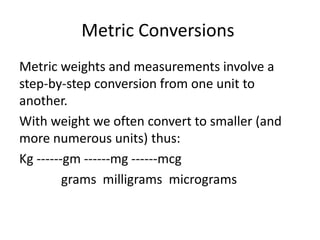
Metric Conversions
Metric weights and measurements involve a
step-by-step conversion from one unit to
another.
With weight we often convert to smaller (and
more numerous units) thus:
Kg ------gm ------mg ------mcg
grams milligrams micrograms
Metric Conversions
Each of these steps involves the heavier unit
being multiplied by 1000 to bring up the
number of the smaller units for the same
weight.
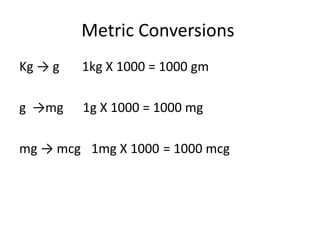
Metric Conversions
Kg → g 1kg X 1000 = 1000 gm
g →mg 1g X 1000 = 1000 mg
= 1000 mcg1mg X 1000mg → mcg
Metric Conversions
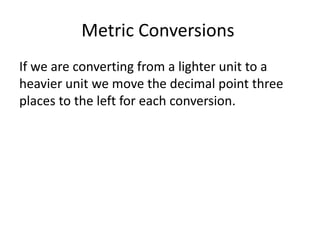
If we are converting from a lighter unit to a
heavier unit we move the decimal point three
places to the left for each conversion.
Metric Conversions
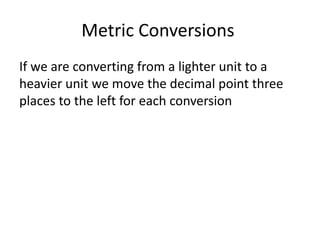
If we are converting from a lighter unit to a
heavier unit we move the decimal point three
places to the left for each conversion
Metric Conversions
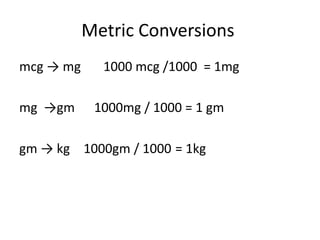
mcg → mg 1000 mcg /1000 = 1mg
mg →gm 1000mg / 1000 = 1 gm
= 1kg1000gm / 1000gm → kg
Please answer questions from 4-7
Metric Conversions
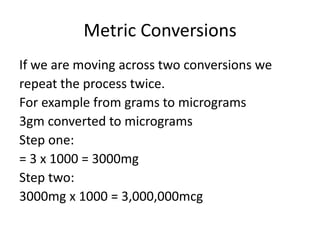
If we are moving across two conversions we
repeat the process twice.
For example from grams to micrograms
3gm converted to micrograms
Step one:
= 3 x 1000 = 3000mg
Step two:
3000mg x 1000 = 3,000,000mcg
Please answer questions from 8-10
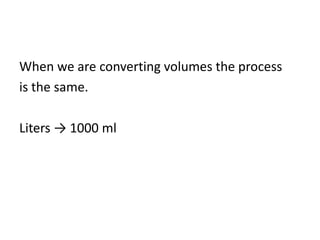
When we are converting volumes the process
is the same.
Liters → 1000 ml
Please answer questions from 11-13
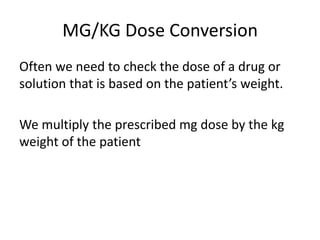
MG/KG Dose Conversion
Often we need to check the dose of a drug or
solution that is based on the patient’s weight.
We multiply the prescribed mg dose by the kg
weight of the patient
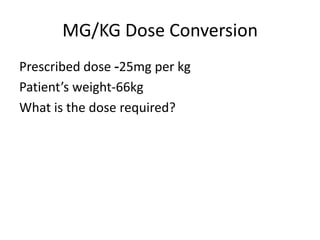
MG/KG Dose Conversion
25mg per kg-Prescribed dose
Patient’s weight-66kg
What is the dose required?
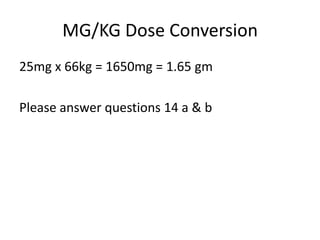
MG/KG Dose Conversion
25mg x 66kg = 1650mg = 1.65 gm
Please answer questions 14 a & b
Flow Infusion Rates
Flow Infusion Rates
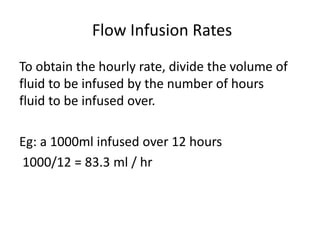
To obtain the hourly rate, divide the volume of
fluid to be infused by the number of hours
fluid to be infused over.
Eg: a 1000ml infused over 12 hours
1000/12 = 83.3 ml / hr
Flow Infusion Rates
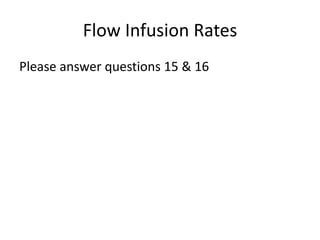
Please answer questions 15 & 16
Flow Infusion Rates
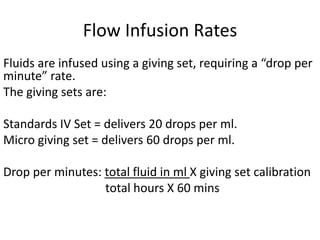
Fluids are infused using a giving set, requiring a “drop per
minute” rate.
The giving sets are:
Standards IV Set = delivers 20 drops per ml.
Micro giving set = delivers 60 drops per ml.
Drop per minutes: total fluid in ml X giving set calibration
total hours X 60 mins
Flow Infusion Rates
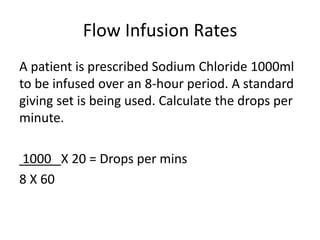
A patient is prescribed Sodium Chloride 1000ml
to be infused over an 8-hour period. A standard
giving set is being used. Calculate the drops per
minute.
1000 X 20 = Drops per mins
8 X 60
Flow Infusion Rates
Please answer question number 17
Answers
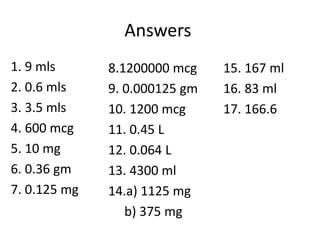
1. 9 mls
2. 0.6 mls
3. 3.5 mls
4. 600 mcg
5. 10 mg
6. 0.36 gm
7. 0.125 mg
8.1200000 mcg
9. 0.000125 gm
10. 1200 mcg
11. 0.45 L
12. 0.064 L
13. 4300 ml
14.a) 1125 mg
b) 375 mg
15. 167 ml
16. 83 ml
17. 166.6
References
Dodds, K.G. (2012). Safety in Numbers–
Essential Calculations for Nurses. Palmerston
North. Dunmore Press Ltd.
Christchurch Hospital Department of Nursing
Drug Calculation Prompt Card
(15/06/00)

Drug calculations

  • 1.
  • 2.
  • 3.
    Introduction When calculating howmuch of a drug is required, working with the formula helps the accuracy of the calculation.
  • 4.
    Always remember thisformula: What you want X Quantity it comes in What you have
  • 5.
    A patient requires4 mg of Morphine IV. Morphine is available as 10mg/ml. How many mls will you draw up? Please answer questions 1-3
  • 6.
    Metric Conversions Metric weightsand measurements involve a step-by-step conversion from one unit to another. With weight we often convert to smaller (and more numerous units) thus: Kg ------gm ------mg ------mcg grams milligrams micrograms
  • 7.
    Metric Conversions Each ofthese steps involves the heavier unit being multiplied by 1000 to bring up the number of the smaller units for the same weight.
  • 8.
    Metric Conversions Kg →g 1kg X 1000 = 1000 gm g →mg 1g X 1000 = 1000 mg = 1000 mcg1mg X 1000mg → mcg
  • 9.
    Metric Conversions If weare converting from a lighter unit to a heavier unit we move the decimal point three places to the left for each conversion.
  • 10.
    Metric Conversions If weare converting from a lighter unit to a heavier unit we move the decimal point three places to the left for each conversion
  • 11.
    Metric Conversions mcg →mg 1000 mcg /1000 = 1mg mg →gm 1000mg / 1000 = 1 gm = 1kg1000gm / 1000gm → kg
  • 12.
  • 13.
    Metric Conversions If weare moving across two conversions we repeat the process twice. For example from grams to micrograms 3gm converted to micrograms Step one: = 3 x 1000 = 3000mg Step two: 3000mg x 1000 = 3,000,000mcg
  • 14.
  • 15.
    When we areconverting volumes the process is the same. Liters → 1000 ml
  • 16.
  • 17.
    MG/KG Dose Conversion Oftenwe need to check the dose of a drug or solution that is based on the patient’s weight. We multiply the prescribed mg dose by the kg weight of the patient
  • 18.
    MG/KG Dose Conversion 25mgper kg-Prescribed dose Patient’s weight-66kg What is the dose required?
  • 19.
    MG/KG Dose Conversion 25mgx 66kg = 1650mg = 1.65 gm Please answer questions 14 a & b
  • 20.
  • 21.
    Flow Infusion Rates Toobtain the hourly rate, divide the volume of fluid to be infused by the number of hours fluid to be infused over. Eg: a 1000ml infused over 12 hours 1000/12 = 83.3 ml / hr
  • 22.
    Flow Infusion Rates Pleaseanswer questions 15 & 16
  • 23.
    Flow Infusion Rates Fluidsare infused using a giving set, requiring a “drop per minute” rate. The giving sets are: Standards IV Set = delivers 20 drops per ml. Micro giving set = delivers 60 drops per ml. Drop per minutes: total fluid in ml X giving set calibration total hours X 60 mins
  • 24.
    Flow Infusion Rates Apatient is prescribed Sodium Chloride 1000ml to be infused over an 8-hour period. A standard giving set is being used. Calculate the drops per minute. 1000 X 20 = Drops per mins 8 X 60
  • 25.
    Flow Infusion Rates Pleaseanswer question number 17
  • 26.
    Answers 1. 9 mls 2.0.6 mls 3. 3.5 mls 4. 600 mcg 5. 10 mg 6. 0.36 gm 7. 0.125 mg 8.1200000 mcg 9. 0.000125 gm 10. 1200 mcg 11. 0.45 L 12. 0.064 L 13. 4300 ml 14.a) 1125 mg b) 375 mg 15. 167 ml 16. 83 ml 17. 166.6
  • 27.
    References Dodds, K.G. (2012).Safety in Numbers– Essential Calculations for Nurses. Palmerston North. Dunmore Press Ltd. Christchurch Hospital Department of Nursing Drug Calculation Prompt Card (15/06/00)