Basic Math Review Tyra L. Ousley, RN, MSN
I.  PERCENTAGES Any quantity stated as the proportion per hundred; expressed with % sign meaning “for every hundred”.
A.  Convert a percent to a decimal RULES: Delete the % sign Divide the remaining number by 100, which is the same as moving the decimal point 2 places to the left. Ex: 25% = 25/100 = 0.25 50% = ___________ 75% = ___________ 67% = ___________
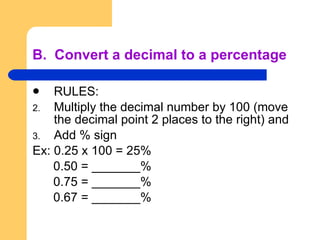
B.  Convert a decimal to a percentage RULES: Multiply the decimal number by 100 (move the decimal point 2 places to the right) and Add % sign Ex: 0.25 x 100 = 25% 0.50 = _______% 0.75 = _______% 0.67 = _______%
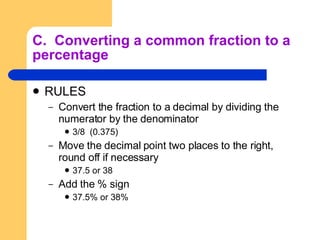
C.  Converting a common fraction to a percentage RULES Convert the fraction to a decimal by dividing the numerator by the denominator 3/8  (0.375) Move the decimal point two places to the right, round off if necessary 37.5 or 38 Add the % sign 37.5% or 38%
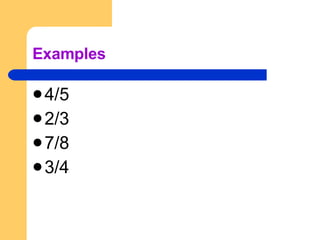
Examples 4/5 2/3 7/8 3/4
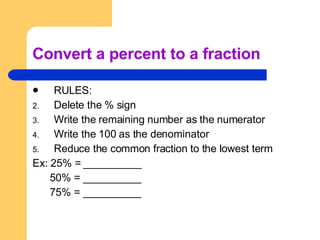
Convert a percent to a fraction RULES: Delete the % sign Write the remaining number as the numerator Write the 100 as the denominator Reduce the common fraction to the lowest term Ex: 25% = __________ 50% = __________ 75% = __________
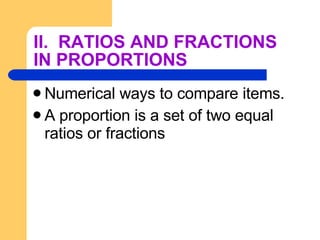
II.  RATIOS AND FRACTIONS IN PROPORTIONS Numerical ways to compare items. A proportion is a set of two equal ratios or fractions
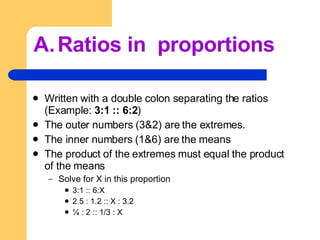
Ratios in  proportions Written with a double colon separating the ratios (Example:  3:1 :: 6:2 ) The outer numbers (3&2) are the extremes. The inner numbers (1&6) are the means The product of the extremes must equal the product of the means Solve for X in this proportion 3:1 :: 6:X 2.5 : 1.2 :: X : 3.2 ¼ : 2 :: 1/3 : X
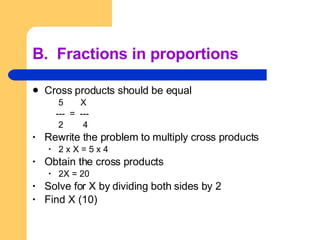
B.  Fractions in proportions Cross products should be equal 5  X ---  =  --- 2  4 Rewrite the problem to multiply cross products 2 x X = 5 x 4 Obtain the cross products 2X = 20 Solve for X by dividing both sides by 2 Find X (10)
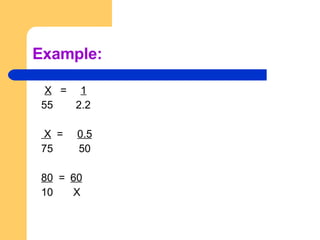
Example: X   =  1 55  2.2 X   =  0.5 75  50 80   =  60 10  X
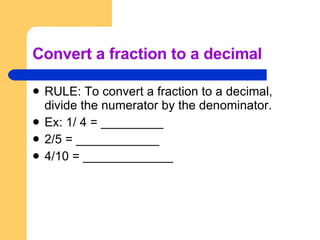
Convert a fraction to a decimal RULE: To convert a fraction to a decimal, divide the numerator by the denominator. Ex: 1/ 4 = _________ 2/5 = ____________ 4/10 = _____________
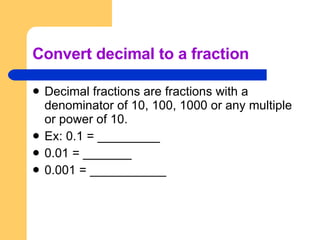
Convert decimal to a fraction Decimal fractions are fractions with a denominator of 10, 100, 1000 or any multiple or power of 10. Ex: 0.1 = _________ 0.01 = _______ 0.001 = ___________
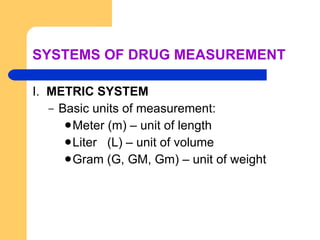
SYSTEMS OF DRUG MEASUREMENT I.  METRIC SYSTEM Basic units of measurement: Meter (m) – unit of length Liter  (L) – unit of volume Gram (G, GM, Gm) – unit of weight
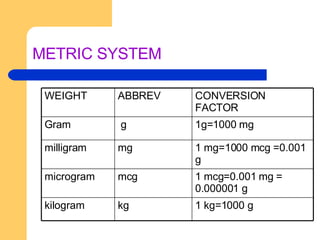
METRIC SYSTEM WEIGHT ABBREV CONVERSION FACTOR Gram g 1g=1000 mg milligram mg 1 mg=1000 mcg =0.001 g microgram mcg 1 mcg=0.001 mg = 0.000001 g kilogram kg 1 kg=1000 g
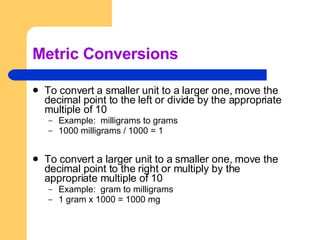
Metric Conversions To convert a smaller unit to a larger one, move the decimal point to the left or divide by the appropriate multiple of 10 Example:  milligrams to grams 1000 milligrams / 1000 = 1 To convert a larger unit to a smaller one, move the decimal point to the right or multiply by the appropriate multiple of 10 Example:  gram to milligrams 1 gram x 1000 = 1000 mg
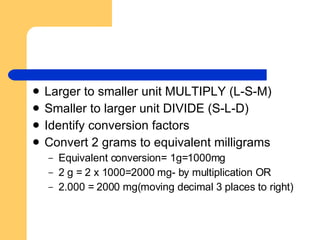
Larger to smaller unit MULTIPLY (L-S-M) Smaller to larger unit DIVIDE (S-L-D) Identify conversion factors Convert 2 grams to equivalent milligrams Equivalent conversion= 1g=1000mg 2 g = 2 x 1000=2000 mg- by multiplication OR 2.000 = 2000 mg(moving decimal 3 places to right)
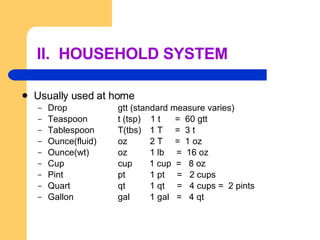
II.  HOUSEHOLD SYSTEM Usually used at home Drop gtt (standard measure varies) Teaspoon  t (tsp)  1 t  =  60 gtt Tablespoon  T(tbs)  1 T  =  3 t Ounce(fluid)  oz  2 T  =  1 oz  Ounce(wt) oz  1 lb  =  16 oz Cup  cup  1 cup  =  8 oz Pint  pt  1 pt  =  2 cups Quart  qt  1 qt  =  4 cups =  2 pints Gallon  gal 1 gal  =  4 qt
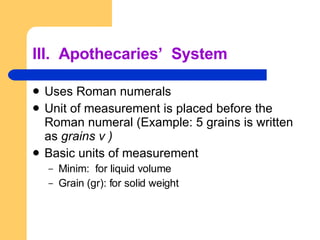
III.  Apothecaries’  System Uses Roman numerals Unit of measurement is placed before the Roman numeral (Example: 5 grains is written as  grains v ) Basic units of measurement Minim:  for liquid volume Grain (gr): for solid weight
IV.  Avoirdupois System Used for ordering and purchasing some pharmaceutical products and for weighing patients in clinical settings Units of weight include grains, ounces, pounds
V.  Unit System USP – United States Pharmacopeia Units IU – International Units Common drugs in units Insulin Heparin
VI.  Milliequivalent System Most electrolytes are measured in mEq Example:  Potassium Chloride
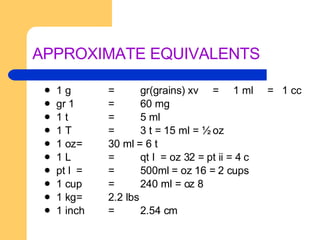
APPROXIMATE EQUIVALENTS 1 g = gr(grains) xv  =  1 ml  =  1 cc gr 1   = 60 mg  1 t = 5 ml 1 T = 3 t = 15 ml = ½ oz 1 oz = 30 ml = 6 t 1 L =  qt I  = oz 32 = pt ii = 4 c pt I =  = 500ml = oz 16 = 2 cups  1 cup  =  240 ml = oz 8 1 kg = 2.2 lbs 1 inch = 2.54 cm
Conversions for Other Clinical Applications:  Time and Temperature Chapter 5
Time is an  essential part of the drug order
What are some issues  related to using the traditional time method?
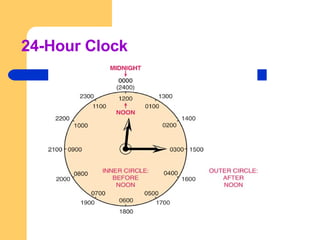
24-Hour Clock
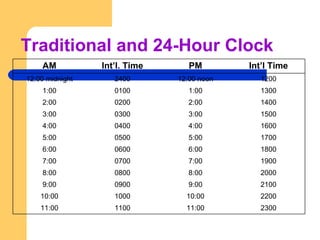
Traditional and 24-Hour Clock AM Int’l. Time PM Int’l Time 12:00 midnight 2400 12:00 noon 1200 1:00 0100 1:00 1300 2:00 0200 2:00 1400 3:00 0300 3:00 1500 4:00 0400 4:00 1600 5:00 0500 5:00 1700 6:00 0600 6:00 1800 7:00 0700 7:00 1900 8:00 0800 8:00 2000 9:00 0900 9:00 2100 10:00 1000 10:00 2200 11:00 1100 11:00 2300
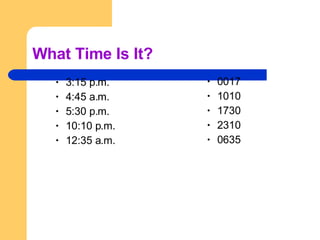
What Time Is It? 3:15 p.m. 4:45 a.m. 5:30 p.m. 10:10 p.m. 12:35 a.m. 0017 1010 1730 2310 0635
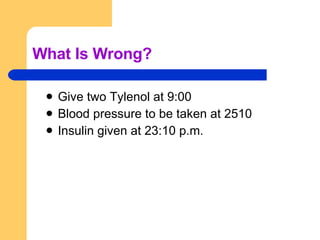
What Is Wrong? Give two Tylenol at 9:00 Blood pressure to be taken at 2510 Insulin given at 23:10 p.m.
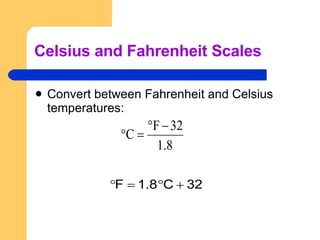
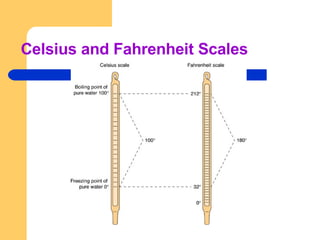
Celsius and Fahrenheit Scales Convert between Fahrenheit and Celsius temperatures:
Celsius and Fahrenheit Scales
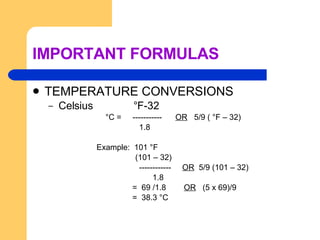
IMPORTANT FORMULAS TEMPERATURE CONVERSIONS Celsius  °F-32 °C =  -----------  OR   5/9 ( °F – 32)  1.8 Example:  101 °F   (101 – 32) ------------  OR   5/9 (101 – 32) 1.8 =  69 /1.8  OR   (5 x 69)/9 =  38.3 °C
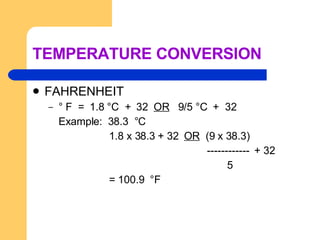
TEMPERATURE CONVERSION FAHRENHEIT ° F  =  1.8 °C  +  32  OR   9/5 °C  +  32 Example:  38.3  °C 1.8 x 38.3 + 32  OR   (9 x 38.3) ------------  + 32 5 = 100.9  °F
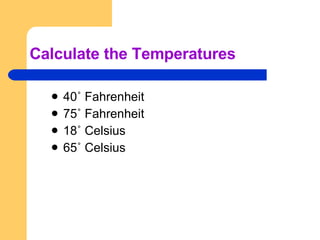
Calculate the Temperatures 40˚ Fahrenheit 75˚ Fahrenheit 18˚ Celsius 65˚ Celsius
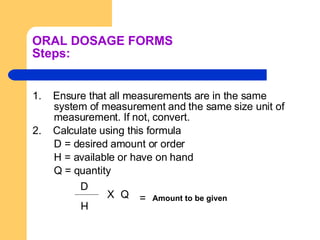
ORAL DOSAGE FORMS Steps: 1.  Ensure that all measurements are in the same system of measurement and the same size unit of measurement. If not, convert.  2.  Calculate using this formula D = desired amount or order H = available or have on hand Q = quantity   D H =  Amount to be given X Q
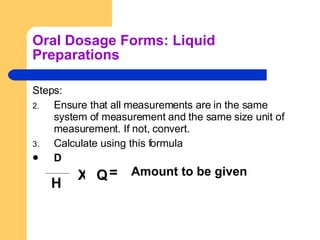
Oral Dosage Forms: Liquid Preparations Steps: Ensure that all measurements are in the same system of measurement and the same size unit of measurement. If not, convert.  Calculate using this formula D H X Q = Amount to be given
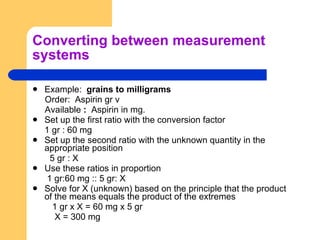
Converting between measurement systems Example:  grains to milligrams Order:  Aspirin gr v Available  :  Aspirin in mg. Set up the first ratio with the conversion factor 1 gr : 60 mg Set up the second ratio with the unknown quantity in the appropriate position 5 gr : X Use these ratios in proportion   1 gr:60 mg :: 5 gr: X Solve for X (unknown) based on the principle that the product of the means equals the product of the extremes 1 gr x X = 60 mg x 5 gr X = 300 mg
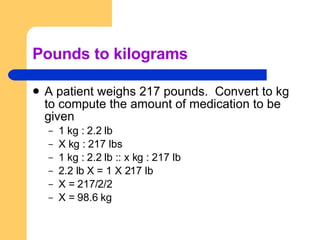
Pounds to kilograms A patient weighs 217 pounds.  Convert to kg to compute the amount of medication to be given 1 kg : 2.2 lb X kg : 217 lbs 1 kg : 2.2 lb :: x kg : 217 lb 2.2 lb X = 1 X 217 lb X = 217/2/2 X = 98.6 kg
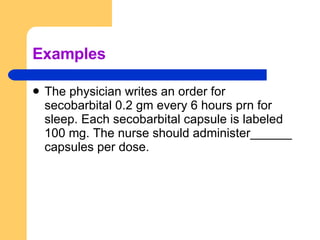
Examples The physician writes an order for secobarbital 0.2 gm every 6 hours prn for sleep. Each secobarbital capsule is labeled 100 mg. The nurse should administer______ capsules per dose.
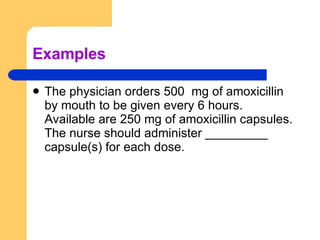
Examples The physician orders 500  mg of amoxicillin by mouth to be given every 6 hours. Available are 250 mg of amoxicillin capsules. The nurse should administer _________ capsule(s) for each dose.
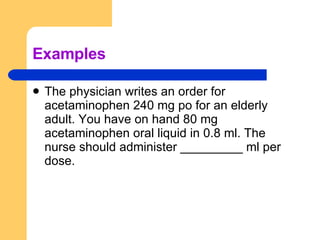
Examples The physician writes an order for acetaminophen 240 mg po for an elderly adult. You have on hand 80 mg acetaminophen oral liquid in 0.8 ml. The nurse should administer _________ ml per dose.
Examples The physician orders amoxicillin 250 mg po. The pharmacy supplies amoxicillin suspension 250 mg/5 ml. in a 50 ml. bottle. The nurse should instruct the client to take _________ ml per dose.
Practice Questions: A physician’s order reads  2 Tbs milk of magnesia.  How many milliliters will the nurse administer? The Physician’s order reads  Tylenol supp. Gr x every 4 hrs p.r.n. for temp. > 101 F.  The package label states that each suppository contains 10 grains of Tylenol.  How many suppositories should the nurse administer? The order states  Lithium Carbonate gr x p.o. tid.  The drug is labeled  Lithium Carbonate 300 milligrams/capsule.  How many capsules should the nurse give?
The order for Coumadin is 5 mg.  It is available in 2.5 mg tablets.  How many tablets should be given? The physician’s order is  Ferrous Sulfate 300 mg p.o. tid X 1 week.  How many tablets in total should be dispensed for the patient?
Calculation for individualized drug dosing Based on actual body weight Used to individualize medication administration for children and adults
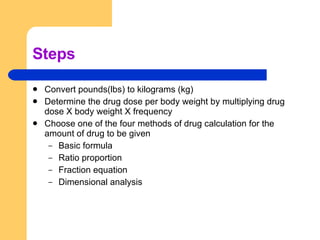
Steps Convert pounds(lbs) to kilograms (kg) Determine the drug dose per body weight by multiplying drug dose X body weight X frequency  Choose one of the four methods of drug calculation for the amount of drug to be given Basic formula Ratio proportion Fraction equation Dimensional analysis
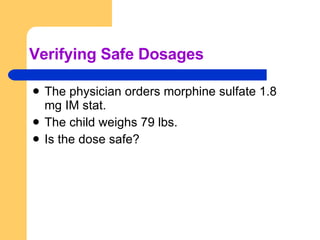
The physician orders morphine sulfate 1.8 mg IM stat.  The child weighs 79 lbs.  Is the dose safe? Verifying Safe Dosages
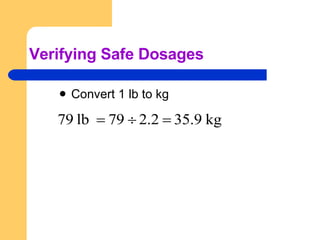
Verifying Safe Dosages Convert 1 lb to kg
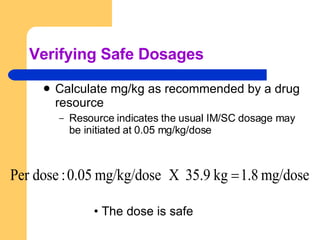
Verifying Safe Dosages Calculate mg/kg as recommended by a drug resource Resource indicates the usual IM/SC dosage may be initiated at 0.05 mg/kg/dose The dose is safe
Kee, pp. 98 -109
REFERENCES Broyles, B. (2003)  Dosage Calculation Practice for Nurses. Canada: Delmar Erickson, B. ( 1991).  Nurse’s Clinical Guide Dosage Calculations. Pennsylvania: Springhouse Corporation Kee, J and Marshall, S.(2004).  Clinical Calculations. 5 th  Edition. Missouri:  Elsevier Pickar, G. ( 2008).  Dosage Calculations. 8 th  Edition.  Canada:  Delmar
ANY QUESTIONS  ????

Rev. 0527 Basic Math Review Complete

  • 1.
    Basic Math ReviewTyra L. Ousley, RN, MSN
  • 2.
    I. PERCENTAGESAny quantity stated as the proportion per hundred; expressed with % sign meaning “for every hundred”.
  • 3.
    A. Converta percent to a decimal RULES: Delete the % sign Divide the remaining number by 100, which is the same as moving the decimal point 2 places to the left. Ex: 25% = 25/100 = 0.25 50% = ___________ 75% = ___________ 67% = ___________
  • 4.
    B. Converta decimal to a percentage RULES: Multiply the decimal number by 100 (move the decimal point 2 places to the right) and Add % sign Ex: 0.25 x 100 = 25% 0.50 = _______% 0.75 = _______% 0.67 = _______%
  • 5.
    C. Convertinga common fraction to a percentage RULES Convert the fraction to a decimal by dividing the numerator by the denominator 3/8 (0.375) Move the decimal point two places to the right, round off if necessary 37.5 or 38 Add the % sign 37.5% or 38%
  • 6.
  • 7.
    Convert a percentto a fraction RULES: Delete the % sign Write the remaining number as the numerator Write the 100 as the denominator Reduce the common fraction to the lowest term Ex: 25% = __________ 50% = __________ 75% = __________
  • 8.
    II. RATIOSAND FRACTIONS IN PROPORTIONS Numerical ways to compare items. A proportion is a set of two equal ratios or fractions
  • 9.
    Ratios in proportions Written with a double colon separating the ratios (Example: 3:1 :: 6:2 ) The outer numbers (3&2) are the extremes. The inner numbers (1&6) are the means The product of the extremes must equal the product of the means Solve for X in this proportion 3:1 :: 6:X 2.5 : 1.2 :: X : 3.2 ¼ : 2 :: 1/3 : X
  • 10.
    B. Fractionsin proportions Cross products should be equal 5 X --- = --- 2 4 Rewrite the problem to multiply cross products 2 x X = 5 x 4 Obtain the cross products 2X = 20 Solve for X by dividing both sides by 2 Find X (10)
  • 11.
    Example: X = 1 55 2.2 X = 0.5 75 50 80 = 60 10 X
  • 12.
    Convert a fractionto a decimal RULE: To convert a fraction to a decimal, divide the numerator by the denominator. Ex: 1/ 4 = _________ 2/5 = ____________ 4/10 = _____________
  • 13.
    Convert decimal toa fraction Decimal fractions are fractions with a denominator of 10, 100, 1000 or any multiple or power of 10. Ex: 0.1 = _________ 0.01 = _______ 0.001 = ___________
  • 14.
    SYSTEMS OF DRUGMEASUREMENT I. METRIC SYSTEM Basic units of measurement: Meter (m) – unit of length Liter (L) – unit of volume Gram (G, GM, Gm) – unit of weight
  • 15.
    METRIC SYSTEM WEIGHTABBREV CONVERSION FACTOR Gram g 1g=1000 mg milligram mg 1 mg=1000 mcg =0.001 g microgram mcg 1 mcg=0.001 mg = 0.000001 g kilogram kg 1 kg=1000 g
  • 16.
    Metric Conversions Toconvert a smaller unit to a larger one, move the decimal point to the left or divide by the appropriate multiple of 10 Example: milligrams to grams 1000 milligrams / 1000 = 1 To convert a larger unit to a smaller one, move the decimal point to the right or multiply by the appropriate multiple of 10 Example: gram to milligrams 1 gram x 1000 = 1000 mg
  • 17.
    Larger to smallerunit MULTIPLY (L-S-M) Smaller to larger unit DIVIDE (S-L-D) Identify conversion factors Convert 2 grams to equivalent milligrams Equivalent conversion= 1g=1000mg 2 g = 2 x 1000=2000 mg- by multiplication OR 2.000 = 2000 mg(moving decimal 3 places to right)
  • 18.
    II. HOUSEHOLDSYSTEM Usually used at home Drop gtt (standard measure varies) Teaspoon t (tsp) 1 t = 60 gtt Tablespoon T(tbs) 1 T = 3 t Ounce(fluid) oz 2 T = 1 oz Ounce(wt) oz 1 lb = 16 oz Cup cup 1 cup = 8 oz Pint pt 1 pt = 2 cups Quart qt 1 qt = 4 cups = 2 pints Gallon gal 1 gal = 4 qt
  • 19.
    III. Apothecaries’ System Uses Roman numerals Unit of measurement is placed before the Roman numeral (Example: 5 grains is written as grains v ) Basic units of measurement Minim: for liquid volume Grain (gr): for solid weight
  • 20.
    IV. AvoirdupoisSystem Used for ordering and purchasing some pharmaceutical products and for weighing patients in clinical settings Units of weight include grains, ounces, pounds
  • 21.
    V. UnitSystem USP – United States Pharmacopeia Units IU – International Units Common drugs in units Insulin Heparin
  • 22.
    VI. MilliequivalentSystem Most electrolytes are measured in mEq Example: Potassium Chloride
  • 23.
    APPROXIMATE EQUIVALENTS 1g = gr(grains) xv = 1 ml = 1 cc gr 1 = 60 mg 1 t = 5 ml 1 T = 3 t = 15 ml = ½ oz 1 oz = 30 ml = 6 t 1 L = qt I = oz 32 = pt ii = 4 c pt I = = 500ml = oz 16 = 2 cups 1 cup = 240 ml = oz 8 1 kg = 2.2 lbs 1 inch = 2.54 cm
  • 24.
    Conversions for OtherClinical Applications: Time and Temperature Chapter 5
  • 25.
    Time is an essential part of the drug order
  • 26.
    What are someissues related to using the traditional time method?
  • 27.
  • 28.
    Traditional and 24-HourClock AM Int’l. Time PM Int’l Time 12:00 midnight 2400 12:00 noon 1200 1:00 0100 1:00 1300 2:00 0200 2:00 1400 3:00 0300 3:00 1500 4:00 0400 4:00 1600 5:00 0500 5:00 1700 6:00 0600 6:00 1800 7:00 0700 7:00 1900 8:00 0800 8:00 2000 9:00 0900 9:00 2100 10:00 1000 10:00 2200 11:00 1100 11:00 2300
  • 29.
    What Time IsIt? 3:15 p.m. 4:45 a.m. 5:30 p.m. 10:10 p.m. 12:35 a.m. 0017 1010 1730 2310 0635
  • 30.
    What Is Wrong?Give two Tylenol at 9:00 Blood pressure to be taken at 2510 Insulin given at 23:10 p.m.
  • 31.
    Celsius and FahrenheitScales Convert between Fahrenheit and Celsius temperatures:
  • 32.
  • 33.
    IMPORTANT FORMULAS TEMPERATURECONVERSIONS Celsius °F-32 °C = ----------- OR 5/9 ( °F – 32) 1.8 Example: 101 °F (101 – 32) ------------ OR 5/9 (101 – 32) 1.8 = 69 /1.8 OR (5 x 69)/9 = 38.3 °C
  • 34.
    TEMPERATURE CONVERSION FAHRENHEIT° F = 1.8 °C + 32 OR 9/5 °C + 32 Example: 38.3 °C 1.8 x 38.3 + 32 OR (9 x 38.3) ------------ + 32 5 = 100.9 °F
  • 35.
    Calculate the Temperatures40˚ Fahrenheit 75˚ Fahrenheit 18˚ Celsius 65˚ Celsius
  • 36.
    ORAL DOSAGE FORMSSteps: 1. Ensure that all measurements are in the same system of measurement and the same size unit of measurement. If not, convert. 2. Calculate using this formula D = desired amount or order H = available or have on hand Q = quantity D H = Amount to be given X Q
  • 37.
    Oral Dosage Forms:Liquid Preparations Steps: Ensure that all measurements are in the same system of measurement and the same size unit of measurement. If not, convert. Calculate using this formula D H X Q = Amount to be given
  • 38.
    Converting between measurementsystems Example: grains to milligrams Order: Aspirin gr v Available : Aspirin in mg. Set up the first ratio with the conversion factor 1 gr : 60 mg Set up the second ratio with the unknown quantity in the appropriate position 5 gr : X Use these ratios in proportion 1 gr:60 mg :: 5 gr: X Solve for X (unknown) based on the principle that the product of the means equals the product of the extremes 1 gr x X = 60 mg x 5 gr X = 300 mg
  • 39.
    Pounds to kilogramsA patient weighs 217 pounds. Convert to kg to compute the amount of medication to be given 1 kg : 2.2 lb X kg : 217 lbs 1 kg : 2.2 lb :: x kg : 217 lb 2.2 lb X = 1 X 217 lb X = 217/2/2 X = 98.6 kg
  • 40.
    Examples The physicianwrites an order for secobarbital 0.2 gm every 6 hours prn for sleep. Each secobarbital capsule is labeled 100 mg. The nurse should administer______ capsules per dose.
  • 41.
    Examples The physicianorders 500 mg of amoxicillin by mouth to be given every 6 hours. Available are 250 mg of amoxicillin capsules. The nurse should administer _________ capsule(s) for each dose.
  • 42.
    Examples The physicianwrites an order for acetaminophen 240 mg po for an elderly adult. You have on hand 80 mg acetaminophen oral liquid in 0.8 ml. The nurse should administer _________ ml per dose.
  • 43.
    Examples The physicianorders amoxicillin 250 mg po. The pharmacy supplies amoxicillin suspension 250 mg/5 ml. in a 50 ml. bottle. The nurse should instruct the client to take _________ ml per dose.
  • 44.
    Practice Questions: Aphysician’s order reads 2 Tbs milk of magnesia. How many milliliters will the nurse administer? The Physician’s order reads Tylenol supp. Gr x every 4 hrs p.r.n. for temp. > 101 F. The package label states that each suppository contains 10 grains of Tylenol. How many suppositories should the nurse administer? The order states Lithium Carbonate gr x p.o. tid. The drug is labeled Lithium Carbonate 300 milligrams/capsule. How many capsules should the nurse give?
  • 45.
    The order forCoumadin is 5 mg. It is available in 2.5 mg tablets. How many tablets should be given? The physician’s order is Ferrous Sulfate 300 mg p.o. tid X 1 week. How many tablets in total should be dispensed for the patient?
  • 46.
    Calculation for individualizeddrug dosing Based on actual body weight Used to individualize medication administration for children and adults
  • 47.
    Steps Convert pounds(lbs)to kilograms (kg) Determine the drug dose per body weight by multiplying drug dose X body weight X frequency Choose one of the four methods of drug calculation for the amount of drug to be given Basic formula Ratio proportion Fraction equation Dimensional analysis
  • 48.
    The physician ordersmorphine sulfate 1.8 mg IM stat. The child weighs 79 lbs. Is the dose safe? Verifying Safe Dosages
  • 49.
    Verifying Safe DosagesConvert 1 lb to kg
  • 50.
    Verifying Safe DosagesCalculate mg/kg as recommended by a drug resource Resource indicates the usual IM/SC dosage may be initiated at 0.05 mg/kg/dose The dose is safe
  • 51.
  • 52.
    REFERENCES Broyles, B.(2003) Dosage Calculation Practice for Nurses. Canada: Delmar Erickson, B. ( 1991). Nurse’s Clinical Guide Dosage Calculations. Pennsylvania: Springhouse Corporation Kee, J and Marshall, S.(2004). Clinical Calculations. 5 th Edition. Missouri: Elsevier Pickar, G. ( 2008). Dosage Calculations. 8 th Edition. Canada: Delmar
  • 53.

Editor's Notes

  • #2 Mom, when starting, please click to display intro.