Grantwriting for Artists   How to Build a Strong  Grant Application
Monica Miller  Director of Programs 206/467-8734 x10 [email_address]
WELCOME
Cell Phones Presentation Materials Questions Reduce, Reuse, Recycle
This Workshop will cover: Overview of Artist Trust Common Components    of an Application or Proposal Example Project Descriptions & Budgets Example Work Samples Overview of Grants for Artist Projects (GAP) Funding Resources
Overview of Artist Trust Artist Trust is a not-for-profit organization whose sole mission is to support and encourage individual artists working in all disciplines in order to enrich community life throughout Washington State. Artist Trust is funded through an array of sources, including: members, donors, government, foundations, corporations and our annual art auction.
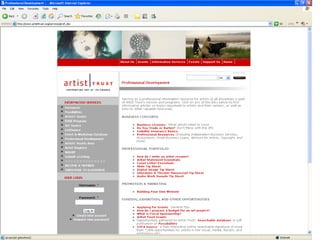
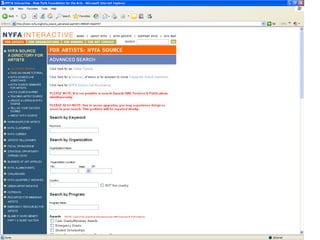
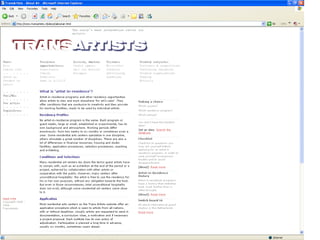
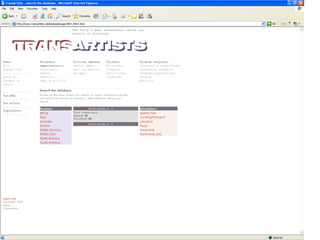
Information Services Possibilities Art Source   Artists’ Assets www.artisttrust.org (re)Source Artists’ Assets Area Professional Staff EDGE Program Workshops
 
Artist Trust Grant Programs Grants for Artist Projects (GAP) Program  GAP or  G rants for  A rtist  P rojects provides support for INDIVIDUAL artist's projects All artistic disciplines may apply each year Maximum amount of support is $1,500 In 2008, 80 artists received GAP grants from a pool of 975 applicants Applications available in December each year Deadline: Last Friday of February each year
Artist Trust Grant Programs Artist Trust/Washington State Arts Commission  Fellowship Program  Merit Award, based on artistic excellence 21 - $7,500 Awards given each year Applications available in April and due on June 12th.  400-500 applications per year. Biennial, discipline specific: Odd numbered years (2009) - Craft, Music, Media, and Literature. Even numbered years (2008) – Emerging Fields & Cross-Disciplinary Arts, Performing Arts, Traditional & Folk Arts, and Visual Arts
Artist Trust Grant Programs Twining Humber Award  for Lifetime Artistic Achievement  Lifetime achievement award for a Washington State female visual artist, age 60 or over, who has dedicated 25 or more years of her life to creating art  Nomination process One $10,000 award given each year Nomination forms available in November each year Deadline: January of each year
Additional  Artist Trust Projects EDGE Expansion into different disciplines  Residency Programs WAHIP (Washington Artists Health Insurance Project) Community Matching Grants Workshops Learn more at: www.artisttrust.org
Sign in please
How to Build a  Strong Grant Application
THE BASICS Make sure you meet the eligibility requirements. How to Build a  Strong Grant Application
GAP ELIGIBILITY  –  APPLICANTS MUST BE: 18 years of age or older A Washington state resident at the time of application and when the award is granted Cannot be a matriculating student enrolled in ANY kind of degree program 2009 applicants can’t be the recipient of a 2007 or 2008 GAP grant NOTE:  You can only submit one application per award each year
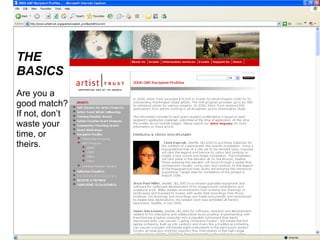
THE  BASICS Are you a good match? If not, don’t waste your time, or theirs.
THE BASICS Read all guidelines and instructions carefully before you begin.  Please follow all the directions on the application. If you have any questions, call the funding organization. Make a checklist of all required components requested and give yourself plenty of time to put them together.  Proof read everything and ask a friend to proof read it too. How to Build a  Strong Grant Application
GAP -  SELECTION CRITERIA The  foremost criterion  the selection panel uses to evaluate a GAP application is the  artistic excellence  of the work represented in the support materials. You could say 75% of the decision is based on your  work sample. The  second criterion  is the Selection Panel's  subjective   response to your project  in comparison to other projects submitted. The third and  final criterion  is the reasonable  likelihood that the project can be realized with GAP support , based on your budget and other sources of support.
THE BASICS Review and understand the selection criteria.  Send ONLY what is asked for. Send everything that is asked for. Application vs. portfolio How to Build a  Strong Grant Application
Common Components of an Application or Proposal
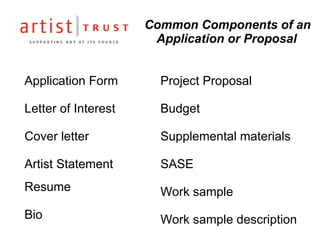
Common Components of an Application or Proposal Application Form Letter of Interest Cover letter Artist Statement   Resume Bio Project Proposal Budget Supplemental materials SASE Work sample Work sample description
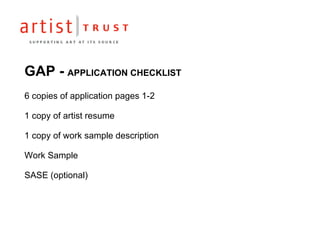
GAP -   APPLICATION CHECKLIST  6 copies of application pages 1-2  1 copy of artist resume 1 copy of work sample description Work Sample SASE (optional)
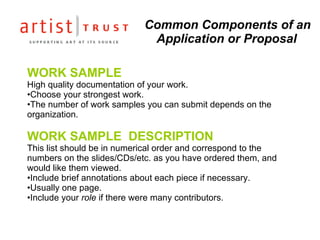
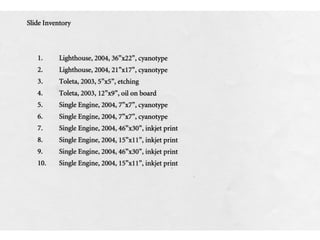
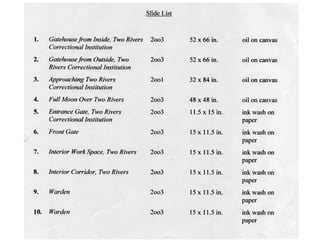
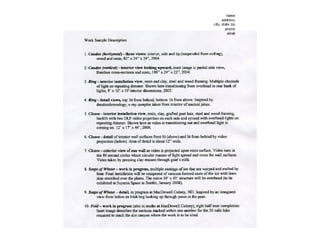
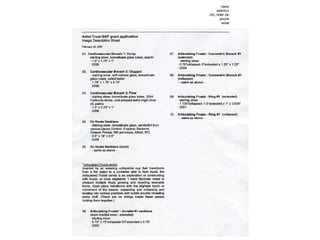
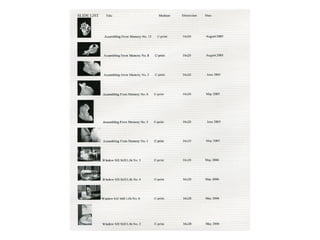
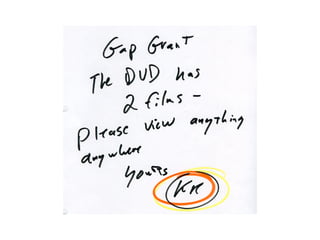
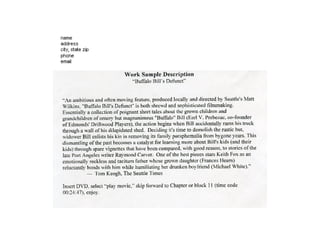
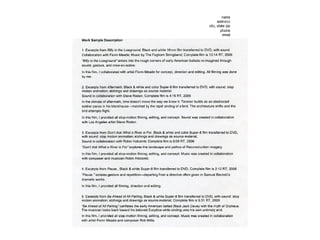
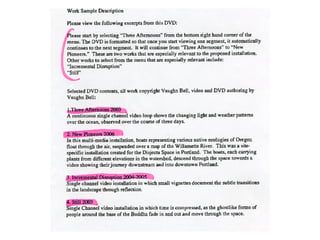
Common Components of an Application or Proposal WORK SAMPLE  High quality documentation of your work.  Choose your strongest work. The number of work samples you can submit depends on the organization. WORK SAMPLE  DESCRIPTION This list should be in numerical order and correspond to the numbers on the slides/CDs/etc. as you have ordered them, and would like them viewed.  Include brief annotations about each piece if necessary. Usually one page. Include your  role  if there were many contributors.
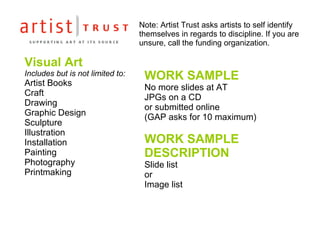
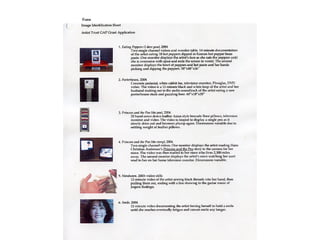
Visual Art Includes but is not limited to: Artist Books Craft Drawing Graphic Design  Sculpture Illustration Installation Painting Photography Printmaking WORK SAMPLE No more slides at AT JPGs on a CD  or submitted online (GAP asks for 10 maximum) WORK SAMPLE  DESCRIPTION Slide list  or  Image list Note: Artist Trust asks artists to self identify themselves in regards to discipline. If you are unsure, call the funding organization.


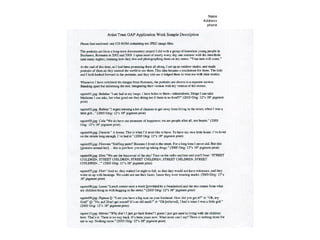
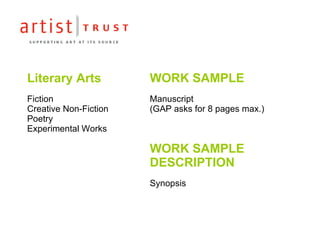
Literary Arts Fiction Creative Non-Fiction Poetry Experimental Works WORK SAMPLE Manuscript  (GAP asks for 8 pages max.) WORK SAMPLE  DESCRIPTION Synopsis
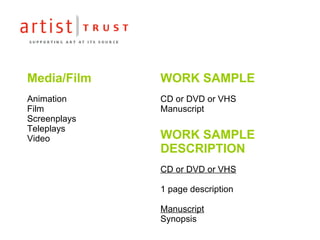
Media/Film Animation Film  Screenplays Teleplays Video WORK SAMPLE CD or DVD or VHS  Manuscript  WORK SAMPLE  DESCRIPTION CD or DVD or VHS   1 page description Manuscript Synopsis


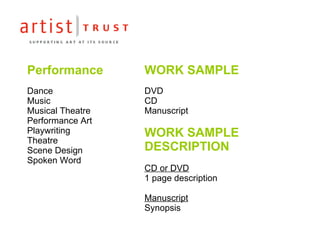
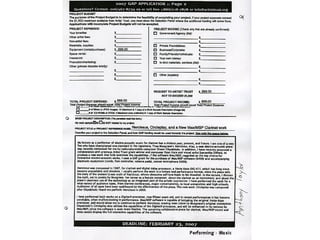
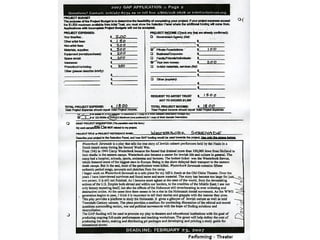
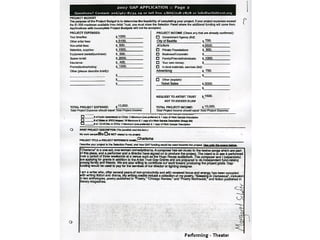
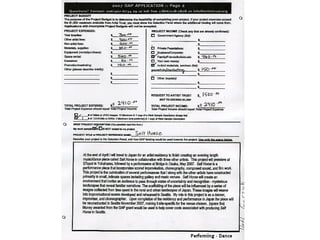
Performance Dance  Music Musical Theatre Performance Art Playwriting Theatre Scene Design Spoken Word WORK SAMPLE DVD  CD Manuscript WORK SAMPLE  DESCRIPTION CD or DVD 1 page description Manuscript Synopsis
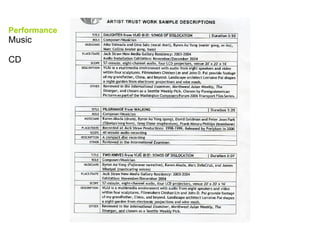
Performance Music CD
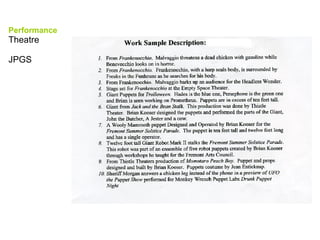
Performance Theatre JPGS
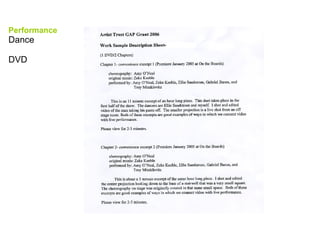
Performance Dance DVD
A PROJECT may be cross-disciplinary, but the applicant might not be - apply under the category which best describes YOUR work Emerging Fields Cross-Disciplinary Arts Graphic Novels Interactive Installation & Sculpture Environmental Design Immersive Audio & Video Works Sound Art Digital Arts Cross-Disciplinary -  artists who use two  or more artist disciplines in their art practice.
 
 
SELECTION PROCESS The Artist Trust program staff selects the panelists The staff in choosing the Selection Panel is looking  for diversity across the board. This includes stylistic  diversity, and diversity in location and media The Selection Panel is comprised of a group of artists and arts professionals The Selection Panel evaluates the applications and selects which artists' projects will receive GAP support The GAP Selection Panels are facilitated by Artist Trust program staff Grants for Artist Projects (GAP) Program
Common Components of an Application or Proposal PROJECT PROPOSAL Be clear and concise; concentrate on explaining the most important aspects of your project. Assume the person reading the application is unfamiliar with your work.  What do you usually say to introduce your work to the individuals that you meet? Explain in a sentence or two what is unique and exciting about your project.  Focus on answering the six basic questions in your project proposal:  who, what, when, why, where, and how.
GAP  -  ARTIST PROJECTS Development, completion or presentation of new work; publication; travel for artistic research or to present or complete work; documentation of work; advanced workshops for professional development; equipment, etc. Your project does not have to take place in Washington, YOU just have to be a Washington state resident We do not fund projects that are already finished at the time the application is due. But, if your project will be completed before the grants are awarded in June that is OK.
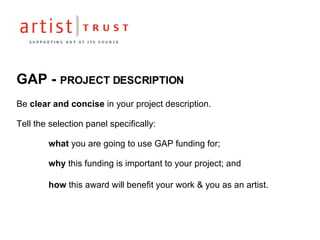
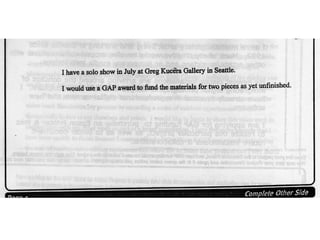
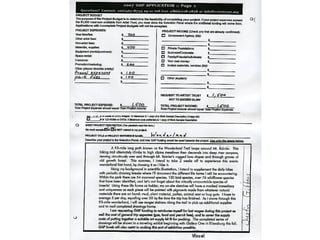
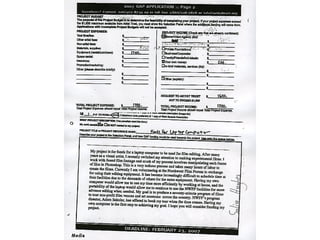
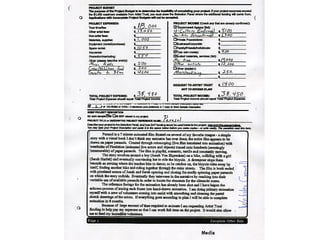
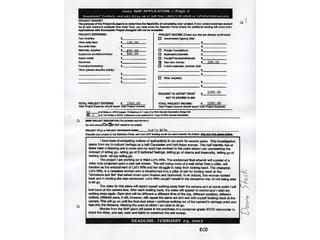
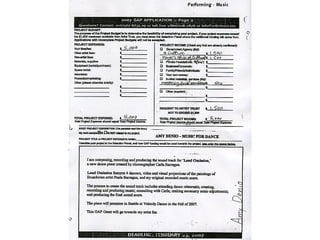
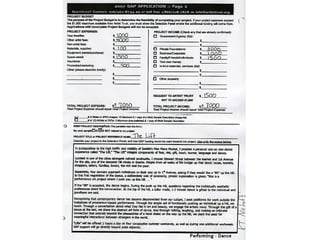
GAP -  PROJECT DESCRIPTION Be  clear and concise  in your project description.  Tell the selection panel specifically:  what  you are going to use GAP funding for;  why  this funding is important to your project; and  how  this award will benefit your work & you as an artist.
 
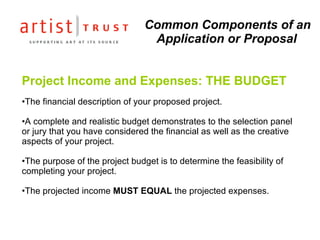
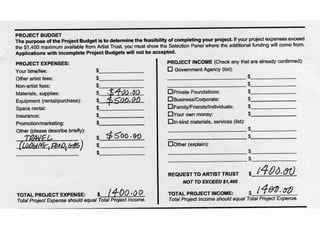
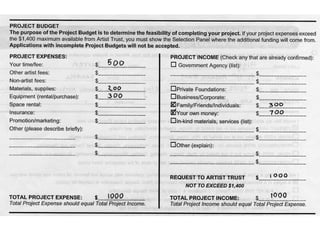
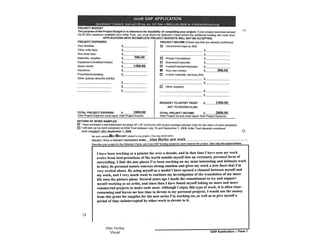
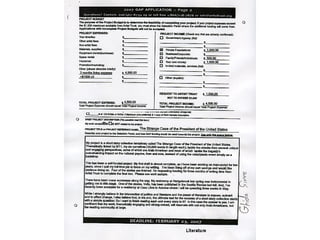
Common Components of an Application or Proposal Project Income and Expenses: THE BUDGET The financial description of your proposed project.   A complete and realistic budget demonstrates to the selection panel or jury that you have considered the financial as well as the creative aspects of your project. The purpose of the project budget is to determine the feasibility of completing your project. The projected income  MUST EQUAL  the projected expenses.


Common Components of an Application or Proposal LETTER OF INTEREST Initial contact.  Shorter than a full proposal, so not to waste your time and theirs, if the two of you are not a match.  Usually 1-2 pages in length.  Introduces yourself and your artwork, brief project description, brief budget overview.  Concentrate on “OVERVIEW”.
Common Components of an Application or Proposal COVER LETTER Should be brief and to the point.  Don’t repeat much of the same information that the reader will learn in your resume, artist statement, work samples, or other things submitted in your packet.  The cover letter is speaking for you the artist .
Common Components of an Application or Proposal ARTIST STATEMENT   Should be specific to the application or to the work samples submitted.  Provides insight into your work by helping to clarify the focus or concept.  There is no formula for an artist statement, but it might include information about how the work developed (its source and direction), the underlying idea and structure, the conceptual aspects, your philosophies, and/or possible influences.  Usually 1 paragraph - 1 page in length.  The artist statement is speaking for your artwork.
Common Components of an Application or Proposal ARTIST RESUME An artist resume summarizes your professional art activities and accomplishments.  Should include: your name and contact information; Exhibitions/Performances; Education; Honors and Awards/Grants; Collections; Bibliography; Professional affiliations; Residencies; related experience, etc.
ARTIST RESUME Components of a resume: Contact Exhibitions Awards Education Collections Bibliography Affiliations Related work experience Grants for Artist Projects (GAP) Program
Common Components of an Application or Proposal BIO A narrative bio is useful if you are an emerging artist and don’t have a great deal to include on a resume, so you would send a bio instead of a resume.   It’s also useful if your work corresponds directly to your biography. You can use this as a vehicle for discussing this relationship instead of your artist statement.
Common Components of an Application or Proposal SUPPLEMENTAL MATERIALS Letters of reference, letters of support. Proof of residence.   Articles written about your work, from the newspaper, a magazine,    journal, or in an exhibition publication. Postcards, programs, catalogs from an exhibition/performance. Digital reproductions of your artwork. Etc.
Common Components of an Application or Proposal SASE Self Addressed Stamped Envelope Include only if you would like your work sample returned to you. Stamps only, no metered postage. Make sure you have  correct  postage. Include padding/cardboard to protect your slides, CDs, DVDs, VHS, etc.
SELECTION PROCESS The Artist Trust program staff selects the panelists The staff in choosing the Selection Panel is looking  for diversity across the board. This includes stylistic  diversity, and diversity in location and media The Selection Panel is comprised of artists and arts professionals The Selection Panel evaluates the applications and selects which artists' projects will receive GAP support The GAP Selection Panels are facilitated by Artist Trust program staff Grants for Artist Projects (GAP) Program
That being said… Artist Trust has recently decided to move towards an online application system for the next round of Grants for Artists Projects. We will not accept paper applications: All of the same suggestions as before but remember: - Be prepared  - Call the granting organization in advance to answer any questions - Submit your application during the granting organization’s business hours Online Applications
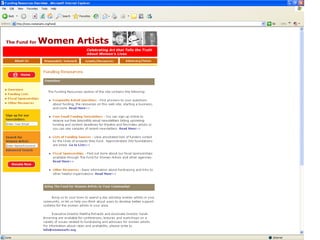
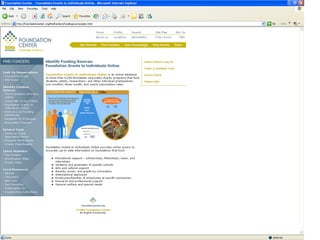
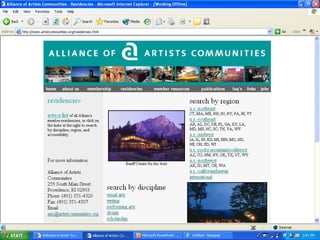
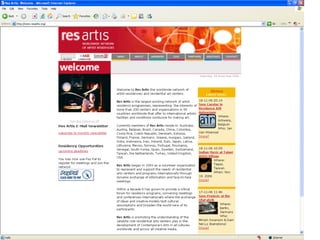
FUNDING RESOURCES


Questions?
Monica Miller  Director of Programs 206/467-8734 x10 [email_address]

Strong Grant Writing Workshop

  • 1.
    Grantwriting for Artists How to Build a Strong Grant Application
  • 2.
    Monica Miller Director of Programs 206/467-8734 x10 [email_address]
  • 3.
  • 4.
    Cell Phones PresentationMaterials Questions Reduce, Reuse, Recycle
  • 5.
    This Workshop willcover: Overview of Artist Trust Common Components of an Application or Proposal Example Project Descriptions & Budgets Example Work Samples Overview of Grants for Artist Projects (GAP) Funding Resources
  • 6.
    Overview of ArtistTrust Artist Trust is a not-for-profit organization whose sole mission is to support and encourage individual artists working in all disciplines in order to enrich community life throughout Washington State. Artist Trust is funded through an array of sources, including: members, donors, government, foundations, corporations and our annual art auction.
  • 7.
    Information Services PossibilitiesArt Source Artists’ Assets www.artisttrust.org (re)Source Artists’ Assets Area Professional Staff EDGE Program Workshops
  • 8.
  • 9.
    Artist Trust GrantPrograms Grants for Artist Projects (GAP) Program GAP or G rants for A rtist P rojects provides support for INDIVIDUAL artist's projects All artistic disciplines may apply each year Maximum amount of support is $1,500 In 2008, 80 artists received GAP grants from a pool of 975 applicants Applications available in December each year Deadline: Last Friday of February each year
  • 10.
    Artist Trust GrantPrograms Artist Trust/Washington State Arts Commission Fellowship Program Merit Award, based on artistic excellence 21 - $7,500 Awards given each year Applications available in April and due on June 12th. 400-500 applications per year. Biennial, discipline specific: Odd numbered years (2009) - Craft, Music, Media, and Literature. Even numbered years (2008) – Emerging Fields & Cross-Disciplinary Arts, Performing Arts, Traditional & Folk Arts, and Visual Arts
  • 11.
    Artist Trust GrantPrograms Twining Humber Award for Lifetime Artistic Achievement Lifetime achievement award for a Washington State female visual artist, age 60 or over, who has dedicated 25 or more years of her life to creating art Nomination process One $10,000 award given each year Nomination forms available in November each year Deadline: January of each year
  • 12.
    Additional ArtistTrust Projects EDGE Expansion into different disciplines Residency Programs WAHIP (Washington Artists Health Insurance Project) Community Matching Grants Workshops Learn more at: www.artisttrust.org
  • 13.
  • 14.
    How to Builda Strong Grant Application
  • 15.
    THE BASICS Makesure you meet the eligibility requirements. How to Build a Strong Grant Application
  • 16.
    GAP ELIGIBILITY – APPLICANTS MUST BE: 18 years of age or older A Washington state resident at the time of application and when the award is granted Cannot be a matriculating student enrolled in ANY kind of degree program 2009 applicants can’t be the recipient of a 2007 or 2008 GAP grant NOTE: You can only submit one application per award each year
  • 17.
    THE BASICSAre you a good match? If not, don’t waste your time, or theirs.
  • 18.
    THE BASICS Readall guidelines and instructions carefully before you begin. Please follow all the directions on the application. If you have any questions, call the funding organization. Make a checklist of all required components requested and give yourself plenty of time to put them together. Proof read everything and ask a friend to proof read it too. How to Build a Strong Grant Application
  • 19.
    GAP - SELECTION CRITERIA The foremost criterion the selection panel uses to evaluate a GAP application is the artistic excellence of the work represented in the support materials. You could say 75% of the decision is based on your work sample. The second criterion is the Selection Panel's subjective response to your project in comparison to other projects submitted. The third and final criterion is the reasonable likelihood that the project can be realized with GAP support , based on your budget and other sources of support.
  • 20.
    THE BASICS Reviewand understand the selection criteria. Send ONLY what is asked for. Send everything that is asked for. Application vs. portfolio How to Build a Strong Grant Application
  • 21.
    Common Components ofan Application or Proposal
  • 22.
    Common Components ofan Application or Proposal Application Form Letter of Interest Cover letter Artist Statement Resume Bio Project Proposal Budget Supplemental materials SASE Work sample Work sample description
  • 23.
    GAP - APPLICATION CHECKLIST 6 copies of application pages 1-2 1 copy of artist resume 1 copy of work sample description Work Sample SASE (optional)
  • 24.
    Common Components ofan Application or Proposal WORK SAMPLE High quality documentation of your work. Choose your strongest work. The number of work samples you can submit depends on the organization. WORK SAMPLE DESCRIPTION This list should be in numerical order and correspond to the numbers on the slides/CDs/etc. as you have ordered them, and would like them viewed. Include brief annotations about each piece if necessary. Usually one page. Include your role if there were many contributors.
  • 25.
    Visual Art Includesbut is not limited to: Artist Books Craft Drawing Graphic Design Sculpture Illustration Installation Painting Photography Printmaking WORK SAMPLE No more slides at AT JPGs on a CD or submitted online (GAP asks for 10 maximum) WORK SAMPLE DESCRIPTION Slide list or Image list Note: Artist Trust asks artists to self identify themselves in regards to discipline. If you are unsure, call the funding organization.
  • 26.
  • 27.
  • 28.
  • 29.
  • 30.
  • 31.
  • 32.
    Literary Arts FictionCreative Non-Fiction Poetry Experimental Works WORK SAMPLE Manuscript (GAP asks for 8 pages max.) WORK SAMPLE DESCRIPTION Synopsis
  • 33.
    Media/Film Animation Film Screenplays Teleplays Video WORK SAMPLE CD or DVD or VHS Manuscript WORK SAMPLE DESCRIPTION CD or DVD or VHS 1 page description Manuscript Synopsis
  • 34.
  • 35.
  • 36.
  • 37.
    Performance Dance Music Musical Theatre Performance Art Playwriting Theatre Scene Design Spoken Word WORK SAMPLE DVD CD Manuscript WORK SAMPLE DESCRIPTION CD or DVD 1 page description Manuscript Synopsis
  • 38.
  • 39.
  • 40.
  • 41.
    A PROJECT maybe cross-disciplinary, but the applicant might not be - apply under the category which best describes YOUR work Emerging Fields Cross-Disciplinary Arts Graphic Novels Interactive Installation & Sculpture Environmental Design Immersive Audio & Video Works Sound Art Digital Arts Cross-Disciplinary - artists who use two or more artist disciplines in their art practice.
  • 42.
  • 43.
  • 44.
    SELECTION PROCESS TheArtist Trust program staff selects the panelists The staff in choosing the Selection Panel is looking for diversity across the board. This includes stylistic diversity, and diversity in location and media The Selection Panel is comprised of a group of artists and arts professionals The Selection Panel evaluates the applications and selects which artists' projects will receive GAP support The GAP Selection Panels are facilitated by Artist Trust program staff Grants for Artist Projects (GAP) Program
  • 45.
    Common Components ofan Application or Proposal PROJECT PROPOSAL Be clear and concise; concentrate on explaining the most important aspects of your project. Assume the person reading the application is unfamiliar with your work. What do you usually say to introduce your work to the individuals that you meet? Explain in a sentence or two what is unique and exciting about your project. Focus on answering the six basic questions in your project proposal: who, what, when, why, where, and how.
  • 46.
    GAP - ARTIST PROJECTS Development, completion or presentation of new work; publication; travel for artistic research or to present or complete work; documentation of work; advanced workshops for professional development; equipment, etc. Your project does not have to take place in Washington, YOU just have to be a Washington state resident We do not fund projects that are already finished at the time the application is due. But, if your project will be completed before the grants are awarded in June that is OK.
  • 47.
    GAP - PROJECT DESCRIPTION Be clear and concise in your project description. Tell the selection panel specifically: what you are going to use GAP funding for; why this funding is important to your project; and how this award will benefit your work & you as an artist.
  • 48.
  • 49.
    Common Components ofan Application or Proposal Project Income and Expenses: THE BUDGET The financial description of your proposed project. A complete and realistic budget demonstrates to the selection panel or jury that you have considered the financial as well as the creative aspects of your project. The purpose of the project budget is to determine the feasibility of completing your project. The projected income MUST EQUAL the projected expenses.
  • 50.
  • 51.
  • 52.
  • 53.
  • 54.
  • 55.
  • 56.
  • 57.
  • 58.
  • 59.
  • 60.
  • 61.
  • 62.
  • 63.
  • 64.
    Common Components ofan Application or Proposal LETTER OF INTEREST Initial contact. Shorter than a full proposal, so not to waste your time and theirs, if the two of you are not a match. Usually 1-2 pages in length. Introduces yourself and your artwork, brief project description, brief budget overview. Concentrate on “OVERVIEW”.
  • 65.
    Common Components ofan Application or Proposal COVER LETTER Should be brief and to the point. Don’t repeat much of the same information that the reader will learn in your resume, artist statement, work samples, or other things submitted in your packet. The cover letter is speaking for you the artist .
  • 66.
    Common Components ofan Application or Proposal ARTIST STATEMENT Should be specific to the application or to the work samples submitted. Provides insight into your work by helping to clarify the focus or concept. There is no formula for an artist statement, but it might include information about how the work developed (its source and direction), the underlying idea and structure, the conceptual aspects, your philosophies, and/or possible influences. Usually 1 paragraph - 1 page in length. The artist statement is speaking for your artwork.
  • 67.
    Common Components ofan Application or Proposal ARTIST RESUME An artist resume summarizes your professional art activities and accomplishments. Should include: your name and contact information; Exhibitions/Performances; Education; Honors and Awards/Grants; Collections; Bibliography; Professional affiliations; Residencies; related experience, etc.
  • 68.
    ARTIST RESUME Componentsof a resume: Contact Exhibitions Awards Education Collections Bibliography Affiliations Related work experience Grants for Artist Projects (GAP) Program
  • 69.
    Common Components ofan Application or Proposal BIO A narrative bio is useful if you are an emerging artist and don’t have a great deal to include on a resume, so you would send a bio instead of a resume. It’s also useful if your work corresponds directly to your biography. You can use this as a vehicle for discussing this relationship instead of your artist statement.
  • 70.
    Common Components ofan Application or Proposal SUPPLEMENTAL MATERIALS Letters of reference, letters of support. Proof of residence. Articles written about your work, from the newspaper, a magazine, journal, or in an exhibition publication. Postcards, programs, catalogs from an exhibition/performance. Digital reproductions of your artwork. Etc.
  • 71.
    Common Components ofan Application or Proposal SASE Self Addressed Stamped Envelope Include only if you would like your work sample returned to you. Stamps only, no metered postage. Make sure you have correct postage. Include padding/cardboard to protect your slides, CDs, DVDs, VHS, etc.
  • 72.
    SELECTION PROCESS TheArtist Trust program staff selects the panelists The staff in choosing the Selection Panel is looking for diversity across the board. This includes stylistic diversity, and diversity in location and media The Selection Panel is comprised of artists and arts professionals The Selection Panel evaluates the applications and selects which artists' projects will receive GAP support The GAP Selection Panels are facilitated by Artist Trust program staff Grants for Artist Projects (GAP) Program
  • 73.
    That being said…Artist Trust has recently decided to move towards an online application system for the next round of Grants for Artists Projects. We will not accept paper applications: All of the same suggestions as before but remember: - Be prepared - Call the granting organization in advance to answer any questions - Submit your application during the granting organization’s business hours Online Applications
  • 74.
  • 75.
  • 76.
  • 77.
  • 78.
  • 79.
  • 80.
  • 81.
  • 82.
  • 83.
  • 84.
  • 85.
  • 86.
    Monica Miller Director of Programs 206/467-8734 x10 [email_address]