By
David Sylvester
   Pre-Grant Writing check list
    ◦ Meet all of the grants requirements
    ◦ Summary statement
      Brief paragraph
        Who you are, what your project is, money needed
    ◦ Create an outline
      Describe each point of your proposal
        Expand on each point as needed
    ◦ Go back and make sure that the grant funder
      matches the funds you need
      Re-check the requirements
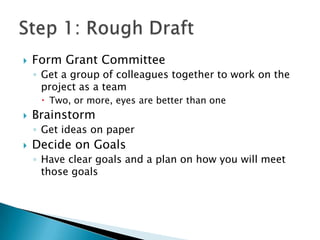
   Form Grant Committee
    ◦ Get a group of colleagues together to work on the
      project as a team
      Two, or more, eyes are better than one
   Brainstorm
    ◦ Get ideas on paper
   Decide on Goals
    ◦ Have clear goals and a plan on how you will meet
      those goals
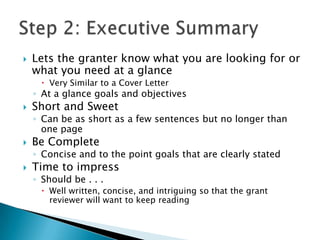
   Lets the granter know what you are looking for or
    what you need at a glance
       Very Similar to a Cover Letter
    ◦ At a glance goals and objectives
   Short and Sweet
    ◦ Can be as short as a few sentences but no longer than
      one page
   Be Complete
    ◦ Concise and to the point goals that are clearly stated
   Time to impress
    ◦ Should be . . .
       Well written, concise, and intriguing so that the grant
        reviewer will want to keep reading
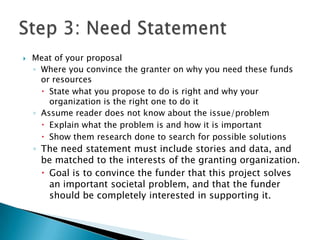
   Meat of your proposal
    ◦ Where you convince the granter on why you need these funds
      or resources
       State what you propose to do is right and why your
        organization is the right one to do it
    ◦ Assume reader does not know about the issue/problem
       Explain what the problem is and how it is important
       Show them research done to search for possible solutions
    ◦ The need statement must include stories and data, and
      be matched to the interests of the granting organization.
       Goal is to convince the funder that this project solves
        an important societal problem, and that the funder
        should be completely interested in supporting it.
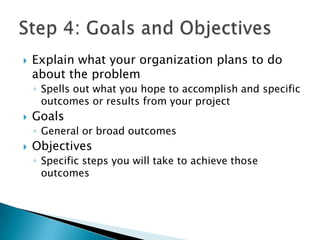
   Explain what your organization plans to do
    about the problem
    ◦ Spells out what you hope to accomplish and specific
      outcomes or results from your project
   Goals
    ◦ General or broad outcomes
   Objectives
    ◦ Specific steps you will take to achieve those
      outcomes
   Section where you will walk the grantor by the
    hand through EXACTLY HOW you will the
    goals and objectives from the previous slide
    ◦ This section must be very detailed and go into every
      aspect and step of the project’s process until
      completion
      Include a timeline along with a who will do what when
      Provide Logic Model
        Simple Chart of the key elements of the project
            Inputs-What is needed to complete the project
            Outputs-What will be produced
            Outcomes-What will be gained
            Impacts-How it will effect the community at large
   Funder’s want to know that their money is
    going to actually do something so one must
    decide in the grant writing process how they
    will evaluate the impact of their project.
    ◦ Include what records you will keep or data you will
      collect and how you will use that data
      If this process costs money make sure to include that
       cost in your budget
        Many organizations hire outside firms to do this data
         collection
   Most funders do not like to be the only
    source of funds so. . .
    ◦ Show the grantor that you have committed funds
      from other sources
    ◦ Also show the in kind contributions you expect
      Like, a meeting space or any equipment
      Any and all sources you may have gotten funds from
        Like
            Fundraisers
            Other Grantors
            Private investors
            Etc.
   A few paragraphs explaining your organization
    ◦ Explain what your organization does
    ◦ Why it can be trusted to use the resources responsibly
      and effectively
   History of your organization
    ◦   State its mission
    ◦   The population it serves
    ◦   Provide overview of past projects and accomplishments
    ◦   Describe/list other programs
   Be Complete and describe everything about
    yourself
   How much will the project cost as a whole
    ◦ Explains the money your organization will need and
      how it is going to be used to the grantor
      Needs to include expected expenses and income
       expenses
        Expected expenses are. . .
          Personnel expenses
          Direct project expenses
          Administrative or overhead expenses
        Income Expenses are. . .
          Earned income
          Contributed income
   Where you show the grantor all of the
    additional work, research, and documentation
    that your organization is trust-worthy
    ◦ Need such things as
        IRS letter showing your organization is tax-exempt
        List of your board of directors and their affiliations
        Financial statement from your last fiscal year
        Budget for your current fiscal year
        Budget for your next fiscal year if it is upcoming
        Anything else that the grantor requires you to show or
         prove within the requirements
   This is the first thing that the grantor will see and
    read about your organization so make it
    professional but eye catching
    ◦ This is simply a brief summary and quick and concise
      needs statement on why your organization needs these
      funds
    ◦ Also is a brief and concise statement about your
      organization and what it has done and what it wants to
      do
   This is the thing that will grab the grantor and
    make them want to continue reading
   Should be completed last so you know exactly
    what you want and can state it in a paragraph or
    two
   The final process to writing a grant is putting it
    all together
    ◦ First the grant should be proof read and gone over so
      that there are no grammatical or analytical mistakes
      Need to make sure that you have provided and answered
       everything that is required for the grantor
    ◦ Next a Cover Letter and Cover sheet should be added
      with your organizations CEO’s signature on both
    ◦ Does not need to be placed into a fancy binder but
      should be held together as one piece in some form
    ◦ Make a copy of the grant for personal files
    ◦ Mail it to the grantor
   After mailing the grant application wait a little
    while and check in how the application is doing
    by contacting the grantor
    ◦ Ask if it was received and complete
   Keep the grantor informed
    ◦ Mail or contact the grantor if your organization has
      accomplished anything new or has been sited in a news
      article
   Be patient and wait
    ◦ The application process can take sometime so be patient
      and you will be notified if you have received the grant
   Good Luck!

How to write a grant application

  • 1.
  • 2.
    Pre-Grant Writing check list ◦ Meet all of the grants requirements ◦ Summary statement  Brief paragraph  Who you are, what your project is, money needed ◦ Create an outline  Describe each point of your proposal  Expand on each point as needed ◦ Go back and make sure that the grant funder matches the funds you need  Re-check the requirements
  • 4.
    Form Grant Committee ◦ Get a group of colleagues together to work on the project as a team  Two, or more, eyes are better than one  Brainstorm ◦ Get ideas on paper  Decide on Goals ◦ Have clear goals and a plan on how you will meet those goals
  • 5.
    Lets the granter know what you are looking for or what you need at a glance  Very Similar to a Cover Letter ◦ At a glance goals and objectives  Short and Sweet ◦ Can be as short as a few sentences but no longer than one page  Be Complete ◦ Concise and to the point goals that are clearly stated  Time to impress ◦ Should be . . .  Well written, concise, and intriguing so that the grant reviewer will want to keep reading
  • 6.
    Meat of your proposal ◦ Where you convince the granter on why you need these funds or resources  State what you propose to do is right and why your organization is the right one to do it ◦ Assume reader does not know about the issue/problem  Explain what the problem is and how it is important  Show them research done to search for possible solutions ◦ The need statement must include stories and data, and be matched to the interests of the granting organization.  Goal is to convince the funder that this project solves an important societal problem, and that the funder should be completely interested in supporting it.
  • 7.
    Explain what your organization plans to do about the problem ◦ Spells out what you hope to accomplish and specific outcomes or results from your project  Goals ◦ General or broad outcomes  Objectives ◦ Specific steps you will take to achieve those outcomes
  • 8.
    Section where you will walk the grantor by the hand through EXACTLY HOW you will the goals and objectives from the previous slide ◦ This section must be very detailed and go into every aspect and step of the project’s process until completion  Include a timeline along with a who will do what when  Provide Logic Model  Simple Chart of the key elements of the project  Inputs-What is needed to complete the project  Outputs-What will be produced  Outcomes-What will be gained  Impacts-How it will effect the community at large
  • 9.
    Funder’s want to know that their money is going to actually do something so one must decide in the grant writing process how they will evaluate the impact of their project. ◦ Include what records you will keep or data you will collect and how you will use that data  If this process costs money make sure to include that cost in your budget  Many organizations hire outside firms to do this data collection
  • 10.
    Most funders do not like to be the only source of funds so. . . ◦ Show the grantor that you have committed funds from other sources ◦ Also show the in kind contributions you expect  Like, a meeting space or any equipment  Any and all sources you may have gotten funds from  Like  Fundraisers  Other Grantors  Private investors  Etc.
  • 11.
    A few paragraphs explaining your organization ◦ Explain what your organization does ◦ Why it can be trusted to use the resources responsibly and effectively  History of your organization ◦ State its mission ◦ The population it serves ◦ Provide overview of past projects and accomplishments ◦ Describe/list other programs  Be Complete and describe everything about yourself
  • 12.
    How much will the project cost as a whole ◦ Explains the money your organization will need and how it is going to be used to the grantor  Needs to include expected expenses and income expenses  Expected expenses are. . .  Personnel expenses  Direct project expenses  Administrative or overhead expenses  Income Expenses are. . .  Earned income  Contributed income
  • 13.
    Where you show the grantor all of the additional work, research, and documentation that your organization is trust-worthy ◦ Need such things as  IRS letter showing your organization is tax-exempt  List of your board of directors and their affiliations  Financial statement from your last fiscal year  Budget for your current fiscal year  Budget for your next fiscal year if it is upcoming  Anything else that the grantor requires you to show or prove within the requirements
  • 14.
    This is the first thing that the grantor will see and read about your organization so make it professional but eye catching ◦ This is simply a brief summary and quick and concise needs statement on why your organization needs these funds ◦ Also is a brief and concise statement about your organization and what it has done and what it wants to do  This is the thing that will grab the grantor and make them want to continue reading  Should be completed last so you know exactly what you want and can state it in a paragraph or two
  • 15.
    The final process to writing a grant is putting it all together ◦ First the grant should be proof read and gone over so that there are no grammatical or analytical mistakes  Need to make sure that you have provided and answered everything that is required for the grantor ◦ Next a Cover Letter and Cover sheet should be added with your organizations CEO’s signature on both ◦ Does not need to be placed into a fancy binder but should be held together as one piece in some form ◦ Make a copy of the grant for personal files ◦ Mail it to the grantor
  • 16.
    After mailing the grant application wait a little while and check in how the application is doing by contacting the grantor ◦ Ask if it was received and complete  Keep the grantor informed ◦ Mail or contact the grantor if your organization has accomplished anything new or has been sited in a news article  Be patient and wait ◦ The application process can take sometime so be patient and you will be notified if you have received the grant  Good Luck!