Partner Service & Sales TrainingNonprofit Grant Development
Grant Funding OverviewI. Grant Funding Overview II. Proposal Outline & ContentsIII. Funder IdentificationIV. BizCentral USA Services & Processes
Grant WritingThe process of grant writing includes identifying a community need, matching that need to the mission of the funding source, communicating with the funding source regarding the need, implementing the funded project, and reporting back to the funder.
Identifying ProjectsWhat are the unmet needs in the community that the applicant agency is positioned to meet?
Once a project is identified, consider anticipated results.
If the project is implemented:
Who would do it?
Where would it be done?
Who would benefit from it?
What would the specific benefits be?Developing the IdeaDeveloping a proposal idea requires knowledge of the applicant agency and the funder. You must know both agencies’:MissionsBoard AffiliationsOrganizational and Administrative StructuresCurrent Services and ProjectsAnticipated Results
Grant Development OverviewIn the public and nonprofit sectors, foundation and government grant funding is a major source of operational revenue.Knowing the steps involved is essential for those working in an organization's development department.Eloquent writing skills-including exceptional spelling and grammar, and the ability to follow directions are essential.
Proposal Outline & ContentsI. Grant Funding Overview II. Proposal Outline & ContentsIII. Funder IdentificationIV. BizCentral USA Services & Processes
Grant ProposalsGrant proposals generally include versions of the following sections:Executive SummaryIntroduction (Organizational Background)Need Statement (Problem Statement)ObjectivesMethodologyEvaluation TechniquesSustainabilityBudget
Executive SummaryShould be the last section written, but comes first in the outline. Provides a basic overview of the proposal.States overall impact the funder will have on the community through the project.Must reflect the funder’s mission, interests, and values.Reiterates the qualifications of the agency to carry out the project.
IntroductionUsed to introduce the applicant agency to the funder.Clearly describes the experience and expertise of the applicant agency.“Shakes hands” with the funder.
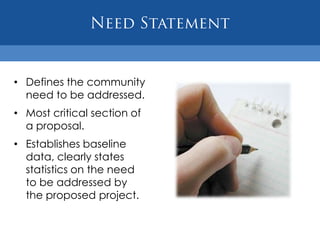
Need StatementDefines the community need to be addressed.Most critical section of a proposal.Establishes baseline data, clearly states statistics on the need to be addressed by the proposed project.
ObjectivesDefines clear goals and objectives.Should tie directly to the need statement.Should contain at least one goal and two objectives.Goal- Broad based statement of the ultimate expected result.Objective- Measurable, time-specific result expected of the project.
MethodologyUsually the longest section of the proposal.Lets funder know exactly what you will be doing with the funds requested for the project.Paints a detailed picture of the project in an easy to read narrative.Describes Who, What, When, Where, and How.
EvaluationProcess that determines the effectiveness and efficiency of the project.Ties directly with the objectives section.Describes who will be responsible for measuring the objective and determining whether it has been met or not.
SustainabilityA.K.A. Future fundingNo funding source wants to support your project forever.Should provide a specific plan for future funding of the project.Explains how the project will continue once the funding being requested runs out.
BudgetTranslates the methodology section of the proposal into dollars.Paints a picture of the project with numbers.Should place a dollar value to what has been described.Funder may request a specific budget forms.May be best to use a spreadsheet program.
Funder IdentificationI. Grant Funding Overview II. Proposal Outline & ContentsIII. Funder IdentificationIV. BizCentral USA Services & Processes
FundersJust as nonprofits have missions, so do funders.Foundations and corporate giving programs typically publish their funding missions. Funder missions can be located through:Annual ReportsWebsitesKey word searchesLicensing Agencies
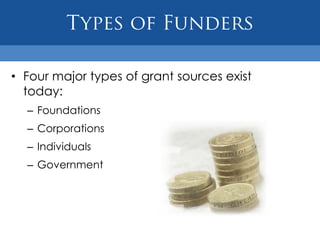
Types of FundersFour major types of grant sources exist today:FoundationsCorporationsIndividualsGovernment
FoundationsAll foundations are set up with a mission and bylaws that must be adhered to.Foundations have duties to be publicly accountable.There are more than 63,000 private and community foundations in the U.S. today.Total foundation giving exceeds $30 billion annually.
FoundationsThere are 3 types of foundations that may provide funding:Private (foundation/independent)Corporate or Company-sponsoredCommunity Foundations
Private FoundationsUsually set up by wealthy families or individualsAssets generally come from one source and are invested to earn incomeUsually set up to benefit a specific cause or causesThe bylaws stipulate the types of causes it will support and the types of agencies it will fund
Corporate FoundationsMust have the approval of its corporate board or shareholdersWill typically fund programs within their geographic service areaMost fund initiatives that will somehow be of benefit to their employeesMost like direct benefit to their surrounding community
Community FoundationsSet up within specific geographical locations.Make grant awards only within their geographical area.Awards are typically small, and not for multiple years.A community foundation usually accepts contributions from various sources, who advise on the use of the funding.
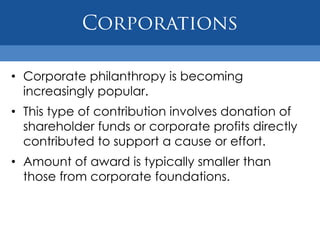
CorporationsCorporate philanthropy is becoming increasingly popular.This type of contribution involves donation of shareholder funds or corporate profits directly contributed to support a cause or effort.Amount of award is typically smaller than those from corporate foundations.
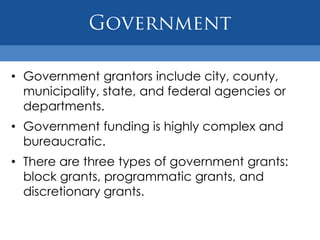
GovernmentGovernment grantors include city, county, municipality, state, and federal agencies or departments.Government funding is highly complex and bureaucratic.There are three types of government grants: block grants, programmatic grants, and discretionary grants.
Services & ProcessesI. Grant Funding Overview II. Proposal Outline & ContentsIII. Funder IdentificationIV. BizCentral USA Services & Processes

Partner Training: Grants & Funding

  • 1.
    Partner Service &Sales TrainingNonprofit Grant Development
  • 2.
    Grant Funding OverviewI.Grant Funding Overview II. Proposal Outline & ContentsIII. Funder IdentificationIV. BizCentral USA Services & Processes
  • 3.
    Grant WritingThe processof grant writing includes identifying a community need, matching that need to the mission of the funding source, communicating with the funding source regarding the need, implementing the funded project, and reporting back to the funder.
  • 4.
    Identifying ProjectsWhat arethe unmet needs in the community that the applicant agency is positioned to meet?
  • 5.
    Once a projectis identified, consider anticipated results.
  • 6.
    If the projectis implemented:
  • 7.
  • 8.
  • 9.
  • 10.
    What would thespecific benefits be?Developing the IdeaDeveloping a proposal idea requires knowledge of the applicant agency and the funder. You must know both agencies’:MissionsBoard AffiliationsOrganizational and Administrative StructuresCurrent Services and ProjectsAnticipated Results
  • 11.
    Grant Development OverviewInthe public and nonprofit sectors, foundation and government grant funding is a major source of operational revenue.Knowing the steps involved is essential for those working in an organization's development department.Eloquent writing skills-including exceptional spelling and grammar, and the ability to follow directions are essential.
  • 12.
    Proposal Outline &ContentsI. Grant Funding Overview II. Proposal Outline & ContentsIII. Funder IdentificationIV. BizCentral USA Services & Processes
  • 13.
    Grant ProposalsGrant proposalsgenerally include versions of the following sections:Executive SummaryIntroduction (Organizational Background)Need Statement (Problem Statement)ObjectivesMethodologyEvaluation TechniquesSustainabilityBudget
  • 14.
    Executive SummaryShould bethe last section written, but comes first in the outline. Provides a basic overview of the proposal.States overall impact the funder will have on the community through the project.Must reflect the funder’s mission, interests, and values.Reiterates the qualifications of the agency to carry out the project.
  • 15.
    IntroductionUsed to introducethe applicant agency to the funder.Clearly describes the experience and expertise of the applicant agency.“Shakes hands” with the funder.
  • 16.
    Need StatementDefines thecommunity need to be addressed.Most critical section of a proposal.Establishes baseline data, clearly states statistics on the need to be addressed by the proposed project.
  • 17.
    ObjectivesDefines clear goalsand objectives.Should tie directly to the need statement.Should contain at least one goal and two objectives.Goal- Broad based statement of the ultimate expected result.Objective- Measurable, time-specific result expected of the project.
  • 18.
    MethodologyUsually the longestsection of the proposal.Lets funder know exactly what you will be doing with the funds requested for the project.Paints a detailed picture of the project in an easy to read narrative.Describes Who, What, When, Where, and How.
  • 19.
    EvaluationProcess that determinesthe effectiveness and efficiency of the project.Ties directly with the objectives section.Describes who will be responsible for measuring the objective and determining whether it has been met or not.
  • 20.
    SustainabilityA.K.A. Future fundingNofunding source wants to support your project forever.Should provide a specific plan for future funding of the project.Explains how the project will continue once the funding being requested runs out.
  • 21.
    BudgetTranslates the methodologysection of the proposal into dollars.Paints a picture of the project with numbers.Should place a dollar value to what has been described.Funder may request a specific budget forms.May be best to use a spreadsheet program.
  • 22.
    Funder IdentificationI. GrantFunding Overview II. Proposal Outline & ContentsIII. Funder IdentificationIV. BizCentral USA Services & Processes
  • 23.
    FundersJust as nonprofitshave missions, so do funders.Foundations and corporate giving programs typically publish their funding missions. Funder missions can be located through:Annual ReportsWebsitesKey word searchesLicensing Agencies
  • 24.
    Types of FundersFourmajor types of grant sources exist today:FoundationsCorporationsIndividualsGovernment
  • 25.
    FoundationsAll foundations areset up with a mission and bylaws that must be adhered to.Foundations have duties to be publicly accountable.There are more than 63,000 private and community foundations in the U.S. today.Total foundation giving exceeds $30 billion annually.
  • 26.
    FoundationsThere are 3types of foundations that may provide funding:Private (foundation/independent)Corporate or Company-sponsoredCommunity Foundations
  • 27.
    Private FoundationsUsually setup by wealthy families or individualsAssets generally come from one source and are invested to earn incomeUsually set up to benefit a specific cause or causesThe bylaws stipulate the types of causes it will support and the types of agencies it will fund
  • 28.
    Corporate FoundationsMust havethe approval of its corporate board or shareholdersWill typically fund programs within their geographic service areaMost fund initiatives that will somehow be of benefit to their employeesMost like direct benefit to their surrounding community
  • 29.
    Community FoundationsSet upwithin specific geographical locations.Make grant awards only within their geographical area.Awards are typically small, and not for multiple years.A community foundation usually accepts contributions from various sources, who advise on the use of the funding.
  • 30.
    CorporationsCorporate philanthropy isbecoming increasingly popular.This type of contribution involves donation of shareholder funds or corporate profits directly contributed to support a cause or effort.Amount of award is typically smaller than those from corporate foundations.
  • 31.
    GovernmentGovernment grantors includecity, county, municipality, state, and federal agencies or departments.Government funding is highly complex and bureaucratic.There are three types of government grants: block grants, programmatic grants, and discretionary grants.
  • 32.
    Services & ProcessesI.Grant Funding Overview II. Proposal Outline & ContentsIII. Funder IdentificationIV. BizCentral USA Services & Processes