Lesson 1.1
The Big Bang Theory and the
Formation of Light Elements
Objective give evidence for and
explain the formation of the
light elements in the big
bang theory.
1
At the end of
the lesson,
you should
be able to:
Learn about It!
Cosmology is the body of science that studies the origin,
evolution and eventual fate of the universe
Cosmology
Learn about It!
Religious Cosmology
• Religious or mythological cosmology explains the origin
of universe and life based on religious beliefs of a specific
tradition
• The concept of creatio ex nihilo
• God creating the universe as written in the book of
Genesis
Cosmology
Learn about It!
Physical Cosmology
Physical cosmology explains the origin of universe based on
scientific insights, studies and experiments
• Nicolaus Copernicus and the heliocentric nature of the
universe
• The expanding universe through Albert Einstein’s theory of
relativity
• The big bang theory
Cosmology
Learn about It!
The big bang theory, a cosmological model that describes how
the universe started its expansion about 13.8 billion years ago,
states that the universe continues to move and expand
Big Bang Theory
Learn about It!
1. The universe began as a singularity or a point containing
all space, time, matter and energy
2. It expanded rapidly in nothingness through a rapid yet
peaceful process called inflation
3. The universe cooled down as it expanded
Big Bang Theory
Learn about It!
4. A soup of matter in the form of subatomic particles was
formed and nuclei of light atoms were created via
nucleosynthesis or nuclear fusion between protons and
neutrons
5. Electrons interacted with these nuclei to form actual,
primordial atoms via the process of recombination
Big Bang Theory
Learn about It!
Evidences
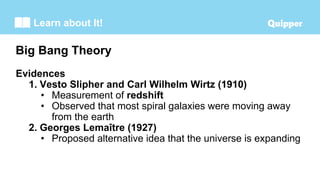
1. Vesto Slipher and Carl Wilhelm Wirtz (1910)
• Measurement of redshift
• Observed that most spiral galaxies were moving away
from the earth
2. Georges Lemaître (1927)
• Proposed alternative idea that the universe is expanding
Big Bang Theory
Learn about It!
Evidences
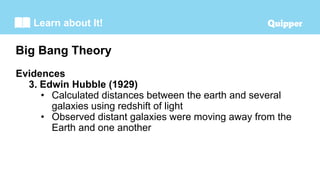
3. Edwin Hubble (1929)
• Calculated distances between the earth and several
galaxies using redshift of light
• Observed distant galaxies were moving away from the
Earth and one another
Big Bang Theory
Learn about It!
Evidences
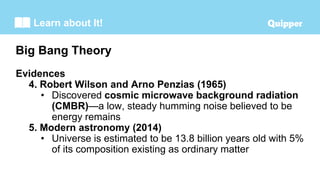
4. Robert Wilson and Arno Penzias (1965)
• Discovered cosmic microwave background radiation
(CMBR)—a low, steady humming noise believed to be
energy remains
5. Modern astronomy (2014)
• Universe is estimated to be 13.8 billion years old with 5%
of its composition existing as ordinary matter
Big Bang Theory
Learn about It!
Big Bang Nucleosynthesis
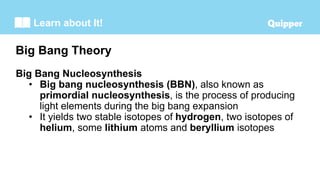
• Big bang nucleosynthesis (BBN), also known as
primordial nucleosynthesis, is the process of producing
light elements during the big bang expansion
• It yields two stable isotopes of hydrogen, two isotopes of
helium, some lithium atoms and beryllium isotopes
Big Bang Theory
Learn about It!
Big Bang Nucleosynthesis
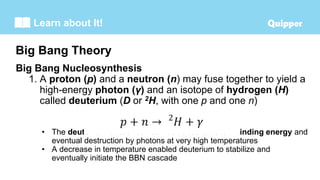
1. A proton (p) and a neutron (n) may fuse together to yield a
high-energy photon (γ) and an isotope of hydrogen (H)
called deuterium (D or 2H, with one p and one n)
• The deuterium bottleneck can be traced to its low binding energy and
eventual destruction by photons at very high temperatures
• A decrease in temperature enabled deuterium to stabilize and
eventually initiate the BBN cascade
Big Bang Theory
Learn about It!
Big Bang Nucleosynthesis
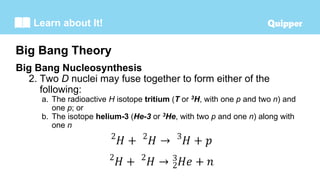
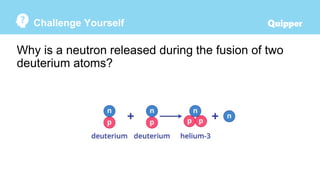
2. Two D nuclei may fuse together to form either of the
following:
a. The radioactive H isotope tritium (T or 3H, with one p and two n) and
one p; or
b. The isotope helium-3 (He-3 or 3He, with two p and one n) along with
one n
Big Bang Theory
Learn about It!
Big Bang Nucleosynthesis
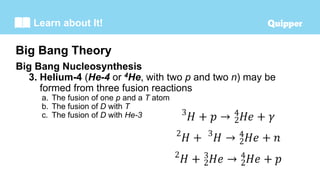
3. Helium-4 (He-4 or 4He, with two p and two n) may be
formed from three fusion reactions
a. The fusion of one p and a T atom
b. The fusion of D with T
c. The fusion of D with He-3
Big Bang Theory
Learn about It!
Big Bang Nucleosynthesis
• He-4 has a binding energy of 28 MeV, and further fusion
products were a rarity since these resulting atoms had binding
energies lower than this aforementioned amount
Big Bang Theory
Learn about It!
Big Bang Nucleosynthesis
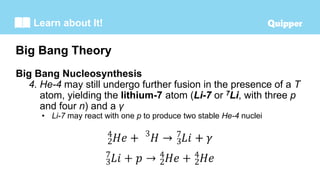
4. He-4 may still undergo further fusion in the presence of a T
atom, yielding the lithium-7 atom (Li-7 or 7Li, with three p
and four n) and a γ
• Li-7 may react with one p to produce two stable He-4 nuclei
Big Bang Theory
Learn about It!
Big Bang Nucleosynthesis
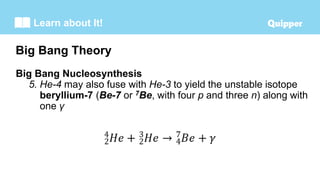
5. He-4 may also fuse with He-3 to yield the unstable isotope
beryllium-7 (Be-7 or 7Be, with four p and three n) along with
one γ
Big Bang Theory
Learn about It!
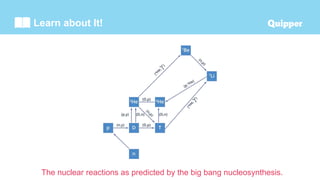
The nuclear reactions as predicted by the big bang nucleosynthesis.
Learn about It!
• The correlation between predicted and observed cosmic
abundances of H and He was the major proof of the big
bang theory
• Almost all available neutrons have combined with protons, forming 24%
He-4 by mass
• About 74% H by mass remained uncombined
Big Bang Theory
Learn about It!
• To verify these observations, scientists measured
abundances of primordial material in unprocessed gas in
some parts of the universe with no stars as well as in parts
of meteorites known as chondrites that commonly fall to
Earth
Big Bang Theory
Key Points
The big bang theory is a cosmological model that
describes how the universe started its expansion about
13.8 billion years ago.
1
Big bang nucleosynthesis is the process of producing
light elements during the big bang expansion.
2
The correlation between the predicted and observed
cosmic abundances of hydrogen and helium was the
major proof of the big bang theory.
3
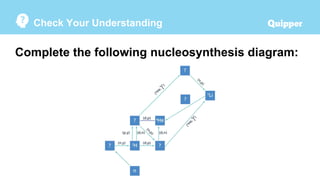
Check Your Understanding
Complete the following nucleosynthesis diagram:
Challenge Yourself
Why is a neutron released during the fusion of two
deuterium atoms?
Bibliography
Clayton, D.D. 1968. Principles of Stellar Evolution and Nucleosynthesis. Chicago, USA: University of Chicago
Press.
Constan, Z. “Learn Nuclear Science with Marbles.” National Science Foundation 2017. Accessed July 13,
2018. http://www.jinaweb.org/outreach/marble/Marble%20Nuclei%20Project%20-
%20Activities%20Student%20Worksheet.pdf
Langer, N. “Nucleosynthesis.” Bonn University SS 2012. Accessed December 8, 2016. https:// astro.uni-
bonn.de/~nlanger/siu_web/nucscript/Nucleo.pdf
National Aeronautics and Space Administration. “The Big Bang.” Accessed December 8, 2016.
http://science.nasa.gov/astrophysics/focus-areas/what-powered-the-big-bang/
National Geographic. “Origins of the Universe—An Expanding World.” Accessed December 8, 2016.
http://science.nationalgeographic.com/science/space/universe/origins-universe-article/
Bibliography
Overton, Tina, et al. 2010. Shriver and Atkins’ Inorganic Chemistry. 5th ed. London: Oxford University Press.

1.1-The-Big-Bang-Theory-and-the-Formation-of-Light-Elements.pptx

  • 1.
    Lesson 1.1 The BigBang Theory and the Formation of Light Elements
  • 2.
    Objective give evidencefor and explain the formation of the light elements in the big bang theory. 1 At the end of the lesson, you should be able to:
  • 3.
    Learn about It! Cosmologyis the body of science that studies the origin, evolution and eventual fate of the universe Cosmology
  • 4.
    Learn about It! ReligiousCosmology • Religious or mythological cosmology explains the origin of universe and life based on religious beliefs of a specific tradition • The concept of creatio ex nihilo • God creating the universe as written in the book of Genesis Cosmology
  • 5.
    Learn about It! PhysicalCosmology Physical cosmology explains the origin of universe based on scientific insights, studies and experiments • Nicolaus Copernicus and the heliocentric nature of the universe • The expanding universe through Albert Einstein’s theory of relativity • The big bang theory Cosmology
  • 6.
    Learn about It! Thebig bang theory, a cosmological model that describes how the universe started its expansion about 13.8 billion years ago, states that the universe continues to move and expand Big Bang Theory
  • 7.
    Learn about It! 1.The universe began as a singularity or a point containing all space, time, matter and energy 2. It expanded rapidly in nothingness through a rapid yet peaceful process called inflation 3. The universe cooled down as it expanded Big Bang Theory
  • 8.
    Learn about It! 4.A soup of matter in the form of subatomic particles was formed and nuclei of light atoms were created via nucleosynthesis or nuclear fusion between protons and neutrons 5. Electrons interacted with these nuclei to form actual, primordial atoms via the process of recombination Big Bang Theory
  • 9.
    Learn about It! Evidences 1.Vesto Slipher and Carl Wilhelm Wirtz (1910) • Measurement of redshift • Observed that most spiral galaxies were moving away from the earth 2. Georges Lemaître (1927) • Proposed alternative idea that the universe is expanding Big Bang Theory
  • 10.
    Learn about It! Evidences 3.Edwin Hubble (1929) • Calculated distances between the earth and several galaxies using redshift of light • Observed distant galaxies were moving away from the Earth and one another Big Bang Theory
  • 11.
    Learn about It! Evidences 4.Robert Wilson and Arno Penzias (1965) • Discovered cosmic microwave background radiation (CMBR)—a low, steady humming noise believed to be energy remains 5. Modern astronomy (2014) • Universe is estimated to be 13.8 billion years old with 5% of its composition existing as ordinary matter Big Bang Theory
  • 12.
    Learn about It! BigBang Nucleosynthesis • Big bang nucleosynthesis (BBN), also known as primordial nucleosynthesis, is the process of producing light elements during the big bang expansion • It yields two stable isotopes of hydrogen, two isotopes of helium, some lithium atoms and beryllium isotopes Big Bang Theory
  • 13.
    Learn about It! BigBang Nucleosynthesis 1. A proton (p) and a neutron (n) may fuse together to yield a high-energy photon (γ) and an isotope of hydrogen (H) called deuterium (D or 2H, with one p and one n) • The deuterium bottleneck can be traced to its low binding energy and eventual destruction by photons at very high temperatures • A decrease in temperature enabled deuterium to stabilize and eventually initiate the BBN cascade Big Bang Theory
  • 14.
    Learn about It! BigBang Nucleosynthesis 2. Two D nuclei may fuse together to form either of the following: a. The radioactive H isotope tritium (T or 3H, with one p and two n) and one p; or b. The isotope helium-3 (He-3 or 3He, with two p and one n) along with one n Big Bang Theory
  • 15.
    Learn about It! BigBang Nucleosynthesis 3. Helium-4 (He-4 or 4He, with two p and two n) may be formed from three fusion reactions a. The fusion of one p and a T atom b. The fusion of D with T c. The fusion of D with He-3 Big Bang Theory
  • 16.
    Learn about It! BigBang Nucleosynthesis • He-4 has a binding energy of 28 MeV, and further fusion products were a rarity since these resulting atoms had binding energies lower than this aforementioned amount Big Bang Theory
  • 17.
    Learn about It! BigBang Nucleosynthesis 4. He-4 may still undergo further fusion in the presence of a T atom, yielding the lithium-7 atom (Li-7 or 7Li, with three p and four n) and a γ • Li-7 may react with one p to produce two stable He-4 nuclei Big Bang Theory
  • 18.
    Learn about It! BigBang Nucleosynthesis 5. He-4 may also fuse with He-3 to yield the unstable isotope beryllium-7 (Be-7 or 7Be, with four p and three n) along with one γ Big Bang Theory
  • 19.
    Learn about It! Thenuclear reactions as predicted by the big bang nucleosynthesis.
  • 20.
    Learn about It! •The correlation between predicted and observed cosmic abundances of H and He was the major proof of the big bang theory • Almost all available neutrons have combined with protons, forming 24% He-4 by mass • About 74% H by mass remained uncombined Big Bang Theory
  • 21.
    Learn about It! •To verify these observations, scientists measured abundances of primordial material in unprocessed gas in some parts of the universe with no stars as well as in parts of meteorites known as chondrites that commonly fall to Earth Big Bang Theory
  • 22.
    Key Points The bigbang theory is a cosmological model that describes how the universe started its expansion about 13.8 billion years ago. 1 Big bang nucleosynthesis is the process of producing light elements during the big bang expansion. 2 The correlation between the predicted and observed cosmic abundances of hydrogen and helium was the major proof of the big bang theory. 3
  • 23.
    Check Your Understanding Completethe following nucleosynthesis diagram:
  • 24.
    Challenge Yourself Why isa neutron released during the fusion of two deuterium atoms?
  • 25.
    Bibliography Clayton, D.D. 1968.Principles of Stellar Evolution and Nucleosynthesis. Chicago, USA: University of Chicago Press. Constan, Z. “Learn Nuclear Science with Marbles.” National Science Foundation 2017. Accessed July 13, 2018. http://www.jinaweb.org/outreach/marble/Marble%20Nuclei%20Project%20- %20Activities%20Student%20Worksheet.pdf Langer, N. “Nucleosynthesis.” Bonn University SS 2012. Accessed December 8, 2016. https:// astro.uni- bonn.de/~nlanger/siu_web/nucscript/Nucleo.pdf National Aeronautics and Space Administration. “The Big Bang.” Accessed December 8, 2016. http://science.nasa.gov/astrophysics/focus-areas/what-powered-the-big-bang/ National Geographic. “Origins of the Universe—An Expanding World.” Accessed December 8, 2016. http://science.nationalgeographic.com/science/space/universe/origins-universe-article/
  • 26.
    Bibliography Overton, Tina, etal. 2010. Shriver and Atkins’ Inorganic Chemistry. 5th ed. London: Oxford University Press.