PHYSIOLOGICAL
MODELING
OBJECTIVES
• Describe the process used to build a mathematical physiological
model.
• Explain the concept of a compartment.
• Analyze a physiological system using compartmental analysis.
• Solve a nonlinear compartmental model.
• Qualitatively describe a saccadic eye movement.
• Describe the saccadic eye movement system with a second-order
model.
• Explain the importance of the pulse-step saccadic control signal.
• Explain how a muscle operates using a nonlinear and linear muscle
model.
• Simulate a saccade with a fourth-order saccadic eye movement
model. Estimate the parameters of a model using system
identification.
INTRODUCTION
Physiology – the science of the functioning of
living organisms and of their component parts.
2 Types of physiological model:
• A quantitative physiological model is a
mathematical representation that
approximates the behavior of an actual
physiological system.
• A qualitative physiological model describes the
actual physiological system without the use of
mathematics.
Flow Chart for
physiological
modeling
Deterministic and Stochastic Models
• A deterministic model is one that has an exact
solution that relates the independent variables of
the model to each other and to the dependent
variable. For a given set of initial conditions, a
deterministic model yields the same solution
each and every time.
• A stochastic model involves random variables
that are functions of time and include
probabilistic considerations. For a given set of
initial conditions, a stochastic model yields a
different solution each and every time.
Solutions
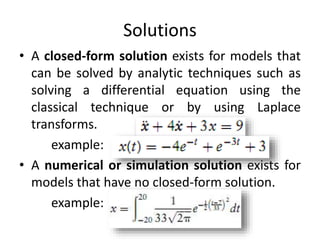
• A closed-form solution exists for models that
can be solved by analytic techniques such as
solving a differential equation using the
classical technique or by using Laplace
transforms.
example:
• A numerical or simulation solution exists for
models that have no closed-form solution.
example:
COMPARTMENTAL MODELING
• Compartmental modeling is analyzing systems of the
body characterized by a transfer of solute from one
compartment to another, such as the respiratory and
circulatory systems.
• It is concerned with maintaining correct chemical
levels in the body and their correct fluid volumes.
• Some readily identifiable compartments are:
– Cell volume that is separated from the extracellular space
by the cell membrane
– Interstitial volume that is separated from the plasma
volume by the capillary walls that contain the fluid that
bathes the cells
– Plasma volume contained in the circulatory system that
consists of the fluid that bathes blood cells
Fick’s law of diffusion:
Where:
q = quantity of solute
A = membrane surface area
c = concentration
D = diffusion coefficient
dx = membrane thickness
Transfer of Substances Between Two
Compartments Separated by a Thin
Membrane
Compartmental Modeling Basics
• Compartmental modeling involves describing a system
with a finite number of compartments, each connected
with a flow of solute from one compartment to another.
• Compartmental analysis predicts the concentrations of
solutes under consideration in each compartment as a
function of time using conservation of mass: accumulation
equals input minus output.
• The following assumptions are made when describing the
transfer of a solute by diffusion between any two
compartments:
1. The volume of each compartment remains constant.
2. Any solute q entering a compartment is
instantaneously mixed throughout the entire compartment.
3. The rate of loss of a solute from a compartment is
proportional to the amount of solute in the compartment
times the transfer rate, K, given by Kq.
Multi-compartmental Models
• Real models of the body involve many more
compartments such as cell volume, interstitial volume,
and plasma volume. Each of these volumes can be
further compartmentalized.
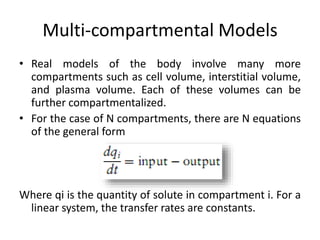
• For the case of N compartments, there are N equations
of the general form
Where qi is the quantity of solute in compartment i. For a
linear system, the transfer rates are constants.
Modified Compartmental Modeling
• Many systems are not appropriately described by
the compartmental analysis because the transfer
rates are not constant.
• Compartmental analysis, now termed modified
compartmental analysis, can still be applied to
these systems by incorporating the nonlinearities
in the model. Because of the non linearity,
solution of the differential equation is usually not
possible analytically, but can be easily simulated.
• Another method of handling the nonlinearity is to
linearize the nonlinearity or invoke
pseudostationary conditions.
Transfer of Solutes Between Physiological
Compartments by Fluid Flow
• Uses a modified compartmental model to
consider the transfer of solutes between
compartments by fluid flow.
Compartmental model for the transfer of solutes
between compartments by fluid flow
Dye Dilution Model
• Dye dilution studies are used to determine
cardiac output, cardiac function, perfusion of
organs, and the functional state of the
vascular system.
• Usually the dye is injected at one site in the
cardiovascular system and observed at one or
more sites as a function of time.
AN OVERVIEW OF THE FAST EYE
MOVEMENT SYSTEM
• A fast eye movement is usually
referred to as a saccade and
involves quickly moving the eye
from one image to another
image.
• The saccade system is part of the
oculomotor system that controls
all movements of the eyes due to
any stimuli.
• Each eye can be moved within
the orbit in three directions:
vertically, horizontally, and
torsionally, due to three pairs of
agonist–antagonist muscles.
• Fast eye movements are used to
locate or acquire targets.
TYPES OF EYE MOVEMENTS
• Smooth pursuit - used to track or follow a target
• Vestibular ocular - used to maintain the eyes on
the target during head movements
• Vergence - used to track near and far targets
• Optokinetic – used when moving through a
target-filled environment or to maintain the eyes
on target during continuous head rotation
• Visual – used for head and body movements
Saccade Characteristics
• Saccadic eye movements, among the fastest
voluntary muscle movements the human is
capable of producing, are characterized by a
rapid shift of gaze from one point of fixation
to another.
• Saccadic eye movements are conjugate and
ballistic, with a typical duration of 30–100ms
and a latency of 100–300ms.
WESTHEIMER SACCADIC EYE
MOVEMENT MODEL
The first quantitative saccadic
horizontal eye movement
model, was published by
Westheimer in 1954.
Westheimer proposed a
second-order model equation
THE SACCADE CONTROLLER
• In 1964, Robinson attempted
to measure the input to the
eyeballs during a saccade by
fixing one eye using a suction
contact lens, while the other
eye performed a saccade from
target to target. He proposed
that muscle tension driving
the eyeballs during a saccade
is a pulse plus a step, or
simply, a pulse-step input .
• One of the challenges in modeling physiological systems
is the lack of data or information about the input to the
system. Recording the signal would involve invasive
surgery and instrumentation
THE SACCADE CONTROLLER
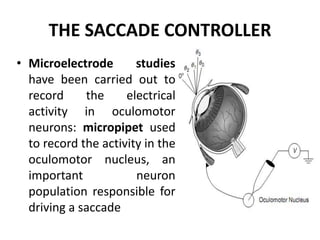
• Microelectrode studies
have been carried out to
record the electrical
activity in oculomotor
neurons: micropipet used
to record the activity in the
oculomotor nucleus, an
important neuron
population responsible for
driving a saccade
THE SACCADE CONTROLLER
• Collins and his coworkers reported using a
miniature ‘‘C’’-gauge force transducer to
measure muscle tension in vivo at the muscle
tendon during unrestrained human eye
movements.
DEVELOPMENT OF AN OCULOMOTOR
MUSCLE MODEL
• An accurate model of muscle is essential in
the development of a model of the horizontal
fast eye movement system.
• The model elements consist of an active-state
tension generator (input), elastic elements,
and viscous elements. Each element is
introduced separately and the muscle model
is incremented in each subsection.
Passive Elasticity
• Involves recording
of the tension
observed in an eye
rectus muscle.
• The tension
required to stretch
a muscle is a
nonlinear function
of distance.
Active-State Tension Generator
• In general, a muscle produces a force in
proportion to the amount of stimulation. The
element responsible for the creation of force
is the active-state tension generator.
• The relationship between tension, T, active-
state tension, F, and elasticity is given by
Elasticity
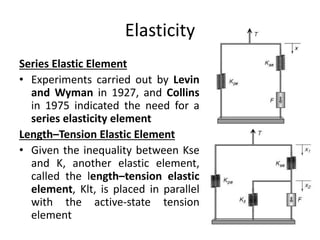
Series Elastic Element
• Experiments carried out by Levin
and Wyman in 1927, and Collins
in 1975 indicated the need for a
series elasticity element
Length–Tension Elastic Element
• Given the inequality between Kse
and K, another elastic element,
called the length–tension elastic
element, Klt, is placed in parallel
with the active-state tension
element
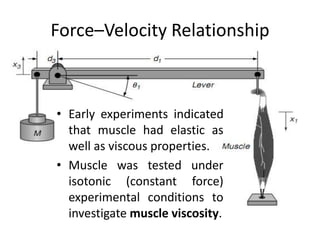
Force–Velocity Relationship
• Early experiments indicated
that muscle had elastic as
well as viscous properties.
• Muscle was tested under
isotonic (constant force)
experimental conditions to
investigate muscle viscosity.
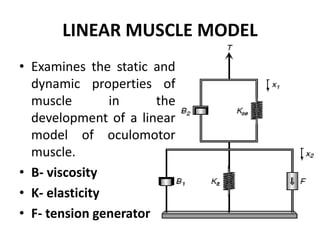
LINEAR MUSCLE MODEL
• Examines the static and
dynamic properties of
muscle in the
development of a linear
model of oculomotor
muscle.
• B- viscosity
• K- elasticity
• F- tension generator
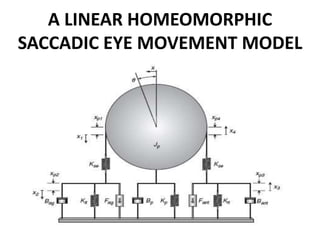
A LINEAR HOMEOMORPHIC
SACCADIC EYE MOVEMENT
MODEL
• In 1980, Bahill and coworkers presented a
linear fourth-order model of the horizontal
oculomotor plant that provides an excellent
match between model predictions and
horizontal eye movement data. This model
eliminates the differences seen between
velocity and acceleration predictions of the
Westheimer and Robinson models and the
data.
A LINEAR HOMEOMORPHIC
SACCADIC EYE MOVEMENT MODEL
A TRUER LINEAR HOMEOMORPHIC
SACCADIC EYE MOVEMENT MODEL
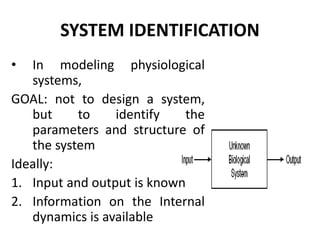
SYSTEM IDENTIFICATION
• In modeling physiological
systems,
GOAL: not to design a system,
but to identify the
parameters and structure of
the system
Ideally:
1. Input and output is known
2. Information on the Internal
dynamics is available
SYSTEM IDENTIFICATION
• System identification is the process of creating
a model of a system and estimating the
parameters of the model.
2 concepts of S.I.:
a. Time domain
b. Frequency domain
• Before S.I. begins, understanding the
characteristics of the input and output signals is
important (e.g. voltage and frequency
range,type of signal whether it is deterministic
or stochastic and if coding is involved.)
SYSTEM IDENTIFICATION
The simplest and most direct method of system
identification is sinusoidal analysis.
Source of sinusoidal excitation consists:
a. sine wave generator
b. a measurement transducer
c. recorder to gather frequency response
data(can be obtained using the oscilloscope)
SYSTEM IDENTIFICATION
Another type of identification technique either
for a
• first-order system or
• a second-order system
is by using a time-domain approach.

11_physiologicalmodeling.ppt

  • 1.
  • 2.
    OBJECTIVES • Describe theprocess used to build a mathematical physiological model. • Explain the concept of a compartment. • Analyze a physiological system using compartmental analysis. • Solve a nonlinear compartmental model. • Qualitatively describe a saccadic eye movement. • Describe the saccadic eye movement system with a second-order model. • Explain the importance of the pulse-step saccadic control signal. • Explain how a muscle operates using a nonlinear and linear muscle model. • Simulate a saccade with a fourth-order saccadic eye movement model. Estimate the parameters of a model using system identification.
  • 3.
    INTRODUCTION Physiology – thescience of the functioning of living organisms and of their component parts. 2 Types of physiological model: • A quantitative physiological model is a mathematical representation that approximates the behavior of an actual physiological system. • A qualitative physiological model describes the actual physiological system without the use of mathematics.
  • 4.
  • 5.
    Deterministic and StochasticModels • A deterministic model is one that has an exact solution that relates the independent variables of the model to each other and to the dependent variable. For a given set of initial conditions, a deterministic model yields the same solution each and every time. • A stochastic model involves random variables that are functions of time and include probabilistic considerations. For a given set of initial conditions, a stochastic model yields a different solution each and every time.
  • 6.
    Solutions • A closed-formsolution exists for models that can be solved by analytic techniques such as solving a differential equation using the classical technique or by using Laplace transforms. example: • A numerical or simulation solution exists for models that have no closed-form solution. example:
  • 7.
    COMPARTMENTAL MODELING • Compartmentalmodeling is analyzing systems of the body characterized by a transfer of solute from one compartment to another, such as the respiratory and circulatory systems. • It is concerned with maintaining correct chemical levels in the body and their correct fluid volumes. • Some readily identifiable compartments are: – Cell volume that is separated from the extracellular space by the cell membrane – Interstitial volume that is separated from the plasma volume by the capillary walls that contain the fluid that bathes the cells – Plasma volume contained in the circulatory system that consists of the fluid that bathes blood cells
  • 8.
    Fick’s law ofdiffusion: Where: q = quantity of solute A = membrane surface area c = concentration D = diffusion coefficient dx = membrane thickness Transfer of Substances Between Two Compartments Separated by a Thin Membrane
  • 9.
    Compartmental Modeling Basics •Compartmental modeling involves describing a system with a finite number of compartments, each connected with a flow of solute from one compartment to another. • Compartmental analysis predicts the concentrations of solutes under consideration in each compartment as a function of time using conservation of mass: accumulation equals input minus output. • The following assumptions are made when describing the transfer of a solute by diffusion between any two compartments: 1. The volume of each compartment remains constant. 2. Any solute q entering a compartment is instantaneously mixed throughout the entire compartment. 3. The rate of loss of a solute from a compartment is proportional to the amount of solute in the compartment times the transfer rate, K, given by Kq.
  • 10.
    Multi-compartmental Models • Realmodels of the body involve many more compartments such as cell volume, interstitial volume, and plasma volume. Each of these volumes can be further compartmentalized. • For the case of N compartments, there are N equations of the general form Where qi is the quantity of solute in compartment i. For a linear system, the transfer rates are constants.
  • 11.
    Modified Compartmental Modeling •Many systems are not appropriately described by the compartmental analysis because the transfer rates are not constant. • Compartmental analysis, now termed modified compartmental analysis, can still be applied to these systems by incorporating the nonlinearities in the model. Because of the non linearity, solution of the differential equation is usually not possible analytically, but can be easily simulated. • Another method of handling the nonlinearity is to linearize the nonlinearity or invoke pseudostationary conditions.
  • 12.
    Transfer of SolutesBetween Physiological Compartments by Fluid Flow • Uses a modified compartmental model to consider the transfer of solutes between compartments by fluid flow. Compartmental model for the transfer of solutes between compartments by fluid flow
  • 13.
    Dye Dilution Model •Dye dilution studies are used to determine cardiac output, cardiac function, perfusion of organs, and the functional state of the vascular system. • Usually the dye is injected at one site in the cardiovascular system and observed at one or more sites as a function of time.
  • 14.
    AN OVERVIEW OFTHE FAST EYE MOVEMENT SYSTEM • A fast eye movement is usually referred to as a saccade and involves quickly moving the eye from one image to another image. • The saccade system is part of the oculomotor system that controls all movements of the eyes due to any stimuli. • Each eye can be moved within the orbit in three directions: vertically, horizontally, and torsionally, due to three pairs of agonist–antagonist muscles. • Fast eye movements are used to locate or acquire targets.
  • 15.
    TYPES OF EYEMOVEMENTS • Smooth pursuit - used to track or follow a target • Vestibular ocular - used to maintain the eyes on the target during head movements • Vergence - used to track near and far targets • Optokinetic – used when moving through a target-filled environment or to maintain the eyes on target during continuous head rotation • Visual – used for head and body movements
  • 16.
    Saccade Characteristics • Saccadiceye movements, among the fastest voluntary muscle movements the human is capable of producing, are characterized by a rapid shift of gaze from one point of fixation to another. • Saccadic eye movements are conjugate and ballistic, with a typical duration of 30–100ms and a latency of 100–300ms.
  • 17.
    WESTHEIMER SACCADIC EYE MOVEMENTMODEL The first quantitative saccadic horizontal eye movement model, was published by Westheimer in 1954. Westheimer proposed a second-order model equation
  • 18.
    THE SACCADE CONTROLLER •In 1964, Robinson attempted to measure the input to the eyeballs during a saccade by fixing one eye using a suction contact lens, while the other eye performed a saccade from target to target. He proposed that muscle tension driving the eyeballs during a saccade is a pulse plus a step, or simply, a pulse-step input . • One of the challenges in modeling physiological systems is the lack of data or information about the input to the system. Recording the signal would involve invasive surgery and instrumentation
  • 19.
    THE SACCADE CONTROLLER •Microelectrode studies have been carried out to record the electrical activity in oculomotor neurons: micropipet used to record the activity in the oculomotor nucleus, an important neuron population responsible for driving a saccade
  • 20.
    THE SACCADE CONTROLLER •Collins and his coworkers reported using a miniature ‘‘C’’-gauge force transducer to measure muscle tension in vivo at the muscle tendon during unrestrained human eye movements.
  • 21.
    DEVELOPMENT OF ANOCULOMOTOR MUSCLE MODEL • An accurate model of muscle is essential in the development of a model of the horizontal fast eye movement system. • The model elements consist of an active-state tension generator (input), elastic elements, and viscous elements. Each element is introduced separately and the muscle model is incremented in each subsection.
  • 22.
    Passive Elasticity • Involvesrecording of the tension observed in an eye rectus muscle. • The tension required to stretch a muscle is a nonlinear function of distance.
  • 23.
    Active-State Tension Generator •In general, a muscle produces a force in proportion to the amount of stimulation. The element responsible for the creation of force is the active-state tension generator. • The relationship between tension, T, active- state tension, F, and elasticity is given by
  • 24.
    Elasticity Series Elastic Element •Experiments carried out by Levin and Wyman in 1927, and Collins in 1975 indicated the need for a series elasticity element Length–Tension Elastic Element • Given the inequality between Kse and K, another elastic element, called the length–tension elastic element, Klt, is placed in parallel with the active-state tension element
  • 25.
    Force–Velocity Relationship • Earlyexperiments indicated that muscle had elastic as well as viscous properties. • Muscle was tested under isotonic (constant force) experimental conditions to investigate muscle viscosity.
  • 26.
    LINEAR MUSCLE MODEL •Examines the static and dynamic properties of muscle in the development of a linear model of oculomotor muscle. • B- viscosity • K- elasticity • F- tension generator
  • 27.
    A LINEAR HOMEOMORPHIC SACCADICEYE MOVEMENT MODEL • In 1980, Bahill and coworkers presented a linear fourth-order model of the horizontal oculomotor plant that provides an excellent match between model predictions and horizontal eye movement data. This model eliminates the differences seen between velocity and acceleration predictions of the Westheimer and Robinson models and the data.
  • 28.
  • 29.
    A TRUER LINEARHOMEOMORPHIC SACCADIC EYE MOVEMENT MODEL
  • 30.
    SYSTEM IDENTIFICATION • Inmodeling physiological systems, GOAL: not to design a system, but to identify the parameters and structure of the system Ideally: 1. Input and output is known 2. Information on the Internal dynamics is available
  • 31.
    SYSTEM IDENTIFICATION • Systemidentification is the process of creating a model of a system and estimating the parameters of the model. 2 concepts of S.I.: a. Time domain b. Frequency domain • Before S.I. begins, understanding the characteristics of the input and output signals is important (e.g. voltage and frequency range,type of signal whether it is deterministic or stochastic and if coding is involved.)
  • 32.
    SYSTEM IDENTIFICATION The simplestand most direct method of system identification is sinusoidal analysis. Source of sinusoidal excitation consists: a. sine wave generator b. a measurement transducer c. recorder to gather frequency response data(can be obtained using the oscilloscope)
  • 33.
    SYSTEM IDENTIFICATION Another typeof identification technique either for a • first-order system or • a second-order system is by using a time-domain approach.