MUSCLE
Presented by:- PANKAJ SINGH
46, 1st year BHMS
Learning Objectives:
1 Classify muscles
2. Classify skeletal muscles based on fascicular architecture and their blood and nerve
supply
3. Explain the actions of skeletal muscles
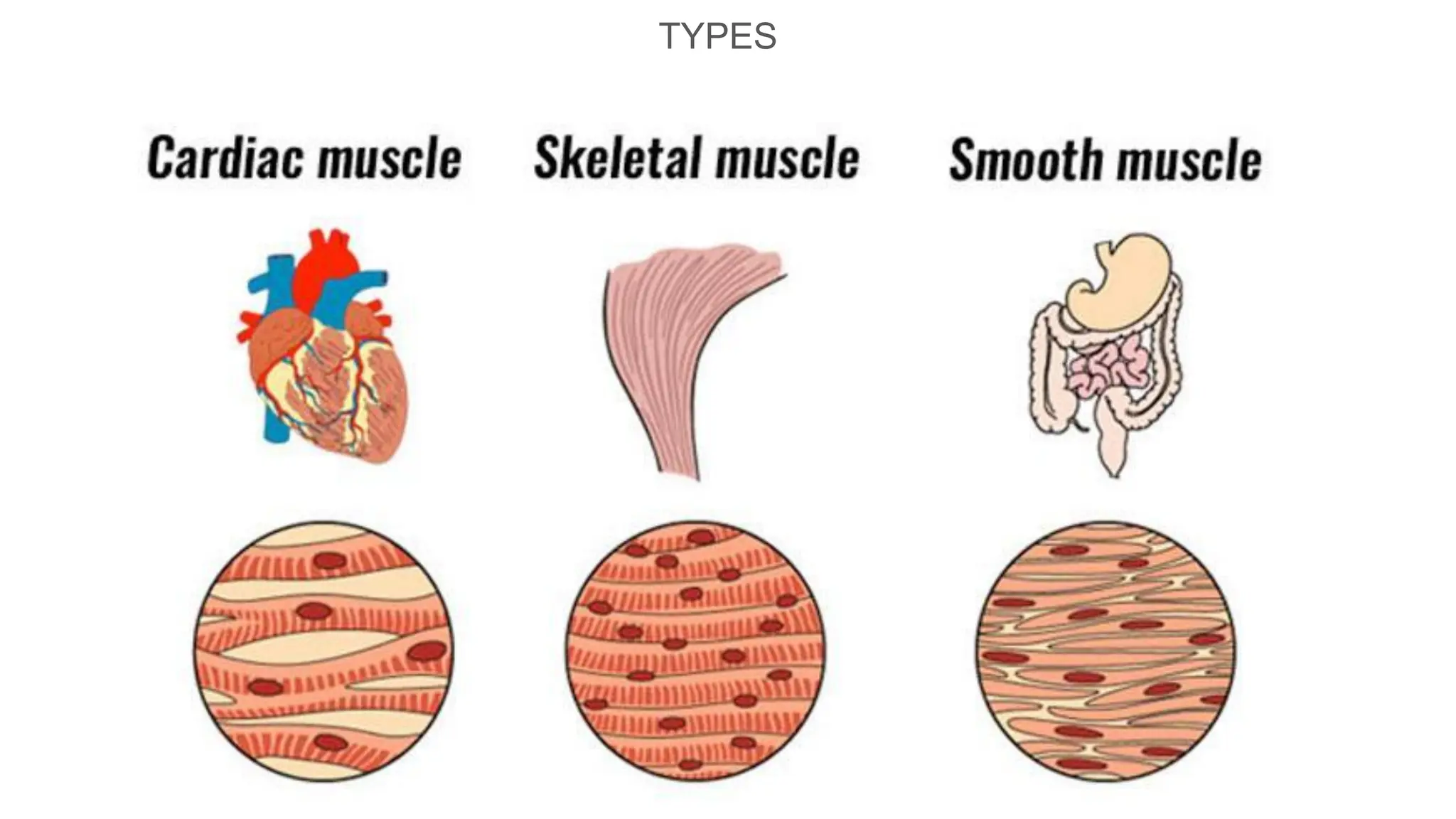
TYPES
Skeleton. Smooth. Cardiac.
2
FASCICULI
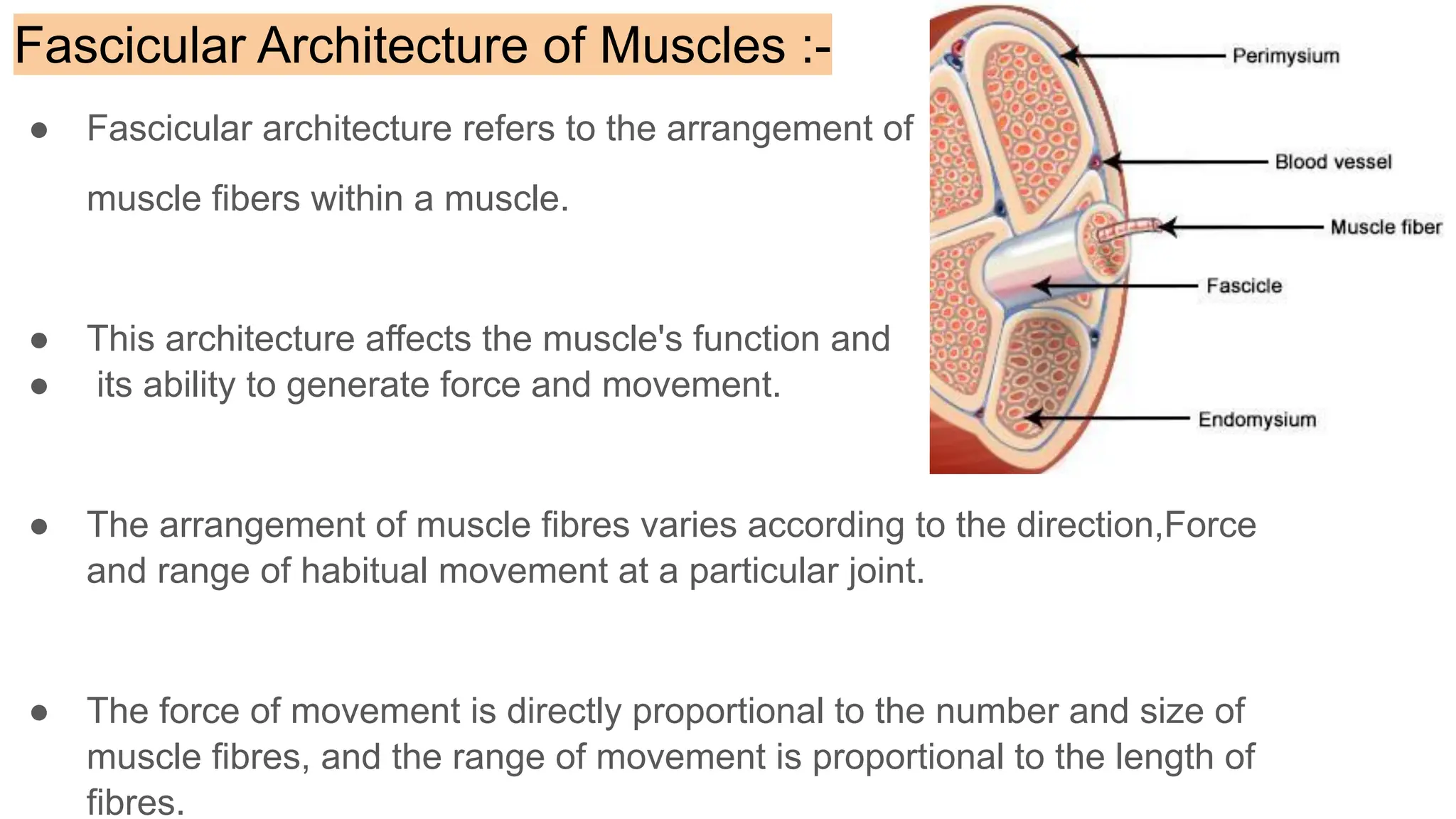
● Fasciculi (or fascicles) of muscle are bundles of skeletal
muscle fibers (cells) surrounded by a type of connective
tissue called perimysium. Each fasciculus contains
multiple muscle fibers, which are the individual muscle
cells. These muscle fibers are in turn composed of
myofibrils, which contain the actin and myosin filaments
responsible for muscle contraction.
● A group of fasciculi bound together by another layer of connective tissue called the
epimysium.
Fascicular Architecture of Muscles :-
● Fascicular architecture refers to the arrangement of
muscle fibers within a muscle.
● This architecture affects the muscle's function and
● its ability to generate force and movement.
● The arrangement of muscle fibres varies according to the direction,Force
and range of habitual movement at a particular joint.
● The force of movement is directly proportional to the number and size of
muscle fibres, and the range of movement is proportional to the length of
fibres.
1 Parallel fasciculi :-
The muscle fibers or fasciculi are parallel to the line of muscle pull.
Such muscles contract over a great distance (ie. they have maximum
range of
movement) and have good endurance.
They may be:
(a) Quadrilateral, e.g. thyrohyoid, pronator quadratus.
(b) Strake-like, e.g. infrahyoid muscles, sartorius. muse focatien
(c) Strap-like with tendinous intersections, e.g. rectus abdominis
(d) Fusiform, e.g. biceps, diagastric.
The major types of arrangement of
muscle fibers or fasciculi are described :::::
Range of movement=length
of fasciculi
2. Convergent fasciculi:
The muscle fibers or fasciculi
converge at the insertion point to maximize contraction. fossa
This arrangement makes the muscle very powerful,
although the range of movement is reduced;
such Intercostals Between the ribs muscles may be:-
(a) Triangular, e.g. adductor longus.
(b) Fan-shaped, e.g. temporalis.
3, Spiral or twisted fasciculi:
In some muscles, the fibers
are twisted or spiraled, e.g. trapezius, latissimus dorsi,
pectoralis major, supinator.
4. Cruciate muscles:
In some muscles, the fibers or fasciculi
are arranged in superficial and deep planes and crossed ‘X’,
e.g. sterno-cleidomastoid, masseter, adductor magnus.
5, Sphincteric fasciculi:
In some muscles, the fibers or
fasciculi surround an opening or orifice, thus when they
contract, the opening is closed or constricted, e.g. orbi-
cularis oculi around the eye and orbicularis oris surrounding the oral orifice.
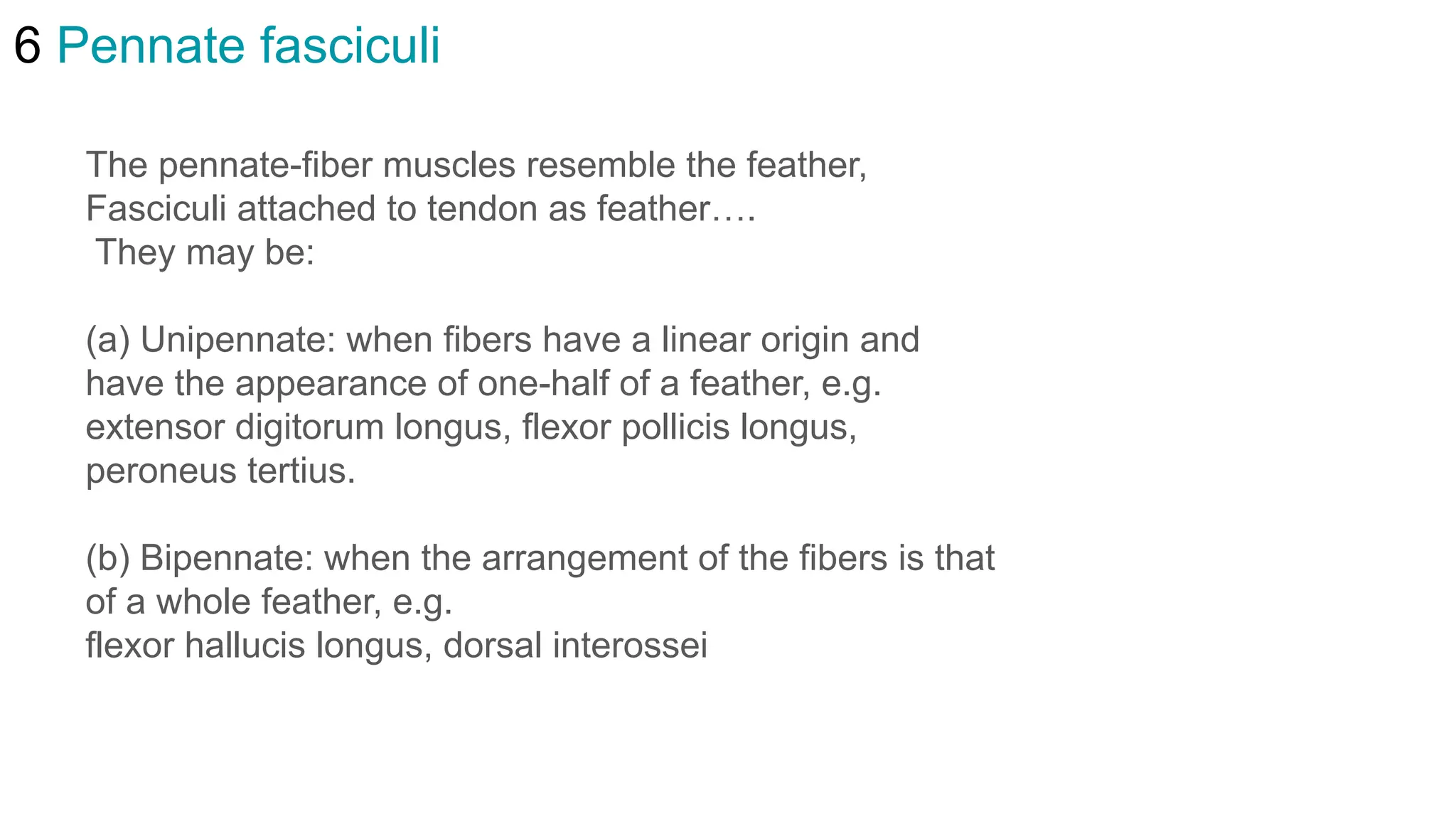
6 Pennate fasciculi
The pennate-fiber muscles resemble the feather,
Fasciculi attached to tendon as feather….
They may be:
(a) Unipennate: when fibers have a linear origin and
have the appearance of one-half of a feather, e.g.
extensor digitorum longus, flexor pollicis longus,
peroneus tertius.
(b) Bipennate: when the arrangement of the fibers is that
of a whole feather, e.g.
flexor hallucis longus, dorsal interossei
(d) Circumpennate: when fibers converge from the walls
of a cylindrical space to a buried central tendon, e.g. tibialis anterior.
3
Blood supply
● primarily provided by arteries….
● These arteries branch extensively within the muscle tissue .
● Ensure that oxygen and nutrients are delivered efficiently to meet the high metabolic
demands
● The key steps of blood supply to skeletal muscles are:
● Main Arteries: Major arteries, femoral artery for the legs or the brachial artery for
the arms,
● Arterioles: Arteries branch into smaller arterioles as they penetrate the muscle
tissue.
● Capillaries: Arterioles —networks
Capillaries are tiny blood vessels where the exchange of
oxygen, nutrients, and waste products occurs between the blood
and muscle cells.
● Venules and Veins: After the exchange, deoxygenated blood and
metabolic waste are carried away from the muscle cells through
venules,
● This extensive network of blood vessels ensures that skeletal
muscles receive the necessary nutrients and oxygen for energy
production and efficient function, especially during physical activity.
Vesicular pedicle
A vesicular pedicle refers to a stalk-like structure that
contains blood vessels and connects a cyst or other
fluid-filled sac (vesicle) to surrounding tissues. This
pedicle provides the necessary blood supply to the
vesicle, allowing it to maintain its structure and
function
Classification of Muscles According to Vascular Pedicles
4
NERVE SUPPLY
● Generally called:--- motor,
● But its mixed type both…..
Motor. Sensory
The motor fibers conduct nerve
impulses to muscle fibers to
stimulate them to contract,
whereas the sensory fibers
conduct
impulses away from
neuromuscular spindles in the
muscle
and Golgi nerve endings in the
tendon to the central nervous
system
Further details:
1. Motor fibers (60%) supplying the
muscles are of two
types:
(a) Large myelinated alpha (a) fibers
which supply
extrafusal muscle fibers of muscle
spindles.
(b) Small myelinated gamma (y) fibers
which supply
intrafusal fibers of muscle spindles.
2.
2.Sensory fibers (40%) supplying the
muscles are of two types:
(a) Myelinated fibers carrying
proprioceptive sensations
from muscle spindles and tendons.
(b) Nonmyelinated fibers carrying
exteroceptive (pain,
touch and temperature) sensations.
The relative size of the nerve supplying a muscle depends
upon the size of the motor units in that muscle.
Motor Point
It is the point of entry of nerve trunk into the muscle. The
nerves mostly enter the muscles from their deep surfaces
with few exceptions such as long thoracic nerve supplies
serratus anterior muscle from its superficial surface. The
motor
points corresponds to neurovascular hila.
Motor Unit
A motor unit consists of a single motor neuron (as
anterior
horn cell), its axon and all the muscle fibers that it
supplies.
The muscles that have precise and accurately
controlled
action, viz. extraocular muscles, have smaller
motor units
with an innervation ratio of 1:10. But muscles that
have gen-
eralized functions (gross body movements), such
as those in
gluteal region and thigh, have very large motor
units with an
innervation ratio exceeding 1:500.
ACTION OF
SKELETON
MUSCLE
MUSCLE TONE
It refers to the constant tension produced by muscles for long
periods of time. Muscle tone is responsible for keeping our
back and leg straight. The muscle tone is maintained by a
small percentage of motor units. The motor units that are contracting are
stimulated in such a way that tension
produced in a muscle remains constant.
The same motor units are not contracting all the time.
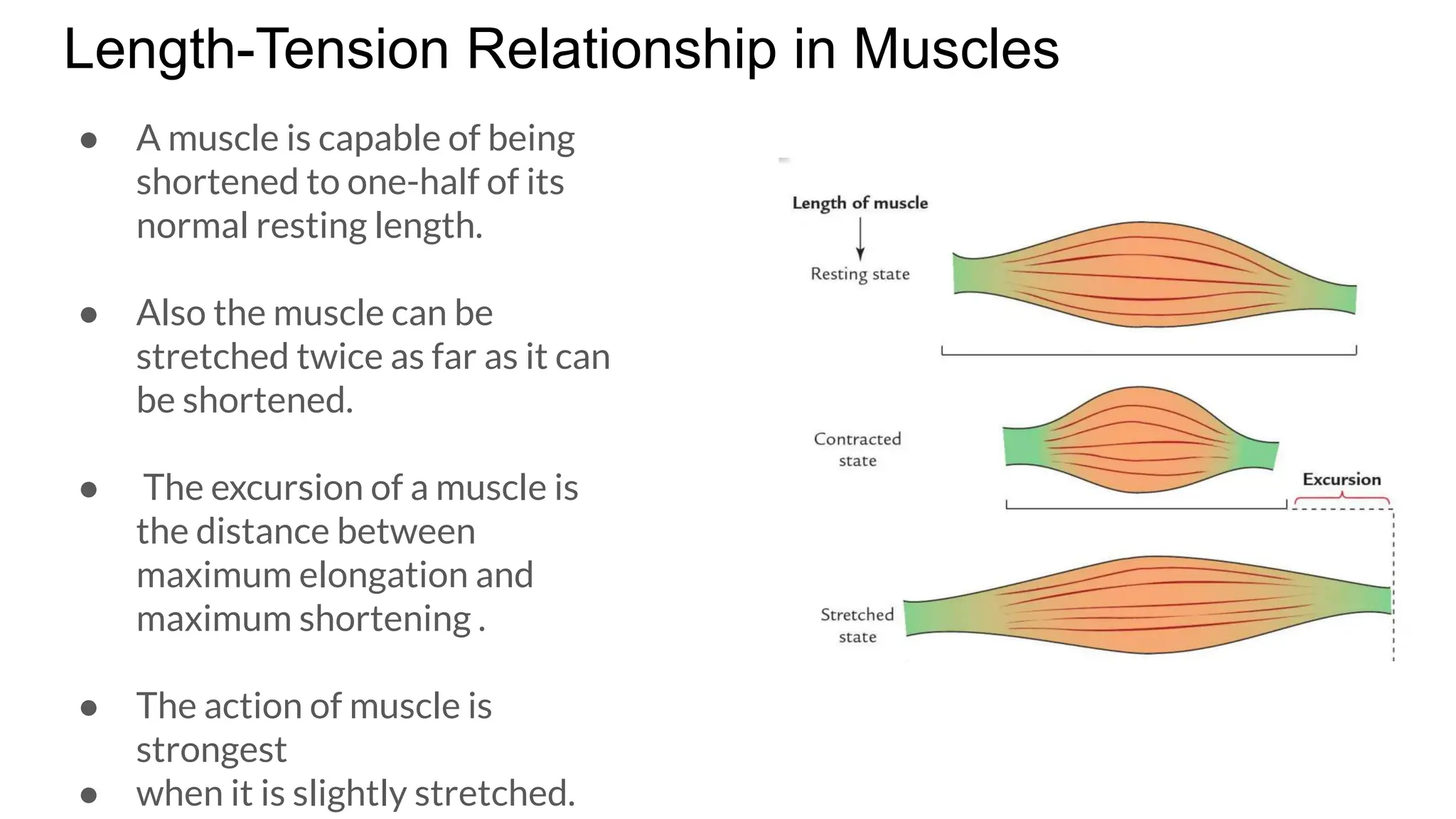
Length-Tension Relationship in Muscles
● A muscle is capable of being
shortened to one-half of its
normal resting length.
● Also the muscle can be
stretched twice as far as it can
be shortened.
● The excursion of a muscle is
the distance between
maximum elongation and
maximum shortening .
● The action of muscle is
strongest
● when it is slightly stretched.
Types of Muscle Contraction
1. Isometric contractions:
2. Isotonic contractions:
3. Concentric contractions: The muscle produces increas-
ing tension as it shortens. A large percentage of move-
ments produced by muscle contractions are concentric
contractions.
4. Eccentric contractions: In eccentric contractions the
tension is maintained in muscle while muscle increases
in length, e.g. lowering the arm to the side of body.
Active insufficiency: When muscle reaches a point where
it cannot shorten further, it is termed as active insufficiency.
It occurs in the agonist muscle that is contracting.
Passive insufficiency: When muscle cannot be elongated
any farther without damage to its fibers, it is termed as passive insufficiency. It
occurs in the antagonist muscle that is reaxed during a movement and is on the
opposite side of a Joint.
Think of how much you are hurt when slapped with a loose
and stretched hand by a teacher.., JK
Group Action of Muscles
With a few exceptions, a single muscle does not contract alone.
Each movement requires contraction or relaxation of a whole group of
muscles.
Further, each movement is brought about by a coordi-
nated activity of different group of muscles.
These muscle groups are classified according to the role played by them in
the occurrence of a particular action:
1. **Prime movers (agonists):**
- Definition: Muscles primarily responsible for producing a desired movement.
- Example: Biceps brachii acts as a prime mover in elbow flexion, bringing the
insertion closer to its origin.
2. **Antagonists:**
- Definition: Muscles capable of producing movement opposite to a prime
mover.
- Interaction: Usually, agonists (prime movers) and antagonists work together.
When the prime mover contracts, the antagonist relaxes to allow controlled
movement.
-
Example: In elbow flexion, biceps brachii is the prime mover while triceps brachii acts as
the antagonist, reversing roles during elbow extension.
3. **Fixators:**
- Definition: Muscles that stabilize the origin of the prime mover to enhance its
efficiency.
- Example: Muscles stabilizing the shoulder girdle during shoulder abduction
allow the deltoid to perform its action effectively.
4. **Synergists:**
- Definition: Muscles that assist the prime mover by preventing undesired
movement at proximal joints.
- Example: Long flexors of the fingers cross the wrist joint, potentially flexing it
undesirably when making a fist. Synergistic action of wrist extensors prevents
this flexion, allowing effective fist clenching.
Muscle  : it's type and.... Skeleton muscle intro

Muscle : it's type and.... Skeleton muscle intro

  • 1.
    MUSCLE Presented by:- PANKAJSINGH 46, 1st year BHMS
  • 2.
    Learning Objectives: 1 Classifymuscles 2. Classify skeletal muscles based on fascicular architecture and their blood and nerve supply 3. Explain the actions of skeletal muscles
  • 3.
  • 4.
  • 9.
    2 FASCICULI ● Fasciculi (orfascicles) of muscle are bundles of skeletal muscle fibers (cells) surrounded by a type of connective tissue called perimysium. Each fasciculus contains multiple muscle fibers, which are the individual muscle cells. These muscle fibers are in turn composed of myofibrils, which contain the actin and myosin filaments responsible for muscle contraction. ● A group of fasciculi bound together by another layer of connective tissue called the epimysium.
  • 10.
    Fascicular Architecture ofMuscles :- ● Fascicular architecture refers to the arrangement of muscle fibers within a muscle. ● This architecture affects the muscle's function and ● its ability to generate force and movement. ● The arrangement of muscle fibres varies according to the direction,Force and range of habitual movement at a particular joint. ● The force of movement is directly proportional to the number and size of muscle fibres, and the range of movement is proportional to the length of fibres.
  • 11.
    1 Parallel fasciculi:- The muscle fibers or fasciculi are parallel to the line of muscle pull. Such muscles contract over a great distance (ie. they have maximum range of movement) and have good endurance. They may be: (a) Quadrilateral, e.g. thyrohyoid, pronator quadratus. (b) Strake-like, e.g. infrahyoid muscles, sartorius. muse focatien (c) Strap-like with tendinous intersections, e.g. rectus abdominis (d) Fusiform, e.g. biceps, diagastric. The major types of arrangement of muscle fibers or fasciculi are described ::::: Range of movement=length of fasciculi
  • 13.
    2. Convergent fasciculi: Themuscle fibers or fasciculi converge at the insertion point to maximize contraction. fossa This arrangement makes the muscle very powerful, although the range of movement is reduced; such Intercostals Between the ribs muscles may be:- (a) Triangular, e.g. adductor longus. (b) Fan-shaped, e.g. temporalis. 3, Spiral or twisted fasciculi: In some muscles, the fibers are twisted or spiraled, e.g. trapezius, latissimus dorsi, pectoralis major, supinator.
  • 14.
    4. Cruciate muscles: Insome muscles, the fibers or fasciculi are arranged in superficial and deep planes and crossed ‘X’, e.g. sterno-cleidomastoid, masseter, adductor magnus. 5, Sphincteric fasciculi: In some muscles, the fibers or fasciculi surround an opening or orifice, thus when they contract, the opening is closed or constricted, e.g. orbi- cularis oculi around the eye and orbicularis oris surrounding the oral orifice.
  • 17.
    6 Pennate fasciculi Thepennate-fiber muscles resemble the feather, Fasciculi attached to tendon as feather…. They may be: (a) Unipennate: when fibers have a linear origin and have the appearance of one-half of a feather, e.g. extensor digitorum longus, flexor pollicis longus, peroneus tertius. (b) Bipennate: when the arrangement of the fibers is that of a whole feather, e.g. flexor hallucis longus, dorsal interossei
  • 18.
    (d) Circumpennate: whenfibers converge from the walls of a cylindrical space to a buried central tendon, e.g. tibialis anterior.
  • 19.
    3 Blood supply ● primarilyprovided by arteries…. ● These arteries branch extensively within the muscle tissue . ● Ensure that oxygen and nutrients are delivered efficiently to meet the high metabolic demands ● The key steps of blood supply to skeletal muscles are: ● Main Arteries: Major arteries, femoral artery for the legs or the brachial artery for the arms, ● Arterioles: Arteries branch into smaller arterioles as they penetrate the muscle tissue.
  • 20.
    ● Capillaries: Arterioles—networks Capillaries are tiny blood vessels where the exchange of oxygen, nutrients, and waste products occurs between the blood and muscle cells. ● Venules and Veins: After the exchange, deoxygenated blood and metabolic waste are carried away from the muscle cells through venules, ● This extensive network of blood vessels ensures that skeletal muscles receive the necessary nutrients and oxygen for energy production and efficient function, especially during physical activity.
  • 23.
    Vesicular pedicle A vesicularpedicle refers to a stalk-like structure that contains blood vessels and connects a cyst or other fluid-filled sac (vesicle) to surrounding tissues. This pedicle provides the necessary blood supply to the vesicle, allowing it to maintain its structure and function
  • 24.
    Classification of MusclesAccording to Vascular Pedicles
  • 27.
    4 NERVE SUPPLY ● Generallycalled:--- motor, ● But its mixed type both….. Motor. Sensory
  • 28.
    The motor fibersconduct nerve impulses to muscle fibers to stimulate them to contract, whereas the sensory fibers conduct impulses away from neuromuscular spindles in the muscle and Golgi nerve endings in the tendon to the central nervous system
  • 29.
    Further details: 1. Motorfibers (60%) supplying the muscles are of two types: (a) Large myelinated alpha (a) fibers which supply extrafusal muscle fibers of muscle spindles. (b) Small myelinated gamma (y) fibers which supply intrafusal fibers of muscle spindles. 2. 2.Sensory fibers (40%) supplying the muscles are of two types: (a) Myelinated fibers carrying proprioceptive sensations from muscle spindles and tendons. (b) Nonmyelinated fibers carrying exteroceptive (pain, touch and temperature) sensations.
  • 30.
    The relative sizeof the nerve supplying a muscle depends upon the size of the motor units in that muscle. Motor Point It is the point of entry of nerve trunk into the muscle. The nerves mostly enter the muscles from their deep surfaces with few exceptions such as long thoracic nerve supplies serratus anterior muscle from its superficial surface. The motor points corresponds to neurovascular hila.
  • 31.
    Motor Unit A motorunit consists of a single motor neuron (as anterior horn cell), its axon and all the muscle fibers that it supplies. The muscles that have precise and accurately controlled action, viz. extraocular muscles, have smaller motor units with an innervation ratio of 1:10. But muscles that have gen- eralized functions (gross body movements), such as those in gluteal region and thigh, have very large motor units with an innervation ratio exceeding 1:500.
  • 32.
  • 33.
    MUSCLE TONE It refersto the constant tension produced by muscles for long periods of time. Muscle tone is responsible for keeping our back and leg straight. The muscle tone is maintained by a small percentage of motor units. The motor units that are contracting are stimulated in such a way that tension produced in a muscle remains constant. The same motor units are not contracting all the time.
  • 34.
    Length-Tension Relationship inMuscles ● A muscle is capable of being shortened to one-half of its normal resting length. ● Also the muscle can be stretched twice as far as it can be shortened. ● The excursion of a muscle is the distance between maximum elongation and maximum shortening . ● The action of muscle is strongest ● when it is slightly stretched.
  • 35.
    Types of MuscleContraction 1. Isometric contractions: 2. Isotonic contractions: 3. Concentric contractions: The muscle produces increas- ing tension as it shortens. A large percentage of move- ments produced by muscle contractions are concentric contractions. 4. Eccentric contractions: In eccentric contractions the tension is maintained in muscle while muscle increases in length, e.g. lowering the arm to the side of body.
  • 36.
    Active insufficiency: Whenmuscle reaches a point where it cannot shorten further, it is termed as active insufficiency. It occurs in the agonist muscle that is contracting. Passive insufficiency: When muscle cannot be elongated any farther without damage to its fibers, it is termed as passive insufficiency. It occurs in the antagonist muscle that is reaxed during a movement and is on the opposite side of a Joint. Think of how much you are hurt when slapped with a loose and stretched hand by a teacher.., JK
  • 37.
    Group Action ofMuscles With a few exceptions, a single muscle does not contract alone. Each movement requires contraction or relaxation of a whole group of muscles. Further, each movement is brought about by a coordi- nated activity of different group of muscles. These muscle groups are classified according to the role played by them in the occurrence of a particular action:
  • 38.
    1. **Prime movers(agonists):** - Definition: Muscles primarily responsible for producing a desired movement. - Example: Biceps brachii acts as a prime mover in elbow flexion, bringing the insertion closer to its origin. 2. **Antagonists:** - Definition: Muscles capable of producing movement opposite to a prime mover. - Interaction: Usually, agonists (prime movers) and antagonists work together. When the prime mover contracts, the antagonist relaxes to allow controlled movement. -
  • 39.
    Example: In elbowflexion, biceps brachii is the prime mover while triceps brachii acts as the antagonist, reversing roles during elbow extension.
  • 40.
    3. **Fixators:** - Definition:Muscles that stabilize the origin of the prime mover to enhance its efficiency. - Example: Muscles stabilizing the shoulder girdle during shoulder abduction allow the deltoid to perform its action effectively. 4. **Synergists:** - Definition: Muscles that assist the prime mover by preventing undesired movement at proximal joints. - Example: Long flexors of the fingers cross the wrist joint, potentially flexing it undesirably when making a fist. Synergistic action of wrist extensors prevents this flexion, allowing effective fist clenching.