Computer Engineering and Intelligent Systems                                                  www.iiste.org
     ISSN 2222-1719 (Paper) ISSN 2222-2863 (Online)
     Vol 3, No.3, 2012


       Performance Evaluation of Geometric Active Contour (GAC) and
      Enhanced Geometric Active Contour Segmentation Model (ENGAC)
                     for Medical Image Segmentation

                                        Ajala Funmilola Alaba*, Emuoyibofarhe Justice O

           Department of Computer Science and Engineering, LAUTECH Ogbomoso, Oyo state, Nigeria.

              *E-mail of the corresponding author:    funfaith2003@yahoo.co.uk.

Abstract
         Segmentation is an aspect of computer vision that deals with partitioning of an image into homogeneneous region.
Medical image segmentation is an indispensable tool for medical image diagnoses. Geometric active contour (GAC) segmentation
is one of the outstanding model used in machine learning community to solve the problem of medical image segmentation.
However, It has problem of deviation from the true outline of the target feature and it generates spurious edge caused by noise that
normally stop the evolution of the surface to be extracted.
         In this paper, enhanced Geometric active contour was formulated by using Kernel Principal Component Analysis(KPCA)
with the existing Geometric active contour segmentation model and performance evaluation of the formulated model was carried
out.

Keyword: Geometric active contour, Segmentation, Medical image, Kernel Principal Component Analysis.


1.       Introduction

Image segmentation is an aspect of computer vision that deals with the partitioning an image into regions having homogeneous
meaning. It is used to separate an object from its background and extracts meaningful objects lying in images either by dividing
images into contiguous semantic regions, or by extracting one or more specific objects in images such as medical structures.
However, we have different types of image segmentation methods which are not suitable for medical images since medical images
are diverse, complex and vary from natural images.

Some of the methods used for medical image segmentation fall under deformable models. The use of deformable model was
popularized by Kass et al. (1990), snake model was used to develop active contour model that minimizes energy functional under
the influence of forces which are internal force, image force and external constraint force. Deformable models can be classified
into three categories which are Free-form, Parametric and Geometric active contour model.

Geometric active contour model

This make use of level set method that represent contour or surfaces as Zero level set of a higher dimensional function usually
called a level set function Chunming et al, (2011). Level set can handle topological changes in curve evolution which is not
possible with the classical active contour model. Osher and Sethian (1998) offer a natural and numerical implementation of curve
evolution equation using level set. Readers are refer to Neithammer and Tannenbum (2004) for some previous work on Geometric
active contour model. Xiao et al., (2003) gave the numeric scheme used for GAC model, which is describe in the following
equation.

Let x= (x, y) denote a point in a curve C which is a member in image domain Ω and let the curve be represented by Lipchitz-
continuous function using signed distance function A parameterized differentiable curve C is a differential map
                                                  .

                C : a, b      x( p), y( p)  x( p)
                                                       T
                                                                                                                              (1)
                                                                78
Computer Engineering and Intelligent Systems                                                www.iiste.org
ISSN 2222-1719 (Paper) ISSN 2222-2863 (Online)
Vol 3, No.3, 2012


The rule that determine how each point C moves starting from initial curve C o is
         dC P, t 
                     vC P, t , t 
           dt                                                                                                                (2)
Where V = vector field that refers to as speed, Ignoring C and V in equation 2 gives
         dC
            v
         dt                                                                                                                 (3)
Equation (2) gives a partial differential equation that determines how curve C evolves and often called flow. Minimized the energy
below
                     
             E image  , T  H  G (T )
                                           2
                                                        2
                                                  H x  G T , I x
                                                                                                                            (4)

Where Eimage is the energy that represents distance between the shape of the region defined by the interior of the curve C and the
shape G extracted from the image. Effective minimization of the energy in (4) amount to realizing a trade-off between segmented
object and the background.

Enhanced Geometric Active contour model

The enhanced model (ENGAC) was formulated using Kernel Principal Component Analysis (KPCA) and Geometric active
contour (GAC) segmentation model. KPCA was used to get shape variability within the Geometric active contour segmentation
model. The training set of MRI and CT scan of tran-axial medical images were gotten from University College Hospital, Ibadan,
Oyo state. The medical images were registered using appropriate registration method to pre-process the medical images. Figure 1
gives the overview of the enhanced geometric active contour segmentation model.


                   Figure 1: Overview of enhanced Geometric Active Contour model

The enhancement process started for the conventional Geometric active contour segmentation model by building Kernel Principal
Component Analysis (KPCA) feature space for medical shapes to be extracted and segmented. The steps involves were;

                                                                        79
Computer Engineering and Intelligent Systems                                                                  www.iiste.org
      ISSN 2222-1719 (Paper) ISSN 2222-2863 (Online)
      Vol 3, No.3, 2012


 (i)     Get a training set of registered medical images
 (ii)    Represent the contour of the registered medical images with high dimensional function using signed distance function, such that
         a point was represented by (Xi ,Xj) where i = 1……N and j = 1…..N
(iii)    Calculation of mean offset map represented by φ for the points using

                                            
                                                 1 N
                                                     X i , X j
                                                 N i 1
                                                                             
                                                                                                                             (5)
(iv)     The centered kernel was formed for the points this equation
                     K (i,j)=             X i    ,  X j       X i ,  X j   K X i X j                             (6)
                     X i   X i   
             where
(v)      The centered kernel was decomposed by getting
         (a) Diagonal matrix that represent Eigen values represented by (α1……αn)
         (b) Orthonormal matrix that contain Eigen vectors represented by (M i1……MiN)

         (c) Covariance matrix calculated using
                                                              C 
                                                                         1 N
                                                                                        
                                                                             Xi , X j  Xi , X j
                                                                         N i 1
                                                                                                      T


(vi)         The Eigenvector of Covariance matrix was computed for the decomposed kernel denoted by

                                                              
                                              N M ki
                                        Vk           Xi
                                             i 1 
                                                    k                                                                                        (7)

(vii)         Any subsequent projection of element X of the input space I on the KPCA space was denoted by
                                                                                                                                    P' X  and the co-

              ordinate of
                            P'  X  on kth component Vk , was calculated by
                                               1 N
                                       Bk        U ki K  X , X i 
                                               k i 1                                                                                       (8)

(viii)        The projection of
                                    X  onto the subspace          spanned by the first l eigenvectors was calculated by
                                                       l
                                          P '   Bk Vk  
                                                      k 1                                                                                   (9)

                 The square distance
                                        d between   X  and its projection on the KPCA space was denoted by
                                          2
                                          F
      (ix)

                                                  d F   X , P'  X     X   P'  X 
                                                    2                                                      2

                                                                                                                                             (10)

      To hybridize GAC and Kernel PCA, these are the steps;

  (i)        Perform nonlinear PCA on the constraint SDF using Polynomial kernel function.
                                        K o i, j   i ,  j
                                                                          c

                                                                                                                                              (11)
      From equation (11), when c = 2 and the square bracket is opened,
                                                  c                  2                    2
                                       i ,  j        i   j           i   j
                                                                                                                                              (12)
        where
                            c=       variance parameter.
                                                                                     80
Computer Engineering and Intelligent Systems                                                        www.iiste.org
ISSN 2222-1719 (Paper) ISSN 2222-2863 (Online)
Vol 3, No.3, 2012


             2
 i   j        = square distance between two SDFs Φi and Φj
o     = nonlinear mapping corresponding to Polynomial kernel

(2)     Minimize the energy functional equation below;
                                           Eenergy ( x)   xi , Z ' xi 
                                            F
                                                                                                                                (13)
where
 F
Eenergy
          denotes the facts that the shape knowledge is expressed as a distance in feature space.
x = test shape represented by Signed Distance Function (SDF).
 using
                                                                               dx
                                                     Eenergy   x Eenergy.
                                                          F              F

                                                t                               d                                             (14)
where

                                    g i  ko i ,  j 
                                       N
                   E   F                                      c
                         energy
                                      i 1
2.          Methods of Performance Evaluation

            The performance evaluations of the models were carried out using the following metrics by Lauren (2001). These metrics
     were used to evaluate the performance of enhanced Phasewire image segmentation on Livewire image segmentation.

     (a) Segmentation/Running time

              This is the time taken to compute the segmentation including the running time of the algorithm or the time spent to
     perform interactive segmentation. The research was implemented on Compaq Presario CQ60 notebook PC with AMD Athlon
     Dual-core QL-62 2.00 GHz processor.

     (b) Segmentation Accuracy

             The accuracy of the segmentation algorithms is generally based on Volume measurement. This is the volume of
     segmented feature in the image domain. It is calculated by multiplying number of voxel by the volume of each voxel.

     (c) Hausdsorff distance

                This evaluating metric measures the degree of mismatch between the initial constraint and the boundary of the
     extracted feature. It identifies the point in one set that is the farthest from the other and outputs the distance to the nearest point
     in the other set. For two sets of points A  a1 ,....., a m and B  b1 ,....., bn the hausdorff distance H(A,B) is defined as;


                                         H ( A, B) = max( h( A, B), h(B, A))
                 Where     h(A, B) = max min || a- b ||
                    aε A bεB
(d) Assessment by the Medical expert.

This is the evaluation based on Expert comment on the output of the system. The questionnaire and the system were made
available for the Medical expert on the ease of usage and segmentation quality of the output


3           Discussion of Results


                                                                                81
Computer Engineering and Intelligent Systems                                               www.iiste.org
ISSN 2222-1719 (Paper) ISSN 2222-2863 (Online)
Vol 3, No.3, 2012


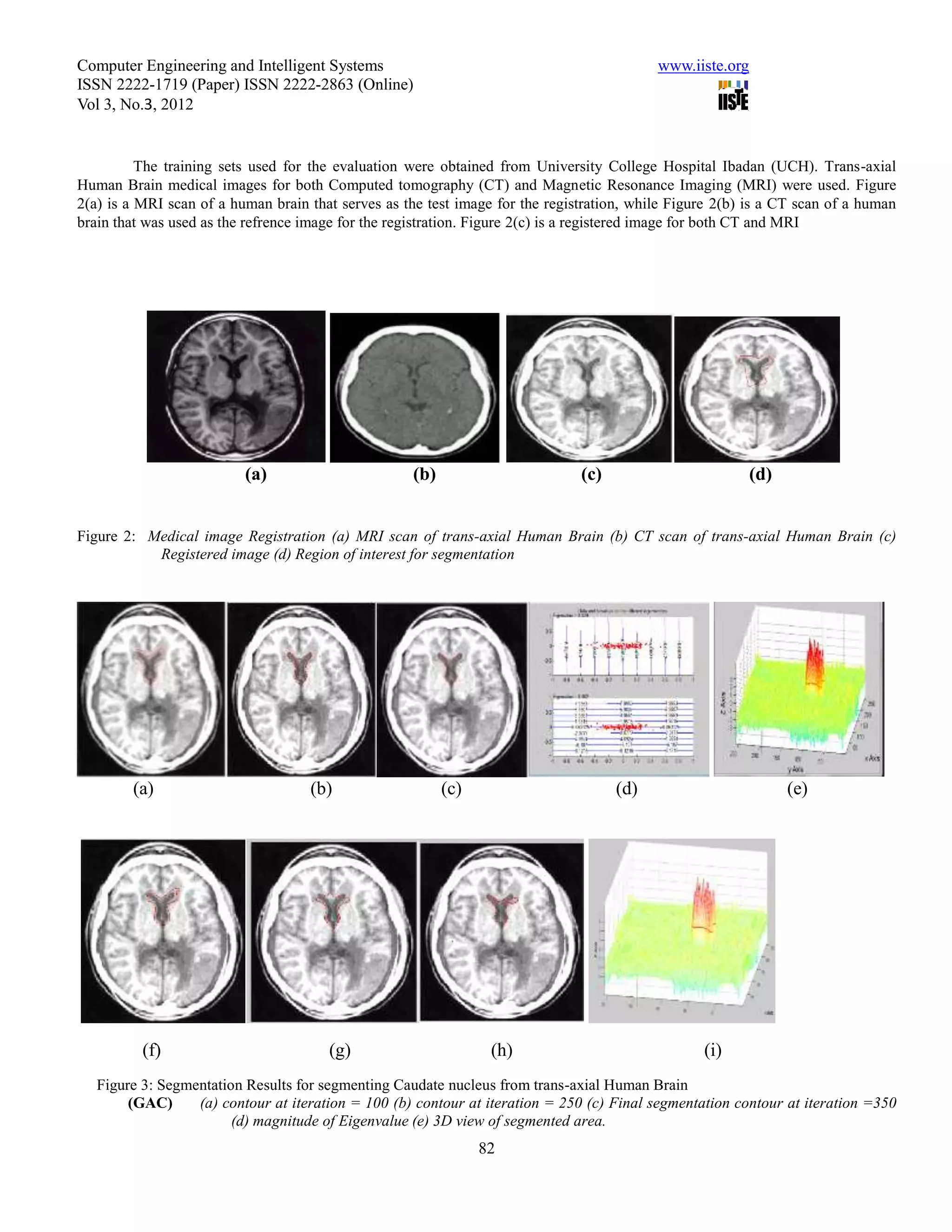
          The training sets used for the evaluation were obtained from University College Hospital Ibadan (UCH). Trans-axial
Human Brain medical images for both Computed tomography (CT) and Magnetic Resonance Imaging (MRI) were used. Figure
2(a) is a MRI scan of a human brain that serves as the test image for the registration, while Figure 2(b) is a CT scan of a human
brain that was used as the refrence image for the registration. Figure 2(c) is a registered image for both CT and MRI


                          (a)                       (b)                        (c)                         (d)


Figure 2: Medical image Registration (a) MRI scan of trans-axial Human Brain (b) CT scan of trans-axial Human Brain (c)
           Registered image (d) Region of interest for segmentation


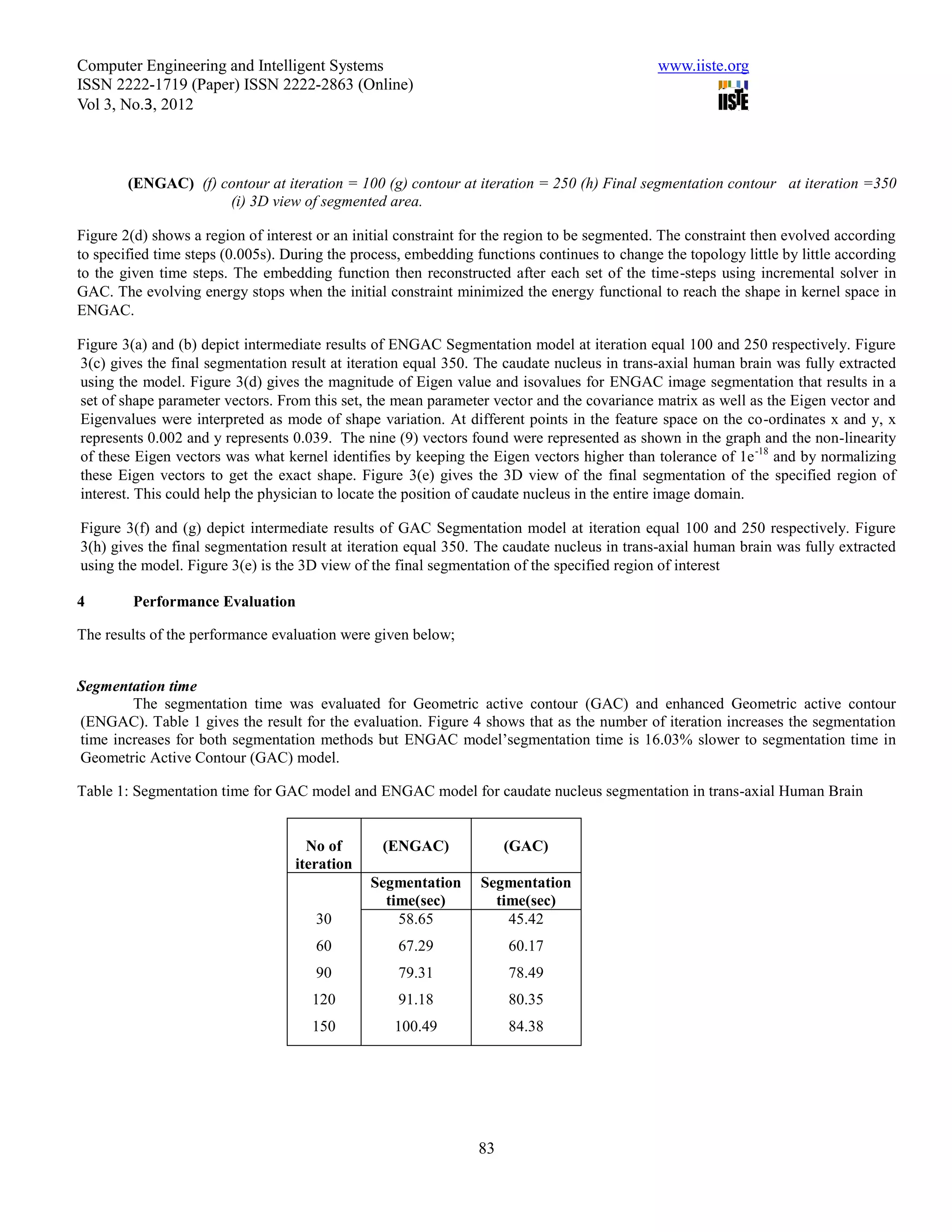
        (a)                         (b)                   (c)                        (d)                         (e)


          (f)                          (g)                       (h)                              (i)
   Figure 3: Segmentation Results for segmenting Caudate nucleus from trans-axial Human Brain
        (GAC)     (a) contour at iteration = 100 (b) contour at iteration = 250 (c) Final segmentation contour at iteration =350
                        (d) magnitude of Eigenvalue (e) 3D view of segmented area.
                                                                82
Computer Engineering and Intelligent Systems                                                  www.iiste.org
ISSN 2222-1719 (Paper) ISSN 2222-2863 (Online)
Vol 3, No.3, 2012


        (ENGAC) (f) contour at iteration = 100 (g) contour at iteration = 250 (h) Final segmentation contour at iteration =350
                     (i) 3D view of segmented area.

Figure 2(d) shows a region of interest or an initial constraint for the region to be segmented. The constraint then evolved according
to specified time steps (0.005s). During the process, embedding functions continues to change the topology little by little according
to the given time steps. The embedding function then reconstructed after each set of the time-steps using incremental solver in
GAC. The evolving energy stops when the initial constraint minimized the energy functional to reach the shape in kernel space in
ENGAC.

Figure 3(a) and (b) depict intermediate results of ENGAC Segmentation model at iteration equal 100 and 250 respectively. Figure
3(c) gives the final segmentation result at iteration equal 350. The caudate nucleus in trans-axial human brain was fully extracted
using the model. Figure 3(d) gives the magnitude of Eigen value and isovalues for ENGAC image segmentation that results in a
set of shape parameter vectors. From this set, the mean parameter vector and the covariance matrix as well as the Eigen vector and
Eigenvalues were interpreted as mode of shape variation. At different points in the feature space on the co-ordinates x and y, x
represents 0.002 and y represents 0.039. The nine (9) vectors found were represented as shown in the graph and the non-linearity
of these Eigen vectors was what kernel identifies by keeping the Eigen vectors higher than tolerance of 1e -18 and by normalizing
these Eigen vectors to get the exact shape. Figure 3(e) gives the 3D view of the final segmentation of the specified region of
interest. This could help the physician to locate the position of caudate nucleus in the entire image domain.

Figure 3(f) and (g) depict intermediate results of GAC Segmentation model at iteration equal 100 and 250 respectively. Figure
3(h) gives the final segmentation result at iteration equal 350. The caudate nucleus in trans-axial human brain was fully extracted
using the model. Figure 3(e) is the 3D view of the final segmentation of the specified region of interest

4        Performance Evaluation

The results of the performance evaluation were given below;


Segmentation time
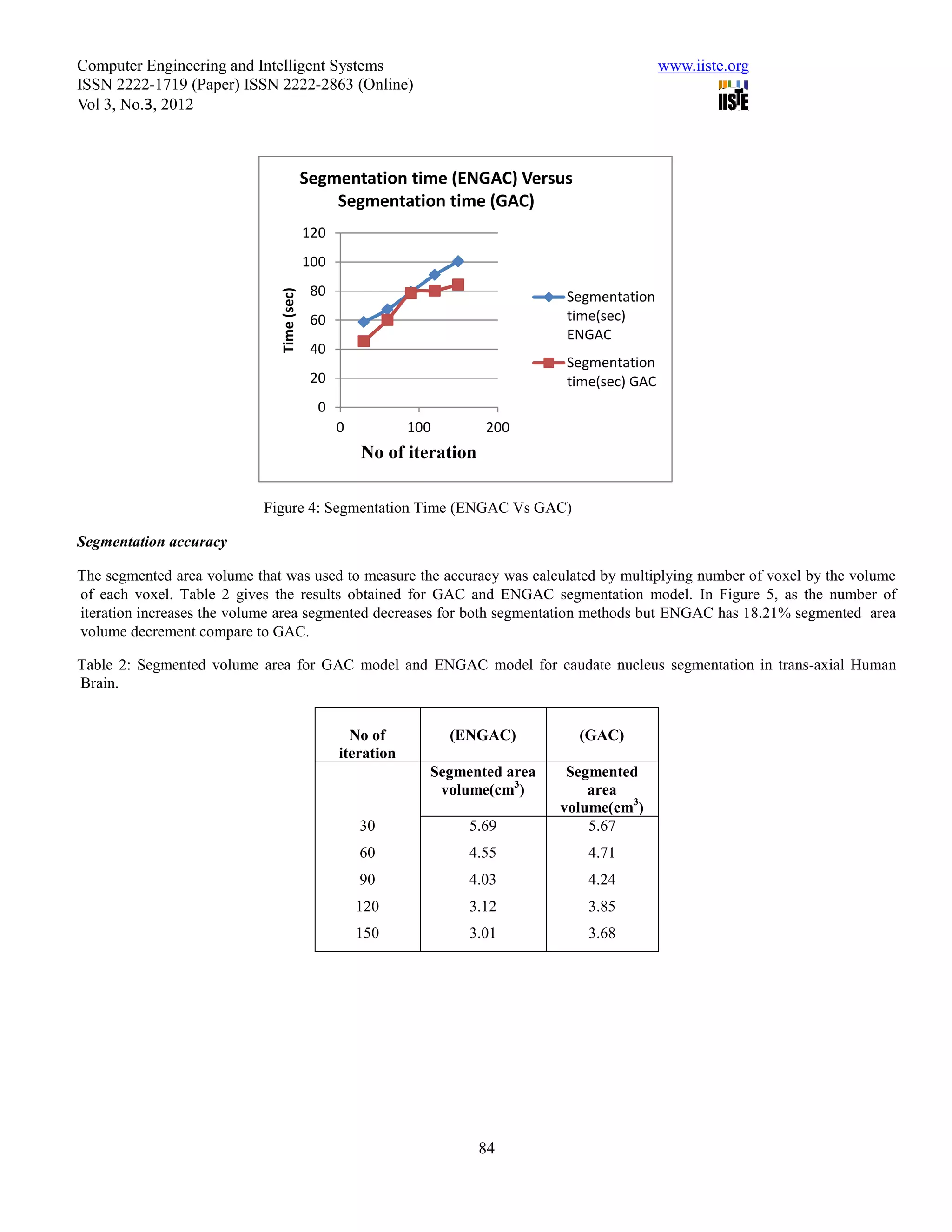
        The segmentation time was evaluated for Geometric active contour (GAC) and enhanced Geometric active contour
(ENGAC). Table 1 gives the result for the evaluation. Figure 4 shows that as the number of iteration increases the segmentation
time increases for both segmentation methods but ENGAC model’segmentation time is 16.03% slower to segmentation time in
Geometric Active Contour (GAC) model.

Table 1: Segmentation time for GAC model and ENGAC model for caudate nucleus segmentation in trans-axial Human Brain


                                     No of       (ENGAC)              (GAC)
                                   iteration
                                               Segmentation      Segmentation
                                                 time(sec)         time(sec)
                                      30           58.65             45.42
                                      60            67.29             60.17
                                      90            79.31             78.49
                                      120           91.18             80.35
                                      150          100.49             84.38


                                                                 83
Computer Engineering and Intelligent Systems                                                    www.iiste.org
ISSN 2222-1719 (Paper) ISSN 2222-2863 (Online)
Vol 3, No.3, 2012


                                           Segmentation time (ENGAC) Versus
                                               Segmentation time (GAC)
                                           120
                                           100
                              Time (sec)    80                                  Segmentation
                                            60                                  time(sec)
                                                                                ENGAC
                                            40
                                                                                Segmentation
                                            20                                  time(sec) GAC
                                             0
                                                 0           100       200
                                                     No of iteration

                            Figure 4: Segmentation Time (ENGAC Vs GAC)

Segmentation accuracy

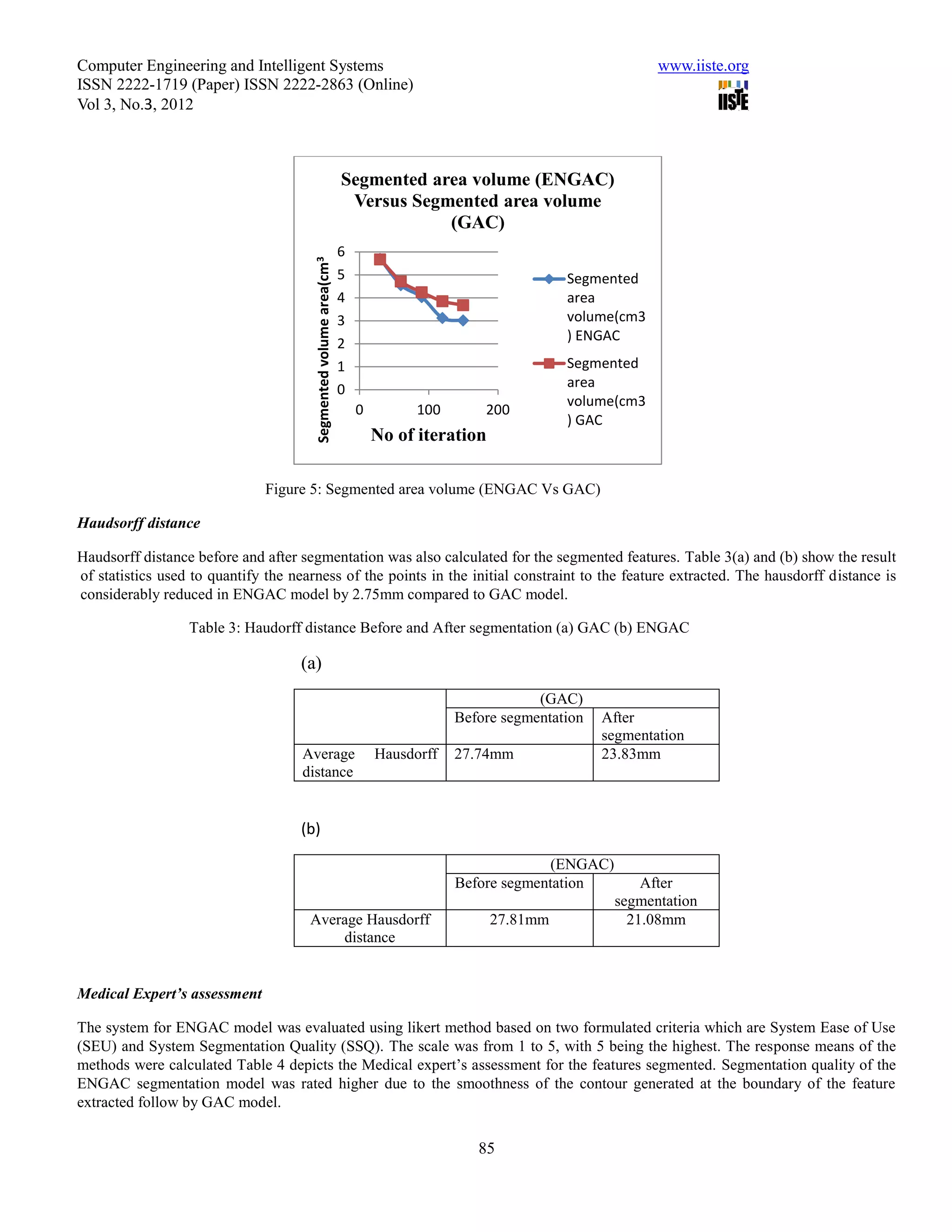
The segmented area volume that was used to measure the accuracy was calculated by multiplying number of voxel by the volume
of each voxel. Table 2 gives the results obtained for GAC and ENGAC segmentation model. In Figure 5, as the number of
iteration increases the volume area segmented decreases for both segmentation methods but ENGAC has 18.21% segmented area
volume decrement compare to GAC.

Table 2: Segmented volume area for GAC model and ENGAC model for caudate nucleus segmentation in trans-axial Human
Brain.


                                                   No of           (ENGAC)        (GAC)
                                                 iteration
                                                               Segmented area    Segmented
                                                                volume(cm3)         area
                                                                                volume(cm3)
                                                     30              5.69           5.67
                                                     60              4.55          4.71
                                                     90              4.03          4.24
                                                     120             3.12          3.85
                                                     150             3.01          3.68


                                                                       84
Computer Engineering and Intelligent Systems                                                                         www.iiste.org
ISSN 2222-1719 (Paper) ISSN 2222-2863 (Online)
Vol 3, No.3, 2012


                                                                   Segmented area volume (ENGAC)
                                                                    Versus Segmented area volume
                                                                               (GAC)
                                                                   6


                                       Segmented volume area(cm3
                                                                   5                                   Segmented
                                                                   4                                   area
                                                                   3                                   volume(cm3
                                                                                                       ) ENGAC
                                                                   2
                                                                   1                                   Segmented
                                                                   0                                   area
                                                                                                       volume(cm3
                                                                       0         100       200
                                                                                                       ) GAC
                                                                           No of iteration

                               Figure 5: Segmented area volume (ENGAC Vs GAC)

Haudsorff distance

Haudsorff distance before and after segmentation was also calculated for the segmented features. Table 3(a) and (b) show the result
of statistics used to quantify the nearness of the points in the initial constraint to the feature extracted. The hausdorff distance is
considerably reduced in ENGAC model by 2.75mm compared to GAC model.

                  Table 3: Haudorff distance Before and After segmentation (a) GAC (b) ENGAC

                                    (a)
                                                                                                   (GAC)
                                                                                       Before segmentation   After
                                                                                                             segmentation
                                     Average                               Hausdorff   27.74mm               23.83mm
                                     distance


                                    (b)

                                                                                                     (ENGAC)
                                                                                       Before segmentation         After
                                                                                                               segmentation
                                      Average Hausdorff                                      27.81mm             21.08mm
                                          distance


Medical Expert’s assessment

The system for ENGAC model was evaluated using likert method based on two formulated criteria which are System Ease of Use
(SEU) and System Segmentation Quality (SSQ). The scale was from 1 to 5, with 5 being the highest. The response means of the
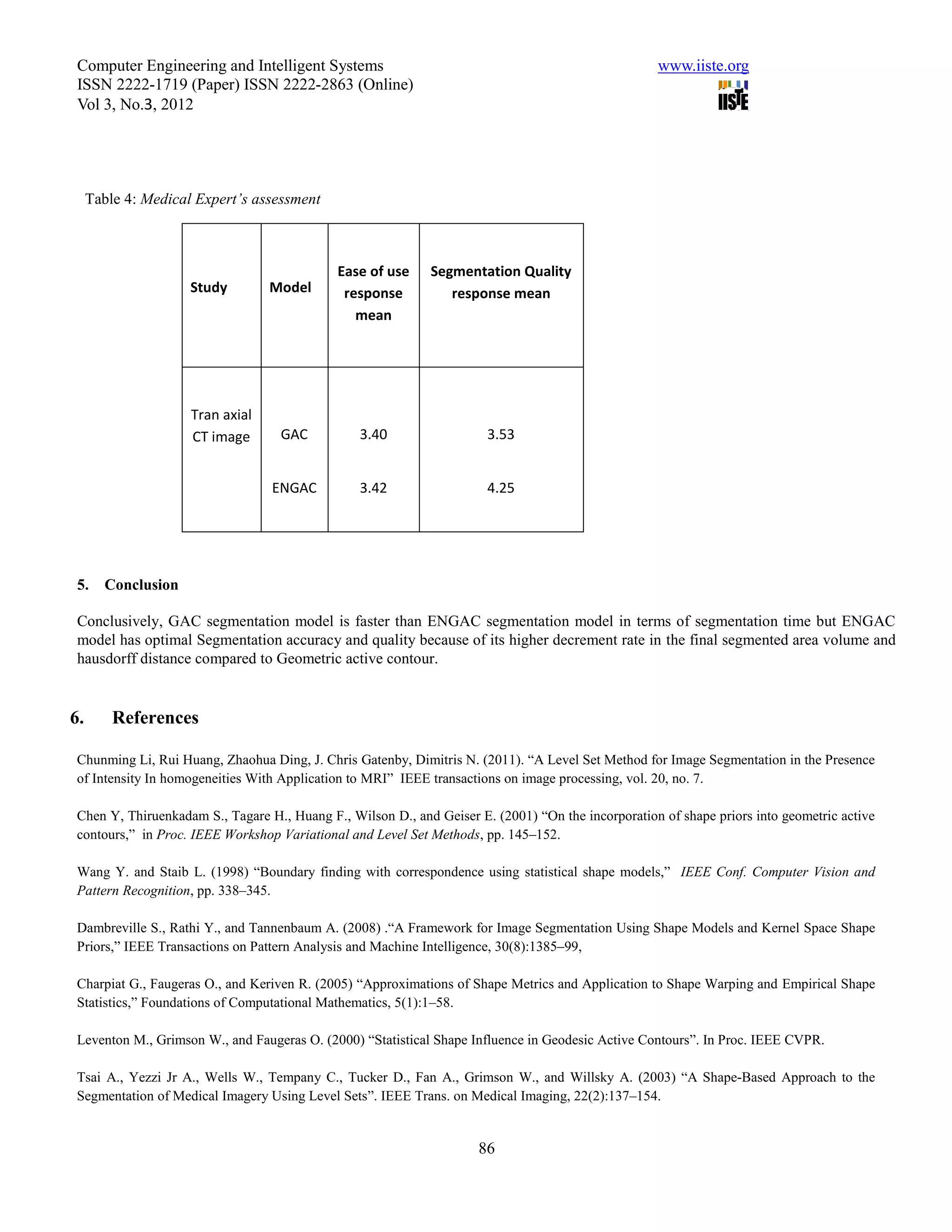
methods were calculated Table 4 depicts the Medical expert’s assessment for the features segmented. Segmentation quality of the
ENGAC segmentation model was rated higher due to the smoothness of the contour generated at the boundary of the feature
extracted follow by GAC model.

                                                                                          85
Computer Engineering and Intelligent Systems                                                      www.iiste.org
 ISSN 2222-1719 (Paper) ISSN 2222-2863 (Online)
 Vol 3, No.3, 2012


     Table 4: Medical Expert’s assessment


                                            Ease of use     Segmentation Quality
                     Study        Model      response          response mean
                                               mean


                     Tran axial
                     CT image      GAC          3.40                  3.53


                                  ENGAC         3.42                  4.25


 5.    Conclusion

 Conclusively, GAC segmentation model is faster than ENGAC segmentation model in terms of segmentation time but ENGAC
 model has optimal Segmentation accuracy and quality because of its higher decrement rate in the final segmented area volume and
 hausdorff distance compared to Geometric active contour.


6.       References

Chunming Li, Rui Huang, Zhaohua Ding, J. Chris Gatenby, Dimitris N. (2011). “A Level Set Method for Image Segmentation in the Presence
of Intensity In homogeneities With Application to MRI” IEEE transactions on image processing, vol. 20, no. 7.

Chen Y, Thiruenkadam S., Tagare H., Huang F., Wilson D., and Geiser E. (2001) “On the incorporation of shape priors into geometric active
contours,” in Proc. IEEE Workshop Variational and Level Set Methods, pp. 145–152.

Wang Y. and Staib L. (1998) “Boundary finding with correspondence using statistical shape models,” IEEE Conf. Computer Vision and
Pattern Recognition, pp. 338–345.

Dambreville S., Rathi Y., and Tannenbaum A. (2008) .“A Framework for Image Segmentation Using Shape Models and Kernel Space Shape
Priors,” IEEE Transactions on Pattern Analysis and Machine Intelligence, 30(8):1385–99,

Charpiat G., Faugeras O., and Keriven R. (2005) “Approximations of Shape Metrics and Application to Shape Warping and Empirical Shape
Statistics,” Foundations of Computational Mathematics, 5(1):1–58.

Leventon M., Grimson W., and Faugeras O. (2000) “Statistical Shape Influence in Geodesic Active Contours”. In Proc. IEEE CVPR.

Tsai A., Yezzi Jr A., Wells W., Tempany C., Tucker D., Fan A., Grimson W., and Willsky A. (2003) “A Shape-Based Approach to the
Segmentation of Medical Imagery Using Level Sets”. IEEE Trans. on Medical Imaging, 22(2):137–154.


                                                                    86
Computer Engineering and Intelligent Systems                                                      www.iiste.org
     ISSN 2222-1719 (Paper) ISSN 2222-2863 (Online)
     Vol 3, No.3, 2012


Osher S. and Sethian J.A. (1988) “Fronts propagating with curvature dependent speed: algorithms based on Hamilton-Jacobi formulation,”
Journal of Computer Physics, vol. (79): 12-49.

Niethammer T. and Allen Tannenbaum (2004) “ Dynamic Geodesic Snakes for Visual Tracking”. Proceedings of the 2004 IEEE Computer
Society Conference on Computer Vision and Pattern Recognition CVPR (4) : 660-667

Xiao Han, Chenyang Xu, and Jerry L. Prince, (2003) “A Topology Preserving Level Set Method for Geometric Deformable Models” IEEE
Transactions on Pattern analysis and Machine intelligence, 25(6):56-70.


                                                                    87
International Journals Call for Paper
The IISTE, a U.S. publisher, is currently hosting the academic journals listed below. The peer review process of the following journals
usually takes LESS THAN 14 business days and IISTE usually publishes a qualified article within 30 days. Authors should
send their full paper to the following email address. More information can be found in the IISTE website : www.iiste.org

Business, Economics, Finance and Management               PAPER SUBMISSION EMAIL
European Journal of Business and Management               EJBM@iiste.org
Research Journal of Finance and Accounting                RJFA@iiste.org
Journal of Economics and Sustainable Development          JESD@iiste.org
Information and Knowledge Management                      IKM@iiste.org
Developing Country Studies                                DCS@iiste.org
Industrial Engineering Letters                            IEL@iiste.org


Physical Sciences, Mathematics and Chemistry              PAPER SUBMISSION EMAIL
Journal of Natural Sciences Research                      JNSR@iiste.org
Chemistry and Materials Research                          CMR@iiste.org
Mathematical Theory and Modeling                          MTM@iiste.org
Advances in Physics Theories and Applications             APTA@iiste.org
Chemical and Process Engineering Research                 CPER@iiste.org


Engineering, Technology and Systems                       PAPER SUBMISSION EMAIL
Computer Engineering and Intelligent Systems              CEIS@iiste.org
Innovative Systems Design and Engineering                 ISDE@iiste.org
Journal of Energy Technologies and Policy                 JETP@iiste.org
Information and Knowledge Management                      IKM@iiste.org
Control Theory and Informatics                            CTI@iiste.org
Journal of Information Engineering and Applications       JIEA@iiste.org
Industrial Engineering Letters                            IEL@iiste.org
Network and Complex Systems                               NCS@iiste.org


Environment, Civil, Materials Sciences                    PAPER SUBMISSION EMAIL
Journal of Environment and Earth Science                  JEES@iiste.org
Civil and Environmental Research                          CER@iiste.org
Journal of Natural Sciences Research                      JNSR@iiste.org
Civil and Environmental Research                          CER@iiste.org


Life Science, Food and Medical Sciences                   PAPER SUBMISSION EMAIL
Journal of Natural Sciences Research                      JNSR@iiste.org
Journal of Biology, Agriculture and Healthcare            JBAH@iiste.org
Food Science and Quality Management                       FSQM@iiste.org
Chemistry and Materials Research                          CMR@iiste.org


Education, and other Social Sciences                      PAPER SUBMISSION EMAIL
Journal of Education and Practice                         JEP@iiste.org
Journal of Law, Policy and Globalization                  JLPG@iiste.org                       Global knowledge sharing:
New Media and Mass Communication                          NMMC@iiste.org                       EBSCO, Index Copernicus, Ulrich's
Journal of Energy Technologies and Policy                 JETP@iiste.org                       Periodicals Directory, JournalTOCS, PKP
Historical Research Letter                                HRL@iiste.org                        Open Archives Harvester, Bielefeld
                                                                                               Academic Search Engine, Elektronische
Public Policy and Administration Research                 PPAR@iiste.org                       Zeitschriftenbibliothek EZB, Open J-Gate,
International Affairs and Global Strategy                 IAGS@iiste.org                       OCLC WorldCat, Universe Digtial Library ,
Research on Humanities and Social Sciences                RHSS@iiste.org                       NewJour, Google Scholar.

Developing Country Studies                                DCS@iiste.org                        IISTE is member of CrossRef. All journals
Arts and Design Studies                                   ADS@iiste.org                        have high IC Impact Factor Values (ICV).

11.performance evaluation of geometric active contour (gac) and enhanced geometric active contour segmentation model (engac) for medical image segmentation

  • 1.
    Computer Engineering andIntelligent Systems www.iiste.org ISSN 2222-1719 (Paper) ISSN 2222-2863 (Online) Vol 3, No.3, 2012 Performance Evaluation of Geometric Active Contour (GAC) and Enhanced Geometric Active Contour Segmentation Model (ENGAC) for Medical Image Segmentation Ajala Funmilola Alaba*, Emuoyibofarhe Justice O Department of Computer Science and Engineering, LAUTECH Ogbomoso, Oyo state, Nigeria. *E-mail of the corresponding author: funfaith2003@yahoo.co.uk. Abstract Segmentation is an aspect of computer vision that deals with partitioning of an image into homogeneneous region. Medical image segmentation is an indispensable tool for medical image diagnoses. Geometric active contour (GAC) segmentation is one of the outstanding model used in machine learning community to solve the problem of medical image segmentation. However, It has problem of deviation from the true outline of the target feature and it generates spurious edge caused by noise that normally stop the evolution of the surface to be extracted. In this paper, enhanced Geometric active contour was formulated by using Kernel Principal Component Analysis(KPCA) with the existing Geometric active contour segmentation model and performance evaluation of the formulated model was carried out. Keyword: Geometric active contour, Segmentation, Medical image, Kernel Principal Component Analysis. 1. Introduction Image segmentation is an aspect of computer vision that deals with the partitioning an image into regions having homogeneous meaning. It is used to separate an object from its background and extracts meaningful objects lying in images either by dividing images into contiguous semantic regions, or by extracting one or more specific objects in images such as medical structures. However, we have different types of image segmentation methods which are not suitable for medical images since medical images are diverse, complex and vary from natural images. Some of the methods used for medical image segmentation fall under deformable models. The use of deformable model was popularized by Kass et al. (1990), snake model was used to develop active contour model that minimizes energy functional under the influence of forces which are internal force, image force and external constraint force. Deformable models can be classified into three categories which are Free-form, Parametric and Geometric active contour model. Geometric active contour model This make use of level set method that represent contour or surfaces as Zero level set of a higher dimensional function usually called a level set function Chunming et al, (2011). Level set can handle topological changes in curve evolution which is not possible with the classical active contour model. Osher and Sethian (1998) offer a natural and numerical implementation of curve evolution equation using level set. Readers are refer to Neithammer and Tannenbum (2004) for some previous work on Geometric active contour model. Xiao et al., (2003) gave the numeric scheme used for GAC model, which is describe in the following equation. Let x= (x, y) denote a point in a curve C which is a member in image domain Ω and let the curve be represented by Lipchitz- continuous function using signed distance function A parameterized differentiable curve C is a differential map . C : a, b      x( p), y( p)  x( p) T (1) 78
  • 2.
    Computer Engineering andIntelligent Systems www.iiste.org ISSN 2222-1719 (Paper) ISSN 2222-2863 (Online) Vol 3, No.3, 2012 The rule that determine how each point C moves starting from initial curve C o is dC P, t   vC P, t , t  dt (2) Where V = vector field that refers to as speed, Ignoring C and V in equation 2 gives dC v dt (3) Equation (2) gives a partial differential equation that determines how curve C evolves and often called flow. Minimized the energy below   E image  , T  H  G (T ) 2      2    H x  G T , I x (4) Where Eimage is the energy that represents distance between the shape of the region defined by the interior of the curve C and the shape G extracted from the image. Effective minimization of the energy in (4) amount to realizing a trade-off between segmented object and the background. Enhanced Geometric Active contour model The enhanced model (ENGAC) was formulated using Kernel Principal Component Analysis (KPCA) and Geometric active contour (GAC) segmentation model. KPCA was used to get shape variability within the Geometric active contour segmentation model. The training set of MRI and CT scan of tran-axial medical images were gotten from University College Hospital, Ibadan, Oyo state. The medical images were registered using appropriate registration method to pre-process the medical images. Figure 1 gives the overview of the enhanced geometric active contour segmentation model. Figure 1: Overview of enhanced Geometric Active Contour model The enhancement process started for the conventional Geometric active contour segmentation model by building Kernel Principal Component Analysis (KPCA) feature space for medical shapes to be extracted and segmented. The steps involves were; 79
  • 3.
    Computer Engineering andIntelligent Systems www.iiste.org ISSN 2222-1719 (Paper) ISSN 2222-2863 (Online) Vol 3, No.3, 2012 (i) Get a training set of registered medical images (ii) Represent the contour of the registered medical images with high dimensional function using signed distance function, such that a point was represented by (Xi ,Xj) where i = 1……N and j = 1…..N (iii) Calculation of mean offset map represented by φ for the points using  1 N  X i , X j N i 1   (5) (iv) The centered kernel was formed for the points this equation K (i,j)=  X i    ,  X j       X i ,  X j   K X i X j  (6) X i   X i    where (v) The centered kernel was decomposed by getting (a) Diagonal matrix that represent Eigen values represented by (α1……αn) (b) Orthonormal matrix that contain Eigen vectors represented by (M i1……MiN) (c) Covariance matrix calculated using C  1 N    Xi , X j  Xi , X j N i 1 T (vi) The Eigenvector of Covariance matrix was computed for the decomposed kernel denoted by   N M ki Vk    Xi i 1  k (7) (vii) Any subsequent projection of element X of the input space I on the KPCA space was denoted by P' X  and the co- ordinate of P'  X  on kth component Vk , was calculated by 1 N Bk  U ki K  X , X i  k i 1 (8) (viii) The projection of   X  onto the subspace spanned by the first l eigenvectors was calculated by l P '   Bk Vk   k 1 (9) The square distance d between   X  and its projection on the KPCA space was denoted by 2 F (ix) d F   X , P'  X     X   P'  X  2 2 (10) To hybridize GAC and Kernel PCA, these are the steps; (i) Perform nonlinear PCA on the constraint SDF using Polynomial kernel function. K o i, j   i ,  j c (11) From equation (11), when c = 2 and the square bracket is opened, c 2 2 i ,  j  i   j   i   j (12) where c= variance parameter. 80
  • 4.
    Computer Engineering andIntelligent Systems www.iiste.org ISSN 2222-1719 (Paper) ISSN 2222-2863 (Online) Vol 3, No.3, 2012 2 i   j = square distance between two SDFs Φi and Φj o = nonlinear mapping corresponding to Polynomial kernel (2) Minimize the energy functional equation below; Eenergy ( x)   xi , Z ' xi  F (13) where F Eenergy denotes the facts that the shape knowledge is expressed as a distance in feature space. x = test shape represented by Signed Distance Function (SDF). using  dx   Eenergy   x Eenergy. F F t d (14) where   g i  ko i ,  j  N  E F c energy i 1 2. Methods of Performance Evaluation The performance evaluations of the models were carried out using the following metrics by Lauren (2001). These metrics were used to evaluate the performance of enhanced Phasewire image segmentation on Livewire image segmentation. (a) Segmentation/Running time This is the time taken to compute the segmentation including the running time of the algorithm or the time spent to perform interactive segmentation. The research was implemented on Compaq Presario CQ60 notebook PC with AMD Athlon Dual-core QL-62 2.00 GHz processor. (b) Segmentation Accuracy The accuracy of the segmentation algorithms is generally based on Volume measurement. This is the volume of segmented feature in the image domain. It is calculated by multiplying number of voxel by the volume of each voxel. (c) Hausdsorff distance This evaluating metric measures the degree of mismatch between the initial constraint and the boundary of the extracted feature. It identifies the point in one set that is the farthest from the other and outputs the distance to the nearest point in the other set. For two sets of points A  a1 ,....., a m and B  b1 ,....., bn the hausdorff distance H(A,B) is defined as; H ( A, B) = max( h( A, B), h(B, A)) Where h(A, B) = max min || a- b || aε A bεB (d) Assessment by the Medical expert. This is the evaluation based on Expert comment on the output of the system. The questionnaire and the system were made available for the Medical expert on the ease of usage and segmentation quality of the output 3 Discussion of Results 81
  • 5.
    Computer Engineering andIntelligent Systems www.iiste.org ISSN 2222-1719 (Paper) ISSN 2222-2863 (Online) Vol 3, No.3, 2012 The training sets used for the evaluation were obtained from University College Hospital Ibadan (UCH). Trans-axial Human Brain medical images for both Computed tomography (CT) and Magnetic Resonance Imaging (MRI) were used. Figure 2(a) is a MRI scan of a human brain that serves as the test image for the registration, while Figure 2(b) is a CT scan of a human brain that was used as the refrence image for the registration. Figure 2(c) is a registered image for both CT and MRI (a) (b) (c) (d) Figure 2: Medical image Registration (a) MRI scan of trans-axial Human Brain (b) CT scan of trans-axial Human Brain (c) Registered image (d) Region of interest for segmentation (a) (b) (c) (d) (e) (f) (g) (h) (i) Figure 3: Segmentation Results for segmenting Caudate nucleus from trans-axial Human Brain (GAC) (a) contour at iteration = 100 (b) contour at iteration = 250 (c) Final segmentation contour at iteration =350 (d) magnitude of Eigenvalue (e) 3D view of segmented area. 82
  • 6.
    Computer Engineering andIntelligent Systems www.iiste.org ISSN 2222-1719 (Paper) ISSN 2222-2863 (Online) Vol 3, No.3, 2012 (ENGAC) (f) contour at iteration = 100 (g) contour at iteration = 250 (h) Final segmentation contour at iteration =350 (i) 3D view of segmented area. Figure 2(d) shows a region of interest or an initial constraint for the region to be segmented. The constraint then evolved according to specified time steps (0.005s). During the process, embedding functions continues to change the topology little by little according to the given time steps. The embedding function then reconstructed after each set of the time-steps using incremental solver in GAC. The evolving energy stops when the initial constraint minimized the energy functional to reach the shape in kernel space in ENGAC. Figure 3(a) and (b) depict intermediate results of ENGAC Segmentation model at iteration equal 100 and 250 respectively. Figure 3(c) gives the final segmentation result at iteration equal 350. The caudate nucleus in trans-axial human brain was fully extracted using the model. Figure 3(d) gives the magnitude of Eigen value and isovalues for ENGAC image segmentation that results in a set of shape parameter vectors. From this set, the mean parameter vector and the covariance matrix as well as the Eigen vector and Eigenvalues were interpreted as mode of shape variation. At different points in the feature space on the co-ordinates x and y, x represents 0.002 and y represents 0.039. The nine (9) vectors found were represented as shown in the graph and the non-linearity of these Eigen vectors was what kernel identifies by keeping the Eigen vectors higher than tolerance of 1e -18 and by normalizing these Eigen vectors to get the exact shape. Figure 3(e) gives the 3D view of the final segmentation of the specified region of interest. This could help the physician to locate the position of caudate nucleus in the entire image domain. Figure 3(f) and (g) depict intermediate results of GAC Segmentation model at iteration equal 100 and 250 respectively. Figure 3(h) gives the final segmentation result at iteration equal 350. The caudate nucleus in trans-axial human brain was fully extracted using the model. Figure 3(e) is the 3D view of the final segmentation of the specified region of interest 4 Performance Evaluation The results of the performance evaluation were given below; Segmentation time The segmentation time was evaluated for Geometric active contour (GAC) and enhanced Geometric active contour (ENGAC). Table 1 gives the result for the evaluation. Figure 4 shows that as the number of iteration increases the segmentation time increases for both segmentation methods but ENGAC model’segmentation time is 16.03% slower to segmentation time in Geometric Active Contour (GAC) model. Table 1: Segmentation time for GAC model and ENGAC model for caudate nucleus segmentation in trans-axial Human Brain No of (ENGAC) (GAC) iteration Segmentation Segmentation time(sec) time(sec) 30 58.65 45.42 60 67.29 60.17 90 79.31 78.49 120 91.18 80.35 150 100.49 84.38 83
  • 7.
    Computer Engineering andIntelligent Systems www.iiste.org ISSN 2222-1719 (Paper) ISSN 2222-2863 (Online) Vol 3, No.3, 2012 Segmentation time (ENGAC) Versus Segmentation time (GAC) 120 100 Time (sec) 80 Segmentation 60 time(sec) ENGAC 40 Segmentation 20 time(sec) GAC 0 0 100 200 No of iteration Figure 4: Segmentation Time (ENGAC Vs GAC) Segmentation accuracy The segmented area volume that was used to measure the accuracy was calculated by multiplying number of voxel by the volume of each voxel. Table 2 gives the results obtained for GAC and ENGAC segmentation model. In Figure 5, as the number of iteration increases the volume area segmented decreases for both segmentation methods but ENGAC has 18.21% segmented area volume decrement compare to GAC. Table 2: Segmented volume area for GAC model and ENGAC model for caudate nucleus segmentation in trans-axial Human Brain. No of (ENGAC) (GAC) iteration Segmented area Segmented volume(cm3) area volume(cm3) 30 5.69 5.67 60 4.55 4.71 90 4.03 4.24 120 3.12 3.85 150 3.01 3.68 84
  • 8.
    Computer Engineering andIntelligent Systems www.iiste.org ISSN 2222-1719 (Paper) ISSN 2222-2863 (Online) Vol 3, No.3, 2012 Segmented area volume (ENGAC) Versus Segmented area volume (GAC) 6 Segmented volume area(cm3 5 Segmented 4 area 3 volume(cm3 ) ENGAC 2 1 Segmented 0 area volume(cm3 0 100 200 ) GAC No of iteration Figure 5: Segmented area volume (ENGAC Vs GAC) Haudsorff distance Haudsorff distance before and after segmentation was also calculated for the segmented features. Table 3(a) and (b) show the result of statistics used to quantify the nearness of the points in the initial constraint to the feature extracted. The hausdorff distance is considerably reduced in ENGAC model by 2.75mm compared to GAC model. Table 3: Haudorff distance Before and After segmentation (a) GAC (b) ENGAC (a) (GAC) Before segmentation After segmentation Average Hausdorff 27.74mm 23.83mm distance (b) (ENGAC) Before segmentation After segmentation Average Hausdorff 27.81mm 21.08mm distance Medical Expert’s assessment The system for ENGAC model was evaluated using likert method based on two formulated criteria which are System Ease of Use (SEU) and System Segmentation Quality (SSQ). The scale was from 1 to 5, with 5 being the highest. The response means of the methods were calculated Table 4 depicts the Medical expert’s assessment for the features segmented. Segmentation quality of the ENGAC segmentation model was rated higher due to the smoothness of the contour generated at the boundary of the feature extracted follow by GAC model. 85
  • 9.
    Computer Engineering andIntelligent Systems www.iiste.org ISSN 2222-1719 (Paper) ISSN 2222-2863 (Online) Vol 3, No.3, 2012 Table 4: Medical Expert’s assessment Ease of use Segmentation Quality Study Model response response mean mean Tran axial CT image GAC 3.40 3.53 ENGAC 3.42 4.25 5. Conclusion Conclusively, GAC segmentation model is faster than ENGAC segmentation model in terms of segmentation time but ENGAC model has optimal Segmentation accuracy and quality because of its higher decrement rate in the final segmented area volume and hausdorff distance compared to Geometric active contour. 6. References Chunming Li, Rui Huang, Zhaohua Ding, J. Chris Gatenby, Dimitris N. (2011). “A Level Set Method for Image Segmentation in the Presence of Intensity In homogeneities With Application to MRI” IEEE transactions on image processing, vol. 20, no. 7. Chen Y, Thiruenkadam S., Tagare H., Huang F., Wilson D., and Geiser E. (2001) “On the incorporation of shape priors into geometric active contours,” in Proc. IEEE Workshop Variational and Level Set Methods, pp. 145–152. Wang Y. and Staib L. (1998) “Boundary finding with correspondence using statistical shape models,” IEEE Conf. Computer Vision and Pattern Recognition, pp. 338–345. Dambreville S., Rathi Y., and Tannenbaum A. (2008) .“A Framework for Image Segmentation Using Shape Models and Kernel Space Shape Priors,” IEEE Transactions on Pattern Analysis and Machine Intelligence, 30(8):1385–99, Charpiat G., Faugeras O., and Keriven R. (2005) “Approximations of Shape Metrics and Application to Shape Warping and Empirical Shape Statistics,” Foundations of Computational Mathematics, 5(1):1–58. Leventon M., Grimson W., and Faugeras O. (2000) “Statistical Shape Influence in Geodesic Active Contours”. In Proc. IEEE CVPR. Tsai A., Yezzi Jr A., Wells W., Tempany C., Tucker D., Fan A., Grimson W., and Willsky A. (2003) “A Shape-Based Approach to the Segmentation of Medical Imagery Using Level Sets”. IEEE Trans. on Medical Imaging, 22(2):137–154. 86
  • 10.
    Computer Engineering andIntelligent Systems www.iiste.org ISSN 2222-1719 (Paper) ISSN 2222-2863 (Online) Vol 3, No.3, 2012 Osher S. and Sethian J.A. (1988) “Fronts propagating with curvature dependent speed: algorithms based on Hamilton-Jacobi formulation,” Journal of Computer Physics, vol. (79): 12-49. Niethammer T. and Allen Tannenbaum (2004) “ Dynamic Geodesic Snakes for Visual Tracking”. Proceedings of the 2004 IEEE Computer Society Conference on Computer Vision and Pattern Recognition CVPR (4) : 660-667 Xiao Han, Chenyang Xu, and Jerry L. Prince, (2003) “A Topology Preserving Level Set Method for Geometric Deformable Models” IEEE Transactions on Pattern analysis and Machine intelligence, 25(6):56-70. 87
  • 11.
    International Journals Callfor Paper The IISTE, a U.S. publisher, is currently hosting the academic journals listed below. The peer review process of the following journals usually takes LESS THAN 14 business days and IISTE usually publishes a qualified article within 30 days. Authors should send their full paper to the following email address. More information can be found in the IISTE website : www.iiste.org Business, Economics, Finance and Management PAPER SUBMISSION EMAIL European Journal of Business and Management EJBM@iiste.org Research Journal of Finance and Accounting RJFA@iiste.org Journal of Economics and Sustainable Development JESD@iiste.org Information and Knowledge Management IKM@iiste.org Developing Country Studies DCS@iiste.org Industrial Engineering Letters IEL@iiste.org Physical Sciences, Mathematics and Chemistry PAPER SUBMISSION EMAIL Journal of Natural Sciences Research JNSR@iiste.org Chemistry and Materials Research CMR@iiste.org Mathematical Theory and Modeling MTM@iiste.org Advances in Physics Theories and Applications APTA@iiste.org Chemical and Process Engineering Research CPER@iiste.org Engineering, Technology and Systems PAPER SUBMISSION EMAIL Computer Engineering and Intelligent Systems CEIS@iiste.org Innovative Systems Design and Engineering ISDE@iiste.org Journal of Energy Technologies and Policy JETP@iiste.org Information and Knowledge Management IKM@iiste.org Control Theory and Informatics CTI@iiste.org Journal of Information Engineering and Applications JIEA@iiste.org Industrial Engineering Letters IEL@iiste.org Network and Complex Systems NCS@iiste.org Environment, Civil, Materials Sciences PAPER SUBMISSION EMAIL Journal of Environment and Earth Science JEES@iiste.org Civil and Environmental Research CER@iiste.org Journal of Natural Sciences Research JNSR@iiste.org Civil and Environmental Research CER@iiste.org Life Science, Food and Medical Sciences PAPER SUBMISSION EMAIL Journal of Natural Sciences Research JNSR@iiste.org Journal of Biology, Agriculture and Healthcare JBAH@iiste.org Food Science and Quality Management FSQM@iiste.org Chemistry and Materials Research CMR@iiste.org Education, and other Social Sciences PAPER SUBMISSION EMAIL Journal of Education and Practice JEP@iiste.org Journal of Law, Policy and Globalization JLPG@iiste.org Global knowledge sharing: New Media and Mass Communication NMMC@iiste.org EBSCO, Index Copernicus, Ulrich's Journal of Energy Technologies and Policy JETP@iiste.org Periodicals Directory, JournalTOCS, PKP Historical Research Letter HRL@iiste.org Open Archives Harvester, Bielefeld Academic Search Engine, Elektronische Public Policy and Administration Research PPAR@iiste.org Zeitschriftenbibliothek EZB, Open J-Gate, International Affairs and Global Strategy IAGS@iiste.org OCLC WorldCat, Universe Digtial Library , Research on Humanities and Social Sciences RHSS@iiste.org NewJour, Google Scholar. Developing Country Studies DCS@iiste.org IISTE is member of CrossRef. All journals Arts and Design Studies ADS@iiste.org have high IC Impact Factor Values (ICV).