Computer Engineering and Intelligent Systems                                                  www.iiste.org
ISSN 2222-1719 (Paper) ISSN 2222-2863 (Online)
Vol 3, No.3, 2012


  Optimal Nonlocal means algorithm for denoising ultrasound
                           image
        Md. Motiur Rahman 1 , Md. Gauhar Arefin1*, Mithun Kumar PK.1 ,         Dr. Md. Shorif Uddin2


           1.    Dept. of Computer Science & Engineering , Mawlana Bhashani Science and Technology
                                    University, Santosh, Tangail-1902, Bangladesh
        2.      Dept. of Computer Science & Engineering , Jahangirnagar University, Savar, Dhaka-1342 ,
                                                     Bangladesh
             * E-mail: garefin005@gmail.com


Abstract
We propose a new measure for denoising image by calculating mean distance of all pixels in an image in
non-local means (NL-means) algorithm. We compute and analyze the original NL-means algorithm which
total all the distance of the patches but, our proposed algorithm calculates the mean value of all distance of
all the patches and then than get the sum of all distance. Our proposed algorithm exhibit better result with
comparison of the existing NL-means algorithm.


Keywords: NL-means, Patches, Mean Value, Measurement Matrix.


1. Introduction
Non-local means algorithm systematically use all possible self-predictions that an image can be provided
[1]. But local filters or frequency domain filters are not avail to do that. Non-Local means (NL-means)
approach introduced by Buades et al. to denoise 2D natural images corrupted by an additive white Gaussian
noise [2]. NL-means filter normally calculate the total patch distances of the image, computed a weighted
average of all the pixels in the image and denoise the image [1][3]. We propose a method that could
denoise the image by calculating mean value of all patch distances of the image and denoise the image
better than previous filter.


  The aim is to recover the original image from a noisy measurement,


                                                 v(i) = u(i) + n(i)   …     ……………(1)


where, v(i) is the result value, u(i) is the “original” value and n(i) is the noise perturbation at a pixel i.
The best way to model the effect of noise on a digital image is to add some gaussian white noise. In that
case, n(i) are i.i.d. Gaussian values with zero mean and variance σ2 [2].


    The denoising methods must not change the original image. But, for the better understanding of an
image those method allows to loss data to reduce the noise from the image [4]. Human vision can only
understand the better recognition of the intensity of the pixel value of an image [5][6]. That’s why, the
propose method is allows calculate mean patch distances, avoiding the total patch distances.

                                                     56
Computer Engineering and Intelligent Systems                                                                   www.iiste.org
ISSN 2222-1719 (Paper) ISSN 2222-2863 (Online)
Vol 3, No.3, 2012


Section II. gives the introduction of the NL-means algorithm. Section III. discuses the NL-means algorithm
with mean distance calculation of pixel neighborhoods [7]. Section IV. compare the performance of the
NL-means algorithm and proposed NL-mean algorithm.


2. Non-Local Means Algorithm

2.1.   Non local means
Recently, a new patch-based non local recovery paradigm has been proposed by Buades et al [2]. This new
paradigm replaces the local comparison of pixels by the non local comparison of patches. The current pixel
does not depend on the distance between neither spatial distances nor in intensity distance. NL-means filter
analyzes the patterns around the pixels.


2.2 Algorithm

In the actual NL-means algorithm filter the restored intensity NL(u)(xi) of pixel xiЄΩdim, is the weighted
average of all the pixel intensities u(xi) in the image Ωdim (a bounded
           dim         dim
domain Ω         ⊆ R         ):

                       NL (u )( x ) =         ∑ W ( xi , x j )u ( x j )......... .......... ..(12 )
                                                                           ………….…….(2
                                           x j ∈Ω
                                               dim


where the family of weights {w(xi,xj)}j depend on the similarity between the pixels xi and xj and satisfy the
usual conditions 0 ≤ w(xi, xj) ≤ 1 and w(xi,xj)=1. The weight evaluates the similarity between the intensities
of the local neighborhoods (patches) Ni and Nj centered on pixels xi and xj.

                                                                                                   2
For each pixel xj in ∆i, the Gaussian-weighted Euclidean distance ║.║ 2 ,a is computed between the two
patches u(Nj) and u(Ni) of image as explained in [8]. This distance is the traditional L2-norm convolved
with a Gaussian kernel of standard deviation a. The kernel is used to assign spatial weights to the patch
elements. The central pixels in the patch contribute more to the distance than the pixels surrounded of the
central pixel.


 The weights w(xi, xj) are then computed as follows:

                                                    ||u ( N i ) − u ( N j )||2,a
                                                                             2
                                      1
                  W ( xi , x j ) =         exp−                     2
                                                                                   ..................(13)
                                                                                      …………..(3)
                                      Zi                        h


 where Zi is the normalizing constant and h acts as a filtering parameter controlling the decay of the
exponential function.
                                                  || u ( N i ) − u ( N j ) || 2 ,a
                                                        2
                                           1
                         W ( x i , x j i =∑ exp −
                                   Z) = exp                       2
                                                                                   .......... ........( 13 )
                                                                                        ……….....(4)
                                           Zi                   h


                                                                        57
Computer Engineering and Intelligent Systems                                                  www.iiste.org
ISSN 2222-1719 (Paper) ISSN 2222-2863 (Online)
Vol 3, No.3, 2012

 The NL-means not only compares the gray level in a single point but also compute the geometrical
configurations of whole neighborhoods [4]. Fig. 1 showing this fact, the pixel q3 has the same gray level
value of pixel p, but the neighborhoods are much different and therefore the weight w(p, q3) is nearly
zero[9][10].


3. NL-means algorithm with mean distance calculation

In previous section we discuss about the original algorithm of NL-means. In the equation (2) it estimated
value NL(u)(xi), for a pixel xi, is computed as a weighted average of all the pixels in the image. In this
proposed algorithm of NL-means we determinate the value NL(u)(xi), for a pixel xi, is calculate weighted
mean distance of all the pixels in the image. The proposed algorithm is only compute the mean distances of
the neighborhoods, total all the distances and then it averaged all the weights of neighborhoods.


In NL-means the current pixel does not depend on the distance between neither spatial distances nor in
intensity distance. This filter analyzes the patterns around the pixels. The similarity between two pixels xi
and xj depends on the similarity of the intensity gray level vectors u(Ni ) and u(Nj), where Nk denotes a
square neighborhood of fixed size and centered at a pixel k [3]. This similarity is determinate as a
decreasing function of the weighted Euclidean distance, of equation (3), where a>0 is the standard
deviation of the Gaussian kernel. In the distance calculation we compute mean distance of all
neighborhoods and then calculate the total of all distances.


      Figure 1:   Similar neighborhoods pixels give a large weight, w(p,q1) and w(p,q2), while much
                           different neighborhoods give a small weight w(p,q3).


                                Mean ( ||u(Ni)−u(N j)||2,a ) * size(patch)
                                                        2
                                 1
                      W(xi , x j) = exp−        2
                                                          ..........
                                                                   ........( )
                                                                           13
                                 Zi            h
                                                       58
Computer Engineering and Intelligent Systems                                                  www.iiste.org
ISSN 2222-1719 (Paper) ISSN 2222-2863 (Online)
Vol 3, No.3, 2012


After calculating the mean distance of the intensities of the local neighborhoods (patches) Ni and Nj
centered on pixels xi and xj, it need to multiply with the size of local neighborhood, because it need to have
actual distances of all neighborhoods.


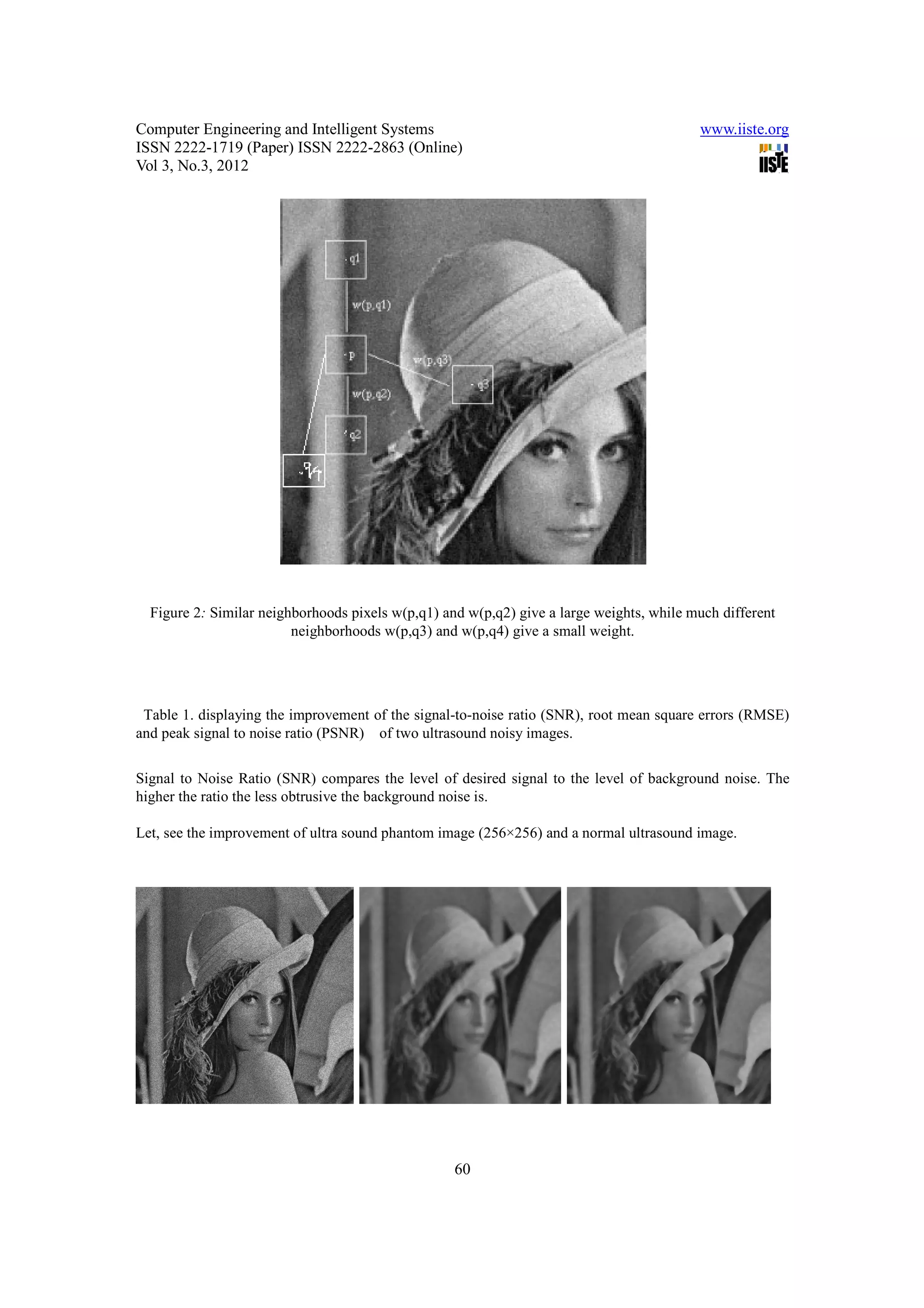
From Figure 2. we can read the pixel q4 has the same gray level value of pixel p, but it’s neighborhoods
make the w(p,q4) is smaller weighted. Here our propose NL-means algorithm turn the q4 pixel intensity
less and q3 pixel intensity high [11]. That’s why visually the image is more readable and it makes the noise
removed.


The original NL-means algorithm donoises an image by smoothing and calculating the total distances of
neighborhoods [4]. It improves the visibility of an image than local filters. But the propose algorithm
compute the mean distance of all neighborhoods, then calculate the total and makes the image more visible
and more easily edge detectable [10].


4.   Performance and analysis
 In this section we will compare NL-means algorithm and proposed algorithm under three well defined
criteria: the noise removing, the visual quality of the restored image and the mean square error, that is, the
Euclidean difference between the restored and original images [5][12].


 For programming and calculation purposes of the NL-means algorithm, in a larger “search window” of
size S×S pixels we restrict the search of similar windows [13]. In all the experimentation we have fixed a
similarity square neighborhood Ni of 5×5 pixels and a search window of 11×11 pixels. If N2 is the number
of pixels of the image, then the final complexity of the algorithm is about 25 × 121 × N2 [3].


 Large Euclidean distances lead to nearly zero weights acting as an automatic threshold because the fast
decay of the exponential kernel.


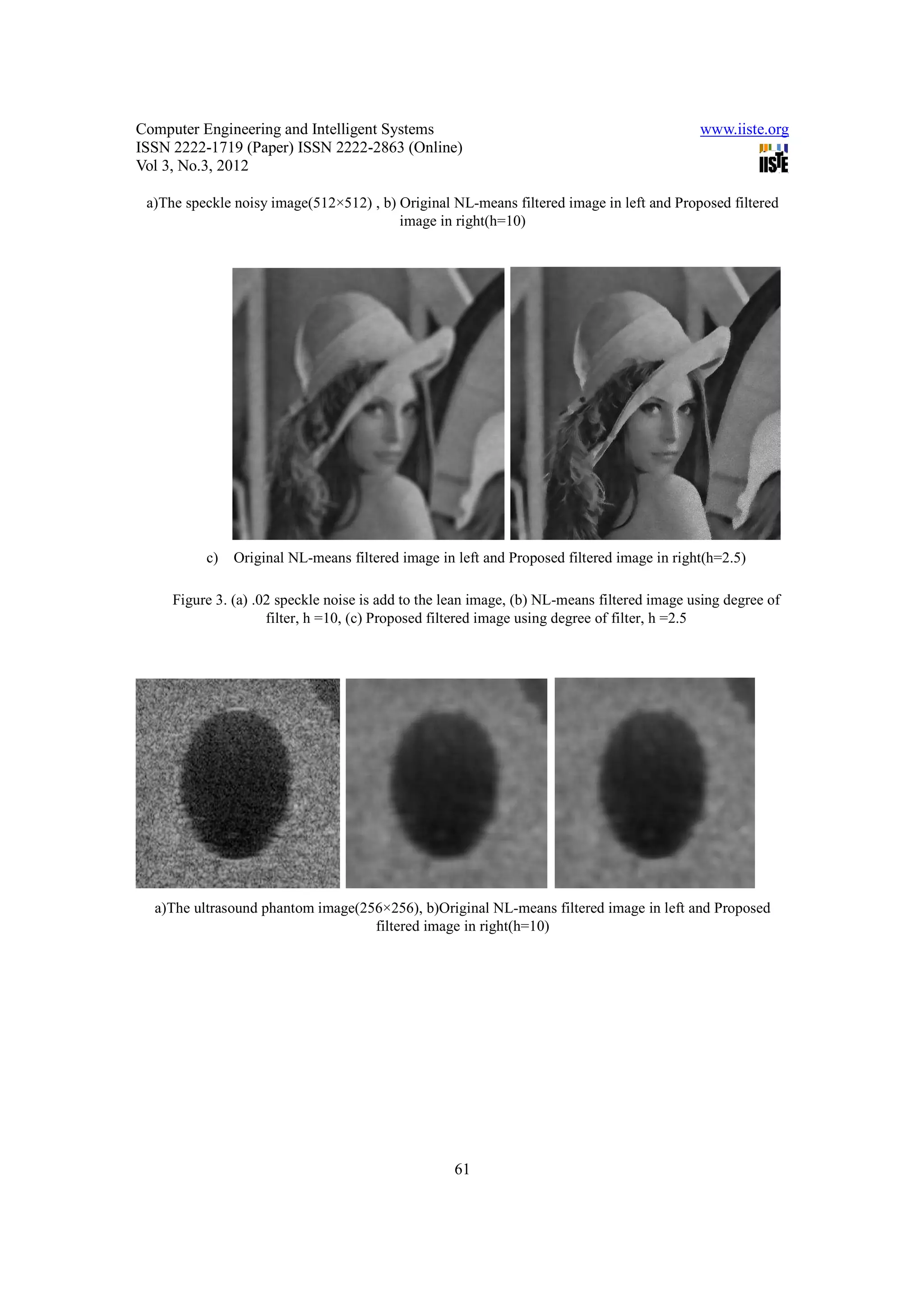
These formulas are corroborated by the visual experiments of Figure 3. This figure displays the visual
different
between those methods for the standard image Lena(512 x 512). In this figure we can identify the
NL-means filter reduce the noise and blur the image and the propose filter reduce the noise [4], blur the
image and detected some edges of the image. It makes the image quality increase and more suitable for
human eyes.


                                                     59
Computer Engineering and Intelligent Systems                                              www.iiste.org
ISSN 2222-1719 (Paper) ISSN 2222-2863 (Online)
Vol 3, No.3, 2012


  Figure 2: Similar neighborhoods pixels w(p,q1) and w(p,q2) give a large weights, while much different
                         neighborhoods w(p,q3) and w(p,q4) give a small weight.


 Table 1. displaying the improvement of the signal-to-noise ratio (SNR), root mean square errors (RMSE)
and peak signal to noise ratio (PSNR) of two ultrasound noisy images.


Signal to Noise Ratio (SNR) compares the level of desired signal to the level of background noise. The
higher the ratio the less obtrusive the background noise is.

Let, see the improvement of ultra sound phantom image (256×256) and a normal ultrasound image.


                                                   60
Computer Engineering and Intelligent Systems                                                www.iiste.org
ISSN 2222-1719 (Paper) ISSN 2222-2863 (Online)
Vol 3, No.3, 2012

 a)The speckle noisy image(512×512) , b) Original NL-means filtered image in left and Proposed filtered
                                         image in right(h=10)


          c)   Original NL-means filtered image in left and Proposed filtered image in right(h=2.5)

     Figure 3. (a) .02 speckle noise is add to the lean image, (b) NL-means filtered image using degree of
                     filter, h =10, (c) Proposed filtered image using degree of filter, h =2.5


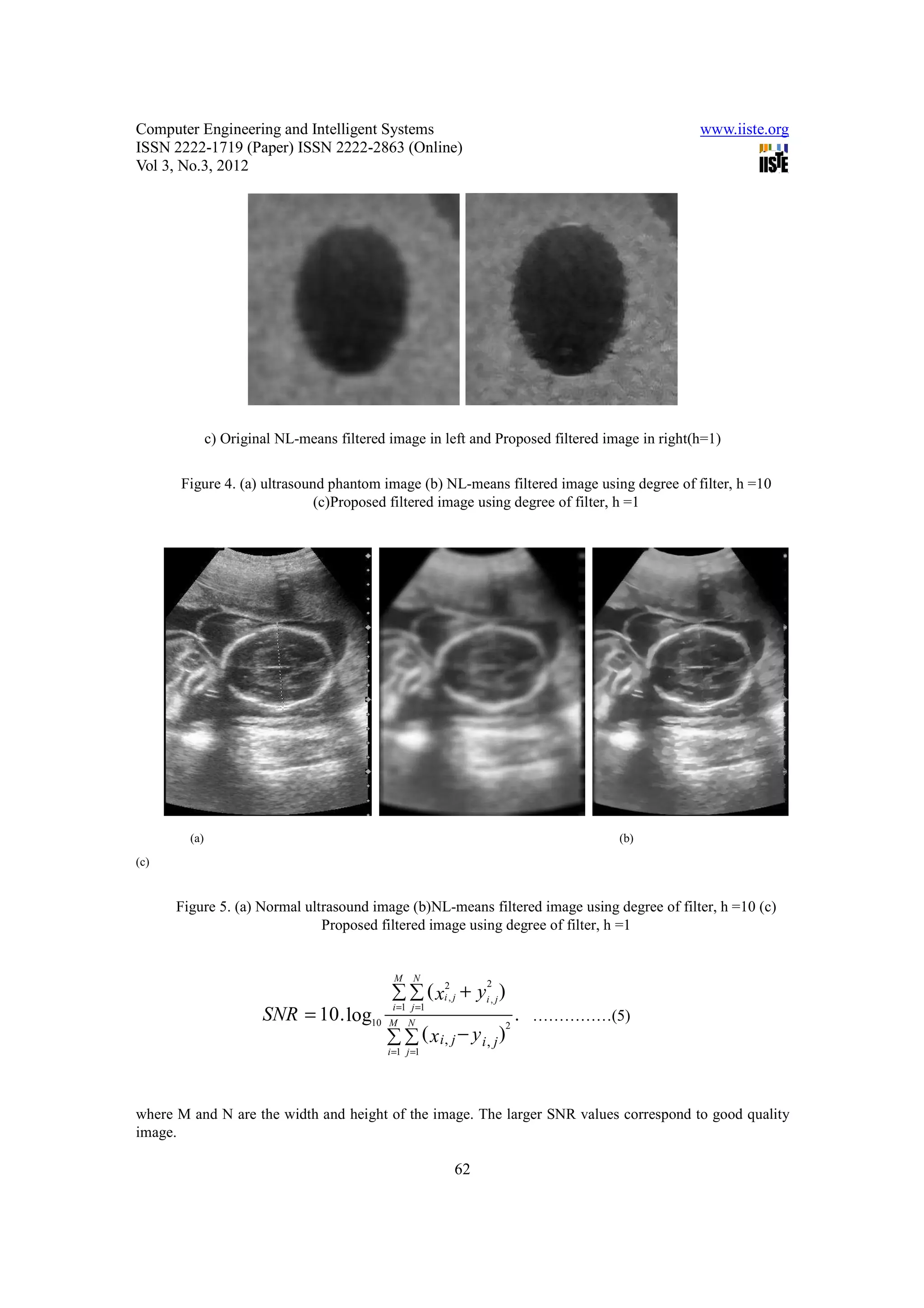
  a)The ultrasound phantom image(256×256), b)Original NL-means filtered image in left and Proposed
                                   filtered image in right(h=10)


                                                   61
Computer Engineering and Intelligent Systems                                                                     www.iiste.org
ISSN 2222-1719 (Paper) ISSN 2222-2863 (Online)
Vol 3, No.3, 2012


              c) Original NL-means filtered image in left and Proposed filtered image in right(h=1)

      Figure 4. (a) ultrasound phantom image (b) NL-means filtered image using degree of filter, h =10
                             (c)Proposed filtered image using degree of filter, h =1


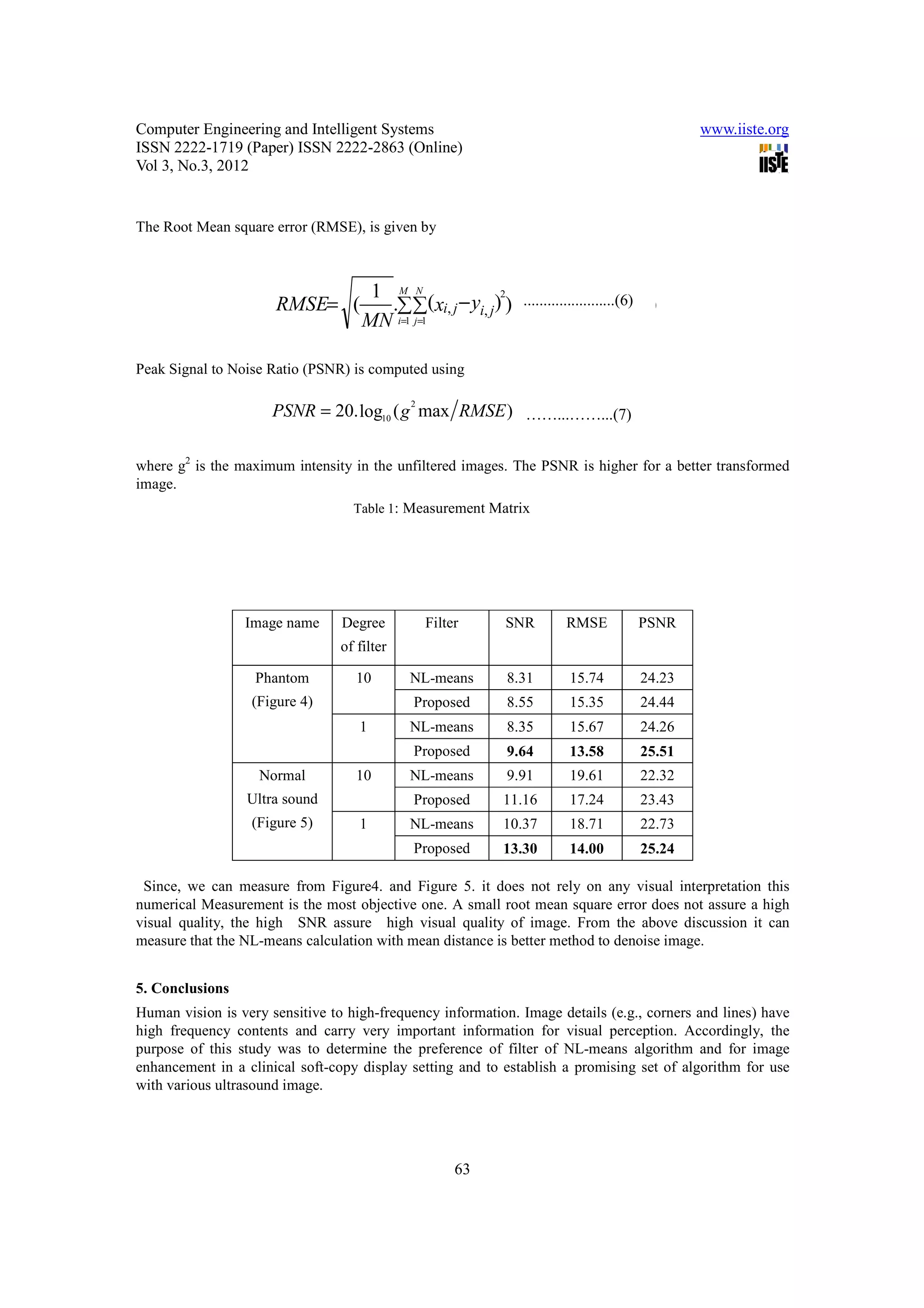
        (a)                                                                                    (b)
(c)


      Figure 5. (a) Normal ultrasound image (b)NL-means filtered image using degree of filter, h =10 (c)
                              Proposed filtered image using degree of filter, h =1


                                             M     N
                                             ∑ ∑ ( xi2, j + yi , j )
                                                                2

                                             i =1 j =1
                       SNR = 10 . log10     M    N
                                                                           .......... .......... ........(16 )
                                                                               ……………(5)
                                            ∑ ∑ ( xi, j − y i, j )
                                                                       2

                                            i =1 j =1


where M and N are the width and height of the image. The larger SNR values correspond to good quality
image.

                                                         62
Computer Engineering and Intelligent Systems                                                   www.iiste.org
ISSN 2222-1719 (Paper) ISSN 2222-2863 (Online)
Vol 3, No.3, 2012


The Root Mean square error (RMSE), is given by


                                      1 MN
                      RMSE= (           .∑∑(xi, j − yi, j) ).........
                                                          2
                                                              .......................(6)17)
                                                                     .......... .......(
                                     MN i=1 j=1

Peak Signal to Noise Ratio (PSNR) is computed using

                      PSNR = 20. log10 ( g max RMSE )........................(18)
                                             2
                                                        ……...……...(7)


where g2 is the maximum intensity in the unfiltered images. The PSNR is higher for a better transformed
image.
                                   Table 1: Measurement Matrix


                 Image name      Degree          Filter        SNR        RMSE         PSNR
                                 of filter

                   Phantom          10       NL-means          8.31        15.74       24.23
                  (Figure 4)                  Proposed         8.55        15.35       24.44
                                    1        NL-means          8.35        15.67       24.26
                                              Proposed         9.64        13.58       25.51
                    Normal          10       NL-means          9.91        19.61       22.32
                  Ultra sound                 Proposed        11.16        17.24       23.43
                  (Figure 5)        1        NL-means         10.37        18.71       22.73
                                              Proposed        13.30        14.00       25.24

 Since, we can measure from Figure4. and Figure 5. it does not rely on any visual interpretation this
numerical Measurement is the most objective one. A small root mean square error does not assure a high
visual quality, the high SNR assure high visual quality of image. From the above discussion it can
measure that the NL-means calculation with mean distance is better method to denoise image.


5. Conclusions
Human vision is very sensitive to high-frequency information. Image details (e.g., corners and lines) have
high frequency contents and carry very important information for visual perception. Accordingly, the
purpose of this study was to determine the preference of filter of NL-means algorithm and for image
enhancement in a clinical soft-copy display setting and to establish a promising set of algorithm for use
with various ultrasound image.


                                                      63
Computer Engineering and Intelligent Systems                                                 www.iiste.org
ISSN 2222-1719 (Paper) ISSN 2222-2863 (Online)
Vol 3, No.3, 2012


References


Pierrick Coup´e1,2,4, Pierre Hellier1,2,4, Charles Kervrann3,5 and Christian      Barillot 1, 2,
     4(2009),“NonLocal Means-based Speckle Filtering for Ultrasound Images”,“IEEE Transactions on
     Image Processing 2009;18(10):2221-9", DOI :10.1109/TIP.2024064.
A. Buades, B. Coll, and J. M. Morel(2005) “A review of image denoising algorithms, with a new one,”
    Multiscale Modeling & Simulation, vol. 4, no. 2, pp. 490–530.
B. Coll and J.-M. Morel(2004), "A non-local algorithm for image denoising", SIAM J. Multiscale Model.
    Simul., vol. 4, pp. 490 .
A. Buades, B. Coll, and J. Morel(2004). On image denoising methods. Technical Report 2004-15, CMLA.
Z. Wang, A. C. Bovik, H. R. Sheikh, and E. P. Simoncelli(2004), "Image quality assessment: From error
    visibility to structural similarity", IEEE Transactios on Image Processing, vol. 13, no. 4, pp. 600-612,
    Apr. 2004
R C Gonzalez, and R E Woods(2002), “Digital Image Processing”, Pearson Education, India.
A. Buades, B. Coll, and J. Morel(2005). Neighborhood filters and pde’s. Technical Report 2005-04,
   CMLA.
H.Q. Luong, A. Ledda, and W. Philips(2006),“Non-local                  image    interpolation,”   in   IEEE
   InternationalConferenceonImageProcessing,pp.693–696.
D. Donoho(1995). De-noising by soft-thresholding. IEEE Transactions on Information Theory,
   41:613–627.
S Sudha , GR Suresh , R Sukanesh (2009), “Speckle Noise Reduction in Ultrasound Images Using
   Context-based Adaptive Wavelet Thresholding”, IETE Journal of Research, Volume: 55, Issue:
   3, Page: 135-143.
S W Smith, and H Lopez(1982), “A contrast-detail analysis of diagnostic    ultrasound imaging”, Med. Phy,
   Vol. 9, pp. 4-12.
J.S.Lee(1980),“Digital image enhancement and noise filtering by use of local statistics,” IEEET
     ransactionson Pattern Analysis and Machine Intelligence, vol.2, pp.165 168. [Online]. Available:
     http://adsabs.harvard.edu/cgi-bin/nph-bibquery?bibcode=1980ITPAM...2..165L
Tay, P.C. Acton, S.T. Hossack, J.A.(2006) “Ultrasound despeckling using an adaptive window stochastic
    approach,” in       IEEE International Conferenceon Image Processing,pp.2549–2552. [Online].
    Available: http://ieeexplore.ieee.org/xpls/ abs all.jsp?arnumber=4107088


Authors

Md. Motiur Rahman           received the B.Sc Engg. & M.S degree in Computer Science & Engineering
from Jahangir Nagar University,Dhaka, Bangladesh, in 1995 & 2001, Where he is currently pursuing the
Ph.D. degree. His research interests include digital image processing, medical image processing,
computer vision & digital electronics.


Md. Gauhar Arefin was born in Nilphamari, Bangladesh in 1990. Currently he is the student of the
department of Computer Science & Engineering in Mawlana Bhashani Science & Technology University,


                                                    64
Computer Engineering and Intelligent Systems                                            www.iiste.org
ISSN 2222-1719 (Paper) ISSN 2222-2863 (Online)
Vol 3, No.3, 2012

Santosh, Tangail, Bangladesh. His research interests include image analysis, image processing & medical
image processing, 3D visualization.


Mithun Kumar PK. was born in Rajshahi, Bangladesh in 1989. Currently he is the student of the
department of Computer Science & Engineering in Mawlana Bhashani Science & Technology University,
Santosh, Tangail, Bangladesh. His research interests include image analysis, image processing & medical
image processing, 3D visualization, Segmentation, Filter Optimization.


Dr. Mohammad Shorif Uddin is currently working in Department of Computer Science and Engineering,
Jahangirnagar University, Dhaka, Bangladesh. His research is focused on bioimaging and image analysis,
computer vision, pattern recognition, blind navigation, medical diagnosis, and disaster prevention. He
published many papers in renowned journals like IEEE, ELESVIER,IET, OPTICAL SOCIETY OF
AMERICA etc.


                                                  65
International Journals Call for Paper
The IISTE, a U.S. publisher, is currently hosting the academic journals listed below. The peer review process of the following journals
usually takes LESS THAN 14 business days and IISTE usually publishes a qualified article within 30 days. Authors should
send their full paper to the following email address. More information can be found in the IISTE website : www.iiste.org

Business, Economics, Finance and Management               PAPER SUBMISSION EMAIL
European Journal of Business and Management               EJBM@iiste.org
Research Journal of Finance and Accounting                RJFA@iiste.org
Journal of Economics and Sustainable Development          JESD@iiste.org
Information and Knowledge Management                      IKM@iiste.org
Developing Country Studies                                DCS@iiste.org
Industrial Engineering Letters                            IEL@iiste.org


Physical Sciences, Mathematics and Chemistry              PAPER SUBMISSION EMAIL
Journal of Natural Sciences Research                      JNSR@iiste.org
Chemistry and Materials Research                          CMR@iiste.org
Mathematical Theory and Modeling                          MTM@iiste.org
Advances in Physics Theories and Applications             APTA@iiste.org
Chemical and Process Engineering Research                 CPER@iiste.org


Engineering, Technology and Systems                       PAPER SUBMISSION EMAIL
Computer Engineering and Intelligent Systems              CEIS@iiste.org
Innovative Systems Design and Engineering                 ISDE@iiste.org
Journal of Energy Technologies and Policy                 JETP@iiste.org
Information and Knowledge Management                      IKM@iiste.org
Control Theory and Informatics                            CTI@iiste.org
Journal of Information Engineering and Applications       JIEA@iiste.org
Industrial Engineering Letters                            IEL@iiste.org
Network and Complex Systems                               NCS@iiste.org


Environment, Civil, Materials Sciences                    PAPER SUBMISSION EMAIL
Journal of Environment and Earth Science                  JEES@iiste.org
Civil and Environmental Research                          CER@iiste.org
Journal of Natural Sciences Research                      JNSR@iiste.org
Civil and Environmental Research                          CER@iiste.org


Life Science, Food and Medical Sciences                   PAPER SUBMISSION EMAIL
Journal of Natural Sciences Research                      JNSR@iiste.org
Journal of Biology, Agriculture and Healthcare            JBAH@iiste.org
Food Science and Quality Management                       FSQM@iiste.org
Chemistry and Materials Research                          CMR@iiste.org


Education, and other Social Sciences                      PAPER SUBMISSION EMAIL
Journal of Education and Practice                         JEP@iiste.org
Journal of Law, Policy and Globalization                  JLPG@iiste.org                       Global knowledge sharing:
New Media and Mass Communication                          NMMC@iiste.org                       EBSCO, Index Copernicus, Ulrich's
Journal of Energy Technologies and Policy                 JETP@iiste.org                       Periodicals Directory, JournalTOCS, PKP
Historical Research Letter                                HRL@iiste.org                        Open Archives Harvester, Bielefeld
                                                                                               Academic Search Engine, Elektronische
Public Policy and Administration Research                 PPAR@iiste.org                       Zeitschriftenbibliothek EZB, Open J-Gate,
International Affairs and Global Strategy                 IAGS@iiste.org                       OCLC WorldCat, Universe Digtial Library ,
Research on Humanities and Social Sciences                RHSS@iiste.org                       NewJour, Google Scholar.

Developing Country Studies                                DCS@iiste.org                        IISTE is member of CrossRef. All journals
Arts and Design Studies                                   ADS@iiste.org                        have high IC Impact Factor Values (ICV).

11.optimal nonlocal means algorithm for denoising ultrasound image

  • 1.
    Computer Engineering andIntelligent Systems www.iiste.org ISSN 2222-1719 (Paper) ISSN 2222-2863 (Online) Vol 3, No.3, 2012 Optimal Nonlocal means algorithm for denoising ultrasound image Md. Motiur Rahman 1 , Md. Gauhar Arefin1*, Mithun Kumar PK.1 , Dr. Md. Shorif Uddin2 1. Dept. of Computer Science & Engineering , Mawlana Bhashani Science and Technology University, Santosh, Tangail-1902, Bangladesh 2. Dept. of Computer Science & Engineering , Jahangirnagar University, Savar, Dhaka-1342 , Bangladesh * E-mail: garefin005@gmail.com Abstract We propose a new measure for denoising image by calculating mean distance of all pixels in an image in non-local means (NL-means) algorithm. We compute and analyze the original NL-means algorithm which total all the distance of the patches but, our proposed algorithm calculates the mean value of all distance of all the patches and then than get the sum of all distance. Our proposed algorithm exhibit better result with comparison of the existing NL-means algorithm. Keywords: NL-means, Patches, Mean Value, Measurement Matrix. 1. Introduction Non-local means algorithm systematically use all possible self-predictions that an image can be provided [1]. But local filters or frequency domain filters are not avail to do that. Non-Local means (NL-means) approach introduced by Buades et al. to denoise 2D natural images corrupted by an additive white Gaussian noise [2]. NL-means filter normally calculate the total patch distances of the image, computed a weighted average of all the pixels in the image and denoise the image [1][3]. We propose a method that could denoise the image by calculating mean value of all patch distances of the image and denoise the image better than previous filter. The aim is to recover the original image from a noisy measurement, v(i) = u(i) + n(i) … ……………(1) where, v(i) is the result value, u(i) is the “original” value and n(i) is the noise perturbation at a pixel i. The best way to model the effect of noise on a digital image is to add some gaussian white noise. In that case, n(i) are i.i.d. Gaussian values with zero mean and variance σ2 [2]. The denoising methods must not change the original image. But, for the better understanding of an image those method allows to loss data to reduce the noise from the image [4]. Human vision can only understand the better recognition of the intensity of the pixel value of an image [5][6]. That’s why, the propose method is allows calculate mean patch distances, avoiding the total patch distances. 56
  • 2.
    Computer Engineering andIntelligent Systems www.iiste.org ISSN 2222-1719 (Paper) ISSN 2222-2863 (Online) Vol 3, No.3, 2012 Section II. gives the introduction of the NL-means algorithm. Section III. discuses the NL-means algorithm with mean distance calculation of pixel neighborhoods [7]. Section IV. compare the performance of the NL-means algorithm and proposed NL-mean algorithm. 2. Non-Local Means Algorithm 2.1. Non local means Recently, a new patch-based non local recovery paradigm has been proposed by Buades et al [2]. This new paradigm replaces the local comparison of pixels by the non local comparison of patches. The current pixel does not depend on the distance between neither spatial distances nor in intensity distance. NL-means filter analyzes the patterns around the pixels. 2.2 Algorithm In the actual NL-means algorithm filter the restored intensity NL(u)(xi) of pixel xiЄΩdim, is the weighted average of all the pixel intensities u(xi) in the image Ωdim (a bounded dim dim domain Ω ⊆ R ): NL (u )( x ) = ∑ W ( xi , x j )u ( x j )......... .......... ..(12 ) ………….…….(2 x j ∈Ω dim where the family of weights {w(xi,xj)}j depend on the similarity between the pixels xi and xj and satisfy the usual conditions 0 ≤ w(xi, xj) ≤ 1 and w(xi,xj)=1. The weight evaluates the similarity between the intensities of the local neighborhoods (patches) Ni and Nj centered on pixels xi and xj. 2 For each pixel xj in ∆i, the Gaussian-weighted Euclidean distance ║.║ 2 ,a is computed between the two patches u(Nj) and u(Ni) of image as explained in [8]. This distance is the traditional L2-norm convolved with a Gaussian kernel of standard deviation a. The kernel is used to assign spatial weights to the patch elements. The central pixels in the patch contribute more to the distance than the pixels surrounded of the central pixel. The weights w(xi, xj) are then computed as follows: ||u ( N i ) − u ( N j )||2,a 2 1 W ( xi , x j ) = exp− 2 ..................(13) …………..(3) Zi h where Zi is the normalizing constant and h acts as a filtering parameter controlling the decay of the exponential function. || u ( N i ) − u ( N j ) || 2 ,a 2 1 W ( x i , x j i =∑ exp − Z) = exp 2 .......... ........( 13 ) ……….....(4) Zi h 57
  • 3.
    Computer Engineering andIntelligent Systems www.iiste.org ISSN 2222-1719 (Paper) ISSN 2222-2863 (Online) Vol 3, No.3, 2012 The NL-means not only compares the gray level in a single point but also compute the geometrical configurations of whole neighborhoods [4]. Fig. 1 showing this fact, the pixel q3 has the same gray level value of pixel p, but the neighborhoods are much different and therefore the weight w(p, q3) is nearly zero[9][10]. 3. NL-means algorithm with mean distance calculation In previous section we discuss about the original algorithm of NL-means. In the equation (2) it estimated value NL(u)(xi), for a pixel xi, is computed as a weighted average of all the pixels in the image. In this proposed algorithm of NL-means we determinate the value NL(u)(xi), for a pixel xi, is calculate weighted mean distance of all the pixels in the image. The proposed algorithm is only compute the mean distances of the neighborhoods, total all the distances and then it averaged all the weights of neighborhoods. In NL-means the current pixel does not depend on the distance between neither spatial distances nor in intensity distance. This filter analyzes the patterns around the pixels. The similarity between two pixels xi and xj depends on the similarity of the intensity gray level vectors u(Ni ) and u(Nj), where Nk denotes a square neighborhood of fixed size and centered at a pixel k [3]. This similarity is determinate as a decreasing function of the weighted Euclidean distance, of equation (3), where a>0 is the standard deviation of the Gaussian kernel. In the distance calculation we compute mean distance of all neighborhoods and then calculate the total of all distances. Figure 1: Similar neighborhoods pixels give a large weight, w(p,q1) and w(p,q2), while much different neighborhoods give a small weight w(p,q3). Mean ( ||u(Ni)−u(N j)||2,a ) * size(patch) 2 1 W(xi , x j) = exp− 2 .......... ........( ) 13 Zi h 58
  • 4.
    Computer Engineering andIntelligent Systems www.iiste.org ISSN 2222-1719 (Paper) ISSN 2222-2863 (Online) Vol 3, No.3, 2012 After calculating the mean distance of the intensities of the local neighborhoods (patches) Ni and Nj centered on pixels xi and xj, it need to multiply with the size of local neighborhood, because it need to have actual distances of all neighborhoods. From Figure 2. we can read the pixel q4 has the same gray level value of pixel p, but it’s neighborhoods make the w(p,q4) is smaller weighted. Here our propose NL-means algorithm turn the q4 pixel intensity less and q3 pixel intensity high [11]. That’s why visually the image is more readable and it makes the noise removed. The original NL-means algorithm donoises an image by smoothing and calculating the total distances of neighborhoods [4]. It improves the visibility of an image than local filters. But the propose algorithm compute the mean distance of all neighborhoods, then calculate the total and makes the image more visible and more easily edge detectable [10]. 4. Performance and analysis In this section we will compare NL-means algorithm and proposed algorithm under three well defined criteria: the noise removing, the visual quality of the restored image and the mean square error, that is, the Euclidean difference between the restored and original images [5][12]. For programming and calculation purposes of the NL-means algorithm, in a larger “search window” of size S×S pixels we restrict the search of similar windows [13]. In all the experimentation we have fixed a similarity square neighborhood Ni of 5×5 pixels and a search window of 11×11 pixels. If N2 is the number of pixels of the image, then the final complexity of the algorithm is about 25 × 121 × N2 [3]. Large Euclidean distances lead to nearly zero weights acting as an automatic threshold because the fast decay of the exponential kernel. These formulas are corroborated by the visual experiments of Figure 3. This figure displays the visual different between those methods for the standard image Lena(512 x 512). In this figure we can identify the NL-means filter reduce the noise and blur the image and the propose filter reduce the noise [4], blur the image and detected some edges of the image. It makes the image quality increase and more suitable for human eyes. 59
  • 5.
    Computer Engineering andIntelligent Systems www.iiste.org ISSN 2222-1719 (Paper) ISSN 2222-2863 (Online) Vol 3, No.3, 2012 Figure 2: Similar neighborhoods pixels w(p,q1) and w(p,q2) give a large weights, while much different neighborhoods w(p,q3) and w(p,q4) give a small weight. Table 1. displaying the improvement of the signal-to-noise ratio (SNR), root mean square errors (RMSE) and peak signal to noise ratio (PSNR) of two ultrasound noisy images. Signal to Noise Ratio (SNR) compares the level of desired signal to the level of background noise. The higher the ratio the less obtrusive the background noise is. Let, see the improvement of ultra sound phantom image (256×256) and a normal ultrasound image. 60
  • 6.
    Computer Engineering andIntelligent Systems www.iiste.org ISSN 2222-1719 (Paper) ISSN 2222-2863 (Online) Vol 3, No.3, 2012 a)The speckle noisy image(512×512) , b) Original NL-means filtered image in left and Proposed filtered image in right(h=10) c) Original NL-means filtered image in left and Proposed filtered image in right(h=2.5) Figure 3. (a) .02 speckle noise is add to the lean image, (b) NL-means filtered image using degree of filter, h =10, (c) Proposed filtered image using degree of filter, h =2.5 a)The ultrasound phantom image(256×256), b)Original NL-means filtered image in left and Proposed filtered image in right(h=10) 61
  • 7.
    Computer Engineering andIntelligent Systems www.iiste.org ISSN 2222-1719 (Paper) ISSN 2222-2863 (Online) Vol 3, No.3, 2012 c) Original NL-means filtered image in left and Proposed filtered image in right(h=1) Figure 4. (a) ultrasound phantom image (b) NL-means filtered image using degree of filter, h =10 (c)Proposed filtered image using degree of filter, h =1 (a) (b) (c) Figure 5. (a) Normal ultrasound image (b)NL-means filtered image using degree of filter, h =10 (c) Proposed filtered image using degree of filter, h =1 M N ∑ ∑ ( xi2, j + yi , j ) 2 i =1 j =1 SNR = 10 . log10 M N .......... .......... ........(16 ) ……………(5) ∑ ∑ ( xi, j − y i, j ) 2 i =1 j =1 where M and N are the width and height of the image. The larger SNR values correspond to good quality image. 62
  • 8.
    Computer Engineering andIntelligent Systems www.iiste.org ISSN 2222-1719 (Paper) ISSN 2222-2863 (Online) Vol 3, No.3, 2012 The Root Mean square error (RMSE), is given by 1 MN RMSE= ( .∑∑(xi, j − yi, j) )......... 2 .......................(6)17) .......... .......( MN i=1 j=1 Peak Signal to Noise Ratio (PSNR) is computed using PSNR = 20. log10 ( g max RMSE )........................(18) 2 ……...……...(7) where g2 is the maximum intensity in the unfiltered images. The PSNR is higher for a better transformed image. Table 1: Measurement Matrix Image name Degree Filter SNR RMSE PSNR of filter Phantom 10 NL-means 8.31 15.74 24.23 (Figure 4) Proposed 8.55 15.35 24.44 1 NL-means 8.35 15.67 24.26 Proposed 9.64 13.58 25.51 Normal 10 NL-means 9.91 19.61 22.32 Ultra sound Proposed 11.16 17.24 23.43 (Figure 5) 1 NL-means 10.37 18.71 22.73 Proposed 13.30 14.00 25.24 Since, we can measure from Figure4. and Figure 5. it does not rely on any visual interpretation this numerical Measurement is the most objective one. A small root mean square error does not assure a high visual quality, the high SNR assure high visual quality of image. From the above discussion it can measure that the NL-means calculation with mean distance is better method to denoise image. 5. Conclusions Human vision is very sensitive to high-frequency information. Image details (e.g., corners and lines) have high frequency contents and carry very important information for visual perception. Accordingly, the purpose of this study was to determine the preference of filter of NL-means algorithm and for image enhancement in a clinical soft-copy display setting and to establish a promising set of algorithm for use with various ultrasound image. 63
  • 9.
    Computer Engineering andIntelligent Systems www.iiste.org ISSN 2222-1719 (Paper) ISSN 2222-2863 (Online) Vol 3, No.3, 2012 References Pierrick Coup´e1,2,4, Pierre Hellier1,2,4, Charles Kervrann3,5 and Christian Barillot 1, 2, 4(2009),“NonLocal Means-based Speckle Filtering for Ultrasound Images”,“IEEE Transactions on Image Processing 2009;18(10):2221-9", DOI :10.1109/TIP.2024064. A. Buades, B. Coll, and J. M. Morel(2005) “A review of image denoising algorithms, with a new one,” Multiscale Modeling & Simulation, vol. 4, no. 2, pp. 490–530. B. Coll and J.-M. Morel(2004), "A non-local algorithm for image denoising", SIAM J. Multiscale Model. Simul., vol. 4, pp. 490 . A. Buades, B. Coll, and J. Morel(2004). On image denoising methods. Technical Report 2004-15, CMLA. Z. Wang, A. C. Bovik, H. R. Sheikh, and E. P. Simoncelli(2004), "Image quality assessment: From error visibility to structural similarity", IEEE Transactios on Image Processing, vol. 13, no. 4, pp. 600-612, Apr. 2004 R C Gonzalez, and R E Woods(2002), “Digital Image Processing”, Pearson Education, India. A. Buades, B. Coll, and J. Morel(2005). Neighborhood filters and pde’s. Technical Report 2005-04, CMLA. H.Q. Luong, A. Ledda, and W. Philips(2006),“Non-local image interpolation,” in IEEE InternationalConferenceonImageProcessing,pp.693–696. D. Donoho(1995). De-noising by soft-thresholding. IEEE Transactions on Information Theory, 41:613–627. S Sudha , GR Suresh , R Sukanesh (2009), “Speckle Noise Reduction in Ultrasound Images Using Context-based Adaptive Wavelet Thresholding”, IETE Journal of Research, Volume: 55, Issue: 3, Page: 135-143. S W Smith, and H Lopez(1982), “A contrast-detail analysis of diagnostic ultrasound imaging”, Med. Phy, Vol. 9, pp. 4-12. J.S.Lee(1980),“Digital image enhancement and noise filtering by use of local statistics,” IEEET ransactionson Pattern Analysis and Machine Intelligence, vol.2, pp.165 168. [Online]. Available: http://adsabs.harvard.edu/cgi-bin/nph-bibquery?bibcode=1980ITPAM...2..165L Tay, P.C. Acton, S.T. Hossack, J.A.(2006) “Ultrasound despeckling using an adaptive window stochastic approach,” in IEEE International Conferenceon Image Processing,pp.2549–2552. [Online]. Available: http://ieeexplore.ieee.org/xpls/ abs all.jsp?arnumber=4107088 Authors Md. Motiur Rahman received the B.Sc Engg. & M.S degree in Computer Science & Engineering from Jahangir Nagar University,Dhaka, Bangladesh, in 1995 & 2001, Where he is currently pursuing the Ph.D. degree. His research interests include digital image processing, medical image processing, computer vision & digital electronics. Md. Gauhar Arefin was born in Nilphamari, Bangladesh in 1990. Currently he is the student of the department of Computer Science & Engineering in Mawlana Bhashani Science & Technology University, 64
  • 10.
    Computer Engineering andIntelligent Systems www.iiste.org ISSN 2222-1719 (Paper) ISSN 2222-2863 (Online) Vol 3, No.3, 2012 Santosh, Tangail, Bangladesh. His research interests include image analysis, image processing & medical image processing, 3D visualization. Mithun Kumar PK. was born in Rajshahi, Bangladesh in 1989. Currently he is the student of the department of Computer Science & Engineering in Mawlana Bhashani Science & Technology University, Santosh, Tangail, Bangladesh. His research interests include image analysis, image processing & medical image processing, 3D visualization, Segmentation, Filter Optimization. Dr. Mohammad Shorif Uddin is currently working in Department of Computer Science and Engineering, Jahangirnagar University, Dhaka, Bangladesh. His research is focused on bioimaging and image analysis, computer vision, pattern recognition, blind navigation, medical diagnosis, and disaster prevention. He published many papers in renowned journals like IEEE, ELESVIER,IET, OPTICAL SOCIETY OF AMERICA etc. 65
  • 11.
    International Journals Callfor Paper The IISTE, a U.S. publisher, is currently hosting the academic journals listed below. The peer review process of the following journals usually takes LESS THAN 14 business days and IISTE usually publishes a qualified article within 30 days. Authors should send their full paper to the following email address. More information can be found in the IISTE website : www.iiste.org Business, Economics, Finance and Management PAPER SUBMISSION EMAIL European Journal of Business and Management EJBM@iiste.org Research Journal of Finance and Accounting RJFA@iiste.org Journal of Economics and Sustainable Development JESD@iiste.org Information and Knowledge Management IKM@iiste.org Developing Country Studies DCS@iiste.org Industrial Engineering Letters IEL@iiste.org Physical Sciences, Mathematics and Chemistry PAPER SUBMISSION EMAIL Journal of Natural Sciences Research JNSR@iiste.org Chemistry and Materials Research CMR@iiste.org Mathematical Theory and Modeling MTM@iiste.org Advances in Physics Theories and Applications APTA@iiste.org Chemical and Process Engineering Research CPER@iiste.org Engineering, Technology and Systems PAPER SUBMISSION EMAIL Computer Engineering and Intelligent Systems CEIS@iiste.org Innovative Systems Design and Engineering ISDE@iiste.org Journal of Energy Technologies and Policy JETP@iiste.org Information and Knowledge Management IKM@iiste.org Control Theory and Informatics CTI@iiste.org Journal of Information Engineering and Applications JIEA@iiste.org Industrial Engineering Letters IEL@iiste.org Network and Complex Systems NCS@iiste.org Environment, Civil, Materials Sciences PAPER SUBMISSION EMAIL Journal of Environment and Earth Science JEES@iiste.org Civil and Environmental Research CER@iiste.org Journal of Natural Sciences Research JNSR@iiste.org Civil and Environmental Research CER@iiste.org Life Science, Food and Medical Sciences PAPER SUBMISSION EMAIL Journal of Natural Sciences Research JNSR@iiste.org Journal of Biology, Agriculture and Healthcare JBAH@iiste.org Food Science and Quality Management FSQM@iiste.org Chemistry and Materials Research CMR@iiste.org Education, and other Social Sciences PAPER SUBMISSION EMAIL Journal of Education and Practice JEP@iiste.org Journal of Law, Policy and Globalization JLPG@iiste.org Global knowledge sharing: New Media and Mass Communication NMMC@iiste.org EBSCO, Index Copernicus, Ulrich's Journal of Energy Technologies and Policy JETP@iiste.org Periodicals Directory, JournalTOCS, PKP Historical Research Letter HRL@iiste.org Open Archives Harvester, Bielefeld Academic Search Engine, Elektronische Public Policy and Administration Research PPAR@iiste.org Zeitschriftenbibliothek EZB, Open J-Gate, International Affairs and Global Strategy IAGS@iiste.org OCLC WorldCat, Universe Digtial Library , Research on Humanities and Social Sciences RHSS@iiste.org NewJour, Google Scholar. Developing Country Studies DCS@iiste.org IISTE is member of CrossRef. All journals Arts and Design Studies ADS@iiste.org have high IC Impact Factor Values (ICV).