Computer Engineering and Intelligent Systems                                                   www.iiste.org
ISSN 2222-1719 (Paper) ISSN 2222-2863 (Online)
Vol 3, No.4, 2012

 Dynamic Instruction Scheduling For Microprocessors Having
                  Out Of Order Execution
                             Suresh Kumar, Vishal Gupta*, Vivek Kumar Tamta
         Department of Computer Science, G. B. Pant Engineering College, Pauri, Uttarakhand, INDIA
    * E-mail of the corresponding author: vishalgupta87@gmail.com


Abstract


Dynamic Instruction Scheduling is very much needed for fast working of multiprocessor and reduction of
overhead by the processor. The Instruction scheduling logic mainly depends on associative searching of the
entries to the dynamic wakeup instructions for the execution. We also describes the scheduler concept
which also the concern for scalability and complexity of the multiprocessor. We have different Dynamic
Instruction Scheduling Logic highlighting the objectives, goals, advantages and challenges facing during
scheduling logic like energy issues and complexity issues as well as full description of dynamic instruction
Scheduling logic.
In this paper, we will be presented in a comprehensive analysis to reschedule the execution order of
instructions for improve the performance of microprocessor.
General Terms: Design, Performance, Measurement
Keywords: Dynamic Instruction Scheduling, Instruction Grouping, Issue Queue.


1. Introduction


General purpose microprocessors usually apply superscalar and out-of-order execution. These
microprocessors should dynamically extract instruction level parallelism (ILP) for high performance
because they are required to execute various types of programs efficiently and must also have to run a
number of legacy binary codes.
However, dynamic instruction scheduling logic for out-of-order execution has a serious problem in that it
consumes a significant amount of energy due to the complicated nature of its hardware logic.
We propose a micro architectural technique and hardware implementation to reduce the complexity and
energy consumption of dynamic instruction scheduling logic by grouping instructions together in the
instruction queue. The concept of the proposed method is to group several instructions together and let the
dynamic instruction scheduling logic treats them as a single instruction. Thus, grouping should be
performed in the dispatch stage when instructions are written into the instruction queue. In the present
paper, we propose the grouping of two instructions by using dependence information. If issuing one
instruction is the only requirement for starting the other instruction, this pair will be grouped together. By
treating the grouped instructions as a single instruction, dynamic instruction scheduling logic becomes
capable of holding and issuing a greater number of instructions without increasing the size or number of
ports of the instruction queue or the selection logic.


2. Logic behind Scheduling
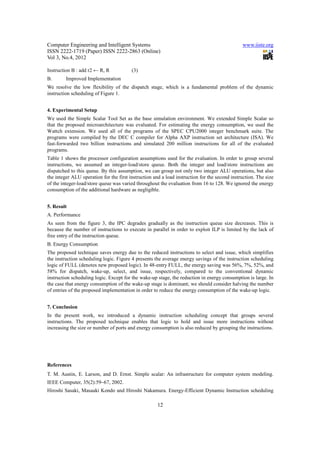
This shows the conventional dynamic instruction scheduling logic of a four-way out-of-order superscalar
processor. The right hand side of the figure shows the instruction queue, and the blue line indicates a single

                                                     10
Computer Engineering and Intelligent Systems                                                    www.iiste.org
ISSN 2222-1719 (Paper) ISSN 2222-2863 (Online)
Vol 3, No.4, 2012

entry, which is composed of the CAM logic for tag matching and the payload RAM (op codes, physical
register number, offsets, etc.). The left-hand side shows the selection logic.
The instruction queue has four read and write ports for dispatch and issue, respectively, and the selection
logic has the ability to select four instructions per cycle.


3. Proposed Technique
The objective of this study is to reduce the complexity and energy consumption of dynamic instruction
scheduling. We propose the grouping of several instructions together in order to reduce the required
hardware of dynamic instruction scheduling.
A. Grouping Condition
By grouping two instructions, waking up, selecting, and issuing only the first instruction leads to the
issuing of both instructions because the second instruction should be issued in the cycle following the first
instruction. We decided to group a single latency operation for the first instruction because this can
simplify the logic and the hardware used to support the proposed technique, which is described in Section
C. The candidate of grouping, the latency of which is single cycle, is an integer ALU operation. We are
required to implement the proposed technique in the instruction queue, in which the integer instructions are
dispatched. The details of hardware implementation of the proposed dynamic instruction scheduling logic
are described in Section C. Instruction pairs, which are candidates of the proposed grouping technique, can
be classified into the following two types.
[I] The issuing of one instruction is the only requirement for issuing the other instruction.
[II] Both instructions can be issued in the same cycle.
We first discuss about Type [I], which consists of two different types of pairs, each of which will be
explained using an example.
Instruction A: add r5 ← r3, r2
Instruction B: add r4 ← r5, R             (1)
We can see that right operand of Instruction B is ready, and the left operand r5 is the destination of
Instruction A. Therefore, only the condition of issuing Instruction A enables Instruction B to be issued in
the next cycle.
The pair of instructions below also belongs to Type [I].
Instruction A : add r5 ← r3, r2
Instruction B : add r4 ← r5, r3           (2)
The left operand of Instruction B is the destination of Instruction A and is the same as Example (1).
Furthermore, the right operand r3 of Instruction B is the left operand of Instruction A, so if Instruction A is
ready for issue, r3 is also ready. For this reason, the above instructions can be grouped together, as in the
case of Example (1). Next, we describe Type [II]. The instructions of Example (3), given below, are both
ready for issue, because both the left and right operands are ready. Since both instructions are ready, they
can be grouped, although there are no data dependencies between these two instructions. In this case, the
previous instruction in program order is issued first. When grouping is not performed, these two
instructions might be able to be executed in the same cycle. Therefore, the second instruction will be issued
one cycle later and may cause performance degradation. However, in the proposed technique, it is
important to obtain a high throughput by grouping as many instructions as possible. Moreover, ready
instructions usually stay in the instruction queue for only a short time, and most of these instructions are not
critical to the performance. Thus, even if the second instruction is issued one cycle later, there is almost no
performance degradation. Therefore, we group ready instructions. Although more patterns that belong to
the above two types exist, we decided to group only three types of pairs described above.
Instruction A : add r1 ← R, R


                                                      11
Computer Engineering and Intelligent Systems                                                   www.iiste.org
ISSN 2222-1719 (Paper) ISSN 2222-2863 (Online)
Vol 3, No.4, 2012

Instruction B : add r2 ← R, R            (3)
B.       Improved Implementation
We resolve the low flexibility of the dispatch stage, which is a fundamental problem of the dynamic
instruction scheduling of Figure 1.


4. Experimental Setup
We used the Simple Scalar Tool Set as the base simulation environment. We extended Simple Scalar so
that the proposed microarchitecture was evaluated. For estimating the energy consumption, we used the
Wattch extension. We used all of the programs of the SPEC CPU2000 integer benchmark suite. The
programs were compiled by the DEC C compiler for Alpha AXP instruction set architecture (ISA). We
fast-forwarded two billion instructions and simulated 200 million instructions for all of the evaluated
programs.
Table 1 shows the processor configuration assumptions used for the evaluation. In order to group several
instructions, we assumed an integer-load/store queue. Both the integer and load/store instructions are
dispatched to this queue. By this assumption, we can group not only two integer ALU operations, but also
the integer ALU operation for the first instruction and a load instruction for the second instruction. The size
of the integer-load/store queue was varied throughout the evaluation from 16 to 128. We ignored the energy
consumption of the additional hardware as negligible.


5. Result
A. Performance
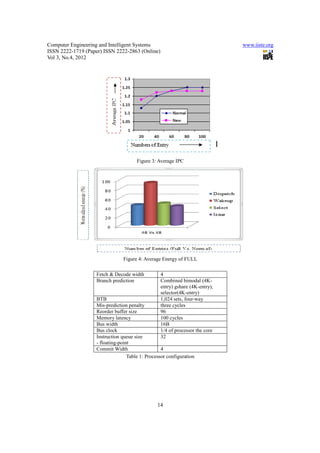
As seen from the figure 3, the IPC degrades gradually as the instruction queue size decreases. This is
because the number of instructions to execute in parallel in order to exploit ILP is limited by the lack of
free entry of the instruction queue.
B. Energy Consumption
The proposed technique saves energy due to the reduced instructions to select and issue, which simplifies
the instruction scheduling logic. Figure 4 presents the average energy savings of the instruction scheduling
logic of FULL (denotes new proposed logic). In 48-entry FULL, the energy saving was 56%, 7%, 52%, and
58% for dispatch, wake-up, select, and issue, respectively, compared to the conventional dynamic
instruction scheduling logic. Except for the wake-up stage, the reduction in energy consumption is large. In
the case that energy consumption of the wake-up stage is dominant; we should consider halving the number
of entries of the proposed implementation in order to reduce the energy consumption of the wake-up logic.


7. Conclusion
In the present work, we introduced a dynamic instruction scheduling concept that groups several
instructions. The proposed technique enables that logic to hold and issue more instructions without
increasing the size or number of ports and energy consumption is also reduced by grouping the instructions.


References
T. M. Austin, E. Larson, and D. Ernst. Simple scalar: An infrastructure for computer system modeling.
IEEE Computer, 35(2):59–67, 2002.
Hiroshi Sasaki, Masaaki Kondo and Hiroshi Nakamura. Energy-Efficient Dynamic Instruction scheduling

                                                      12
Computer Engineering and Intelligent Systems                                                www.iiste.org
ISSN 2222-1719 (Paper) ISSN 2222-2863 (Online)
Vol 3, No.4, 2012

logic through instruction grouping. IEEE Transactions on VLSI Systems, Vol. 17, No. 6, 2009
A. Buyuktosunoglu, T. Karkhanis, D. H. Albonesi, and P. Bose. Energy efficient co-adaptive instruction
fetch and issue. In ISCA, pp. 147–156, 2003.
R. Canal and A. Gonz´alez. Reducing the complexity of the issue logic. In ICS, pp. 312–320, 2001.
D. Folegnani and A. Gonz´alez. Energy-effective issue logic. In ISCA, pp. 230–239, 2001.
P. Michaud and A. Seznec. Data-flow prescheduling for large instruction windows in out-of-order
processors. In HPCA, pp. 27–36, 2001.
J. J. Sharkey and D. V. Ponomarev. Efficient instruction schedulers for smt processors. In HPCA, 2006.
J. J. Sharkey, D. V. Ponomarev, K. Ghose, and O. Ergin. Instruction packing: reducing power and delay of
the dynamic scheduling logic. In ISLPED, pp. 30–35, 2005.
S. A. Taylor, M. Quinn, D. Brown, N. Dohm, S. Hildebrandt, J. Huggins, and C. Ramey. Functional
verification of a multiple-issue, out-of-order, superscalar alpha processor - the dec alpha 21264
microprocessor. In DAC, pp. 638–643, 1998.


                               Figure 1: Conventional dynamic scheduling


                               Figure 2: Showing grouping of Instructions


                                                   13
Computer Engineering and Intelligent Systems                                  www.iiste.org
ISSN 2222-1719 (Paper) ISSN 2222-2863 (Online)
Vol 3, No.4, 2012


                                       Figure 3: Average IPC


                                Figure 4: Average Energy of FULL

                    Fetch & Decode width          4
                    Branch prediction             Combined bimodal (4K-
                                                  entry) gshare (4K-entry),
                                                  selector(4K-entry)
                    BTB                           1,024 sets, four-way
                    Mis-prediction penalty        three cycles
                    Reorder buffer size           96
                    Memory latency                100 cycles
                    Bus width                     16B
                    Bus clock                     1/4 of processor the core
                    Instruction queue size        32
                    - floating-point
                    Commit Width                   4
                                   Table 1: Processor configuration


                                                 14
International Journals Call for Paper
The IISTE, a U.S. publisher, is currently hosting the academic journals listed below. The peer review process of the following journals
usually takes LESS THAN 14 business days and IISTE usually publishes a qualified article within 30 days. Authors should
send their full paper to the following email address. More information can be found in the IISTE website : www.iiste.org

Business, Economics, Finance and Management               PAPER SUBMISSION EMAIL
European Journal of Business and Management               EJBM@iiste.org
Research Journal of Finance and Accounting                RJFA@iiste.org
Journal of Economics and Sustainable Development          JESD@iiste.org
Information and Knowledge Management                      IKM@iiste.org
Developing Country Studies                                DCS@iiste.org
Industrial Engineering Letters                            IEL@iiste.org


Physical Sciences, Mathematics and Chemistry              PAPER SUBMISSION EMAIL
Journal of Natural Sciences Research                      JNSR@iiste.org
Chemistry and Materials Research                          CMR@iiste.org
Mathematical Theory and Modeling                          MTM@iiste.org
Advances in Physics Theories and Applications             APTA@iiste.org
Chemical and Process Engineering Research                 CPER@iiste.org


Engineering, Technology and Systems                       PAPER SUBMISSION EMAIL
Computer Engineering and Intelligent Systems              CEIS@iiste.org
Innovative Systems Design and Engineering                 ISDE@iiste.org
Journal of Energy Technologies and Policy                 JETP@iiste.org
Information and Knowledge Management                      IKM@iiste.org
Control Theory and Informatics                            CTI@iiste.org
Journal of Information Engineering and Applications       JIEA@iiste.org
Industrial Engineering Letters                            IEL@iiste.org
Network and Complex Systems                               NCS@iiste.org


Environment, Civil, Materials Sciences                    PAPER SUBMISSION EMAIL
Journal of Environment and Earth Science                  JEES@iiste.org
Civil and Environmental Research                          CER@iiste.org
Journal of Natural Sciences Research                      JNSR@iiste.org
Civil and Environmental Research                          CER@iiste.org


Life Science, Food and Medical Sciences                   PAPER SUBMISSION EMAIL
Journal of Natural Sciences Research                      JNSR@iiste.org
Journal of Biology, Agriculture and Healthcare            JBAH@iiste.org
Food Science and Quality Management                       FSQM@iiste.org
Chemistry and Materials Research                          CMR@iiste.org


Education, and other Social Sciences                      PAPER SUBMISSION EMAIL
Journal of Education and Practice                         JEP@iiste.org
Journal of Law, Policy and Globalization                  JLPG@iiste.org                       Global knowledge sharing:
New Media and Mass Communication                          NMMC@iiste.org                       EBSCO, Index Copernicus, Ulrich's
Journal of Energy Technologies and Policy                 JETP@iiste.org                       Periodicals Directory, JournalTOCS, PKP
Historical Research Letter                                HRL@iiste.org                        Open Archives Harvester, Bielefeld
                                                                                               Academic Search Engine, Elektronische
Public Policy and Administration Research                 PPAR@iiste.org                       Zeitschriftenbibliothek EZB, Open J-Gate,
International Affairs and Global Strategy                 IAGS@iiste.org                       OCLC WorldCat, Universe Digtial Library ,
Research on Humanities and Social Sciences                RHSS@iiste.org                       NewJour, Google Scholar.

Developing Country Studies                                DCS@iiste.org                        IISTE is member of CrossRef. All journals
Arts and Design Studies                                   ADS@iiste.org                        have high IC Impact Factor Values (ICV).

11.dynamic instruction scheduling for microprocessors having out of order execution

  • 1.
    Computer Engineering andIntelligent Systems www.iiste.org ISSN 2222-1719 (Paper) ISSN 2222-2863 (Online) Vol 3, No.4, 2012 Dynamic Instruction Scheduling For Microprocessors Having Out Of Order Execution Suresh Kumar, Vishal Gupta*, Vivek Kumar Tamta Department of Computer Science, G. B. Pant Engineering College, Pauri, Uttarakhand, INDIA * E-mail of the corresponding author: vishalgupta87@gmail.com Abstract Dynamic Instruction Scheduling is very much needed for fast working of multiprocessor and reduction of overhead by the processor. The Instruction scheduling logic mainly depends on associative searching of the entries to the dynamic wakeup instructions for the execution. We also describes the scheduler concept which also the concern for scalability and complexity of the multiprocessor. We have different Dynamic Instruction Scheduling Logic highlighting the objectives, goals, advantages and challenges facing during scheduling logic like energy issues and complexity issues as well as full description of dynamic instruction Scheduling logic. In this paper, we will be presented in a comprehensive analysis to reschedule the execution order of instructions for improve the performance of microprocessor. General Terms: Design, Performance, Measurement Keywords: Dynamic Instruction Scheduling, Instruction Grouping, Issue Queue. 1. Introduction General purpose microprocessors usually apply superscalar and out-of-order execution. These microprocessors should dynamically extract instruction level parallelism (ILP) for high performance because they are required to execute various types of programs efficiently and must also have to run a number of legacy binary codes. However, dynamic instruction scheduling logic for out-of-order execution has a serious problem in that it consumes a significant amount of energy due to the complicated nature of its hardware logic. We propose a micro architectural technique and hardware implementation to reduce the complexity and energy consumption of dynamic instruction scheduling logic by grouping instructions together in the instruction queue. The concept of the proposed method is to group several instructions together and let the dynamic instruction scheduling logic treats them as a single instruction. Thus, grouping should be performed in the dispatch stage when instructions are written into the instruction queue. In the present paper, we propose the grouping of two instructions by using dependence information. If issuing one instruction is the only requirement for starting the other instruction, this pair will be grouped together. By treating the grouped instructions as a single instruction, dynamic instruction scheduling logic becomes capable of holding and issuing a greater number of instructions without increasing the size or number of ports of the instruction queue or the selection logic. 2. Logic behind Scheduling This shows the conventional dynamic instruction scheduling logic of a four-way out-of-order superscalar processor. The right hand side of the figure shows the instruction queue, and the blue line indicates a single 10
  • 2.
    Computer Engineering andIntelligent Systems www.iiste.org ISSN 2222-1719 (Paper) ISSN 2222-2863 (Online) Vol 3, No.4, 2012 entry, which is composed of the CAM logic for tag matching and the payload RAM (op codes, physical register number, offsets, etc.). The left-hand side shows the selection logic. The instruction queue has four read and write ports for dispatch and issue, respectively, and the selection logic has the ability to select four instructions per cycle. 3. Proposed Technique The objective of this study is to reduce the complexity and energy consumption of dynamic instruction scheduling. We propose the grouping of several instructions together in order to reduce the required hardware of dynamic instruction scheduling. A. Grouping Condition By grouping two instructions, waking up, selecting, and issuing only the first instruction leads to the issuing of both instructions because the second instruction should be issued in the cycle following the first instruction. We decided to group a single latency operation for the first instruction because this can simplify the logic and the hardware used to support the proposed technique, which is described in Section C. The candidate of grouping, the latency of which is single cycle, is an integer ALU operation. We are required to implement the proposed technique in the instruction queue, in which the integer instructions are dispatched. The details of hardware implementation of the proposed dynamic instruction scheduling logic are described in Section C. Instruction pairs, which are candidates of the proposed grouping technique, can be classified into the following two types. [I] The issuing of one instruction is the only requirement for issuing the other instruction. [II] Both instructions can be issued in the same cycle. We first discuss about Type [I], which consists of two different types of pairs, each of which will be explained using an example. Instruction A: add r5 ← r3, r2 Instruction B: add r4 ← r5, R (1) We can see that right operand of Instruction B is ready, and the left operand r5 is the destination of Instruction A. Therefore, only the condition of issuing Instruction A enables Instruction B to be issued in the next cycle. The pair of instructions below also belongs to Type [I]. Instruction A : add r5 ← r3, r2 Instruction B : add r4 ← r5, r3 (2) The left operand of Instruction B is the destination of Instruction A and is the same as Example (1). Furthermore, the right operand r3 of Instruction B is the left operand of Instruction A, so if Instruction A is ready for issue, r3 is also ready. For this reason, the above instructions can be grouped together, as in the case of Example (1). Next, we describe Type [II]. The instructions of Example (3), given below, are both ready for issue, because both the left and right operands are ready. Since both instructions are ready, they can be grouped, although there are no data dependencies between these two instructions. In this case, the previous instruction in program order is issued first. When grouping is not performed, these two instructions might be able to be executed in the same cycle. Therefore, the second instruction will be issued one cycle later and may cause performance degradation. However, in the proposed technique, it is important to obtain a high throughput by grouping as many instructions as possible. Moreover, ready instructions usually stay in the instruction queue for only a short time, and most of these instructions are not critical to the performance. Thus, even if the second instruction is issued one cycle later, there is almost no performance degradation. Therefore, we group ready instructions. Although more patterns that belong to the above two types exist, we decided to group only three types of pairs described above. Instruction A : add r1 ← R, R 11
  • 3.
    Computer Engineering andIntelligent Systems www.iiste.org ISSN 2222-1719 (Paper) ISSN 2222-2863 (Online) Vol 3, No.4, 2012 Instruction B : add r2 ← R, R (3) B. Improved Implementation We resolve the low flexibility of the dispatch stage, which is a fundamental problem of the dynamic instruction scheduling of Figure 1. 4. Experimental Setup We used the Simple Scalar Tool Set as the base simulation environment. We extended Simple Scalar so that the proposed microarchitecture was evaluated. For estimating the energy consumption, we used the Wattch extension. We used all of the programs of the SPEC CPU2000 integer benchmark suite. The programs were compiled by the DEC C compiler for Alpha AXP instruction set architecture (ISA). We fast-forwarded two billion instructions and simulated 200 million instructions for all of the evaluated programs. Table 1 shows the processor configuration assumptions used for the evaluation. In order to group several instructions, we assumed an integer-load/store queue. Both the integer and load/store instructions are dispatched to this queue. By this assumption, we can group not only two integer ALU operations, but also the integer ALU operation for the first instruction and a load instruction for the second instruction. The size of the integer-load/store queue was varied throughout the evaluation from 16 to 128. We ignored the energy consumption of the additional hardware as negligible. 5. Result A. Performance As seen from the figure 3, the IPC degrades gradually as the instruction queue size decreases. This is because the number of instructions to execute in parallel in order to exploit ILP is limited by the lack of free entry of the instruction queue. B. Energy Consumption The proposed technique saves energy due to the reduced instructions to select and issue, which simplifies the instruction scheduling logic. Figure 4 presents the average energy savings of the instruction scheduling logic of FULL (denotes new proposed logic). In 48-entry FULL, the energy saving was 56%, 7%, 52%, and 58% for dispatch, wake-up, select, and issue, respectively, compared to the conventional dynamic instruction scheduling logic. Except for the wake-up stage, the reduction in energy consumption is large. In the case that energy consumption of the wake-up stage is dominant; we should consider halving the number of entries of the proposed implementation in order to reduce the energy consumption of the wake-up logic. 7. Conclusion In the present work, we introduced a dynamic instruction scheduling concept that groups several instructions. The proposed technique enables that logic to hold and issue more instructions without increasing the size or number of ports and energy consumption is also reduced by grouping the instructions. References T. M. Austin, E. Larson, and D. Ernst. Simple scalar: An infrastructure for computer system modeling. IEEE Computer, 35(2):59–67, 2002. Hiroshi Sasaki, Masaaki Kondo and Hiroshi Nakamura. Energy-Efficient Dynamic Instruction scheduling 12
  • 4.
    Computer Engineering andIntelligent Systems www.iiste.org ISSN 2222-1719 (Paper) ISSN 2222-2863 (Online) Vol 3, No.4, 2012 logic through instruction grouping. IEEE Transactions on VLSI Systems, Vol. 17, No. 6, 2009 A. Buyuktosunoglu, T. Karkhanis, D. H. Albonesi, and P. Bose. Energy efficient co-adaptive instruction fetch and issue. In ISCA, pp. 147–156, 2003. R. Canal and A. Gonz´alez. Reducing the complexity of the issue logic. In ICS, pp. 312–320, 2001. D. Folegnani and A. Gonz´alez. Energy-effective issue logic. In ISCA, pp. 230–239, 2001. P. Michaud and A. Seznec. Data-flow prescheduling for large instruction windows in out-of-order processors. In HPCA, pp. 27–36, 2001. J. J. Sharkey and D. V. Ponomarev. Efficient instruction schedulers for smt processors. In HPCA, 2006. J. J. Sharkey, D. V. Ponomarev, K. Ghose, and O. Ergin. Instruction packing: reducing power and delay of the dynamic scheduling logic. In ISLPED, pp. 30–35, 2005. S. A. Taylor, M. Quinn, D. Brown, N. Dohm, S. Hildebrandt, J. Huggins, and C. Ramey. Functional verification of a multiple-issue, out-of-order, superscalar alpha processor - the dec alpha 21264 microprocessor. In DAC, pp. 638–643, 1998. Figure 1: Conventional dynamic scheduling Figure 2: Showing grouping of Instructions 13
  • 5.
    Computer Engineering andIntelligent Systems www.iiste.org ISSN 2222-1719 (Paper) ISSN 2222-2863 (Online) Vol 3, No.4, 2012 Figure 3: Average IPC Figure 4: Average Energy of FULL Fetch & Decode width 4 Branch prediction Combined bimodal (4K- entry) gshare (4K-entry), selector(4K-entry) BTB 1,024 sets, four-way Mis-prediction penalty three cycles Reorder buffer size 96 Memory latency 100 cycles Bus width 16B Bus clock 1/4 of processor the core Instruction queue size 32 - floating-point Commit Width 4 Table 1: Processor configuration 14
  • 6.
    International Journals Callfor Paper The IISTE, a U.S. publisher, is currently hosting the academic journals listed below. The peer review process of the following journals usually takes LESS THAN 14 business days and IISTE usually publishes a qualified article within 30 days. Authors should send their full paper to the following email address. More information can be found in the IISTE website : www.iiste.org Business, Economics, Finance and Management PAPER SUBMISSION EMAIL European Journal of Business and Management EJBM@iiste.org Research Journal of Finance and Accounting RJFA@iiste.org Journal of Economics and Sustainable Development JESD@iiste.org Information and Knowledge Management IKM@iiste.org Developing Country Studies DCS@iiste.org Industrial Engineering Letters IEL@iiste.org Physical Sciences, Mathematics and Chemistry PAPER SUBMISSION EMAIL Journal of Natural Sciences Research JNSR@iiste.org Chemistry and Materials Research CMR@iiste.org Mathematical Theory and Modeling MTM@iiste.org Advances in Physics Theories and Applications APTA@iiste.org Chemical and Process Engineering Research CPER@iiste.org Engineering, Technology and Systems PAPER SUBMISSION EMAIL Computer Engineering and Intelligent Systems CEIS@iiste.org Innovative Systems Design and Engineering ISDE@iiste.org Journal of Energy Technologies and Policy JETP@iiste.org Information and Knowledge Management IKM@iiste.org Control Theory and Informatics CTI@iiste.org Journal of Information Engineering and Applications JIEA@iiste.org Industrial Engineering Letters IEL@iiste.org Network and Complex Systems NCS@iiste.org Environment, Civil, Materials Sciences PAPER SUBMISSION EMAIL Journal of Environment and Earth Science JEES@iiste.org Civil and Environmental Research CER@iiste.org Journal of Natural Sciences Research JNSR@iiste.org Civil and Environmental Research CER@iiste.org Life Science, Food and Medical Sciences PAPER SUBMISSION EMAIL Journal of Natural Sciences Research JNSR@iiste.org Journal of Biology, Agriculture and Healthcare JBAH@iiste.org Food Science and Quality Management FSQM@iiste.org Chemistry and Materials Research CMR@iiste.org Education, and other Social Sciences PAPER SUBMISSION EMAIL Journal of Education and Practice JEP@iiste.org Journal of Law, Policy and Globalization JLPG@iiste.org Global knowledge sharing: New Media and Mass Communication NMMC@iiste.org EBSCO, Index Copernicus, Ulrich's Journal of Energy Technologies and Policy JETP@iiste.org Periodicals Directory, JournalTOCS, PKP Historical Research Letter HRL@iiste.org Open Archives Harvester, Bielefeld Academic Search Engine, Elektronische Public Policy and Administration Research PPAR@iiste.org Zeitschriftenbibliothek EZB, Open J-Gate, International Affairs and Global Strategy IAGS@iiste.org OCLC WorldCat, Universe Digtial Library , Research on Humanities and Social Sciences RHSS@iiste.org NewJour, Google Scholar. Developing Country Studies DCS@iiste.org IISTE is member of CrossRef. All journals Arts and Design Studies ADS@iiste.org have high IC Impact Factor Values (ICV).