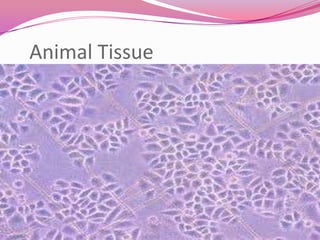
Animal Tissue
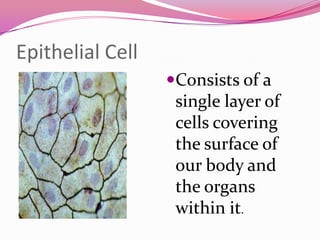
Epithelial Cell
Consists of a
single layer of
cells covering
the surface of
our body and
the organs
within it.
Structurally we may group
the cells squamous or flat,
cuboidal, columnar, ciliated ,
or flagelatted.
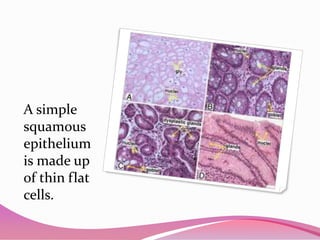
A simple
squamous
epithelium
is made up
of thin flat
cells.
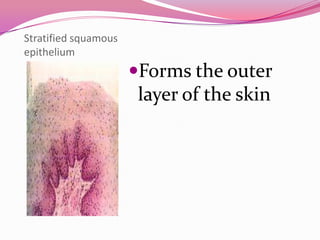
Stratified squamous
epithelium
Forms the outer
layer of the skin
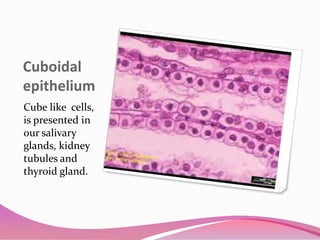
Cuboidal
epithelium
Cube like cells,
is presented in
our salivary
glands, kidney
tubules and
thyroid gland.
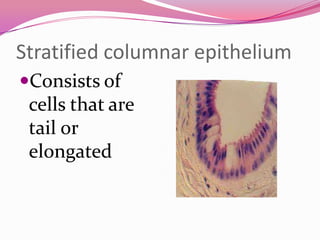
Stratified columnar epithelium
Consists of
cells that are
tail or
elongated
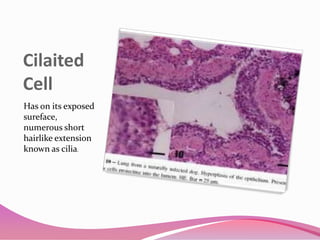
Cilaited
Cell
Has on its exposed
sureface,
numerous short
hairlike extension
known as cilia.
Columnar ciliated epithelium
Lines the air
passages of land
vertebrates
Glandullar
Epithelium
Specializes in
secreting
products
needed by the
body. Our
sebaceous and
salivary glands
are lined with
cuboidal cells
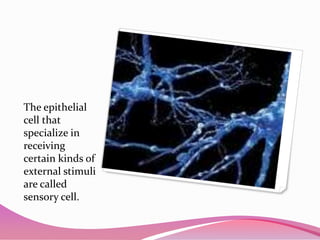
The epithelial
cell that
specialize in
receiving
certain kinds of
external stimuli
are called
sensory cell.
The most common types of
connective tissues are fibrous,
cartilage, bone, adipose and,
vascular tissues.
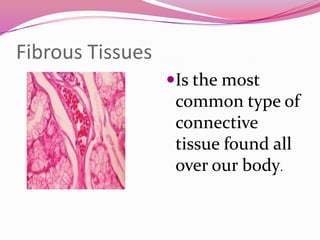
Fibrous Tissues
Is the most
common type of
connective
tissue found all
over our body.
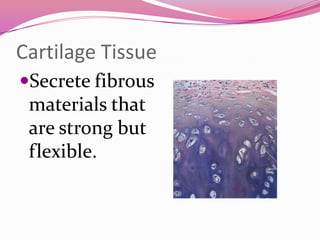
Cartilage Tissue
Secrete fibrous
materials that
are strong but
flexible.
The other parts of our body
with cartilage are our larynx and
intervertebral discs.
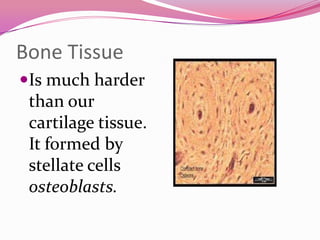
Bone Tissue
Is much harder
than our
cartilage tissue.
It formed by
stellate cells
osteoblasts.
The dead, hard materials of bone is
mainly calcium phosphate.
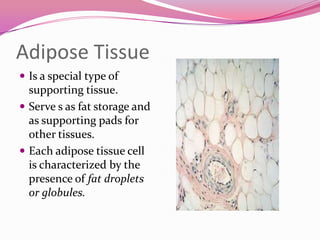
Adipose Tissue
 Is a special type of
supporting tissue.
 Serve s as fat storage and
as supporting pads for
other tissues.
 Each adipose tissue cell
is characterized by the
presence of fat droplets
or globules.
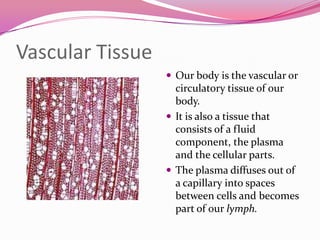
Vascular Tissue
 Our body is the vascular or
circulatory tissue of our
body.
 It is also a tissue that
consists of a fluid
component, the plasma
and the cellular parts.
 The plasma diffuses out of
a capillary into spaces
between cells and becomes
part of our lymph.
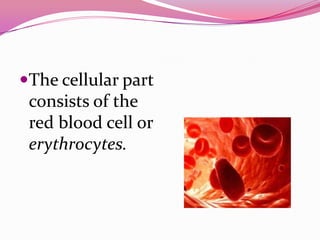
The cellular part
consists of the
red blood cell or
erythrocytes.
The white blood
cell or
leukocytes.
Small cell
fragment called
blood platelets or
thrombocytes.
Muscular pr Contractile Tissue
The different kinds of muscle
tissues are smooth, striated and
cardiac
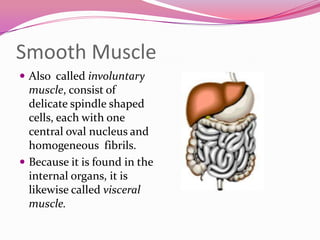
Smooth Muscle
 Also called involuntary
muscle, consist of
delicate spindle shaped
cells, each with one
central oval nucleus and
homogeneous fibrils.
 Because it is found in the
internal organs, it is
likewise called visceral
muscle.
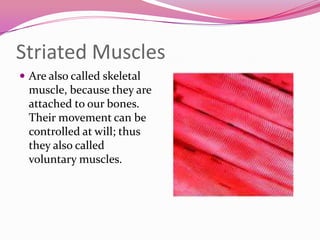
Striated Muscles
 Are also called skeletal
muscle, because they are
attached to our bones.
Their movement can be
controlled at will; thus
they also called
voluntary muscles.
Heart muscle
 Is called the cardiac
muscle
 The cardiac muscle is
striated yet involuntary.
Its movement is not
controlled at will.
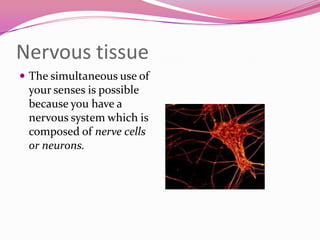
Nervous tissue
 The simultaneous use of
your senses is possible
because you have a
nervous system which is
composed of nerve cells
or neurons.

1165566 634501107798085000